The Koch are a people of Meghalaya, Assam, north Bengal and northern Bangladesh whose language is a Boro-Garo language that the Koch page reports as 'Definitely Endangered' (Datta Majumdar 2020, as cited there)[1]. The Atlas dates the Koch kingdom of Kamata and Cooch Behar to its founding by Biswa Singha in 1515, and the kingdom's coinage, the Narayani Mudra, was issued from 1555 to 1866[2]. Chilarai attacked Tripura in 1562 and defeated the Jaintia king about 1564[3][4]. Today the Koch are a Scheduled Tribe in Meghalaya, as Meghalaya's grant of ST status is recorded[5]; the Atlas records 'ST in Meghalaya only' in the Ministry of Tribal Affairs list dated 09-07-2024. The Koch are matrilineal, with exogamous clans called nikini, and the Garo Hills Koch give two accounts of their homeland[5].
01Faith and deities
The Koch national festival and its shrine are for Goddess Pabuni, a nature deity linked to rain and sunshine (NE News 2025)[7]. The Atlas's KulDevi, Kamakhya, is listed below.
Koch king Naranarayan rebuilt Kamakhya in 1565
A recorded tie between the clan and the goddess.
| Deity or tradition | Place in the clan's life | Evidence |
|---|---|---|
| Pabuni | Goddess of the Koch national festival; the Pabuni Shali shrine is hers, with offerings of Chokot rice beer and Fap rice cakes | [7] |
| Narayan | Royal deity of the Koch kings; the coinage page names him as a possible source of the term Narayani | [2] |
| Kamakhya (KulDevi) | Clan goddess in the Atlas (Mahavidya family); the sheet notes that Koch king Naranarayan rebuilt Kamakhya in 1565 | Atlas |
| The Koch curse at Kamakhya | The Koch Bihar family do not visit the temple and avert their gaze, after the Koch curse (a priest beheaded, a king cursed), as the Kamakhya article tells it | [8] |
02Temples
No temple built by a Koch king is recorded in the extracts beyond the sheet's 1565 Kamakhya rebuild. The Kamata and Cooch Behar dynasty pages are unread.
Built by the clan
| Temple | Deity | Built by | When | Where |
|---|---|---|---|---|
| Kamakhya temple (rebuild) | Kamakhya | Naranarayan, Koch king | 1565 | Kamakhya |
Given patronage or grants by the clan
| Temple | Deity | What the clan gave | When | Where |
|---|---|---|---|---|
| Kamakhya | Kamakhya | A Koch and Rabha sacrificial site, as the article names it | Not dated | [8] |
Later temples in the clan's lands
| Temple | Deity | Built | Where | |
|---|---|---|---|---|
| Pabuni Shali | Pabuni | Not given | 2025: the chief guest announced Rs 3 lakh for the compound | Gandhipara, Meghalaya[7] |
03Languages and scripts
| Language or script | Kind | Under the clan | Evidence |
|---|---|---|---|
| Koch living | Boro-Garo language, Tibeto-Burman, Sino-Tibetan; written in Assamese, Bengali and Roman scripts | All Koch groups | [6][1] |
| Harigaya living | Dialect; the common Koch variety (Kondakov 2020) | Harigaya Koch | [1] |
| Tintikiya, Wanang, Chapra, Margan living | Surviving dialects of the Koch dialect chain | Koch groups | [6][1] |
| Jharua or Hajong living | Speech of Satpari, Sankar and Banai (Kondakov 2013) | Those three groups | [1] |
04Books and literature
Koch books come from Koch Krorang Mathop, Tura, Meghalaya, which publishes Koch books and an annual magazine (Koch language page). The extracts quote no Koch-language book.
Written during the clan's history
| Work | Author | Kind | When | Link to the clan |
|---|---|---|---|---|
| History of the Koch Kingdom c. 1515–1615 | Nath | Book | 1989 | [1] |
| Discovering Boro-Garo | Jacquesson | Book | 2008 | [1] |
| Kirata-Jana-Krti | Chatterji | Book | 1951 | [1] |
| Koch dialects of Meghalaya and Assam | Kondakov | Book | 2013 | [1] |
| Outline of Harigaya Koch Grammar (SIL) | Kondakov | Book | 2020 | [1] |
| Sociolinguistic Survey among the Koch | Kondakov | Survey | 2010 | [9] |
| Origin, Expansion and Abolition of Narayani Coins of the Princely state of Cooch Behar | Haque | Article | 2019 | [2] |
| Koch coinage: a study in historical perspective | Debajit Dutta | Article | 2015 | [2] |
| Coins of the Kings of Koch Bihar in Koch Bihar Palace Museum | Shamoon Ahmad | Article | Not dated | [2] |
| Population Composition of Five Subgroups of Koch Populations of Meghalaya, India | Kotal and colleagues | Article | 2025 | [5] |
Given patronage by the clan
Not recorded.
05Thinkers and scholars
| Name | Field | Era | Contribution |
|---|---|---|---|
| Nath | History | 1989 | History of the Koch Kingdom c. 1515–1615[1] |
| Haque | Coinage | 2019 | Narayani coins of Cooch Behar, their origin, expansion and abolition[2] |
| Debajit Dutta | Coinage | 2015 | A study of Koch coinage in historical perspective[2] |
| Shamoon Ahmad | Coinage | Not dated | Coins of the Kings of Koch Bihar[2] |
| Kondakov | Koch language | 2010–2020 | Koch dialects of Meghalaya and Assam (2013); Harigaya grammar (2020)[1] |
| Jacquesson | Boro-Garo languages | 2008 | Discovering Boro-Garo[1] |
| Chatterji | Kirata peoples | 1951 | Kirata-Jana-Krti[1] |
| Playfair | Garo ethnography | 1909 | The Garos; passages on the Koch (pp. 15, 19–22, 45, 60–63)[10] |
| Kotal, Khongsdier, Sengupta, Mishra and Adak | Demography | 2025 | Population composition of five Koch subgroups in Meghalaya[5] |
Names are as the sources print them; first names are not given in the extracts.
06Art and architecture
The extracts name one Koch craft: woven cloth, the Liphan and sokatharay. No painting, sculpture or crafts are recorded.
Painting and wall art
Not recorded.
Sculpture and temple art
Not recorded.
Temple and building architecture
| Art form | What it is | Era | Evidence |
|---|---|---|---|
| Pabuni Shali | Shrine of Goddess Pabuni, where the festival rites are led by the Deusi | Not dated | [7] |
Weaving and textiles
| Art form | What it is | Era | Evidence |
|---|---|---|---|
| Liphan and sokatharay | Handwoven floral cloths, decorated on a cloth called mug paini; women are described as efficient weavers | Not dated | [11] |
Clothing and jewellery
Not recorded.
Coins, pottery and crafts
Not recorded.
07History
Early mentions in outside texts
The Tabaqat-i-Nasiri names Kunch (Koch), Mej (Mech) and Tiharu among the peoples between Lakhanawati and Tibet, as Jacquesson (2008) gives it[1]. Salam (1902) puts Koch, Mech and Tharu in western Kamrud[1].
The Yogini Tantra (c. 16th century) calls Koches 'kuvachas' (Nath 1989), and the Fatiyah-i-Ibriah (1661–1663) says Cooch Behar was inhabited by Koch[1].
The kingdom: Biswa Singha, Nara Narayan and Chilarai
The Atlas gives the Koch kingdom of Kamata and Cooch Behar as founded by Biswa Singha in 1515, with the general Chilarai. Haque (2019), citing the Assam Burunji, says the Cooch kingdom had no coin before Maharaja Biswa Singha; Biswa Singha is credited with a 'Sikka Rupee', but none has been found[2].
Nara Narayan first issued the Narayani coins in his accession year; the page gives his reign as 1544–1587 in one place and 1554–1587 in another[2]. The Atlas notes that Koch king Naranarayan rebuilt the Kamakhya temple in 1565; kamakhya.org lists a Kamakhya Temple inscription of Naranarayana dated 1565 AD, which does not itself say he rebuilt it[12].
Chilarai attacked Tripura in 1562, and Khaspur was made dewani of the Koch kingdom[3]. He defeated the Jaintia king about 1564 (KHADC)[4]; Banglapedia dates the conquest of Jaintia by the king of Cooch Bihar to 1548–1564[13].
In the book's example, the Khyrim king Virjyavunta submitted to Chilarai in the 16th century[14]. The KHADC names the annals of the Koch king Naranarayana among the sources for early Khasi history[4].
Raghudeva and Koch Hajo
Raghudeva, son of Chilarai, struck his own coins after asserting independence between the Sankosh and Bhareli rivers (Koch Hajo); the coins were short-lived. The Cooch Behar kingdom west of the Sankosh continued to 1949 and issued coins until late. Circulation of the Narayani coins ceased from 1866 under the British[2].
Ahoms, Mughals and Saraighat
The Ahoms had a Koch ally from 1603[15].
From 1669 to 1671 Koch Bihar armies marched as Mughal vassals with Ram Singh I against the Ahoms, with 10,000 Koch archers and shieldmen in the force, or 2,000 per Sarkar (1992)[16].
A Koch kingdom in the Garo Hills
Indpaedia gives a Koch kingdom in the Garo Hills under chief Suryanarayan, then Mahindranarayan, who was annexed to the British empire in his time. The Koch villages called him 'Pagla Raja' and 'Okate Raja'; Mahindra-Ganj in Ampati sub-division is named after him[17].
Origins: two accounts and a dispute
Indpaedia says the Koch claim an original home in the Arebela hill range of central Garo Hills and moved to the plains for scarce farmland. A myth gives their descent from sisters Hira and Jhiva (or Mukdi and Kundi), 'daughters of the sun', linked to a man named Hajo. The name Koch is said to derive from 'Kochimuchi', 'shrinkage due to shame'. Kock (1984) is cited as holding a migration from China[17].
Kotal et al. (2025) record two homeland accounts for the Garo Hills Koch: the Arebela range, or migration from Assam[5]. Affinity is disputed: Dalton (1872) said Dravidian; Haddon (1924), Das (1962) and Sengupta (1982) said Mongoloid; Gait (1905) is cited for a Tibeto-Burman origin[5].
Playfair on the Koch kings
Playfair (p. 15, 1909) mentions the Koch kings only in passing, as ruling the lower Brahmaputra valley after the Kacharis split; no Cooch Behar king is named in the pages read[10].
08Journey and migrations
The origin claims as the sources give them; none is dated.
| When | From | To | Why | Evidence |
|---|---|---|---|---|
| Before the plains (Indpaedia's account) | Arebela range, central Garo Hills | The plains | Scarce farmland | [17] |
| Route as the account tells it | Kamrup and Hajo, then Sonapur, 'titli hacheng', Rongjeng | Along the Simsang River | The migration route as the account gives it | [17] |
| A crossing that failed | Twelve households at the Simsang | The Garos | Those who failed to cross reportedly intermarried with the Garos | [17] |
| Second homeland account | Assam | Garo Hills | Migration from Assam, as the Garo Hills Koch give it | [5] |
| Migration from China | China | — | Claimed by Kock (1984), as Indpaedia cites him | [17] |
09Seats and lands
| Place | Role | Where today |
|---|---|---|
| Kamata and Cooch Behar | Seat of the Koch kingdom (Atlas: 'Kamata/Cooch Behar') | Koch in Cooch Behar, West Bengal[11] |
| Koch Hajo | Realm between the Sankosh and Bhareli rivers, asserted by Raghudeva[2] | — |
| Arebela range | Claimed original home of the Garo Hills Koch[17] | Central Garo Hills |
| Mahindra-Ganj | Named after Mahindranarayan[17] | Ampati sub-division |
| Western Kamrud | Inhabited by Koch, Mech and Tharu, per Salam (1902)[1] | — |
| West Garo Hills | Where the Garo Hills Koch are a Scheduled Tribe[17] | Western and south-western West Garo Hills, Meghalaya |
| Assam districts | Where the Koch live[1] | Goalpara, Nagaon, Dhubri, Kokrajhar, Chirang, Bongaigaon, Barpeta, Baksa, Udalguri, Karbi Anglong, Golaghat |
| Meghalaya districts | Where the Koch live[1] | West Garo Hills, South West Garo Hills, South Garo Hills, East Khasi Hills |
| Other places | Named as places where Koch live[11][17][5] | Manipur, Tripura, north Bengal, Purnia (Bihar), Bangkura (West Bengal), Chittagong and Noakhali (Bangladesh), Nepal, Bhutan |
10Notable figures
| Name | Role | Era | Known from |
|---|---|---|---|
| Biswa Singha | Founder of the Koch kingdom of Kamata, per the Atlas; credited with a 'Sikka Rupee' that has not been found | 1515 | [2] |
| Nara Narayan | King who first issued the Narayani coins in his accession year | Reign 1544–1587 or 1554–1587 (the page gives both) | [2] |
| Chilarai | General of the Koch kingdom; father of Raghudeva | 16th century; Tripura 1562; Jaintia c. 1564 | [4][3][2] |
| Raghudeva | Son of Chilarai; struck his own coins at Koch Hajo | Not dated in the extract | [2] |
| Hira and Jhiva legend | Sisters, 'daughters of the sun', in the origin myth (or Mukdi and Kundi) | Mythical | [17] |
| Hajo legend | Man linked to the sisters in the origin myth | Mythical | [17] |
| Suryanarayan | Chief of the Koch kingdom in the Garo Hills | Not dated in the extract | [17] |
| Mahindranarayan | Chief of the Garo Hills Koch kingdom; annexed to the British empire in his time | Not dated in the extract | [17] |
11Allies, rivals and marriages
| People | Relationship | When |
|---|---|---|
| Ahom | A Koch ally of the Ahoms from 1603 | 1603[15] |
| Mughals | Koch Bihar armies marched as Mughal vassals with Ram Singh I against the Ahoms; 10,000 Koch archers and shieldmen (2,000 per Sarkar 1992) | 1669–1671[16] |
| Jaintia | Conquered by the king of Cooch Bihar between 1548 and 1564; Chilarai defeated the Jaintia king about 1564 | 1548–1564[13][4] |
| Jaintia (overlord) | Gale (2008) says the Koch kingdom was one of the kingdoms the Jaintia were vassals of, with no detail | 13th–18th centuries[18] |
| Tripura (Twipra) | Chilarai attacked Tripura; Khaspur was made dewani of the Koch kingdom | 1562[3] |
| Khasi | The Khyrim king Virjyavunta submitted to Chilarai in the book's example | 16th century[14] |
| Garo | Listed as related in the Garo people article; Indpaedia believes the Garo Hills Koch and Cooch Behar Koch are one tribe, from a 1931 map; Playfair leaves the identity uncertain | Not dated[19][17][10] |
| Rabha | Koch-Rabha (Kocha) in Dhubri and Kokrajhar identify with the Rabha; Kocha Rabha is closer to Koch (Kondakov 2010) | Present[1][9] |
| Mech | Listed as related; the Tabaqat-i-Nasiri names Mej beside the Koch | Early mentions[1] |
| Rajbongshi | Related but distinct, per Kondakov (2013) | Present[1] |
12Society and livelihood
Koch society is matrilineal, with strictly exogamous clans (nikini), and matrilineal rules are less rigid than among the Garo and Khasi (Kondakov 2013)[1]. About 94% of marriages are within the Koch subgroups, and agriculture is the mainstay, with land individually owned (Kotal 2025)[5].
Government and social order
| Institution or group | What it was | Evidence |
|---|---|---|
| Nikini | Matrilineal, strictly exogamous clans within each of nine groups (Kondakov 2013) | [1] |
| Meghalaya Koch Association | Organises the Pabuni festival, with the Meghalaya Koch Students' Union (NE News 2025) | [7] |
| Koch Development Forum | Promotes the Koch language (Koch language page) | [6] |
| Koch Krorang Mathop | Publishes Koch books and an annual magazine, from Tura, Meghalaya | [6] |
| Deusi | Priest who leads the rites at the Pabuni shrine (NE News 2025) | [7] |
Livelihood over time
| Era | Livelihood | Evidence |
|---|---|---|
| Present | Agriculture is the mainstay; land is individually owned (Kotal 2025) | [5] |
| 1909 | Koches and Rabhas hold the wet-cultivation valleys (Playfair, p. 45) | [10] |
13Sub-clans and related clans
The Koch are split into groups that speak a dialect chain, and each group has matrilineal, exogamous clans called nikini (Kondakov 2013)[1]. The sources name nine groups (Kondakov 2013), while Kotal et al. (2025) give seven subgroups and studied five of them[5]. Pani Koch is given as another name for Banai and Wanang[6]. Wanang is also written Swmbri[6].
| Clan | Relation | Where | Size | In the Atlas | Evidence |
|---|---|---|---|---|---|
| Tintekiya | Sub-clan | 409 in a survey sample (not a census), 2025[5] | new clan candidate | [1][5] | |
| Wanang | Sub-clan | 396 in a survey sample (not a census), 2025[5] | new clan candidate | [1][6][5] | |
| Harigaya | Sub-clan | new clan candidate | [1][6] | ||
| Margan | Sub-clan | new clan candidate | [1] | ||
| Sanga | Sub-clan | 287 in a survey sample (not a census), 2025[5] | same name as ST-552: check | [5] | |
| Chapra | Sub-clan | 310 in a survey sample (not a census), 2025[5] | new clan candidate | [1][5] | |
| Satpari | Sub-clan | 242 in a survey sample (not a census), 2025[5] | new clan candidate | [1][5] | |
| Sankar | Sub-clan | new clan candidate | [1][5] | ||
| Banai | Sub-clan | Sparse in West Garo Hills (Kotal 2025, not studied) | new clan candidate | [1][6][5] | |
| Koch-Rabha (Kocha) | Sub-clan | Dhubri and Kokrajhar | new clan candidate | [1] | |
| Bor Koch | Related people | Named in Playfair's account of the Garos (1909, p. 22) | new clan candidate | [10] | |
| Haru Koch | Related people | Named in Playfair's account of the Garos (1909, p. 22) | new clan candidate | [10] | |
| Rabha | Related people | Assam, Meghalaya, West Bengal | ST-268 | [1][9] | |
| Garo | Related people | Garo Hills | ST-084 | [1][19] | |
| Mech | Related people | ST-213 | [1] | ||
| Koch-Rajbongshi | Related people | Lower Assam, North Bengal | NE-004 | [1] | |
| Hajong | Related people | ST-094 | [1] (Satpari, Sankar and Banai speak Jharua or Hajong) |
Clans marked "new clan candidate" are not in the Atlas yet.
14Surnames
No surname is recorded in the extracts. The NE News 2025 article prints 'Koch' after personal names (Jibananda Koch, Sanjay Koch, Premananda Koch), but the extract does not say that this is a surname system.
Not recorded.
15Songs and music
No Koch song is named or quoted in the extracts read.
None recorded yet.
16Poems, lullabies and children's rhymes
No Koch poem, lullaby or rhyme is recorded in the extracts.
None recorded yet.
17Stories, legends and proverbs
Stories and legends
| Story | What happens | Told by | Evidence |
|---|---|---|---|
| Hira and Jhiva legend | Sisters, 'daughters of the sun', linked to a man named Hajo; the origin myth as Indpaedia gives it | Indpaedia (People of India) | [17] |
| The Simsang crossing | Twelve households failed to cross the Simsang and reportedly intermarried with the Garos | Indpaedia (People of India) | [17] |
Proverbs and sayings
Not recorded.
18Festivals and fairs
| Festival or fair | When | Where | What happens |
|---|---|---|---|
| Pabuni living | Each Baishakh (April), at the start of the Assamese New Year; the 2025 article reports it held on a Sunday | Gandhipara, Meghalaya (the article gives South West Garo Hills; its metadata gives West Garo Hills) | Named from 'Paoni', calling or welcoming; marks spring; offerings of Chokot rice beer and Fap rice cakes to Goddess Pabuni at the Pabuni Shali, led by the Deusi (priest); organised by the Meghalaya Koch Association and the Meghalaya Koch Students' Union[7] |
19Food, dress and games
Food
| Item | What it is | Evidence |
|---|---|---|
| Chokot | Rice beer offered to Goddess Pabuni at the festival | [7] |
| Fap | Rice cakes offered to Goddess Pabuni at the festival | [7] |
Dress
| Item | What it is | Evidence |
|---|---|---|
| Liphan | Women's wrap, from chest to ankle, wrapped above the waist, with silver ornaments | [11] |
| Sokatharay | Handwoven floral cloth, like the Liphan | [11] |
| Rildag and ear rings | Garo-style rildag and ear rings worn by the Tintekiya Koches (Playfair 1909) | [10] |
Games and martial arts
Not recorded.
Tags: living still practised · revived brought back after a break · lost known only from records · research reported but not yet confirmed from a source. Songs and poems under copyright are listed by title only; restricted or sacred material is noted without its content.
20Status today
The Koch are a Scheduled Tribe in Meghalaya and a living people in Assam, north Bengal and northern Bangladesh. Each population figure below carries its own year and source[1].
Who carries the name today
| Community | Link | Basis | Evidence |
|---|---|---|---|
| Koch-Rajbongshi (NE-004), heirs of the Koch kings per the Atlas | Disputed | [1] (Kondakov 2013 says the Koch are related to but distinct from the Rajbongshi) | |
| Western Meghalaya Koch (a claim of kinship with the Koch kings) | Community tradition | [1] (Kondakov 2013) |
Recognised heritage
| What | Recognition | Evidence |
|---|---|---|
| Pabuni festival (National Koch Festival) | Held each Baishakh; in 2025 the chief guest announced Rs 3 lakh for the Pabuni compound | [7] |
| Koch language and books | The Koch Development Forum promotes the language; Koch Krorang Mathop (Tura) publishes Koch books and an annual magazine | [6] |
No community review of this page is recorded. The community sources used are the Meghalaya Koch Association (NE News 2025) and the Koch Development Council advisor's statement, as the Koch page reports it.
21For children
The Koch and their spring festival
The Koch are a people of Meghalaya, Assam and north Bengal. Long ago, a king named Biswa Singha started the Koch kingdom, which had Kamata and Cooch Behar as its centres. The Koch kings had their own coins, called Narayani coins. The Koch speak a language from the Boro-Garo family. Their families follow the mothers' line, and each group has its own clans. Every spring, at the start of the Assamese New Year, the Koch hold the Pabuni festival to welcome the season.
22Across the project
| Project | What carries this clan | Status |
|---|---|---|
| Atlas of the Janas | No footprint file has been written for this run, so no pins are placed. The districts are in the Lands section | To check |
| KulDevi and GrahDevi | KulDevi Kamakhya (Mahavidya family; basis Documented, Atlas). GrahDevi forms: Kali, Tara, Shodashi, Bhuvaneshvari, Bhairavi, Chhinnamasta, Dhumavati, Bagalamukhi, Matangi, Kamala | From the Atlas |
| Planet naming | The extracts give no planet names for the Koch | Under research |
| Renaming and waters | Mahindra-Ganj is named after Mahindranarayan (Indpaedia). The Simsang River is on the migration route as the account tells it | Indpaedia |
23Open questions
- Native-script forms of 'Koch' and of the clan names: no Assamese or Bengali form is given in any extract. The 'Nani ata mung?' line is a sample sentence, not a motto; a motto is not in the extracts.
- The Koch deity list: Northeast Today (2020) says the list is 'below', but the extract does not include it. The deities here come from the 2025 festival article.
- The Koch dynasty narrative: the capital, the partition into Koch Bihar and Koch Hajo, and the dates for Biswa Singha, Naranarayan and Raghudeva. Only the sheet's 1515 and the coinage page's dates are in the extracts.
- Temples built by Koch kings: the 1565 Kamakhya rebuild rests in the Atlas's note alone. Check the Kamata and Cooch Behar dynasty pages.
- Inscriptions and copper plates: none in the extracts. The Narayani coin design and legends are not described; Haque (2019) and Dutta (2015) are the leads.
- Nikini clan names, the number of groups (nine or seven), and the Sanga and Margan difference between sources.
- Surnames: none is recorded as used by the Koch.
- Whether the Garo Hills Koch and the Cooch Behar Koch are one tribe (Indpaedia, from a 1931 map) is not settled by Playfair (1909), who leaves the identity uncertain. Hamilton's 'Kochunasindiya' is discussed at Playfair pp. 60–63 and was not read in full.
- The Koch-Rajbongshi descent claim: the Atlas calls them heirs of the Koch kings; Kondakov (2013) calls them related but distinct.
- Songs, poems, proverbs and riddles: none in the extracts. Unfetched leads: the Assam Folk Song PDF, nenews.in/?p=38147 and the Bahona journal issue.
- Seat: the lands table gives Kamata and Cooch Behar as the seat (Atlas, 'Kamata/Cooch Behar'), and the kids story calls them the centres[1]; the info table says the seat is not stated and the Atlas gives no capital. Both are sheet statements; resolve against the sheet.
- Coinage start: Nara Narayan first issued the Narayani coins in his accession year, which the coinage page gives as 1544 or 1554[2]; the coinage is dated from 1555 in the same page and in the Era row.
- Meghalaya numbers: about 25,000 (Census 2011, Kondakov 2020)[1] and 23,199 (the Koch people infobox, no year)[1] are both given for Meghalaya; the two are not reconciled.
- Legend native script: Hira and Jhiva and Hajo are given in Roman transliteration only; no native-script form of either name is in the extracts[17].
24Astitva
अस्तित्व · being, existence: everything by which the clan is known
The extracts document the Narayani coinage (C1), the cloth of the Koch women (F1) and two names for the Garo Hills chief (H2). Everything else is listed as research[2].
Every clan has every accessory, royal objects included. Each one says how it is known: Documented This clan's own object is recorded. · Regional tradition Recorded for the region or for peoples like this one, not for this clan. · Design Made for this project, with no historical claim. · Under research To be found for this clan from sources. Legends and titles are written in the clan's own script.
1. Seals and coins
| Accessory | For this clan | Basis |
|---|---|---|
| B1 Rajamudra · house seal Round seal with the clan emblem and a short legend in the clan's script | Not yet designed for this clan | Design |
| B2 Anguliya-mudra · signet ring Personal seal ring of the head of the house | Not yet designed for this clan | Design |
| B3 Chhapa · house stamp Ink or block stamp for letters, goods and cloth | Not yet designed for this clan | Design |
| B4 Tamrapatra · charter plate Copper-plate grant on a ring, closed with the house seal | Not yet designed for this clan | Design |
| B5 Shreni-mudra · guild or trade seal Seal for the clan's trade, craft or caravan | Not yet designed for this clan | Design |
| C1 Clan coin Emblem or deity on one side, a legend in the clan's script | Narayani Mudra: gold and silver coins of the Koch kingdom, issued 1555 to 1866; the design and legend are not described in the extract | Documented |
| C2 Coin die The die that strikes the coin | Not yet designed for this clan | Design |
2. Living symbols
| Accessory | For this clan | Basis |
|---|---|---|
| I1 Totem trio The tree, bird and animal the clan protects | Not yet found for this clan | Under research |
| I2 Kaval-maram · guardian tree The tree that stands at the clan's seat | Not yet found for this clan | Under research |
3. Stone and gate
| Accessory | For this clan | Basis |
|---|---|---|
| G1 Torana · gateway The built gate of the seat; the cloth Toran hangs in it | Not yet designed for this clan | Regional tradition |
| G2 Viragallu · hero stone Carved panel stone for a member who died defending the clan | Not yet designed for this clan | Regional tradition |
| G3 Kula-shila · clan stones Standing and table stones that remember the ancestors | Not yet designed for this clan | Design |
| G4 Jayastambha · victory pillar A pillar raised for a victory | Not yet designed for this clan | Design |
| G5 Sima-shila · boundary stone Marks the clan's land, with a line in the native script | Not yet designed for this clan | Design |
4. Sounds
| Accessory | For this clan | Basis |
|---|---|---|
| D1 Pancha-mahashabda · five great sounds The right to five instruments | Not yet designed for this clan | Design |
| D2 Shankha · clan conch The clan's own named war conch | Not yet designed for this clan | Design |
| D3 Murasu · house drums Three drums: war, charity and justice | Not yet designed for this clan | Design |
5. Kit: colours, metals and emblems
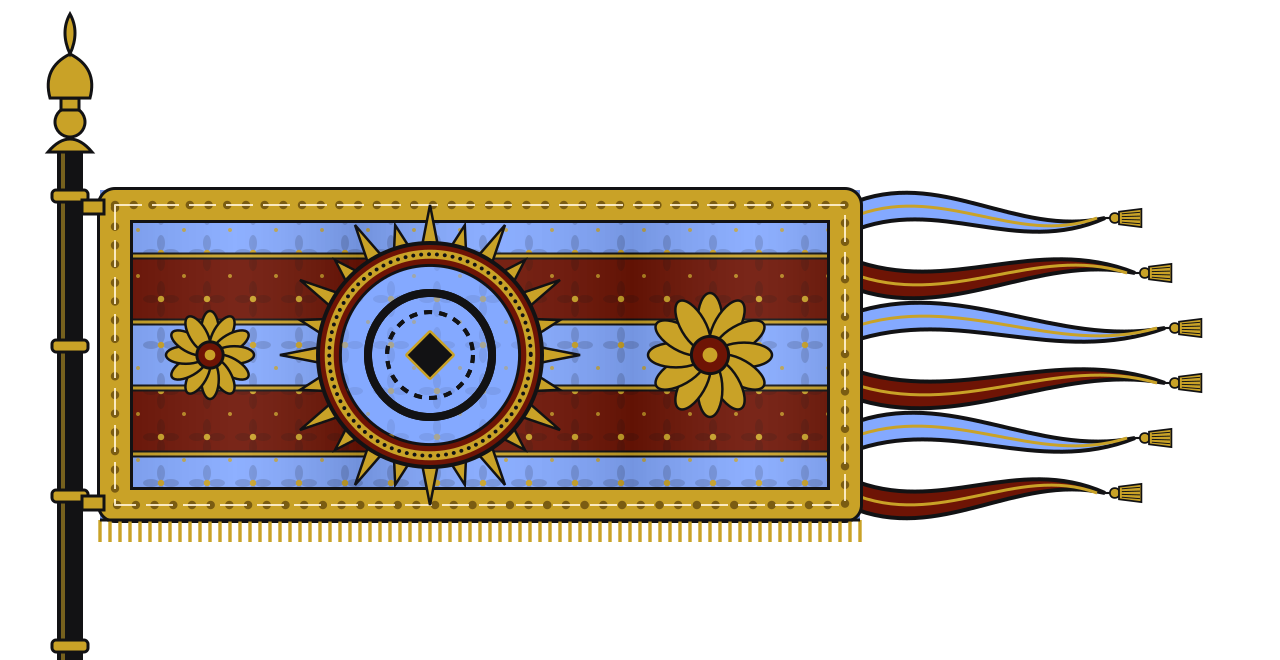
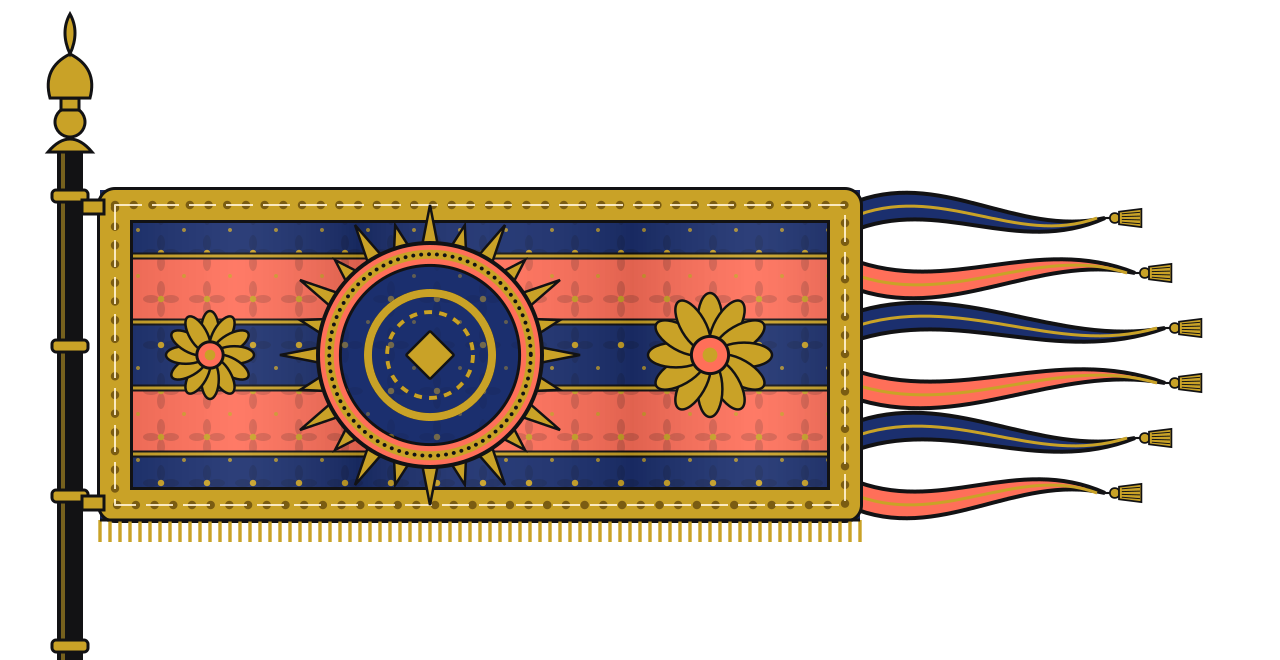
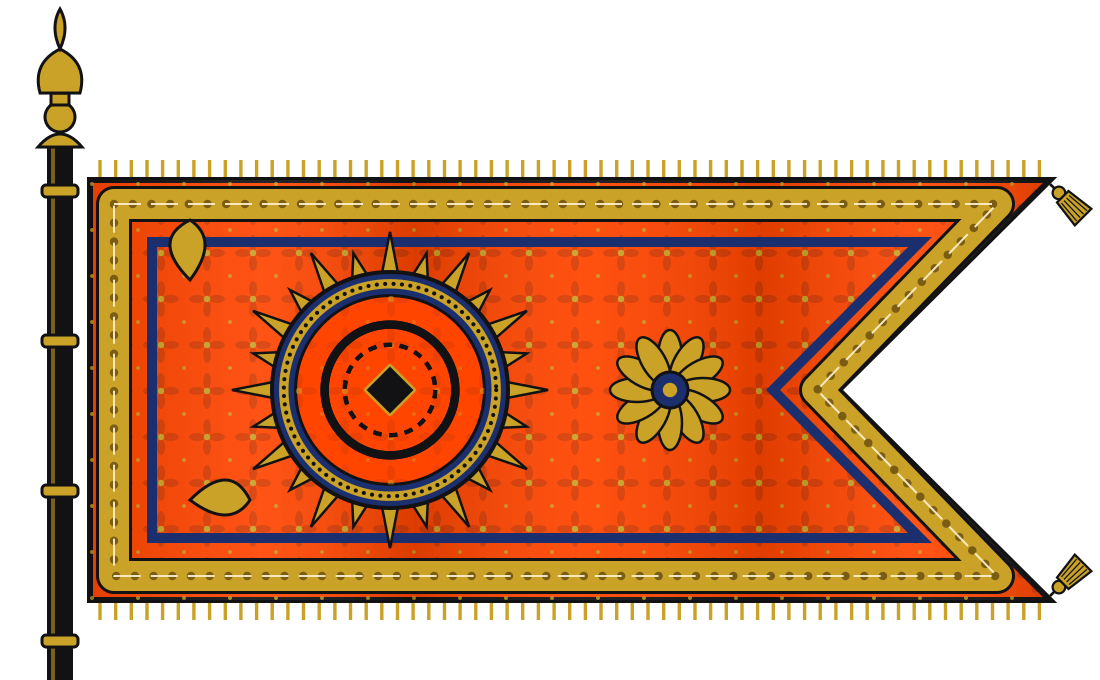
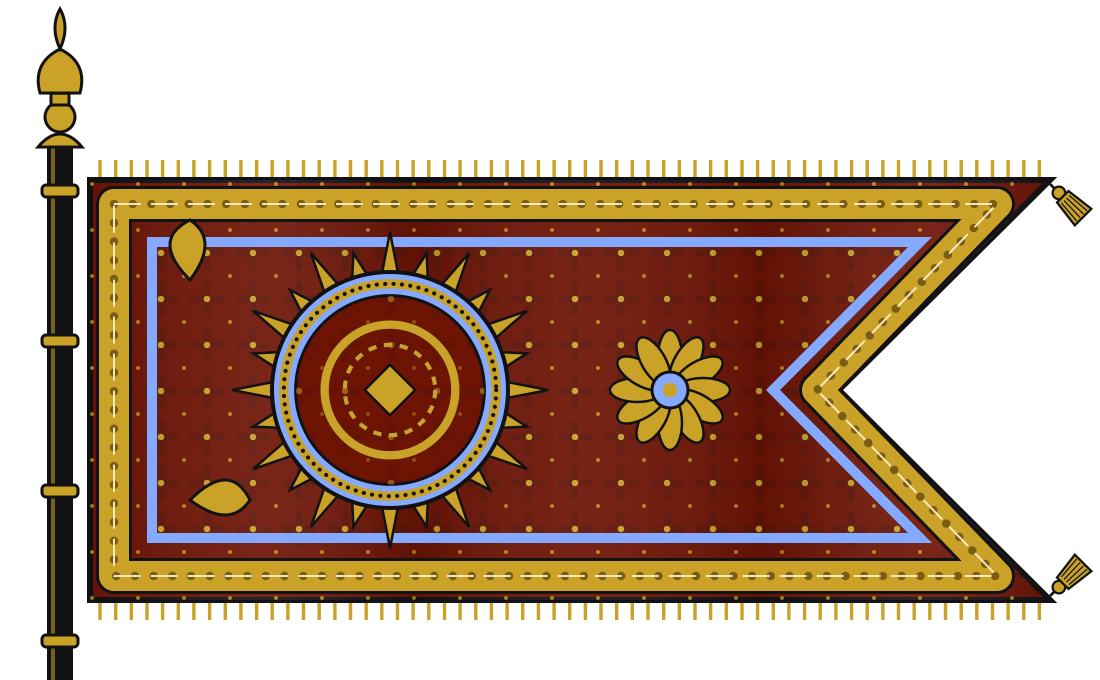
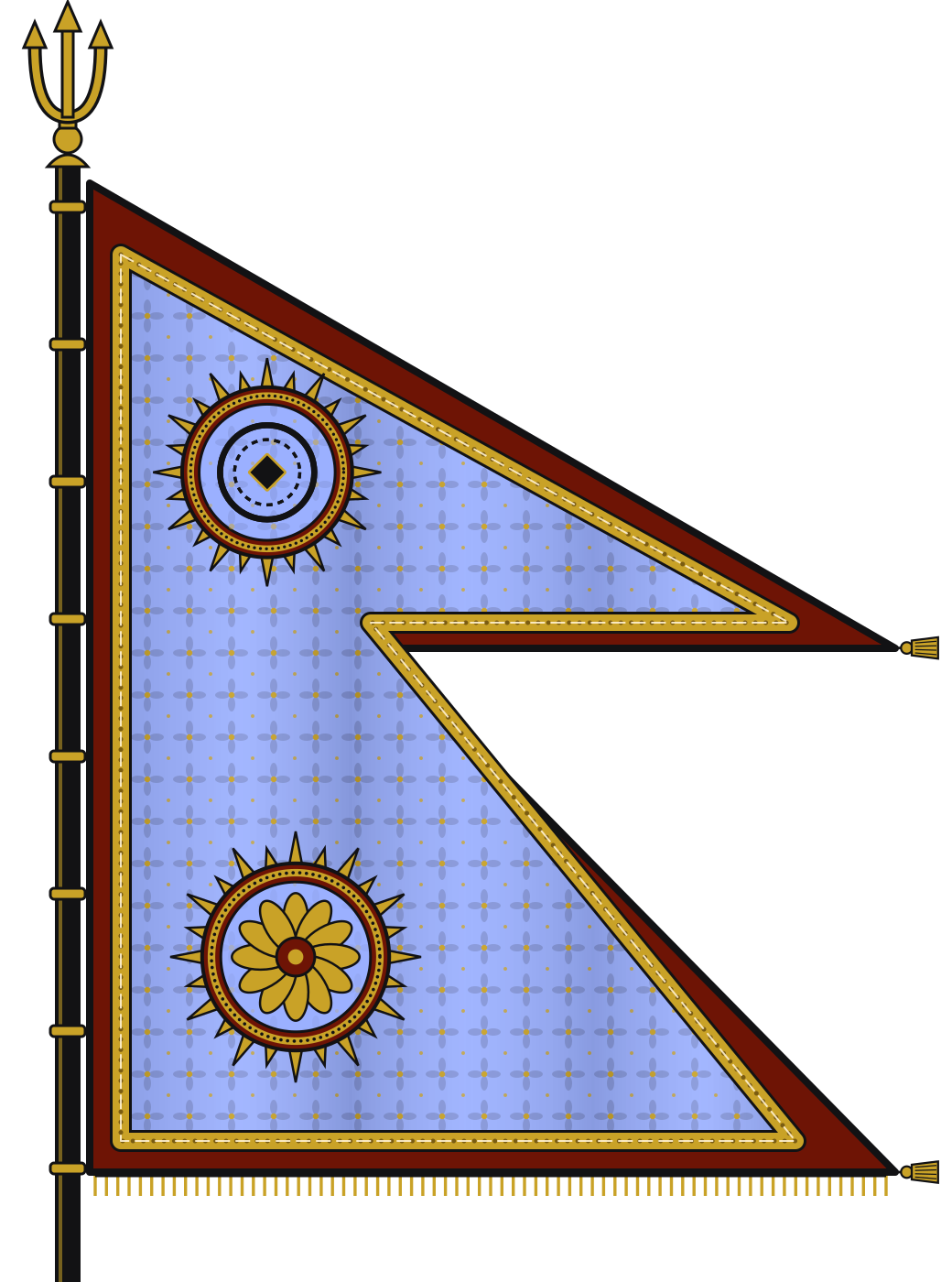
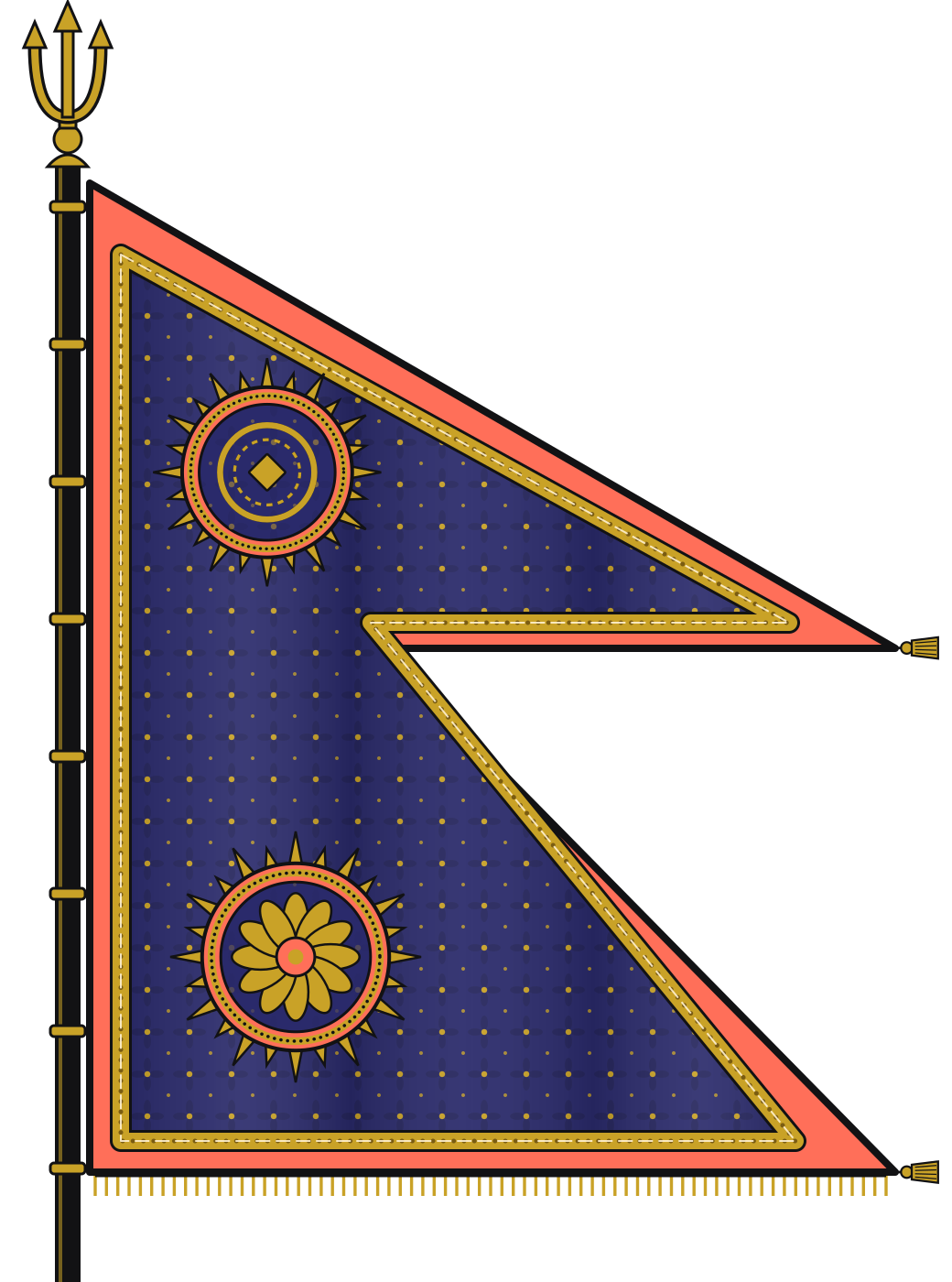
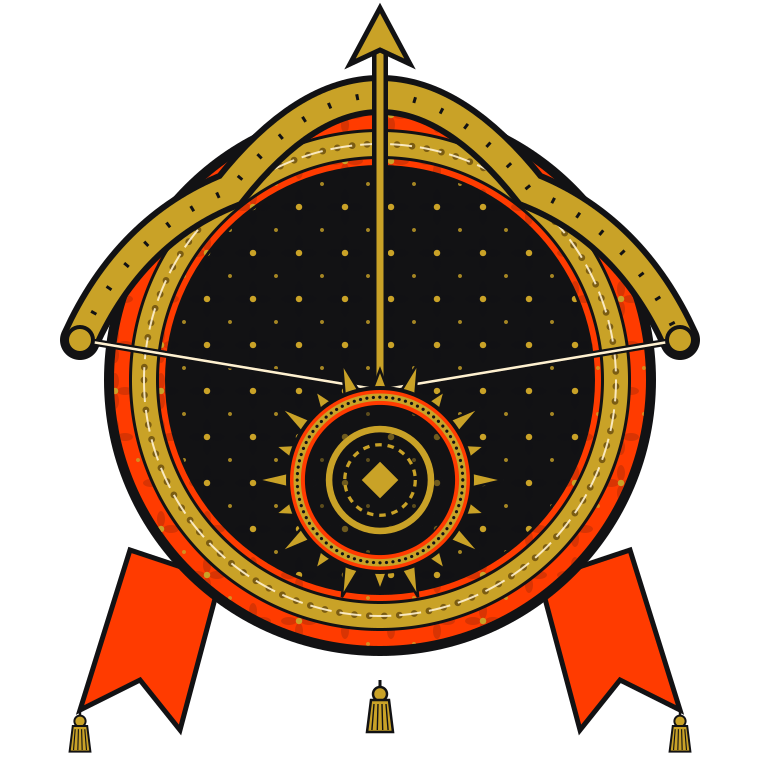
The sources give no Koch seal, arms or emblem, and the coinage page describes no symbols or seals[2]. The Atlas's flag is a project design.
| Part of the kit | This clan |
|---|---|
| Field | Royal Navy #1B2F6E |
| Accent | Deep Crimson Red #FF3B00 |
| Emblem colour | Metallic Gold #C9A227 |
| Zari metal | Gold |
| Main emblem | A galloping horse |
| Second image | A royal umbrella |
| Night and day | Every visual accessory has two versions: by night the emblem on the dark field, by day the clan's field colour on cloth woven from its metal. |
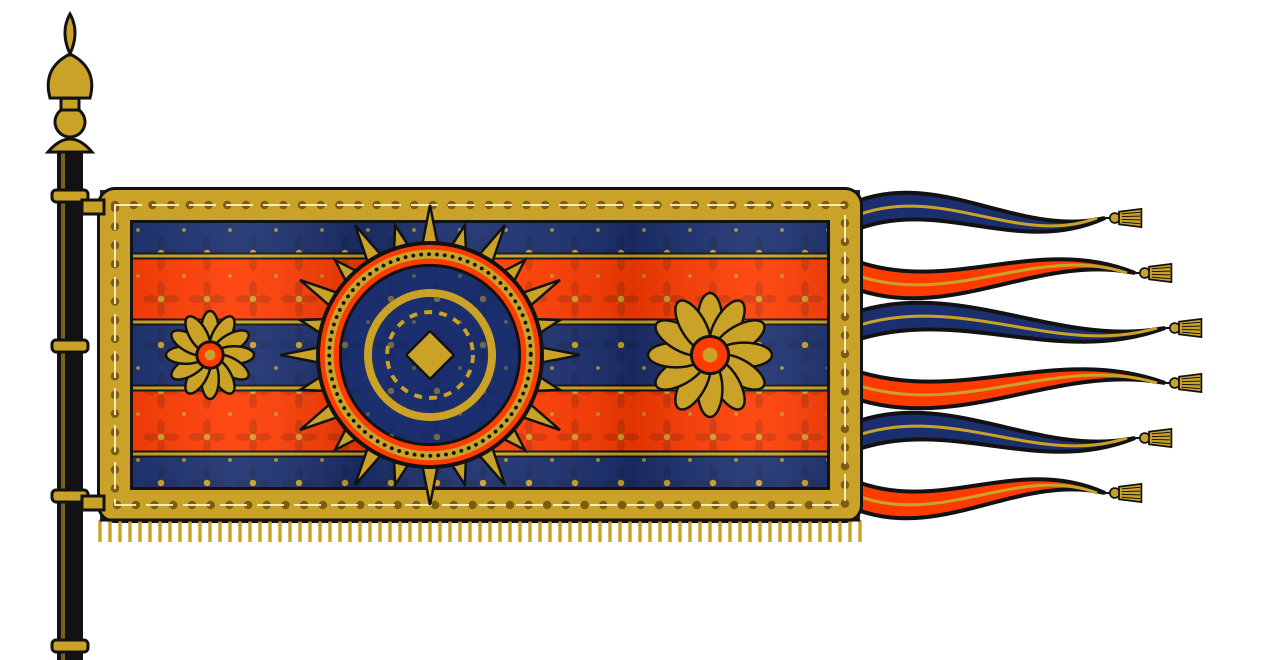
6. Flags
Every clan has every flag type; the type says the occasion and the colours say the clan. The outlined card is the flag the Atlas assigns.

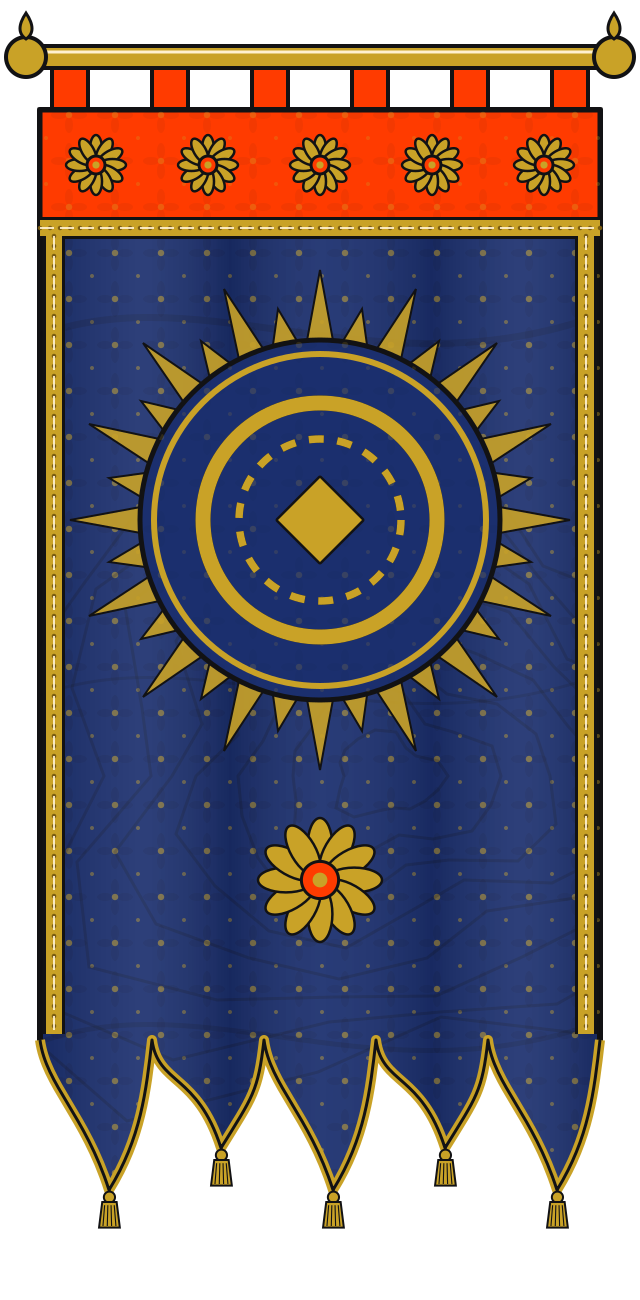
Historic banner
None known
New flag types
| Accessory | For this clan | Basis |
|---|---|---|
| A9 Pota-dhvaja · ship and trade flag For ships, caravans and markets | Not yet designed for this clan | Design |
| A10 Utsava-patāka · festival flag Light, bright flag for fairs and festivals | Not yet designed for this clan | Design |
| A11 Shoka-dhvaja · mourning flag White cloth with the emblem outline in the clan's metal | Not yet designed for this clan | Design |
7. Regalia
| Accessory | For this clan | Basis |
|---|---|---|
| E1 Chhatra · house parasol The ceremonial umbrella | Not yet designed for this clan | Design |
| E2 Chamara · fly-whisks The pair of whisks beside the head of the house | Not yet designed for this clan | Design |
| E3 Danda · staff of office Staff or scepter | Not yet designed for this clan | Design |
| E4 Simhasana · seat The seat of the house, covered in clan cloth | Not yet designed for this clan | Design |
| E5 Khetaka · shield A round shield; the Changi and Dhanush are its flag forms | Not yet designed for this clan | Regional tradition |
| E6 Kula-ayudha · clan weapon The weapon the clan honours | Not yet found for this clan | Under research |
8. Worn
| Accessory | For this clan | Basis |
|---|---|---|
| F1 Kula-vastra · clan cloth The clan's woven pattern in its kit colours | Liphan and sokatharay: handwoven floral cloths of the Koch women, decorated on a cloth called mug paini; a women's cloth | Documented |
| F2 Kirti-vastra · honour cloth A cloth earned for a deed, not inherited | Not yet designed for this clan | Design |
| F3 Kula-mala · garland flower The flower or leaf the clan wears as a garland | Not yet found for this clan | Under research |
| F4 Chinha · house pin A metal badge with the pin emblem | Not yet designed for this clan | Design |
9. Records
| Accessory | For this clan | Basis |
|---|---|---|
| H1 Clan words A traditional line in the native script | Nani ata mung? · “What is your name? (Harigaya Koch, the sample the Koch language page gives; a sentence, not a motto)” Koch language sample[6] | Design |
| H2 Biruda · titles The house's title or titles | 'Pagla Raja' and 'Okate Raja': the names the Garo Hills chief is called by in Koch villages, in Indpaedia's account | Documented |
| H3 Prashasti · praise genealogy The lineage as written at the head of a grant | Not yet found for this clan | Under research |
| H4 Vahi · clan register The book of the clan's births, marriages and deaths | Not yet found for this clan | Under research |
| H5 Rana-ghosha · war cry The clan's cry in battle or celebration | Not yet found for this clan | Under research |
10. VishwaVit · knower of the world
Game values are design choices for this project, not historical claims.
References
- Wikipedia, Koch people, read 2026-11-19 (cites Kondakov 2013/2020, Jacquesson 2008, Nath 1989, Chatterji 1951), link
- Wikipedia, Koch coinage, read 2026-11-19 (cites Haque 2019, Ahmad Shamoon, Debajit Dutta 2015), link
- Wikipedia, Twipra Kingdom, read 2026-11-08, link
- Khasi Hills Autonomous District Council, Khasi States and the Shillong Municipality, read 2026-10-19, khadc.nic.in (author and date not stated in the extract; the fetch summarised the page, paraphrases marked)
- M. Kotal, R. Khongsdier, S. Sengupta, A. M. Mishra and D. K. Adak, Population Composition of Five Subgroups of Koch Populations of Meghalaya, India, Athens Journal of Demography & Anthropology 1(1), 2025, read 2026-11-19, link
- Wikipedia, Koch language, read 2026-11-19, link
- NE News, National Koch Festival brings colour, culture and community to life in Meghalaya, 4 May 2025, read 2026-11-19, link
- Kamakhya Temple, Wikipedia (citing Shin 2010, Urban 2009–2019, Banerji 1925, Sarma 1981/1988, Nath 1989, Kakati 1989, Neog 1980).
- Wikipedia, Rabha people, read 2026-11-19, https://en.wikipedia.org/wiki/Rabha_people
- A. Playfair, The Garos (London: David Nutt, 1909), NVLI OCR RB858, read 2026-11-19 (pp. vi–86 of the text only), link
- Cultures and indigenous beliefs of Koch tribe, Northeast Today, September 2020 (no author shown; via Magzter), read 2026-11-19, link
- History and heritage: published research, kamakhya.org (read 10 Oct 2026, KulDevi run 64).
- Sirajul Islam, "Jaintia, Kingdom of", Banglapedia (page edited 18 June 2021, read 2026-10-10).
- Ahom-tribal Relations: a political study (OCR), National Virtual Library of India, read 2026-10-19 (Ch. I only), link
- Ahom kingdom (Wikipedia, read 2026-10-08), citing A. Guha (1978–1986), S. L. Baruah (1986), Y. Saikia (1997, 2004), J. N. Phukan (1991, 1992), J. N. Sarkar (1992) and S. K. Bhuyan.
- Battle of Saraighat (Wikipedia, read 2026-10-09), citing S. L. Baruah (1986), S. C. Dutta (1981), S. K. Bhuyan, Lachit Barphukan and His Times (1947), P. Gogoi (1968), S. Kakoty (2003) and J. N. Sarkar (1992, 1994).
- Indpaedia, Koch (mirror at dcmpx.remotevs.com; credits Imperial Gazetteer of India 1908, Gait 1924), read 2026-11-19, link
- Gale Group (2008) via everyculture.com, Khasi - History and Cultural Relations (no author named), read 2026-11-01
- Wikipedia, Garo people, read 2026-11-15, https://en.wikipedia.org/wiki/Garo_people (cites Playfair 1909, Sinha 1955, Marak 2005 and Marak 2014 as printed in the article)