The Kisan, also called Nagesia, Nagasia and Nagesar[1], are a Scheduled Tribe (Ministry list dated 09-07-2024, per the Atlas) living mainly in Sundargarh, Sambalpur and Jharsuguda in Odisha, with smaller numbers in West Bengal and Jharkhand[2][3][4][5]. The article says they are said to have come from the Chotanagpur plateau and taken up farming in these districts, and the name is said to mean cultivator[6][7]. Their language, Kisan (kunha), is described as a dialect of Kurukh by scholarly opinion and is endangered[6][8]. Marriage is usually a negotiated benja, and the village priest, the kalo, worships Dharme Belas at the rite[6][9].
01Faith and deities
Samaleswari of Sambalpur, goddess of western Odisha
The presiding goddess of the clan's homeland or capital: a link of place, not a recorded clan tie.
| Deity or tradition | Place in the clan's life | Evidence |
|---|---|---|
| Dharme Belas | Supreme gods; worshipped by the kalo at marriage | [6][9] |
| Veemdevata | Village deity | [10] |
| Budhabandha, Ganasir, Baghiya, Gosain | Named among the deities in the 2023 abstract; roles not given there | [10] |
| Samalai Mahaprabhu | House deity | [10] |
| Guhalpuja | Worship at cattle pasture places | [10] |
| Samaleswari | KulDevi in the Atlas only (project data, not a source finding) | Atlas |
02Temples
No Kisan temple is named in the extracts read for this page.
Built by the clan
Not recorded.
Given patronage or grants by the clan
Not recorded.
03Languages and scripts
| Language or script | Kind | Under the clan | Evidence |
|---|---|---|---|
| Kisan (kunha) living | North Dravidian; a dialect of Kurukh by scholarly opinion, or a distinct language | The clan's own tongue; 206,100 speakers in 2011 (Kurukh article); its text gives 219,000 | [6][8] |
| कुँड़ुख़ (Kurukh) | North Dravidian language; the Kisan dialect is grouped with it | Devanagari form given for the Kurukh language, shared with the Oraon | [8] |
| Odia, Sambalpuri, Hindi, Bengali | Other languages used alongside Kisan | Listed in the Kisan article | [6] |
04Books and literature
The works below are those the Kisan article cites. Only the 2023 abstract was read for this page.
Written during the clan's history
| Work | Author | Kind | When | Link to the clan |
|---|---|---|---|---|
| A Study on Life Cycle Rituals of Kisan Tribe in Odisha | Gouri Majhi and Ratnakar Mohapatra | Journal article (abstract read) | 2023 | [10] |
| Tribes of Orissa | B. Chowdhury | Cited in the Kisan article | 2004 | [6] |
| People of India, vol. 35 pt 2 | K. S. Singh | Cited in the Kisan article | 2013 | [6] |
| Encyclopaedia of Art and Culture in India, vol. 18 | Gopal Bhargava | Cited in the Kisan article (migration claim) | 2003 | [6] |
| Kisan | Girijasankara Gosvami | Cited in the Kisan article | 1989 | [6] |
| Encyclopaedia of Dravidian Tribes, vol. 3 | Author not named in the extract | Cited in the Kisan article | 1996 | [6] |
| PhD thesis (title not in the extract) | Laxman Kishan | Thesis, Utkal University | 2022 | [6] |
| PhD thesis (title not in the extract) | Sarojini Ekka | Thesis, Sambalpur University | 2017 | [6] |
| PhD thesis (title not in the extract) | Gouri Majhi | Thesis, KISS | 2024 | [6] |
| PhD thesis (title not in the extract) | Albin Rico Xalxo | Thesis, Hyderabad | 2024 | [6] |
| PhD thesis (title not in the extract) | Anup Kumar Kujur | Thesis, Annamalai | 2019 | [6] |
Given patronage by the clan
Not recorded.
05Thinkers and scholars
| Name | Field | Era | Contribution |
|---|---|---|---|
| Gouri Majhi | Study of Kisan life-cycle rituals | 2023; PhD 2024 (as the article gives it) | [10][6] |
| Ratnakar Mohapatra | Co-author of the 2023 study | 2023 | [10] |
The other PhD writers named in the Kisan article were not read.
06Art and architecture
The extracts record dance and music rather than a visual art tradition: the Odisha State Tribal Museum calls the Kisan fond of dance and music.
Painting and wall art
Not recorded.
Sculpture and temple art
Not recorded.
Temple and building architecture
Not recorded.
Weaving and textiles
Not recorded.
Clothing and jewellery
| Art form | What it is | Era | Evidence |
|---|---|---|---|
| Dance costume set | 282 sets of costumes for a Kisan dance item, listed by name as printed: Khadad Saree, White Dhoti, Red Gamucha, Pagdi Topi and 16 more | 2018–19 contract | [11] |
Coins, pottery and crafts
| Art form | What it is | Era | Evidence |
|---|---|---|---|
| Mat weaving | Women weave mats | Not dated | [7] |
| Date palm broomsticks | Women make broomsticks from date palm leaves | Not dated | [7] |
| Brick making and carpentry | Men's crafts | Not dated | [7] |
07History
Name and origin
The Kisan are also called Nagesar and Nagesia in the Odisha list[2]. They call themselves Kunhar, and Kisan is said to mean cultivator in Hindi[7]. The 2023 study abstract also says the word means cultivator and that the people had earlier local designations[10].
Said migration
The Kisan article says the people are said to have migrated from the Chotanagpur plateau and settled in the Sundargarh and Sambalpur districts, taking up agriculture, citing Bhargava (2003, p. 270)[6].
Hunter-gatherers and an Oraon link
The Odisha State Tribal Museum says the Kisan were originally hunter-gatherers, and that they are believed to be an offshoot of the Oraon tribe[7]. The same page says they are listed among the PVTG communities (Micro Project Survey Data, 2010)[7]; the Atlas gives no PVTG value.
08Journey and migrations
The only movement the extracts record is the one said to take the Kisan from the Chotanagpur plateau to the Sundargarh and Sambalpur area[6].
| When | From | To | Why | Evidence |
|---|---|---|---|---|
| Not dated | Chotanagpur plateau | Sundargarh and Sambalpur districts, Odisha | Settled and took up agriculture (said) | [6] |
09Seats and lands
| Place | Role | Where today |
|---|---|---|
| Sundargarh, Sambalpur, Jharsuguda | Major concentration in Odisha[7][3] | Odisha |
| Keonjhar | Named among the districts in the Odisha list[2] | Odisha |
| Deogarh (primary); Bargarh, Balangir, Kalahandi, Boud, Jaipur (as printed) | Districts named in the 2023 abstract[10] | Odisha; Jaipur not given a state in the abstract |
| Kuchinda block, Sambalpur | Where the local designations Kola and Morva are given[10] | Odisha |
| Malda | Named as a Kisan area[6] | West Bengal |
| Latehar and Gumla | Named as Kisan areas[9] | Jharkhand |
| Jhapa | About 1,000 people, per the article[6] | Nepal |
| Madhya Pradesh and Maharashtra | Census rows for Nagesia and Nagasia (359 and 133, as printed)[1][12] | Madhya Pradesh; Maharashtra |
10Notable figures
Not recorded.
11Allies, rivals and marriages
| People | Relationship | When |
|---|---|---|
| Oraon | Said by OSTM to be the people the Kisan are an offshoot of; the Kisan share the Kurukh dialect[7][8] | Undated |
| Kurukh | The Kisan speak a dialect of Kurukh by scholarly opinion[6][8] | Undated |
12Society and livelihood
The sources name the bansa, the patrilineal lineage, and the village priest, the kalo. Marriage is arranged through a mediator, usually the agua in a benja marriage[6][9].
Government and social order
| Institution or group | What it was | Evidence |
|---|---|---|
| Bansa | Patrilineal lineage; no marriage within the same bansa | [6][9] |
| Kalo | Village priest; worships Dharme Belas at marriage and sets the date | [9][6] |
| Agua | Mediator in a negotiated (benja) marriage | [6] |
| Marriage forms | Benja (negotiated, the most common), capture, love, intrusion, adoption and exchange | [6] |
| Bride price | Kania muli hessu or sukha mula, paid in rice: about 10 khani (about 1 quintal) | [6] |
| Marriage rite | Seven rounds of the pandal; a marriage is counted successful once a child is born | [6][9] |
| Divorce and remarriage | Divorce allowed for adultery, impotence, cruelty and incompatibility; widows may remarry, including a younger brother-in-law; widowers may marry a younger sister-in-law | [6] |
Livelihood over time
| Era | Livelihood | Evidence |
|---|---|---|
| Earlier | Hunter-gatherers (OSTM says 'originally') | [7] |
| Traditional | Farmers and food gatherers; rice, and a minor millet, gulji | [6][7] |
| Traditional | Women weave mats and make broomsticks from date palm leaves; men make bricks and do carpentry | [7] |
13Sub-clans and related clans
The extracts name no sub-clan or gotra of the Kisan. The unit they describe is the bansa, a patrilineal lineage within which marriage is forbidden. The 2023 abstract gives local designations; these are listed as related names, not as sub-clans, and the Kisan article lists no clan names.
| Clan | Relation | Where | Size | In the Atlas | Evidence |
|---|---|---|---|---|---|
| Kola | Related people | Kuchinda block, Sambalpur (Odisha) | same name as ST-427: check | [10] | |
| Morva | Related people | Kuchinda block, Sambalpur (Odisha) | same name as ST-457: check | [10] | |
| Kor | Related people | Sundargarh (Odisha) | same name as ST-411: check | [10] | |
| Mirdha | Related people | Sundargarh (Odisha); named with Kuda and Kor in the 2023 abstract | ST-219 | [10] | |
| Oraon | Related people | Said by OSTM to be the Kisan's origin (offshoot); listed separately in Odisha | 358,112 in Odisha, 2011[2] | ST-241 | [7] |
Clans marked "new clan candidate" are not in the Atlas yet.
14Surnames
The extracts name no surname used by Kisan families. The 2023 abstract calls Kuda, Kor and Mirdha local designations, not surnames.
Not recorded.
15Songs and music
No Kisan song is quoted in the extracts read for this page. The Odisha State Tribal Museum says the Kisan are fond of dance and music.
None recorded yet.
Instruments and styles
| Instrument or style | What it is | Evidence |
|---|---|---|
| Mandal baja | 3 sets, in the contract for a Kisan dance item (as printed) | [11] |
| Nagra baja | 2 sets, in the same contract (as printed) | [11] |
| Jham | 2 sets, in the same contract (as printed) | [11] |
| Gini | 2 sets, in the same contract (as printed) | [11] |
| Singa | 2 sets, in the same contract (as printed) | [11] |
| Bansi | 1 set, in the same contract (as printed) | [11] |
| Ring | 2 sets, in the same contract (as printed) | [11] |
| Keyboard | 1 set, in the same contract (as printed) | [11] |
16Poems, lullabies and children's rhymes
None recorded yet.
17Stories, legends and proverbs
Stories and legends
Not recorded.
Proverbs and sayings
Not recorded.
18Festivals and fairs
| Festival or fair | When | Where | What happens |
|---|---|---|---|
| Jatra | Youth festival, held in summer and winter | Among the Kisan of Odisha | The youth festival of Jatra[7] |
19Food, dress and games
Food
| Item | What it is | Evidence |
|---|---|---|
| Rice and gulji | Rice is the main crop, with a minor millet called gulji | [7] |
| Handia | Rice beer, given as a marriage gift; mahua liquor replaces handia in today's practice (article) | [6] |
Dress
| Item | What it is | Evidence |
|---|---|---|
| Marriage clothing | Red, yellow and white; never black | [6] |
Games and martial arts
Not recorded.
Tags: living still practised · revived brought back after a break · lost known only from records · research reported but not yet confirmed from a source. Songs and poems under copyright are listed by title only; restricted or sacred material is noted without its content.
20Status today
Scheduled Tribe in Odisha, West Bengal and Jharkhand, with smaller listings in Madhya Pradesh and Maharashtra and a census count in Nepal. The language is endangered[2][6][8].
Recognised heritage
| What | Recognition | Evidence |
|---|---|---|
| Scheduled Tribe listing | Odisha, West Bengal and Jharkhand lists (as printed); list dated 09-07-2024, per the Atlas | [2][4][5] |
| Jatra youth festival | Observed in summer and winter (OSTM) | [7] |
Not reviewed by the Kisan community; no community review is in the sources.
21For children
The Kisan farmers (an original story)
The Kisan are a people of western Odisha, in the districts of Sundargarh, Sambalpur and Jharsuguda. Their name is said to mean cultivator, and they grow rice and a small millet called gulji. Their lineages are called bansa, and people of one bansa do not marry each other. At a Kisan wedding, the village priest, the kalo, worships their supreme gods, Dharme Belas. Gifts of rice, rice beer and animals are given. The youth festival of Jatra is held in summer and in winter.
Written for this project
22Across the project
| Project | What carries this clan | Status |
|---|---|---|
| Atlas of the Janas | Pin at the master-sheet homeland (Sundargarh) | From the Atlas |
| KulDevi and GrahDevi | Samaleswari of Sambalpur (Atlas only) | From the Atlas |
| Planet naming | Star and planets not checked against the Tier registers | To check |
| Renaming and waters | No Kisan-derived place or water name in the extracts | — |
23Open questions
- Nagesia and Kisan: the West Bengal list prints them as separate rows (Kisan 98,434; Nagesia 16,378), and the Madhya Pradesh and Maharashtra lists print Nagesia, Nagasia. Settle whether they are one people before adding the figures.
- The Atlas records a serpent (Naga) ancestry claim and links the Nagas (ANC-088). No source read for this page supports either, so neither is stated as fact. Lead: a source for the claim, or a sheet correction.
- Kisan speakers: the Kurukh article gives 206,100 (2011), and 219,000 in its text.
- PVTG: the OSTM page says the Kisan are listed among PVTG communities (Micro Project Survey Data, 2010). The Atlas gives no PVTG value. Check the official PVTG list.
- Clan and sub-clan names beyond the local designations (Kola, Morva, Kor, Kuda, Mirdha): People of India vol. 35 (Singh, 2013) was not read.
- Native-script name: no native-script form of the Kisan name is in the extracts. The Devanagari form given is the Kurukh language's, not the people's.
- Districts differ: the Odisha list gives Keonjhar among its districts; the KISS handbook gives Sundergarh, Sambalpur and Jharsuguda; the 2023 abstract gives Deogarh as primary and Keonjhar as other.
- Clan words: no line of the Kisan's own, or a cited line tied to them, is in the extracts. The words field is left blank rather than filled with an illustrative line.
- Songs, sayings, rhymes and stories: none in the extracts. Leads: the full text of the 2023 study (Zenodo), and Gosvami (1989).
- Jaipur (2023 abstract) is given with no state in the abstract; left as printed.
- The 2023 abstract's deity names (Veemdevata, Budhabandha, Ganasir, Baghiya, Gosain, Samalai Mahaprabhu) are given without roles or meanings there. Check the full text.
- Community review: none recorded.
24Astitva
अस्तित्व · being, existence: everything by which the clan is known
No seal, coin, title, totem, guardian tree or war cry of the Kisan is documented in the extracts read for this page.
Every clan has every accessory, royal objects included. Each one says how it is known: Documented This clan's own object is recorded. · Regional tradition Recorded for the region or for peoples like this one, not for this clan. · Design Made for this project, with no historical claim. · Under research To be found for this clan from sources. Legends and titles are written in the clan's own script.
1. Seals and coins
| Accessory | For this clan | Basis |
|---|---|---|
| B1 Rajamudra · house seal Round seal with the clan emblem and a short legend in the clan's script | Not yet designed for this clan | Design |
| B2 Anguliya-mudra · signet ring Personal seal ring of the head of the house | Not yet designed for this clan | Design |
| B3 Chhapa · house stamp Ink or block stamp for letters, goods and cloth | Not yet designed for this clan | Design |
| B4 Tamrapatra · charter plate Copper-plate grant on a ring, closed with the house seal | Not yet designed for this clan | Design |
| B5 Shreni-mudra · guild or trade seal Seal for the clan's trade, craft or caravan | Not yet designed for this clan | Design |
| C1 Clan coin Emblem or deity on one side, a legend in the clan's script | Not yet designed for this clan | Design |
| C2 Coin die The die that strikes the coin | Not yet designed for this clan | Design |
2. Living symbols
| Accessory | For this clan | Basis |
|---|---|---|
| I1 Totem trio The tree, bird and animal the clan protects | Not yet found for this clan | Under research |
| I2 Kaval-maram · guardian tree The tree that stands at the clan's seat | Not yet found for this clan | Under research |
3. Stone and gate
| Accessory | For this clan | Basis |
|---|---|---|
| G1 Torana · gateway The built gate of the seat; the cloth Toran hangs in it | Not yet designed for this clan | Regional tradition |
| G2 Viragallu · hero stone Carved panel stone for a member who died defending the clan | Not yet designed for this clan | Regional tradition |
| G3 Kula-shila · clan stones Standing and table stones that remember the ancestors | Not yet designed for this clan | Design |
| G4 Jayastambha · victory pillar A pillar raised for a victory | Not yet designed for this clan | Design |
| G5 Sima-shila · boundary stone Marks the clan's land, with a line in the native script | Not yet designed for this clan | Design |
4. Sounds
| Accessory | For this clan | Basis |
|---|---|---|
| D1 Pancha-mahashabda · five great sounds The right to five instruments | Not yet designed for this clan | Design |
| D2 Shankha · clan conch The clan's own named war conch | Not yet designed for this clan | Design |
| D3 Murasu · house drums Three drums: war, charity and justice | Not yet designed for this clan | Design |
5. Kit: colours, metals and emblems
The Atlas gives the Kisan a design: a coiled serpent in a sun crest. That is project data, not a documented symbol, and no seal, coin, totem or banner of the Kisan is in the extracts read for this page.
| Part of the kit | This clan |
|---|---|
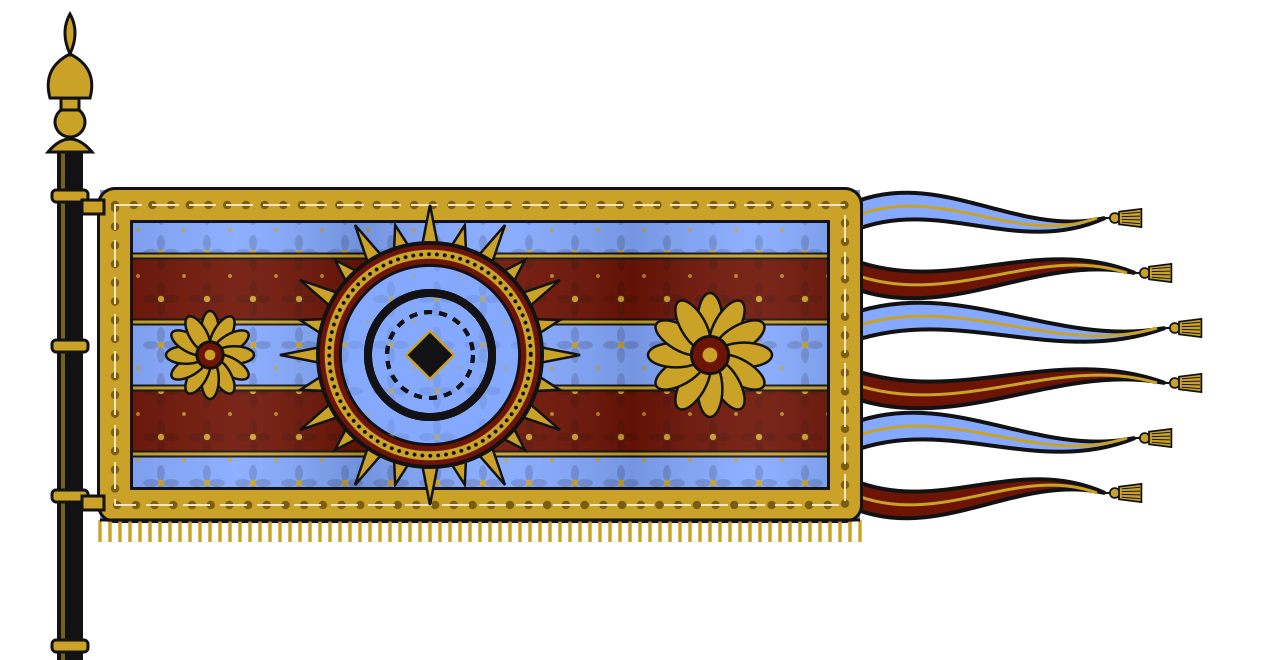
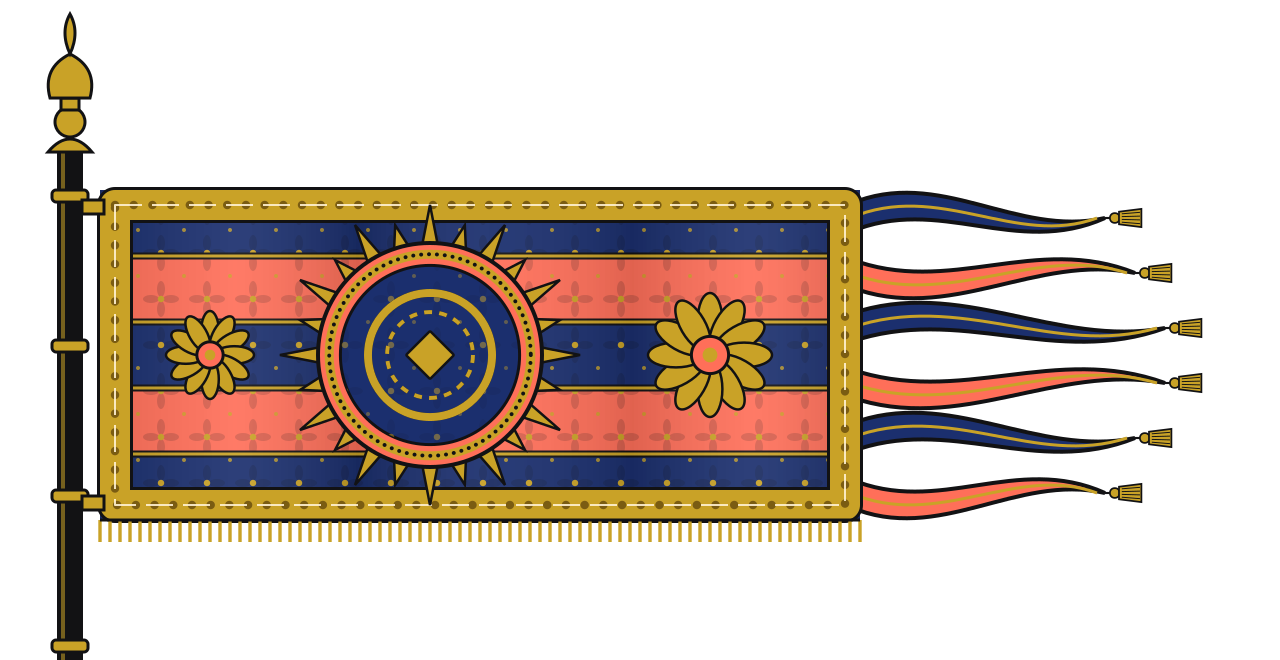
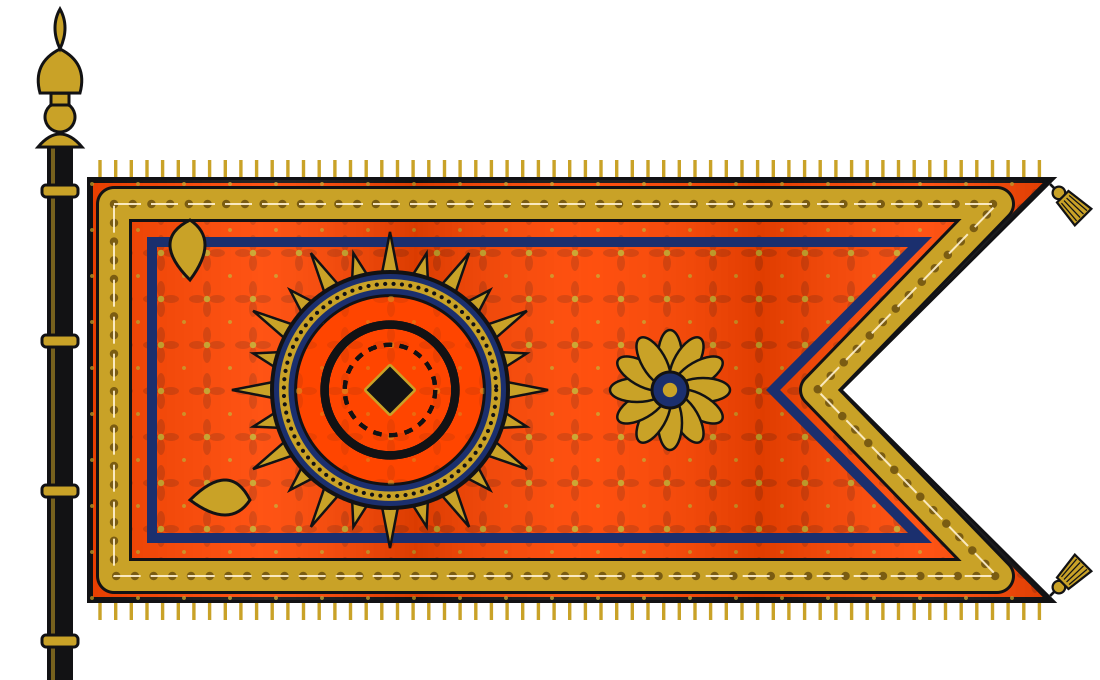
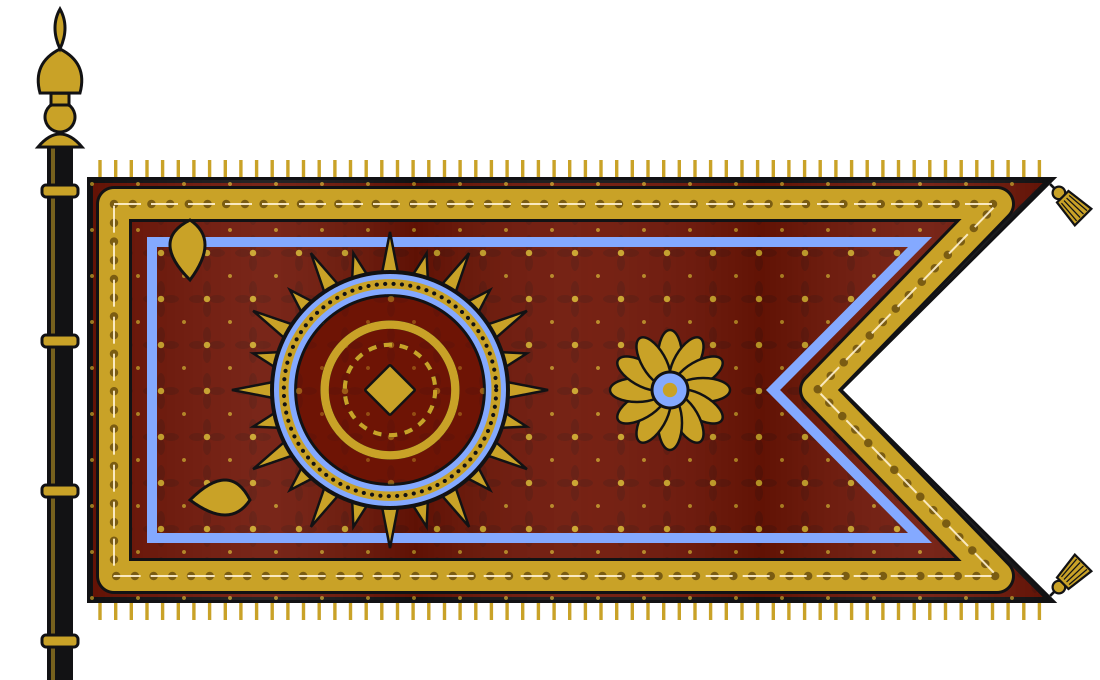
| Field | Deep Brick #7E2A1E |
| Accent | Deep Cosmic Blue #9BB0FF |
| Emblem colour | Metallic Gold #C9A227 |
| Zari metal | Gold |
| Main emblem | A coiled serpent |
| Second image | — |
| Night and day | Every visual accessory has two versions: by night the emblem on the dark field, by day the clan's field colour on cloth woven from its metal. |
6. Flags
Every clan has every flag type; the type says the occasion and the colours say the clan. The outlined card is the flag the Atlas assigns.



Historic banner
None known
New flag types
| Accessory | For this clan | Basis |
|---|---|---|
| A9 Pota-dhvaja · ship and trade flag For ships, caravans and markets | Not yet designed for this clan | Design |
| A10 Utsava-patāka · festival flag Light, bright flag for fairs and festivals | Not yet designed for this clan | Design |
| A11 Shoka-dhvaja · mourning flag White cloth with the emblem outline in the clan's metal | Not yet designed for this clan | Design |
7. Regalia
| Accessory | For this clan | Basis |
|---|---|---|
| E1 Chhatra · house parasol The ceremonial umbrella | Not yet designed for this clan | Design |
| E2 Chamara · fly-whisks The pair of whisks beside the head of the house | Not yet designed for this clan | Design |
| E3 Danda · staff of office Staff or scepter | Not yet designed for this clan | Design |
| E4 Simhasana · seat The seat of the house, covered in clan cloth | Not yet designed for this clan | Design |
| E5 Khetaka · shield A round shield; the Changi and Dhanush are its flag forms | Not yet designed for this clan | Regional tradition |
| E6 Kula-ayudha · clan weapon The weapon the clan honours | Not yet found for this clan | Under research |
8. Worn
| Accessory | For this clan | Basis |
|---|---|---|
| F1 Kula-vastra · clan cloth The clan's woven pattern in its kit colours | Not yet designed for this clan | Design |
| F2 Kirti-vastra · honour cloth A cloth earned for a deed, not inherited | Not yet designed for this clan | Design |
| F3 Kula-mala · garland flower The flower or leaf the clan wears as a garland | Not yet found for this clan | Under research |
| F4 Chinha · house pin A metal badge with the pin emblem | Not yet designed for this clan | Design |
9. Records
| Accessory | For this clan | Basis |
|---|---|---|
| H1 Clan words A traditional line in the native script | · “” No line of the Kisan's own, and no cited line tied to them, is in the extracts read for this page | Documented |
| H2 Biruda · titles The house's title or titles | Not yet found for this clan | Under research |
| H3 Prashasti · praise genealogy The lineage as written at the head of a grant | Not yet found for this clan | Under research |
| H4 Vahi · clan register The book of the clan's births, marriages and deaths | Not yet found for this clan | Under research |
| H5 Rana-ghosha · war cry The clan's cry in battle or celebration | Not yet found for this clan | Under research |
10. VishwaVit · knower of the world
Game values are design choices for this project, not historical claims.
References
- Wikipedia, Tribals in Madhya Pradesh, read 2026-10-19, https://en.wikipedia.org/wiki/Tribals_in_Madhya_Pradesh
- Wikipedia, List of Scheduled Tribes in Odisha, read 2026-10-20, https://en.wikipedia.org/wiki/List_of_Scheduled_Tribes_in_Odisha
- Sushree Mohanty, Indigenous Colours of Odisha: Handbook on 62 Tribes (KISS), read 2026-10-20, link
- Wikipedia, List of Scheduled Tribes in West Bengal, read 2026-10-21, https://en.wikipedia.org/wiki/List_of_Scheduled_Tribes_in_West_Bengal
- Wikipedia, Tribes of Jharkhand, read 2026-10-20, https://en.wikipedia.org/wiki/Tribes_of_Jharkhand
- Wikipedia, Kisan people, read 2026-10-23, https://en.wikipedia.org/wiki/Kisan_people
- Odisha State Tribal Museum, Tribes of Odisha: Kisan, read 2026-10-23, https://ostm.in/tribes_of_odisha/kisan/
- Wikipedia, Kurukh language, read 2026-10-21, https://en.wikipedia.org/wiki/Kurukh_language
- Dr. Ramdayal Munda Tribal Welfare Research Institute, Jharkhand, Kisan, read 2026-10-23, https://trijharkhand.in/en/kisan
- Gouri Majhi and Ratnakar Mohapatra, A Study on Life Cycle Rituals of Kisan Tribe in Odisha, Zenodo, 20 May 2023, read 2026-10-23, https://zenodo.org/records/7953013
- ITDA Sundargarh, Annual Rate Contract bidding document for costumes and musical instruments of tribal dance troupes, 2018-19, read 2026-10-23, link
- dhammabharat.com, List of Scheduled Tribes in Maharashtra and Population of each Tribe (2011 Census), read 2026-10-10, https://dhammabharat.com/?p=13656