The Khond (Kui, Kondh, Kandha) are a Dravidian-speaking people of the hills of Odisha, most of whom live in Kandhamal and nearby districts[1][2]. Their society is clan-based, and each clan is identified by a totem, usually a male wild animal[1]. Their earth goddess is Dharni Penu, later male as Dharni Deota[1][3]. The Ghumsur rising was led by Kondh chiefs against the British; Ghadai dates it 1835 to 1856[4], while Wikipedia dates it 1753 to 1856 (see open), and Kandhamal takes its name from the tribe that revolted in 1846[1]. The 2011 census counts 1,627,486 in Odisha and 1,743,406 across India[2][1].
01Faith and deities
No KulDevi has been found for this clan yet; it is on the research list.
| Deity or tradition | Place in the clan's life | Evidence |
|---|---|---|
| Dharni Penu (Dharani) | Earth goddess, creator and sustainer; the rite is held at a fixed place outside the village. Offerings moved from human victims to monkeys and then to buffaloes[5] | [1][5] |
| Bhatbarsi Deota | God of hunting and companion of Dharni Deota; a conglomerate stone with granules at his feet; bow and arrows worshipped before the hunt | [3][1] |
| Pennu | The Khond name for a god. Eighty-four gods; every hill and valley has its deity (Russell) | [3] |
| Niyam Raja | Supreme god of the Niyamgiri jungle, worshipped by the Dongria; represented by the Niyamgiri hills | [6][7] |
| Horu, the mountain | Dongria regard the mountain as Father God, and worship Dharni Penu as Earth Goddess | [7] |
| Pideri penu | Ancestors who receive rice and liquor (secondary blog) | [8] |
| Kali, Durga, Shiva and others | Kali and Durga are worshipped as forms of Dharani; Shiva as a form of Bhatbarsi Deota; Jagannath, Ram, Krishna and Balram 'tribalised' | [1] |
| Boora Panoo, Tadapanoo, Dasapanoo | Gods in the origin legend; the Janni (priest) performs the rites | [9] |
| Thadha Pennoo (the earth) | Sacrifice each year under an effigy of a bird meant as a peacock, in the Goomsur Maliahs (1837 report) | [9] |
02Temples
No temple is named in the extracts, and no builder or date is recorded. Village shrines are described: a village altar to Darni Penu at the village side (secondary blog)[8]; Dongria shrines to Dharani Penu inside a hamlet or at its entrance, with carved breasts on wooden beams and stones for ancestors (MAGIK India, secondary)[10]; a shrine installed close to that of the earth goddess Dharni Penu (KISS handbook, as in the saved notes; not re-read in this run)[11]. Russell (1916) shows Dharni Deota as a rectangular wooden peg.
Built by the clan
Not recorded.
Given patronage or grants by the clan
Not recorded.
03Languages and scripts
| Language or script | Kind | Under the clan | Evidence |
|---|---|---|---|
| Kui (Kuvi, Kui language) living | Dravidian, South-Central, Konda-Kui branch | Spoken by more than half the tribe (Russell, 1916); written in the Odia script (Wikipedia) | [12][3] |
| Kuvi living | South-Central Dravidian, in Odisha and Andhra Pradesh | The other language of the Kandhas, closely related to Kui; 155,548 native speakers (2011 census) | [13] |
| Odia script living | Writing system used for Kui | Russell (1916) recorded that Kui had no written character; Wikipedia now gives the Odia script | [12][3] |
| Kui numerals (base twelve) living | Counting runs in twelves: rondi 1, rindi 2, munji 3, dasa 10, bara 12 | Counting in base twelve, with Romanised numerals as Wikipedia gives them | [12] |
04Books and literature
No Khond-language literature is recorded in the extracts. Kui had no written character when Russell wrote in 1916. The works below are about the people and their language.
Written during the clan's history
| Work | Author | Kind | When | Link to the clan |
|---|---|---|---|---|
| Tribes and Castes of the Central Provinces of India, vol. 3 (Khond entry) | R. V. Russell | Ethnography | 1916 | [3] |
| A Personal Narrative of Thirteen Years Service amongst the Wild Tribes of Khondistan | John Campbell | Memoir on the suppression of human sacrifice (catalogue entry read; text not read) | 1864 | [14] |
| Castes and Tribes of Southern India, vol. 3 (Kondh entry) | Edgar Thurston, K. Rangachari | Ethnography | 1909 | [9] |
| Report on the Khonds of Ganjam and Cuttack | Macpherson | Official report (as cited by Russell) | 1863 | [3] |
| A Grammar of the Kui language | Friend-Pereira | Grammar | 1909 | [12] |
| A Grammar of the Kuvi Language | Schulze | Grammar | 1911 | [13] |
| The Religion of the Kuvi-Konds | Schulze | Religion | 1912 | [1] |
| Forest Tribes of Orissa | Jena et al. | Study | 2002 | [1] |
| Children of the Earth Goddess | Hardenberg | Study | 2005 | [1] |
| Kondh Oral Epics | Mishra | Oral epics | 2007 | [1] |
| The Ghumsar Uprising | Behera | History | 2021 | [1] |
| The Creation Myth of the Kutia Kondh | Mishra | Myth | 2025 | [1] |
Given patronage by the clan
Not recorded.
05Thinkers and scholars
| Name | Field | Era | Contribution |
|---|---|---|---|
| Friend-Pereira | Language and customs | 1909 | Grammar of the Kui language; Totemism among the Khonds (JASB)[12][9] |
| Winfield | Language | 1928 | A grammar of the Kui language (Bibliotheca Indica)[12] |
| Schulze | Language and religion | 1911 to 1912 | Grammar of the Kuvi language; The Religion of the Kuvi-Konds[13][1] |
| Macpherson | Administration | 1863 | Report on the Khonds of Ganjam and Cuttack[3] |
| John Campbell | Administration | 1864 | Meriah Agent; memoir on the suppression of human sacrifice[15][14] |
| Mishra | Oral literature | 2007, 2025 | Kondh Oral Epics (2007); The Creation Myth of the Kutia Kondh (2025)[1] |
| Behera | History | 2021 | The Ghumsur uprising[1] |
| Balabhadra Ghadai | History | 2012 | Odisha Review article on the Ghumsur rising[4] |
Other scholars cited by Wikipedia, such as Jena et al. and Israel (grammar of Kuvi), are listed under Books.
06Art and architecture
The extracts record textiles and a few architectural details. No painting or sculpture is recorded.
Painting and wall art
Not recorded.
Sculpture and temple art
Not recorded.
Temple and building architecture
| Art form | What it is | Era | Evidence |
|---|---|---|---|
| Sal plank and mud houses | Kitchen 'baja edu', cowshed 'goheli', verandah 'pinduli', living room 'dopa edu' (secondary blog); geometric patterns on Dongria houses | Recorded | [8][10] |
Weaving and textiles
| Art form | What it is | Era | Evidence |
|---|---|---|---|
| Kapdaganda shawl (Dongria) | White cotton shawl embroidered by young women. Triangles stand for the Niyamgiri hills, lines for trails and streams, red for blood and strength, yellow for sun, earth and ancestors, green for forests | Living; Kapdaganda has a Geographical Indication | [10][16] |
Clothing and jewellery
Not recorded.
Coins, pottery and crafts
| Art form | What it is | Era | Evidence |
|---|---|---|---|
| Dhokra objects | Named linga and darba in a secondary blog; the maker is not stated | Recorded | [8] |
07History
Name and early records
The name Khond is said to come from the Telugu word konda, meaning hill, given by outsiders; the people call themselves Kui, with the self-names Kuiloka and Kuienju[3][9][16]. Russell (1916) says there were once 168,000 Khonds in the Central Provinces, about 10,000 by 1916, mainly in the Khariar zamindari, in a tract he calls the Kondhan[3].
The Ghumsur rising, 1835 to 1856
Wikipedia dates the Ghumsur uprising against the East India Company from 1753 to 1856, citing Behera (2021)[1]. The Odisha Review article by Ghadai (2012) dates the 1835 rebellion in Ghumsur, led by the Kondh leader Kamal Lochan Dora Bisoyee, which supported Dhanurjay Bhanja's effort to restore the Bhanja family. The British captured Dora in 1837, and he died as a state prisoner at Ooty in 1846[4].
His nephew Chakra Bisoyee carried the rising on from 1837 to 1856, refused a pardon and was never captured[4]. In 1846 Captain Macpherson was humiliated at the Bisipara camp and forced to surrender rescued Meriahs. The Kandhas then installed Pitambar, a minor son of Dhananjay Bhanja, as king of Ghumsur. In 1855 the Bengal government ordered Kandhamal annexed, and Chakra died in 1856[15]. Wikipedia says the Kandhamal district takes its name from the Khond, who revolted against the British in 1846[1].
Meriah sacrifice and the British
British writers noted human sacrifice among the Khond, linked to fertility[1][3]. Thurston records the last recorded Meriah sacrifice in the Ganjam Maliahs in 1852. In the 1901 census, 25 descendants of rescued victims returned themselves as Meriah, and by then buffalo had been substituted[9]. Lieutenant Colonel Campbell, as Meriah Agent, used a persuasive policy, and most Kandhas committed to abstain. Campbell's 1864 memoir is titled for the suppression of human sacrifice[15][14].
Kalahandi in 1882, and the wars
Russell (1916) records a Khond rising in Kalahandi in 1882 against Kolta settlers. Its signals were a knotted string, a bent arrow, a mahua branch and an axe oath[3]. Many Khonds were recruited by the British in the First and Second World Wars[1].
Violence and the Niyamgiri case, 2007 to 2014
On 25 December 2007 a Khond-Pano conflict broke out in Kandhamal, and on 23 August 2008 Swami Lakshmanananda Saraswati was killed[1]. The Niyamgiri hills, home of the Dongria, were the site of a bauxite project. On 18 April 2013 the Supreme Court upheld the ban on the Vedanta project, and in January 2014 the Ministry stopped it[1][6]. Twelve gram sabhas voted against mining[7].
08Journey and migrations
The extracts give no origin narrative. The recorded moves are labour migrations to Assam.
| When | From | To | Why | Evidence |
|---|---|---|---|---|
| Before 1902 | Khond country, Odisha | Assam tea gardens | Emigration to the tea gardens began; about 3,000 went (Fawcett, 1902). An order under the Assam Labour and Emigration Act of 1901 prohibited it. | [9] |
| 1951 | Khond country | Assam | 9,936 Khonds recorded in Assam (the 1951 figure Wikipedia gives), mainly tea-garden workers | [1] |
09Seats and lands
| Place | Role | Where today |
|---|---|---|
| Kandhamal district | Main Khond district; about 55% of the population is Khond | Odisha[1] |
| Rayagada, Koraput, Balangir, Boudh | Nearby Khond districts in the Odisha list | Odisha[2] |
| Sambalpur, Patna and Kalahandi tract | The Uriya-speaking tract where Russell found the Khonds, known as the Kondhan | Odisha[3] |
| Ghumsur | Centre of the Ghumsur rising, with Bisipara and Hindol (dates: see open) | Odisha[15] |
| Niyamgiri range | Hills held sacred by the Dongria Khond; home of Niyam Raja | Rayagada and Kalahandi, Odisha[6] |
| Ganjam Maliahs | Hill tract where Thurston recorded Meriah rites and the Maliah families | Ganjam, Odisha[9] |
| Other states and countries | Andhra Pradesh (5.92% of Khonds), Chhattisgarh (about 10,000) and Bangladesh (1,898 in 2022) | [1] |
10Notable figures
| Name | Role | Era | Known from |
|---|---|---|---|
| Kamal Lochan Dora Bisoyee | Kondh leader of the 1835 Ghumsur rising; captured 1837, died at Ooty in 1846 | 1835 to 1846 | [4] |
| Chakra Bisoyee | Nephew of Dora; carried on the rising, refused a pardon, never captured; died 1856 | 1837 to 1856 | [15] |
| Pitambar | Minor son of Dhananjay Bhanja, installed by the Kandhas as king of Ghumsur | Not dated | [15] |
| Nabghan Konhoro | Surrendered under a pardon during the Ghumsur rising | Not dated | [15] |
| Rendo Majhi | Leader of the Borikiya Kandhas of Kalahandi; captured | Not dated | [15] |
| Mandia Patro legend | Ancestor of a Patro family in the Maliahs; four Kondhs brought him from Jorasingi in Boad | Legend | [9] |
| Kondh Pradhan | Leader (eldest male) of the most powerful clan | Not dated | [1] |
11Allies, rivals and marriages
| People | Relationship | When |
|---|---|---|
| Gond (ST-088) | From the Atlas: linked people (ST-088). Wikipedia says the Khond language is close to Gondi; Russell says Kui is closer to Telugu than to Gondi | — |
| Dangaria Kandha (Dongria Kondh) | Named as a sub-group by the Odisha State Tribal Museum; Particularly Vulnerable Tribal Group[16] | — |
| Porja (ST-261) | Russell: most Parjas are akin to the Khonds of the Ganjam Maliahs (1871 report) | 1871, printed 1916 |
| Pano | Scheduled Caste neighbours; Khond-Pano conflict in Kandhamal on 25 December 2007 | 2007 |
| Kandha Gauda | Considered a subsection of the Kandh; Kandha Gauda herd cattle for Kondh households under a yearly arrangement[17] | Recorded |
| Kolta settlers | Target of the 1882 Kalahandi rising[3] | 1882 |
| Kalahandi Raj | At accession the Raja sat on the lap of a Khond (the Patnaji) and married a Khond girl (Russell)[3] | Not dated |
12Society and livelihood
Clan-based and patrilineal, with mostly nuclear families and patrilocal residence. Each clan is led by the eldest male of its most powerful family, and clan names pass through the father[1]. Women may inherit and own property, choose husbands and seek divorce[1]. The bride price was traditionally tiger pelts, now land or gold sovereigns[1].
Government and social order
| Institution or group | What it was | Evidence |
|---|---|---|
| Clan | Exogamous, each with a totem usually a male wild animal; members of a mutha regard each other as siblings | [1][8] |
| Dormitory | Youth dormitories for boys and girls, where taboos, myths, legends, stories, riddles and proverbs are taught | [1] |
| Chiefly titles | Dolabehara, Moliko, Patro and Bissoyi are chiefly titles, headmen of muttahs or settlements | [9] |
| Priests in the Dharani Penu rite | Jani, Matiguru, Dehuri, Bahuk and Jhankar; the Dehuri does most of the ritual | [5] |
| Marriage | A brass cup and three arrows are set at the bride's father's door; the bridegroom shoots seven cowdung cakes; Udhlia, love in the fields; paisa moli, marriage by purchase | [3] |
| Birth and death | Rice grains in water identify the ancestor; the soul is brought back on the tenth day after death | [3] |
| Sworn friendship | Two men swear friendship by eating mahaprasad together | [9] |
Livelihood over time
| Era | Livelihood | Evidence |
|---|---|---|
| Recorded | Hunting, gathering, trapping and honey; podu shifting cultivation of rice, lentils and millets | [1] |
| Recorded | Pineapple, oranges, turmeric, ginger and papaya in hill gardens; Kandhamal turmeric has a Geographical Indication | [1] |
| 1909 | Turmeric the most valuable crop; shifting cultivation (kumeri), especially the Kutia Khonds; sago palm liquor and mohwa | [9] |
13Sub-clans and related clans
Sub-divisions, septs, totemic groups and related peoples named in the extracts. Russell (1916), Thurston (1909) and a 2018 blog (secondary) each name different groups, so they are listed as each source gives them.
| Clan | Relation | Where | Size | In the Atlas | Evidence |
|---|---|---|---|---|---|
| Kutia Khond (Kutia Kandha) | Sub-clan | Hills: Tumudibandha (Kandhamal) and Lanjigarh (Kalahandi)[8]; Particularly Vulnerable Tribal Group | new clan candidate | [16][3] | |
| Desia Khond (Desia Kandha) | Sub-clan | The plains; settled agriculture | new clan candidate | [16][8] | |
| Dongria Khond (Dangaria Kandha, Dongria Kondh) | Sub-clan | Niyamgiri hills, Rayagada and Kalahandi; Particularly Vulnerable Tribal Group | 8,848, 2011[6] | new clan candidate | [6][16] |
| Dal Khond (Adi Kandh, Balusudia) | Sub-clan | Village priests; refuse fowls, offer tulsi | new clan candidate | [3] | |
| Kandhana | Sub-clan | Grow turmeric | new clan candidate | [3] | |
| Raj Khond | Sub-clan | Landed; the highest subdivision | new clan candidate | [3][16] | |
| Pakhia | Sub-clan | Eat por buffalo | new clan candidate | [3] | |
| Gauria | Sub-clan | Graziers | new clan candidate | [3] | |
| Nagla | Sub-clan | Naked (Russell) | new clan candidate | [3] | |
| Utar (Satbhuiyan) | Sub-clan | Described by Russell as a degraded group | new clan candidate | [3] | |
| Sitha Kandha (basket makers) | Sub-clan | Basket makers | new clan candidate | [8][16] | |
| Buda Kondh | Sub-clan | new clan candidate | [8][16] | ||
| Pengo Kandha | Sub-clan | Say Pengo for Bengo, frog, and eat frogs | new clan candidate | [8][16] | |
| Malua Kondh | Sub-clan | new clan candidate | [8][16] | ||
| Saiti (mutha) | Sub-clan | Exogamous mutha; members regard each other as siblings | new clan candidate | [8] | |
| Paba (mutha) | Sub-clan | Exogamous mutha | new clan candidate | [8] | |
| Jurapi (mutha) | Sub-clan | Exogamous mutha | new clan candidate | [8] | |
| Bongodi (mutha) | Sub-clan | Exogamous mutha | new clan candidate | [8] | |
| Baka (mutha) | Sub-clan | Exogamous mutha | new clan candidate | [8] | |
| Bidu (mutha) | Sub-clan | Exogamous mutha | new clan candidate | [8] | |
| Teriki (mutha) | Sub-clan | Exogamous mutha | new clan candidate | [8] | |
| Damsing (mutha) | Sub-clan | Exogamous mutha | new clan candidate | [8] | |
| Pira (mutha) | Sub-clan | Exogamous mutha | new clan candidate | [8] | |
| Tupa | Sub-clan | Round Teplagarh, Patna | new clan candidate | [3] | |
| Loa | Sub-clan | Sindhekala | new clan candidate | [3] | |
| Borga | Sub-clan | Bangomunda | new clan candidate | [3] | |
| Bachha (calf) | Sub-clan | Totemistic sub-sept | new clan candidate | [3] | |
| Chhatra (umbrella) | Sub-clan | Totemistic sub-sept | new clan candidate | [3] | |
| Hikoka (horse) | Sub-clan | Totemistic sub-sept | new clan candidate | [3] | |
| Kelka (kingfisher) | Sub-clan | Totemistic sub-sept | new clan candidate | [3] | |
| Konjaka (monkey) | Sub-clan | Totemistic sub-sept | new clan candidate | [3] | |
| Mandinga (earthen pot) | Sub-clan | Totemistic sub-sept | new clan candidate | [3] | |
| Kadam group | Sub-clan | Will not stand under the kadam tree | new clan candidate | [3] | |
| Narsingha sept | Sub-clan | Will not kill a tiger | new clan candidate | [3] | |
| Patro family (Maliahs) | Related people | Ganjam Maliahs; Patro is a chiefly title | new clan candidate | [9] | |
| Bhanja family of Ghumsur | Dynasty from this clan | Ghumsur; the rising sought to restore the family | new clan candidate | [4][15] | |
| Kalahandi Raj | Dynasty from this clan | Kalahandi; Raja Raghu Kesari Deo | same name as SUB-261: check | [3] | |
| Kondh (Kui, Kuvi) | Related people | From the Atlas: the Kui-speaking Kondh (ST-152) | ST-152 | [1] | |
| Porja (Khond Porja) | Related people | Hill cultivators of the Ganjam and Vizagapatam agencies (Thurston) | ST-261 | [18][19] | |
| Gond | Related people | From the Atlas: linked people (ST-088) | ST-088 | [1] |
Clans marked "new clan candidate" are not in the Atlas yet.
14Surnames
Surnames named in the extracts. Mallick, Majhi, Kanhar and Pradhan come from a 2018 blog (secondary source, not verified); Pradhan also appears in Wikipedia's Kandha Gauda entry. No surname count is sourced.
| Surname | Clan or sub-clan | Where | People with this surname | Also used by other communities |
|---|---|---|---|---|
| Pradhan | Kondh Pradhan, leader of the most powerful clan | not yet counted | Yes | |
| Mallick | not yet counted | Not checked | ||
| Majhi | not yet counted | Not checked | ||
| Kanhar | not yet counted | Not checked |
Counts are of everyone with the surname, from the cited source and year, not only members of this clan. A surname shared with other communities says nothing about any one person's origin.
15Songs and music
Thurston (1909) quotes a Kondh song translated by J. E. Friend-Pereira. It recalls the coming of the British officers who suppressed the Meriah sacrifice. No modern Khond song titles are recorded in the extracts.
Song on the coming of the Sahibs (Friend-Pereira translation)
At the time of the great Kiabon (Campbell) Sahib's coming, the country was in darkness; it was enveloped in mist.
Instruments and styles
| Instrument or style | What it is | Evidence |
|---|---|---|
| Drums and pipes | Wine, drums and pipes are used in the Dharani Penu rite | [5] |
| Dance and song | Dancing and singing at the Niyamgiri festival; no titles or lyrics are given | [7] |
16Poems, lullabies and children's rhymes
None recorded yet.
17Stories, legends and proverbs
Stories and legends
| Story | What happens | Told by | Evidence |
|---|---|---|---|
| The origin legend legend | Two women, Karaboodi and Tharthaboodi, have sons Kasarodi and Singarodi. Plants spring up, and blood on wet earth makes it dry. Karaboodi's body is buried, and ragi, maize, dhal and rice spring from it. The god Boora Panoo and the Janni's rites follow; a boy was sacrificed, and later a buffalo | A. B. Jayaram Moodaliar, quoted by Thurston | [9] |
| Mandia Patro legend | Four Kondhs bring the ancestor Mandia Patro from Jorasingi in Boad and give him authority over several settlements | Maliah tradition, as Thurston records it | [9] |
| Martial ancestors | Legends of martial ancestors are taught in the dormitory | Dormitory teaching | [1] |
| Niyam Raja and the Dongria legend | Niyam Raja, god of justice, created the Dongria as his representatives | Dongria tradition (MAGIK India, secondary) | [10] |
Proverbs and sayings
| Saying | Meaning | Evidence |
|---|---|---|
| Kandh ghare Domna Mantri (Uriya saying, as Russell prints it; native script not in the extract) | In a Khond house the Dom is Prime Minister | [3] |
18Festivals and fairs
| Festival or fair | When | Where | What happens |
|---|---|---|---|
| Dharani Penu Puja | Buffalo rite (Jhagadi or Kedu) for Dharni and Bhatbarsi: annual per Wikipedia, but a buffalo once in four or five years per Russell (see open)[1][3] | A fixed place outside the village | Two-day rite: sal and siali leaves, sun-dried rice, turmeric, country wine, a fowl and a he-goat are offered, and the blood goes to the deity; the Jani beheads the buffalo and buries it[5][1] |
| Matiguru (earth worship) | Before sowing | Not stated | Earth worship before sowing, led by the Matiguru, priest of the Earth Goddess[1][5] |
| Semi Jatra | Tenth of the waning moon of Aghan | Khond country | Beans are roasted and offered to the earth god[3] |
| Mahul Jatra | Tenth of the waning moon of Chait | Khond country | Festival of the mahua flower[3] |
| Chawal Dhuba or Dasahra | Tenth of the waning moon of Kunwar | Khond country | New rice[3] |
| Niyamgiri festival | 22 to 25 February, after the harvest | Near Anlabhata village, Niyamgiri (Dongria) | Campfires and a community kitchen; young men go from campfire to campfire to meet women; Rs 30 per household[7] |
| Saru, Gurba, Turky and Pitabali pujas | Not dated in the extracts | Not stated | Other pujas named by eTribal Tribune and Wikipedia[5][1] |
19Food, dress and games
Food
| Item | What it is | Evidence |
|---|---|---|
| Turmeric and hill crops | Turmeric is the most valuable crop (1909); Kandhamal turmeric has a Geographical Indication. Pineapple, oranges, ginger and papaya | [9][1] |
| Sago palm and mahua | Sago palm liquor (solopo) and mohwa | [9] |
| Rice, lentils and millets | Podu (shifting) cultivation of rice, lentils and millets | [1] |
Dress
| Item | What it is | Evidence |
|---|---|---|
| Women's dress | Two cloths called sinda; women's faces tattooed (tikanguhpa); white bead necklaces among the Kuttiya women | [8][9] |
| Men's dress | Dhoti and ganji | [8] |
| Hair and pins | Hairpins of sambar bone or porcupine quills; hair knot with jay, crane or peacock feathers; Bala Chapa pins among the Dongria | [9][10] |
| Tattoos | Figures of trees, flowers, fishes, crocodiles, lizards and scorpions | [3] |
| War dress | Leather cuirass, red cloak, bison horns and peacock feathers | [9] |
Games and martial arts
Not recorded.
Tags: living still practised · revived brought back after a break · lost known only from records · research reported but not yet confirmed from a source. Songs and poems under copyright are listed by title only; restricted or sacred material is noted without its content.
20Status today
The Khond are a Scheduled Tribe in eight states, most of them in Odisha, where Kandhamal is the main district[1][2].
Who carries the name today
| Community | Link | Basis | Evidence |
|---|---|---|---|
| Dongria Kondh | Documented | [6] | |
| Kutia Kondh | Documented | [16] | |
| Desia Kondh | Documented | [16] | |
| Kandha Gauda | Community tradition | [17] |
Recognised heritage
| What | Recognition | Evidence |
|---|---|---|
| Particularly Vulnerable Tribal Group | Kutia and Dongria Kondh are listed as PVTGs | [16] |
| Niyamgiri ruling, 2013 | Supreme Court upheld the ban on the Vedanta project on 18 April 2013; the Ministry stopped it in January 2014 (Wikipedia); twelve gram sabhas voted against mining (PARI) | [1][7] |
| Kapdaganda shawl | Geographical Indication | [10] |
Not reviewed by the community. No community review is recorded in the sources used.
21For children
Dharni Penu, the Earth Mother
Long ago, the Khond people of the Odisha hills honoured the earth goddess, Dharni Penu. She cares for the land, so each village keeps a small shrine to her at the village side. Before the sowing, a priest called the Matiguru prays to the earth for a good harvest. The Khond also remember their ancestors and offer them rice and liquor. Boys and girls learn taboos, myths, legends and proverbs from their elders in the dormitory. Today the Khond live in many states, and they still sing and dance at their festivals.
Written for this project
22Across the project
| Project | What carries this clan | Status |
|---|---|---|
| Atlas of the Janas | Homeland pin: Kandhamal district, Odisha; era: living community | Atlas |
| KulDevi and GrahDevi | No KulDevi in the Atlas (basis: Research). The main deity is the clan's own, Dharni Penu | Atlas |
| Planet naming | Not in the extracts | To check |
| Renaming and waters | Dongria Kondh call themselves Jharnia, 'protector of streams' (CSE 2010, via the Dangaria Kandha page) | [6] |
23Open questions
- The sub-groups Desia, Dongria and Kutia Kondh and Sitha Kandha are aliases of the Atlas's Kondh row (ST-152). Which row owns them is for the owner to decide.
- Kui in the 1916 record had no written character (Russell); Wikipedia now gives the Odia script. Which records the present practice?
- Wikipedia says the Khond language is close to Gondi; Russell says Kui is closer to Telugu than Gondi.
- The Ghumsur rising starts in 1753 on Wikipedia and in 1835 in the Odisha Review article. Which start date is right?
- The clan count differs: 32 septs (Russell), 50 muthas (secondary blog), about 36 clans among the Dongria (Wikipedia). The ST-152 Kondh page may count them differently.
- The Khond native-script name is not sourced. The Atlas has no native name, and Kui self-names are Romanised only.
- No totem species is recorded (Wikipedia: 'a male wild animal'). Accessory E6 (axe) rests on Russell's arms list; museum and dealer notes tie a Khond axe to the Khond with hedged wording, not checked in this run.
- Surname counts are not sourced. Census 2011 surname tables not yet read. Surnames come from a 2018 blog (secondary, not verified).
- Dhokra objects and the Kapdaganda motifs come from secondary blogs and a craft site; check against an academic source.
- Coordinates for the Khond sub-groups are not in the extracts; their pins need a source.
- Campbell (1864) is marked not in copyright on archive.org; Schulze (1912) rights not checked; neither is read. They may hold lullabies, songs and sayings.
- The buffalo rite interval conflicts: Wikipedia says the annual buffalo sacrifice is for Dharni and Bhatbarsi; Russell (1916) says a buffalo is offered once in four or five years for the earth god. Which applies now?
- The Ghumsur start date conflicts: Wikipedia dates the uprising from 1753 (Behera 2021); Ghadai (2012) dates the 1835 rebellion. The lead and figures use Ghadai's 1835; the info and lands rows show both.
24Astitva
अस्तित्व · being, existence: everything by which the clan is known
The extracts record clan totems and weapons, but no seals, coins or clan war cry[1][3].
Every clan has every accessory, royal objects included. Each one says how it is known: Documented This clan's own object is recorded. · Regional tradition Recorded for the region or for peoples like this one, not for this clan. · Design Made for this project, with no historical claim. · Under research To be found for this clan from sources. Legends and titles are written in the clan's own script.
1. Seals and coins
| Accessory | For this clan | Basis |
|---|---|---|
| B1 Rajamudra · house seal Round seal with the clan emblem and a short legend in the clan's script | Not yet designed for this clan | Design |
| B2 Anguliya-mudra · signet ring Personal seal ring of the head of the house | Not yet designed for this clan | Design |
| B3 Chhapa · house stamp Ink or block stamp for letters, goods and cloth | Not yet designed for this clan | Design |
| B4 Tamrapatra · charter plate Copper-plate grant on a ring, closed with the house seal | Not yet designed for this clan | Design |
| B5 Shreni-mudra · guild or trade seal Seal for the clan's trade, craft or caravan | Not yet designed for this clan | Design |
| C1 Clan coin Emblem or deity on one side, a legend in the clan's script | Not yet designed for this clan | Design |
| C2 Coin die The die that strikes the coin | Not yet designed for this clan | Design |
2. Living symbols
| Accessory | For this clan | Basis |
|---|---|---|
| I1 Totem trio The tree, bird and animal the clan protects | A male wild animal, species not stated; Maliah families: wood-pigeon and peacock; totemic sub-septs Calf, Umbrella, Horse, Kingfisher, Monkey and Earthen pot | Documented |
| I2 Kaval-maram · guardian tree The tree that stands at the clan's seat | Not yet found for this clan | Under research |
3. Stone and gate
| Accessory | For this clan | Basis |
|---|---|---|
| G1 Torana · gateway The built gate of the seat; the cloth Toran hangs in it | Not yet designed for this clan | Regional tradition |
| G2 Viragallu · hero stone Carved panel stone for a member who died defending the clan | Not yet designed for this clan | Regional tradition |
| G3 Kula-shila · clan stones Standing and table stones that remember the ancestors | Stones for the ancestors, in Dongria village shrines (secondary) | Regional tradition |
| G4 Jayastambha · victory pillar A pillar raised for a victory | Not yet designed for this clan | Design |
| G5 Sima-shila · boundary stone Marks the clan's land, with a line in the native script | Not yet designed for this clan | Design |
4. Sounds
| Accessory | For this clan | Basis |
|---|---|---|
| D1 Pancha-mahashabda · five great sounds The right to five instruments | Not yet designed for this clan | Design |
| D2 Shankha · clan conch The clan's own named war conch | Not yet designed for this clan | Design |
| D3 Murasu · house drums Three drums: war, charity and justice | Not yet designed for this clan | Design |
5. Kit: colours, metals and emblems
The extracts give no seal, banner or symbol for the Khond; Wikipedia says 'seal, banner and symbol not stated'[1]. The Atlas's emblem is a design choice (the head of a male wild animal, the clan totem), not a record.
| Part of the kit | This clan |
|---|---|
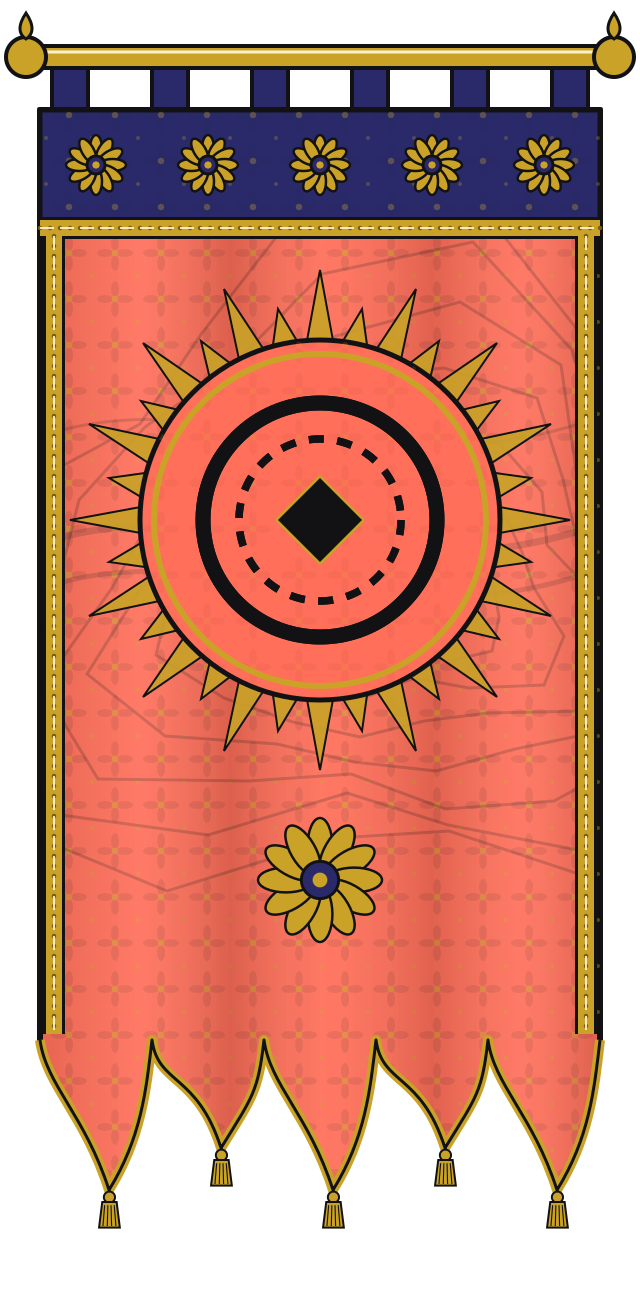
| Field | Warm Red-Orange #FF6F59 |
| Accent | Deep Indigo #2A2A6B |
| Emblem colour | Charcoal Black #121214 |
| Zari metal | Gold |
| Main emblem | Design choice: the head of a male wild animal (clan totem; species not stated in the source) |
| Second image | — |
| Night and day | Every visual accessory has two versions: by night the emblem on the dark field, by day the clan's field colour on cloth woven from its metal. |
6. Flags
Every clan has every flag type; the type says the occasion and the colours say the clan. The outlined card is the flag the Atlas assigns.
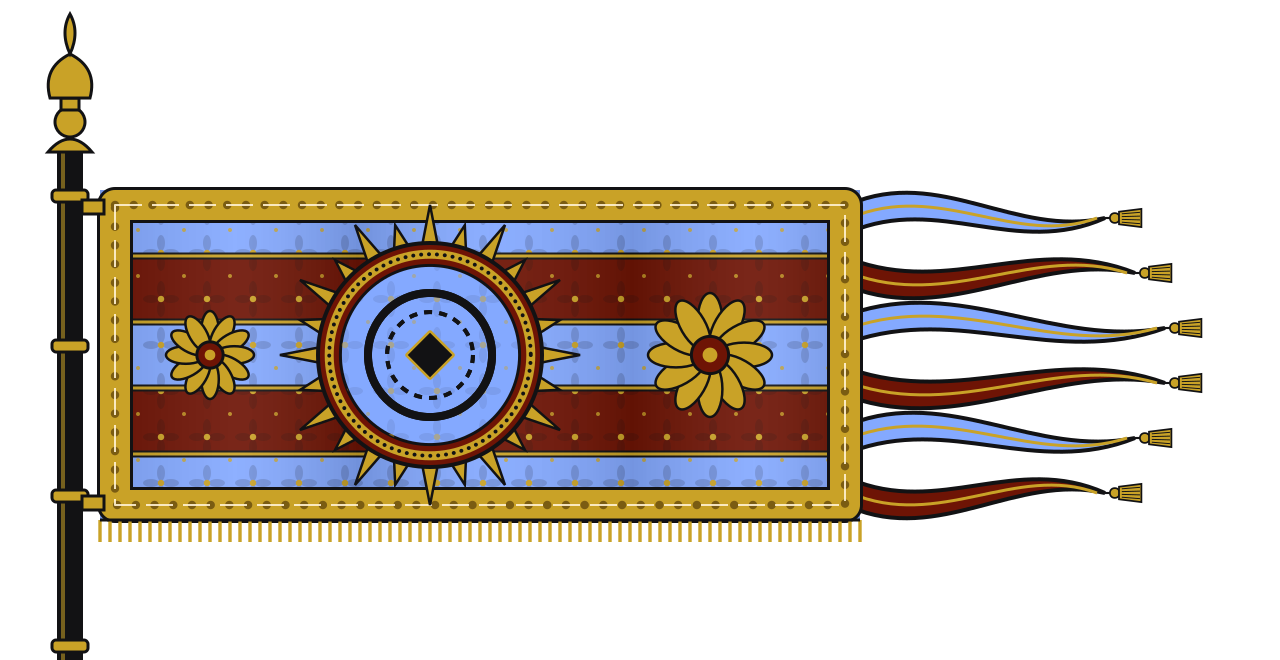
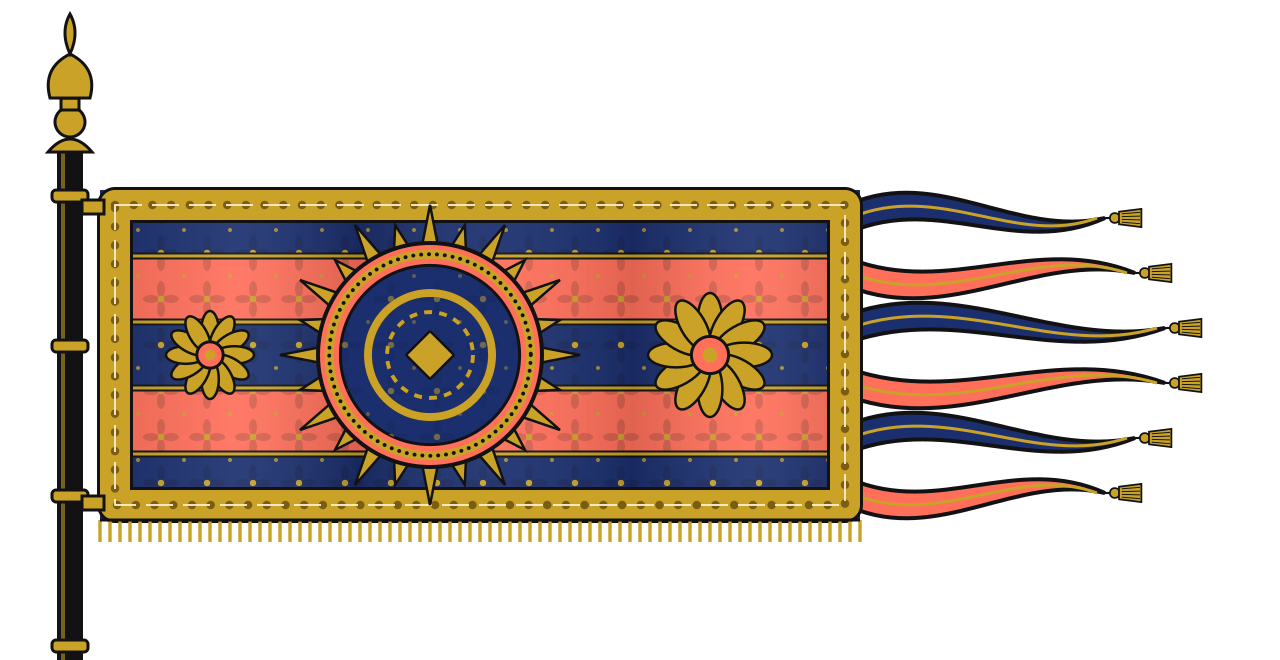
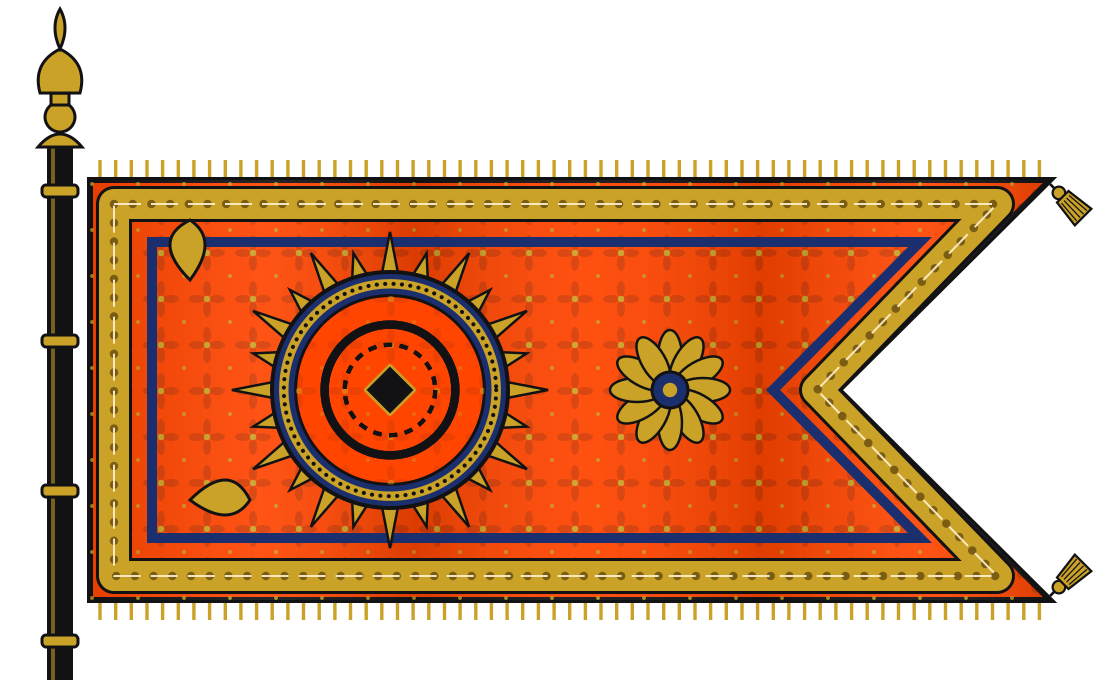
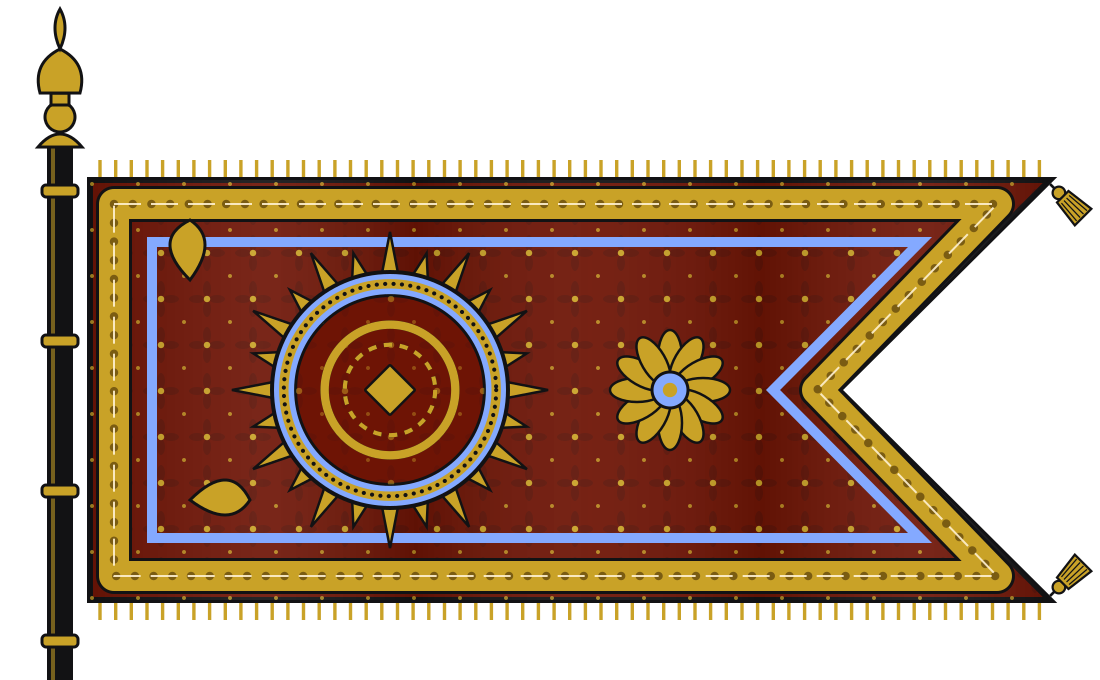
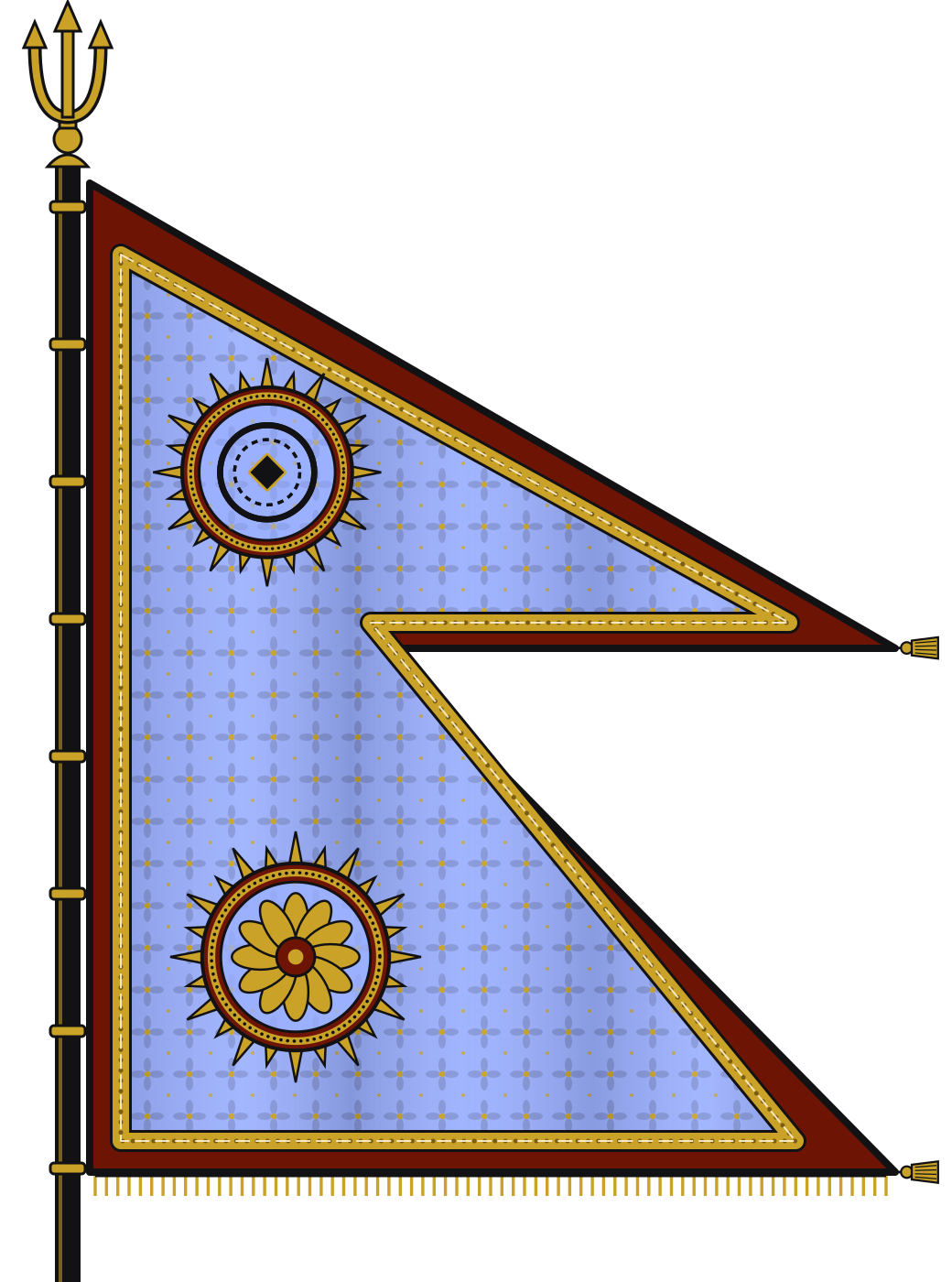
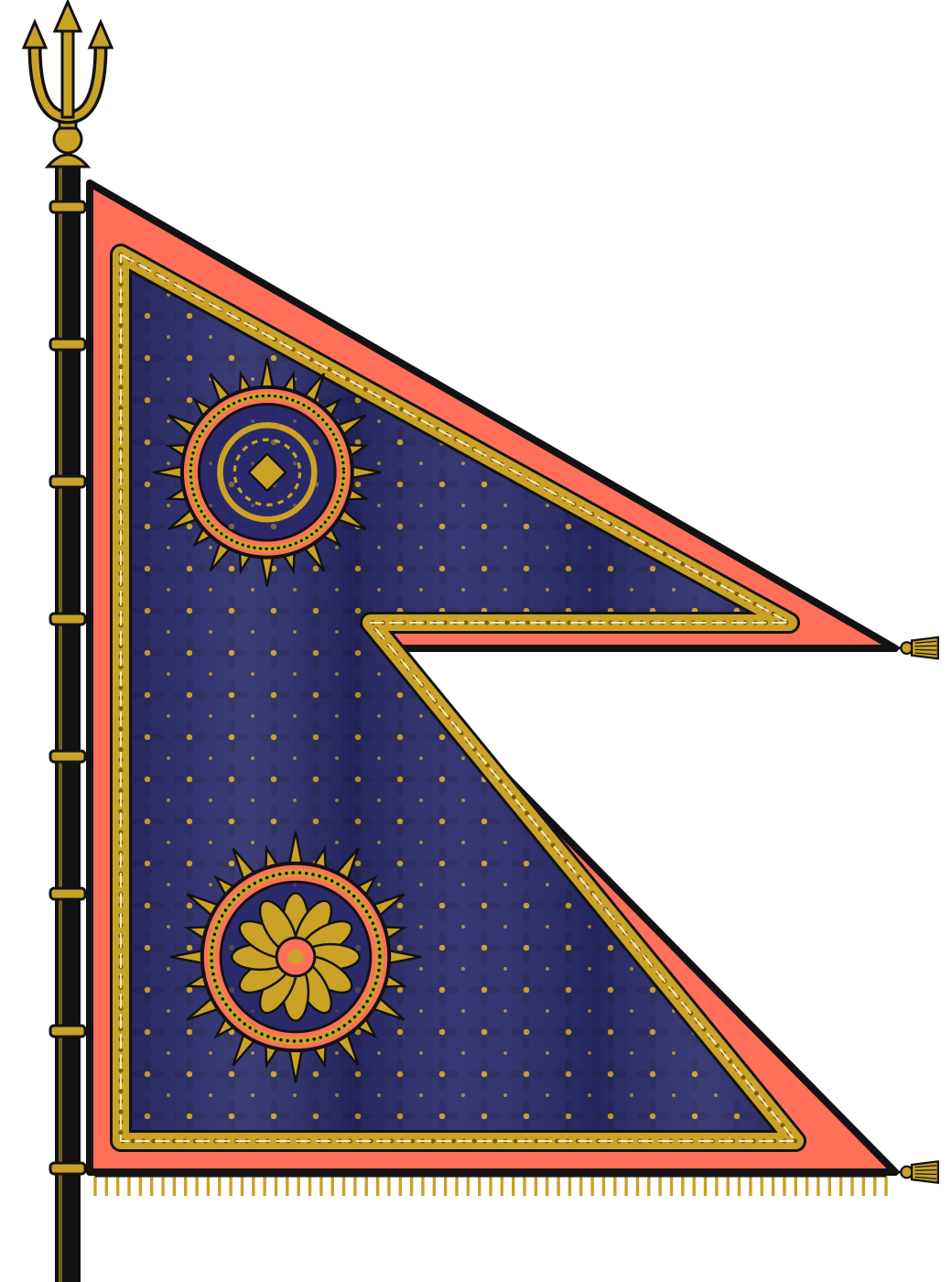

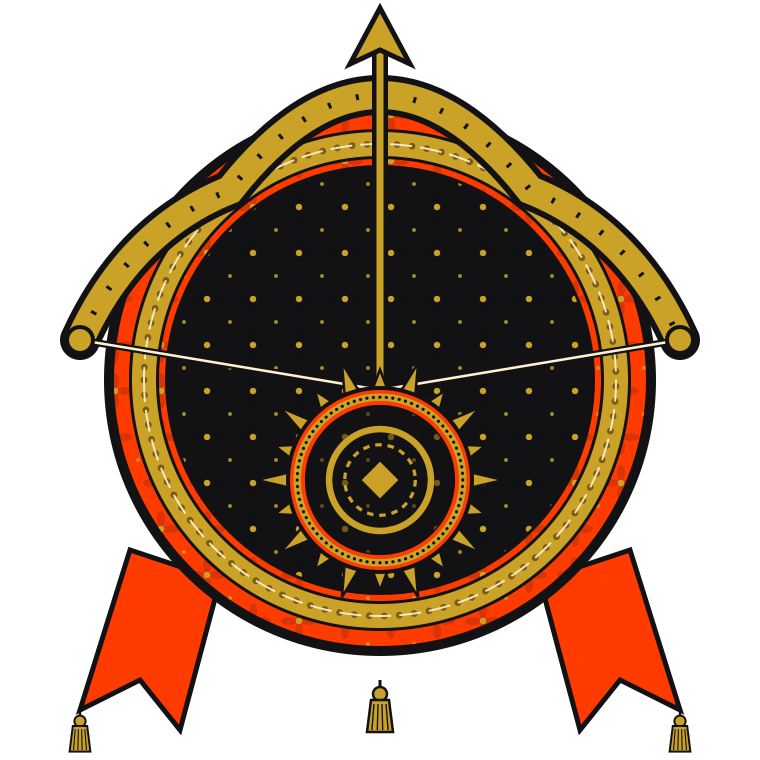
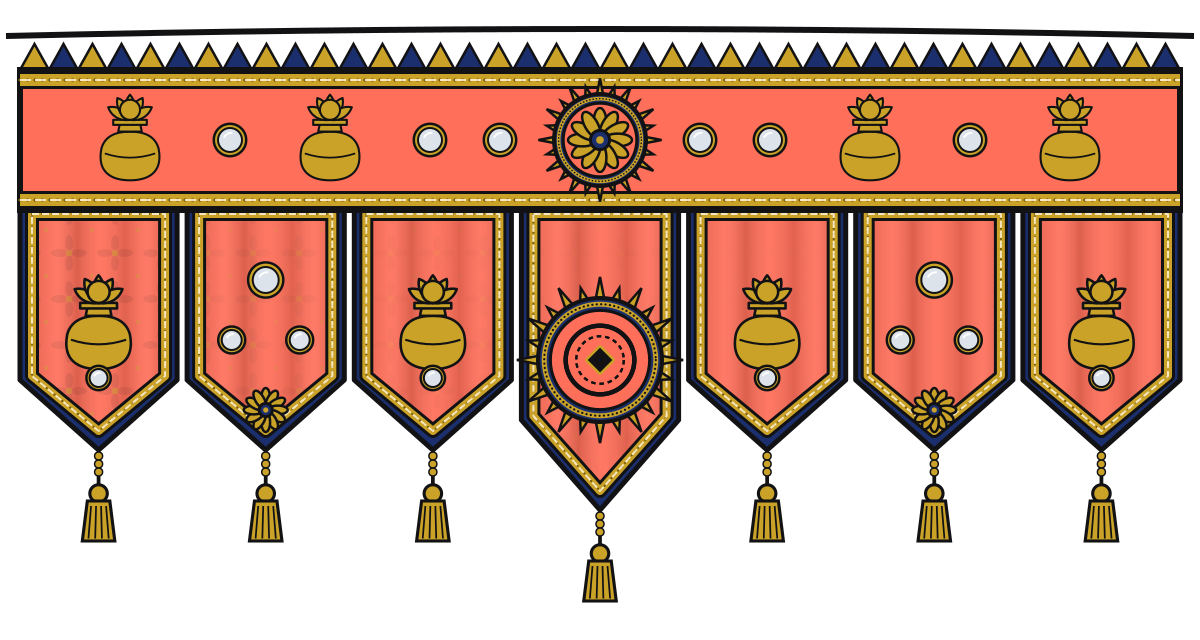
Historic banner
None recorded.
New flag types
| Accessory | For this clan | Basis |
|---|---|---|
| A9 Pota-dhvaja · ship and trade flag For ships, caravans and markets | Not yet designed for this clan | Design |
| A10 Utsava-patāka · festival flag Light, bright flag for fairs and festivals | Not yet designed for this clan | Design |
| A11 Shoka-dhvaja · mourning flag White cloth with the emblem outline in the clan's metal | Not yet designed for this clan | Design |
7. Regalia
| Accessory | For this clan | Basis |
|---|---|---|
| E1 Chhatra · house parasol The ceremonial umbrella | Not yet designed for this clan | Design |
| E2 Chamara · fly-whisks The pair of whisks beside the head of the house | Not yet designed for this clan | Design |
| E3 Danda · staff of office Staff or scepter | Not yet designed for this clan | Design |
| E4 Simhasana · seat The seat of the house, covered in clan cloth | Not yet designed for this clan | Design |
| E5 Khetaka · shield A round shield; the Changi and Dhanush are its flag forms | Not yet designed for this clan | Regional tradition |
| E6 Kula-ayudha · clan weapon The weapon the clan honours | Tanghi, an axe with a brass-plated handle, among the Khond arms (with a carved sword, bow and arrows, and sling); the axe is revered among the Dongria | Regional tradition |
8. Worn
| Accessory | For this clan | Basis |
|---|---|---|
| F1 Kula-vastra · clan cloth The clan's woven pattern in its kit colours | Kapdaganda shawl: white cotton, embroidered by young women, triangles for the Niyamgiri hills | Regional tradition |
| F2 Kirti-vastra · honour cloth A cloth earned for a deed, not inherited | Not yet designed for this clan | Design |
| F3 Kula-mala · garland flower The flower or leaf the clan wears as a garland | Not yet found for this clan | Under research |
| F4 Chinha · house pin A metal badge with the pin emblem | Not yet designed for this clan | Design |
9. Records
| Accessory | For this clan | Basis |
|---|---|---|
| H1 Clan words A traditional line in the native script | Kandh ghare Domna Mantri · “In a Kandh house the Dom is Prime Minister” Russell (1916), an Uriya saying about the Kandh household[3] | Design |
| H2 Biruda · titles The house's title or titles | Not yet found for this clan | Under research |
| H3 Prashasti · praise genealogy The lineage as written at the head of a grant | Not yet found for this clan | Under research |
| H4 Vahi · clan register The book of the clan's births, marriages and deaths | Not yet found for this clan | Under research |
| H5 Rana-ghosha · war cry The clan's cry in battle or celebration | Not yet found for this clan | Under research |
10. VishwaVit · knower of the world
Game values are design choices for this project, not historical claims.
References
- Wikipedia, Khond people, read 2026-10-22 and 2026-10-25, https://en.wikipedia.org/wiki/Khond_people
- Wikipedia, List of Scheduled Tribes in Odisha, read 2026-10-20, https://en.wikipedia.org/wiki/List_of_Scheduled_Tribes_in_Odisha
- R. V. Russell, The Tribes and Castes of the Central Provinces of India, vol. 3 (1916), Project Gutenberg #41424, read 2026-10-10, https://gutenberg.org/cache/epub/41424/pg41424-images.html
- Balabhadra Ghadai, Freedom Struggle in Odisha, Odisha Review, August 2012, pp. 31-35, read 2026-10-30, link
- Ritual Sacrifice Among the Kondh People, eTribal Tribune (read 28 Oct 2026, KulDevi run 335).
- Wikipedia, Dangaria Kandha, read 2026-10-25, https://en.wikipedia.org/wiki/Dangaria_Kandha
- Purusottam Thakur, Gathering at the campfires of Niyamgiri, PARI, 27 April 2018, read 2026-10-30, link
- Kandha Tribe of Odisha, asomodia blogspot (secondary blog), read 2026-10-30, https://asomodia.blogspot.com/2018
- Edgar Thurston and K. Rangachari, Castes and Tribes of Southern India, vol. 3 (Madras, 1909), Project Gutenberg eBook #42993, https://www.gutenberg.org/ebooks/42993
- MAGIK INDIA, The Dongria Kondh: guardians of the peaks, read 2026-10-30, link
- Sushree Mohanty, Indigenous Colours of Odisha: Handbook on 62 Tribes (KISS), read 2026-10-20, https://kissnew.kiss.ac.in/wp-content/uploads/2026/05/Indigenous-Colours-of-Odisha-Handbook-on-62-Tribes-Sushree-Mohanty.pdf
- Wikipedia, Kui language (India), read 2026-10-25, https://en.wikipedia.org/wiki/Kui_language_(India)
- Wikipedia, Kuvi language, read 2026-10-30, https://en.wikipedia.org/wiki/Kuvi_language
- John Campbell, A Personal Narrative of Thirteen Years Service amongst the Wild Tribes of Khondistan (London: Hurst and Blackett, 1864), archive.org, read 2026-10-30 (catalogue page), link
- Kandha Rising under Chakra Bisoi, historyofodisha.in, read 2026-10-30, link
- Odisha State Tribal Museum (SCSTRTI), Tribes of Odisha: Kandha, read 2026-10-25, https://ostm.in/tribes_of_odisha/kandha/
- Wikipedia, Kandha Gauda, read 2026-10-25, https://en.wikipedia.org/wiki/Kandha_Gauda
- R. V. Russell and Hira Lal, The Tribes and Castes of the Central Provinces of India, vol. 4 (London, 1916), Project Gutenberg eBook #20668, https://www.gutenberg.org/ebooks/20668
- Edgar Thurston and K. Rangachari, Castes and Tribes of Southern India, vol. 6 (Madras, 1909), Project Gutenberg eBook #42996, https://www.gutenberg.org/ebooks/42996