The Kheng live mainly in Zhemgang, Trongsa, Bumthang, Dagana and Mongar in central Bhutan, and are described as indigenous to south-central Bhutan[1]. Their language, Khengkha, is oral and is written unofficially in the Tibetan script; its name is printed as ཁེངས་ཁ་[2]. Until the 17th century the Kheng were split into petty kingdoms, the most important Buli and Nyakhar, and noble Dung houses held small fiefdoms[3][1]. Today the Kheng are known for bamboo and cane craft: most of Bhutan's bamboo, cane and rattan ware is produced in Zhemgang[3].
01Faith and deities
The Atlas assigns the KulDevi Guhyeshwari and records it as 'Assigned (not their faith)'. The sources name several deities, but none as the chief deity of the Kheng, so the sheet's KulDevi is shown as the main deity.
Shakti Peetha of Kathmandu, honoured by Buddhists too
The clan followed another faith. This goddess of its homeland is assigned for naming only.
| Deity or tradition | Place in the clan's life | Evidence |
|---|---|---|
| O-de Gungyal (God of Heaven) | Named among the deities in Lham Dorji's account of the Kheng nobles | [4] |
| Tenpa Shenrab | Named among the deities in Lham Dorji's account | [4] |
| Ama Gung-lhai-gyalmo | Named among the deities in Lham Dorji's account | [4] |
| Palden Lhamo | Named among the deities in Lham Dorji's account | [4] |
| Guru Rinpoche | Named in Lham Dorji's account; Zhemgang sites are linked to him | [4][3] |
| Jitsun Drolma | Named among the deities in Lham Dorji's account | [4] |
| Buli Manmo (lake goddess) | legend The legendary pot of the Buli Ponpo came from her | [4] |
| Tshomen Kuntu Zangmo (Buli Moenmo) | Protector goddess of Kheng Buli; her palace is at the Buli Tsho lake | [5] |
| Oath witnesses: Nadpo Rinchen Drakpo, Chunglai Lhasang Karpo, Dhongai Tsanchen Marpo, Kibulungtsan, Aka Raja | Local deities who witness oaths, such as the Berti Mon oath to Tagma Dung | [4] |
| Choed-pala | Festival with Bon elements at which Kheng shamans play the nga | [6] |
| Bon | The practice of the Kheng before Buddhism (shamanism and animism) | [1] |
02Temples
The sources name these places of worship, but not who built or patronised them: Nyakhar Lhakhang, Monmo Tokto Lhakhang (Kikhar), Tharpacholing (Tagma Gonphai) and Umpang Dzong (the Tagma Dung manor)[4]. A story tells that Nyakhar Dung threw a cymbal to find a temple site[4]. Under research: the builders and patrons of each place, and their deities.
Built by the clan
Not recorded.
Given patronage or grants by the clan
Not recorded.
03Languages and scripts
| Language or script | Kind | Under the clan | Evidence |
|---|---|---|---|
| Khengkha (Kheng) living | Oral language; East Bodish, Sino-Tibetan; ISO 639-3 xkf | Native names ཁེངས་ཁ་ and འཁྱེང་ཁ་; spoken at home, in commerce, local politics and traditional religion; not taught in Bhutanese schools | [2][7] |
| Tibetan (Uchen) script | Writing system, unofficially borrowed for the language | The article prints the native names in the Dzongkha script; the language itself is oral | [2] |
| Bumthap, Khempa and Kurtoep dialects | Dialects by district | Lower (Bumthap), Middle (Khempa) and Upper (Kurtoep) Kheng, per the Bumthang district description | [2] |
| Pchikor, Nangkor and Tamacho dialects | Dialects named by Asia Harvest | Conflicts with the list above; not checked | [8] |
| Bumthang languages (Kurtoep, Nupbi, Bumthang) | Languages in contact with Khengkha | Contact noted by Schicklgruber (1998) and van Driem (2007) | [2] |
| Dzongkha later | Language listed alongside Khengkha | Kuensel (2008) reports an acute shortage of Dzongkha teachers in Kheng areas | [1][9] |
04Books and literature
No Kheng book from the clan's own era is listed in the sources read. The works below are modern studies of the people and language, and one article records oral sources.
Written during the clan's history
| Work | Author | Kind | When | Link to the clan |
|---|---|---|---|---|
| An Introduction to Khengkha: A Language of Central Bhutan | Takumi Ikeda | Language study | 2021 | [10] |
| Khengkha Lessonbook | Yangdzom and Arkesteijn | Teaching book (SNV, Thimphu) | Not dated in the source | [11] |
| Endangered Languages of Bhutan and Sikkim | G. van Driem | Language survey | 2007 | [12] |
| "The Historical Anecdotes of Kheng Nobilities" | Lham Dorji | History article, Journal of Bhutan Studies 13(2); oral sources, some going back to the 9th century | 2005 | [4] |
| The Spider and the Piglet | John Ardussi | History (cited for the noble families) | 2004 | [13] |
| Khenrig Namsum: A Historical Profile of Zhemgang Dzongkhag | Rigden and Pelgen | History of the district | 1999 | [14] |
Given patronage by the clan
Not recorded.
05Thinkers and scholars
| Name | Field | Era | Contribution |
|---|---|---|---|
| Lham Dorji | Writer on the Kheng nobles | 2005 | Oral sources on the Dung, Ponpo, Khoche and Gadpo houses[4] |
| Dr Tim Bodt | Researcher credited for the habitation claim | Not dated | Archaeological and linguistic evidence for more than 4,000 years in the central valleys[15] |
| John Ardussi | Author cited for the noble families | 2004 | The Spider and the Piglet[13] |
| G. van Driem | Language survey | 1994; 2007 | Mutual intelligibility of Kheng, Bumthang and Kurtoep; Endangered Languages of Bhutan and Sikkim[16][12] |
| Takumi Ikeda | Language study | 2021 | An Introduction to Khengkha[10] |
| Hyslop | Language classification | 2010 | East Bodish classification of Khengkha[7] |
| S. R. Chakravarty | Scholar cited for the earliest inhabitants | Not dated | Khengpas among the earliest inhabitants of Bhutan[17] |
| Dechen Tshering | Researcher at the Royal University of Bhutan | 2019 | Study of Tsharzo, the cane and bamboo work of Kheng Bjoka[18] |
| André Bosch | Researcher, University of Sydney | 2016 | Study of Tshangkha village, Trongsa[17] |
| Janet Herman | Writer for Smithsonian Folkways | 2014 | Article on Kheng Sonam Dorji[19] |
Scholars and writers the sources name. Their field is what the source says of them; no other training is claimed.
06Art and architecture
The Kheng are known for cane and bamboo ware (Tsharzo)[3][18]. Architecture named in the sources: Zhemgang Dzong and the lhakhangs named above.
Painting and wall art
Not recorded.
Sculpture and temple art
Not recorded.
Temple and building architecture
| Art form | What it is | Era | Evidence |
|---|---|---|---|
| Zhemgang Dzong (Druk Dechen Yangtse Dzong) | Built in 1655 by Zhabdrung Ngawang Namgyal to symbolise the unification of Khengrig Namsum | 1655 | [5] |
Weaving and textiles
Not recorded.
Clothing and jewellery
Not recorded.
Coins, pottery and crafts
| Art form | What it is | Era | Evidence |
|---|---|---|---|
| Tsizib | Carry basket | Tsharzo, cane and bamboo | [18] |
| Lakchung | Fruit basket for ceremonies | Tsharzo, cane and bamboo | [18] |
| Beykur | Square yarn basket or gift box | Tsharzo, cane and bamboo | [18] |
| Bangchung | Paired round containers, from Yulay bamboo | Tsharzo, cane and bamboo | [18] |
| Bello | Sun hat | Tsharzo, cane and bamboo | [18] |
| Poedung | Incense container | Tsharzo, cane and bamboo | [18] |
| Bechab | Winnowing platter | Tsharzo, cane and bamboo | [18] |
| Pari | Drying mat | Tsharzo, cane and bamboo | [18] |
| Soray | Arrow quiver | Tsharzo, cane and bamboo | [18] |
| Jatsa | Butter-tea strainer | Tsharzo, cane and bamboo | [18] |
| Sipa | Lidded butter container | Tsharzo, cane and bamboo | [18] |
| Palang | Tube for alcohol or water | Tsharzo, cane and bamboo | [18] |
07History
Before the Drukpa state
Before Buddhism the Kheng practised Bon, shamanism and animism[1]. Archaeological and linguistic evidence is said to show habitation of the central valleys for more than 4,000 years, a claim the Wikipedia article credits to Dr Tim Bodt[15][1]. The Kheng, Bumthang, Kurtoep and Trongsa Mangdue peoples are described as ethnolinguistically the same or closely related[1]. The Kheng language is said to have spread to the Bumthang and Kurtoep areas (S. R. Chakravarty, cited by Facts and Details)[17].
Petty kingdoms to the 17th century
The Kheng were split into many petty kingdoms until the 17th century, the most important Buli and Nyakhar[3]. Numerous Dung families, secular and religious noble families, held small fiefdoms until the 17th century (John Ardussi, 2004, cited on the Wikipedia page)[1][13]. The Drukpa conquest in the mid-17th century ended the real power of these kingdoms; their descendants still use 'king' as an honorific[3].
Zhabdrung and the dzong (1616–1655)
The arrival of the Zhabdrung in 1616 shifted dominance in Kheng; the nobles were later subdued under Tongsa Penlop Chogyal Minjur Tenpa (1613–1680) and Lama Namsey Dorji[4]. Zhemgang Dzong (Druk Dechen Yangtse Dzong) was built in 1655 by Zhabdrung Ngawang Namgyal to symbolise the unification of Khengrig Namsum[5].
Late nineteenth century
After a revolt against the Dzongpon, upper Kheng was administered from Wangdicholing. Central forces crushed the Nyakhar Dung lineage, and the Zhabdrung later restored privileges[4]. Pema Tenzin was killed in 1882 at Byakar Dzong[4].
Reforms and the district split (1950s–1963)
The Kheng nobles lost their power after the Third King's reforms of the early 1950s, which abolished serfdom[4]. Samkhar village was deserted and resettled in the 1950s[4]. In 1963 Khengrig Namsum was divided into Mongar and Zhemgang districts[3].
Under research
Under research. Leads: the full Lham Dorji article (JBS 13(2)); John Ardussi, The Spider and the Piglet (Heidelberg PDF, not yet read); Heidelberg chapter 2 (not yet read); Rigden and Pelgen (1999); White, Sikhim and Bhutan (1909, archive.org, not yet read). No dated inscription or dated primary chronicle of the Kheng kingdoms was in the sources read.
08Journey and migrations
The sources read place the Kheng in the central valleys of Bhutan. They describe no dated migration.
Not recorded.
09Seats and lands
| Place | Role | Where today |
|---|---|---|
| Zhemgang Dzong (Druk Dechen Yangtse Dzong) | Built 1655 by Zhabdrung Ngawang Namgyal; the nobles were the principal taxpayers (ma-khrai) here | Zhemgang district[4][5] |
| Buli | Petty kingdom; Buli forest and the sacred Buli Tsho lake; rice grown on the Buli plateau | Zhemgang[3][5] |
| Nyakhar | Petty kingdom and the Nyakhar Dung lineage; Nyakhar Lhakhang | Not given in the sources read[4] |
| Tagma (Tagma Chogpa, Lower Kheng) | Place of the Tagma Dung house; Tharpacholing in Tagma Gonphai | Not given[4] |
| Umpang Dzong | Manor of the Tagma Dung | Not given[4] |
| Samkhar | Village of the Samkhar Dung; deserted and resettled in the 1950s | Not given[4] |
| Goleng | Place of the Roop festival, led by the Dung household | Not given[4] |
| Kikhar | Place of Monmo Tokto Lhakhang | Not given[4] |
| Wangdicholing | Administered upper Kheng after the late-19th-century revolt | Not given[4] |
| Byakar Dzong | Where Pema Tenzin was killed in 1882 | Not given[4] |
| Goshing and Pantang | Kheng communities where the tamuru is listed | Not given[6] |
| Kamalung | Centre of Bjoka gewog; 31 km from Panbang | Bjoka gewog, Zhemgang[18] |
| Kaktong | Birthplace of the singer Kheng Sonam Dorji, in lower Zhemgang | Lower Zhemgang[19] |
| Duenmang hot spring | Hot spring in Nangkor gewog | Zhemgang[5] |
| Manas (Drangme Chhu) | River and Manas National Park, Zhemgang | Zhemgang[3] |
| Mangdechu and Kurichu | Rivers marking the Kheng boundary with the Nyenkha and Tsangla areas (Asia Harvest) | Zhemgang and western Mongar[8] |
| Khengrig Namsum | The Kheng name for their region; divided into Mongar and Zhemgang in 1963 | Central Bhutan[3] |
| Central Bhutan districts | Where the Kheng live, per Wikipedia: Zhemgang, Trongsa, Bumthang, Dagana and Mongar; also south-west Mongar, south-east Trongsa and Sarpang | Central and southern Bhutan[2][1] |
10Notable figures
| Name | Role | Era | Known from |
|---|---|---|---|
| Kings of Buli and Nyakhar | Rulers of the most important petty kingdoms until the 17th century; names not given in the sources read | To the 17th century[3] | |
| Guse Langling (Lhagon Pelchen) | Named in Lham Dorji's account of the Dung houses | Not dated[4] | |
| Dung Nagpo Dragpa Wangchuk | Named in Lham Dorji's account of the Dung houses | Not dated[4] | |
| Norbu Wangchuk (Tunglabi Dung) | Of the Tunglabi Dung house | Not dated[4] | |
| Drongsep Singye Namgyal (Buli Ponpo) | Of the Buli Ponpo house | Not dated[4] | |
| Pema Tenzin | Killed at Byakar Dzong | 1882[4] | |
| Chogyal Minjur Tenpa (1613–1680) | Tongsa Penlop who subdued the Kheng nobles | 1613–1680[4] | |
| Lama Namsey Dorji | Subdued the Kheng nobles together with the Tongsa Penlop | Not dated[4] | |
| Zhabdrung Ngawang Namgyal | Arrival in 1616 shifted dominance; built Zhemgang Dzong in 1655 | 1616; 1655[4][5] | |
| The Third King | Reforms of the early 1950s abolished serfdom and ended the nobles' power | Early 1950s[4] | |
| Pema Lingpa | legend Hosted in spirit by Tagma Dung; the bi-annual Peling Kuchey ceremony is held for him | Not dated[4] | |
| Lhasey Tsangma | Named in Lham Dorji's account | Not dated[4] | |
| Monmo Tashi Kheudon | Named in Lham Dorji's account | Not dated[4] | |
| Kheng Sonam Dorji | Singer and dranyen player, born in Kaktong, lower Zhemgang; sang the first Khengpa-language song broadcast nationally | Modern (birth year not given)[19] |
11Allies, rivals and marriages
| People | Relationship | When |
|---|---|---|
| Bumthang | Close language kin, mutually intelligible (van Driem 1994); Bumthang nobles held land in Kheng and their herds wintered there[3][16] | Not dated |
| Kurtoep | Named with Kheng and Bumthang as the Bumthang languages[2][20][12] | Not dated |
| Trongsa Mangdue | Ethnolinguistically the same or closely related[1] | Not dated |
| Ngalop | Listed as related in the Kheng infobox; the name may include Kheng speakers[1][17] | Not dated |
| Sharchop | Listed as related in the Kheng infobox; Kheng are closer to central peoples than to Sharchops[1][17] | Not dated |
| Bumthap and Mangdep | Grouped with the Khengpas by the Tourism Council of Bhutan[17] | Not dated |
| Berti Mon | Bound to Tagma Dung by an oath witnessed by local deities, 'until crow turns white'; attendant (arpo) on rotation until the 1970s; bond formally burned in 1990[4] | 1970s–1990 |
| Tunglabi Dung and Nyakhar Dung | Contested jurisdiction[4] | Not dated |
| Zhabdrung and the Drukpa state | Arrival in 1616 shifted dominance; the late-19th-century revolt and the restored privileges of the Nyakhar Dung[4] | 1616 onward |
| Tongsa Penlop | Subdued the Kheng nobles[4] | 1613–1680 |
12Society and livelihood
The Kheng were governed through noble houses until the 1950s reforms. The Dung houses were patrilineal, with the eldest son as heir; Ponpo, Khoche and Gadpo were further titles[4]. Zhemgang has eight gewogs, and a cane and bamboo cooperative was formed at Bjoka in 2007[5][18].
Government and social order
| Institution or group | What it was | Evidence |
|---|---|---|
| Dung houses | Noble families; patrilineal, eldest son heir[4] | [4] |
| Ponpo, Khoche and Gadpo | Titles of noble status; Gadpo status came from intelligence, strength and wealth rather than noble ancestry[4] | [4] |
| Zhemgang Dzong | Where the nobles paid as the principal taxpayers (ma-khrai)[4] | [4] |
| Berti Mon oath | A bond between Berti Mon and Tagma Dung, sworn before local deities, with an attendant on rotation; formally burned in 1990[4] | [4] |
| Bjoka Tsharzo Gongphel Doetshen | Cane and bamboo cooperative formed in 2007, 174 members (2019 page) | [18] |
| Gewogs of Zhemgang | Eight gewogs; the page names Trong, Ngangla, Pangkhar, Nangkor and Shingkhar | [5] |
| Nurseries and plantations | Started after over-harvesting of wild cane and bamboo; a Remote Community Development Project (2007) is named in the page without detail | [18] |
Livelihood over time
| Era | Livelihood | Evidence |
|---|---|---|
| Since the 17th century (page) | Cane and bamboo craft (Tsharzo), one of the Zorig Chusum crafts | [18] |
| Not dated | Rice on the Buli plateau; farming like the Mangdeps (Facts and Details) | [3][17] |
| Not dated | Knowledge of forest plants; wild foods of Zhemgang: bananas, oranges, mangoes, yams, bamboo shoots, ferns and orchids | [3] |
| Not dated | Noble families as principal taxpayers at Zhemgang Dzong | [4] |
| 2019 (page) | Men and women both work the cane; households reportedly earn Nu. 50,000–100,000 a year; the page says baskets replaced brass, steel and plastic utensils | [18] |
| 2016 (study) | Tshangkha village, Trongsa: maize the main cash crop; many young people left for work (the entry lists this under Kheng facts; the village's link to the Kheng is not stated) | [17] |
13Sub-clans and related clans
The sources name noble title groups (Dung, Ponpo, Khoche, Gadpo), each with its houses and villages, and three regional divisions (Tagma Chogpa, Nangkorpa, Chikorpa; by distance from Zhemgang Dzong). Dialect groups and related peoples follow. Every house listed is a candidate for its own entry; the sources do not give sizes for any of them.
| Clan | Relation | Where | Size | In the Atlas | Evidence |
|---|---|---|---|---|---|
| Dung | Branch | Noble title (Wylie gdung): numerous families, patrilineal, eldest son heir | new clan candidate | [4] | |
| Tagma Dung | Sub-clan | Tagma (Tagma Chogpa, Lower Kheng); manor at Umpang Dzong; sustains Peling Kuchey | new clan candidate | [4] | |
| Samkhar Dung | Sub-clan | Samkhar (village deserted and resettled in the 1950s) | new clan candidate | [4] | |
| Subrang Dung | Sub-clan | Named in the Dung list; place not given | new clan candidate | [4] | |
| Zurphai Dung | Sub-clan | Named in the Dung list; place not given | new clan candidate | [4] | |
| Goleng Dung | Sub-clan | Goleng; the Dung household leads Roop | new clan candidate | [4] | |
| Nyakhar Dung | Sub-clan | Nyakhar; the lineage is effectively extinct (oral knowledge fading) | new clan candidate | [4] | |
| Shingkhar Dung | Sub-clan | Named in the Dung list; place not given | new clan candidate | [4] | |
| Tunglabi Dung | Sub-clan | Named in the Dung list; Norbu Wangchuk of this house; contested jurisdiction with Nyakhar Dung | new clan candidate | [4] | |
| Kuther Dung | Sub-clan | Named in the Dung list; place not given | new clan candidate | [4] | |
| Ponpo | Branch | Noble title (Wylie dpon po) | new clan candidate | [4] | |
| Dakpai Ponpo | Sub-clan | Dakpai | new clan candidate | [4] | |
| Kikhar Jang Ponpo | Sub-clan | Kikhar; Monmo Tokto Lhakhang is at Kikhar | new clan candidate | [4] | |
| Tali Ponpo | Sub-clan | Tali | new clan candidate | [4] | |
| Buli Ponpo | Sub-clan | Buli; legend the legendary pot came from a lake goddess; Drongsep Singye Namgyal of this house | new clan candidate | [4] | |
| Khoche | Branch | Noble title (Wylie kho che) | new clan candidate | [4] | |
| Joka Khoche | Sub-clan | Joka | new clan candidate | [4] | |
| Ngangla Khoche | Sub-clan | Ngangla | new clan candidate | [4] | |
| Gadpo | Branch | Noble title (Wylie rgad po); status from intelligence, strength and wealth | new clan candidate | [4] | |
| Gomphu Gadpo | Sub-clan | Gomphu | new clan candidate | [4] | |
| Wamling Gadpo | Sub-clan | Wamling | new clan candidate | [4] | |
| Bardo Gadpo | Sub-clan | Bardo | new clan candidate | [4] | |
| Khomshar Gadpo | Sub-clan | Khomshar | new clan candidate | [4] | |
| Buli kings | Dynasty from this clan | Buli, petty kingdom until the 17th century; descendants still use 'king' as an honorific | new clan candidate | [3] | |
| Nyakhar kings | Dynasty from this clan | Nyakhar, petty kingdom until the 17th century | new clan candidate | [3] | |
| Tagma Chogpa (Lower Kheng) | Branch | Division by distance from Zhemgang Dzong; places include Tagma, Berti, Samkhar, Tali, Buli, Goleng, Nyakhar, Joka, Ngangla, Kikhar, Dakpai | new clan candidate | [4] | |
| Nangkorpa (Middle Kheng) | Branch | Division by distance from Zhemgang Dzong | new clan candidate | [4] | |
| Chikorpa (Upper Kheng) | Branch | Division by distance from Zhemgang Dzong; administered from Wangdicholing after the late-19th-century revolt | new clan candidate | [4] | |
| Khempa | Branch | Middle Kheng dialect (Bumthang district description); conflicts with Pchikor/Nangkor/Tamacho (Asia Harvest) | new clan candidate | [2] | |
| Pchikor, Nangkor and Tamacho | Branch | Three dialects named by Asia Harvest; conflicts with the Bumthap, Khempa, Kurtoep list | new clan candidate | [8] | |
| Bumthap | Related people | Lower Kheng dialect (Bumthang district description); grouped with Khengpas by the Tourism Council of Bhutan | new clan candidate | [2][17] | |
| Kurtoep | Related people | Upper Kheng dialect; mutually intelligible with Kheng (van Driem 1994) | new clan candidate | [2][1][16] | |
| Bumthang | Related people | Bumthang district; close language and land ties; 92% lexical similarity per Asia Harvest | new clan candidate | [1][8][3] | |
| Trongsa Mangdue | Related people | Trongsa; ethnolinguistically the same or closely related | new clan candidate | [1] | |
| Ngalop | Related people | Western and northern Bhutan, including Thimphu; listed as related in the Kheng infobox | same name as SUB-065: check | [1][21] | |
| Sharchop | Related people | Eastern districts; listed as related in the Kheng infobox | same name as SUB-076: check | [1][21] | |
| Mangdep | Related people | Central Bhutan (Tourism Council of Bhutan grouping) | new clan candidate | [17] | |
| Berti Mon | Related people | Berti; oath bond with Tagma Dung | new clan candidate | [4] |
Clans marked "new clan candidate" are not in the Atlas yet.
14Surnames
No surname is recorded for the Kheng in the sources read. The Lham Dorji article names the noble houses by title and village (Dung, Ponpo, Khoche, Gadpo), and gives no surnames[4].
Not recorded.
15Songs and music
No Kheng song text is recorded in the sources read. Instruments named for the Kheng are listed below; the songs are described without their words.
The first Khengpa-language song broadcast nationally
The article ties the name 'Kheng' to this song; sung by Kheng Sonam Dorji, who plays the dranyen[19]
Two songs for the first king's family (untitled in the source)
Recalled by an elderly informant in Bosch's 2016 study; not reproduced[17]
Instruments and styles
| Instrument or style | What it is | Evidence |
|---|---|---|
| Dong-lim (badui-pa jing) | Vertical bamboo flute of the cowherds; listed for the Kheng | [6] |
| Bai-jing (ba-jing) | Bamboo flute; listed for the Kheng | [6] |
| Nga | Barrel drum of solid wood, leather and cane straps; played by shamans at the Choed-pala festival, which has Bon elements | [6] |
| Tamuru | One-string bowed instrument of bamboo covered with dried animal skin, with a horse-tail bow; listed for the Kheng at Goshing and Pantang | [6] |
| Kralang ba (prutung ba) | Bamboo wind chime of six to eight pipes, pentatonic; played in the harvest season | [6] |
| Kapka ma | Full-length bamboo poles hung from cane rope to scare animals from crops, in lower Kheng | [6] |
16Poems, lullabies and children's rhymes
No Kheng poem, lullaby or rhyme is recorded in the sources read.
None recorded yet.
17Stories, legends and proverbs
Stories and legends
| Story | What happens | Told by | Evidence |
|---|---|---|---|
| The Buli Ponpo's legendary pot legend | A pot that came from the lake goddess to the Buli Ponpo | Oral sources, via Lham Dorji | [4] |
| The cymbal at Nyakhar legend | Nyakhar Dung threw a cymbal to find a temple site | Oral sources, via Lham Dorji | [4] |
| Pema Lingpa and Tagma Dung legend | Tagma Dung hosted Pema Lingpa in spirit | Oral sources, via Lham Dorji | [4] |
Proverbs and sayings
Not recorded.
18Festivals and fairs
| Festival or fair | When | Where | What happens |
|---|---|---|---|
| Roop | Not dated in the source | Goleng | Led by the Dung household[4] |
| Peling Kuchey | Bi-annual | Not given | Ceremony for Pema Lingpa, sustained by Tagma Dung[4] |
| Chodpa | Not dated in the source | Goshing | Named as the festival at Goshing[4] |
| Choed-pala | Not dated in the source | Not given | Kheng shamans play the nga; the festival has Bon elements[6] |
| Bird-watching festival | October–November | Zhemgang | Named on the Zhemgang page with the Buddhist and non-Buddhist festivals of small villages[3] |
19Food, dress and games
Food
| Item | What it is | Evidence |
|---|---|---|
| Wild foods of Zhemgang | Bananas, oranges, mangoes, yams, bamboo shoots, ferns and orchids, with knowledge of forest plants (as the page gives them for Zhemgang) | [3] |
Dress
Not recorded.
Games and martial arts
Not recorded.
Tags: living still practised · revived brought back after a break · lost known only from records · research reported but not yet confirmed from a source. Songs and poems under copyright are listed by title only; restricted or sacred material is noted without its content.
20Status today
The Kheng live in central Bhutan. Khengkha is still spoken at home, in commerce and in local politics, and is listed as vulnerable[1][2]. The cane and bamboo cooperative at Bjoka had 174 members in 2019[18].
Who carries the name today
| Community | Link | Basis | Evidence |
|---|---|---|---|
| Kheng (SUB-039) | Documented | [1] | |
| Tagma Dung (noble house) | Documented | [4] | |
| Nyakhar Dung (noble house) | Documented | [4] (effectively extinct) | |
| Descendants of the Buli and Nyakhar kings | Documented | [3] (they still use 'king' as an honorific) |
Recognised heritage
| What | Recognition | Evidence |
|---|---|---|
| Tsharzo cane and bamboo work | One of the Zorig Chusum crafts (the page); Bjoka Tsharzo Gongphel Doetshen cooperative formed 2007 | [18] |
| Peling Kuchey | A bi-annual ceremony for Pema Lingpa, sustained by Tagma Dung | [4] |
| Roop in Goleng | Led by the Dung household | [4] |
Not yet reviewed by the Kheng community. This page is drafted from published sources only; the community's own view is not yet recorded.
21For children
The cowherd's flute
In the hills of central Bhutan live the Kheng. Their homes are in Zhemgang, Trongsa, Bumthang, Dagana and Mongar. Long ago, the Kheng had small kingdoms, and the most important were Buli and Nyakhar. The people speak a language called Khengkha. Bamboo grows in their forests, and the Kheng make baskets from cane. Cowherds play the dong-lim, a bamboo flute. At harvest time, the kralang ba, a bamboo wind chime with six to eight pipes, sings in the fields.
Written for this project
22Across the project
| Project | What carries this clan | Status |
|---|---|---|
| Atlas of the Janas | No pin set for the Kheng in this run; Zhemgang is the homeland the sources give (era not dated) | Research |
| KulDevi and GrahDevi | Guhyeshwari, assigned in the Atlas (not the Kheng's own faith) | From the Atlas |
| Planet naming | Under research | Research |
| Renaming and waters | Buli Tsho lake (sacred) and the Manas (Drangme Chhu) in Zhemgang; no renaming recorded in the sources read | Sources read |
23Open questions
- Native-script form of the greeting 'Kuzu zangpo' (the page gives it in Latin letters only); a Khengkha motto or saying, if the community offers one.
- Dialect names conflict: Bumthap, Khempa and Kurtoep (Bumthang district description) against Pchikor, Nangkor and Tamacho (Asia Harvest). Check against a Khengkha source.
- Speaker numbers conflict: about 40,000 (language page body), 50,000 (infobox 2003), 65,000 in total; Asia Harvest's 2000, 2010 and 2020 series names no source.
- Is Khengkha a language (ISO 639-3 xkf) or a dialect of Bumthangkha (Bhutan Cultural Atlas)? Both are on the record.
- Buli Manmo (Lham Dorji) and Buli Moenmo or Tshomen Kuntu Zangmo (Zhemgang page): the same deity, or two?
- Who built or patronised Nyakhar Lhakhang, Monmo Tokto Lhakhang, Tharpacholing and Umpang Dzong; their deities.
- The name 'Kheng': the Smithsonian Folkways article ties it to a song (2014); check against the older account of the kingdoms (Facts and Details, S. R. Chakravarty).
- Tshangkha village, Trongsa (Bosch 2016): the entry lists it among Kheng facts, but the village's link to the Kheng is not stated.
- Dates for Roop, Chodpa, Peling Kuchey and Choed-pala; Zhemgang Tshechu (triptobhutan.com, not yet read).
- Surnames: none found. Check Ardussi (2004) and the Huber 2015 PDF (not yet read).
- Unfetched leads: Bjoka Lhakhang (BCA), Zhemgang Dzong (BCA), Bomeyla Karmai Wangzom (BCA), JBS 15 PDF, Heidelberg chapter 2 and Ardussi's PDF, core.ac.uk 1323132, the ecb.bt village list and White 1909 (archive.org).
- Community review: none yet. Ask the Kheng community to check the house list, the deities and the songs before the page is treated as final.
24Astitva
अस्तित्व · being, existence: everything by which the clan is known
The sources record one accessory for the Kheng: the titles of the noble houses (Dung, Ponpo, Khoche, Gadpo) and the 'king' honorific of the Buli and Nyakhar lines[4][3]. No seal, coin, totem, guardian tree or war cry is recorded in the sources read.
Every clan has every accessory, royal objects included. Each one says how it is known: Documented This clan's own object is recorded. · Regional tradition Recorded for the region or for peoples like this one, not for this clan. · Design Made for this project, with no historical claim. · Under research To be found for this clan from sources. Legends and titles are written in the clan's own script.
1. Seals and coins
| Accessory | For this clan | Basis |
|---|---|---|
| B1 Rajamudra · house seal Round seal with the clan emblem and a short legend in the clan's script | Not yet designed for this clan | Design |
| B2 Anguliya-mudra · signet ring Personal seal ring of the head of the house | Not yet designed for this clan | Design |
| B3 Chhapa · house stamp Ink or block stamp for letters, goods and cloth | Not yet designed for this clan | Design |
| B4 Tamrapatra · charter plate Copper-plate grant on a ring, closed with the house seal | Not yet designed for this clan | Design |
| B5 Shreni-mudra · guild or trade seal Seal for the clan's trade, craft or caravan | Not yet designed for this clan | Design |
| C1 Clan coin Emblem or deity on one side, a legend in the clan's script | Not yet designed for this clan | Design |
| C2 Coin die The die that strikes the coin | Not yet designed for this clan | Design |
2. Living symbols
| Accessory | For this clan | Basis |
|---|---|---|
| I1 Totem trio The tree, bird and animal the clan protects | Not yet found for this clan | Under research |
| I2 Kaval-maram · guardian tree The tree that stands at the clan's seat | Not yet found for this clan | Under research |
3. Stone and gate
| Accessory | For this clan | Basis |
|---|---|---|
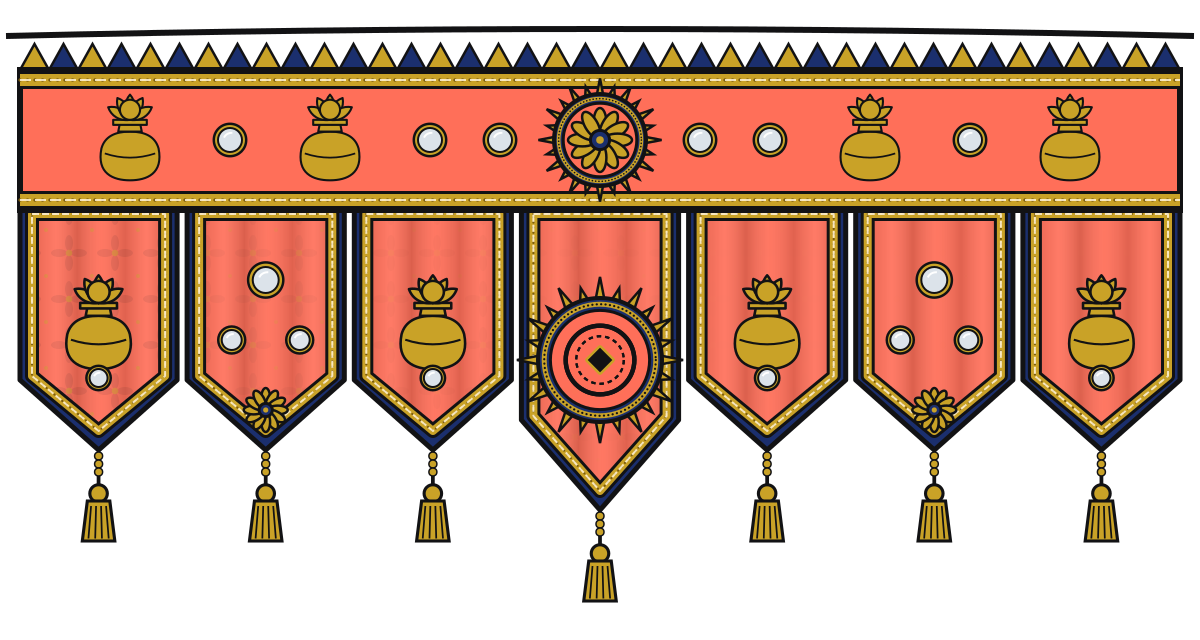
| G1 Torana · gateway The built gate of the seat; the cloth Toran hangs in it | Not yet designed for this clan | Regional tradition |
| G2 Viragallu · hero stone Carved panel stone for a member who died defending the clan | Not yet designed for this clan | Regional tradition |
| G3 Kula-shila · clan stones Standing and table stones that remember the ancestors | Not yet designed for this clan | Design |
| G4 Jayastambha · victory pillar A pillar raised for a victory | Not yet designed for this clan | Design |
| G5 Sima-shila · boundary stone Marks the clan's land, with a line in the native script | Not yet designed for this clan | Design |
4. Sounds
| Accessory | For this clan | Basis |
|---|---|---|
| D1 Pancha-mahashabda · five great sounds The right to five instruments | Not yet designed for this clan | Design |
| D2 Shankha · clan conch The clan's own named war conch | Not yet designed for this clan | Design |
| D3 Murasu · house drums Three drums: war, charity and justice | Not yet designed for this clan | Design |
5. Kit: colours, metals and emblems
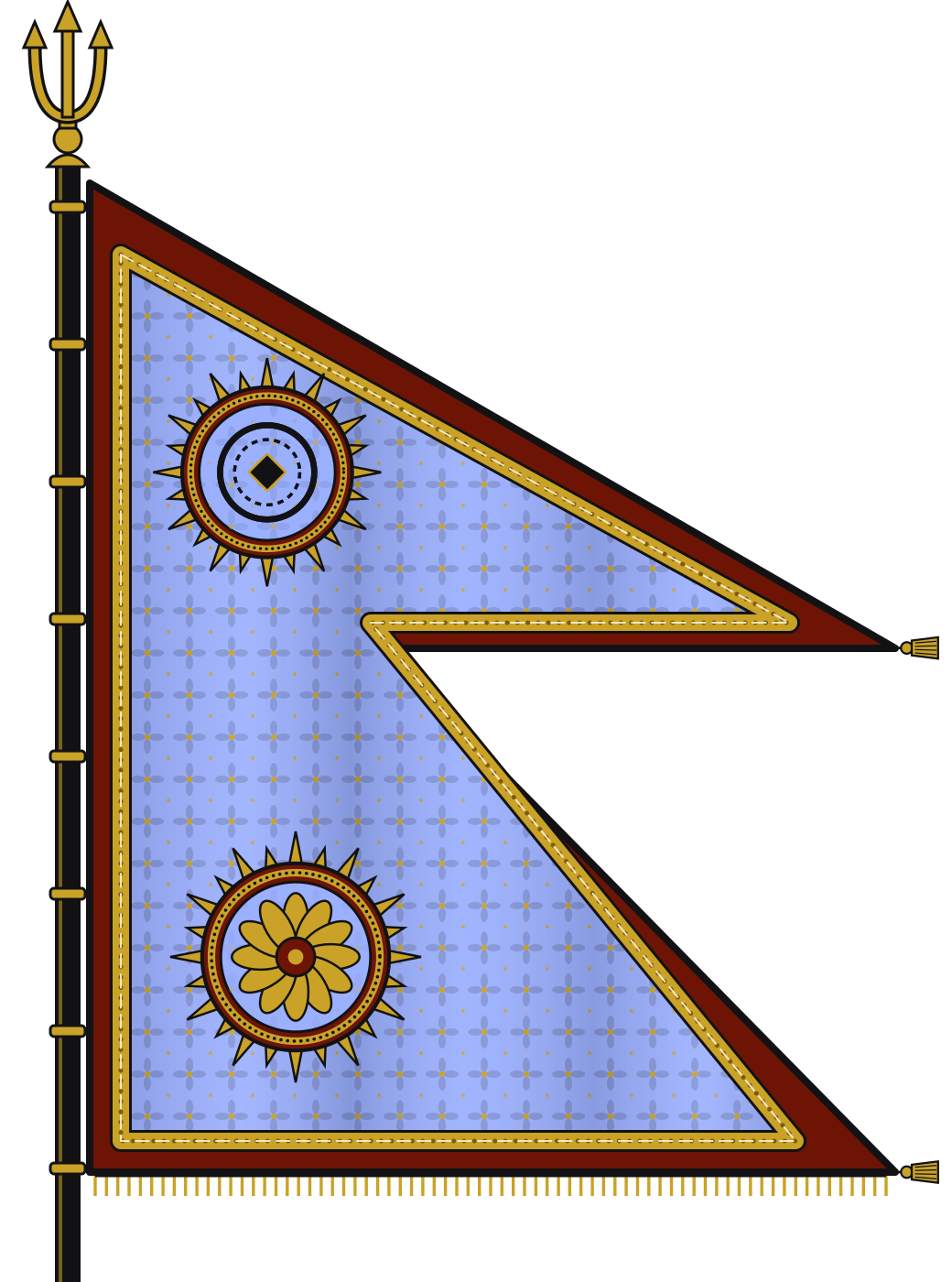
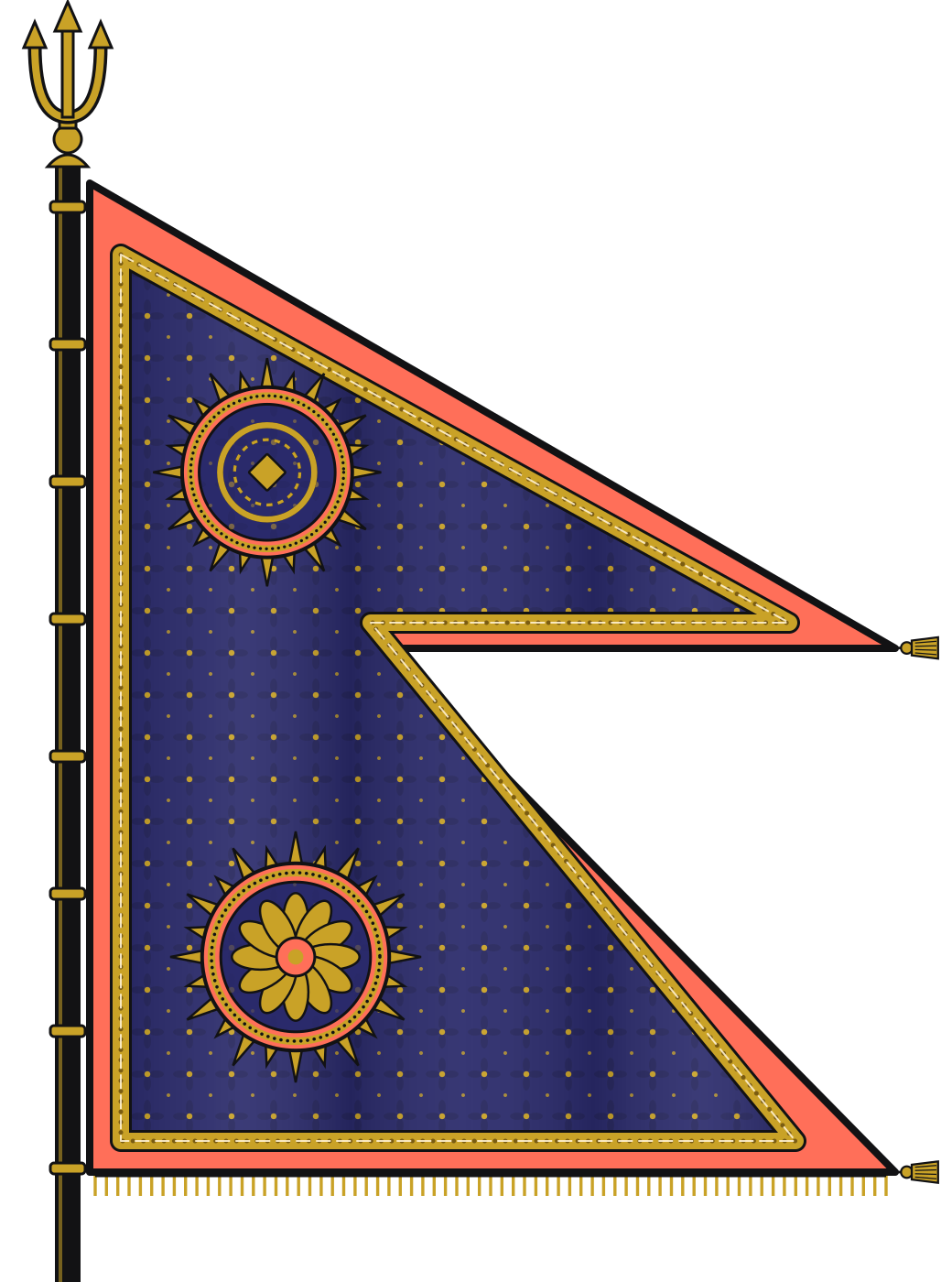
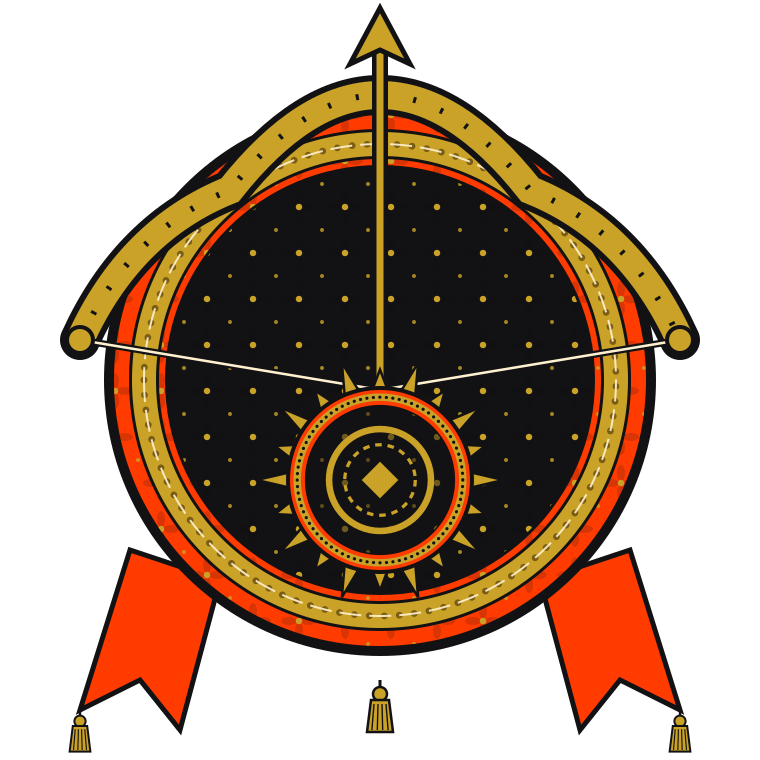
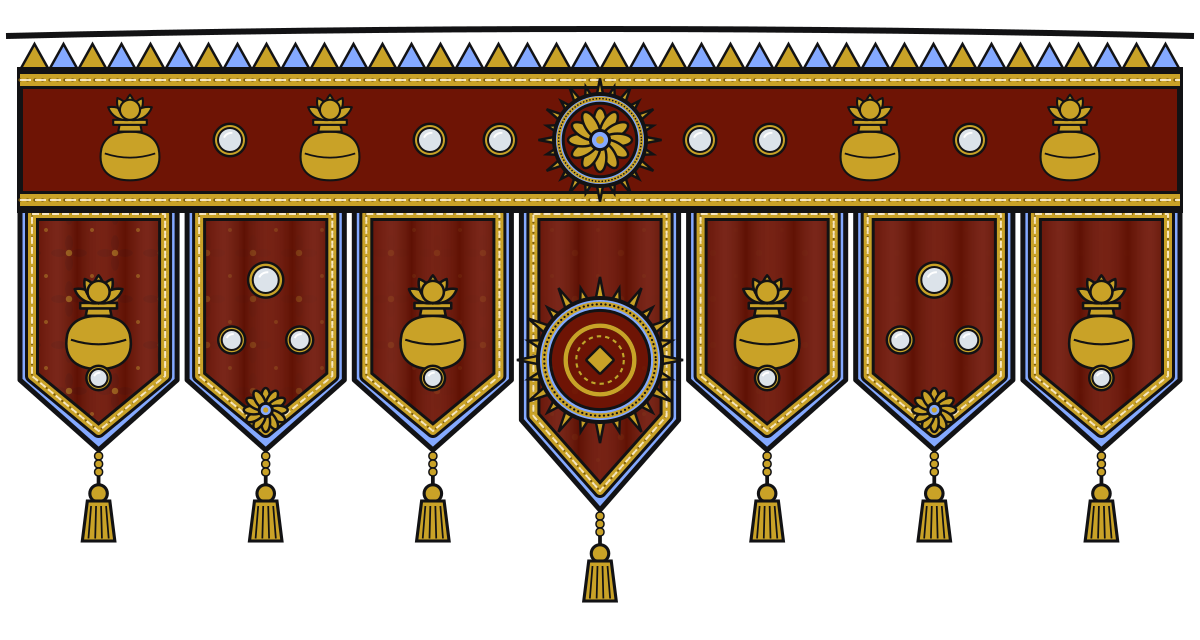
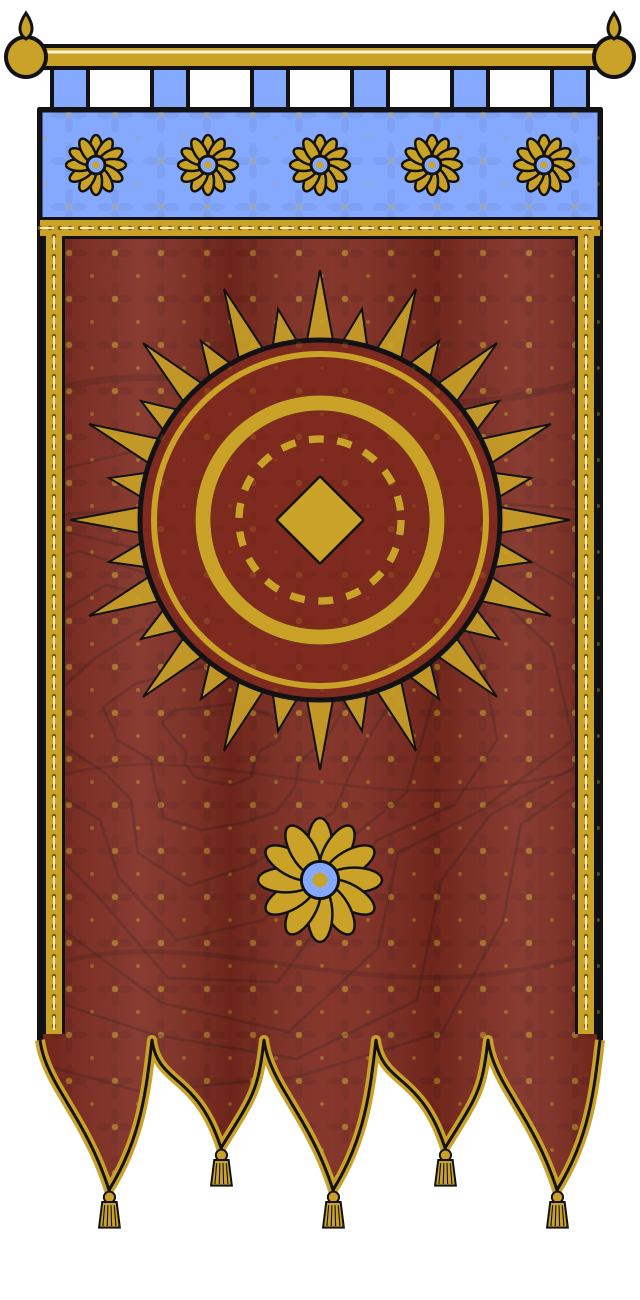
The Atlas gives the Kheng a Changi flag with woven cane as its emblem, for cane craft. This is a design for the project, not a documented emblem: no seal, coin, banner or totem of the Kheng is recorded in the sources read. The page shows the placeholder medallion until the emblem is drawn.
| Part of the kit | This clan |
|---|---|
| Field | Deep Brick #7E2A1E |
| Accent | Intense Electric Blue #84A9FF |
| Emblem colour | Metallic Gold #C9A227 |
| Zari metal | Gold |
| Main emblem | Woven cane |
| Second image | — |
| Night and day | Every visual accessory has two versions: by night the emblem on the dark field, by day the clan's field colour on cloth woven from its metal. |
6. Flags
Every clan has every flag type; the type says the occasion and the colours say the clan. The outlined card is the flag the Atlas assigns.
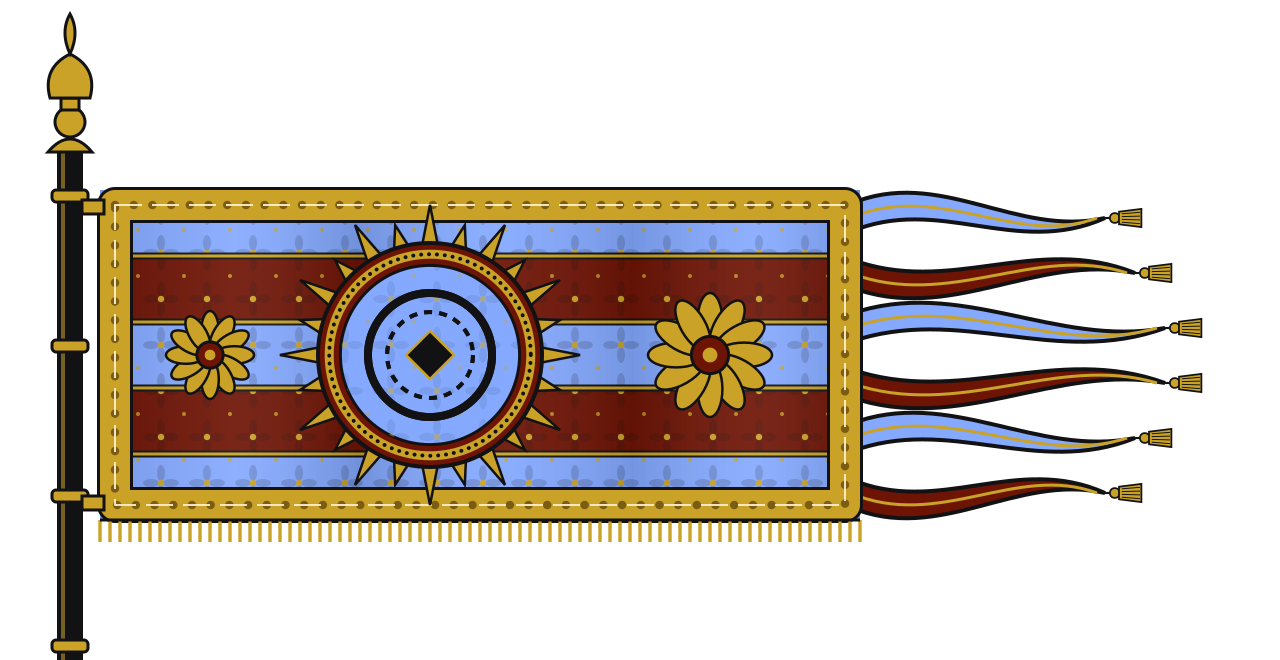
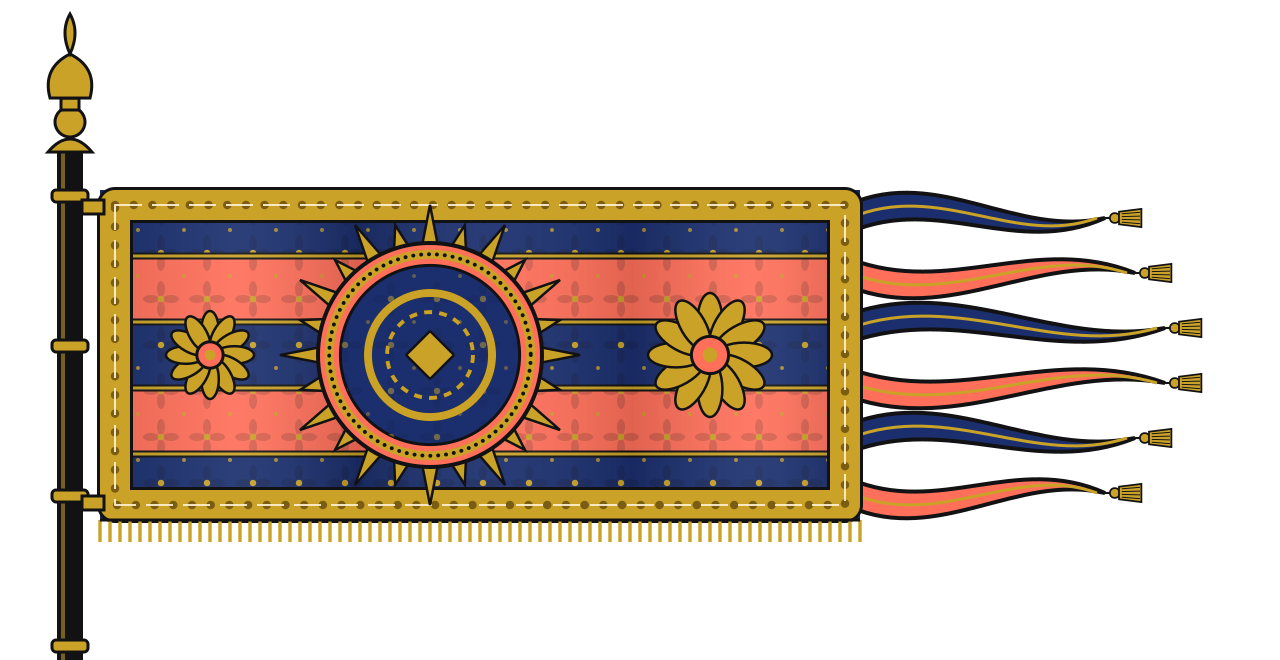
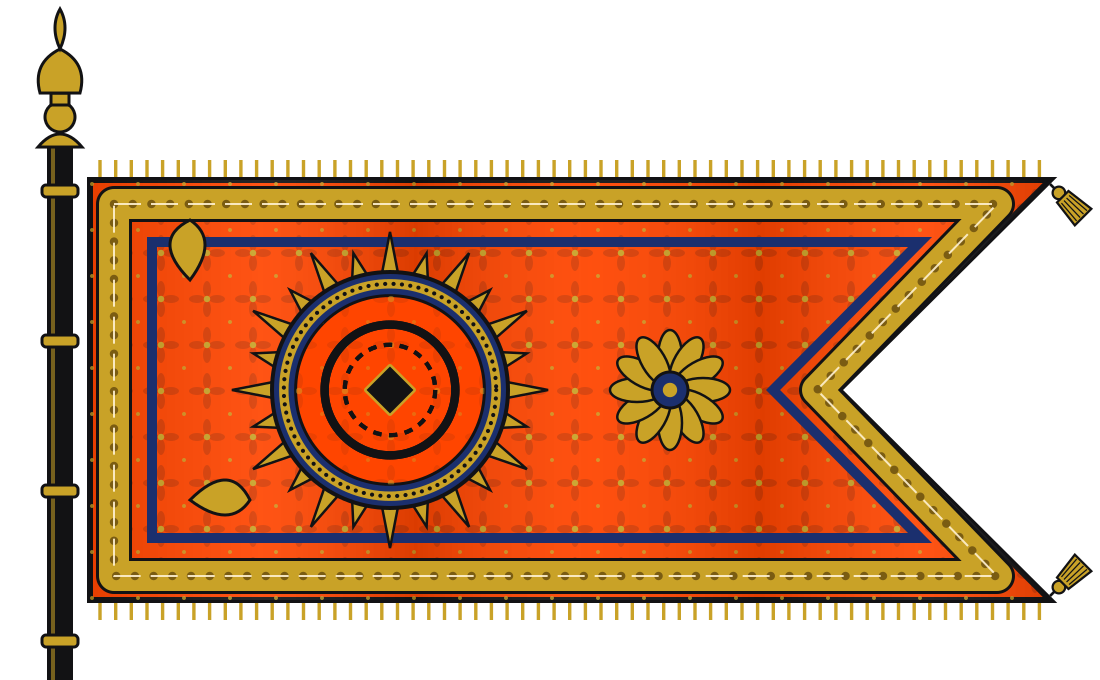
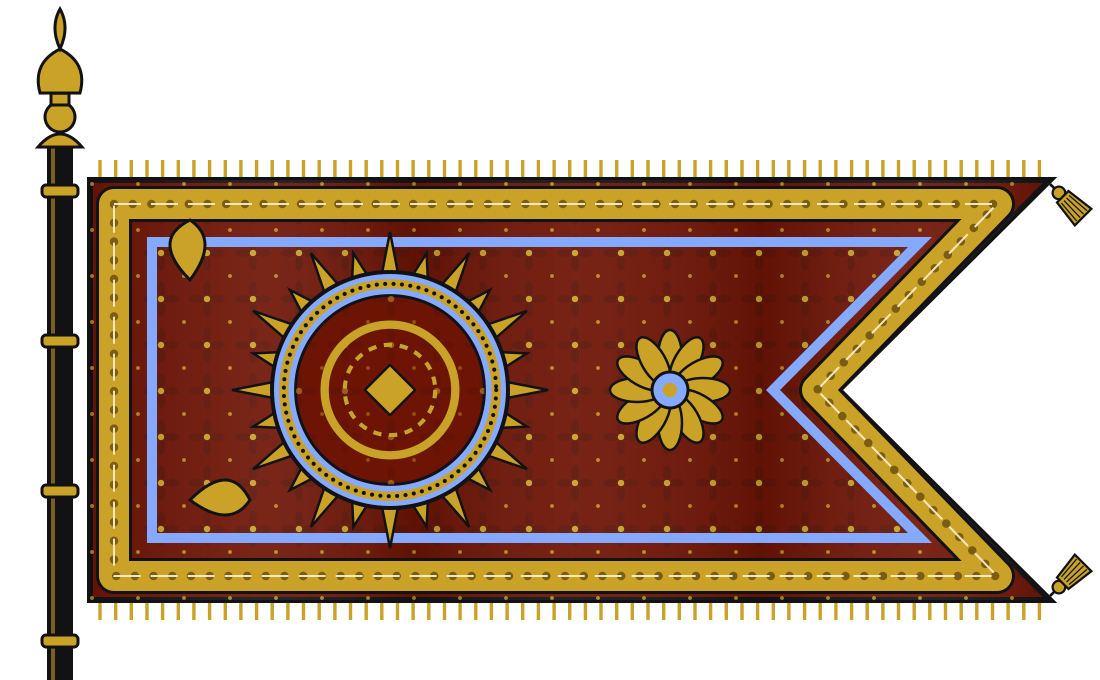

Historic banner
None known
New flag types
| Accessory | For this clan | Basis |
|---|---|---|
| A9 Pota-dhvaja · ship and trade flag For ships, caravans and markets | Not yet designed for this clan | Design |
| A10 Utsava-patāka · festival flag Light, bright flag for fairs and festivals | Not yet designed for this clan | Design |
| A11 Shoka-dhvaja · mourning flag White cloth with the emblem outline in the clan's metal | Not yet designed for this clan | Design |
7. Regalia
| Accessory | For this clan | Basis |
|---|---|---|
| E1 Chhatra · house parasol The ceremonial umbrella | Not yet designed for this clan | Design |
| E2 Chamara · fly-whisks The pair of whisks beside the head of the house | Not yet designed for this clan | Design |
| E3 Danda · staff of office Staff or scepter | Not yet designed for this clan | Design |
| E4 Simhasana · seat The seat of the house, covered in clan cloth | Not yet designed for this clan | Design |
| E5 Khetaka · shield A round shield; the Changi and Dhanush are its flag forms | Not yet designed for this clan | Regional tradition |
| E6 Kula-ayudha · clan weapon The weapon the clan honours | Not yet found for this clan | Under research |
8. Worn
| Accessory | For this clan | Basis |
|---|---|---|
| F1 Kula-vastra · clan cloth The clan's woven pattern in its kit colours | Not yet designed for this clan | Design |
| F2 Kirti-vastra · honour cloth A cloth earned for a deed, not inherited | Not yet designed for this clan | Design |
| F3 Kula-mala · garland flower The flower or leaf the clan wears as a garland | Not yet found for this clan | Under research |
| F4 Chinha · house pin A metal badge with the pin emblem | Not yet designed for this clan | Design |
9. Records
| Accessory | For this clan | Basis |
|---|---|---|
| H1 Clan words A traditional line in the native script | Kuzu zangpo · “Hello” Khengkha greeting, as given on the Kheng language page[2] | Documented |
| H2 Biruda · titles The house's title or titles | Noble titles Dung, Ponpo, Khoche and Gadpo, each with its houses and villages; the 'king' honorific of the Buli and Nyakhar lines | Documented |
| H3 Prashasti · praise genealogy The lineage as written at the head of a grant | Not yet found for this clan | Under research |
| H4 Vahi · clan register The book of the clan's births, marriages and deaths | Not yet found for this clan | Under research |
| H5 Rana-ghosha · war cry The clan's cry in battle or celebration | Not yet found for this clan | Under research |
10. VishwaVit · knower of the world
Game values are design choices for this project, not historical claims.
References
- Wikipedia, Kheng people, read 2026-11-17, https://en.wikipedia.org/wiki/Kheng_people
- Wikipedia, Kheng language, read 2026-11-17, https://en.wikipedia.org/wiki/Kheng_language
- Bhutan Cultural Atlas (College of Language and Culture Studies), Zhemgang (Kheng), 2019, read 2026-11-17, https://bca.clcs.edu.bt/2019/10/zhemgang-kheng
- Lham Dorji, "The Historical Anecdotes of Kheng Nobilities", Journal of Bhutan Studies 13(2), Centre for Bhutan Studies, 2005, pp. 31-59, read 2026-11-17, https://sources.mandala.library.virginia.edu/node/126707 (article: JBS 13(2))
- Wikipedia, Zhemgang District, read 2026-11-17, https://en.wikipedia.org/wiki/Zhemgang_District
- Music of Bhutan, Instruments (musicofbhutan.org), read 2026-11-04, musicofbhutan.org
- Hyslop (2010), East Bodish classification, as cited on Wikipedia, Kheng people, read 2026-11-17 (not read directly)
- Asia Harvest, Kheng people profile (PDF, mission-profile page), read 2026-11-17, https://www.people-groups.asiaharvest.org/Bhutan/Kheng.pdf
- Kuensel (Tashi Dema), 2008, as cited on Wikipedia, Kheng people, read 2026-11-17 (not read directly)
- Takumi Ikeda (2021), An Introduction to Khengkha: A Language of Central Bhutan, as cited on Wikipedia, Kheng language, read 2026-11-17 (not read directly)
- Yangdzom and Arkesteijn, Khengkha Lessonbook, SNV, Thimphu, as cited on Wikipedia, Kheng language, read 2026-11-17 (not read directly)
- G. van Driem (2007), Endangered Languages of Bhutan and Sikkim, as cited on Wikipedia, Kheng language, read 2026-11-17 (not read directly)
- John Ardussi (2004), The Spider and the Piglet, as cited on Wikipedia, Kheng people, read 2026-11-17 (not read directly)
- Rigden and Pelgen, Khenrig Namsum: A Historical Profile of Zhemgang Dzongkhag (1999), as cited on Wikipedia, Zhemgang District, read 2026-11-17 (not read directly)
- Dr Tim Bodt, archaeological and linguistic evidence for habitation of the central valleys for more than 4,000 years, as credited on Wikipedia, Kheng people, read 2026-11-17 (not read directly)
- G. van Driem (1994), as cited on Wikipedia, Kheng people, read 2026-11-17 (not read directly)
- Facts and Details, Minorities and Small Indigenous Ethnic Groups in Bhutan, read 2026-11-17, https://factsanddetails.com/south-asia/Bhutan/People_Bhutan/entry-7905.html
- Bhutan Cultural Atlas (College of Language and Culture Studies), Dechen Tshering, Tsharzo: An Economic Activity of Kheng Bjoka, 2019, read 2026-11-17, https://bca.clcs.edu.bt/2019/10/tsharzo-an-economic-activity-of-kheng-bjoka
- Janet Herman, Smithsonian Folkways, Kheng Sonam Dorji, Oct 2014, read 2026-11-17, link
- Schicklgruber (1998), as cited on Wikipedia, Kheng language, read 2026-11-17 (not read directly)
- Wikipedia, Ethnic groups in Bhutan, read 2026-11-03, https://en.wikipedia.org/wiki/Ethnic_groups_in_Bhutan
- Minority Rights Group, Bhutan, read 2026-11-03, https://minorityrights.org/country/bhutan/