The Khasi are an Austroasiatic people of the Khasi Hills in Meghalaya, with smaller groups in Assam and in Bangladesh around Jaflong[1]. Their society is matrilineal: clans (kur) do not marry within themselves and the youngest daughter, Ka Khadduh, is the heiress[1]. They were ruled by about twenty-five small states (hima): fifteen under syiems, five under sirdars, four under lyngdohs and the Shella confederacy under an elected wahadadar[2]. The British bound them by subsidiary alliance after 1823[1]. From 1829 to 1833 U Tirot Sing, Syiem of Nongkhlaw, led a guerrilla war against British rule[3]. Their language has been written down since the 1840s[4].
01Faith and deities
Kamakhya of Assam, the great goddess of the north-east[5]
The clan followed another faith. This goddess of its homeland is assigned for naming only.
| Deity or tradition | Place in the clan's life | Evidence |
|---|---|---|
| U Blei Nongthaw living | Supreme, formless creator | [1] |
| U Blei Trai Kynrad legend | God who divided humankind into the sixteen heavenly families | [1] |
| Ka Blei Synshar living | Goddess appeased at Nongkrem for a good harvest | [6] |
| Lei Shyllong living | God of Shillong peak; receives a cock at Nongkrem and prayers at Umsan Nongkharai | [6][7] |
| Ancestor and ancestress of the ruling clan; the first uncle | Honoured with offerings at Nongkrem | [6] |
| Kamakhya (Ka Mei Kha?) | Project KulDevi; some say a Khasi goddess site before Kamarupa (claimed) | [1] |
02Temples
Khasi rites are held at sacred places in the open: streams, hills, the Rishot Blei pillar at Smit[7]. No built temple is sourced.
Built by the clan
Not recorded.
Given patronage or grants by the clan
Not recorded.
03Languages and scripts
| Language or script | Kind | Under the clan | Evidence |
|---|---|---|---|
| Khasi living | Austroasiatic (Khasian, close to Palaungic) | Spoken by all the Khasi groups; shares words such as khla (tiger), snem (year), khaw (rice) with Khmer and Palaung | [1] |
| Sohra dialect living | Standard written Khasi | Written by the Welsh missionaries | [1] |
| Bengali script lost | Script | First used by missionaries for Khasi | [1] |
| Latin (Roman) script living | Script | Thomas Jones's alphabet, used since the 1840s | [4] |
04Books and literature
Khasi was an oral language until the 1840s[1].
Written during the clan's history
| Work | Author | Kind | When | Link to the clan |
|---|---|---|---|---|
| Khasi Reader | Thomas Jones | Primer | 1842 | Among the first books in Khasi[4] |
| Rhodd Mam (translated) | Thomas Jones | Welsh catechism in Khasi | 1842 | [4] |
| Khasi Bible | Not given | Translation | 1891 | First Bible in a north-east Indian language[1] |
| The Khasis | P. R. T. Gurdon | Ethnography | Colonial period | Cited by the Khasi page[1] |
| Bhagavad Gita (and Ramayana, Mahabharata, Upanishads) | Leslie Hardinge Pde | Translations into Khasi | Gita published 9 May 2011 | [1] |
| Khasi Folk Songs and Tales | Desmond L. Kharmawphlang (tr.) | Folklore in English | Modern | [1] |
| The Poetics of the Khasi Phawar | Kynpham Sing Nongkynrih | Study | 2009 | [8] |
Given patronage by the clan
Not recorded.
05Thinkers and scholars
| Name | Field | Era | Contribution |
|---|---|---|---|
| Thomas Jones | Language | 1840s | Alphabet, dictionary and first books; "founding father of the Khasi alphabet and literature"[4] |
| Desmond L. Kharmawphlang | Folklore | Modern | Translator of Khasi folk songs and tales[1] |
| Kynpham Sing Nongkynrih | Literature | Modern | Study of the phawar[8] |
Early Khasi writers in Khasi itself are not yet sourced.
06Art and architecture
Painting and wall art
Not recorded.
Sculpture and temple art
Not recorded.
Temple and building architecture
| Art form | What it is | Era | Evidence |
|---|---|---|---|
| Living root bridges living | Bridges grown from tree roots by the War on the southern slopes | [1] |
Weaving and textiles
Not recorded.
Clothing and jewellery
| Art form | What it is | Era | Evidence |
|---|---|---|---|
| Jainsem and Dhara living | Women's dress: two pieces (jainsem) or one (dhara) fastened at the shoulders | [1] | |
| Jymphong living | Men's long sleeveless, collarless coat | [1] |
Coins, pottery and crafts
| Art form | What it is | Era | Evidence |
|---|---|---|---|
| Silver and gold crown with a back spike living | Worn by women dancers | [1][7] | |
| U Kpieng Paila living | Coral necklace of the dance dress | [7] |
07History
Origins: the Seven Huts {LEG} and the Austroasiatic link
In Khasi tradition God divided people into sixteen heavenly families; seven stayed on earth, the Ki Hynñiewtrep or Seven Huts, and nine stayed in heaven. A ladder on Lum Sohpetbneng joined earth and heaven until a divine tree was cut at Lum Diengiei legend[1].
Linguists place Khasian close to the Palaungic languages of Myanmar; Paul Sidwell (2021) suggests a migration through Upper Burma into the Brahmaputra valley and then onto the Meghalaya plateau[1].
The syiemships (hima)
The Khasi lived in independent states, each a hima ruled by a syiem chosen by the people or by the ruling clans, governing through a durbar of male clan elders. Named states include Hima Mylliem, Hima Khyrim, whose royal seat is Smit, and Hima Nongkhlaw[1]. The Syiem was a constitutional head who shared power with a council of the leading clans[3].
Outside the Jaintia kingdom the Khasi had no princes: about twenty petty states (hima) and smaller divisions were led by chiefs styled Siem or Syiem, sometimes Sardar, chosen in various ways[9]. The states the page names are Bhowal, Cherra (Sohra), Dwara, Jirang, Khyriem, Langrin, Langïong, Maharam, Malai Sohmat, Marriw, Mawdon, Mawiang, Mawlong, Mawphlang, Mylliem, Nobosohphoh, Nonglwai, Nongkhlaw, Nongspung, Nongstoiñ, Pamsanngut, Rambrai, Shella and Sohïong[9]. In Khyrim the high priestess is the head of the state, holding priestly and royal office together[10].
The states before the British: Lyngdoh and the Nongpoh page
Lyngdoh (2009) says the Khasi states were independent before the British, and that commercial dealings with them began after 1765 (abstract, p. 2)[11]. He says the rulers of the earliest states Malngiang, Sutnga and Shillong were regarded as ki Syiem blei, 'ruler gods' (p. 43)[11].
The Nongpoh Syiemship is linked to Sajar Nangli and his followers, settled c. 1500–1600 A.D.; another tradition says the Syiem Nongshai ruled there before them. The state was called Ka Ri Khadar Lyngdoh, 'The State of Twelve Priests'[12].
Early dynasties and the states (undated)
The KHADC document gives no date for the migration. It reports Gurdon's view that the Khasis came from the east, from Burma, as an offshoot of the Mon (paraphrase of the document)[2]. It names the Malyngiang Syiems as an early dynasty, possibly c. 1200 AD, a date it calls disputed. For early history it names the Ahom Buranjis, the annals of the Koch king Naranarayana and the Tippera chronicles as sources[2].
Mylliem was originally part of Khyrim and became separate after a succession dispute; the extract gives no date for the split. Among the states the Raja of Jaintia held pre-eminence, and the Raja of Khyrim came next[2].
Lyngdoh (2009, pp. 2, 7) dates the split of Shillong state (ka Hima Shillong) into Hima Khyrim and Hima Mylliem to 1853[11].
Hima Shillong before 1853: its officers and the split
Before 1853 Hima Shillong had four Basan and three Lyngdoh, each held by a named clan: Basan Nongkseh (Thangkhiew Laikpoh clan), Basan Nongumlong (Nongneng Daloi clan), Basan Swer (Swer clan), Basan Synrem (Synrem clan), Lyngdoh Mylliem (Marbaniang clan), Lyngdoh Nongkrem (Pyngrope clan) and Lyngdoh Nongbri (Nongbri clan), as the Shillong Times gives them, citing Giri (2012)[13].
In 1853 Hima Shillong split, after an AJM Mills report, into Hima Mylliem (Basan Nongkseh, Basan Nongumlong and Lyngdoh Mylliem) and Hima Khyrim (Lyngdoh Nongbri and Lyngdoh Nongkrem). Basan Swer moved to Hima Sohra and Basan Synrem to Shella after a dorbar that the article places in the 1829 era (citing Giri 2012)[13]. The 1853 date agrees with Lyngdoh (2009); the cause does not agree with the KHADC account (see open questions).
Markets and the syiems' tax (undated)
Sellers paid a small tax to the Syiem in whose territory a market lay. The Syiems kept up the stalls, and the tax was their main income. The excerpt does not say which hima owned which market[14]. The annual Nongkrem sacrifice was made for the king's health, good markets and the realm[14].
Lyngdoh (2009, citing V. V. Rao) lists the Syiem's revenue as fines, tolls (khrong) on markets within his jurisdiction, land patta fees and licence fees on country liquor. Land belongs to the clan and people, and the Syiem cannot claim land revenue (p. 46)[11].
The Jaintia kingdom, the Khasi of the plains' edge
East of the Khasi states lay the Jaintia kingdom of the Pnar, a Khasi sub-tribe, whose rajas were of Khasi lineage[9][10]. Beneath the raja, twelve chiefs called Dolloi held the elaka, Ka Ri Khadar Dolloi, the land of twelve chiefs; the princely family began as Syiems at Sutnga, later kept its summer seat at Nartiang and its winter capital at Jaintiapur at the foot of the hills, now in Bangladesh[9][10].
In the medieval period most of greater Sylhet lay under the Jaintia king. About 1500 the king, Parbat Ray, took a Sanskrit name; the Koch king of Cooch Bihar conquered Jaintia between 1548 and 1564, the Kachari king held it in the late 16th century, and in 1605 it regained its independence with help from the Ahom king. Lakshmi Narayan (1669–1697) built in brick at his capital[15].
The Siem of Nongkrem once captured Jaintia cannons[10].
Khasi and Ahom contact before 1823
When the Ahoms first met the Jayantias in the early 17th century, the book describes the Jayantias and the Khasis of Khyrim as the exceptions among the hill tribes that were under plains influence[16].
A footnote says that of the 25 Khasi states only Khyrim had established a relationship with the Ahom government. Its one example is a 16th-century Khyrim king who submitted to the Koch general Chilarai, not to the Ahoms, so the example does not support the footnote[16]. KHADC dates the Jaintia-Ahom contact to the early 17th century, under Pratap Singha (1603–41), when Jasa Manik of Jaintia offered two princesses in marriage[2]. The book gives no detailed Ahom–Khasi diplomatic, trade, boundary or treaty account[16].
The Nongpoh page's oral literature says Ahom traders travelling to the hills met local people and used the phrase bhoi lage; one etymology links Bhoi to Assamese Bhoiyam, 'dwellers of low fertile lands'. The page gives no date[12]. As read, the Introduction and Ch. I–II of Gurdon describe no direct Khasi–Ahom political relations, though the Introduction notes that Ahom invaders entered Assam by the Patkoi range[10].
Hima Shillong and the Ahoms, 1784–1786
The Shillong Times (2023) says that in 1784 envoys U Narleng and U Manu Rai went to the Ahom king Gaurinath to discuss trade and borders with Raid Dumria, and that on 17 April 1786 a large emissary was received by the Bar Phukan at Bharalumukh (citing Bareh, 1967 reprint)[13]. These were Hima Shillong contacts, and before 1853 that state included Khyrim and Mylliem.
The same article says a past Syiem erected the Noakuchi monolith to mark goodwill with the Ahom Swargadeo. It gives no date for the monolith[13].
The Sylhet frontier, 1765–1826
When the East India Company took the diwani of Bengal in 1765 it gained Sylhet, and drove the Jaintia king from the Sylhet plains[15][10]. The frontier Khasis were known to the Company as troublesome marauders who raided the plains; a 1774 attack on Jaintia was reportedly in return for raids into Sylhet[10].
Regulation No. 1 of 1799 allowed trade with the hills but banned supplying them with arms, and forts were built along the foot of the hills[10]. The Burmese overran Assam in 1824 and Jaintia lost its independence until the British drove them out in 1825; in 1835 the Company annexed Jaintia to Bengal to ease the Sylhet trade in limestone and cane[15].
Frontier quarries and trade rules, 1779–1821 (weak secondary)
The Yellow Baobab blog (a weak secondary source, mostly unattributed) says that before c. 1800 the Khasi Hills held 26 independent states, loosely confederated, which it calls the "land of the 30 kings"[17].
The blog says Regulation No. 1 of 1779 declared freedom of trade between the Khasis and Sylhet but banned arms and ammunition to the Khasis, crediting Sir Charles Lyall's introduction to Gurdon; in 1789 Cornwallis ordered the boundary defined and the Khasis not to come down armed[17]. The Gurdon-based row above dates the regulation to 1799; the two years are not reconciled (see open questions).
On the quarries, the blog says Robert Lindsay leased lime quarries at Pandua near Bhologanj c. 1779, that Khasis attacked Pandua in 1783 after an insult to a chief by Lindsay's havildar, and that the Syiem of Langrin leased the quarries at Lour to Inglis and Company for ten years from 1817 to 1821. In 1821 the Syiem of Nongstoin disputed that lease and Khasi traders raided, taking seven Company men[17].
The Anglo-Khasi War, 1829–1833
After the Treaty of Yandabo (1826) the British wanted a road through the hills from Guwahati to Sylhet. A two-day durbar accepted the road in return for the duars (passes into Assam). On 4 April 1829 the Khasis attacked the British garrison at Nongkhlaw, where U Tirot Sing was Syiem[3].
With swords, shields, bows and arrows they fought a guerrilla war for about four years. Tirot Sing, wounded and betrayed for gold, was captured in January 1833 and deported to Dhaka, where he died on 17 July 1835[3].
Hima Shillong and Raid Dumria, 1828–1876
The Shillong Times (2023) says Bor Manik Syiem and Basan Nongkseh went to Raid Dumria in March 1828 to seize revenue the British had collected there. In 1829 the British claimed Borduar, which the article says was held by Hima Nongkhlaw, and on 1 April 1829 the Khasi Himas declared war. In May 1830 Bor Manik was arrested and made to abdicate for Shan Sing Syiem, and the war ended in 1833[13].
By Notification 1430 of 14 September 1876 Raid Dumria, an area of 487.72 sq km in dispute, was placed under Kamrup[13].
Under British rule and after {LATER}
The Khasi Hill States entered a subsidiary alliance and the area became part of Assam Province; about twenty-five native states later acceded to the Indian Union[1]. The syiemships still work under the Khasi Hills Autonomous District Council, set up under the Sixth Schedule[1].
Lyngdoh (2009, abstract, pp. 2–3) says the principal states granted the East India Company strategic concessions in 1824, against a possible Burmese advance, and that insurrections were suppressed between 1829 and 1839[11]. He says Cherra, Khyrim, Nongstoin, Langrin and Nongspung were semi-dependent under British rule and the others dependent (citing W. J. Allen, 1858 Report, p. 26)[11]. The Nongpoh page says Nongpoh was reduced to a Sirdarship in the 1860s, probably 1863–64, and that the Nongwah Syiemship lost its status in the 1870s when its last chief, Syiem U Lang Singh, left no male heir[12].
Chiefdoms, raids and the British foothold (16th century to 1790s)
Mid-16th century: 25 Khasi chiefdoms plus the separate Jaintia kingdom[18].
In 1765 Sylhet markets joined the colonial economy, which Gale (2008) calls the start of Khasi subjugation[18]. In the 1790s Khasi raids led to British fortifications in the foothills and an embargo on Khasi goods in Sylhet markets[18].
Before the British, the Khasi states had limited outside relations: internal warfare, raiding and trading in the Sylhet and Brahmaputra valleys[18]. Against the British they relied on ambush and guerrilla tactics[19].
Roads, treaties and annexation (1826 to 1862)
Gale (2008) dates a road through Nongkhlaw State, linking Calcutta with the Brahmaputra valley, to 1837; it dates the annexation of the Jaintia Hills to 1860; and it says that in 1862 treaties with all Khasi states granted autonomy and freedom from British taxation[18].
Gurdon's Introduction, in the Yandex copy, quotes the 1826 road treaty as speaking of 'the territory of the Khasi Siem or Chief of Nongkhlaw'[20]. Undated, Gurdon also records that a house at Cherrapunji was acquired from the Siem by exchange for land in the plains, as the site of a sanitarium[20].
08Journey and migrations
The Khasi journey is known from language and legend, not records.
| When | From | To | Why | Evidence |
|---|---|---|---|---|
| Holocene (undated) | South-east Asia, through Upper Burma | Brahmaputra valley, then the Meghalaya plateau | Austroasiatic spread; Khasian close to Palaungic (Sidwell 2021) | [1] |
| Legend legend | Heaven, by the ladder on Lum Sohpetbneng | The Khasi Hills | Seven of sixteen heavenly families stayed on earth | [1] |
| Present day | Khasi Hills | Jaflong, Sylhet (Bangladesh) and Assam | Communities across today's border | [1] |
09Seats and lands
| Place | Role | Where today |
|---|---|---|
| Khasi Hills | Homeland | Meghalaya: East, West, South West and Eastern West Khasi Hills, Ri-Bhoi[1] |
| Smit | Royal seat of Hima Khyrim; Nongkrem festival ground | About 11 km from Shillong[6] |
| Nongkhlaw | Seat of the syiemship of U Tirot Sing | Khasi Hills[3] |
| Mylliem | Syiemship (Hima Mylliem) | Khasi Hills[1] |
| Sohra (Cherrapunji) | Where Thomas Jones settled; its dialect became written Khasi | Khasi Hills[4][1] |
| Lum Sohpetbneng legend | Peak of the heavenly ladder | Ri-Bhoi[1] |
| Jaflong | Main Khasi area in Bangladesh | Sylhet Division[1] |
| Jaintiapur | Winter capital of the Jaintia rajas | Sylhet Division, Bangladesh[9][10] |
| Nartiang | Summer seat of the Jaintia rajas; seat of the Raja of Nartiang, styled premier chief, U Kongsong | Jaintia Hills[9] |
| Sutnga | Where the Jaintia princely family began as Syiems | Jaintia Hills[9] |
| Borghat | Commercial centre with a palace of the Jaintia rajas | Meghalaya[9] |
| Theriaghat | Market at the foot of the hills: rice and salt went up to Cherrapunji | Sylhet border[10] |
| Shella, Dwara, Mawphlang, Nongstoiñ and the other hima | Khasi states, about twenty in all | Khasi Hills[9] |
| The 25 petty states | 15 under Syiems; the Confederacy of Shella under an elected Wahadadar; 5 under Sirdars; 4 under Lyngdohs. Largest Khyrim (31,327), smallest Nonglewai (169), figures as the document gives them, year not stated | Khasi Hills[2] |
| Nongpoh | Syiemship, later a Sirdarship (reduced in the 1860s, probably 1863–64); ruled by the Syiem Nongshai clan; called Ka Ri Khadar Lyngdoh, 'The State of Twelve Priests' | Ri-Bhoi[12] |
| Langrim, Bhoval and Nobosohpoh | States where siems were elected; the British tried to impose election on all states, and the results were called 'questionable' | Named in Gale (2008); location not given[19] |
| Borduar | A duar (pass) the British claimed in 1829; the article says it was held by Hima Nongkhlaw | Claimed 1829[13] |
| Raid Dumria | Disputed area of 487.72 sq km; Hima Shillong went there in 1828 to seize British-collected revenue; placed under Kamrup by Notification 1430 (14 Sept 1876) | Kamrup[13] |
10Notable figures
| Name | Role | Era | Known from |
|---|---|---|---|
| U Tirot Sing Syiemlieh | Syiem of Nongkhlaw; leader of the Anglo-Khasi War | c. 1802–1835 | Tirot Sing page[3] |
| U Kiang Nangbah | Freedom fighter | Not given on the page | Named among notable Khasi[1] |
| J. J. M. Nichols Roy | Named among notable Khasi | 20th century | [1] |
| George Gilbert Swell | Deputy Speaker of the Lok Sabha; ambassador to Norway and Burma | 20th century | [1] |
| Silverine Swer | Educationist, social and environmental worker | 20th century | [1] |
| Skendrowell Syiemlieh | Folk singer, Padma Shri | 20th–21st century | [1] |
| Neil Nongkynrih | Founder-director of the Shillong Chamber Choir | 21st century | [1] |
| Keishing Clifford Nongrum | Mahavir Chakra (posthumous) | Modern | [1] |
| Bor Manik Syiem | Syiem who went to Raid Dumria in March 1828 to seize British-collected revenue; arrested and made to abdicate in May 1830 for Shan Sing Syiem (the article does not name his hima in that passage) | 1828–1830 | [13] |
11Allies, rivals and marriages
| People | Relationship | When |
|---|---|---|
| British East India Company | Sylhet frontier from 1765; road treaty 1826; war 1829–1833; subsidiary alliance | 1765–1947[10][1][3] |
| Balaram Singh, Raja of Ranee | Rival claimant to the duars | 1828[3] |
| Welsh Presbyterian mission | Thomas Jones's school, alphabet and first books | From the 1840s[4] |
| Pnar (Jaintia) | Upland neighbours of the Jaintia Hills, counted with the Khasi groups | Living[1] |
| Garo | Western neighbours; the Lyngngam show Garo influence | Living[1] |
| Jaintia kingdom | Khasi-speaking neighbour; a Siem of Nongkrem captured Jaintia cannons | Before 1835[10][15] |
| Koch kingdom (Cooch Bihar) | Conquered Jaintia | 1548–1564[15] |
| Kachari kingdom | Held Jaintia | Late 16th century[15] |
| Ahom kingdom | Helped Jaintia regain its independence | 1605[15] |
| Sylhet under the Company | Frontier raids and retaliation; trade allowed but arms banned (Regulation 1 of 1799) | 1765–1826[10][15] |
| Burmese kingdom | Overran Assam and Jaintia; a tradition says the Burmese king received an annual axe from the Khasis legend | 1824–1825[15][10] |
| Ahom kingdom (Khyrim) | The Ahom book's footnote names Khyrim as the only Khasi state in relation with the Ahom government; its example is a Koch one (see history) | Not dated[16] |
| Ahom kingdom (Hima Shillong) | Envoys in 1784 (U Narleng and U Manu Rai) to the Ahom king Gaurinath on trade and the Raid Dumria border; an emissary received by the Bar Phukan at Bharalumukh on 17 April 1786 | 1784–1786[13] |
| Ahom traders (oral literature) | Ahom traders travelling to the hills met local people and used the phrase bhoi lage; the Nongpoh page gives no date | Undated[12] |
| Plains peoples and neighbouring states | Conflict was 'prevalent' before the British; head-taking was linked to the war god U Syngkai Bamon; little is known of traditional contacts with other groups | Before the British[19] |
| Sylhet markets | Joined the colonial economy in 1765; Khasi raids in the 1790s led to British fortifications in the foothills and an embargo on Khasi goods in Sylhet markets | 1765–1790s[18] |
12Society and livelihood
A matrilineal society: descent and clan come through the mother[1].
Government and social order
| Institution or group | What it was | Evidence |
|---|---|---|
| Kur | Exogamous clan; spouses may not share a kur; inheritance follows it | [1] |
| Ka Khadduh | The youngest daughter, heiress of the family house; her husband lives in her mother's house | [1] |
| Iing-Kur | Maternal clan home, to which a childless widower traditionally returned | [1] |
| Hima and U Syiem | State and its chief, chosen by the people or the ruling clans | [1] |
| Succession | Chiefs are chosen by popular election; the syiemship passes to the son of the eldest uterine sister, by seniority, as the KHADC document states | [2] |
| Siem, Syiem or Sardar | Titles of the chiefs of the twenty-odd hima, chosen in various ways; in Khyrim the high priestess heads the state | [9][10] |
| Dolloi | The twelve chiefs of the Jaintia elaka under the raja | [9] |
| Durbar | Assembly of male clan elders; the Syiem governs with it | [1][3] |
| Dorbar Hima | The popular assembly of adult male citizens, as Lyngdoh (2009) describes it (the Durbar row above gives an assembly of male clan elders) | [11] |
| Dorbar Synshar Hima | Executive council of the Basan, the Lyngdoh and the Myntri; the Syiem may veto it and tries cases with it as jury | [11] |
| Syiem clan | A pre-ordained royal clan from which only the Syiem is drawn; heirship passes through female offspring (p. 42) | [11] |
| Electors | In Khyrim, Mylliem and Sohra (Cherrapunjee) electors from the founding clans and the clans of nobility choose the Syiem (p. 44); the thesis gives the Khyrim electoral college as 30 electors and Mylliem's as 48 | [11] |
| Lyngdoh | May be a secular office, a religious office or a clan (p. 39); the Syiem and Lyngdoh clans were not the original clans of a village, raid or hima but were ordained by elders to administer (citing D. P. Diengdoh, 1995, p. 29) | [11] |
| Early migrant kur | Early migrant batches were each a kur led by the eldest maternal uncle, u Knyi or Rangbah Kur (citing G. Costa, p. 37) | [11] |
| U Rangbah Shnong | Elected village headman | [1] |
| Myntries | Ministers of the Syiem, who take part in the Nongkrem rites | [7] |
| KHADC later | Khasi Hills Autonomous District Council (Sixth Schedule), under which the syiemships still work | [1] |
| Succession to the siemship | Always through the female side. Each state has one siem family, and a new siem is chosen from it by an electoral body that may include priestly and non-priestly clan representatives, village headmen and basams (market supervisors) | [19] |
| Class lineages and villages | Villages are usually endogamous and hold several matrilineal clans (kur); three class lineages: nobles, commoners and slaves | [19] |
| Siem's durbar | The siem is head of state with limited monarchical powers and presides over the durbar, an executive council whose members are called mantris; the siem is usually both religious and secular head, consults oracles and judges with the durbar as jury | [19] |
| Sirdar and lyngskor | Sirdars (village headmen) collect labour, settle local cases and receive pynsuk for the siem; in Nongstoin a lyngskor supervises several sirdars | [19] |
| Elected chiefs (1874) | Col. H. S. Bivar (1874), as quoted by the Shillong Times: "the Chiefs in the Khasi Hills States are no territorial sovereigns, but elected democratic Chiefs" | [13] |
Livelihood over time
| Era | Livelihood | Evidence |
|---|---|---|
| Traditional | Hunting with bow and arrow, celebrated in the deer-hunt dance Shad Beh Sier | [7] |
| Today | Betel leaf, areca nut, oranges, pineapples, plums, litchis, local rice and vegetables | [1] |
| Hill trade (Gurdon, 1907) | Porters carried potatoes down to the Sylhet-side markets and rice and salt up from Theria to Cherrapunji; cattle were sold to Sylhetis; lime was quarried | [10] |
| Iron lost | Iron was smelted in the hills, using up much forest for fuel | [10] |
| Hill markets (undated excerpt) | Markets come at eight-day intervals. The excerpt gives the interval also as 'after seven days, on the eighth day', and does not reconcile the two. Market days are named after the nearest market (examples Laban, Cherra, Nongkrem, Jowai), not after weekdays, so a market's weekday shifts; its example is Shillong, which moves through Monday, Tuesday, Saturday and Sunday. Women generally buy and sell; men handle meat, timber, planks and iron goods. The market day was the rest day, as Khasis have no Sundays | [14] |
| Iron trade with Sylhet research | Known only from the title and author of D. R. Syiemlieh's NEHU study, 'Khasi iron culture and iron trade with Sylhet in the late eighteenth and early nineteenth centuries'; its full text has not been read | [21] |
| Iron tools and guns | The East Khasi Hills page says the Khasis extracted iron ore and made knives, utensils and guns (undated) | [22] |
| Lime (Gurdon, Introduction) | The Khasis controlled the quarries that supplied the chief lime for deltaic Bengal | [10] |
| Silk (Gurdon, Introduction) | Lindsay believed the Khasis brought silk cloths from China to the Sylhet markets | [10] |
| Nongstoin market (Gurdon, Ch. I) | Caps sold there were brought from the Synteng country and from Shillong | [10] |
| Iron smithies (Gurdon, Ch. I) | Forests near villages were cleared 'for iron smelting in days gone by'; swords and spear heads 'are forged in the local smithies'. The text does not describe the iron trade with Sylhet | [10] |
| Iew Rynghep, Nongkseh (article, uncredited) | A weekly market at Nongkseh with megaliths as stalls (basa); the article says they remain there but credits no source for this | [13] |
| Orange export (historical; weak secondary) | The Khasi orange was an export, carried by Arab traders into Syria (Birdwood, as cited by the blog) | [17] |
13Sub-clans and related clans
Writers often count seven Khasi groups, named by where they live, though the Khasi page also notes that the people recognise no sub-tribes[1]. Clans (kur) are exogamous lineages inside all of them. Lyngdoh (2009, p. 3) names five sub-groups instead: Khynriam, Pnar/Synteng, Bhoi, War and Lyngngam.
| Clan | Relation | Where | Size | In the Atlas | Evidence |
|---|---|---|---|---|---|
| Khynriam (Nongphlang) | Sub-clan | Uplands of East Khasi Hills | new clan candidate | [1] | |
| Pnar (Synteng) | Related people | Uplands of the Jaintia Hills | ST-108 | [1] | |
| Bhoi | Sub-clan | Lower hills north and north-east, toward the Brahmaputra; Ri-Bhoi | ST-132 | [1] | |
| War | Sub-clan | Steep southern slopes toward Bangladesh; builders of the living root bridges | ST-132 | [1] | |
| War-Jaintia | Sub-clan | Southern slopes of the Jaintia Hills | new clan candidate | [1] | |
| War-Khynriam | Sub-clan | Southern slopes of the Khasi Hills | new clan candidate | [1] | |
| Maram (Khasi) | Sub-clan | Central West Khasi Hills (not the Maram of Manipur, ST-204) | new clan candidate | [1] | |
| Lyngngam | Sub-clan | Western West Khasi Hills, on the Garo Hills border | ST-132 | [1] | |
| Diko | Sub-clan | West Khasi Hills lowlands; extinct | new clan candidate | [1] | |
| Rimen | Related people | Regional name in the west | new clan candidate | [1] | |
| Khatsawphra (Khadsawphra) | Related people | Regional name in the west; also a syiemship of Tirot Sing | new clan candidate | [1][3] | |
| Mawiang | Related people | Regional name in the west | new clan candidate | [1] | |
| Syiemlieh clan | Sub-clan | Kur of U Tirot Sing, Syiem of Nongkhlaw | new clan candidate | [3][12] | |
| Syiem Nongshai clan | Sub-clan | Ruled the Nongpoh Sirdarship, Ri-Bhoi; traced to Ka Shai | new clan candidate | [12] | |
| Syiemiong clan | Sub-clan | The clan of Nongspung; traced to Ka Iong | new clan candidate | [12] | |
| Palaung | Related people | Myanmar; Palaungic speakers, the Khasi's closest linguistic kin | same name as SUB-124: check | [1] | |
| Syiem Sutnga | Dynasty from this clan | Sutnga, later the Jaintia Kingdom; traced to Ka Nga | ST-459 | [12] | |
| Pnar Dolloiships (Ka Ri Khadar Dolloi) | Related people | The twelve Jaintia elaka: Nartiang, Amwi, Jowai, Lakadong, Mynso, Nongbah, Nongjngi, Nongphyllut, Nongtalang, Raliang, Shangpung, Sutnga | ST-108 | [9] | |
| Malyngiang Syiems | Dynasty from this clan | new clan candidate | [2] | ||
| Thangkhiew Laikpoh clan | Related people | Hima Shillong: Basan Nongkseh (before 1853; Hima Mylliem after) | new clan candidate | [13] | |
| Nongneng Daloi clan | Related people | Hima Shillong: Basan Nongumlong (before 1853; Hima Mylliem after) | new clan candidate | [13] | |
| Swer clan | Related people | Hima Shillong: Basan Swer; moved to Hima Sohra (Cherrapunji) after a dorbar the article dates to the 1829 era | new clan candidate | [13][9] | |
| Synrem clan | Related people | Hima Shillong: Basan Synrem; moved to Shella after the same dorbar | new clan candidate | [13] | |
| Marbaniang clan | Related people | Hima Shillong: Lyngdoh Mylliem (before 1853; Hima Mylliem after) | new clan candidate | [13] | |
| Pyngrope clan | Related people | Hima Shillong: Lyngdoh Nongkrem (Hima Khyrim after 1853) | new clan candidate | [13] | |
| Nongbri clan | Related people | Hima Shillong: Lyngdoh Nongbri (Hima Khyrim after 1853) | new clan candidate | [13] |
Clans marked "new clan candidate" are not in the Atlas yet.
14Surnames
Khasi family names are usually Khasi words, while given names may be Khasi, Christian or English[1]. Family names are mostly kur (clan) names, but which kur each belongs to is sourced only for Syiemlieh. A surname never tells a person's origin.
| Surname | Clan or sub-clan | Where | People with this surname | Also used by other communities |
|---|---|---|---|---|
| Syiemlieh | Syiemlieh kur | Nongkhlaw; Khasi Hills[3] | not yet counted | Not checked |
| Lyngdoh | Khasi Hills[1] | not yet counted | Not checked | |
| Nongkynrih | Khasi Hills[1] | not yet counted | Not checked | |
| Nongrum | Khasi Hills[1] | not yet counted | Not checked | |
| Kharmawphlang | Khasi Hills[1] | not yet counted | Not checked |
Counts are of everyone with the surname, from the cited source and year, not only members of this clan. A surname shared with other communities says nothing about any one person's origin.
15Songs and music
Song and dance go with every Khasi rite from birth to death[7]. No song text is sourced yet.
Ballads of heroes and laments for martyrs living
Shad Shyngwiang-Thangiap music living
Men play flute, drum and bamboo pole beside the kitchen hearth, then at the cremation ground[7]
Instruments and styles
| Instrument or style | What it is | Evidence |
|---|---|---|
| Ksing drums (Nakra, Ksing Padiah) | Big and small drums; the main instrument, calling people to festivals | [7] |
| Tangmuri | Pipe that leads the Nongkrem dance | [7][6] |
| Besli | Flute for solo playing | [7] |
| Sharati and Shyngwiang | Wind instruments for sad and joyful days | [7] |
| Duitara | String instrument played with a wooden pick | [7] |
| Dymphong | Bamboo reeds | [7] |
| Shaw Shaw | Cymbals | [7] |
| Ksing Shynrang, Ksing Kynthei | Named instruments for song and dance | [7] |
16Poems, lullabies and children's rhymes
None recorded yet.
17Stories, legends and proverbs
Stories and legends
| Story | What happens | Told by | Evidence |
|---|---|---|---|
| The golden ladder of Sohpetbneng legend | Seven families lived on earth and could climb a heavenly ladder on Lum Sohpetbneng, until a divine tree was cut at Lum Diengiei and the way to heaven closed | Khasi tradition | [1] |
| The sixteen families legend | God divided people into sixteen heavenly families; seven stayed on earth (the Seven Huts), nine in heaven | Khasi tradition | [1] |
| The rooster of dawn legend | The rooster stands for dawn and the beginning of creation | Khasi tradition | [1] |
| The lost book legend | In a great flood a Khasi lost his book while swimming, while the Bengali kept his | Khasi tradition, in Gurdon | [10] |
| The axe for the Burmese king legend | A tradition reported by Roberts links the Khasi to the Burmese king, who received an axe from them each year as a token of submission | Khasi tradition, in Gurdon | [10] |
Proverbs and sayings
Not recorded.
18Festivals and fairs
| Festival or fair | When | Where | What happens |
|---|---|---|---|
| Ka Pomblang Nongkrem living | Five days, autumn (generally November) | Smit, Hima Khyrim | The Syiem of Khyrim and the high priest offer a cock to Lei Shyllong and goats (pomblang) for Ka Blei Synshar; unmarried girls dance in crowns, men with swords and yak-hair whisks[6][7] |
| Ka Shad Suk Mynsiem living | Spring (April)[22] | Villages; Weiking Ground, Shillong (Seng Khasi) | Dance of the joyful heart: unmarried women in the inner circle, men guarding them in the outer[7] |
| Umsan Nongkharai living | Spring, five days | Sacred sites and streams | Prayers to Lei Shyllong; on the fifth day cocks and nine fish of the Umran are offered[7] |
| Ka Bam Khana Shnong living | January | Village grounds | Village feast of thanks: every household gives, the old and young eat first[7] |
| Shad Beh Sier | After harvest | Forests and villages | Deer-hunt dance; the first arrow wins the antlers[7] |
| Ka Shad Kynjoh Khaskain living | At house-building[10] | The new house | Night-long dances in three stages[7] |
| Seng Kut Snem living | November | Khasi Hills | Named in the state calendar[7] |
| U Tirot Sing Day later | 17 July | Meghalaya | State holiday for the hero of 1829–1833[3] |
| Goat-killing at Smit | Not dated[10] | Smit, Hima Khyrim | The Siem priestess and the women of the Siem's family dance before an oak post[10] |
19Food, dress and games
Food
| Item | What it is | Evidence |
|---|---|---|
| Pork living | Centre of feasts such as Ka Bam Khana Shnong | [7] |
| Rice and rice-beer living | Rice (khaw) and rice-beer at feasts | [1][7] |
| Betel-nut and pan living | Chewed constantly; spirit is distilled from rice or millet | [10] |
Dress
| Item | What it is | Evidence |
|---|---|---|
| Jainsem, Dhara living | Women's dress | [1] |
| Jymphong living | Men's coat; with a sarong, waistband and turban on feast days | [1] |
| Dance dress living | Women: Ka Jingpim Shad, Ka Dhara Rong Ksiar, crown, coral; men: silk turban with plume, Ka Jympang, quiver, sword Ka Waitlam, whisk U Symphiah | [7] |
Games and martial arts
| Item | What it is | Evidence |
|---|---|---|
| Archery living | Called the Khasi national game | [10] |
Tags: living still practised · revived brought back after a break · lost known only from records · research reported but not yet confirmed from a source. Songs and poems under copyright are listed by title only; restricted or sacred material is noted without its content.
20Status today
The Khasi are a living people of Meghalaya, with smaller groups in Assam and in Bangladesh around Jaflong[1]. Their syiemships still work under the Khasi Hills Autonomous District Council[1], and Ka Niam Khasi rites such as Nongkrem are kept by the Syiem of Khyrim and by Seng Khasi[6][7].
Who carries the name today
| Community | Link | Basis | Evidence |
|---|---|---|---|
| Khasi (ST-132) | Documented | [1] |
Recognised heritage
| What | Recognition | Evidence |
|---|---|---|
| U Tirot Sing Day, 17 July | Meghalaya state holiday; Indian postage stamp | [3] |
| Thomas Jones Day, 22 June | Declared by the Meghalaya government, 2018 | [4] |
| Ka Pomblang Nongkrem | Described by the Government of Meghalaya | [6] |
Not yet reviewed by the Khasi community.
21For children
The ladder to the sky
Long ago, the Khasi say, there was a golden ladder on a hill called Sohpetbneng. It reached all the way up to heaven. Seven families lived on earth, and they could climb up to visit the nine families who lived in the sky. One day a holy tree was cut down, and the way to heaven closed. The seven families stayed on the hills. They became the Khasi, the people of the Seven Huts.
Written for this project
Riddle: I am a bridge, but nobody built me with stones or wood. I grow a little stronger every year. What am I? (A living root bridge of the Khasi Hills)
22Across the project
| Project | What carries this clan | Status |
|---|---|---|
| Atlas of the Janas | Pin on the Khasi Hills (ST-132); area drawn from the Codex districts, with Jaflong (Bangladesh) hatched | Live |
| KulDevi and GrahDevi | Kamakhya, assigned for naming; some say Kamakhya began as a Khasi goddess site (Ka Mei Kha) | Assigned; claim noted[1] |
| Planet naming | Not yet checked against the Tier registers | To check |
| Renaming and waters | The Umran stream (Umsan Nongkharai) is a candidate; not yet checked against the renaming register | To check |
23Open questions
- Quote the official ST entry for Meghalaya in full (it groups Khasi, Jaintia, Synteng/Pnar, War, Bhoi, Lyngngam) with its date, and the Census 2011 ST population.
- Source the three tenets of Ka Niam Khasi and whether 'Tip briew tip Blei' can stand as the clan's own words.
- U Kiang Nangbah: Khasi or Pnar (Jaintia), and the 1862 rising.
- Living root bridges and the UNESCO tentative list: date and listing.
- Ka Likai, teer, jadoh and a Khasi lullaby or phawar text with its rights.
- The Kamakhya–Ka Mei Kha claim: who makes it, and the other side.
- Which kur ruled each of the 25 states: the Meghalaya portal says the Syiem Nongshai clan ruled Nongpoh and that the Syiemiong and Syiemlieh clans have kinship ties with Nongspung and Nongkhlaw[12]. For Hima Shillong the Shillong Times (citing Giri 2012) names the clans of its seven pre-1853 Basan and Lyngdoh officers, but those are office-holders' kur, not the ruling kur[13]; no read source names the ruling kur of the others. The KHADC document counts 25 states, the Khasi and Jaintia Hills page says about twenty petty states, and the Yellow Baobab blog (weak secondary) says 26 before c. 1800; the difference is not reconciled. Gale (2008) gives the succession rule and the electoral body but no state-by-state kur[19]; the Yandex Gurdon copy stops in Ch. II, before Ch. III[20]. Gale also gives 25 chiefdoms for the mid-16th century[18].
- Clan count: the Wikipedia extract lists seven clan groups and says the Khasi have no sub-tribes[1], while Lyngdoh (2009, p. 3) names five sub-groups[11]; the page does not say which count it follows.
- The split of Mylliem: the early dynasties section says Mylliem was originally part of Khyrim and became separate after a succession dispute, with no date[2]. Lyngdoh (2009, pp. 2, 7) and the Shillong Times (2023, citing Giri 2012) both give 1853 for the split of Shillong state into Hima Khyrim and Hima Mylliem[11][13], so the date now has two sources. The cause does not agree: the article says the split followed an AJM Mills report, and the KHADC document gives a succession dispute. Not reconciled.
- The state assembly: the Durbar row gives an assembly of male clan elders[1], while the Dorbar Hima row gives the popular assembly of adult male citizens[11]; the page does not say which one the Syiem governs with.
- Did the Ahoms deal with the Khasi states directly before 1823, as they did with Jaintia? The Shillong Times (2023, citing Bareh 1967) records envoys from Hima Shillong, which then included Khyrim and Mylliem, to the Ahom king in 1784 and a reception by the Bar Phukan in 1786[13]. That does not contradict the Ahom book's footnote that only Khyrim dealt with the Ahom government, but the footnote's one example is with the Koch general Chilarai, and the extract has no other detailed Ahom–Khasi account. Gale (2008) says only that the Jaintia were vassals of the Kachari, Koch and Ahom kingdoms from the 13th to the 18th centuries, with no Khasi state named[18]. Other states are still open.
- Gurdon says the Jaintia were attacked in 1774 in return for raids into Sylhet: by whom, and was it the Khasi states or Jaintia who raided? The Yellow Baobab blog (weak secondary, mostly unattributed) names the Syiem of Sutnga as the Company's most troublesome Khasi ruler in 1774, and says Captain Elliker's punitive expedition to Jaintiapur demanded Rs 25,000 and that the Syiem fled to the hills[17]. It does not say whether Jaintia took part in the raids, so the question stays open.
- Contact with the British: the relations row and the info Era said first contact in 1823, while the page's own history shows Sylhet frontier contact from 1765 (Gurdon: Sylhet acquired 1765; frontier raids; 1774 attack on Jaintia; Regulation No. 1 of 1799). Both now read 1765 as the start of frontier contact; the 1823 start, the 1824 Jaintia treaty (KHADC) and the 1826 road treaty (Gurdon) need one agreed timeline. Gale (2008) adds 1765 (Sylhet markets join the colonial economy) and an 1790s embargo on Khasi goods in Sylhet markets[18]; it gives 1837 for the Nongkhlaw road, 1860 for the Jaintia Hills annexation and 1862 for treaties with all Khasi states[18]. These are not yet reconciled with the 1826 road treaty.
- Eyebrow said syiemships to 1947, while the lead, today and the KHADC document (syiemships retained under District Council control) say they still work. The eyebrow now reads 'retained under the district council'; the 1947 end date in the relations row is not sourced. Gale (2008) gives 1947 as the start of an autonomous tribal area under Assam's governor, with the native state system and its functionaries remaining; it gives no end date for the syiemships[18].
- Jaintia and the Ahoms: the history and the Jaintia spillover say the Ahom king helped Jaintia regain independence in 1605 (Banglapedia, cited key not read in this run), while the Ahom book, Ch. I (NVLI), says Jayantia was formally annexed in 1708 under Rudra Singha. The two accounts are not reconciled.
- Names of the Jaintia king about 1500: the history says Parbat Ray (Banglapedia key, not re-read in this run), while the Wikipedia Jaintia Kingdom extract (an earlier cache extract, not cited by a key) says Prabhat Ray Syiem Sutnga (1500-1516). The winter capital is spelled Jaintiapur in the sources; the spillover had Jaintapur, now corrected.
- Regulation No. 1: 1779 or 1799? The Yellow Baobab blog (weak secondary) dates Regulation No. 1 to 1779, crediting Sir Charles Lyall's introduction to Gurdon[17]; the Gurdon-based relations row and history give Regulation No. 1 of 1799[10]. The Gurdon text needs checking for the year before either date is used again.
- The start of the 1829 war: the Shillong Times gives 1 April 1829 as the day the Khasi Himas declared war[13], while the Tirot Sing row gives 4 April 1829 for the attack on the garrison at Nongkhlaw[3]. These may be different acts; not reconciled.
- The Noakuchi monolith: the Shillong Times says a past Syiem erected it to mark goodwill with the Ahom Swargadeo, with no date[13]. Its date, the Syiem's name and the hima are open.
24Astitva
अस्तित्व · being, existence: everything by which the clan is known
The Khasi states had no coins or seals in the sources read; what they record is the chiefs' titles, the weapons of the 1829–1833 war, the whisks and swords of the Nongkrem dance and the cannons and mortars kept by the syiems[10][3][7].
Every clan has every accessory, royal objects included. Each one says how it is known: Documented This clan's own object is recorded. · Regional tradition Recorded for the region or for peoples like this one, not for this clan. · Design Made for this project, with no historical claim. · Under research To be found for this clan from sources. Legends and titles are written in the clan's own script.
1. Seals and coins
| Accessory | For this clan | Basis |
|---|---|---|
| B1 Rajamudra · house seal Round seal with the clan emblem and a short legend in the clan's script | Not yet designed for this clan | Design |
| B2 Anguliya-mudra · signet ring Personal seal ring of the head of the house | Not yet designed for this clan | Design |
| B3 Chhapa · house stamp Ink or block stamp for letters, goods and cloth | Not yet designed for this clan | Design |
| B4 Tamrapatra · charter plate Copper-plate grant on a ring, closed with the house seal | Not yet designed for this clan | Design |
| B5 Shreni-mudra · guild or trade seal Seal for the clan's trade, craft or caravan | Not yet designed for this clan | Design |
| C1 Clan coin Emblem or deity on one side, a legend in the clan's script | Not yet designed for this clan | Design |
| C2 Coin die The die that strikes the coin | Not yet designed for this clan | Design |
2. Living symbols
| Accessory | For this clan | Basis |
|---|---|---|
| I1 Totem trio The tree, bird and animal the clan protects | Not yet found for this clan | Under research |
| I2 Kaval-maram · guardian tree The tree that stands at the clan's seat | Not yet found for this clan | Under research |
3. Stone and gate
| Accessory | For this clan | Basis |
|---|---|---|
| G1 Torana · gateway The built gate of the seat; the cloth Toran hangs in it | Not yet designed for this clan | Regional tradition |
| G2 Viragallu · hero stone Carved panel stone for a member who died defending the clan | Not yet designed for this clan | Regional tradition |
| G3 Kula-shila · clan stones Standing and table stones that remember the ancestors | Not yet designed for this clan | Design |
| G4 Jayastambha · victory pillar A pillar raised for a victory | Not yet designed for this clan | Design |
| G5 Sima-shila · boundary stone Marks the clan's land, with a line in the native script | Not yet designed for this clan | Design |
4. Sounds
| Accessory | For this clan | Basis |
|---|---|---|
| D1 Pancha-mahashabda · five great sounds The right to five instruments | Not yet designed for this clan | Design |
| D2 Shankha · clan conch The clan's own named war conch | Not yet designed for this clan | Design |
| D3 Murasu · house drums Three drums: war, charity and justice | Not yet designed for this clan | Design |
5. Kit: colours, metals and emblems
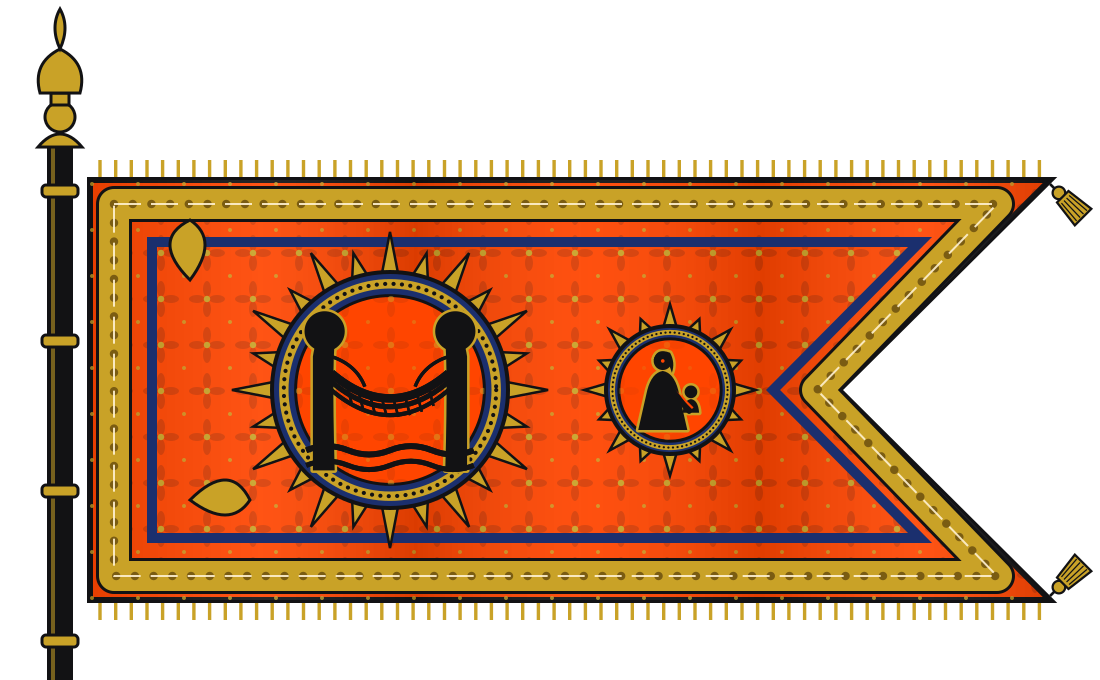
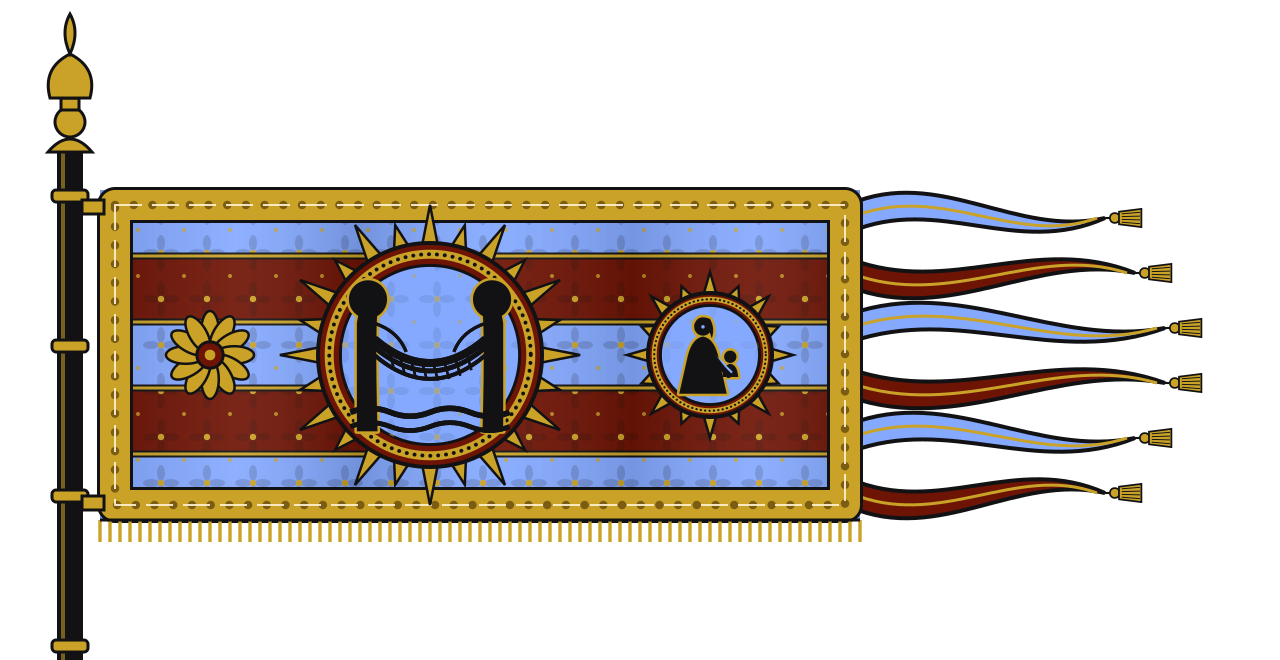
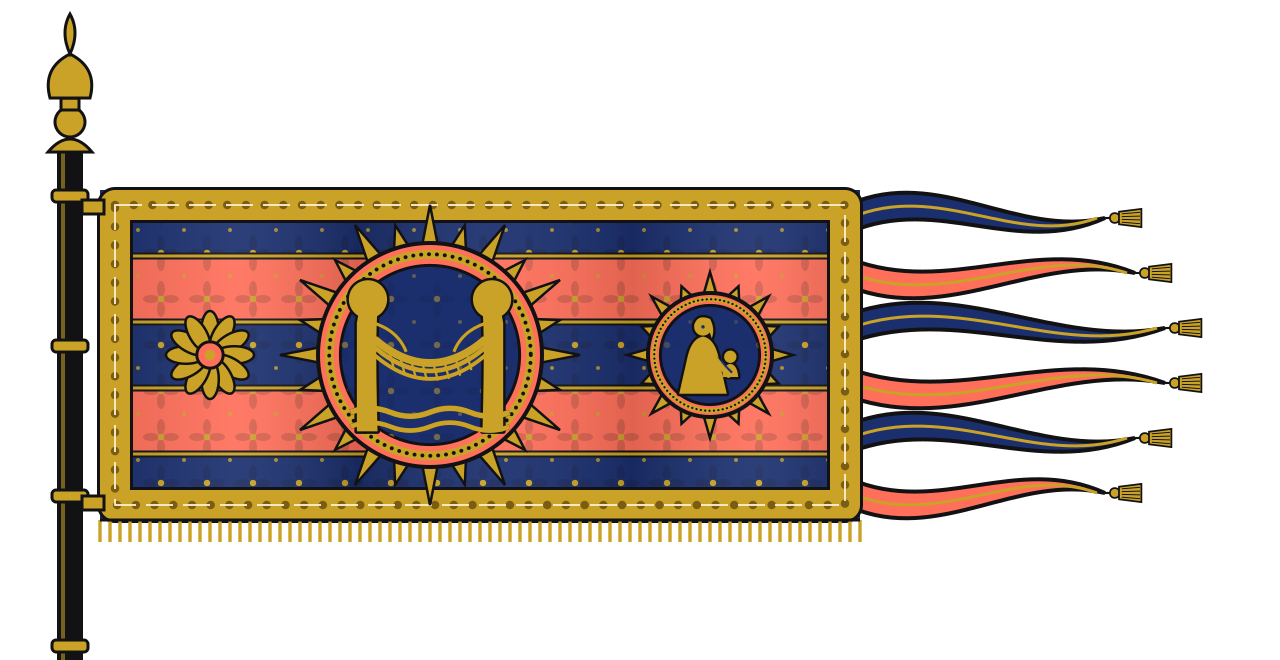
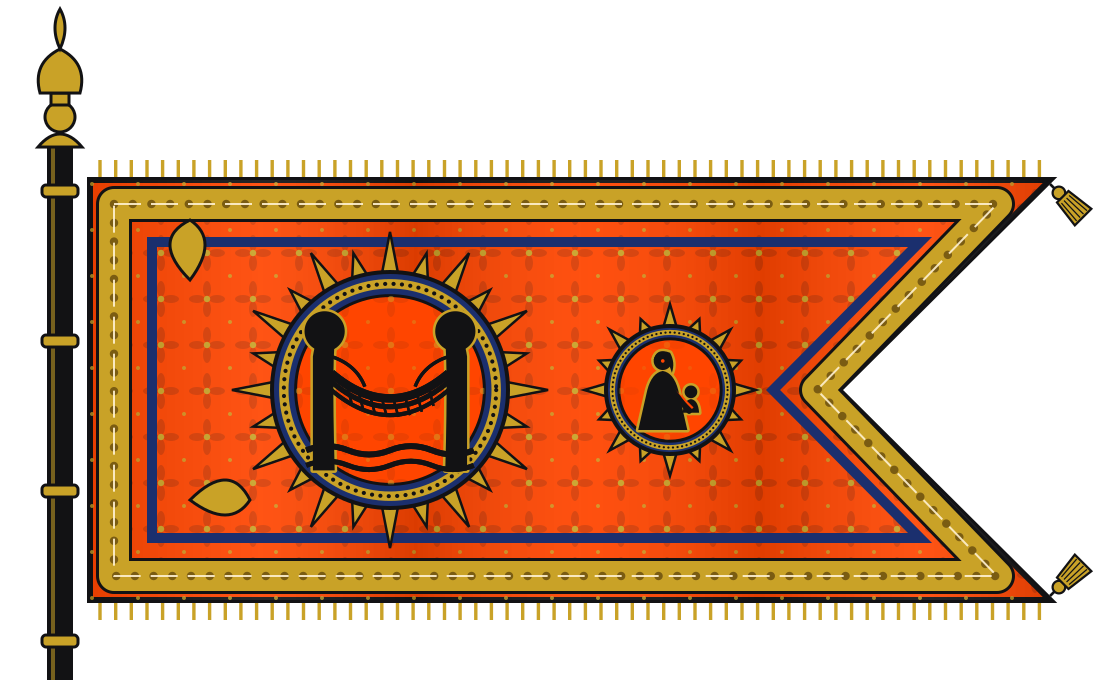
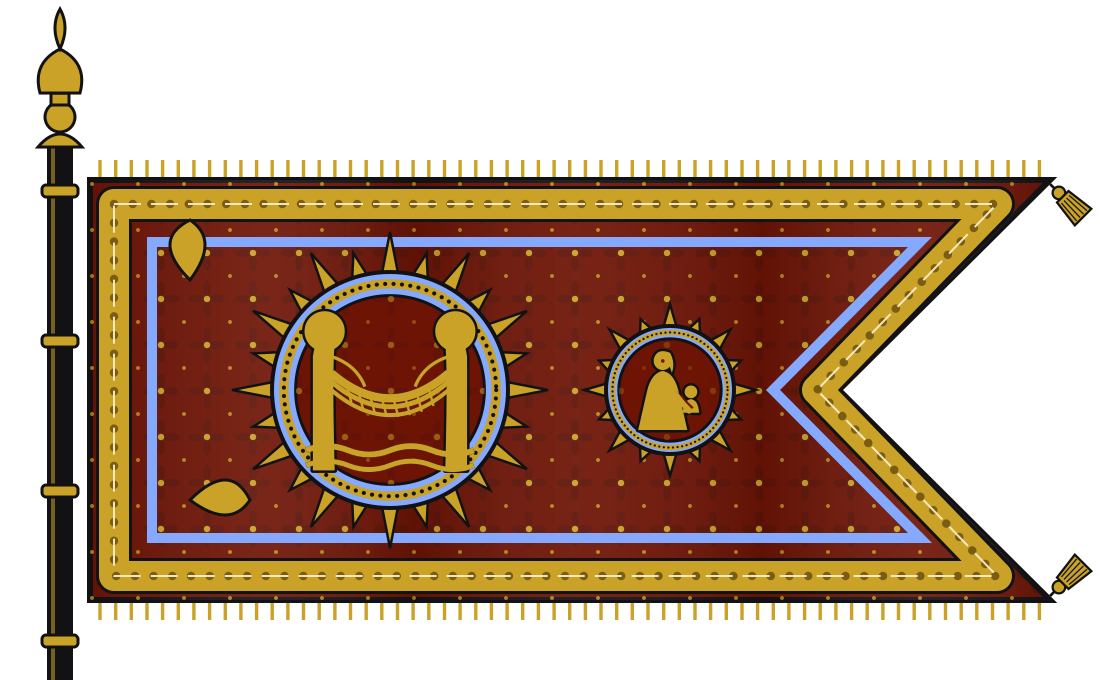
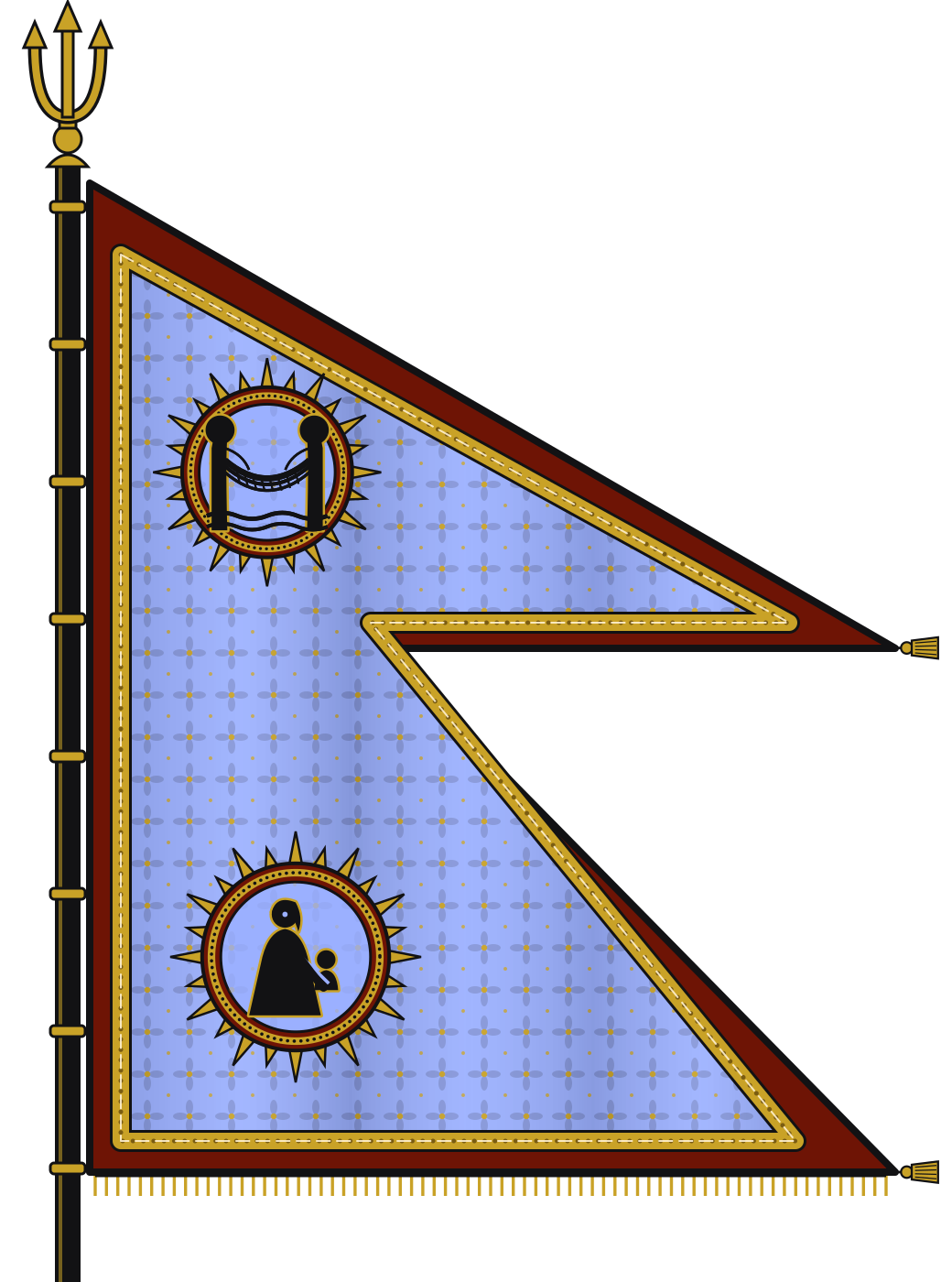
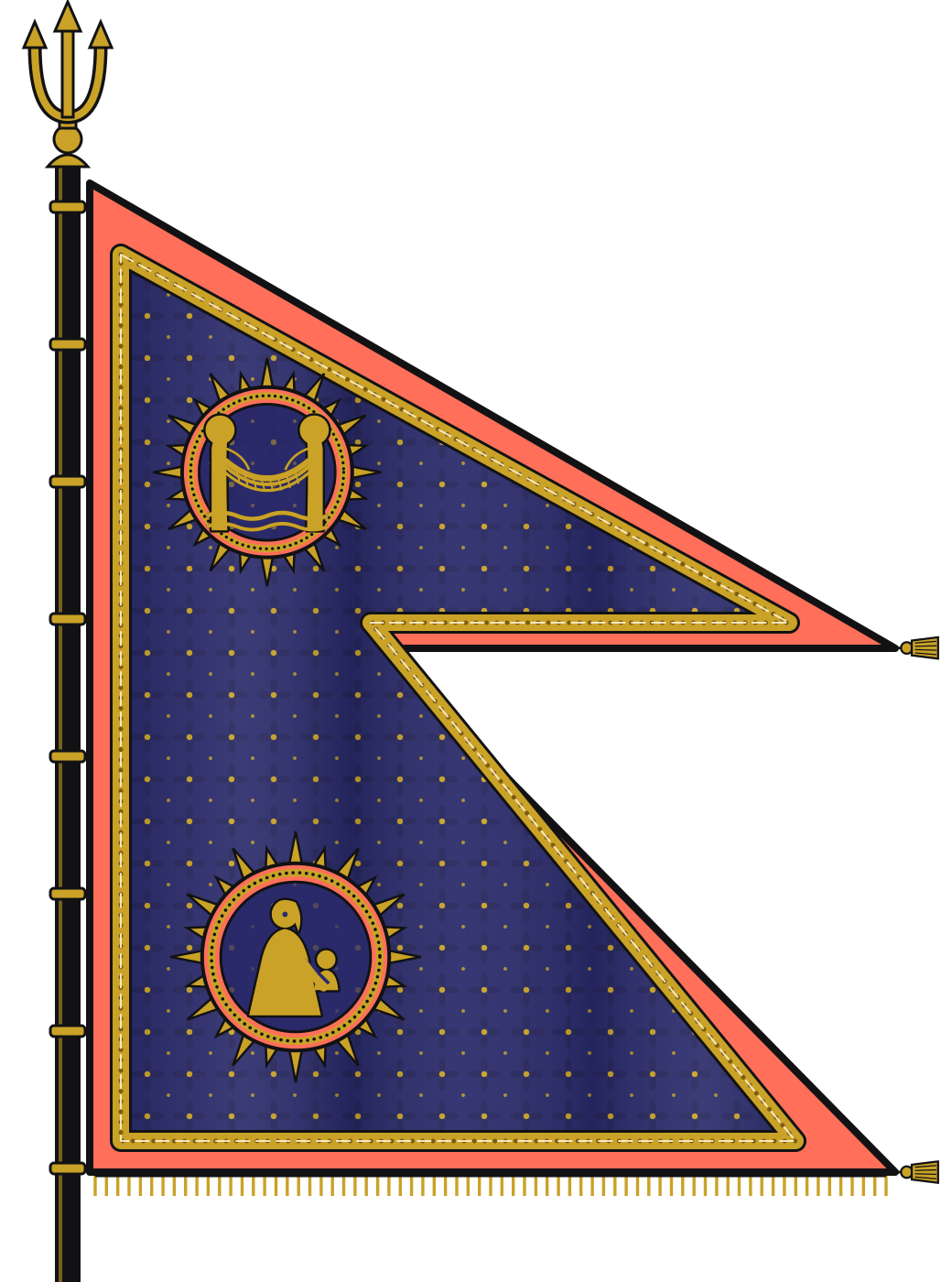
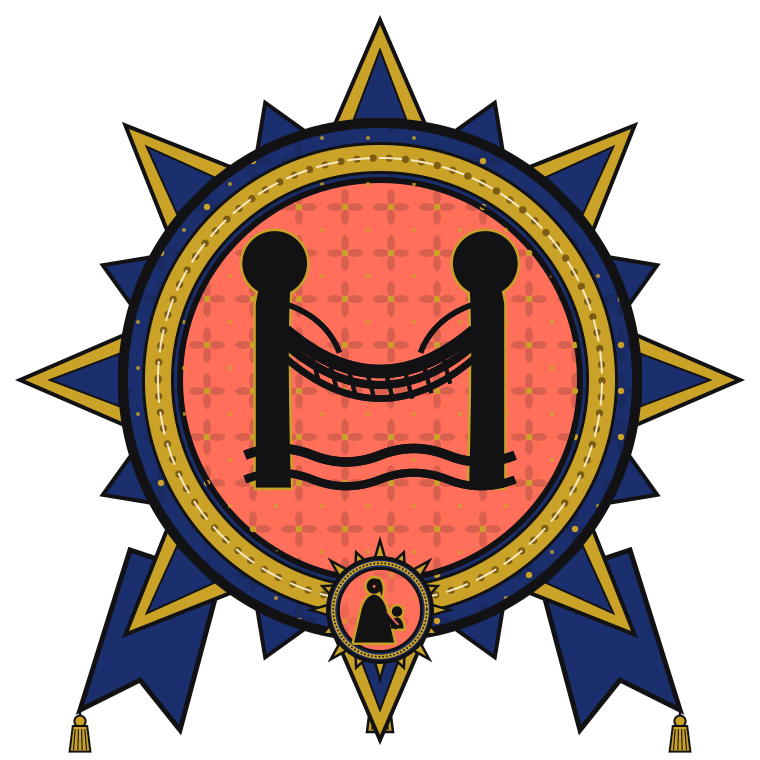
The Atlas gives the Khasi a living root bridge over a stream, for the bridges the War grow from tree roots[1], and a mother figure, for their matrilineal society in which the youngest daughter keeps the house[1]. The flag is a Jaripataka.
| Part of the kit | This clan |
|---|---|
| Field | Fiery Vermilion #FF4500 |
| Accent | Royal Navy #1B2F6E |
| Emblem colour | Charcoal Black #121214 |
| Zari metal | Gold |
| Main emblem | A living root bridge over a stream |
| Second image | A mother figure |
| Night and day | Every visual accessory has two versions: by night the emblem on the dark field, by day the clan's field colour on cloth woven from its metal. |
6. Flags
Every clan has every flag type; the type says the occasion and the colours say the clan. The outlined card is the flag the Atlas assigns.
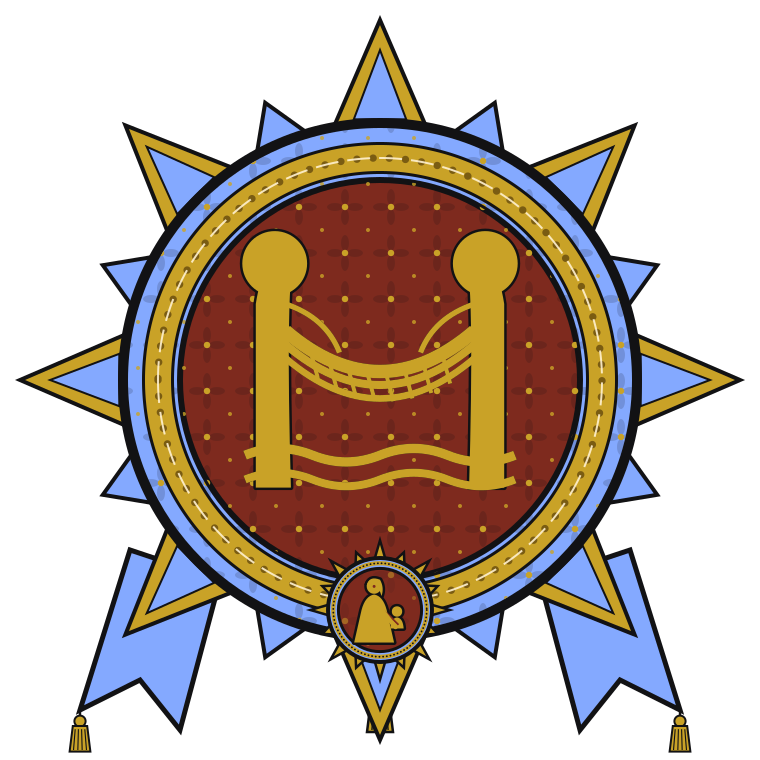
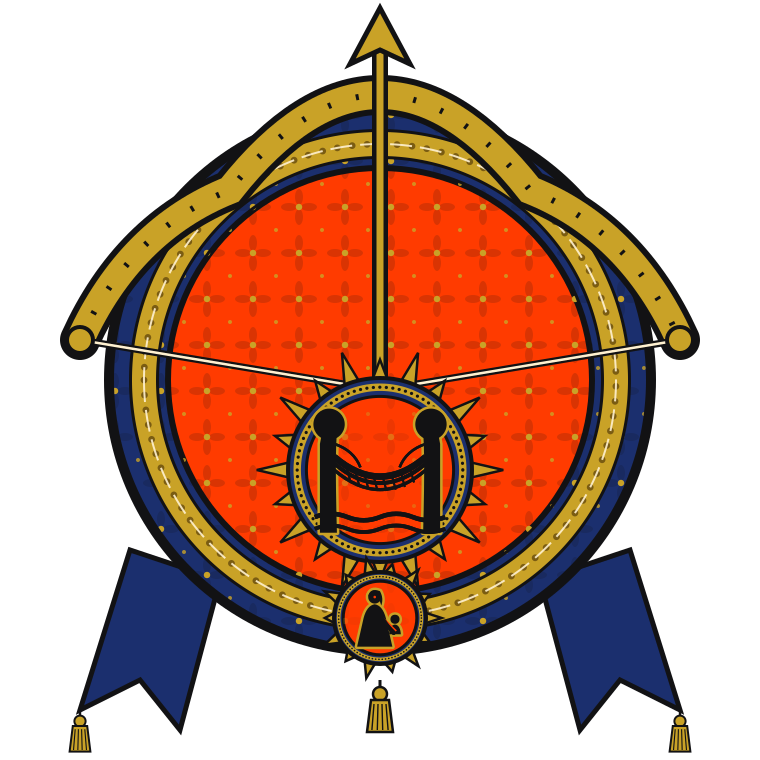
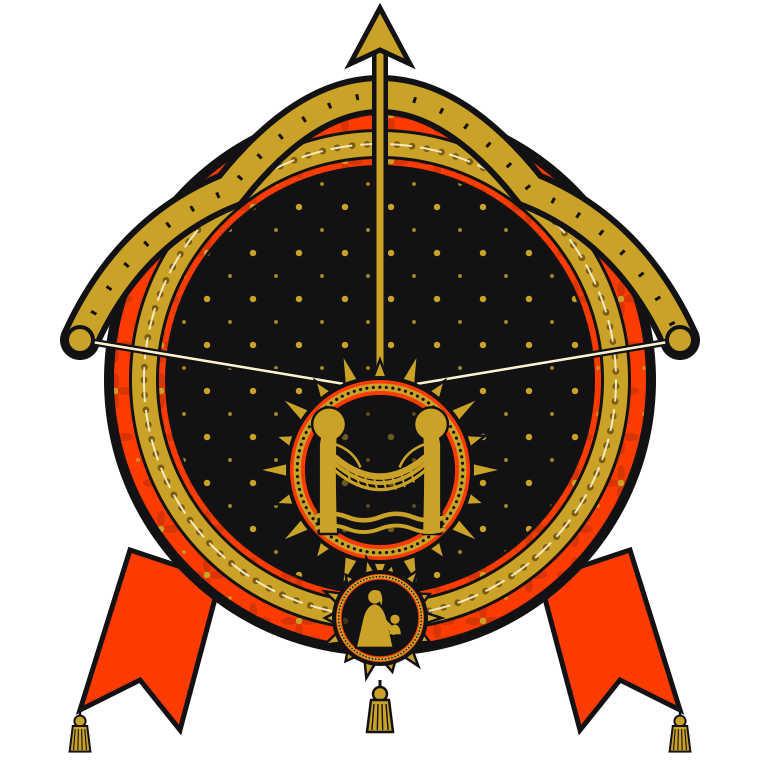
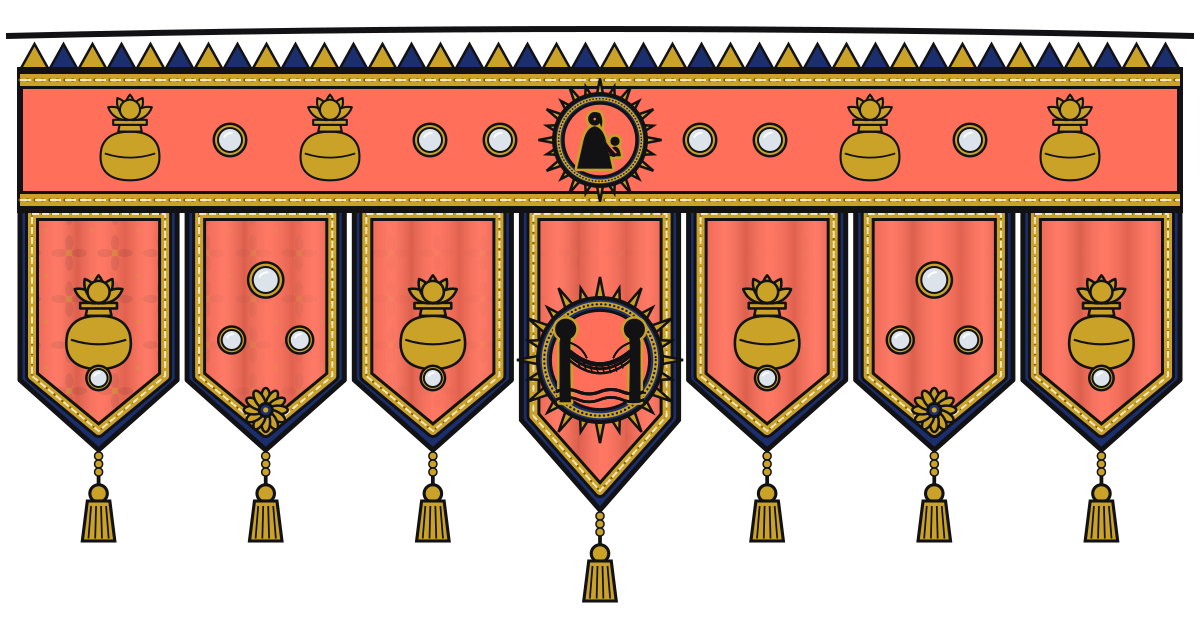
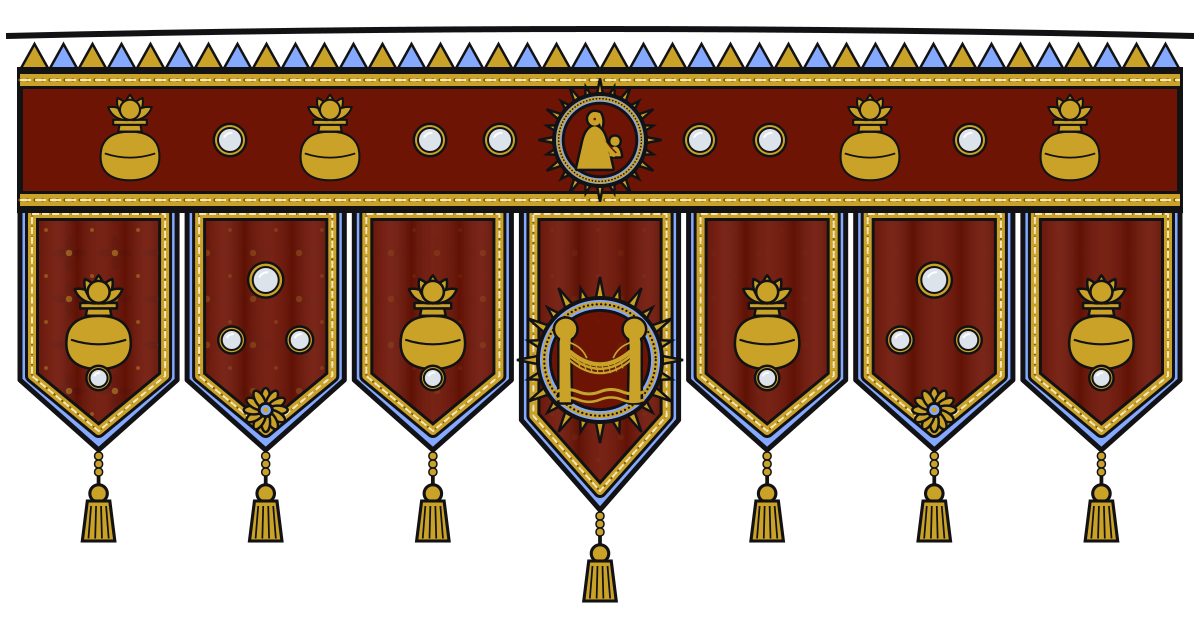
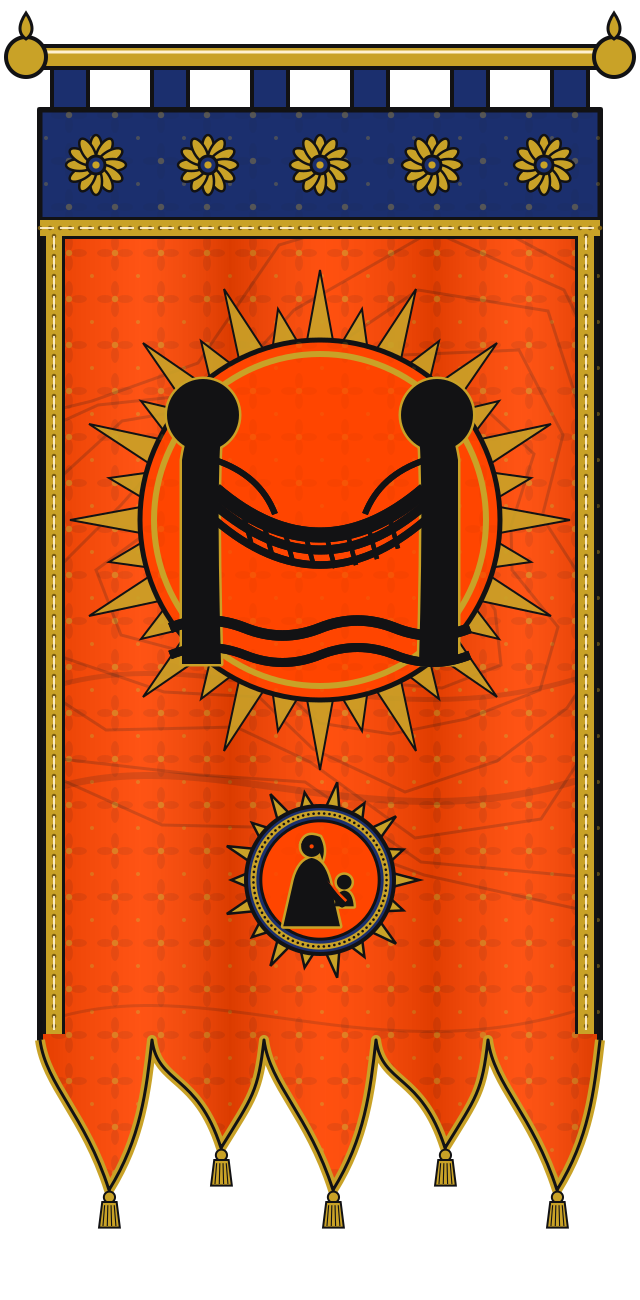
Historic banner
None known
New flag types
| Accessory | For this clan | Basis |
|---|---|---|
| A9 Pota-dhvaja · ship and trade flag For ships, caravans and markets | Not yet designed for this clan | Design |
| A10 Utsava-patāka · festival flag Light, bright flag for fairs and festivals | Not yet designed for this clan | Design |
| A11 Shoka-dhvaja · mourning flag White cloth with the emblem outline in the clan's metal | Not yet designed for this clan | Design |
7. Regalia
| Accessory | For this clan | Basis |
|---|---|---|
| E1 Chhatra · house parasol The ceremonial umbrella | Not yet designed for this clan | Design |
| E2 Chamara · fly-whisks The pair of whisks beside the head of the house | U Symphiah, the yak-hair whisk Carried by the men in the Nongkrem dance[7] | Documented |
| E3 Danda · staff of office Staff or scepter | Not yet designed for this clan | Design |
| E4 Simhasana · seat The seat of the house, covered in clan cloth | Not yet designed for this clan | Design |
| E5 Khetaka · shield A round shield; the Changi and Dhanush are its flag forms | The Khasi shield Carried in the war of 1829–1833[3] | Documented |
| E6 Kula-ayudha · clan weapon The weapon the clan honours | Bow and arrow, with the sword | Documented |
8. Worn
| Accessory | For this clan | Basis |
|---|---|---|
| F1 Kula-vastra · clan cloth The clan's woven pattern in its kit colours | Not yet designed for this clan | Design |
| F2 Kirti-vastra · honour cloth A cloth earned for a deed, not inherited | Not yet designed for this clan | Design |
| F3 Kula-mala · garland flower The flower or leaf the clan wears as a garland | Not yet found for this clan | Under research |
| F4 Chinha · house pin A metal badge with the pin emblem | Not yet designed for this clan | Design |
9. Records
| Accessory | For this clan | Basis |
|---|---|---|
| H1 Clan words A traditional line in the native script | Ki Hynñiewtrep · “The Seven Huts: the seven families who, in Khasi tradition, stayed on earth and became the people” Clan words · the Khasi name of their first home in their own tradition[1] | Design |
| H2 Biruda · titles The house's title or titles | U Syiem (Siem) for the chief of a hima, sometimes Sardar; Dolloi for the twelve Jaintia chiefs, and U Kongsong for the premier chief at Nartiang | Documented |
| H3 Prashasti · praise genealogy The lineage as written at the head of a grant | Not yet found for this clan | Under research |
| H4 Vahi · clan register The book of the clan's births, marriages and deaths | Not yet found for this clan | Under research |
| H5 Rana-ghosha · war cry The clan's cry in battle or celebration | Not yet found for this clan | Under research |
10. VishwaVit · knower of the world
Game values are design choices for this project, not historical claims.
References
- Khasi people, Wikipedia (Kiwix copy of the October 2023 article, read 2026-10-08), citing Census of India 2011 (mother tongue), P. Sidwell (2021), P. R. T. Gurdon, The Khasis, and The Shillong Times (2019).
- Khasi Hills Autonomous District Council, Khasi States and the Shillong Municipality, read 2026-10-19, khadc.nic.in (author and date not stated in the extract; the fetch summarised the page, paraphrases marked)
- Tirot Sing, Wikipedia (read 2026-10-08) — Nongkhlaw, the road, the Anglo-Khasi War 1829–1833, capture and death.
- Thomas Jones (missionary), Wikipedia (read 2026-10-08), citing D. R. Syiemlieh (1994), D. Ben Rees (2002) and A. J. May (2012).
- Kamakhya Temple, Wikipedia (citing Shin 2010, Urban 2009–2019, Banerji 1925, Sarma 1981/1988, Nath 1989, Kakati 1989, Neog 1980).
- Nongkrem Dance, Government of Meghalaya portal (read 2026-10-08).
- Festivals and Ceremonies of the Khasis, Department of Arts and Culture, Government of Meghalaya (read 2026-10-08).
- Kynpham Sing Nongkynrih, "The poetics of the Khasi phawar", in Badaplin War (ed.), Tribal Literature of North-East India (Shillong: SMS Hi-Tech Impression, 2009), pp. 43–56; NEHU repository record (metadata read 2026-10-08).
- Khasi and Jaintia Hills (Wikipedia, read 2026-10-10).
- P. R. T. Gurdon, The Khasis (1907; public domain), Project Gutenberg eBook 12786 (Introduction, Ch. I–II read 2026-10-10).
- Charles Reuben Lyngdoh (2009), thesis on the Khasi hima, NEHU DSpace, read 2026-10-25 (first 100000 of 111371 chars; title not shown in the extract), dspace.nehu.ac.in (fetch summarised)
- Government of Meghalaya portal, Nongpoh / Ri Bhoi page, read 2026-10-25, meghalaya.gov.in
- Basan Nongkseh, "Unfortunate events leading to bifurcation of Hima Shillong into Hima Mylliem and Khyrim in 1853", The Shillong Times, 19 Aug 2023 (cites Lyngdoh 1938, Giri 2012 and Bareh 1967; fetch summarised), read 2026-11-10, theshillongtimes.com
- cherrapunjee.com, On the Markets in the Khasi Hills (book excerpt, pp. 147–151, author and original date not given; site post 2019-09-18), read 2026-10-19, link
- Sirajul Islam, "Jaintia, Kingdom of", Banglapedia (page edited 18 June 2021, read 2026-10-10).
- Ahom-tribal Relations: a political study (OCR), National Virtual Library of India, read 2026-10-19 (Ch. I only), link
- Yellow Baobab blog (author not named), History of the Khasis 1824 to present, read 2026-11-10 (weak secondary: mostly unattributed; credits Lyall, Gurdon, Pemberton, I. M. Simon and Birdwood), yellowbaobab.blogspot.com
- Gale Group (2008) via everyculture.com, Khasi - History and Cultural Relations (no author named), read 2026-11-01
- Gale Group (2008; no author named) via everyculture.com, Khasi - Sociopolitical Organization, read 2026-11-01
- P. R. T. Gurdon, The Khasis (1907; public domain), Yandex Books read-online copy, books.yandex.ru (read 2026-11-01; the text stops partway through Ch. II, so Ch. III is not in it)
- D. R. Syiemlieh, Khasi iron culture and iron trade with Sylhet in the late eighteenth and early nineteenth centuries, NEHU DSpace catalogue record (listed 2013-01-18; catalogue only, full text not read), read 2026-10-19, https://dspace.nehu.ac.in/handle/1/8880
- East Khasi Hills District, The People, read 2026-10-10, https://eastkhasihills.gov.in/?p=2811
- D. R. Syiemlieh, "Trade and markets in the Khasi Jaintia Hills: Changed conditions in the 19th and 20th centuries", in Syiemlieh and Manorama Sharma (eds), Society and Economy in North-East India, vol. 3 (Regency, New Delhi, 2008), pp. 51–61 (NEHU DSpace catalogue record; PDF not read), read 2026-11-10, dspace.nehu.ac.in
- Ministry of Tribal Affairs, State/UT-wise list of Scheduled Tribes (Constitution (ST) Order 1950 as amended; list dated 09-07-2024), via the Atlas entries ST-015 and ST-093.
- Government of Bangladesh, Small Ethnic Groups Cultural Institutions Act, list of 50 groups (2019), via the Atlas row ST-132.