The Kharwar are a Scheduled Tribe in the Atlas's list (dated 9 July 2024) in Bihar, Jharkhand, Odisha, Uttar Pradesh and West Bengal. The earliest record in the extracts is a 1169 AD inscription at Phulwari in Rohtas district, which credits Nayak Pratapdhavala, chief of Japila, with a road; whether his Khayaravala line is the Kharwar is disputed[1][2]. In 1857 Nilamber and Pitamber, described as Bhogta chiefs of the Kharwar tribe, led a revolt in Palamu[3]. The community's totem is khar grass, which members do not cut or injure while it grows[1]. Members consider themselves Kshatriya and claim descent from the Surajvanshi Rajputs; the Tribal Research Institute says they prefer to see themselves as a tribe[2].
01Faith and deities
The project KulDevi from the Atlas (basis: homeland shrine at Rajrappa, Jharkhand). The extracts do not name Chhinnamasta as a Kharwar goddess. The Rajrappa page records the site as a tribal place of worship in ancient times[4]
Chhinnamasta of Rajrappa, Jharkhand[4]
The presiding goddess of the clan's homeland or capital: a link of place, not a recorded clan tie.
| Deity or tradition | Place in the clan's life | Evidence |
|---|---|---|
| Nibeshwar Mahadev | Shiva at Ambada (now Adamapur), Rohtas; land given by Sahas Dhaval Dev, and a ritual with mantras, attended by the royal family and officers, funding incense lamps and naivedya | [2] |
| Brahmin and Pahan priests | Perform the religious functions (the page does not name the rites) | [1] |
| Sun (Surya) | Descent claim: the Kharwar claim Sun descent, and the Birhor regard them as brothers; some Uttar Pradesh Kharwar claim the Suryavansha dynasty | [5][1] |
02Temples
The extracts record temples linked to the Khayaravala chiefs and their copper plates. None is recorded as built by the Kharwar. Tutla Bhawani at Tilothu is named on the page, with no link to Kharwar worship stated[1].
Built by the clan
Not recorded.
Given patronage or grants by the clan
| Temple | Deity | What the clan gave | When | Where |
|---|---|---|---|---|
| Nibeshwar Mahadev | Shiva | Land at Ambada (now Adamapur), and a ritual donation with incense lamps and naivedya | Vikrami Samvat 1241 as printed; 1181 AD (Dr. Shyam Sundar Tiwari) | Ambada, Rohtas[2] |
| Tarachandi temple | Not named on the page | An inscription by Nayak Pratapdhavala on the temple; the extracts do not say he built it | Not dated in the extract | Sasaram[1][2] |
03Languages and scripts
| Language or script | Kind | Under the clan | Evidence |
|---|---|---|---|
| Sadri living | Indo-Aryan home language | Spoken at home[1][2] | |
| Hindi living | Link language | Used with others[1][2] | |
| Bhojpuri and Nagpuri | Listed in the infobox of the Wikipedia page; no source is credited | Infobox[1] | |
| Sanskrit and early Nagari script | Language and script of the inscriptions | Not dated[2] |
04Books and literature
The extracts name no book by a Kharwar author and no book the Kharwar patronised. The works below describe the people.
Written during the clan's history
| Work | Author | Kind | When | Link to the clan |
|---|---|---|---|---|
| Encyclopaedia of Scheduled Tribes in Jharkhand | Minz and Hansda | Reference, cited for the khar grass totem and the Surajvanshi Rajput descent claim | 2010 | [1] |
| History of the Gahadavala Dynasty | Niyogi | Reference, cited on the Khayaravala question | 1959 | [1] |
| Antiquarian remains in Bihar | Patil | Reference, cited on the Khayaravala question | 1963 | [1] |
| Tribes and Castes of Bengal, Vol. I | H. H. Risley | Reference, with the sept lists | 1891 | [6] |
| Mishra (2011), title not named on the page | Mishra | Reference, for the putative origins and the Uttar Pradesh Suryavansha claim | 2011 | [1] |
Given patronage by the clan
Not recorded.
05Thinkers and scholars
| Name | Field | Era | Contribution |
|---|---|---|---|
| Dr. Shyam Sundar Tiwari | Historian | Not dated | Read the Adamapur copper plate and dated it 1181 AD[2] |
| Niyogi | Historical study | 1959 | Cited on whether the Khayaravala line is the Kharwar[1] |
| Patil | Antiquarian study | 1963 | Cited with Niyogi on the Khayaravala question[1] |
| H. H. Risley | Ethnology | 1891 | Recorded the sept names of the Kharwar[6] |
| Minz and Hansda | Tribal encyclopaedia | 2010 | The khar grass totem and the Surajvanshi Rajput descent claim[1] |
The scholars named come from the page's citations. No Kharwar scholar is named in the extracts.
06Art and architecture
Under research: the extracts record no painting, sculpture, textile or craft of the Kharwar. The Khayaravala-era inscriptions and the Nibeshwar temple are recorded but are not tied to Kharwar art. Leads: the Tribal Research Institute's Kharwar page.
Painting and wall art
Not recorded.
Sculpture and temple art
Not recorded.
Temple and building architecture
Not recorded.
Weaving and textiles
Not recorded.
Clothing and jewellery
Not recorded.
Coins, pottery and crafts
Not recorded.
07History
1169 and 1223 AD: the Khayaravala inscriptions at Rohtas
A 1169 AD inscription at Phulwari, Rohtas district, records road construction by Nayak Pratapdhavala, chief of Japila (modern Japla)[1]. A 1223 AD inscription at the Lal Darwaja gate of Rohtas fort names his successor, Shri Pratapa, said to belong to the Khayaravalavansha[1].
The Tribal Research Institute places the Khayarwal (Khayaravala) rule in the 11th to 16th century, from the Varanasi border to Gaya, and says the dynastic name is the origin of the modern Kharwar name[2]. The Wikipedia page suggests the Khayaravala may survive as the Kharwar but flags this as possibly unreliable, citing Niyogi (1959, pp. 118-119) and Patil (1963, p. 488)[1].
Sahas Dhaval Dev and the Adamapur copper plate
The Institute page gives the genealogy as Khadir Pal (the first king), Sadhav, Ran Dhaval, Pratap Dhaval and Sahas Dhaval, with Indra Dhaval and Vikram Dhaval following[2]. In Sahas Dhaval Dev's reign Rohtasgarh was taken from the Oraon kings[2].
Sahas Dhaval Dev donated land at Ambada (now Adamapur) to the deity of the Nibeshwar Mahadev temple, by a copper plate dated Vikrami Samvat 1241 on the page; the historian Dr. Shyam Sundar Tiwari read the plate and dated it 1181 AD[2].
Palamu and the risings of 1832
The Latehar district history says the Kharwars, Oraons and Cheros were three aboriginal races said to have practically ruled the tract, with no source credited[3]. During the Kol rebellion of 1832, Cheros and Kharwars rose against the administration and were defeated near Latehar[3]; the Kharwar are among the groups in the 1831-32 Kol uprising[7].
1857: Nilamber and Pitamber in Palamu
Nilambar and Pitambar, described as chiefs of the Bhogta clan of the Kharwar tribe with ancestral jagirs, organised a force of 500 and on 21 October 1857 attacked Raghubar Dayal at Chainpur, who had sided with the British; they then moved on Leslieganj[3]. Many Chero jagirdars joined their movement. The district history calls it 'no mere sepoy mutiny but an uprising of the indigenous population of the district', and records that the Palamu fort was captured by Col. Dalton in January[3].
08Journey and migrations
The extracts give putative origins, not a recorded migration.
| When | From | To | Why | Evidence |
|---|---|---|---|---|
| Early (putative) | Palamu, the Sone Valley or Rohtas | — | Origins are given in different versions; Mishra (2011) gives Palamu, the Sone Valley and Rohtas, and Uttar Pradesh Kharwar claim Rohtas | [1][2] |
09Seats and lands
| Place | Role | Where today |
|---|---|---|
| Palamu | A tract the Kharwars, Oraons and Cheros are said to have practically ruled (Latehar history, no source credited) | Jharkhand[3] |
| Rohtas and Rohtasgarh | The Khayaravala chiefs' fort; taken from the Oraon kings in Sahas Dhaval Dev's reign | Rohtas, as the page names it[2] |
| Phulwari | Site of the 1169 AD road inscription of Nayak Pratapdhavala | Rohtas district[1] |
| Japila (Japla) | Seat of Nayak Pratapdhavala; the dynasty's origin is placed here | Japla, as the page names it[2] |
| Lal Darwaja, Rohtas fort | Gate with the 1223 AD inscription naming Shri Pratapa | Rohtas[1] |
| Sasaram | Tarachandi temple, with an inscription by Nayak Pratapdhavala | Not stated[1] |
| Ambada, now Adamapur | Nibeshwar Mahadev temple; land and copper plate of Sahas Dhaval Dev | Rohtas district[2] |
| Navner | Copper plate of Indra Dhaval Dev | Aurangabad district, as the page gives it[2] |
| Bandu | Inscription of Vikram Dhaval Dev | Not stated[2] |
| Gaya and the Varanasi border | The range of Khayarwal rule (Institute page) | Bihar and Uttar Pradesh[2] |
| Latehar and Chainpur | Places of the 1832 defeat near Latehar and the 1857 attack at Chainpur | Palamu, Jharkhand[3] |
| Chotanagpur and Lohardaga | Places where the sept lists place Kharwar groups | Jharkhand[1] |
| Sone Valley | Named as a putative origin | Not stated[1] |
| Deoria, Balia, Ghazipur, Varanasi and Sonbhadra | Districts in which the Uttar Pradesh Scheduled Tribe entry for Kharwar and Khairwar applies | Uttar Pradesh[8] |
| Sundergarh and Keonjhar | Odisha districts for the Kharwar in the KISS handbook (spellings as printed) | Odisha[9] |
10Notable figures
| Name | Role | Era | Known from |
|---|---|---|---|
| Nayak Pratapdhavala | Chief of Japila; credited with road construction at Phulwari and with an inscription on the Tarachandi temple, Sasaram | 1169 AD[1][2] | |
| Shri Pratapa | Successor named in the Lal Darwaja inscription, said to belong to the Khayaravala line | 1223 AD[1] | |
| Sahas Dhaval Dev | Gave land at Ambada to Nibeshwar Mahadev; Rohtasgarh was taken from the Oraon kings in his reign | Vikrami Samvat 1241 as printed[2] | |
| Indra Dhaval Dev | Second son of Sahas Dhaval Dev; the Navner copper plate | Not dated[2] | |
| Vikram Dhaval Dev | Son of Indra Dhaval Dev; the Bandu inscription | Not dated[2] | |
| Khadir Pal | First king of the line, as the Institute page gives it | Not dated[2] | |
| Pandit Mahanidhi | The judge who issued the copper plate | Not dated[2] | |
| Nilamber and Pitamber | Brothers, Bhogta chiefs of the Kharwar with ancestral jagirs; led the revolt in Palamu | 1857[3][10] | |
| Lakshman Acharya | Governor of Sikkim, as the page lists him | Not dated[1] | |
| Chhotelal Kharwar | Former Member of Parliament, Robertsganj | Not dated[1] | |
| Satyanand Bhogta | Labour minister of Jharkhand, as the page lists him | Not dated[1][10] | |
| Nikki Pradhan | Hockey player | Not dated[1] |
11Allies, rivals and marriages
| People | Relationship | When |
|---|---|---|
| Bhogta | Related group; a Jharkhand Scheduled Tribe synonym of the Kharwar from 2022 (Bhogta page); listed as a sub-group in the Atlas[10] | 2022 |
| Khairaha | Described as a sub-group of the Khairwar; now a separate Scheduled Caste group, strictly endogamous[11] | Not dated |
| Khairwar | Listed with the Kharwar in the Uttar Pradesh Scheduled Tribe list (Atlas ID ST-127)[8] | 2011 list |
| Kol and Kolarian tribes | Russell (1916) says Khairwars call themselves Kols; Everyculture lists the Khairwar among the Kolarian tribes[12][13] | 1916; 2008 |
| Munda, Kharia and Korwa | Russell (1916) lists Kharias, Khairwars, Korwas and Korkus as related stock[12] | Not dated |
| Asur | The Asurs claim putative kinship with the Kharwar and accept food from them[14] | Not dated |
| Birhor | Regard the Kharwar as brothers; both claim descent from the Sun[5] | Not dated |
| Oraon | Named in the record: Rohtasgarh was taken from the Oraon kings in Sahas Dhaval Dev's reign[2] | Sahas Dhaval Dev's reign |
| Chero | Rose together in 1832; many Chero jagirdars joined Nilamber and Pitamber in 1857[3] | 1832; 1857 |
| Other groups in the 1831-32 Kol uprising | Mankis, Mundas, Oraons, Hos, Bhumijs and Chero[7] | 1831-32 |
| Rajputs (Suryavanshi) | Descent claimed by members (Minz and Hansda 2010, as the Wikipedia page cites them)[1][2] | Claimed |
12Society and livelihood
The Kharwar are patrilineal. Each village has a leader called Pradhan: a Chatti Pradhan heads four villages, a Panchora Pradhan five and a Satora Pradhan seven[1]. Members consider themselves Kshatriya, and prefer to see themselves as a tribe[2].
Government and social order
| Institution or group | What it was | Evidence |
|---|---|---|
| Pradhan | Village leader; Chatti Pradhan for four villages, Panchora Pradhan for five, Satora Pradhan for seven | [1] |
| Six endogamous divisions | Surajbanshi, Daulat bandi, Paraband, Kharia bhogti and Mauijhia (the page says six divisions and prints five names) | [1][2] |
| Totemic clans | Clans named after grasses, birds and animals, such as Kansi (kans grass), Tirkey (eagle) and Besra (sparrowhawk) | [1] |
| Birth and death rites | Birth pollution lasts six days; the dead are cremated or buried, and death pollution lasts ten days | [1][2] |
Livelihood over time
| Era | Livelihood | Evidence |
|---|---|---|
| Traditional | Agriculture as the base, with forest work, livestock, fishing, hunting and trapping; a single annual crop often falls short | [1][2] |
| Traditional (Bhogta) | Traditionally cultivators | [10] |
13Sub-clans and related clans
Every sub-clan, sept and related people the extracts name. The divisions and totemic clans come from the Wikipedia page; the Risley septs are as the page gives them (Risley, 1891); the Bhogta clans come from the Bhogta page.
| Clan | Relation | Where | Size | In the Atlas | Evidence |
|---|---|---|---|---|---|
| Surajbanshi | Sub-clan | Endogamous division | same name as ST-557: check | [1] | |
| Daulat bandi | Sub-clan | Endogamous division | new clan candidate | [1] | |
| Paraband | Sub-clan | Endogamous division | new clan candidate | [1] | |
| Kharia bhogti | Sub-clan | Endogamous division | new clan candidate | [1] | |
| Mauijhia | Sub-clan | Endogamous division | new clan candidate | [1] | |
| Kansi | Sub-clan | Totemic: kans grass | same name as ST-546: check | [1] | |
| Nilkanth | Sub-clan | Totemic: Indian roller | same name as ST-541: check | [1] | |
| Hansgadhia | Sub-clan | Totemic | new clan candidate | [1] | |
| Besra | Sub-clan | Totemic: sparrowhawk | same name as ST-354: check | [1] | |
| Sahil | Sub-clan | Totemic | new clan candidate | [1] | |
| Tirkey | Sub-clan | Totemic: eagle | same name as ST-558: check | [1] | |
| Chandiyar | Sub-clan | Totemic | new clan candidate | [1] | |
| Lohwar | Sub-clan | Totemic | new clan candidate | [1] | |
| Bania | Sub-clan | Chotanagpur (Risley septs) | same name as SUB-131: check | [1][6] | |
| Ba | Sub-clan | Chotanagpur (Risley septs) | new clan candidate | [1][6] | |
| Bahera | Sub-clan | Chotanagpur (Risley septs) | same name as ST-524: check | [1][6] | |
| Bael | Sub-clan | Chotanagpur (Risley septs) | new clan candidate | [1][6] | |
| Bair | Sub-clan | Chotanagpur (Risley septs) | new clan candidate | [1][6] | |
| Bamria | Sub-clan | Chotanagpur (Risley septs) | new clan candidate | [1][6] | |
| Bandia | Sub-clan | Chotanagpur (Risley septs) | new clan candidate | [1][6] | |
| Pat bandh | Sub-clan | Palamu (Risley septs) | new clan candidate | [1][6] | |
| Dulbandh | Sub-clan | Palamu (Risley septs) | new clan candidate | [1][6] | |
| Khairi | Sub-clan | Palamu (Risley septs) | new clan candidate | [1][6] | |
| Deshmari | Sub-clan | Southern Lohardaga (Risley septs) | new clan candidate | [1][6] | |
| Kharwar (sept) | Sub-clan | Southern Lohardaga (Risley septs) | new clan candidate | [1][6] | |
| Bhagta | Sub-clan | Southern Lohardaga (Risley septs) | new clan candidate | [1][6] | |
| Rout | Sub-clan | Southern Lohardaga (Risley septs) | new clan candidate | [1][6] | |
| Manjhia | Sub-clan | Southern Lohardaga (Risley septs) | new clan candidate | [1][6] | |
| Bhogta | Related people | Bihar, Jharkhand, West Bengal | 2,23,453 (Jharkhand, 2011); 18,269 (West Bengal, 2011); 15,103 (Bihar, 2011)[10] | new clan candidate | [10] |
| Damajhwar | Sub-clan | Bihar Bhogta clan | new clan candidate | [10] | |
| Saichumair (Saichuniar) | Sub-clan | Bihar Bhogta clan | new clan candidate | [10] | |
| Bhumchuriar (Bhumchuniar) | Sub-clan | Bihar Bhogta clan | new clan candidate | [10] | |
| Rimrimria | Sub-clan | Bihar Bhogta clan | new clan candidate | [10] | |
| Pathbhandhi | Sub-clan | Bihar Bhogta clan | new clan candidate | [10] | |
| Musuar | Sub-clan | Bihar Bhogta clan | new clan candidate | [10] | |
| Kmariar (Kawliar) | Sub-clan | Bihar Bhogta clan | new clan candidate | [10] | |
| Beharwar | Sub-clan | Bihar Bhogta clan | new clan candidate | [10] | |
| Hans | Sub-clan | West Bengal Bhogta clan | new clan candidate | [10] | |
| Mur | Sub-clan | West Bengal Bhogta clan | new clan candidate | [10] | |
| Kaua | Sub-clan | West Bengal Bhogta clan | new clan candidate | [10] | |
| Ganjhu | Related people | Surname used by Bhogta (Bhogta page); also an alias in the Atlas | new clan candidate | [10] | |
| Khairaha | Related people | Mirzapur and Allahabad, Uttar Pradesh | 892, 2011 (Uttar Pradesh SC list)[15] | same name as SUB-217: check | [11] |
| Kashyap (Khairaha surname) | Related people | Surname of the Khairaha | new clan candidate | [11] | |
| Khairwar | Related people | Uttar Pradesh (Khairwar listed with Kharwar) | 1,60,676 Kharwar and Khairwar together, 2011[8] | ST-127 | [8] |
| Kol | Related people | Chota Nagpur and central India | ST-141 | [12] | |
| Munda | Related people | Chota Nagpur | ST-229 | [12] | |
| Kharia | Related people | Odisha, Jharkhand and other states | ST-130 | [12] | |
| Korwa | Related people | Jharkhand and central India | ST-157 | [12] | |
| Asur | Related people | Jharkhand and Bihar | ST-012 | [14] | |
| Birhor | Related people | Jharkhand | ST-040 | [5] |
Clans marked "new clan candidate" are not in the Atlas yet.
14Surnames
Bhogta, Ganjhu, Singh and Pradhan are the surnames the extracts give. No count of bearers is sourced for any of them. Singh is a common surname, and the extracts do not say how many other communities use it. Pradhan is a village-leader title on the Kharwar page and an alternate name for the Bhogta[10].
| Surname | Clan or sub-clan | Where | People with this surname | Also used by other communities |
|---|---|---|---|---|
| Bhogta | Bhogta | Jharkhand, Bihar, West Bengal | not yet counted | Not checked |
| Ganjhu | Ganjhu | not yet counted | Not checked | |
| Singh | Bhogta | not yet counted | Not checked | |
| Pradhan | Bhogta (alternate name) | not yet counted | Not checked | |
| Kashyap | Khairaha | Uttar Pradesh | not yet counted | Not checked |
Counts are of everyone with the surname, from the cited source and year, not only members of this clan. A surname shared with other communities says nothing about any one person's origin.
15Songs and music
Under research: the extracts give no Kharwar song.
None recorded yet.
16Poems, lullabies and children's rhymes
None recorded yet.
17Stories, legends and proverbs
Stories and legends
| Story | What happens | Told by | Evidence |
|---|---|---|---|
| Descent from the Sun | The Kharwar claim descent from the Sun, and some Uttar Pradesh Kharwar claim the mythological Suryavansha dynasty | Kharwar (Mishra 2011, as the page cites) | [1][5] |
Proverbs and sayings
Not recorded.
18Festivals and fairs
Not recorded.
19Food, dress and games
Food
Not recorded.
Dress
Not recorded.
Games and martial arts
Not recorded.
Tags: living still practised · revived brought back after a break · lost known only from records · research reported but not yet confirmed from a source. Songs and poems under copyright are listed by title only; restricted or sacred material is noted without its content.
20Status today
The Kharwar are a living Scheduled Tribe in the Atlas's list (dated 9 July 2024). The page says Uttar Pradesh first listed them as a Scheduled Caste, redesignated them as a Scheduled Tribe by 2007, and applied that from 2017 only in certain districts[1].
Who carries the name today
| Community | Link | Basis | Evidence |
|---|---|---|---|
| Bhogta (Jharkhand Scheduled Tribe synonym from 2022) | Documented | [10] | |
| Khairaha (described as a sub-group of the Khairwar) | Community tradition | [11] | |
| Khayaravala dynasty (identification with the Kharwar disputed) | Disputed | [2][1] |
Recognised heritage
| What | Recognition | Evidence |
|---|---|---|
| Nilamber and Pitamber of 1857 | Atlas: 'Heroes of 1857 in Palamu' (popular identifier) | [3] |
| Khar grass | Community totem, not cut or injured while growing | [1] |
| Scheduled Tribe status | Official lists in Jharkhand, Odisha, West Bengal and Uttar Pradesh (2011 counts as printed) | [16][18][17][8] |
No community review of this page is recorded in this run.
21For children
The Grass That Is Not Cut
The Kharwar are a people of Bihar, Jharkhand, Odisha, Uttar Pradesh and West Bengal. Their special plant is khar grass. While khar grass is growing, the Kharwar do not cut it or hurt it, because it is their community's totem. Some Kharwar say their family goes back to the Sun. Long ago, a chief named Nayak Pratapdhavala had a road made in Rohtas district, and an old stone writing still tells us about it. In 1857 two brothers, Nilamber and Pitamber, led a revolt in Palamu against the East India Company. Today the Kharwar are a Scheduled Tribe, which means they are on a government list (the Atlas's list, dated 9 July 2024).
22Across the project
| Project | What carries this clan | Status |
|---|---|---|
| Atlas of the Janas | Rohtas and Palamu, the Sone Valley, Lohardaga, and the Uttar Pradesh districts the list names; the Wikipedia page also names Chhattisgarh, which is outside the sheet's states | Footprints not yet written |
| KulDevi and GrahDevi | Chhinnamasta of Rajrappa (KulDevi) and the GrahDevi forms, both; no extract links the Kharwar to them | From the Atlas |
| Planet naming | Under research | — |
| Renaming and waters | Under research: the extracts name no Kharwar water | — |
23Open questions
- Khayaravala question: the Institute page says the dynastic name is the origin of the Kharwar name; the Wikipedia page says the identification may be unreliable (Niyogi 1959; Patil 1963). Both sides are set out; neither is settled in the extracts.
- Bhogta status: the Bhogta page says the Bhogta of Jharkhand became a Scheduled Tribe in 2022. The Jharkhand Scheduled Caste list page still gives Bhogta as SC 003, population 2,23,453 (2011)[19]. The two are not reconciled in the extracts.
- Uttar Pradesh status: the Scheduled Tribe entry applies only in certain districts (Deoria, Balia, Ghazipur, Varanasi, Sonbhadra); the Scheduled Caste list excludes those districts. Check the current central list for each district.
- Khairwar: the Atlas lists Khairwar as its own Scheduled Tribe (ST-127) and as an alias of the Kharwar. The Madhya Pradesh Scheduled Tribe row 'Khairwar, Korwar' gives 76,097 (2011). Whether this is the same people is not stated.
- Surajvanshi and Sun descent: the claim is recorded (Minz and Hansda 2010; Mishra 2011; the Birhor page), with no primary source in the extracts.
- Sixth endogamous division: the page says six and prints five names.
- Khar grass totem: the only source is Minz and Hansda (2010), as the Wikipedia page cites it.
- The Latehar history says the Kharwar, Oraons and Cheros practically ruled the tract, with no source credited.
- The Bharat Discovery Hindi page on the Khairwar tribe failed to fetch in the pack's research; retry it for the culture sections.
- Uttar Pradesh Kharwar are said to claim Suryavansha descent; the UP OBC list excludes Kharwar claiming Rajput rank from one entry (Patwa). This is recorded in spillover, not decided.
- Jharkhand count: the Tribes of Jharkhand list gives 248,974 for the Kharwar (2011)[16]; the Kharwar page prints 248,947, from populationu.com[1]. The two figures are not reconciled in the extracts.
24Astitva
अस्तित्व · being, existence: everything by which the clan is known
The extracts document the khar grass totem, the totemic sept names, the self-name Athara Hazari, the Nayak title of the 1169 AD inscription, and the copper plates and gate inscriptions of the Khayaravala chiefs. No seal, coin or hero stone of the clan is recorded[1][2].
Every clan has every accessory, royal objects included. Each one says how it is known: Documented This clan's own object is recorded. · Regional tradition Recorded for the region or for peoples like this one, not for this clan. · Design Made for this project, with no historical claim. · Under research To be found for this clan from sources. Legends and titles are written in the clan's own script.
1. Seals and coins
| Accessory | For this clan | Basis |
|---|---|---|
| B1 Rajamudra · house seal Round seal with the clan emblem and a short legend in the clan's script | Not yet designed for this clan | Design |
| B2 Anguliya-mudra · signet ring Personal seal ring of the head of the house | Not yet designed for this clan | Design |
| B3 Chhapa · house stamp Ink or block stamp for letters, goods and cloth | Not yet designed for this clan | Design |
| B4 Tamrapatra · charter plate Copper-plate grant on a ring, closed with the house seal | Copper-plate grants of the Khayaravala chiefs: Ambada (Sahas Dhaval Dev, Vikrami Samvat 1241) and Navner (Indra Dhaval Dev) | Regional tradition |
| B5 Shreni-mudra · guild or trade seal Seal for the clan's trade, craft or caravan | Not yet designed for this clan | Design |
| C1 Clan coin Emblem or deity on one side, a legend in the clan's script | Not yet designed for this clan | Design |
| C2 Coin die The die that strikes the coin | Not yet designed for this clan | Design |
2. Living symbols
| Accessory | For this clan | Basis |
|---|---|---|
| I1 Totem trio The tree, bird and animal the clan protects | Grass: khar, the community totem, not cut while growing. Birds and animals: Nilkanth (Indian roller), Besra (sparrowhawk) and Tirkey (eagle) sept names | Documented |
| I2 Kaval-maram · guardian tree The tree that stands at the clan's seat | Not yet found for this clan | Under research |
3. Stone and gate
| Accessory | For this clan | Basis |
|---|---|---|
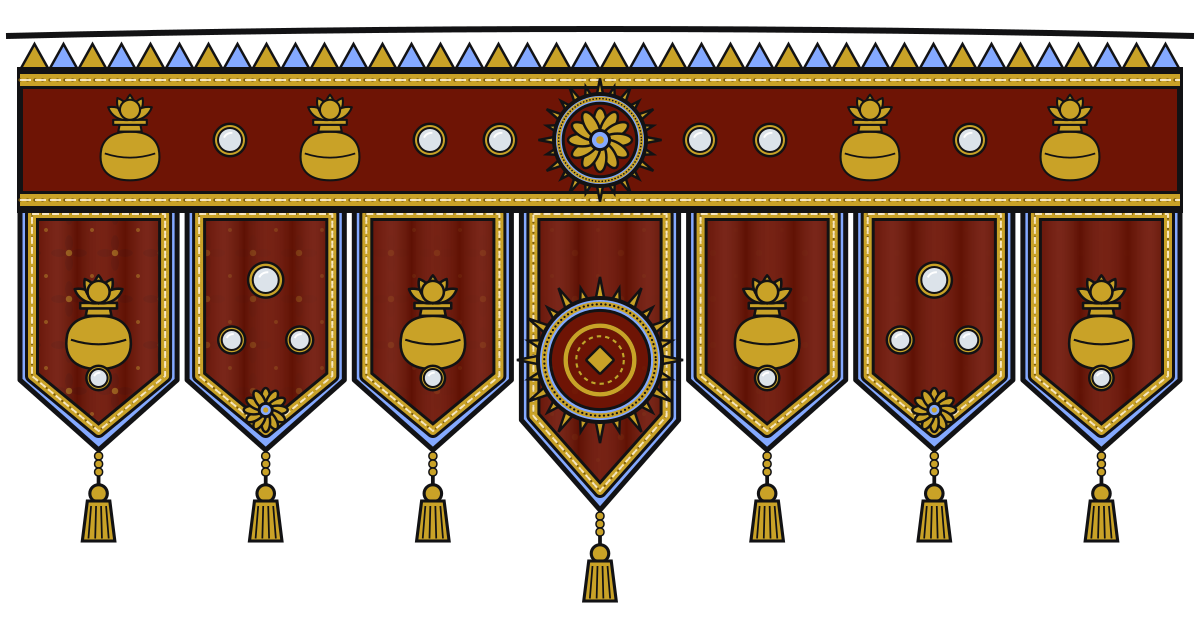
| G1 Torana · gateway The built gate of the seat; the cloth Toran hangs in it | Lal Darwaja gate of Rohtas fort, with the 1223 AD inscription naming Shri Pratapa, said to belong to the Khayaravala line; the link to the Kharwar is disputed | Regional tradition |
| G2 Viragallu · hero stone Carved panel stone for a member who died defending the clan | Not yet designed for this clan | Regional tradition |
| G3 Kula-shila · clan stones Standing and table stones that remember the ancestors | Not yet designed for this clan | Design |
| G4 Jayastambha · victory pillar A pillar raised for a victory | Not yet designed for this clan | Design |
| G5 Sima-shila · boundary stone Marks the clan's land, with a line in the native script | Not yet designed for this clan | Design |
4. Sounds
| Accessory | For this clan | Basis |
|---|---|---|
| D1 Pancha-mahashabda · five great sounds The right to five instruments | Not yet designed for this clan | Design |
| D2 Shankha · clan conch The clan's own named war conch | Not yet designed for this clan | Design |
| D3 Murasu · house drums Three drums: war, charity and justice | Not yet designed for this clan | Design |
5. Kit: colours, metals and emblems
The Atlas gives the Kharwar a design emblem: a hill fort with two raised swords, for the fort holders and for Nilamber and Pitamber of 1857. No seal, coin or banner of the clan is documented in the extracts; the emblem is a design, not a documented symbol. The Khayaravala inscriptions are recorded in[1].
| Part of the kit | This clan |
|---|---|
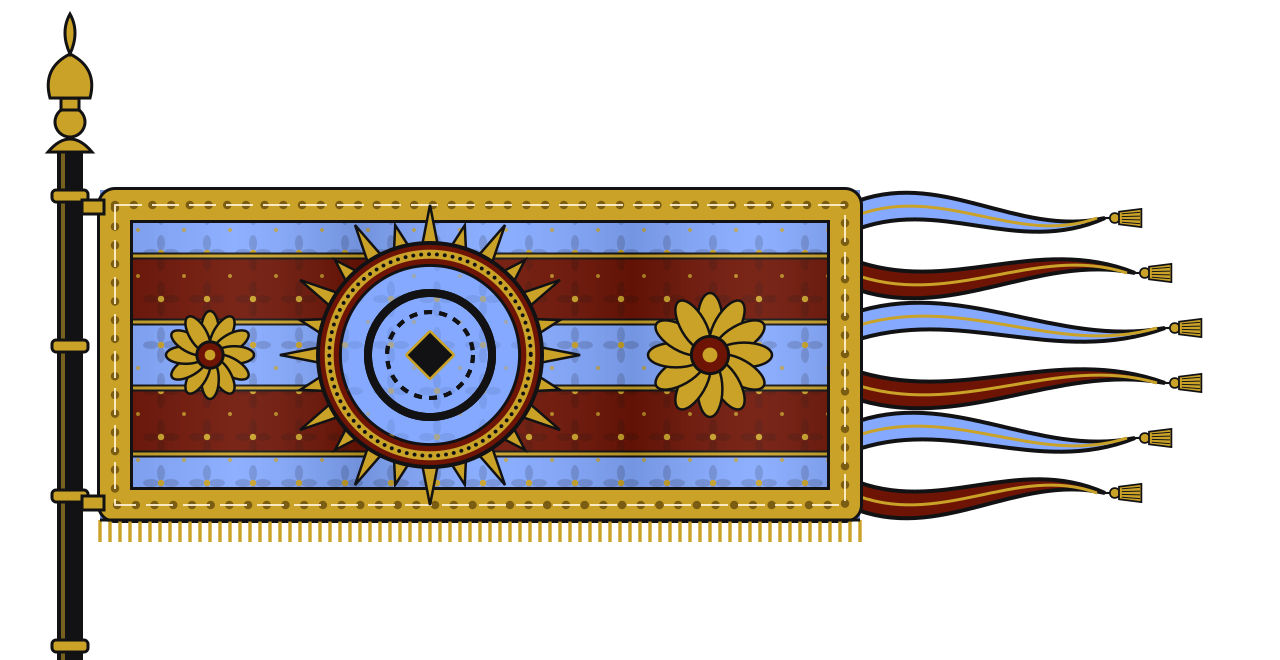
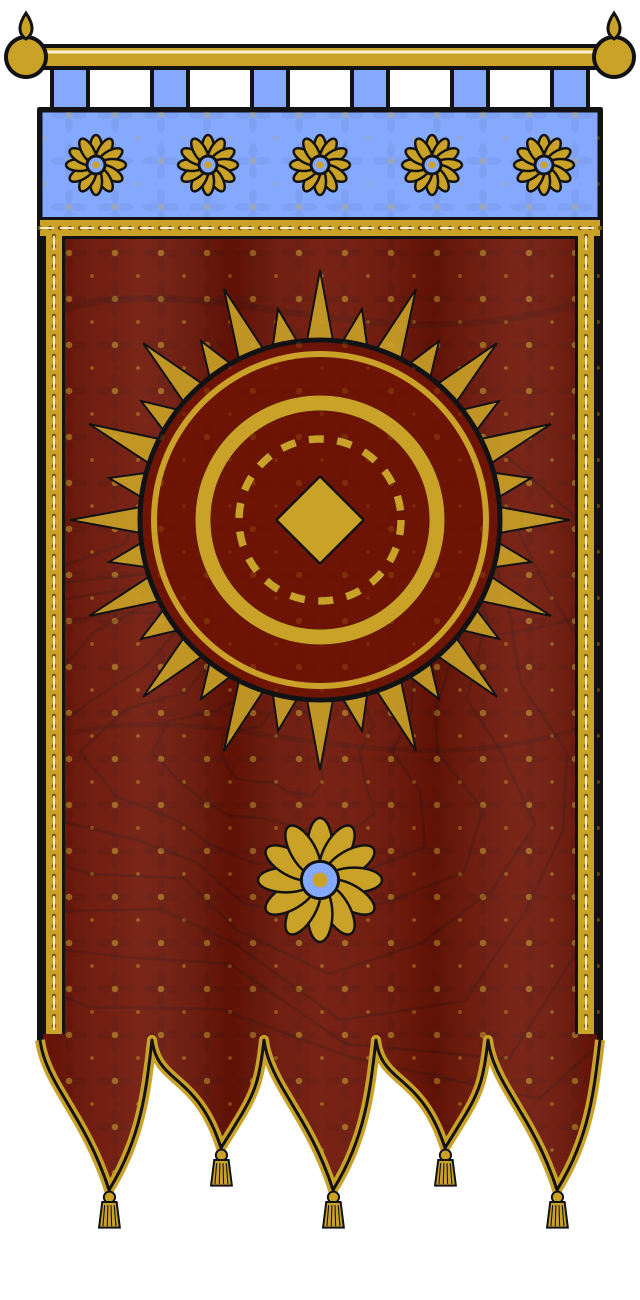
| Field | Maroon #6E1405 |
| Accent | Intense Electric Blue #84A9FF |
| Emblem colour | Metallic Gold #C9A227 |
| Zari metal | Gold |
| Main emblem | A hill fort |
| Second image | Two raised swords |
| Night and day | Every visual accessory has two versions: by night the emblem on the dark field, by day the clan's field colour on cloth woven from its metal. |
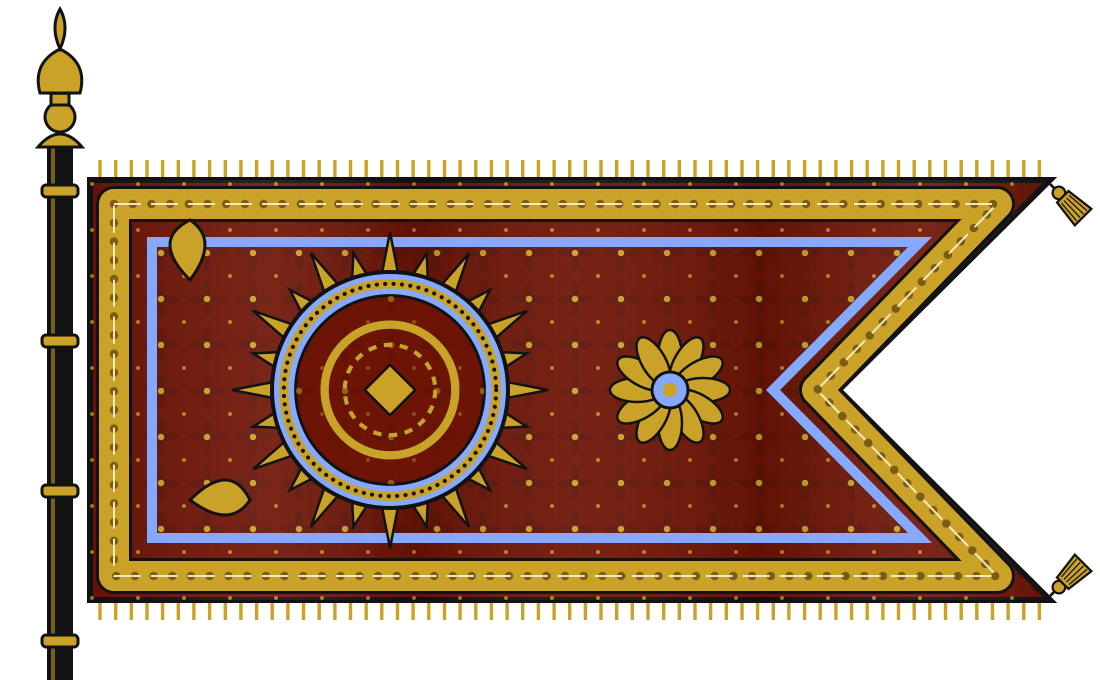
6. Flags
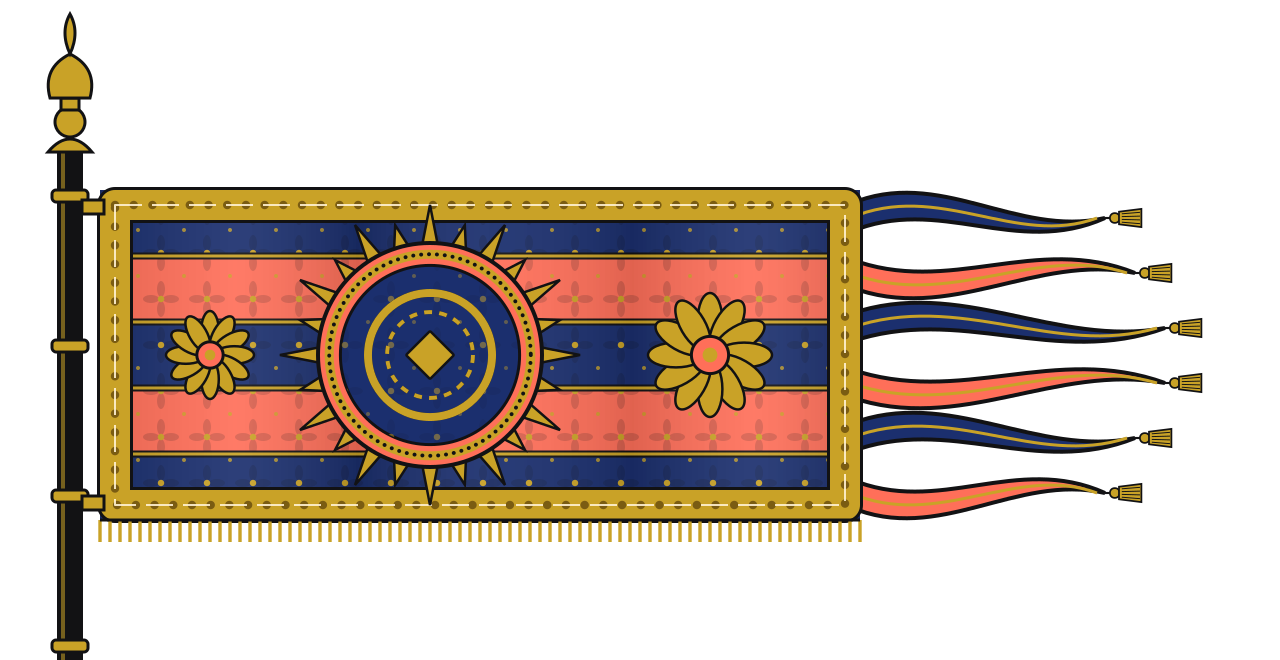
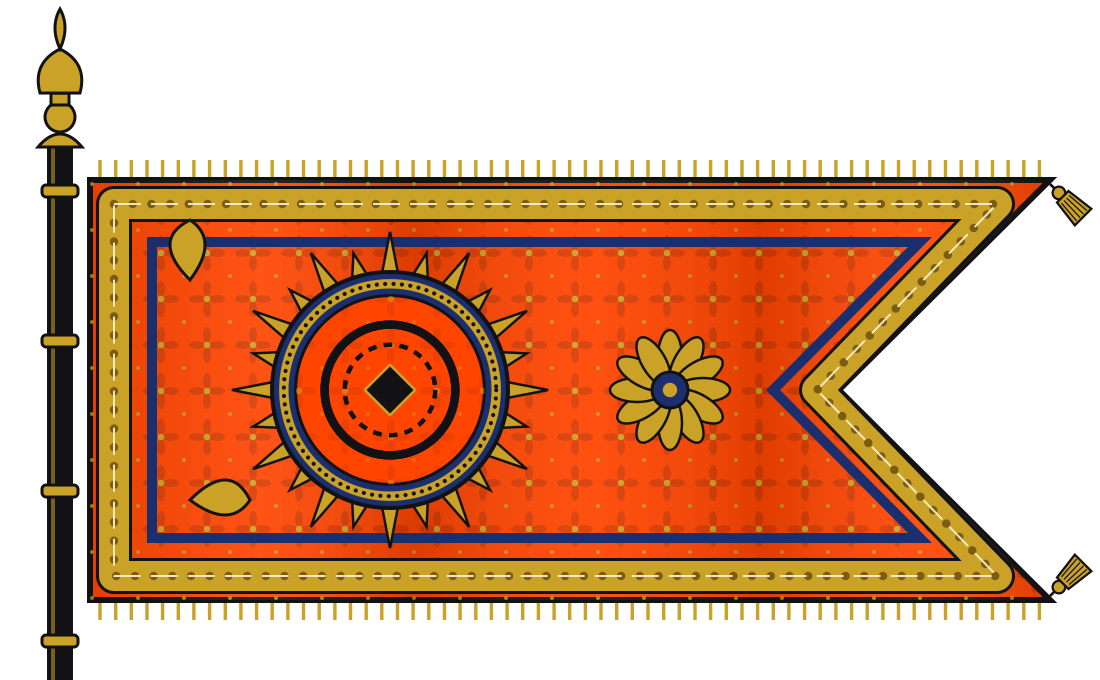
Every clan has every flag type; the type says the occasion and the colours say the clan. The outlined card is the flag the Atlas assigns.
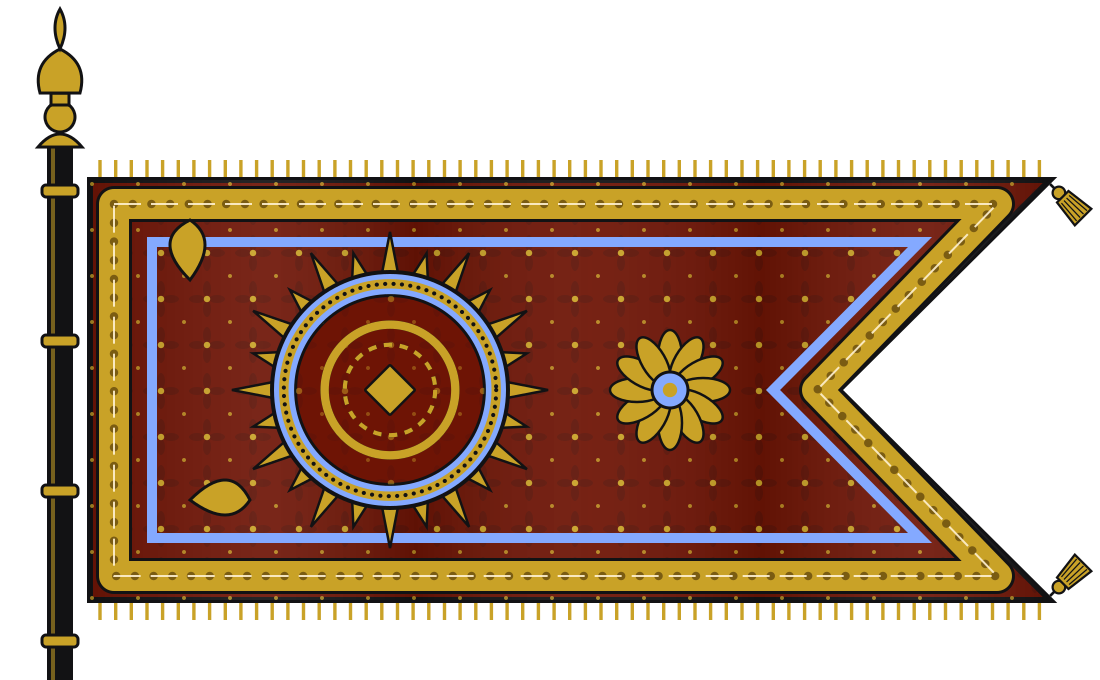
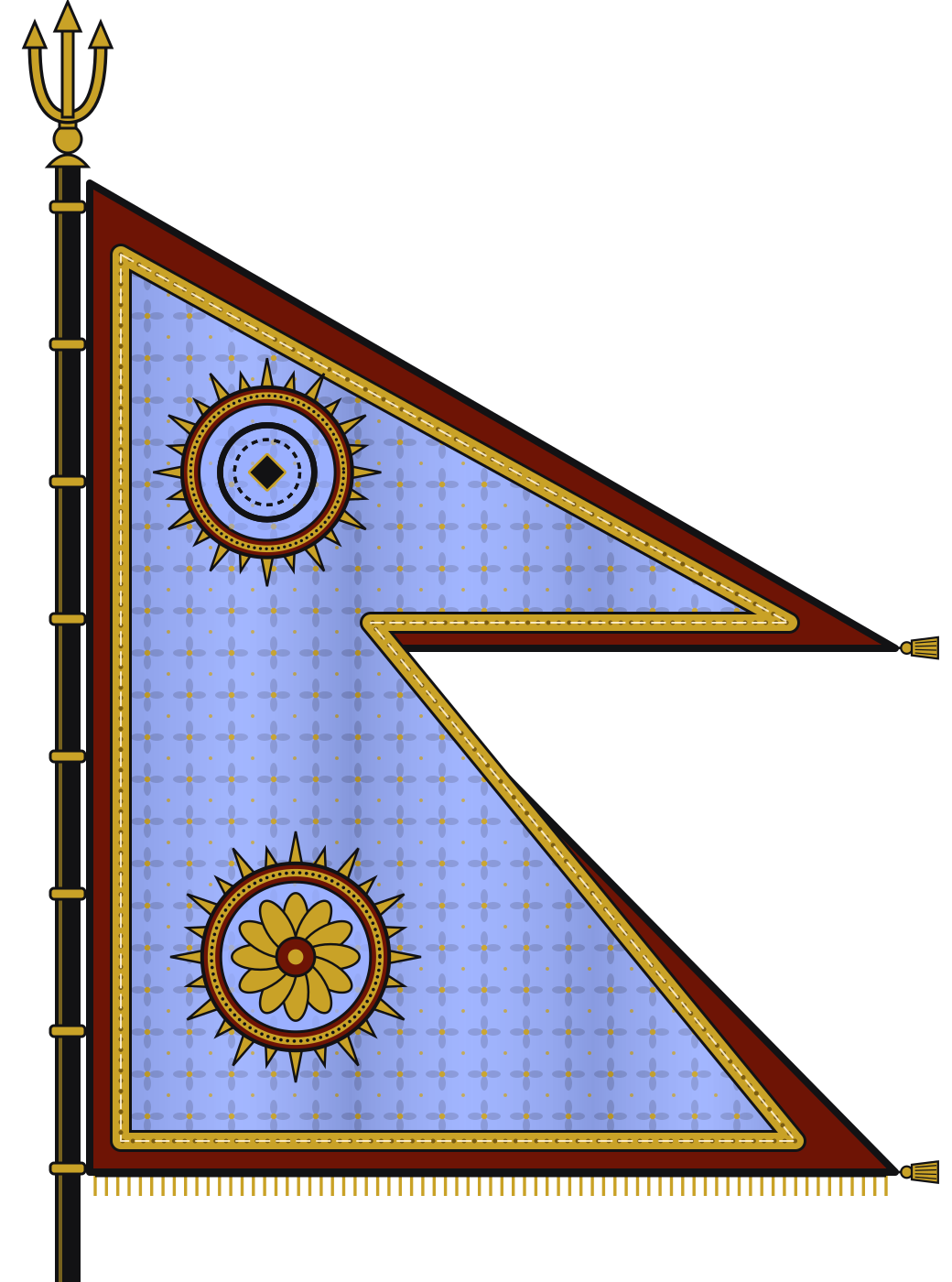
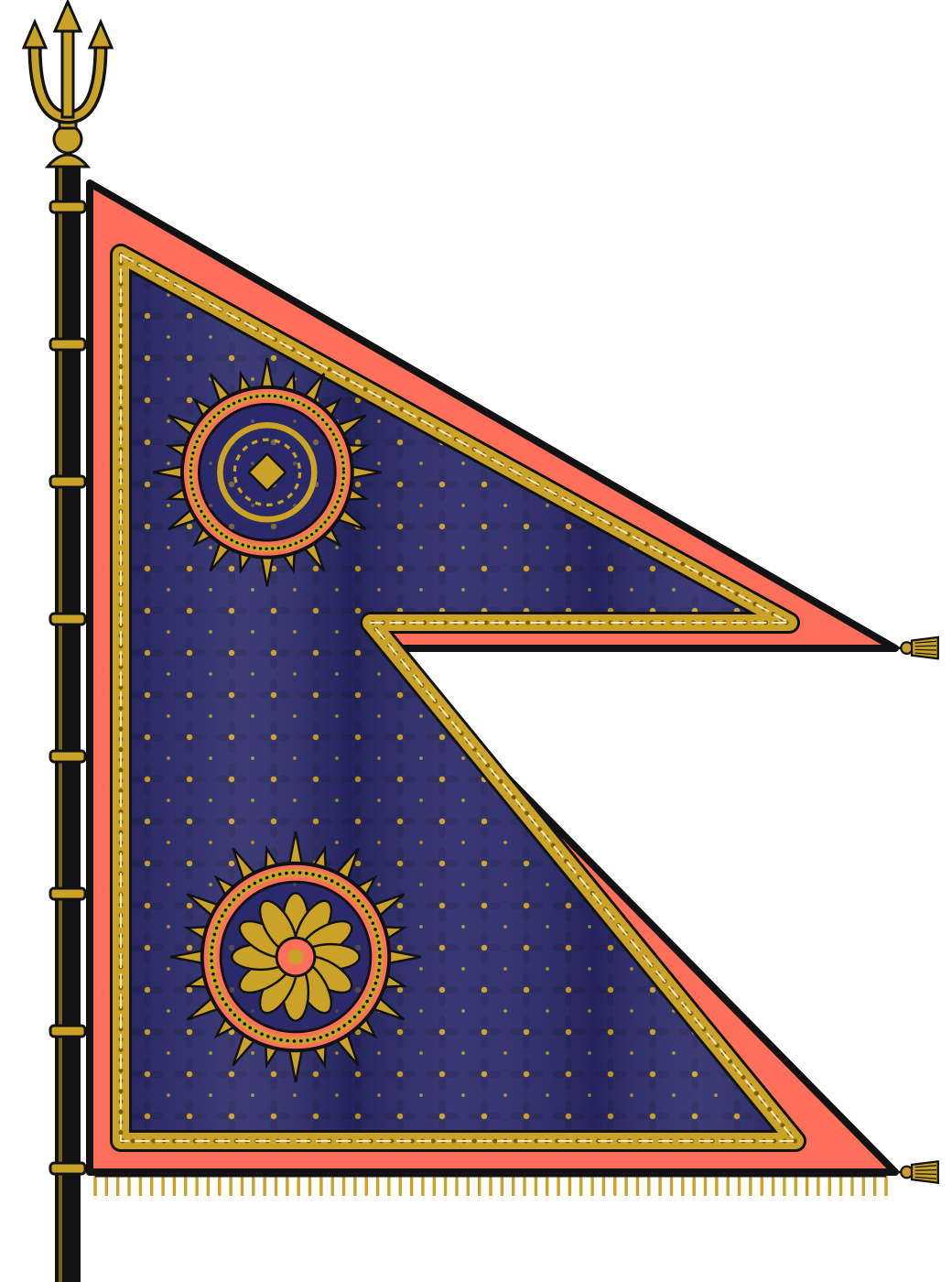

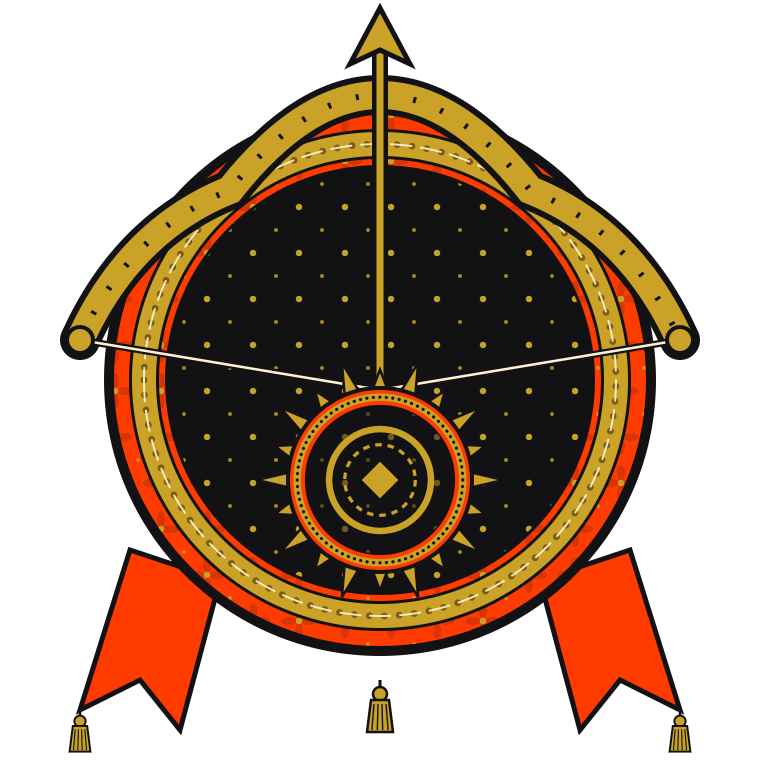
Historic banner
None known
New flag types
| Accessory | For this clan | Basis |
|---|---|---|
| A9 Pota-dhvaja · ship and trade flag For ships, caravans and markets | Not yet designed for this clan | Design |
| A10 Utsava-patāka · festival flag Light, bright flag for fairs and festivals | Not yet designed for this clan | Design |
| A11 Shoka-dhvaja · mourning flag White cloth with the emblem outline in the clan's metal | Not yet designed for this clan | Design |
7. Regalia
| Accessory | For this clan | Basis |
|---|---|---|
| E1 Chhatra · house parasol The ceremonial umbrella | Not yet designed for this clan | Design |
| E2 Chamara · fly-whisks The pair of whisks beside the head of the house | Not yet designed for this clan | Design |
| E3 Danda · staff of office Staff or scepter | Not yet designed for this clan | Design |
| E4 Simhasana · seat The seat of the house, covered in clan cloth | Not yet designed for this clan | Design |
| E5 Khetaka · shield A round shield; the Changi and Dhanush are its flag forms | Not yet designed for this clan | Regional tradition |
| E6 Kula-ayudha · clan weapon The weapon the clan honours | Not yet found for this clan | Under research |
8. Worn
| Accessory | For this clan | Basis |
|---|---|---|
| F1 Kula-vastra · clan cloth The clan's woven pattern in its kit colours | Not yet designed for this clan | Design |
| F2 Kirti-vastra · honour cloth A cloth earned for a deed, not inherited | Not yet designed for this clan | Design |
| F3 Kula-mala · garland flower The flower or leaf the clan wears as a garland | Not yet found for this clan | Under research |
| F4 Chinha · house pin A metal badge with the pin emblem | Not yet designed for this clan | Design |
9. Records
| Accessory | For this clan | Basis |
|---|---|---|
| H1 Clan words A traditional line in the native script | · “” Under research: the extracts give no line of the Kharwar's own, and no classical line is tied to the clan in them. Leads: Minz and Hansda (2010) on the Surajvanshi claim; the Tribal Research Institute's Hindi pages. | Design |
| H2 Biruda · titles The house's title or titles | Nayak, the title of Pratapdhavala, chief of Japila (1169 AD); Athara Hazari, a self-name the members sometimes use; Pradhan, the village leader's title | Documented |
| H3 Prashasti · praise genealogy The lineage as written at the head of a grant | Not yet found for this clan | Under research |
| H4 Vahi · clan register The book of the clan's births, marriages and deaths | Not yet found for this clan | Under research |
| H5 Rana-ghosha · war cry The clan's cry in battle or celebration | Not yet found for this clan | Under research |
10. VishwaVit · knower of the world
Game values are design choices for this project, not historical claims.
References
- Wikipedia, Kharwar, read 2026-10-24, https://en.wikipedia.org/wiki/Kharwar
- Dr. Ramdayal Munda Tribal Welfare Research Institute, Jharkhand, Kharwar, read 2026-10-24, https://trijharkhand.in/en/kharwar
- Latehar district administration, History, read 2026-10-24, https://latehar.nic.in/history/
- Chhinnamasta Temple, Rajrappa, Wikipedia (cites E. A. Benard 2000 and R. Mahalakshmi 2014).
- Wikipedia, Birhor people, read 2026-10-23, https://en.wikipedia.org/wiki/Birhor_people
- NVLI rare books catalogue record, H. H. Risley, The Tribes and Castes of Bengal Vol-I (1891), read 2026-10-20, https://icvtesting.nvli.in/rarebooks/tribes-and-castes-bengal-vol-i
- Wikipedia, Kol uprising, read 2026-10-22, https://en.wikipedia.org/wiki/Kol_uprising
- Wikipedia, List of Scheduled Tribes in Uttar Pradesh, read 2026-10-22, https://en.wikipedia.org/wiki/List_of_Scheduled_Tribes_in_Uttar_Pradesh
- Sushree Mohanty, Indigenous Colours of Odisha: Handbook on 62 Tribes (KISS), read 2026-10-20, https://kissnew.kiss.ac.in/wp-content/uploads/2026/05/Indigenous-Colours-of-Odisha-Handbook-on-62-Tribes-Sushree-Mohanty.pdf
- Wikipedia, Bhogta, read 2026-10-24, https://en.wikipedia.org/wiki/Bhogta
- Wikipedia, Khairaha, read 2026-10-24, https://en.wikipedia.org/wiki/Khairaha
- R. V. Russell, The Tribes and Castes of the Central Provinces of India, vol. 3 (1916), Project Gutenberg #41424, read 2026-10-10, https://gutenberg.org/cache/epub/41424/pg41424-images.html
- Encyclopedia of World Cultures (Gale, 2008) via everyculture.com, Kol: Orientation, read 2026-10-22, https://www.everyculture.com/South-Asia/Kol-Orientation.html
- Wikipedia, Asur people, read 2026-10-20, https://en.wikipedia.org/wiki/Asur_people
- Wikipedia, List of Scheduled Castes in Uttar Pradesh, read 2026-10-22, https://en.wikipedia.org/wiki/List_of_Scheduled_Castes_in_Uttar_Pradesh
- Wikipedia, Tribes of Jharkhand, read 2026-10-20, https://en.wikipedia.org/wiki/Tribes_of_Jharkhand
- Wikipedia, List of Scheduled Tribes in West Bengal, read 2026-10-21, https://en.wikipedia.org/wiki/List_of_Scheduled_Tribes_in_West_Bengal
- Wikipedia, List of Scheduled Tribes in Odisha, read 2026-10-20, https://en.wikipedia.org/wiki/List_of_Scheduled_Tribes_in_Odisha
- Wikipedia, List of Scheduled Castes in Jharkhand, read 2026-10-20, https://en.wikipedia.org/wiki/List_of_Scheduled_Castes_in_Jharkhand