The Kharia are a Munda-speaking people of the Austroasiatic family, in three sub-groups: Hill, Delki (Dhelki) and Dudh Kharia[1]. Russell (1916) records them as one of the Munda subcastes, and says the Kharias, Khairwars, Korwas and Korkus were once one people with the Mundas[2]. Their principal deity, as Russell reports, is a hero called Banda, and they venerate ploughs and axes[2]. The 2011 census counts 297,614 native speakers of Kharia, about 69% of the ethnic population[3].
01Faith and deities
Chhinnamasta of Rajrappa, Jharkhand
The clan followed another faith. This goddess of its homeland is assigned for naming only.
| Deity or tradition | Place in the clan's life | Evidence |
|---|---|---|
| Banda | Hero-deity. Legend: he cleared kans grass from a hillock for an Oraon's daughter, dug her from her grave, and she revived | [2] |
| Ploughs and axes | Venerated; offered to the sun on Dasahra (Russell) | [2] |
| Jankor | A sacred stone for the Jankor deity; the Jankor rite is in Phalguna, with fowls and vegetables for better farm yields | [5] |
| Khunt and Pat | Ancestral spirits | [5] |
| Churil | A spirit in the Kharia spirit list; its role is not given | [5] |
| Goria Darha | Guardian of cattle | [5] |
| Dohor | A spirit; Dohor Puja in Aghan, with five fowls | [5] |
| Chitta | A spirit in the Kharia spirit list; its role is not given | [5] |
| Ghardeota | Household deity | [5] |
| Bhaiyad Bhut | Clan spirit, shown as a wooden post | [5] |
| Durga, Saraswati, Kali, Shitla Devi | Named as worshipped by the Kharia of Bangladesh | [6] |
| Bana Devota, Buraburi, Duradhulu, Raksadhulu, Dharam Devota | Deities named by Banglapedia for the Kharia of Bangladesh | [6] |
| Chhinnamasta | KulDevi; assigned, not the clan's own faith | Atlas |
02Temples
Under research: no temple built or patronised by the Kharia is in the extracts. The shrines named are village and household shrines: the Jankor sacred stone and the Bhaiyad Bhut wooden post[5]. Leads: Vidyarthi and Upadhyay (1980).
Built by the clan
Not recorded.
Given patronage or grants by the clan
Not recorded.
03Languages and scripts
| Language or script | Kind | Under the clan | Evidence |
|---|---|---|---|
| Kharia living | Munda language, Austroasiatic family | Spoken by Dudh and Dhelki Kharia; Simdega and Gumla dialects; the closest relative is Juang (remote) | [3][1] |
| Kharia Thar living | Indo-Aryan language | The language the Hill Kharia have switched to | [1] |
| Sadri (Nagpuri) | Lingua franca of the area | Used with others; lent words to Kharia | [3] |
| Classical Kharia (Sudh Kharia) lost | Traditional written Kharia, no longer spoken | Heavily influenced by Hindi and Sadri | [3] |
| Scripts: Devanagari, Odia, Bengali, Latin | Kharia is written in these scripts | Sample in Devanagari, Article 1 of the UDHR: सोउब्म लेबु कियाऽ गैरव ओडोऽ अधिकाराऽ मासन बुँग जोनोम-जात स्वतंत्रता ओडोऽ समानता कुई सिड होतोके लुर ओडोऽ जातोमाऽ तेर तेर कुई सिऽ ओडोऽ मुनुडू होकी ते भाई-भाई मुन व्यवहार करायना चाहि। | [4][3] |
04Books and literature
These are scholarly works on the Kharia. The sources name no book the clan itself wrote or patronised.
Written during the clan's history
| Work | Author | Kind | When | Link to the clan |
|---|---|---|---|---|
| The Tribes and Castes of the Central Provinces of India | R. V. Russell and Hira Lal | Tribes and castes | 1916 | [2] |
| Introduction to the Kharia Language | G. B. Banerjee | Grammar | 1894 | [3] |
| Kharia-English Dictionary | Tea Districts Labour Association; Floor et al. | Dictionary | 1929; 1934 | [3] |
| Roy and Roy | Roy and Roy | Ethnological study | 1937 | [3] |
| The Kharia: Then and Now | L. P. Vidyarthi and V. S. Upadhyay | Book | 1980 | [1] |
| Kharia: the victim of social stigma | Mukhopadhyay | Book | 1998 | [1] |
| Tribal Dances of India | Trubhuwan | Book | 1999 | [1] |
| The Munda Languages | Anderson | Book | 2008 | [3] |
Given patronage by the clan
Not recorded.
05Thinkers and scholars
| Name | Field | Era | Contribution |
|---|---|---|---|
| L. P. Vidyarthi and V. S. Upadhyay | Ethnography | 1980 | The main cited ethnographers of the Kharia[1] |
| Paul Sidwell | Linguist | 2018 | Dates Munda arrival on the Odisha coast[1] |
| G. B. Banerjee | Grammar | 1894 | Introduction to the Kharia Language[3] |
| Grierson | Linguistics | Quoted in 1916 | Dialect closely allied to Savara; some similarity to Korku and Juang[2] |
06Art and architecture
Painting, sculpture and architecture: none are in the extracts. The dances are the clan's art in the sources: Hario, Kinbhar, Halka, Kudhing and Jadhura (Trubhuwan 1999); Dalton describes the nuptial dances as very wild[1][2].
Painting and wall art
Not recorded.
Sculpture and temple art
Not recorded.
Temple and building architecture
Not recorded.
Weaving and textiles
Not recorded.
Clothing and jewellery
Not recorded.
Coins, pottery and crafts
| Art form | What it is | Era | Evidence |
|---|---|---|---|
| Cottage industries | Skilled in cottage industries (as Wikipedia reports) | 2001 | [1] |
| Mats and ropes | Women make mats and ropes from palm, bamboo, sabai fibre and aloe leaves | Not dated | [7] |
07History
Origins as the sources give them
The Odisha State Tribal Museum says the Kharia are believed to have migrated from river valleys north of the Vindhya and Kairmur ranges[7]. Linguist Paul Sidwell (2018) dates the arrival of the Munda languages on the Odisha coast, from Southeast Asia, to about 4000 to 3500 years ago; the Wikipedia article gives this for the Kharia's language family[1].
A legend of origin (claimed) {LEG}
Russell (1916) records the Kharia legend of origin. A child is born in the jungle and protected by a cobra's hood; he is called Nagvansi and is the ancestor of the Nagvansi Rajas of Chota Nagpur. The Kharias claim descent from his elder brother, who, offered two caskets, one silver and one of earth, chose earth. So his descendants till the soil and carry banghys[2]. This is the community's own tradition as recorded in 1916, and is marked claimed.
The move to Chota Nagpur
The Wikipedia article gives a tradition that the Kharia were attacked by an Ahir chief and then moved to the Chota Nagpur Plateau (Trubhuwan 1999, p. 129)[1].
Under the British
Under zamindars in British rule, and later as landowning farmers[1]. Banglapedia says that under British rule Kharias settled in Sylhet as tea garden workers and became permanent residents[6].
08Journey and migrations
The moves the sources record, with the dates they give.
| When | From | To | Why | Evidence |
|---|---|---|---|---|
| About 4000 to 3500 years ago (Sidwell 2018) | Southeast Asia | The Odisha coast | Arrival of the Munda languages, the Kharia's language family | [1] |
| Believed (Odisha museum) | River valleys north of the Vindhya and Kairmur ranges | Not stated | Migration, as believed | [7] |
| Date not given | Attacked by an Ahir chief | Chota Nagpur Plateau | Move after attack, Trubhuwan 1999 | [1] |
| Under British rule | Chota Nagpur, Rohtasghar and a mountainous region of Oudh (Banglapedia) | Sylhet, Bangladesh (Srimangal) | Tea garden work; permanent residence | [6] |
09Seats and lands
| Place | Role | Where today |
|---|---|---|
| Chota Nagpur | Home, as given by Russell; Banglapedia lists it as an original home | Jharkhand[1] |
| Simdega and Gumla | Core area of the language | Jharkhand[3][4] |
| East Singhbhum, Gumla, Simdega | Hill Kharia and others; Musabani, Dumaria and Chakulia blocks most populous | Jharkhand[1][8] |
| Mayurbhanj | Forests; Hill Kharia in Jashipur and Karanjia blocks, some villages in Morada | Odisha[7][1] |
| Sundergarh, Sambalpur, Jharsuguda | Plains, as the museum and KISS handbook name them | Odisha[7][9] |
| Bilaspur, Jashpur and Raigarh | About 900 returned from the Central Provinces in 1911 (Russell 1916) | Under research; Raigarh and Surguja are named in[4] for the language |
| West Midnapur, Bankura, Purulia | Hill Kharia areas; Purulia the majority district | West Bengal[1][8] |
| Srimangal and Moulvibazar | Tea garden settlement since British rule | Sylhet, Bangladesh[6] |
| Madhya Pradesh, Maharashtra, Tripura | Smaller populations | [1] |
| Assam and the Andaman Islands | A few families each | [1] |
10Notable figures
| Name | Role | Era | Known from |
|---|---|---|---|
| Telanga Kharia | Freedom fighter | Not dated in the extracts | [1] |
| Gladson Dungdung | Tribal rights activist | Not dated in the extracts | [1] |
| Sylvanus Dung Dung | Hockey | Not dated in the extracts | [1] |
| Rose Kerketta | Writer | Not dated in the extracts | [1] |
| Jyoti Sunita Kullu | Hockey | Not dated in the extracts | [1] |
| Archana Soreng | Activist | Not dated in the extracts | [1] |
| Salima Tete | Hockey | Not dated in the extracts | [1] |
11Allies, rivals and marriages
| People | Relationship | When |
|---|---|---|
| Munda | Russell: the Kharia are one of the Munda subcastes; Banglapedia: Kharias and Mundas are one ethnic group; the Mundas take Kharia daughters but do not give theirs (Risley, in Russell) | Russell 1916; Banglapedia |
| Khairwars, Korwas and Korkus | Once one people with the Mundas and Kharias (Russell 1916) | Russell 1916 |
| Savars (Savara, Sabar) | Russell calls the Kharias allied to the Mundas and Savars; Wikipedia lists Savara and Sabar as other names of the Kharia, who call themselves Sabar | Russell 1916; Wikipedia |
| Bhumij | A Kharia feature noted by an observer as 'not unlike the Bhumij' (Russell 1916) | Russell 1916 |
| Oraon | In the Uriya country the Oraons who carry litters are also called Kharias (Hira Lal, in Russell) | Russell 1916 |
| Juang | Closest relative of Kharia, in the Kharia-Juang branch (remote) | Wikipedia |
| Ahir chief | Attacked the Kharia before their move to the Chota Nagpur Plateau (Trubhuwan 1999) | [1] |
| Nagvansi Rajas of Chota Nagpur | Kharia legend makes Nagvansi, born to a cobra's hood, ancestor of the Rajas; the Kharias cannot enter the house of the Rajas (Russell 1916) | [2] |
| Sadri (Nagpuri), Mundari, Hindi, Odia | Languages in contact; Sadri lent words, Mundari influenced grammar and vocabulary (Wikipedia) | [3] |
12Society and livelihood
Kharia society is organised by sub-group, by exogamous sept, and by a headman and officiants.
Government and social order
| Institution or group | What it was | Evidence |
|---|---|---|
| Pahan or Dehuri | Heads the panchayat (Banglapedia, Bangladesh) | [6] |
| Headman (Pardhan), assistant (Negi), messenger (Ganda) | Offices held by the Samer, Suren and Bartha septs (Russell 1916) | [2] |
| Kalo | Ritual officiant for many festivals | [5] |
| Deonras | Diviner and medicine man (Asadhi Puja) | [5] |
| Dehri | Elderly lineage member who performs the Khunti Puja | [5] |
| Sept exogamy | Marriage within the sept is forbidden (Russell 1916); same-clan marriage prohibited (Banglapedia) | [2][6] |
| Descent and property | Patriarchal; sons inherit all property; women are self-reliant (Banglapedia, Bangladesh) | [6] |
Livelihood over time
| Era | Livelihood | Evidence |
|---|---|---|
| 1916 (Russell) | Original occupation: carrying dhoolies (litters); also cultivators and collectors of forest produce | [2] |
| Today (Odisha museum) | Hill Kharia: hunters and food gatherers; forest produce (resin, honey, tussar cocoons) is the main income; Dhelki: agricultural labour; Dudh: settled cultivators | [7] |
| Today (Wikipedia) | Hill Kharia: forest produce, hunting, labour; Dhelki: agricultural labourers; Dudh: agriculturists; skilled in cottage industries | [1] |
| Under the British | Tea garden labour in Sylhet, and in Assam (Russell) | [6][2] |
13Sub-clans and related clans
Three sub-groups (Hill, Delki and Dudh Kharia), other sub-groups named in Bangladesh and Russell, the gotras and septs the sources list, and related peoples. Every name the sources give is listed.
| Clan | Relation | Where | Size | In the Atlas | Evidence |
|---|---|---|---|---|---|
| Hill Kharia | Sub-clan | Odisha (Mayurbhanj), Jharkhand (East Singhbhum, Gumla, Simdega), West Bengal (West Midnapur, Bankura, Purulia) | same name as ST-394: check | [1][8] | |
| Delki (Dhelki) Kharia | Sub-clan | Raigarh (Russell 1916); agricultural labourers today | new clan candidate | [2][1] | |
| Dudh Kharia | Sub-clan | Raigarh (Russell 1916); settled cultivators | same name as ST-386: check | [2][7] | |
| Erenga Kharia | Sub-clan | Bengal (Russell 1916); Banglapedia main clan | same name as ST-389: check | [2][6] | |
| Kharia-Munda | Sub-clan | Bengal (Russell 1916, Munda-Kharia); Banglapedia main clan Munda-Kharia; Banglapedia's Munda page lists Kharia-Munda among 13 Munda sub-tribes | same name as ST-407: check | [2][6][10] | |
| Munda | Parent people | Chota Nagpur; Odisha; Bangladesh | Jharkhand 1,229,221, 2011[11] | ST-229 | [2] |
| Oraon | Related people | Jharkhand, Odisha, Madhya Pradesh | Jharkhand 1,716,618, 2011[11] | ST-241 | [2] |
| Kol | Related people | Chota Nagpur; Central Provinces (Mandla, Jubbulpore) | Jharkhand 53,584, 2011[11] | ST-141 | [2] |
| Khairwar | Related people | Central India | Madhya Pradesh 76,097, 2011[12] | ST-127 | [2] |
| Korwa | Related people | Jharkhand, Madhya Pradesh | Jharkhand 35,606, 2011[11] | ST-157 | [2] |
| Korku | Related people | Madhya Pradesh, Maharashtra | Madhya Pradesh 730,847, 2011[12] | ST-156 | [2] |
| Savar | Related people | Russell: Savars allied to Mundas; Madhya Pradesh | Madhya Pradesh 881, 2011[12] | ST-285 | [2][1] |
| Bhumij | Related people | Jharkhand, Odisha | Jharkhand 209,448, 2011[11] | ST-033 | [2] |
| Santal | Related people | Jharkhand, Odisha | Jharkhand 2,754,723, 2011[11] | ST-280 | [2] |
| Juang | Branch | Odisha (Keonjhar, Dhenkanal) | Odisha 47,095, 2011[13] | ST-114 | [3] |
| Dehuri | Sub-clan | Gotra listed by the Tribal Research Institute, Jharkhand (not in Wikipedia's list) | same name as ST-380: check | [8] | |
| Nagvansi (Nagvanshi) Rajas | Dynasty from this clan | Chota Nagpur | new clan candidate | [2] | |
| Golgo | Sub-clan | Hill Kharia gotra; named first in each village, and appears dominant | same name as ST-392: check | [8] | |
| Bilung | Sub-clan | Hill Kharia gotra; appears to hold prominence | same name as ST-376: check | [1] | |
| Dungdung | Sub-clan | Hill Kharia gotra; Bangladesh clan | same name as ST-528: check | [1][6] | |
| Kerketta | Sub-clan | Hill Kharia gotra; Bangladesh clan | same name as ST-405: check | [1][6] | |
| Kullu | Sub-clan | Hill Kharia gotra; Russell spells the tortoise sept Kulu | same name as ST-430: check | [1][2] | |
| Soreng | Sub-clan | Hill Kharia gotra | new clan candidate | [1] | |
| Tete | Sub-clan | Hill Kharia gotra | new clan candidate | [1] | |
| Kiro | Sub-clan | Hill Kharia gotra; tiger sept (Russell) | same name as ST-426: check | [1][2] | |
| Nag | Sub-clan | Cobra sept (Russell); Hill Kharia list has Nago | same name as ST-476: check | [2][1] | |
| Kankul | Sub-clan | Leopard sept (Russell) | new clan candidate | [2] | |
| Kuto | Sub-clan | Crocodile sept (Russell) | new clan candidate | [2] | |
| Baa | Sub-clan | Rice sept (Russell); Hill Kharia gotra | same name as ST-366: check | [2][1] | |
| Bilum | Sub-clan | Salt sept (Russell) | new clan candidate | [2] | |
| Suren | Sub-clan | Stone sept (Russell); its assistant headman, the Negi, is of this sept | new clan candidate | [2] | |
| Katang Kondai | Sub-clan | Bamboo sept (Russell) | new clan candidate | [2] | |
| Samer | Sub-clan | Sept of the headman, the Pardhan (Russell) | new clan candidate | [2] | |
| Bartha | Sub-clan | Sept of the messenger, the Ganda (Russell) | new clan candidate | [2] | |
| Topno | Sub-clan | Sept listed by Russell; formerly ate monkeys (Russell) | same name as ST-560: check | [2] | |
| Indoar | Sub-clan | Bangladesh, non-caste clan | new clan candidate | [6] | |
| Baghoar | Sub-clan | Bangladesh, non-caste clan | new clan candidate | [6] | |
| Bilunga | Sub-clan | Bangladesh, non-caste clan | new clan candidate | [6] | |
| Dalmaria | Sub-clan | Bangladesh, non-caste clan | new clan candidate | [6] | |
| Dhanoar | Sub-clan | Bangladesh, non-caste clan | new clan candidate | [6] | |
| Keshwar | Sub-clan | Bangladesh, non-caste clan | new clan candidate | [6] | |
| Khat-Kharia | Sub-clan | Bangladesh, non-caste clan | new clan candidate | [6] | |
| Surujpuria | Sub-clan | Bangladesh, non-caste clan | new clan candidate | [6] | |
| Henthetu | Sub-clan | Bangladesh, non-caste clan | new clan candidate | [6] | |
| Toporia | Sub-clan | Bangladesh, non-caste clan | new clan candidate | [6] | |
| Dhurbungia | Sub-clan | Bangladesh, non-caste clan | new clan candidate | [6] | |
| Alkosi | Sub-clan | Hill Kharia gotra | new clan candidate | [1] | |
| Bhunia | Sub-clan | Hill Kharia gotra | new clan candidate | [1] | |
| Dhar | Sub-clan | Hill Kharia gotra | new clan candidate | [1] | |
| Digar | Sub-clan | Hill Kharia gotra | new clan candidate | [1] | |
| Dolai | Sub-clan | Hill Kharia gotra | new clan candidate | [1] | |
| Gidi | Sub-clan | Hill Kharia gotra | new clan candidate | [1] | |
| Kharmoi | Sub-clan | Hill Kharia gotra | new clan candidate | [1] | |
| Khiladi | Sub-clan | Hill Kharia gotra | new clan candidate | [1] | |
| Kotal | Sub-clan | Hill Kharia gotra | same name as ST-533: check | [1] | |
| Laha | Sub-clan | Hill Kharia gotra | new clan candidate | [1] | |
| Pichria | Sub-clan | Hill Kharia gotra | new clan candidate | [1] | |
| Rai | Sub-clan | Hill Kharia gotra | same name as SUB-072: check | [1] | |
| Sal | Sub-clan | Hill Kharia gotra | new clan candidate | [1] | |
| Saddar | Sub-clan | Hill Kharia gotra | new clan candidate | [1] | |
| Sandi | Sub-clan | Hill Kharia gotra | new clan candidate | [1] | |
| Sikari | Sub-clan | Hill Kharia gotra | new clan candidate | [1] | |
| Suya | Sub-clan | Hill Kharia gotra | new clan candidate | [1] | |
| Tesa | Sub-clan | Hill Kharia gotra | new clan candidate | [1] | |
| Tolong | Sub-clan | Hill Kharia gotra | new clan candidate | [1] | |
| Nago | Sub-clan | Hill Kharia gotra (spelling as Wikipedia prints it; may be the Nag sept) | new clan candidate | [1] |
Clans marked "new clan candidate" are not in the Atlas yet.
14Surnames
The sources use these clan names as family names (Wikipedia: the clan names are the only family names given). No bearer counts are sourced.
| Surname | Clan or sub-clan | Where | People with this surname | Also used by other communities |
|---|---|---|---|---|
| Dungdung | Dungdung (Hill Kharia gotra; Bangladesh clan) | Named in the notable-people list; area not given[1] | not yet counted | Not checked |
| Kerketta | Kerketta (Hill Kharia gotra; Bangladesh clan) | Named in the notable-people list (Rose Kerketta); area not given[1] | not yet counted | Not checked |
| Kullu | Kullu (Hill Kharia gotra) | Named in the notable-people list (Jyoti Sunita Kullu); area not given[1] | not yet counted | Not checked |
| Soreng | Soreng (Hill Kharia gotra) | Named in the notable-people list (Archana Soreng); area not given[1] | not yet counted | Not checked |
| Tete | Tete (Hill Kharia gotra) | Named in the notable-people list (Salima Tete); area not given[1] | not yet counted | Not checked |
Counts are of everyone with the surname, from the cited source and year, not only members of this clan. A surname shared with other communities says nothing about any one person's origin.
15Songs and music
No Kharia song is quoted in the extracts, so none is given here. The sources describe the singing only: boys and girls sing in alternating groups, and some dances use male-female call-and-response[1][8].
None recorded yet.
Instruments and styles
| Instrument or style | What it is | Evidence |
|---|---|---|
| Thechka and Phechka | Instruments played by the Uraon, Kharia and Munda (Sangeet Galaxy) | [14] |
| Tritiyo | Instrument played by the Uraon, Munda and Kharia (Sangeet Galaxy) | [14] |
16Poems, lullabies and children's rhymes
None recorded yet.
17Stories, legends and proverbs
Stories and legends
Not recorded.
Proverbs and sayings
Not recorded.
18Festivals and fairs
| Festival or fair | When | Where | What happens |
|---|---|---|---|
| Jankor | Phalguna | Not stated | The chief and boys gather fowls and vegetables for the puja, for better farm yields[5] |
| Dimtang Sung (Baisakhi Puja) | Baisakh | Not stated | Cleans the cattle shed; drawings of cow, ox and dog are worshipped[5] |
| Ba-Bidn-Bidn Puja | Jyestha | Not stated | Sowing festival; ends with a feast linked to forest life[5] |
| Asadhi Puja | Asadh | Not stated | First fruit-eating, of blackberries and Rugara; the Deonras, diviner, officiates[5] |
| Dhela Puja | Before transplanting | Not stated | Spirits believed to possess acquired land are honoured[5] |
| Ronal (Bangari) | Sawan | Not stated | Transplantation of paddy[5] |
| Kadleta | Ashin | Not stated | After transplanting and the harvest of upland paddy[5] |
| Nyo-dem | Ashin | Not stated | Rice beer and cakes of the new paddy[5] |
| Bandai Puja | Kartik | Not stated | Buffaloes on the first moon day; cows and bullocks at the full moon[5] |
| Dohor Puja | Aghan | Not stated | When the paddy is ready; five fowls[5] |
| Tolo (Kharra) Puja | Harvest | Not stated | Paddy on the threshing floor[5] |
| Paisari Puja | Not stated | Not stated | Wards off harmful spirits; linked to ear boring, marriage, death rites and the Pushyatra Mela[5] |
| Baranda Puja | Baisakh | Not stated | A clan-level rite[5] |
| Khunti Puja (Khunti-Bati Puja) | Not stated | The kitchen garden (Bari) | A lineage-level rite performed by the Dehri; the family pays the costs[5] |
19Food, dress and games
Food
| Item | What it is | Evidence |
|---|---|---|
| Diet (Bangladesh) | Non-vegetarian diet that excludes beef and buffalo; milk products favoured; tea, bidi, betel and hanria (Banglapedia) | [6] |
| Sub-groups (Russell) | Delki abstain from tiger and monkey flesh, which the Dudh eat (Russell 1916) | [2] |
Dress
| Item | What it is | Evidence |
|---|---|---|
| Men's dhoti | Called Bhagwan | [1] |
| Women's saree | Floor-length saree; going out of use, kept more by the Hill Kharia | [1] |
| Ornaments | Brass, nickel, aluminium and silver; gold rarely, though Dudh women prefer it | [1] |
| Hair and tattoo | Hair knot on the right for men and left for women; women tattooed, men not (Russell 1916) | [2] |
| Married women (Bangladesh) | Vermilion and iron bangles (Banglapedia) | [6] |
Games and martial arts
Not recorded.
Tags: living still practised · revived brought back after a break · lost known only from records · research reported but not yet confirmed from a source. Songs and poems under copyright are listed by title only; restricted or sacred material is noted without its content.
20Status today
The Kharia are a living people, mostly in Jharkhand and Odisha, in three sub-groups. The 2011 census counts 482,754 in total[1].
Recognised heritage
Not yet reviewed by the Kharia community. Corrections and preferred spellings from the community will be recorded here.
21For children
The cobra's child
Long ago, the Kharia tell, a child was born in the deep jungle. A cobra spread its hood over him to keep him safe. He was called Nagvansi, and he is the ancestor of the Nagvansi Rajas of Chota Nagpur. The Kharia say they come from his elder brother. When the brother was offered two caskets, one of silver and one of earth, he chose the earth. So his children till the soil, and they carry the banghy pole. This is the Kharia's own story, as Russell wrote it down in 1916[2].
22Across the project
| Project | What carries this clan | Status |
|---|---|---|
| Atlas of the Janas | Under research: no pin is set yet; the Atlas names Simdega as the key site | To check |
| KulDevi and GrahDevi | Chhinnamasta of Rajrappa, Jharkhand (from the Atlas; assigned, not the clan's faith) | From the Atlas |
| Planet naming | Not yet checked against the Tier registers | To check |
| Renaming and waters | The southern Koel river is venerated by the Kharia, into which they throw the ashes of their dead (Dalton, in Russell 1916) | [2] |
23Open questions
- Native-script name: the Atlas's Devanagari name for the clan (खड़िया) is not printed in any cached extract; confirm the form.
- Kharia songs, lullabies, rhymes, riddles and proverbs with native titles: none in the extracts. Leads: the NEHU volumes on the Kharias (dspace.nehu.ac.in), Vidyarthi and Upadhyay (1980), and the Kharia-English Lexicon (2009).
- Roy and Roy (1937), The Kharias, volumes I and II, and Vidyarthi and Upadhyay (1980) are cited secondhand here; the NVLI and NEHU pages are not yet read.
- The Hindi Tribal Research Institute page (trijharkhand.in/hi/kharia) could not be read; its claims are not used.
- Dudh literacy 'as high as 90%' appears in Wikipedia with no source given; it is not used.[1]
- Dudh and Delki sept lists are missing; the Hill Kharia gotra lists disagree (Dehuri appears only in the Tribal Research Institute list).
- Date and place of the Ahir chief's attack (Trubhuwan 1999, p. 129) and of the move to Chota Nagpur.
- Russell (vol. 1, 1916): the line that the Kharias were the earliest Kol settlers was cut by the checker; no cached extract supports it. Check it against the text before reinstating.
- Odisha Scheduled Tribe list: Wikipedia gives Ho as 806,008 and the KISS handbook as 80,608; not used here.[13][9]
- Whether Savar (ST-285) or Savara (ST-286, Saora) is the Kharia's 'Sabar' or Savara; the master IDs are linked as printed.
- Community review of the page.
- Contradiction, not reconciled: Dehuri is the panchayat head (Pahan or Dehuri, Banglapedia[6]), a Hill Kharia gotra (Tribal Research Institute[8]), and Dehri is the lineage member who performs the Khunti Puja (Indianetzone[5]). The sources do not say whether these are one office or name.
24Astitva
अस्तित्व · being, existence: everything by which the clan is known
The Kharia's documented accessories are their sept totems (Russell 1916), the Jankor sacred stone and the Bhaiyad Bhut wooden post (Indianetzone), and the offices of headman, assistant and messenger (Russell 1916)[2][5].
Every clan has every accessory, royal objects included. Each one says how it is known: Documented This clan's own object is recorded. · Regional tradition Recorded for the region or for peoples like this one, not for this clan. · Design Made for this project, with no historical claim. · Under research To be found for this clan from sources. Legends and titles are written in the clan's own script.
1. Seals and coins
| Accessory | For this clan | Basis |
|---|---|---|
| B1 Rajamudra · house seal Round seal with the clan emblem and a short legend in the clan's script | Not yet designed for this clan | Design |
| B2 Anguliya-mudra · signet ring Personal seal ring of the head of the house | Not yet designed for this clan | Design |
| B3 Chhapa · house stamp Ink or block stamp for letters, goods and cloth | Not yet designed for this clan | Design |
| B4 Tamrapatra · charter plate Copper-plate grant on a ring, closed with the house seal | Not yet designed for this clan | Design |
| B5 Shreni-mudra · guild or trade seal Seal for the clan's trade, craft or caravan | Not yet designed for this clan | Design |
| C1 Clan coin Emblem or deity on one side, a legend in the clan's script | Not yet designed for this clan | Design |
| C2 Coin die The die that strikes the coin | Not yet designed for this clan | Design |
2. Living symbols
| Accessory | For this clan | Basis |
|---|---|---|
| I1 Totem trio The tree, bird and animal the clan protects | Sept totems: tortoise (Kulu), tiger (Kiro), cobra (Nag), leopard (Kankul), crocodile (Kuto); also rice (Baa), salt (Bilum), stone (Suren), bamboo (Katang Kondai) Septs fold their hands to the animal and put dust of its track on the head; the Baa sept will not eat the scum of boiling rice[2] | Documented |
| I2 Kaval-maram · guardian tree The tree that stands at the clan's seat | Not yet found for this clan | Under research |
3. Stone and gate
| Accessory | For this clan | Basis |
|---|---|---|
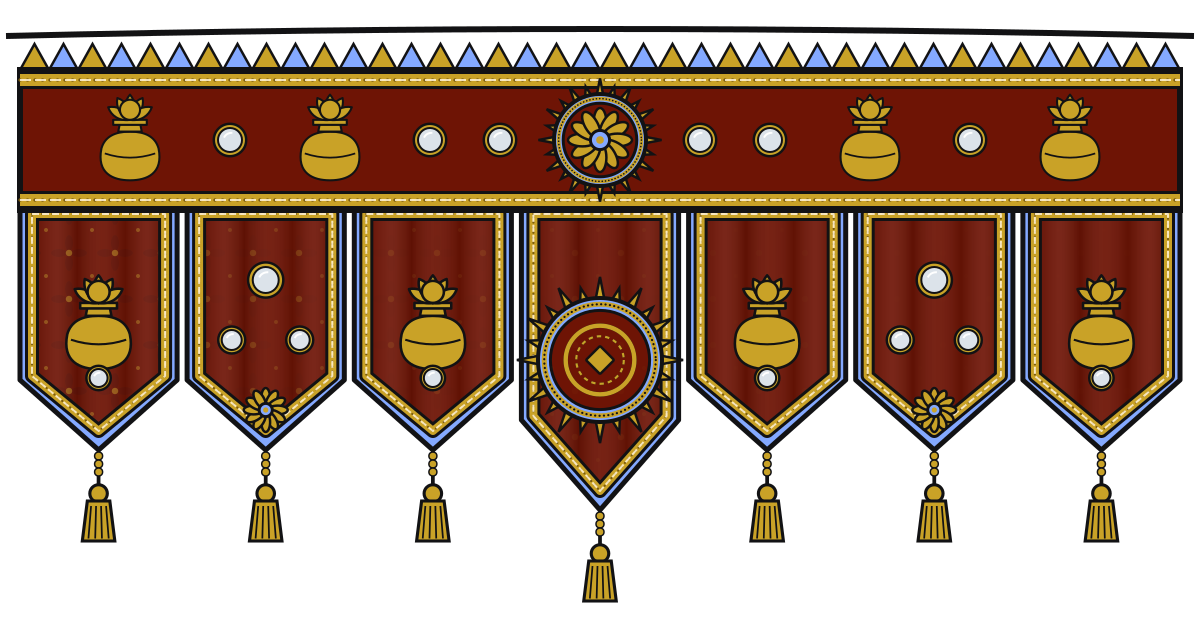
| G1 Torana · gateway The built gate of the seat; the cloth Toran hangs in it | Not yet designed for this clan | Regional tradition |
| G2 Viragallu · hero stone Carved panel stone for a member who died defending the clan | Not yet designed for this clan | Regional tradition |
| G3 Kula-shila · clan stones Standing and table stones that remember the ancestors | Jankor sacred stone: a stone representing the Jankor deity Sacred stone representing the Jankor deity, in the Phalguna rite[5] | Documented |
| G4 Jayastambha · victory pillar A pillar raised for a victory | Not yet designed for this clan | Design |
| G5 Sima-shila · boundary stone Marks the clan's land, with a line in the native script | Not yet designed for this clan | Design |
4. Sounds
| Accessory | For this clan | Basis |
|---|---|---|
| D1 Pancha-mahashabda · five great sounds The right to five instruments | Not yet designed for this clan | Design |
| D2 Shankha · clan conch The clan's own named war conch | Not yet designed for this clan | Design |
| D3 Murasu · house drums Three drums: war, charity and justice | Not yet designed for this clan | Design |
5. Kit: colours, metals and emblems
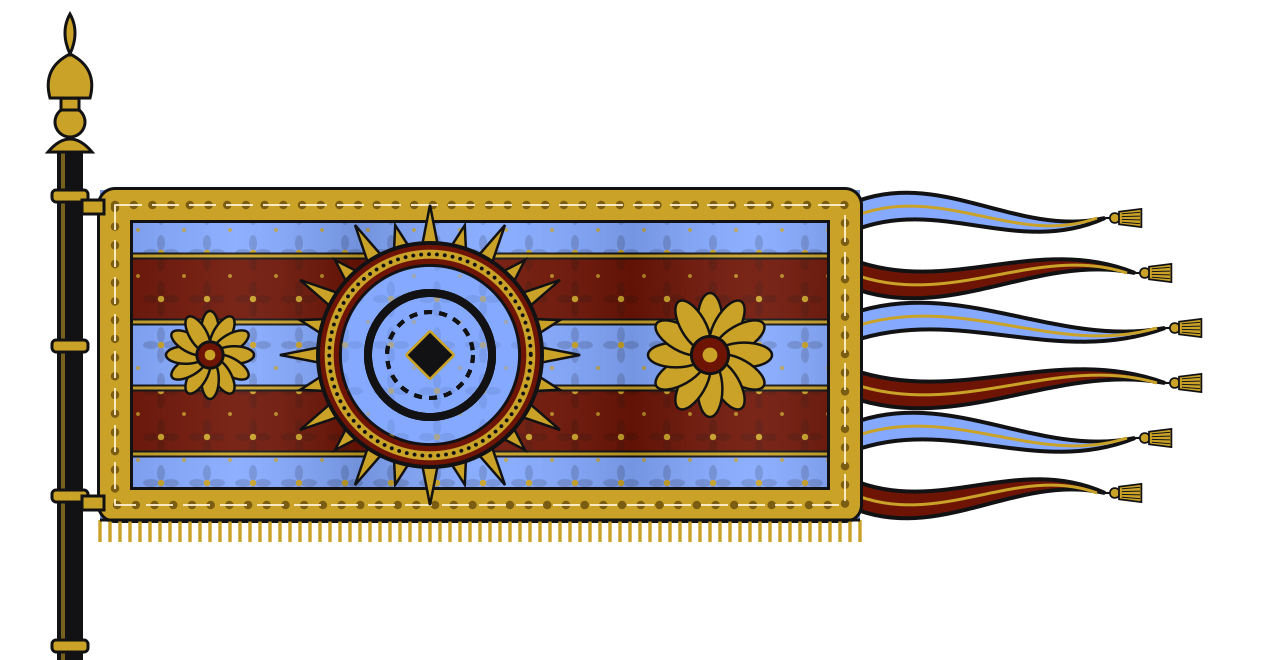
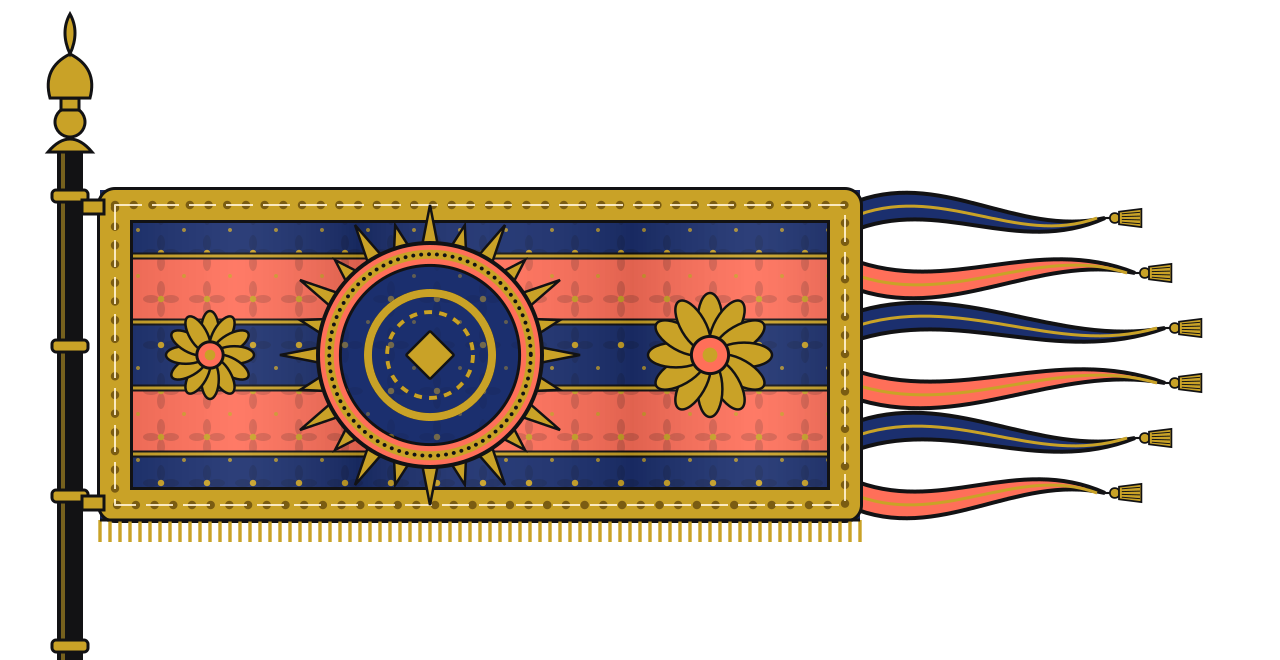
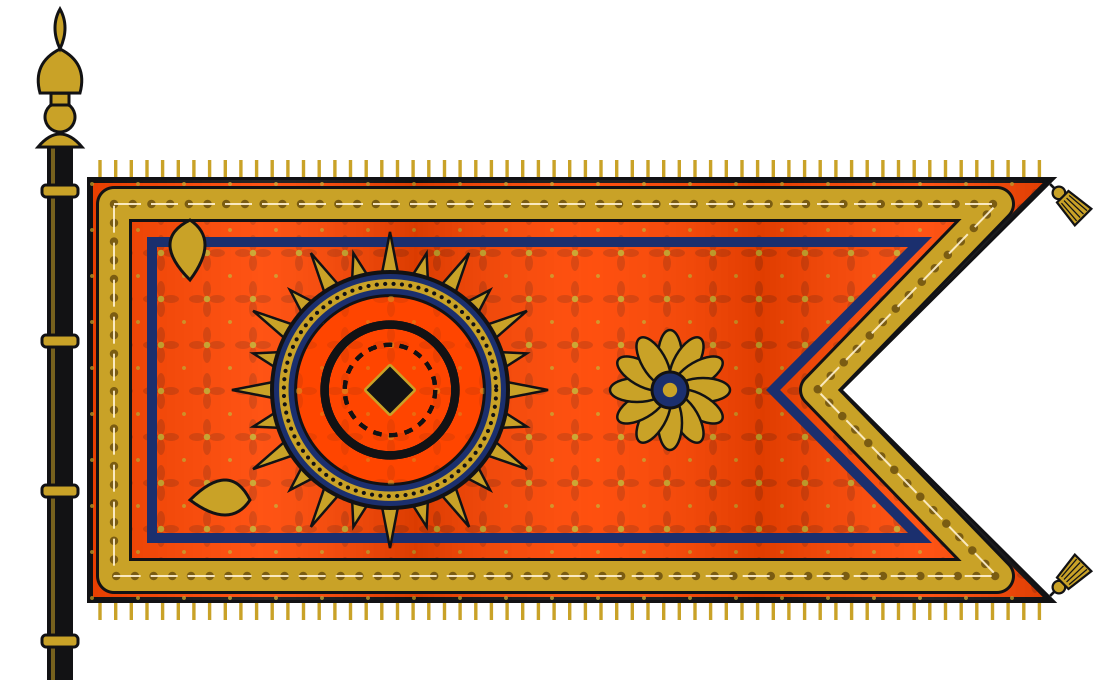
The clan's main emblem and flag are project designs from the Atlas: crossed hockey sticks, with a sal tree as the second image. No documented Kharia arms are in the extracts. Documented totems and offices are under Living symbols and Records[2].
| Part of the kit | This clan |
|---|---|
| Field | Deep Indigo #2A2A6B |
| Accent | Fiery Vermilion #FF4500 |
| Emblem colour | Metallic Gold #C9A227 |
| Zari metal | Gold |
| Main emblem | Crossed hockey sticks |
| Second image | A sal tree |
| Night and day | Every visual accessory has two versions: by night the emblem on the dark field, by day the clan's field colour on cloth woven from its metal. |
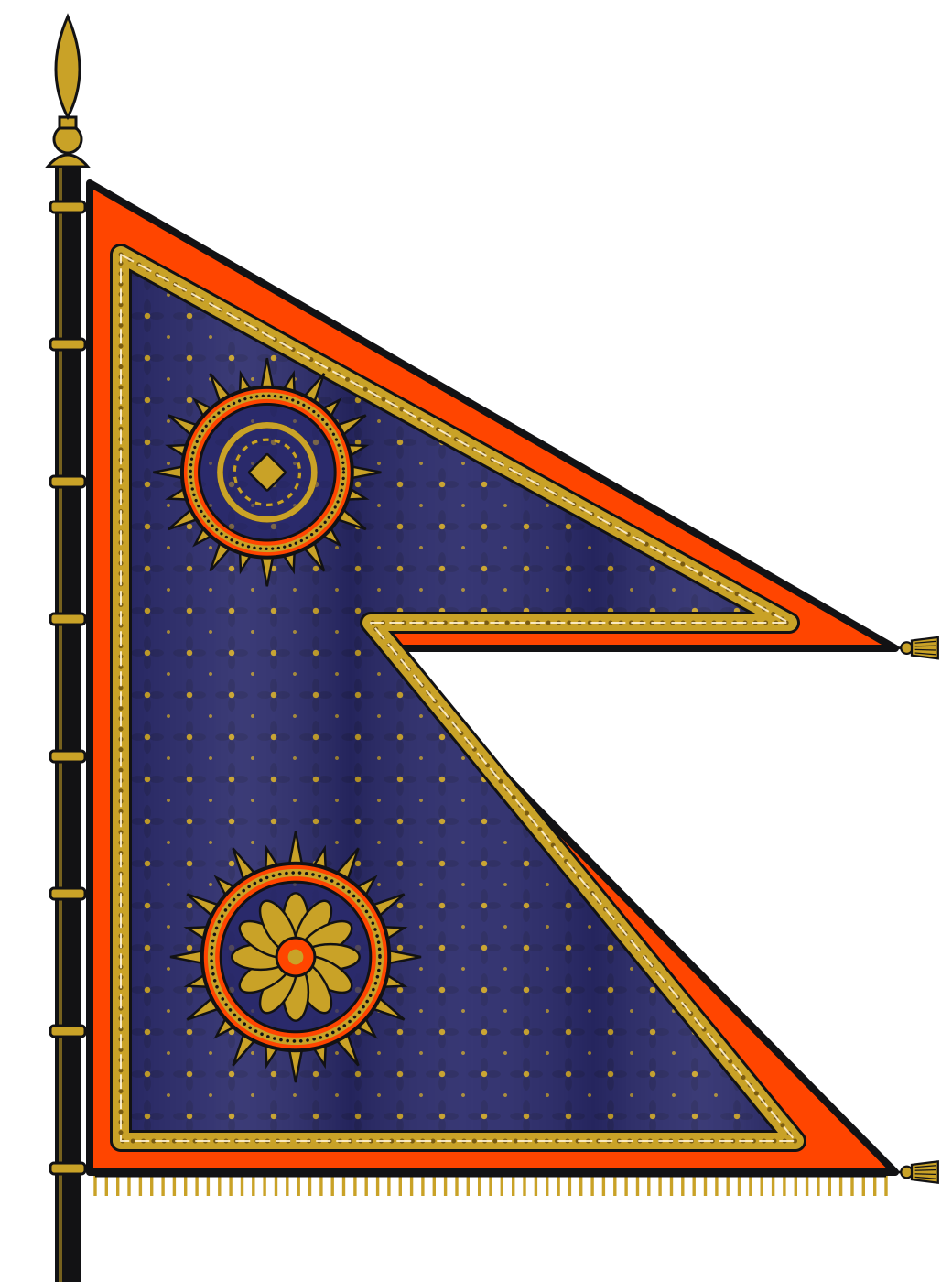
6. Flags
Every clan has every flag type; the type says the occasion and the colours say the clan. The outlined card is the flag the Atlas assigns.
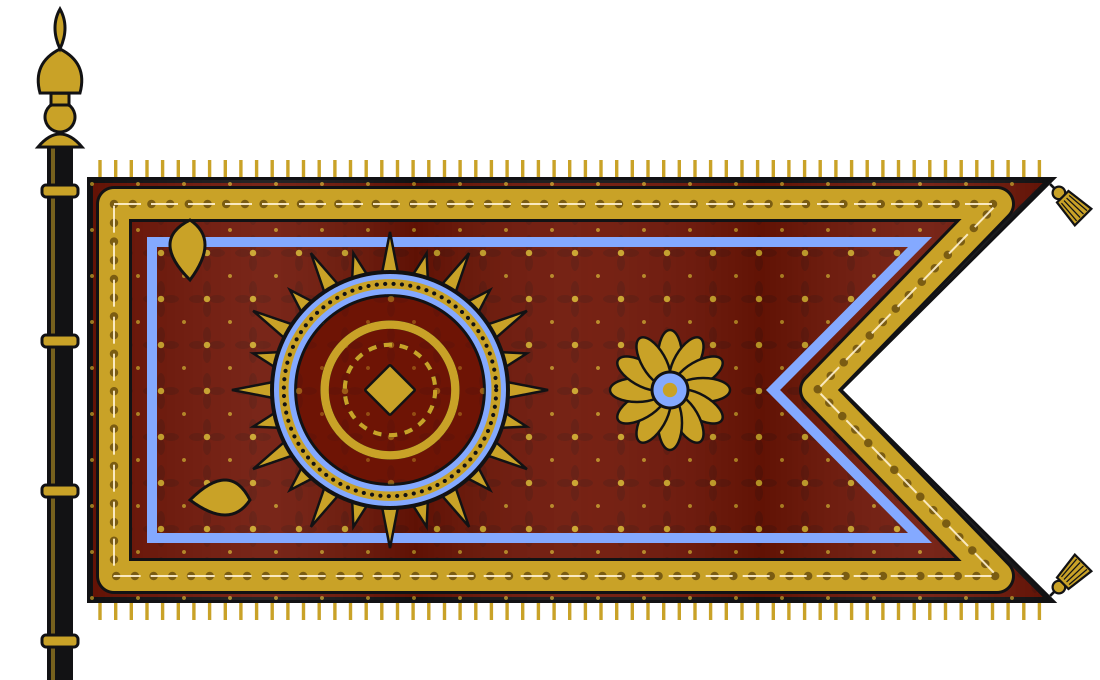

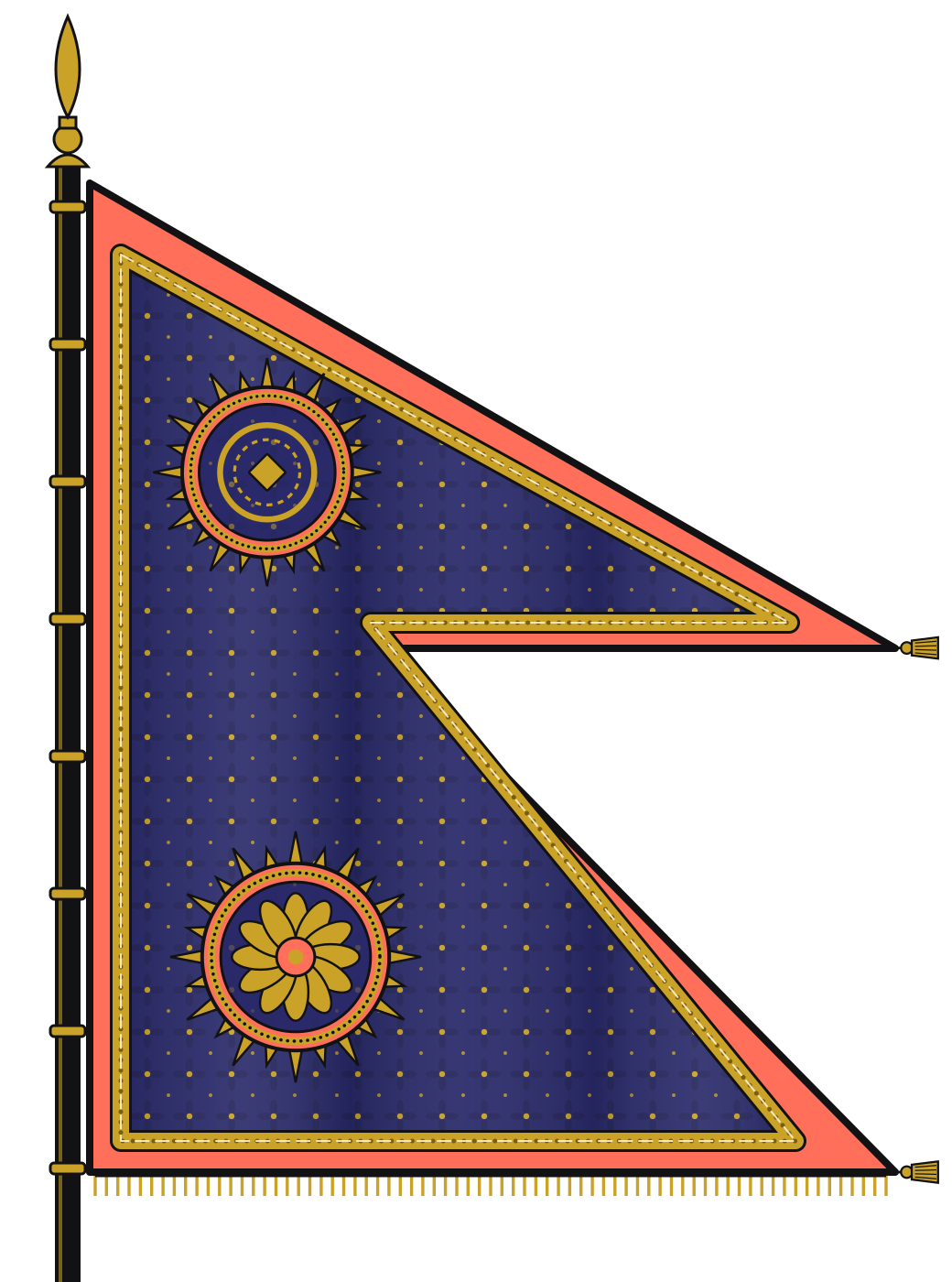

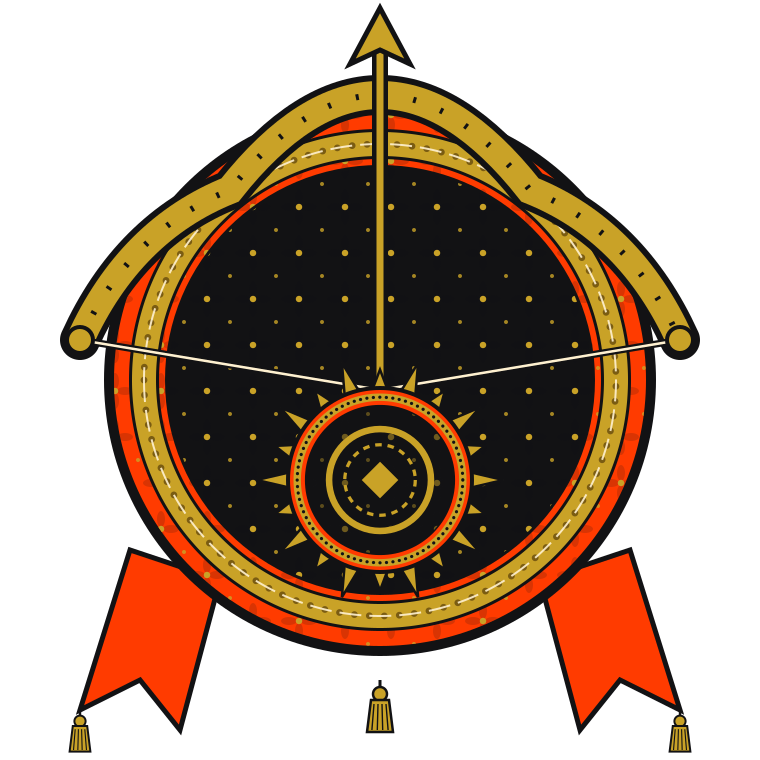
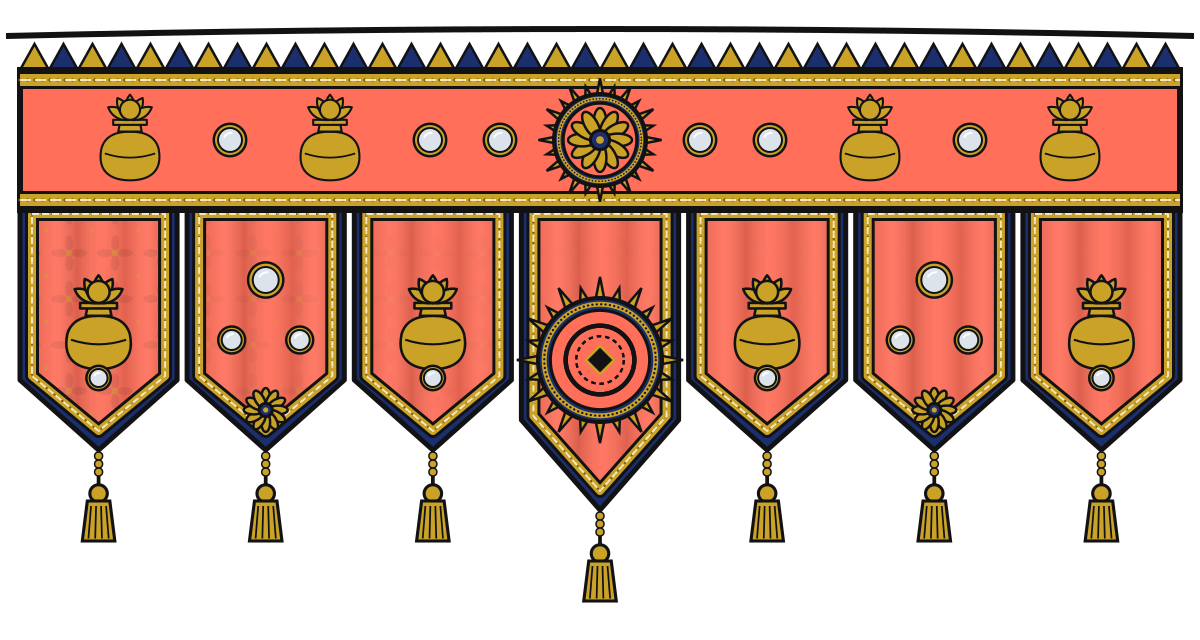

Historic banner
The Sarna flag (red and white) is used by many Adivasi Sarna followers in Jharkhand
New flag types
| Accessory | For this clan | Basis |
|---|---|---|
| A9 Pota-dhvaja · ship and trade flag For ships, caravans and markets | Not yet designed for this clan | Design |
| A10 Utsava-patāka · festival flag Light, bright flag for fairs and festivals | Not yet designed for this clan | Design |
| A11 Shoka-dhvaja · mourning flag White cloth with the emblem outline in the clan's metal | Not yet designed for this clan | Design |
7. Regalia
| Accessory | For this clan | Basis |
|---|---|---|
| E1 Chhatra · house parasol The ceremonial umbrella | Not yet designed for this clan | Design |
| E2 Chamara · fly-whisks The pair of whisks beside the head of the house | Not yet designed for this clan | Design |
| E3 Danda · staff of office Staff or scepter | Not yet designed for this clan | Design |
| E4 Simhasana · seat The seat of the house, covered in clan cloth | Not yet designed for this clan | Design |
| E5 Khetaka · shield A round shield; the Changi and Dhanush are its flag forms | Not yet designed for this clan | Regional tradition |
| E6 Kula-ayudha · clan weapon The weapon the clan honours | Axe, venerated with the plough The Kharia venerate ploughs and axes[2] | Documented |
8. Worn
| Accessory | For this clan | Basis |
|---|---|---|
| F1 Kula-vastra · clan cloth The clan's woven pattern in its kit colours | Not yet designed for this clan | Design |
| F2 Kirti-vastra · honour cloth A cloth earned for a deed, not inherited | Not yet designed for this clan | Design |
| F3 Kula-mala · garland flower The flower or leaf the clan wears as a garland | Not yet found for this clan | Under research |
| F4 Chinha · house pin A metal badge with the pin emblem | Not yet designed for this clan | Design |
9. Records
| Accessory | For this clan | Basis |
|---|---|---|
| H1 Clan words A traditional line in the native script | सोउब्म लेबु कियाऽ गैरव ओडोऽ अधिकाराऽ मासन बुँग जोनोम-जात स्वतंत्रता ओडोऽ समानता कुई सिड होतोके लुर ओडोऽ जातोमाऽ तेर तेर कुई सिऽ ओडोऽ मुनुडू होकी ते भाई-भाई मुन व्यवहार करायना चाहि। · “All human beings are born free and equal in dignity and rights.” Kharia translation of UDHR Article 1, as printed in Devanagari and Odia by Omniglot[4]. A modern translation, not a traditional saying. | Design |
| H2 Biruda · titles The house's title or titles | Office titles: Pardhan (headman, Samer sept), Negi (assistant, Suren sept), Ganda (messenger, Bartha sept) Russell 1916[2] | Documented |
| H3 Prashasti · praise genealogy The lineage as written at the head of a grant | Not yet found for this clan | Under research |
| H4 Vahi · clan register The book of the clan's births, marriages and deaths | Not yet found for this clan | Under research |
| H5 Rana-ghosha · war cry The clan's cry in battle or celebration | Not yet found for this clan | Under research |
10. VishwaVit · knower of the world
Game values are design choices for this project, not historical claims.
References
- Wikipedia, Kharia people, read 2026-10-23, https://en.wikipedia.org/wiki/Kharia_people
- R. V. Russell and Hira Lal, The Tribes and Castes of the Central Provinces of India, vol. 3 (London, 1916), Project Gutenberg #41424, read 2026-10-10, https://gutenberg.org/cache/epub/41424/pg41424-images.html
- Wikipedia, Kharia language, read 2026-10-23, https://en.wikipedia.org/wiki/Kharia_language
- Omniglot, Kharia language and alphabets, read 2026-10-23, https://www.omniglot.com/writing/kharia.htm
- Indianetzone, Festivals of Kharia Tribe, read 2026-10-23, https://www.indianetzone.com/festivals_kharia_tribe
- Subhash Jengcham, Kharia, Banglapedia (revision 18 June 2021), read 2026-10-23, https://en.banglapedia.org/index.php/Kharia
- Odisha State Tribal Museum, Kharia, read 2026-10-23, https://ostm.in/?p=5455
- Dr. Ramdayal Munda Tribal Welfare Research Institute, Jharkhand, Kharia, read 2026-10-23, https://trijharkhand.in/en/kharia
- Sushree Mohanty, Indigenous Colours of Odisha: Handbook on 62 Tribes (KISS), read 2026-10-20, link
- Enamul Haq, Munda, Banglapedia (revision 18 June 2021), read 2026-10-21, https://en.banglapedia.org/index.php/Munda
- Wikipedia, Tribes of Jharkhand, read 2026-10-20, https://en.wikipedia.org/wiki/Tribes_of_Jharkhand
- Wikipedia, Tribals in Madhya Pradesh, read 2026-10-19, https://en.wikipedia.org/wiki/Tribals_in_Madhya_Pradesh
- Wikipedia, List of Scheduled Tribes in Odisha, read 2026-10-20, https://en.wikipedia.org/wiki/List_of_Scheduled_Tribes_in_Odisha
- Sangeet Galaxy, Jharkhand traditional instruments (Ashok Gope, Shakir Tasnim), read 2026-10-10, https://sangeetgalaxy.co.in/wp-content/uploads/2025/06/15.-Ashok-Gope-Shakir-Tasnim.pdf
- dhammabharat.com, List of Scheduled Tribes in Maharashtra and Population of each Tribe (2011 Census), read 2026-10-10, https://dhammabharat.com/?p=13656