The Khairwars are a Scheduled Tribe whose name, Russell and Hira Lal say, most probably comes from khair, the catechu tree whose wood they boiled[1]. In 1916 nearly 20,000 Khairwars lived under the Central Provinces, two-thirds of them in Sarguja State[1]. The 2011 census gives 76,097 in the Madhya Pradesh Scheduled Tribe row 'Khairwar, Korwar'[2], and the Atlas lists the tribe as a Scheduled Tribe in Chhattisgarh, Madhya Pradesh and Maharashtra (list dated 9 July 2024). Their claims of descent from the Sun and their origin stories are community and state traditions, set out below with their owners named[1]. Russell treats the Khairwar and the Kharwar of Bihar and Jharkhand as one tribe; the Kharwar codex (ST-131) covers that people's own claims, and the two pages are linked, not merged[1].
01Faith and deities
Mahamaya of Ambikapur, goddess of Surguja[4]
The presiding goddess of the clan's homeland or capital: a link of place, not a recorded clan tie.
| Deity or tradition | Place in the clan's life | Evidence |
|---|---|---|
| Village priest (Pahan or Baiga) | Drawn from the Bhuiya, Kharwar or Korwa; offers a great triennial buffalo sacrifice in the sacred grove or on a rock near the village | [1] |
| Kali research | Village deity in Joshua Project's modern account. Crooke's report, as Russell passes it on, says that after adopting Hinduism the Khairwars performed human sacrifices to Kali; the extracts give no other source for this | [3][1] |
| Durga and Bajrangbali research | Regional deities in Joshua Project's modern account | [3] |
| Mahamaya of Surguja | KulDevi from the Atlas (basis: homeland shrine). Mahamaya, or Ambika Devi, is worshipped at Ambikapur, the Surguja headquarters | [4][5] |
02Temples
No temple built or patronised by the Khairwars is named in the extracts. The Mahamaya temple at Ambikapur, the KulDevi shrine in the Atlas, was constructed by Maharaja Bahadur Raghunath Sharan Singh Dev, so it is not recorded as Khairwar patronage[4].
Built by the clan
Not recorded.
Given patronage or grants by the clan
Not recorded.
03Languages and scripts
| Language or script | Kind | Under the clan | Evidence |
|---|---|---|---|
| Chhattisgarhi living | Primary language, as PeopleGroups gives for the Chhattisgarhi-speaking Khairwar | Under the clan (mission source, undated)[6] | |
| Khirwar research | A Dravidian language, unclassified; native speakers 26,000 (2011 census, infobox), native to Surguja district; the page says the Kharwar tribe speaks it | Flagged: the Russell entry records no Dravidian language for the Khairwar, so the link is unconfirmed[7] | |
| Hindi living | Named as a secondary language in Joshua Project's table, which pools several groups | Not a Khairwar-only figure[3] |
04Books and literature
The Khairwar appear in Russell and Hira Lal's 1916 survey of the Central Provinces. No book by a Khairwar author is in the extracts.
Written during the clan's history
| Work | Author | Kind | When | Link to the clan |
|---|---|---|---|---|
| The Tribes and Castes of the Central Provinces of India | R. V. Russell and Hira Lal | Ethnographic survey; entry Khairwar (vol. 3); vol. 1 index | 1916 | [1][8] |
Given patronage by the clan
Not recorded.
05Thinkers and scholars
| Name | Field | Era | Contribution |
|---|---|---|---|
| Captain J. P. Blunt | Traveller, quoted by Russell | 1794 | Journey from Chunar to Ellora; found the Khairwas of the Kaimur hills[1] |
| Dalton | Writer quoted by Russell | As cited in 1916 | The Santal tradition of the name; the Khairwar appeal to the sun; the Chero link and Palamu saying[1] |
| Risley | Writer quoted by Russell | As cited in 1916 | The Kharwar Rohtas and Surajvansi claim; the Bengal inheritance rule[1] |
| Crooke | Writer quoted by Russell | As cited in 1916 | The Khairagarh origin of the name; the Mirzapur catechu makers[1] |
These are the outside writers who recorded the Khairwar; the extracts give none from inside the community.
06Art and architecture
No Khairwar painting, sculpture, architecture, textile, clothing or craft is named in the extracts.
Painting and wall art
Not recorded.
Sculpture and temple art
Not recorded.
Temple and building architecture
Not recorded.
Weaving and textiles
Not recorded.
Clothing and jewellery
Not recorded.
Coins, pottery and crafts
Not recorded.
07History
Name and origin
Russell and Hira Lal give the name as Khairwar, Kharwar, Khaira and Khairwa, for a primitive tribe of the Chota Nagpur plateau and Bihar[1].
The name most probably comes from khair, catechu (Acacia catechu). Crooke gave other sources: a place called Khairagarh (in Hazaribagh District, or a Chhattisgarh Feudatory State, or a pargana of Allahabad District), or a mix of forest tribes in Mirzapur. Russell thought Khairagarh was 'almost certainly the fort of the khair trees'[1].
Russell concludes that the Khairwars of Chota Nagpur are an occupational offshoot of the Cheros and Santals, and the Kaimur hill Khairwars of the Gonds and Savars[1]. These are Russell's conclusions, not the people's own accounts.
The Central Provinces, 1916
Nearly 20,000 Khairwars were under the Central Provinces in 1916, two-thirds in the recently acquired Sarguja State, the rest in neighbouring states and Bilaspur District. A few hundred were in Damoh District in Bundelkhand[1].
At Damoh the Khairwars lived in temporary forest sheds during the working season and moved on as the khair trees were used up. They said they came from Panna State[1].
Palamu and the Cheros
Dalton links the Khairwars closely with the Cheros, who were once dominant in Gorakhpur and Shahabad and came into Palamu. In Palamu the population then included Kharwars, Gonds, Mars, Korwas, Parheyas and Kisans; the Kharwars were 'the people of most consideration', and the Cheros let them keep the hill tracts bordering Sarguja[1].
Dalton also says the Rajas of Ramgarh and Jashpur are members of the tribe, and that the Jashpur Raja married a lady of Rajput blood. This is Dalton's claim, and the extract gives no other source[1].
The Kaimur hills, 1794
In 1794 Captain J. P. Blunt, travelling from Chunar to Ellora, met the Khairwas of the Kaimur hills near Mirzapur. They were armed with bows, arrows and a hatchet, and their villages fled at his approach; Kols were used as mediators[1].
The Bhogta rising, 1857-58
The Bhogtas, a division of the Khairwar in Russell's list, were most important in Bengal and in the Palamu hills. A Palamu Bhogta clan head, an outlawed freebooter who took a jagir, had two sons who rebelled in 1857-58; one was hanged, one transported, and the estate was confiscated[1].
Claims of descent (community and state traditions)
Risley records that the Kharwars declare their original seat the fort of Rohtas, abode of Rohitaswa, son of Harischandra, of the family of the Sun. They claim descent from it, call themselves Surajvansis and wear the sacred thread. Risley also records a less flattering tradition, of a Kshatriya man and a Bhar woman in the days of King Ben[1].
The Bamra State tradition traces the people to the Sun and a daughter of Lakshmi; Hira Lal identifies Rathgarh with Rath in north Raigarh State and Sara with Saria in Sarangarh[1]. These are claims by the tradition's owners, not established history.
08Journey and migrations
The extracts record few movements of the Khairwars, and none is dated: a Santal tradition about the name, the Damoh forest moves, and a reported move to Mirzapur by a sub-group.
| When | From | To | Why | Evidence |
|---|---|---|---|---|
| Undated (Santal tradition) legend | Ahiri Pipri | Hara Dutti | Santal ancestors, who 'were called Kharwar', multiplied after the wild goose's eggs (Dalton's Santal tradition) | [1] |
| Undated (Damoh District) | Panna State | Damoh District | Said to come from Panna State; forest sheds moved as the khair trees were used up | [1] |
| 18th century (reported) | Not stated | Mirzapur and Allahabad | Small Khairwar groups, now called Khairaha, reportedly migrated to Mirzapur | [9] |
09Seats and lands
| Place | Role | Where today |
|---|---|---|
| Chota Nagpur plateau and Bihar | Region named for the tribe in 1916 | Not stated in the extracts |
| Sarguja State | Two-thirds of the 1916 Khairwars | Surguja district, Chhattisgarh; Ambikapur is the headquarters[10][4][5] |
| Bilaspur District | Khairwar population, 1916; the children's custom in Russell | Bilaspur District, as Russell names it[1] |
| Damoh District, Bundelkhand | A few hundred Khairwars, 1916 | Not stated in the extracts |
| Kaimur hills, Mirzapur | Khairwas met by Blunt in 1794; Kols as mediators | Mirzapur, Uttar Pradesh[9] |
| Palamu | Bhogta and Kharwar ties with the Cheros; the Bhogta rising of 1857-58 | Palamu, as Russell names it[1] |
| Ramgarh and Jashpur | Principalities whose Rajas Dalton names as members of the tribe | Not stated in the extracts |
| Rath and Saria | Places Hira Lal identifies in the Bamra tradition: Rath (north Raigarh State) and Saria (Sarangarh) | Not stated in the extracts |
10Notable figures
| Name | Role | Era | Known from |
|---|---|---|---|
| Maninath Singh | Raja of Ramgarh; his sister married a relative of the Palamu Raja | Not dated | [1] |
| Rajas of Ramgarh and Jashpur | Members of the tribe, as Dalton states | Not dated | [1] |
| Bhujbalrai legend | Son born from the arm of a daughter of Lakshmi, in the Bamra tradition; became king of Rathgarh | Legendary | [1] |
| Janghrai legend | Daughter born from the thigh of the same daughter of Lakshmi, in the Bamra tradition | Legendary | [1] |
| Rohitaswa legend | Son of Harischandra, of the family of the Sun; the Kharwars' first seat is his fort at Rohtas | Legendary | [1] |
| Bhogta clan head, Palamu | An outlawed freebooter who took a jagir; his two sons rebelled | 1857-58 | [1] |
11Allies, rivals and marriages
| People | Relationship | When |
|---|---|---|
| Mundas | Once one people with the Kharias, Korwas and Korkus, in Russell's view | Not dated |
| Kols | In the Central Provinces the Khairwars call themselves Kols; Russell calls them an occupational offshoot of the Kols and Cheros | 1916 |
| Cheros | Dalton links them closely with the Khairwars; Chero and Kharwar intermarried in Palamu | Palamu; not dated |
| Santals | Russell's view: the Chota Nagpur Khairwars are an offshoot of Cheros and Santals; Dalton's Santal tradition of the name | Not dated |
| Gonds | The Kaimur Khairwas are generally recognised as Gonds who took to boiling catechu | Not dated |
| Savars and Bharias | They call themselves Kols; Russell links the Kaimur Khairwars with the Savars | 1916 |
| Kharwar (ST-131) | Russell treats Kharwar as a name of the Khairwar; the Kharwar codex covers the Bihar, Jharkhand and UP people | 1916 |
| Bhuiyas and Korwas | The village priest is taken from them, which Russell reads as their being earlier residents | Not dated |
| Kathkaris of Bombay | Crooke identifies the Khairwar with the Kathkaris, makers of katha | Not dated |
| Rajputs | Dalton says the Jashpur Raja married a lady of Rajput blood and obtained such unions for three daughters | Not dated |
| Bhar | Named in Risley's less flattering origin tradition | Not dated |
12Society and livelihood
Khairwar society as Russell records it in 1916: exogamous septs named for plants and animals, a village priest taken from neighbouring peoples, Hindu inheritance in the Central Provinces, and a marriage with a mango tree in Bengal.
Government and social order
| Institution or group | What it was | Evidence |
|---|---|---|
| Exogamous septs (totem septs) | Septs are named for plants and animals. The mouse, tortoise, parrot, pig, monkey, vulture, banyan and date-palm septs revere their totem; a sept that finds its dead totem animal throws away the earthen cooking-pot. The rice, salt, plough and rice-lever septs make obeisance before using those objects | [1] |
| Village priest | Pahan or Baiga, drawn from the Bhuiya, Kharwar or Korwa; Russell reads these as the earlier residents | [1] |
| Inheritance | Hindu rule in the Central Provinces. In Bengal (Risley), the eldest son of the senior wife takes the property and must provide for the other legitimate children. Daughters do not inherit, but may live in the ancestral home until marriage | [1] |
| Marriage | Marriage in infancy or adulthood; a girl is not disposed of without her consent; bride-price is five to ten rupees, doubled for a widower; a Brahman fixes the day. In Bengal the couple first go through a form of marriage to a mango tree or branch, exchange blood mixed with sindur, and the bride's forehead is smeared with sindur | [1] |
| Death and mourning | The dead are usually buried, though cremation is spreading among the well-to-do. The corpse is carried seven times round the grave, feet to the north. Mourning lasts ten days without animal food or liquor. In Bilaspur District children are reported to cut a small piece of flesh from a dead parent's finger and swallow it, which Frazer explains as a way to avoid being haunted | [1] |
Livelihood over time
| Era | Livelihood | Evidence |
|---|---|---|
| 1916, Damoh District | Forest sheds in the working season. The khair tree is cut, its bark stripped, and the inner wood boiled for two to three days to a thick black paste, made into cakes and dried in the sun. The Forest Department charged a rupee per boiling pot | [1] |
| 1916, Chota Nagpur | Catechu making, which Russell gives as the people's occupation and the source of the name | [1] |
| Today (mission sources, undated) | Mostly farming, most not landowners; hunting and fishing add to the food. Traditionally forest-dwelling, linked to land, forest, farming and wage labour | [3][6] |
13Sub-clans and related clans
Every sub-clan, division, sept and related people the extracts name. Items with a master ID link to that people's page; items without one are new clan candidates. Mahto, Rawat and Manjhi are titles Russell gives for Dalton's four divisions, not confirmed as the sheet's Mahto (SUB-121).
| Clan | Relation | Where | Size | In the Atlas | Evidence |
|---|---|---|---|---|---|
| Bhogta | Related people | Bengal; the Palamu hills skirting Sarguja; Tori and Bhanwar Pahar (Chota Nagpur). The Atlas lists Bhogta as an alias of Kharwar (ST-131) | ST-131 | [1][8] | |
| Mahto | Sub-clan | A title (headman); one of Dalton's four divisions | same name as SUB-121: check | [1] | |
| Rawat | Sub-clan | A title (chief); one of Dalton's four divisions | new clan candidate | [1] | |
| Manjhi | Sub-clan | A title (boatman, or a Santal headman); one of Dalton's four divisions | new clan candidate | [1] | |
| Surajvansi | Sub-clan | Central Provinces; the aristocratic division of chiefs and zamindars, descended from the Sun, who wear the sacred thread. Also called Janeodhari. The Atlas spells a Kharwar division Surajbanshi (ST-557); not linked here | new clan candidate | [1] | |
| Dualbandhi | Sub-clan | Central Provinces; earthen walls (diwals), or in Mirzapur a dual leather belt of soldier forefathers | new clan candidate | [1] | |
| Patbandhi | Sub-clan | Central Provinces; silk makers and tasar rearers. The Atlas lists Patbandi as an alias of Kharwar (ST-131) | ST-131 | [1] | |
| Beldar | Sub-clan | Navvies (earthwork labourers); also called Matkora | new clan candidate | [1] | |
| Kawarvansi | Sub-clan | Descendants of the Kawars; see Kawar (ST-126) | new clan candidate | [1] | |
| Kanwarbansi | Sub-clan | A subtribe of the Khairwar in Russell v1 | new clan candidate | [8] | |
| Khairchura | Sub-clan | Catechu makers in the Central Provinces | new clan candidate | [1] | |
| Khairi | Sub-clan | Catechu-making subdivision in Bengal. The Atlas lists Khairi as an alias of Kharwar (ST-131) | ST-131 | [1] | |
| Khairaha | Sub-clan | Mirzapur and Allahabad, Uttar Pradesh; catechu-making subdivision in the United Provinces | 892, 2011 (UP Scheduled Caste population, Wikipedia) | SUB-217 | [1][9] |
| Chouria | Sub-clan | Exogamous kuri of Khairaha (SUB-217) | new clan candidate | [9] | |
| Nagria | Sub-clan | Exogamous kuri of Khairaha (SUB-217) | new clan candidate | [9] | |
| Tengriha | Sub-clan | Exogamous kuri of Khairaha (SUB-217) | new clan candidate | [9] | |
| Kharwar | Related people | Palamu, Bihar, UP, West Bengal, Odisha; Russell treats the two names as one tribe | 1,60,676, UP Scheduled Tribe row 'Kharwar, Khairwar', 2011; the row may be the ST-131 people | ST-131 | [1][11] |
| Kawar | Related people | Kawarvansi and Kanwarbansi names link the Khairwar to the Kawar | 18,603, 2011 (MP ST row 'Kawar, Kanwar, etc.') | ST-126 | [1][2] |
| Kharia | Related people | Chota Nagpur; once one people with the Mundas, in Russell's view | 2,429, 2011 (MP ST row 'Kharia') | ST-130 | [1][2] |
| Korwa | Related people | Once one people with the Mundas (Russell); their priests are taken as earlier residents | 920, 2011 (MP ST row 'Korwa, Kodaku') | ST-157 | [1][2] |
| Korku | Related people | Once one people with the Mundas (Russell) | 7,30,847, 2011 (MP ST row 'Korku, etc.') | ST-156 | [1][2] |
| Munda | Related people | Chota Nagpur; once one people with the Khairwars (Russell) | 5,041, 2011 (MP ST row 'Munda') | ST-229 | [1][2] |
| Kol | Parent people | Russell's view: the Khairwars are an occupational offshoot of the Kols and Cheros; in the Central Provinces they call themselves Kols | 11,67,694, 2011 (MP ST row 'Kol') | ST-141 | [1][8][2] |
| Chero | Parent people | Russell's view: an occupational offshoot of the Cheros; Dalton links the two closely | 42,227, 2011 (UP ST row 'Chero') | ST-055 | [1][11] |
| Santal | Parent people | Russell's view for the Chota Nagpur Khairwars; Dalton's Santal tradition of the name | ST-280 | [1] | |
| Gond | Parent people | Russell's view for the Kaimur Khairwas, who are recognised as Gonds who took to boiling catechu | ST-088 | [1] | |
| Savar | Parent people | Russell's view for the Kaimur Khairwars; the Savars call themselves Kols | 881, 2011 (MP ST row 'Sawar, Sawara') | ST-285 | [1][2] |
| Bharia | Related people | Bharias call themselves Kols (Russell) | ST-024 | [1] | |
| Bhuiya | Related people | A source of village priests (Pahan or Baiga), with Kharwar and Korwa | 15,599, 2011 (UP ST row 'Bhuiya') | ST-031 | [1][11] |
| Kathodi | Related people | Crooke identifies the Khairwar with the Kathkaris of Bombay, makers of katha | ST-124 | [1] | |
| Kansi | Related people | Khairwar sept; sprinkles kans-grass water on the bride and groom at marriage | ST-546 | [1] | |
| Chandan sept | Sub-clan | Khairwar sept (sandalwood); applies sandal paste to foreheads | new clan candidate | [1] | |
| Dhan sept | Sub-clan | Khairwar sept (rice); makes obeisance before using rice | new clan candidate | [1] | |
| Non sept | Sub-clan | Khairwar sept (salt); makes obeisance before using salt | new clan candidate | [1] | |
| Dila sept | Sub-clan | Khairwar sept (plough); makes obeisance before using the plough | new clan candidate | [1] | |
| Dhenki sept | Sub-clan | Khairwar sept (rice-pounding lever); makes obeisance before using it | new clan candidate | [1] | |
| Kilkila sept | Sub-clan | Khairwar sept (kingfisher) | new clan candidate | [8][1] | |
| Mouse sept (Khairwar) | Sub-clan | Khairwar sept; revere the mouse as totem; throws away the cooking-pot if a dead mouse is found | new clan candidate | [1] | |
| Tortoise sept (Khairwar) | Sub-clan | Khairwar sept; revere the tortoise as totem | new clan candidate | [1] | |
| Parrot sept (Khairwar) | Sub-clan | Khairwar sept; revere the parrot as totem | new clan candidate | [1] | |
| Pig sept (Khairwar) | Sub-clan | Khairwar sept; revere the pig as totem | new clan candidate | [1] | |
| Monkey sept (Khairwar) | Sub-clan | Khairwar sept; revere the monkey as totem | new clan candidate | [1] | |
| Vulture sept | Sub-clan | Khairwar sept; revere the vulture as totem | new clan candidate | [1] | |
| Banyan sept | Sub-clan | Khairwar sept; revere the banyan tree as totem | new clan candidate | [1] | |
| Date-palm sept | Sub-clan | Khairwar sept; revere the date-palm as totem | new clan candidate | [1] | |
| Bhar | Related people | Named in Risley's less flattering origin tradition | new clan candidate | [1] | |
| Mars | Related people | Named among the Palamu population of 1916 (Dalton) | new clan candidate | [1] | |
| Parheya | Related people | Named among the Palamu population of 1916 (Dalton) | new clan candidate | [1] |
Clans marked "new clan candidate" are not in the Atlas yet.
14Surnames
The extracts name one surname: Kashyap, given for the Khairaha sub-group (Wikipedia). No count of bearers is sourced. Joshua Project's alternate names (Kaira, Kathakar, Khai, Khaira, Khairah, Kharwar, Kherwar, Khirwar, Konda, Roy) are listed as names, not surnames, so they are not listed here.
| Surname | Clan or sub-clan | Where | People with this surname | Also used by other communities |
|---|---|---|---|---|
| Kashyap | Khairaha | Mirzapur and Allahabad, Uttar Pradesh (the Khairaha sub-group) | not yet counted | No |
Counts are of everyone with the surname, from the cited source and year, not only members of this clan. A surname shared with other communities says nothing about any one person's origin.
15Songs and music
No Khairwar song is named in the extracts. None is written here.
None recorded yet.
16Poems, lullabies and children's rhymes
No Khairwar lullaby, rhyme or riddle is in the extracts, so none is written here.
None recorded yet.
17Stories, legends and proverbs
Stories and legends
| Story | What happens | Told by | Evidence |
|---|---|---|---|
| The Sun, Lakshmi and the khair tree | In the Bamra State tradition the Sun and a daughter of Lakshmi, living in Sara, have a son and a daughter. Lakshmi comes to them disguised as a beggar; they refuse her, and she curses their Khairwar descendants to be poor, to live by the forests and to boil wood for catechu | Bamra State tradition, as Russell records it | [1] |
| The fort of Rohtas legend | The Kharwars' first seat is the fort of Rohtas, home of Rohitaswa, son of Harischandra; they call themselves Surajvansi and wear the sacred thread | Kharwars, as Risley records them | [1] |
| The Bhar woman and King Ben | A less flattering origin: a Kshatriya man and a Bhar woman in the days of King Ben | A less flattering tradition, as Risley records it | [1] |
| The wild goose and Hara Dutti | A wild goose from the great ocean lays two eggs at Ahiri Pipri; Santal ancestors go to Hara Dutti, multiply, and 'were called Kharwar' | Santal tradition, as Dalton records it | [1] |
Proverbs and sayings
| Saying | Meaning | Evidence |
|---|---|---|
| Cheros 'twelve thousand' families, Kharwars 'eighteen thousand' (a Palamu saying; no native-script form is given in the extract) | A popular comparison of the family numbers of Cheros and Kharwars in Palamu | [1] |
18Festivals and fairs
| Festival or fair | When | Where | What happens |
|---|---|---|---|
| Triennial buffalo sacrifice research | Once every three years (as recorded in 1916) | The sacred grove, or a rock near the village | The village priest, Pahan or Baiga, offers a buffalo[1] |
19Food, dress and games
Food
| Item | What it is | Evidence |
|---|---|---|
| Catechu cakes | Khair wood boiled to a black paste, dried in cakes, and eaten in small pieces with betel leaf and areca nut (Damoh Khairwars, 1916) | [1] |
Dress
Not recorded.
Games and martial arts
Not recorded.
Tags: living still practised · revived brought back after a break · lost known only from records · research reported but not yet confirmed from a source. Songs and poems under copyright are listed by title only; restricted or sacred material is noted without its content.
20Status today
The Khairwar are a living Scheduled Tribe in the Atlas's list (dated 9 July 2024). The Uttar Pradesh Scheduled Tribe list (2011) gives one row for 'Kharwar, Khairwar'[11].
Who carries the name today
| Community | Link | Basis | Evidence |
|---|---|---|---|
| Khairaha (SUB-217), described as a sub-group of the Khairwar | Community tradition | [9] | |
| Kharwar (ST-131), treated by Russell as one tribe with the Khairwar | Disputed | [1] |
Recognised heritage
| What | Recognition | Evidence |
|---|---|---|
| Descent from the Sun; the Surajvansi name and sacred thread | Community tradition, as Risley records the Kharwars | [1] |
| The khair tree | Gives the name and the catechu craft; the Atlas's emblem | [1] |
| Mahamaya of Surguja | KulDevi in the Atlas (homeland shrine) | [4][5] |
Not reviewed by the Khairwar community; no community review is recorded in the extracts.
21For children
The Sun, Lakshmi and the Khair Tree
Long ago, the Sun and a daughter of Lakshmi lived in the town of Sara, and they had a son and a daughter. Their son became a king of Rathgarh. One day Lakshmi came to them dressed as a poor beggar, but they were proud and sent her away. She was angry, and she said that their children, the Khairwars, would be poor. So the Khairwars had to live in the forest and boil khair wood to make catechu. This is the Bamra State tradition about the name, as Russell records it.
22Across the project
| Project | What carries this clan | Status |
|---|---|---|
| Atlas of the Janas | Places the extracts name: Sarguja, Bilaspur, Damoh, Panna, Mirzapur and the Kaimur hills; Palamu and Chota Nagpur; Rath and Saria (Bamra tradition) | Footprints not yet written |
| KulDevi and GrahDevi | Mahamaya of Surguja (KulDevi), with the Navadurga family and the GrahDevi forms, all; no extract links the Khairwar to the GrahDevi forms | From the Atlas |
| Planet naming | Under research | — |
| Renaming and waters | Under research: the extracts name no Khairwar water | — |
23Open questions
- Khirwar language link: Wikipedia says the Khirwar language (Dravidian, unclassified, 26,000 speakers in 2011, native to Surguja) is spoken by the Kharwar tribe. The Russell entry records no Dravidian language for the Khairwar, and PeopleGroups gives Chhattisgarhi. The link is flagged and not used as fact. Next run: check the 2011 language returns for Surguja before citing Khirwar for the Khairwar.
- Kharwar link: Russell treats Khairwar and Kharwar as one tribe, the Atlas lists Khairwar (UP), Bhogta, Patbandi and Khairi as aliases of Kharwar (ST-131), and the UP Scheduled Tribe row 'Kharwar, Khairwar' (1,60,676, 2011) combines both. The Kharwar codex (ST-131, kharwar.json) keeps the Bihar, Jharkhand and UP people's own claims (the Khayaravala chiefs). The two pages are linked; neither is merged, and which people the UP row counts is unresolved.
- Official status: Joshua Project's page classes the Khairwar as a Scheduled Caste; the Atlas and the list dated 09-07-2024 give Scheduled Tribe. The page follows the sheet and does not rank the communities.
- Chhattisgarh 2011 figure: not found in the extracts. Lead: the census Scheduled Tribe list PDF on ncst.nic.in (not fetched).
- Population: Joshua Project's 444,000 and its Chhattisgarh figure pool several Kharwar-named groups. PeopleGroups gives about 17,500 for the Chhattisgarhi-speaking group. Both are undated; neither is used as a total.
- Surajvansi (Janeodhari) and the Atlas's Surajbanshi (ST-557): confirm whether they are the same division before linking.
- Dualbandhi and the Atlas's Dautalbandi (alias of Kharwar, ST-131): confirm whether they are the same division.
- Mahto, Rawat and Manjhi are titles Russell gives for Dalton's four divisions. The Atlas has a Mahto (SUB-121) linked to Koeri; that link is not confirmed for the Khairwar's Mahto.
- Heritage: the Rohtas and Surajvansi descent is a community claim recorded by Risley. It needs the community's own account before it is stated as fact.
- Sources not yet read: Crooke's Tribes and Castes of the North-Western Provinces (archive.org PDF, public domain) for sayings, customs, songs and any Khairwar entry; the Hindi Tribal Research Institute page on Khairwar (bharatdiscovery, fetch failed in this run).
- Sahapedia's Karma festival and the Chhattisgarh folklore pages are not tied to the Khairwar in the sources, so they are not used.
- Parentage: the v1 index and entry say the Khairwars are an occupational offshoot of the Kols and Cheros (Russell and Hira Lal, vol. 1, line 3463[8]); the v3 entry and the v1 Chero article say the Chota Nagpur Khairwars are an offshoot of the Cheros and Santals[1]. The page gives both as Russell's views and does not pick one.
24Astitva
अस्तित्व · being, existence: everything by which the clan is known
Russell's 1916 entry records the totem septs, the divisions' titles and the sacred thread of the Surajvansi. No seal, coin, plate, war cry, instrument or cloth is recorded for the Khairwar[1].
Every clan has every accessory, royal objects included. Each one says how it is known: Documented This clan's own object is recorded. · Regional tradition Recorded for the region or for peoples like this one, not for this clan. · Design Made for this project, with no historical claim. · Under research To be found for this clan from sources. Legends and titles are written in the clan's own script.
1. Seals and coins
| Accessory | For this clan | Basis |
|---|---|---|
| B1 Rajamudra · house seal Round seal with the clan emblem and a short legend in the clan's script | Not yet designed for this clan | Design |
| B2 Anguliya-mudra · signet ring Personal seal ring of the head of the house | Not yet designed for this clan | Design |
| B3 Chhapa · house stamp Ink or block stamp for letters, goods and cloth | Not yet designed for this clan | Design |
| B4 Tamrapatra · charter plate Copper-plate grant on a ring, closed with the house seal | Not yet designed for this clan | Design |
| B5 Shreni-mudra · guild or trade seal Seal for the clan's trade, craft or caravan | Not yet designed for this clan | Design |
| C1 Clan coin Emblem or deity on one side, a legend in the clan's script | Not yet designed for this clan | Design |
| C2 Coin die The die that strikes the coin | Not yet designed for this clan | Design |
2. Living symbols
| Accessory | For this clan | Basis |
|---|---|---|
| I1 Totem trio The tree, bird and animal the clan protects | Banyan and date-palm (trees); parrot, vulture and kingfisher (birds); mouse, tortoise, pig and monkey (animals). Each is the totem of a sept; the khair tree gives the name | Documented |
| I2 Kaval-maram · guardian tree The tree that stands at the clan's seat | Not yet found for this clan | Under research |
3. Stone and gate
| Accessory | For this clan | Basis |
|---|---|---|
| G1 Torana · gateway The built gate of the seat; the cloth Toran hangs in it | Not yet designed for this clan | Regional tradition |
| G2 Viragallu · hero stone Carved panel stone for a member who died defending the clan | Not yet designed for this clan | Regional tradition |
| G3 Kula-shila · clan stones Standing and table stones that remember the ancestors | Not yet designed for this clan | Design |
| G4 Jayastambha · victory pillar A pillar raised for a victory | Not yet designed for this clan | Design |
| G5 Sima-shila · boundary stone Marks the clan's land, with a line in the native script | Not yet designed for this clan | Design |
4. Sounds
| Accessory | For this clan | Basis |
|---|---|---|
| D1 Pancha-mahashabda · five great sounds The right to five instruments | Not yet designed for this clan | Design |
| D2 Shankha · clan conch The clan's own named war conch | Not yet designed for this clan | Design |
| D3 Murasu · house drums Three drums: war, charity and justice | Not yet designed for this clan | Design |
5. Kit: colours, metals and emblems
The Atlas gives a khair tree as the main emblem, for catechu making, and a Changi crest with the sun as its flag type. No seal, coin or plate of the Khairwar is in the extracts[1].
| Part of the kit | This clan |
|---|---|
| Field | Deep Brick #7E2A1E |
| Accent | Deep Cosmic Blue #9BB0FF |
| Emblem colour | Metallic Gold #C9A227 |
| Zari metal | Gold |
| Main emblem | A khair tree |
| Second image | — |
| Night and day | Every visual accessory has two versions: by night the emblem on the dark field, by day the clan's field colour on cloth woven from its metal. |
6. Flags
Every clan has every flag type; the type says the occasion and the colours say the clan. The outlined card is the flag the Atlas assigns.
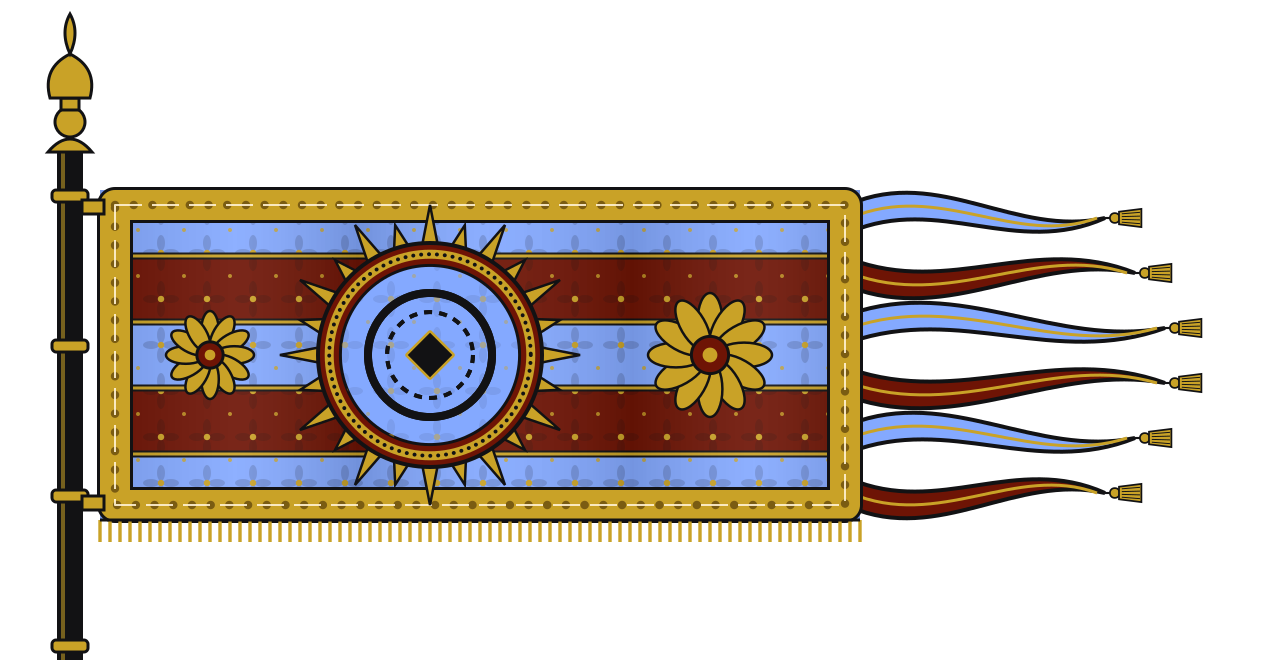
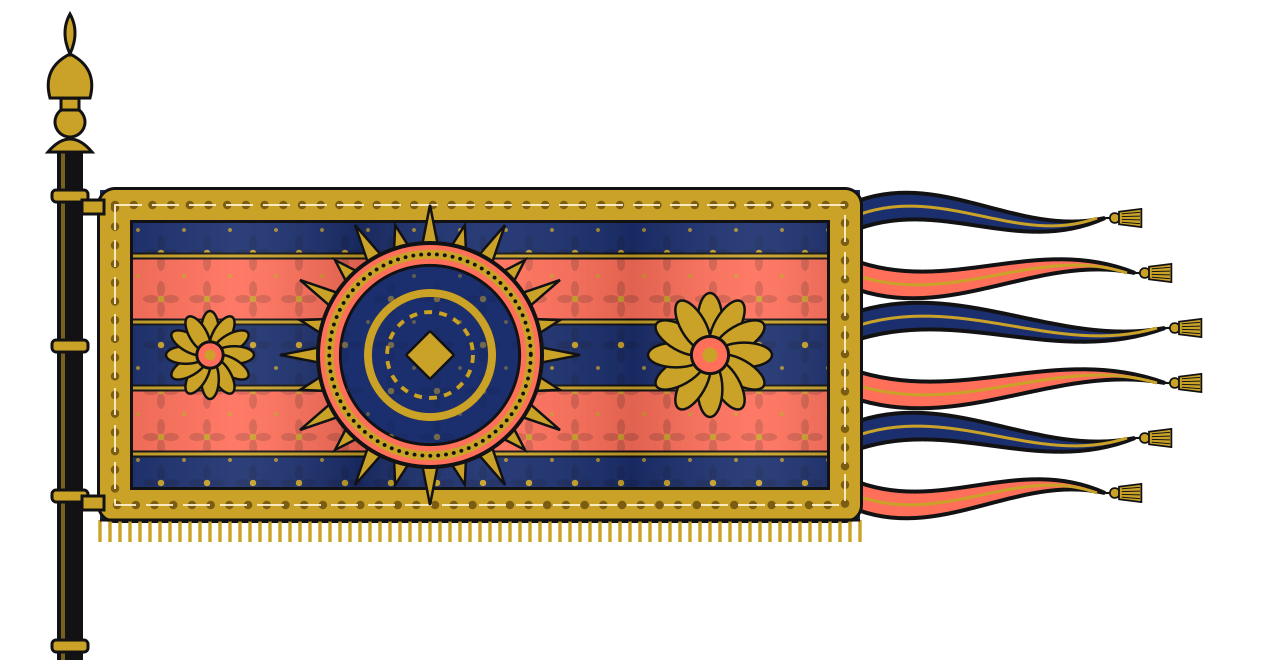
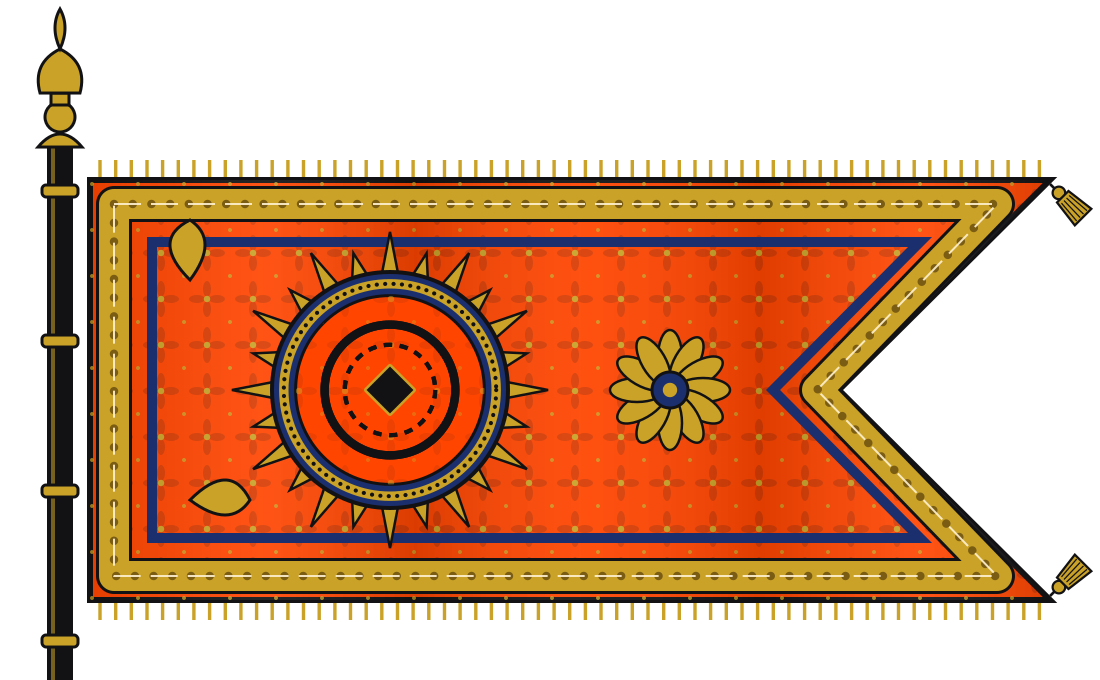
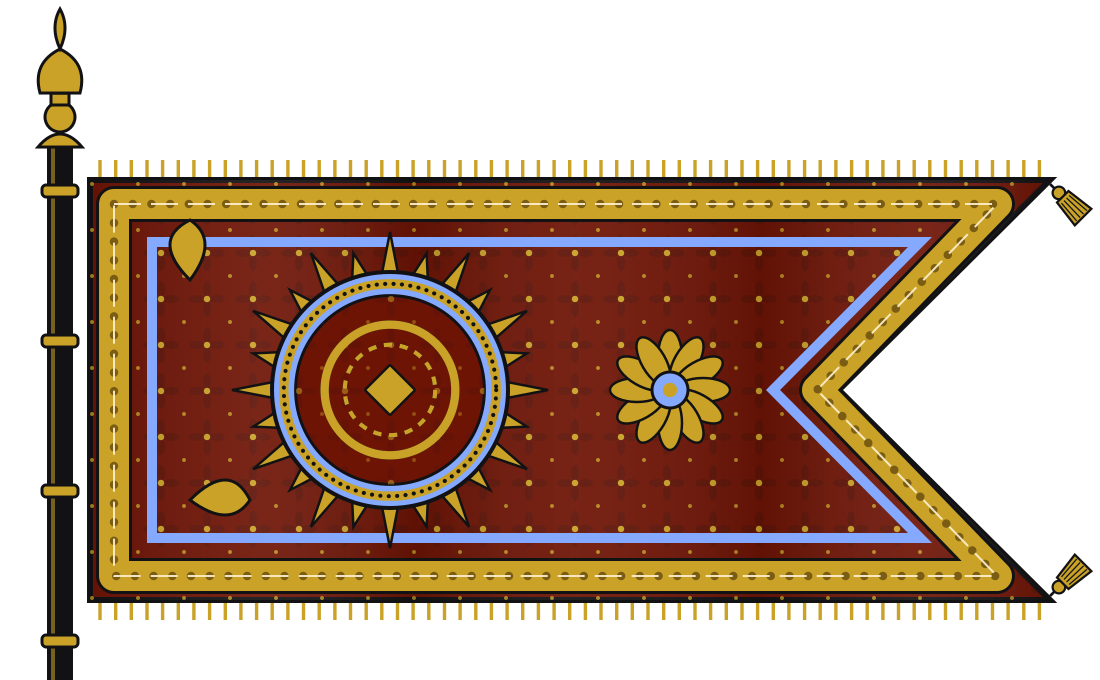
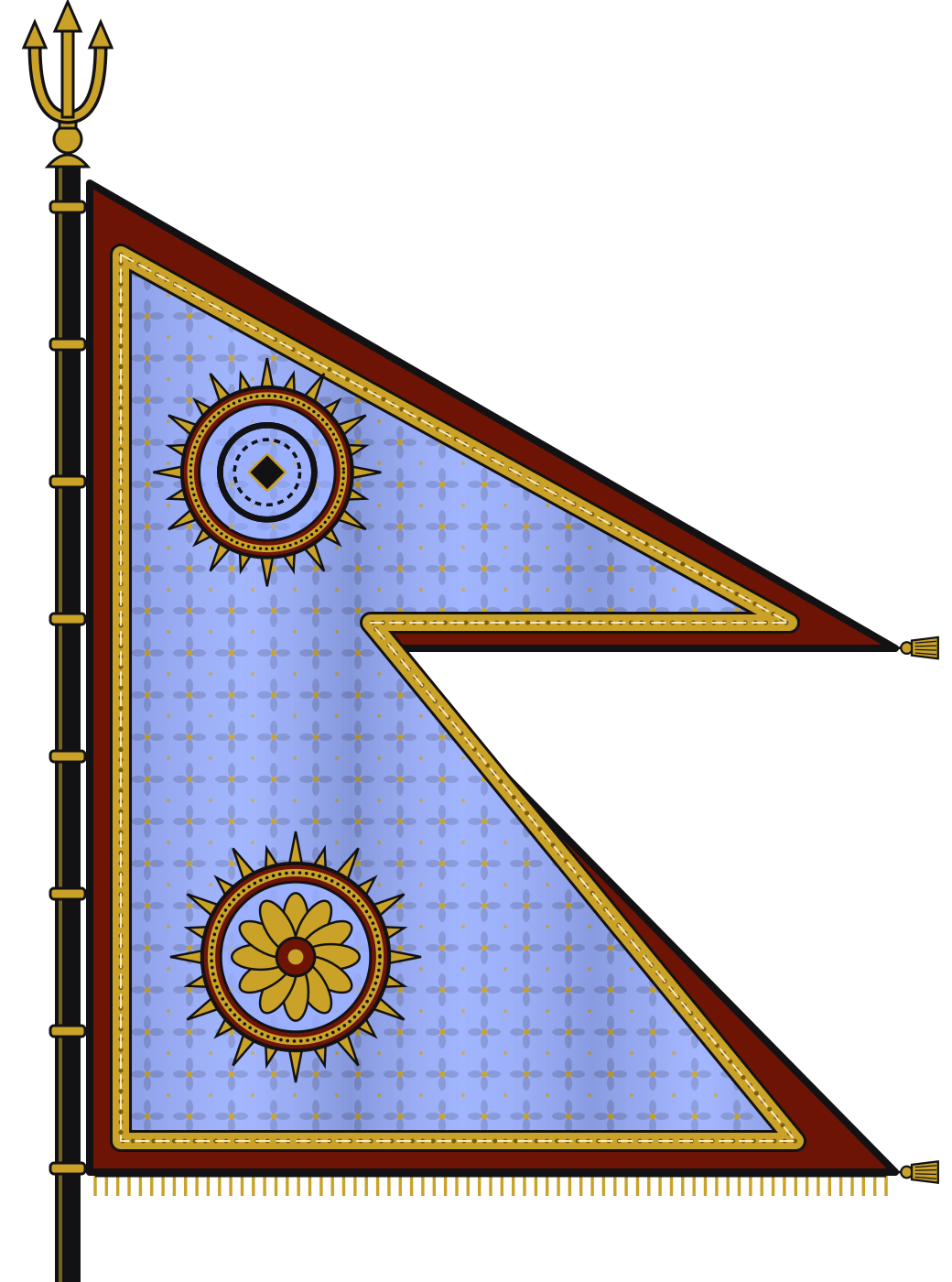
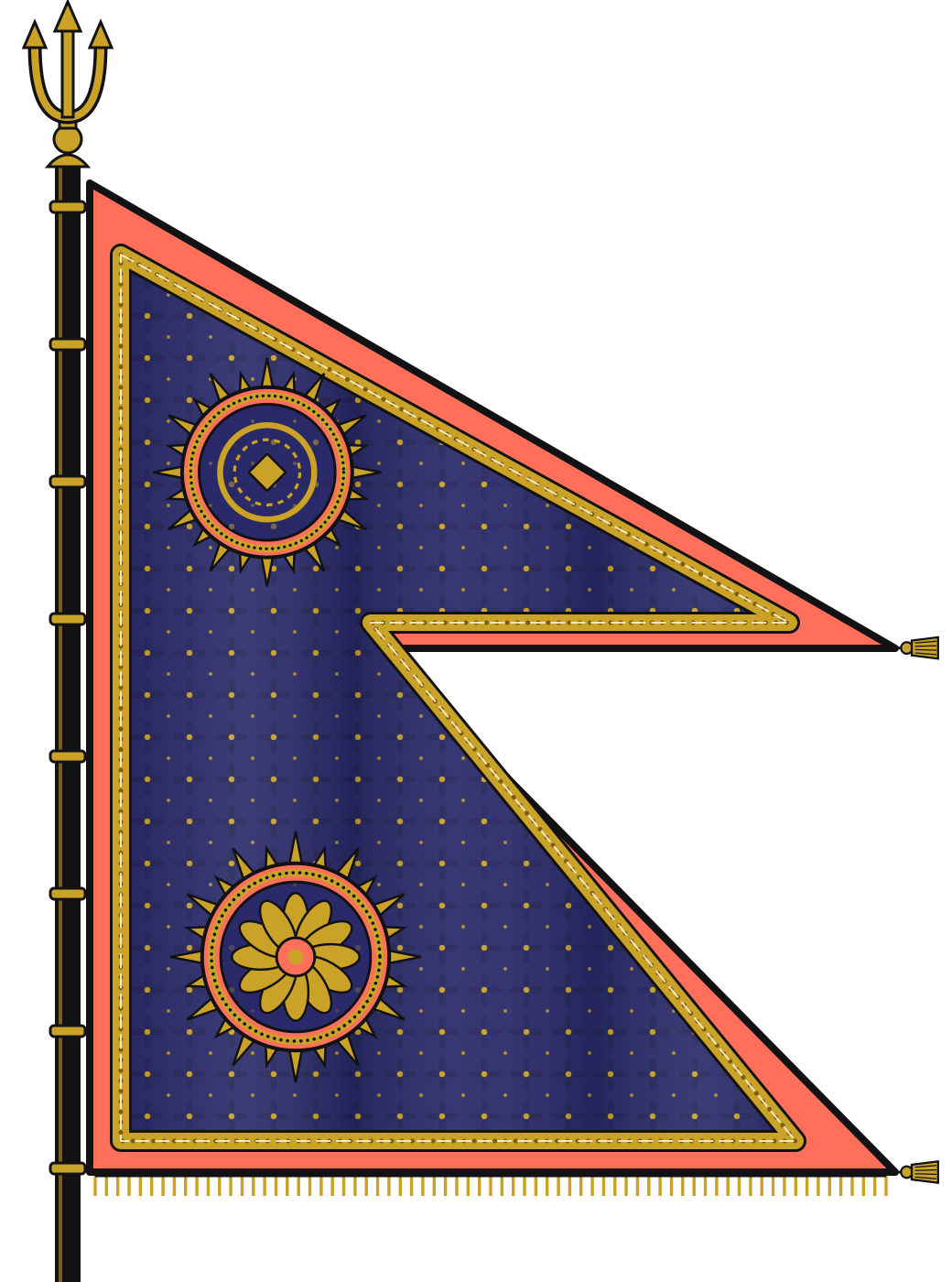

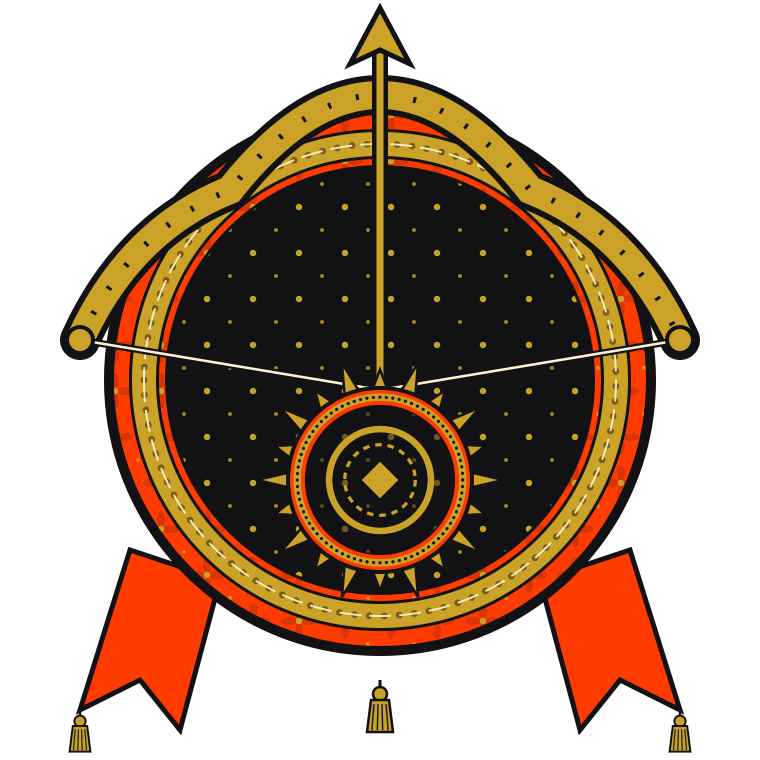
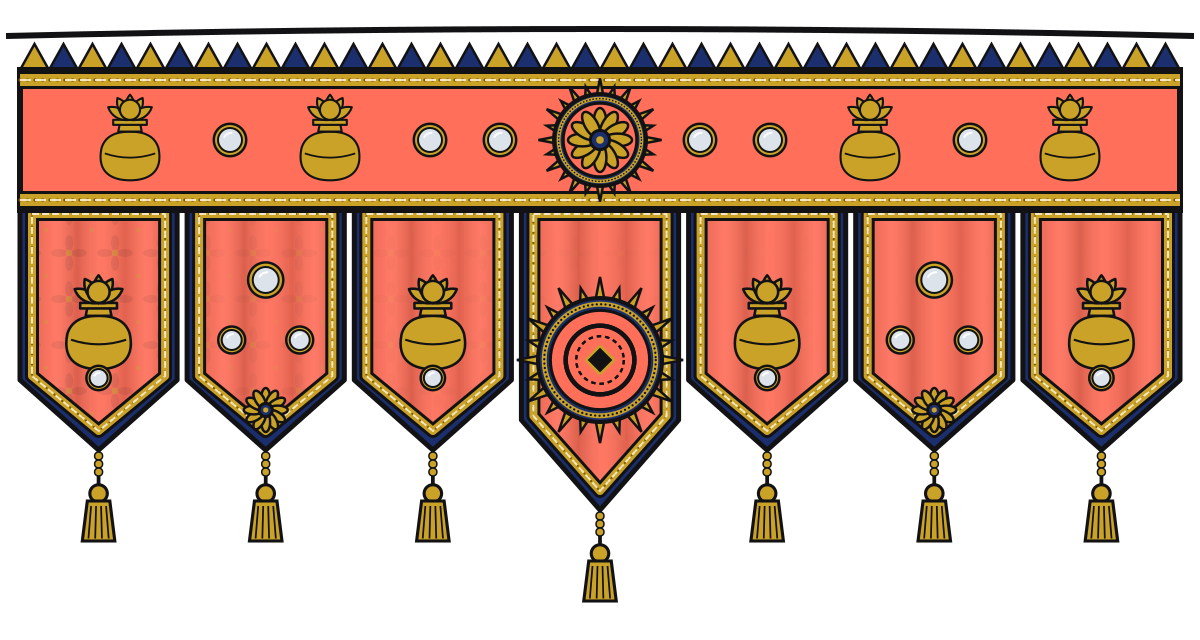

Historic banner
None known
New flag types
| Accessory | For this clan | Basis |
|---|---|---|
| A9 Pota-dhvaja · ship and trade flag For ships, caravans and markets | Not yet designed for this clan | Design |
| A10 Utsava-patāka · festival flag Light, bright flag for fairs and festivals | Not yet designed for this clan | Design |
| A11 Shoka-dhvaja · mourning flag White cloth with the emblem outline in the clan's metal | Not yet designed for this clan | Design |
7. Regalia
| Accessory | For this clan | Basis |
|---|---|---|
| E1 Chhatra · house parasol The ceremonial umbrella | Not yet designed for this clan | Design |
| E2 Chamara · fly-whisks The pair of whisks beside the head of the house | Not yet designed for this clan | Design |
| E3 Danda · staff of office Staff or scepter | Not yet designed for this clan | Design |
| E4 Simhasana · seat The seat of the house, covered in clan cloth | Not yet designed for this clan | Design |
| E5 Khetaka · shield A round shield; the Changi and Dhanush are its flag forms | Not yet designed for this clan | Regional tradition |
| E6 Kula-ayudha · clan weapon The weapon the clan honours | Not yet found for this clan | Under research |
8. Worn
| Accessory | For this clan | Basis |
|---|---|---|
| F1 Kula-vastra · clan cloth The clan's woven pattern in its kit colours | Not yet designed for this clan | Design |
| F2 Kirti-vastra · honour cloth A cloth earned for a deed, not inherited | Not yet designed for this clan | Design |
| F3 Kula-mala · garland flower The flower or leaf the clan wears as a garland | Not yet found for this clan | Under research |
| F4 Chinha · house pin A metal badge with the pin emblem | Not yet designed for this clan | Design |
9. Records
| Accessory | For this clan | Basis |
|---|---|---|
| H1 Clan words A traditional line in the native script | · “” Under research: the extracts give no line of the Khairwar's own, and no classical line is tied to the clan in them. Leads: Crooke's Tribes and Castes of the North-Western Provinces (archive.org, public domain) for sayings and customs; the Hindi Tribal Research Institute page (fetch failed in this run). | Documented |
| H2 Biruda · titles The house's title or titles | Not yet found for this clan | Under research |
| H3 Prashasti · praise genealogy The lineage as written at the head of a grant | Not yet found for this clan | Under research |
| H4 Vahi · clan register The book of the clan's births, marriages and deaths | Not yet found for this clan | Under research |
| H5 Rana-ghosha · war cry The clan's cry in battle or celebration | Not yet found for this clan | Under research |
10. VishwaVit · knower of the world
Game values are design choices for this project, not historical claims.
References
- R. V. Russell and Hira Lal, The Tribes and Castes of the Central Provinces of India, vol. 3 (London, 1916), entry Khairwar, Project Gutenberg eBook #41424, https://www.gutenberg.org/ebooks/41424
- Wikipedia, Tribals in Madhya Pradesh, read 2026-10-19, https://en.wikipedia.org/wiki/Tribals_in_Madhya_Pradesh
- Joshua Project, Khairwar in India (PeopleID3 17157), read 2026-11-04, https://joshuaproject.net/people_groups/17157/IN
- Culture & Heritage, Surguja district, Government of Chhattisgarh (read 10 Oct 2026, KulDevi run 49).
- Ambikapur, Chhattisgarh, Wikipedia (read 10 Oct 2026, KulDevi run 49).
- PeopleGroups.org (IMB), The Khairwar (Chhattisgarhi) of India, read 2026-11-04, https://peoplegroups.org/people_groups/pg048295
- Wikipedia, Khirwar language, read 2026-11-04, https://en.wikipedia.org/wiki/Khirwar_language
- R. V. Russell and Hira Lal, The Tribes and Castes of the Central Provinces of India, vol. 1 (London, 1916), Project Gutenberg eBook #20583, https://www.gutenberg.org/ebooks/20583
- Wikipedia, Khairaha, read 2026-10-24, https://en.wikipedia.org/wiki/Khairaha
- Wikipedia, Surguja State, read 2026-10-27, https://en.wikipedia.org/wiki/Surguja_State
- Wikipedia, List of Scheduled Tribes in Uttar Pradesh, read 2026-10-22, https://en.wikipedia.org/wiki/List_of_Scheduled_Tribes_in_Uttar_Pradesh
- dhammabharat.com, List of Scheduled Tribes in Maharashtra and Population of each Tribe (2011 Census), read 2026-10-10, https://dhammabharat.com/?p=13656