The Kawar (Kanwar, Kaur; कंवर) are a Scheduled Tribe listed in Bihar, Chhattisgarh, Jharkhand, Madhya Pradesh, Maharashtra and Odisha (list dated 09-07-2024, Atlas)[1]. Their tradition says they descend from a Kaurava of the Mahabharata; Russell and Hira Lal call this a myth based on the similarity of names, and Trivedi (1971) reads the name as a corruption of Kaurava for soldiers of the Haihaiyavanshi chiefs of Ratanpur[2][1]. Russell (1916) records eight endogamous divisions and about 117 totemic septs, and the 2011 census infobox gives a total of about 947,000, most in Chhattisgarh[2][3]. Military service was their traditional occupation, and most now farm or labour[2][4]. No temple built or patronised by the Kawar is recorded in the extracts; the sheet's KulDevi, Mahamaya, is a project label.
01Faith and deities
Russell (1916) calls Jhagra Khand, the 'Sword of Strife', the principal tribal deity; the sheet's KulDevi is Mahamaya[2]
Mahamaya of Ratanpur, goddess of Chhattisgarh
The presiding goddess of the clan's homeland or capital: a link of place, not a recorded clan tie.
| Deity or tradition | Place in the clan's life | Evidence |
|---|---|---|
| Bhagwan | Supreme deity, identified with the sun (Russell 1916); religion recorded as animistic | [2] |
| Jhagra Khand | Two-edged sword worshipped by the Paikara on Dasahra | [2] |
| Bagharra Deo | Tiger deity who protects cattle | [2] |
| Mandwa Rani | Goddess of Mandwa hill in the Korba zamindari; guides lost wayfarers | [2] |
| Sat Bahini | The seven sisters, goddesses of rivers | [2] |
| Purainha | Godling of lotus tanks | [2] |
| Shesk Kund snake | A mythical red-crested snake said to live in pools | [2] |
| Thakur Deo | Deity of agriculture; the whole village worships him at the start of the rains (Russell 1916) | [2] |
| Dulha Deo, Bahan Deo, Shikar Deo | Deities named by TRI and Wikipedia | [1][3] |
| Sagai Devi, Matin Devi, Banjari Devi | Goddesses named by Wikipedia (Pfeffer and Behera 1997) | [3] |
| Deities of sword, gun, axe and spear | Worshipped as deities (Russell 1916) | [2] |
| Kauraini Sati | A grove between Partabpur and Jhilmili, with a fowl yearly and a black goat every third year; Dalton, quoted by Russell, says the Kawars of Sarguja encouraged widows to become Satis | [2] |
| Breaking the string | After a tiger's death, a Baiga is painted as a tiger in this ceremony (Russell 1916) | [2] |
| Household spirits | Kawars of the wilder tracts believe household objects are inhabited by spirits (Nelson 1910, p.89) | [5] |
| Breaking the string (tiger kill) | After a tiger kill, the rite severs the tiger's link with the victim's family (Nelson 1910, pp.88-89) | [5] |
02Temples
No temple built or patronised by the Kawar is recorded in the extracts. KulDevi Mahamaya of Ratanpur is the Atlas's label; no extract ties the Kawar to the Mahamaya temple. Wikipedia calls Mahamaya the kuldevi of the Ratanpur state, the Haihaiyavansi kingdom[6].
Built by the clan
Not recorded.
Given patronage or grants by the clan
Not recorded.
03Languages and scripts
| Language or script | Kind | Under the clan | Evidence |
|---|---|---|---|
| Chhattisgarhi छत्तीसगढ़ी living | Speech | Main language today (TRI, Wikipedia) | [1][3] |
| Sadri सदरी living | Speech | Also spoken (TRI, Wikipedia) | [1] |
| Own language lost | Speech | Lost by 1916; they spoke a corrupt Chhattisgarhi (Russell) | [2] |
| Chhattisgarhi, a corrupt form | Speech | Nelson (1910, p.89): the Kawars have no language of their own and speak a corrupt Chhattisgarhi, "almost indistinguishable from" that of the Gonds (as printed) | [5] |
04Books and literature
Works that describe the Kawar, as cited in the extracts. No Kawar-written book is sourced.
Written during the clan's history
| Work | Author | Kind | When | Link to the clan |
|---|---|---|---|---|
| The Tribes and Castes of the Central Provinces of India, vol. 3 | R. V. Russell and Hira Lal | Ethnography | 1916 | [2] |
| Contemporary Society: Tribal Studies, vol. 7 | Pfeffer and Behera | Study | 1997 | [3] |
| Tribal Roots of Hinduism | Shiv Kumar Tiwari | Book | 2002 | [3] |
Given patronage by the clan
Not recorded.
05Thinkers and scholars
| Name | Field | Era | Contribution |
|---|---|---|---|
| R. V. Russell and Hira Lal | Ethnography | 1916 | Recorded the divisions, septs and rites; called the descent a myth from name similarity[2] |
| Trivedi | Not stated in the extracts | 1971 | Read Kawar as a corruption of Kaurava, soldiers of the Haihaiyavanshi chiefs of Ratanpur[1] |
| Hewitt | Not stated in the extracts | 1869 | Called them imperfect Rajputs of the Vindhya hills[3] |
Full citations for Trivedi and Hewitt are not in the library; they are cited through TRI and Wikipedia.
06Art and architecture
No painting, sculpture or architecture by the Kawar is recorded in the extracts. Under research.
Painting and wall art
Not recorded.
Sculpture and temple art
Not recorded.
Temple and building architecture
Not recorded.
Weaving and textiles
Not recorded.
Clothing and jewellery
Not recorded.
Coins, pottery and crafts
| Art form | What it is | Era | Evidence |
|---|---|---|---|
| Rope and cots | Rathia and Routia make rope and sleeping cots (OSTM) | [4] |
07History
Kaurava descent: tradition and its critics
The Kawar say they descend from the Kauravas defeated at Hastinapur. In Russell's version, two pregnant women survived and fled to the hills, where a Rawat and a Dhobi sheltered them, and their children became the Kawar[2]. Russell and Hira Lal call the descent a myth based on the similarity of the names[2].
Trivedi (1971) reads the name as a corruption of Kaurava, for trusted soldiers of the Haihaiyavanshi chiefs of Ratanpur; Hewitt (1869) called them imperfect Rajputs who settled the Vindhya hills and did not become Hindu[1][3]. These are outside views; the descent is a claimed community tradition.
Soldiers, foot-soldiers and zamindars (to 1916)
The Paikara division (paik, foot-soldier) served the Haihaivansi Rajas of Ratanpur[2]. Military service was the traditional occupation[2][4].
In 1916 eight Bilaspur zamindars were Kawars, and Kawar country was recorded in the northern zamindari estates of Bilaspur and the feudatory states of Jashpur, Udaipur, Sarguja, Chang Bhakar and Korea[2].
Bilaspur zamindars and the Tanwar group (as recorded in 1916)
In Russell and Hira Lal's 1916 account, eight Bilaspur zamindars are Kawars[2]. The first volume speaks of "the Tawar subtribe of the Kawar tribe of Bilaspur, to which all the zamindars belong", who "now claim to be Tomara Rajputs, on the basis of the similarity of the name"[7]. The third volume gives the zamindars' group as the Tanwar (also Umrao) division: it claims Tomara Rajput origin, wears the sacred thread and forbids widow remarriage, and "the name Tanwar is not improbably simply a corruption of Kawar"[2].
The zamindars also set a marriage rule. No family counted as Tanwar for marriage without a certificate signed by the zamindar; some zamindars charged considerable sums, and families who could not pay often could not marry off their daughters[2]. No subcaste ate together except at the houses of its zamindars, from whom all took food[2]. The Kawars of the Chhuri estate stopped attending their zamindar's feasts after he, offended that a village thekadar had kept a dead buffalo's hide, said "Here come our Chamars" at a marriage feast with the Pendra zamindar and others present; they then took food from no zamindar[2].
Bilaspur zamindars in 1910 (Nelson)
Nelson's Bilaspur gazetteer (1910) says the proprietors of eight of the ten zamindari estates belong to the Tawar subcaste of the Kawar tribe. All the zamindars except those of Pandaria and Kanteli belong to it, and the Pandaria and Kanteli zamindars are Raj-Gonds[5]. The zamindars are not named on these pages.
The zamindars "call themselves Tawar instead of Kawar", claim descent from Tuar Rajputs and wear the sacred thread, but Brahmans do not take water from them[5].
The Kawar name and the Haihaya era (Nelson)
Nelson (1910, p.86) says the name is derived from fighting for the Kauravas, and calls the Kawars "a fairly important tribe residing in the hilly tracts to the north and east"[5].
In the Haihaya era, Nelson says (p.47), local leaders of the Gonds, Kawars and Binjhwars held "an important share of the forest country", and were later partly admitted to the Kshatriya caste[5]. Nelson also says the ancestors of the Chhuri and Pandaria zamindars took estates from the Gond chief Dama Dhurwa and from the former Lodhi rulers of Kamthi (p.47)[5].
Sarguja and the Kaurs (Dalton and Ball, quoted by Russell)
Dalton, whose Descriptive Ethnology of Bengal was printed in 1872[8], wrote: "I found that the Kawars of Sarguja encouraged widows to become Satis and greatly venerated those who did so." Between Partabpur and Jhilmili in Sarguja he camped in a grove sacred to a Kauraini Sati, where a fowl was sacrificed yearly and a black goat every third year[2]. The words are Russell's quotation; Dalton's full text was not read.
Ball, also quoted by Russell, saw a dance by villagers he believed were Kaurs: men performing "a kind of ladies' chain" and striking pronged sticks together to a tom-tom[2].
The states named (context; their rulers are not called Kawar)
In 1905 Korea, Surguja, Udaipur, Jashpur and Chang Bhakar were among the Chhattisgarh feudatory states, under a political agent, as the IRFCA page records from de Brett's 1906 gazetteer[9]. Korea paid tribute to the Marathas from 1790; the Bhonsle Raja of Nagpur ceded it to the British in 1818, and a British protectorate followed on 24 December 1819[10]. Changbhakar was carved out of Korea as a zamindari in 1790[11]. Surguja was under a British protectorate from 1818, and its rulers claimed Lunar-race Rajput descent from a Raksel Raja of Palamau[12].
None of these pages mentions the Kawars, and none of the rulers they name is called Kawar here. Korea's rulers are Chauhan Rajputs in the Wikipedia account[10].
08Journey and migrations
Only one move is recorded in the extracts.
| When | From | To | Why | Evidence |
|---|---|---|---|---|
| Not dated (OSTM tradition) | Chainpur, near Ranchi | Not stated in the extract | Not stated | [4] |
09Seats and lands
| Place | Role | Where today |
|---|---|---|
| Chhattisgarh hills north of the Mahanadi, sometimes called Kamran | Homeland of the tribe; the Kawar are a primitive tribe of these hills in 1916 | Chhattisgarh, except Bastar division[1][2] |
| Ratanpur | Seat of the Haihaiyavanshi rulers the Kawar are said to have served[1] | Ratanpur, Bilaspur district, Chhattisgarh[6] |
| Bilaspur, Jashpur, Udaipur, Sarguja, Chang Bhakar, Korea | Zamindari and feudatory estates where Kawars lived in 1916 | Not stated in the extract[2] |
| Mandwa hill, Korba zamindari | Hill of the goddess Mandwa Rani (Russell) | Not stated in the extract[2] |
| Bangawan | Tract of the wilder Kawars (Russell) | Not stated in the extract[2] |
| Gondiya and Gadchiroli | Places where Kawars live, per TRI | Maharashtra[1] |
| Shahdol | Place where Kawars live, per TRI and Wikipedia | Madhya Pradesh[1][3] |
| Sundergarh, Jharsuguda, Nuapara | Odisha districts (KISS handbook, OSTM) | Odisha[13][4] |
| Bilaspur zamindari estates (1910) | Ten estates in all: Pendra, Matin and Uprora are the most northern; south of them Kenda, Lapha, Chhuri and Korba; Pandaria adjoins Mungeli tahsil; Madanpur-Kanteli and Champa lie in open country. The Lormi reserve is Government forest, not a zamindari. The names of the Kawar zamindars are not given in this text | Bilaspur district, Nelson's gazetteer (1910)[14] |
| Matin and Uprora | Matin had 22 persons to the square mile and Uprora 14 | Bilaspur district, 1910 gazetteer[14] |
| Pandaria; Madanpur-Kanteli | Zamindari estates whose zamindars are Raj-Gonds, not Kawars (Nelson 1910, pp.83, 86) | Bilaspur district[5] |
| Hilly tracts to the north and east | Nelson calls the Kawars "a fairly important tribe residing in the hilly tracts to the north and east" (1910, p.86) | Nelson's Bilaspur gazetteer, 1910, p.86[5] |
| Zamindari seats named by Nelson | Pendra, Korba, Pandaria, Lapha (Pondi), Matin, Kenda, Uprora, Champa and Chhuri. No holders are named on these pages (Nelson 1910, pp.23, 32, 41, 61) | Bilaspur district[5] |
| Charratnagar (north Raigarh State) | The important family in the village is that of the gaontia, who is of the Kawar caste | Raigarh State[15] |
| Upkachna (Sakti State) | The chief caste inhabiting the village is the Kawar | Sakti State[15] |
10Notable figures
| Name | Role | Era | Known from |
|---|---|---|---|
| Kolin Sati | Deified woman, a Kol concubine of the Pendra zamindar, worshipped by the Kawar | Not dated | [2] |
| Sarangarhni | Deified woman, a Ghasia woman, worshipped by the Kawar | Not dated | [2] |
11Allies, rivals and marriages
| People | Relationship | When |
|---|---|---|
| Rawat (Kauria subcaste) | Kawar take food from Rawats; a Rawat shelters the legend's survivors | Legend; 1916 |
| Dhobi (washerman) | Shelters the legend's survivors; readmits an outcasted Kawar | Legend; 1916 |
| Gond | Kawar eat food taken from Gonds and resemble them; Gond panchayat compared with theirs | 1916 |
| Kol (Raigarh Kol list) | Kawar septs are listed among the Raigarh Kol septs | 1916 |
| Ahir, Bhatra, Gadaria | Ahir and Bhatra share the Baghwa (tiger) sept with the Kawar; Gadaria shares the Bhanwar (bee) section | 1916 |
| Chero of Chota Nagpur | Cherwa division probably a cross of Kawar and Chero | 1916 |
| Rawat (Rautia division) | Rautia division probably a cross of Kawar and Rawat | 1916 |
| Haihaiyavanshi rulers of Ratanpur | The Kawar were their soldiers, per Trivedi (1971) | 1971 |
| Kurus (Kauravas), ANC-069 | Claimed ancestors in the community tradition | Legend |
| Raj-Gond | Hold the Pandaria and Kanteli zamindari estates, which are not Kawar (Nelson 1910, p.83) | 1910 |
| Bhaina | At ceremonial feasts the Kawars must feed a Bhaina first (Nelson 1910, p.91) | 1910 |
| Dhanwar | Dhanwars admit Kawar women and take cooked food from them (Nelson 1910, p.90) | 1910 |
| Ahir, Rawat, Kurmi | Named with the Kawars among the "fairly strong castes" of Bilaspur (Nelson 1910, p.83) | 1910 |
12Society and livelihood
Patrilineal, patriarchal and patrilocal, with landowning cultivators[3]. Russell (1916) records the village council and the customs below.
Government and social order
| Institution or group | What it was | Evidence |
|---|---|---|
| Village-cluster council | A council of several villages with an elected head and elders[3]; the panchayat head is called Pardhan[2] | [2] |
| Outcasting | Outcasting is recorded (Russell 1916) | [2] |
| Marriage | The boy's father proposes through a pej (boiled rice-water) invitation; betrothal gifts of bangles, clothes and cakes; suk bride-price (cash, rice, pulses and oil, about Rs 25 in 1916) plus goats; no Brahmans; the couple circle a sacred pole six times one day and once the next; the bride's parents wash the couple's feet in milk and drink it; the groom shoots arrows at seven straw deer[2][1] | [2] |
| Exchange and service marriages | Gunrawat is an exchange of girls; Gharjian is service for a wife (Russell 1916) | [2] |
| Childbirth | The umbilical cord is buried at the council place for eloquence, in the market for trade, or at a shrine for piety; a boy after three girls is a titura, a girl after three boys a tituri | [2] |
| Death and mourning | The dead are buried head north, face east; til, cotton, urad and rice are thrown as seed-grain; mourning lasts ten days for a man, nine for a woman and three for a child; smallpox dead are not burnt | [2] |
| Auspicious days | Tuesday is best for weddings, Thursday and Monday for field-work, Saturday for worshipping the gods (Russell 1916) | [2] |
| Witchcraft and cures | Tonhi (witch) beliefs; a Baiga medicine-man is consulted (Russell 1916) | [2] |
| Exchange marriage and widow remarriage | Exchange marriage and widow remarriage are allowed, except in the zamindars' subcaste (Nelson 1910, p.88) | [5] |
| Bride-price | Averages Rs. 25 (Nelson 1910, p.87) | [5] |
| Totemic septs | The septs are totemistic (Nelson 1910, p.87) | [5] |
| Death by cholera | Cholera victims are buried, and then sometimes burnt; the dead are generally buried (Nelson 1910, p.88) | [5] |
| Theft | Said to be almost unknown (Nelson 1910, p.89) | [5] |
Livelihood over time
| Era | Livelihood | Evidence |
|---|---|---|
| 1916 (Russell) | Military service was the traditional occupation; the bulk were cultivators and labourers; many were village farmers in the zamindaris | [2] |
| Today (TRI, OSTM) | Landowning cultivators and agricultural labour (TRI); the Routia or Rathia make rope and sleeping cots and collect forest produce (OSTM) | [1][4] |
| 1909 gazetteer (Feudatory States) | Gurda (Raigarh State zamindari, 12 villages): the zamindar is a Kanwar by caste and pays a takoli of Rs. 4654 to the State | [15] |
| 1909 gazetteer (Feudatory States) | Bandarchua (Jashpur State ilakadari, eight villages): the ilakadar is a Kawar by caste, with the local title Saidai, and pays a takoli of Rs. 251 yearly | [15] |
| 1910 (Nelson) | Only the Rautia weave twine and rope and make cots (p.89) | [5] |
13Sub-clans and related clans
Russell (1916) names eight endogamous divisions and about 117 totemic septs. Every division and sept the extracts name is listed below, with the native form where TRI's Hindi page gives it. Names with no English form in the extracts are given in Devanagari only. Nelson (1910, pp.86-87) lists eight divisions: Kamalbansi is the oldest division, Chanti the lowest, and the zamindars' division is "known as Tanwar or Umrao"[5].
| Clan | Relation | Where | Size | In the Atlas | Evidence |
|---|---|---|---|---|---|
| Tanwar तंवर | Sub-clan | Zamindars' group, also called Umrao; claims Tomara Rajput origin, wears the sacred thread and forbids widow remarriage (Russell 1916) | same name as ST-501: check | [2] | |
| Kamalbansi कमलबंसी | Sub-clan | 'Stock of the Lotus' (Russell 1916) | same name as ST-466: check | [2] | |
| Paikara पैकरा | Sub-clan | About three-fifths of the tribe; from paik, foot-soldier; served the Haihaivansi Rajas of Ratanpur (Russell 1916) | same name as ST-516: check | [2] | |
| Dodh-Kawar | Sub-clan | Ranks with Kamalbansi and Paikara above Rathia, Chanti, Cherwa and Rautia (Nelson 1910, p.86). | new clan candidate | [5] | |
| Dudh Kanwar दूध कंवर | Sub-clan | 'Cream of the Kawars' (Dalton, quoted by Russell 1916) | same name as ST-465: check | [2] | |
| Rathia राठिया | Sub-clan | Immigrants from Rath, a tract of Raigarh State (Russell 1916); Routia or Rathia sub-group (OSTM) | same name as ST-485: check | [2][4][16] | |
| Chanti चंटी | Sub-clan | From 'ant'; the lowest division (Russell 1916) | same name as ST-460: check | [2] | |
| Cherwa चेरवा | Sub-clan | Probably Kawar and Chero of Chota Nagpur (Russell 1916) | same name as ST-461: check | [2][16] | |
| Rautia रौतिया | Sub-clan | Probably Kawar and Rawat; weave ropes and cots; counted as Kol at the census (Russell 1916); Routia (OSTM) | same name as ST-488: check | [2][4] | |
| Dhangur (Dhananjaya) धनगुरु | Sub-clan | Tanwar sept renamed Dhananjaya after a Brahmanical gotra (Russell 1916) | new clan candidate | [2] | |
| Sarvaria (Sandilya) | Sub-clan | Tanwar sept renamed Sandilya after a Brahmanical gotra (Russell 1916) | new clan candidate | [2] | |
| Telasi (Kairava) | Sub-clan | Four zamindars, renamed Kairava after a Brahmanical gotra; Telasi is also an 'oily' sept (Russell 1916) | new clan candidate | [2] | |
| Andil | Sub-clan | Born from an egg (Russell 1916) | new clan candidate | [2] | |
| Bagh (Baghwa) बाघवा | Sub-clan | Tiger; spelt Baghwa by TRI; shared with Ahir and Bhatra (Russell 1916) | new clan candidate | [2] | |
| Bagh-Daharia डहरिया | Sub-clan | Double name in Russell 1916; TRI lists डहरिया | new clan candidate | [2] | |
| Bichhi बिच्छी | Sub-clan | Scorpion (Russell 1916; TRI) | new clan candidate | [2] | |
| Bilwa बिलवा | Sub-clan | Wild cat (Russell 1916; TRI) | new clan candidate | [2] | |
| Bokra बोकार | Sub-clan | Goat (Russell 1916); Bokar (TRI) | new clan candidate | [2] | |
| Chandrama चंद्रमा | Sub-clan | Moon (Russell 1916) | new clan candidate | [2] | |
| Chanwar चंवर | Sub-clan | Whisk (Russell 1916) | new clan candidate | [2] | |
| Chita चिता | Sub-clan | Leopard (Russell 1916; TRI) | new clan candidate | [2] | |
| Chuva चुआ | Sub-clan | Well (Russell 1916) | new clan candidate | [2] | |
| Champa चंपा | Sub-clan | Sweet-scented flower (Russell 1916) | new clan candidate | [2] | |
| Dhenki ढेंकी | Sub-clan | Pounding-lever (Russell 1916) | new clan candidate | [2] | |
| Darpan दर्पण | Sub-clan | Mirror (Russell 1916) | new clan candidate | [2] | |
| Gauriya-Sonwani | Sub-clan | Double name in Russell 1916 | new clan candidate | [2] | |
| Gobira गोबरा | Sub-clan | Dung insect (Russell 1916); dung beetle (Wikipedia, as Gobra) | new clan candidate | [2][3] | |
| Hundar हुदरा | Sub-clan | Wolf (Russell 1916) | same name as ST-530: check | [2] | |
| Janta | Sub-clan | Grinding-mill (Russell 1916) | new clan candidate | [2] | |
| Kothi कोठी | Sub-clan | Store-house (Russell 1916) | new clan candidate | [2] | |
| Khumari खुमरी | Sub-clan | Leaf-umbrella (Russell 1916) | new clan candidate | [2] | |
| Lodha लोढ़ा | Sub-clan | Wild dog (Russell 1916) | same name as ST-177: check | [2] | |
| Mama | Sub-clan | Maternal uncle (Russell 1916) | new clan candidate | [2] | |
| Mahadeo | Sub-clan | Sept named in Russell 1916 | new clan candidate | [2] | |
| Nunmutaria | Sub-clan | Packet of salt (Russell 1916) | new clan candidate | [2] | |
| Sendur | Sub-clan | Vermilion (Russell 1916) | new clan candidate | [2] | |
| Sua सुआ | Sub-clan | Parrot (Russell 1916; TRI) | new clan candidate | [2] | |
| Thath Murra | Sub-clan | Pressed in a sugarcane press (Russell 1916) | new clan candidate | [2] | |
| Karsayal | Sub-clan | Deer (Russell 1916) | new clan candidate | [2] | |
| Behar | Sub-clan | Cat; a sept of the Kawar (Russell 1916) | new clan candidate | [2] | |
| Bhanwar | Sub-clan | Bee; a section of Gadaria and Kawar (Russell 1916) | new clan candidate | [2] | |
| Bhainsa भैंसा | Sub-clan | Buffalo; a section including Kawar (Russell 1916); भैंसा (TRI) | new clan candidate | [2] | |
| आदिला आदिला | Sub-clan | Listed in Devanagari on TRI's Hindi page; no English gloss in the extracts | same name as ST-568: check | [17] | |
| भंडारी भंडारी | Sub-clan | Listed in Devanagari on TRI's Hindi page; no English gloss in the extracts | new clan candidate | [17] | |
| फुलबंधिया फुलबंधिया | Sub-clan | Listed in Devanagari on TRI's Hindi page; no English gloss in the extracts | new clan candidate | [17] | |
| गोंगा कोचर गोंगा कोचर | Sub-clan | Listed in Devanagari on TRI's Hindi page; no English gloss in the extracts | new clan candidate | [17] | |
| सनवामी सनवामी | Sub-clan | Listed in Devanagari on TRI's Hindi page; no English gloss in the extracts | new clan candidate | [17] | |
| मांझी मांझी | Sub-clan | Listed in Devanagari on TRI's Hindi page; no English gloss in the extracts | new clan candidate | [17] | |
| नहना नहना | Sub-clan | Listed in Devanagari on TRI's Hindi page; no English gloss in the extracts | new clan candidate | [17] | |
| समुंद समुंद | Sub-clan | Listed in Devanagari on TRI's Hindi page; no English gloss in the extracts | new clan candidate | [17] | |
| कोडिया दूध कोडिया दूध | Sub-clan | Listed in Devanagari on TRI's Hindi page; no English gloss in the extracts | new clan candidate | [17] | |
| सोन पाखर सोन पाखर | Sub-clan | Listed in Devanagari on TRI's Hindi page; no English gloss in the extracts | new clan candidate | [17] | |
| सिकुटा सिकुटा | Sub-clan | Listed in Devanagari on TRI's Hindi page; no English gloss in the extracts | new clan candidate | [17] |
Clans marked "new clan candidate" are not in the Atlas yet.
14Surnames
No Kawar surname is sourced in the extracts.
Not recorded.
15Songs and music
No Kawar song title or lyric is in the extracts.
None recorded yet.
Instruments and styles
| Instrument or style | What it is | Evidence |
|---|---|---|
| Tom-tom | Keeps the time for the Ball dance (Russell 1916) | [2] |
16Poems, lullabies and children's rhymes
None recorded yet.
17Stories, legends and proverbs
Stories and legends
| Story | What happens | Told by | Evidence |
|---|---|---|---|
| Survivors of the Kauravas | Two pregnant women survive the defeat at Hastinapur, flee to the hills, are sheltered by a Rawat and a Dhobi; their children become the Kawar | Kawar tradition, as Russell records it | [2] |
| Mandwa Rani | The goddess guides lost wayfarers; a basket of brinjals turned to stones | Russell's account (1916) | [2] |
Proverbs and sayings
| Saying | Meaning | Evidence |
|---|---|---|
| A titura child either fills the storehouse or empties it (English, Russell) | On a titura child, born after three of the other sex | [2] |
| The Ganda's panchayat always ends in a quarrel; the Gond's panchayat cares only for the feast; and the Kawar's panchayat takes a year to make up its mind (English, Russell) | A comparison of three peoples' councils; the Kawar's is slow to decide | [2] |
| The Kawar's panchayat takes a year to arrive at a decision, but then acts with vigour (English, Nelson 1910) | A proverb on the Kawar council, as Nelson gives it (p.89) | [5] |
| Shall my daughter leap over the wall to find a husband? (English, Nelson 1910) | Given by Nelson as a saying (p.87); no meaning is given | [5] |
18Festivals and fairs
| Festival or fair | When | Where | What happens |
|---|---|---|---|
| Dasahra: worship of Jhagra Khand | Dasahra | Among the Paikara division (Russell) | The Paikara still worship the two-edged sword Jhagra Khand[2] |
| Start of the rains: Thakur Deo rite | Start of the rains | In the village | The whole village worships Thakur Deo; rice is offered and mixed with seed-grain; two bachelors sprinkle water as rain[2] |
| Gauri game | Asarh (month) | Not stated in the extract | Girls sing, men drum, an image of Gauri is shown, men mock possession and beat the girls with grass ropes[2]; in the marriage rites it falls on the fourth day[3] |
19Food, dress and games
Food
| Item | What it is | Evidence |
|---|---|---|
| Flesh, fowl and pork | Eat flesh, fowls and pork; not beef, monkeys or reptiles (Russell 1916) | [2] |
Dress
| Item | What it is | Evidence |
|---|---|---|
| Women's ornaments | Pewter foot ornaments, silver or pewter neck rings and silver ear pendants (Russell 1916) | [2] |
| Tattoos | A figure of Krishna tattooed on the breast and deer on the arms (Russell 1916) | [2] |
Games and martial arts
| Item | What it is | Evidence |
|---|---|---|
| Ball (stick dance) | A dance by men in a ladies' chain, striking pronged sticks, timed by a tom-tom (Russell 1916) | [2] |
Tags: living still practised · revived brought back after a break · lost known only from records · research reported but not yet confirmed from a source. Songs and poems under copyright are listed by title only; restricted or sacred material is noted without its content.
20Status today
A Scheduled Tribe in six states (list dated 09-07-2024, Atlas); the 2011 census gives a total of about 947,000, most in Chhattisgarh[3][1].
Not reviewed by the Kawar community yet.
21For children
Two women and the hill
In the Kawar tradition, the Kauravas were defeated at Hastinapur. Only two women who were going to have babies were left alive. They fled up into the hills. A Rawat and a Dhobi sheltered them. Their children became the Kawar people. Russell records this as Kawar tradition.
22Across the project
| Project | What carries this clan | Status |
|---|---|---|
| Atlas of the Janas | Chhattisgarh hills, Ratanpur, Odisha, Maharashtra and Madhya Pradesh (see Seats and lands) | |
| KulDevi and GrahDevi | KulDevi Mahamaya. GrahDevi forms from the Atlas: Shailaputri, Brahmacharini, Chandraghanta, Kushmanda, Skandamata, Katyayani, Kalaratri, Mahagauri, Siddhidatri | |
| Planet naming | Under research: no planet name is in the extracts | |
| Renaming and waters | Tanwar septs renamed after gotras: Dhangur as Dhananjaya, Sarvaria as Sandilya, Telasi as Kairava (Russell 1916). Sat Bahini (river goddesses) and Purainha (lotus tanks)[2] |
23Open questions
- Surnames: no Kawar surname is sourced; the Kaur honorific and Rajput and Jat uses need a source for any Kawar use.
- Songs, lullabies and proverbs in native script: the Chhattisgarh folklore pages (theindiantribal.com, Sahapedia) are not yet read.
- Current practice of the Jhagra Khand worship and the Thakur Deo rite: not sourced for today.
- Migration from Chainpur near Ranchi: date and destination.
- Dalton, Descriptive Ethnology of Bengal (1872): the full text was not read; his words on the Kaurs of Sarguja are known here only as Russell quotes them.
- Full citations for Trivedi (1971) and Hewitt (1869); both are cited here through TRI and Wikipedia.
- Community review of this page.
- Ho (Odisha) 2011 population conflict: the Wikipedia ST list gives 806,008[20]; the KISS handbook gives 80,608[13]. Neither figure is used until a census table settles it.
- Names of the zamindars of the eight Tawar estates: Nelson 1910 (pp.83-89) and the Russell text read do not name them.
- Dodh-Kawar (Nelson 1910) and Dudh-Kawar (Russell 1916): the same division is likely (count of eight, spelling); not confirmed.
- Brahmans and water (contradiction): Russell 1916 vol. 1 says the Tawar subtribe rank with good agricultural castes, and "Brahmans sometimes take water"[7]; Nelson 1910 (pp.86-87) and Russell 1916 vol. 3 say Brahmans do not take water from the zamindars[5][2]. Both are kept on the page where they are cited; the vol. 1 passage needs a re-read before the water claim is used.
24Astitva
अस्तित्व · being, existence: everything by which the clan is known
The only Kawar accessory the extracts record is the Jhagra Khand sword, worshipped on Dasahra by the Paikara; the totem septs are recorded as totems that are not worshipped[2].
Every clan has every accessory, royal objects included. Each one says how it is known: Documented This clan's own object is recorded. · Regional tradition Recorded for the region or for peoples like this one, not for this clan. · Design Made for this project, with no historical claim. · Under research To be found for this clan from sources. Legends and titles are written in the clan's own script.
1. Seals and coins
| Accessory | For this clan | Basis |
|---|---|---|
| B1 Rajamudra · house seal Round seal with the clan emblem and a short legend in the clan's script | Not yet designed for this clan | Design |
| B2 Anguliya-mudra · signet ring Personal seal ring of the head of the house | Not yet designed for this clan | Design |
| B3 Chhapa · house stamp Ink or block stamp for letters, goods and cloth | Not yet designed for this clan | Design |
| B4 Tamrapatra · charter plate Copper-plate grant on a ring, closed with the house seal | Not yet designed for this clan | Design |
| B5 Shreni-mudra · guild or trade seal Seal for the clan's trade, craft or caravan | Not yet designed for this clan | Design |
| C1 Clan coin Emblem or deity on one side, a legend in the clan's script | Not yet designed for this clan | Design |
| C2 Coin die The die that strikes the coin | Not yet designed for this clan | Design |
2. Living symbols
| Accessory | For this clan | Basis |
|---|---|---|
| I1 Totem trio The tree, bird and animal the clan protects | Tree: not recorded · bird: parrot (Sua sept) · animal: tiger (Baghwa sept) | Documented |
| I2 Kaval-maram · guardian tree The tree that stands at the clan's seat | Not yet found for this clan | Under research |
3. Stone and gate
| Accessory | For this clan | Basis |
|---|---|---|
| G1 Torana · gateway The built gate of the seat; the cloth Toran hangs in it | Not yet designed for this clan | Regional tradition |
| G2 Viragallu · hero stone Carved panel stone for a member who died defending the clan | Not yet designed for this clan | Regional tradition |
| G3 Kula-shila · clan stones Standing and table stones that remember the ancestors | Not yet designed for this clan | Design |
| G4 Jayastambha · victory pillar A pillar raised for a victory | Not yet designed for this clan | Design |
| G5 Sima-shila · boundary stone Marks the clan's land, with a line in the native script | Not yet designed for this clan | Design |
4. Sounds
| Accessory | For this clan | Basis |
|---|---|---|
| D1 Pancha-mahashabda · five great sounds The right to five instruments | Not yet designed for this clan | Design |
| D2 Shankha · clan conch The clan's own named war conch | Not yet designed for this clan | Design |
| D3 Murasu · house drums Three drums: war, charity and justice | Not yet designed for this clan | Design |
5. Kit: colours, metals and emblems
The extracts record one weapon the Kawar honour and their totem septs. No coin, seal, inscription or title is recorded[2].
| Part of the kit | This clan |
|---|---|
| Field | Warm Red-Orange #FF6F59 |
| Accent | Intense Electric Blue #84A9FF |
| Emblem colour | Charcoal Black #121214 |
| Zari metal | Gold |
| Main emblem | A crown with a mace |
| Second image | — |
| Night and day | Every visual accessory has two versions: by night the emblem on the dark field, by day the clan's field colour on cloth woven from its metal. |
6. Flags
Every clan has every flag type; the type says the occasion and the colours say the clan. The outlined card is the flag the Atlas assigns.

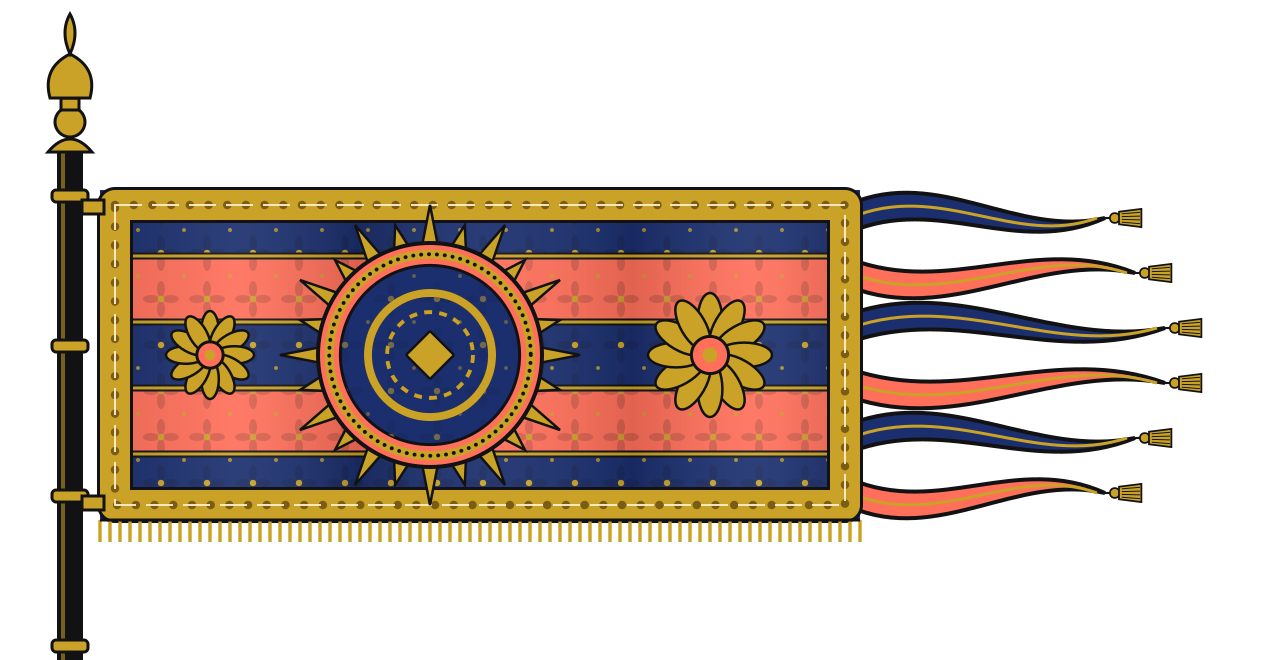
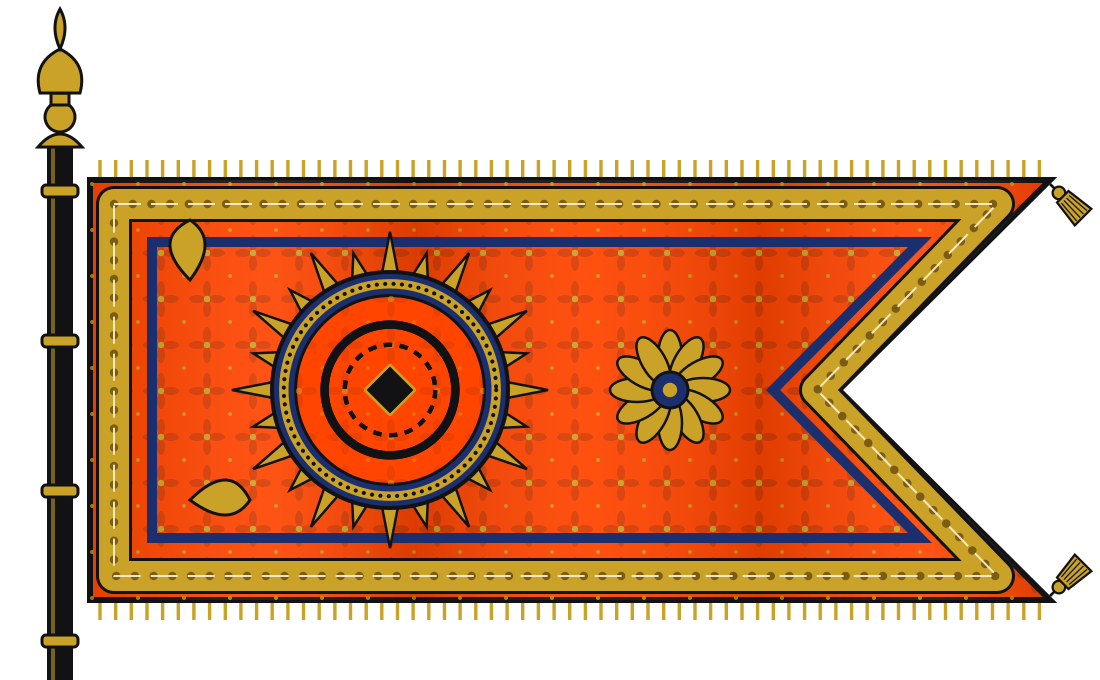


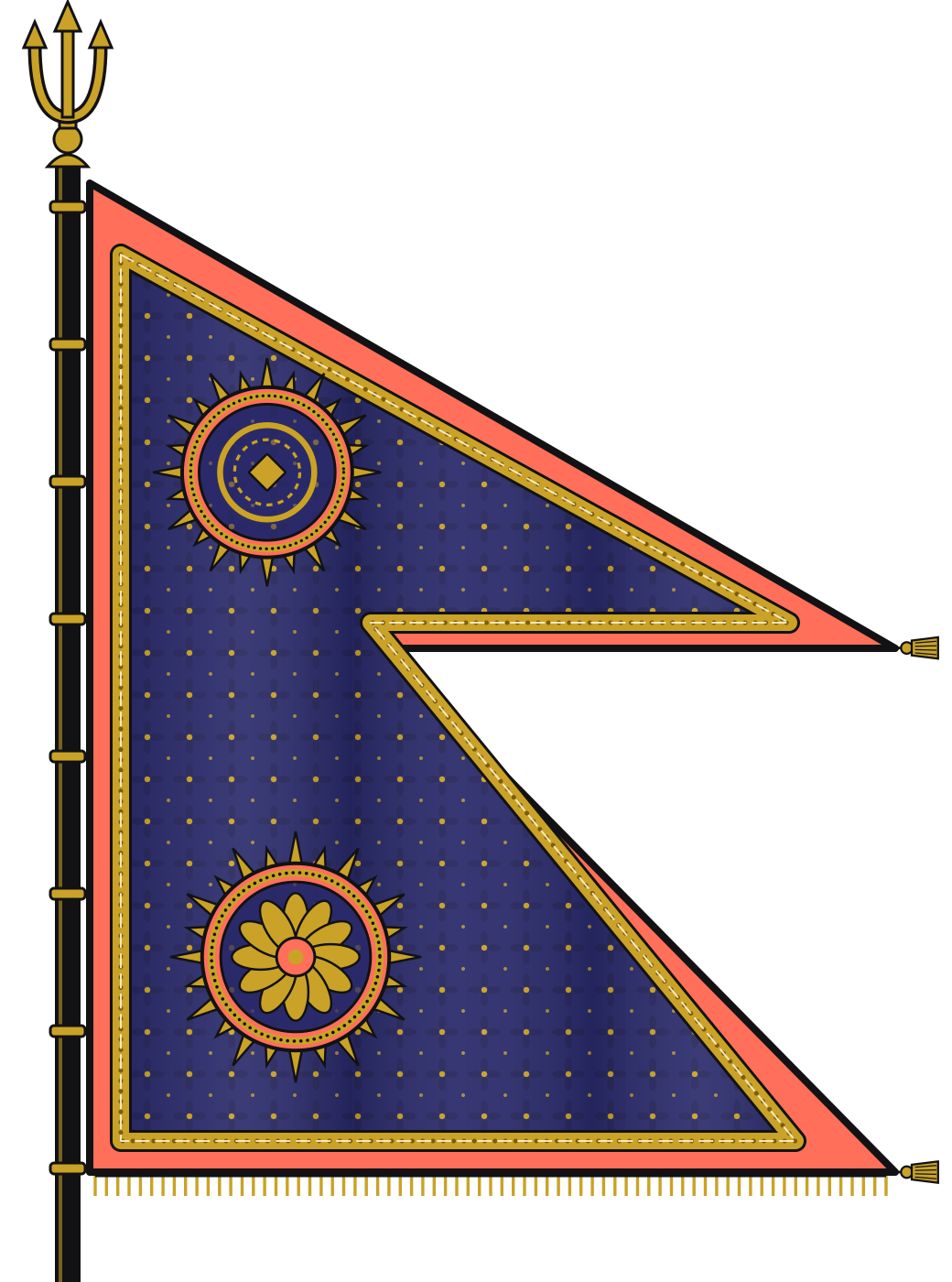


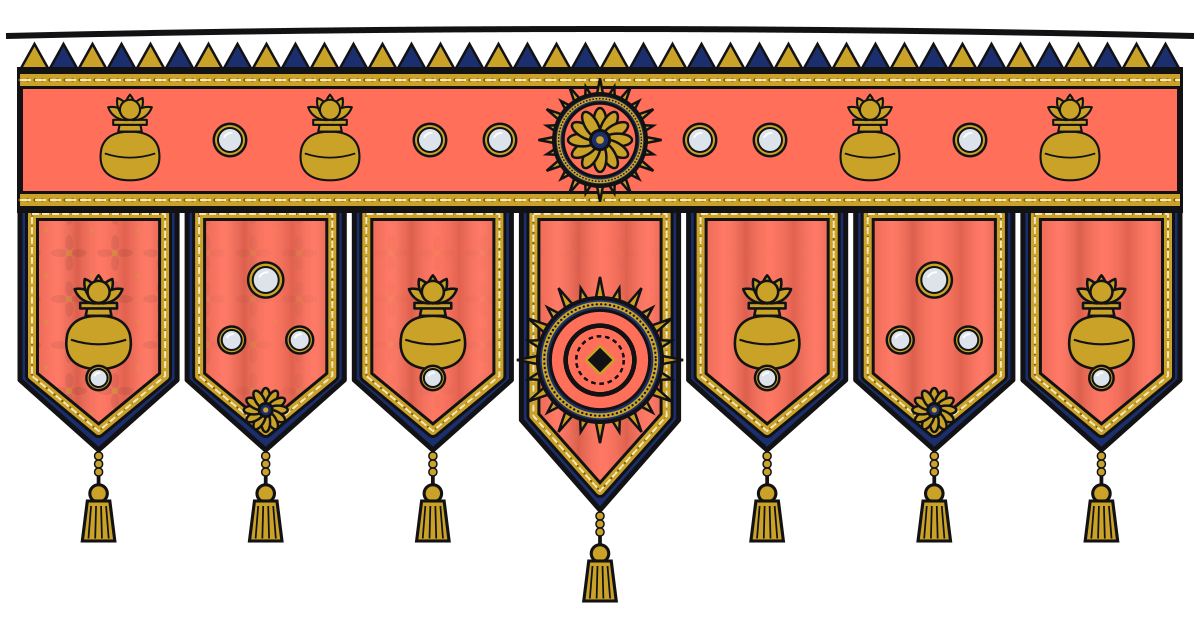

Historic banner
None known
New flag types
| Accessory | For this clan | Basis |
|---|---|---|
| A9 Pota-dhvaja · ship and trade flag For ships, caravans and markets | Not yet designed for this clan | Design |
| A10 Utsava-patāka · festival flag Light, bright flag for fairs and festivals | Not yet designed for this clan | Design |
| A11 Shoka-dhvaja · mourning flag White cloth with the emblem outline in the clan's metal | Not yet designed for this clan | Design |
7. Regalia
| Accessory | For this clan | Basis |
|---|---|---|
| E1 Chhatra · house parasol The ceremonial umbrella | Not yet designed for this clan | Design |
| E2 Chamara · fly-whisks The pair of whisks beside the head of the house | Not yet designed for this clan | Design |
| E3 Danda · staff of office Staff or scepter | Not yet designed for this clan | Design |
| E4 Simhasana · seat The seat of the house, covered in clan cloth | Not yet designed for this clan | Design |
| E5 Khetaka · shield A round shield; the Changi and Dhanush are its flag forms | Not yet designed for this clan | Regional tradition |
| E6 Kula-ayudha · clan weapon The weapon the clan honours | Jhagra Khand, a two-edged sword worshipped by the Paikara on Dasahra | Documented |
8. Worn
| Accessory | For this clan | Basis |
|---|---|---|
| F1 Kula-vastra · clan cloth The clan's woven pattern in its kit colours | Not yet designed for this clan | Design |
| F2 Kirti-vastra · honour cloth A cloth earned for a deed, not inherited | Not yet designed for this clan | Design |
| F3 Kula-mala · garland flower The flower or leaf the clan wears as a garland | Not yet found for this clan | Under research |
| F4 Chinha · house pin A metal badge with the pin emblem | Not yet designed for this clan | Design |
9. Records
| Accessory | For this clan | Basis |
|---|---|---|
| H1 Clan words A traditional line in the native script | The Kawar's panchayat takes a year to make up its mind. · “Russell gives this saying in English only.” Russell 1916, a saying about the Kawar's council[2] | Design |
| H2 Biruda · titles The house's title or titles | Not yet found for this clan | Under research |
| H3 Prashasti · praise genealogy The lineage as written at the head of a grant | Not yet found for this clan | Under research |
| H4 Vahi · clan register The book of the clan's births, marriages and deaths | Not yet found for this clan | Under research |
| H5 Rana-ghosha · war cry The clan's cry in battle or celebration | Not yet found for this clan | Under research |
10. VishwaVit · knower of the world
Game values are design choices for this project, not historical claims.
References
- Tribal Research Institute, Jharkhand, Kanwar (read 2026-10-07) — origin tradition, divisions, septs, language and deities.
- R. V. Russell and Hira Lal, The Tribes and Castes of the Central Provinces of India, vol. 3 (London, 1916), Project Gutenberg eBook #41424, https://www.gutenberg.org/ebooks/41424
- Wikipedia, Kanwar (tribe), read 2026-10-24, https://en.wikipedia.org/wiki/Kanwar_(tribe)
- Odisha State Tribal Museum, Tribes of Odisha: Kawar, read 2026-10-24, https://ostm.in/tribes_of_odisha/kawar/
- A. E. Nelson (ed.), Central Provinces District Gazetteers: Bilaspur District, vol. A (Descriptive) (Allahabad, Pioneer Press, 1910), pp. 83-89 (page numbers inferred from running headers in the OCR), read 2026-11-12 (characters 78,000-278,000), archive.org
- Mahamaya Temple, Wikipedia (read 10 Oct 2026).
- R. V. Russell and Hira Lal, The Tribes and Castes of the Central Provinces of India, vol. 1 (London, 1916), Project Gutenberg eBook #20583, https://www.gutenberg.org/ebooks/20583
- Matt Reeck, Dalton's Ethnology of Bengal, UCLA Center for India and South Asia, read 2026-10-20, https://southasia.ucla.edu/history-politics/colonial-epistemologies/daltons-ethnology-bengal
- E. A. de Brett, Central Provinces District Gazetteers, vol. 10: Chhattisgarh Feudatory States (Bombay, Times Press, 1906), as credited on irfca.org, read 2026-10-27, https://irfca.org/docs/history/chhattisgarh-district.html (full text not read)
- Wikipedia, Korea State, read 2026-10-27, https://en.wikipedia.org/wiki/Korea_State
- Wikipedia, Changbhakar, read 2026-10-27, https://en.wikipedia.org/wiki/Changbhakar
- Wikipedia, Surguja State, read 2026-10-27, https://en.wikipedia.org/wiki/Surguja_State
- Sushree Mohanty, Indigenous Colours of Odisha: Handbook on 62 Tribes (KISS), read 2026-10-20, link
- A. E. Nelson (ed.), Central Provinces District Gazetteers: Bilaspur District, vol. A (Descriptive) (Allahabad, Pioneer Press, 1910), read 2026-11-02, archive.org
- Chhattisgarh Feudatory States (gazetteer text, 1909 / de Brett 1906), as reproduced on the CGLA site, read 2026-11-02, link
- Wikipedia, Tribals in Madhya Pradesh, read 2026-10-19, https://en.wikipedia.org/wiki/Tribals_in_Madhya_Pradesh
- Dr. Ramdayal Munda Tribal Welfare Research Institute, Jharkhand, Kanwar (Hindi page), read 2026-10-24, https://trijharkhand.in/hi/kanwar
- dhammabharat.com, List of Scheduled Tribes in Maharashtra and Population of each Tribe (2011 Census), read 2026-10-10, https://dhammabharat.com/?p=13656
- Wikipedia, Tribes of Jharkhand, read 2026-10-20, https://en.wikipedia.org/wiki/Tribes_of_Jharkhand
- Wikipedia, List of Scheduled Tribes in Odisha, read 2026-10-20, https://en.wikipedia.org/wiki/List_of_Scheduled_Tribes_in_Odisha