The Kathodi, also called Katkari, are a Scheduled Tribe (list dated 09-07-2024, Atlas) whose name comes from kath, the catechu made by boiling khair (Acacia catechu) wood[1][2][3]. The 2011 census row for Maharashtra reads 'Kathodi, Katkari, Dhor Kathodi' with 2,85,334 people in the state[4]. They were listed under the Criminal Tribes Act of 1871, and the stigma of that listing continued after its repeal[3]. Enthoven (1922), quoted by the Gujarat TRTI, calls them 'a tribe of catechu makers'; no dynasty, inscription or royal house is found in the extracts[2]. Men from Kolaba, Thana and Khandesh first came to Gujarat alone for eight-month seasonal work, and contractors later persuaded families to move[2].
01Faith and deities
Set by the Atlas, labelled as such: no Katkari source in the extracts names Ekvira. The sheet gives the basis as a homeland shrine (Ekvira Aai of Karla, Sahyadri). The TRTI Gujarat page names Dungardev, Vaghdev and Gamdev, with the roles given in the table below, but does not name a chief deity.
Ekvira Aai of Karla, Sahyadri
The presiding goddess of the clan's homeland or capital: a link of place, not a recorded clan tie.
| Deity or tradition | Place in the clan's life | Evidence |
|---|---|---|
| Dungardev | Cattle protector (TRTI) | [2] |
| Vaghdev | Forest deity (TRTI) | [2] |
| Gamdev | Village protector (TRTI) | [2] |
| Marimata | Named in the TRTI list (role not stated) | [2] |
| Ram and Hanuman | Worshipped in some Katkari hamlets in Panvel, Raigad (Round Table India); temples in most hamlets | [5] |
| Shiva | Named in the TRTI list (role not stated) | [2] |
| Possession rite | On the day a person wishes to be possessed by a deity or spirit, the Katkari sleep on the earth (Enthoven 1915, note from a Chiplun schoolmaster) | [6] |
02Temples
The TRTI Gujarat page names shrines that Kathodi visit. The extracts record no temple built by the clan.
Built by the clan
Not recorded.
Given patronage or grants by the clan
| Temple | Deity | What the clan gave | When | Where |
|---|---|---|---|---|
| Sarvneshwar | Not stated | Visited | Not dated | Named by TRTI (location not given) |
| Vireshwar | Not stated | Visited | Not dated | Named by TRTI (location not given) |
| Mahadeo | Not stated | Visited | Not dated | Named by TRTI (location not given) |
| Khed Brahma | Not stated | Visited | Not dated | Named by TRTI (location not given) |
| Ambaji | Not stated | Visited | Not dated | Named by TRTI (location not given) |
| Shamlaji | Not stated | Visited | Not dated | Named by TRTI (location not given) |
03Languages and scripts
| Language or script | Kind | Under the clan | Evidence |
|---|---|---|---|
| Katkari living | Language, a Marathi dialect | Spoken among themselves | [1] |
| Marathi, Gujarati and Hindi | Languages spoken with neighbours | Marathi with others; a few Hindi (Vajiram); Marathi mixed with Gujarati in Gujarat (TRTI) | [7][2] |
| Gujarati script | Script | Used in the Gujarat context (TRTI) | [2] |
04Books and literature
Titles come from the hgcosmos bibliography and from the extracts. Only the Enthoven and Russell passages were read, as quoted in the extracts.
Written during the clan's history
| Work | Author | Kind | When | Link to the clan |
|---|---|---|---|---|
| The Katkaris: a sociological study of an aboriginal tribe of the Bombay Presidency | A. N. Weling | Study (book, 156 p.) | 1934 | [8] |
| Tribal identity and minority status: the Kathkari nomads in transition | R. C. Heredia and R. Srivastava | Study (book, 157 p.) | 1994 | [8] |
| Enthoven's survey (title not given in the TRTI extract) | R. E. Enthoven | Tribal survey (book), as quoted by TRTI | 1922 | [2] |
| Tribal survey, vol. 3 (title not given in the extract) | R. V. Russell and Hira Lal | Tribal survey (book) | 1916 | [9] |
| Folk Lore Notes, vol. II: Konkan | R. E. Enthoven (ed.) | Folklore (book) | 1915 | [6] |
| Microsatellite diversity study (title as in the bibliography) | Gaikwad, Vasulu and Kashyap | Genetics paper, American Journal of Physical Anthropology | 2006 | [8] |
Given patronage by the clan
Not recorded.
05Thinkers and scholars
| Name | Field | Era | Contribution |
|---|---|---|---|
| Stephen Fuchs | Not stated | Not dated | Regards the Kathodi as a subsection of the Bhils; as recorded by TRTI[2] |
| Sherring | Not stated | 1881 | Records 'Kathodia' as the Gujarati form, used only in Gujarat[2] |
| R. E. Enthoven | Folklore (editor of Folk Lore Notes) | 1915, 1922 | Calls them 'a tribe of catechu makers' (1922); records the earth-sleeping rite before possession (1915)[6] |
| R. V. Russell and Hira Lal | Tribal survey | 1916 | Quote Crooke's identification of the Khairwars with the Kathkaris; quote the Bombay Gazetteer on monkey descent[9] |
| A. N. Weling | Sociology | 1934 | A sociological study of the Katkaris (book)[8] |
| Masvi and Pandya | Not stated | 1981 | Record Bohra contractors bringing the Kathodi to Gujarat for catechu work[2] |
| R. C. Heredia and R. Srivastava | Not stated | 1994 | A study of identity and minority status among the Kathkari nomads[8] |
Fields are given only where the extract names them.
06Art and architecture
No painting, sculpture, architecture, textile or clothing is recorded in the extracts. The khair-wood catechu craft is the only trade recorded.
Painting and wall art
Not recorded.
Sculpture and temple art
Not recorded.
Temple and building architecture
Not recorded.
Weaving and textiles
Not recorded.
Clothing and jewellery
Not recorded.
Coins, pottery and crafts
Not recorded.
07History
Name and the catechu trade
The name comes from kath, the catechu made by boiling khair wood (Acacia catechu)[1][2][3]. Sherring (1881), as recorded by the TRTI, gives 'Kathodia' as the Gujarati form, used only in Gujarat[2].
Bohra contractors and traders brought them into Gujarat to make catechu from khair trees (Masvi and Pandya 1981, as recorded by the TRTI)[2].
Records to 1916
The Bombay Gazetteer (1901), as recorded by the TRTI, describes them as small, hard-featured and black[2]. Russell and Hira Lal (1916) quote Crooke, who identifies the Khairwars with the Kathkaris of Bombay, 'makers of katha or prepared catechu'[9].
The same 1916 volume quotes the Bombay Gazetteer: the Kathkaris 'represent themselves as descended from the monkeys of Rama'. In 1916 they lived mostly by hunting, killing and eating monkeys with bows and arrows[9].
Criminal Tribes Act, 1871
The earliest dated reference is the listing under the Criminal Tribes Act of 1871[10]. The Act labelled them habitually criminal; the stigma persists after repeal[3].
08Journey and migrations
The extracts give the Gujarat movement in outline; the dates are not stated.
| When | From | To | Why | Evidence |
|---|---|---|---|---|
| Not dated | Kolaba, Thana and Khandesh (border villages of Khandesh) | Dangs, Gandevi, Chhota-Udepur and Vijaynagar talukas, Gujarat | Men first came alone for eight-month seasonal work (October to May); contractors then persuaded families to move | [2] |
| Not dated | Bohra contractors and traders | Gujarat, for catechu work from khair trees | Catechu making from khair | [2] |
| Not dated | Hill areas of Nashik, Pune, Dhule and southern Gujarat (historical, per Wikipedia) | Thane and Raigad, Maharashtra (where most live today; the extract does not say they moved) | Not stated | [10] |
09Seats and lands
| Place | Role | Where today |
|---|---|---|
| Magrol and Uchhal talukas | Gujarat settlement (TRTI) | Surat district, Gujarat |
| Sagbara | Gujarat settlement (TRTI) | Bharuch, Gujarat |
| Vijaynagar | Gujarat settlement and fair (TRTI) | Sabarkantha, Gujarat |
| The Dangs | Seasonal work (TRTI) | Gujarat |
| Raigad and Thane (Panvel hamlets, Lahu Chi Wadi) | Main Maharashtra settlement (Wikipedia; Round Table India) | Raigad and Thane districts, Maharashtra |
| Palghar, Ratnagiri, Pune, Nashik, Dhule | Also named as places (Youth Ki Awaaz; Wikipedia; Indian Tribal Heritage) | Maharashtra |
10Notable figures
Not recorded.
11Allies, rivals and marriages
| People | Relationship | When |
|---|---|---|
| Bohra traders and contractors | Brought Kathodi families into Gujarat to make catechu from khair; economic ties | Not dated |
| Koli, Dungri, Garasia, Gamit, Vasava, Bhil, Kanbi | Kathodi work as labourers for them in Gujarat | Not dated |
| Potters and blacksmiths | Supply goods to the Kathodi (TRTI) | Not dated |
| Other communities | Some do not accept Kathodi food or water (TRTI) | Not dated |
| Thakar (ST-310) | Hold more land and power over the Katkari hamlets in Panvel; Katkari often work for them (Round Table India) | Present (article) |
| Naikda (ST-232) | The Naikda page says they are also called Katkari in Maharashtra; the page also says Katkari is generally a separate people | Not dated |
| Khairwar (ST-127) | Crooke identifies Khairwars with the Kathkaris, makers of katha | 1916 record |
| Warli (ST-326) | Named as a neighbour in the PARI article | Present |
| Kolam (ST-143) and Madia Gond | Named with the Katkari as a particularly vulnerable tribal group in Maharashtra | Present |
12Society and livelihood
Kathodi society as the TRTI Gujarat page describes it: a village mukhi (headman) and panch council; marriage arranged, with exchange and service marriage; patrilocal and male inheritance. Maharashtra sources add that patriarchal, nuclear families are preferred (Vajiram) and that caste discrimination from other communities is reported (Round Table India).
Government and social order
| Institution or group | What it was | Evidence |
|---|---|---|
| Village headman and panch | Village mukhi with a panch council; divorce needs panch permission | [2] |
| Son Kathodi and Dhor Kathodi | Two groups: Son Kathodi do not eat beef; Dhor Kathodi eat carrion | [2] |
| Marriage | Mostly monogamous; arranged, exchange and service marriage; girls 13-16 and boys 15-29; bride price Rs 60-125; widow remarriage, levirate, junior sororate and cross-cousin marriage | [2] |
| Birth and purification rites | Panchuro on the fifth day for daughters and the third day for sons; barwa purification on the twelfth day | [2] |
| Engagement and marriage terms | Engagement through hathio mediators (nani-pen); marriage terms varady and moti pen | [2] |
| Burial | Burial north-south (TRTI) | [2] |
| Discrimination | Caste discrimination from other communities is reported (Round Table India) | [5] |
Livelihood over time
| Era | Livelihood | Evidence |
|---|---|---|
| Historically | Catechu (kath) made from khair wood | [1] |
| Gujarat (undated) | Forest work, minor forest produce, agricultural labour, charcoal-making, cattle grazing, bamboo cutting; maize, nagli, jowar; mahuva liquor | [2] |
| Maharashtra (undated) | Agricultural labour, firewood and jungle fruit, fishing, coal-making, brick manufacture; bamboo huts | [7] |
| 2019 article | May to October labour for Maratha farmers (Rs 300 a day plus meals), fish and crab sale, minor forest produce; November to April brick kilns, with bonded labour common | [3] |
| Present (Panvel hamlets) | Men do local labour or commute to Panvel and Pen; women sell forest produce or do farm labour | [5] |
13Sub-clans and related clans
TRTI Gujarat names two groups, Son Kathodi (do not eat beef) and Dhor Kathodi (eat carrion), and fifteen clans, 'equal in status, not strictly exogamous'. Dhor and Son Katkari are the Katkari spellings of the same groups in the ST lists, so they are not listed twice. Items with no ID are new clan candidates.
| Clan | Relation | Where | Size | In the Atlas | Evidence |
|---|---|---|---|---|---|
| Son Kathodi | Sub-clan | new clan candidate | [2] | ||
| Dhor Kathodi | Sub-clan | new clan candidate | [2] | ||
| Nagher | Sub-clan | Gujarat (TRTI list) | new clan candidate | [2] | |
| Gangada | Sub-clan | Gujarat (TRTI list) | new clan candidate | [2] | |
| Chanda | Sub-clan | Gujarat (TRTI list) | new clan candidate | [2] | |
| Nayak | Sub-clan | Gujarat (TRTI list) | new clan candidate | [2] | |
| Mishal | Sub-clan | Gujarat (TRTI list) | new clan candidate | [2] | |
| Kever | Sub-clan | Gujarat (TRTI list) | new clan candidate | [2] | |
| Lakhan | Sub-clan | Gujarat (TRTI list) | new clan candidate | [2] | |
| Savra | Sub-clan | Gujarat (TRTI list) | new clan candidate | [2] | |
| Power | Sub-clan | Gujarat (TRTI list) | new clan candidate | [2] | |
| Dhum | Sub-clan | Gujarat (TRTI list) | new clan candidate | [2] | |
| Kokhi | Sub-clan | Gujarat (TRTI list) | new clan candidate | [2] | |
| Deve | Sub-clan | Gujarat (TRTI list) | new clan candidate | [2] | |
| Mukanya | Sub-clan | Gujarat (TRTI list) | new clan candidate | [2] | |
| Gavit | Related people | Gujarat (TRTI list); in the 2011 ST list Gavit is named in the Gamit row | ST-080 | [2][11] | |
| Bhil | Parent people | Fuchs' view: the Kathodi are a subsection of the Bhils | ST-027 | [2] (Fuchs as recorded) | |
| Naikda | Related people | Maharashtra, per Wikipedia: called Katkari (the page's claim) | ST-232 | [12] | |
| Khairwar | Related people | Identified with the Kathkaris by Crooke (1916) | ST-127 | [9] | |
| Thakar | Related people | Power over Katkari hamlets in Panvel, Raigad | ST-310 | [5] | |
| Waghmare | Related people | Surname (not a separate people) | new clan candidate | [1][3] |
Clans marked "new clan candidate" are not in the Atlas yet.
14Surnames
The extracts name one surname: Waghmare, also written Waughmare, read as 'tiger slayer' (Wikipedia, via Indian Tribal Heritage and Youth Ki Awaaz). A wife takes her husband's surname after marriage (TRTI). No count of bearers is sourced.
| Surname | Clan or sub-clan | Where | People with this surname | Also used by other communities |
|---|---|---|---|---|
| Waghmare | Kathodi (Katkari) | Common among the Katkari (Wikipedia via Indian Tribal Heritage; Youth Ki Awaaz 2019) | not yet counted | Not checked |
Counts are of everyone with the surname, from the cited source and year, not only members of this clan. A surname shared with other communities says nothing about any one person's origin.
15Songs and music
The extracts record oral tradition, dance and song among the Kathodi of Gujarat, and name instruments; no song title or text is given.
None recorded yet.
Instruments and styles
| Instrument or style | What it is | Evidence |
|---|---|---|
| Taroa | Instrument named for the Gujarat Kathodi; not described in the extract | [2] |
| Adhol | Instrument named for the Gujarat Kathodi; not described in the extract | [2] |
| Chunghuru | Instrument named for the Gujarat Kathodi; not described in the extract | [2] |
| Dholki | Instrument named for the Gujarat Kathodi; not described in the extract | [2] |
16Poems, lullabies and children's rhymes
None recorded yet.
17Stories, legends and proverbs
Stories and legends
| Story | What happens | Told by | Evidence |
|---|---|---|---|
| 'Tiger slayer' surname | The common surname Waghmare is read as 'tiger slayer'; the people have a special relationship with forest creatures such as the tiger (Wikipedia, via Indian Tribal Heritage) | Wikipedia, via Indian Tribal Heritage and Youth Ki Awaaz | [1][3] |
Proverbs and sayings
Not recorded.
18Festivals and fairs
| Festival or fair | When | Where | What happens |
|---|---|---|---|
| Holi (ancestor worship) | Holi | Not stated | Ancestor worship at Holi[2] |
| Vijaynagar fair | Fifth day after Holi | Vijaynagar, Sabarkantha, Gujarat | A big festival[2] |
| Navratri, Mahashivratri, Diwali, Akha-tij | Calendar festivals | Gujarat | Kept by the Gujarat Kathodi[2] |
| Ram Navami, Navratri and Ganesh | Not stated | Not stated | Celebrated by Katkari and Thakar (Round Table India) |
| Undir Navmi | Not stated | Not stated | A rodent festival, per Wikipedia's Katkari page[10] |
19Food, dress and games
Food
| Item | What it is | Evidence |
|---|---|---|
| Rodents | Among the few tribal communities that eat rodents (Vajiram) | [7] |
| Wild foods | Fish, crabs, birds, tubers and fruits; maize, nagli and jowar (Vajiram; TRTI) | [7][2] |
| Mahuva liquor | Named among the Gujarat Kathodi's food and drink (TRTI) | [2] |
Dress
Not recorded.
Games and martial arts
Not recorded.
Tags: living still practised · revived brought back after a break · lost known only from records · research reported but not yet confirmed from a source. Songs and poems under copyright are listed by title only; restricted or sacred material is noted without its content.
20Status today
A Scheduled Tribe of Maharashtra, Gujarat and Rajasthan, known as Kathodi or Katkari, known for catechu (kath) made from khair wood. The Atlas lists it as a PVTG. The landless rate is 87%, against 48% for rural India (Vajiram)[7].
Recognised heritage
| What | Recognition | Evidence |
|---|---|---|
| PVTG (particularly vulnerable tribal group) | Atlas; Youth Ki Awaaz (Maharashtra has three PVTGs) | [3] |
| Van Dhan scheme, Shahapur | Vikaspedia describes a Van Dhan scheme success story by the Katkari of Maharashtra (Shahapur); the page text was not read | [14] |
| Shramjeevi Organisation | Protest for land rights (Nov 2025), credited to the Free Press Journal via Vajiram | [7] |
No community review is recorded in this run.
21For children
The catechu makers
The Kathodi have long made catechu from the wood of the khair tree. The word kath means catechu, and so the people took their name from it. Many live in Maharashtra, mostly in Raigad and Thane. Some went to Gujarat for seasonal work, and contractors later persuaded families to move. They play instruments such as the taroa, adhol, chunghuru and dholki. Today the Kathodi are a Scheduled Tribe (list dated 09-07-2024), and in Maharashtra they are a particularly vulnerable one.
22Across the project
| Project | What carries this clan | Status |
|---|---|---|
| Atlas of the Janas | No pin drawn yet; the districts are in the extracts (see Seats and lands) | To check |
| KulDevi and GrahDevi | Ekvira; no Katkari source names her | From the Atlas |
| Planet naming | Not in the extracts | — |
| Renaming and waters | Not in the extracts | — |
23Open questions
- Which deity is the Kathodi's own chief deity? The TRTI page names Dungardev, Vaghdev and Gamdev without ranking them; the KulDevi Ekvira has no Katkari source.
- Maharashtra exogamous clans and surnames beyond Waghmare: Weling (1934), Heredia and Srivastava (1994), and the Thana and Kolaba Gazetteers are the leads.
- A clan line in the people's own words (native script) with a source: not found in the extracts.
- Songs, sayings and rhymes in Marathi or Katkari: the rest of Enthoven's Konkan volume and the PARI Katkari tag page.
- Dates of the Gujarat migration and of the Maharashtra festivals.
- Whether 'Nayak' among the Gujarat clans is the Naikda alias 'Nayaka'.
- Tiger link: the surname and Wikipedia's note on forest creatures are not a recorded totem; a totem or guardian tree is not found.
- Contradiction to resolve: the clans intro counts Bhil among the fifteen TRTI clans, 'equal in status'[2], while the Bhil clan row calls it the parent people (Fuchs as recorded by TRTI)[2]. Check the TRTI wording before the Bhil link is kept.
- Contradiction to resolve: the art note says the catechu craft is 'the only trade recorded'[2], while the livelihood rows record charcoal-making, coal-making and brick manufacture[2][7][3].
- Reference to check: the Enthoven 1915 key is cited as 'ch. I note 68' with a Gutenberg link[6], but the cached text (archive.org) gives the possession rite as note 9, p. 11.
24Astitva
अस्तित्व · being, existence: everything by which the clan is known
The extracts record no seal, coin, stone, gate, title or war cry for the Kathodi. They do record the khair tree and catechu as name and craft, a claimed descent from Rama's monkeys and a tiger link[2][9].
Every clan has every accessory, royal objects included. Each one says how it is known: Documented This clan's own object is recorded. · Regional tradition Recorded for the region or for peoples like this one, not for this clan. · Design Made for this project, with no historical claim. · Under research To be found for this clan from sources. Legends and titles are written in the clan's own script.
1. Seals and coins
| Accessory | For this clan | Basis |
|---|---|---|
| B1 Rajamudra · house seal Round seal with the clan emblem and a short legend in the clan's script | Not yet designed for this clan | Design |
| B2 Anguliya-mudra · signet ring Personal seal ring of the head of the house | Not yet designed for this clan | Design |
| B3 Chhapa · house stamp Ink or block stamp for letters, goods and cloth | Not yet designed for this clan | Design |
| B4 Tamrapatra · charter plate Copper-plate grant on a ring, closed with the house seal | Not yet designed for this clan | Design |
| B5 Shreni-mudra · guild or trade seal Seal for the clan's trade, craft or caravan | Not yet designed for this clan | Design |
| C1 Clan coin Emblem or deity on one side, a legend in the clan's script | Not yet designed for this clan | Design |
| C2 Coin die The die that strikes the coin | Not yet designed for this clan | Design |
2. Living symbols
| Accessory | For this clan | Basis |
|---|---|---|
| I1 Totem trio The tree, bird and animal the clan protects | Monkey (claimed descent from Rama's monkeys, 1916 record) · tiger (special relationship, not a recorded totem) | Documented |
| I2 Kaval-maram · guardian tree The tree that stands at the clan's seat | Not yet found for this clan | Under research |
3. Stone and gate
| Accessory | For this clan | Basis |
|---|---|---|
| G1 Torana · gateway The built gate of the seat; the cloth Toran hangs in it | Not yet designed for this clan | Regional tradition |
| G2 Viragallu · hero stone Carved panel stone for a member who died defending the clan | Not yet designed for this clan | Regional tradition |
| G3 Kula-shila · clan stones Standing and table stones that remember the ancestors | Not yet designed for this clan | Design |
| G4 Jayastambha · victory pillar A pillar raised for a victory | Not yet designed for this clan | Design |
| G5 Sima-shila · boundary stone Marks the clan's land, with a line in the native script | Not yet designed for this clan | Design |
4. Sounds
| Accessory | For this clan | Basis |
|---|---|---|
| D1 Pancha-mahashabda · five great sounds The right to five instruments | Not yet designed for this clan | Design |
| D2 Shankha · clan conch The clan's own named war conch | Not yet designed for this clan | Design |
| D3 Murasu · house drums Three drums: war, charity and justice | Not yet designed for this clan | Design |
5. Kit: colours, metals and emblems
The Atlas gives the khair (catechu) tree as the main emblem and a Changi flag form, with the colours and form set out there. The extracts record no seal, coin or banner of the clan[2].
| Part of the kit | This clan |
|---|---|
| Field | Deep Brick #7E2A1E |
| Accent | Intense Electric Blue #84A9FF |
| Emblem colour | Metallic Gold #C9A227 |
| Zari metal | Gold |
| Main emblem | A khair (catechu) tree |
| Second image | — |
| Night and day | Every visual accessory has two versions: by night the emblem on the dark field, by day the clan's field colour on cloth woven from its metal. |
6. Flags
Every clan has every flag type; the type says the occasion and the colours say the clan. The outlined card is the flag the Atlas assigns.
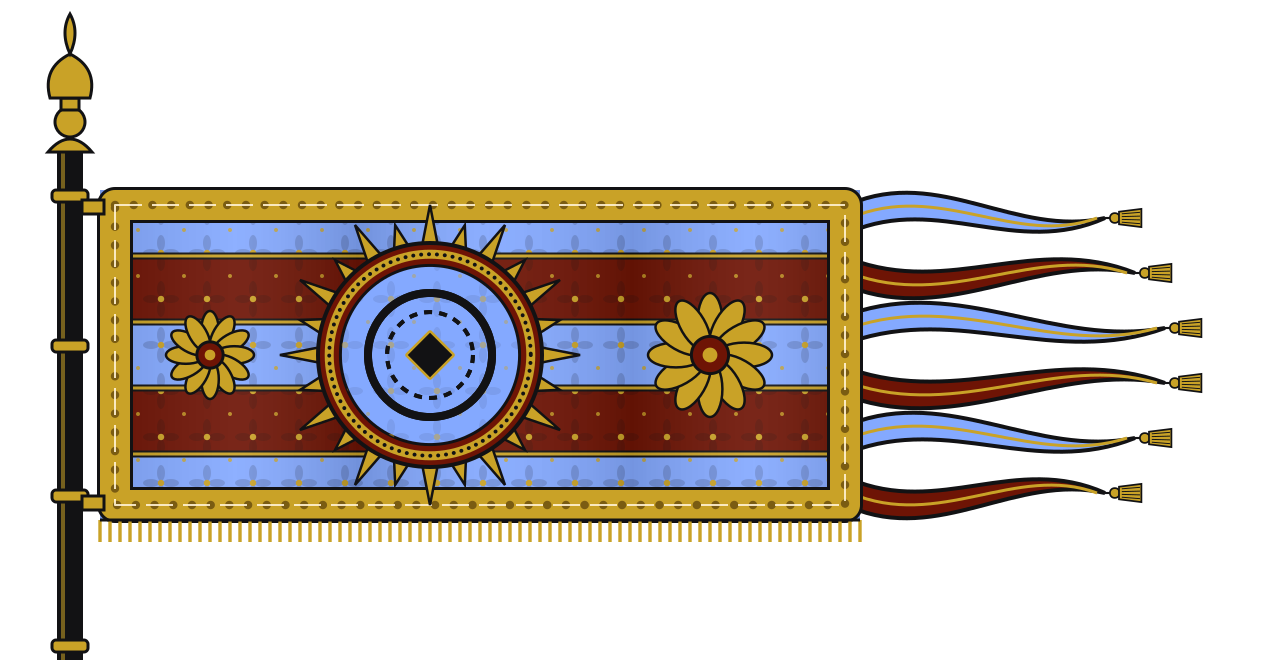
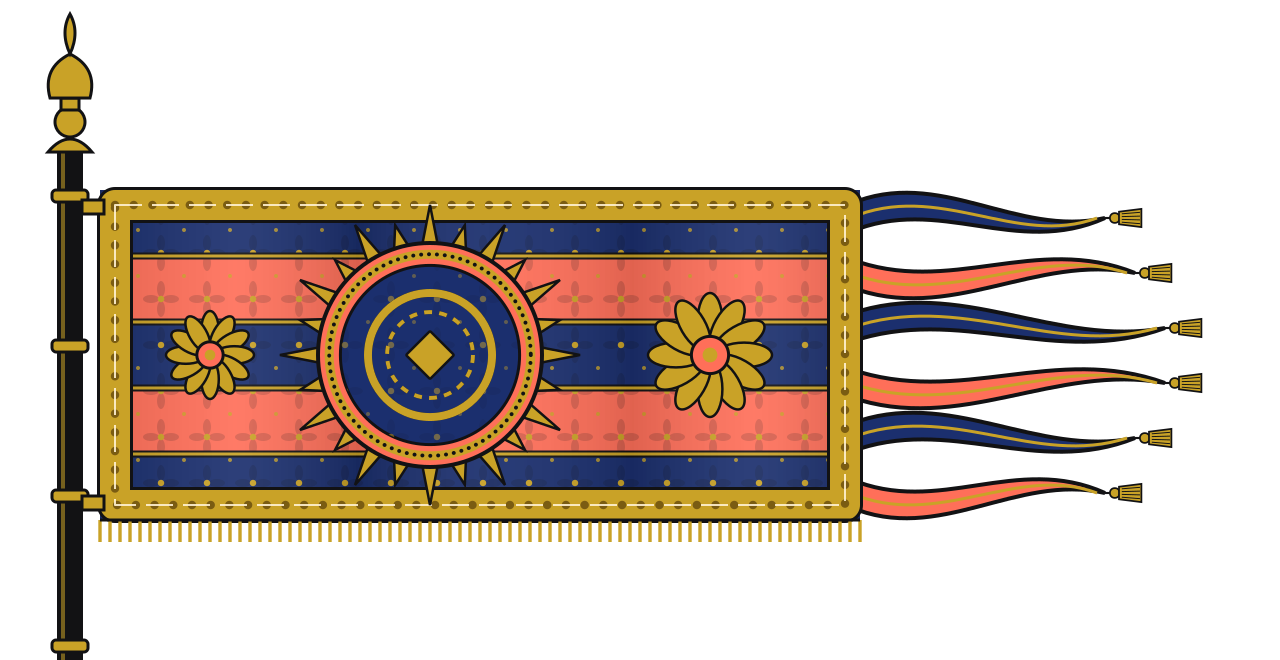
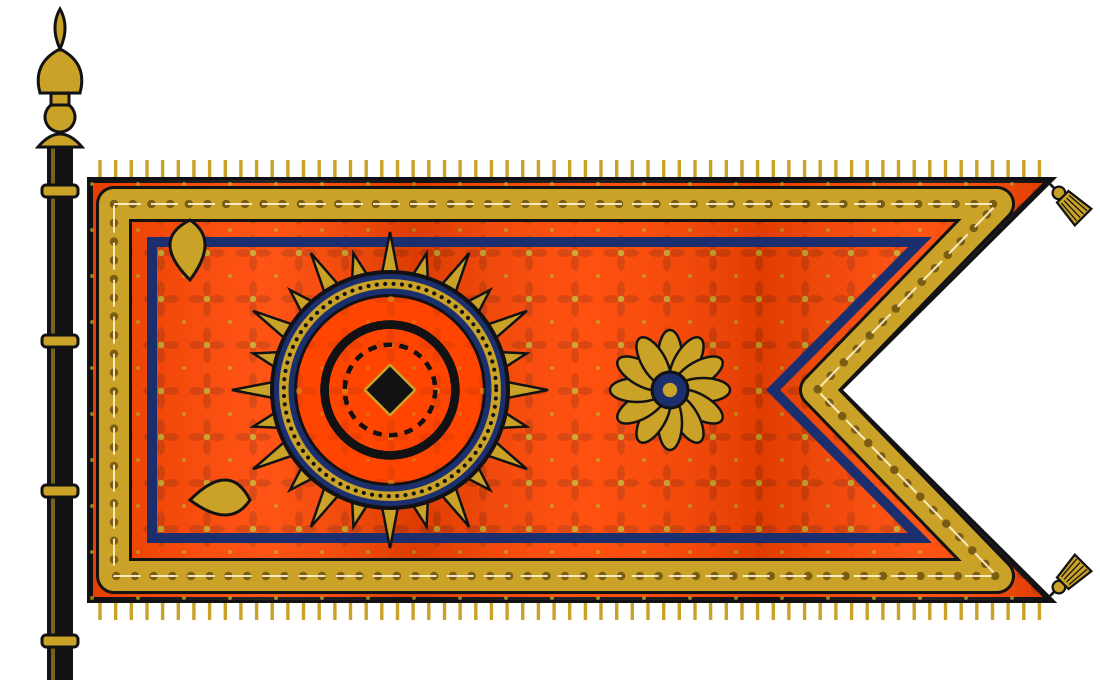
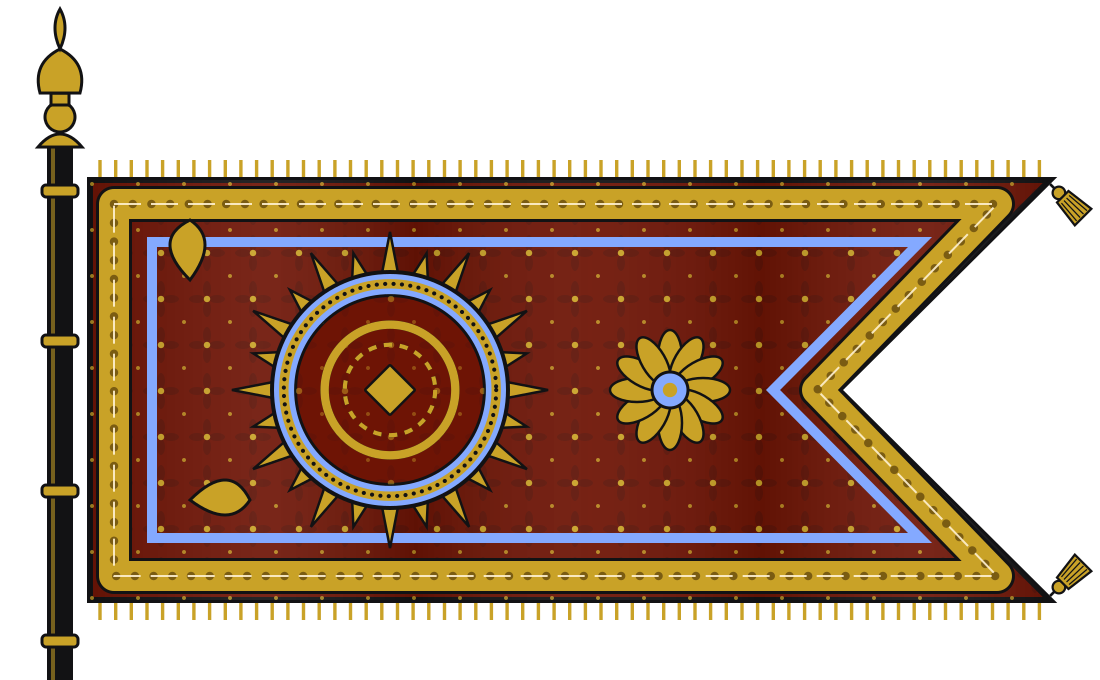
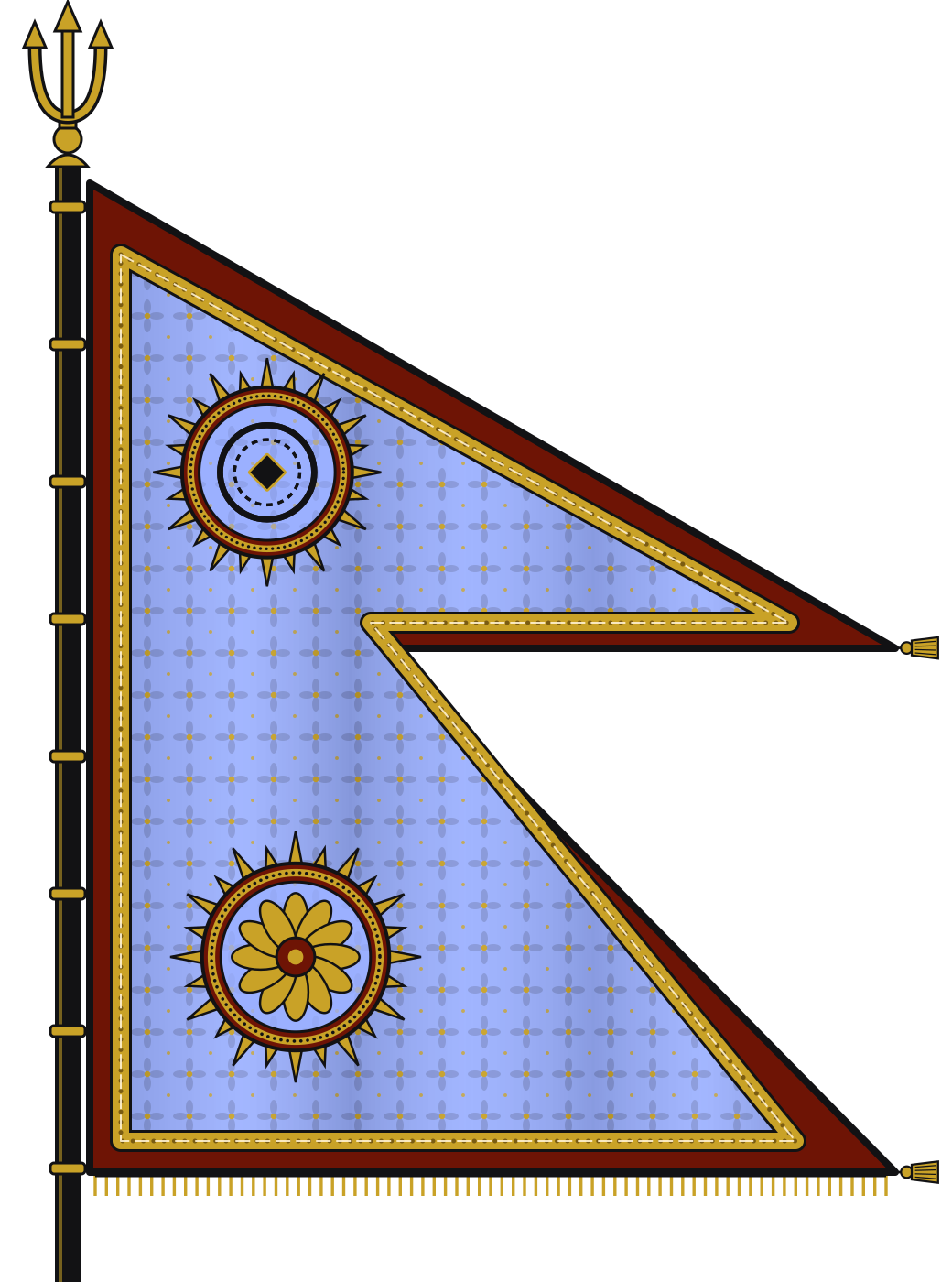
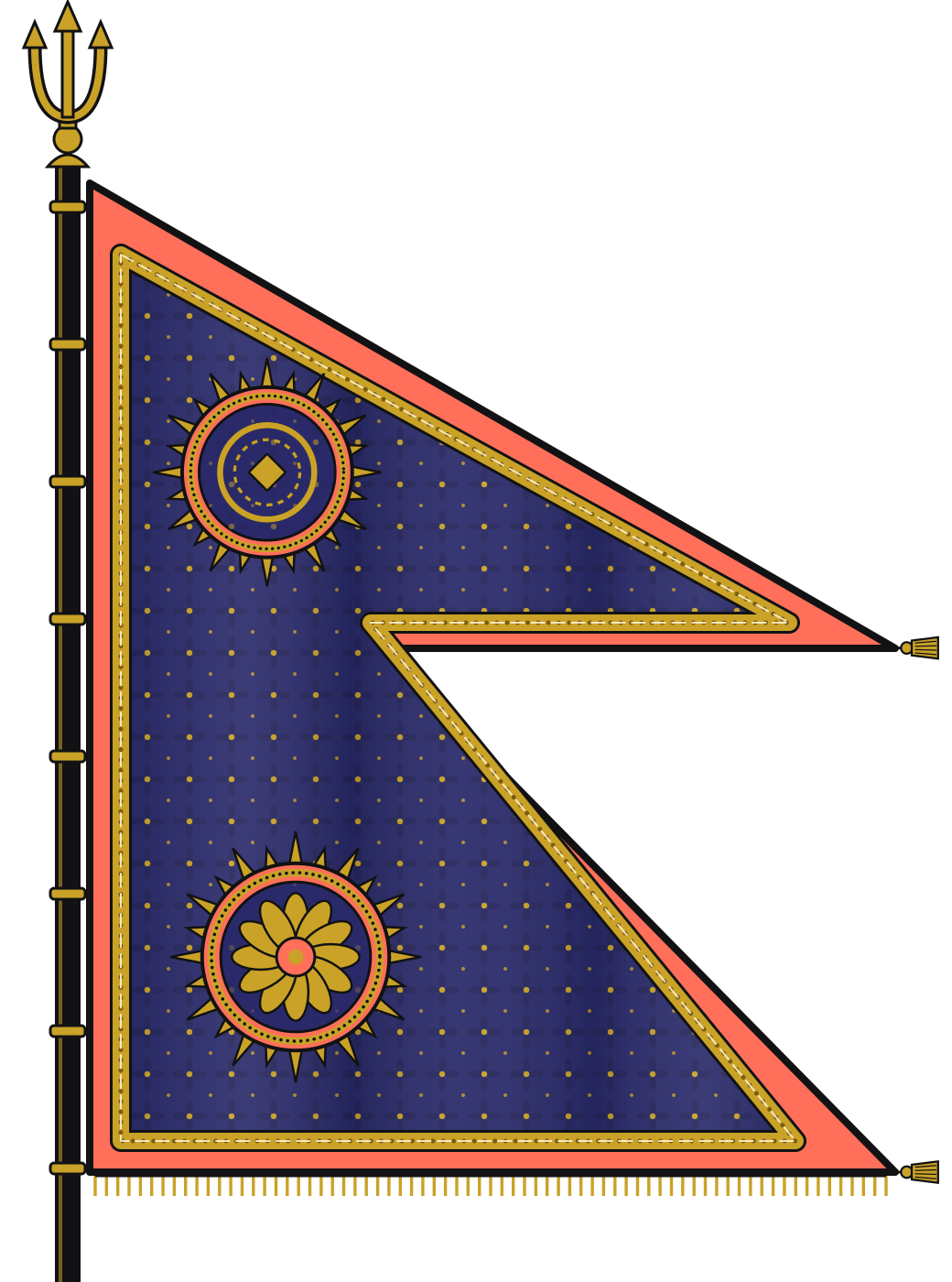

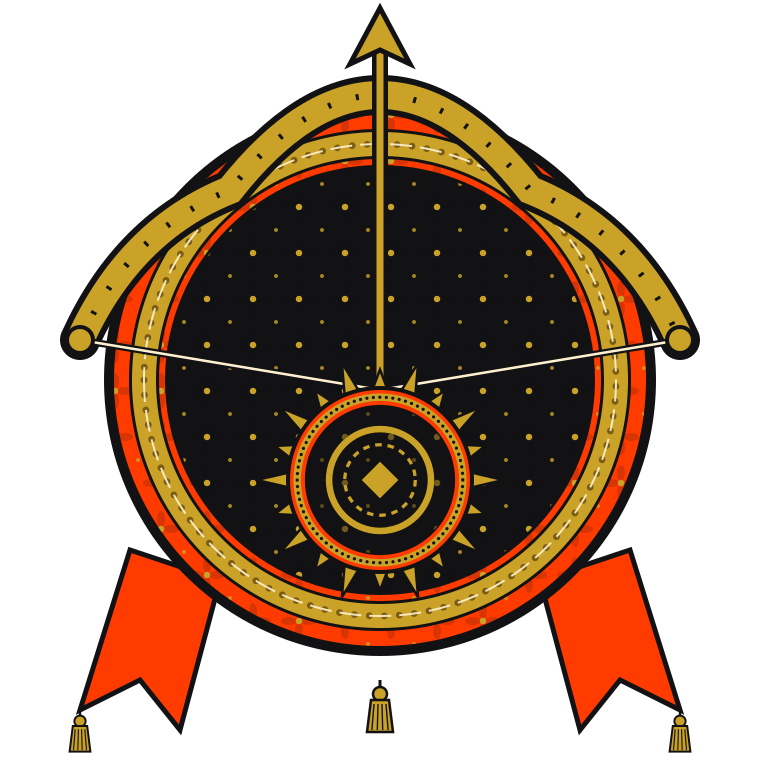
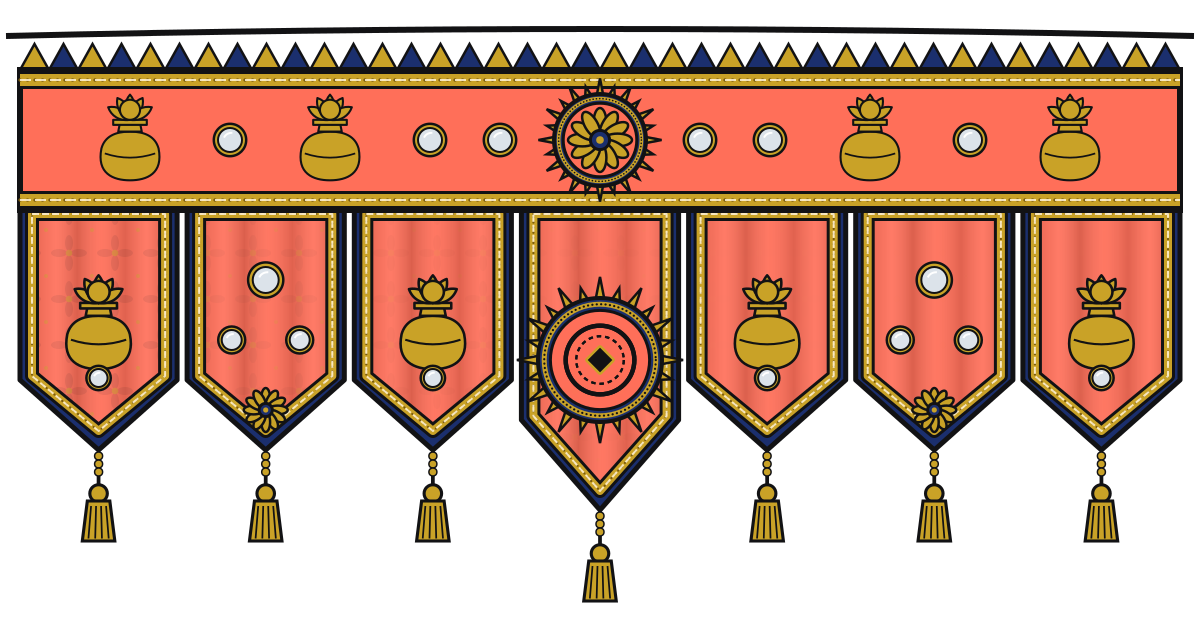

Historic banner
None known
New flag types
| Accessory | For this clan | Basis |
|---|---|---|
| A9 Pota-dhvaja · ship and trade flag For ships, caravans and markets | Not yet designed for this clan | Design |
| A10 Utsava-patāka · festival flag Light, bright flag for fairs and festivals | Not yet designed for this clan | Design |
| A11 Shoka-dhvaja · mourning flag White cloth with the emblem outline in the clan's metal | Not yet designed for this clan | Design |
7. Regalia
| Accessory | For this clan | Basis |
|---|---|---|
| E1 Chhatra · house parasol The ceremonial umbrella | Not yet designed for this clan | Design |
| E2 Chamara · fly-whisks The pair of whisks beside the head of the house | Not yet designed for this clan | Design |
| E3 Danda · staff of office Staff or scepter | Not yet designed for this clan | Design |
| E4 Simhasana · seat The seat of the house, covered in clan cloth | Not yet designed for this clan | Design |
| E5 Khetaka · shield A round shield; the Changi and Dhanush are its flag forms | Not yet designed for this clan | Regional tradition |
| E6 Kula-ayudha · clan weapon The weapon the clan honours | Not yet found for this clan | Under research |
8. Worn
| Accessory | For this clan | Basis |
|---|---|---|
| F1 Kula-vastra · clan cloth The clan's woven pattern in its kit colours | Not yet designed for this clan | Design |
| F2 Kirti-vastra · honour cloth A cloth earned for a deed, not inherited | Not yet designed for this clan | Design |
| F3 Kula-mala · garland flower The flower or leaf the clan wears as a garland | Not yet found for this clan | Under research |
| F4 Chinha · house pin A metal badge with the pin emblem | Not yet designed for this clan | Design |
9. Records
| Accessory | For this clan | Basis |
|---|---|---|
| H1 Clan words A traditional line in the native script | · “No line of the clan's own is in the extracts; a cited line is still to be found (see open questions).” | Documented |
| H2 Biruda · titles The house's title or titles | Not yet found for this clan | Under research |
| H3 Prashasti · praise genealogy The lineage as written at the head of a grant | Not yet found for this clan | Under research |
| H4 Vahi · clan register The book of the clan's births, marriages and deaths | Not yet found for this clan | Under research |
| H5 Rana-ghosha · war cry The clan's cry in battle or celebration | Not yet found for this clan | Under research |
10. VishwaVit · knower of the world
Game values are design choices for this project, not historical claims.
References
- Indian Tribal Heritage, Katkari (relays Wikipedia and Indian Express 2010), read 12 Nov 2026, https://indiantribalheritage.org/?p=2725
- Kathodi, Tribal Research and Training Institute, Gujarat (read 6 Nov 2026, KulDevi clan check).
- Nikhil Kanakamedala, Youth Ki Awaaz, Who are the Katkari, Dec 2019, read 12 Nov 2026, https://youthkiawaaz.com/2019/12/who-are-the-katkari/amp
- dhammabharat.com, List of Scheduled Tribes in Maharashtra and Population of each Tribe (2011 Census), read 2026-10-10, https://dhammabharat.com/?p=13656
- Anil Sardar, Round Table India, The marginalisation of the Katkari tribals, read 12 Nov 2026, https://www.roundtableindia.co.in/the-marginalisation-of-the-katkari-tribals/
- R. E. Enthoven (ed.), Folk Lore Notes Vol. II: Konkan (1915), ch. I note 68, gutenberg.org/files/57520
- Vajiram and Ravi, Katkari Tribe (exam-prep site; cites Free Press Journal, Nov 2025), read 12 Nov 2026, https://vajiramandravi.com/current-affairs/katkari-tribe/
- Thanos Kouravelos, hgcosmos.org, Katkari (Kathodi) bibliography (updated 11 Sep 2019), read 12 Nov 2026, https://www.hgcosmos.org/assets/culture/AZ/K/Katkari.pdf
- R. V. Russell and Hira Lal, The Tribes and Castes of the Central Provinces of India, vol. 3 (1916), Project Gutenberg #41424, read 2026-10-10, gutenberg.org/cache/epub/41424
- Wikipedia, Katkari people, read 2026-10-10, https://en.wikipedia.org/wiki/Katkari_people
- Wikipedia, List of Scheduled Tribes in Gujarat (2011 census figures), read 2026-10-18, https://en.wikipedia.org/wiki/List_of_Scheduled_Tribes_in_Gujarat
- Wikipedia, Naikda, read 9 Nov 2026, https://en.wikipedia.org/wiki/Naikda
- Wikipedia, List of Scheduled Tribes in Rajasthan (2011 census), read 18 Oct 2026, https://en.wikipedia.org/wiki/List_of_Scheduled_Tribes_in_Rajasthan
- Vikaspedia, The Story of Shahapur's Katkari Tribe (page metadata only), read 12 Nov 2026, https://en.vikaspedia.in/social-welfare/scheduled-tribes-welfare/the-story-of-shahapurs-katkari-tribe