The Kambojas were a people of the north-west, first attested in Late Vedic Indo-Aryan sources and in Ashoka's edicts, where they appear among the Greeks and beside the Gandharas[1][2]. Schmitt's Encyclopaedia Iranica entry calls them a southeastern Iranian people whose language was close to Younger Avestan[1]. Buddhist and Sanskrit lists count Kamboja among the sixteen mahajanapadas[3][4], and the Pali commentary calls it the birthplace of horses[3]. Where the kingdom lay is still debated, from Kafiristan and the Kabul valley to the Rajaori area, and its capital Rajapura has not been located[4][5].
01Faith and deities
No Kamboja deity is sourced in the extracts. The sheet's KulDevi is Asamai, Asha Mai, the hill goddess of Kabul, from a homeland shrine. This is project data, not a web source.
Asha Mai, the hill goddess of Kabul
The presiding goddess of the clan's homeland or capital: a link of place, not a recorded clan tie.
| Deity or tradition | Place in the clan's life | Evidence |
|---|---|---|
| Buddhism | Ashoka's missionaries visited Kamboja (Rock Edict 13); Maharakkhita preached among the Yonas and Kambojas | [3][6] |
| Mazdayasnian practice | The Iranica entry says the Kandahar evidence supports the view that the Kambojas followed the Mazdayasnian faith | [1] |
| Killing of insects and snakes | A religious duty in their practice; tied by scholars to the Avestan Videvdad 14.5f and to Herodotus on the magoi | [1][5] |
02Temples
No temple, shrine or monastery of the Kambojas is named in the extracts. Ashoka's missionaries visited Kamboja; no building is recorded.
Built by the clan
Not recorded.
Given patronage or grants by the clan
Not recorded.
03Languages and scripts
| Language or script | Kind | Under the clan | Evidence |
|---|---|---|---|
| Kamboji lost | Iranian language, close to Younger Avestan (Kuhn, Grierson, Charpentier, Benveniste, Witzel) | Reported speech of the Kambojas; the extracts cite only single words from it | [1] |
| Savati 'goes, moves' | A Sanskrit word matched to Younger Avestan siiauua- | Yaska says the word is used only by the Kambojas | [4][1] |
| Dasht-e Nawar inscriptions IDN 3 and 5 | Inscriptions in an unknown language | Possibly Kamboji (Fussman); Proto-Ormuri is the alternative | [1] |
| Kandahar bilingual | Greek and Aramaic-script Iranian inscription of Ashoka | Not the Kambojas' own text; a bilingual edict in the region[4] | [4] |
04Books and literature
The Kambojas appear in lexicons, grammars, Buddhist texts, the epics, Puranas and a horse treatise. No text written by the Kambojas is sourced.
Written in the clan's lands during its era
| Work | Author | Kind | When | Link to the clan |
|---|---|---|---|---|
| Naighantuka | Not named in the extracts | Lexicon; oldest surviving Indian glossary | Not dated in the extracts | [1] |
| Nirukta 2.2 | Yaska | Etymology; savati used only by the Kambojas | Not dated in the extracts | [4] |
| Mahabhashya | Patanjali | Grammar commentary; repeats the savati remark | 2nd century BCE | [4] |
| Anguttara Nikaya | Buddhist canon | Lists Kamboja among the sixteen mahajanapadas | Not dated in the extracts | [3] |
| Asvayurveda | Vagbhata | Horse treatise; lists Kamboja among 54 horse breeds | At least 10th century | [5] |
Given patronage by the clan
Not recorded.
05Thinkers and scholars
| Name | Field | Era | Contribution |
|---|---|---|---|
| Yaska | Etymology | Not dated in the extracts | Nirukta 2.2 on savati[4] |
| Patanjali | Grammar | 2nd century BCE | Mahabhashya on savati[4] |
| Panini | Grammar | 4th century BCE | Rule 4.1.175, 'Kambojan king'[1][7] |
| Charpentier | Indology | 1923 | Linked the name to Cambyses I and II; Schmitt rejects it[1] |
| Benveniste | Iranian philology | 1958 | Linked the Kambojas to the Greeks in the Kandahar edicts[4] |
| Lamotte | Indology | Not dated in the extracts | Linked Aspasioi and Assakenoi to Kamboja horse-breeding[4] |
| Vagbhata | Horse medicine | At least 10th century | Asvayurveda, with Kamboja among 54 breeds[5] |
Scholars disagree on the language, the origin and the location of the Kambojas; the Iranica entry and the Wikipedia article set the views out[1][4].
06Art and architecture
Under research. No painting, sculpture, architecture, textile or craft of the Kambojas is sourced in the extracts.
Painting and wall art
Not recorded.
Sculpture and temple art
Not recorded.
Temple and building architecture
Not recorded.
Weaving and textiles
Not recorded.
Clothing and jewellery
Not recorded.
Coins, pottery and crafts
Not recorded.
07History
First mentions and Ashoka's edicts
The Kambojas appear first in Late Vedic Indo-Aryan sources; Witzel dates the word to c. 500 BCE or earlier[1]. The earliest datable record is Ashoka's Major Rock Edict 13 (his reign, 268–232 BCE), which names the Kambojas among the Greeks; Edict 5 adds the Gandharians[1][2].
Panini's grammar, rule 4.1.175, uses the form 'Kambojan king', which shows that the people were ruled by a king[1].
The sixteen great peoples
The Anguttara Nikaya and Sanskrit geographies list Kamboja among the sixteen mahajanapadas, placed in the Uttarapatha with Gandhara and not in the Majjhimadesa[3][4]. Iranica notes that the Kambojas are listed last of the sixteen great peoples[1].
A Pali text says a road ran directly from Dvaraka to Kamboja, on a major caravan route[3].
Missions and the Pali texts
Rock Edict 13, in the Shahbazgarhi text, lists Kamboja among the countries visited by Ashoka's missionaries[3]. The Dipavamsa and Sasanavamsa say the monk Maharakkhita preached among the Yonas and Kambojas[6].
The Mahabharata
In the Mahabharata, King Sudaksina of Kamboja comes to Draupadi's svayamvara legend. Arjuna killed his younger brother and subdued the kingdom (Sabha Parva 27.23)[5]. The Kambojas fought for the Kauravas, including in Bhishma's Garuda array, and Karna defeated them legend[5]. The Vana Parva foretells Kamboja mlecchas as kings in the Kali age[5].
Mathura and the Greeks
New World Encyclopedia, adapted from Wikipedia, says Yavanas and Kambojas jointly ruled Mathura for nearly two centuries, and cites the Mathura Lion Capital of Rajuvula in support[6]. The capital itself, dated 1–10 CE, names Rajuvula and the queens and donors; it mentions a Kamuia clan that may be a Gandhari-Prakrit form of Kamboja, which is not established[8].
Chandragupta and the alliance
The Mudrarakshasa says Chandragupta Maurya used a Shaka-Yavana-Kamboja-Parasika-Bahlika alliance to seize Magadha[9]. The Pahlavas article cites the same play for Chandragupta's composite army, which there included Pahlavas[10].
Puranic and Gupta-age accounts
Markandeya Purana chapter 58 names the Pahlavas and Kambojas as neighbours of Sindhu, Sauvira and Anarta[10]. Varahamihira's Brihat Samhita, in the 6th century, puts Kamboja in the south-west[5][10]. Kshmendra's Brihat-Katha-Manjari says Vikramaditya (Chandragupta II) destroyed barbarian peoples such as the Sakas and Kambojas[10].
Hazra's article on the Agneya-purana says that Purana describes the Kambojas as originally Ksatriyas[11].
Later claims (uncertain)
Some historians link the Kamboja Pala dynasty of Bengal to settled Kambojas. Raychaudhuri proposed a migration after the Gurjara-Pratihara conquests, under ruler Narayanapala; the link is uncertain[4].
08Journey and migrations
The extracts give no migration of the Kambojas themselves. The Bengal theory and the location debate are the only moves they describe, and both are uncertain.
Not recorded.
09Seats and lands
| Place | Role | Where today |
|---|---|---|
| Kamboja | Mahajanapada in the Uttarapatha; location debated | Kabul valley, Ghazni mountains, or Rajaori area by theory[4][5] |
| Rajapura | Capital, 'King's town' in the Mahabharata; not located | Unknown[1] |
| Nandipura | The only Kamboja city known from Luders' inscriptions | Not stated in the extracts[5] |
| Kafiristan and Kabul valley | Proposed sites (Levi, Liebich, Bloch) | Afghanistan[4] |
| Ghazni and Upper Arghandab | Site proposed by Fussman | Afghanistan[4] |
| Sri Lanka (Kaboja) | Kambojas traded there; Sithulpawwa Rajamaha Viharaya inscriptions (Bopearachchi 2025) | Sri Lanka[4] |
10Notable figures
| Name | Role | Era | Known from |
|---|---|---|---|
| Sudaksina (Sudakshin) legend | King of Kamboja; at Draupadi's svayamvara; his younger brother killed by Arjuna | Mahabharata | [5][10] |
| A King Kamboja legend | Received a sword from Dhundhumara | Mahabharata (Santi Parva 166.77) | [5] |
| Kambojan kings legend | Sought marriage alliances with Vasupujya, per Jain sources | Jain sources (undated in the extracts) | [5] |
| A Samavedic teacher | Characterised by his name as a Kambojan | Vamsa-Brahmana | [1] |
11Allies, rivals and marriages
| People | Relationship | When |
|---|---|---|
| Yavanas (Yonas, Greeks) | Named with them in Ashoka's edicts and the Mahabharata; some sources say they ruled Mathura together[4][6] | Edicts, c. 250 BCE; Mathura rule undated in the extract |
| Gandharas | Named with them in Ashoka's Rock Edicts 5 and 13[1][6]; one school holds the two peoples cognate[7] | c. 250 BCE on |
| Shakas (Indo-Scythians) | Named together in the Mahabharata's Kali Yuga prophecy and in the Ramayana and Mahabharata mleccha lists; Konow linked the two peoples[9][8] | Epic lists; Konow (1929) |
| Pahlavas | Grouped with the Kambojas in the Panca-ganah (five hordes) in the Puranas; neighbours in the Markandeya Purana[10] | Puranic |
| Paradas | In the Panca-ganah with the Kambojas, Sakas, Yavanas and Pahlavas[10] | Puranic |
| Bahlikas (Bactrians) | Named with the Kambojas in the Mudrarakshasa alliance and paired with them in the Mahabharata[1][9] | Mudrarakshasa (undated) |
| Parasikas | Named with the Kambojas in the Mudrarakshasa alliance[9] | Mudrarakshasa (undated) |
| Aspasioi and Assakenoi | Lamotte linked their names to Kamboja horse-breeding (Old Persian aspa, Sanskrit asva); not established[4]. Alexander defeated both in the north-west[7] | 327 BCE |
| Mauryas | Chandragupta Maurya's alliance with the Kambojas, per the Mudrarakshasa[9]; Ashoka's edicts name them[2] | Mauryan period |
| Kauravas | Kambojas fought for the Kauravas, and Karna defeated them[5] | Mahabharata |
| Nuristani (Kom) | Descendants, in one scholar's view (Strand 2022), not established[4] | Living people |
12Society and livelihood
The Kambojas are known mainly from outside: Pali and Brahmanical texts, edicts and epics. They had kings and bred horses.
Government and social order
| Institution or group | What it was | Evidence |
|---|---|---|
| Kingship | Ruled by a king: 'Kambojan king' under Panini 4.1.175 | [1] |
| Status in texts | Called non-Aryan (anariya) in the Jatakas; Manu 10.44 says they were once Kshatriyas who lost their rites; the Agneya-purana says the same | [1][5][11] |
| Two classes | In Yona and Kamboja there are only two classes, master and slave, interchangeable (Assalayana Sutta, M.ii.149) | [3] |
| Horse trade and tribute | Horses were imported in large numbers and given as tribute with camels and asses | [1] |
Livelihood over time
| Era | Livelihood | Evidence |
|---|---|---|
| Ancient | Horse breeding: horses best for war; the Asvayurveda lists the Kamboja breed among 54 | [1][5] |
| Ancient | Catching wild horses with honey-moss (Kunala Jataka) | [3] |
| Ancient | Trade with Sri Lanka (Sithulpawwa inscriptions, Bopearachchi 2025) | [4] |
13Sub-clans and related clans
The sources name the following peoples as related to the Kambojas: they were grouped with them, named in the same lists, or linked by a scholar. Those not in the Atlas are candidates for their own entries.
| Clan | Relation | Where | Size | In the Atlas | Evidence |
|---|---|---|---|---|---|
| Yavanas | Related people | Greek (Yona) peoples; Bactrian Greeks per Malalasekera | ANC-154 | [6] | |
| Gandharas | Related people | Gandhara, north-west Pakistan and north-east Afghanistan | ANC-035 | [7] | |
| Shakas (Indo-Scythians) | Related people | Ujjain, Mathura, Gujarat, Malwa, Gandhara | ANC-119 | [9] | |
| Pahlavas | Related people | Uttarapatha in most Puranic lists | ANC-092 | [10] | |
| Paradas | Related people | Lands along the Oxus (Chakshu) in the Vayu and Matsya Puranas | ANC-097 | [10] | |
| Mauryas | Related people | Magadha; Mauryan empire | ANC-157 | [9][2] | |
| Nuristani (Kom) | Related people | Nuristan, Afghanistan | SUB-066 | [4] | |
| Aspasioi | Related people | Kunar valley | same name as ANC-189: check | [7][4] | |
| Assakenoi | Related people | Ora, Bazira, Massaga, Aornos (north-west) | new clan candidate | [7][4] | |
| Bahlikas (Bactrians) | Related people | Bactria (per Iranica) | new clan candidate | [1][9] | |
| Parasikas | Related people | same name as ANC-221: check | [9] |
Clans marked "new clan candidate" are not in the Atlas yet.
14Surnames
No surname of the Kambojas is in the extracts, and none is counted here.
Not recorded.
15Songs and music
Under research. No song of the Kambojas is sourced in the extracts.
None recorded yet.
16Poems, lullabies and children's rhymes
Under research. No lullaby, rhyme or poem of the Kambojas is sourced.
None recorded yet.
17Stories, legends and proverbs
Stories and legends
| Story | What happens | Told by | Evidence |
|---|---|---|---|
| Catching the wild horses | The Kambojas leave moss sprinkled with honey at the drinking place; honey on the grass leads the horses into an enclosure | Kunala Jataka, Pali (J.v.445); scholiast J.v.446 | [3] |
| The brahmin's family enslaved | A brahmin who trades in Yona or Kamboja dies there, his wife is forced to work and his children are enslaved (commentary MA.ii.784) | Pali commentary on the Assalayana Sutta | [3] |
| The Kali Yuga prophecy | Shakas, Yavanas and Kambojas are foretold to rule unrighteously in the Kali Yuga | Mahabharata, Vana Parva | [6] |
Proverbs and sayings
Not recorded.
18Festivals and fairs
Not recorded.
19Food, dress and games
Food
Not recorded.
Dress
| Item | What it is | Evidence |
|---|---|---|
| Shaved heads | The Kambojas shaved their heads completely; the Ganapatha on Panini reads 'Kamboja-mundah Yavana-mundah' (cropped hair) | [1][6] |
Games and martial arts
Not recorded.
Tags: living still practised · revived brought back after a break · lost known only from records · research reported but not yet confirmed from a source. Songs and poems under copyright are listed by title only; restricted or sacred material is noted without its content.
20Status today
No living community of the ancient Kambojas is established in the extracts, and the Atlas gives no modern official status. One scholar, Richard Strand (2022), links the Nuristani Kom people to them[4].
Who carries the name today
| Community | Link | Basis | Evidence |
|---|---|---|---|
| Nuristani Kom (SUB-066) | Under research | [4] |
Recognised heritage
| What | Recognition | Evidence |
|---|---|---|
| Named in Ashoka's edicts | The edicts are found across India, Bangladesh, Nepal, Afghanistan and Pakistan[2] | [2] |
Not yet reviewed by any community. No living community is established for this people in the sources.
21For children
The horses of Kamboja
Long ago, in a land in the north-west, lived a people called the Kambojas. They were famous for their horses. Old Buddhist stories tell how wild horses were caught. So the hunters sprinkled honey on moss and left it by the place where the horses drank. The honey on the grass led the horses into a fence. The Kambojas are still remembered in old books and in the edicts of King Ashoka.
Written for this project
Riddle: I am swift, I have a mane and a tail, and an old people of the north-west bred and prized my kind. What am I? (A horse.)
22Across the project
| Project | What carries this clan | Status |
|---|---|---|
| Atlas of the Janas | Location debated; pin at Rajapura (disputed) in the Atlas | To check |
| KulDevi and GrahDevi | Asamai, the hill goddess of Kabul | From the Atlas |
| Planet naming | Not checked against the Tier registers | To check |
| Renaming and waters | No place or water name drawn from the Kambojas yet | — |
23Open questions
- Sub-clans, gotras and surnames of the Kambojas: read the Kamboh pages (kiwix 2023-10 mirror, episteme.tllm.fr/wiki/Kamboj), Rose Glossary vol. I (icvtesting.nvli.in). The Kamboj Wikipedia page was blocked and the Kamboh mirror timed out.
- Kamuia, a clan in the Mathura capital: a form of Kamboja or not[8].
- Coins, seals, charters, war cry, guardian tree and garland flower: none sourced. Check Epigraphia Indica 33 (jainqq.org, unfetched) and the Sithulpawwa inscriptions.
- The Kambojas' own words or motto: not sourced.
- Location of Rajapura and the bounds of the kingdom[1].
- Dasht-e Nawar inscriptions IDN 3 and 5: Kamboji or Proto-Ormuri[1].
- The Parama Kamboja 2006 mirror and the reference.org copy are unfetched.
- Region: the info table and the lead place Kamboja in the north-west (Uttarapatha), but the Brihat Samhita (6th century) puts Kamboja in the south-west near Gujarat and Saurashtra[10][5]. Both are recorded; the sources do not settle it.
24Astitva
अस्तित्व · being, existence: everything by which the clan is known
The Kambojas are known for their horses and for the 'Kambojan king' form, both recorded. No seal, coin, totem, war cry or guardian tree is sourced[1][3].
Every clan has every accessory, royal objects included. Each one says how it is known: Documented This clan's own object is recorded. · Regional tradition Recorded for the region or for peoples like this one, not for this clan. · Design Made for this project, with no historical claim. · Under research To be found for this clan from sources. Legends and titles are written in the clan's own script.
1. Seals and coins
| Accessory | For this clan | Basis |
|---|---|---|
| B1 Rajamudra · house seal Round seal with the clan emblem and a short legend in the clan's script | Not yet designed for this clan | Design |
| B2 Anguliya-mudra · signet ring Personal seal ring of the head of the house | Not yet designed for this clan | Design |
| B3 Chhapa · house stamp Ink or block stamp for letters, goods and cloth | Not yet designed for this clan | Design |
| B4 Tamrapatra · charter plate Copper-plate grant on a ring, closed with the house seal | Not yet designed for this clan | Design |
| B5 Shreni-mudra · guild or trade seal Seal for the clan's trade, craft or caravan | Not yet designed for this clan | Design |
| C1 Clan coin Emblem or deity on one side, a legend in the clan's script | Not yet designed for this clan | Design |
| C2 Coin die The die that strikes the coin | Not yet designed for this clan | Design |
2. Living symbols
| Accessory | For this clan | Basis |
|---|---|---|
| I1 Totem trio The tree, bird and animal the clan protects | Animal: the horse. No totem tree or bird of the people is sourced. | Documented |
| I2 Kaval-maram · guardian tree The tree that stands at the clan's seat | Not yet found for this clan | Under research |
3. Stone and gate
| Accessory | For this clan | Basis |
|---|---|---|
| G1 Torana · gateway The built gate of the seat; the cloth Toran hangs in it | Not yet designed for this clan | Regional tradition |
| G2 Viragallu · hero stone Carved panel stone for a member who died defending the clan | Not yet designed for this clan | Regional tradition |
| G3 Kula-shila · clan stones Standing and table stones that remember the ancestors | Not yet designed for this clan | Design |
| G4 Jayastambha · victory pillar A pillar raised for a victory | Not yet designed for this clan | Design |
| G5 Sima-shila · boundary stone Marks the clan's land, with a line in the native script | Not yet designed for this clan | Design |
4. Sounds
| Accessory | For this clan | Basis |
|---|---|---|
| D1 Pancha-mahashabda · five great sounds The right to five instruments | Not yet designed for this clan | Design |
| D2 Shankha · clan conch The clan's own named war conch | Not yet designed for this clan | Design |
| D3 Murasu · house drums Three drums: war, charity and justice | Not yet designed for this clan | Design |
5. Kit: colours, metals and emblems
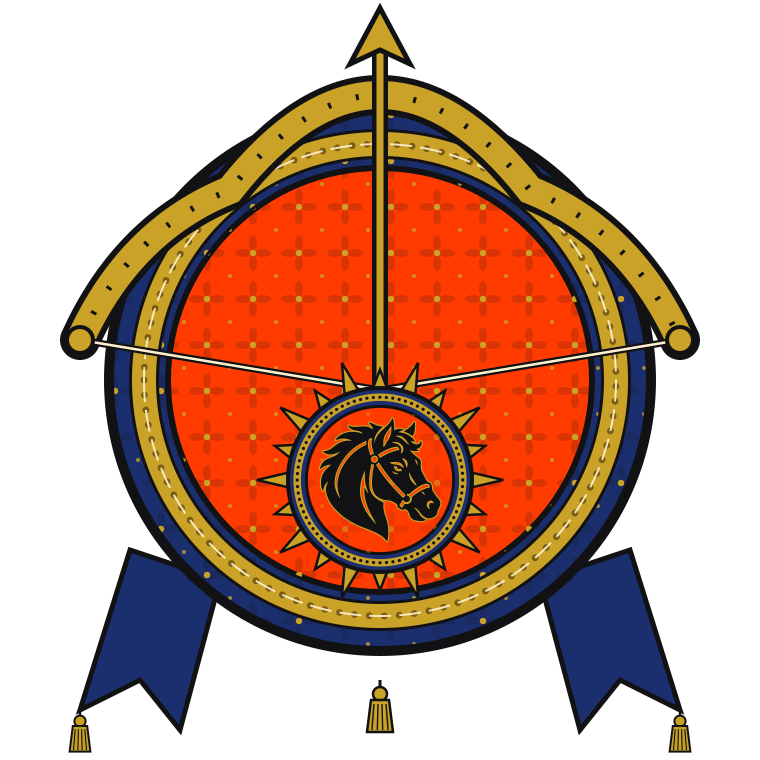
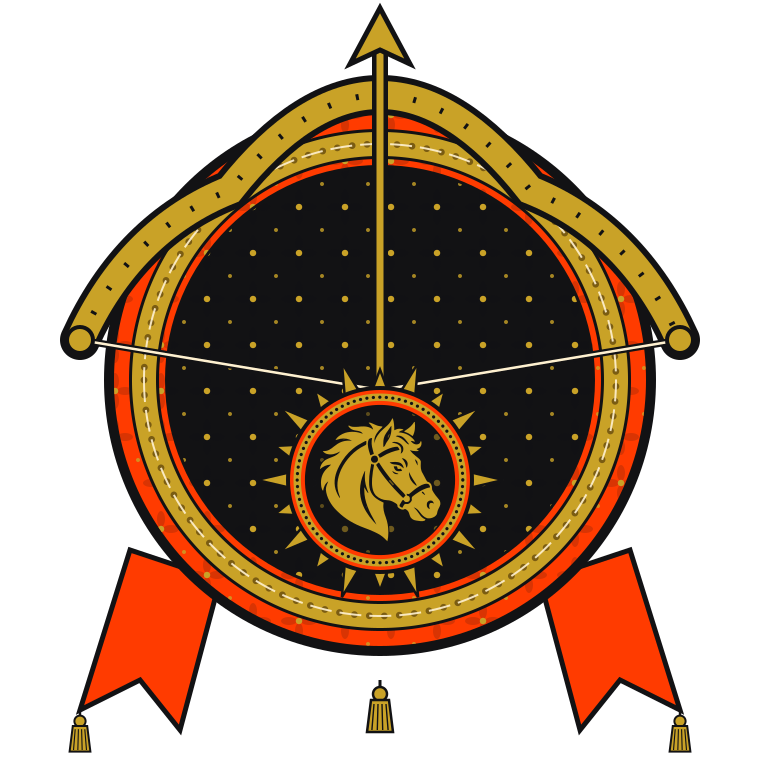
The Atlas's emblem is a design: a galloping war horse in a bow crest. The horse matches the people's known breed[1]; the bow crest is a design choice.
| Part of the kit | This clan |
|---|---|
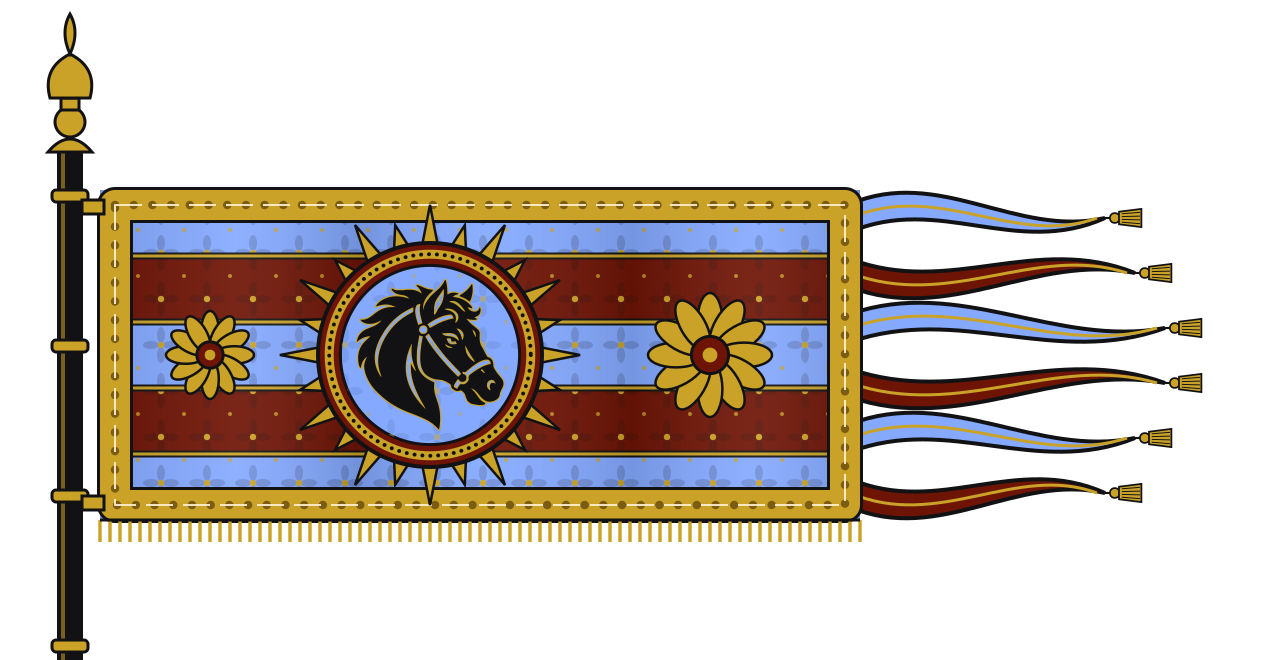
| Field | Charcoal Black #121214 |
| Accent | Intense Electric Blue #84A9FF |
| Emblem colour | Metallic Gold #C9A227 |
| Zari metal | Gold |
| Main emblem | A galloping war horse |
| Second image | — |
| Night and day | Every visual accessory has two versions: by night the emblem on the dark field, by day the clan's field colour on cloth woven from its metal. |

6. Flags
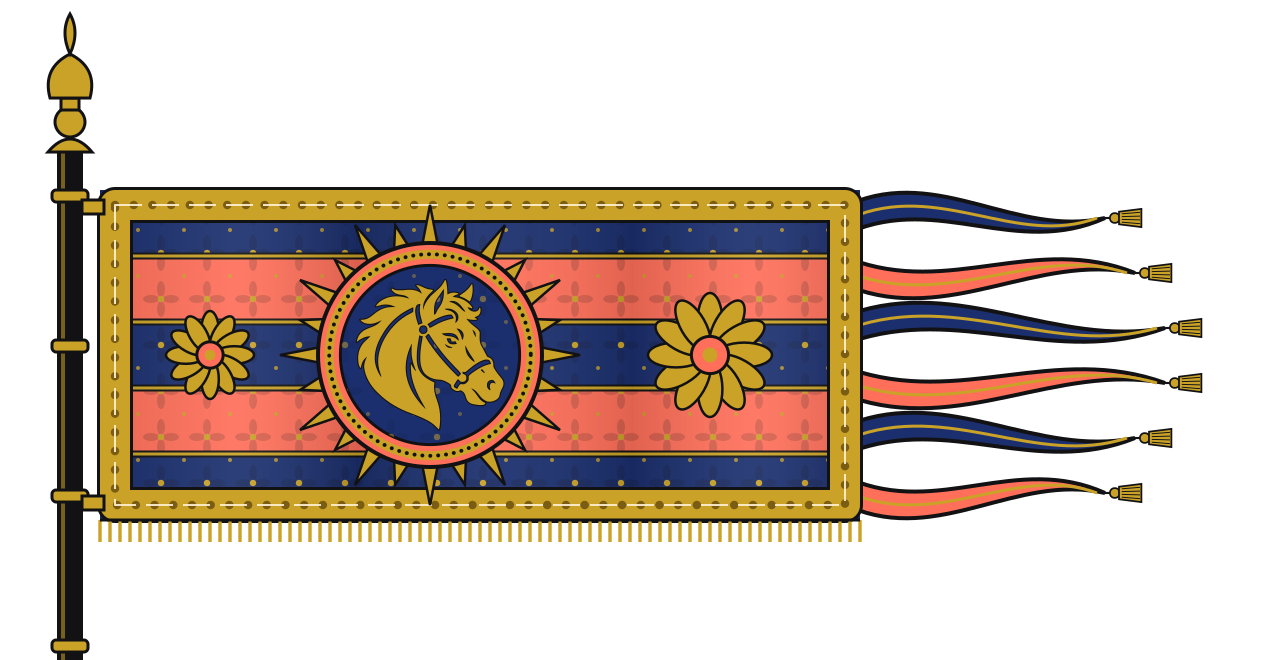
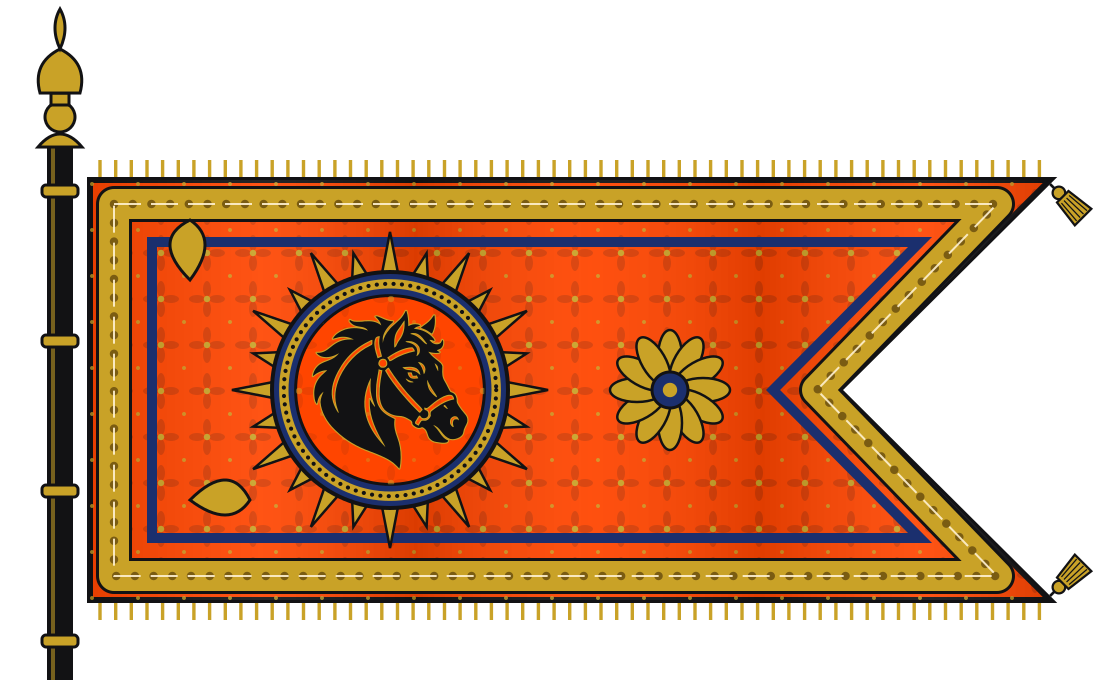
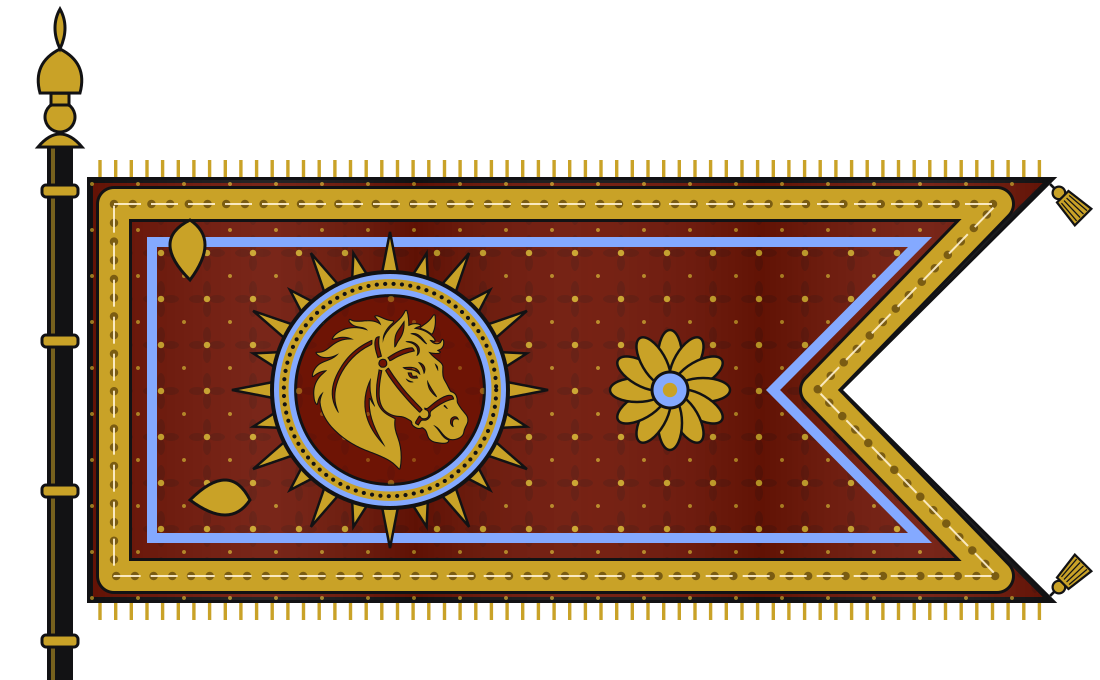
Every clan has every flag type; the type says the occasion and the colours say the clan. The outlined card is the flag the Atlas assigns.
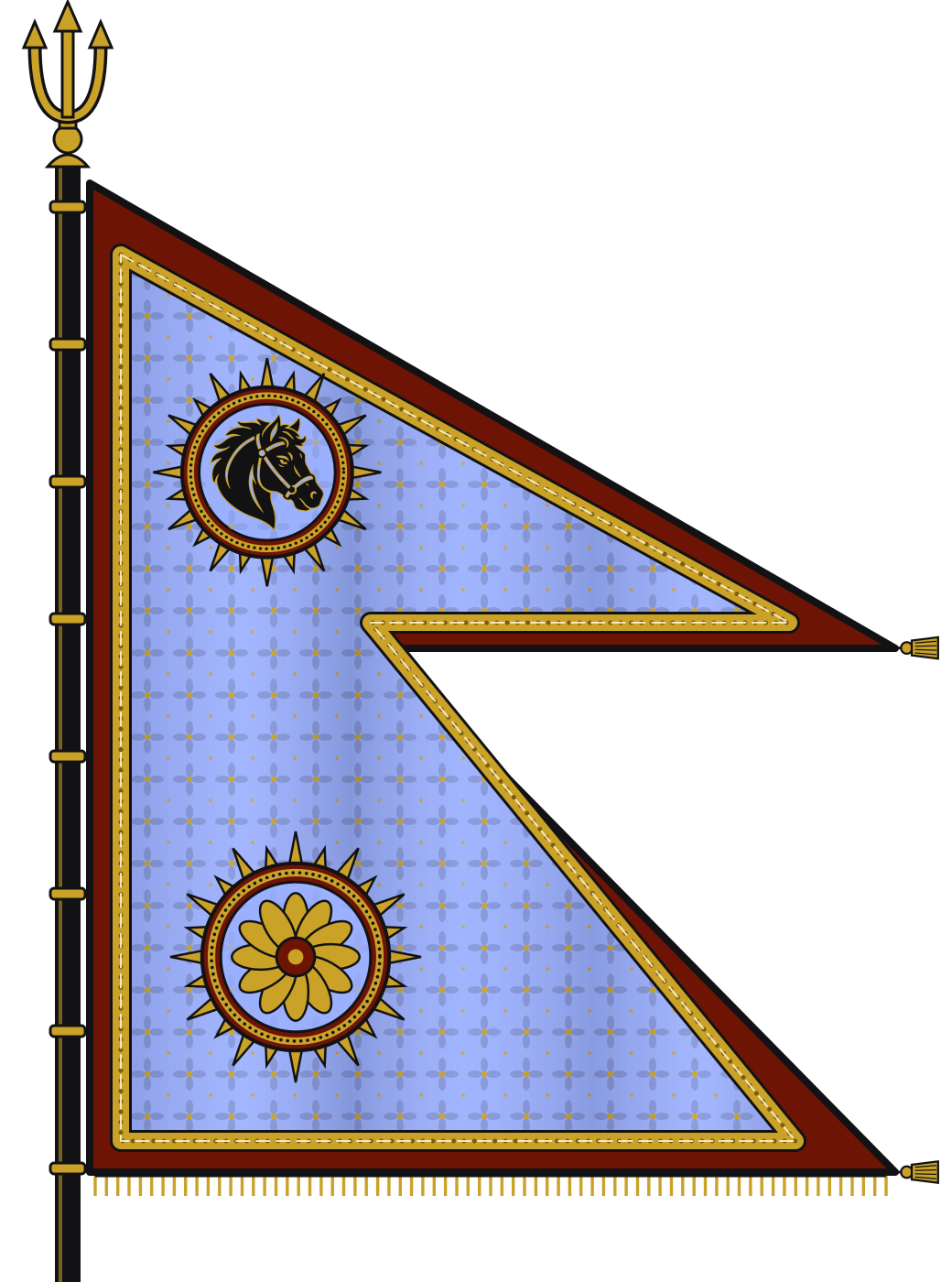
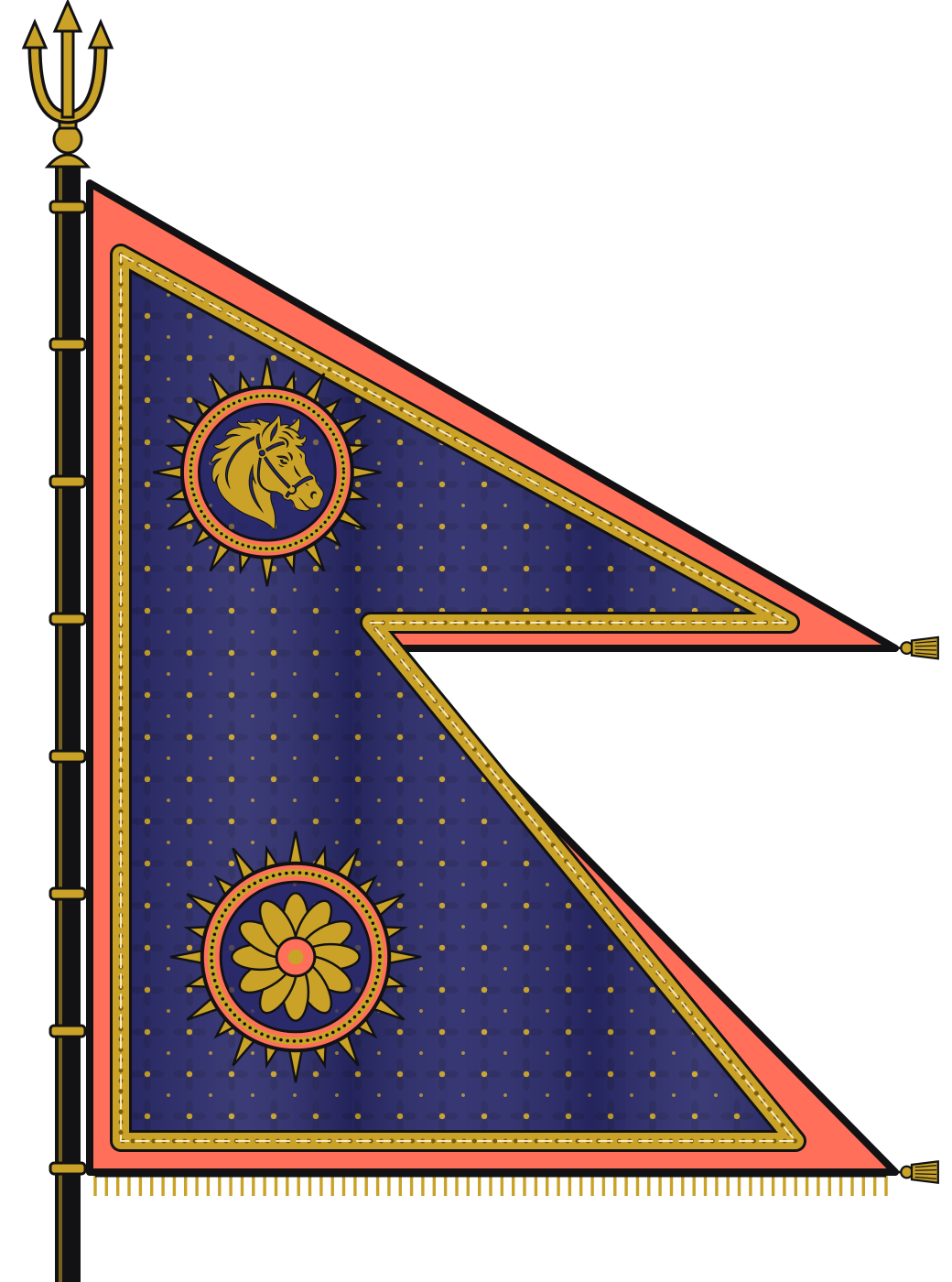


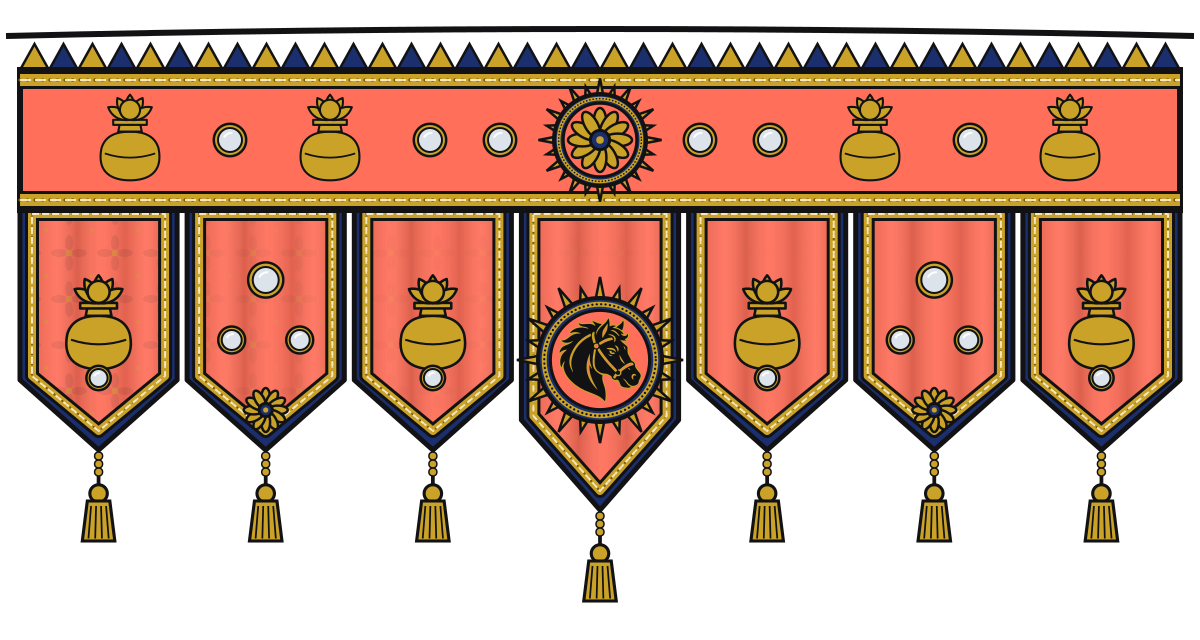
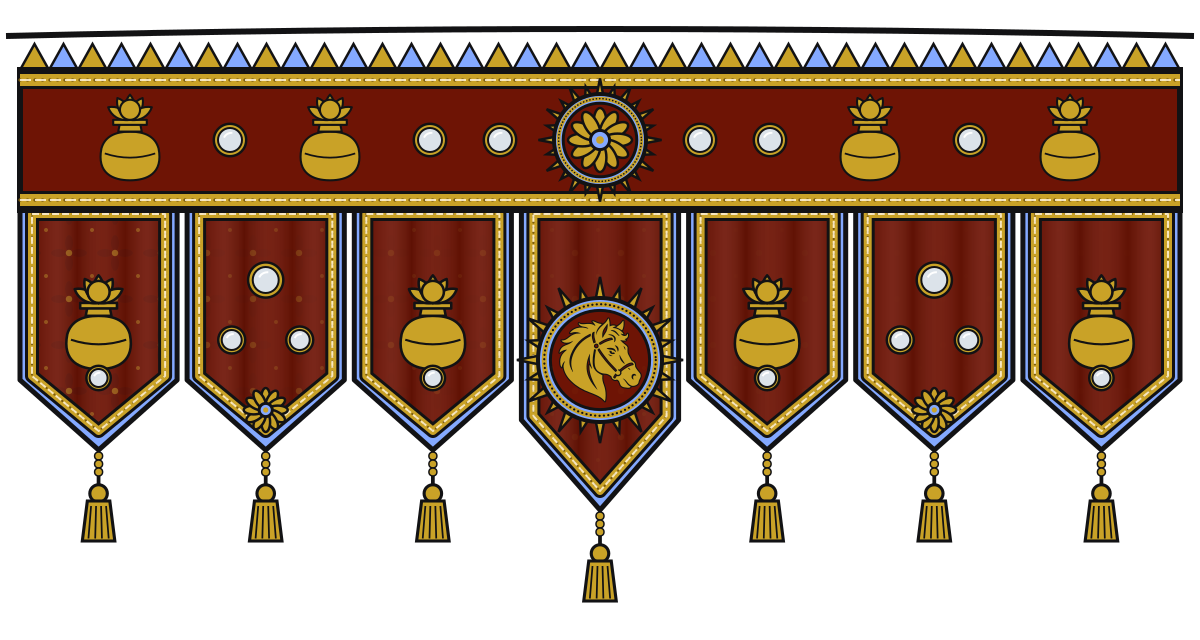
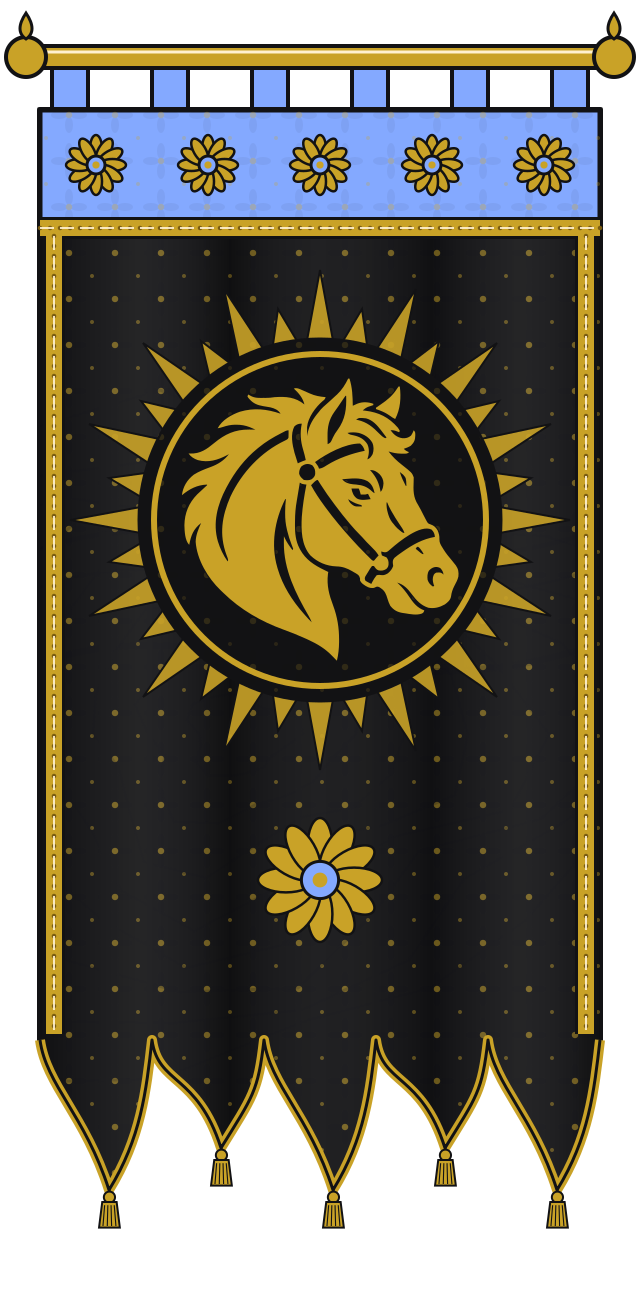
Historic banner
None known
New flag types
| Accessory | For this clan | Basis |
|---|---|---|
| A9 Pota-dhvaja · ship and trade flag For ships, caravans and markets | Not yet designed for this clan | Design |
| A10 Utsava-patāka · festival flag Light, bright flag for fairs and festivals | Not yet designed for this clan | Design |
| A11 Shoka-dhvaja · mourning flag White cloth with the emblem outline in the clan's metal | Not yet designed for this clan | Design |
7. Regalia
| Accessory | For this clan | Basis |
|---|---|---|
| E1 Chhatra · house parasol The ceremonial umbrella | Not yet designed for this clan | Design |
| E2 Chamara · fly-whisks The pair of whisks beside the head of the house | Not yet designed for this clan | Design |
| E3 Danda · staff of office Staff or scepter | Not yet designed for this clan | Design |
| E4 Simhasana · seat The seat of the house, covered in clan cloth | Not yet designed for this clan | Design |
| E5 Khetaka · shield A round shield; the Changi and Dhanush are its flag forms | Not yet designed for this clan | Regional tradition |
| E6 Kula-ayudha · clan weapon The weapon the clan honours | Not yet found for this clan | Under research |
8. Worn
| Accessory | For this clan | Basis |
|---|---|---|
| F1 Kula-vastra · clan cloth The clan's woven pattern in its kit colours | Not yet designed for this clan | Design |
| F2 Kirti-vastra · honour cloth A cloth earned for a deed, not inherited | Not yet designed for this clan | Design |
| F3 Kula-mala · garland flower The flower or leaf the clan wears as a garland | Not yet found for this clan | Under research |
| F4 Chinha · house pin A metal badge with the pin emblem | Not yet designed for this clan | Design |
9. Records
| Accessory | For this clan | Basis |
|---|---|---|
| H1 Clan words A traditional line in the native script | काम्बोज · “Kamboja” The people's own name in Sanskrit, as the Mahabharata and Puranas write it[5]. No line of the Kambojas' own words is sourced; this is not a motto. | Design |
| H2 Biruda · titles The house's title or titles | The 'Kambojan king' form in Panini 4.1.175, cited as a grammar example. No royal title or regnal name is sourced. | Documented |
| H3 Prashasti · praise genealogy The lineage as written at the head of a grant | Not yet found for this clan | Under research |
| H4 Vahi · clan register The book of the clan's births, marriages and deaths | Not yet found for this clan | Under research |
| H5 Rana-ghosha · war cry The clan's cry in battle or celebration | Not yet found for this clan | Under research |
10. VishwaVit · knower of the world
Game values are design choices for this project, not historical claims.
References
- Rudiger Schmitt, "Kamboja", Encyclopaedia Iranica (3 March 2021, updated 21 May 2021), read 2026-10-20, https://www.iranicaonline.org/articles/kamboja/
- Edicts of Ashoka (Wikipedia, read 2026-10-10), citing Hultzsch, Dhammika, Thapar, Olivelle and others.
- G. P. Malalasekera, Dictionary of Pali Proper Names, Kamboja entry (palikanon.com copy), read 2026-10-20, https://palikanon.com/namen/ka/kamboja.htm
- Wikipedia, Kambojas, read 2026-10-20, https://en.wikipedia.org/wiki/Kambojas
- Wisdomlib, Kamboja (14 glossary definitions), read 2026-10-20, https://www.wisdomlib.org/definition/kamboja
- New World Encyclopedia, Yona (adapted from Wikipedia, CC BY-SA 3.0), read 2026-10-18, https://www.newworldencyclopedia.org/entry/Yona
- Gandhara (Wikipedia, snapshot of 24 May 2022, read 2026-10-09), citing Macdonell and Keith (1912), Al-Biruni (tr. Sachau 1910), Watters (1904), Salomon (1998), Neelis (2010), Behrendt (2007), Srinivasan (2008), Blurton (1993), Upinder Singh (2017) and Narasimhan et al. (2019).
- Wikipedia, Mathura lion capital, read 2026-10-19, https://en.wikipedia.org/wiki/Mathura_lion_capital
- Wikipedia, Indo-Scythian Kingdom, read 2026-10-19, https://en.wikipedia.org/wiki/Indo-Scythian_Kingdom
- Wikipedia, Pahlavas, read 2026-10-20, https://en.wikipedia.org/wiki/Pahlavas
- R. C. Hazra, article on the Agneya-purana (Part II), wilbourhall.org, read 2026-10-11, https://wilbourhall.org/sansknet/general/ourheritage/Agneya.htm
- Wikipedia, A Glossary of the Tribes and Castes of the Punjab and North-West Frontier Province (H. A. Rose, 1911-1919), read 2026-10-20, link