The Kamar are a forest people of central India. In 1903 G. F. D'Penha gave about 7,000 of them in scattered forests in the south-eastern corner of Raipur district[1]. Russell and Hira Lal described them in 1916 as a small tribe with a few septs bearing Gond sept names, probably an offshoot of the Gonds, and recorded a legend of a Kamar ruler of Bindranawagarh[2]. Their known craft is basketry in bamboo and cane[3][4]. In 2023 Chhattisgarh recognised habitat rights over 22 Kamar settlements in Dhamtari, as a Particularly Vulnerable Tribal Group[5][4]. Their language is Kamar, classed as Indo-Aryan, with about 40,000 native speakers recorded in 2003[6].
01Faith and deities
Russell names Dulha Deo first among the deities the Kamar worship, with Devi[2]. The extract does not call him the chief god, so the main deity is shown on that basis only.
Mahamaya of Ratanpur, goddess of Chhattisgarh
The presiding goddess of the clan's homeland or capital: a link of place, not a recorded clan tie.
| Deity or tradition | Place in the clan's life | Evidence |
|---|---|---|
| Dulha Deo | Worshipped with Devi[2] | [2] |
| Devi | Worshipped with Dulha Deo[2] | [2] |
| Mahadeo | Story of a flood: a jackal, twelve years, a log carrying two children[2] | [2] |
| Forest god | A head is offered to the forest god (Russell)[2] | [2] |
| Water goddess | Five chickens are offered before fishing[2] | [2] |
| Durga Mata, goddess of smallpox | Iron is venerated as her emblem; on Hareli and Dasahra iron implements are washed and worshipped with rice, flowers and incense[2] | [2] |
| Mother earth, gods and ancestors | Liquor is poured as a libation[2] | [2] |
| Supreme God | Religion propitiatory, with a Supreme God (name not given)[1] | [1] |
| Jhakur, the priest | Hereditary priest; about 30 per cent of men are jhakurs; a village priest is consulted before hunting[1][2] | [1] |
| Sacrifice of goats | Goats are sacrificed in sickness, at betrothal and at marriage[1] | [1] |
02Temples
No temple or shrine of the Kamar is named in the extracts. The KulDevi shown above is from the Atlas (homeland shrine), not from a web source.
Built by the clan
Not recorded.
Given patronage or grants by the clan
Not recorded.
03Languages and scripts
| Language or script | Kind | Under the clan | Evidence |
|---|---|---|---|
| Kamar living | Language; Indo-Aryan, Halbic branch (ISO 639-3 keq) | Spoken in Madhya Pradesh and Chhattisgarh; about 40,000 native speakers, 2003 | [6] |
| Speech of 1903 | Observed mix of languages | D'Penha found much Marathi and some Urdu, and no resemblance to Gondi[1] | [1] |
04Books and literature
The extracts name no book by the Kamar. The main monograph is Dube (1951); its text is not readable online.
Written during the clan's history
| Work | Author | Kind | When | Link to the clan |
|---|---|---|---|---|
| The Tribes and Castes of the Central Provinces of India | R. V. Russell and Hira Lal | Ethnography; Kamar entry in vol. 3 | 1916 | [2] |
| Notes on the Kamars of the Raipur District | G. F. D'Penha | Article, Indian Antiquary vol. 32 | 1903 | [1] |
| The Kamar | S. C. Dube | Monograph | 1951 (3rd edn OUP 2012) | [7] |
| Exchange and reciprocity in Kamar tribe | B. M. Mukherjee and N. Khatua | Article, Man in India 78(3-4) | 1998 | [8] |
Given patronage by the clan
Not recorded.
05Thinkers and scholars
| Name | Field | Era | Contribution |
|---|---|---|---|
| G. F. D'Penha | Ethnographic notes | 1903 | Notes on the Kamars of the Raipur District[1] |
| R. V. Russell and Hira Lal | Ethnography (castes and tribes) | 1916 | Kamar entry, vol. 3[2] |
| S. C. Dube | Monograph on the Kamar | 1951 | The Kamar[7] |
| Ball | Observer, quoted by Russell | 1876 | Account of cave-dwelling Kamars, as quoted[2] |
Mukherjee and Khatua (1998) wrote on exchange and reciprocity among the Kamar (bibliography only; text not read).
06Art and architecture
No painting, sculpture or architecture is recorded for the Kamar in the extracts. Their known craft is in bamboo and cane.
Painting and wall art
Not recorded.
Sculpture and temple art
Not recorded.
Temple and building architecture
Not recorded.
Weaving and textiles
Not recorded.
Clothing and jewellery
Not recorded.
Coins, pottery and crafts
| Art form | What it is | Era | Evidence |
|---|---|---|---|
| Bamboo and cane baskets living | Baskets, fish traps, mats, mouse and bird traps[3]; cane baskets woven today by Indra Bai[4] | Recorded from 1916; living in 2023 | [3][4] |
07History
Recorded in print, 1876 to 1903
Ball's account of 1876, quoted by Russell, describes cave-dwelling Kamars[2].
D'Penha in 1903 found about 7,000 Kamars in scattered forests in the south-eastern corner of Raipur district. He noted that their ethnological position was unclear: they resemble the Gonds, their legendary origin points to the Gonds, and their speech has much Marathi and some Urdu with no resemblance to Gondi. He also noted that the 1891 Census wrongly called them former metal-workers[1].
The legend of Bindranawagarh
Russell records that a Kamar was once the original ruler of Bindranawagarh. In the story the Kamars killed a tame hawking bird of a foreigner from Delhi, who brought man-eating soldiers called Aghori. The soldiers ate all but a pregnant widow, who took refuge in a Brahman's hut in Patna. Her son Kachra-Dhurwa (rubbish and dust) cut off the head of an iron goat with a bamboo stick, slew the soldiers and regained Bindranawagarh. Lime-encrusted fossil heaps are shown as the soldiers' bones[2].
Russell says the Kamar had no tradition of metalworking and were probably an offshoot of the Gonds[2].
1916 and the twentieth century
Russell gives the Kamar of Raipur district as about 7,000 in 1911, mainly in the Khariar and Bindranawagarh zamindaris[2].
2023: habitat rights
On 9 August 2023, World Tribal Day, Chhattisgarh recognised the habitat rights of the Kamar PVTG in 22 settlements of Magarlod block, Dhamtari, under the Forest Rights Act 2006. Officials called it the first PVTG in the state to receive them, and Chhattisgarh the second state after Madhya Pradesh[5][4].
08Journey and migrations
The sources record no migration story. The Kamar are placed in Raipur district in 1903 and 1916; the districts named today are Gariaband and Dhamtari.
Not recorded.
09Seats and lands
| Place | Role | Where today |
|---|---|---|
| Bindranawagarh | Legendary seat of a Kamar ruler; a zamindari in Raipur district in 1916 | Under research |
| Khariar zamindari | Where many Kamar lived, mainly, in 1911 (Russell) | Under research |
| South-eastern Raipur district | Scattered forests where about 7,000 Kamars lived in 1903 (D'Penha) | Gariaband and Dhamtari (Vajiram and Ravi) |
| Magarlod block, Dhamtari | 22 Kamar settlements with habitat rights from 2023 | Dhamtari district, Chhattisgarh |
| Pali sub-habitats | Territory divided into Pali, each of several para or tola (2023) | Dhamtari, Gariyaband, Mahasamund and Kanker (UNDP) |
10Notable figures
| Name | Role | Era | Known from |
|---|---|---|---|
| Kachra-Dhurwa legend | Son of the widow; slew the Aghori soldiers and regained Bindranawagarh | Legend, no date | [2] |
| An unnamed Kamar ruler of Bindranawagarh legend | Original ruler of Bindranawagarh (Russell) | Legend, no date | [2] |
| Indra Bai | Kamar member who weaves cane baskets; said the rights would give her people legal rights to their land | 2023 | [4] |
11Allies, rivals and marriages
| People | Relationship | When |
|---|---|---|
| Gonds (parent people) | Kamar are probably an offshoot of the Gonds (Russell). Gonds are regarded as superiors though closely related: men eat with Gonds, women only with Kamars (D'Penha) | 1903; 1916 |
| Bhunjia | Only Kamars accept food from Bhunjias (Russell 1916, Bhunjia article)[9] | 1916 |
| Chinda Bhunjia | In a Bhunjia-article tradition a Kamar ruler of Bindranawagarh was dispossessed by the Chinda. The Kamar text itself does not mention it; not checked in this run | Legend |
12Society and livelihood
The Kamar were forest people: small jhuming plots, forest produce bartered, bow hunting and bamboo baskets (D'Penha 1903; Russell 1916).
Government and social order
| Institution or group | What it was | Evidence |
|---|---|---|
| Divisions Nag and Netam | Two exogamous divisions, said to come from a cobra and a tortoise. A Nag must marry a Netam; marriage within a division means expulsion[1] | [1] |
| Subdivisions Bundhrajia and Makadia | Russell names two subdivisions; Makadia eat monkeys and are looked down on[2] | [2] |
| Marriage | Sept exogamy; cross-cousin and sister's-son marriage favoured; a service-bridegroom (lamsena) is mentioned in inheritance[2] | [2] |
| Pali and para or tola | Territory divided into Pali, each of several para or tola; each para or tola has a traditional leader (Mukhdihvar), each Pali a leader (Mudadaar)[5] | [5] |
Livelihood over time
| Era | Livelihood | Evidence |
|---|---|---|
| 1903 | Small jhuming plots; forest produce (lac, myrabolams, mahua wax, honey, roots) bartered; hunting with bows and arrows[1] | [1] |
| 1916 | Formerly dahya cultivation; now bamboo baskets[2] | [2] |
| Today (undated) | Bamboo baskets, fish traps, mats, mouse and bird traps[3]; cane baskets woven by Indra Bai (2023)[4] | [3] |
13Sub-clans and related clans
The sources name two subdivisions (Bundhrajia and Makadia), two divisions (Nag and Netam, exogamous), a parent people (Gonds) and a related Bhunjia division (Chinda). Russell also says a few septs bear Gond sept names; they are not listed.
| Clan | Relation | Where | Size | In the Atlas | Evidence |
|---|---|---|---|---|---|
| Bundhrajia | Sub-clan | One of the two subdivisions (Russell 1916) | new clan candidate | [2] | |
| Makadia | Sub-clan | The other subdivision; its people eat monkeys and are looked down on (Russell 1916) | new clan candidate | [2] | |
| Nag | Sub-clan | Division; the origin story has it from a cobra (nag). A Nag must marry a Netam (D'Penha 1903) | same name as ST-476: check | [1] | |
| Netam | Sub-clan | Division; from a tortoise (metam) in the origin story (D'Penha 1903). The same name is a Gond sept (Russell) | same name as ST-480: check | [1] | |
| Gond | Parent people | Probable parent people (Russell 1916) | ST-088 | [2] | |
| Bhunjia | Related people | Food-sharing: only Kamars accept food from Bhunjias (Russell 1916) | ST-034 | [9] | |
| Chinda Bhunjia | Related people | A division of the Bhunjia; named in the legend of the Kamar ruler of Bindranawagarh (Russell 1916, vol 2) | new clan candidate | [9] |
Clans marked "new clan candidate" are not in the Atlas yet.
14Surnames
Not recorded.
15Songs and music
No Kamar song is named in the extracts read for this page.
None recorded yet.
16Poems, lullabies and children's rhymes
None recorded yet.
17Stories, legends and proverbs
Stories and legends
| Story | What happens | Told by | Evidence |
|---|---|---|---|
| The western sea legend | The sea in the far west gave birth first to a Gond, then to a cobra, then to a tortoise; the Nag and Netam divisions come from the cobra and the tortoise | Kamar, as recorded by D'Penha | [1] |
| Kachra-Dhurwa and Bindranawagarh legend | A Kamar ruler; a foreigner's man-eating Aghori soldiers; the widow's son slays them and regains the seat; lime-encrusted heaps are shown as their bones | Kamar, as recorded by Russell | [2] |
| Mahadeo's flood legend | A flood story of a jackal, twelve years and a log with two children | Kamar, as recorded by Russell | [2] |
Proverbs and sayings
Not recorded.
18Festivals and fairs
| Festival or fair | When | Where | What happens |
|---|---|---|---|
| Hareli | Date not given | Not stated | Iron implements washed and worshipped with rice, flowers and incense[2] |
| Dasahra | Date not given | Not stated | Iron implements washed and worshipped as at Hareli[2] |
| Chathi | Sixth day after birth | Not stated | A sixth-day ceremony; the extract gives no details[2] |
| Funeral rite (dund) | At burial | Not stated | After burial the tribe wades into water, gathers living frogs, fish and prawns and throws them on the floor of the dead person's house to draw back the soul; the soul may become a Kamar, tiger, wild dog or other hunting form[1] |
19Food, dress and games
Food
| Item | What it is | Evidence |
|---|---|---|
| Forbidden foods | The Kamar do not eat vermin, monkeys or domestic cattle; women also avoid fowl[1] | [1] |
| Drink | Women drink only water; men drink strong spirits[1] | [1] |
Dress
| Item | What it is | Evidence |
|---|---|---|
| Women's tattoos | Peacock, scorpion and fly-dot designs[2] | [2] |
| Men's hair | Long and sacred; shaved on the death of the father[2] | [2] |
Games and martial arts
Not recorded.
Tags: living still practised · revived brought back after a break · lost known only from records · research reported but not yet confirmed from a source. Songs and poems under copyright are listed by title only; restricted or sacred material is noted without its content.
20Status today
The Kamar are a Scheduled Tribe and PVTG (list dated 09-07-2024, Atlas), living in Chhattisgarh, Madhya Pradesh and Maharashtra[10][11]. In 2023 Chhattisgarh recognised habitat rights for their settlements in Dhamtari[5].
Who carries the name today
| Community | Link | Basis | Evidence |
|---|---|---|---|
| Kamar communities of Chhattisgarh, Madhya Pradesh and Maharashtra (ST-117) | Documented | [5] |
Recognised heritage
| What | Recognition | Evidence |
|---|---|---|
| Habitat rights, 22 Kamar settlements, Magarlod block, Dhamtari (Forest Rights Act 2006) | Recognised by Chhattisgarh on 9 August 2023 | [4] |
| Particularly Vulnerable Tribal Group (PVTG) | One of 75 PVTGs recognised by the Government of India (UNDP, 2023) | [4] |
Not yet reviewed by the Kamar community. The only Kamar voice in the extracts is Indra Bai, quoted by UNDP on the 2023 habitat rights[4].
21For children
Baskets from the forest
In the forests of central India live the Kamar. By 1916 they had turned to bamboo baskets, and today they also make mats and traps from bamboo. They gather lac, honey, mahua wax and roots from the forest to barter. Before they go fishing, they make an offering of five chickens to a water goddess. A story says that a Kamar once ruled a town called Bindranawagarh. In 2023 the Kamar of Dhamtari district were given rights over their forest homes under the Forest Rights Act.
22Across the project
| Project | What carries this clan | Status |
|---|---|---|
| Atlas of the Janas | Districts only in the sources: Raipur (1903, 1916), Gariaband and Dhamtari (today). No pin set | To check |
| KulDevi and GrahDevi | Mahamaya, KulDevi from the Atlas (homeland shrine) | From the Atlas |
| Planet naming | Not in the extracts | — |
| Renaming and waters | The water goddess is invoked before fishing (Russell 1916); no place name drawn from the Kamar yet | — |
23Open questions
- The native-script name (कमार, Devanagari) is in the pack, but no fetched source prints it. It is left out until a source does.
- No native-script words, songs, sayings or proverbs are in the extracts. The clan words are an English 1916 line, marked illustrative.
- Sept names with Gond-like forms are not listed. Dube (1951) is the main monograph; the OUP page shows only the foreword. Read it for sept names, surnames, songs, rhymes and sayings.
- The food-sharing claim and the Chinda tradition (Russell vol. 2, Bhunjia article) come from the Bhunjia codex notes and are not re-read in this run.
- Affiliation differs: Russell calls the tribe Dravidian (a label for the tribe, not a claim about its language); Wikipedia classes the language Indo-Aryan (Halbic); D'Penha found Marathi and Urdu in its speech. The sources do not agree.
- The 26,630 figure is quoted by Telangana Today (2023) from Shammi Abidi; it is not checked against census tables. The 7,000 counts of 1903 and 1911 are for Raipur district only.
- Area: the sources give districts only; no footprints file was written in this run.
- Wikipedia 'Kamar (caste)' is the Odisha blacksmith caste, not this tribe, and is not used.
- Community review of this page is still needed.
24Astitva
अस्तित्व · being, existence: everything by which the clan is known
The sources record bows and arrows, bamboo baskets, women's tattoos and the iron emblem of Durga Mata. No seal, coin, title, flag, sound or war cry is recorded[2].
Every clan has every accessory, royal objects included. Each one says how it is known: Documented This clan's own object is recorded. · Regional tradition Recorded for the region or for peoples like this one, not for this clan. · Design Made for this project, with no historical claim. · Under research To be found for this clan from sources. Legends and titles are written in the clan's own script.
1. Seals and coins
| Accessory | For this clan | Basis |
|---|---|---|
| B1 Rajamudra · house seal Round seal with the clan emblem and a short legend in the clan's script | Not yet designed for this clan | Design |
| B2 Anguliya-mudra · signet ring Personal seal ring of the head of the house | Not yet designed for this clan | Design |
| B3 Chhapa · house stamp Ink or block stamp for letters, goods and cloth | Not yet designed for this clan | Design |
| B4 Tamrapatra · charter plate Copper-plate grant on a ring, closed with the house seal | Not yet designed for this clan | Design |
| B5 Shreni-mudra · guild or trade seal Seal for the clan's trade, craft or caravan | Not yet designed for this clan | Design |
| C1 Clan coin Emblem or deity on one side, a legend in the clan's script | Not yet designed for this clan | Design |
| C2 Coin die The die that strikes the coin | Not yet designed for this clan | Design |
2. Living symbols
| Accessory | For this clan | Basis |
|---|---|---|
| I1 Totem trio The tree, bird and animal the clan protects | Not yet found for this clan | Under research |
| I2 Kaval-maram · guardian tree The tree that stands at the clan's seat | Not yet found for this clan | Under research |
3. Stone and gate
| Accessory | For this clan | Basis |
|---|---|---|
| G1 Torana · gateway The built gate of the seat; the cloth Toran hangs in it | Not yet designed for this clan | Regional tradition |
| G2 Viragallu · hero stone Carved panel stone for a member who died defending the clan | Not yet designed for this clan | Regional tradition |
| G3 Kula-shila · clan stones Standing and table stones that remember the ancestors | Not yet designed for this clan | Design |
| G4 Jayastambha · victory pillar A pillar raised for a victory | Not yet designed for this clan | Design |
| G5 Sima-shila · boundary stone Marks the clan's land, with a line in the native script | Not yet designed for this clan | Design |
4. Sounds
| Accessory | For this clan | Basis |
|---|---|---|
| D1 Pancha-mahashabda · five great sounds The right to five instruments | Not yet designed for this clan | Design |
| D2 Shankha · clan conch The clan's own named war conch | Not yet designed for this clan | Design |
| D3 Murasu · house drums Three drums: war, charity and justice | Not yet designed for this clan | Design |
5. Kit: colours, metals and emblems
No coat of arms is recorded for the Kamar. The emblem the extracts give is iron, venerated as the emblem of Durga Mata[2].
| Part of the kit | This clan |
|---|---|
| Field | Deep Brick #7E2A1E |
| Accent | Deep Cosmic Blue #9BB0FF |
| Emblem colour | Metallic Gold #C9A227 |
| Zari metal | Gold |
| Main emblem | Woven bamboo baskets |
| Second image | — |
| Night and day | Every visual accessory has two versions: by night the emblem on the dark field, by day the clan's field colour on cloth woven from its metal. |
6. Flags
Every clan has every flag type; the type says the occasion and the colours say the clan. The outlined card is the flag the Atlas assigns.
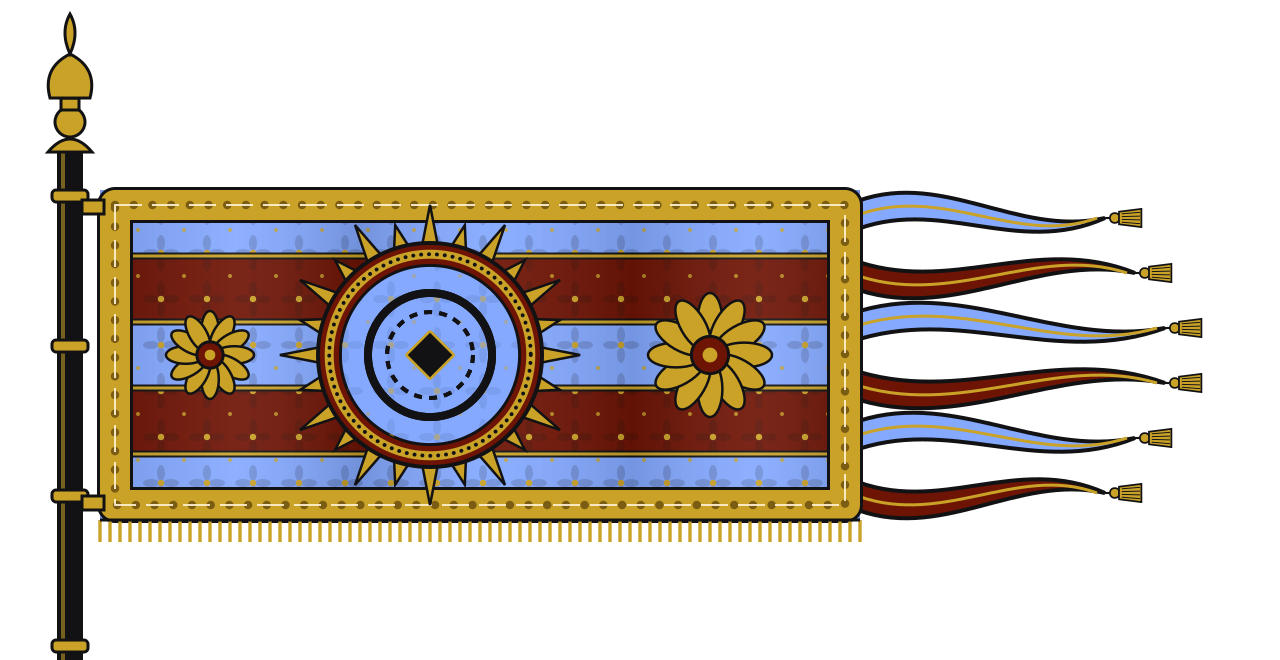
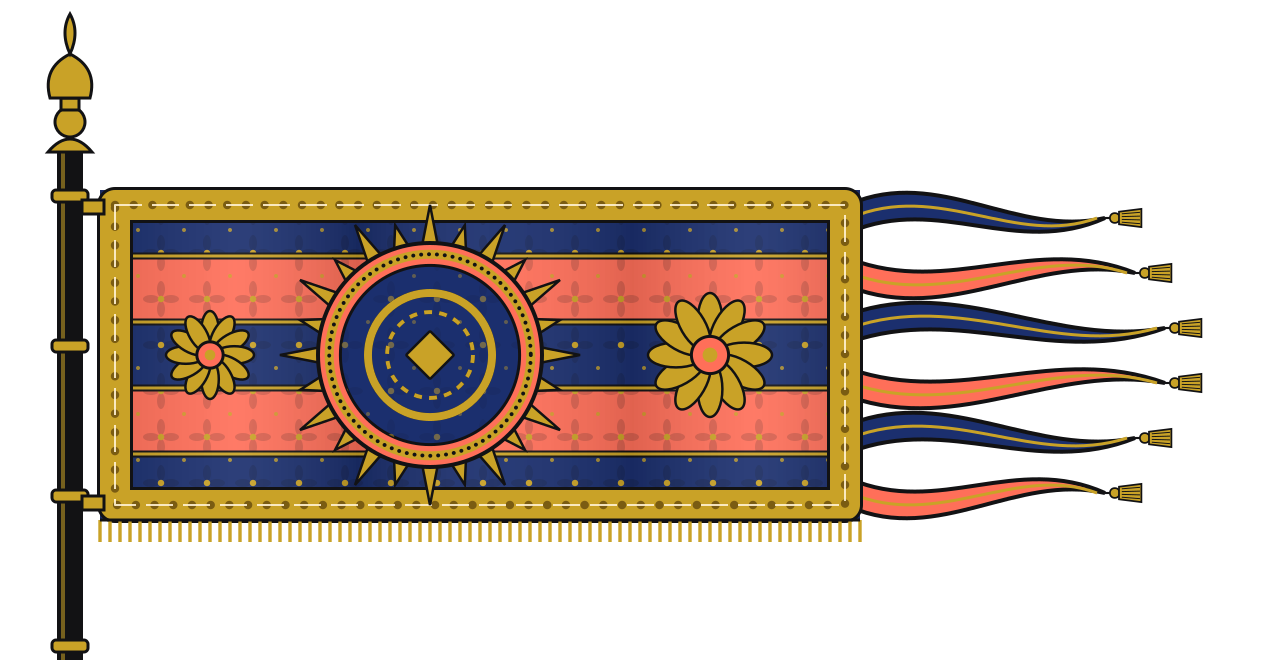
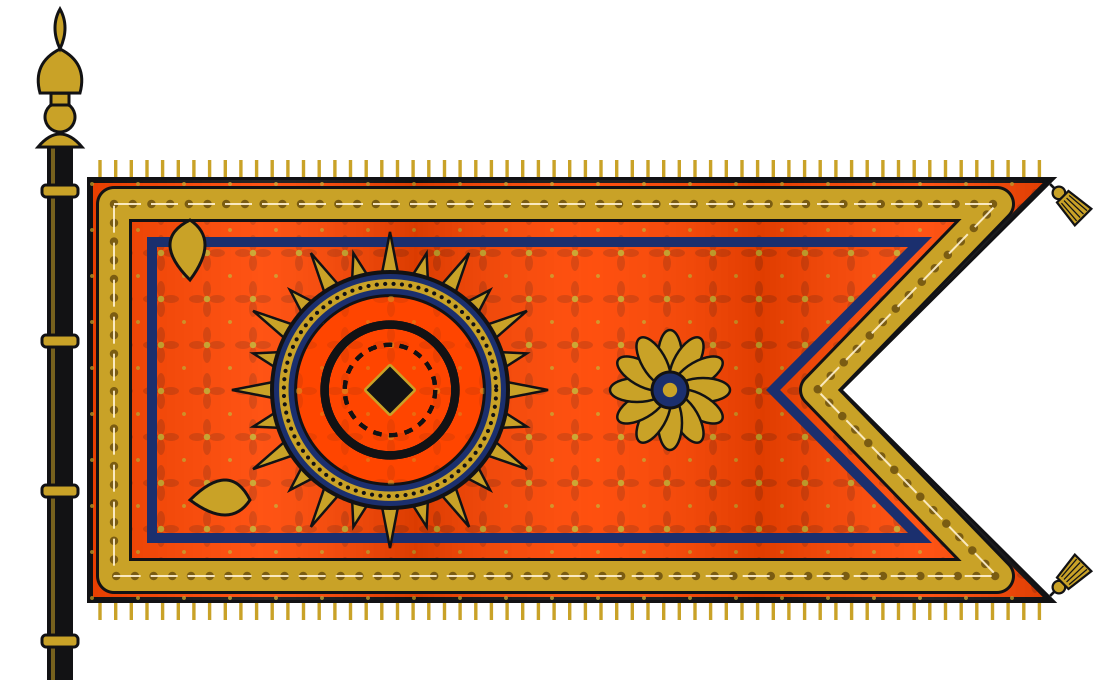
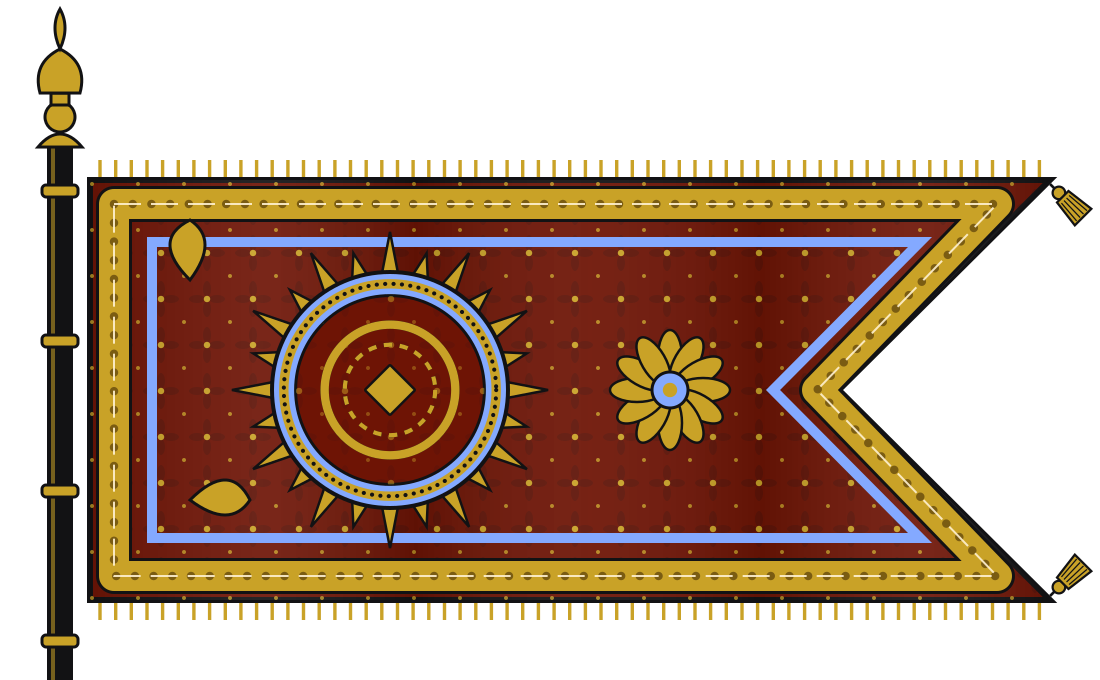

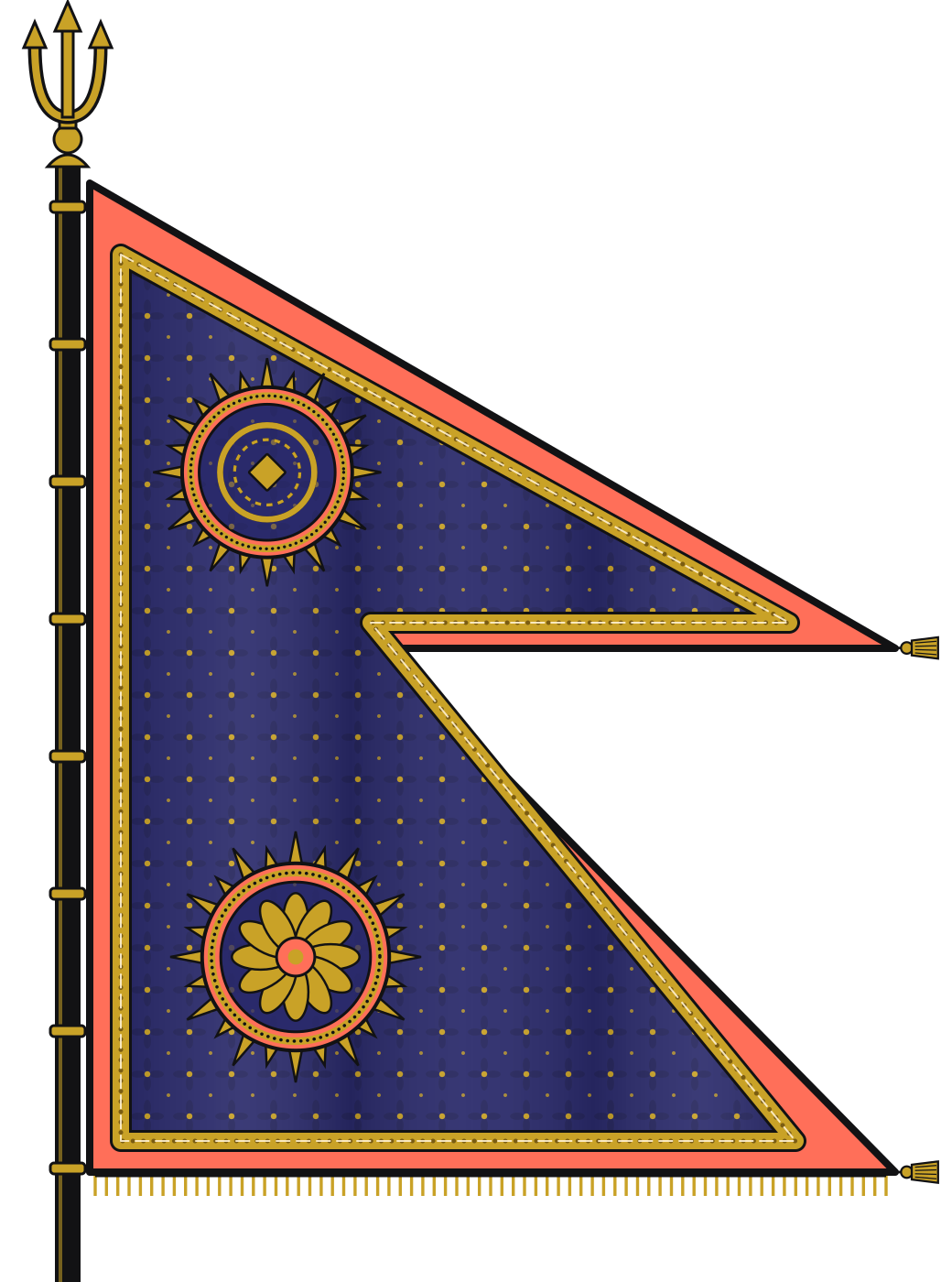

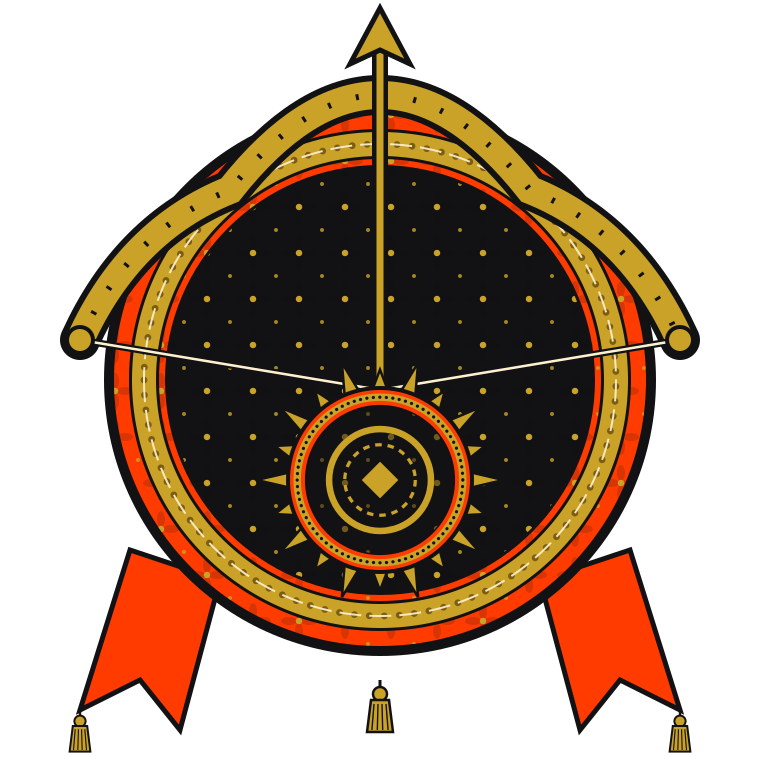
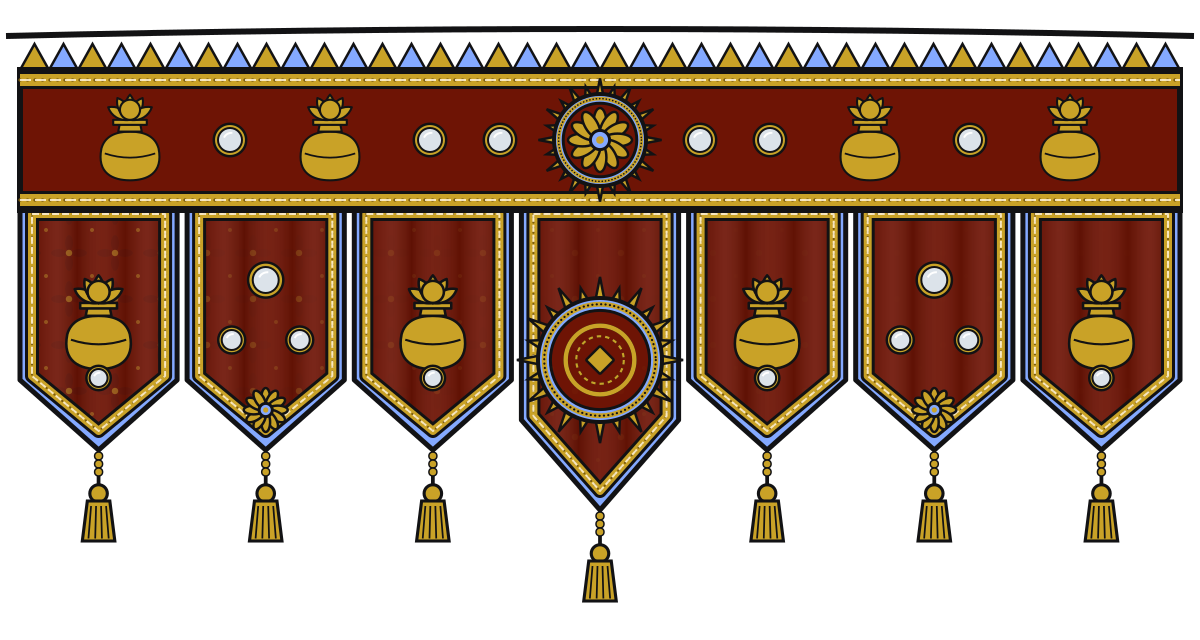

Historic banner
None known
New flag types
| Accessory | For this clan | Basis |
|---|---|---|
| A9 Pota-dhvaja · ship and trade flag For ships, caravans and markets | Not yet designed for this clan | Design |
| A10 Utsava-patāka · festival flag Light, bright flag for fairs and festivals | Not yet designed for this clan | Design |
| A11 Shoka-dhvaja · mourning flag White cloth with the emblem outline in the clan's metal | Not yet designed for this clan | Design |
7. Regalia
| Accessory | For this clan | Basis |
|---|---|---|
| E1 Chhatra · house parasol The ceremonial umbrella | Not yet designed for this clan | Design |
| E2 Chamara · fly-whisks The pair of whisks beside the head of the house | Not yet designed for this clan | Design |
| E3 Danda · staff of office Staff or scepter | Not yet designed for this clan | Design |
| E4 Simhasana · seat The seat of the house, covered in clan cloth | Not yet designed for this clan | Design |
| E5 Khetaka · shield A round shield; the Changi and Dhanush are its flag forms | Not yet designed for this clan | Regional tradition |
| E6 Kula-ayudha · clan weapon The weapon the clan honours | Bows and arrows: the Kamar hunt with them; the sources do not say they are honoured as the clan weapon | Regional tradition |
8. Worn
| Accessory | For this clan | Basis |
|---|---|---|
| F1 Kula-vastra · clan cloth The clan's woven pattern in its kit colours | Not yet designed for this clan | Design |
| F2 Kirti-vastra · honour cloth A cloth earned for a deed, not inherited | Not yet designed for this clan | Design |
| F3 Kula-mala · garland flower The flower or leaf the clan wears as a garland | Not yet found for this clan | Under research |
| F4 Chinha · house pin A metal badge with the pin emblem | Not yet designed for this clan | Design |
9. Records
| Accessory | For this clan | Basis |
|---|---|---|
| H1 Clan words A traditional line in the native script | They worship Dulha Deo and Devi · “English original; no native-script line is in the sources read” An outsider's note on Kamar worship, Russell 1916, not a Kamar saying[2] | Design |
| H2 Biruda · titles The house's title or titles | Not yet found for this clan | Under research |
| H3 Prashasti · praise genealogy The lineage as written at the head of a grant | Not yet found for this clan | Under research |
| H4 Vahi · clan register The book of the clan's births, marriages and deaths | Not yet found for this clan | Under research |
| H5 Rana-ghosha · war cry The clan's cry in battle or celebration | Not yet found for this clan | Under research |
10. VishwaVit · knower of the world
Game values are design choices for this project, not historical claims.
References
- G. F. D'Penha, Notes on the Kamars of the Raipur District, Indian Antiquary vol. 32 (March 1903), OCR text, read 2026-11-05, https://jainqq.org/pagetext/Indian_Antiquary_Vol_32/032524/150
- R. V. Russell and Hira Lal, The Tribes and Castes of the Central Provinces of India, vol. 3 (London, 1916), Project Gutenberg eBook #41424, https://www.gutenberg.org/ebooks/41424
- Asia InCH (Craft Revival Trust), Cane and bamboo of Chattisgarh, read 2026-11-05, https://asiainch.org/craft/cane-bamboo-of-chattisgarh/
- Divya Saini and Sreetama Gupta Bhaya, Empowering Particularly Vulnerable Tribal Groups (PVTGs): Recognition of Habitat Rights in Chhattisgarh, UNDP India, 9 Aug 2023, read 2026-11-05, https://www.undp.org/node/412716
- PTI, Chhattisgarh: Tribal group Kamar in Dhamtari district gets habitat rights, Telangana Today, 10 Aug 2023, read 2026-11-05, https://telanganatoday.com/chattisgarh-tribal-group-kamar-in-dhamtari-district-gets-habitat-rights
- Wikipedia, Kamar language, read 2026-11-05, https://en.wikipedia.org/wiki/Kamar_language
- S. C. Dube, The Kamar (1951; 3rd edn, Oxford University Press, 2012), Foreword page only, read 2026-11-05, https://academic.oup.com/book/7647/chapter/152680894
- Thanos Kouravelos, Kamar (bibliography), hgcosmos.org, updated 11/09/2019, read 2026-11-05, https://www.hgcosmos.org/assets/culture/AZ/K/Kamar.pdf
- R. V. Russell and Hira Lal, The Tribes and Castes of the Central Provinces of India, vol. 2 (London, 1916), Project Gutenberg eBook #22010, https://www.gutenberg.org/ebooks/22010
- Wikipedia, Tribals in Madhya Pradesh, read 2026-10-19, https://en.wikipedia.org/wiki/Tribals_in_Madhya_Pradesh
- dhammabharat.com, List of Scheduled Tribes in Maharashtra and Population of each Tribe (2011 Census), read 2026-10-10, https://dhammabharat.com/?p=13656