The Kalash live in the Bumburet, Rumbur and Birir valleys of Chitral in Pakistan, and speak Kalasha, an Indo-Aryan (Dardic) language[1][2]. Their traditional faith centres on Dezau, the creator, and a pantheon of gods and spirits[3][4]. The Atlas records a legend that they once ruled Chitral, and the JRSP paper says Rais forces later pushed them into the lower and southern valleys[5]. Where they came from is disputed: Indo-Aryan and Greek origins are both argued[6]. The Kalasha language is endangered, and it is shifting to Khowar[2].
01Faith and deities
Kalash goddess of birth and women
A recorded tie between the clan and the goddess.
| Deity or tradition | Place in the clan's life | Evidence |
|---|---|---|
| Imra (Yama Rajan) | Lord of the nether world and of heaven; an Imra stone stands in a cedar tree | [1][3] |
| Indr (Varendr, Waren) | Indra-like god of the rainbow and thunder; wine is sacred to Indr | [1] |
| Balumain | Culture hero who taught the winter festival; came from Tsyam; a 'guest god' (Ali 2024) | [1][4] |
| Mahandeo | God of crops and war (Witzel; Jamil 2019, as cited); guardian deity (Ali 2024) | [1][4] |
| Munjem Malek | Lord of the Middle Earth | [1] |
| Jestak | Goddess of home, family and marriage; the Jestak-han is her lodge | [1][4] |
| Dezalik (KulDevi) | Linked to childbirth and the hearth; Simple Wikipedia links her to Dizane (Disani), 'sister of Dezau', with life force and wheat | [3] |
| Sajigor (Shura Verin) | Shrine in Rumbur; stone altars under old trees | [1] |
| Krumai (Shumai) | Lives on Tirich Mir; goddess of childbirth; shrine at Badawan with goat sacrifice | [1][3] |
| Nirmali | Protects women and children in childbirth | [3] |
| Dezau's seven daughters | Safeguard agriculture; goats are sacrificed to them at planting | [3] |
| Saranji | One of the twelve main gods and goddesses, as printed | [3] |
| Suchi and Varoti | Mountain fairies | [1] |
| Jach | Female spirits of the soil and pastures | [1] |
| Sorizan and Goshidai | Pastoral gods | [1] |
| Jestan | Demon-like being | [1] |
| Charmo Vetr | Fairy; a kam makes offerings to her on the Kutaringul stream | [3] |
| Yush | The devil, appeased with bread cakes | [3] |
| Ingaw, Praba and Warin | Named in one source each: Ingaw as a major deity (World History Encyclopedia); Praba and Warin as enigmatic deities (Ali 2024) | [6][4] |
02Temples
Worship happens at village altars, the Jestak-han and shrines in the valleys. Every village has altars (Simple Wikipedia). The sources date none of these buildings.
Built by the clan
| Temple | Deity | Built by | When | Where |
|---|---|---|---|---|
| Jestak-han | Jestak | Each kam | Not dated | Kalash valleys[1] |
| Mahandeo shrines | Mahandeo | Not named | Not dated | Carved wooden shrines with four horse heads[1] |
| Sajigor altars | Sajigor | Not named | Not dated | Rumbur[1] |
| Krumai shrine | Krumai | Not named | Not dated | Badawan[3] |
| Dancing house | Krumai (effigy seen by Robertson) | Not named | Not dated | Presungul[3] |
Given patronage or grants by the clan
Not recorded.
03Languages and scripts
| Language or script | Kind | Under the clan | Evidence |
|---|---|---|---|
| Kalasha living | Indo-Aryan (Dardic); locally Kalasamondr | Spoken in the three valleys; about 7,466 speakers in the 2023 census | [2] |
| Written forms | Arabic and Latin scripts | The name is printed in Arabic script as کالؕاشؕا | [1] |
| Urtsuniwar dialect | Khowar-influenced variety | Adopted by the Southern (Urtsun) Kalash in the 20th century | [2] |
| Khowar and Urdu living | Second languages | Khowar is replacing Kalasha, mostly in the western side valleys; Urdu is also a second language | [1][2] |
| Nuristani 'Kalasha' | A different language (Kalasha-ala, Waigali) | Waygal and middle Pech valleys, Nuristan; distinct from Kalasha | [2] |
04Books and literature
The Kalasha language is endangered (Wikipedia). Most of the works below are by outside scholars; the sources name no book by a Kalash author.
Written during the clan's history
| Work | Author | Kind | When | Link to the clan |
|---|---|---|---|---|
| Indo-Iranian Frontier Languages, vol. IV | Morgenstierne | Language study | 1973 | [2] |
| Kalasha dictionary | Trail and Cooper | Dictionary | 1999 | [2] |
| Kalasha texts (Acta Linguistica Hafniensia 47) | Heegard Petersen | Texts | 2015 | [2] |
| Article in JIPA 51(3) | Kochetov et al. | Journal article | 2021 | [2] |
| Our Women are Free | Maggi | Book | 2001 | [3] |
| The Kafirs of the Hindu Kush | Sir George Scott Robertson, with Arthur David McCormick (illustrator) | Travel account; describes Kafir customs and lineage | 1896 | [7] |
| Thesis on merit feasting | Darling | Thesis | 1979 | [3] |
| The Kalasha Pantheon | Muhammad Kashif Ali | Journal article (abstract read) | 2024 | [4] |
Given patronage by the clan
Not recorded.
05Thinkers and scholars
| Name | Field | Era | Contribution |
|---|---|---|---|
| Witzel | Religion and origins | Not dated | Pre-Vedic and Indo-Iranian elements; the name Dezau from the root 'to form'[1] |
| Morgenstierne | Language and religion | 1929 | Documented priests and shrines[1]; Indo-Aryan origin hypothesis[6] |
| Richard Strand | Religion | Not dated | Pre-Islamic Nuristani religion resembled ancient Hinduism[1] |
| H. W. Bellew | Scholar (as named in the source) | 1834–1892 | Linked the Kalash to the Gandhari[1] |
| Augusto Cacopardo | Origins and the Alexander legend | Not dated | Work on the Alexander legend and the Kalash origins[1] |
| Elena Bashir | Language | Recent | Recent study of the Kalasha language[2] |
| Leitner | Language | 19th century | Early study of the Kalasha language[2] |
| Peter Parkes | Religion and society | Not dated | The onjesta and pragata categories[3]; the Juar Beg refuge[5] |
| Muhammad Kashif Ali | Religion | 2024 | The Kalasha Pantheon[4] |
Each scholar is cited as the sources cite them; their own works were not read except where a reference gives them.
06Art and architecture
The sources describe carved wood: shrines, effigies and coffins. They give no painting from the Kalash.
Painting and wall art
Not recorded.
Sculpture and temple art
| Art form | What it is | Era | Evidence |
|---|---|---|---|
| Carved Mahandeo shrines | Four carved wooden horse heads | Not dated | [1] |
| Wooden effigies | Carved for honoured people | Not dated | [1] |
| Carved wooden coffins | The dead are buried above ground in wooden coffins | Not dated | [1] |
Temple and building architecture
| Art form | What it is | Era | Evidence |
|---|---|---|---|
| Bashali | Village building for menstruating women and new mothers | Not dated | [1] |
| Jestak-han | Each kam's house of the goddess Jestak | Not dated | [1] |
Weaving and textiles
| Art form | What it is | Era | Evidence |
|---|---|---|---|
| Cowrie-embroidered robes | Long black robes embroidered with cowrie shells | Not dated | [1][8] |
Clothing and jewellery
| Art form | What it is | Era | Evidence |
|---|---|---|---|
| Piran | Long black embroidered dress of girls | Not dated | [8] |
Coins, pottery and crafts
Not recorded.
07History
Origins: traditions and hypotheses
The Kalash trace their first homeland to Tsyam, a place whose location is unknown, and a forefather, Shalak Shah, who came from there to Chitral with an army[6]. Another tradition, given by Morgenstierne, places the ancestors in the Waigal valley of Nuristan, or in a Tsiyam near Jalalabad and Lughman[1]. The Wikipedia article says that the claim of descent from Alexander's army has no evidence[1].
Two origin hypotheses are argued: Indo-Aryan (Morgenstierne, Schomberg, Jettmar, Parkes) and Greek (H. Siiger; Loude and Lievre). A 2004 study by Ayub et al. found no Greek origin[6]. A 2003 study by Kivisild et al. disputed a Greek admixture claim[1].
Rais and Katur rule (dated by the 2021 JRSP paper)
The JRSP paper dates the Rais to 1320–1595 and the Katur to 1595–1969[5]. The Wikipedia article dates the Katur from the 18th century and gives Shah Nadir Rais as 1698–1747, as printed[1]. The two sets of dates do not agree; both are set out under open questions.
Under Shah Nasir Rais (1531–1574) the Rais took the Kalasha chiefdoms of Bumburet, Ayun, Jinjeret Kuh, Birir, Shishi Kuh and Rumbur, and their forces pushed the Kalasha into the lower and southern valleys[5]. Shah Mahmood Rais (1574–1595) was the last Rais; Mohtaram Shah and Khushwaqt overthrew him in 1595[5]. The Kalasha backed the Katur against Khushwaqt, and the paper recalls a Kalasha legend of a 'golden period' when 'they were kings'[5].
Chitral rule and the levies
Chitrali society had the classes Adam Zada, Arab Zada and Faqir Miskeen, and the Kalasha were the Mehtar's 'third estate'[5]. The Kalasha owed the levies thangi, qalang and begar, and annual dues of wood, 5–10 kg of honey, 6–12 goats and 10 kg of butter, according to Baig (1994). The qalang was a tax on those who refused conversion. Enslavement sales were recorded at Rs 100–300 (Barrow 1888) until they were abolished in 1895 (Murtaza 1962)[5].
Kafiristan and the Durand Line (1893–1896)
The Durand Line was drawn in 1893. Amir Abdur Rahman attacked Kafiristan in 1895, and the country was renamed Nuristan[5]. Robertson's 1896 book describes the Kafirs of Kafiristan, not the Chitral Kalash in particular[7]. The Wikipedia article says the Nuristani were converted en masse under Abdur Rahman, with no date given[7].
Since the 1940s
The Wikipedia article counts five former Kalash valleys before the 1940s: Jinjeret Kuh, Urtsun, Suwir, Kalkatak and Damel. The last Kalash of Jinjeret Kuh, Mukadar, died in the early 1940s, and Mranzi, the last Urtsun practitioner of the old religion, lived into the 1980s[1].
The article reports 1970s missionary and militant activity, Taliban threats in 2014 and a Supreme Court intervention that followed[1]. In 2017 Wazir Zada became the first Kalasha elected to the Khyber Pakhtunkhwa Provincial Assembly[1]. In November 2019 the Duke and Duchess of Cambridge visited[1].
08Journey and migrations
The Kalash tell of an origin in Tsyam and a move into Chitral. Their valleys later shrank under Chitral rulers, and the places they lived in are not all the same today.
| When | From | To | Why | Evidence |
|---|---|---|---|---|
| Before the records (tradition) | Tsyam (location unknown) | Chitral, with the forefather Shalak Shah | Tradition given through a spokesman, Saifullah Jan | [6] |
| Before the records (tradition) | Waigal valley, Nuristan, or a Tsiyam near Jalalabad and Lughman | The Chitral valleys | Tradition given by Morgenstierne; the sources do not agree on the homeland | [1] |
| Under the Rais (dates in the JRSP paper) | Chiefdoms: Bumburet, Ayun, Jinjeret Kuh, Birir, Shishi Kuh, Rumbur | The lower and southern valleys | Rais forces pushed the Kalasha out of their chiefdoms | [5] |
| Not dated | Rumbur | Bashgal valley, Kafiristan, for about twenty years | Juar Beg and his family fled there, then returned (Parkes 2008, as cited) | [5] |
09Seats and lands
| Place | Role | Where today |
|---|---|---|
| Bumburet (Mumuret) | Kalash valley; villages at about 1,900–2,200 m | Chitral, Khyber Pakhtunkhwa, Pakistan |
| Rumbur (Rukmu) | Kalash valley; the Sajigor shrine stands here | Chitral, Khyber Pakhtunkhwa |
| Birir (Biriu) | Kalash valley; the more traditional of the two cultural areas | Chitral, Khyber Pakhtunkhwa |
| Chitral valley | The JRSP paper says the Kalasha once ruled the whole valley, from the Lowari Pass fringe to Boni and Mastuj | Chitral, Khyber Pakhtunkhwa |
| Former valleys: Jinjeret Kuh, Urtsun, Suwir, Kalkatak, Damel | Kalash valleys before the 1940s (Wikipedia) | Chitral, Khyber Pakhtunkhwa |
| Waygal and middle Pech valleys | Home of the Nuristani 'Kalasha', a language distinct from Kalasha | Nuristan, Afghanistan |
10Notable figures
| Name | Role | Era | Known from |
|---|---|---|---|
| Shalak Shah legend | Forefather who came from Tsyam to Chitral with an army | Tradition | [6] |
| Shah Nadir Rais | Founder of the Rais dynasty (Wikipedia); invaded Chitral (JRSP) | Early 14th c. (JRSP), or 1698–1747 (Wikipedia, as printed) | [1][5] |
| Jan Rais | Rais ruler | 1341–1356 | [5] |
| Khan Rais | Rais ruler | 1356–1420 | [5] |
| Shah Nasir Rais | Rais ruler; took the Kalasha chiefdoms of Bumburet, Ayun, Jinjeret Kuh, Birir, Shishi Kuh and Rumbur | 1531–1574 | [5] |
| Shah Mahmood Rais | Last Rais ruler, overthrown in 1595 | 1574–1595 | [5] |
| Mohtaram Shah | Overthrew the Rais with Khushwaqt; killed by the Kalasha of Kalkatak | 1595; c. 1630 | [5] |
| Sangin Ali-II | Regained Chitral, with Aurangzeb's aid | 1660 | [5] |
| Amanul Mulk | Ruler of Chitral | 1857–1892 | [5] |
| Nizamul Mulk | Killed at Broze | 1 January 1895 | [5] |
| Shujaul Mulk | Ruler of Chitral; a Kalasha dehar is said to have foretold his rule | 1895–1936 | [5] |
| Sindi | Kalasha dehar said to have foretold Shujaul Mulk's rule | Not dated | [5] |
| Bulasing | Kalasha chief | Not dated | [5] |
| Raja Wai | Kalasha chief of Lower Chitral | Not dated | [5] |
| Kriznook | Kalasha chief | Not dated | [5] |
| Juar Beg | Left Rumbur for the Bashgal valley for about twenty years, then returned | Not dated | [5] |
| Sirang and Sherjang of Lawi | Named Kalasha figures | Not dated | [5] |
| Mahamurat | Of the Dremese clan of Rumbur | Not dated | [5] |
| Shah Jawan | Of Rumbur | Not dated | [5] |
| Mukadar | Last Kalash of Jinjeret Kuh | Died in the early 1940s | [1] |
| Mranzi | Last Urtsun practitioner of the old religion | Into the 1980s | [1] |
| Wazir Zada | First Kalasha elected to the KP Provincial Assembly | 2017 | [1][5] |
| Saifullah Jan | Spokesman for the tradition of Tsyam | Not dated | [6] |
11Allies, rivals and marriages
| People | Relationship | When |
|---|---|---|
| Kho (SUB-040) | Cordial relations under the State of Chitral; Chitralis protected them from Afghan raids | Chitral state period (not dated) |
| Rais dynasty | Ruled Chitral and took the Kalasha chiefdoms | 1320–1595 (JRSP) |
| Katur dynasty | The Kalasha backed the Katur against Khushwaqt | 1595–1969 (JRSP) |
| Khushwaqt | Rivals of the Katur; overthrew the Rais with Mohtaram Shah | 1595 |
| Nuristani (SUB-066) | Share a similar pre-Islamic culture (Wikipedia); cultural ties with the Bashgal Kafirs (JRSP) | Not dated |
| Chitralis | Protected the Kalasha from Afghan raids (Wikipedia) | Not dated |
12Society and livelihood
The Rumbur and Bumburet valleys form one cultural area, and Birir is the more traditional (Wikipedia). Women are not secluded. Two categories, onjesta (pure) and pragata (impure), sort the valley's places and things (Parkes, as cited).
Government and social order
| Institution or group | What it was | Evidence |
|---|---|---|
| Kam | Lineages, which separate after seven or more generations; a 'breaking agnation' rite (tatbre chin) makes former agnates permissible affines | [1] |
| Jestak-han | Each kam's temple to the goddess Jestak; it is also called Jestak's lodge, the women's house | [1] |
| Bashali | Village building for menstruating women and new mothers; first menses are marked here | [3][1] |
| Onjesta and pragata | Pure (mountains, juniper, markhor, altars, men) and impure (lower valleys, onions, garlic, cattle, women, graveyards), per Peter Parkes | [3] |
| Potlatch feasts | Feasts of giving; up to twelve, the highest being the biramor | [1] |
| Former artisan class | Excluded from public religious functions | [1] |
| Asaqal | Village headman under the Chitral system | [5] |
Livelihood over time
Not recorded.
13Sub-clans and related clans
The Kalash divide into kam lineages, which separate after seven or more generations (Wikipedia). The valley communities of Rumbur, Bumburet and Birir are named as cultural areas. Nuristani-speaking groups and the Chitrali dynasties are named as related.
| Clan | Relation | Where | Size | In the Atlas | Evidence |
|---|---|---|---|---|---|
| Dremese | Sub-clan | Rumbur valley | same name as SUB-111: check | [5] | |
| Rumbur | Branch | Rumbur (Rukmu), Chitral | new clan candidate | [1] | |
| Bumburet | Branch | Bumburet (Mumuret), Chitral | same name as SUB-139: check | [1] | |
| Birir | Branch | Birir (Biriu), Chitral; the more traditional area | same name as SUB-110: check | [1] | |
| Kho | Related people | Chitral | SUB-040 | [1] | |
| Nuristani | Related people | Nuristan (Afghanistan); Bashgal valley | SUB-066 | [7][5] | |
| Vai | Related people | A Nuristani-speaking group; location not given | same name as SUB-192: check | [1] | |
| Cima-nishei | Related people | A Nuristani-speaking group; location not given | same name as SUB-148: check | [1] | |
| Vanta | Related people | A Nuristani-speaking group; location not given | same name as SUB-195: check | [1] | |
| Ashkun | Related people | A Nuristani-speaking group; location not given | same name as SUB-144: check | [1] | |
| Tregami | Related people | A Nuristani-speaking group; location not given | same name as SUB-191: check | [1] | |
| Waigali | Related people | Waygal and middle Pech valleys, Nuristan; the Nuristani 'Kalasha' (Kalasha-ala) | new clan candidate | [2] | |
| Rais | Dynasty from this clan | Chitral; dated 1320–1595 (JRSP) | same name as SUB-185: check | [5] | |
| Katur | Dynasty from this clan | Chitral; dated 1595–1969 (JRSP) | same name as SUB-156: check | [5] | |
| Khushwaqt | Dynasty from this clan | Chitral | same name as SUB-157: check | [5] | |
| Khairullah | Dynasty from this clan | Chitral; named as a Chitrali lineage name | same name as ANC-292: check | [5] | |
| Gandharas | Related people | Linked by H. W. Bellew (1834–1892); a hypothesis | ANC-035 | [1] | |
| Chitrali | Related people | Chitral; the people of the Chitral state | new clan candidate | [5] | |
| Adam Zada | Related people | Chitral; a Chitrali social class, not a clan | new clan candidate | [5] | |
| Arab Zada | Related people | Chitral; a Chitrali social class, not a clan | new clan candidate | [5] | |
| Faqir Miskeen | Related people | Chitral; a Chitrali social class, not a clan | new clan candidate | [5] |
Clans marked "new clan candidate" are not in the Atlas yet.
14Surnames
The sources name no Kalasha surname.
Not recorded.
15Songs and music
The sources name no Kalash song by title and give no lyrics. They describe singing, poetry, clapping and dancing, with flute-like instruments and drums[1].
None recorded yet.
Instruments and styles
| Instrument or style | What it is | Evidence |
|---|---|---|
| Flute-like instruments | Played with singing, poetry and clapping | [1] |
| Wac | Hourglass drum | [1] |
| Dau | Large drum | [1] |
16Poems, lullabies and children's rhymes
The sources name no Kalash poem, lullaby or children's rhyme.
None recorded yet.
17Stories, legends and proverbs
Stories and legends
| Story | What happens | Told by | Evidence |
|---|---|---|---|
| Indr and the Sun legend | Indr kills a snake or demon and releases the Sun | Kalash tradition, recorded by Witzel | [1] |
| Balumain's arrival legend | Balumain comes from Tsyam with seven boys | Kalash tradition, recorded by Witzel | [1] |
| Shalak Shah's sons legend | Shalak Shah had four sons, born in Chitral, and divided the region among them | Tradition, as given in World History Encyclopedia | [6] |
Proverbs and sayings
Not recorded.
18Festivals and fairs
| Festival or fair | When | Where | What happens |
|---|---|---|---|
| Chilam Joshi | Mid-May, spring (Wikipedia; World History Encyclopedia) | Kalash valleys | Called 'Milk Day' in the Wikipedia article[1][6] |
| Uchau | Autumn (Wikipedia); late August (World History Encyclopedia) | Kalash valleys | Linked to wheat in the World History Encyclopedia[1][6] |
| Pul (Poh) | Around the September full moon | Birir only (World History Encyclopedia) | Not described in the sources[1][6] |
| Chaumos | About 7–22 December (Wikipedia); a two-week New Year festival (World History Encyclopedia) | Kalash valleys | Goats are killed; a Tok tree is used in the ritual[1][6] |
| Chel'ik sambiek | 19 December; held at Chaumos or Joshi, never at Uchau | Jestak-han | A fire is lit inside Jestak-han, with singing, clapping and dancing[8] |
| Gice | New-year festival for Dizane | Kalash valleys | A torchlight procession (Simple Wikipedia)[3] |
| Suri Jagek | Recognised by UNESCO as intangible cultural heritage in 2018 (as printed) | Not given | Not described in the sources[3] |
19Food, dress and games
Food
| Item | What it is | Evidence |
|---|---|---|
| Bread | About 350 t'at'ori (bread) distributed in Brun village, Bumburet; bread cakes offered to the devil Yush | [8][3] |
| Wine | Sacred to Indr | [1] |
| Meat | Goats, horses and sheep are sacrificed; a goat is offered to Dizane at the birth of each son | [1][3] |
| Crops | Wheat, maize, grapes, apples, apricots and walnuts | [1] |
Dress
| Item | What it is | Evidence |
|---|---|---|
| Girls | Piran (long black embroidered dress), pati (woven belt), kupas (headdress with cowrie shells); later shushut | [8] |
| Boys | Kamiz, chel'ik (white belt), osainyi (white turban); later bhut (shalvar) and kas'ong (woollen hat) | [8] |
| Horned headdress | A horned headdress in the Bashgul style, recorded for Urtsun | [1] |
| First dressing | A child aged four to seven is first dressed in Kalasha costume by the maternal uncles | [8] |
Games and martial arts
Not recorded.
Tags: living still practised · revived brought back after a break · lost known only from records · research reported but not yet confirmed from a source. Songs and poems under copyright are listed by title only; restricted or sacred material is noted without its content.
20Status today
The Kalash are a living community in three valleys of Chitral, Pakistan. Their language is endangered, and their traditional faith, festivals and dress are set out in this codex[1][2].
Recognised heritage
| What | Recognition | Evidence |
|---|---|---|
| Suri Jagek | Recognised by UNESCO as intangible cultural heritage in 2018, as printed in Simple Wikipedia | [3] |
No community review is recorded for this page.
21For children
Indr and the Sun
Long ago, the Kalash told a story about the god Indr. In it, Indr kills a snake or demon and releases the Sun. The Kalash honour many gods, of the mountains, the fields and the home. Their festivals follow the seasons, and in May they celebrate Chilam Joshi. Their language is called Kalasha, and it is spoken in three valleys.
Written for this project
22Across the project
| Project | What carries this clan | Status |
|---|---|---|
| Atlas of the Janas | Pin not yet set; the homeland is the Chitral valleys of Bumburet, Rumbur and Birir | To check |
| KulDevi and GrahDevi | KulDevi Dezalik, 'Kalash goddess of birth and women'. The sheet files her under Saptamatrika (+Narasimhi); no source in the pack links her to that family. GrahDevi forms: Brahmani, Maheshvari, Kaumari, Vaishnavi, Varahi, Indrani, Chamunda, Narasimhi | From the Atlas |
| Planet naming | Not yet checked against the planet naming method | To check |
| Renaming and waters | No place or water name drawn from the Kalash is in the sources yet | — |
23Open questions
- Dates for the Rais and Katur conflict. JRSP 2021 gives Rais 1320–1595 and Katur 1595–1969, and says Shah Nadir Rais invaded in the early 14th century (Baig 2004). Wikipedia dates the Katur from the 18th century and gives Shah Nadir Rais as 1698–1747, as printed. Both are recorded; find the Chitral chronicles to settle them.
- First attestation. Wikipedia gives 1339, 'in Timur's invasions' (as printed). The Rais dates above are not tied to this date in any source, and it needs a primary source.
- Population. 7,466 Kalasha mother-tongue speakers (2023 census); about 4,000 (est. 2010, World History Encyclopedia); about 4,000 Kalasha among about 12,000 valley people (2017, JRSP). One source's count of followers is not used here, under the rule against reporting religious make-up.
- Origins. Indo-Aryan and Greek hypotheses are both argued (World History Encyclopedia). Ayub et al. 2004 found no Greek origin; Kivisild et al. 2003 disputed a Greek admixture claim; the Alexander-army tradition has no evidence (Wikipedia).
- Homeland. Tsyam is unlocated. Morgenstierne's tradition names the Waigal valley or a Tsiyam near Jalalabad and Lughman (Wikipedia). Both are recorded.
- Chaumos and Uchau dates. Wikipedia gives Chaumos as 7–22 December and Uchau as autumn; World History Encyclopedia gives two weeks in December and Uchau in late August. Athanasopoulou gives 19 December for Chel'ik sambiek.
- Dezalik, Dizane and Disani. Simple Wikipedia links them as one goddess; the Atlas names Dezalik. Check this link in a primary text.
- KulDevi family. The Atlas files Dezalik under Saptamatrika (+Narasimhi). No source in the pack links her to that family.
- Deities named by one source only: Ingaw, Praba, Warin, Saranji, Jestan, Munjem Malek, Charmo Vetr. Check Robertson 1896 and Ali 2024 in full.
- Kam lineages. Only the Dremese clan of Rumbur is named. Find the full kam list in Parkes, Maggi and Cacopardo, as cited.
- Surnames. No Kalasha surname is given in the sources. Katur, Rais, Khushwaqt and Khairullah are Chitrali dynasty or lineage names (JRSP 2021), not Kalasha surnames.
- Songs, poems and proverbs. None is given with a title or text in the pack. Fetch Robertson 1896 (public-domain status not stated) and Heegard Petersen 2015 (Kalasha texts).
- Clan words. 'Mul'awa ta deva' is the opening of Kalash prayers (Simple Wikipedia). It has no native-script form and no translation in the sources. Find both before the line is treated as a motto.
- Accessories. No coin, seal, plate, title, prashasti, war cry or clan totem is recorded. Leads: Chitral state documents for titles (Mehtar; asaqal), and Robertson 1896 for the wider Kafir material.
- Basis of the astitva items. The pack labels the trees and horse heads 'documented regionally', and the Wikipedia astitva bullet says 'regional/documented'. Items I1 and I2 are set to regional here. F1 stays documented from the Athanasopoulou archive. The wac and dau drums are in the songs section, not in the astitva items.
- Heritage. The Suri Jagek recognition (2018) and the 'tentative' World Heritage listing are as printed in Simple Wikipedia and World History Encyclopedia. Verify with UNESCO.
- Community review. None is recorded. The page needs review by Kalash community members before it is treated as final.
- Name. The Kalasha name is reportedly adopted by Chitral speakers from Nuristanis of Waygal (Wikipedia, language page). The origin of the name needs a primary source.
- Rumbur, Bumburet and Birir. The society section says Rumbur and Bumburet form one cultural area, and Birir is the more traditional (Wikipedia). The clans list gives Rumbur, Bumburet and Birir as separate 'branch' entries (Wikipedia). The sources name these as valleys and cultural areas, not kam clans, so the 'branch' relation needs checking.
24Astitva
अस्तित्व · being, existence: everything by which the clan is known
The sources give the Kalash cowrie-embroidered robes and headdresses, sacred trees, goats, horses and drums; no coin, seal, war cry or clan totem is recorded[1][8].
Every clan has every accessory, royal objects included. Each one says how it is known: Documented This clan's own object is recorded. · Regional tradition Recorded for the region or for peoples like this one, not for this clan. · Design Made for this project, with no historical claim. · Under research To be found for this clan from sources. Legends and titles are written in the clan's own script.
1. Seals and coins
| Accessory | For this clan | Basis |
|---|---|---|
| B1 Rajamudra · house seal Round seal with the clan emblem and a short legend in the clan's script | Not yet designed for this clan | Design |
| B2 Anguliya-mudra · signet ring Personal seal ring of the head of the house | Not yet designed for this clan | Design |
| B3 Chhapa · house stamp Ink or block stamp for letters, goods and cloth | Not yet designed for this clan | Design |
| B4 Tamrapatra · charter plate Copper-plate grant on a ring, closed with the house seal | Not yet designed for this clan | Design |
| B5 Shreni-mudra · guild or trade seal Seal for the clan's trade, craft or caravan | Not yet designed for this clan | Design |
| C1 Clan coin Emblem or deity on one side, a legend in the clan's script | Not yet designed for this clan | Design |
| C2 Coin die The die that strikes the coin | Not yet designed for this clan | Design |
2. Living symbols
| Accessory | For this clan | Basis |
|---|---|---|
| I1 Totem trio The tree, bird and animal the clan protects | Juniper (the sacred fire); crow (ancestors); horse and goat (sacred animals). No clan totem trio is recorded. | Regional tradition |
| I2 Kaval-maram · guardian tree The tree that stands at the clan's seat | Cedar and oak at the shrines; the Tok tree at Chaumos. Not recorded as the guardian tree of a seat. | Regional tradition |
3. Stone and gate
| Accessory | For this clan | Basis |
|---|---|---|
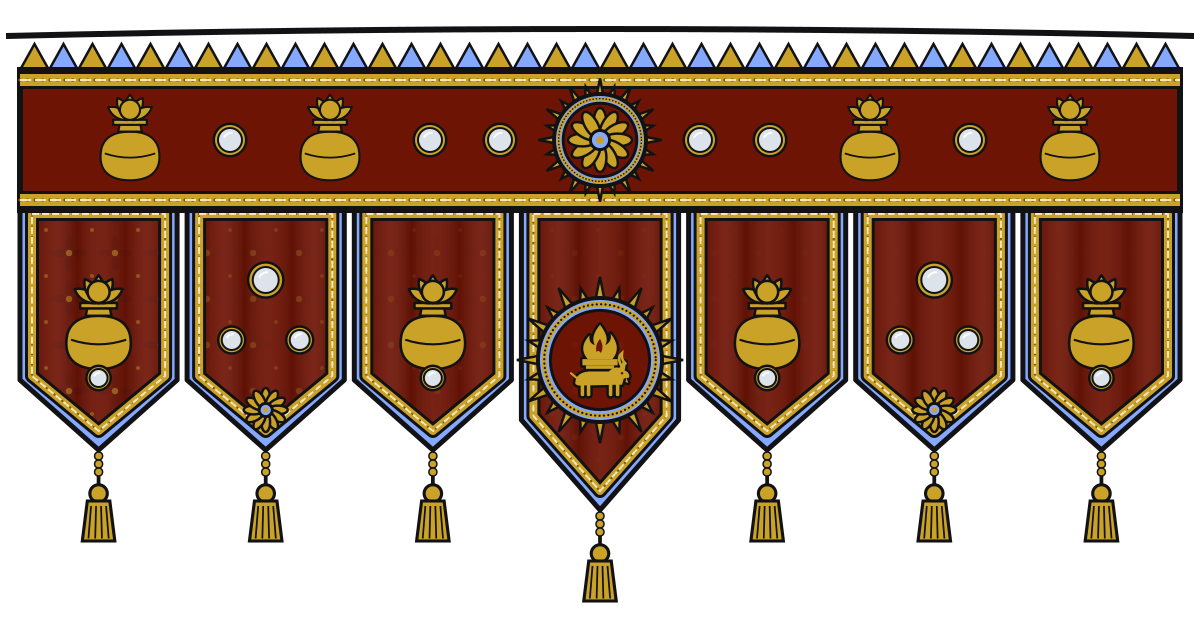
| G1 Torana · gateway The built gate of the seat; the cloth Toran hangs in it | Not yet designed for this clan | Regional tradition |
| G2 Viragallu · hero stone Carved panel stone for a member who died defending the clan | Not yet designed for this clan | Regional tradition |
| G3 Kula-shila · clan stones Standing and table stones that remember the ancestors | Not yet designed for this clan | Design |
| G4 Jayastambha · victory pillar A pillar raised for a victory | Not yet designed for this clan | Design |
| G5 Sima-shila · boundary stone Marks the clan's land, with a line in the native script | Not yet designed for this clan | Design |
4. Sounds
| Accessory | For this clan | Basis |
|---|---|---|
| D1 Pancha-mahashabda · five great sounds The right to five instruments | Not yet designed for this clan | Design |
| D2 Shankha · clan conch The clan's own named war conch | Not yet designed for this clan | Design |
| D3 Murasu · house drums Three drums: war, charity and justice | Not yet designed for this clan | Design |
5. Kit: colours, metals and emblems
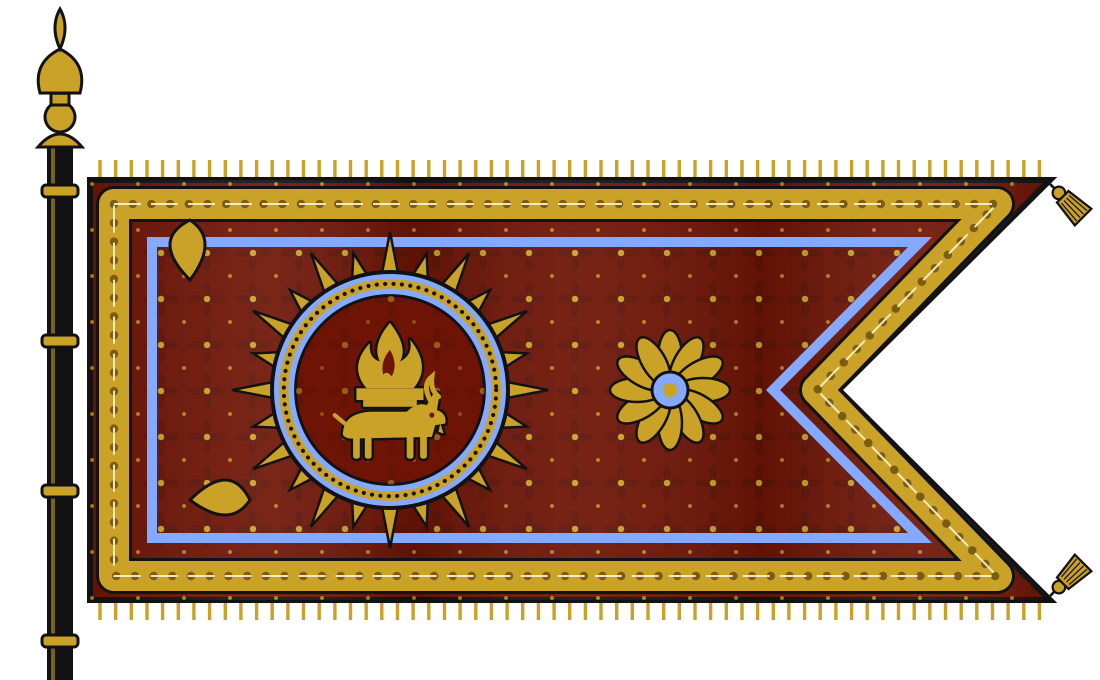
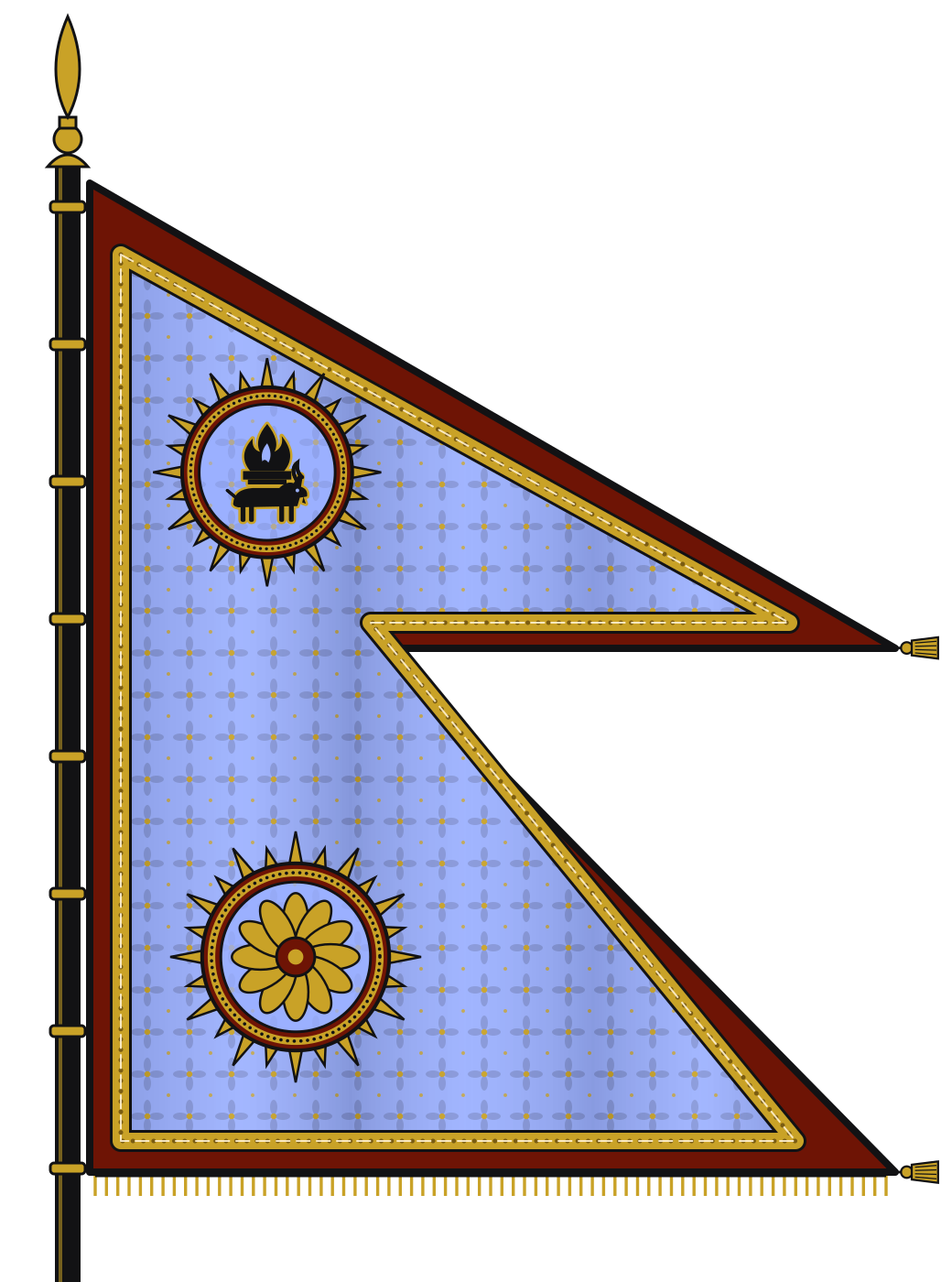
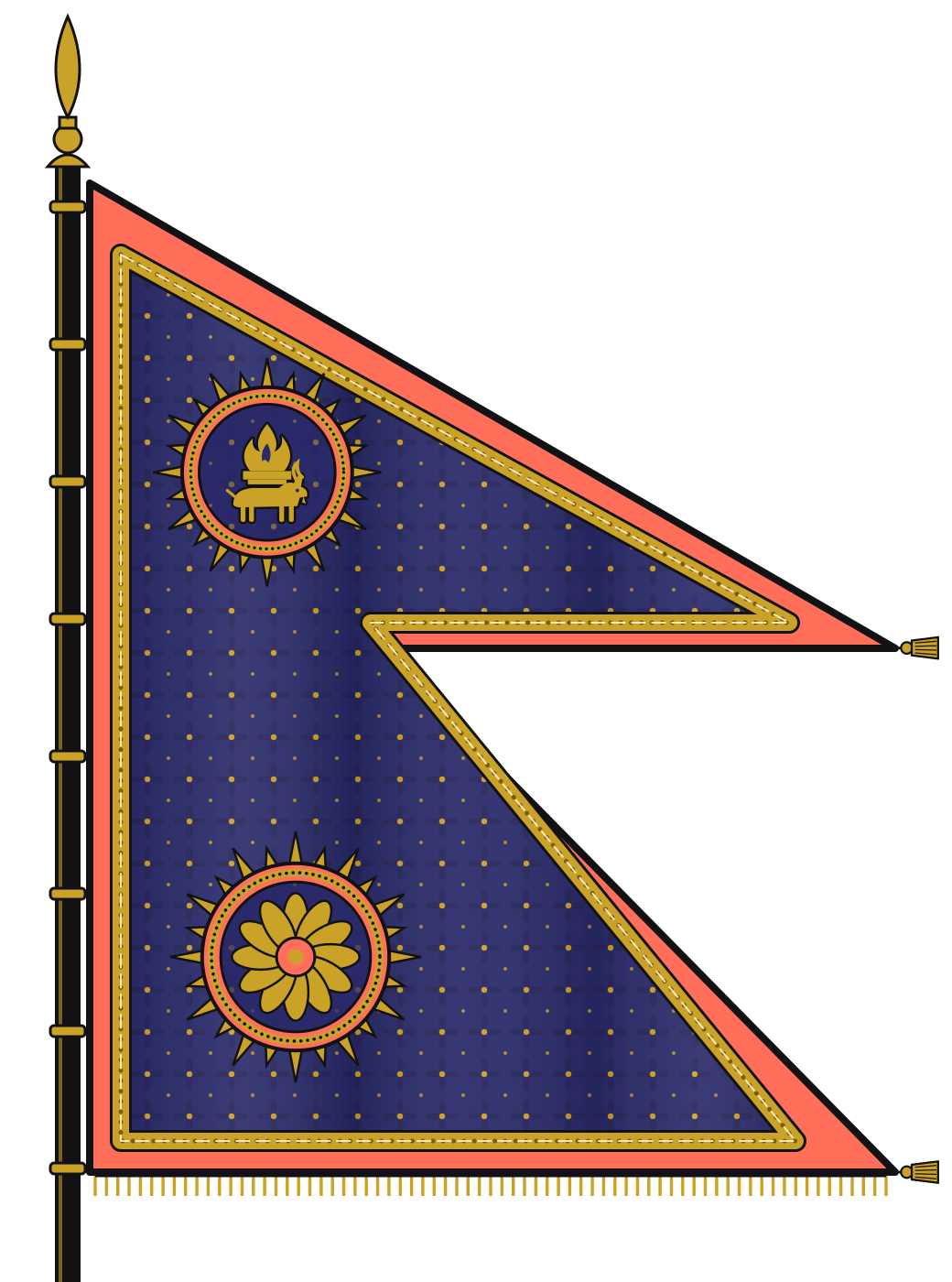
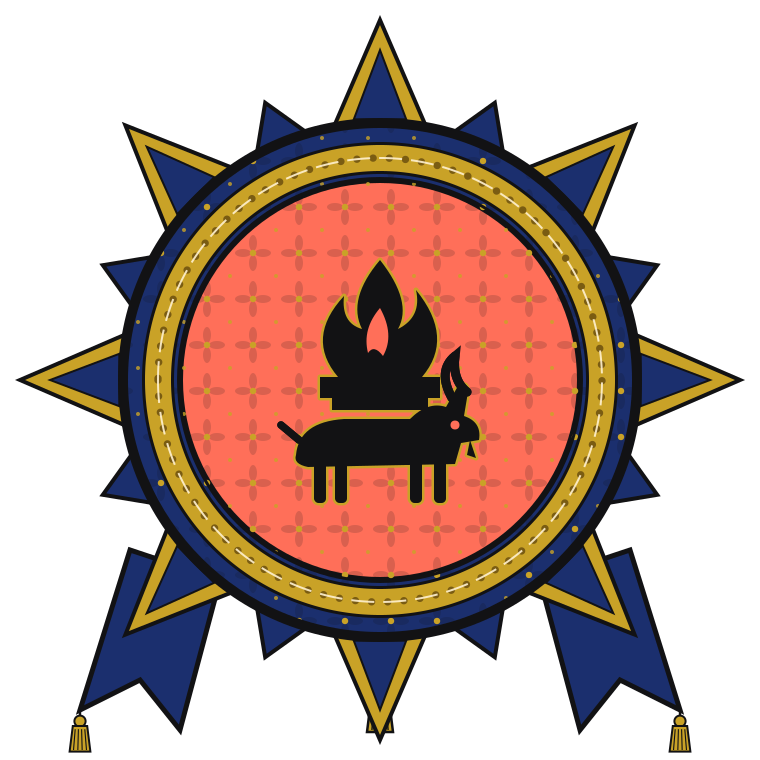
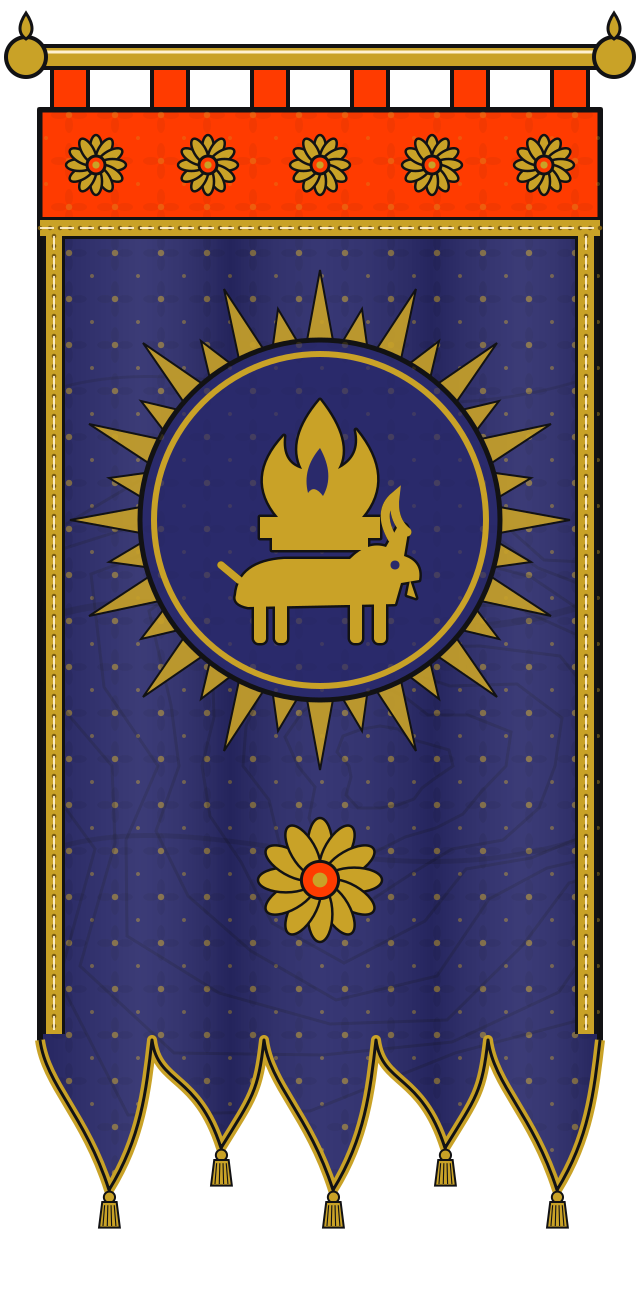
The Atlas's main emblem is a sacred fire and a goat, for the old Kalash faith. The sources give juniper as the sacred fire tree and goats as sacrificial animals[1][3]. The flag's form is the project's own design.
| Part of the kit | This clan |
|---|---|
| Field | Deep Indigo #2A2A6B |
| Accent | Deep Crimson Red #FF3B00 |
| Emblem colour | Metallic Gold #C9A227 |
| Zari metal | Gold |
| Main emblem | A sacred fire and a goat |
| Second image | — |
| Night and day | Every visual accessory has two versions: by night the emblem on the dark field, by day the clan's field colour on cloth woven from its metal. |
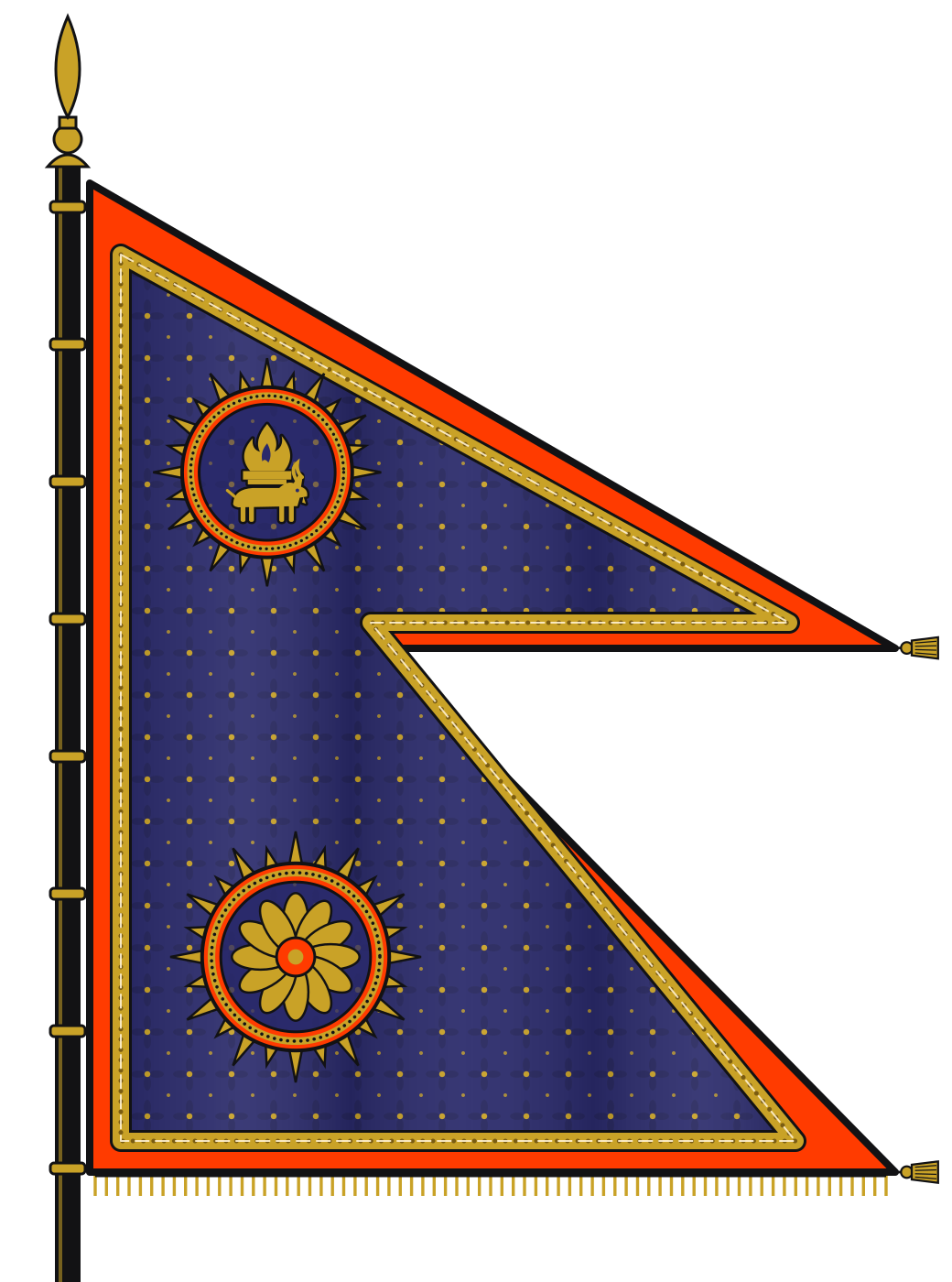
6. Flags
Every clan has every flag type; the type says the occasion and the colours say the clan. The outlined card is the flag the Atlas assigns.
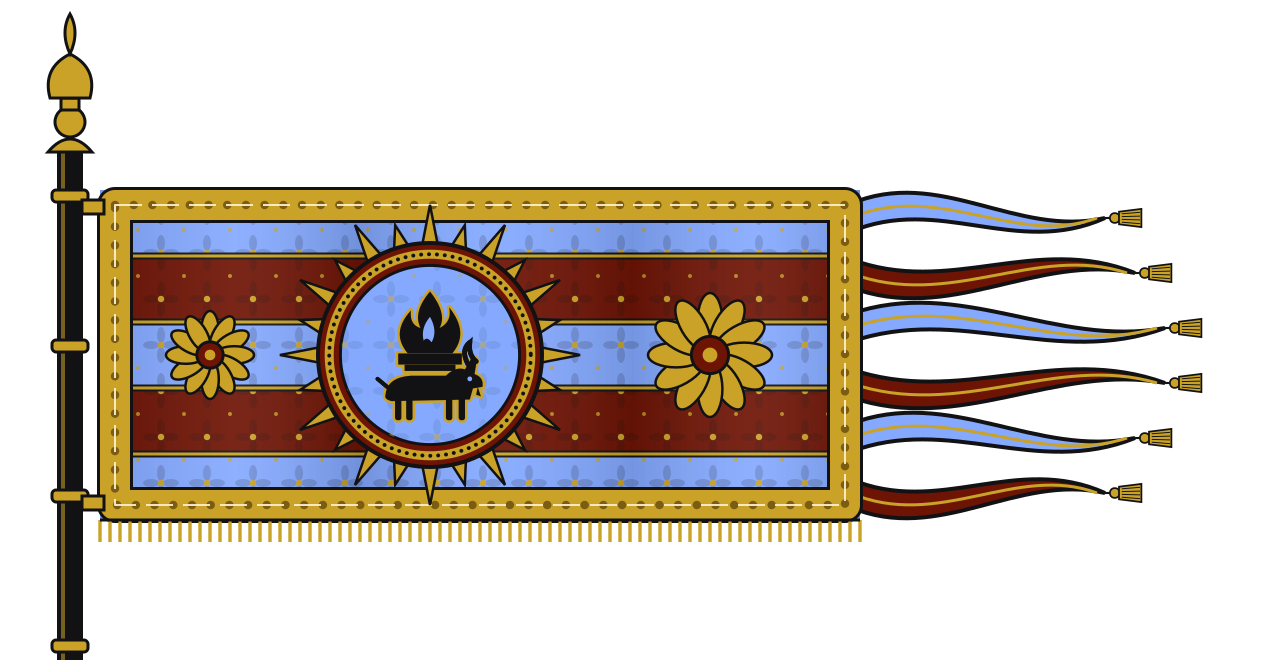
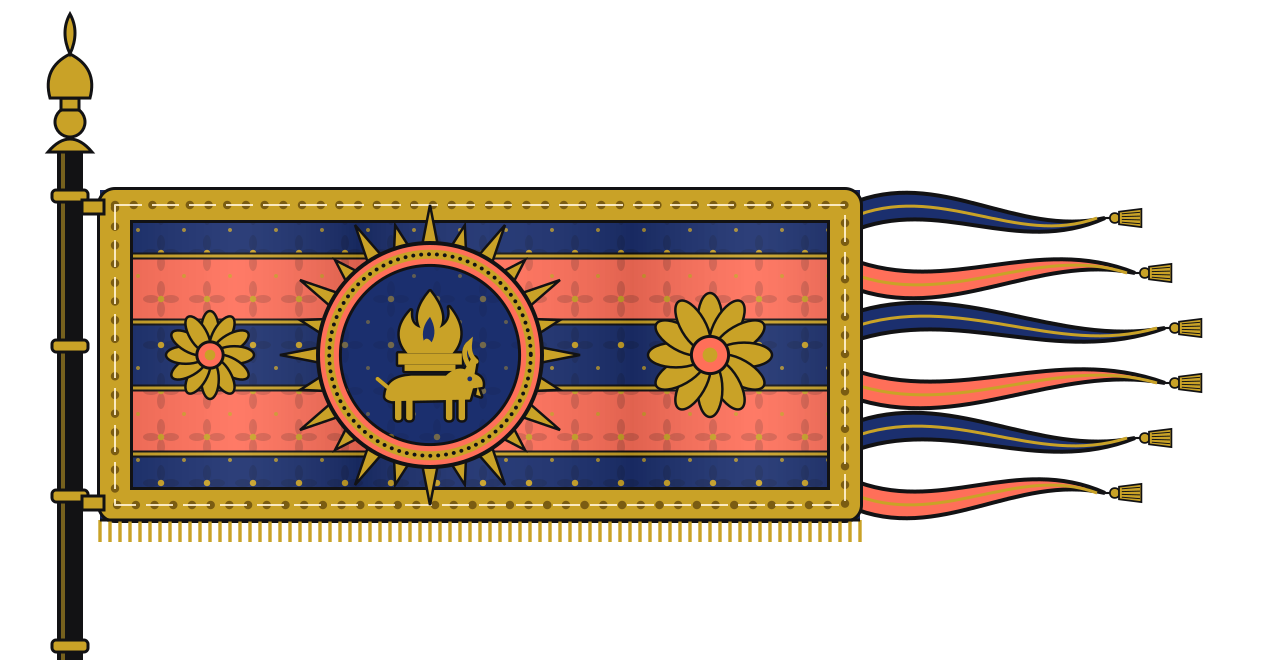
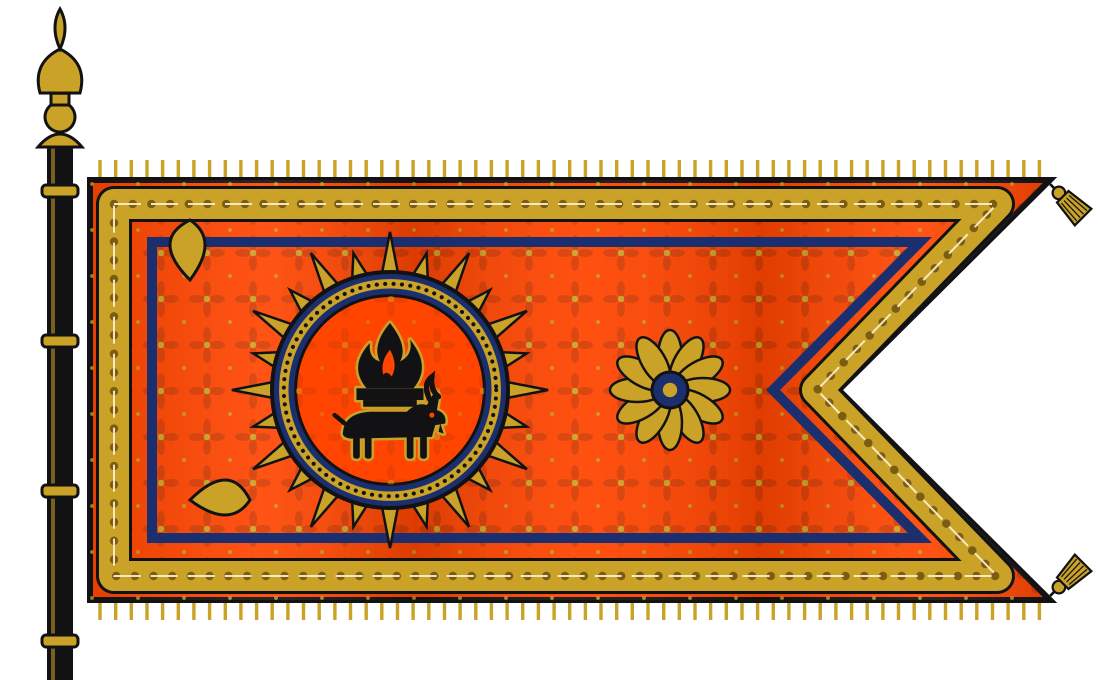
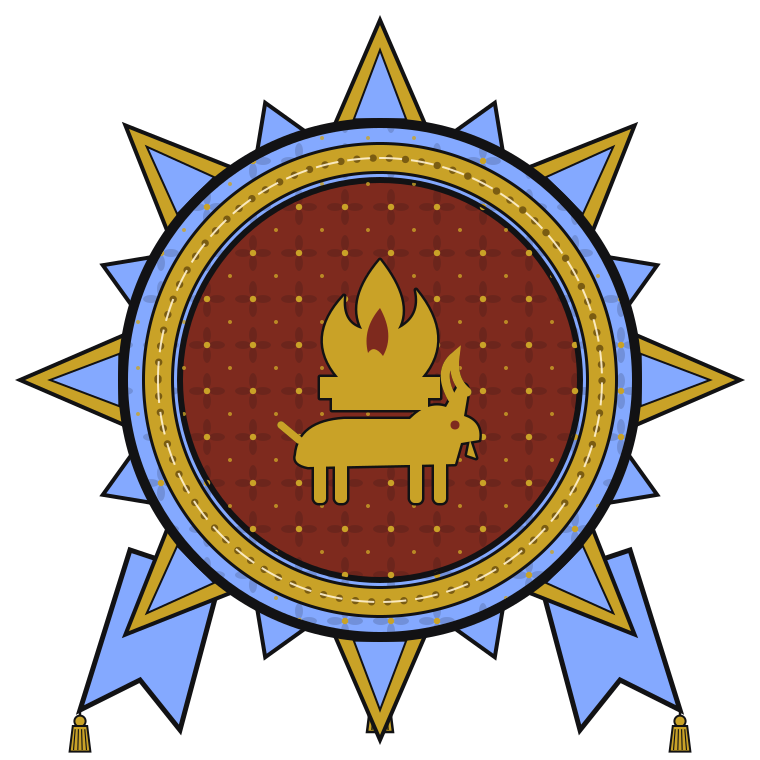
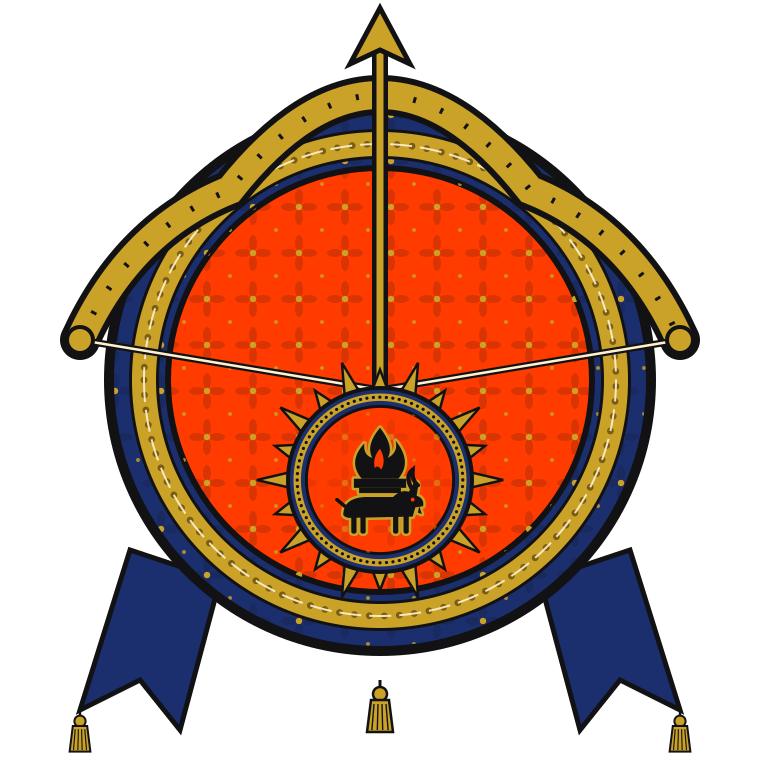
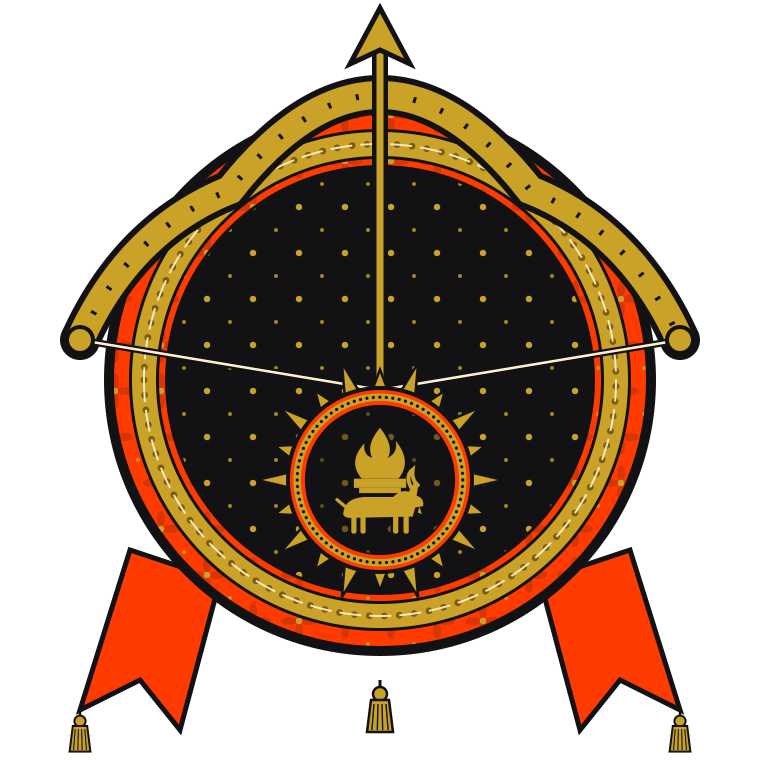
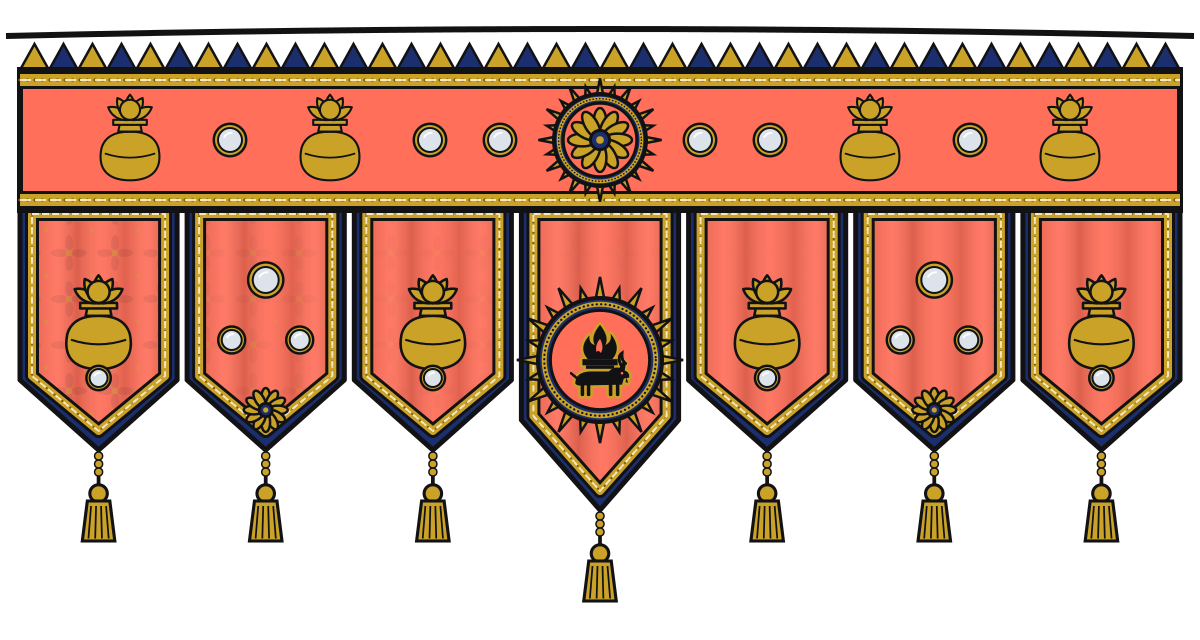
Historic banner
None known
New flag types
| Accessory | For this clan | Basis |
|---|---|---|
| A9 Pota-dhvaja · ship and trade flag For ships, caravans and markets | Not yet designed for this clan | Design |
| A10 Utsava-patāka · festival flag Light, bright flag for fairs and festivals | Not yet designed for this clan | Design |
| A11 Shoka-dhvaja · mourning flag White cloth with the emblem outline in the clan's metal | Not yet designed for this clan | Design |
7. Regalia
| Accessory | For this clan | Basis |
|---|---|---|
| E1 Chhatra · house parasol The ceremonial umbrella | Not yet designed for this clan | Design |
| E2 Chamara · fly-whisks The pair of whisks beside the head of the house | Not yet designed for this clan | Design |
| E3 Danda · staff of office Staff or scepter | Not yet designed for this clan | Design |
| E4 Simhasana · seat The seat of the house, covered in clan cloth | Not yet designed for this clan | Design |
| E5 Khetaka · shield A round shield; the Changi and Dhanush are its flag forms | Not yet designed for this clan | Regional tradition |
| E6 Kula-ayudha · clan weapon The weapon the clan honours | Not yet found for this clan | Under research |
8. Worn
| Accessory | For this clan | Basis |
|---|---|---|
| F1 Kula-vastra · clan cloth The clan's woven pattern in its kit colours | Piran robe embroidered with cowrie shells; pati belt; kupas headdress with cowrie shells; pacek headdress | Documented |
| F2 Kirti-vastra · honour cloth A cloth earned for a deed, not inherited | Not yet designed for this clan | Design |
| F3 Kula-mala · garland flower The flower or leaf the clan wears as a garland | Not yet found for this clan | Under research |
| F4 Chinha · house pin A metal badge with the pin emblem | Not yet designed for this clan | Design |
9. Records
| Accessory | For this clan | Basis |
|---|---|---|
| H1 Clan words A traditional line in the native script | Mul'awa ta deva · “Opening words of Kalash prayers, as printed. The source gives no translation and no native-script form.” Prayers begin with these words (Simple Wikipedia, Kalasha religion)[3] | Documented |
| H2 Biruda · titles The house's title or titles | Not yet found for this clan | Under research |
| H3 Prashasti · praise genealogy The lineage as written at the head of a grant | Not yet found for this clan | Under research |
| H4 Vahi · clan register The book of the clan's births, marriages and deaths | Not yet found for this clan | Under research |
| H5 Rana-ghosha · war cry The clan's cry in battle or celebration | Not yet found for this clan | Under research |
10. VishwaVit · knower of the world
Game values are design choices for this project, not historical claims.
References
- Wikipedia, Kalash people, read 2026-10-10, https://en.wikipedia.org/wiki/Kalash_people
- Wikipedia, Kalasha language, read 2026-10-10, https://en.wikipedia.org/wiki/Kalasha_language
- Simple Wikipedia, Kalasha religion, read 2026-10-10, https://simple.wikipedia.com/wiki/Kalasha_religion
- Ali, The Kalasha Pantheon, Sadiq Journal of Pakistan Studies 4(2), 2024, read 2026-10-10, https://journals.iub.edu.pk/index.php/sjps/article/view/3624
- Ali, Ahmed and Rana, History and Development of the Kalasha ... Rais and Katur Dynastic Eras, JRSP 58(4), 2021, read 2026-10-10, https://pu.edu.pk/images/journal/history/PDF-FILES/21_58_4_21.pdf
- World History Encyclopedia, Kalasha, read 2026-10-10, https://www.worldhistory.org/Kalasha/
- Wikipedia, The Kafirs of the Hindu Kush (Robertson 1896), read 2026-10-10, https://en.wikipedia.org/wiki/The_Kafirs_of_the_Hindu_Kush
- Athanasopoulou, The Kalasha archives: Chelik sambiek, read 2026-10-10, https://enl.auth.gr/kalasha/cheliksambiek.html