The Juang are a Munda-speaking people of the Keonjhar and Dhenkanal hills and plains in Odisha, listed as a Scheduled Tribe and among the state's 13 PVTGs[1][2][3]. Their tradition places their origin on the Gonasika hills at the source of the Baitarani river, where a Rusi couple is remembered as their ancestors[4][5]. Many wore leaves instead of cloth, which gave them the older name Patua, “leaf-wearers”, and the record runs from Samuells (1856) through Dalton (1872) to Elwin (1942)[6][4][1]. Their language is endangered, with about 30,000 speakers in the 2011 census, and it is written in Odia script[7]. The Juang have no temples; their faith centres on the Sun god Dharam Devta and the Earth goddess Basumata, worshipped without idols[4][8].
01Faith and deities
Maa Tarini of Ghatagaon, Keonjhar
The presiding goddess of the clan's homeland or capital: a link of place, not a recorded clan tie.
From the Atlas: the KulDevi is Tarini (Maa Tarini of Ghatagaon, Keonjhar), a homeland shrine, which is a link of place and not a recorded Juang tie. The cached Tarini pages (odiasites, incredibleodisha) name no Juang, Sabara or Bhuyan kuldevi community[9][10].
| Deity or tradition | Place in the clan's life | Evidence |
|---|---|---|
| Basumata (Basumatimata, Basukimata) | The Earth goddess, creator and protector with Dharam Devta; prayed to first in every ritual | [4][8] |
| Gramashree (Gramsiri, Thaniputi) | The village deity; a wooden post and stones beside the Mandaghar stand for her; Thaniputi is invoked when new beads are worn (spellings differ by source) | [4][5][6] |
| Spirits | Spirits are appeased by sacrifices; the Juang offer fowls and animals (Dhaara; Juang blog) | [4][5] |
| Hindu gods | Also worshipped, according to the Juang blog | [5] |
02Temples
The Juang have no temples (Dhaara). Their sacred place is the wooden post and stones beside the Mandaghar. The extracts name no Juang temple, built or patronised.
Built by the clan
Not recorded.
Given patronage or grants by the clan
Not recorded.
03Languages and scripts
| Language or script | Kind | Under the clan | Evidence |
|---|---|---|---|
| Juang living | Munda language of the Austroasiatic family; endangered | The clan's own language | [7][11] |
| Odia | Script the Juang write in; used for inter-group communication | Odia script; the Juang are shifting to Odia | [7][11][8] |
| Kharia | Closest relative in the Kharia-Juang branch | Related language | [12] |
04Books and literature
The Juang have no writing system of their own; the Odia script is used. The works below are ethnographies and language studies about the Juang, not Juang literature.
Written during the clan's history
| Work | Author | Kind | When | Link to the clan |
|---|---|---|---|---|
| Ethnography of Juang Tribe Odisha | Acharya and Mohanty | Ethnography | 2015 | [1] |
| Art and Culture of the Juang | Dasa | Art and culture | 1992 | [1] |
| The Juang | Patnaik | Ethnography | 1989 | [1] |
| Forest Tribes of Orissa: The Juang | Patnaik | Ethnography | 2002 | [1] |
| Forest Tribes of Orissa | Naveen, Choudhury and others | Ethnography | 2007 | [1] |
| A Heritage of Tribes in India | Sahoo and Naidu | Survey | 2017 | [1] |
| The Juang (in The Munda Languages, pp. 508-556) | Patnaik | Linguistics | 2008 | [7] |
| A Grammatical Sketch of Juang | Matson | PhD thesis, Wisconsin | 1964 | [7] |
| Comparative Notes on Juang and Kharia Finite Verbs | Mahapatra | Article | 1976 | [7] |
| Juanga (Linguistic Survey of India, Orissa, pp. 335-371) | Rajendra | Linguistic survey | 2002 | [7] |
| Odia-Juang Sabdakosh | Not given | Dictionary | Not given | [7] |
| Juang language materials (phonology, morphology, vocabulary, songs, folk tales) | Sashmita Mohapatra | Academy of Tribal Dialects and Culture | 1991 | [11] |
| Juang beads | Alok Kumar Kanungo | Article in Beads 8-9 | 1996-1997 | [6] |
| Juang language studies (Grierson; Konow; Pinnow; Mahapatra; Matson; Dasgupta; Patnaik) | Various | Language studies | Not given | [11] |
Given patronage by the clan
Not recorded.
05Thinkers and scholars
| Name | Field | Era | Contribution |
|---|---|---|---|
| Samuells | Colonial report | 1856 | First report on the Juang[6] |
| Edward Tuite Dalton | Ethnology | Late 1860s; 1872 | Saw the Juang in Dhenkanal and recorded the leaf dress; called the dialect Kolarian (blog spells it Dalten)[6][5] |
| N. K. Bose | Anthropology | 1928 | Found leaf-wearing women[6] |
| Verrier Elwin | Anthropology | 1942, 1948 | Accounts of the leaf dress, bead girdles and witches[6] |
| Alok Kumar Kanungo | Writing on beads | 1996-1997 | Juang beads[6] |
| Patnaik | Ethnography and Munda languages | 1989, 2002, 2008 | Juang ethnographies and the Munda languages chapter[1][7] |
| Matson | Linguistics | 1964 | Grammatical sketch of Juang[7] |
| Rajendra | Linguistics | 2002 | Juanga entry in the Linguistic Survey of India, Orissa[7] |
| Sashmita Mohapatra | Language documentation | 1991 | Juang language materials at the Academy of Tribal Dialects and Culture[11] |
Other Juang scholars named in the extracts are in the books list.
06Art and architecture
The extracts name no Juang painting, sculpture or stone art. The Juang's known arts are beadwork, basketry, dress and the dormitory.
Painting and wall art
Not recorded.
Sculpture and temple art
Not recorded.
Temple and building architecture
| Art form | What it is | Era | Evidence |
|---|---|---|---|
| Mandaghar youth dormitory | Carved beams and a fire (Kanungo); houses unmarried boys and girls (Dhaara) | Not dated | [6][4] |
Weaving and textiles
Not recorded.
Clothing and jewellery
| Art form | What it is | Era | Evidence |
|---|---|---|---|
| Bead strings | Glass bead strings: every Juang should wear at least one; the ahuda mali marriage string of alternating white and reddish-brown glass beads; pohala large red furnace-wound glass beads | Not dated | [6] |
| Leaf girdle and leaf apron | Women's leaf girdles, men's small loincloth (Dalton); bead girdle with leaf aprons (Elwin, 1948) | Until the 20th century | [1][6][4] |
Coins, pottery and crafts
| Art form | What it is | Era | Evidence |
|---|---|---|---|
| Bamboo baskets | Plains Juang (Bhagudia) are bamboo basket weavers; baskets were traded for salt, oil, food and money | Not dated | [8][1] |
| Ornamental combs and tobacco cases | The Juang are known for these (Dhaara); no further detail is given | Not dated | [4] |
| Silver and coin beads | Made for the Juang by Kamara ironsmiths (Kanungo) | Not dated | [6] |
07History
Origin on the Gonasika hills
Juang tradition holds that the people emerged from the earth on the Gonasika hills, where the Baitarani rises, near Honda village in Keonjhar[5]. Dhaara records that they believe they were the first humans, descended from the Rusi couple[4]. Kanungo describes the Gonasika hills as twelve villages at about 1,000 metres, “considered the Juang capital”[6].
First records (1856 to 1872)
Samuells (1856) made the first report on the Juang. Dalton saw them in Dhenkanal in the late 1860s and in 1872 recorded their leaf dress and a legend that a river goddess from a Gonasika rock cursed naked Juang dancers to wear leaves forever or die[6].
Clothing and the Keonjhar State (about 1870)
About 1870, Captain F. J. Johnstone, Superintendent of Keonjhar State, persuaded the women to wear clothes. N. K. Bose still found leaf-wearing women in 1928, and Elwin recorded the leaf dress in 1942[6].
The Bhuiyan revolt and the move to the plains
In the late 19th century, during the Bhuiyan revolt, some Juang moved from the hills to the plains of Dhenkanal[1]. Dhaara says the leaf attire lasted until the twentieth century, after which pressure from neighbours and government agencies grew[4].
Forest reserves and trade
After the British declared their forests reserves, the Juang had to find other livelihoods. They traded baskets for salt, oil, food and money[1].
08Journey and migrations
The sources give one origin tradition and a few recorded moves; the dates of the moves are not given.
| When | From | To | Why | Evidence |
|---|---|---|---|---|
| Not dated | Original homeland, Gonasika | Plains (Bhagudiya) | The Bhagudiya migrated and the Thaniya stayed in the original homelands[5] | [5] |
| Late 19th century | Hills of Keonjhar | Dhenkanal plains | Some moved during the Bhuiyan revolt[1] | [1] |
09Seats and lands
| Place | Role | Where today |
|---|---|---|
| Gonasika hills | Origin hills; source of the Baitarani; Kanungo calls the twelve villages there the Juang capital | Keonjhar district[6][4] |
| Pallahara (Pal Lahara) hills | Hill Juang range; the leaf dress survived there (Kanungo) | Keonjhar district[4][6] |
| Rusi Tangar | Hill near Gonasika linked to the origins | Near Gonasika, Keonjhar[4] |
| Honda village | Named in the emergence tradition | Keonjhar[5] |
| Plains of southern Keonjhar and eastern Dhenkanal | Plains Juang live in about 147 villages | Keonjhar and Dhenkanal, Odisha[7][11] |
| Banspal, Telkoi and Harichandanpur blocks | Blocks where Juang live, mostly on the plains | Keonjhar, some in Dhenkanal[5] |
| Angul | Recorded among the districts where the Juang live | Angul district, Odisha[6][8] |
10Notable figures
| Name | Role | Era | Known from |
|---|---|---|---|
| Rusi couple legend | Ancestors of the Juang, in the origin tradition | Not dated | [4] |
| A saint and his wife legend | Named among the ancestors (Dhaara) | Not dated | [4] |
| Gonasika saint legend | Used red beads as a rosary, in a legend (Kanungo) | Not dated | [6] |
| Samuells | First published report on the Juang | 1856 | [6] |
| Col. Edward Tuite Dalton | Saw the Juang in Dhenkanal and recorded the leaf-dress legend; credited with a 19th-century photograph, “Juang girls” | Late 1860s; 1872 | [6][1] |
| Capt. F. J. Johnstone | Superintendent of Keonjhar State who persuaded the women to wear clothes | About 1870 | [6] |
| N. K. Bose | Found leaf-wearing women | 1928 | [6] |
| Verrier Elwin | Accounts of the leaf dress, bead girdles and witches | 1942, 1948 | [6] |
11Allies, rivals and marriages
| People | Relationship | When |
|---|---|---|
| Kharia | Closest relative; the Kharia-Juang branch of Munda, though remote. Anderson holds that the two split early; Zide grouped them (1969)[12][11] | Not dated |
| Munda | The Juang are a Munda people and language; the Munda page names the Juang as related[7][13] | Not dated |
| Ho | Named among the related peoples of the Munda page[13] | Not dated |
| Bhumij | Named among the related peoples of the Munda page[13] | Not dated |
| Santhal (Santal) | Named among the related peoples of the Munda page[13] | Not dated |
| Gorum and Gutob | Share complex negation with the Juang language (Wikipedia)[7] | Not dated |
| Mon-Khmer peoples | Listed among the related groups on the Juang page[1] | Not dated |
| Bhuiya (Bhuyan) | Context, not kin: some Juang moved to the Dhenkanal plains during the Bhuiyan revolt[1] | Late 19th century |
| Kamara ironsmiths | Make the silver and coin beads of the Juang[6] | Not dated |
| Savara (patra-Savara) | Some link the Juang to the patra-Savara; the link is not sourced in the extracts[5][14] | Not dated |
12Society and livelihood
The Juang are a Scheduled Tribe of Odisha, listed as a PVTG, with a village council and a youth dormitory. The village is the largest corporate group, and the descent is patrilineal (Juang blog).
Government and social order
| Institution or group | What it was | Evidence |
|---|---|---|
| Mandaghar (Majang) | Youth dormitory of unmarried boys and girls (Dhangada boys, Dhangdi girls, IASGyan); used for dances, the panchayat and guests (Juang blog) | [4][8][5] |
| Village council (Barabhai) | The village council of the Juang (IASGyan) | [8] |
| Pirh | A group of villages under an inter-village head, among the Hill Juang | [8] |
| Pradhan, Nagam, Boita and Dehuri | The village head (Pradhan); the religious heads are Nagam or Dehuri (IASGyan); the Juang blog also lists Boita | [8][5] |
| Madhyasta | Marriage middleman, who brings a sacred stick from the dormitory and bead strings to the marriage | [6] |
| Marriage rules | Marriage is exogamous; monogamy is general and polygyny is allowed; women adopt the husband's clan; levirate and sororate are common (Dhaara; IASGyan; Juang blog) | [4][8][5] |
Livelihood over time
| Era | Livelihood | Evidence |
|---|---|---|
| Not dated | Gatherers and hunters, later cultivators, who traded baskets (Juang blog) | [5] |
| Not dated | Hunting, agriculture and weaving (Dhaara) | [4] |
| After the forest reserves | Had to find other livelihoods after the British declared their forests reserves; baskets traded for salt, oil, food and money | [1] |
| Now (Hill Juang) | Shifting cultivation (toila or ering), oilseeds (rasi), pulses and millets (IASGyan) | [8] |
| Now (Plains Juang) | Bamboo basket weaving (Bhagudia) | [8] |
13Sub-clans and related clans
The exogamous clans are called bok (Dhaara), or bansa and khilli (IASGyan). They are totemic: the totem may be an animal, bird, insect, tree, flower, grain or mushroom, and the totem must not be harmed (Dhaara; the Juang blog). The extracts name no individual bok. The two divisions are the Thaniya (Hill Juang) and the Bhagudiya (Plains Juang)[4][6]; kin groups named are Bandhu and Kutumba.
| Clan | Relation | Where | Size | In the Atlas | Evidence |
|---|---|---|---|---|---|
| Thaniya | Sub-clan | Gonasika and Pallahara hills, Keonjhar; ‘those who stayed behind’ (Kanungo), also called Hill Juang | new clan candidate | [5][6][11][4] | |
| Bhagudiya | Sub-clan | Plains of Dhenkanal, Keonjhar and Angul; ‘those who did not’ (Kanungo), also called Plains Juang; bamboo basket weavers (IASGyan) | new clan candidate | [8][6][4] | |
| Bandhu | Sub-clan | Kin group with totemic clans (Juang blog); Dhaara reads Bandhu as marriageable partners | new clan candidate | [4][5] | |
| Kutumba | Sub-clan | Kin group with totemic clans (Juang blog); Dhaara reads Kutumba as blood relatives | new clan candidate | [4][5] | |
| Kharia | Related people | Jharkhand, Chhattisgarh and Odisha (Kharia language page) | ST-130 | [12][7] | |
| Munda | Related people | Jharkhand, Odisha, West Bengal and others (Munda page) | ST-229 | [13] | |
| Ho | Related people | ST-102 | [13] | ||
| Bhumij | Related people | ST-033 | [13] | ||
| Santal | Related people | ST-280 | [13] | ||
| Gorum | Related people | new clan candidate | [7] | ||
| Gutob | Related people | Gadaba (Gutob Gadaba on the ST list) | ST-076 | [7][2] |
Clans marked "new clan candidate" are not in the Atlas yet.
14Surnames
The extracts give no surname for the Juang. The clan names above are bok, not surnames.
Not recorded.
15Songs and music
No Juang song title or text is given in the extracts. The Academy of Tribal Dialects and Culture materials on Juang include songs and folk tales, but titles and text are not on the cited page (Sanchika).
None recorded yet.
Instruments and styles
| Instrument or style | What it is | Evidence |
|---|---|---|
| Changu drum | The drum of the Changu dance, which men and women dance together | [8] |
| Folk dance mimicking birds and animals | A dance style recorded for the Juang (Britannica, via Wikipedia) | [1] |
16Poems, lullabies and children's rhymes
None recorded yet.
17Stories, legends and proverbs
The Juang origin stories are told as community belief; the legends are recorded by outsiders.
Stories and legends
| Story | What happens | Told by | Evidence |
|---|---|---|---|
| Emergence on Gonasika | The Juang emerged from the earth on the Gonasika hills, where the Baitarani rises, near Honda village | Juang tradition | [5][14] |
| The Rusi couple legend | The Juang descend from a Rusi couple, a saint and his wife, and believe they were the first humans | Juang belief | [4] |
| The river goddess's curse legend | A river goddess from a rock at Gonasika cursed naked Juang dancers to wear leaves forever or die | Recorded by Dalton (1872) | [6] |
| Tiger war and the red bead legend | In a tiger war only the red-beaded Juang survived, and a Gonasika saint used red beads as a rosary | Juang legend, recorded by Kanungo | [6] |
| Discarded leaves and witches | Witches could harm a person through a discarded leaf | Recorded by Elwin, as cited by Kanungo | [6] |
| Barren wife | A barren wife uses the flower or seed paste of the Sajana (drumstick) tree, and a seven-knot cotton thread talisman is used | Juang custom | [5] |
| Pregnancy restrictions | Pregnant women keep restrictions (Devisthan, mats, plastering); the blog gives no more detail | Juang custom | [5] |
Proverbs and sayings
Not recorded.
18Festivals and fairs
| Festival or fair | When | Where | What happens |
|---|---|---|---|
| Pusha Purnima | Not given | Not given | Named in the Juang festival list (SCSTRTI, via Wikipedia)[1] |
| Amba Nuakhia | Not given | Not given | Named in the Juang festival list (SCSTRTI, via Wikipedia)[1] |
| Pirha Puja | Not given | Not given | Named in the Juang festival list (SCSTRTI, via Wikipedia)[1][5] |
| Akhaya Trutiya | Not given | Not given | Named in the Juang festival list (SCSTRTI, via Wikipedia)[1] |
| Asarhi | Not given | Not given | Named in the Juang festival list (SCSTRTI, via Wikipedia)[1] |
| Gahma | Not given | Not given | Named in the Juang festival list (SCSTRTI, via Wikipedia)[1] |
| Pus Punei | Not given | Not given | Named by IASGyan[8] |
| Dances and weddings | Not given | Not given | The leaf dress is worn for dances and weddings, and the bride wears it; at festivals people wear all their glass beads (Elwin 1948, via Kanungo)[6] |
19Food, dress and games
Food
| Item | What it is | Evidence |
|---|---|---|
| Oilseeds (rasi), pulses and millets | Grown by Hill Juang in shifting cultivation (toila or ering) | [8] |
Dress
| Item | What it is | Evidence |
|---|---|---|
| Leaf dress | Women's leaf girdles, men's small loincloth (Dalton); leaf attire into the 20th century (Dhaara) | [1][4] |
| Bead girdle | Bead girdle of baked-earth bugles on a bark cord, with leaf aprons (Elwin 1948, via Kanungo) | [6] |
| Glass bead strings | The first bead thread is put on at the first birthday; modern use is 5 to 15 glass strings, mostly red | [6] |
Games and martial arts
Not recorded.
Tags: living still practised · revived brought back after a break · lost known only from records · research reported but not yet confirmed from a source. Songs and poems under copyright are listed by title only; restricted or sacred material is noted without its content.
20Status today
The Juang are a Munda-speaking Scheduled Tribe of Keonjhar, Dhenkanal and Angul in Odisha, listed as a PVTG, with an endangered language[2][7][3].
Who carries the name today
| Community | Link | Basis | Evidence |
|---|---|---|---|
| Juang (ST-114) | Documented | [2] |
Recognised heritage
| What | Recognition | Evidence |
|---|---|---|
| Scheduled Tribe, Odisha | Official ST list (2011 population cited with it; list date not in the extract) | [2] |
| PVTG, Odisha | One of the 13 Odisha PVTGs | [3] |
Not yet reviewed by the Juang community.
21For children
The Juang in short
The Juang say that their people came out of the earth on the Gonasika hills, where the river Baitarani begins. They tell that a Rusi couple was their first family, and that the Juang were the first people. Their name is said to mean Sons of Man. Long ago, many Juang wore leaves instead of cloth, so people called them Patua, which means leaf-wearers. Their village has a big house for young people, called the Mandaghar, where boys and girls live and dance. Juang families live in the hills and on the plains of Keonjhar and Dhenkanal.
22Across the project
| Project | What carries this clan | Status |
|---|---|---|
| Atlas of the Janas | Places named in the sources: the Gonasika and Pallahara hills in Keonjhar; the plains of Keonjhar and Dhenkanal; Angul. Footprint not yet drawn. | [6][7] |
| KulDevi and GrahDevi | KulDevi Tarini (Maa Tarini of Ghatagaon, Keonjhar), a homeland shrine. GrahDevi forms from the sheet: Brahmani, Maheshvari, Kaumari, Vaishnavi, Varahi, Indrani, Chamunda, Narasimhi. | From the Atlas |
| Planet naming | Not yet researched for this clan. | |
| Renaming and waters | The Baitarani rises at Gonasika and is the river of the Juang origin tradition. | [4][5] |
23Open questions
- Bok clan names and surnames: none in the extracts. Read the OSTM Juang profile (https://ostm.in/tribes_of_odisha/juang/) and the Orissa Post pieces.
- Population: the infobox and the ST list give 47,095 (2011)[1][2][16]; the Dhaara piece[4] and the body text of the Juang people page[1] say about 50,000. Speakers: 30,000 (2011, infobox) and 'roughly under 20,000' in the body of the language page[7].
- Magh Parab: IASGyan lists it as a Juang festival[8]; the Wikipedia Mage Parab article says the Juang do not keep it[15].
- Bandhu and Kutumba: Dhaara[4] and the Juang blog[5] differ on their meaning, and IndiaNetzone[14] contradicts itself on same-clan marriage.
- KulDevi Tarini is project data; the cached Tarini pages name no Juang link[9][10].
- Patra-Savara link: the blog and IndiaNetzone say some link the Juang to it; no source gives the link.
- Native-script forms: none of the Juang's own words, songs, proverbs or names are in the extracts. Odia-script forms need a source.
- Primary texts not yet read: Dalton (1872) and Risley (1891) on the Juang; Patnaik (1989); Matson (1964); Elwin's Tribal Myths of Orissa (catalogue only). Keonjhar State and the Bhuiyan revolt need their own source (the cached etribaltribune piece on the Bhuiyan uprising may help).
- Official status: the list dates of the ST list and the PVTG list are not in the extracts; the status is given with the read date only[2][3].
24Astitva
अस्तित्व · being, existence: everything by which the clan is known
The documented accessories of the Juang are the leaf dress, the bead strings and the red bead of identity, and the dormitory's post and stones. No coin, seal, inscription or war cry is recorded in the extracts[6][4].
Every clan has every accessory, royal objects included. Each one says how it is known: Documented This clan's own object is recorded. · Regional tradition Recorded for the region or for peoples like this one, not for this clan. · Design Made for this project, with no historical claim. · Under research To be found for this clan from sources. Legends and titles are written in the clan's own script.
1. Seals and coins
| Accessory | For this clan | Basis |
|---|---|---|
| B1 Rajamudra · house seal Round seal with the clan emblem and a short legend in the clan's script | Not yet designed for this clan | Design |
| B2 Anguliya-mudra · signet ring Personal seal ring of the head of the house | Not yet designed for this clan | Design |
| B3 Chhapa · house stamp Ink or block stamp for letters, goods and cloth | Not yet designed for this clan | Design |
| B4 Tamrapatra · charter plate Copper-plate grant on a ring, closed with the house seal | Not yet designed for this clan | Design |
| B5 Shreni-mudra · guild or trade seal Seal for the clan's trade, craft or caravan | Not yet designed for this clan | Design |
| C1 Clan coin Emblem or deity on one side, a legend in the clan's script | Not yet designed for this clan | Design |
| C2 Coin die The die that strikes the coin | Not yet designed for this clan | Design |
2. Living symbols
| Accessory | For this clan | Basis |
|---|---|---|
| I1 Totem trio The tree, bird and animal the clan protects | Not yet found for this clan | Under research |
| I2 Kaval-maram · guardian tree The tree that stands at the clan's seat | Not yet found for this clan | Under research |
3. Stone and gate
| Accessory | For this clan | Basis |
|---|---|---|
| G1 Torana · gateway The built gate of the seat; the cloth Toran hangs in it | Not yet designed for this clan | Regional tradition |
| G2 Viragallu · hero stone Carved panel stone for a member who died defending the clan | Not yet designed for this clan | Regional tradition |
| G3 Kula-shila · clan stones Standing and table stones that remember the ancestors | A wooden post and stones beside the Mandaghar represent the village deity Gramsiri. | Documented |
| G4 Jayastambha · victory pillar A pillar raised for a victory | Not yet designed for this clan | Design |
| G5 Sima-shila · boundary stone Marks the clan's land, with a line in the native script | Not yet designed for this clan | Design |
4. Sounds
| Accessory | For this clan | Basis |
|---|---|---|
| D1 Pancha-mahashabda · five great sounds The right to five instruments | Not yet designed for this clan | Design |
| D2 Shankha · clan conch The clan's own named war conch | Not yet designed for this clan | Design |
| D3 Murasu · house drums Three drums: war, charity and justice | Not yet designed for this clan | Design |
5. Kit: colours, metals and emblems
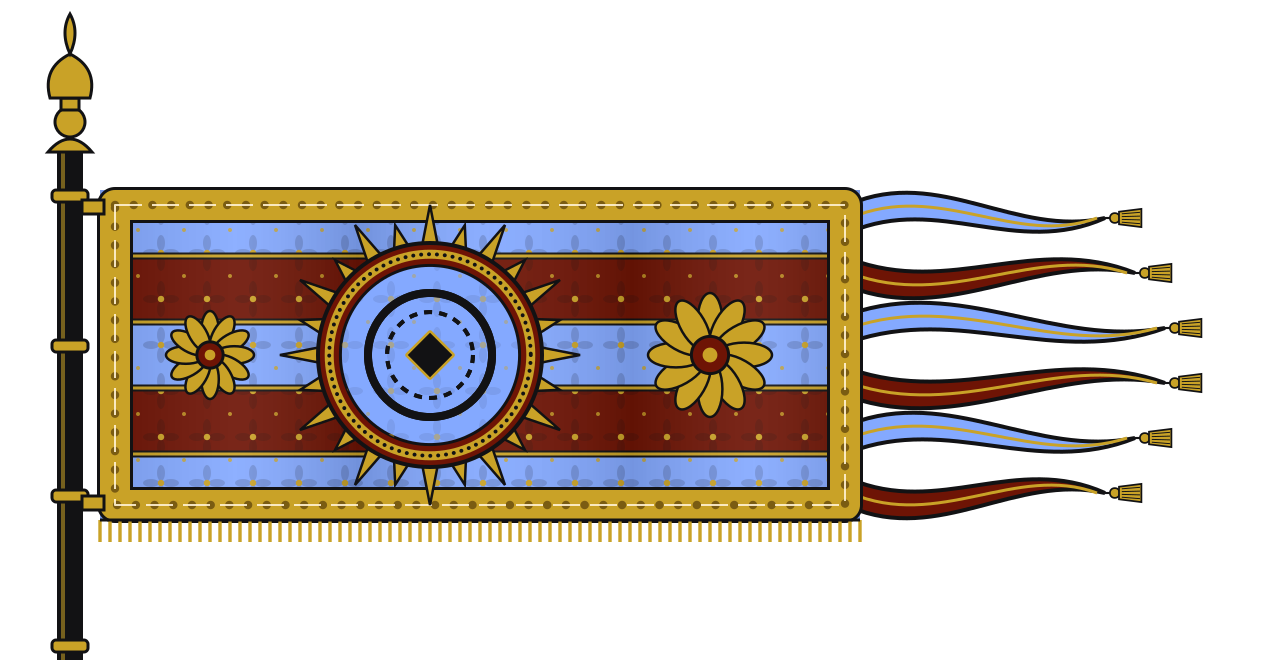
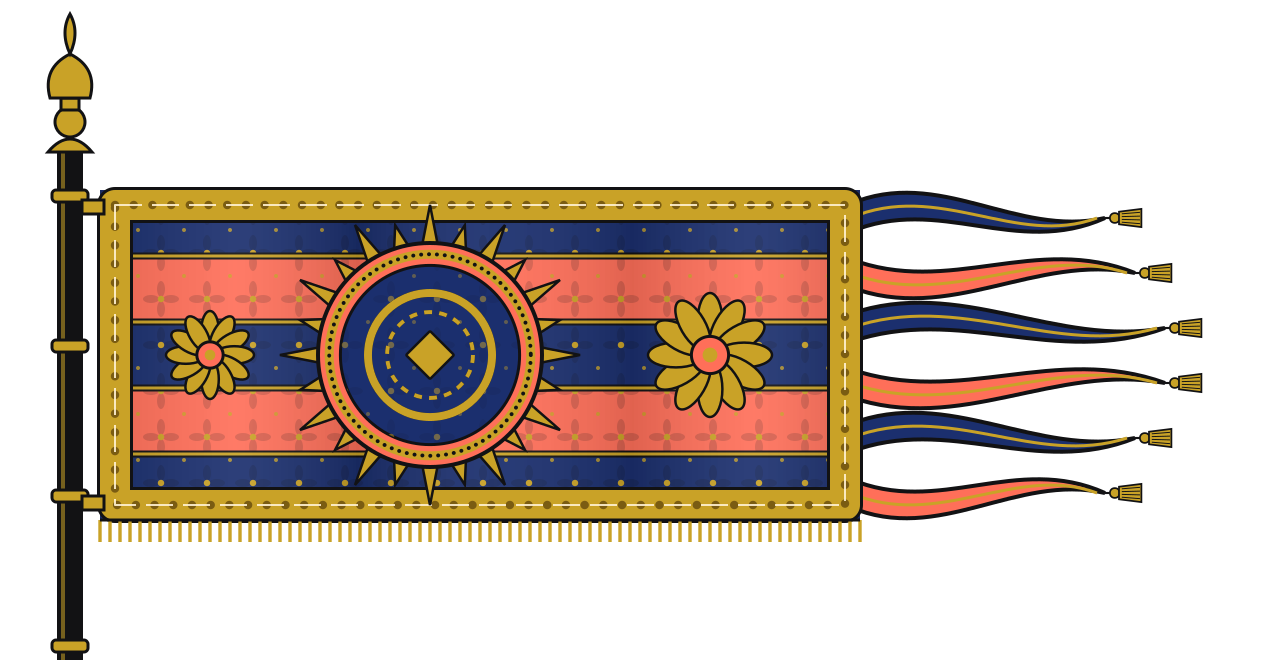
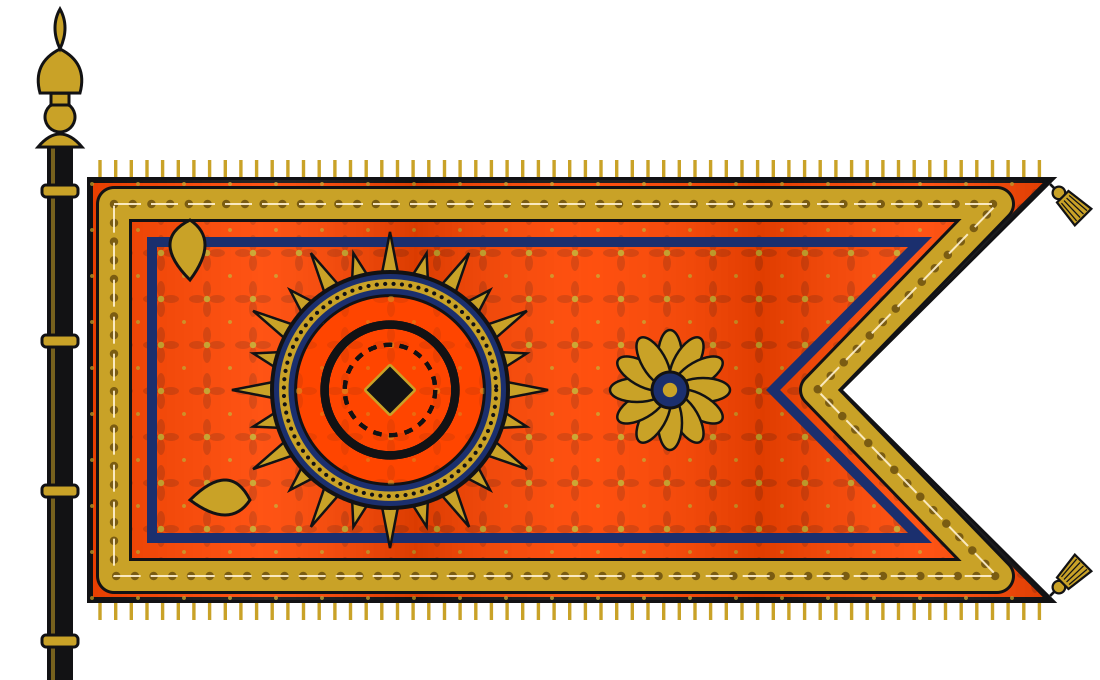
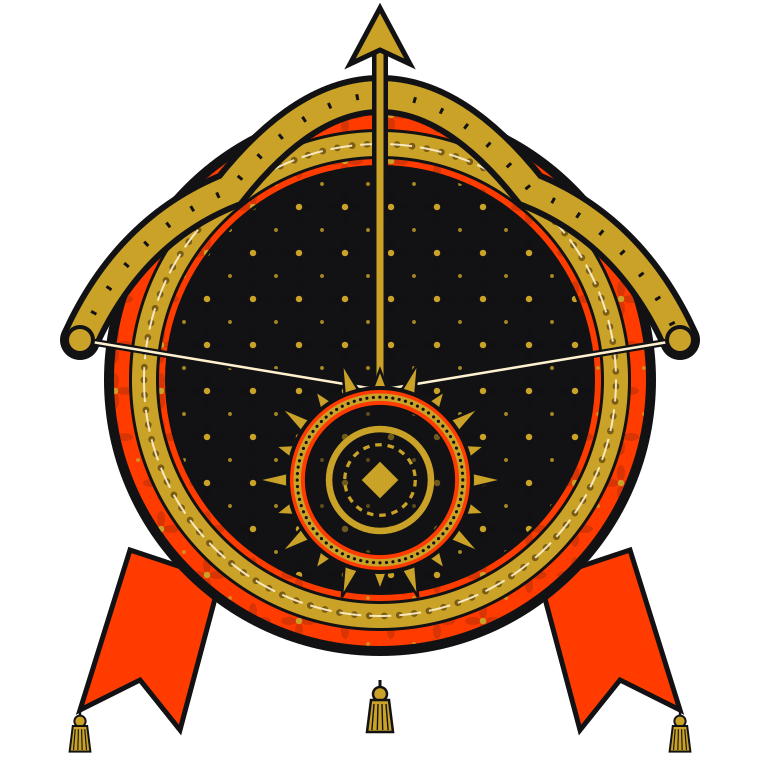
The red bead is the Juang's documented emblem of identity, with two legends (Kanungo)[6]. The emblem on the sheet's flag, a leaf garment under a rising sun, is a design made for this project, not a documented symbol.
| Part of the kit | This clan |
|---|---|
| Field | Warm Red-Orange #FF6F59 |
| Accent | Deep Indigo #2A2A6B |
| Emblem colour | Charcoal Black #121214 |
| Zari metal | Gold |
| Main emblem | A leaf garment |
| Second image | A sun rising |
| Night and day | Every visual accessory has two versions: by night the emblem on the dark field, by day the clan's field colour on cloth woven from its metal. |
6. Flags
Every clan has every flag type; the type says the occasion and the colours say the clan. The outlined card is the flag the Atlas assigns.




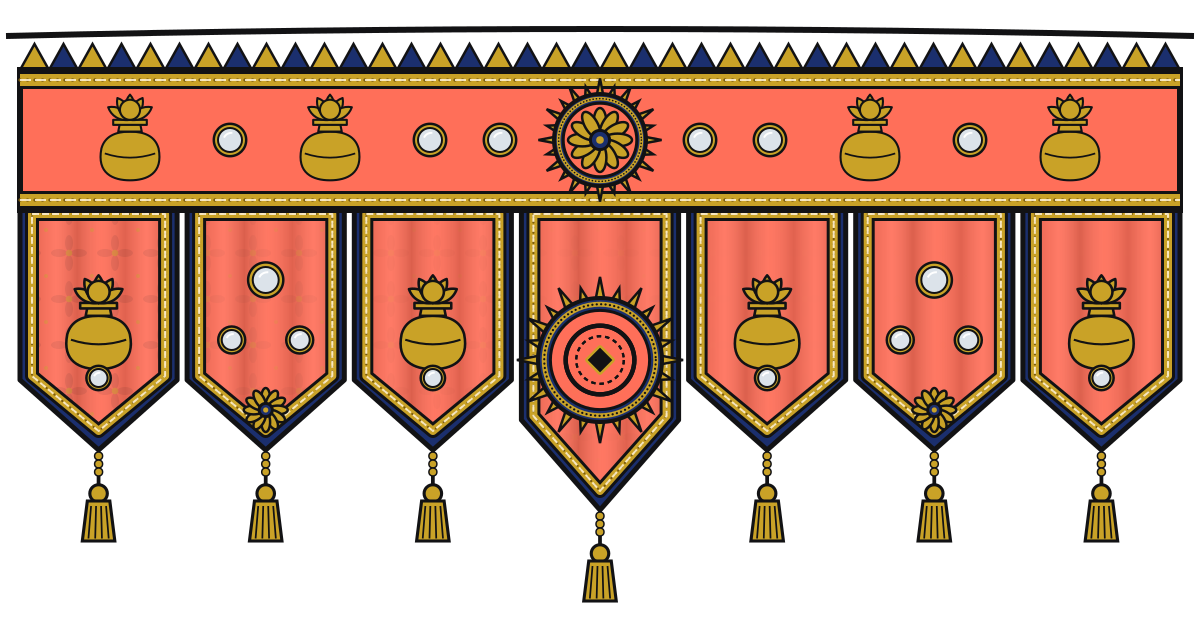
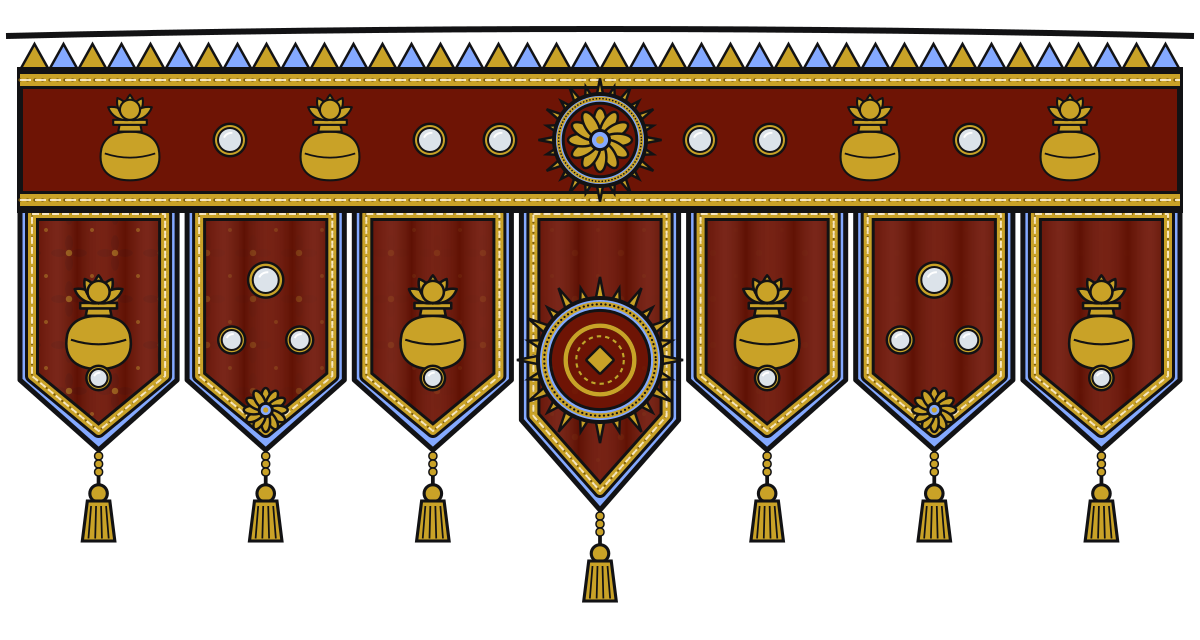

Historic banner
None known
New flag types
| Accessory | For this clan | Basis |
|---|---|---|
| A9 Pota-dhvaja · ship and trade flag For ships, caravans and markets | Not yet designed for this clan | Design |
| A10 Utsava-patāka · festival flag Light, bright flag for fairs and festivals | Not yet designed for this clan | Design |
| A11 Shoka-dhvaja · mourning flag White cloth with the emblem outline in the clan's metal | Not yet designed for this clan | Design |
7. Regalia
| Accessory | For this clan | Basis |
|---|---|---|
| E1 Chhatra · house parasol The ceremonial umbrella | Not yet designed for this clan | Design |
| E2 Chamara · fly-whisks The pair of whisks beside the head of the house | Not yet designed for this clan | Design |
| E3 Danda · staff of office Staff or scepter | Not yet designed for this clan | Design |
| E4 Simhasana · seat The seat of the house, covered in clan cloth | Not yet designed for this clan | Design |
| E5 Khetaka · shield A round shield; the Changi and Dhanush are its flag forms | Not yet designed for this clan | Regional tradition |
| E6 Kula-ayudha · clan weapon The weapon the clan honours | Not yet found for this clan | Under research |
8. Worn
| Accessory | For this clan | Basis |
|---|---|---|
| F1 Kula-vastra · clan cloth The clan's woven pattern in its kit colours | Leaf dress: women's leaf girdles and men's small loincloth (Dalton); leaf attire into the 20th century (Dhaara). The older name Patua means leaf-wearers. | Documented |
| F2 Kirti-vastra · honour cloth A cloth earned for a deed, not inherited | Not yet designed for this clan | Design |
| F3 Kula-mala · garland flower The flower or leaf the clan wears as a garland | Bead strings: every Juang should wear at least one, for courage and fortune; the ahuda mali marriage string of alternating white and reddish-brown glass beads; homo (Symplocos cochinchinensis) and erimindri (Coix lacryma-jobi) seed beads. | Documented |
| F4 Chinha · house pin A metal badge with the pin emblem | Red bead, the emblem of identity, with two legends: a tiger war in which only the red-beaded Juang survived, and a Gonasika saint who used red beads as a rosary. (A bead, not a metal badge; set here as the nearest register entry.) | Documented |
9. Records
| Accessory | For this clan | Basis |
|---|---|---|
| H1 Clan words A traditional line in the native script | Juang · “Said to mean ‘Sons of Man’ (Dhaara)” The people's name, with the meaning given by Dhaara; no native-script line of the Juang is in the extracts[4] | Documented |
| H2 Biruda · titles The house's title or titles | Not yet found for this clan | Under research |
| H3 Prashasti · praise genealogy The lineage as written at the head of a grant | Not yet found for this clan | Under research |
| H4 Vahi · clan register The book of the clan's births, marriages and deaths | Not yet found for this clan | Under research |
| H5 Rana-ghosha · war cry The clan's cry in battle or celebration | Not yet found for this clan | Under research |
10. VishwaVit · knower of the world
Game values are design choices for this project, not historical claims.
References
- Wikipedia, Juang people, read 2026-10-29, https://en.wikipedia.org/wiki/Juang_people
- Wikipedia, List of Scheduled Tribes in Odisha, read 2026-10-20, https://en.wikipedia.org/wiki/List_of_Scheduled_Tribes_in_Odisha
- journalsofindia, Mankidia: Tribals of Simlipal (lists Odisha's 13 PVTGs), read 2026-10-27, https://journalsofindia.com/mankidia-tribals-of-simlipal/?print=pdf
- Shruti Sharma, Sons of Man: The Juang Tribe of Odisha, Dhaara Magazine, 16 Nov 2023, read 2026-10-29, https://dhaaramagazine.in/2023/11/16/sons-of-man-the-juang-tribe-of-odisha/
- tribalcultureofodisha blog (author unnamed), Juang, read 2026-10-29, https://tribalcultureofodisha.blogspot.com/search/label/Juang
- Alok Kumar Kanungo, Juang beads, Beads 8-9 (1996-1997), read 2026-10-29, https://journals3.library.oregonstate.edu/beads/article/download/6279/8032/11925
- Wikipedia, Juang language, read 2026-10-29, https://en.wikipedia.org/wiki/Juang_language
- IASGyan, Juanga Tribe: Habitat, Culture and Latest News (tertiary), read 2026-10-29, https://www.iasgyan.in/daily-current-affairs/juanga-tribe-habitat-culture-latest-news
- Maa Tarini: tale of a sacred journey, odiasites.com, September 2023 (blog; read 29 Oct 2026, KulDevi run 352).
- Ghatagaon Maa Tarini Temple, Keonjhar: timings, prasad, history, festivals, Incredible Odisha (tourism blog; read 29 Oct 2026, KulDevi run 352).
- CIIL Bhasha Sanchika, Juang community collection, read 2026-10-29, https://sanchika.ciil.org/communities/6f83d2da-28b5-433e-ada3-d6fa12db3e8f
- Wikipedia, Kharia language, read 2026-10-23, https://en.wikipedia.org/wiki/Kharia_language
- Wikipedia, Munda people, read 2026-10-21, https://en.wikipedia.org/wiki/Munda_people
- Indianetzone, Juang Tribe (tertiary), read 2026-10-29, https://www.indianetzone.com/juang_tribe
- Wikipedia, Mage Parab, read 2026-10-22, https://en.wikipedia.org/wiki/Mage_Parab
- Sushree Mohanty, Indigenous Colours of Odisha: Handbook on 62 Tribes (KISS), read 2026-10-20, link