The Jatapu are a Scheduled Tribe of hill farmers in the Vizianagaram hills of Andhra Pradesh and in Rayagada and Gajapati in Odisha[1][2]. Their name is popularly believed to be short for Konda Jatapu Doralu, lords of the Khond caste; C. Hayavadana Rao reported this belief, and Thurston quotes it[3][4]. The Madras census of 1901 called them a civilised section of the Khonds, now practically a distinct caste[3]. Their caste goddess is Jakara Devata, to whom the first fruits of the harvest are offered before anyone eats[3]. The early history is not in the extracts, and the Odisha list counts 14,890 Jatapu in Odisha in 2011[5].
01Faith and deities
Jakara Devata: "The caste goddess is Jakara Devata" (Thurston 1909; accepted by the owner 10 Oct 2026; family assigned by the sweep)
A recorded tie between the clan and the goddess.
| Deity or tradition | Place in the clan's life | Evidence |
|---|---|---|
| Jakara Devata, caste goddess | Propitiated with pigs, sheep and buffaloes; the first fruits of the harvest are offered to her and then eaten | [3] |
| Janni | Caste priest who officiates at ceremonials | [3] |
| Polamma | The Gazetteer's extract (p.95) describes the Jatapu as 'a civilized Khond', priest of Polamma; the page gives no more | [7] |
| Godlamma Devatha | Named as a Jatapu deity on the ITDA list; the list does not mention Jakara in the Jatapu entry[8] | [8] |
02Temples
No temple built or patronised by the Jatapu is recorded in the extracts.
Built by the clan
Not recorded.
Given patronage or grants by the clan
Not recorded.
Later temples in the clan's lands
| Temple | Deity | Built | Where | |
|---|---|---|---|---|
| Sri Jakara Devata and Goddali Devatha temple, Basangi | Jakara Devata and Goddali Devatha | Not stated | Not stated | Basangi, Ziyyammavalasa, Vizianagaram district[9]; no link to the Jatapu is shown |
03Languages and scripts
| Language or script | Kind | Under the clan | Evidence |
|---|---|---|---|
| Kuvi living | Speech of the people, as Wikipedia and Omniglot give it | Mainly spoken among themselves; Omniglot calls it the dialect the Jatapu speak[1][10] | |
| Khond | Speech of the hills, in the 1901 census | The census, quoted by Thurston, says Khond on the hills and Telugu on the plains[3] | |
| Telugu | Speech of the plains and of neighbours | Used with neighbours and through acculturation[1]; on the plains per the 1901 census[3] | |
| Odia | Speech of neighbours | Used with neighbours and through acculturation[1] | |
| Dravidian family | Language family in the Atlas | [6] | |
| Jatapu script research | Script, per Omniglot | Omniglot says Prof. Prasanna Sree, Andhra University, devised a Jatapu script; the script is not shown and no native-script form is printed[10] |
04Books and literature
No book or text by a Jatapu author is recorded in the extracts. A 1970 Andhra University PhD thesis by D. L. Prasada Rao, 'An Analysis of Kinship Economy and Religion of the Jatapus', is recorded at Shodhganga; only the record was read, with an empty abstract, and the chapters are PDFs not read[11].
Written during the clan's history
Not recorded.
Given patronage by the clan
Not recorded.
05Thinkers and scholars
Not recorded.
No Jatapu thinker or scholar is named in the extracts. Omniglot credits Prof. Prasanna Sree of Andhra University with a Jatapu script, not seen[10]. Under research: the 1970 thesis author and others who have written on the script.
06Art and architecture
Under research. No painting, sculpture, architecture, textiles or clothing is recorded in the extracts.
Painting and wall art
Not recorded.
Sculpture and temple art
Not recorded.
Temple and building architecture
Not recorded.
Weaving and textiles
Not recorded.
Clothing and jewellery
Not recorded.
Coins, pottery and crafts
| Art form | What it is | Era | Evidence |
|---|---|---|---|
| Pottery, baskets and bangles | Sold by a few of the people today | Today | [1] |
07History
The name and the Khond link
The name is popularly believed to be short for Konda Jatapu Doralu, lords of the Khond caste. This is a popular belief reported by C. Hayavadana Rao and quoted by Thurston, not a record[3]. The Gazetteer says the name is said to be short for Khonda Jatapu Doralu[4].
The Gazetteer notes that the Khonds of the Palkonda hills call themselves Jatapu[4].
The Palkonda chiefs (popular belief)
Hayavadana Rao also says the old chiefs of the Palkonda Zamindari were said to belong to the Jatapu. This is a belief, not a sourced descent, and is reported here as such[3].
The colonial census view
The Madras census of 1901 describes the Jatapus as 'a civilised section of the Khonds', who speak Khond on the hills and Telugu on the plains, and as 'now practically a distinct caste'[3].
The Gazetteer says the Jatapus or Jatapu Doras are usually classed as a separate caste, and that the 1901 census returned about 66,000 of them[4]. Omniglot says the 1911 census treats Khondas and Jatapus as synonymous[10].
Forest life and the zamindaris
Wikipedia says the people were earlier primarily forest dwellers, in the hill areas of Vizianagaram and in Rayagada and Gajapati[1].
The Atlas gives the historical polity as the Jeypore and Paralakhemundi zamindaris[6]. The extracts do not show how the people were governed under them.
08Journey and migrations
No migration is recorded in the extracts. They give where the people live now, not how they came there.
Not recorded.
09Seats and lands
| Place | Role | Where today |
|---|---|---|
| Hill areas of Vizianagaram district | Main home: forest and hill areas, especially GL Puram, Kurupam and Komarada mandals[12][13] | Vizianagaram, Andhra Pradesh |
| Rayagada and Gajapati | Odisha districts where the people live, as the KISS handbook and the Wikipedia list give them[2][1] | Odisha |
| Srikakulam | Named as a homeland in the Atlas and by Omniglot[6][10] | Andhra Pradesh |
| Koraput | Homeland in the Atlas; Omniglot also names Koraput and Ganjam[6][10] | Odisha |
| Ganjam | Named by Omniglot as a district of the people[10] | Odisha |
| Palkonda hills | The Khonds of these hills call themselves Jatapu[4] | Not stated in the extracts |
| Jeypore and Paralakhemundi zamindaris | Historical polity in the Atlas[6] | Not stated in the extracts |
10Notable figures
| Name | Role | Era | Known from |
|---|---|---|---|
| Ramachandra Ulaka | Named as a politician (page link on Wikipedia)[1] | Not stated | [1] |
| Saptagiri Sankar Ulaka | Named as a politician (page link on Wikipedia)[1] | Not stated | [1] |
| Old chiefs of the Palkonda Zamindari | Said to belong to the people; a popular belief reported by Hayavadana Rao[3] | Not dated | [3] |
11Allies, rivals and marriages
| People | Relationship | When |
|---|---|---|
| Khonds (Khond) | The 1901 census calls the Jatapus a civilised section of the Khonds[3]; the Gazetteer calls a Jatapu 'a civilized Khond'[7] | 1901 census |
| Odia | Adopted aspects of neighbouring Odia and Telugu culture through acculturation[1] | Not dated |
| Telugu | Used with neighbours (Wikipedia); the 1901 census says the Jatapus speak Telugu on the plains[1][3] | 1901 census; now |
| Samanthulu, Korings, Kodulu | Used interchangeably with Jatapu and Khond for Kuvi speakers[10] | Not dated |
12Society and livelihood
Thurston records a headman, a caste priest and caste titles[3]. Marriage may come before or after puberty; a man may claim his paternal aunt's daughter; the bride-price is voli, new cloth for the bride's mother with rice, grains and liquor; widow remarriage and levirate are allowed, and divorce is allowed[3]. The dead are usually buried, but those who die of snake-bite are burnt; death pollution lasts three days; a family ceremony is held each year with a fowl or goat, and about once in twenty years a pig or cow is sacrificed for the ancestors[3]. These are customs as Thurston recorded them in 1909.
Government and social order
| Institution or group | What it was | Evidence |
|---|---|---|
| Nayudu or Samanthi | Headman | [3] |
| Janni | Caste priest who officiates at ceremonials | [3] |
| Dora, Naiko, Samanto | Titles | [3] |
Livelihood over time
| Era | Livelihood | Evidence |
|---|---|---|
| Traditional | Pastoral farmers | [1] |
| Traditional | Shifting cultivation (podu chasa) as the main occupation | [1] |
| Today | Rice, red gram, ragi, jowar, bajra, tobacco, beans, chillies and millets | [1] |
| Today | Gather minor forest produce and sell it at weekly markets | [1] |
| Today | A few sell pottery, baskets and bangles | [1] |
13Sub-clans and related clans
The septs (sub-clans) below are named in Thurston's list, with the 1901 census additions. Each is a candidate for its own entry; the sources give no size for any of them. Related peoples follow, with the figures the lists give. The name form Jatapu Dora and the names Chatriya, Jadapu, Kui Dora, Kuvinga, Pandara Kula and Samanthula are the alternate names printed on Wikipedia; the Devanagari form जातापू is printed there too, its language tag is not verified.
| Clan | Relation | Where | Size | In the Atlas | Evidence |
|---|---|---|---|---|---|
| Thorika | Sub-clan | new clan candidate | [3] | ||
| Kadrika | Sub-clan | new clan candidate | [3] | ||
| Mamdangi | Sub-clan | new clan candidate | [3] | ||
| Addaku | Sub-clan | same name as ST-569: check | [3] | ||
| Konda Gorre | Sub-clan | new clan candidate | [3] | ||
| Navalipitta | Sub-clan | new clan candidate | [3] | ||
| Arika | Sub-clan | new clan candidate | [3] | ||
| Koalaka | Sub-clan | new clan candidate | [3] (1901 census) | ||
| Kutraki | Sub-clan | new clan candidate | [3] (1901 census) | ||
| Vinka | Sub-clan | new clan candidate | [3] (1901 census) | ||
| Khond | Parent people | Kandhamal and nearby Odisha districts (Odisha list) | 1,627,486 in Odisha, 2011[5] | ST-408 | [3][4] |
| Kondh | Related people | ST-152 | [10] | ||
| Konda Dora | Related people | Saluru, Pachipenta, Makkuva and Parvathipuram mandals (Parvathipuram Manyam district) | 20,802 in Odisha, 2011[5]; about 24% of the district's tribal population, year not stated[12] | ST-149 | [13][12] |
| Savara | Related people | Srikakulam and Vizianagaram hill areas; Gummalakshmipuram and Kurupam mandals | 31,983 in the Parvathipuram Manyam district, year not stated[12] | ST-286 | [13][12] |
| Gadaba | Related people | Odisha: Koraput, Malkangiri, Nowrangapur (KISS) | 84,689 in Odisha, 2011[5]; 19,164 in a district not named, year not stated[13] | ST-076 | [5][13] |
| Konda Reddi | Related people | Interior forest and hill areas of East and West Godavari | new clan candidate | [13] | |
| Muka Dora | Related people | Odisha (listed in the text) | No population given | ST-228 | [5] |
| Konda Jatapu Doralu | Dynasty from this clan | Popular belief, not a record | new clan candidate | [3] |
Clans marked "new clan candidate" are not in the Atlas yet.
14Surnames
No modern surname of the Jatapu is recorded in the extracts. The septs above are not shown to be used as surnames.
Not recorded.
15Songs and music
No songs are recorded in the extracts.
None recorded yet.
16Poems, lullabies and children's rhymes
No poems, lullabies or children's rhymes are recorded in the extracts.
None recorded yet.
17Stories, legends and proverbs
Stories and legends
Not recorded.
Proverbs and sayings
Not recorded.
18Festivals and fairs
| Festival or fair | When | Where | What happens |
|---|---|---|---|
| Kandi Pandaga | Not stated | Vizianagaram district (ITDA list) | Named as a Jatapu festival on the ITDA list; no detail given[8] |
19Food, dress and games
Food
| Item | What it is | Evidence |
|---|---|---|
| Rice, ragi malt, mango seed malt, vegetables, fish, beef and pork | Diet | [1] |
Dress
Not recorded.
Games and martial arts
Not recorded.
Tags: living still practised · revived brought back after a break · lost known only from records · research reported but not yet confirmed from a source. Songs and poems under copyright are listed by title only; restricted or sacred material is noted without its content.
20Status today
The Jatapu are a Scheduled Tribe in Andhra Pradesh and Odisha. The Atlas records their official status from the Ministry of Tribal Affairs' list[6], and the Odisha list gives their 2011 population there[5].
Recognised heritage
| What | Recognition | Evidence |
|---|---|---|
| Scheduled Tribe status | Scheduled Tribe in Odisha and Andhra Pradesh, on the Ministry list dated 09-07-2024 | [6][5] |
Not yet reviewed by the Jatapu community. No review is recorded in the pack.
21For children
The hill farmers
The Jatapu are a people of the hills. Their homes are in the hill areas of Vizianagaram in Andhra Pradesh, and in Rayagada and Gajapati in Odisha. Many of them farm the hills and grow rice, ragi and millets. They also gather forest produce and sell it at the weekly market. The Jatapu's caste goddess is Jakara Devata. When the crop is gathered in, the first fruits are offered to her, and only then are they eaten. The government lists the Jatapu as a Scheduled Tribe.
22Across the project
| Project | What carries this clan | Status |
|---|---|---|
| Atlas of the Janas | Not yet pinned; the sources name hill areas of Vizianagaram and Odisha's Rayagada and Gajapati | To check |
| KulDevi and GrahDevi | Jakara Devata (Atlas, basis documented); KulDevi family Saptamatrika (+Narasimhi); planets take Brahmani, Maheshvari, Kaumari, Vaishnavi, Varahi, Indrani, Chamunda and Narasimhi | From the Atlas |
| Planet naming | Not yet checked against the planet register | To check |
| Renaming and waters | No place or water name drawn from the Jatapu yet | — |
23Open questions
- Which language is the Jatapu's own? Wikipedia and Omniglot say Kuvi; the 1901 census, quoted by Thurston, says Khond on the hills and Telugu on the plains; the Atlas says Dravidian. Check the 1911 census tables and sources on Kuvi.
- Omniglot says the Jatapu originally belonged to the ancient kingdom of Jeypore, placed under the Nawab of Bedar in the 13th century. The claim is unsourced and is not used here.
- Wikipedia's figure of over one million in 1991 is marked as unattributed and is not used.
- Native script: the Devanagari form जातापू is printed on Wikipedia's alternate-name list, with no verified language tag, so the page header leaves the native name empty. Find a source that gives the Jatapu's own script or name.
- The Jatapu script devised by Prof. Prasanna Sree (Omniglot) has not been seen. Find the script and any native-script form.
- Clan words: no line of the Jatapu's own is found in the extracts; the page has no words line until a source gives one.
- The Wikisource Thurston pages for the Jatapu and the Vinka sept (not fetched), and the Prasada Rao 1970 thesis chapters (PDFs, not read), are the next reads for origin, history, kinship and religion.
- The Palkonda chiefs claim and the name Konda Jatapu Doralu are popular beliefs reported by Hayavadana Rao. Find an earlier record.
- Who is Polamma, and what is the Jatapu priest's role? The Gazetteer extract (p.95) is the only source so far.
- The Basangi temple to Jakara Devata and Goddali Devatha: who built it, and do Jatapu use it? The extracts do not show it.
- The Tribal Culture in Flux: Jatapus of Eastern Ghats listing and the Endangered Alphabets page were seen only as search results and have not been read.
- A saved note from another codex says the Wikipedia Bagata article lists the Jatapu among peoples with no distinct linguistic identity. That article is not among this pack's extracts, so the claim is not used here.
- Sizes of the septs, and any present-day surnames, are not sourced.
24Astitva
अस्तित्व · being, existence: everything by which the clan is known
Thurston records the totems of the Jatapu septs and the caste titles of the people[3]. No seal, coin, inscription, banner or war cry is recorded in the extracts.
Every clan has every accessory, royal objects included. Each one says how it is known: Documented This clan's own object is recorded. · Regional tradition Recorded for the region or for peoples like this one, not for this clan. · Design Made for this project, with no historical claim. · Under research To be found for this clan from sources. Legends and titles are written in the clan's own script.
1. Seals and coins
| Accessory | For this clan | Basis |
|---|---|---|
| B1 Rajamudra · house seal Round seal with the clan emblem and a short legend in the clan's script | Not yet designed for this clan | Design |
| B2 Anguliya-mudra · signet ring Personal seal ring of the head of the house | Not yet designed for this clan | Design |
| B3 Chhapa · house stamp Ink or block stamp for letters, goods and cloth | Not yet designed for this clan | Design |
| B4 Tamrapatra · charter plate Copper-plate grant on a ring, closed with the house seal | Not yet designed for this clan | Design |
| B5 Shreni-mudra · guild or trade seal Seal for the clan's trade, craft or caravan | Not yet designed for this clan | Design |
| C1 Clan coin Emblem or deity on one side, a legend in the clan's script | Not yet designed for this clan | Design |
| C2 Coin die The die that strikes the coin | Not yet designed for this clan | Design |
2. Living symbols
| Accessory | For this clan | Basis |
|---|---|---|
| I1 Totem trio The tree, bird and animal the clan protects | Sept totems: wild fowl (Thorika, Kadrika), bull or cow (Mamdangi), Bauhinia racemosa (Addaku), sheep (Konda Gorre), peacock (Navalipitta), Paspalum scrobiculatum (Arika); the 1901 census adds arrow (Koalaka), wild goat (Kutraki) and white ant (Vinka) Recorded for the septs in Thurston's list[3] | Documented |
| I2 Kaval-maram · guardian tree The tree that stands at the clan's seat | Not yet found for this clan | Under research |
3. Stone and gate
| Accessory | For this clan | Basis |
|---|---|---|
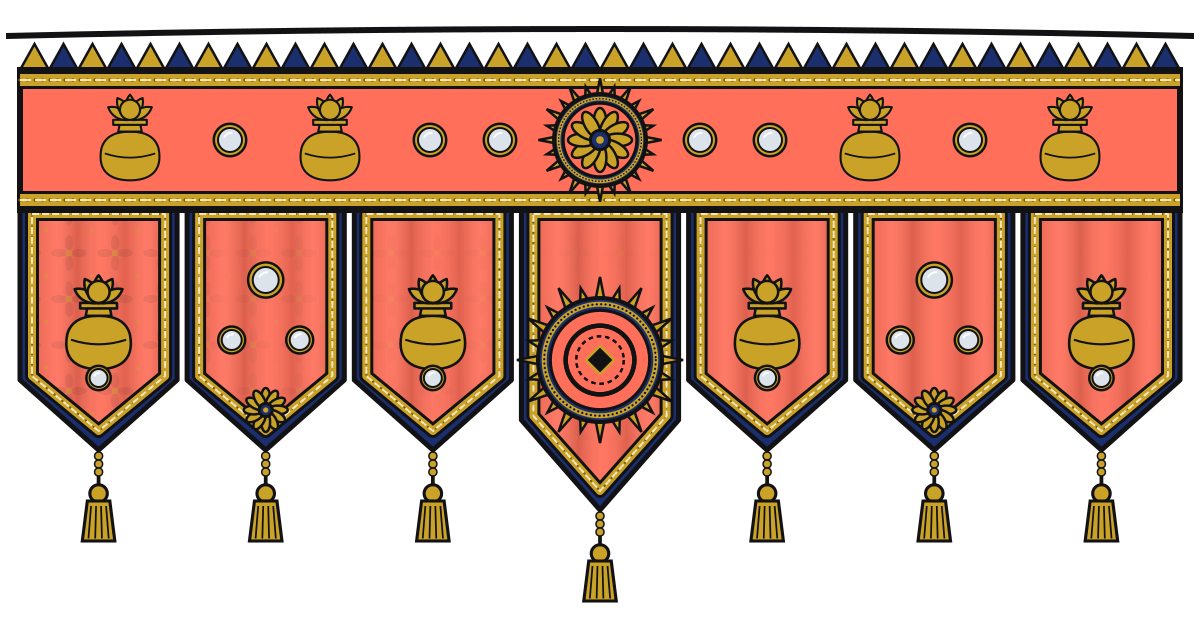
| G1 Torana · gateway The built gate of the seat; the cloth Toran hangs in it | Not yet designed for this clan | Regional tradition |
| G2 Viragallu · hero stone Carved panel stone for a member who died defending the clan | Not yet designed for this clan | Regional tradition |
| G3 Kula-shila · clan stones Standing and table stones that remember the ancestors | Not yet designed for this clan | Design |
| G4 Jayastambha · victory pillar A pillar raised for a victory | Not yet designed for this clan | Design |
| G5 Sima-shila · boundary stone Marks the clan's land, with a line in the native script | Not yet designed for this clan | Design |
4. Sounds
| Accessory | For this clan | Basis |
|---|---|---|
| D1 Pancha-mahashabda · five great sounds The right to five instruments | Not yet designed for this clan | Design |
| D2 Shankha · clan conch The clan's own named war conch | Not yet designed for this clan | Design |
| D3 Murasu · house drums Three drums: war, charity and justice | Not yet designed for this clan | Design |
5. Kit: colours, metals and emblems
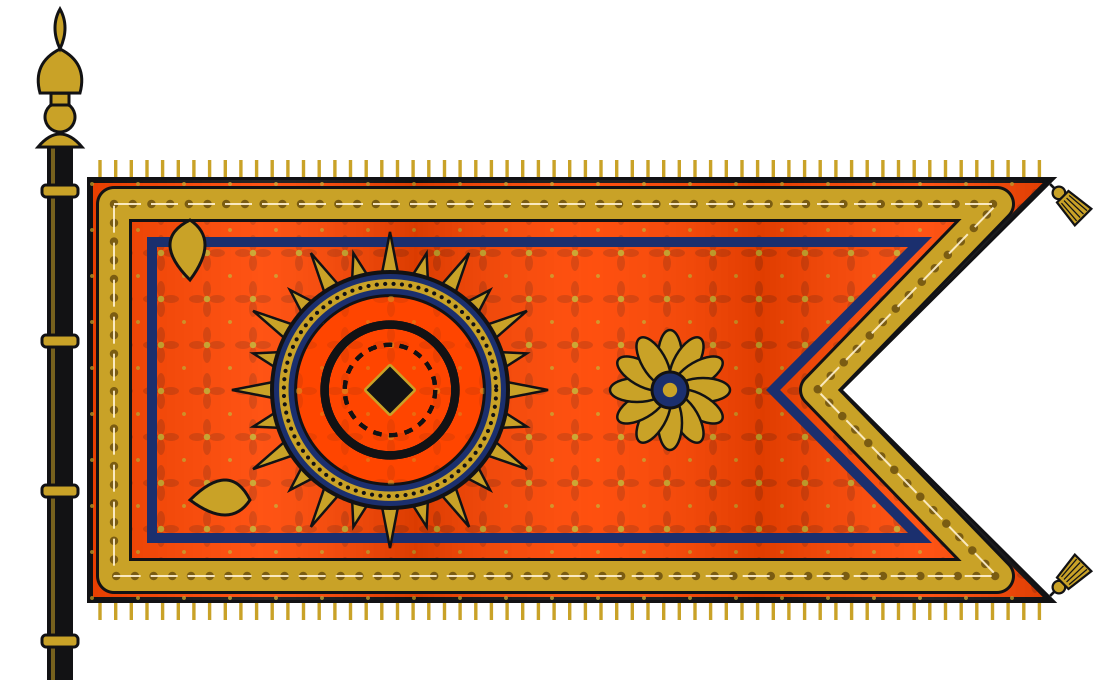
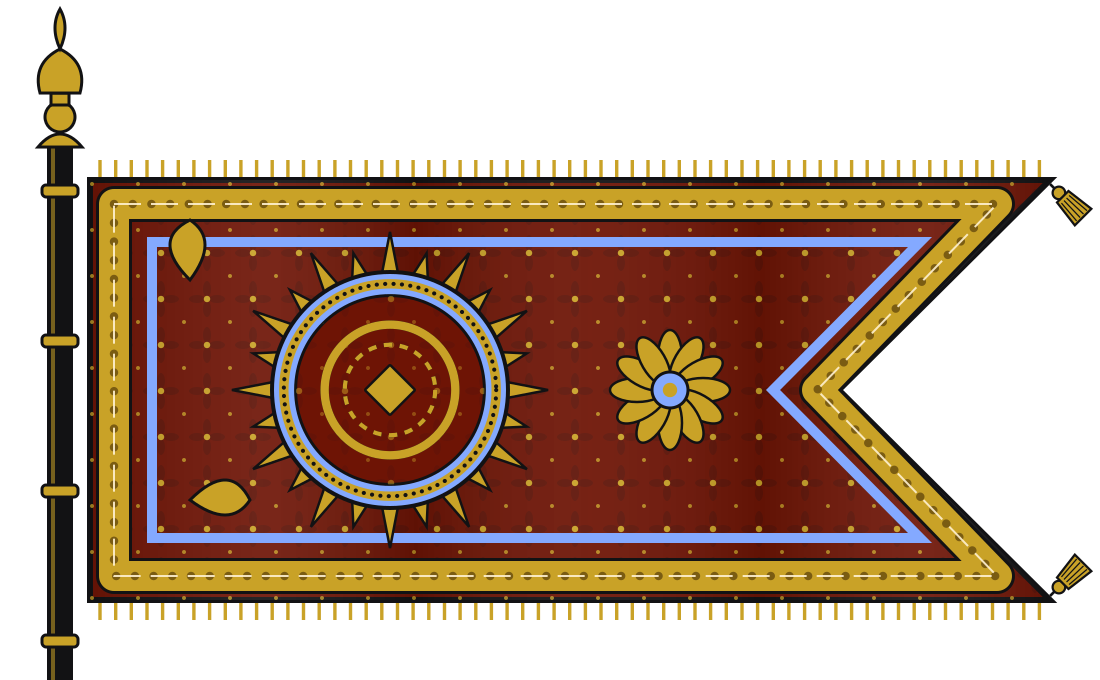
The Atlas gives the Jatapu a Changi flag type, with stepped hill terraces for terrace farming in deep brick and gold[6]. These are design choices for the project and carry no historical claim.
| Part of the kit | This clan |
|---|---|
| Field | Deep Brick #7E2A1E |
| Accent | Intense Electric Blue #84A9FF |
| Emblem colour | Metallic Gold #C9A227 |
| Zari metal | Gold |
| Main emblem | Stepped hill terraces |
| Second image | — |
| Night and day | Every visual accessory has two versions: by night the emblem on the dark field, by day the clan's field colour on cloth woven from its metal. |
6. Flags
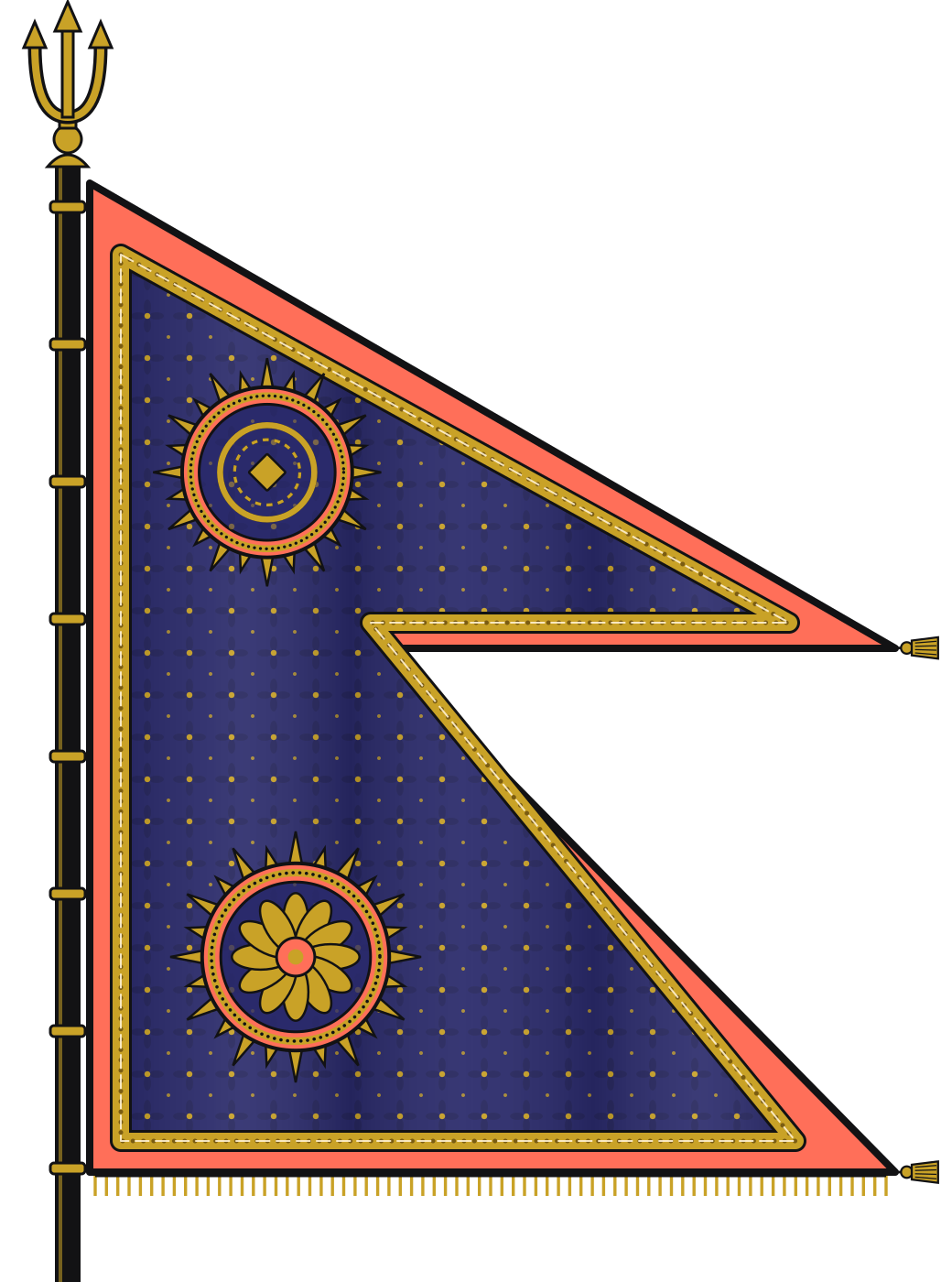
Every clan has every flag type; the type says the occasion and the colours say the clan. The outlined card is the flag the Atlas assigns.





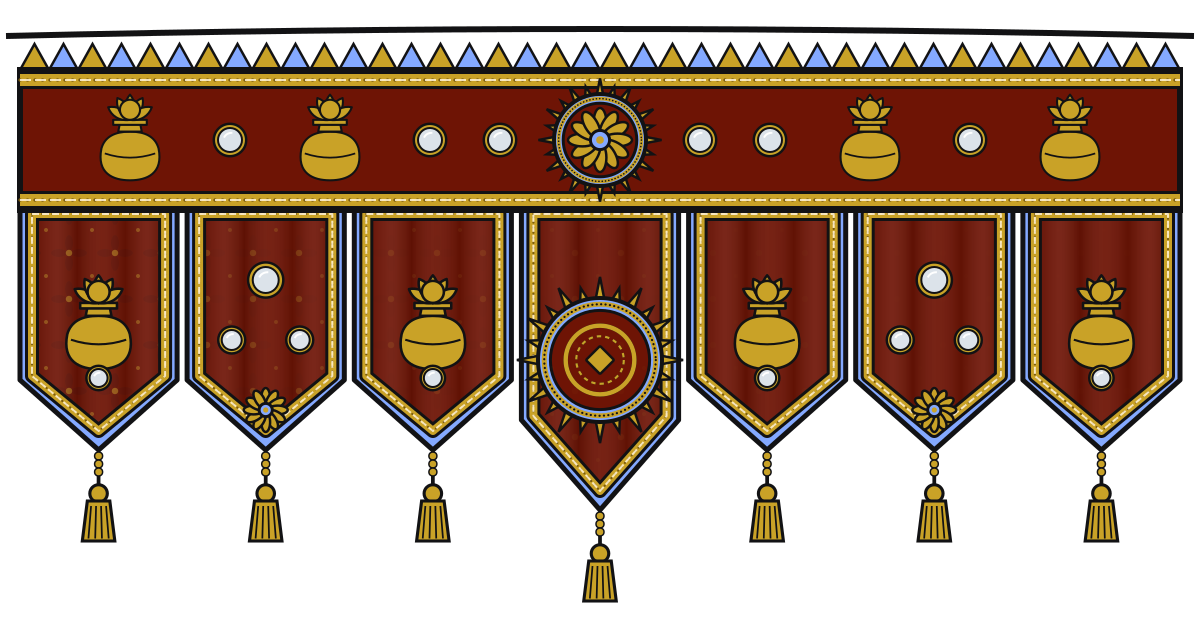

Historic banner
None known
New flag types
| Accessory | For this clan | Basis |
|---|---|---|
| A9 Pota-dhvaja · ship and trade flag For ships, caravans and markets | Not yet designed for this clan | Design |
| A10 Utsava-patāka · festival flag Light, bright flag for fairs and festivals | Not yet designed for this clan | Design |
| A11 Shoka-dhvaja · mourning flag White cloth with the emblem outline in the clan's metal | Not yet designed for this clan | Design |
7. Regalia
| Accessory | For this clan | Basis |
|---|---|---|
| E1 Chhatra · house parasol The ceremonial umbrella | Not yet designed for this clan | Design |
| E2 Chamara · fly-whisks The pair of whisks beside the head of the house | Not yet designed for this clan | Design |
| E3 Danda · staff of office Staff or scepter | Not yet designed for this clan | Design |
| E4 Simhasana · seat The seat of the house, covered in clan cloth | Not yet designed for this clan | Design |
| E5 Khetaka · shield A round shield; the Changi and Dhanush are its flag forms | Not yet designed for this clan | Regional tradition |
| E6 Kula-ayudha · clan weapon The weapon the clan honours | Not yet found for this clan | Under research |
8. Worn
| Accessory | For this clan | Basis |
|---|---|---|
| F1 Kula-vastra · clan cloth The clan's woven pattern in its kit colours | Not yet designed for this clan | Design |
| F2 Kirti-vastra · honour cloth A cloth earned for a deed, not inherited | Not yet designed for this clan | Design |
| F3 Kula-mala · garland flower The flower or leaf the clan wears as a garland | Not yet found for this clan | Under research |
| F4 Chinha · house pin A metal badge with the pin emblem | Not yet designed for this clan | Design |
9. Records
| Accessory | For this clan | Basis |
|---|---|---|
| H1 Clan words A traditional line in the native script | · “Under research” No clan line of the Jatapu's own is in the pack's sources, and none is linked to this people. Leads: the sept names with their meanings and the caste titles recorded by Thurston (1909) are documented under Astitva; the 1970 Andhra University thesis by D. L. Prasada Rao on Jatapu religion and kinship may record sayings. | Documented |
| H2 Biruda · titles The house's title or titles | Caste titles Dora, Naiko and Samanto Titles recorded by Thurston[3] | Documented |
| H3 Prashasti · praise genealogy The lineage as written at the head of a grant | Not yet found for this clan | Under research |
| H4 Vahi · clan register The book of the clan's births, marriages and deaths | Not yet found for this clan | Under research |
| H5 Rana-ghosha · war cry The clan's cry in battle or celebration | Not yet found for this clan | Under research |
10. VishwaVit · knower of the world
Game values are design choices for this project, not historical claims.
References
- Wikipedia, Jatapu people, read 2026-10-31, https://en.wikipedia.org/wiki/Jatapu_people
- Sushree Mohanty, Indigenous Colours of Odisha: Handbook on 62 Tribes (KISS), read 2026-10-20, link
- Edgar Thurston and K. Rangachari, Castes and Tribes of Southern India, vol. 2 (Madras, 1909), Project Gutenberg eBook #42992, https://www.gutenberg.org/ebooks/42992
- Vizagapatam District Gazetteer, page 114, Wikisource mirror (read 31 Oct 2026, codex team run 114).
- Wikipedia, List of Scheduled Tribes in Odisha, read 2026-10-20, https://en.wikipedia.org/wiki/List_of_Scheduled_Tribes_in_Odisha
- Project Atlas, row ST-111, Jatapu. Reference / source column: Ministry of Tribal Affairs, State/UT-wise list of Scheduled Tribes (Constitution (ST) Order 1950 as amended; list dated 09-07-2024).
- Vizagapatam District Gazetteer, page 95, Wikisource mirror (read 29 Oct 2026, KulDevi run 347).
- ITDA tribes, Vizianagaram district website, Andhra Pradesh (read 29 Oct 2026, KulDevi run 347).
- Sri Jakara Devata & Goddali Devatha, Basangi, Ziyyammavalasa, HinduPad, read 11 October 2026.
- Omniglot, Jatapu, read 2026-10-31, https://omniglot.com/writing/jatapu.htm
- D. L. Prasada Rao, An Analysis of Kinship Economy and Religion of the Jatapus (Andhra University, 1970), Shodhganga record, read 2026-10-31, https://shodhganga.inflibnet.ac.in:8443/jspui/handle/10603/560517
- Parvathipuram Manyam district website, Tribes, read 2026-10-31, https://parvathipurammanyam.ap.gov.in/tribes/
- Vajiram and Ravi, Tribes of Andhra Pradesh, read 2026-10-10, https://vajiramandravi.com/current-affairs/tribes-of-andhra-pradesh/