The Pnar, also called Synteng, live in the Jaintia Hills, and the Khasi page lists them among the Khasi groups[1]. Their language, Pnar (Ka Ktien Pnar), is Austroasiatic and had 395,124 speakers in the 2011 census[2]. A Jaintia kingdom ruled by the Syiem Sutnga line is recorded from about 1500 until its annexation to Bengal in 1835, with a winter capital at Jaintiapur[3][4] and a summer capital at Nartiang[5]. The Jaintias fought with the Ahoms at the Battle of Saraighat (1669–1671)[6]. The Behdienkhlam festival at Jowai, held after sowing, is named by the Meghalaya government as the most important dance festival of the Jaintia tribes[7].
01Faith and deities
The Nartiang Durga temple of the Jaintia kings, where the Syiem is chief patron[5]. The KulDevi of this clan is also Jayanti Devi (from the Atlas, basis Documented).
Durga temple of the Jaintia kings at Nartiang[5]
A recorded tie between the clan and the goddess.
| Deity or tradition | Place in the clan's life | Evidence |
|---|---|---|
| Jayanti Devi (Jainteswari) | Durga, worshipped at the Nartiang temple; the name Jaiñtia is linked with her in one theory | [9] |
| U-Mokhai legend | Eldest of the five deities of Jowai | [8] |
| Knia Pyrthat | The thunder deity; a pig is sacrificed a week before Behdienkhlam | [8] |
| Niamtre | The traditional faith, with 'God' and the forefathers' spirits; no deity is named | [9][7] |
| Forefathers' spirits | Women offer food to them during Behdienkhlam | [7] |
02Temples
The Nartiang Durga temple stands on a hilltop, and the extracts give a nearby Shiva temple whose priests are said to descend from priests at Jaintiapur[5]. The Kamakhya Bama Jangha Pitha is a separate temple near Kanaighat[4].
Built by the clan
| Temple | Deity | Built by | When | Where |
|---|---|---|---|---|
| Nartiang Durga temple | Durga (Jayanti Devi), one of the 51 Shakta pithas | The Jaintia kings, on their conversion to Hinduism (Incredible India); tradition gives the request to Jaso Manik | Not dated; described as about 600 years old | Nartiang, West Jaintia Hills[5][10] |
| Kamakhya Bama Jangha Pitha | Kamakhya, as the page calls the goddess | Jayantak (per Wikipedia) | Not dated | Near Kanaighat[4] |
Given patronage or grants by the clan
| Temple | Deity | What the clan gave | When | Where |
|---|---|---|---|---|
| Nartiang Durga temple | Durga (Jayanti Devi) | The Syiem, as chief patron, sacrifices goats at Durga Puja; a gun salute is given to the goddess | Every autumn at Durga Puja | Nartiang[5] |
Later temples in the clan's lands
| Temple | Deity | Built | Where |
|---|---|---|---|
| Nartiang Durga temple | In 2017 Kiren Rijiju said it 'will be declared as a heritage site'; the extracts show no declaration | [5] |
03Languages and scripts
| Language or script | Kind | Under the clan | Evidence |
|---|---|---|---|
| Pnar (Ka Ktien Pnar) living | Austroasiatic, Khasic branch; ISO 639-3 pbv; 30 phonemes (7 vowels, 23 consonants) | The clan's own language, also called Jaiñtia and Synteng | [2] |
| Latin script living | The script in which Pnar is written; the extracts give no other script for the people | Pnar writing today | [11] |
| Khasi living | Very similar to Pnar; the Khasi page gives the dialects Khasi, Jaintia, Lyngngam and War | The parent people's language | [9][12] |
04Books and literature
Pnar is written in Latin script. The extracts name no Pnar literature of the people's own; the works below are about the Pnar language, folklore or history.
Written during the clan's history
| Work | Author | Kind | When | Link to the clan |
|---|---|---|---|---|
| A Grammar of Pnar | Hiram Ring | Grammar (PhD) | 2015 | [2] |
| Word Order in Pnar | Choudhary | Thesis (MA) | 2004 | [2] |
| Mon-Khmer Studies 40, pp. 133–175 | Hiram Ring | Journal article | 2012 | [2] |
| Mon-Khmer Studies 42 | Nagaraja, Sidwell and Greenhill | Journal article | 2013 | [2] |
| Khasi-Jaintia folklore | Soumen Sen | Folklore book | 2004 | [9] |
| Encyclopaedia of North-East India: Meghalaya | Hamlet Bareh | Encyclopaedia | 2001 | [9] |
| People of India: Meghalaya | K. S. Singh (ASI) | Survey | 1994 | [9] |
| Early Jaintia state | Laloo Betty | Thesis | 2016 | [9] |
| The Pnar Trilogy | Valentina Pakyntein | Trilogy, title as cited | No year given | [9] |
| The Khasis | P. R. T. Gurdon | Ethnography of the Khasi, with the Jaintia rajas | 1907 | [13] |
| Jayantia Buranji | S. K. Bhuyan (cited) | Chronicle of the Jayantias, as the Ahom book cites it | Not dated | [14] |
Given patronage by the clan
Not recorded.
05Thinkers and scholars
| Name | Field | Era | Contribution |
|---|---|---|---|
| Hiram Ring | Linguistics | 2012–2015 | A grammar of Pnar and the DoReCo corpus of Pnar audio narratives[2] |
| P. Sidwell | Linguistics | 2005 | Cited for the Khasic classification of Pnar[2] |
| Soumen Sen | Folklore | 2004 | Khasi-Jaintia folklore; the Sutong origin of the name (p. 56)[9] |
| Hamlet Bareh | Regional encyclopaedia | 2001 | Encyclopaedia of North-East India: Meghalaya[9] |
| Laloo Betty | History (thesis) | 2016 | A thesis on the early Jaintia state[9] |
The scholars named by the extracts. No Pnar writer or scholar of the people is named in them.
06Art and architecture
What survives of the kingdom is mostly stone: the Nartiang monoliths and dolmens, and the ruined palace at Jaintiapur. The extracts give no Jaintia painting or textile.
Painting and wall art
Not recorded.
Sculpture and temple art
| Art form | What it is | Era | Evidence |
|---|---|---|---|
| Nartiang menhirs and dolmens | Standing stones (menhirs) and flat stones (dolmens); the dolmens are dedicated to the women | Erected 1500–1835, as printed | [15][10] |
Temple and building architecture
| Art form | What it is | Era | Evidence |
|---|---|---|---|
| Jaintia Rajbari, Jaintiapur | Winter-capital palace, now ruined | Not dated | [4] |
| Brick building at Jaintapur | Built by Lakshmi Narayan | 1669–1697 | [3] |
| Khasi-Jaintia house | A house with a central wooden pillar | Not dated | [10] |
| Aitnar site, Jowai | River dam and a low brick-wall amphitheatre for the festival | Not dated | [8] |
Weaving and textiles
Not recorded.
Clothing and jewellery
Not recorded.
Coins, pottery and crafts
| Art form | What it is | Era | Evidence |
|---|---|---|---|
| Weaving; wood and bamboo crafts | The crafts of the people today | Today | [16] |
07History
Origins and the name
Pnar tradition says the people descend from Ki Hynñiew Trep, the Seven Huts[9]. A Pnar origin narrative, as Omniglot prints it from Ring's grammar, says some people were sent to earth through water in the form of a fish[11].
The name Jaiñtia has two theories given: a link with Jayanti Devi or Jainteswari, which the Pnar article calls one theory, not confirmed[9], and the former settlement of Sutong, which the Pnar article gives as a possible origin (Sen 2004, p. 56)[9]. The Ahom book says the Jayantias had come under Hinduism from about 1500 (citing Gait)[14].
From about 1500 to 1605
About 1500 the king took a Sanskrit name, Parbat Ray, and the capital was Jaintapur[3]. Wikipedia lists the Syiem Sutnga rulers from Prabhat Ray Syiem Sutnga (1500–1516), and says all the Pnar rajas came from the Syiem Sutnga clan[4].
The kingdom was conquered by the Koch king of Cooch Bihar in 1548–1564[3], and KHADC dates Chilarai's defeat of the Jaintia king to about 1564[17]. Under the Kachari king in the late 16th century, Jaintia was independent again in 1605 with Ahom help[3].
Nartiang and the 17th century
Dhan Manik (1596–1612) made Nartiang the summer capital; Jaso Manik reigned 1606–1641[5]. KHADC gives the start of Jaintia–Ahom contact under Pratap Singha (1603–41), when Jasa Manik of Jaintia offered two princesses in marriage[17].
Lakshmi Narayan (1669–1697) built a brick building at Jaintapur[3]. The Nartiang article names a queen Lakshmi Narayana, daughter of the Koch king, who encouraged Shaktism[5]; the two accounts are left open.
Alliance and tribute with the Ahoms
Ahom king Chakradhwaj Singha renewed the alliance with Jaintia after 1663, and the Jaintias fought with the Ahoms at Saraighat (1669–1671)[6].
Rudra Singha (1696–1714) subdued the Jaintia kingdom[14]. The Ahom book dates the formal annexation to 1708[14]; the 1605 independence above and the 1708 annexation need reconciling.
Eighteenth century and British rule
After the British took the Sylhet plains in 1765 (Diwani), the Jaintia king was driven from them[3]. A 1774 attack on Jaintia was reportedly in return for raids into Sylhet[13].
After the Burmese conquest of Assam in 1824 Jaintia lost its independence, and the British restored it in 1825[3]. A Jaintia treaty was signed on 10 March 1824 by David Scot[17].
Annexation
Wikipedia gives the annexation on 15 March 1835 and Rajendra Singh (1832–1835) as the last ruler[4]. Banglapedia says it was annexed to Bengal in 1835 to ease the trade in limestone and cane[3]. KHADC says the Jaintia Hills lapsed to British India in 1835[17], while Encyclopedia.com gives 1860 for the annexation of the Jaintia Hills[12]; the date is left open.
Wikipedia records human sacrifice at Jangha Kali, which it says a ruler named Bancharu began[4].
After 1835
The Pnar article says the Jaintia Hills became a district after Meghalaya statehood in 1972[9]. The Jaintia Hills district was split on 31 July 2012 into East and West Jaintia Hills[18].
08Journey and migrations
The extracts give a seven-huts origin and the kingdom's seats, but no route of migration for the Pnar.
| When | From | To | Why | Evidence |
|---|---|---|---|---|
| Early (no date) | Ki Hynñiew Trep, the Seven Huts | The Jaintia Hills | Origin tradition of the Pnar, who claim West and East Jaintia Hills | [9][16] |
| Not dated; Dhan Manik (1596–1612) | Sutnga, where the princely family began as Syiems | Nartiang, the summer seat | Summer residence moved to Nartiang; Dhan Manik made it the summer capital | [18][5] |
| c. 1500 onward | Jaintia kingdom | Jaintiapur, the winter capital (now Bangladesh) | Winter capital at the foot of the hills near the Surma | [4][13] |
09Seats and lands
| Place | Role | Where today |
|---|---|---|
| Nartiang | Summer capital of the Jaintia kings and the Dolloi seat of the premier chief. Monolith field and Durga temple[18][10] | West Jaintia Hills, Meghalaya |
| Jaintiapur | Winter capital; the Jaintia Rajbari palace is now ruined[4] | Jaintiapur upazila, Sylhet, Bangladesh[9] |
| Jaintapur | Capital under Parbat Ray; Lakshmi Narayan's brick building[3] | Sylhet, Bangladesh (the extracts give no closer place) |
| Sutnga | Where the princely family began as Syiems; one of the twelve Dolloi seats[18] | Jaintia Hills, Meghalaya (not placed more closely) |
| Jowai | Behdienkhlam is held at Aitnar, Jowai; the Department's page gives the Jowai legend of U-Mokhai. 1220 m, 64 km from Shillong[8] | West Jaintia Hills, Meghalaya |
| Khliehriat | Headquarters of East Jaintia Hills district[18] | East Jaintia Hills, Meghalaya |
| Twelve Dolloi (Ka Ri Khadar Dolloi) | The elaka of twelve chiefs: Nartiang, Amwi, Jowai, Lakadong, Mynso, Nongbah, Nongjngi, Nongphyllut, Nongtalang, Raliang, Shangpung and Sutnga[18] | Jaintia Hills, Meghalaya |
| Myntdu river | The plantain image of the goddess is immersed here at the end of the Durga Puja[5] | Nartiang area, West Jaintia Hills |
| Sylhet plains | Lost after 1765, when the Jaintia king was driven out[3] | Sylhet, Bangladesh |
| Mynthong | Where the dad-lawakor wooden-ball game is played to predict the harvest[7] | Not placed more closely in the extracts |
10Notable figures
| Name | Role | Era | Known from |
|---|---|---|---|
| Parbat Ray | King who took a Sanskrit name; capital Jaintapur | c. 1500 | [3] |
| Prabhat Ray Syiem Sutnga | First of the Syiem Sutnga rulers in the Wikipedia list | 1500–1516 | [4] |
| Dhan Manik | Made Nartiang the summer capital | 1596–1612 | [5] |
| Jaso Manik | King to whom the goddess appeared in a dream, asking for a temple (tradition). KHADC spells him Jasa Manik | r. 1606–1641 | [5][17] |
| Lakshmi Narayan research | Built a brick building at Jaintapur; the Nartiang article names a queen of this name | 1669–1697 | [3][5] |
| U Mar Phalyngki | Trusted lieutenant of the Jaintia king; the tallest Nartiang menhir commemorates his battle victory | Monoliths dated 1500–1835 as printed | [15] |
| U Luh Lyngskor Lamare | Erected the Nartiang monoliths with U Mar Phalyngki and the village clans | As for U Mar Phalyngki | [15] |
| U Kongsong | Raja of Nartiang, styled premier chief among the Dolloi | Not dated | [18] |
| Jayantak | Built the Kamakhya Bama Jangha Pitha temple near Kanaighat, as the Wikipedia article gives it | Not dated | [4] |
| David Scot | British party to the Jaintia treaty of 10 March 1824 | 1824 | [17] |
| Rajendra Singh | Last Jaintia ruler in the Wikipedia list | 1832–1835 | [4] |
| U-Mokhai legend | Eldest of the five deities of Jowai; welcomed a wandering tribe with a dance | Legend, no date | [8] |
11Allies, rivals and marriages
| People | Relationship | When |
|---|---|---|
| Khasi | The Khasi page counts the Pnar (Synteng) among the Khasi groups[1] | Today |
| Ahom kingdom | Jaintia–Ahom contact began under Pratap Singha; the Ahoms often called the Jayantias 'Garos' (Bhuyan, Jayantia Buranji)[17][14] | Early 17th century |
| Ahom royal house | Jasa Manik of Jaintia offered two princesses in marriage[17] | Under Pratap Singha (1603–41) |
| Ahom kingdom | Alliance renewed by Chakradhwaj Singha; Jaintias fought with the Ahoms at Saraighat[6] | 1663–1671 |
| Ahom kingdom | Subdued by Rudra Singha; formal annexation dated 1708 by the Ahom book[14] | 1696–1714 |
| Koch of Cooch Bihar | Conquered Jaintia; Chilarai defeated the Jaintia king about 1564[3][17] | 1548–1564 |
| Kachari | Jaintia under the Kachari king in the late 16th century[3] | Late 16th century |
| Khasi states | Raja of Jaintia held pre-eminence among the Khasi states, and the Raja of Khyrim came next[17] | Not dated |
| British | Sylhet plains lost in 1765; treaty of 10 March 1824; annexation in 1835[3][4] | 1765–1835 |
| Burmese | Conquest of Assam in 1824 ended Jaintia independence until 1825[3] | 1824–1825 |
12Society and livelihood
Pnar society is matrilineal: property and wisdom pass through the daughters, and people speak of their mother's and father's clans[16]. The extracts give no further detail of the Pnar councils, and the rules for the Khasi heiress are not assumed to hold for the Pnar.
Government and social order
| Institution or group | What it was | Evidence |
|---|---|---|
| Syiem Sutnga line | The royal family of the Jaintia kings; its princely family began as Syiems at Sutnga | [4][18] |
| Dolloi | The elaka of twelve chiefs, the Ka Ri Khadar Dolloi; the Raja of Nartiang is premier chief | [18] |
| Daloi | Leads the three-day Behdienkhlam festival at Jowai | [7] |
| Wasan (priests) | Ring the brass bell Chew Chew at the festivals | [8] |
| Central Puja Committee | Caretaker of the Nartiang Durga temple | [5] |
| Niamtre | The traditional faith, whose three principles are kamai yei hok, tipbru tipblai and tipkur tipkha (right livelihood, duty to fellow humans, and respect for the paternal and maternal clans) | [9] |
Livelihood over time
| Era | Livelihood | Evidence |
|---|---|---|
| Kingdom era | Limestone and cane (rattan) trade with Sylhet, which the 1835 annexation was meant to ease | [3] |
| Today | Farming (rice, maize and millet, terrace and jhum), animal husbandry, weaving, and wood and bamboo crafts | [16] |
13Sub-clans and related clans
The extracts name the Khasi as parent people and the Syiem Sutnga line as the royal family. For sub-groups they name Khyrwangs, Labangs, Nangphylluts and Nangtungs in the Jaintia Hills, and the recently recognised Maden (hadems).
| Clan | Relation | Where | Size | In the Atlas | Evidence |
|---|---|---|---|---|---|
| Khasi | Parent people | Khasi Hills, Meghalaya; the Pnar count among the Khasi groups | ST-132 | [1] | |
| Syiem Sutnga | Dynasty from this clan | Sutnga, Nartiang and Jaintiapur | same name as ST-459: check | [4] | |
| Khyrwang | Sub-clan | Jaintia Hills | same name as ST-448: check | [19] | |
| Labang | Sub-clan | Jaintia Hills | same name as ST-415: check | [19] | |
| Nangphylut | Sub-clan | Jaintia Hills | same name as ST-477: check | [19] | |
| Nangtung | Sub-clan | Jaintia Hills | same name as ST-478: check | [19] | |
| Maden (hadems) | Branch | Jaintia, recently recognised | same name as ST-431: check | [20] | |
| War-Jaintia | Branch | Southern slopes of the Jaintia Hills | new clan candidate | [1] | |
| Khynriam | Related people | Shillong plateau (UGC paper); Nongphlang uplands, East Khasi Hills (Khasi page) | same name as ST-428: check | [20][1] |
Clans marked "new clan candidate" are not in the Atlas yet.
14Surnames
No Pnar surname is named in the extracts. The Khasi matrilineal article says children take their mother's surname, but gives no list[21].
Not recorded.
15Songs and music
The extracts describe Pnar music and chanting, but give no song titles or lyrics. Pnar chanting is sung on the house visits of Behdienkhlam, and in the Laho dance a leader recites rhythmic couplets[8]; no line is quoted here.
None recorded yet.
Instruments and styles
| Instrument or style | What it is | Evidence |
|---|---|---|
| Ramynthei | A single-string bamboo fiddle | [16] |
| Duitara | A two-string lute | [16] |
| Ksing / Nakra | A bamboo nose flute, as the page gives it (see open) | [16] |
| Tangmuri | Percussion, as the page gives it | [16] |
| Drums, pipes, cymbals and the brass bell Chew Chew | Played at the Behdienkhlam rites | [8] |
16Poems, lullabies and children's rhymes
The extracts give no Pnar poems and no Pnar rhymes.
None recorded yet.
17Stories, legends and proverbs
Stories and legends
| Story | What happens | Told by | Evidence |
|---|---|---|---|
| The seven huts | The Pnar come from Ki Hynñiew Trep, the Seven Huts | Community tradition | [9] |
| The fish origin | Some people were sent to earth through water in the form of a fish; some came with Ynñiaw Wasa from the beginning | Ring's grammar, as Omniglot prints it | [11] |
| U-Mokhai and the five deities legend | A forest holds five deities; a wandering tribe arrives and U-Mokhai welcomes it with a dance, saying 'Children of God, fear not' | Jowai legend, as the Department page gives it | [8] |
| The famine and the festival legend | The people of Jowai ask U-Mokhai for help; he tells them to hold a festival after sowing, which became Behdienkhlam | Jowai legend | [8] |
| The Nartiang monolith legend | A monolith could be raised only after a human sacrifice (the legend of Mar Phalangki) | Incredible India page | [10] |
| The goddess's dream legend | The goddess appears to King Jaso Manik in a dream and asks him to build a temple | Tradition, as Wikipedia gives it | [5] |
Proverbs and sayings
Not recorded.
18Festivals and fairs
| Festival or fair | When | Where | What happens |
|---|---|---|---|
| Behdienkhlam living | July, after sowing (Meghalaya portal). The NVLI page gives July, four days and three nights; the Department gives June–July | Jowai; Aitnar; Mynthong | Young men beat house roofs with bamboo poles to drive out evil spirits and disease. Tall decorated rots are brought to Aitnar; the khnong pole goes into the pool on the last day; the dad-lawakor game predicts the harvest[7][22][8] |
| Durga Puja at Nartiang living | Every autumn; the Department gives September–November | Nartiang Durga temple | A four-day festival that ends with the plantain image immersed in the Myntdu river; goats are sacrificed by the Syiem; a gun salute is given[5][8] |
| Laho dance | Not dated | Not stated | A dance credited to Pakyntein; a leader recites rhythmic couplets[9][8] |
| Chad Sukra and Chad Pastieh | Not dated | Not stated | Named as Pnar festivals; the extracts give no detail[9][16] |
| Tiger Festival | January to March | Not stated | In the Department's Jaintia calendar[8] |
| Bam Phalar and Bam Doh | January | Not stated | In the Department's Jaintia calendar[8] |
| Rong Belyngkan | May to June | Not stated | In the Department's Jaintia calendar[8] |
| Beh Ser Soopen | At sowing | Not stated | The priest breaks an egg for hunting luck; the bamboo-and-grass thatch Cher iung blai locks away evil spirits[8] |
| Seng Kut Snem | November | Not stated | In the Department's Jaintia calendar[8] |
19Food, dress and games
Food
| Item | What it is | Evidence |
|---|---|---|
| Ka Sohliah | Rice beer; the lady of the house offers it on the Behdienkhlam house visits | [16][8] |
| Don Sain, Ja Doit, Doh Khleh, Ka Ryndia, Ja Dohbleih | Named Pnar dishes; the extracts give no description | [16] |
Dress
| Item | What it is | Evidence |
|---|---|---|
| Jingsem and Dohkha | Women's dress | [16] |
| Ri-Shyngñong and Jymphong | Men's dress | [16] |
| Silver, bead and feather jewellery | Worn with the dress | [16] |
Games and martial arts
| Item | What it is | Evidence |
|---|---|---|
| Dad-lawakor | A wooden ball contested between Northerners and Southerners at Mynthong; it predicts the next harvest | [7] |
| Wooden-ball football | Played at the end of Behdienkhlam | [8] |
| Wah-eit-nar | A muddy ditch where the beam contest is held | [7] |
Tags: living still practised · revived brought back after a break · lost known only from records · research reported but not yet confirmed from a source. Songs and poems under copyright are listed by title only; restricted or sacred material is noted without its content.
20Status today
The Pnar live in East and West Jaintia Hills in Meghalaya, with communities in Assam and in Bangladesh (Jaintiapur upazila, Sylhet)[9]. The Jaintia Hills were made a district after Meghalaya's statehood in 1972[9] and split in 2012[18].
Who carries the name today
| Community | Link | Basis | Evidence |
|---|---|---|---|
| Pnar / Synteng (ST-108) | Community tradition | [9] |
Recognised heritage
| What | Recognition | Evidence |
|---|---|---|
| Behdienkhlam festival | The Meghalaya portal calls it the most important dance festival of the Jaintia tribes; the NVLI has a Jowai entry on it | [7][22] |
| Nartiang Durga temple | Announced in 2017 as a future heritage site; no declaration in the extracts | [5] |
Under research: the extracts do not say whether Pnar community bodies have reviewed this page.
21For children
The Children of God
Long ago, in the hills of Jowai, there was a forest where five deities lived. One day a wandering tribe came to the forest. The eldest deity, U-Mokhai, welcomed them with a dance and said, 'Children of God, fear not.' Later the people of Jowai had a bad time with hunger, and they asked U-Mokhai for help. He told them to hold a festival after sowing. That festival is Behdienkhlam, and it is still held in July. Young men beat the roofs of houses with bamboo poles to chase away evil spirits and sickness.
22Across the project
| Project | What carries this clan | Status |
|---|---|---|
| Atlas of the Janas | Seats: Nartiang (summer), Jaintiapur (winter), Sutnga; the festival at Jowai | To check |
| KulDevi and GrahDevi | Jayanti Devi, KulDevi from the Atlas (basis Documented); planets take the Navadurga forms Shailaputri to Siddhidatri | From the Atlas |
| Planet naming | Not yet checked against the Tier registers | To check |
| Renaming and waters | Name theories: Jainteswari, and Sutong (Sen 2004); the Myntdu river at Nartiang | — |
23Open questions
- The Ahom book dates the annexation of Jayantia to 1708[14]; the Jaintia account above gives independence again in 1605[3]. Reconcile.
- Annexation date: 1835[3][17][4] or 1860 for the Jaintia Hills[12].
- Annexed to Bengal[3] or into Assam[9]: the lead says Bengal, and the Pnar article says Assam.
- Spelling and identity: Jaso Manik[5] or Jasa Manik[17]; Parbat Ray[3] and Prabhat Ray Syiem Sutnga[4]; Lakshmi Narayan as king[3] or queen[5].
- Behdienkhlam length: three days[7] or four days and three nights[22].
- The Nakra: a big drum[23] (Khasi page) or a bamboo flute[16] (Pnar page); the Pnar page's instrument labels need checking.
- Summer capital at Nartiang: 'there may have been a summer capital'[4] against 'made Nartiang the summer capital'[5].
- Pnar kur and surnames: none named in the extracts. Gurdon's clan appendices and the NEHU Landmarks paper are to be read.
- Pnar proverbs, songs and rhymes: none in the extracts, and no Pnar-language text was found.
- Coins, seals, copper plates and royal chronicles of the Jaintia kings: none in the extracts beyond the Jayantia Buranji cited by Bhuyan.
- Whether the youngest-daughter inheritance rule of the Khasi sources applies to the Pnar.
- Living descendants of the Syiem Sutnga line: not identified in the extracts.
24Astitva
अस्तित्व · being, existence: everything by which the clan is known
The Jaintia's best-documented accessories are its stones: the Nartiang menhirs and dolmens, and the victory menhir of U Mar Phalyngki[15][10]. No coin, seal or copper plate of the Jaintia kings is in the extracts.
Every clan has every accessory, royal objects included. Each one says how it is known: Documented This clan's own object is recorded. · Regional tradition Recorded for the region or for peoples like this one, not for this clan. · Design Made for this project, with no historical claim. · Under research To be found for this clan from sources. Legends and titles are written in the clan's own script.
1. Seals and coins
| Accessory | For this clan | Basis |
|---|---|---|
| B1 Rajamudra · house seal Round seal with the clan emblem and a short legend in the clan's script | Not yet designed for this clan | Design |
| B2 Anguliya-mudra · signet ring Personal seal ring of the head of the house | Not yet designed for this clan | Design |
| B3 Chhapa · house stamp Ink or block stamp for letters, goods and cloth | Not yet designed for this clan | Design |
| B4 Tamrapatra · charter plate Copper-plate grant on a ring, closed with the house seal | Not yet designed for this clan | Design |
| B5 Shreni-mudra · guild or trade seal Seal for the clan's trade, craft or caravan | Not yet designed for this clan | Design |
| C1 Clan coin Emblem or deity on one side, a legend in the clan's script | Not yet designed for this clan | Design |
| C2 Coin die The die that strikes the coin | Not yet designed for this clan | Design |
2. Living symbols
| Accessory | For this clan | Basis |
|---|---|---|
| I1 Totem trio The tree, bird and animal the clan protects | Not yet found for this clan | Under research |
| I2 Kaval-maram · guardian tree The tree that stands at the clan's seat | Not yet found for this clan | Under research |
3. Stone and gate
| Accessory | For this clan | Basis |
|---|---|---|
| G1 Torana · gateway The built gate of the seat; the cloth Toran hangs in it | Not yet designed for this clan | Regional tradition |
| G2 Viragallu · hero stone Carved panel stone for a member who died defending the clan | Not yet designed for this clan | Regional tradition |
| G3 Kula-shila · clan stones Standing and table stones that remember the ancestors | Menhirs (Moo Shynrang) and dolmens (Moo Kynthai) at Nartiang, for kings, women and battles Moo Shynrang; Moo Kynthai | Documented |
| G4 Jayastambha · victory pillar A pillar raised for a victory | The tallest Nartiang menhir, about 8 m, commemorates a battle victory of U Mar Phalyngki | Documented |
| G5 Sima-shila · boundary stone Marks the clan's land, with a line in the native script | Not yet designed for this clan | Design |
4. Sounds
| Accessory | For this clan | Basis |
|---|---|---|
| D1 Pancha-mahashabda · five great sounds The right to five instruments | Not yet designed for this clan | Design |
| D2 Shankha · clan conch The clan's own named war conch | Not yet designed for this clan | Design |
| D3 Murasu · house drums Three drums: war, charity and justice | Not yet designed for this clan | Design |
5. Kit: colours, metals and emblems
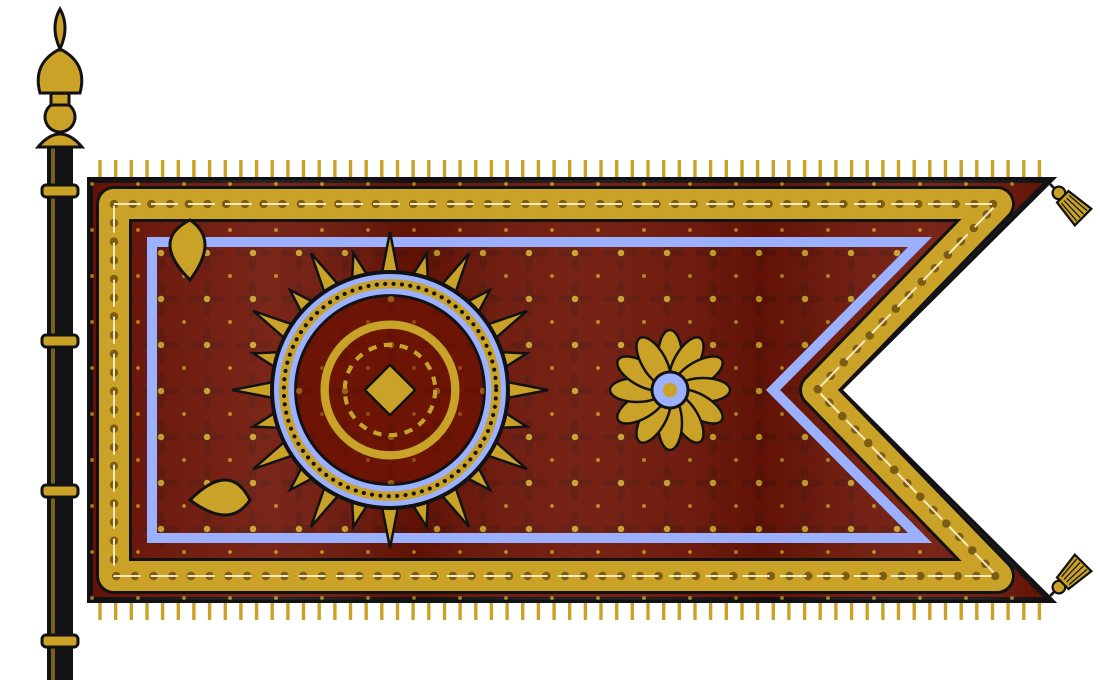
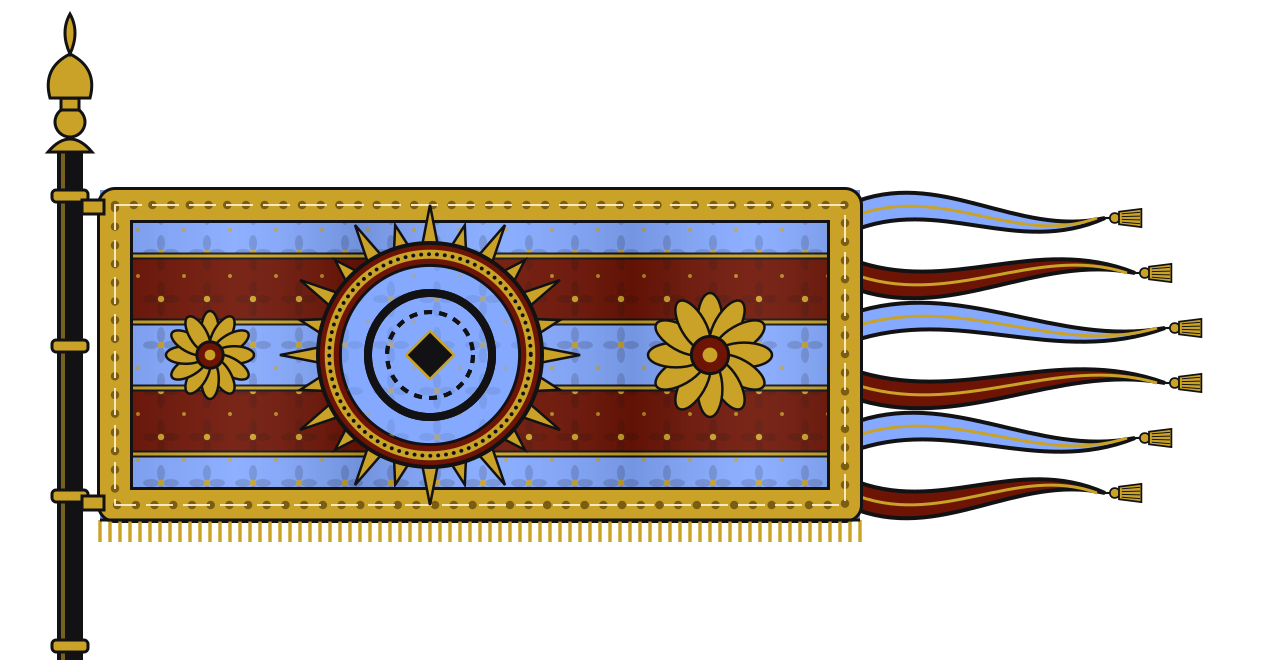
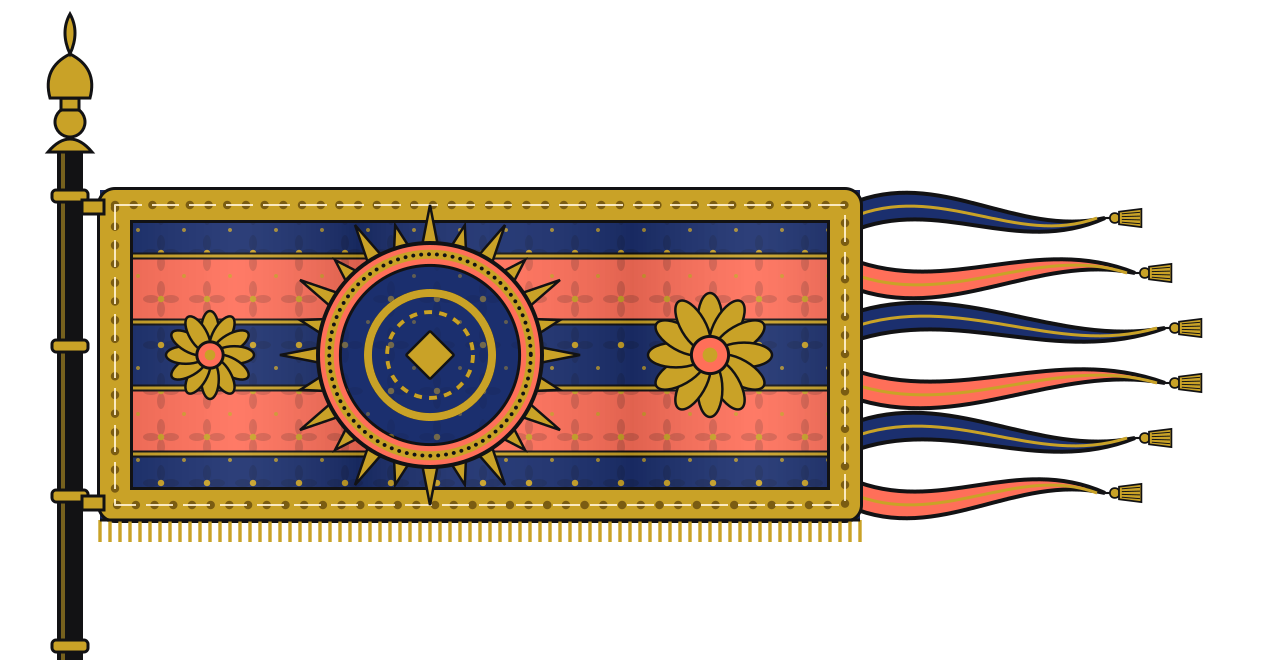
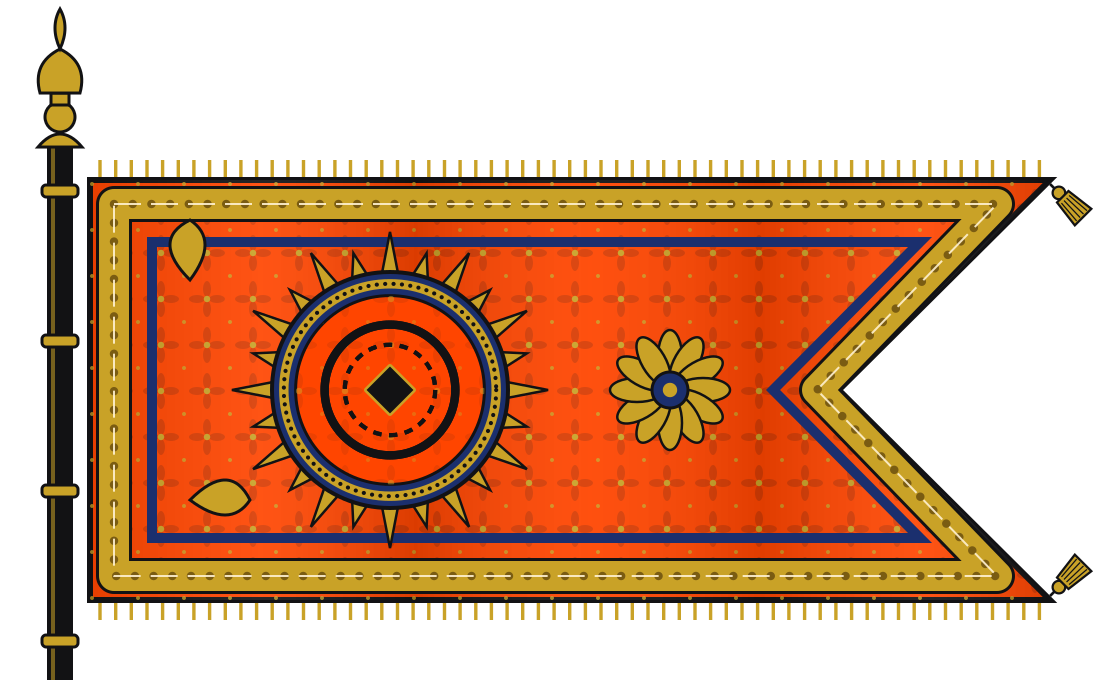
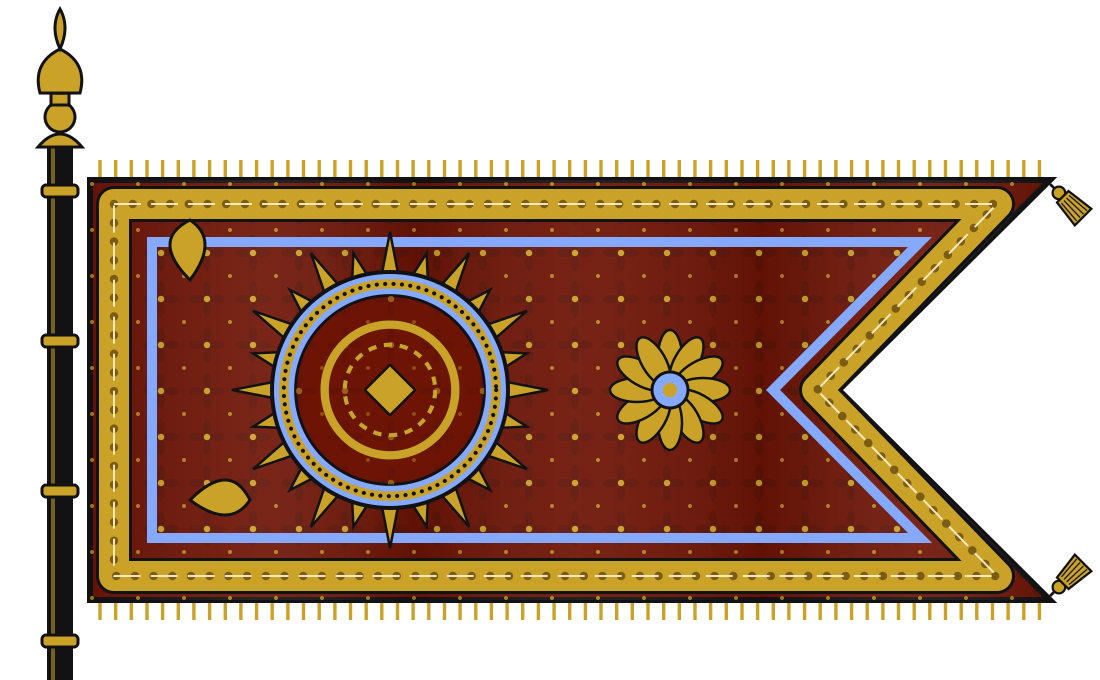
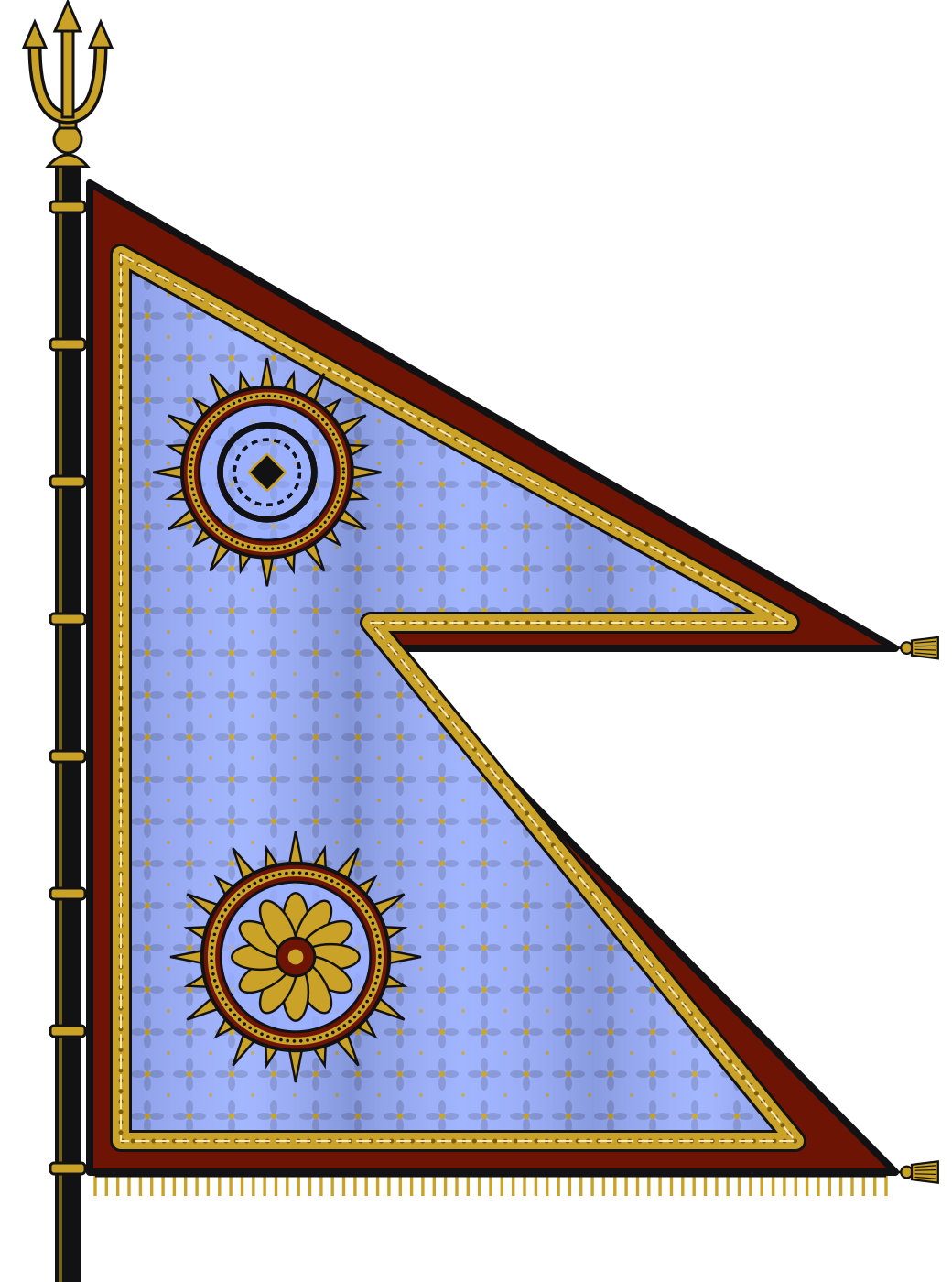
The Atlas's Jaripataka (royal crown flag) carries standing stone monoliths and a tall wooden pole: the Nartiang monoliths and the Behdienkhlam festival[15][7]. The sheet records no historic banner for the clan, and the design is the sheet's own.
| Part of the kit | This clan |
|---|---|
| Field | Maroon #6E1405 |
| Accent | Deep Cosmic Blue #9BB0FF |
| Emblem colour | Metallic Gold #C9A227 |
| Zari metal | Gold |
| Main emblem | Standing stone monoliths |
| Second image | A tall wooden pole |
| Night and day | Every visual accessory has two versions: by night the emblem on the dark field, by day the clan's field colour on cloth woven from its metal. |
6. Flags
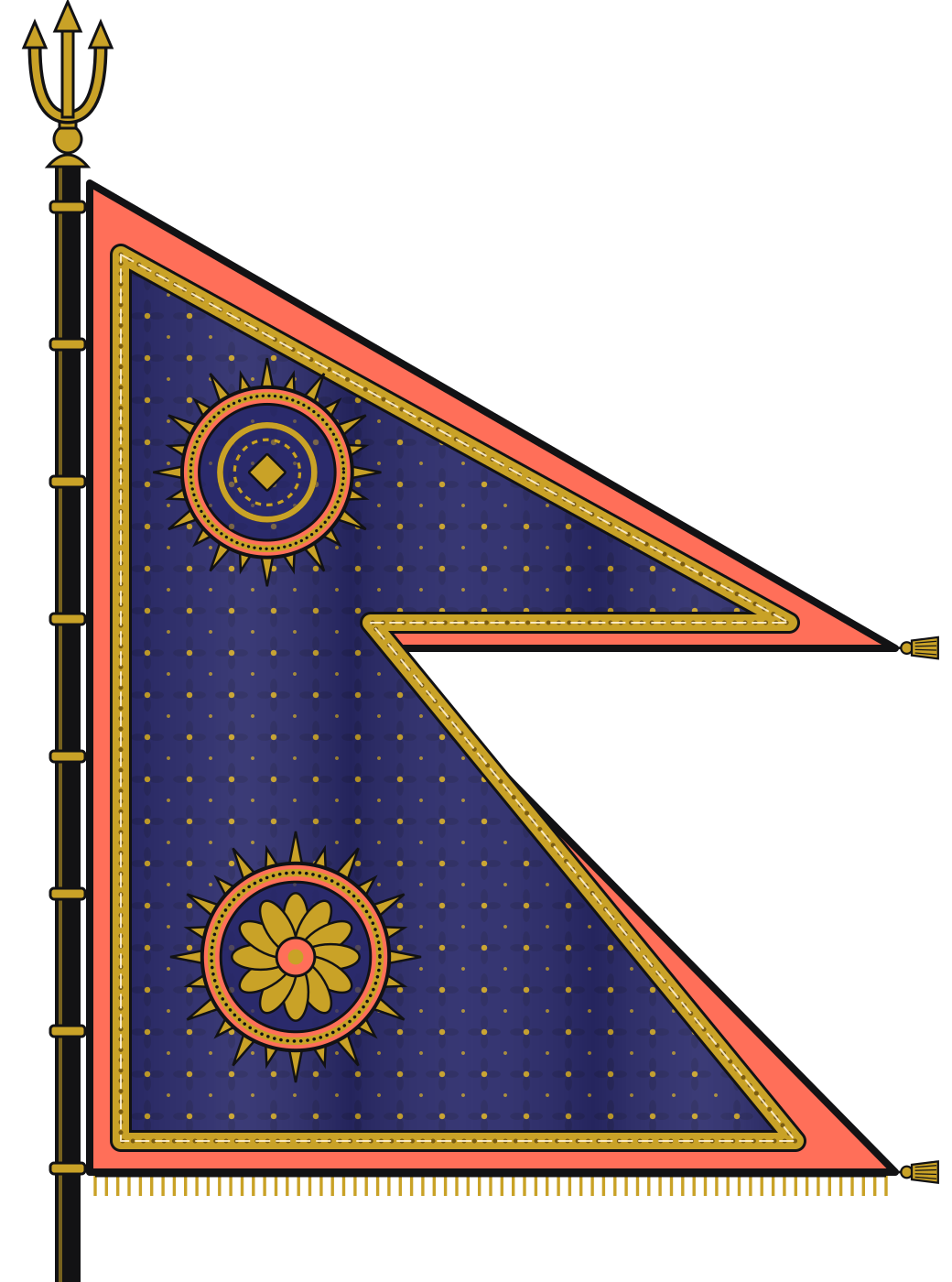
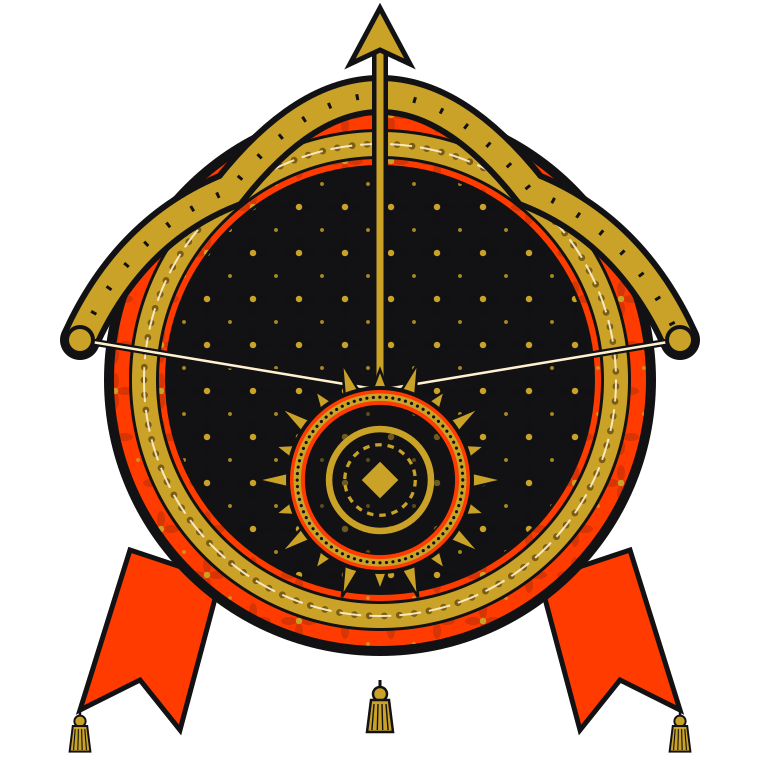
Every clan has every flag type; the type says the occasion and the colours say the clan. The outlined card is the flag the Atlas assigns.

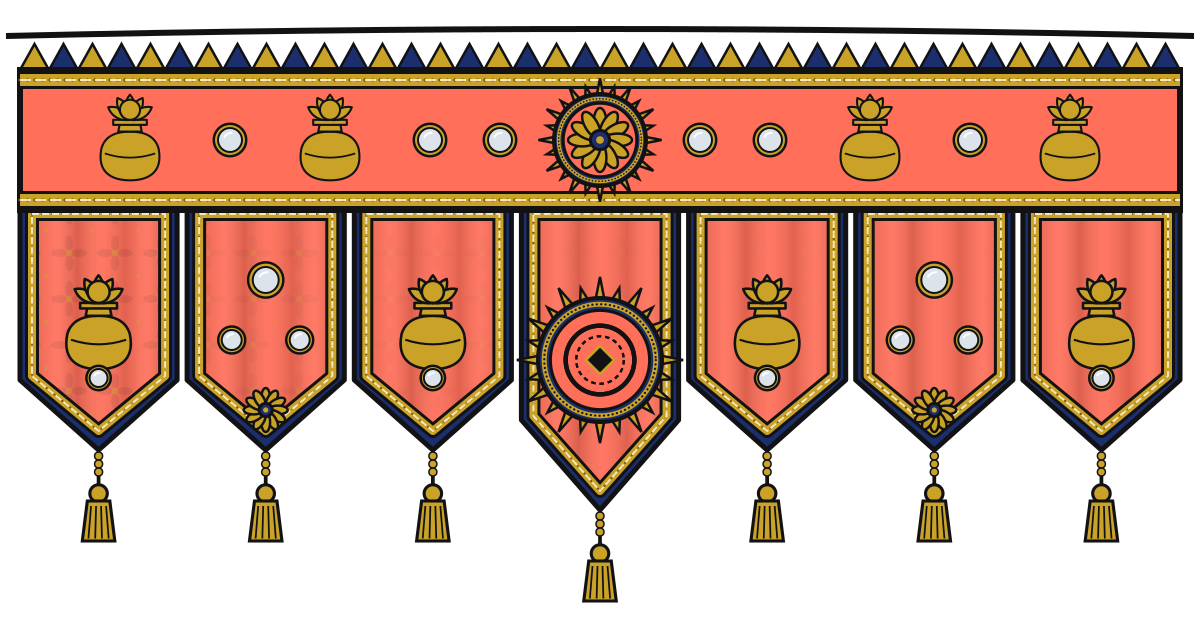
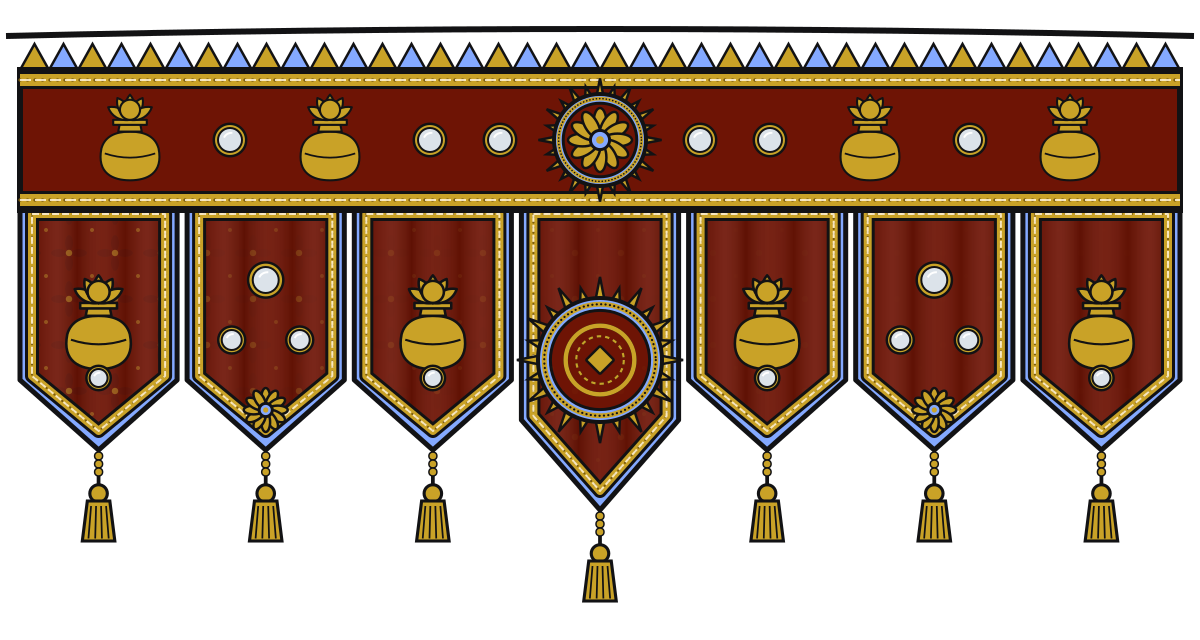

Historic banner
None known
New flag types
| Accessory | For this clan | Basis |
|---|---|---|
| A9 Pota-dhvaja · ship and trade flag For ships, caravans and markets | Not yet designed for this clan | Design |
| A10 Utsava-patāka · festival flag Light, bright flag for fairs and festivals | Not yet designed for this clan | Design |
| A11 Shoka-dhvaja · mourning flag White cloth with the emblem outline in the clan's metal | Not yet designed for this clan | Design |
7. Regalia
| Accessory | For this clan | Basis |
|---|---|---|
| E1 Chhatra · house parasol The ceremonial umbrella | Not yet designed for this clan | Design |
| E2 Chamara · fly-whisks The pair of whisks beside the head of the house | Not yet designed for this clan | Design |
| E3 Danda · staff of office Staff or scepter | Not yet designed for this clan | Design |
| E4 Simhasana · seat The seat of the house, covered in clan cloth | Not yet designed for this clan | Design |
| E5 Khetaka · shield A round shield; the Changi and Dhanush are its flag forms | Not yet designed for this clan | Regional tradition |
| E6 Kula-ayudha · clan weapon The weapon the clan honours | Not yet found for this clan | Under research |
8. Worn
| Accessory | For this clan | Basis |
|---|---|---|
| F1 Kula-vastra · clan cloth The clan's woven pattern in its kit colours | Not yet designed for this clan | Design |
| F2 Kirti-vastra · honour cloth A cloth earned for a deed, not inherited | Not yet designed for this clan | Design |
| F3 Kula-mala · garland flower The flower or leaf the clan wears as a garland | Not yet found for this clan | Under research |
| F4 Chinha · house pin A metal badge with the pin emblem | Not yet designed for this clan | Design |
9. Records
| Accessory | For this clan | Basis |
|---|---|---|
| H1 Clan words A traditional line in the native script | Children of God, fear not. · “English as the Department of Arts and Culture page prints the words of U-Mokhai; no Pnar original is in the extracts” Jowai legend of U-Mokhai, as told by the Government of Meghalaya Department of Arts and Culture[8] | Documented |
| H2 Biruda · titles The house's title or titles | Raja (the Jaintia kings); Syiem (the Syiem Sutnga family); Dolloi (the twelve chiefs) | Documented |
| H3 Prashasti · praise genealogy The lineage as written at the head of a grant | Not yet found for this clan | Under research |
| H4 Vahi · clan register The book of the clan's births, marriages and deaths | Not yet found for this clan | Under research |
| H5 Rana-ghosha · war cry The clan's cry in battle or celebration | Not yet found for this clan | Under research |
10. VishwaVit · knower of the world
Game values are design choices for this project, not historical claims.
References
- Khasi people, Wikipedia (Kiwix copy of the October 2023 article, read 2026-10-08), citing Census of India 2011 (mother tongue), P. Sidwell (2021), P. R. T. Gurdon, The Khasis, and The Shillong Times (2019).
- Wikipedia, Pnar language, read 2026-10-19, https://en.wikipedia.org/wiki/Pnar_language
- Sirajul Islam, "Jaintia, Kingdom of", Banglapedia (page edited 18 June 2021, read 2026-10-10).
- Jaintia Kingdom, Wikipedia (read 11 Oct 2026).
- Nartiang Durga Temple, Wikipedia (read 11 Oct 2026).
- Battle of Saraighat (Wikipedia, read 2026-10-09), citing S. L. Baruah (1986), S. C. Dutta (1981), S. K. Bhuyan, Lachit Barphukan and His Times (1947), P. Gogoi (1968), S. Kakoty (2003) and J. N. Sarkar (1992, 1994).
- Government of Meghalaya portal, Behdienkhlam Festival, read 2026-10-19, https://meghalaya.gov.in/behdienkhlam
- Festivals and Ceremonies of the Jaintias, Department of Arts and Culture, Government of Meghalaya, read 2026-10-19, https://megartsculture.gov.in/festivals-jaintia.html
- Wikipedia, Pnar people, read 2026-10-19, https://en.wikipedia.org/wiki/Pnar_people
- The monoliths and old tales of Nartiang, Incredible India (Ministry of Tourism), read 11 October 2026.
- Omniglot, Pnar (Ka Ktien Pnar), read 2026-10-19, https://www.omniglot.com/writing/pnar.htm
- Hugh R. Page Jr., Khasi, Encyclopedia of World Cultures (via encyclopedia.com), read 2026-10-10, https://www.encyclopedia.com/humanities/encyclopedias-almanacs-transcripts-and-maps/khasi
- P. R. T. Gurdon, The Khasis (1907; public domain), Project Gutenberg eBook 12786 (Introduction, Ch. I–II read 2026-10-10).
- Ahom-tribal Relations: a political study (OCR), National Virtual Library of India, read 2026-10-19 (Ch. I only), link
- West Jaintia Hills District website, Nartiang Monoliths, read 2026-10-19, https://westjaintiahills.gov.in/?p=26714
- Aatreyi Dutta, Uncovering Meghalaya's Pnar: A Matrilineal Tribe, Humans of North East (29 Jan 2024), read 2026-10-19, https://humansofnortheast.com/uncovering-meghalayas-pnar-a-matrilineal-tribe/
- Khasi Hills Autonomous District Council, Khasi States and the Shillong Municipality, read 2026-10-19, khadc.nic.in (author and date not stated in the extract; the fetch summarised the page, paraphrases marked)
- Khasi and Jaintia Hills (Wikipedia, read 2026-10-10).
- East Khasi Hills District, The People, read 2026-10-10, https://eastkhasihills.gov.in/?p=2811
- Wikipedia, Matrilineal society of Meghalaya, read 2026-10-10, https://en.wikipedia.org/wiki/Matrilineal_society_of_Meghalaya
- National Virtual Library of India, Behdienkhlam Jowai (commentary by C. D. Pde), read 2026-10-19, https://apitesting.nvli.in/intangible-cultural-heritage/social-practices-rituals-and-festive-events/behdienkhlam-jowai
- Festivals and Ceremonies of the Khasis, Department of Arts and Culture, Government of Meghalaya (read 2026-10-08).