The Ho (Hoo Jagar) are an Austroasiatic-speaking people of the Kolhan, West Singhbhum, in Jharkhand, with large communities in Odisha and smaller ones in West Bengal, Bihar, Bangladesh and Nepal[1][2][3]. Russell (1916), citing Dalton, counted the Kol, Munda and Ho as one great tribe of Chota Nagpur, and named the Singhbhum branch Ho or Larka Kol[4]. Their creator is Singbonga, honoured at Mage Parab, the principal festival, and they keep sarna groves where village bongas are worshipped[5][6]. The Ho took part in the revolts of 1821-22, the Kol uprising of 1831-33 and the 1857 rising of the Raja of Porahat, and the British recognised and co-opted the Manki-Munda system[1][7]. Their script, Warang Citi, was made by Lako Bodra from the 1950s[8].
01Faith and deities
Chhinnamasta of Rajrappa, Jharkhand
The clan followed another faith. This goddess of its homeland is assigned for naming only.
| Deity or tradition | Place in the clan's life | Evidence |
|---|---|---|
| Singbonga | Creator; honoured at Mage Parab; a white fowl is offered (eTribal); invoked for harvests, health and prosperity (Wikipedia); eTribal calls him the Hindu equivalent of the Sun God | [9][6] |
| Marang Buru | Supreme deity of the Ho, with the Dehuri as priest (Wikipedia, Marang Buru article) | [10] |
| Marang Bonga | A clan deity that protects clans from disease and drought; offerings are sunned rice, sindoor, areca nut and sometimes a he-goat. eTribal notes that some scholars equate it with Buru Bonga, but field information treats them as different | [6] |
| Buru Bonga | Hill deity; worshipped at the Akhari Parab | [6] |
| Bura Buri | Ancestor spirits; worshipped at the Sarhul Parab | [6] |
| Goram | Village deity, worshipped monthly | [6] |
| Dessauli Bonga | Village deity against smallpox and cholera; worshipped at Maghe, Baha, Haro and Jomnawa | [6] |
| Bagia Bonga | Deity of tigers and wild animals | [6] |
| Nage Bonga | River goddess, wife of Singh Bonga | [6] |
| Cattle bonga | Honoured at Sohrai; a black chicken is sacrificed to its image (Wikipedia) | [1][2] |
| Malevolent bongas | Gara Satamia, Suni kar, Rahu Kar, Chandi, Juguni Bonga, Bisai-Chandi, Ranga-Chandi, Jugini, Dakini and Manasa (a snake deity from Hindu neighbours); Churningbonga is appeased in pregnancy | [6] |
| Sarna grove | Sarnasthal or Jahera, outside the village, thought to be a remnant of the forest of the ancestors (eTribal). TRI names the faith Sarna dhorom, the religion of the holy woods | [6][2] |
| Witches (dian) | Said to invoke bongas at cremation grounds on new-moon nights (eTribal) | [6] |
02Temples
No temple is named in any extract. Worship is held at the sarna grove and at village shrines (eTribal), so the built and patronised lists are empty.
Built by the clan
Not recorded.
Given patronage or grants by the clan
Not recorded.
03Languages and scripts
| Language or script | Kind | Under the clan | Evidence |
|---|---|---|---|
| Ho (Hoo Jagar) living | Austroasiatic, Munda branch; ISO 639-3 hoc | The clan's own language. Dialects: Lohara, Chaibasa, Thakurmunda. Speakers: 1,421,418 in the 2011 census infobox; about 2.2 million in the body text (2001); 1,040,000 in Ethnologue (2001). The figures conflict[3][1][2] | |
| Warang Citi living | Script; an alphabet and abugida blend of 32 letters, with its own numerals | Invented by Lako Bodra from the 1950s; preferred by many Ho, though many prefer oral transmission, Devanagari or Latin; in primary and adult education; added to Unicode 7.0 in 2014[8][3] | |
| Devanagari, Latin, Odia and Bengali-Assamese living | Scripts used for Ho | Hindi script in Jharkhand, Oriya in Mayurbhanj and Bengali in Bengal (eTribal); Ho is written in Devanagari, Latin, Odia and Bengali-Assamese (Wikipedia)[3][6] | |
| Northern and southern Kolhan forms research | Dialect difference | The northern and southern Kolhan forms differ (oroq and andoq, Hoffmann, as cited by Wikipedia)[3] |
04Books and literature
Journals in Ho: Johar, Turturd, Ottoroad, Sarnaphool, Diyang and Dostur Korang (Wikipedia). The weekly Adivasi Saptahik carries Ho folk stories and songs (Wikipedia). The extracts name no Ho book that the clan patronised.
Written during the clan's history
| Work | Author | Kind | When | Link to the clan |
|---|---|---|---|---|
| Grammatical construction of the Ho language | Samuel Tickell | Grammar | 1840 | [3] |
| Ho Grammar with Vocabulary | L. Burrows | Grammar | 1915 | [3] |
| Ho Grammar and Vocabulary | J. J. Deeney | Grammar | 1975 | [3] |
| Ho-English Dictionary | J. J. Deeney | Dictionary | 1978 | [3] |
| Ho Hayam Paham Puti | Ete Turtung Akhara | Book in Warang Chiti | 1963 | [3] |
| Ho Kudih | Janum Singh Soy | Novel | Not dated | [3] |
| Bonga Buru Ko | Pradhan Gagrai | Book | Not dated | [3] |
| Tuturd and Sayan Marsal | S. K. Tiyu | Books | Not dated | [3] |
| The Ho Tribe of Singhbhum | C. P. Singh | Book | Not dated | [1] |
| Homecoming: Ho Women, Work, and Land Rights in Jharkhand | Ritambhara Hebbar | Article (Sociological Bulletin) | 2005 | [1] |
| Bihar: The Heart of India | Houlton | Book | 1949 | [1] |
| The Mundas and their Country | Sarat Chandra Roy | Ethnography (describes Mage Parab) | 1912 | [5] |
| Ho folk-song collections | Sharatchandra Rai, D. N. Majumdar and others | Folk songs (titles only) | 1915-1926 | [3] |
Given patronage by the clan
Not recorded.
05Thinkers and scholars
| Name | Field | Era | Contribution |
|---|---|---|---|
| Lako Bodra | Script maker | 20th century | Warang Citi, from the 1950s[8] |
| Kanuram Deogam | Writer | 1930 | First writing by an ethnic Ho[3] |
| Janum Singh Soy | Scholar | Not dated | Padma Shri; recognised for preserving the Ho language[1] |
| Samuel Tickell | Linguist | 1840 | Grammar of the Ho language[3] |
| L. Burrows | Linguist | 1915 | Ho Grammar with Vocabulary[3] |
| J. J. Deeney | Linguist | 1975-1978 | Ho grammar and dictionary[3] |
| E. T. Dalton | Ethnologist | 1872 | Ho name and the Larka Kol[6][4] |
| Ritambhara Hebbar | Sociologist | 2005 | Ho women, work and land rights[1] |
| Ram Dayal Munda and Bhagey Gobardhan | Script committee | 1985 | Chose Warang Chiti[3] |
Rival script inventors named by Wikipedia: Sangram Sindhu, Rohidas Singh Nag, Raghunath Purty and Purushottam Godsora. Ete Turtung Akhara, Jhinkapani, is linked with Lako Bodra[3].
06Art and architecture
Dance is integral to Ho life; the village dancing ground, the akhra, stands under a spreading tree (Wikipedia). Hunting battues use drums (Wikipedia).
Painting and wall art
Not recorded.
Sculpture and temple art
| Art form | What it is | Era | Evidence |
|---|---|---|---|
| Grave slabs and megalithic pillars | Large stone slabs and pillars 5 to 15 ft high on Ho and Mundari graves (Dalton via Russell) | [4] | |
| Sasandhiri memorial stones | Erected after burial; eTribal says Hindu neighbours engraved them in Hindi or Oriya, often with 'Om Ganesaya Namoh' | [6] |
Temple and building architecture
| Art form | What it is | Era | Evidence |
|---|---|---|---|
| Houses | Mud houses with tiled roofs (eTribal) | [6] |
Weaving and textiles
Not recorded.
Clothing and jewellery
Not recorded.
Coins, pottery and crafts
Not recorded.
07History
The name, and the Kol family in 1916
Russell (1916), citing Dalton, calls Kol, Munda and Ho one great tribe of Chota Nagpur that gave its name to the Kolarian family, with Kolhan (Singhbhum, near Chaibasa) as the special home of the Larka Kols[4].
The name Ho is glossed as "man" by eTribal, which also prints Hodoko and Horo as self-names; Mohanta cites Dalton (1872) on the name and D. N. Majumdar (1950), who derives it from the Sanskrit Kol (pig) or Horo[6][2].
Coming into Singhbhum
The Ho migrated from Manbhum into Singhbhum, possibly in the 14th century or earlier, and had overcome the Bhuiyas by the 17th century[1].
The Ho language's oral tradition says its speakers moved into Singhbhum from the north[3]. Ho and Munda are believed to have migrated from the Gangetic plains under Indo-Aryan pressure, with no date or route given[6].
Wars and the Company, 1765 to 1820
In the late 18th century the Ho fought the rajas of Chota Nagpur and Mayurbhanj. Chota Nagpur was ceded to the East India Company in 1765; the Raja of Singhbhum sought British protection in 1767 and became a feudatory in 1820[1].
The Permanent Settlement of 1793 led zamindars to seize Ho lands, which sparked the Ho revolt of 1821-22[7].
The Kol uprising and the Kolhan Government Estate
The Kol uprising of 1831-33 was joined by the Mundas and, according to TRI, by the Kurukhs[1][2]. Colonel Richards entered Singhbhum in November 1836.
The Kolhan Government Estate was formed by Wilkinson in 1837, as Wikipedia prints it. Vajiram gives Wilkinson's Rules as drafted in 1833 (31 rules) and also gives 1837 for his appointment, so the dates conflict[1][7]. Copper was smelted in parts of old Singhbhum between the 9th and 12th centuries; Wikipedia does not tie this to the Ho[1].
1857 and after
The Raja of Porahat rebelled in 1857; many Hos joined, and the rising ended by 1859[1].
The Kolhan Government Estate was dissolved after 1947, but its rules remained. In Mora Ho vs State of Bihar (2000), the Patna High Court allowed the customs, not formal law, to continue. A 2021 Nyay Manch proposal was never enacted[7].
1947 to 1958: the Rules in the courts
After 1947 the Kolhan Government Estate was dissolved, but Wilkinson's Rules remained operative and continued to guide governance; the courts treated them as valid customary practice[11][12][13].
The Patna High Court judgment in Dulichand Khirwal vs State of Bihar records that a 1948 Kolhan Inquiry Committee report said civil justice was still administered under Wilkinson's Rules. A 1953 State notification said the Civil Procedure Code amendment "shall not apply to the Sadar Subdivision of the district of Singhbhum" (except Chaibasa and Chakradharpur municipalities), treated as retrospective to 1 April 1951[14].
In that case (AIR 1958 Pat 366, decided 20 January 1958; the writ was dismissed with costs) the court said the Rules were framed for the administration of civil justice under Regulation XIII of 1833, and found it unclear whether the Governor-General or Wilkinson made them. Section 7 of Act XIV of 1874 kept them in force "unless and until"; the petitioner argued that Act I of 1903 ended them. The court presumed the Rules valid because they had been acted on for decades[14]. The judgment does not mention Manki, Munda, Ho customs or Mora Ho; it concerns a civil suit over a quarry lease in Kolhan.
2000: Mora Ho vs State of Bihar, as reported
Three exam-preparation pages report that the Patna High Court, in Mora Ho vs State of Bihar (2000), held that Wilkinson's Rules are customs, not formal law, and allowed their continued practice[11][12][15]. IASGyan adds that customs were allowed to continue for lack of alternatives. Civilsdaily credits the court. GKToday says the courts upheld the rules until 2000, when they were deemed customary, not formal law, but names no court or case[13].
The judgment itself was not read; the case name and year come only from these secondary pages, and no primary text checks them. The 1958 judgment treated the Rules as law in force under the 1874 Act, so how the two positions fit is not sourced.
2000: the Full Bench, as the Jharkhand Story reports it
The Jharkhand Story (11 Feb 2026), a news feature, names the bench in Mora Ho v. State of Bihar as a Patna High Court Full Bench of Justices S.J. Mukhopadhaya, R.A. Sharma and M.Y. Eqbal, decided in January 2000. The dispute concerned Plot No. 2075 in village Konkoa[16].
Per the feature, the majority (Mukhopadhaya) held that Wilkinson's Rules were never approved and lacked statutory force, and that the records said they "did not receive the sanction of Government". Sharma declared the Rules non-statutory but allowed temporary continuation and directed the State to frame regulations within three months. Eqbal dissented for continuity and stability, citing the Kolhan Civil Justice Acts of 1966 and 1978, which the feature says validated actions taken under the Rules[16].
The feature also says two Patna High Court Division Benches in 1958 (Dulichand Khirwal, and Mahendra Singh v. Commissioner, Chotanagpur Division) upheld the Rules' validity. It does not say how the 2000 majority dealt with those holdings. It notes that Jharkhand became a state less than a year after the judgment[16].
2021 and 2025: reform proposals and protests
A 2021 Jharkhand proposal to modernise the system, the "Nyay Manch", was never enacted, according to Drishti, Vajiram and IASGyan[11][7][15]. IASGyan lists its proposals as Gram Sabha approval for Mundas, legal-literacy training, and a state law under the Fifth Schedule to replace Wilkinson's Rules. GKToday instead says that in 2021 Jharkhand recognised a "Nyaya Panch" traditional judicial system for revenue and dispute matters[13]. The sources conflict on the name and on whether the 2021 step was enacted; this is not resolved.
In September 2025 coverage, Ho in West Singhbhum protested against alleged interference in the Manki-Munda system, with removal of Mundas feared[12][13]. IASGyan reports a nine-point directive from the Deputy Commissioner for transparency; the administration denies interference. GKToday reports that the district administration said the Mundas remain part of the revenue and governance system. The complaints are reported as coming from SC and OBC residents[13][15]. No protest date is given in any source.
West Singhbhum has 1,850 Manki-Munda posts, of which 200 are vacant, according to Vajiram[7]. Civilsdaily says about 200 vacant posts were filled by Gram Sabhas[12]; Vajiram says 50 were recently filled that way[7]. The two accounts differ and are shown as reported.
2022 to 2023: the first cases, as 101Reporters reports them
101Reporters (11 Apr 2023) calls the manki-munda nyay panch a tribal custom court, "the one and only such facility operational anywhere in Jharkhand", sitting in the SDO's office complex at Chaibasa. It says the Rs 5,000 case limit was set in 1977 and was unchanged. The article reports the February 2021 recognition as covering revenue matters, law and order and land-dispute settlement[17].
The first case was assigned to the panch from the DC court in March 2022. In January 2023 a dispute from Tantnagar village was resolved in the plaintiff's favour after three hearings, and 21 cases had been heard by the time of writing. A proposal to raise the SDO limit to Rs 50,000 was pending with the Kolhan commissioner[17].
2025: the directive and the 1837 Hukuknama
Rau's IAS Compass (17 Sep 2025) links the Ho protest to a nine-point district directive that reminded Mundas of their duties under the 1837 Hukuknama. The directive was misread as interference; officials said "customary laws remain untouched"[18].
IASGyan adds that the Manki Munda Sangh opposes non-tribal appointments to these posts, and that the Adivasi Ho Yuva Mahasabha seeks reform of hereditary posts[15].
February 2026: new Kolhan Civil Rules
The Jharkhand Story (Feb 2026) says Kolhan still runs on Wilkinson's framework and that draft regulations prepared decades earlier never took effect. The Jharkhand government has only recently begun framing new Kolhan Civil Rules[16]. No order or notification was read.
08Journey and migrations
The only dated movement in the extracts is the move from Manbhum into Singhbhum. Later movements are not sourced.
| When | From | To | Why | Evidence |
|---|---|---|---|---|
| 14th century or earlier | Manbhum | Singhbhum (Kolhan) | Not stated; oral tradition says the speakers came in from the north[3] | [1] |
09Seats and lands
| Place | Role | Where today |
|---|---|---|
| Kolhan (West Singhbhum) | The special home of the Larka Kols (Russell 1916, citing Dalton); Kol-sthan (eTribal); the Kolhan Government Estate of 1837 | West Singhbhum, Jharkhand, near Chaibasa[4][1] |
| Saranda and Porahat forests | Forests with wild elephants; sal is the key tree (Wikipedia; TRI) | Forest names as Wikipedia gives them; districts not stated[2] |
| Pansira Buru | Site of India's first iron ore mine, 1901 (Wikipedia) | Not stated[1] |
| Mining towns | Chiria, Gua, Noamundi and Kiriburu (Wikipedia) | Not stated[1] |
| Northern Odisha | Ho districts as the KISS handbook prints them (its spellings): Mayurbhanja, Anugul, Keonjhar | Odisha[19] |
| West Bengal, Bihar, Bangladesh, Nepal | Places where Ho live, per Wikipedia; 2011 counts for West Bengal (23,483) and Bihar (715) | West Bengal, Bihar; Bangladesh and Nepal[1][20] |
10Notable figures
| Name | Role | Era | Known from |
|---|---|---|---|
| Lako Bodra | Created the Warang Citi script; linked with Ete Turtung Akhara, Jhinkapani | 1950s onward | [8][3] |
| Deowan Turi legend | Named by Bodra as the inventor of the script in a shamanistic vision (Bodra's claim, not established) | 13th century (claimed) | [8] |
| Kanuram Deogam | Wrote the first Ho writing by an ethnic Ho | 1930 | [3] |
| Luku Kola legend | The first man, created by Singbonga in the Ho creation myth | Mythic | [5] |
| Captain Thomas Wilkinson | Political Agent, Kolhan Government Estate; his rules (1833 or 1837, dates conflict) | 1833-1837 | [7] |
| Pradeep Kumar Balmuchu, Debendranath Champia, Lipika Singh Darai, Laxman Giluwa, Geeta Koda, Madhu Koda, Chitrasen Sinku, Bagun Sumbrai | Named as notable Ho on Wikipedia; the page gives no role | Not dated | [1] |
| Janum Singh Soy | Scholar and Padma Shri awardee, recognised for preserving the Ho language | Not dated | [1] |
| Ram Dayal Munda and Bhagey Gobardhan | Members of the 1985 script committee that chose Warang Chiti | 1985 | [3] |
11Allies, rivals and marriages
| People | Relationship | When |
|---|---|---|
| Munda | Kol, Munda and Ho one great tribe of Chota Nagpur (Russell 1916); a close language (Wikipedia) | 1916 account |
| Mundari | A close language (Wikipedia); TRI lists Mundari among the Ho's alternate names | Not dated |
| Santali (Santal) | A close language (Wikipedia); Russell calls the Santals a branch of the Kol family | 1911 figure in Russell |
| Bhumij | Related (Wikipedia); Russell: probably a section of the Kols | 1916 account |
| Kharia and Juang | Related (Wikipedia); Russell: Kharias once one with the Mundas | Not dated |
| Bhuiyas | Overcome by the Ho by the 17th century (Wikipedia) | By the 17th century |
| Rajas of Chota Nagpur and Mayurbhanj | Ho fought them in the late 18th century (Wikipedia) | Late 18th century |
| Raja of Porahat | Rebelled in 1857; many Hos joined (Wikipedia) | 1857-1859 |
| Dikkus (outsiders) | Outsiders in Kolhan: 1,579 (1867) and 15,755 (1897) (Vajiram, secondary) | 1867-1897 |
12Society and livelihood
Ho life is organised in villages led by a hereditary Munda and groups of villages under a Manki (Vajiram, secondary). Marriage is settled between clans, and the status of women is described as high (Houlton, quoted by Wikipedia; TRI). Bride-price was paid in cattle in Russell's time (Dalton via Russell); TRI calls it modest today. Home names differ from formal names (for example Ramachandra is Jaklo at home, Janaki is Dumdi) (eTribal).
Government and social order
| Institution or group | What it was | Evidence |
|---|---|---|
| Village priest (dehuri) | Performs the village rituals (TRI; Wikipedia) | [2][1] |
| Spirit doctor (deowa) | Handles malevolent spirits; eTribal says the deowa came from low-caste Hindu neighbours | [6][1] |
| Munda (village headman) | Hereditary; leads each village under the Kolhan Manki-Munda system | [7] |
| Manki | Head of a pidh of 8 to 15 villages under the Kolhan system | [7] |
| Diuri | Sets the date of Baba Hermutu, the first sowing (Wikipedia, which gives no further detail of the office) | [1] |
| Sokha (witch-finder) | Consulted when disease is ascribed to an evil spirit or witch (Dalton, via Russell 1916) | [4] |
| Khili | A Ho of another clan who performs the shaving at naming rites (eTribal) | [6] |
| Naming | Birth is blessed by Singbonga; the name is given on the 8th day (the 21st day, following Oriya neighbours); tonsure and a clan propitiation (eTribal) | [6] |
| Puberty and marriage | Girls' puberty initiation is called Kui. Marriage types (Andi): Diku Andi (negotiated), Opertipi Andi (groom captures bride), Rajikhusi Andi (planned elopement), Anader Andi (bride enters groom's house), Gardijaumai Andi (groom lives in bride's house) and Badal Andi (exchange of daughters) (eTribal) | [6] |
| Burial | Buried in a wooden box, with a sasandhiri stone erected (eTribal). Dalton (via Russell) records large stone slabs and megalithic pillars 5 to 15 ft high, and bones carried on a decorated tray with deep-toned drums and eight young girls with pitchers | [6][4] |
Livelihood over time
| Era | Livelihood | Evidence |
|---|---|---|
| Not dated (TRI) | Half cultivators, a third landless labourers, many in iron-ore mining | [2] |
| Not dated (Wikipedia) | Mostly farmers or landless labourers; some in mining | [1] |
| Forest | Sal is the most important tree; mahua, kusum and tilai are also named; TRI records resentment at teak replacing sal | [1][2] |
| 1901 (Pansira Buru) | Iron-ore mining from the first mine at Pansira Buru | [1] |
13Sub-clans and related clans
The extracts name no Ho killi (exogamous clan) and no Ho totem. Marriages are settled between clans, and Marang Bonga protects the clans (eTribal). The related peoples below are those the extracts name; Wikipedia names Kol, Kolha and Kolah as Odisha segments of the Ho.
| Clan | Relation | Where | Size | In the Atlas | Evidence |
|---|---|---|---|---|---|
| Kol | Branch | Keonjhar, Mayurbhanj, Balasore (KISS spellings) | 4,058, 2011 (Odisha ST list)[21] | ST-141 | [1][19] |
| Kolha | Branch | Mayurbhanj, Keonjhar, Balasore (KISS spellings) | 625,009, 2011 (Odisha ST list)[21] | same name as ST-447: check | [1][19] |
| Kolah Loharas (Kol Loharas) | Related people | Sundergarh, Mayurbhanj, Keonjhar (KISS spellings) | 9,558, 2011 (Odisha ST list)[21] | new clan candidate | [1][19] |
| Munda | Related people | Chota Nagpur plateau; Jharkhand and Odisha | 1,229,221 in Jharkhand, 2011[22] | ST-229 | [4][1] |
| Bhumij | Related people | East Singhbhum; Odisha; West Bengal | 283,909, Odisha, 2011[21] | ST-033 | [4][23] |
| Santal | Branch | Mayurbhanj, Balasore, Keonjhar (KISS spellings) | 894,764, Odisha, 2011[21] | ST-280 | [4][3] |
| Kharia | Related people | Sundergarh, Sambalpur, Mayurbhanja, Jharsuguda (KISS spellings) | 222,844, Odisha, 2011[21] | ST-130 | [4][1] |
| Juang | Related people | Keonjhar, Dhenkanal (KISS spellings) | 47,095, Odisha, 2011[21] | ST-114 | [1][19] |
| Khairwar | Related people | Central Provinces (Russell 1916) | ST-127 | [4] | |
| Korwa | Related people | Central Provinces (Russell 1916) | ST-157 | [4] | |
| Korku | Related people | Central Provinces (Russell 1916) | ST-156 | [4] |
Clans marked "new clan candidate" are not in the Atlas yet.
14Surnames
Surnames the extracts say Ho people use: Deogam (eTribal: the only Ho surname printed there), and the surnames of notable Ho on the Wikipedia page, which the page does not present as clan names. No counts are sourced, so none is given. Sharing with other communities is not checked.
| Surname | Clan or sub-clan | Where | People with this surname | Also used by other communities |
|---|---|---|---|---|
| Deogam | Not stated | not yet counted | No | |
| Balmuchu | Not stated | not yet counted | No | |
| Champia | Not stated | not yet counted | No | |
| Darai | Not stated | not yet counted | No | |
| Giluwa | Not stated | not yet counted | No | |
| Koda | Not stated | not yet counted | No | |
| Sinku | Not stated | not yet counted | No | |
| Soy | Not stated | not yet counted | No | |
| Sumbrai | Not stated | not yet counted | No |
Counts are of everyone with the surname, from the cited source and year, not only members of this clan. A surname shared with other communities says nothing about any one person's origin.
15Songs and music
The extracts name Ho folk songs and their collectors but give no Ho song texts. The one song title is Dureng Dala (Dibakar Soy).
Dureng Dala
Instruments and styles
| Instrument or style | What it is | Evidence |
|---|---|---|
| Dama | Drum (Wikipedia; TRI) | [1][2] |
| Dumang | Barrel drum (Wikipedia); TRI prints dumeng as a mandar | [1][2] |
| Rutu | Flute (Wikipedia; TRI) | [1][2] |
| Dholak | Drum named by TRI as a Ho instrument | [2] |
| Battue drums | Drums used in hunting battues (Wikipedia) | [1] |
16Poems, lullabies and children's rhymes
Modern Ho poetry is named by title only in the extracts (Wikipedia). No poem text is quoted.
Sengail and Satish Rumul
[3]; credited as printed to Satish Kumar Koda
Parem Sanadh and Eitaa Bataa Nalaa Basaa
[3]; credited as printed to Kamal Lochan Kohaar
Ho Kaboy
[3]; credited as printed to Ghanshyam Bodra
17Stories, legends and proverbs
Stories and legends
| Story | What happens | Told by | Evidence |
|---|---|---|---|
| Singbonga and Luku Kola | Singbonga, the creator, makes Luku Kola, the first man, in the Ho creation myth | Ho tradition, as summarised by Wikipedia | [5] |
| Ho Lokkatha | A collection of Ho folk tales by Aditya Prasad Sinha; no story is summarised in the extracts | Aditya Prasad Sinha (collector) | [3] |
Proverbs and sayings
Not recorded.
18Festivals and fairs
| Festival or fair | When | Where | What happens |
|---|---|---|---|
| Mage Parab (Mage Porob, Magh Porob) | Magha (January-February); a week long | Not stated | The principal festival; honours Singbonga; marks the end of the agricultural cycle[5][1][6] |
| Baa Porob (Baha Parab) | Mid-spring; February-March (eTribal) | Not stated | Named for the sal blossom (Wikipedia)[1][6] |
| Sohrai (Gaumara) | Not dated in the extracts | Not stated | Cattle are painted and anointed; a black chicken is sacrificed to the cattle bonga image[1] |
| Baba Hermutu | Not dated in the extracts; the date is set by the diuri | Not stated | A three-day first sowing[1] |
| Jomnama Porob (Jamnawa Parab) | Late autumn; September-October (eTribal) | Not stated | Held before the first harvest is eaten[1][6] |
| Raja Parab | May-June (eTribal) | Not stated | Named in the eTribal calendar[6] |
| Hero Parab | June-July (eTribal) | Not stated | Named in the eTribal calendar[6] |
| Bahatanli Parab | July-August (eTribal) | Not stated | Named in the eTribal calendar[6] |
| Kakamontanri (Kalam) Parab | December-January (eTribal) | Not stated | Named in the eTribal calendar[6] |
| Akhari Parab | Not dated in the extracts | Not stated | The Buru Bonga hill festival[6] |
| Sarhul Parab | Not dated in the extracts | Not stated | Ancestor spirits, Bura Buri[6] |
19Food, dress and games
Food
| Item | What it is | Evidence |
|---|---|---|
| Rice beer | Diang (Wikipedia); diyeng or handia (TRI) | [1][2] |
| Mahuli | Liquor made from mahua (eTribal) | [6] |
| Tobacco | Taken as picca or bidi (eTribal) | [6] |
Dress
Games and martial arts
Not recorded.
Tags: living still practised · revived brought back after a break · lost known only from records · research reported but not yet confirmed from a source. Songs and poems under copyright are listed by title only; restricted or sacred material is noted without its content.
20Status today
The Ho are a Scheduled Tribe in India, mainly in Jharkhand (West Singhbhum) and Odisha, with communities in West Bengal and Bihar[1][2]. Most are farmers or landless labourers, and many work in iron-ore mining[2].
Recognised heritage
| What | Recognition | Evidence |
|---|---|---|
| Warang Citi script | Added to Unicode 7.0 in June 2014; the 1985 committee chose Warang Chiti (Wikipedia)[8][3] | [8] |
| Ho language | UNESCO: Vulnerable. Odisha and Jharkhand have sought Eighth Schedule inclusion (Wikipedia)[3] | [3] |
| Manki-Munda system | The Patna High Court allowed the customs to continue (Mora Ho vs State of Bihar, 2000); a 2021 Nyay Manch proposal was never enacted (Vajiram, secondary)[7] | [7] |
Not reviewed by the Ho community. The sources are colonial-era (Russell 1916, Dalton) or secondary (eTribal 2018, TRI, Vajiram, Wikipedia).
21For children
Singbonga and the first man
Long ago, the Ho people say, Singbonga was their creator. His name, Sing, means sun in the Munda languages. Every year the Ho keep Mage Parab, a festival that lasts a whole week in the month of Magha. In the Ho story, Singbonga made the first man, whose name was Luku Kola. The Ho call themselves Ho, which means man. They live in Kolhan, where the sal tree is the most important tree. They write their language in a script called Warang Citi, which Lako Bodra made, and its name means Undying Writing.
22Across the project
| Project | What carries this clan | Status |
|---|---|---|
| Atlas of the Janas | Districts and forests are in the lands section (Kolhan, Saranda, Porahat); the footprint file is left to the host | |
| KulDevi and GrahDevi | KulDevi Chhinnamasta is assigned by the project and is not the Ho faith; the GrahDevi forms are | From the Atlas |
| Planet naming | Not sourced for this clan | |
| Renaming and waters | Home names and formal names differ, for example Ramachandra is Jaklo at home (eTribal); villages are at the foothills near water (eTribal) | [6] |
23Open questions
- Ho killi names and totems: none in the extracts. Leads: Dalton (1872); Wikipedia 'Kolha' (not read); everyculture Kol-Orientation (not read).
- Ho population: Odisha 806,008 (ST list) vs 705,618 (Wikipedia) vs 80,608 (KISS). Ho speakers: 1,421,418 (2011 infobox) vs about 2.2 million (2001 body). Not resolved.
- Dates of the Kolhan rules: the 1958 judgment (primary) says the Rules were framed under Regulation XIII of 1833, but Vajiram also gives 1837 for Wilkinson's appointment and the Hukuknama, and Wikipedia prints the Kolhan Government Estate as formed in 1837. Whether Wilkinson's Rules date from 1833 or 1837 is unresolved. Leads: the text of Regulation XIII of 1833; Dalton (1872). Sources:[14][7][1]. 101Reporters (11 Apr 2023) gives 1834 for the framing of Wilkinson's Rule and 1837 for the Kolhan Separate Estate. The 1837 Estate date agrees with the history section; 1834 is a third date for the Rules, beside 1833 (Vajiram and GKToday; the 1958 judgment cites Regulation XIII of 1833 as its authority) and Vajiram's 1837 for the appointment. The framing year is unresolved[17][13][14].
- Dates for Sohrai, Baba Hermutu, Akhari and Sarhul are not in the extracts.
- Bompas (1909) appendix of Hos folklore is listed in the cache but its text is not extracted; read it for songs, proverbs and rhymes.
- Dalton (1872), on the name Ho and the Larka Kol: primary text not read.
- Marang Bonga and Buru Bonga: eTribal says some scholars equate them, but field information treats them as different.
- Deowan Turi (13th century): Bodra's claim, not established.
- No Ho coin, seal, war cry, clan weapon or totem is documented in the extracts.
- Mora Ho vs State of Bihar (2000), Patna High Court: the holding that the Rules are customs, not formal law, and may continue is known from exam-prep pages[11][15]. The bench split and Eqbal's dissent come only from the Jharkhand Story feature[16]. The judgment text is not read. How the 1958 rulings that upheld the Rules' validity[14][16] fit the 2000 majority's view that they lacked statutory force is not explained in any source read.
- Sheet fields not sourced here: the flag images (a drawn bow, a sal tree) are master-sheet design.
- Supreme deity: the Marang Buru article calls Marang Buru supreme for the Ho[10]; the Singbonga article says the Ho revere Singbonga as supreme[9]. Not resolved; the page names Singbonga as creator and Marang Buru as supreme.
- The 2021 step: the name ('Nyay Manch' in Drishti, Vajiram and IASGyan; 'Nyaya Panch' in GKToday and Rau's; 'manki-munda nyay panch' in 101Reporters) and its legal form are unresolved. 101Reporters says the government recognised the system in February 2021; Rau's and GKToday say it was recognised in 2021; Drishti, Vajiram and IASGyan say the draft was not enacted. No government order has been read[17][18][13][11][7][15].
- Vacancies in the Manki-Munda posts: Vajiram says 200 vacant and 50 filled by Gram Sabhas; civilsdaily says about 200 vacant posts filled by Gram Sabhas[12][7].
- Unread leads on the post-1947 Kolhan rulings: Chaturbhuj v Deputy Commissioner of Singhbhum (Patna HC, 1970; courtkutchehry.com, not read); the Indian Express report of September 2025 (original not read; Vision IAS page not read); the 2021 government order; pdf.lawlens.in/6f2902c6-8cd9-4354-a581-a0d0c3a2171c, future.indiankanoon.org/doc/1637445/, newsclick.in/node/53432, lagatar24.com/?p=157865, odishabytes.com/?p=402188, insightsonindia.com (15 Sep 2025), pwonlyias.com (not read). Ho politics after 1947, beyond the Kolhan rules: nothing sourced.
24Astitva
अस्तित्व · being, existence: everything by which the clan is known
The Ho marks in the extracts are the sasandhiri memorial stones, the sal and the sarna grove, and the Warang Citi script. No Ho seal, coin, flag, war cry or clan weapon is recorded[6][8].
Every clan has every accessory, royal objects included. Each one says how it is known: Documented This clan's own object is recorded. · Regional tradition Recorded for the region or for peoples like this one, not for this clan. · Design Made for this project, with no historical claim. · Under research To be found for this clan from sources. Legends and titles are written in the clan's own script.
1. Seals and coins
| Accessory | For this clan | Basis |
|---|---|---|
| B1 Rajamudra · house seal Round seal with the clan emblem and a short legend in the clan's script | Not yet designed for this clan | Design |
| B2 Anguliya-mudra · signet ring Personal seal ring of the head of the house | Not yet designed for this clan | Design |
| B3 Chhapa · house stamp Ink or block stamp for letters, goods and cloth | Not yet designed for this clan | Design |
| B4 Tamrapatra · charter plate Copper-plate grant on a ring, closed with the house seal | Not yet designed for this clan | Design |
| B5 Shreni-mudra · guild or trade seal Seal for the clan's trade, craft or caravan | Not yet designed for this clan | Design |
| C1 Clan coin Emblem or deity on one side, a legend in the clan's script | Not yet designed for this clan | Design |
| C2 Coin die The die that strikes the coin | Not yet designed for this clan | Design |
2. Living symbols
| Accessory | For this clan | Basis |
|---|---|---|
| I1 Totem trio The tree, bird and animal the clan protects | Not yet found for this clan | Under research |
| I2 Kaval-maram · guardian tree The tree that stands at the clan's seat | The sal tree, and the sarna grove outside the village (Sarnasthal or Jahera) | Regional tradition |
3. Stone and gate
| Accessory | For this clan | Basis |
|---|---|---|
| G1 Torana · gateway The built gate of the seat; the cloth Toran hangs in it | Not yet designed for this clan | Regional tradition |
| G2 Viragallu · hero stone Carved panel stone for a member who died defending the clan | Not yet designed for this clan | Regional tradition |
| G3 Kula-shila · clan stones Standing and table stones that remember the ancestors | Large stone slabs and megalithic pillars 5 to 15 ft high on Ho graves; a sasandhiri memorial stone is set up after burial | Documented |
| G4 Jayastambha · victory pillar A pillar raised for a victory | Not yet designed for this clan | Design |
| G5 Sima-shila · boundary stone Marks the clan's land, with a line in the native script | Not yet designed for this clan | Design |
4. Sounds
| Accessory | For this clan | Basis |
|---|---|---|
| D1 Pancha-mahashabda · five great sounds The right to five instruments | Not yet designed for this clan | Design |
| D2 Shankha · clan conch The clan's own named war conch | Not yet designed for this clan | Design |
| D3 Murasu · house drums Three drums: war, charity and justice | Not yet designed for this clan | Design |
5. Kit: colours, metals and emblems
The Atlas gives a drawn bow (for independence) and a sal tree (for the Kolhan forests) as the flag images. These are project design, not documented Ho symbols; the extracts record sal groves and sasandhiri memorial stones instead[6].
| Part of the kit | This clan |
|---|---|
| Field | Deep Indigo #2A2A6B |
| Accent | Deep Crimson Red #FF3B00 |
| Emblem colour | Metallic Gold #C9A227 |
| Zari metal | Gold |
| Main emblem | A drawn bow |
| Second image | A sal tree |
| Night and day | Every visual accessory has two versions: by night the emblem on the dark field, by day the clan's field colour on cloth woven from its metal. |
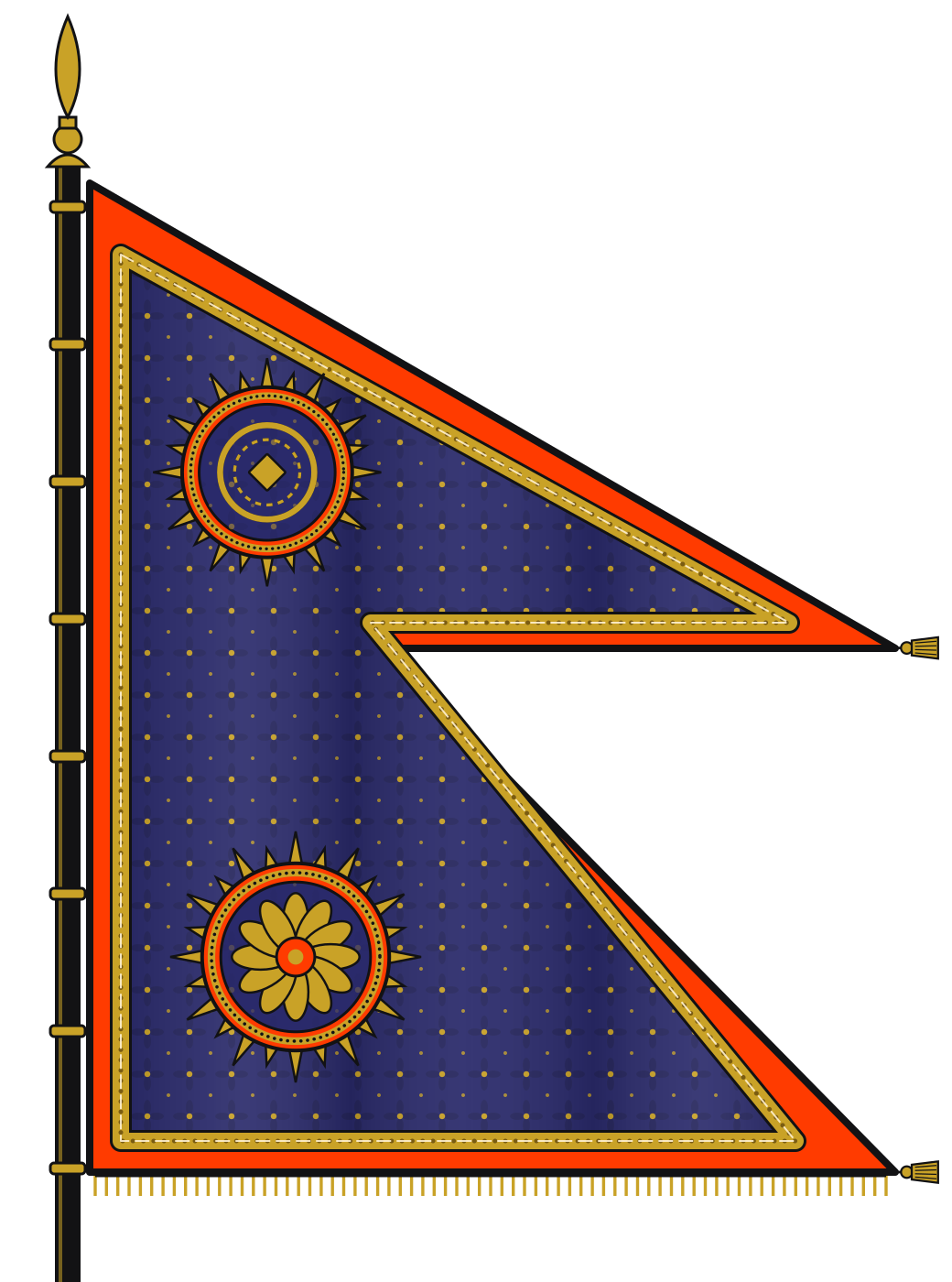
6. Flags
Every clan has every flag type; the type says the occasion and the colours say the clan. The outlined card is the flag the Atlas assigns.
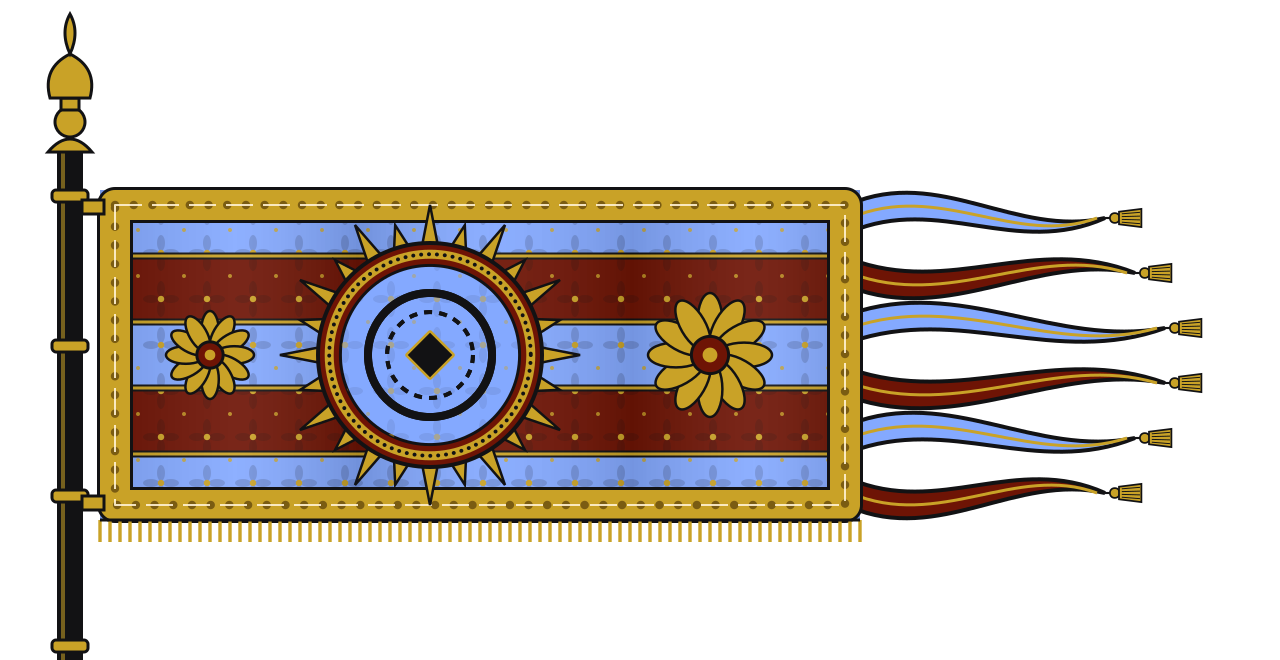
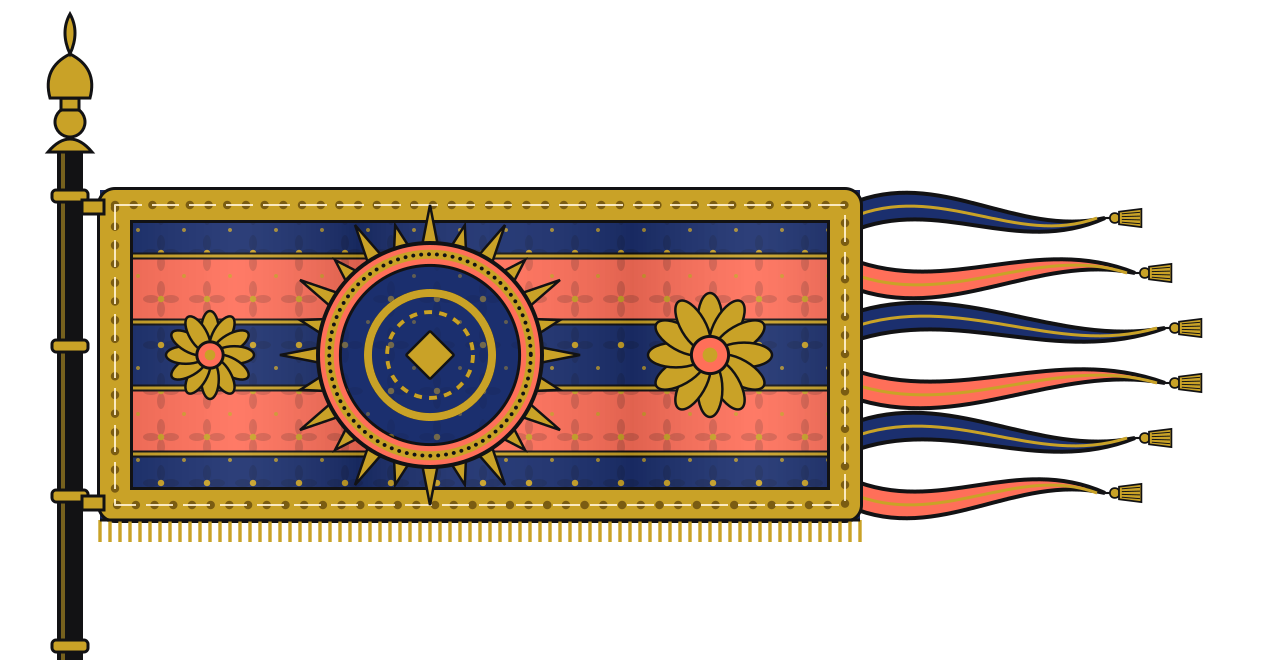
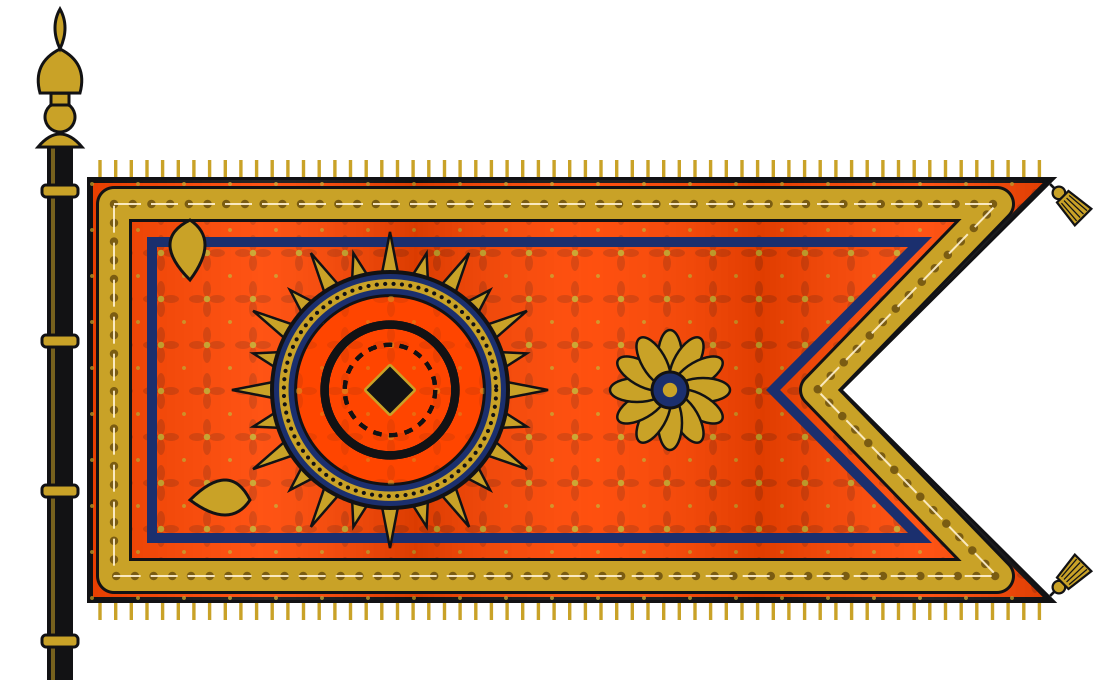
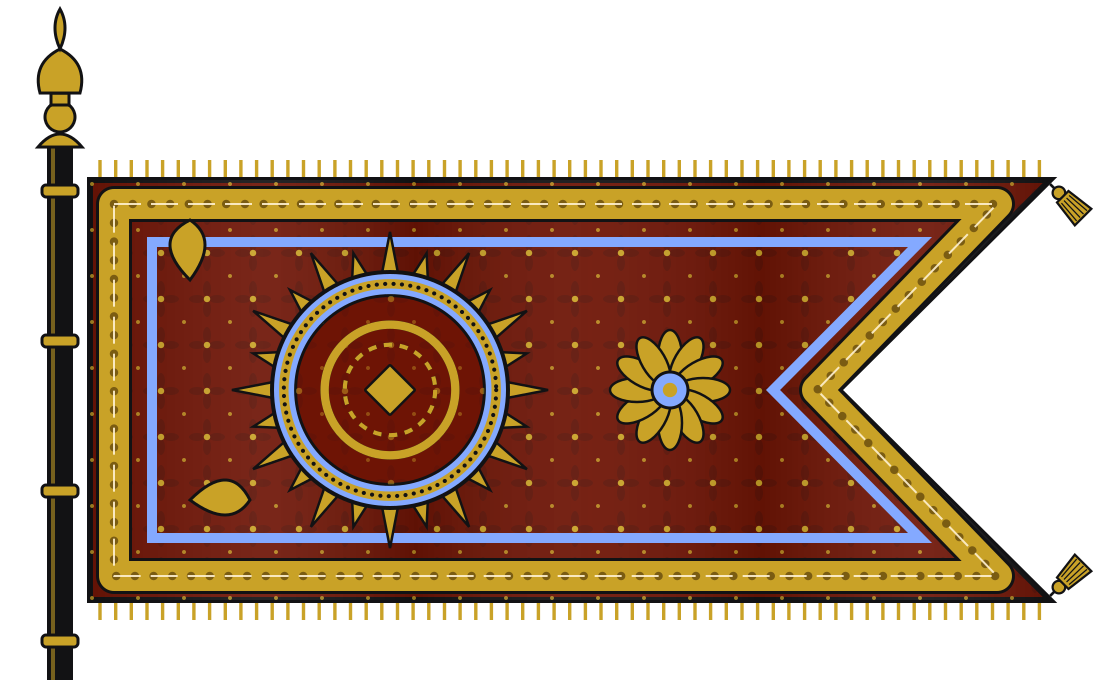

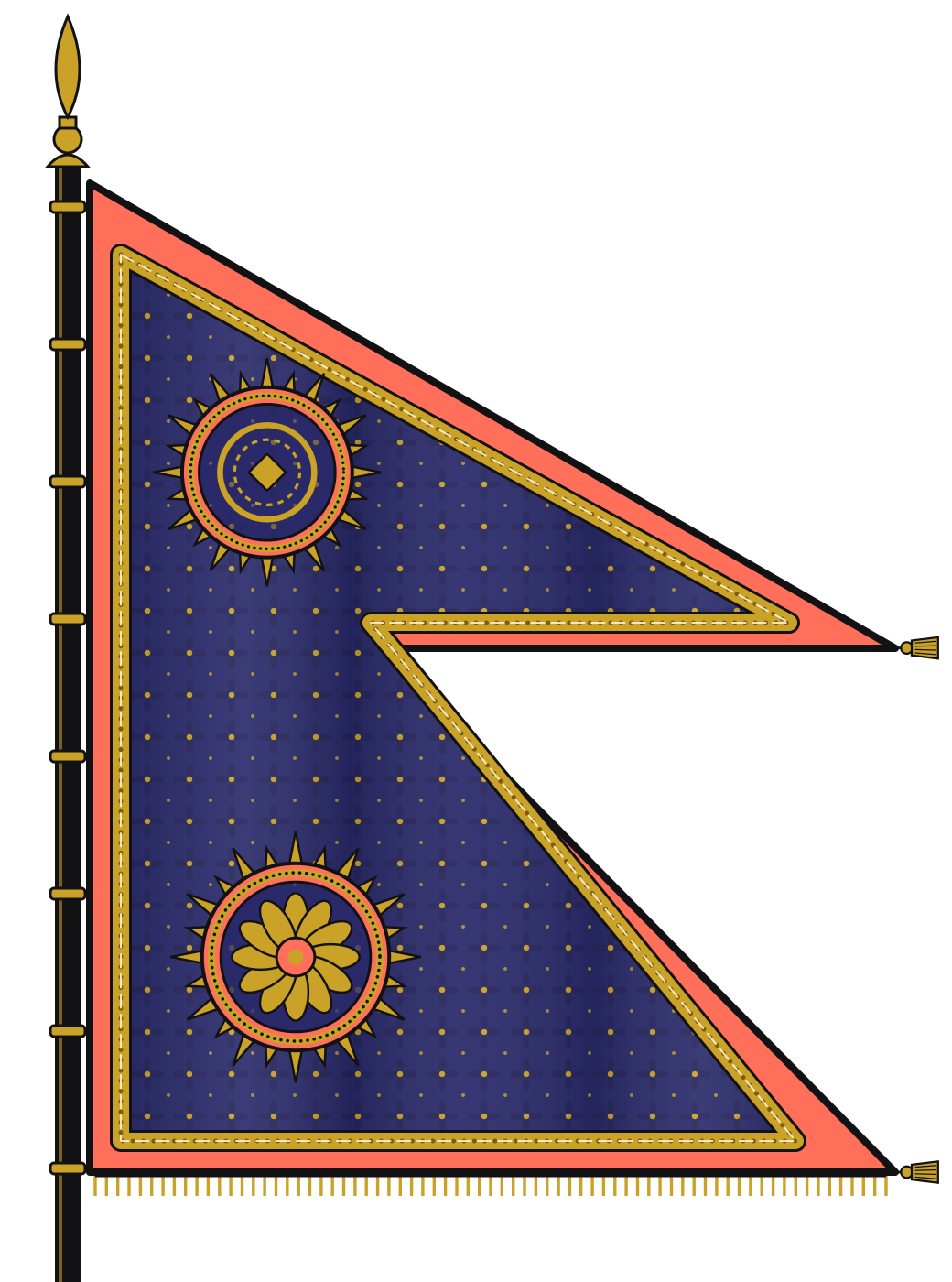

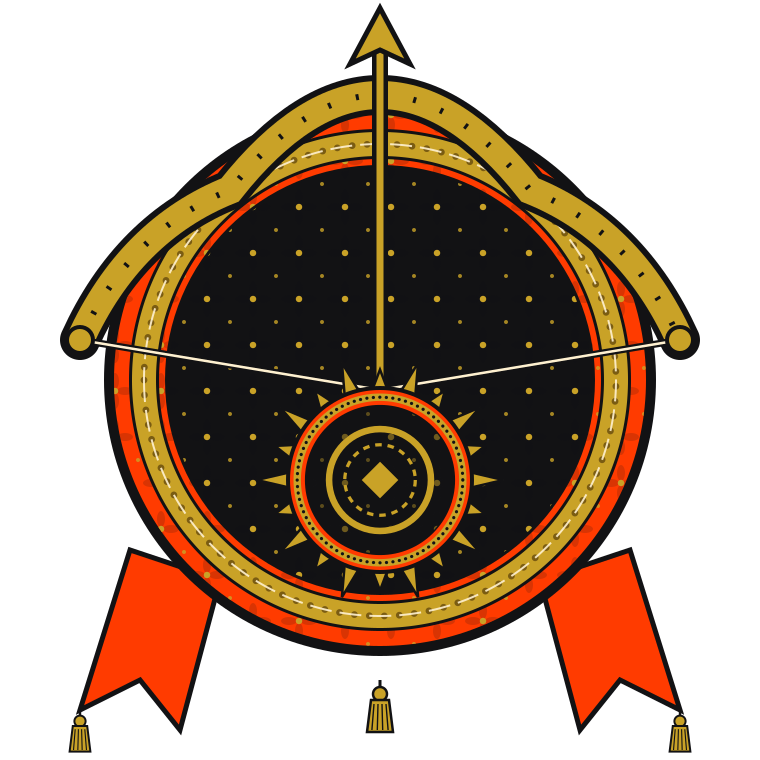
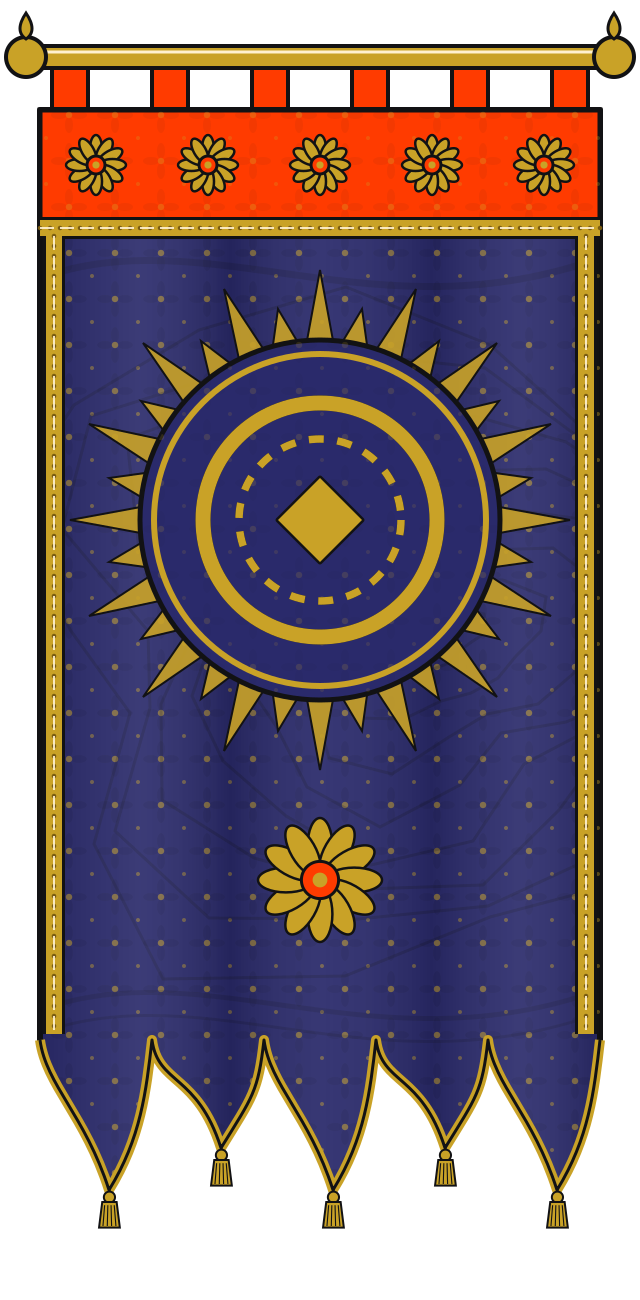
Historic banner
The Sarna flag (red and white) is used by many Adivasi Sarna followers in Jharkhand
New flag types
| Accessory | For this clan | Basis |
|---|---|---|
| A9 Pota-dhvaja · ship and trade flag For ships, caravans and markets | Not yet designed for this clan | Design |
| A10 Utsava-patāka · festival flag Light, bright flag for fairs and festivals | Not yet designed for this clan | Design |
| A11 Shoka-dhvaja · mourning flag White cloth with the emblem outline in the clan's metal | Not yet designed for this clan | Design |
7. Regalia
| Accessory | For this clan | Basis |
|---|---|---|
| E1 Chhatra · house parasol The ceremonial umbrella | Not yet designed for this clan | Design |
| E2 Chamara · fly-whisks The pair of whisks beside the head of the house | Not yet designed for this clan | Design |
| E3 Danda · staff of office Staff or scepter | Not yet designed for this clan | Design |
| E4 Simhasana · seat The seat of the house, covered in clan cloth | Not yet designed for this clan | Design |
| E5 Khetaka · shield A round shield; the Changi and Dhanush are its flag forms | Not yet designed for this clan | Regional tradition |
| E6 Kula-ayudha · clan weapon The weapon the clan honours | Not yet found for this clan | Under research |
8. Worn
| Accessory | For this clan | Basis |
|---|---|---|
| F1 Kula-vastra · clan cloth The clan's woven pattern in its kit colours | Not yet designed for this clan | Design |
| F2 Kirti-vastra · honour cloth A cloth earned for a deed, not inherited | Not yet designed for this clan | Design |
| F3 Kula-mala · garland flower The flower or leaf the clan wears as a garland | Not yet found for this clan | Under research |
| F4 Chinha · house pin A metal badge with the pin emblem | Not yet designed for this clan | Design |
9. Records
| Accessory | For this clan | Basis |
|---|---|---|
| H1 Clan words A traditional line in the native script | 𑢹𑣗𑣁𑣜𑣊 𑣏𑣂𑣕𑣂 · “Undying Writing (gloss as printed by Wikipedia)” The Ho name for the Warang Citi script, glossed "Undying Writing"[8]. It is a name, not a saying; no traditional line of the Ho is in the extracts. | Documented |
| H2 Biruda · titles The house's title or titles | Not yet found for this clan | Under research |
| H3 Prashasti · praise genealogy The lineage as written at the head of a grant | Not yet found for this clan | Under research |
| H4 Vahi · clan register The book of the clan's births, marriages and deaths | Not yet found for this clan | Under research |
| H5 Rana-ghosha · war cry The clan's cry in battle or celebration | Not yet found for this clan | Under research |
10. VishwaVit · knower of the world
Game values are design choices for this project, not historical claims.
References
- Wikipedia, Ho people, read 2026-10-22, https://en.wikipedia.org/wiki/Ho_people
- Dr. Ramdayal Munda Tribal Welfare Research Institute, Jharkhand, Ho, read 2026-10-22, https://trijharkhand.in/en/ho
- Wikipedia, Ho language, read 2026-10-22, https://en.wikipedia.org/wiki/Ho_language
- R. V. Russell, The Tribes and Castes of the Central Provinces of India, vol. 3 (1916), Project Gutenberg #41424, read 2026-10-10, https://gutenberg.org/cache/epub/41424/pg41424-images.html
- Wikipedia, Mage Parab, read 2026-10-22, https://en.wikipedia.org/wiki/Mage_Parab
- Basanta Kumar Mohanta, Ho: A Glimpse of Tribal Life In Transition, eTribal Tribune (2018 article), read 2026-10-22, link
- Vajiram and Ravi, Kolhan's Manki-Munda Governance System (exam-prep site, secondary), read 2026-10-22, link
- Wikipedia, Warang Citi, read 2026-10-22, https://en.wikipedia.org/wiki/Warang_Citi
- Wikipedia, Singbonga, read 2026-10-22, https://en.wikipedia.org/wiki/Singbonga
- Wikipedia, Marang Buru, read 2026-10-10, https://en.wikipedia.org/wiki/Marang_Buru
- Drishti IAS, Manki-Munda System and Ho Tribe (15 Sep 2025, exam-prep, secondary), read 2026-10-30, link
- Civilsdaily, Ho tribe's Manki-Munda system (Sep 2025, exam-prep, secondary), read 2026-10-30, link
- GKToday, Traditional Manki-Munda System Faces Modern Challenges (19 Sep 2025, secondary), read 2026-10-30, link
- Dulichand Khirwal vs State of Bihar, AIR 1958 Pat 366, Patna High Court, 20 Jan 1958, Indian Kanoon, read 2026-10-30, link
- IASGyan, What is Manki-Munda system explained (Sep 2025, exam-prep, secondary), read 2026-10-30, link
- Suman Shrivastava, The Jharkhand Story, 11 Feb 2026, read 2026-11-05, https://thejharkhandstory.co.in/?p=52413
- Rahul Singh, 101Reporters, First tribal court in Jharkhand fast-tracks justice delivery, 11 Apr 2023, read 2026-11-05, link
- Rau's IAS Compass, What is Kolhan's Manki-Munda System?, 17 Sep 2025, read 2026-11-05, link
- Sushree Mohanty, Indigenous Colours of Odisha: Handbook on 62 Tribes (KISS), read 2026-10-20, link
- Wikipedia, List of Scheduled Tribes in West Bengal, read 2026-10-21, https://en.wikipedia.org/wiki/List_of_Scheduled_Tribes_in_West_Bengal
- Wikipedia, List of Scheduled Tribes in Odisha, read 2026-10-20, https://en.wikipedia.org/wiki/List_of_Scheduled_Tribes_in_Odisha
- Wikipedia, Tribes of Jharkhand, read 2026-10-20, https://en.wikipedia.org/wiki/Tribes_of_Jharkhand
- Wikipedia, Bhumij people, read 2026-10-21, https://en.wikipedia.org/wiki/Bhumij_people