The Halba, whose language is called Halbi (हलबी), are a Scheduled Tribe (list dated 09-07-2024), listed in the Atlas in Chhattisgarh, Madhya Pradesh and Maharashtra. In Russell's time they were cultivators and farm-servants in south Raipur, Kanker and Bastar[1]. Their own story has them come with a leprous Raja of Jagannath to the Sihawa jungles, and they served the Bastar kings as guards and militia[2][1]. After a revolt under Daryao Deo was put down, the Halbas swore an oath of fealty before the image of Danteshwari, as a stone inscription at Donger records, in Samvat 1836, which is A.D. 1779[1]. Halbi is spoken by at least 766,297 people (2011)[3].
01Faith and deities
From the Atlas: the KulDevi for the Halba is Danteshwari (basis Documented on the sheet, with the note 'Bastar royal goddess; the Halbas were the kings' militia'). No page read calls her the Halba clan goddess. The ties shown are royal and regional: the Halbas swore fealty before her image in 1779[1], and a Halba jogi takes part in her Dussehra[4]. eTribal Tribune says the Halba 'worship Danteswari mata'[5].
Bastar royal goddess; the Halbas were the kings' militia[6]
A recorded tie between the clan and the goddess.
| Deity or tradition | Place in the clan's life | Evidence |
|---|---|---|
| Danteshwari (KulDevi) | Tutelary goddess of Bastar; the Halbas' oath of fealty in 1779 was taken before her image | [1][6] |
| Jogi of the Bastar Dussehra | A Halba man of the Halda lineage (Aamabal and Parali) sits nine days in a pit at Sirasar (Jogi Bithai) | [4][7] |
| Maili Mata, Gusain-Pusain, Budhadeo, Kunwardeo | Deities that Wikipedia lists among the Halba's; the page does not say how they are worshipped | [2] |
| Mahadeo | The god who gave life to the four scarecrows in the origin legend | [1] |
| Kabirpanthi, Sakta and village godlings | Traditions recorded in 1916: Kabirpanthi and Sakta worship (devotees of Devi or Durga), with village godlings; no Brahmans, and their own caste priest, Joshi | [1] |
02Temples
Russell records no temple built by the Halba. The Sihawa temple is said, in the own story, to have been built by the first Raja over the spring, and has a Halba priest[1]. The Danteshwari temple at Dantewada is the goddess's shrine, not a Halba building.
Built by the clan
Not recorded.
Given patronage or grants by the clan
| Temple | Deity | What the clan gave | When | Where |
|---|---|---|---|---|
| Sihawa temple | Not named in the extract | A Halba priest serves it; the Kapardar takes a new chief of Kanker there and applies tika | Russell's time | Sihawa, on the Mahanadi[1] |
| Danteshwari temple | Danteshwari | A Halba jogi's nine-day Dussehra vigil at Sirasar, for the goddess's festival | Each Bastar Dussehra | Dantewada and Jagdalpur, Bastar[4][6] |
03Languages and scripts
| Language or script | Kind | Under the clan | Evidence |
|---|---|---|---|
| Halbi (हलबी) living | Eastern Indo-Aryan, transitional between Odia and Marathi; ISO 639-3 hlb; a trade language with low literacy | The Halba's own language, spoken with Odia and Hindi (Wikipedia). Written in Odia and Devanagari; at least 766,297 native speakers (2011) and about 200,000 second-language speakers (2001)[3][2] | |
| Dialect forms | Forms recorded by Grierson | Grierson: Halbi mixes Odia, Chhattisgarhi and Marathi; in Bhandara it is nearly all Marathi; in Bastar it has forms that look like Telugu[1][2] | |
| Lingua franca of Bastar living | The lexicon introduction calls Halbi the lingua franca of Bastar District, used in marketplaces | About 600,000 mother-tongue speakers, per the lexicon introduction[8] |
04Books and literature
No book in Halbi, or written by the Halba, is in the extracts. The works below describe them.
Written during the clan's history
| Work | Author | Kind | When | Link to the clan |
|---|---|---|---|---|
| The Tribes and Castes of the Central Provinces of India, vol. 3 | R. V. Russell | Colonial ethnography | 1916 | [1] |
| Grierson's survey, vol. vii (as Wikipedia cites it) | Grierson | Linguistic survey | 1905 | [2] |
| Halbi lexicon, online, with its introduction | Not given on the page; fieldwork by Fran Woods and Betsy Schuyler (1967–1969) and by Woods (1971–1978) | Dictionary (online) | 1967–1978 (data) | [8] |
Given patronage by the clan
Not recorded.
05Thinkers and scholars
| Name | Field | Era | Contribution |
|---|---|---|---|
| R. V. Russell | Colonial ethnography | 1916 | Halba entry in the Central Provinces survey[1] |
| Grierson | Linguistics | 1905 | Halbi dialect survey, as Wikipedia cites it[2] |
| Fran Woods and Betsy Schuyler | Linguistic fieldwork | 1967–1969 | Halbi data collection; Woods continued 1971–1978[8] |
| Durga Ram Kasyap and Chingaru Ram Baghel | Language associates | Not stated | Main associates of the Halbi fieldwork, per the lexicon introduction[8] |
Under research: Halba scholarship beyond these sources. Wikipedia cites Sonkusare (academia.edu) on the Danteshwari temple and the revolt; it was not read.
06Art and architecture
Under research: the extracts record no painting, sculpture, architecture, textile or craft of the Halba.
Painting and wall art
Not recorded.
Sculpture and temple art
Not recorded.
Temple and building architecture
Not recorded.
Weaving and textiles
Not recorded.
Clothing and jewellery
Not recorded.
Coins, pottery and crafts
Not recorded.
07History
Cultivators, guards and soldiers
Russell (1916) records the Halba as cultivators and farm-servants, with their home in south Raipur district and in the Kanker and Bastar states[1]. Wikipedia gives the same home and small groups in Bhandara, Berar and Koraput[2].
Grigson thought they descended from old Paika militia garrisons. They served in militias and as guards of the Bastar kings, then as soldiers under the Ratanpur kings, and became a landholding caste in Bastar[2].
At the Dasahra ceremony a Halba carried the royal chhatra (umbrella), and the Raja walked under the protection of another Halba's naked sword. Russell says the Halbas were the Raja's guards for a long time[1].
Name and origin legend
Wikipedia says the name may come from hal (plough) with harwaha, or from a Canarese word halbar, "old ones"[2].
Russell records a legend told by Gokul Prasad: four scarecrows in the field of a Uriya Raja were given life by Mahadeo at Parvati's request, and the people were named Halba from halna, "to wave"[1]. Russell notes the same scarecrow legend among the Lodhis, and his Korwa entry says it is also told of the Halbas[1].
The Sihawa story and the Kanker line
In the Halba's own story, Halbas accompanied a leprous Raja of Jagannath in Orissa to the Sihawa jungles. The Raja's white dog came out of a copper-red spring; he bathed there, was cured, stayed, and became the ancestor of the Rajas of Kanker[1].
Russell says the Sihawa temple was built by the first Raja over the spring, and that a Halba is its priest[1].
Bastar, Kanker and the claims of descent
Bastar State is traditionally founded by Annamaraja and split in the 15th century into the Kanker and Bastar kingdoms. The Halba claim descent from the military class of those kingdoms; the page calls this the tribe's own claim[9].
Russell records a suggestion that the Halbas came with the Bastar Rajas from Warangal. Panda Baijnath, Diwan of Bastar, quotes a saying about the Raja's coming in which the Halba do not occur[1].
The revolt under Daryao Deo, 1774 to 1779
Wikipedia dates the Halba rebellion to 1774–1779. After Dalpat Deo died, his sons fought: Daryao Deo defeated the elder brother, Ajmer Singh; the page says Bastar's armies, backed by the British and Marathas, crushed the revolt. The page cites Anarchy India (2011)[2]. An exam-prep blog with no sources gives the same dates and says Ajmer Singh died in 1777[10].
Russell quotes the account that, in the reign of Raja Daryao Deo, "about 125 years back", the Halbas rebelled; many were thrown down a waterfall ninety feet high, one only escaping, and the eyes of some were put out. A stone inscription at Donger records the oath of fealty the Halbas took before the image of Danteshwari, tutelary deity of Bastar, after the rising was put down: Samvat 1836, A.D. 1779[1]. Russell's "125 years" does not match his own date; both are given as recorded.
Yojana and civilsdaily, as Wikipedia quotes them, call it "the first rebellion against the British in India". This is their claim, and no extract confirms it; Russell's account does not mention the British[2][1].
Bhandara and Chanda
Russell records that Bhandara Halbas say they came from the United Provinces or Makrai State as Rajputs. Russell thinks this a story devised by Brahmans[1].
Halba zamindars got estates from the Gond Raja of Chanda[1].
Later
Bastar State acceded to India on 1 January 1948 and became part of Chhattisgarh in 2000[9]. Wikipedia says that in the 1970s many Halba weavers lost work to powerlooms[2].
08Journey and migrations
The sources give several accounts of how the Halba came to Bastar and elsewhere. None is dated except as shown; the own story and the suggestions are kept apart.
| When | From | To | Why | Evidence |
|---|---|---|---|---|
| Undated (own story) | Jagannath, Orissa | Sihawa jungles, on the Mahanadi | A leprous Raja cured at a spring; Halbas stayed as his followers[1] | [1] |
| Undated (suggestion) | Warangal | Bastar | Suggested as the route with the Bastar Rajas; Russell gives it as a suggestion[1] | [1] |
| Undated | Sihawa | Kanker and south Raipur | Halba cultivators and later landholders in the Kanker and Bastar states[1] | [1] |
| Undated | Bastar and Kanker | Ratanpur | Halbas later became soldiers of the Ratanpur kings[1] | [1] |
| Unknown (KORNEL 2017) | Banavasi tract (Western Chalukyas), by way of Maharashtra with an invading army | Koraput, Odisha | The Koraput Halba are linked to the Halavur branch; Anchola village of Borigumma is a concentration[2] | [2] |
| Undated (claimed) | United Provinces or Makrai State | Bhandara and Berar | The Bhandara Halbas say they came as Rajputs; Russell thinks this a Brahman-devised story[1] | [1] |
09Seats and lands
| Place | Role | Where today |
|---|---|---|
| Sihawa | First settlement, on the Mahanadi, as Grierson gives it; the forest of the own story | Mahanadi, as named; the district is not stated[1] |
| South Raipur district | Home of the Halba in Russell's time | Raipur, Chhattisgarh[11] |
| Kanker | Halba home in the Kanker state, with the Kanker Rajas | Kanker, Chhattisgarh[11] |
| Bastar | Halba home and militia; old capital Bastar, later Jagdalpur on the Indravati | Bastar, Chhattisgarh[9][11] |
| Durg | Halba (Halbi) found here, per Vajiram and Ravi | Durg, Chhattisgarh[11] |
| Dantewada | The town of the Danteshwari temple, the Halba oath's deity | Dantewada, Chhattisgarh[6] |
| Bhandara and Berar | Small numbers in Russell's time; the Bhandara Halba divisions Barpangat and Khalpangat | Maharashtra[1] |
| Koraput | Groups in Koraput, with the Jeypore clans; Anchola village of Borigumma a concentration | Koraput, Odisha[12][2] |
| Chanda | The Gond Raja of Chanda gave estates to Halba zamindars | Not stated[1] |
10Notable figures
| Name | Role | Era | Known from |
|---|---|---|---|
| Daryao Deo | Bastar ruler in whose reign the Halba rebelled, as Russell gives it; defeated Ajmer Singh (Wikipedia) | 1775–1800 (Bastar State list) | [1][9] |
| Ajmer Singh | Elder brother of Daryao Deo in the succession fight; the blog says he died in 1777 | 1774–1779 (rebellion dates) | [2][10] |
| Dalpat Deo research | Ruler whose death began the succession fight; the dates differ between the sources | 1731–1774 (Halba page) or 1716–1775 (Bastar State list) | [2][9] |
| Leprous Raja of Jagannath legend | The Raja of the own story, cured at the Sihawa spring; ancestor of the Rajas of Kanker | Legendary | [1] |
| Gokul Prasad | Told the origin legend that Russell records | Russell's time | [1] |
| Panda Baijnath | Diwan of Bastar; quoted the Bastar saying and the Halba-Dhakar proverb | Russell's time | [1] |
| Halba jogi of the Halda lineage | Sits nine days in a pit at Sirasar in the Bastar Dussehra | Each Dussehra | [4][7] |
11Allies, rivals and marriages
| People | Relationship | When |
|---|---|---|
| Bastar Rajas | The Halba served them as militia and guards; the Halba claim descent from the military class of the Kanker and Bastar kingdoms (their own claim) | Bastar State split, 15th century; Russell's time[9][1] |
| Rajas of Kanker | In the own story, the leprous Raja whom the Halbas accompanied, cured at the spring, is the ancestor of the Rajas of Kanker; a Halba Kapardar invests each new chief | Legendary; Russell's time[1] |
| Ratanpur kings | The Halbas were later their soldiers | Not dated[1] |
| Gond Rajas of Chanda | Gave estates to Halba zamindars | Not dated[1] |
| Gonds | Wikipedia describes the Halba as a mixed tribe descended from Gonds and Hindus (a claim on that page) | Not dated[12] |
| Dhakars | Paired with the Halbas in a proverb; Dhakars rank above Halbas in Bastar; a Halba section is named Dhakar | Russell's time[1] |
| Bhunjia (ST-034) | A branch of the Halbas, by S.C. Dubey's reading of oral tradition; OSTM says offshoot groups of Halba, Gond and Baiga | Not dated[13][14] |
| Koshti | Some Halbas took up weaving and merged into the Koshti; Halba weavers are also called Koshti | Russell's time; Wikipedia[1][2] |
| Korwa | Russell's Korwa entry says the same scarecrow legend is also told of the Halbas | Russell's time[1] |
| Bhatra | Both take part in the Bastar Dussehra rites | Today[4] |
| Rajputs (claimed) | Bhandara Halbas say they came as Rajputs; Russell thinks this a Brahman-devised story; names often take Sinha or Singh in imitation of Rajputs | Russell's time[1] |
12Society and livelihood
In Russell's time the Halba of Bastar were landholders and moderately good cultivators, the highest local caste except Brahmans, Dhakars and a few Rajput families[1]. Their order had local divisions, totemic groups called barags in Bastar, and a panchayat headed by a Kursha chosen from the Kotwar, Chanap or Naik sections[1].
Government and social order
| Institution or group | What it was | Evidence |
|---|---|---|
| Panchayat and Kursha | A panchayat whose headman, the Kursha, is chosen from the Kotwar, Chanap or Naik sections[1] | [1] |
| Barag and thok | In Bastar, totemic groups are barags; many men belong to a thok, a titular name used as a surname. Marriage is avoided within the same barag or thok[1] | [1] |
| Kapardar | A Halba office at Kanker: takes a new chief to the temple, invests him with the Durbar ki poshak and applies tika of turmeric, rice and sandalwood[1] | [1] |
| Royal guard | The Halbas were the Raja's guards for a long time; a Halba's widows were not sold, and his intestate property was not taken by the Raja[1] | [1] |
| Divisions | Bastarha, Chhattisgarhia and Marethia; Purait (Nekha) and Surait (Nayak) in Bastar and Chhattisgarh; Barpangat and Khalpangat in Bhandara[1] | [1] |
| Caste priest | Their own caste priest, Joshi; no Brahmans[1] | [1] |
Livelihood over time
| Era | Livelihood | Evidence |
|---|---|---|
| Russell's time (1916) | Cultivators and farm-servants; in Bastar, landholders and moderately good cultivators | [1] |
| Earlier (Grigson's view) | Militia garrisons, then guards and soldiers under kings; some took to weaving and merged into Koshti | [2][1] |
| 1970s | Many weavers lost work to powerlooms, per Wikipedia (citing newsinc24, 2022) | [2] |
| 2022 (as the page cites it) | Many in Nagpur sell Saoji food, per Wikipedia (citing newsinc24, 2022) | [2] |
13Sub-clans and related clans
The extracts name these sub-groups, divisions, totemic sections, exogamous sections named after other castes, Koraput clans and related peoples. Only the names are sourced: no sizes are given for any of them.
| Clan | Relation | Where | Size | In the Atlas | Evidence |
|---|---|---|---|---|---|
| Bastarha | Sub-clan | Bastar (local division) | new clan candidate | [1] | |
| Chhattisgarhia | Sub-clan | Chhattisgarh (local division) | new clan candidate | [1] | |
| Marethia | Sub-clan | Not stated (local division) | new clan candidate | [1] | |
| Purait (Nekha) | Sub-clan | Bastar and Chhattisgarh; the pure division | new clan candidate | [1] | |
| Surait (Nayak) | Sub-clan | Bastar and Chhattisgarh; the mixed division | new clan candidate | [1] | |
| Barpangat | Sub-clan | Bhandara | new clan candidate | [1] | |
| Khalpangat | Sub-clan | Bhandara | new clan candidate | [1] | |
| Pentia | Sub-clan | Pottangi hill (worship centre) | ST-257 | [2] | |
| Bunkar | Sub-clan | Not stated (subgroup) | new clan candidate | [12] | |
| Telia | Sub-clan | Not stated (subgroup); the Atlas's Telia (ST-504) is a separate entry, not linked | same name as ST-504: check | [12] | |
| Jadi (Jadia) | Sub-clan | Not stated (subgroup) | new clan candidate | [12] | |
| Bareng | Sub-clan | Jeypore, Koraput, Odisha | new clan candidate | [2] | |
| Mudli | Sub-clan | Jeypore, Koraput, Odisha | new clan candidate | [2] | |
| Nago | Sub-clan | Jeypore, Koraput, Odisha | new clan candidate | [2] | |
| Dalaie | Sub-clan | Jeypore, Koraput, Odisha | new clan candidate | [2] | |
| Sunakaria | Sub-clan | Jeypore, Koraput, Odisha | new clan candidate | [2] | |
| Kaktia | Sub-clan | Jeypore, Koraput, Odisha | new clan candidate | [2] | |
| Uparia | Sub-clan | Jeypore, Koraput, Odisha | new clan candidate | [2] | |
| Soam | Sub-clan | Jeypore, Koraput, Odisha | new clan candidate | [2] | |
| Khamaria | Sub-clan | Jeypore, Koraput, Odisha | new clan candidate | [2] | |
| Dhangundia | Sub-clan | Jeypore, Koraput, Odisha | new clan candidate | [2] | |
| Makad | Sub-clan | Jeypore, Koraput, Odisha | new clan candidate | [2] | |
| Ghorapatia (horse) | Sub-clan | Totemic section; in Bastar a barag | new clan candidate | [1] | |
| Kawaliha (lotus) | Sub-clan | Totemic section; in Bastar a barag | new clan candidate | [1] | |
| Aurila (tamarind) | Sub-clan | Totemic section; in Bastar a barag | new clan candidate | [1] | |
| Lendia (tree) | Sub-clan | Totemic section; in Bastar a barag | new clan candidate | [1] | |
| Gohi (lizard) | Sub-clan | Totemic section; in Bastar a barag | new clan candidate | [1] | |
| Manjur (peacock) | Sub-clan | Totemic section; in Bastar a barag | new clan candidate | [1] | |
| Bhringraj (blackbird) | Sub-clan | Totemic section; in Bastar a barag | new clan candidate | [1] | |
| Baretha | Sub-clan | Exogamous section named after another caste | new clan candidate | [1] | |
| Bhoyar | Sub-clan | Exogamous section named after another caste | new clan candidate | [1] | |
| Rawat | Sub-clan | Exogamous section named after another caste; not linked to the master's Raji (Ban Rawat) | new clan candidate | [1] | |
| Barhai | Sub-clan | Exogamous section named after another caste | same name as SUB-329: check | [1] | |
| Malia | Sub-clan | Exogamous section named after another caste | new clan candidate | [1] | |
| Bhandari | Sub-clan | Exogamous section named after another caste; the master's Bhandari (SUB-316) is not linked | same name as SUB-316: check | [1] | |
| Pardhan | Sub-clan | Exogamous section named after another caste; the master's Pardhan (ST-251) is not linked | same name as ST-251: check | [1] | |
| Mankar | Sub-clan | Exogamous section named after another caste | new clan candidate | [1] | |
| Sahara | Sub-clan | Exogamous section named after another caste | new clan candidate | [1] | |
| Kanderi | Sub-clan | Exogamous section named after another caste | new clan candidate | [1] | |
| Agri | Sub-clan | Exogamous section named after another caste | same name as SUB-325: check | [1] | |
| Baghel | Sub-clan | Exogamous section named after another caste | new clan candidate | [1] | |
| Elmia | Sub-clan | Exogamous section named after another caste | new clan candidate | [1] | |
| Chalki | Sub-clan | Exogamous section named after another caste | new clan candidate | [1] | |
| Ponwar | Sub-clan | Exogamous section named after another caste | new clan candidate | [1] | |
| Kotwar | Sub-clan | A section from which the panchayat headman (Kursha) is chosen | new clan candidate | [1] | |
| Chanap | Sub-clan | A section from which the panchayat headman (Kursha) is chosen | new clan candidate | [1] | |
| Naik | Sub-clan | A section from which the panchayat headman (Kursha) is chosen | new clan candidate | [1] | |
| Bhunjia | Branch | Nuapada, Odisha; Raipur district, Chhattisgarh | 22,953, 2011 census[13] | ST-034 | [13][14] |
| Gond | Related people | Gond Rajas of Chanda | ST-088 | [12][1] | |
| Bhattra | Related people | Bastar Dussehra | ST-026 | [4] | |
| Koshti | Related people | Weavers; Halbas merged into them (Russell) | SUB-289 | [1] | |
| Korwa | Related people | Shared scarecrow origin legend | ST-157 | [1] | |
| Dhakar | Related people | Bastar; paired with the Halbas in a proverb | new clan candidate | [1] | |
| Bastar Rajas | Dynasty from this clan | Bastar | same name as SUB-255: check | [9][1] | |
| Rajas of Kanker | Dynasty from this clan | Kanker | new clan candidate | [1] | |
| Ratanpur kings | Dynasty from this clan | Ratanpur | new clan candidate | [1] | |
| Gond Rajas of Chanda | Dynasty from this clan | Chanda | new clan candidate | [1] |
Clans marked "new clan candidate" are not in the Atlas yet.
14Surnames
Surnames are named by the Halba pages (Wikipedia, citing jankaritoday 2021, and the Halba people page) and by Russell (1916). No bearer count is sourced with a year, so none is given.
| Surname | Clan or sub-clan | Where | People with this surname | Also used by other communities |
|---|---|---|---|---|
| Som | Not stated | Not stated | not yet counted | No |
| Naik | Not stated (also a Halba section) | Not stated | not yet counted | No |
| Raut | Not stated | Not stated | not yet counted | No |
| Voyar | Not stated | Not stated | not yet counted | No |
| Nadge | Not stated | Not stated | not yet counted | No |
| Kothwar | Not stated (Russell spells it Kotwar, a Halba section) | Not stated | not yet counted | No |
| Gharait | Not stated | Not stated | not yet counted | No |
| Chudi | Not stated | Not stated | not yet counted | No |
| Pakhle | Not stated | Not stated | not yet counted | No |
| Gawad | Not stated | Not stated | not yet counted | No |
| Hedu | Not stated | Not stated | not yet counted | No |
| Medke | Not stated | Not stated | not yet counted | No |
| Yele | Not stated | Not stated | not yet counted | No |
| Mankar | Not stated (also a Halba section) | Not stated | not yet counted | No |
| Sherkar | Not stated | Not stated | not yet counted | No |
| Margai | Not stated | Not stated | not yet counted | No |
| Chillar | Not stated | Not stated | not yet counted | No |
| Bhandari | Not stated (also a Halba section) | Not stated | not yet counted | No |
| Sinha | Not stated | Not stated | not yet counted | Yes |
| Singh | Not stated | Not stated | not yet counted | Yes |
Counts are of everyone with the surname, from the cited source and year, not only members of this clan. A surname shared with other communities says nothing about any one person's origin.
15Songs and music
No Halbi song with its words is in the extracts. Russell records one custom with songs and gives no text.
Abusive songs of the bride's party
16Poems, lullabies and children's rhymes
None recorded yet.
17Stories, legends and proverbs
Stories and legends
| Story | What happens | Told by | Evidence |
|---|---|---|---|
| Four scarecrows legend | Four scarecrows in the field of an Uriya Raja are given life by Mahadeo at Parvati's request; the people are named Halba from halna, 'to wave'. Russell notes the same legend among the Lodhis, and in his Korwa entry among the Halbas | Gokul Prasad, as Russell gives it | [1] |
| The leprous Raja and the spring legend | Halbas accompany a leprous Raja of Jagannath to the Sihawa jungles; his white dog comes out of a copper-red spring; he bathes, is cured, stays, and becomes the ancestor of the Rajas of Kanker | The Halba's own story, as Russell records it | [1][2] |
Proverbs and sayings
| Saying | Meaning | Evidence |
|---|---|---|
| "The Halbas and Dhakars form two portions of a bedsheet." English only; no native form in the extract | Meaning not given; quoted by Panda Baijnath, Diwan of Bastar | [1] |
| "If your husband loves you your mother-in-law can do nothing." English only | A saying about a young wife; the extract gives no regional attribution, though Russell places it in the Halba entry | [1] |
18Festivals and fairs
| Festival or fair | When | Where | What happens |
|---|---|---|---|
| Bastar Dussehra | 75 days, beginning on Hariyaali Amavasya (Unexplored Bastar) | Bastar: Dantewada and Jagdalpur | A Halba jogi sits nine days in a pit at Sirasar (Jogi Bithai); a Halba carries the royal chhatra, and a Halba's naked sword protects the Raja at Dasahra[7][4][1] |
| Akti | Not stated | Not stated | Libations to the ancestors[1] |
| Pitripaksh | On the ninth day of the fortnight | Not stated | A feast on the ninth day[1] |
| Tij Nahan | On the third day | Not stated | A rite on the third day[1] |
19Food, dress and games
Food
Not recorded.
Dress
| Item | What it is | Evidence |
|---|---|---|
| Dress | Scanty; a thread tied round the waist by every man | [1] |
Games and martial arts
Not recorded.
Tags: living still practised · revived brought back after a break · lost known only from records · research reported but not yet confirmed from a source. Songs and poems under copyright are listed by title only; restricted or sacred material is noted without its content.
20Status today
The Halba are a living Scheduled Tribe in Chhattisgarh, Madhya Pradesh and Maharashtra in the Atlas, with about 750,000 people in all (2011 census, as Wikipedia gives it) and a language, Halbi, spoken by at least 766,297 people[2][3].
Who carries the name today
| Community | Link | Basis | Evidence |
|---|---|---|---|
| Bhunjia (ST-034) | Community tradition | [13][14] | |
| Koshti (SUB-289): Halbas who took up weaving | Documented | [1] |
Recognised heritage
| What | Recognition | Evidence |
|---|---|---|
| Donger stone inscription, Samvat 1836 (A.D. 1779), the Halbas' oath of fealty | Recorded by Russell (1916); no current recognition in the extracts | [1] |
| Danteshwari temple, Dantewada: the goddess of the oath; the centre of the Bastar Dussehra | Named as the centre of the Bastar Dussehra (Wikipedia) | [6][7] |
Not reviewed by the Halba community. The extracts are books, encyclopedias and web pages; no community voice is in them.
21For children
The four scarecrows
Long ago, there were four scarecrows in the field of a Raja. Parvati asked Mahadeo to give them life. Mahadeo did, and the four scarecrows came alive. They were named Halba, from a word that means to wave. The Halba tell this story, as Russell wrote it down in 1916.
22Across the project
| Project | What carries this clan | Status |
|---|---|---|
| Atlas of the Janas | Places in the sources: Bastar, Kanker, Raipur, Durg, Dantewada, Bhandara, Berar and Koraput (Jeypore); Sihawa on the Mahanadi. No pin set yet | To check |
| KulDevi and GrahDevi | Danteshwari, KulDevi from the Atlas (basis Documented on the sheet); GrahDevi forms from the Atlas (Mahavidya family) | From the Atlas |
| Planet naming | No Halba planet name in the extracts | Under research |
| Renaming and waters | The copper-red spring at Sihawa in the own story; no renaming in the extracts | Under research |
23Open questions
- Native script: only हलबी is printed, and it is the name of the language. Find a Devanagari or Odia form for the people; no page read prints one.
- Clan words: no Halba line is in the extracts, and Russell's proverbs are English only. Find a Halbi saying with its text and meaning (Grierson's specimens, CIIL Sanchika), then fill the words block.
- The 1774–1779 revolt: the primary account (Maratha and British roles) is not read. The Yojana and civilsdaily 'first rebellion' claim is attributed only[2].
- Dates of Dalpat Deo differ between the Halba page (1731–1774)[2] and the Bastar State list (1716–1775; Daryao 1775–1800)[9]. Russell's '125 years back'[1] does not match his date of 1779.
- Telia: the Halba subgroup and the Atlas's Telia (ST-504) may or may not be one people. Not linked.
- Sihawa: the extract gives only the Mahanadi; the district is not stated.
- Festivals and songs with their words are not in the extracts. Leads: exploreindia.tv Halba rites (summary only in cache), CIIL Sanchika.
- Danteshwari's temple date: Wikipedia says the 14th century[6]; Unexplored Bastar says Annamdev of the Kakatiya established her[7]; Wikipedia (Halba page) cites Sonkusare for a Chalukya king[2]. Resolve before using a date.
- The all-India population (about 750,000) comes from Wikipedia; the state rows come from census lists. The all-India ST row has not been read.
- Koraput clans come from Wikipedia citing Datt 2015 and KORNEL 2017, neither read directly.
- Community review: none yet.
24Astitva
अस्तित्व · being, existence: everything by which the clan is known
The extracts document a royal chhatra and a naked sword carried by Halba men at Dasahra, and totem sections named after plants and animals that are revered and not killed. No seal, coin or war cry of the Halba is in the extracts. The Donger stone inscription of 1779 is recorded in the extracts.
Every clan has every accessory, royal objects included. Each one says how it is known: Documented This clan's own object is recorded. · Regional tradition Recorded for the region or for peoples like this one, not for this clan. · Design Made for this project, with no historical claim. · Under research To be found for this clan from sources. Legends and titles are written in the clan's own script.
1. Seals and coins
| Accessory | For this clan | Basis |
|---|---|---|
| B1 Rajamudra · house seal Round seal with the clan emblem and a short legend in the clan's script | Not yet designed for this clan | Design |
| B2 Anguliya-mudra · signet ring Personal seal ring of the head of the house | Not yet designed for this clan | Design |
| B3 Chhapa · house stamp Ink or block stamp for letters, goods and cloth | Not yet designed for this clan | Design |
| B4 Tamrapatra · charter plate Copper-plate grant on a ring, closed with the house seal | Not yet designed for this clan | Design |
| B5 Shreni-mudra · guild or trade seal Seal for the clan's trade, craft or caravan | Not yet designed for this clan | Design |
| C1 Clan coin Emblem or deity on one side, a legend in the clan's script | Not yet designed for this clan | Design |
| C2 Coin die The die that strikes the coin | Not yet designed for this clan | Design |
2. Living symbols
| Accessory | For this clan | Basis |
|---|---|---|
| I1 Totem trio The tree, bird and animal the clan protects | Totem sections: horse (Ghorapatia), lotus (Kawaliha), tamarind (Aurila), a tree (Lendia), lizard (Gohi), peacock (Manjur) and blackbird (Bhringraj). The totem is revered and not killed; if one is killed, a piece of cloth is torn for the shroud | Documented |
| I2 Kaval-maram · guardian tree The tree that stands at the clan's seat | Not yet found for this clan | Under research |
3. Stone and gate
| Accessory | For this clan | Basis |
|---|---|---|
| G1 Torana · gateway The built gate of the seat; the cloth Toran hangs in it | Not yet designed for this clan | Regional tradition |
| G2 Viragallu · hero stone Carved panel stone for a member who died defending the clan | Not yet designed for this clan | Regional tradition |
| G3 Kula-shila · clan stones Standing and table stones that remember the ancestors | Not yet designed for this clan | Design |
| G4 Jayastambha · victory pillar A pillar raised for a victory | Not yet designed for this clan | Design |
| G5 Sima-shila · boundary stone Marks the clan's land, with a line in the native script | Not yet designed for this clan | Design |
4. Sounds
| Accessory | For this clan | Basis |
|---|---|---|
| D1 Pancha-mahashabda · five great sounds The right to five instruments | Not yet designed for this clan | Design |
| D2 Shankha · clan conch The clan's own named war conch | Not yet designed for this clan | Design |
| D3 Murasu · house drums Three drums: war, charity and justice | Not yet designed for this clan | Design |
5. Kit: colours, metals and emblems
The main emblem is a design idea, not a documented symbol: a spear and shield, for the militia of the Bastar kings; the second image is a decorated chariot, for the Bastar Dussehra. The extracts record no seal, coin or banner of the Halba.
| Part of the kit | This clan |
|---|---|
| Field | Fiery Vermilion #FF4500 |
| Accent | Intense Electric Blue #84A9FF |
| Emblem colour | Charcoal Black #121214 |
| Zari metal | Gold |
| Main emblem | A spear and shield |
| Second image | A decorated chariot |
| Night and day | Every visual accessory has two versions: by night the emblem on the dark field, by day the clan's field colour on cloth woven from its metal. |
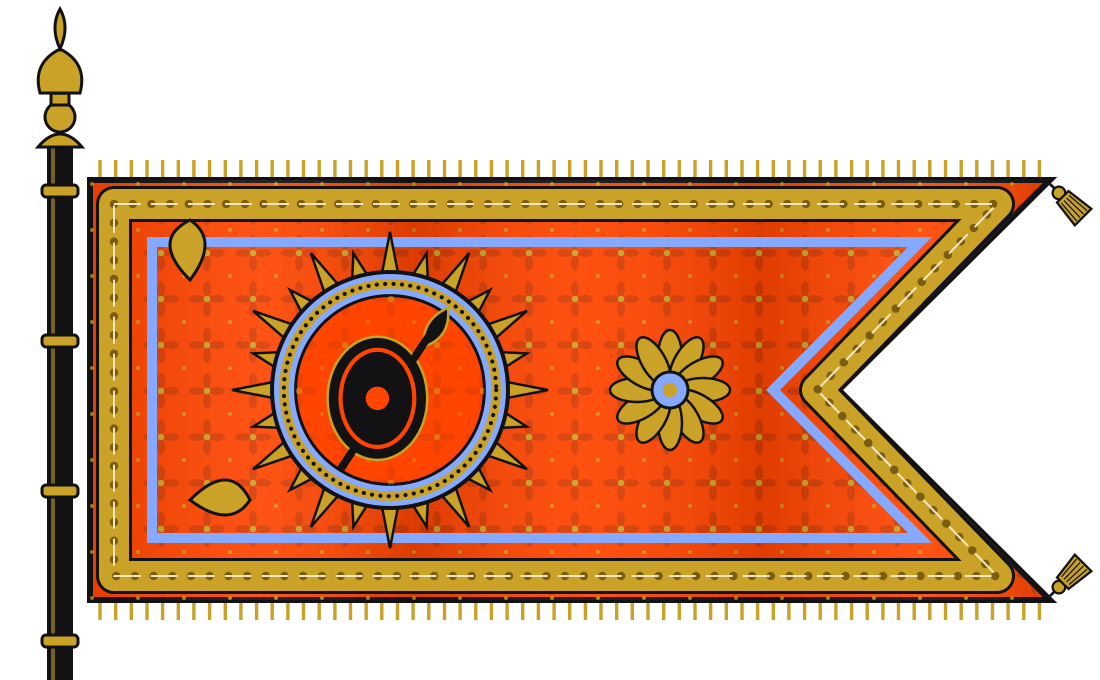
6. Flags
Every clan has every flag type; the type says the occasion and the colours say the clan. The outlined card is the flag the Atlas assigns.
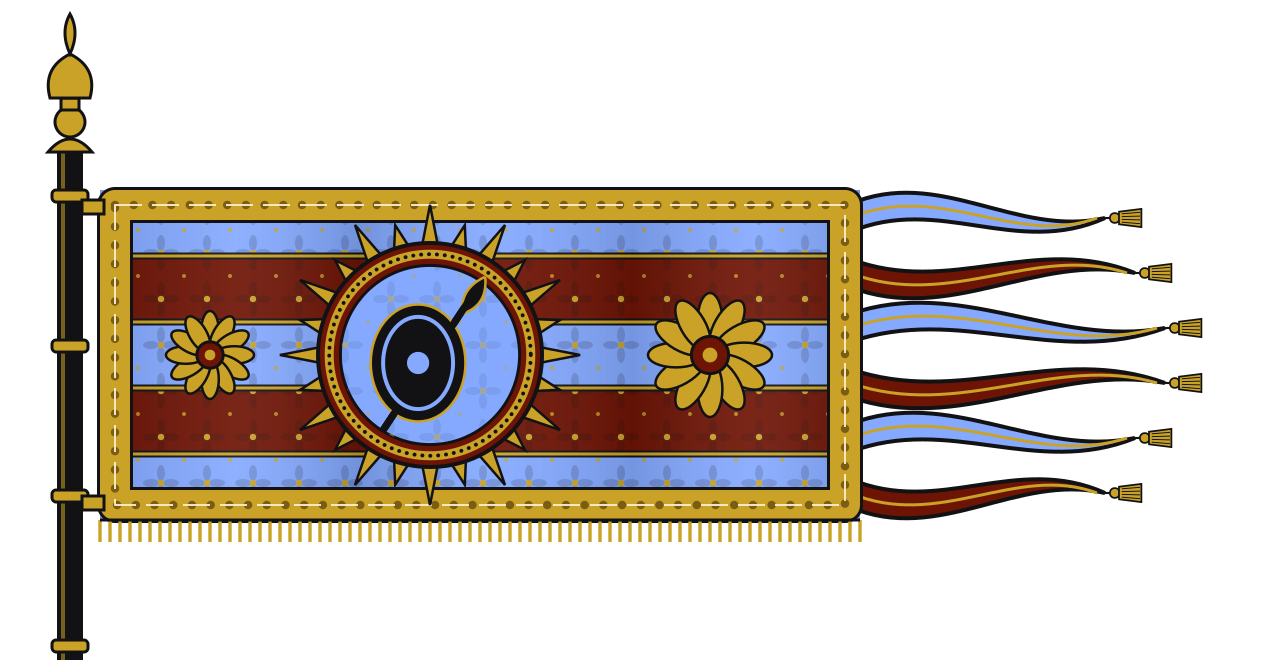
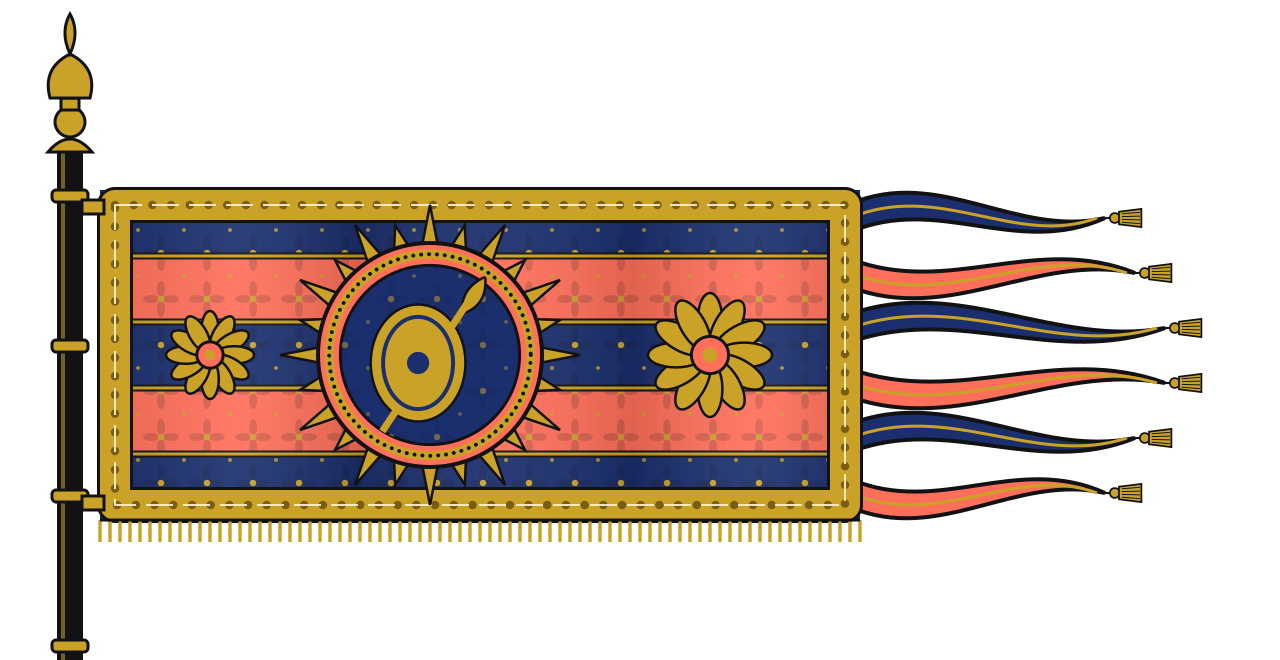
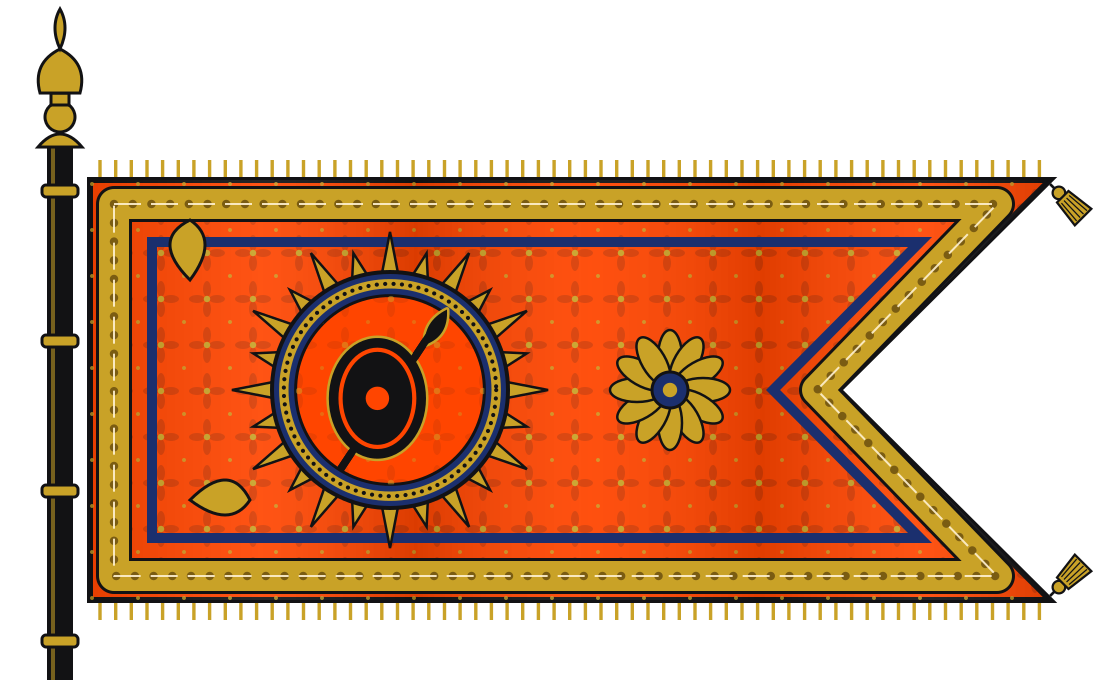
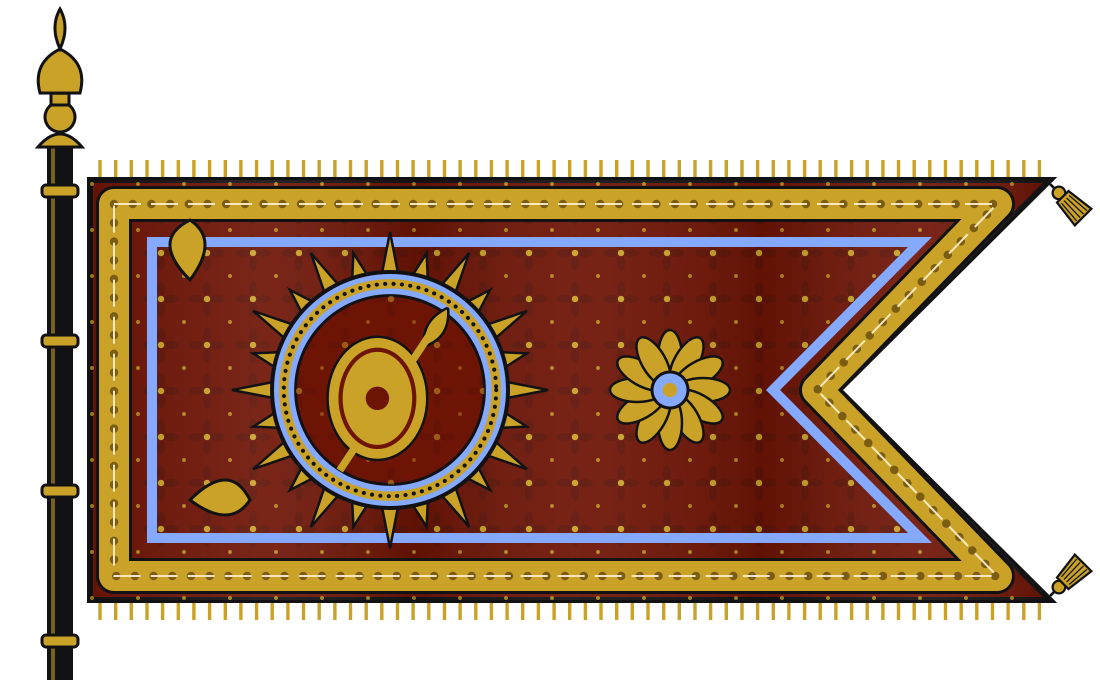

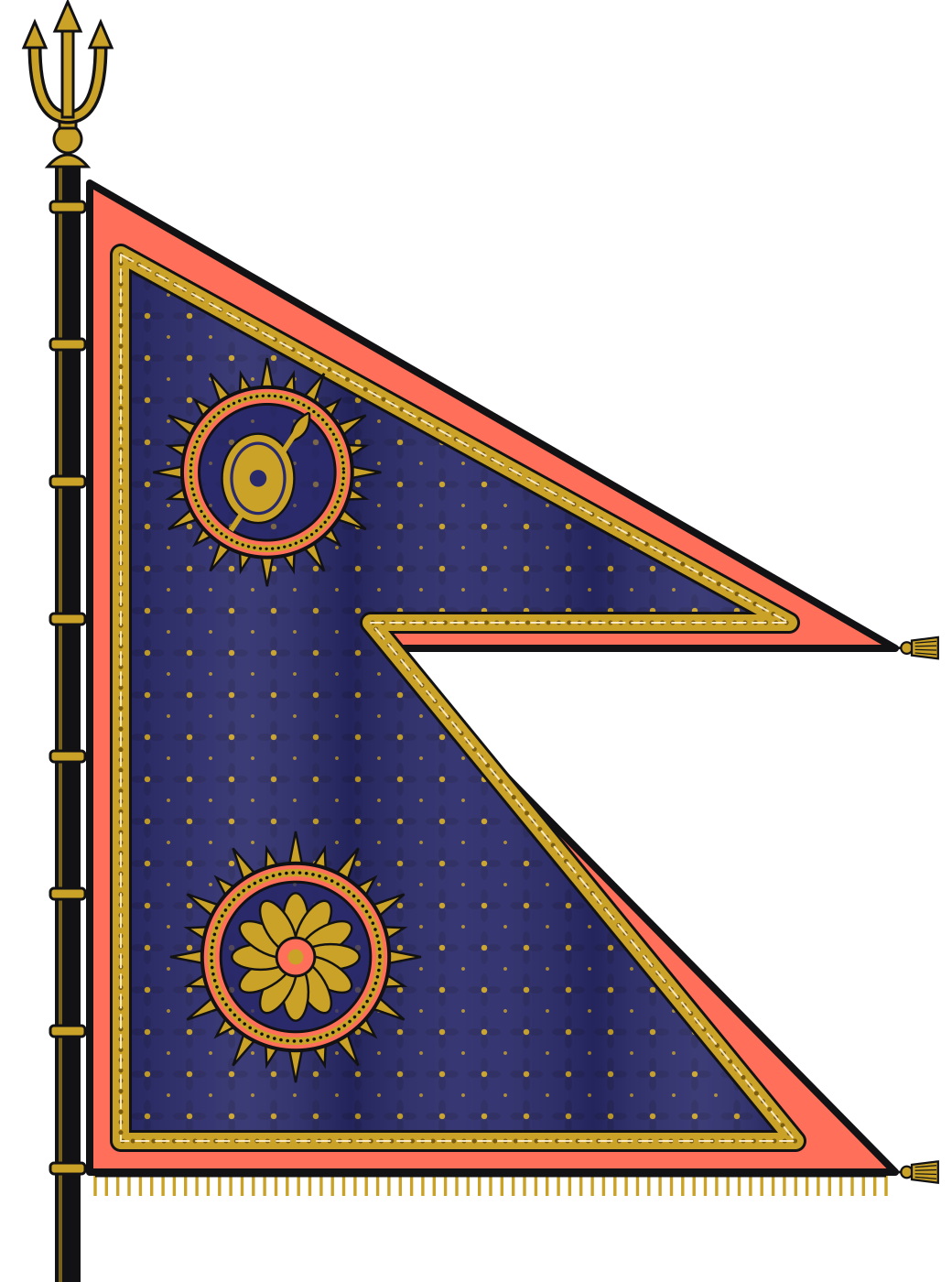

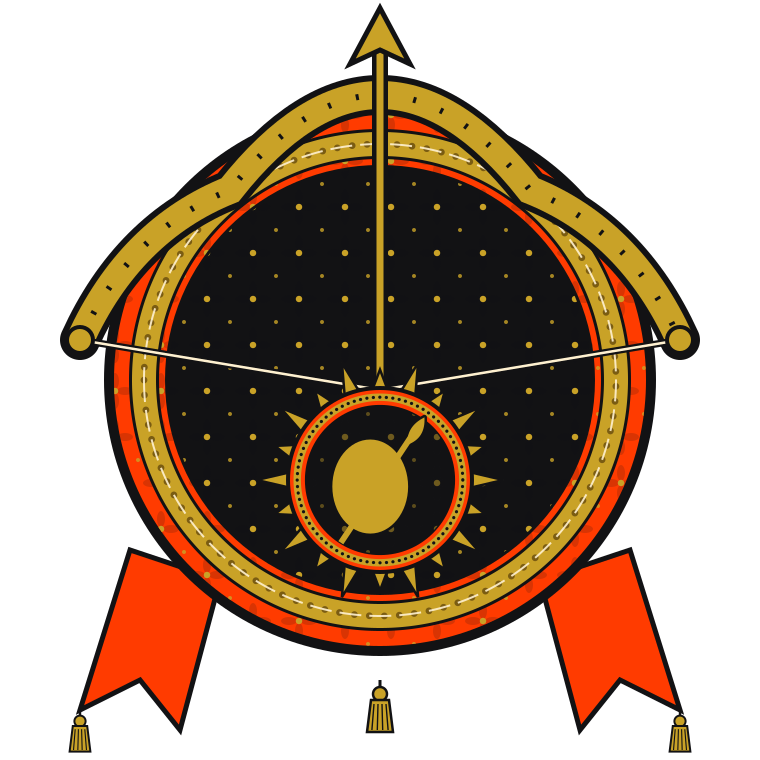
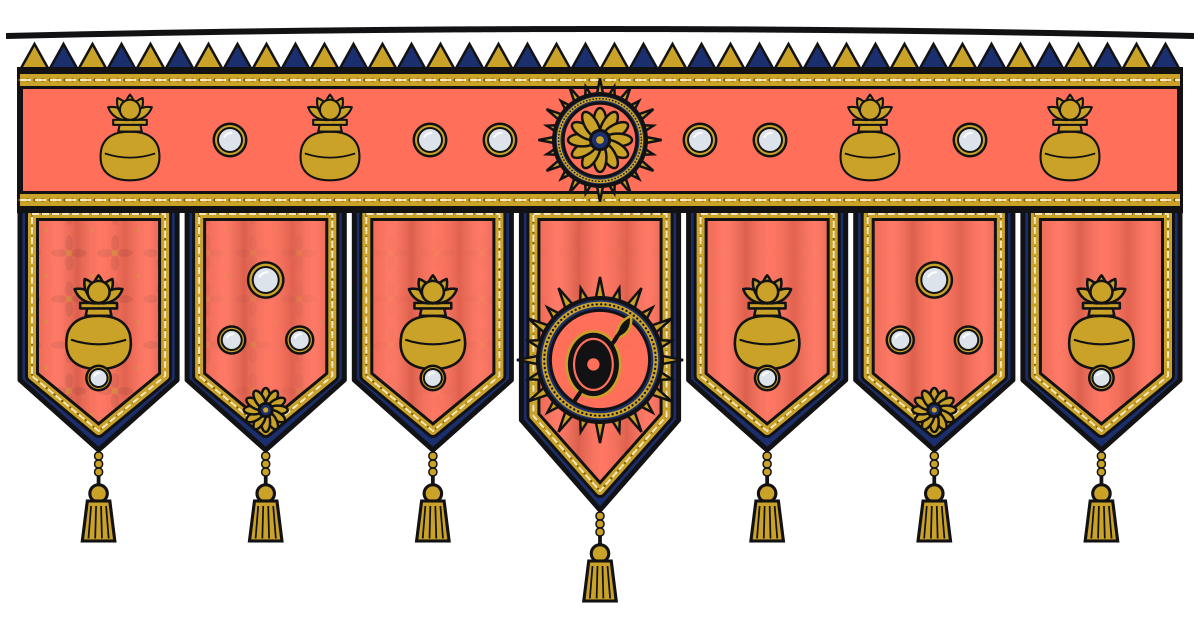
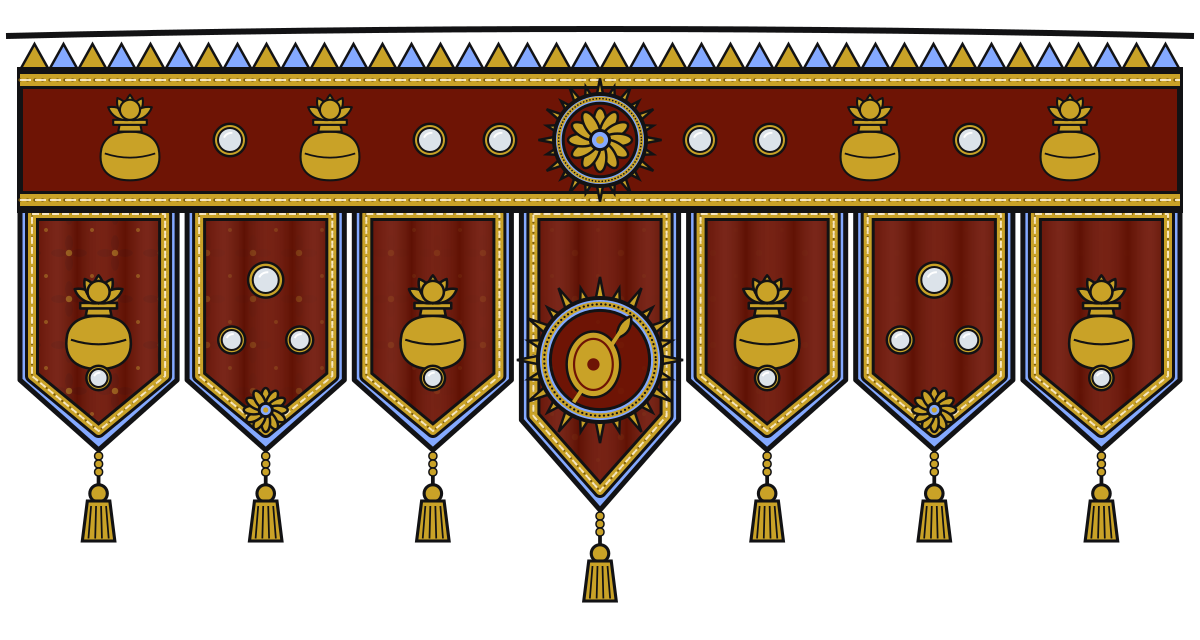
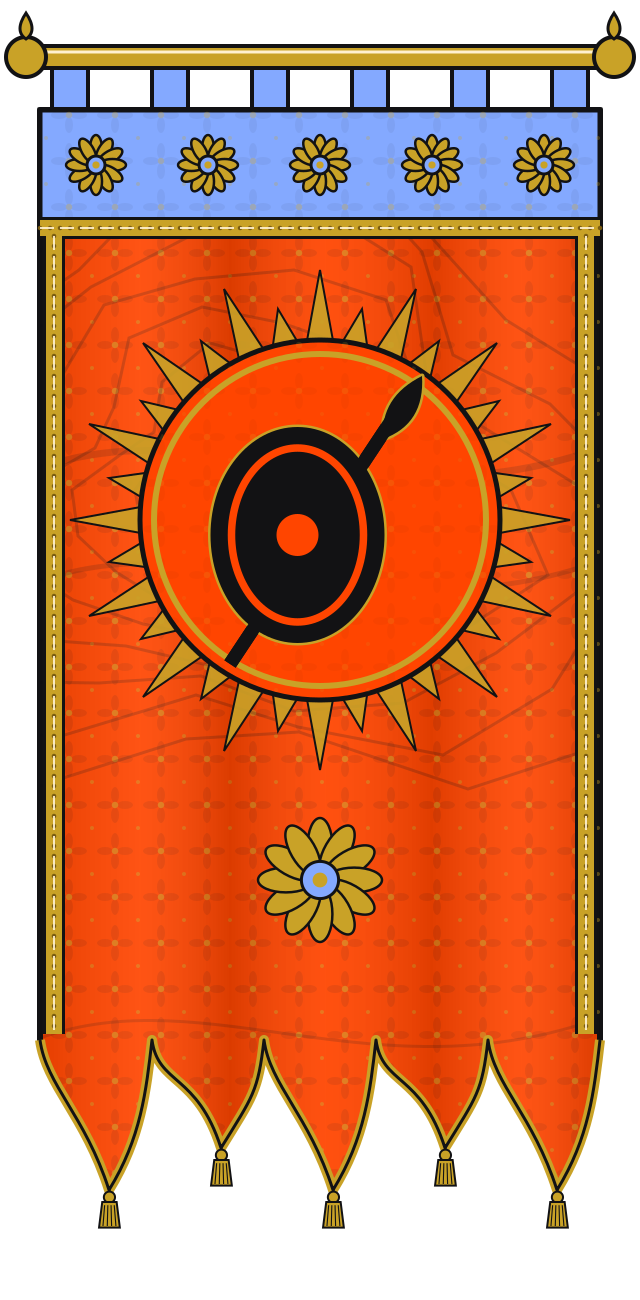
Historic banner
None known
New flag types
| Accessory | For this clan | Basis |
|---|---|---|
| A9 Pota-dhvaja · ship and trade flag For ships, caravans and markets | Not yet designed for this clan | Design |
| A10 Utsava-patāka · festival flag Light, bright flag for fairs and festivals | Not yet designed for this clan | Design |
| A11 Shoka-dhvaja · mourning flag White cloth with the emblem outline in the clan's metal | Not yet designed for this clan | Design |
7. Regalia
| Accessory | For this clan | Basis |
|---|---|---|
| E1 Chhatra · house parasol The ceremonial umbrella | The royal chhatra (umbrella), carried by a Halba at the Dasahra ceremony | Documented |
| E2 Chamara · fly-whisks The pair of whisks beside the head of the house | Not yet designed for this clan | Design |
| E3 Danda · staff of office Staff or scepter | Not yet designed for this clan | Design |
| E4 Simhasana · seat The seat of the house, covered in clan cloth | Not yet designed for this clan | Design |
| E5 Khetaka · shield A round shield; the Changi and Dhanush are its flag forms | Not yet designed for this clan | Regional tradition |
| E6 Kula-ayudha · clan weapon The weapon the clan honours | The naked sword that protects the Raja at Dasahra, held by another Halba | Documented |
8. Worn
| Accessory | For this clan | Basis |
|---|---|---|
| F1 Kula-vastra · clan cloth The clan's woven pattern in its kit colours | Not yet designed for this clan | Design |
| F2 Kirti-vastra · honour cloth A cloth earned for a deed, not inherited | Not yet designed for this clan | Design |
| F3 Kula-mala · garland flower The flower or leaf the clan wears as a garland | Not yet found for this clan | Under research |
| F4 Chinha · house pin A metal badge with the pin emblem | Not yet designed for this clan | Design |
9. Records
| Accessory | For this clan | Basis |
|---|---|---|
| H1 Clan words A traditional line in the native script | · “” Under research: no line of the Halba's own words is in the extracts. The two Russell proverbs are English only. | Documented |
| H2 Biruda · titles The house's title or titles | Not yet found for this clan | Under research |
| H3 Prashasti · praise genealogy The lineage as written at the head of a grant | Not yet found for this clan | Under research |
| H4 Vahi · clan register The book of the clan's births, marriages and deaths | Not yet found for this clan | Under research |
| H5 Rana-ghosha · war cry The clan's cry in battle or celebration | Not yet found for this clan | Under research |
10. VishwaVit · knower of the world
Game values are design choices for this project, not historical claims.
References
- R. V. Russell, The Tribes and Castes of the Central Provinces of India, vol. 3 (1916), Project Gutenberg #41424, read 2026-10-10, https://gutenberg.org/cache/epub/41424/pg41424-images.html
- Wikipedia, Halba (tribe), read 2026-11-03, https://en.wikipedia.org/wiki/Halba_(tribe)
- Wikipedia, Halbi language (Kiwix mirror, mini 2024-02 snapshot), read 2026-11-03, https://kiwix.lema.org/wikipedia_en_all_mini_2024-02/A/Halbi_language
- "Bastaria Dussehra: Coming Together of Deities", Sahapedia, read 10 October 2026.
- Tribes of Bastar, eTribal Tribune vol. 2 (read 20 Oct 2026, KulDevi clan check).
- "Danteshwari Temple", Wikipedia (English), read 10 October 2026.
- Dantewada and Danteshwari, Unexplored Bastar, read 10 October 2026.
- Webonary, Halbi lexicon, introduction (Bhatpal village; author not given on the page), read 2026-11-03, https://www.webonary.org/halbi/?p=9444
- Wikipedia, Bastar State, read 2026-11-03, https://en.wikipedia.org/wiki/Bastar_State
- Exam-prep blog, Major Tribe Revolts in Chhattisgarh, 31 Aug 2020, read 2026-11-03 (no sources cited), https://cgpscgkeng.blogspot.com/2020/08/major-tribe-revolts-in-chhattisgarh.html
- Vajiram and Ravi, Tribes of Chhattisgarh, read 2026-10-19, vajiramandravi.com
- Wikipedia, Halba people (read via Wikiwand mirror), read 2026-10-29, https://wikiwand.com/en/articles/Halba_people
- Wikipedia, Bhunjia, read 2026-10-26, https://en.wikipedia.org/wiki/Bhunjia
- Odisha State Tribal Museum, Tribes of Odisha (Bhunjia entry), read 2026-10-26, https://ostm.in/?p=5488
- Wikipedia, Tribals in Madhya Pradesh, read 2026-10-19, https://en.wikipedia.org/wiki/Tribals_in_Madhya_Pradesh
- dhammabharat.com, List of Scheduled Tribes in Maharashtra and Population of each Tribe (2011 Census), read 2026-10-10, https://dhammabharat.com/?p=13656