The Gurjaras were a people of western India who appear in the records of the 7th century, first as a power feared by their neighbours[1][2] and then as a kingdom with its capital at Bhinmal[3][4]. From them came the Gurjara-Pratihara dynasty, which fought back the Arab armies of Sindh in the 8th century and ruled northern India from Kannauj in the 9th[5][6]. Their kings struck coins with Vishnu's boar form and built the temples of Osian, Bateshwar and Gwalior[7][8][5]. The land they ruled was called Gurjaratra, which became the name Gujarat[9]. The name is still carried by the Gurjar community of north India and Pakistan, by herders and farmers who speak Gujari[10][11].
01Faith and deities
Mihira Bhoja, the greatest Pratihara emperor, took the boar avatar as his own title and put it on his coins, and the Gwalior inscription likens Nagabhata I to Vishnu crushing the invaders[7][6]. The boar who lifts the earth from the flood matched a dynasty that saw itself as the guard of the land.
Khimaj Mata of Bhinmal, the early Gurjara capital[4]
The presiding goddess of the clan's homeland or capital: a link of place, not a recorded clan tie.
| Deity or tradition | Place in the clan's life | Evidence |
|---|---|---|
| Vishnu | Royal patron god; Teli ka Mandir and the Bateshwar group include Vishnu shrines | [5] |
| Shiva | Nagabhata II is credited with rebuilding the Somnath temple; many Bateshwar shrines are Shaiva | [5] |
| Surya and Harihara | Sun and Harihara temples at Osian | [8] |
| Jain tradition | Mahavira temple at Osian built in Vatsaraja's reign; Jain monks wrote at Jalor | [8][12] |
| Devnarayan later | Folk deity of the Gurjar community of Rajasthan, Gujarat and Madhya Pradesh, worshipped as a form of Vishnu | [13] |
02Temples
The Pratihara age shaped the Maru-Gurjara style of western India. Dates for several temples are still debated.
Built by the clan
| Temple | Deity | Built by | When | Where |
|---|---|---|---|---|
| Mahavira temple, Osian | Mahavira (Jain) | Built in Vatsaraja's reign | 783 CE | Osian, Rajasthan[8] |
| Teli ka Mandir | Vishnu | Attributed to Mihira Bhoja (date debated) | 9th century | Gwalior fort[5] |
| Bateshwar group | Shiva and Vishnu | Built under the Pratiharas | 8th–11th centuries | Morena, Madhya Pradesh[5] |
| Surya and Harihara temples | Surya; Harihara | Pratihara period | 8th–9th centuries | Osian, Rajasthan[8] |
Given patronage or grants by the clan
| Temple | Deity | What the clan gave | When | Where |
|---|---|---|---|---|
| Somnath | Shiva | Rebuilt after an Arab raid, credited to Nagabhata II | Early 9th century | Prabhas Patan, Gujarat[5] |
Later temples in the clan's lands
| Temple | Deity | Built | Where |
|---|---|---|---|
| Sawai Bhoj | Devnarayan and the Bagaravat brothers | Folk shrine | Near Asind, Bhilwara[13] |
| Demali and Malaseri | Devnarayan | Folk shrines | Rajasthan[13] |
03Languages and scripts
| Language or script | Kind | Under the clan | Evidence |
|---|---|---|---|
| Sanskrit | Court and inscriptions | Royal praise-poems such as the Gwalior inscription; Brahmagupta and Rajashekhara wrote in it | [6][14][15] |
| Prakrit | Literary language | The Kuvalayamala (779) and Rajashekhara's Karpuramanjari | [12][15] |
| Apabhramsha | Literary vernacular | Quoted in the Kuvalayamala, which also records the speech of Gurjara traders | [12] |
| Gujari (Gojri) living | Community language today | Spoken by Gurjars of the north-west; written in Devanagari, Perso-Arabic and Takri; 1.17 million speakers in J&K (2011) | [11] |
04Books and literature
The Pratihara empire ended in the 11th century; the Gurjar community survives. These works were written in Gurjara lands or at the Pratihara court.
Written in the clan's lands during its era
| Work | Author | Kind | When | Link to the clan |
|---|---|---|---|---|
| Brahmasphutasiddhanta | Brahmagupta | Astronomy and mathematics | 628 CE | Written at Bhinmal, the Gurjara capital[14][4] |
| Shishupalavadha | Magha | Sanskrit epic poem | 7th–8th century | Poet of Bhinmal[4] |
| Kuvalayamala | Uddyotana Suri | Prakrit prose romance | 779 CE | Finished at Jalor in Vatsaraja's reign[12] |
Given patronage by the clan
| Work | Author | What the clan gave | When | Evidence |
|---|---|---|---|---|
| Kavyamimamsa | Rajashekhara | Court poet and royal teacher | c. 880–920 | [15] |
| Karpuramanjari | Rajashekhara | Court poet; written for his wife Avantisundari | c. 900 | [15] |
| Balaramayana | Rajashekhara | Court poet | c. 900 | [15] |
05Thinkers and scholars
| Name | Field | Era | Contribution |
|---|---|---|---|
| Brahmagupta | Mathematician and astronomer | 628 CE | Rules for zero and negative numbers in the Brahmasphutasiddhanta, written at Bhinmal[14] |
| Magha | Poet | 7th–8th century | Shishupalavadha[4] |
| Uddyotana Suri | Jain monk and writer | 8th century | Kuvalayamala, with its survey of India's regional speech[12] |
| Rajashekhara | Poet and critic | c. 880–920 | Kavyamimamsa, a handbook of poetics[15] |
| Avantisundari | Scholar and critic | c. 900 | Rajashekhara's wife, from a Chahamana family; he credits her contributions[15] |
Brahmagupta worked under the Chapa ruler of Bhinmal, before the Pratihara line; he is listed because Bhinmal was the Gurjara capital.
06Art and architecture
What survives is mostly stone: temples and coins. Painting and textiles from the Pratihara age are not known to survive; the living art tied to the Gurjar name is the Devnarayan phad.
Painting and wall art
| Art form | What it is | Era | Evidence |
|---|---|---|---|
| Phad scroll painting later | Painted cloth scrolls about 30 feet long showing the Devnarayan epic, unrolled at night performances | Later centuries; living | [13] |
Sculpture and temple art
| Art form | What it is | Era | Evidence |
|---|---|---|---|
| Bateshwar and Osian carving | Temple sculpture of the Pratihara age | 8th–11th centuries | Surviving temples[5][8] |
Temple and building architecture
| Art form | What it is | Era | Evidence |
|---|---|---|---|
| Maru-Gurjara style | The western Indian temple style that developed under the empire | 8th–11th centuries | [5] |
Weaving and textiles
Not recorded.
Clothing and jewellery
Not recorded.
Coins, pottery and crafts
| Art form | What it is | Era | Evidence |
|---|---|---|---|
| Adivaraha drammas | Silver coins of Mihira Bhoja with the boar Varaha | 9th century | Surviving coins[7] |
07History
A feared name (c. 570–650 CE)
A Gurjara kingdom took shape around 570 CE in what is now Rajasthan and Gujarat[10]. Banabhatta's Harshacharita (c. 630 CE) praises Harsha's father as a threat to the Gurjara's sleep, the oldest dated mention of the people[1][10]. The Aihole inscription of 634 CE lists the Gurjaras among the peoples that the Chalukya king Pulakeshin II claims to have subdued[2].
The Chinese pilgrim Xuanzang, travelling between 631 and 645, described the Gurjara kingdom as the second largest of western India, with its capital at Bhinmal[3][4]. In 628 the astronomer Brahmagupta finished his great treatise in the same city[14][4].
Where they came from: a disputed question
The Gurjaras' origin is still argued. One view holds that they formed from Alchon Hun groups who mixed with the Indian population in the 6th century; others see them as a people native to the north-west[5][10]. The Pratihara kings themselves traced their line to Lakshmana, Rama's brother, who served Rama as a door-keeper (pratihara), and that is the meaning of the dynasty's name legend[6][5]. Their neighbours called them Gurjaras; they called themselves Pratiharas[5].
Wardens of the frontier (c. 730–805 CE)
In the 730s Arab armies from Sindh raided deep into western India and took Bhinmal[4]. Nagabhata I rose to fame by defeating them; the Gwalior inscription of his descendant Mihira Bhoja says he appeared like Vishnu to crush the great armies of the Mleccha ruler[6][5].
His successor Vatsaraja (c. 775–805) pushed the kingdom east from the Thar desert and fought the Pala king Dharmapala for Kannauj, the prize city of the north, before the Rashtrakuta king Dhruva defeated him around 800[5]. In 779, during his reign, the Jain monk Uddyotana Suri finished the Kuvalayamala at Jalor[12].
Kings of Kannauj (c. 805–910 CE)
Nagabhata II (c. 805–833) took Kannauj from the Palas and made it the heart of the empire[5]. Mihira Bhoja drove the Arabs from Kutch and back into Sindh, pushed east against the Palas, and took the title Adivaraha on his coins[5][7]. In 851 the Arab merchant Sulaiman wrote that the king of the Gurjaras kept great forces and that no Indian prince had finer cavalry[16][5].
Under Mahendrapala I the empire reached from the Sindh border to Bengal and from the Himalaya past the Narmada; its kings styled themselves Maharajadhiraja of Aryavarta[5]. The poet Rajashekhara was his teacher and court poet[15]. For a century the Pratiharas, Palas and Rashtrakutas fought over Kannauj in what historians call the tripartite struggle[5].
Breaking apart (910–1036 CE)
After 910 the feudatories broke away one by one: Paramaras, Chandelas, Kalachuris, Tomaras and Chahamanas[5]. The Rashtrakuta Indra III held Kannauj briefly in 916, and the Chandelas took the fortress of Gwalior around 950[5]. In 1018 Mahmud of Ghazni took Kannauj; King Rajyapala fled and was later killed by the Chandela Vidyadhara. The last Pratihara of Kannauj, Jasapala, died in 1036[5].
08Journey and migrations
The Gurjaras moved from the western desert edge to the Ganga plain as an empire, and later as herders into the Himalaya. The dates of the later moves are not yet fixed.
| When | From | To | Why | Evidence |
|---|---|---|---|---|
| c. 570 CE | Unknown (disputed) | Rajasthan and north Gujarat | A Gurjara kingdom takes shape | [10][5] |
| c. 640 CE | — | Bhinmal | Capital of the second largest kingdom of western India | [3][4] |
| c. 775–805 | Western Rajasthan | Malwa and the Ganga–Yamuna doab | Vatsaraja's wars for Kannauj | [5] |
| c. 816 | Malwa | Kannauj | Nagabhata II makes Kannauj the imperial seat | [5] |
| 1018–1036 | Kannauj | Scattered | Mahmud of Ghazni takes Kannauj; the dynasty fades | [5] |
| Later centuries research | Plains of the north-west | Jammu and Kashmir, Himachal, Punjab, Afghanistan | Herding communities carrying the Gurjar name settle the hills; Gujjars and Bakarwals still move to alpine pastures each summer | [10][17] |
09Seats and lands
| Place | Role | Where today |
|---|---|---|
| Bhinmal (Shrimala) | Early capital; seat of Brahmagupta and Magha | Jalore district, Rajasthan |
| Jalor (Jabalipura) | Where the Kuvalayamala was written in 779 | Jalore, Rajasthan |
| Kannauj | Imperial capital, c. 816–1018 | Kannauj, Uttar Pradesh |
| Gwalior | Fortress and temple site; lost to the Chandelas c. 950 | Gwalior, Madhya Pradesh |
| Osian | Temple town of the 8th–12th centuries | Jodhpur district, Rajasthan |
| Gurjaratra | The land of the Gurjaras | Gave its name to Gujarat |
10Notable figures
| Name | Role | Era | Known from |
|---|---|---|---|
| Lakshmana legend | Claimed ancestor; Rama's door-keeper | Epic | Gwalior inscription[6] |
| Vyaghramukha | Chapa ruler at Bhinmal in Brahmagupta's time | 628 CE | Brahmasphutasiddhanta[14][4] |
| Nagabhata I | Founder of the Pratihara power; defeated the Arabs | c. 730–760 | Gwalior inscription[6][5] |
| Vatsaraja (Ranahastin) | Pushed east; fought for Kannauj | c. 775–805 | Kuvalayamala; inscriptions[12][5] |
| Nagabhata II | Took Kannauj | c. 805–833 | [5] |
| Mihira Bhoja (Adivaraha) | Greatest of the emperors; drove the Arabs from Kutch | c. 836–885 | Coins; Gwalior inscription[7][6] |
| Mahendrapala I | Empire at its widest; patron of Rajashekhara | c. 885–910 | [5][15] |
| Rajyapala | Fled Mahmud of Ghazni in 1018 | c. 1018 | [5] |
| Devnarayan legend | Gurjar folk hero worshipped as a form of Vishnu; tradition dates him 911–942 | 10th century (tradition) | Devnarayan epic[13] |
11Allies, rivals and marriages
| People | Relationship | When |
|---|---|---|
| Chalukyas of Badami | Pulakeshin II claims to have subdued the Gurjaras | 634 CE |
| Pushyabhutis (Harsha's house) | Rivals; Harsha's father was a threat to the Gurjaras | c. 600–630 |
| Arab governors of Sindh | Enemies; repelled by Nagabhata I and Mihira Bhoja | 730s–840s |
| Palas of Bengal | Rivals for Kannauj in the tripartite struggle | c. 780–900 |
| Rashtrakutas | Rivals for Kannauj; Dhruva and Indra III defeated the Pratiharas | c. 800–916 |
| Chandelas, Paramaras, Chahamanas, Kalachuris, Tomaras | Feudatories who broke away after 910 | 10th century |
| Hunas | One theory of origin links the Gurjaras to Alchon Hun groups | 6th century (disputed) |
| Ghaznavids | Mahmud of Ghazni took Kannauj | 1018 |
12Society and livelihood
The Pratiharas ruled through a ring of feudatory houses, which later became kingdoms of their own.
Government and social order
| Institution or group | What it was | Evidence |
|---|---|---|
| Pratihara | The dynasty's name, from the office of door-keeper; claimed from Lakshmana | [6][5] |
| Maharajadhiraja of Aryavarta | Imperial title at the height of the empire | [5] |
| Feudatory houses | Paramaras, Chandelas, Kalachuris, Tomaras, Chahamanas held land under the emperor | [5] |
Livelihood over time
| Era | Livelihood | Evidence |
|---|---|---|
| 7th–8th century | Merchants of Gurjara are named among the regional trader groups at Jalor | [12] |
| 9th century | War and horses: a great standing cavalry, praised by Arab writers | [16] |
| Today | Farming and herding; Gujjars keep buffalo and Bakarwals goats and sheep, moving with the seasons | [10][17] |
13Sub-clans and related clans
Gurjar communities are divided into gotras (clans). Denzil Ibbetson recorded nineteen among the Gurjars of the Punjab; more are named elsewhere. Each is a candidate for its own entry.
| Clan | Relation | Where | Size | In the Atlas | Evidence |
|---|---|---|---|---|---|
| Gujjar | Related people | Jammu and Kashmir, Himachal, Ladakh | ST-093 | Atlas | |
| Bakarwal | Related people | Jammu and Kashmir, Ladakh | ST-015 | Atlas | |
| Pratiharas | Dynasty from this clan | Bhinmal, then Kannauj | same name as ANC-224: check | [5] | |
| Tanwar | Sub-clan | Punjab (recorded by Ibbetson) | same name as ST-501: check | [18][19] | |
| Chokhar | Sub-clan | Punjab (recorded by Ibbetson) | same name as SUB-142: check | [18][19] | |
| Rawal | Sub-clan | Punjab (recorded by Ibbetson) | same name as ANC-276: check | [18][19] | |
| Kalsian | Sub-clan | Punjab (recorded by Ibbetson) | new clan candidate | [18][19] | |
| Khatana | Sub-clan | Punjab (recorded by Ibbetson) | new clan candidate | [18][19] | |
| Kasana | Sub-clan | Punjab (recorded by Ibbetson) | new clan candidate | [18][19] | |
| Kalas | Sub-clan | Punjab (recorded by Ibbetson) | new clan candidate | [18][19] | |
| Gorsi | Sub-clan | Punjab (recorded by Ibbetson) | new clan candidate | [18][19] | |
| Chechi | Sub-clan | Punjab (recorded by Ibbetson) | same name as SUB-141: check | [18][19] | |
| Dhodar | Sub-clan | Punjab (recorded by Ibbetson) | same name as SUB-140: check | [18][19] | |
| Poswal | Sub-clan | Punjab (recorded by Ibbetson) | same name as ANC-274: check | [18][19] | |
| Lawi | Sub-clan | Punjab (recorded by Ibbetson) | same name as ANC-271: check | [18][19] | |
| Bijar | Sub-clan | Punjab (recorded by Ibbetson) | same name as SUB-134: check | [18][19] | |
| Khaindar | Sub-clan | Punjab (recorded by Ibbetson) | new clan candidate | [18][19] | |
| Melu | Sub-clan | Punjab (recorded by Ibbetson) | same name as ANC-272: check | [18][19] | |
| Thakaria | Sub-clan | Punjab (recorded by Ibbetson) | same name as ANC-279: check | [18][19] | |
| Chauhan | Sub-clan | Punjab (recorded by Ibbetson) | same name as SUB-109: check | [18][19] | |
| Monana | Sub-clan | Punjab (recorded by Ibbetson) | same name as ANC-273: check | [18][19] | |
| Bhumla | Sub-clan | Punjab (recorded by Ibbetson) | same name as SUB-138: check | [18][19] | |
| Sangu | Sub-clan | same name as ANC-277: check | [19] | ||
| Bajjar | Sub-clan | same name as SUB-136: check | [19] |
Clans marked "new clan candidate" are not in the Atlas yet.
14Surnames
Many Gurjar gotra names are used as surnames.
| Surname | Clan or sub-clan | Where | People with this surname | Also used by other communities |
|---|---|---|---|---|
| Khatana | Khatana gotra | Punjab, Haryana, Rajasthan, J&K, Pakistan | not yet counted | Not checked |
| Kasana | Kasana gotra | Haryana, Delhi, Uttar Pradesh, Rajasthan | not yet counted | Not checked |
| Chechi | Chechi gotra | Punjab (India and Pakistan), J&K | not yet counted | Not checked |
| Poswal | Poswal gotra | J&K, Punjab, Pakistan | not yet counted | Not checked |
| Tanwar | Tanwar gotra | Haryana, Rajasthan, Delhi | not yet counted | Yes |
| Chauhan | Chauhan gotra | North India | not yet counted | Yes |
| Rawal | Rawal gotra | Punjab, Rajasthan | not yet counted | Yes |
Counts are of everyone with the surname, from the cited source and year, not only members of this clan. A surname shared with other communities says nothing about any one person's origin.
15Songs and music
The court music of Kannauj has not survived. What lives on are the sung traditions of the Gurjar community: the Devnarayan epic in Rajasthan and the bait songs of the Gujjars and Bakarwals in Kashmir.
Devnarayan ki Phad living
Bhopa priest-singers of the Gurjar community sing the story of Devnarayan and the 24 Bagaravat brothers in front of the painted phad, playing the jantar[13].
Bait living
Songs of migration, history, love and parting. Women usually sing them at weddings; men and women sing them while working. Written bait are called qalams[17].
Dastan living
Long sung or told stories of Gujari folklore[11].
Instruments and styles
| Instrument or style | What it is | Evidence |
|---|---|---|
| Jantar | Stringed instrument the Bhopa plays during the phad performance | [13] |
16Poems, lullabies and children's rhymes
Gujari has a written poetry tradition that runs from Sufi verse to modern poets.
Sufi poetry of Mian Bashir Ahmed Larvi
Verse on divine love by the Sufi leader of the Gujjar and Bakarwal communities (c. 1923–2021), written under the pen name Mian Bashir[20].
Modern Gujari poetry living
Poets such as Javaid Rahi and Rafiq Anjum[11].
17Stories, legends and proverbs
Stories and legends
| Story | What happens | Told by | Evidence |
|---|---|---|---|
| The door-keeper's line legend | Lakshmana guards Rama's door, and the Pratihara kings take their name from that office | Royal inscriptions | [6] |
| The Bagaravat brothers and Devnarayan | Twenty-four Gurjar brothers die in battle; Devnarayan, born to one of them, returns as a form of Vishnu to avenge and protect | Bhopa singers | [13] |
Proverbs and sayings
Not recorded.
18Festivals and fairs
| Festival or fair | When | Where | What happens |
|---|---|---|---|
| Devnarayan Jayanti | Annual | Devnarayan shrines, Rajasthan | Worship of the folk deity[13] |
| Fairs at Devnarayan shrines | Makar Sankranti and Dev Ekadashi | Shrines including Jodhpuriya (Tonk), which holds two fairs a year | Fairs and worship[13] |
19Food, dress and games
Food
Not recorded.
Dress
Not recorded.
Games and martial arts
Not recorded.
Tags: living still practised · revived brought back after a break · lost known only from records · research reported but not yet confirmed from a source. Songs and poems under copyright are listed by title only; restricted or sacred material is noted without its content.
20Status today
The Gurjara-Pratihara empire ended in the 11th century. The Gurjara name lives on in the Gurjar community, farmers and herders across north India, Pakistan (down to Sindh and the lower Indus) and north-east Afghanistan[10][19].
Who carries the name today
| Community | Link | Basis | Evidence |
|---|---|---|---|
| Gujjar (ST-093) | Buffalo-herding Gurjars of the Himalaya | Community tradition | Linked in the Atlas; name tradition[10] |
| Bakarwal (ST-015) | Goat and sheep herders who share the Gujari language | Community tradition | Linked in the Atlas[11] |
| Gurjars of the plains | Farming and herding Gurjars of Rajasthan, Gujarat, Haryana and Madhya Pradesh | Community tradition | [10] |
| Descent of the Pratihara kings | Claimed by more than one present-day community | Disputed | See open questions |
Recognised heritage
| What | Recognition | Evidence |
|---|---|---|
| Devnarayan postage stamps | India Post, 1992 and 2011 | [13] |
| Mahavira temple, Osian | Oldest surviving Jain temple of western India | [8] |
This page has not yet been reviewed by Gurjar community organisations. Corrections and preferred spellings from the community will be recorded here.
21For children
The boar at the gate
Long ago, in the sandy west of India, lived the Gurjaras. Their kings were called Pratiharas, which means "keepers of the door". When armies came from the west, King Nagabhata stood at the door and sent them home. Later, King Mihira Bhoja put a picture of Varaha, the brave boar who lifted the earth out of the sea, on his silver coins. Today the state of Gujarat still carries their name, and Gujjar shepherds still sing songs as they walk their buffaloes up to the mountain meadows.
Written for this project
Riddle: I lifted the earth from the deep, deep sea, and a king put me on his coins. Who am I? (Varaha, the boar)
22Across the project
| Project | What carries this clan | Status |
|---|---|---|
| Atlas of the Janas | Pin at Bhinmal (ANC-038), era 550–1000 CE | Live |
| KulDevi and GrahDevi | Kshemankari (Khimaj Mata of Bhinmal); planets take Navadurga forms | From the Atlas |
| Planet naming | Star and planets not yet checked against the Tier registers | To check |
| Renaming and waters | No place or water name drawn from the Gurjaras yet | — |
23Open questions
- Both Gurjar and Rajput (Parihar) communities claim the Pratihara kings; set out both claims with sources and the community's own view.
- Check whether Jinasena's Harivamsha Purana (783) names Vatsaraja, and add it to the books if so.
- Find the script used in Pratihara inscriptions (Siddhamatrika or early Nagari) from an epigraphy source.
- The Gurjaras of Nandipuri (Broach) and their link to the Bhinmal kingdom.
- UNESCO vitality level for Gujari.
- A citable Gurjar or Gujari lullaby, play rhyme and proverb, with the community's consent to publish a line.
- Dates and routes of the Gurjar move into the Himalaya.
- Gotra lists and sizes for Gurjars of Rajasthan, Gujarat and Madhya Pradesh.
24Astitva
अस्तित्व · being, existence: everything by which the clan is known
Mihira Bhoja's silver coins give the Gurjaras their boar, their title and their clan words; the Gwalior inscription gives their praise genealogy[7][6]. The other accessories are designed for the project in the clan's kit until sources say more.
Every clan has every accessory, royal objects included. Each one says how it is known: Documented This clan's own object is recorded. · Regional tradition Recorded for the region or for peoples like this one, not for this clan. · Design Made for this project, with no historical claim. · Under research To be found for this clan from sources. Legends and titles are written in the clan's own script.
1. Seals and coins
| Accessory | For this clan | Basis |
|---|---|---|
| B1 Rajamudra · house seal Round seal with the clan emblem and a short legend in the clan's script | Not yet designed for this clan | Design |
| B2 Anguliya-mudra · signet ring Personal seal ring of the head of the house | Not yet designed for this clan | Design |
| B3 Chhapa · house stamp Ink or block stamp for letters, goods and cloth | Not yet designed for this clan | Design |
| B4 Tamrapatra · charter plate Copper-plate grant on a ring, closed with the house seal | Not yet designed for this clan | Design |
| B5 Shreni-mudra · guild or trade seal Seal for the clan's trade, craft or caravan | Not yet designed for this clan | Design |
| C1 Clan coin Emblem or deity on one side, a legend in the clan's script | Silver dramma of Mihira Bhoja with the boar Varaha श्रीमदादिवराह Śrīmad Ādivarāha · “the glorious First Boar” Surviving coins name the king after Vishnu's boar form[7] | Documented |
| C2 Coin die The die that strikes the coin | Not yet designed for this clan | Design |
2. Living symbols
| Accessory | For this clan | Basis |
|---|---|---|
| I1 Totem trio The tree, bird and animal the clan protects | Not yet found for this clan | Under research |
| I2 Kaval-maram · guardian tree The tree that stands at the clan's seat | Not yet found for this clan | Under research |
3. Stone and gate
| Accessory | For this clan | Basis |
|---|---|---|
| G1 Torana · gateway The built gate of the seat; the cloth Toran hangs in it | Not yet designed for this clan | Regional tradition |
| G2 Viragallu · hero stone Carved panel stone for a member who died defending the clan | Not yet designed for this clan | Regional tradition |
| G3 Kula-shila · clan stones Standing and table stones that remember the ancestors | Not yet designed for this clan | Design |
| G4 Jayastambha · victory pillar A pillar raised for a victory | Not yet designed for this clan | Design |
| G5 Sima-shila · boundary stone Marks the clan's land, with a line in the native script | Not yet designed for this clan | Design |
4. Sounds
| Accessory | For this clan | Basis |
|---|---|---|
| D1 Pancha-mahashabda · five great sounds The right to five instruments | Not yet designed for this clan | Design |
| D2 Shankha · clan conch The clan's own named war conch | Not yet designed for this clan | Design |
| D3 Murasu · house drums Three drums: war, charity and justice | Not yet designed for this clan | Design |
5. Kit: colours, metals and emblems
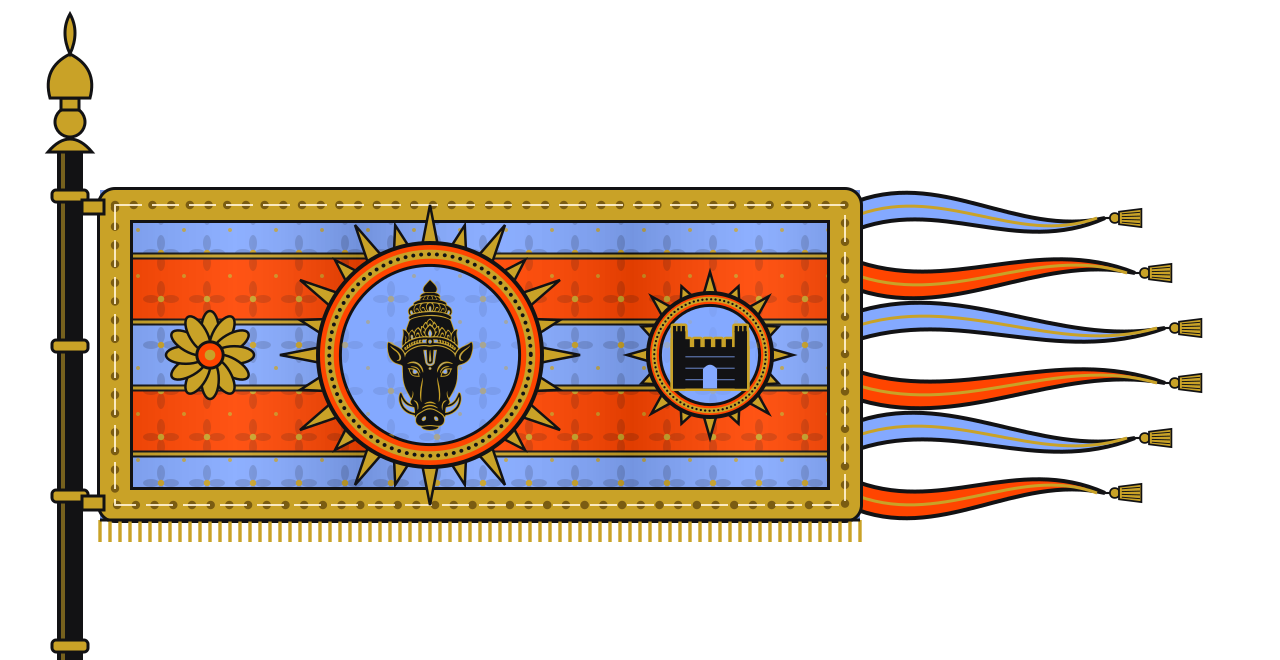
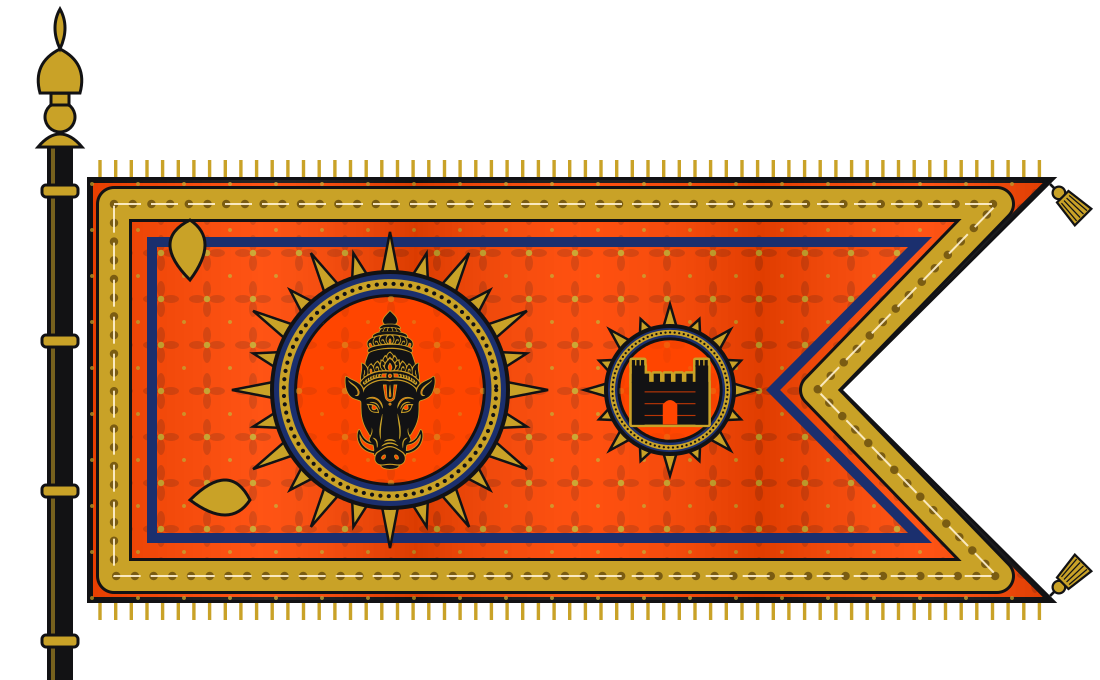
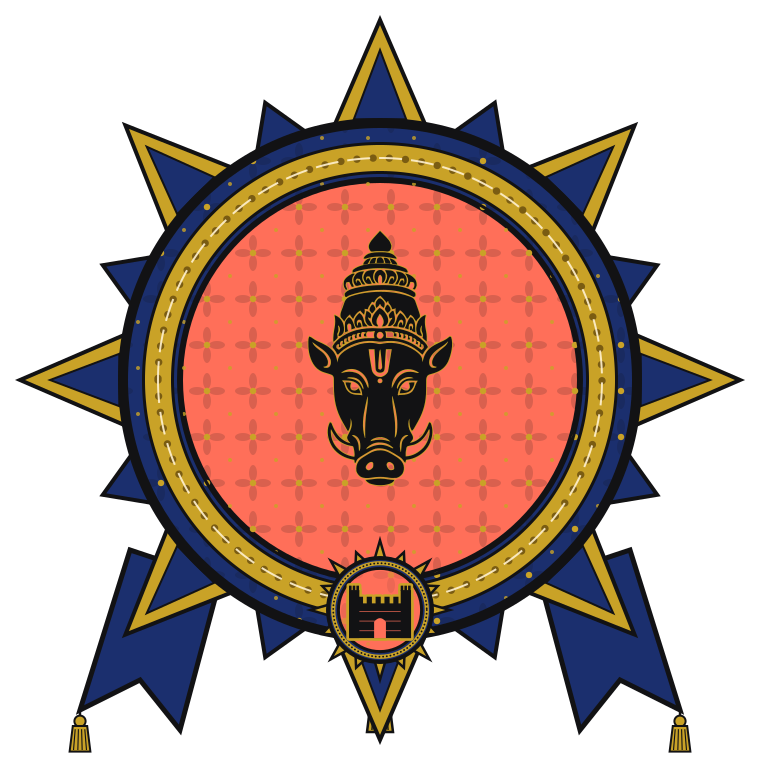
Mihira Bhoja's coins carry the boar Varaha, and the Atlas takes it as the clan's emblem with a fortress wall for the frontier the Pratiharas held[7]. The flag is a Vaijayanti, the imperial standard, for a dynasty that ruled an empire from Kannauj.
| Part of the kit | This clan |
|---|---|
| Field | Intense Electric Blue #84A9FF |
| Accent | Fiery Vermilion #FF4500 |
| Emblem colour | Charcoal Black #121214 |
| Zari metal | Gold |
| Main emblem | A boar (Varaha) standing guard |
| Second image | A fortress wall |
| Night and day | Every visual accessory has two versions: by night the emblem on the dark field, by day the clan's field colour on cloth woven from its metal. |
6. Flags
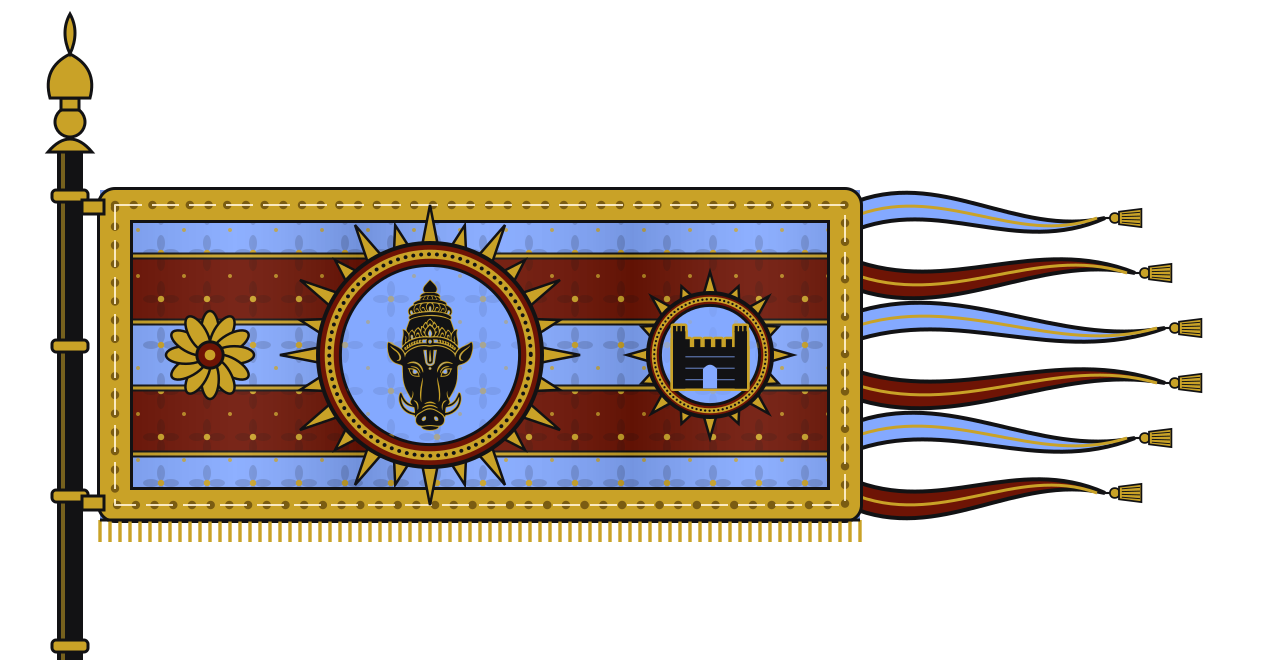
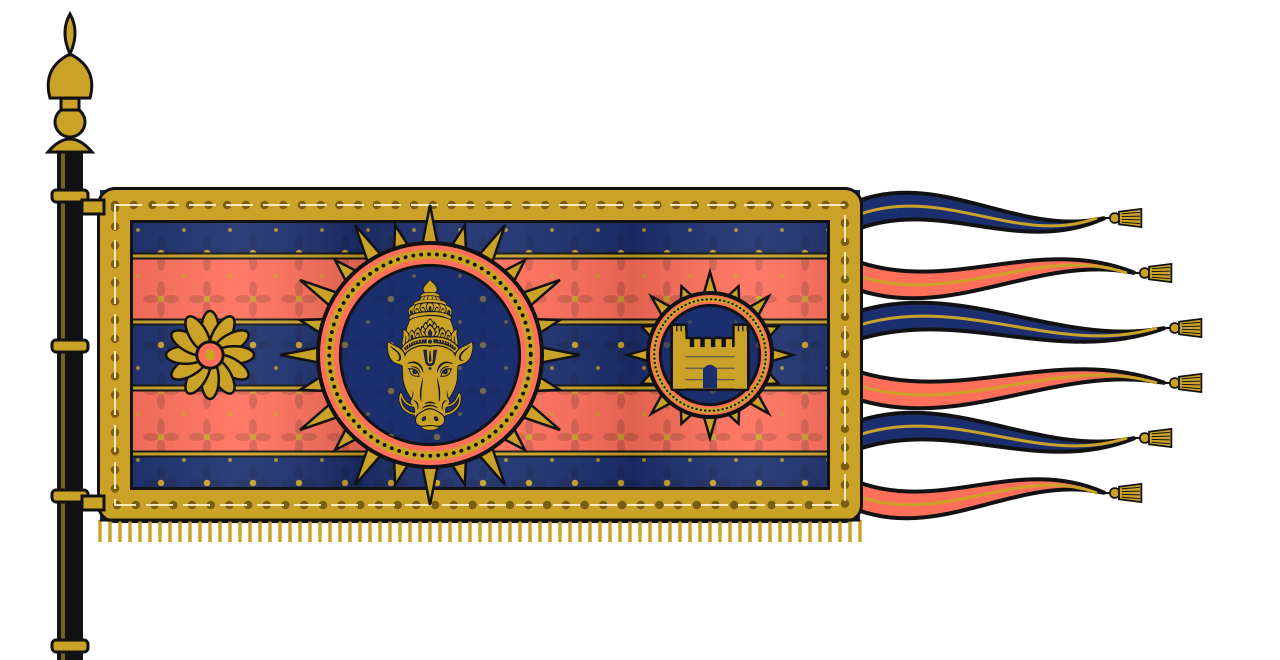
Every clan has every flag type; the type says the occasion and the colours say the clan. The outlined card is the flag the Atlas assigns.
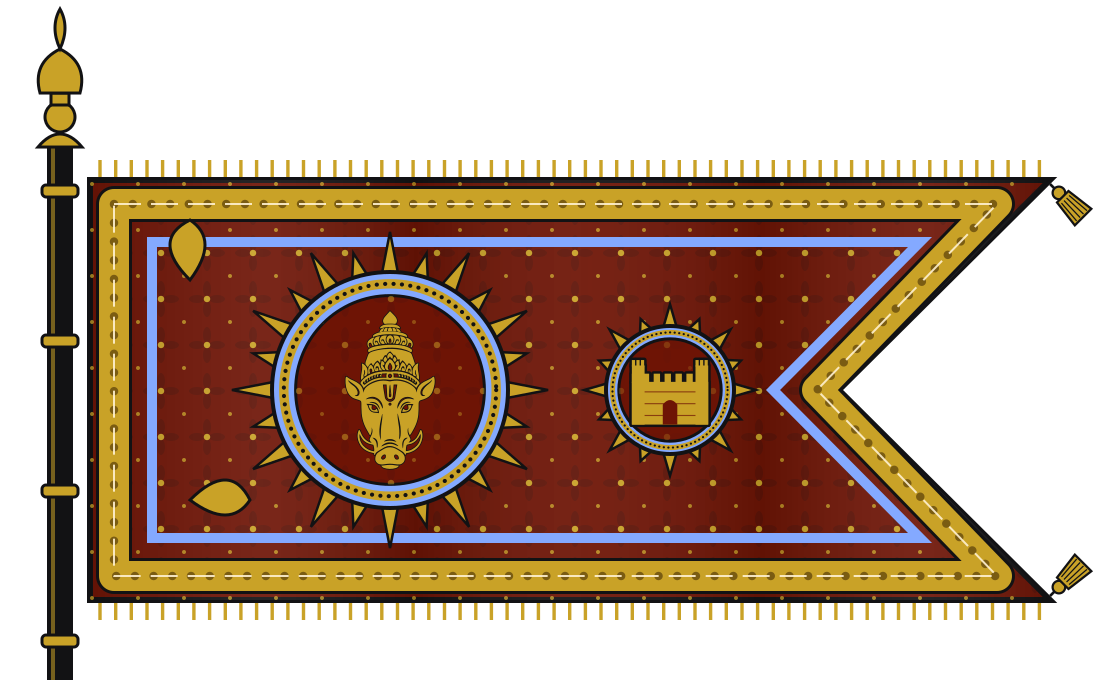
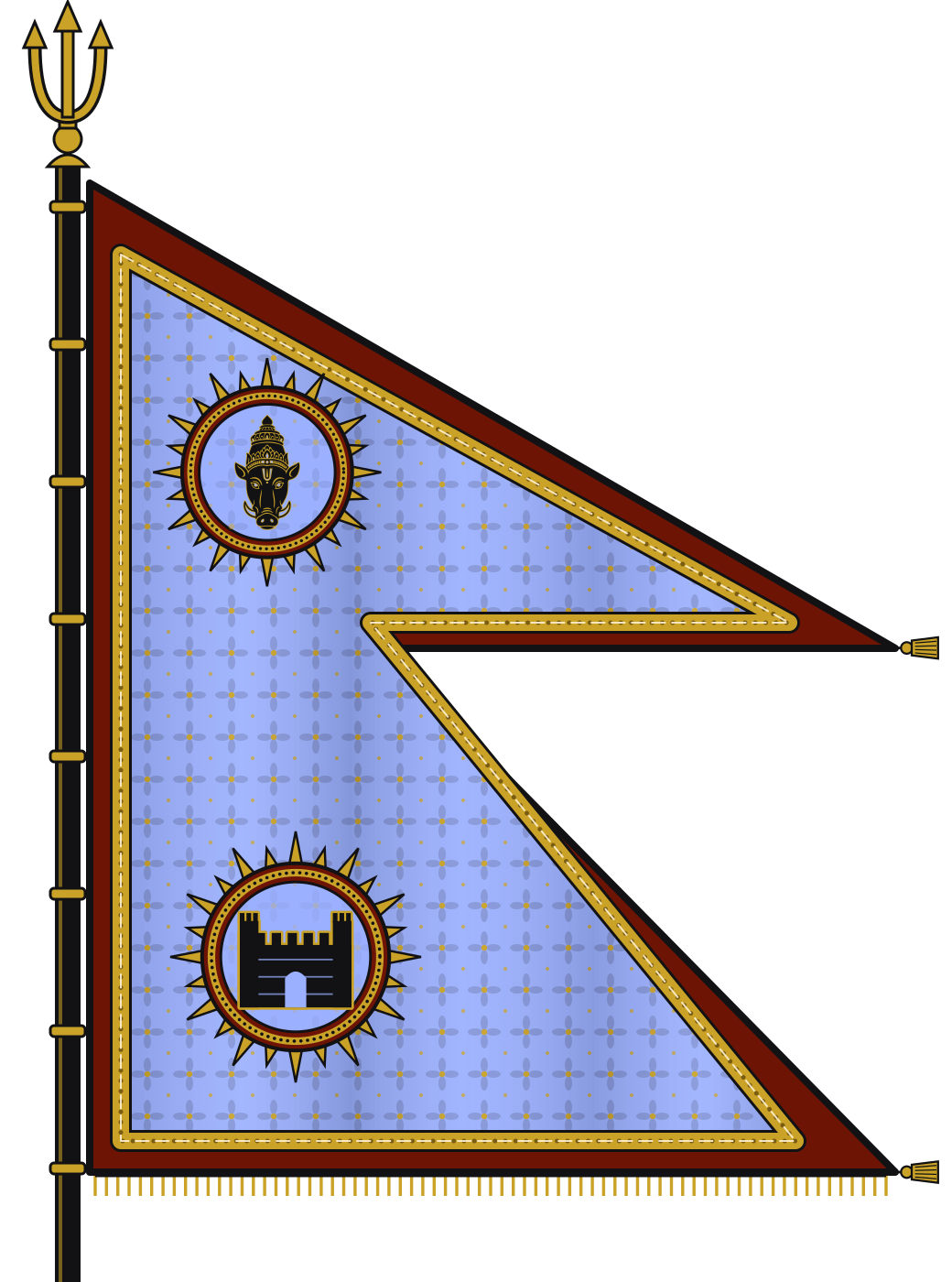
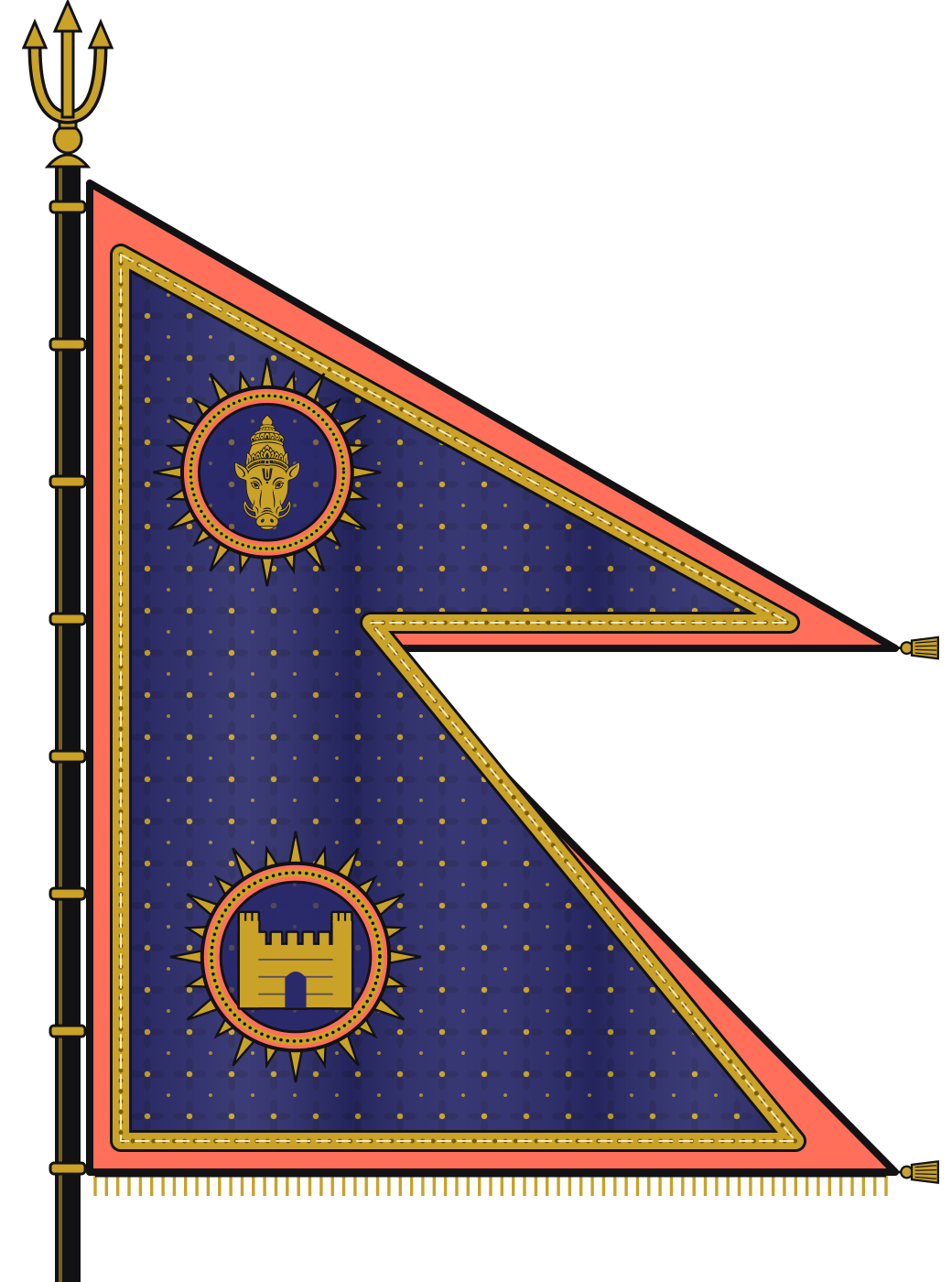
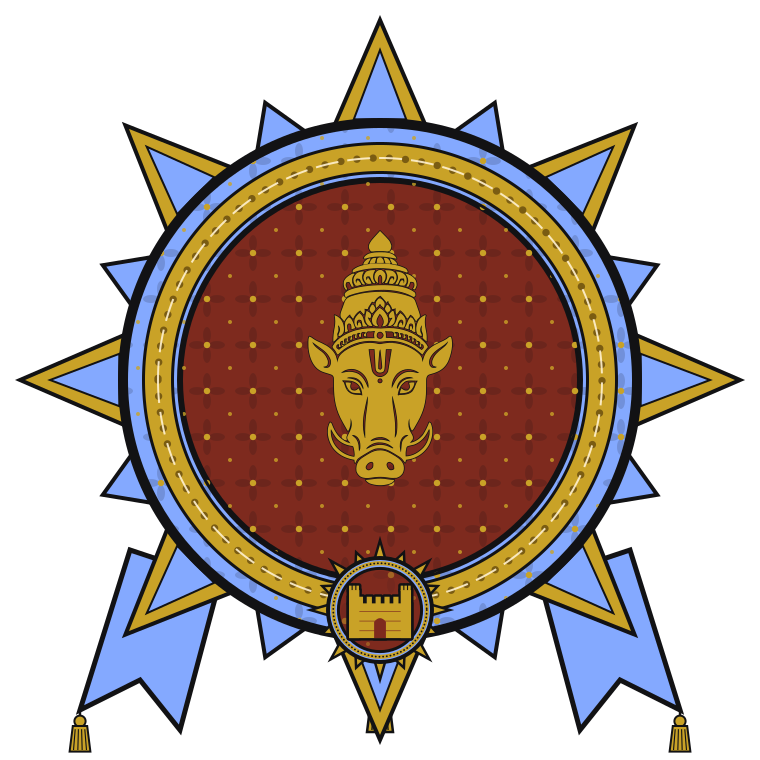
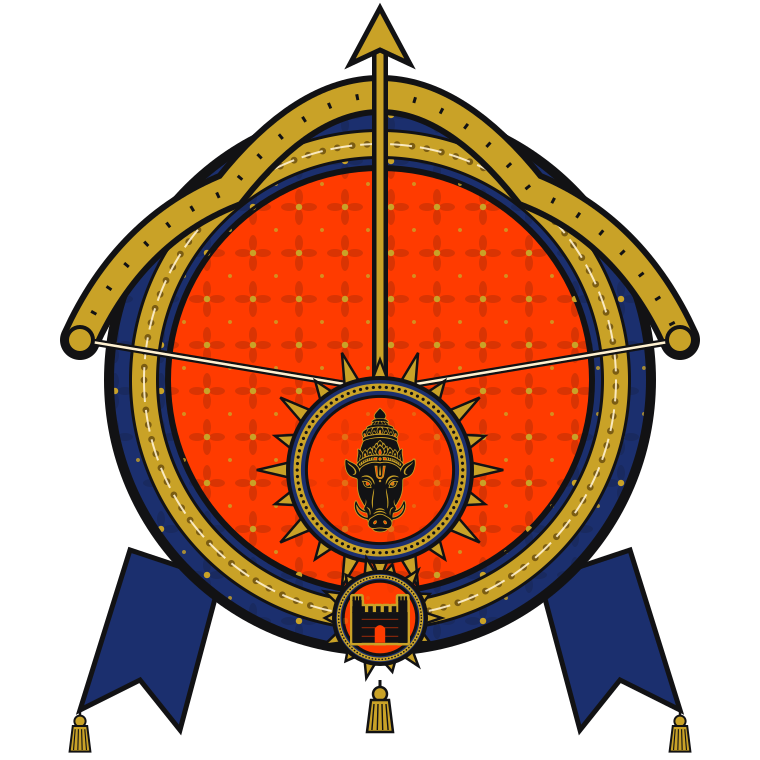
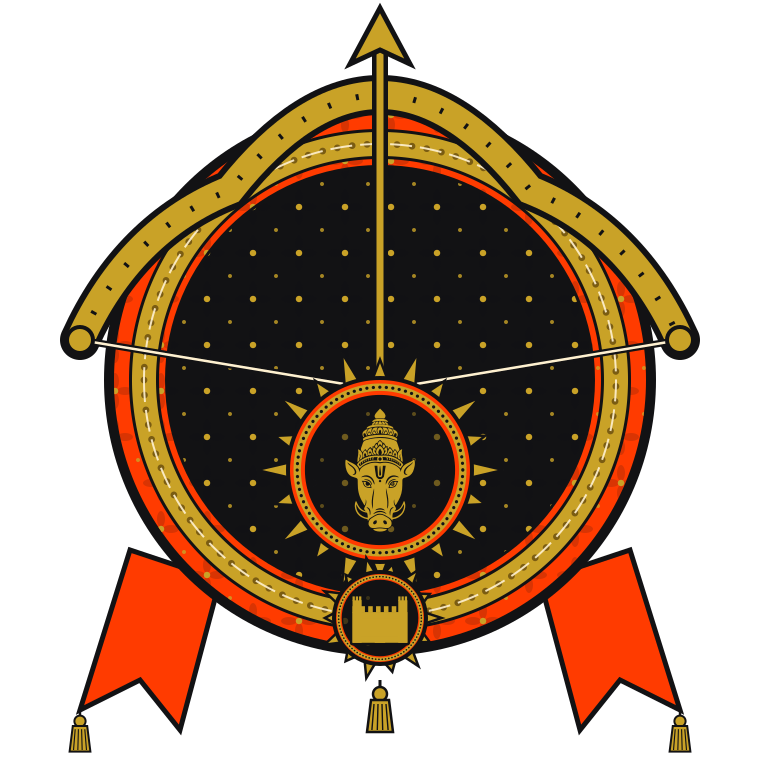
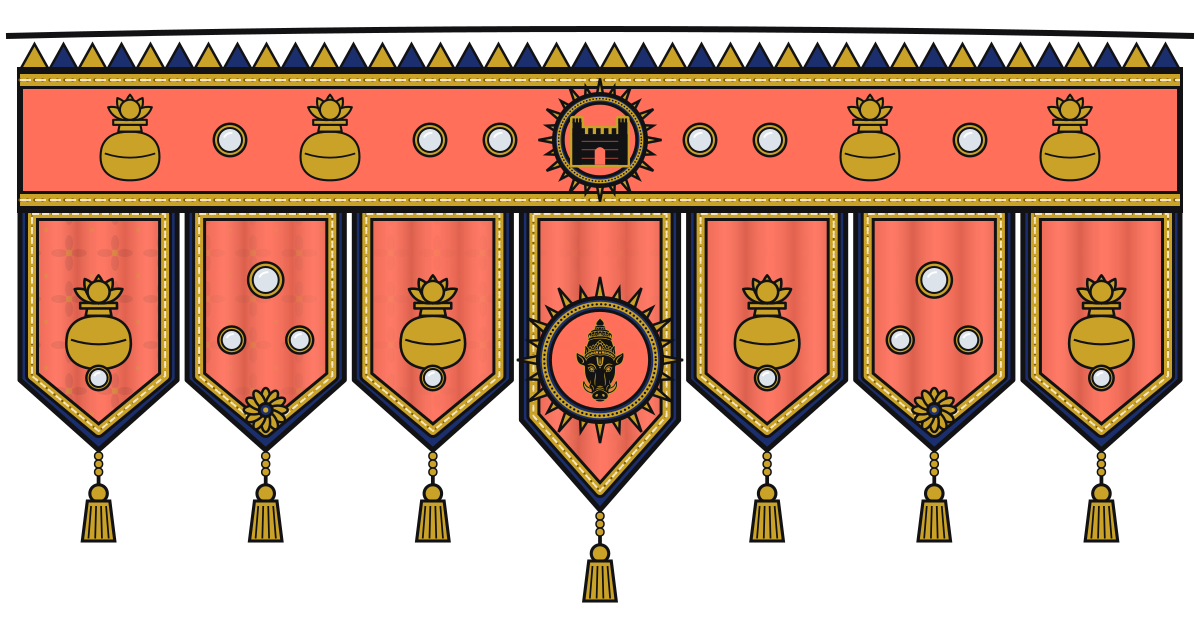
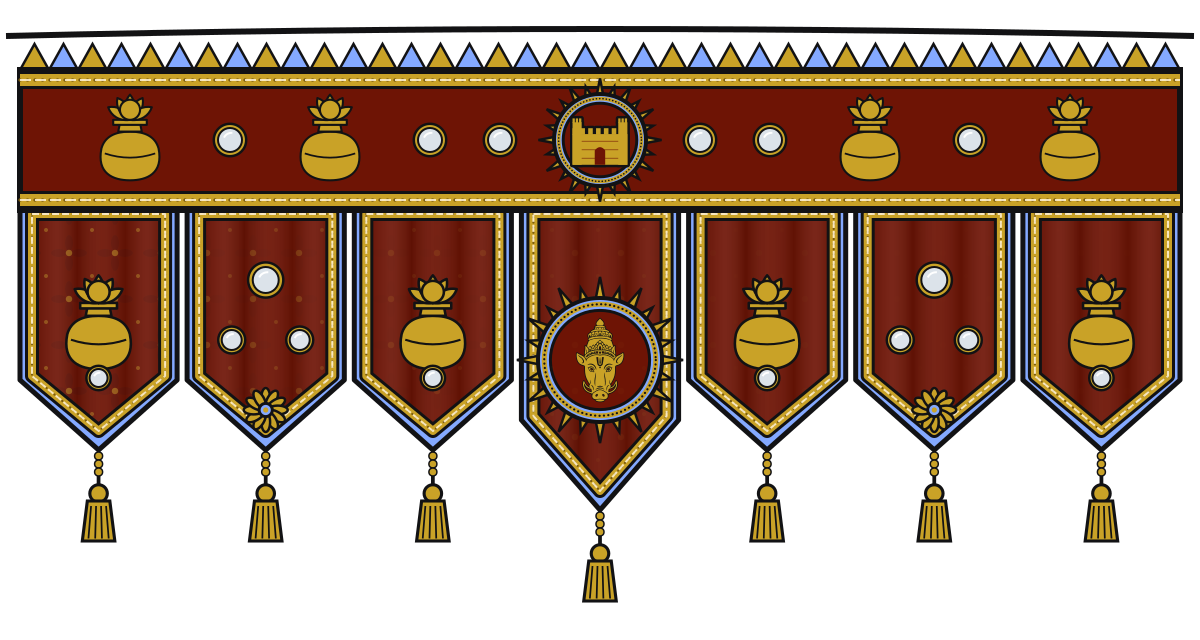
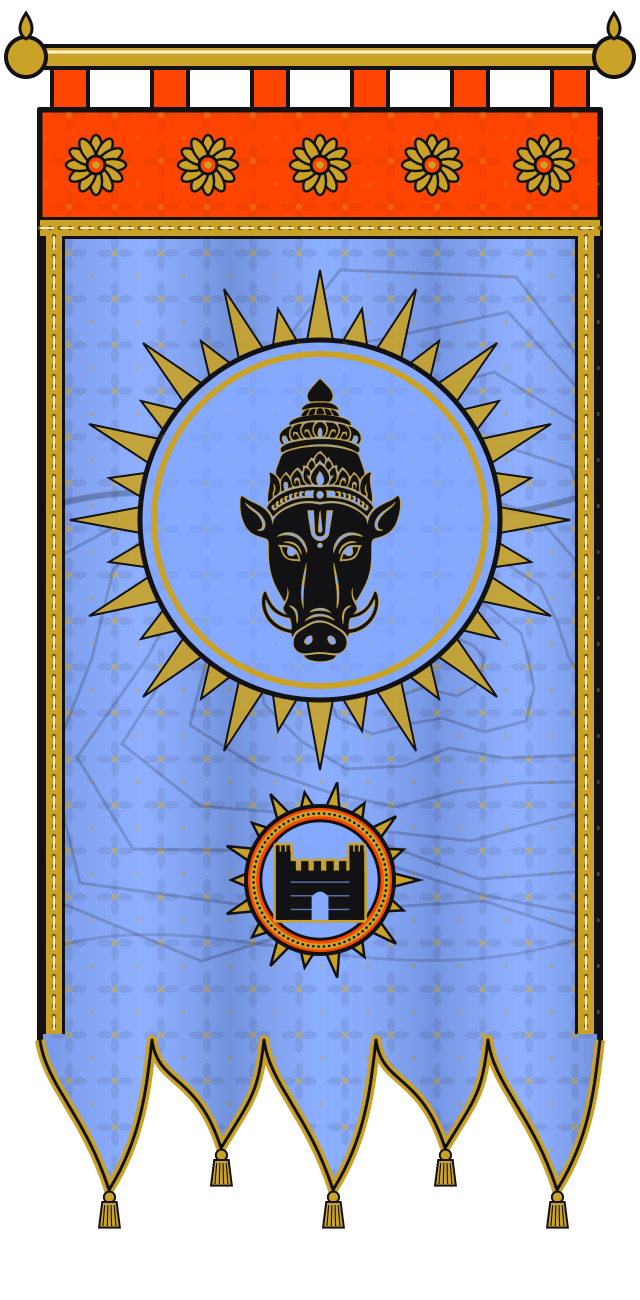
Historic banner
Gurjara-Pratihara coins show the boar avatar Varaha (emblem)
New flag types
| Accessory | For this clan | Basis |
|---|---|---|
| A9 Pota-dhvaja · ship and trade flag For ships, caravans and markets | Not yet designed for this clan | Design |
| A10 Utsava-patāka · festival flag Light, bright flag for fairs and festivals | Not yet designed for this clan | Design |
| A11 Shoka-dhvaja · mourning flag White cloth with the emblem outline in the clan's metal | Not yet designed for this clan | Design |
7. Regalia
| Accessory | For this clan | Basis |
|---|---|---|
| E1 Chhatra · house parasol The ceremonial umbrella | Not yet designed for this clan | Design |
| E2 Chamara · fly-whisks The pair of whisks beside the head of the house | Not yet designed for this clan | Design |
| E3 Danda · staff of office Staff or scepter | Not yet designed for this clan | Design |
| E4 Simhasana · seat The seat of the house, covered in clan cloth | Not yet designed for this clan | Design |
| E5 Khetaka · shield A round shield; the Changi and Dhanush are its flag forms | Not yet designed for this clan | Regional tradition |
| E6 Kula-ayudha · clan weapon The weapon the clan honours | Not yet found for this clan | Under research |
8. Worn
| Accessory | For this clan | Basis |
|---|---|---|
| F1 Kula-vastra · clan cloth The clan's woven pattern in its kit colours | Not yet designed for this clan | Design |
| F2 Kirti-vastra · honour cloth A cloth earned for a deed, not inherited | Not yet designed for this clan | Design |
| F3 Kula-mala · garland flower The flower or leaf the clan wears as a garland | Not yet found for this clan | Under research |
| F4 Chinha · house pin A metal badge with the pin emblem | Not yet designed for this clan | Design |
9. Records
| Accessory | For this clan | Basis |
|---|---|---|
| H1 Clan words A traditional line in the native script | श्रीमदादिवराह · “The glorious First Boar” Clan words · the legend on Mihira Bhoja's silver coins, naming the king after Vishnu's boar form[7] | Documented |
| H2 Biruda · titles The house's title or titles | The title Ādivarāha आदिवराह Ādivarāha · “the First Boar” | Documented |
| H3 Prashasti · praise genealogy The lineage as written at the head of a grant | Gwalior prashasti of Mihira Bhoja (9th century) Traces the Pratihara line from Lakshmana legend and praises Nagabhata I's victory over the Arabs[6] | Documented |
| H4 Vahi · clan register The book of the clan's births, marriages and deaths | Not yet found for this clan | Under research |
| H5 Rana-ghosha · war cry The clan's cry in battle or celebration | Not yet found for this clan | Under research |
10. VishwaVit · knower of the world
Game values are design choices for this project, not historical claims.
References
- Banabhatta, Harshacharita (c. 630 CE) — Harsha's father and the Gurjaras.
- Aihole inscription of Pulakeshin II (634 CE), by Ravikirti — the Latas, Malavas and Gurjaras subdued.
- Xuanzang, Records of the Western Regions (c. 646 CE) — the Gurjara kingdom (Kiu-che-lo) and its capital Pi-lo-mo-lo (Bhinmal).
- Bhinmal, Wikipedia (accessed 3 Oct 2026).
- Gurjara-Pratihara dynasty, Wikipedia (accessed 3 Oct 2026).
- Gwalior prashasti of Mihira Bhoja (9th century) — the Pratihara genealogy from Lakshmana and Nagabhata I's victory over the Arabs.
- Silver drammas of Mihira Bhoja with the boar Varaha and the legend Srimad Adivaraha (surviving coins); see also the Atlas, "Historically associated flag / emblem".
- Osian, Jodhpur, Wikipedia (accessed 3 Oct 2026).
- Gujarat (etymology), Wikipedia (accessed 3 Oct 2026).
- Gurjar, Wikipedia (accessed 3 Oct 2026).
- Gujari language, Wikipedia (accessed 3 Oct 2026).
- Kuvalaya-mala, Wikipedia (accessed 3 Oct 2026).
- Devnarayan, Wikipedia (accessed 3 Oct 2026).
- Brahmagupta, Brahmasphutasiddhanta (628 CE) — written at Bhillamala under Vyaghramukha.
- Rajashekhara (Sanskrit poet), Wikipedia (accessed 3 Oct 2026).
- Sulaiman the Merchant, Akhbar al-Sin wa'l-Hind (851 CE) — the king of the Gurjaras (Juzr) and his cavalry.
- Garima Sharma, Understanding 'Bait': Stories from the Alpine Pastures of Jammu and Kashmir, Vikalp Sangam, 15 Nov 2020.
- Denzil Ibbetson, Panjab Castes (1916; from the 1881 Punjab census report) — the Gurjar clans of the Punjab.
- Muslim Gurjars, Wikipedia (accessed 3 Oct 2026) — distribution in Pakistan and Afghanistan; Ibbetson's clan list.
- Mian Bashir Ahmed, Wikipedia (accessed 3 Oct 2026).
- Ministry of Tribal Affairs, State/UT-wise list of Scheduled Tribes (Constitution (ST) Order 1950 as amended; list dated 09-07-2024), via the Atlas entries ST-015 and ST-093.