The Guptas were the imperial dynasty that ruled much of northern India from Pataliputra, c. 240 to c. 579 CE[1][2]. Srigupta began the rise from Pataliputra c. 240 CE, and Chandragupta I took the title maharajadhiraja and began the Gupta era in 319–20 CE[2][3]. Samudragupta's Allahabad prashasti records his conquests, and Chandragupta II annexed the Shaka-Kshatrapa kingdom of Gujarat and took the title Vikramaditya[3][4][5]. Their emblem was the Garuda, and the Huns ended the dynasty's power in north India c. 550 CE[1][2].
01Faith and deities
No KulDevi has been found for this clan yet; it is on the research list.
| Deity or tradition | Place in the clan's life | Evidence |
|---|---|---|
| Vishnu | Royal patron god; Garuda and Vishnu on coins; Vishnu invoked at the Junagadh inscription | [1][7][8] |
| Garuda | The Gupta emblem and the Garudadhvaja standard | [3][6] |
| Lakshmi | On the coins of Chandragupta I and Samudragupta | [7] |
| Karttikeya | On the peacock coin of Kumaragupta I | [6] |
| Shiva, Surya, Durga, Harihara, Ardhanarishvara | Worshipped in the period; Udayagiri Shiva shrine; Mandsaur Surya temple | [5] |
| Naga, Yaksha, Ganga and Yamuna | Worshipped in the period; Ganga on makara, Yamuna on tortoise | [5] |
| Buddhism and Jainism | The Gupta kings were tolerant; monasteries received gifts | [2] |
02Temples
The Dashavatara Temple at Deogarh is early 6th century and the earliest fully structural north Indian temple with a shikhara, but Smarthistory does not name its patron, so it is not listed as Gupta-built[9].
Built by the clan
| Temple | Deity | Built by | When | Where |
|---|---|---|---|---|
| Two temples at Junagadh (Girnar) | Vishnu is invoked at the start of the inscription; the deity of the two temples is not named | Chakrapalita, under Skandagupta | Embankment burst, Gupta year 136 (455–456 CE) | Junagadh[8] |
| Bhitargaon temple | Not named in the sources read | Under research | c. 480–500 (timeline) | Bhitargaon[2] |
| Nalanda (monastery) | Buddhist monastery | Attributed to Kumaragupta I (Shakraditya) | Kumaragupta I's reign (415–455) | Nalanda[5][10] |
| Udayagiri Shiva shrine | Shiva | Donated by Virasena | Udayagiri caves: earliest inscribed date 401 CE | Udayagiri, Vidisha[5][2] |
Given patronage or grants by the clan
| Temple | Deity | What the clan gave | When | Where |
|---|---|---|---|---|
| Monastery at Bodh Gaya | Buddhist | Samudragupta's permission for the Ceylon monastery | Samudragupta's reign | Bodh Gaya[2][3] |
| Surya temple, Mandsaur | Surya | Built by the silk-weavers' guild; the royal gift is not named | Gupta period | Mandsaur[5] |
Later temples in the clan's lands
| Temple | Deity | Built | Where | |
|---|---|---|---|---|
| Vishnu temple, Aphsad (Later Guptas, ANC-178) | Vishnu | Later Guptas of Magadha | 7th century | Aphsad[11] |
03Languages and scripts
| Language or script | Kind | Under the clan | Evidence |
|---|---|---|---|
| Sanskrit | Court language, inscriptions and books | Chaste Sanskrit in the Allahabad prashasti; the court literature of Kalidasa | [3][2] |
| Prakrit | Court language, with Sanskrit | Atlas: Sanskrit and Prakrit at court | Atlas |
| Gupta Brahmi | Script of the Allahabad prashasti | Gupta (eastern northern) Brahmi script | [3] |
04Books and literature
The works are listed by title and author. The Gupta link is the period or the court; a commission is named only where the source says so. The Samkhya Karika's Gupta date is Larson's, and the link is a dating, not a stated patronage.
Written in the clan's lands during its era
| Work | Author | Kind | When | Link to the clan |
|---|---|---|---|---|
| Abhijnanasakuntalam | Kalidasa | Drama | Court of Chandragupta II (NWE) | [2][4] |
| Malavikagnimitram | Kalidasa | Drama | Gupta period | [2] |
| Raghuvansha | Kalidasa | Epic poem | Gupta period | [2][4] |
| Kumarasambhava | Kalidasa | Epic poem | Gupta period | [2] |
| Mricchakatika | Sudraka | Drama | Gupta period | [2] |
| Mudrarakshasa | Vishakhadatta | Drama | Gupta period | [2] |
| Panchatantra | Vishnusharma | Fables | Gupta period | [2][5] |
| Brihatsamhita | Varahamihira | Astronomy | Gupta period; patron disputed | [12][2] |
| Aryabhatiya | Aryabhata | Astronomy | Gupta period | [5][2] |
| Amarakosha | Amarasimha | Lexicon | Gupta period | [5] |
| Sāṃkhya Kārikā | Ishvarakrishna | Philosophy | Gupta period, 320–540 CE (Larson's dating) | [13] |
| Devi Chandra Guptam | Not named in the sources read | Play | Gupta period (the Ramagupta story) | [2][5] |
Given patronage by the clan
Not recorded.
05Thinkers and scholars
| Name | Field | Era | Contribution |
|---|---|---|---|
| Kalidasa | Poet | Court of Chandragupta II | Abhijnanasakuntalam, Raghuvansha and others[2][4] |
| Varahamihira | Astronomy | Gupta period | Brihatsamhita; at court, per NWE; Bakker says his patron was a Gupta-installed governor at Ujjayini[12][4] |
| Aryabhata | Astronomy | Gupta period | Aryabhatiya; the Surya Siddhanta is placed under him by World History[2][5] |
| Harisena | Poet and officer | Samudragupta's reign | Author of the Allahabad prashasti[3] |
| Vishakhadatta | Playwright | Gupta period | Mudrarakshasa[2] |
| Sudraka | Playwright | Gupta period | Mricchakatika[2] |
| Vishnusharma | Fables | Gupta period | Panchatantra[2] |
| Amarasimha | Lexicon | Gupta period | Amarakosha[5] |
Varahamihira's patron is disputed. The Varahamihira page gives Shastri's view (Dravya-vardhana of Avanti), Balogh's (Drapa-vardhana, no royal patron) and Bakker's (a Gupta-installed governor at Ujjayini)[12]. The nine gems list is given by the Rajras page[5].
06Art and architecture
What survives is mostly stone and coins. The painting and sculpture named here are from the sources, and no textile or clothing from the period is named.
Painting and wall art
| Art form | What it is | Era | Evidence |
|---|---|---|---|
| Ajanta caves 16 and 17 | Dying princess (cave 16); a painted hall, चित्रशाला (cave 17) | [5] |
Sculpture and temple art
| Art form | What it is | Era | Evidence |
|---|---|---|---|
| Sultanganj copper Buddha | Now in Birmingham | [5] |
Temple and building architecture
| Art form | What it is | Era | Evidence |
|---|---|---|---|
| Dashavatara Temple, Deogarh | Early 6th century; the earliest fully structural north Indian temple with a shikhara; patron not named | [9] | |
| Bhitargaon temple | c. 480–500 (timeline) | [2] | |
| Udayagiri cave shrines | Earliest inscribed date 401 CE; the Virasena Shiva shrine | [2][5] | |
| Mehrauli iron pillar | c. 402 CE; a Vishnu flagstaff in memory of Chandra | [2][4] | |
| Surya temple, Mandsaur | Built by the silk-weavers' guild | [5] | |
| Bagh caves | Named in the art section of the Rajras page | [5] |
Weaving and textiles
Not recorded.
Clothing and jewellery
Not recorded.
Coins, pottery and crafts
| Art form | What it is | Era | Evidence |
|---|---|---|---|
| Gold coinage | Dinara of gold, c. 7.8 g, c. 94 per cent gold, modelled on the Roman aureus; the coin types are in Astitva | [7] |
07History
Origins and rise (c. 240–319 CE)
Srigupta began the rise c. 240 CE from Pataliputra, then likely Magadha and part of Bengal[2]. The Poona copper plate gives him the title आदिराज (ādirāja), and his son Ghatotkacha is given महाराज (c. 280–319)[5]. The origin of the family is debated: eastern Uttar Pradesh, Magadha or Bengal[1].
Early rulers may have been feudatories of the Kushanas[5]. The Kushan link is one view and is not confirmed by the sources read.
The Gupta era begins (319–320 CE)
Chandragupta I (c. 320–335) married the Licchavi princess Kumaradevi, and the empire reached Allahabad[2]. The Gupta era began in 319–20 CE with Chandragupta I, the first to issue coins and to take the title maharajadhiraja[3]. The Rajras page gives his reign as 319–335 or 350, with the same title महाराजाधिराज[5].
Samudragupta's conquests (c. 335–375 CE)
The Allahabad prashasti, a Sanskrit panegyric of nine verses and prose by Harisena, praises Samudragupta's digvijaya in the north and dharma-vijaya in the south[3]. It names a first war against Naga kings (Achyuta, Nagasena, Ganapatinaga) and a second against nine rulers, and lists tribes subdued, among them the Malavas, Yaudheyas and Madrakas[3].
In the south the prashasti says twelve rulers of Dakshinapatha were reinstated, among them Mahendra of Kosala, Vishnugopa of Kanchi and Hastivarman of Vengi[3]. The page warns that the praise is hyperbole. Sources give different dates for his reign, from c. 335–375 to 344–378[2][7].
The Allahabad pillar was first set up by Ashoka at Kausambi, and the Samudragupta inscription was cut on it later[3].
Chandragupta II and the western conquest (c. 375–415 CE)
Chandragupta II (375–415 CE on the NWE dates; c. 380–414 on the World History dates) annexed the Gujarat kingdom of the Shaka-Kshatrapas, defeating the last ruler Rudrasimha III[4]. He is given the title विक्रमादित्य[5].
The sources disagree on the capital. The NWE page says Ujjain was relegated to a second capital with Pataliputra as the main capital[4]. The Rajras page says he moved the capital to Ujjain[5]. The World History page says Ujjain became the second capital[2].
His daughter Prabhavati married the Vakataka king Rudrasena II (d. c. 390), and she ruled as regent for her sons[4]. The Allahabad pillar records his marriage to the Naga princess Kuberanaga[4].
The succession story of Devi Chandraguptam is told in the World History and Rajras pages: Ramagupta gave up his queen Dhruvadevi to a Scythian king of Mathura, and Chandragupta II rescued her and killed the king[2][5]. The Rajras page dates Ramagupta's reign to 375–380 CE. Treat the story as legend: legend.
Kumaragupta I (415–455 CE)
Kumaragupta I took the titles महेन्द्रादित्य and शक्रादित्य and performed two Ashvamedhas[5]. His reign produced the peacock and elephant-rider coin types of the Gupta mints[6].
Skandagupta and the Huns (455–467 CE)
The Junagadh (Girnar) rock inscription records that Chakrapalita, under Skandagupta, repaired the Sudarshana lake embankment and built two temples. The embankment burst in Gupta year 136, equated with 455–456 CE[8].
Skandagupta appointed Parnadatta governor of Surashtra, and Parnadatta's son Chakrapalita governed the city[8]. The World History page says Skandagupta repelled the Huns[2], and the Rajras page says he defeated the Huns and the Pushyamitras[5]. The Junagadh page suggests the Huns are the enemies pushed back to the Mlechchha country[8].
Decline (c. 467–550 CE)
Later kings included Purugupta, Kumaragupta II, Buddhagupta, Narasimhagupta Baladitya, Bhanugupta, Vainyagupta, Kumaragupta III and Vishnugupta[5]. Baladitya freed the Hephthalite Mihirakula after he was captured[2].
The Rajras page gives the causes of decline as the Huns, provincial governors, and the split of Magadha, Malwa and Bengal[5]. The Huns ended the empire in north India c. 550, and the last ruler was Vishnugupta Chandraditya[2]. The Later Guptas of Magadha were a separate regional line from c. 490 to c. 750[11].
08Journey and migrations
The Guptas moved from Pataliputra outward into Allahabad, the south and the west. The dates of several moves differ between sources.
| When | From | To | Why | Evidence |
|---|---|---|---|---|
| c. 240 CE | Pataliputra | Magadha and part of Bengal (likely) | Srigupta's rise[2] | [1] |
| c. 320 CE | Pataliputra | Allahabad | Chandragupta I's marriage to Kumaradevi; the empire reached Allahabad[2] | [2] |
| c. 335–375 CE | Pataliputra | Himalayas to Narmada (the prashasti's extent) | Samudragupta's digvijaya and dharma-vijaya[3] | [3] |
| c. 380–415 CE | Pataliputra | Ujjain (second capital, per NWE; sources differ) | Chandragupta II's western wars; the sources differ on Ujjain's status[4][5] | [4] |
| 455 CE | Gupta domains | Surashtra (Junagadh) | Skandagupta's governor Parnadatta appointed[8] | [8] |
| After 455 CE | Pataliputra | Ayodhya | Capital moved to Ayodhya after 455[1] | [1] |
09Seats and lands
| Place | Role | Where today |
|---|---|---|
| Pataliputra (Kusumapura, Pushpapura) | Main capital; the Allahabad prashasti equates Pushpapura with Kusumapura, i.e. Pataliputra | Patna (Magadha page) |
| Ayodhya | Later capital, after 455 CE | Ayodhya |
| Ujjain | Second capital under Chandragupta II (sources differ) | Ujjain (Ujjayini) |
| Mathura | Named by World History among Gupta lands; the Scythian king in the Ramagupta story ruled here | Mathura |
| Allahabad (Prayaga) | Pillar with the Samudragupta prashasti, reached by the empire under Chandragupta I | Allahabad (Prayaga) |
| Junagadh (Girnar, Raivataka) | Surashtra (Girnar); Sudarshana lake repaired under Skandagupta | Surashtra (Kathiawad, per the inscription) |
| Nalanda | Monastery attributed to Kumaragupta I | Nalanda |
| Tamralipta and Sopara | Ports of the sea trade (World History) | Named as ports |
| Bhitargaon, Udayagiri (Vidisha), Mandsaur, Deogarh | Temple and cave sites of the period | Bhitargaon; Udayagiri (Vidisha); Mandsaur; Deogarh (Uttar Pradesh, per Smarthistory) |
| Frontier kingdoms: Samatata, Davaka, Kamarupa, Nepala, Kartaripura | Named as frontier in the Allahabad prashasti | Named in the prashasti |
10Notable figures
| Name | Role | Era | Known from |
|---|---|---|---|
| Srigupta | Founder; आदिराज on the Poona copper plate | c. 240–280 CE | [5][2] |
| Ghatotkacha | Ruler, महाराज | c. 280–319 CE | [5] |
| Chandragupta I | First to take maharajadhiraja and issue coins | c. 320–335 CE | [3][2] |
| Kumaradevi | Licchavi princess; wife of Chandragupta I and mother of Samudragupta | Chandragupta I's reign (c. 320–335 CE) | [2][3] |
| Samudragupta | Conqueror, poet, and veena player on his Lyrist coin | c. 335–375 CE | [3][7] |
| Harisena | Author of the Allahabad prashasti; sandhivigrahika and kumaramatya | Samudragupta's reign | [3] |
| Chandragupta II (Vikramaditya) विक्रमादित्य | Conqueror of the Shaka-Kshatrapas; court of the nine gems | 375–415 CE (NWE); c. 380–414 (WH) | [4][5] |
| Ramagupta legend | Ruler in the succession story; gave his queen to the Scythian king of Mathura | 375–380 CE (Rajras) | [2][5] |
| Dhruvadevi | Queen in the succession story; mother of Kumaragupta I | Not dated in the extracts | [2][5] |
| Prabhavati Gupta | Daughter of Chandragupta II; married Vakataka Rudrasena II; regent for her sons | Before c. 390 CE | [4][5] |
| Kumaragupta I (Mahendraditya) महेन्द्रादित्य | Ruler; two Ashvamedhas; Nalanda attributed to him | 415–455 CE | [5] |
| Virasena | Son of Harisena; donated the Udayagiri Shiva shrine | Not dated in the extracts | [5] |
| Skandagupta | Ruler; repelled the Huns; repaired the Sudarshana lake | 455–467 CE | [2][8] |
| Parnadatta | Governor of Surashtra appointed by Skandagupta | Skandagupta's reign | [8] |
| Chakrapalita | Son of Parnadatta; the lake and temple works; the embankment burst in Gupta year 136 | Embankment burst, 455–456 CE | [8] |
| Baladitya (Narasimhagupta) | Freed the captured Hephthalite Mihirakula | After Kumaragupta I | [2][5] |
| Vishnugupta Chandraditya | Last ruler, c. 550 CE | c. 550 CE | [2] |
| Fa-Hien | Chinese pilgrim who visited India in Chandragupta II's reign | c. 399–414 (Rajras) | [4][5] |
11Allies, rivals and marriages
| People | Relationship | When |
|---|---|---|
| Licchavis | Marriage of Chandragupta I to Kumaradevi; Samudragupta is called 'Lichchhavi-dauhitra' | c. 320 CE |
| Vakatakas | Prabhavati Gupta married Rudrasena II; she ruled as regent | Before c. 390 CE |
| Nagas | First war of Samudragupta against Naga kings; Chandragupta II married the Naga princess Kuberanaga | Samudragupta's reign |
| Shakas (Shaka-Kshatrapas) | Annexed by Chandragupta II; the Ramagupta story legend has Ramagupta give his queen to a Shaka king | 375–415 CE |
| Huns (Hunas) | Repelled by Skandagupta; ended the empire in north India c. 550 | 455–550 CE |
| Later Guptas | Regional line of Magadha and Malwa; the link to the imperial Guptas is disputed | c. 490–750 CE |
| Maukharis | Rivals of the Later Guptas | Not dated in the extracts |
| Harsha | Restored the Later Guptas as vassals | Not dated in the extracts |
| Simhalas (Ceylon) | Meghavarna of Ceylon built a monastery at Bodh Gaya with Samudragupta's permission | Samudragupta's reign |
| Kushanas | Early Gupta rulers may have been feudatories of the Kushanas | 4th century (the rise in Magadha) |
| Pushyamitras | Defeated by Skandagupta | 455–467 CE |
| Pallavas and Salankayanas | Visnugopa of Kanchi and Hastivarman of Vengi reinstated by Samudragupta | Samudragupta's reign |
| Gauda (Shashanka) | Rival of the Later Guptas | Not dated in the extracts |
12Society and livelihood
The Gupta state had provinces with administrators, a court of named officers, and guilds and corporations that had their own leaders (World History; Rajras; EPG).
Government and social order
| Institution or group | What it was | Evidence |
|---|---|---|
| Provinces (pradesha) | Provinces with administrators (World History) | [2] |
| Guilds (श्रेणी) and corporations (निगम) | Led by ज्येष्ठक and श्रेष्ठि | [5] |
| Kumaramatya and mahadandanayaka | Officers named in the Allahabad prashasti | [3] |
| Law and punishment | No capital punishment, and mild criminal law, in the Fa-Hien account | [2][4] |
| Social practices recorded | Untouchability (Fa-Hien's Chandala), child marriage, sati (earliest record Eran, 510 CE), slavery lists | [5] |
Livelihood over time
| Era | Livelihood | Evidence |
|---|---|---|
| Gupta era | Gold dinara and silver drachm coinage; gold of about 94 per cent fineness (CoinWeek) | [7] |
| Gupta era | Sea trade in silk, cotton, spices, gems, pearl and steel; ports Tamralipta and Sopara | [2] |
| Gupta era | Irrigation by rahat and ghatiyantra; the Sudarshana lake repaired under Skandagupta | [5][8] |
| Gupta era | Silk-weavers' guild at Mandsaur | [5] |
13Sub-clans and related clans
The extracts name these sub-clans, branches and related peoples. Each is a candidate for its own entry unless its ID is given. The Gupta name is a dynastic name and the sources do not describe sub-clans of the dynasty itself.
| Clan | Relation | Where | Size | In the Atlas | Evidence |
|---|---|---|---|---|---|
| Later Guptas | Dynasty from this clan | Magadha, Malwa; Bihar | ANC-178 | [11] | |
| Vakatakas | Related people | Marriage link through Prabhavati Gupta | same name as ANC-231: check | [4][5] | |
| Licchavis | Related people | Vaishali; the marriage link to Chandragupta I | ANC-072 | [2][3] | |
| Nagas | Related people | Naga kings of the first war; Kuberanaga | ANC-088 | [3][4] | |
| Shakas | Related people | Shaka-Kshatrapas of Gujarat; Scythians of Mathura | ANC-119 | [4][2] | |
| Hunas | Related people | Huns and Hephthalites | ANC-040 | [2][8] | |
| Pushyamitras | Related people | Named in the Rajras page with the Huns | same name as ANC-281: check | [5] | |
| Malavas | Related people | Tribe subdued by Samudragupta | ANC-078 | [3] | |
| Arjunayanas | Related people | Tribe subdued by Samudragupta | ANC-011 | [3] | |
| Yaudheyas | Related people | Tribe subdued by Samudragupta | ANC-153 | [3] | |
| Madrakas | Related people | Tribe subdued by Samudragupta | ANC-074 | [3] | |
| Abhiras | Related people | Tribe subdued by Samudragupta | ANC-001 | [3] | |
| Prarjunas | Related people | Tribe subdued by Samudragupta | ANC-104 | [3] | |
| Sanakanikas | Related people | Tribe subdued by Samudragupta | ANC-113 | [3] | |
| Kakas | Related people | Tribe subdued by Samudragupta | ANC-042 | [3] | |
| Kharaparikas | Related people | Tribe subdued by Samudragupta | ANC-052 | [3] | |
| Dakshina Kosalas | Related people | Dakshinapatha; Mahendra of Kosala reinstated | ANC-030 | [3] | |
| Pallavas | Related people | Kanchi; Visnugopa reinstated | same name as ANC-218: check | [3] | |
| Salankayanas | Related people | Vengi; Hastivarman reinstated | same name as ANC-226: check | [3] | |
| Simhalas | Related people | Ceylon (island dwellers) | ANC-125 | [3][2] | |
| Kushanas | Related people | Early rulers possibly feudatories | ANC-070 | [5] | |
| Avantis | Related people | Ujjain (Ujjayini), second capital under Chandragupta II | ANC-016 | [4][12] | |
| Saurashtras | Related people | Surashtra (Junagadh) | ANC-116 | [8] | |
| Magadhas | Related people | Pataliputra and Magadha | ANC-075 | [10][1] | |
| Maukharis | Related people | Gaya, then Kannauj; rivals of the Later Guptas | ANC-158 | [11][10] | |
| Chalukyas | Related people | Rivals of the Later Guptas | same name as ANC-190: check | [11] | |
| Kamarupa | Related people | Frontier kingdom in the Allahabad prashasti | same name as ANC-210: check | [3] | |
| Ikshvaku race | Related people | Named by R.C. Majumdar as the race of Aisvaryapala | same name as ANC-244: check | [3] | |
| Muttans | Related people | Malabar trading caste | new clan candidate | [14] | |
| Tamil Pallis | Related people | Named by Thurston (1909) | new clan candidate | [14] | |
| Rauniyar | Related people | Vaishya Bania community; adopted the surname Gupta | new clan candidate | [15] | |
| Agarwal | Related people | Vaishya Bania community; adopted the surname Gupta | same name as SUB-174: check | [15] | |
| Mahur | Related people | Vaishya Bania community; adopted the surname Gupta | new clan candidate | [15] | |
| Barnwal | Related people | Vaishya Bania community; adopted the surname Gupta | same name as SUB-176: check | [15] | |
| Khandelwal | Related people | Vaishya Bania community; adopted the surname Gupta | new clan candidate | [15] | |
| Arora | Related people | Vaishya Bania community; adopted the surname Gupta | same name as SUB-143: check | [15] | |
| Jaiswal | Related people | Vaishya Bania community; adopted the surname Gupta | same name as SUB-198: check | [15] | |
| Arya Vaishya | Related people | Vaishya Bania community; adopted the surname Gupta | same name as SUB-175: check | [15] | |
| Mahajan | Related people | Vaishya Bania community; adopted the surname Gupta | SUB-131 | [15] | |
| Mahawar | Related people | Vaishya Bania community; adopted the surname Gupta | same name as SUB-200: check | [15] | |
| Maheshwari | Related people | Vaishya Bania community; adopted the surname Gupta | new clan candidate | [15] | |
| Patwa | Related people | Vaishya Bania community; adopted the surname Gupta | new clan candidate | [15] | |
| Kasuadhan | Related people | Vaishya Bania community; adopted the surname Gupta | same name as SUB-202: check | [15] | |
| Lashkari | Related people | Vaishya Bania community; adopted the surname Gupta | same name as SUB-199: check | [15] | |
| Mathur Vaishya | Related people | Vaishya Bania community; adopted the surname Gupta | new clan candidate | [15] |
Clans marked "new clan candidate" are not in the Atlas yet.
14Surnames
The surname Gupta (गुप्त) is common in India. The 2016 Wikipedia mirror gives variants Dasgupta, Das Gupta, Sen-Gupta and Gupt, and says the surname is used mainly by Vaishya Bania communities, which adopted it at different times (R.C. Majumdar). Thurston records Gupta as a Vaisya title assumed by some Muttans of Malabar and Tamil Pallis (1909). The origin of the dynasty is debated: Jaiswal (Shudra or Jat), Raychaudhuri and Dasharatha Sharma (Brahmin), R.C. Majumdar and Ojha (Vaishya); the Poona plate's Dharana gotra is cited for a Brahmin origin[5].
| Surname | Clan or sub-clan | Where | People with this surname | Also used by other communities |
|---|---|---|---|---|
| Gupta गुप्त | Vaishya Bania communities (Majumdar); Vaisya title among Muttans and Tamil Pallis (Thurston 1909) | India, widespread | not yet counted | Yes |
| Dasgupta | Variant of Gupta | not yet counted | Not checked | |
| Das Gupta | Variant of Gupta | not yet counted | Not checked | |
| Sen-Gupta | Variant of Gupta | not yet counted | Not checked | |
| Gupt गुप्त | Variant of Gupta (named as the surname of the poet Maithili Sharan Gupt) | not yet counted | Not checked |
Counts are of everyone with the surname, from the cited source and year, not only members of this clan. A surname shared with other communities says nothing about any one person's origin.
15Songs and music
No public-domain or traditional song is quoted in the sources read. The music named is the court's and the temple's.
None recorded yet.
Instruments and styles
| Instrument or style | What it is | Evidence |
|---|---|---|
| Veena | Samudragupta is shown as a veena player on his Lyrist coin; the prashasti says he was skilled in music | [3][7] |
| Flute and mridangam | Music of the temple | [2] |
16Poems, lullabies and children's rhymes
No poem or rhyme of the Gupta period is quoted in the sources read beyond the court works in the books section.
None recorded yet.
17Stories, legends and proverbs
Stories and legends
| Story | What happens | Told by | Evidence |
|---|---|---|---|
| The succession story legend | Ramagupta gives up his queen Dhruvadevi to a Scythian king of Mathura; Chandragupta II rescues her and kills the king | Harshacharita and Devi Chandra Guptam, per World History | [2][5] |
| The Vikramaditya tales legend | Kalidasa's Raghu, Kshemendra's Brihat-Katha-Manjari and an Arabic chronicle are cited for the figure of Vikramaditya; the NWE page discusses how the names are tied to Chandragupta II | NWE, from its sources | [4] |
Proverbs and sayings
Not recorded.
18Festivals and fairs
| Festival or fair | When | Where | What happens |
|---|---|---|---|
| Dhanteras | Not dated in the sources read | Not stated | World History claims that it marks the birth anniversary of Dhanvantari, one of the nine gems; the claim is World History's, and no Gupta-era text is cited for it in the sources read |
19Food, dress and games
Food
| Item | What it is | Evidence |
|---|---|---|
| Vegetarianism | Preferred in the Gupta realm, per Fa-Hien (World History) | [2] |
| No onions, garlic, meat or wine | Abstention in Chandragupta II's reign, per Fa-Hien (NWE) | [4] |
Dress
Not recorded.
Games and martial arts
Not recorded.
Tags: living still practised · revived brought back after a break · lost known only from records · research reported but not yet confirmed from a source. Songs and poems under copyright are listed by title only; restricted or sacred material is noted without its content.
20Status today
The Gupta dynasty ended c. 550 CE with the Huns in north India[2]. Its name survives as a common surname, used mainly by Vaishya Bania communities[15].
Who carries the name today
| Community | Link | Basis | Evidence |
|---|---|---|---|
| Later Guptas (ANC-178) | Disputed | [11] |
Recognised heritage
| What | Recognition | Evidence |
|---|---|---|
| Nalanda | Listed as a UNESCO World Heritage Site on the Magadha page | [10] |
Not reviewed by a community. The Gupta name has no living community named in the sources read.
21For children
The Golden Age
Long ago, the Gupta kings ruled a great land from the city of Pataliputra. Their sign was Garuda, the great bird who carries Vishnu across the sky. Samudragupta was a king skilled in music, shown playing the veena on his coin. Chandragupta II was called Vikramaditya, which means brave as the sun. When the Huns attacked, King Skandagupta pushed them back. People from far away, like the traveller Fa-Hien, came to see how the Guptas lived. Their age left us stone temples, books and music.
Written for this project
Riddle: Which great bird carries Vishnu across the sky, and was the seal of the Guptas? (Garuda)
22Across the project
| Project | What carries this clan | Status |
|---|---|---|
| Atlas of the Janas | Homeland uncertain (eastern Uttar Pradesh, Magadha or Bengal); capital Pataliputra | Not pinned |
| KulDevi and GrahDevi | No KulDevi in the Atlas (basis: research); Vishnu is the main deity from the sources | Research |
| Planet naming | Not checked | Research |
| Renaming and waters | The Sudarshana lake at Junagadh was repaired under Skandagupta | From the Junagadh inscription |
23Open questions
- Native-script legends of the Gupta coins (Brahmi or Devanagari) and a native-script line for the clan words: the sources read give the legends only in Latin transliteration.
- Dates of Samudragupta, Chandragupta II and Kumaragupta I differ between the NWE, World History and Rajras pages; the page gives each.
- Dates of Srigupta and Ghatotkacha: World History gives c. 240–280 and Rajras c. 280–319 (the figures above); the EPG Pathshala module gives c. 275–300 and c. 300–319/20 for the same two rulers. Not yet reconciled.
- Whether Chandragupta II moved the capital to Ujjain or made it a second capital.
- Origin of the dynasty (Jaiswal, Raychaudhuri, Majumdar, Ojha, Dasharatha Sharma; the Poona plate's Dharana gotra); set out as disputed.
- Bhitari pillar of Skandagupta, Eran inscriptions, Mehrauli inscription text and the Indian Analyst politicalhistory pages.
- Chapters XXVII and XXXVI of Legge's Fa-Hien (Pataliputra and Magadha) are not read.
- A count and year for the surname Gupta, with a current source.
- Whether the Dashavatara Temple at Deogarh and the Bhitargaon temple were patronised by the Guptas, and by whom.
24Astitva
अस्तित्व · being, existence: everything by which the clan is known
The Gupta seal is the Garuda, and the coins give the clearest record of the dynasty's symbols and titles[3][6][7].
Every clan has every accessory, royal objects included. Each one says how it is known: Documented This clan's own object is recorded. · Regional tradition Recorded for the region or for peoples like this one, not for this clan. · Design Made for this project, with no historical claim. · Under research To be found for this clan from sources. Legends and titles are written in the clan's own script.
1. Seals and coins
| Accessory | For this clan | Basis |
|---|---|---|
| B1 Rajamudra · house seal Round seal with the clan emblem and a short legend in the clan's script | Garuda seal, the royal seal: Fleet renders lines 23–24 of the Allahabad pillar as 'Garuda badge' | Documented |
| B2 Anguliya-mudra · signet ring Personal seal ring of the head of the house | Not yet designed for this clan | Design |
| B3 Chhapa · house stamp Ink or block stamp for letters, goods and cloth | Not yet designed for this clan | Design |
| B4 Tamrapatra · charter plate Copper-plate grant on a ring, closed with the house seal | Poona copper plates: Shrigupta's title आदिराज and the epithet anek-asvamedha-jajin | Documented |
| B5 Shreni-mudra · guild or trade seal Seal for the clan's trade, craft or caravan | Not yet designed for this clan | Design |
| C1 Clan coin Emblem or deity on one side, a legend in the clan's script | Gold dinara with the Archer type; the Archer legend is 'Apratirathah' (Latin transliteration only; the coin's native-script legend is not yet sourced). The Archer with the Garuda standard is given for Chandragupta I (CoinWeek) | Documented |
| C2 Coin die The die that strikes the coin | Not yet designed for this clan | Design |
2. Living symbols
| Accessory | For this clan | Basis |
|---|---|---|
| I1 Totem trio The tree, bird and animal the clan protects | Not yet found for this clan | Under research |
| I2 Kaval-maram · guardian tree The tree that stands at the clan's seat | Not yet found for this clan | Under research |
3. Stone and gate
| Accessory | For this clan | Basis |
|---|---|---|
| G1 Torana · gateway The built gate of the seat; the cloth Toran hangs in it | Not yet designed for this clan | Regional tradition |
| G2 Viragallu · hero stone Carved panel stone for a member who died defending the clan | Not yet designed for this clan | Regional tradition |
| G3 Kula-shila · clan stones Standing and table stones that remember the ancestors | Not yet designed for this clan | Design |
| G4 Jayastambha · victory pillar A pillar raised for a victory | Iron pillar at Mehrauli, c. 402 CE: a Vishnu flagstaff in memory of Chandra | Documented |
| G5 Sima-shila · boundary stone Marks the clan's land, with a line in the native script | Not yet designed for this clan | Design |
4. Sounds
| Accessory | For this clan | Basis |
|---|---|---|
| D1 Pancha-mahashabda · five great sounds The right to five instruments | Not yet designed for this clan | Design |
| D2 Shankha · clan conch The clan's own named war conch | Not yet designed for this clan | Design |
| D3 Murasu · house drums Three drums: war, charity and justice | Not yet designed for this clan | Design |
5. Kit: colours, metals and emblems
The Gupta emblem is the Garuda with outspread wings: the Allahabad pillar says foreign kings sought the use of the Garuda seal, and the Garuda and Garudadhvaja coin types show the same symbol[3][1]. The Atlas takes the Garuda as the main emblem.
| Part of the kit | This clan |
|---|---|
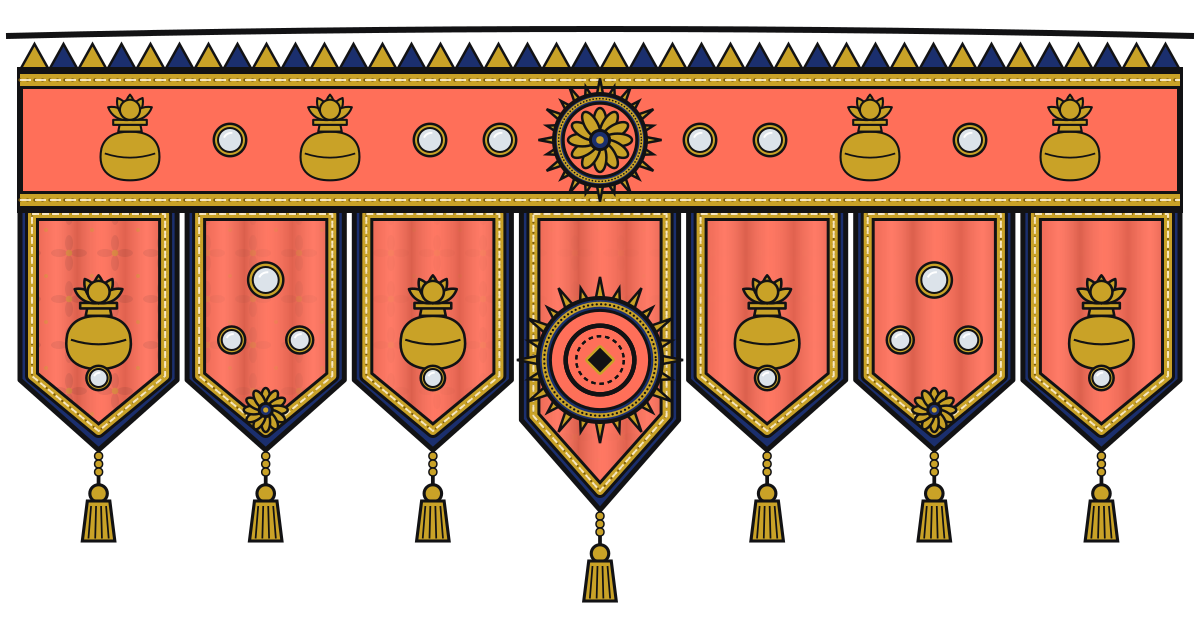
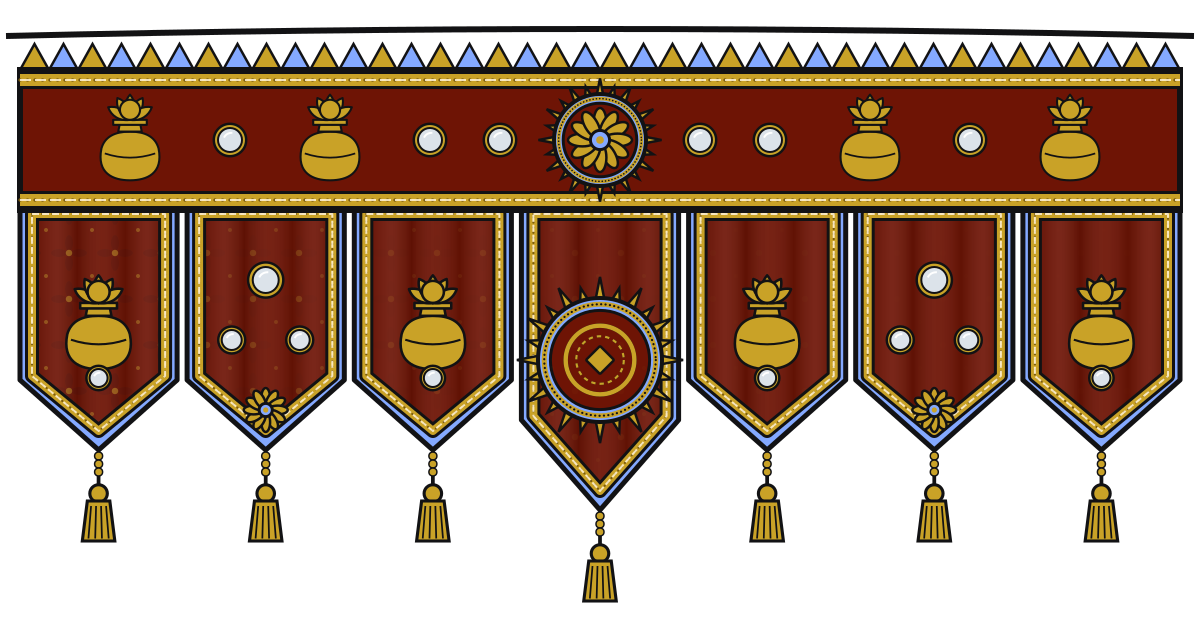
| Field | Warm Red-Orange #FF6F59 |
| Accent | Intense Electric Blue #84A9FF |
| Emblem colour | Charcoal Black #121214 |
| Zari metal | Gold |
| Main emblem | Garuda with outspread wings |
| Second image | — |
| Night and day | Every visual accessory has two versions: by night the emblem on the dark field, by day the clan's field colour on cloth woven from its metal. |
6. Flags
Every clan has every flag type; the type says the occasion and the colours say the clan. The outlined card is the flag the Atlas assigns.
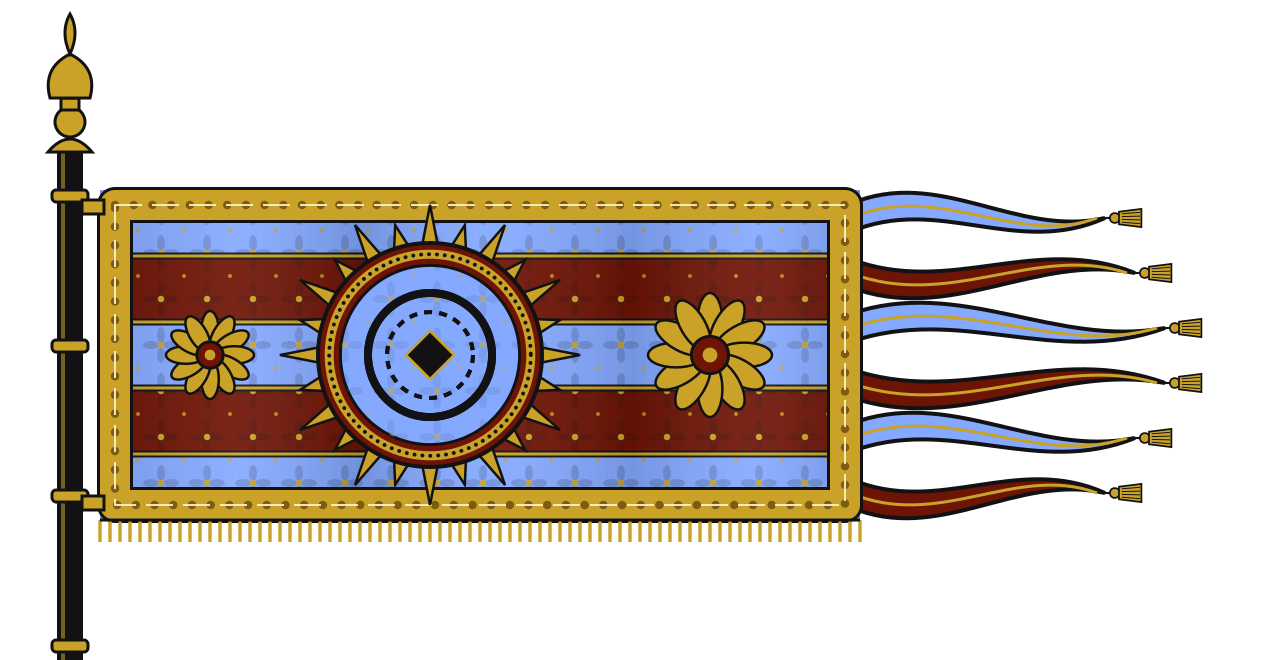

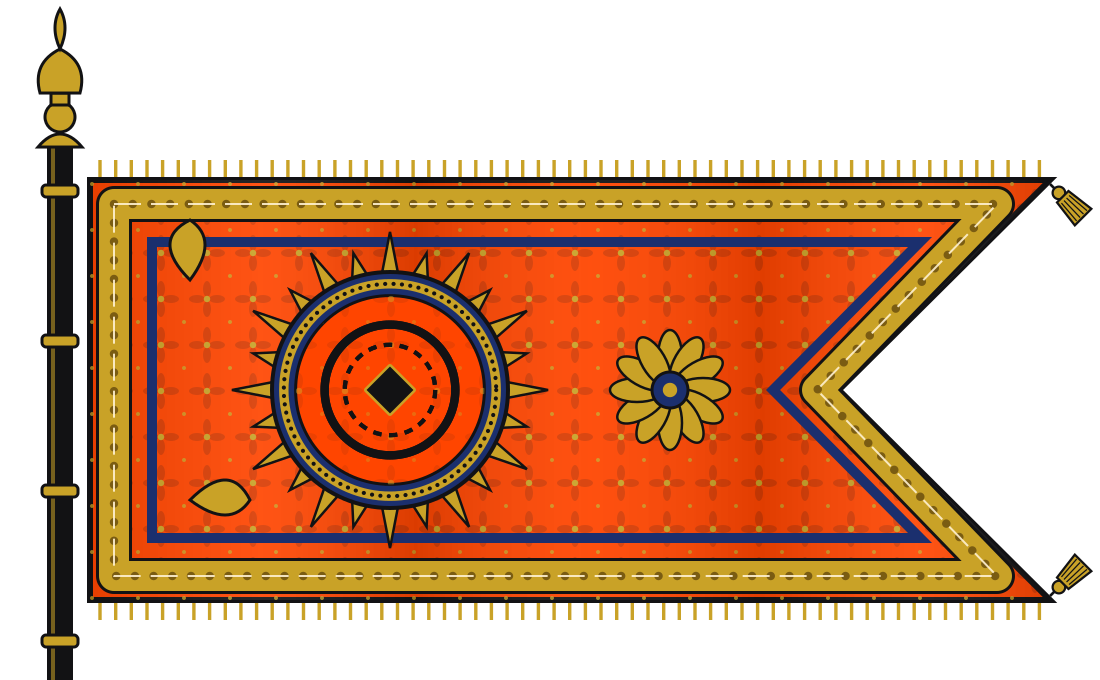


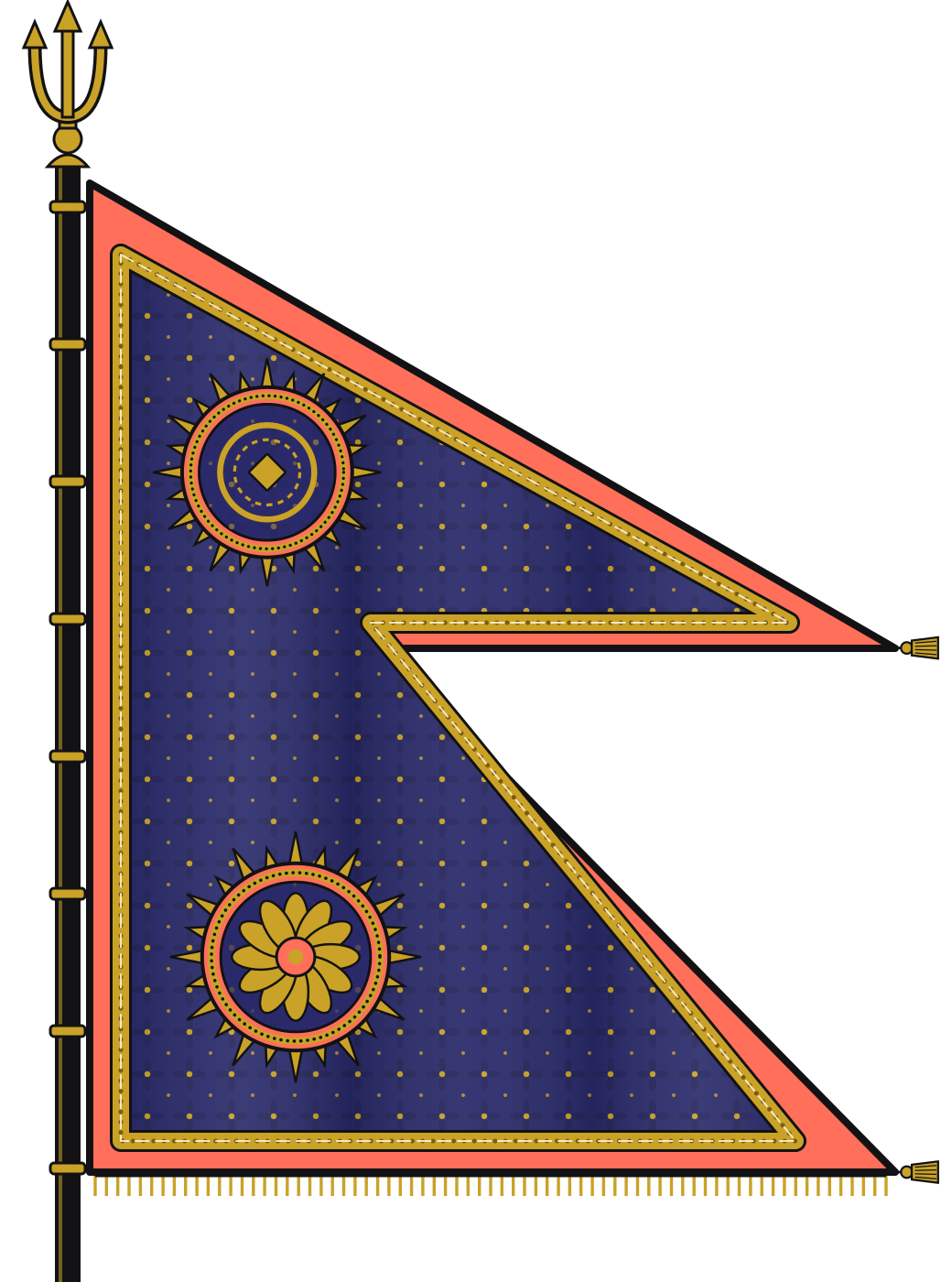

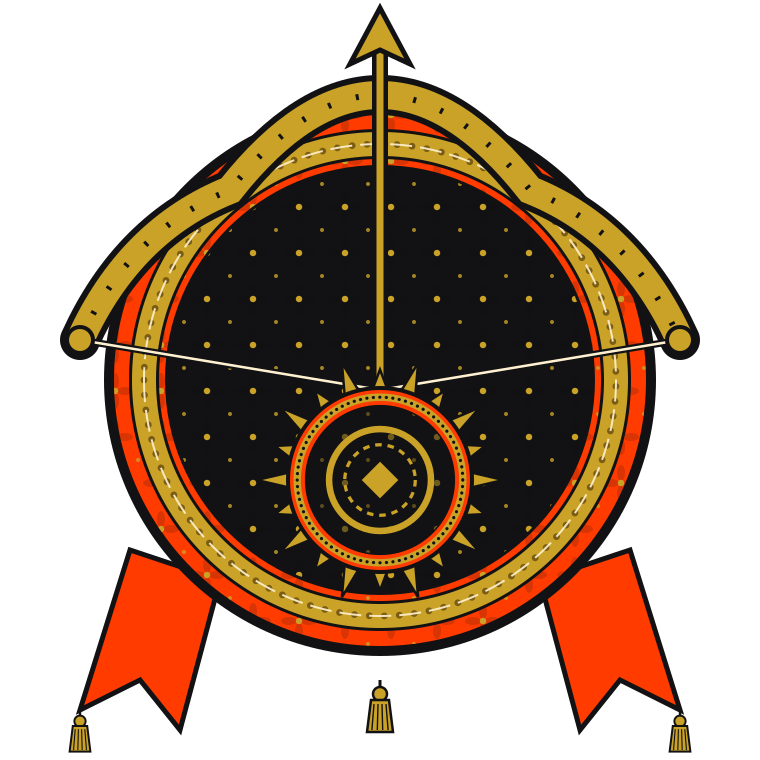

Historic banner
None recorded.
New flag types
| Accessory | For this clan | Basis |
|---|---|---|
| A9 Pota-dhvaja · ship and trade flag For ships, caravans and markets | Not yet designed for this clan | Design |
| A10 Utsava-patāka · festival flag Light, bright flag for fairs and festivals | Not yet designed for this clan | Design |
| A11 Shoka-dhvaja · mourning flag White cloth with the emblem outline in the clan's metal | Not yet designed for this clan | Design |
7. Regalia
| Accessory | For this clan | Basis |
|---|---|---|
| E1 Chhatra · house parasol The ceremonial umbrella | Chhatra, the parasol, on Chandragupta II's gold coins | Documented |
| E2 Chamara · fly-whisks The pair of whisks beside the head of the house | Not yet designed for this clan | Design |
| E3 Danda · staff of office Staff or scepter | Not yet designed for this clan | Design |
| E4 Simhasana · seat The seat of the house, covered in clan cloth | The couch type on Chandragupta II's coins | Documented |
| E5 Khetaka · shield A round shield; the Changi and Dhanush are its flag forms | Not yet designed for this clan | Regional tradition |
| E6 Kula-ayudha · clan weapon The weapon the clan honours | Not yet found for this clan | Under research |
8. Worn
| Accessory | For this clan | Basis |
|---|---|---|
| F1 Kula-vastra · clan cloth The clan's woven pattern in its kit colours | Not yet designed for this clan | Design |
| F2 Kirti-vastra · honour cloth A cloth earned for a deed, not inherited | Not yet designed for this clan | Design |
| F3 Kula-mala · garland flower The flower or leaf the clan wears as a garland | Not yet found for this clan | Under research |
| F4 Chinha · house pin A metal badge with the pin emblem | Not yet designed for this clan | Design |
9. Records
| Accessory | For this clan | Basis |
|---|---|---|
| H1 Clan words A traditional line in the native script | Apratirathah · “Translation not in the sources read; to be sourced” Archer coin of Samudragupta, with the legend in Latin transliteration[6] | Documented |
| H2 Biruda · titles The house's title or titles | The titles of the kings: maharajadhiraja, paramabhattaraka, kaviraja, Vikramaditya, Mahendraditya, Shakraditya, Baladitya, Kramaditya महाराजाधिराज maharajadhiraja | Documented |
| H3 Prashasti · praise genealogy The lineage as written at the head of a grant | Allahabad prashasti of Samudragupta by Harisena (Sanskrit, nine verses and prose) | Documented |
| H4 Vahi · clan register The book of the clan's births, marriages and deaths | Not yet found for this clan | Under research |
| H5 Rana-ghosha · war cry The clan's cry in battle or celebration | Not yet found for this clan | Under research |
10. VishwaVit · knower of the world
Game values are design choices for this project, not historical claims.
References
- Gupta Empire (Wikipedia, read 2026-10-09)
- World History Encyclopedia, Gupta Empire (read 2026-10-19, https://www.worldhistory.org/Gupta_Empire/)
- EPG Pathshala (INFLIBNET), Allahabad Pillar Inscription of Samudragupta, module text by P. Bhaskar Reddy, K. Muniratnam, S. K. Acharya (read 2026-10-19, PDF)
- Chandragupta II (New World Encyclopedia, adapted from Wikipedia, CC BY-SA 3.0, read 2026-10-11)
- RajRAS, गुप्त साम्राज्य (read 2026-10-19, link)
- Ashvini Agrawal, Gupta Coins, Banglapedia (page edited 2021-06-18, read 2026-10-19, https://en.banglapedia.org/index.php/Gupta_Coins)
- CoinWeek, Ancient Coin Series: Coinage of the Guptas (read 2026-10-19, link)
- The Indian Analyst (whatisindia.com), Skandagupta's Junagadh rock inscription, Gupta Inscriptions page, read 2026-10-10, link (editor not named on page)
- Smarthistory (credits MAP Academy), Dashavatara Temple, Deogarh (read 2026-10-19, link)
- Magadha (Wikipedia, read 2026-10-08)
- Later Gupta dynasty (Wikipedia, read 2026-10-09)
- Wikipedia, Varahamihira (read 2026-10-10, https://en.wikipedia.org/wiki/Var%C4%81hamihira); Bakker, Shastri and Balogh are cited on that page for the patron question
- Wikipedia, "Samkhyakarika" (read 2026-10-18, https://en.wikipedia.org/wiki/Samkhyakarika) (cites Larson, Bronkhorst, Wezler and Motegi, Burley, Nakamura)
- Edgar Thurston and K. Rangachari, Castes and Tribes of Southern India, vol. 2 (Madras, 1909), Project Gutenberg eBook #42992, https://www.gutenberg.org/ebooks/42992
- Wikipedia, Gupta (surname), mirror copy of version 2016-11-18 (oldid 750177726), CC BY-SA 3.0, read 2026-10-19, mirror
- James Legge (tr.), A Record of Buddhistic Kingdoms (Fa-hien), Clarendon Press, Oxford, 1886, Project Gutenberg #64535, link (only chapters up to about VII read)