The Gonds, who call themselves Kōītōr or Kōī, are a Dravidian-speaking people of central India.[1] Several Gond kingdoms ruled it, among them Garha-Mandla, Deogarh, Chanda and Kherla; Sangram Shah of Garha-Mandla (1488–1541) and Rani Durgavati's resistance to Akbar's forces in 1564 are the best-known episodes.[2][1] The Marathas annexed the rest of Garha-Mandla in 1781 and the British took most of the region between 1818 and 1853.[3][2] Today the Gonds are a Scheduled Tribe in most of the states they live in, and about 13 million people were counted in the 2011 census.[1]
01Faith and deities
The clan's own high god, also called Bhagavan, Kupar Lingo, Badadeo or Persa Pen; Bura Deo is the 'great god of the Gonds'.[1][5] The KulDevi from the Atlas is Kali Kankali (Documented). Russell (as recorded in 1916): Bura Deo is "their great god in most localities", probably first the saj tree (Boswellia serrata), later also a name for the whole collection of gods; the most sacred oath is to swear by Bura Deo holding a saj branch over the head.[5]
Mother of the Gond clan-gods in the Pahandi Pari Kupar Lingo epic
A recorded tie between the clan and the goddess.
| Deity or tradition | Place in the clan's life | Evidence |
|---|---|---|
| Kali Kankali legend (KulDevi) | From the Atlas: mother of the Gond clan-gods in the Pahandi Pari Kupar Lingo epic. The Kachchargarh origin myth has her children freed from the caves | [1] |
| Persa Pen | Worshipped by the Katora kita; the kingri fiddle of the Pardhan bards calms Persa Pen | [1] |
| Angadevs (Saga Deva) | Ancestral deities of the sagas | [1] |
| Pari Kupar Lingo legend | Founder of Koyapunem, 'the way of nature' | [1] |
| Dulha Deo (Dulha-Pen) | Named among the Gond deities | [1] |
| Vishnu | Patron of the medieval Gond kingdoms | [1] |
| Ravana (Rawan) | Worshipped as the tenth dharmaguru and eightieth lingo (Rashid 2015, as cited on the page) | [1] |
| Other named deities | Mata Kali Kankali, Gansam, Hardul, Bhimsen, Nat Awal, Bhumi, Thakur Dev, Hulera-Pen, Maitya-Pen, Narayan-Pen, Kodapen, Maswasi Pen, Nag Deo and Kanya | [1] |
| Bura Deo forms | Brass or iron balls on a ring hung on a saj tree, an iron chain, or in Mandla an iron doll; sometimes with Mahadeo and Parvati on each side; pig and goat sacrifices every one or two years; the Panda is the priest (as recorded in 1916) | [5] |
| Bura Deo and the dead | In Mandla the dead are mingled with Bura Deo: kunda bundles of charra grass, a pice and turmeric | [5] |
| Deo-khulla gods (god's threshing-floor) | Iron, mostly spear-shaped, kept tied in grass in the fork of a saj tree; women may not worship at the Deo-khulla | [5] |
| Pharsi Pen | Battle-axe god of the Deo-khulla | [5] |
| Matiya | God of mischief, of the Deo-khulla | [5] |
| Ghangra | Bell god of the Deo-khulla | [5] |
| Chawar | Cow's-tail whisk, one of the Deo-khulla gods | [5] |
| Palo | Embroidered cloth that covers the spear-heads of the Deo-khulla; made by a Katia or Raj-Pardhan and embroidered with a bullock, deer, snake and elephant (J. A. Tawney's note, quoted) | [5] |
| Sale | Of the Deo-khulla; perhaps of the cattle-pens | [5] |
| Bhimsen | God of strength; a village god shared with Hindus | [5] |
| Ghor Deo | Horse god; a village god of stones or mud platforms with red or white flags | [5] |
| Holera | Cattle god; a village god, shown by a wooden bullock bell | [5] |
| Ghansiam Deo | Village god in Mandla: a prince killed by a tiger on the way to his wedding | [5] |
| Doctor Deo | Village god of northern Bastar: spirit of a doctor (Russell says a Muhammadan doctor); keeps off cholera | [5] |
| Marai Mata | Cholera goddess, carried from village to village on a small litter | [5] |
| Kalha Deo | The gods' 'peon' (servant) | [5] |
| Village worship | Communal, led by the Bhumka (village priest), at the end of the hot weather before sowing | [5] |
| Jhulan Devi | Cradle goddess; a household god | [5] |
| Nag Deo (house) | Cobra god: a mud image on a house post; a cobra is eaten in Asarh, the first month of the rains, which the Gonds count as the beginning of the year | [5] |
| Narayan Deo | The sun; a platform inside the threshold of the house | [5] |
| Deothana | God's place of the household in Mandla | [5] |
02Temples
No temple built by a Gond king is named in the extracts. The Ramnagar palace of the Garha-Mandla kings (Russell's plate 66) is the nearest royal monument and is not a temple, so the built and later lists are left empty.
Built by the clan
Not recorded.
Given patronage or grants by the clan
| Temple | Deity | What the clan gave | When | Where |
|---|---|---|---|---|
| Kupar Lingo shrines | Pari Kupar Lingo | Shrines kept for worship | Not dated | Across Gondwana[1] |
| Kachchargarh caves | Kali Kankali and Pari Kupar Lingo (origin myth) | Pilgrimage site | Not dated | Kachchargarh[1] |
03Languages and scripts
| Language or script | Kind | Under the clan | Evidence |
|---|---|---|---|
| Gondi (Koitur) living | Dravidian language; about 2.4 million Gondi speakers in the 2011 census | Main language of the clan; claimed to be related to Telugu | [1] |
| Gondi writing | No script of its own, as recorded in 1916 | Gondi | [5] |
04Books and literature
No Gondi-language literature is sourced in the extracts. The works below are those the pages name.
Written during the clan's history
| Work | Author | Kind | When | Link to the clan |
|---|---|---|---|---|
| The Tribes and Castes of the Central Provinces of India, vol. 3 (Gond article) | R. V. Russell | Ethnographic gazetteer | 1916 | [5] |
| Papers on the Aboriginal Tribes of the Central Provinces | Hislop | Papers | 1866 | [5] |
| Rasratnamala | Sangram Shah (per Misra 2007) | Work of letters by a Gond ruler | Reign of Sangram Shah, 1488–1541 | [4] |
| Phulmat of the Hills | Verrier Elwin | Ethnography | 1937 | [1] |
| The Gonds of the Central Indian Highlands | Mehta | Ethnography | 1984 | [1] |
| The Gonds of Vidarbha | Deogaonkar | Ethnography | 1990 (page); 2007 (other page) | [1][3] |
Given patronage by the clan
| Work | Author | What the clan gave | When | Evidence |
|---|---|---|---|---|
| Rasamanjari | Bhanudatta Misra | Praise of Sangram Shah, who was a patron of letters | Sangram Shah's reign | [4] |
05Thinkers and scholars
| Name | Field | Era | Contribution |
|---|---|---|---|
| Pari Kupar Lingo legend | Teacher and founder | Legendary | Founded Koyapunem (Gondi Punem), 'the way of nature' (Koreti 2015, as cited on the page)[1] |
| Motiravan Kangali | Linguist and author | Not dated | Named on the page as a Gond linguist and author[1] |
The principles of Koyapunem (munjok, salla and gangra) are uncited on the page and are left out.
06Art and architecture
Gond painting, named in the Atlas as the clan's popular identifier, is recorded here by its painters. The architecture entries are the Gond monuments and fort imagery the sources describe.
Painting and wall art
| Art form | What it is | Era | Evidence |
|---|---|---|---|
| Jangarh Singh Shyam | Gond painter | [1] | |
| Bhajju Shyam | Gond painter | [1] | |
| Venkat Shyam | Gond painter | [1] | |
| Durga Bai Vyom | Gond painter | [1] |
Sculpture and temple art
Not recorded.
Temple and building architecture
| Art form | What it is | Era | Evidence |
|---|---|---|---|
| Gond monuments of Ramnagar, Mandla | Palace of the Garha-Mandla kings; UNESCO tentative list | [3][5] | |
| Lion-and-elephant imagery on Gondwana forts | Barbicans and gateways, 15th to 17th century (Sohoni 2017, as cited on the page) | [2] |
Weaving and textiles
Not recorded.
Clothing and jewellery
Not recorded.
Coins, pottery and crafts
Not recorded.
07History
Four kingdoms, 13th to 15th century
The Gond kingdoms were four Gondwana states: Northern Garha (Garha-Mandla, at Jabalpur), Southern Chanda (Chandrapur), Western Kherla (Betul) and Deogad (Chhindwara and Nagpur); one account dates their creation to the 15th century and the Gonds are first mentioned in 14th-century Muslim chronicles.[2]
Garha-Mandla's first king is given as Jadurai, a Gond who served the Kalachuris of Tripuri and then deposed them; the page dates Garha to 1440 and, elsewhere, to the 14th century, and flags its early dates as needing citations.[3][1]
Chanda is dated to 1200, though some genealogies say the 9th century; Deogarh was founded in the early 13th century by Jatba.[1]
1488 to 1541: Sangram Shah of Garha-Mandla
Raja Sangram Shah Madavi, the 48th ruler of Garha-Mandla, reigned from 1488 to 1541; his realm is given as 70,000 villages, 57 parganas and 52 forts.[4]
The title Sangram Shah is said to have been given by the sultan of Gujarat, Bahadur Shah, for help in taking Raisen (Abul Fazl, via Misra 2007).[4]
The poet Bhanudatta Misra praised him in the Rasamanjari (Jha 2010, as cited on the page).[4]
1564: Durgavati and the Mughals
Dalpat Shah, Sangram Shah's son, married Durgavati, daughter of Keerat Rai of Mahoba, and the alliance helped against Sher Shah Suri.[4]
Rani Durgavati fought Akbar (1564).[1] Akbar's forces took Garha, with coins, gold, silver, jewels and thousands of elephants, and the battle at Narrai against Asaf Khan I is dated the same year.[3]
Chandra Shah later regained the kingdom after about 25 years of Mughal rule.[4]
1634 to 1781: decline and the Marathas
Hridayshah (1634–1668), the last great king, ruled from Ramnagar.[3]
Bakht Buland Shah of Deogarh founded Nagpur in 1702; he had converted to Islam to win Aurangzeb's support, but did not convert his subjects.[2]
Maharaj Shah (1732–1742) held 29 of Sangram Shah's 52 forts; he was killed in 1742 by the Peshwa Balaji Baji Rao and Visaji Chandorkar, and his son Shivraj Shah paid four lakh in tribute.[3]
Narhar Shah was defeated in 1780 by Mudhoji Bhonsle and the Marathas annexed the rest in 1781.[3]
1799 to 1857: the British and the revolt
Mandla passed to the Bhonsles in 1799 and the British took Garha in 1817–18; the British took most of the region from 1818 to 1853, and Raj Gonds ruled some minor states until 1947.[3][2]
After the 1857 revolt, Shankar Shah and his son Raghunath Shah were blown from guns at Jabalpur.[3]
1910 to 1950s: forest revolts and organisation
The 1910 Bastar bhumkal rebelled against forest policy, and Komaram Bheem led a rebellion in the early 1920s under the call 'jal, jangal, jameen' (water, forest, land).[1]
The Gond Mahasabha was formed in 1916.[1] Heera Singh founded the Bharatiya Gondwana Sangh in the early 1950s and mobilised about 100,000 people in 1962–63.[1]
1990s to 2011: Gondwana politics and Salwa Judum
The Gondwana Ganatantra Party of the 1990s is linked to Heera Singh Markam and Kausalya Porte.[1]
The Supreme Court disbanded the Salwa Judum on 5 July 2011.[1]
08Journey and migrations
The Gonds' own origin is unclear. R. V. Russell (1916) held that they came from the south, and the page notes that they may be several tribes that adopted a common Gondi language.[1]
| When | From | To | Why | Evidence |
|---|---|---|---|---|
| Not dated (Russell's account) | The south | Vidarbha | Up the Godavari into Vidarbha, as Russell's account has it | [1] |
| Not dated (Russell's account) | Vidarbha | Bastar | Up the Indravati into Bastar | [1] |
| Not dated (Russell's account) | Vidarbha | The Satpuras | Up the Wardha and Wainganga into the Satpura hills | [1] |
09Seats and lands
| Place | Role | Where today |
|---|---|---|
| Gondwana | Name of the wider region; core eastern Vidarbha, Garha, parts of Madhya Pradesh and western Chhattisgarh | Central India[2] |
| Garha-Mandla | Northern kingdom; capitals Garha, Singhorgarh, Chouragarh and Ramnagar | Jabalpur and Mandla[3] |
| Chanda | Southern kingdom; seat moved to Chandrapur | Chandrapur[1] |
| Deogarh | Kingdom of Deogad, which founded Nagpur in 1702 | Chhindwara and Nagpur[2] |
| Kherla | Western Gond kingdom | Betul[2] |
| Bastar | Home of the Muria Gond | Bastar district, Chhattisgarh[1][6] |
| Odisha Gond | Gond settlement in western Odisha | Sundergarh, Sambalpur, Balangir, parts of Kalahandi, Nuapara and Nabrangpur[7] |
10Notable figures
| Name | Role | Era | Known from |
|---|---|---|---|
| Jadurai | First Gond king of Garha, who deposed the Kalachuris | 14th century (per the page) | [3][1] |
| Jatba | Founder of Deogarh | Early 13th century | [2][1] |
| Khadkya Ballal Shah | 10th ruler of Chanda, who made Chandrapur the capital | 1472–1497 | [2] |
| Sangram Shah | Ruler of Garha-Mandla, with 52 forts | 1488–1541 | [4] |
| Rani Durgavati | Queen of Garha, a Chandela princess who fought Akbar's forces | 1564 | [1] |
| Hridayshah | Last great king of Garha-Mandla; capital Ramnagar | 1634–1668 | [3] |
| Bakht Buland Shah | Ruler of Deogarh who founded Nagpur | 1702 | [2] |
| Maharaj Shah | Ruler of Garha who held 29 of the 52 forts | 1732–1742 | [3] |
| Shankar Shah and Raghunath Shah | Garha rulers killed after the 1857 revolt | 1857 | [3] |
| Komaram Bheem | Led a rebellion under the call 'jal, jangal, jameen' | Early 1920s | [1] |
| Heera Singh Markam | Founded the Bharatiya Gondwana Sangh; linked to the Gondwana Ganatantra Party | Early 1950s to 1990s | [1] |
11Allies, rivals and marriages
| People | Relationship | When |
|---|---|---|
| Mughals | Rivals; Akbar's forces took Garha in 1564[3] | 1564 |
| Marathas (Bhonsles, Peshwa) | Rivals; forced tribute, then annexed Garha-Mandla[1][3] | 1740s to 1781 |
| Chandelas of Mahoba | Marriage: Dalpat Shah married Durgavati, daughter of Keerat Rai[4] | Before 1564 |
| Rewa (Birsingh Deo) | Sangram Shah served Birsingh Deo, who later invaded Garha[4] | Not dated |
| Aurangzeb | Bakht Buland Shah of Deogarh converted to win his support[2] | Around 1702 (Nagpur founded that year) |
| British | Rivals; took Garha in 1817–18 and most of the region by 1853[3][2] | 1817 to 1853 |
| Rawan (Ravana) | Gond tradition of descent from Rawan, the demon king of Ceylon (a claim)[5] | Tradition |
12Society and livelihood
Gond society is built on exogamous units. Saga members are equal, and each saga has ritual roles.[1]
Government and social order
| Institution or group | What it was | Evidence |
|---|---|---|
| Saga | Exogamous unit whose members are equal; each saga has its own ritual roles | [1] |
| Pari | Clan; common names include Tekam, Uikey, Markam, Dhurwe and Atram, often plant names | [1] |
| Kita | Lineage; the Katora kita alone presides over the worship of Persa Pen | [1] |
| Marriage | At the wedding the couple circle a mahua post | [1] |
| Burial | The dead are buried with their possessions; some kings were cremated, and cremation has risen with Hinduisation | [1] |
| Garh divisions | Gond clans controlled the garh divisions of Garha-Mandla: chourasi (84 villages) and barhot (12 villages) | [3] |
| Gond Mahasabha | Community body formed in 1916 | [1] |
| Bharatiya Gondwana Sangh | Political body founded by Heera Singh in the early 1950s | [1] |
| Gondwana Ganatantra Party | Party formed in the 1990s | [1] |
Livelihood over time
| Era | Livelihood | Evidence |
|---|---|---|
| Gond kingdoms | Taxes collected in gold; Chanda rulers developed irrigation and the first well-defined revenue system among the Gond kingdoms | [2][3] |
| Present day | Mainly agriculturalists and labourers (Odisha Gond) | [7] |
| Diet (undated) | Staple millets kodon, jowar and kutki, with foraged mahua, tengu, char, mango, jamun, sitaphal and amla | [8] |
13Sub-clans and related clans
Gond society is organised in exogamous units: the saga, the clan (pari), the lineage (kita) and the subclan (khandan). The sources name the following; none gives a size. The Atlas also lists Naikpod, Dorla, Dhurwa, Bisonhorn Maria, Abujh Maria and Rajgond among about 50 sub-groups. Russell (as recorded in 1916) adds: in Chanda the septs are grouped by the number of gods they worship (seven, six, five or four), each group of ten to fifteen septs with a sacred animal (porcupine, tiger, saras crane, tortoise), and a man cannot marry into a sept of his own group; by 1916 the scheme was being forgotten, and in Mandla same-number septs call each other brothers (bhaiband).[5]
| Clan | Relation | Where | Size | In the Atlas | Evidence |
|---|---|---|---|---|---|
| Tekam | Sub-clan | Common pari name | same name as ST-502: check | [1] | |
| Uikey | Sub-clan | Common pari name | new clan candidate | [1] | |
| Markam | Sub-clan | Common pari name; also an exogamous sept | same name as ST-453: check | [1][5] | |
| Dhurwe | Sub-clan | Common pari name | new clan candidate | [1] | |
| Atram | Sub-clan | Common pari name | new clan candidate | [1] | |
| Netam | Sub-clan | Exogamous sept | same name as ST-480: check | [5] | |
| Yerwen | Branch | Saga of Adilabad | new clan candidate | [1] | |
| Sarwen | Branch | Saga of Adilabad | new clan candidate | [1] | |
| Siwen | Branch | Saga of Adilabad | new clan candidate | [1] | |
| Nalwen | Branch | Saga of Adilabad | new clan candidate | [1] | |
| Sarpe | Branch | Fifth saga, which marries with Sarwen | new clan candidate | [1] | |
| Muria | Branch | Bastar district, Chhattisgarh | new clan candidate | [6] | |
| Maria (Maadiya Gond) | Branch | Gondi-speaking subgroup | new clan candidate | [1] | |
| Madia Gond | Related people | new clan candidate | [1] | ||
| Khond | Related people | same name as ST-408: check | [1] | ||
| Konda Dhora | Related people | Andhra Pradesh, Odisha, Telangana | ST-149 | [1] | |
| Raj-Gond | Branch | Landholding; rank with Hindu cultivators; in the Telugu country called Durla or Durlasattam (as recorded in 1916) | new clan candidate | [5] | |
| Khatola | Branch | From Khatola in Bundelkhand (as recorded in 1916) | same name as ST-467: check | [5] | |
| Dhur Gond | Branch | Ordinary Gonds, the 'dust' Gonds; Hindus call them Rawanvansi (as recorded in 1916) | new clan candidate | [5] | |
| Koya Gond | Branch | Koi or Koitur is the Gonds' own name (as recorded in 1916) | new clan candidate | [5] | |
| Gaita | Branch | Chanda (as recorded in 1916) | new clan candidate | [5] | |
| Darwe (Naik Gond) | Branch | Chanda; once soldiers (as recorded in 1916) | new clan candidate | [5] | |
| Larhia | Branch | Chhattisgarh (as recorded in 1916) | new clan candidate | [5] | |
| Mandlaha | Branch | Mandla (as recorded in 1916) | new clan candidate | [5] | |
| Lanjiha | Branch | Lanji (as recorded in 1916) | new clan candidate | [5] | |
| Bastar Maria | Branch | Bastar, a hill group, from Mad (as recorded in 1916) | new clan candidate | [5] | |
| Irpachi | Sub-clan | Totem: mahua tree; in a Deo-khulla sept legend the mahua tree grew at the god's place | same name as ST-396: check | [5] | |
| Tumrachi | Sub-clan | Totem: tendu tree (as recorded in 1916) | same name as ST-509: check | [5] | |
| Warkara | Sub-clan | Totem: wild cat; in Betul no village cat is kept in the house (as recorded in 1916) | same name as ST-515: check | [5] | |
| Marabi | Sub-clan | Mandla; split into Eti (goat) and Padi (pig) Marabi; meaning of the name not ascertained (as recorded in 1916) | new clan candidate | [5] | |
| Eti Marabi | Sub-clan | Goat; a split of the Marabi sept in Mandla | new clan candidate | [5] | |
| Padi Marabi | Sub-clan | Pig; a split of the Marabi sept in Mandla | new clan candidate | [5] | |
| Dhurwa | Sub-clan | Mandla; split into Tumrachi and Nabalia Dhurwa; meaning of the name not ascertained (as recorded in 1916) | ST-069 | [5] | |
| Nabalia Dhurwa | Sub-clan | Nabalia (dwarf date-palm); a split of the Dhurwa sept in Mandla | new clan candidate | [5] | |
| Uika | Sub-clan | Mandla; reveres no animal and avoids cutting the saj tree; meaning of the name not ascertained (as recorded in 1916) | new clan candidate | [5] | |
| Parteti | Sub-clan | Betul; reveres the crocodile, and breaks pots if one is found dead (as recorded in 1916) | new clan candidate | [5] | |
| Kunjam | Sub-clan | Betul; reveres the rat (as recorded in 1916) | same name as ST-412: check | [5] | |
| Pusam | Sub-clan | Named with Tekam, Markam and Telengam at the river in the Lingo legend, from Hislop's text (as recorded in 1916) | same name as ST-548: check | [5] | |
| Telengam | Sub-clan | Named with Tekam, Markam and Pusam at the river in the Lingo legend, from Hislop's text (as recorded in 1916) | new clan candidate | [5] | |
| Gouribans Dhurwa | Sub-clan | Sept legend of the Deo-khulla: a bamboo clump (as recorded in 1916) | new clan candidate | [5] | |
| Kusadya Dhurwa | Sub-clan | Sept legend of the Deo-khulla: a tasar cocoon (as recorded in 1916) | new clan candidate | [5] | |
| Kohkapath | Sub-clan | Sept legend of the Deo-khulla: bhilawa nut; the sept does not eat its fruit or flowers (as recorded in 1916) | new clan candidate | [5] | |
| Admachi | Sub-clan | Sept legend of the Deo-khulla: dhaura tree, which is not cut or burned (as recorded in 1916) | same name as ST-570: check | [5] | |
| Watka | Sub-clan | Sept legend of the Deo-khulla: five stones (as recorded in 1916) | new clan candidate | [5] | |
| Eti-kumra | Sub-clan | Sept legend: with Manapa, a Brahman boy (or father and son) turned into goats; the sept does not kill or eat goat (as recorded in 1916) | new clan candidate | [5] | |
| Manapa | Sub-clan | Sept legend: with Eti-kumra, see there (as recorded in 1916) | new clan candidate | [5] | |
| Tirgam | Sub-clan | Sept legend of the Deo-khulla: fire (as recorded in 1916) | new clan candidate | [5] | |
| Korpachi | Sub-clan | Named among the sept legends of the Deo-khulla; no detail given (as recorded in 1916) | new clan candidate | [5] | |
| Paiyam | Sub-clan | Named among the sept legends of the Deo-khulla; no detail given (as recorded in 1916) | new clan candidate | [5] |
Clans marked "new clan candidate" are not in the Atlas yet.
14Surnames
Gond rajas used the titles Singh and Shah; 'Raj Gond' was common in the 1950s and is now nearly obsolete.[1] No surname counts are sourced, so none is given here.
Not recorded.
15Songs and music
In the Saila Karma dance one party sings a line and the other repeats it, with the mandar and timki drums[9]. Pardhan bards play the kingri fiddle to calm Persa Pen[1]. Song texts below are quoted briefly as printed in 1916 (Russell and Hira Lal); the two bawdy specimens are left out.
Muria Nayanar village performance
Karma (dance)
Sela (stick dance)
Specimen (a), as printed in 1916
Be not proud of your body, your body must go away above (to death).
Specimen (d), as printed in 1916
Rawan is coming disguised as a Bairagi; by what road will Rawan come?
Specimen (f), as printed in 1916
I have left my cow in her shed, my buffalo in her stall. I have left my baby at the breast and am come alone to follow you.
Lingo river-crossing cry
O God of the crossing, O Boundary God! Should you be here, Come take us across.
Offering song to Narayan Deo
Eat, Narayan Deo, eat this rice and meat, and protect us from all tigers, snakes and bears in our houses; protect us from all illnesses and troubles.
Maria circle dance
Dance in two lines
Wedding song contests
Naming-day songs
Songs to bring back a soul
Instruments and styles
| Instrument or style | What it is | Evidence |
|---|---|---|
| मंदर (mandar) | Main drum of the Saila Karma dance | [9] |
| टिमकी (timki) | Drum played with the mandar in the Saila Karma dance | [9] |
| Kingri | Fiddle played by Pardhan bards to calm Persa Pen | [1] |
| Drums and tom-toms | Up to thirty musicians at the Maria circle dance (as recorded in 1916) | [5] |
16Poems, lullabies and children's rhymes
Frog rain rhyme (children's drought rhyme)
Mendak Bhai pani de, Dhan, kodon pakne de, Mere byah hone de“Brother Frog, give rain; let the rice and kodon ripen; let my marriage be held.”
17Stories, legends and proverbs
Stories and legends
| Story | What happens | Told by | Evidence |
|---|---|---|---|
| Gond Ramayani legend | Seven stories in which Lakshmana is the protagonist | Gond tradition (Mehta 2011, as cited on the page) | [1] |
| Kachchargarh origin legend | Kali Kankali's children are freed from the caves by Pari Kupar Lingo and the bard Hirasuka Patalir | Gond tradition | [1] |
| Lingo's myth legend | Lingo frees the Gonds from the cave where Mahadeo had shut them, divides them into clans, appoints a Pardhan priest and founds exogamy | Told by a Pardhan priest, as recorded by Hislop and quoted by Russell (1916) | [5] |
Proverbs and sayings
Not recorded.
18Festivals and fairs
| Festival or fair | When | Where | What happens |
|---|---|---|---|
| Saila Karma (Karma) | Not dated | Madhya Pradesh | A circle dance to please the Karma raja and rani; one party sings and the other repeats, with the mandar and timki drums[9] |
| Gussadi | Diwali | Adilabad | Gussadi dance at Diwali[1] |
| Sua | After Diwali | Chhattisgarh | Sua dance[1] |
| Pola | Not dated | Gond areas | Named among the major festivals[1] |
| Phag | Not dated | Gond areas | Named among the major festivals[1] |
| Dassera | Dussehra | Paraswadi, Gadchiroli | A Ravana image is set up on Dussehra[1] |
| Dito Endanna (stilt dance) | Not dated | Muria villages, Bastar | The Muria stilt dance at Nayanar village[6] |
| Chaitrai (Chait) | March | Bastar | New urad and semi beans offered uncooked; all-night dance and song[5] |
| Nawakhai | Bhadon (August) | New rice offered to ancestors; a goat sacrificed[5] | |
| First mahua flowers | Not dated | Worshipped under a saj tree[5] | |
| Bijphutni (breaking the seed) | Before sowing | Held before sowing[5] | |
| Holi (Gond rites) | Not dated | Bilaspur; Mandla | In Bilaspur a Gond or Baiga lights the Holi fire; in Mandla a semar branch is burnt with a pice and an egg; the ploughshare is heated in the fire to 'wake' it[5] |
| Meghnath swing with the Jheri pole | After Holi | Western districts | A teak or saj pole, and the Bhumka is swung on a cross-bar five times; Meghnath is the son of Rawan; then a greased Jheri pole is climbed for a prize while women beat the climbers[5] |
| Karma (branch rite) | Bhadon (August), repeated through the cold weather | A branch of the kalmi or haldu tree wrapped in new cloth, with a feast and dance round it[5] | |
| Kunwar pot-lamp rite | Kunwar (September) | Girls carry a pierced earthen pot with a lamp and a dove image from house to house, singing[5] | |
| Stiria-Raj ('kingdom of women') | Not dated | Chhattisgarh | Women march from village to village, kill a goat at each, with hair unbound[5] |
19Food, dress and games
Food
| Item | What it is | Evidence |
|---|---|---|
| कोदों (kodon), ज्वार (jowar), कुटकी (kutki) | Staple millets, cooked as jhol, rabdi and daliya | [8] |
| Rice | Eaten at night | [8] |
| Forest produce | Mahua, tengu, char, mango, jamun, sitaphal and amla, foraged | [8] |
Dress
| Item | What it is | Evidence |
|---|---|---|
| Loincloth | Traditional dress of men | [8] |
| Dhoti without blouse | Traditional dress of women | [8] |
| Woollen blankets | Worn in winter | [8] |
| Maria dance costume | Men in animal skins, peacock-feather head-dresses, cowrie girdles and a back bell (as recorded in 1916) | [5] |
Games and martial arts
Not recorded.
Tags: living still practised · revived brought back after a break · lost known only from records · research reported but not yet confirmed from a source. Songs and poems under copyright are listed by title only; restricted or sacred material is noted without its content.
20Status today
The Gonds are a Scheduled Tribe in most of the states where they live, and about 13 million people were counted in the 2011 census, mostly in Madhya Pradesh and Chhattisgarh.[1] The official status below is, and the official list itself was not read in this run.
Who carries the name today
| Community | Link | Basis | Evidence |
|---|---|---|---|
| Muria (Gond sub-group) | Documented | [6] | |
| Maria (Maadiya Gond) | Documented | [1] | |
| Koitur (self-name) | Documented | [1] |
Recognised heritage
| What | Recognition | Evidence |
|---|---|---|
| Gond monuments of Ramnagar, Mandla | UNESCO tentative list | [3] |
Not yet reviewed by the Gond community.
21For children
The Forest Drum
Long ago, the Gond people lived in the forests and hills of central India. Their land was called Gondwana, the land of the Gonds. They ate millets such as kodon and kutki, and gathered mahua from the trees. When they danced, they joined hands in a big circle. The mandar drum and the timki kept the beat. One group sang a line, and the other group sang it back.
Traditional
22Across the project
| Project | What carries this clan | Status |
|---|---|---|
| Atlas of the Janas | ||
| KulDevi and GrahDevi | KulDevi: Kali Kankali (Documented) | |
| Planet naming | ||
| Renaming and waters |
23Open questions
- Official list not read: confirm the ST and PVTG wording and the 09-07-2024 list date against the Ministry of Tribal Affairs list.
- Dates conflict: Garha's founding is the 14th century (Jadurai) on the Gondi people page and 1440 on the Garha page, which flags its early dates as needing citations; Deogarh is early 13th century against 'four kingdoms created in the 15th century'; Chanda is 1200 against the 9th century.
- Narhar Shah's fate in 1781 differs by source: killed by Moraji according to Fuchs, sent to Khurai fort according to the page.
- Narrai, 1564: the Garha page says Dalpat Shah died there against Asaf Khan I, while the Gondi people page says Rani Durgavati fought Akbar's forces that year; the two accounts are not reconciled.
- No Gondi-script forms: the extracts give Gondi only in Latin and IPA, and the people's name in Devanagari.
- Deogaonkar's The Gonds of Vidarbha is dated 1990 on one page and 2007 on another.
- Chaubey et al. 2017, Beine 1994 and Rashid 2015 are cited through the Wikipedia page only and were not read.
- Meghnath rite: the cached Russell extract (L4790-4822) has the Bhumka swung on a cross-bar; the plate-69 caption (a woman swung round the post) is in the book's plate list but is not in the cache, so that row was cut. Not reconciled.
- Possible duplicate names: Uika (Russell) and Uikey (sheet), Parteti (Russell) and Purteti (sheet), Dhurwa and Dhurwe; the extracts do not say whether each pair is one sept.
- Sept and subdivision sizes, and which septs are used as surnames, are not in the extracts; no counts are given.
- Koya Gond (Russell) and the Atlas's Koya (ST-160) may be the same people; not confirmed, so no ID is set.
- Dates of the Karma and Sela dances and of the Pola and Phag festivals are not sourced.
- Gondi script today is not sourced; Russell (1916) says Gondi had no script of its own.
- Dulha Deo: the Dulha Deo row said Russell's bridegroom-god note comes only from his Ganda and Ghasia articles; the Gond entry itself mentions Dulha Deo in the Ghansiam Deo note (book L4069, outside the cache), so that sentence was cut.
- Surnames: the surnames research says no sept is used as a surname, and the Markam surname item was cut; Russell names Markam as a sept only.
24Astitva
अस्तित्व · being, existence: everything by which the clan is known
Sangram Shah issued some square coins, the Gond rajas used the titles Singh and Shah, and the Ramnagar inscription praises Sangram Shah in Devanagari.[2][4]
Every clan has every accessory, royal objects included. Each one says how it is known: Documented This clan's own object is recorded. · Regional tradition Recorded for the region or for peoples like this one, not for this clan. · Design Made for this project, with no historical claim. · Under research To be found for this clan from sources. Legends and titles are written in the clan's own script.
1. Seals and coins
| Accessory | For this clan | Basis |
|---|---|---|
| B1 Rajamudra · house seal Round seal with the clan emblem and a short legend in the clan's script | Not yet designed for this clan | Design |
| B2 Anguliya-mudra · signet ring Personal seal ring of the head of the house | Not yet designed for this clan | Design |
| B3 Chhapa · house stamp Ink or block stamp for letters, goods and cloth | Not yet designed for this clan | Design |
| B4 Tamrapatra · charter plate Copper-plate grant on a ring, closed with the house seal | Not yet designed for this clan | Design |
| B5 Shreni-mudra · guild or trade seal Seal for the clan's trade, craft or caravan | Not yet designed for this clan | Design |
| C1 Clan coin Emblem or deity on one side, a legend in the clan's script | Square coin of Sangram Shah; the page gives no design | Documented |
| C2 Coin die The die that strikes the coin | Not yet designed for this clan | Design |
2. Living symbols
| Accessory | For this clan | Basis |
|---|---|---|
| I1 Totem trio The tree, bird and animal the clan protects | Sept totems: mango (Markam), teak (Tekam), dog (Netam), mahua (Irpachi), tendu (Tumrachi), wild cat (Warkara); the Markam sept and, in Bastar, the Netam also revere the tortoise | Documented |
| I2 Kaval-maram · guardian tree The tree that stands at the clan's seat | Saj tree (Boswellia serrata): probably the first form of Bura Deo; the Deo-khulla gods are tied in its fork | Documented |
3. Stone and gate
| Accessory | For this clan | Basis |
|---|---|---|
| G1 Torana · gateway The built gate of the seat; the cloth Toran hangs in it | Lion-and-elephant imagery on the barbicans and gateways of Gondwana and Deccani forts, 15th to 17th century | Regional tradition |
| G2 Viragallu · hero stone Carved panel stone for a member who died defending the clan | Not yet designed for this clan | Regional tradition |
| G3 Kula-shila · clan stones Standing and table stones that remember the ancestors | Not yet designed for this clan | Design |
| G4 Jayastambha · victory pillar A pillar raised for a victory | Not yet designed for this clan | Design |
| G5 Sima-shila · boundary stone Marks the clan's land, with a line in the native script | Not yet designed for this clan | Design |
4. Sounds
| Accessory | For this clan | Basis |
|---|---|---|
| D1 Pancha-mahashabda · five great sounds The right to five instruments | Not yet designed for this clan | Design |
| D2 Shankha · clan conch The clan's own named war conch | Not yet designed for this clan | Design |
| D3 Murasu · house drums Three drums: war, charity and justice | Not yet designed for this clan | Design |
5. Kit: colours, metals and emblems
No Gond emblem is sourced beyond the Atlas. The forts of Gondwana carry lion-and-elephant imagery from the 15th to 17th century.[2]
| Part of the kit | This clan |
|---|---|
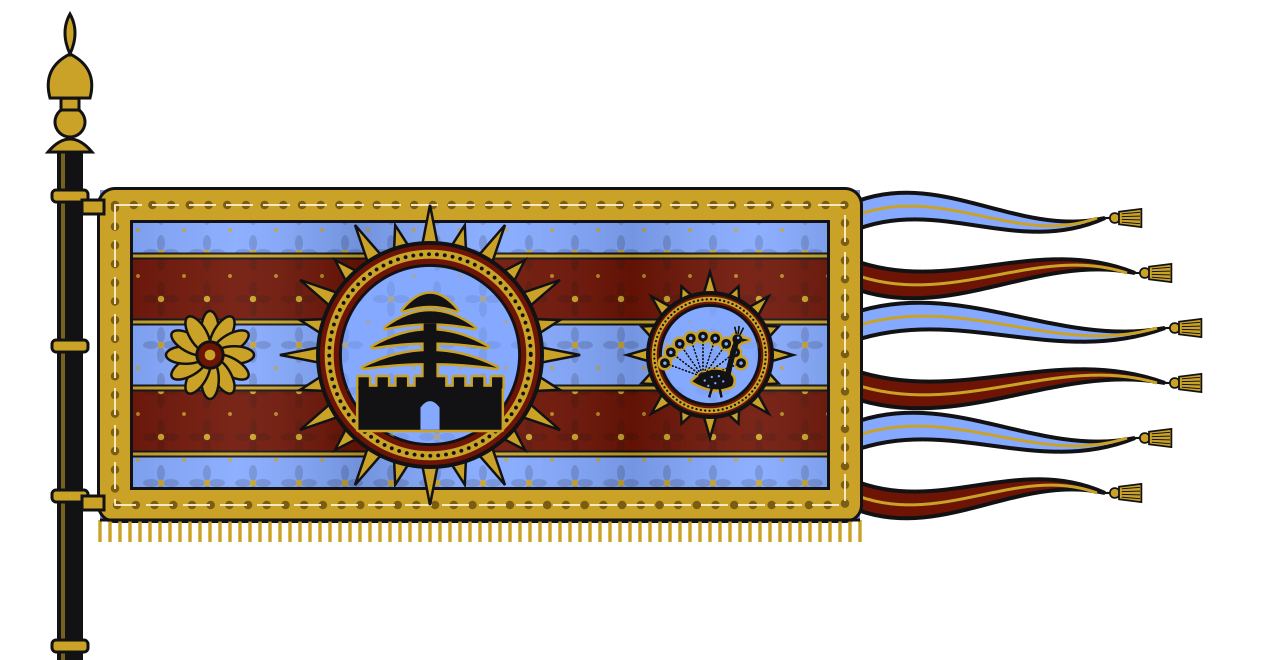
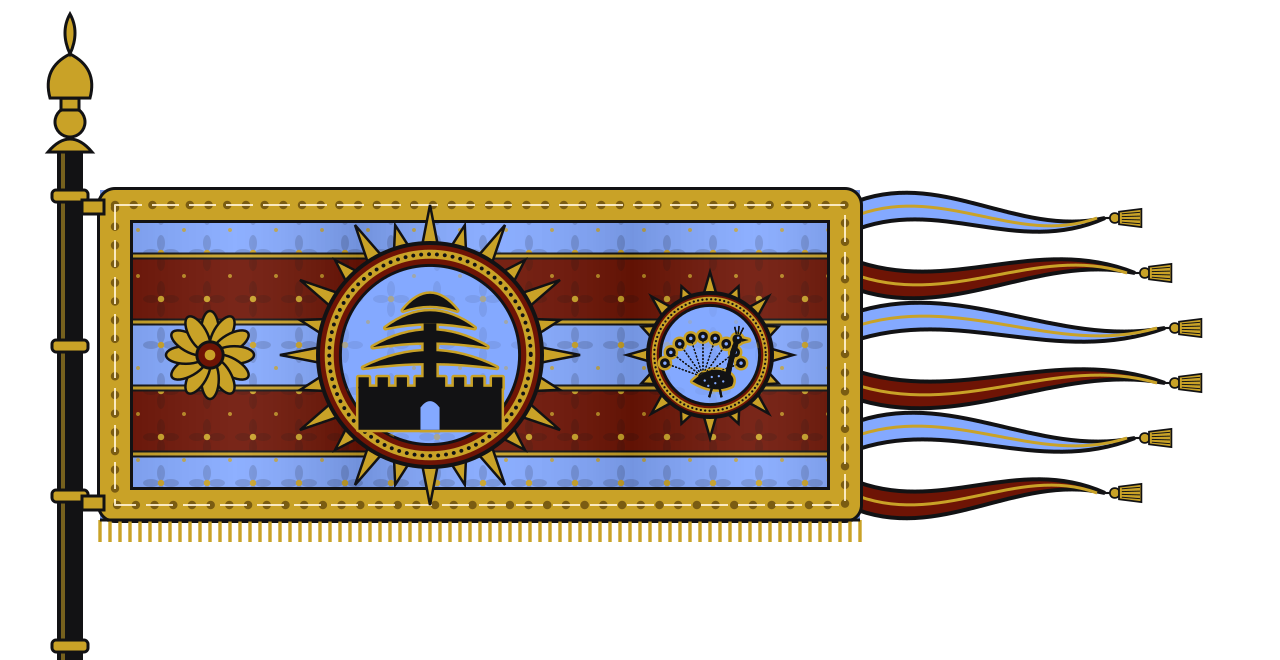
| Field | Intense Electric Blue #84A9FF |
| Accent | Maroon #6E1405 |
| Emblem colour | Charcoal Black #121214 |
| Zari metal | Gold |
| Main emblem | A great sal tree above a fort |
| Second image | A painted peacock in dots and lines |
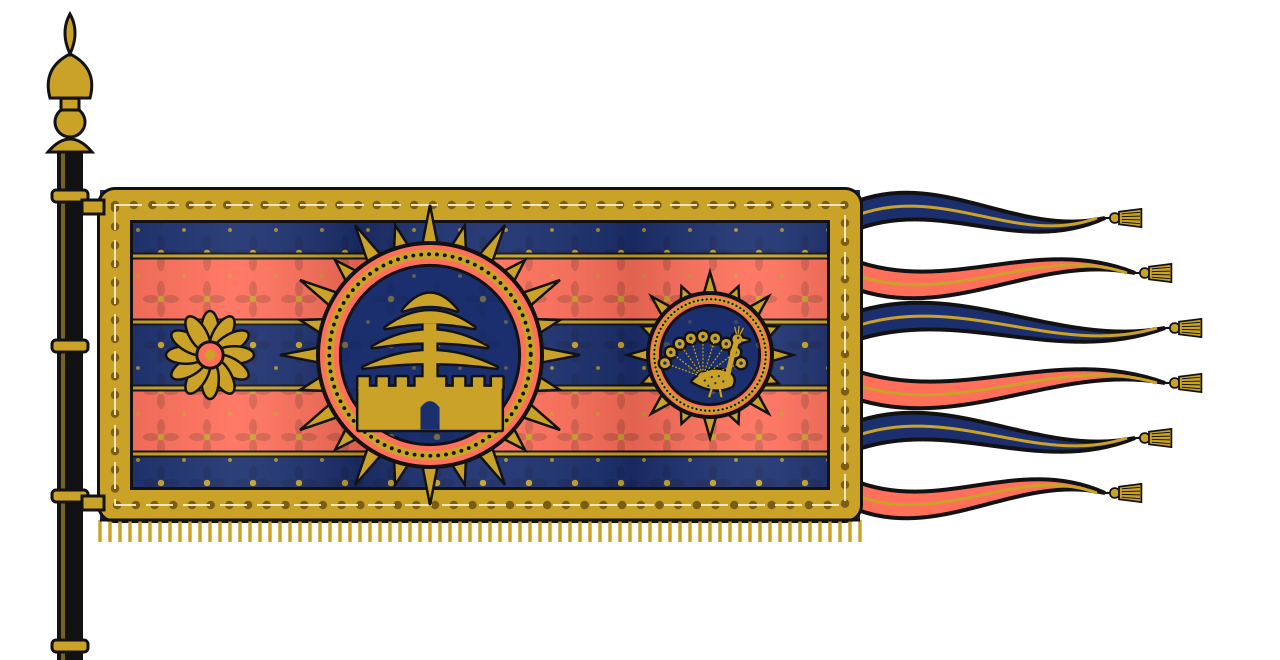
| Night and day | Every visual accessory has two versions: by night the emblem on the dark field, by day the clan's field colour on cloth woven from its metal. |
6. Flags
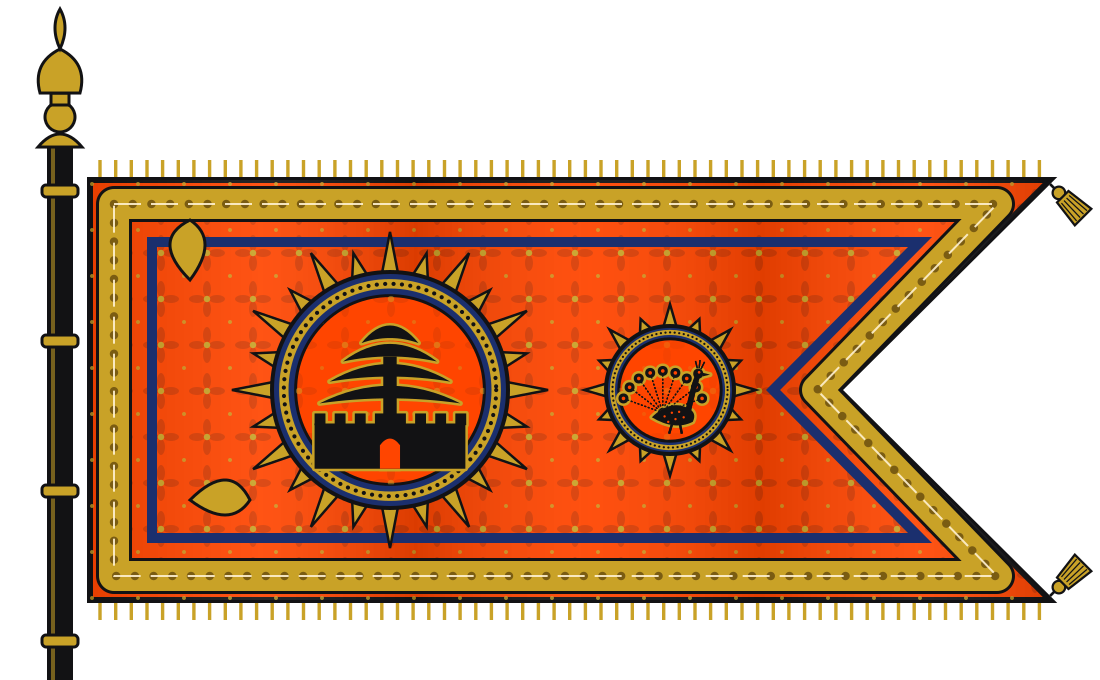
Every clan has every flag type; the type says the occasion and the colours say the clan. The outlined card is the flag the Atlas assigns.
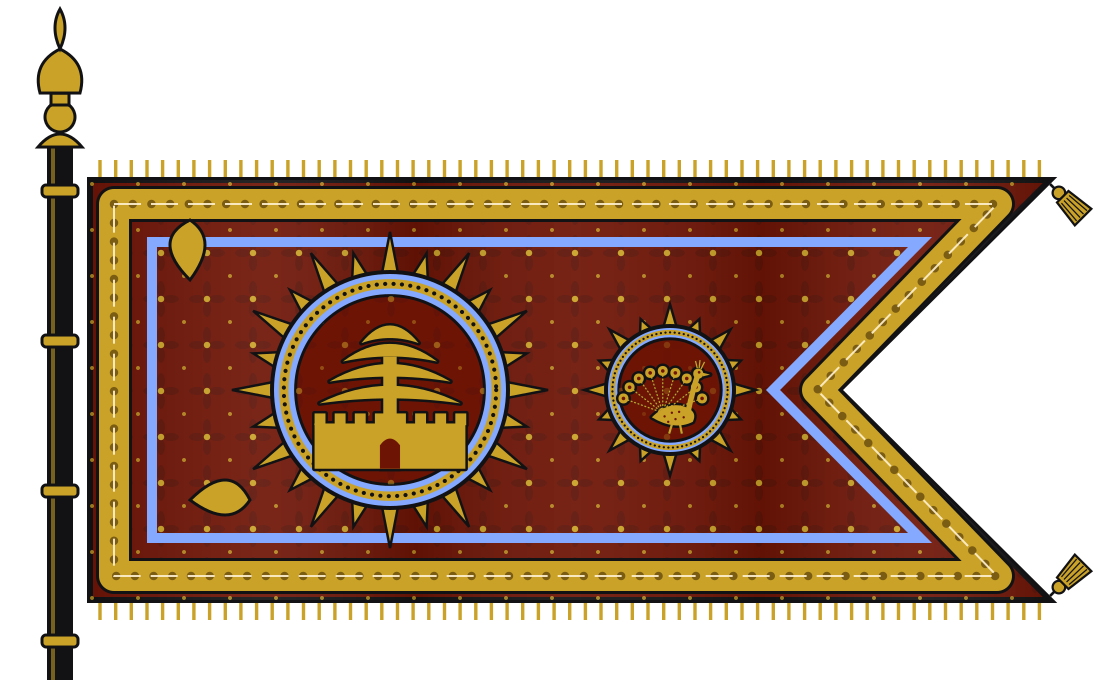
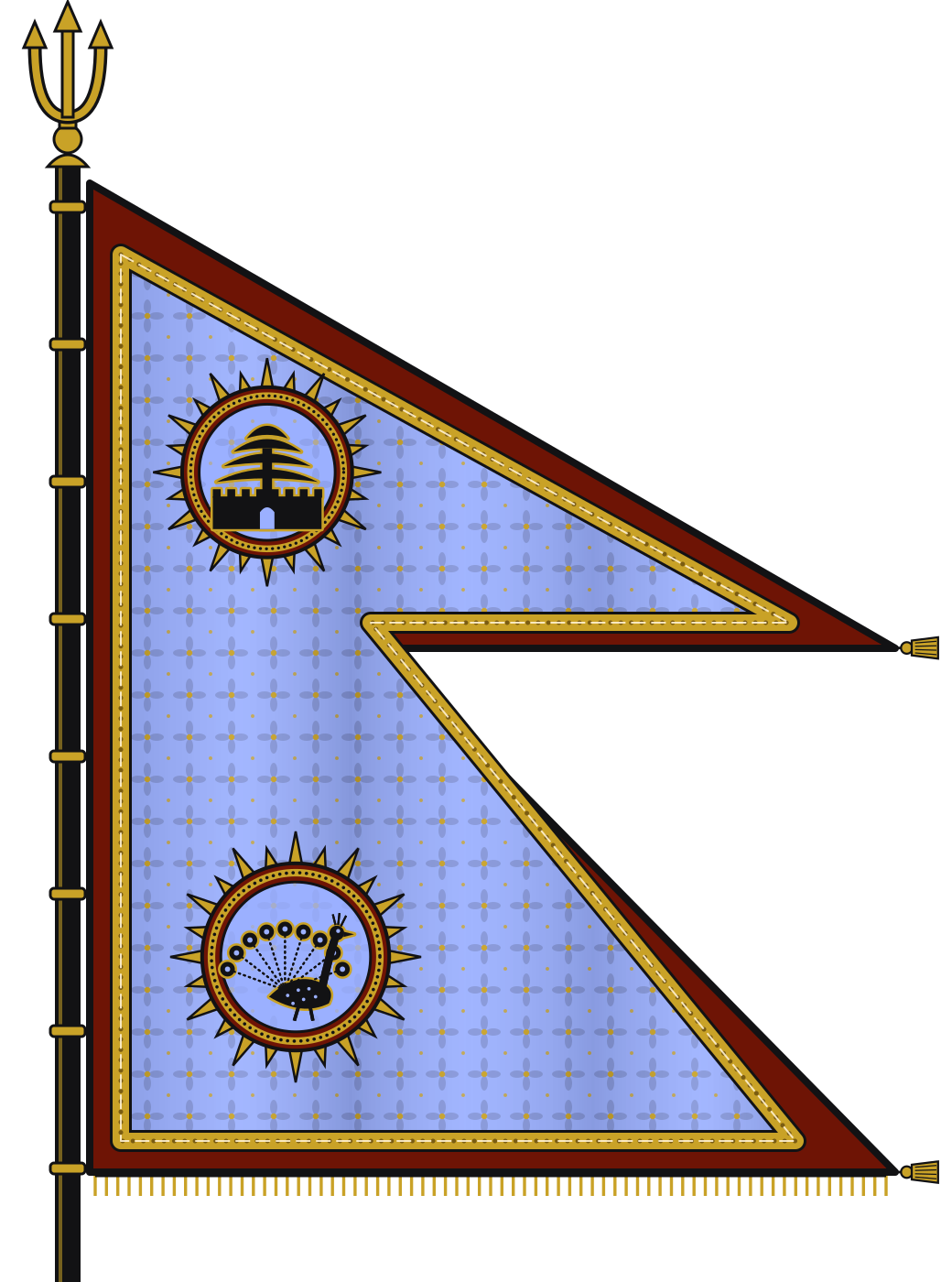
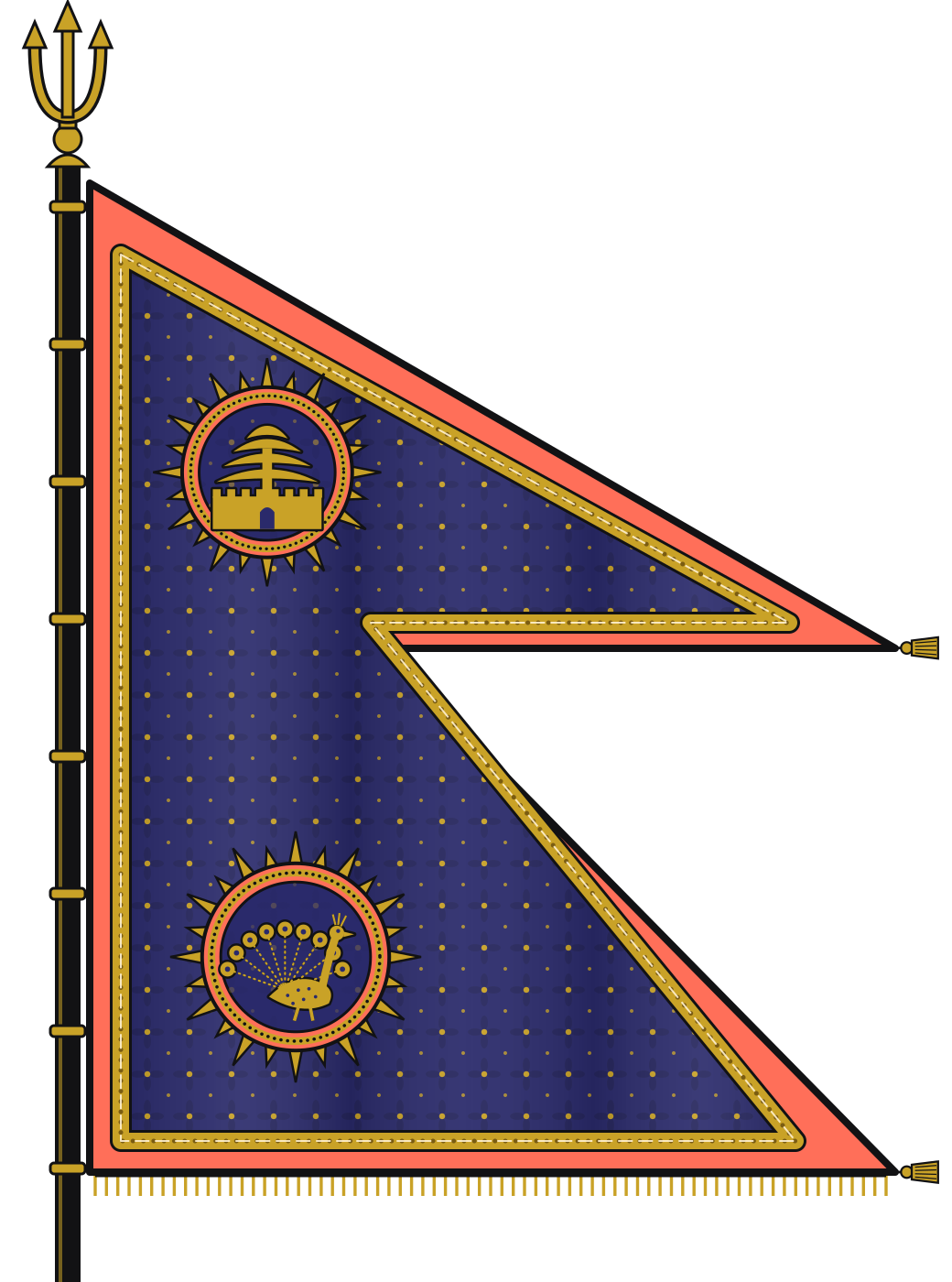




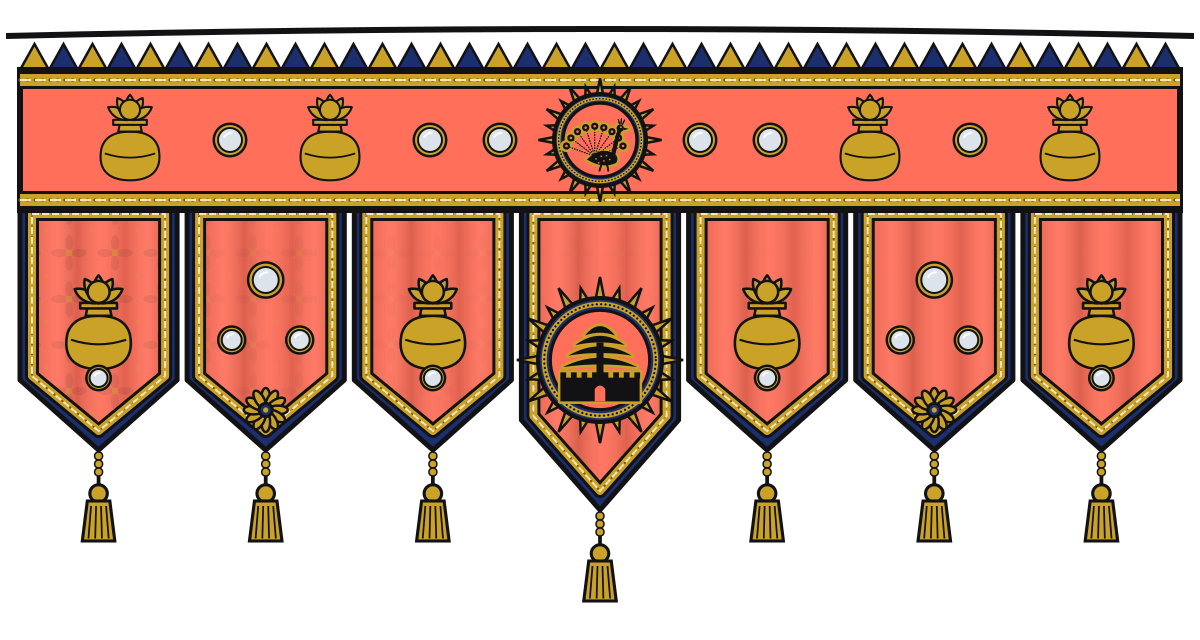
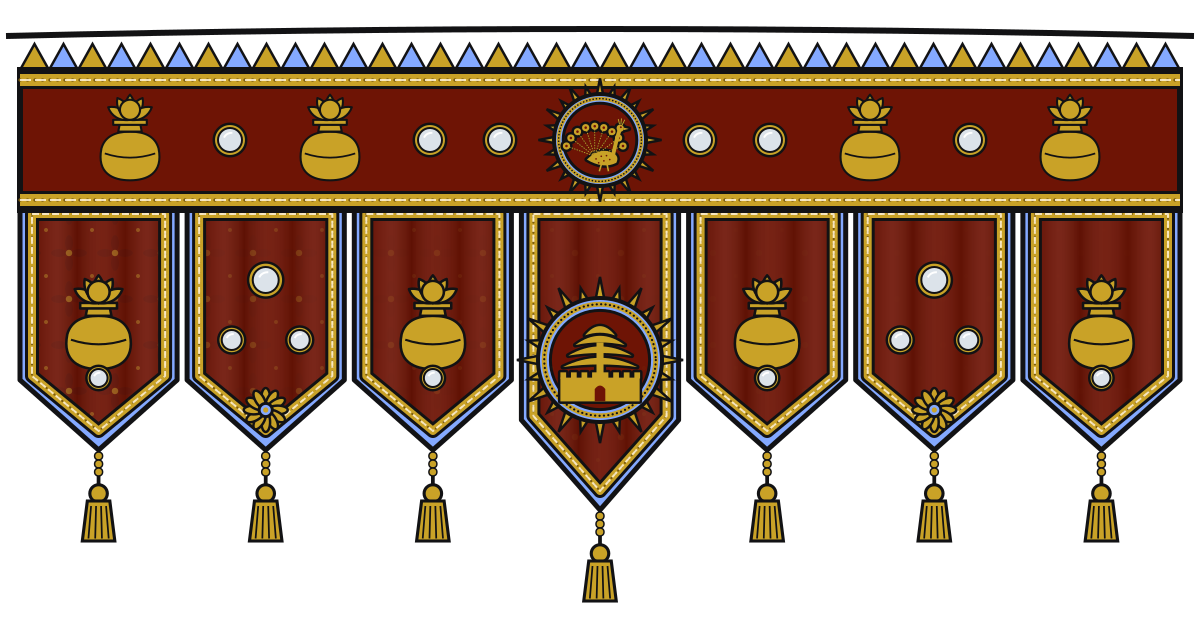

Historic banner
Gond community flags are used by the Gondwana movement; designs vary (verify before use)
New flag types
| Accessory | For this clan | Basis |
|---|---|---|
| A9 Pota-dhvaja · ship and trade flag For ships, caravans and markets | Not yet designed for this clan | Design |
| A10 Utsava-patāka · festival flag Light, bright flag for fairs and festivals | Not yet designed for this clan | Design |
| A11 Shoka-dhvaja · mourning flag White cloth with the emblem outline in the clan's metal | Not yet designed for this clan | Design |
7. Regalia
| Accessory | For this clan | Basis |
|---|---|---|
| E1 Chhatra · house parasol The ceremonial umbrella | Not yet designed for this clan | Design |
| E2 Chamara · fly-whisks The pair of whisks beside the head of the house | Chawar: cow's-tail whisk kept among the Deo-khulla gods | Documented |
| E3 Danda · staff of office Staff or scepter | Not yet designed for this clan | Design |
| E4 Simhasana · seat The seat of the house, covered in clan cloth | Not yet designed for this clan | Design |
| E5 Khetaka · shield A round shield; the Changi and Dhanush are its flag forms | Not yet designed for this clan | Regional tradition |
| E6 Kula-ayudha · clan weapon The weapon the clan honours | Pharsi Pen, the battle-axe god, and the spear-shaped iron gods of the Deo-khulla | Documented |
8. Worn
| Accessory | For this clan | Basis |
|---|---|---|
| F1 Kula-vastra · clan cloth The clan's woven pattern in its kit colours | Palo: embroidered cloth that covers the spear-heads of the Deo-khulla, worked with a bullock, deer, snake and elephant | Documented |
| F2 Kirti-vastra · honour cloth A cloth earned for a deed, not inherited | Not yet designed for this clan | Design |
| F3 Kula-mala · garland flower The flower or leaf the clan wears as a garland | Not yet found for this clan | Under research |
| F4 Chinha · house pin A metal badge with the pin emblem | Not yet designed for this clan | Design |
9. Records
| Accessory | For this clan | Basis |
|---|---|---|
| H1 Clan words A traditional line in the native script | वह अपने शत्रुओं के लिए वैसा ही था जैसे कपास की पुंज के लिए प्रलयंकारी अग्नि · “To his enemies he was like a destroying fire to a bale of cotton” Ramnagar inscription of Sangram Shah, as quoted in Gupta 2019[4] | Design |
| H2 Biruda · titles The house's title or titles | Singh and Shah, titles of the Gond rajas; the title Sangram Shah given by the sultan of Gujarat | Documented |
| H3 Prashasti · praise genealogy The lineage as written at the head of a grant | Not yet found for this clan | Under research |
| H4 Vahi · clan register The book of the clan's births, marriages and deaths | Not yet found for this clan | Under research |
| H5 Rana-ghosha · war cry The clan's cry in battle or celebration | Not yet found for this clan | Under research |
10. VishwaVit · knower of the world
Game values are design choices for this project, not historical claims.
References
- Wikipedia, Gondi people, read 2026-10-10, https://en.wikipedia.org/wiki/Gondi_people
- Wikipedia, Gondwana kingdoms, read 2026-10-10, https://en.wikipedia.org/wiki/Gondwana_kingdoms
- Wikipedia, Garha kingdom, read 2026-10-10, https://en.wikipedia.org/wiki/Garha_kingdom
- Wikipedia, Sangram Shah, read 2026-10-10, https://en.wikipedia.org/wiki/Sangram_Shah
- R. V. Russell, The Tribes and Castes of the Central Provinces of India, vol. 3 (1916), Project Gutenberg #41424, read 2026-10-10, https://gutenberg.org/cache/epub/41424/pg41424-images.html
- R. Knight, The Muria Gond people of Bastar District, Chhattisgarh, Oberlin, read 2026-10-10, https://www2.oberlin.edu/faculty/rknight/muria.htm
- Odisha State Tribal Museum, Tribes of Odisha: Gond, read 2026-10-10, https://www.ostm.in/tribes_of_odisha/gond/
- Bharatdiscovery, गोंड, read 2026-10-10, https://bharatdiscovery.org/india/%E0%A4%97%E0%A5%8B%E0%A4%82%E0%A4%A1
- Bharatdiscovery, सैला कर्मा नृत्य (from sczcc.gov.in, accessed 2012), read 2026-10-10, https://bharatdiscovery.org/india/सैला_कर्मा_नृत्य
- dhammabharat.com, List of Scheduled Tribes in Maharashtra and Population of each Tribe (2011 Census), read 2026-10-10, https://dhammabharat.com/?p=13656