The Garo call themselves A·chik or Mande, and their language, A·chikku, is a Tibeto-Burman tongue written in Latin script[1][2][3]. They live mainly in the Garo Hills of Meghalaya, with communities in Assam, Tripura, West Bengal, Nagaland and Bangladesh[1][2]. Their society is matrilineal: children belong to the mother's machong, the youngest daughter inherits, and the husband lives in his wife's house[1][2]. Their traditional religion, Songsarek, centres on the supreme god Tatara Rabuga and the sun and crops deity Misi Saljong[4], and the harvest festival Wangala is held in October and November[2]. Their leader Pa Togan Nengminja Sangma resisted the British, though the sources give conflicting dates for his fall (see section 07)[5][1].
01Faith and deities
Kamakhya of Assam, the great goddess of the north-east[6]
The clan followed another faith. This goddess of its homeland is assigned for naming only.
| Deity or tradition | Place in the clan's life | Evidence |
|---|---|---|
| Tatara Rabuga (Tatara Rabuga Stura Pantura) | Creator and supreme god | [4][1] |
| Misi Saljong (Saljong; the sun god) | Deputy god of the sun, crops and fertility; the first Wangala harvest is offered to him in Rugala; Wangala honours him | [4][2] |
| Susime | Goddess of wealth; the women's diamond-pattern skirts are said to represent her eye; the moon, as Playfair gives it (pp. 80–86) | [4][7][8] |
| Rokkime (Mother Goddess of Rice) | Honoured with Saljong at the Agalmaka festival | [4] |
| Chorabudi | Protects the crops; pig sacrifice | [1] |
| Nawang | A spirit on the way to the land of the dead; malevolent, as Playfair gives it (pp. 80–86) | [1][8] |
| Goera | Strength (Indpaedia); thunder and strength (Playfair, pp. 80–86, as Goéra) | [7][8] |
| Mite | Spirits, as the Meghalaya page prints them | [1] |
| Songsarek living | The Garo animist religion: deities appeased by rituals and animal sacrifice; the name means, in Garo, those who obey the deities; the article notes a possible link with Bengali (Erik de Maaker 2007) | [4][2] |
| Nostu-Nopantu | The world-maker, as Playfair names him (pp. 80–86) | [8] |
| Machi | Named in Playfair’s list of deities; no role is given in the pages read (pp. 80–86) | [8] |
| Kalkamé | Named in Playfair’s list of deities; no role is given (pp. 80–86) | [8] |
| Asima-Dingsima | Named in Playfair’s list of deities; no role is given (pp. 80–86) | [8] |
| Brara and Dégni | The stars, as Playfair names them (pp. 80–86) | [8] |
02Temples
No temple built or patronised by the Garo is recorded in the sources read for this page. Kamakhya (the sheet's KulDevi) is a site that Garo folk tales claim; that is a claim, not patronage[6].
Built by the clan
Not recorded.
Given patronage or grants by the clan
Not recorded.
03Languages and scripts
| Language or script | Kind | Under the clan | Evidence |
|---|---|---|---|
| Garo (A·chikku) living | Tibeto-Burman, Sal group (article); Bodo-Garo | 1,145,323 speakers (2011) | [3] |
| Latin script living | Script; the raka (·) marks the glottal stop; 20 letters | In use since the late 19th century; by 1924 Latin had replaced Bengali (the article flags this for clarification) | [3][2] |
| Bengali script lost | Script used to record Garo | Late 19th century: Baptists recorded A·we in it; Latin replaced it (article, flagged) | [3] |
| A·chik Tokbirim living | Script invented in 1979 by Arun Richil Marak; glyphs are not given in the extracts | Used in Bhabanipur, Bangladesh (article) | [3] |
| Dialects living | A·beng/Am·beng, Matabeng, Atong, Me·gam, Matchi, Dual, Ruga, Chibok, Chisak, Gara, Gan·ching, A·we | Atong, Ruga and Me·gam are ethnically Garo but linguistically distinct | [3][2] |
| Kin words | Ama (mother), Apa (father), Abi (elder sister) | The Garo language | [3] |
04Books and literature
The language article lists further works without titles: Burling and Joseph (2006), Watre Ingty (2008), Wood (2008) and van Breugel (2014, Atong grammar). Titles are not given in the article, so they are not listed.
Written during the clan's history
| Work | Author | Kind | When | Link to the clan |
|---|---|---|---|---|
| The Garos | A. Playfair | Book | 1909 | [2] |
| The Psyche of Garos | T. C. Sinha | Book | 1955 | [2] |
| The Garo tribal religion: beliefs and practices | Paulinus R. Marak | Book | 2005 | [2] |
| Food Politics | Queenbala Marak | Book | 2014 | [2] |
| First Garo Bible | Not given | Bible | 1924 | [2] |
| Language of the Modhupur Mandi, vol. 1 | Burling | Book | 2003 | [3] |
| “Garo Marriages, 1” | Not given | Article in Folk-Lore vol. 32 | Not given | [9] |
| Garo and Khasi: a comparative study in matrilineal systems | Chie Nakane | Book (abstract read) | 1967 | [10] |
| “The Garo Perception of Disease and Medicine: A History since the British Regime in the Indian Sub-Continent” | Pratibha Mandal | Article, Indian Journal of History of Science 49.3 | 2014 | [11] |
Given patronage by the clan
Not recorded.
05Thinkers and scholars
| Name | Field | Era | Contribution |
|---|---|---|---|
| Ramke W. Momin | Educationist and philosopher | Born Goalpara, 1830s (citation needed in the article) | Described as the first Christian Garo[2] |
| Paulinus R. Marak | Writer on Garo religion | 2005 | The Garo tribal religion: beliefs and practices[2] |
| T. C. Sinha | Writer on the Garo | 1955 | The Psyche of Garos[2] |
| A. Playfair | Writer on the Garo | 1909 | The Garos, London: Nutt[2] |
| Burling | Language | 2003 | Language of the Modhupur Mandi, vol. 1[3] |
Ramke W. Momin's birth date is marked as needing a citation in the article. Playfair's book is cited through the article; the book itself has not been read in this run.
06Art and architecture
The Garo sources name weaving, ornaments, crafts and watchtowers. No painting or sculpture is recorded in the extracts, and most items are not dated.
Painting and wall art
Not recorded.
Sculpture and temple art
Not recorded.
Temple and building architecture
| Art form | What it is | Era | Evidence |
|---|---|---|---|
| Borang watchtowers | Watchtowers named in the Meghalaya page's list of Garo art | Not dated | [1] |
Weaving and textiles
| Art form | What it is | Era | Evidence |
|---|---|---|---|
| Dakmanda and Daksaria | Weaving, named in the Meghalaya page's list | Not dated | [1] |
| Eri silk: Samanda, Muga A'dokgre | Silk, named in the Meghalaya page's list | Not dated | [1] |
Clothing and jewellery
| Art form | What it is | Era | Evidence |
|---|---|---|---|
| Ornaments: nadongbi (sisa), nadirong, natapsi, jaksan, ripok, jaksil, penta, sengki, pilne | Ornaments named in the article's list of Garo art | Not dated | [2] |
Coins, pottery and crafts
| Art form | What it is | Era | Evidence |
|---|---|---|---|
| Am (mat), Kera/Kok (basket), Ruan, Gitchera, Chokki | Crafts named in the Meghalaya page's list | Not dated | [1] |
07History
Oral tradition and the first kingdom
The Meghalaya government page gives the early past as legend and oral tradition: a first Garo kingdom near Habraghat Pargana in Goalpara, first ruled by Abrasen legend, with its seat at Sambol A'ding near Dakaitdol[1]. The Wikipedia article gives a migration from Tibet (“Tibotgre”) under Jappa Jalimpa, Sukpa and Bongepa legend, dated c. 400 BC, but cites nothing for the date[2].
Playfair’s legends of a plains kingdom (as recorded in 1909)
Playfair records a tradition of a Garo kingdom near Tukeswar, whose first prince was Abrasen, with its capital Sambol Ading near Dakaitdol in Habraghat pargana, said to be named after him. He was told that no ruins are visible. Five or six later “kings” follow, the last about the end of the 18th century; their names are not matched to Assamese lists (pp. 10–11)[8].
The same legends name Dhobani legend, a king near Dhubri, perhaps a confusion with the washerwoman Dhubini; Lilasing legend, an Assamese raja who persecuted the migrants; and Arambit legend, a chief who married the Garo maiden Jugé-Silché. None of these names is in the Assamese king lists (pp. 9–11), and the legend places Rangamati “near Rangpur” (p. 9)[8].
A legend of Mussulman invaders, with no date established
In the migration legend, the ancestors meet invaders whom Playfair’s text calls Mussulmans, who had invaded Assam, and one of them is said to marry a Garo princess (p. 11), as recorded in 1909[8]. Playfair cannot tie the invasion to a known date: the candidate dates he lists are 1498 and 1683, and some versions name Aurungzeb, which “would appear to point to” Mir Jumla’s invasion of 1655 (p. 11)[8].
No Mughal-era document for the Garo is in the pages of Playfair read for this page, and the Saraighat account gives the Garos only as Ahom allies[12].
Records from c. 1800
The earliest records, c. 1800, from the East India Company (citing Playfair), call the Garo headhunters[2]. Indpaedia dates British contact to the late 18th century and records raids on Goalpara and Mymensing[7].
The Ahom alliance at Saraighat, 1669–1671
The Garos were among the Ahom allies in the Saraighat campaign against the Mughal army under Ram Singh I of Amber, with the Jaintia, the Nagas, the Rani of Darrang and the Raja of Rani[12]. The campaign events cited here run from 1667 to 1671.
British occupation, 1872–73
The Wikipedia article dates the British occupation of the Garo Hills to 1872[5]. The Meghalaya page gives the annexation as 1873, with Captain Williamson as the first Deputy Commissioner[1], and Indpaedia gives early 1873 for the whole Garo Hills[7]. The Wikipedia article also names a December 1872 expedition and a Battle of Rongrenggre, and marks both as needing citation[2].
Playfair on raids, the Deputy Commissioner and head-hunting
Playfair (as recorded in 1909) cites Mackenzie for raids on settlements in Goalpara and Mymensingh, and for grievances over market passes controlled by zemindars (p. 77)[8]. He names Lieut. Williamson as the first Deputy Commissioner (p. 77); the Meghalaya page calls him Captain Williamson[1]. An officer and police were stationed in the Garo Hills in 1866 after the raids (p. 77). Playfair gives 1876 as the last trace of head-hunting, when 200 skulls were surrendered and burnt (p. 78)[8].
Playfair quotes Mackenzie (p. 76): “A man’s great grandfather was killed fifty years ago.” Mandal (2014) gives 1864 as the start of Christian conversion and 1867 as the start of British administration in the Garo Hills[11]. These dates differ from the 1872–73 dates above and are listed in the open notes.
Pa Togan Nengminja Sangma: a conflict in the dates
Pa Togan Nengminja Sangma, an A·chik leader, resisted the British with warriors called Matgriks. The Wikipedia article describes a night attack on sleeping soldiers, with heavy Garo losses, and says he died on the spot; the article marks this account as needing citations[5]. A statue of him stands at Chisobibra, East Garo Hills[5].
Sourced conflict. The Meghalaya page dates his fall at Chisobibra, near Rongrengiri, to 12 December 1837, as printed, and records a memorial and yearly commemoration[1]. The Wikipedia article dates the British occupation to 1872, in the same article that describes his resistance[5]. The two sources do not agree, and neither has been checked against a primary text in this run, so the year of his fall is left open here.
Under the British and after
Tura became the headquarters in 1873[3]. The Baptist mission came from Tura in the early 1900s[2]. The Garo Hills were split into East and West in October 1979, and the East Garo Hills headquarters, Williamnagar, was called Simsanggre until 1976[1].
Playfair’s 1901 census counted 34,180 plains Garo in Mymensingh and 10,842 in Goalpara (p. 4)[8]; Mandal (2014) gives a Garo total of 138,274 for 1901[11]. The eHRAF abstract of Nakane (1967) says expansion into the lowlands brought intense contact with the Hindu population, and that missionaries and schools were sources of change[10].
08Journey and migrations
The Garo tradition is of a crossing from Tibet. Later moves within the hills and into the plains are not dated in the sources read for this page.
| When | From | To | Why | Evidence |
|---|---|---|---|---|
| Oral tradition (c. 400 BC, uncited) | Tibet (“Tibotgre”, province Torus) | Across the Brahmaputra (“Songdu Chibima”) | Migration under Jappa Jalimpa, Sukpa and Bongepa, as the tradition tells it | [2][7] |
| Reached (not dated) | Mymensingh side | Garo Hills | Playfair says the Garo Hills were reached from the Mymensingh side (p. 4); the Cooch Behar and Jalpaiguri settlements are in the lands list[8] | [8] |
| Early contact (not dated) | Garo Hills | Goalpara and Mymensing | Raids, as Indpaedia records them | [7] |
09Seats and lands
| Place | Role | Where today |
|---|---|---|
| Garo Hills | Homeland; East and West Garo Hills | Meghalaya |
| Williamnagar | Headquarters of East Garo Hills; called Simsanggre until 1976 | Meghalaya |
| East Garo Hills district | 1443 sq km; population 145,798 as printed (Meghalaya page) | Meghalaya |
| Khasi Hills and Ri-Bhoi | Garo settlement areas named in the article | Meghalaya |
| Kamrup, Goalpara, Sivasagar, Karbi Anglong | Garo settlement areas named in the article | Assam |
| Tripura | Garo community area named in the article | Tripura |
| Cooch Behar, Jalpaiguri, Darjeeling, West Dinajpur | Garo settlement areas named in the article; Bardhaman and Dinajpur also named by GKToday | West Bengal |
| Nagaland | Garo community area named in the article | Nagaland |
| Mymensingh, Tangail, Netrokona, Sunamganj, Sylhet, Gazipur; Haluaghat, Dhobaura | Garo settlement areas in Bangladesh (Banglapedia, via the article) | Bangladesh |
| Ta'sek Lake | Formed by the 1897 earthquake; the water serpent Sangkini is linked with it | Meghalaya |
| Rongrengiri Reserve Forest, Chisobibra | Site of Pa Togan Nengminja Sangma's fall (as the Meghalaya page dates it) | Meghalaya |
| Mymensingh; Goalpara | Plains Garo in the 1901 census: 34,180 and 10,842 (Playfair, p. 4)[8] | Bangladesh; Assam |
10Notable figures
| Name | Role | Era | Known from |
|---|---|---|---|
| Pa Togan Nengminja Sangma | A·chik leader who resisted the British, with warriors called Matgriks | 1837 (Meghalaya page, as printed); no year for his death in the Wikipedia extract (see section 07) | [5][1] |
| Ramke W. Momin | Educationist and philosopher; described as the first Christian Garo | Born Goalpara, 1830s (citation needed in the article) | [2] |
| Conrad K. Sangma | Named in the article's list of notable people; no role given in the extract | Not given | [2] |
| Mukul M. Sangma | Named in the article's list of notable people; no role given in the extract | Not given | [2] |
| Purno A. Sangma | Named in the article's list of notable people; no role given in the extract | Not given | [2] |
| Agatha Sangma | Named in the article's list of notable people; no role given in the extract | Not given | [2] |
| Rupa M. Marak | Named in the article's list of notable people; no role given in the extract | Not given | [2] |
| Numal Momin | Named in the article's list of notable people; no role given in the extract | Not given | [2] |
| Jewel Arengh | Named in the article's list of notable people; no role given in the extract | Not given | [2] |
| Gilbertson Sangma | Named in the article's list of notable people; no role given in the extract | Not given | [2] |
| Lieut. Williamson | First Deputy Commissioner of the Garo Hills, as Playfair names him (p. 77); the Meghalaya page calls him Captain Williamson | Not dated in the extract | [8][1] |
11Allies, rivals and marriages
| People | Relationship | When |
|---|---|---|
| Ahoms | Allies of the Garo side in the Saraighat campaign (Garos listed among the Ahom allies) | 1667–1671 |
| Jaintia, Nagas, Rani of Darrang, Raja of Rani | Fellow allies of the Ahoms at Saraighat | 1667–1671 |
| Mughal army (Ram Singh I of Amber) | Opponents of the Ahom allies at Saraighat | 1667–1671 |
| British | Resisted by Pa Togan Nengminja Sangma; the Garo Hills were occupied and annexed (dates differ by source) | 1837 (Meghalaya page, as printed); occupation 1872–73 (dates differ by source) |
| Khasi | Both named as matrilineal peoples of Meghalaya; the Khasi avoid cross-cousin marriage, which the Garo prefer | Agarwal 1994, as cited |
| Koch and Rabha | Named as users of Kamakhya as a sacrificial site; Garo folk tales also claim the site | Kamakhya article (undated) |
| Mizo | A similar bachelors' institution, Nokpanti (Garo) and Zawlbuk (Mizo) | Not dated |
| Kiratas | Linked people in the Atlas; no extract states the link | Atlas |
| Jaintia (Jayantias) | The Ahoms often called the Jayantias “Garos” (Ahom-tribal Relations, Ch. I, p. 6, citing Bhuyan)[13] | Not dated in the extract |
| Kachari | Playfair says the Kachari and Garo are very close linguistically, perhaps “originally one and the same” (p. 15), as recorded in 1909[8] | Not dated |
| Koch | Playfair discusses Hamilton’s “Kochunasindiya” and the Garo–Koch identity (pp. 60–63); the NVLI extract reads that identity as uncertain[8] | Not dated |
| Invaders in the migration legend | The legend’s invaders are not identified; Playfair links Aurungzeb to Mir Jumla’s 1655 invasion only as a possibility (p. 11)[8] | 1498, 1683 or 1655 (candidate dates only) |
12Society and livelihood
Garo society is matrilineal. Descent and inheritance run through the mother and the youngest daughter, and the Meghalaya page calls the people casteless. The Wikipedia article says the society is not accurately matriarchal.
Government and social order
| Institution or group | What it was | Evidence |
|---|---|---|
| Machong (motherhood) | The lineage unit: children belong to the mother's machong; husband and wife must belong to different septs and motherhoods (Playfair, as cited) | [1][9] |
| Nokna and Nokrom | The youngest daughter (Nokna, also Nokmechik) is the heiress; her husband (Nokrom) lives in her house | [1][7][2] |
| Nokma | The headman of the village, who organises Wangala; the nokma historically redistributed land each year | [1] |
| Nokpanti (or Nokpante) | A dormitory to which sons go from puberty; the Zawlbuk article lists it as the Garo counterpart of the Mizo Zawlbuk | [2][14] |
| Chatchi (Katchi) | Five exogamous groups: Sangma, Marak, Momin, Shira, Arengh; marriage within the same Katchi is prohibited | [7][15] |
| Marriage rules | Cross-cousin marriage with the father's sister's daughter; nokrom marriage if there is no cousin; the law of akim limits a widow's or widower's remarriage to within the motherhoods unless the family agrees | [9] |
| Marriage by capture | Called Chawarisikka in the article | [2] |
| Jik-mamung and jik-gité | The principal wife (jik-mamung) and the secondary wife (jik-gité), as Playfair names them (pp. 66–79) | [8] |
| Aktim | The rule on widows; in 1883 fifty Someswari women petitioned at Tura against it (p. 69), as recorded in 1909 | [8] |
| Bolseli dena | The divorce oath (pp. 66–79) | [8] |
| Dai | Compensation (pp. 66–79) | [8] |
| Ordeals: sid-sa and cholela-sia | Hot iron (sid-sa) and boiling water (cholela-sia), the ordeals Playfair records (pp. 66–79) | [8] |
| Laskar | An honorary magistrate (pp. 66–79) | [8] |
| Quit-rent and service | Quit-rent called hawtt and avkimil; jak-gitok sika, which the extract does not explain (pp. 66–79) | [8] |
| Property and lineages | In Garo and Khasi societies women own property and men control it; the Garo property group rests on two local lineages, which the abstract says weakens Garo solidarity compared with the Khasi[10] | [10] |
Livelihood over time
| Era | Livelihood | Evidence |
|---|---|---|
| Traditional (not dated) | Jhum (shifting cultivation) in the hills; wet rice in the plains | [1] |
| As Mandal (2014) describes it | Shifting cultivation, fishing, weaving, basket making and barter; diet largely unchanged in a century | [11] |
13Sub-clans and related clans
The Garo lineage unit is the machong (motherhood), the basic unit of Garo social organisation (GlobalSecurity). Five exogamous chatchi (Katchis) are named: Sangma, Marak, Momin, Shira and Arengh. Sangma and Marak are the original groups; the others, per Indpaedia, evolved from them.
| Clan | Relation | Where | Size | In the Atlas | Evidence |
|---|---|---|---|---|---|
| Sangma | Sub-clan | Garo Hills (chatchi) | new clan candidate | [1][7] | |
| Marak | Sub-clan | Garo Hills (chatchi) | new clan candidate | [1][7] | |
| Momin | Sub-clan | Garo Hills (chatchi) | new clan candidate | [1][7] | |
| Shira | Sub-clan | Garo Hills (chatchi); spelled Shirra by GlobalSecurity; Playfair (1909) writes Sira among the emerging septs | new clan candidate | [1][15][8] | |
| Arengh | Sub-clan | Garo Hills (chatchi); spelled Areng by GlobalSecurity; Playfair (1909) writes Areng among the emerging septs | new clan candidate | [1][15][8] | |
| Ebang | Sub-clan | Named as a sub-division of the Katchis; not one of the five chatchi on the Meghalaya page; Playfair (1909) names Ebang among the emerging septs | new clan candidate | [15][8] | |
| Ambeng A·beng, Am·beng | Branch | Dialect group, as printed; Playfair (1909) also spells it Abeng | new clan candidate | [1][3][8] | |
| Akawe A·we | Branch | Dialect group, as printed; Playfair (1909) spells it Akawé/Awé | new clan candidate | [1][3][8] | |
| Matabeng Matabeng | Branch | Dialect group, as printed; Playfair (1909) pairs it as Matjanchi/Matabeng | new clan candidate | [1][2][8] | |
| Matchi Matchi | Branch | Dialect group, as printed; Playfair (1909) spells it Machi | new clan candidate | [1][2][8] | |
| Dual Duals | Branch | Dialect group, as printed; among Playfair’s thirteen divisions (pp. 59–66) | new clan candidate | [1][2][8] | |
| Chibok Chibok | Branch | Dialect group, as printed; among Playfair’s thirteen divisions (pp. 59–66) | new clan candidate | [1][2][8] | |
| Chisak Megam (Lyngngam) Chisak | Branch | Dialect group, as printed (the Meghalaya page gives Lyngngam as an alias); Playfair (1909) writes Megam/Lynngam | new clan candidate | [1][8] | |
| Gara-Ganching Gan·ching | Branch | Dialect group, as printed; Playfair (1909) spells it Ganching/Gara | new clan candidate | [1][2][8] | |
| Atong | Related people | Ethnically Garo, linguistically distinct; Playfair (1909) lists it among the thirteen divisions | new clan candidate | [3][8] | |
| Ruga | Related people | Ethnically Garo, linguistically distinct; among Playfair’s thirteen divisions (pp. 59–66) | new clan candidate | [3][8] | |
| Me·gam | Related people | Ethnically Garo, linguistically distinct | new clan candidate | [3] | |
| Boro | Related people | Listed as related in the article; place not in the extracts | ST-043 | [2] Atlas | |
| Bodo-Kachari | Related people | Listed as related in the article; no place given | new clan candidate | [2] | |
| Hajong | Related people | West Bengal (2011 list) | 621, 2011[16] | ST-094 | [2][16] |
| Rabha | Related people | Assam, Meghalaya, West Bengal | 27,820, West Bengal 2011[16] | ST-268 | [2] |
| Koch | Related people | Garo Hills; Assam and North Bengal | ST-136 | [2] | |
| Dimasa | Related people | Assam | ST-071 | [2] | |
| Tripuri | Related people | Tripura | ST-319 | [2] | |
| Konyak | Related people | Listed as related in the article | ST-153 | [2] | |
| Khasi | Related people | Meghalaya | ST-132 | [17][6] | |
| Kiratas | Related people | Ancient peoples; linked in the Atlas | ANC-056 | Atlas (linked peoples) | |
| Kochu | Sub-clan | Division, as Playfair (1909) lists it among the thirteen divisions (pp. 59–66) | new clan candidate | [8] | |
| Atiagra | Sub-clan | Division, as Playfair (1909) lists it among the thirteen divisions (pp. 59–66) | new clan candidate | [8] | |
| Rangsan | Sub-clan | Motherhood (machong) with a bear as its totem, as Playfair (1909) gives it | new clan candidate | [8] | |
| Naringré-do°kru | Sub-clan | Motherhood (machong) with a dove as its totem, as Playfair (1909) gives it | new clan candidate | [8] | |
| Drokeré | Sub-clan | Motherhood (machong) with a hen as its totem, as Playfair (1909) gives it | new clan candidate | [8] | |
| Koknal | Sub-clan | Motherhood (machong) example, as Playfair (1909) names it; no totem given | new clan candidate | [8] | |
| Do°bakkol | Sub-clan | Motherhood (machong) example, as Playfair (1909) names it; no totem given | new clan candidate | [8] | |
| Wasra | Sub-clan | Motherhood (machong) example, named after a cave and a stream, as Playfair (1909) gives it | new clan candidate | [8] |
Clans marked "new clan candidate" are not in the Atlas yet.
14Surnames
Surnames as the Wikipedia article and Indpaedia print them. The extracts give no counts for any surname, so none is given.
| Surname | Clan or sub-clan | Where | People with this surname | Also used by other communities |
|---|---|---|---|---|
| Sangma | Sangma | Garo Hills | not yet counted | No |
| Marak | Marak | Garo Hills | not yet counted | No |
| Momin | Momin | Garo Hills | not yet counted | No |
| Shira | Shira | Garo Hills | not yet counted | No |
| Arengh | Arengh | Garo Hills | not yet counted | No |
Counts are of everyone with the surname, from the cited source and year, not only members of this clan. A surname shared with other communities says nothing about any one person's origin.
15Songs and music
No Garo song is quoted in the sources read for this page, so no title or lyric is given. The Meghalaya page names two dramas staged at Rajasimla (see section 17).
None recorded yet.
Instruments and styles
| Instrument or style | What it is | Evidence |
|---|---|---|
| Drums, gongs and horns | Played in the lines at Wangala, including the 100-drums festival at Asanang near Tura | [2][1] |
16Poems, lullabies and children's rhymes
No poems or lullabies are recorded in the sources read for this page.
None recorded yet.
17Stories, legends and proverbs
Stories and legends
| Story | What happens | Told by | Evidence |
|---|---|---|---|
| Kalsin-Sonatchi (drama) | A drama staged at Rajasimla; the plot is not given | Not given | [1] |
| Serejing Wal'jan (drama) | A drama staged at Rajasimla; the plot is not given | Not given | [1] |
| Night attack on sleeping soldiers research | Pa Togan's attack by night on sleeping soldiers, with heavy Garo losses; he died on the spot. The article marks this account as needing citations | Wikipedia article (uncited) | [5] |
| The migration legend and the invaders legend | Ancestors meet invaders, one of whom marries a Garo princess; Playfair cannot identify the invasion (p. 11), as recorded in 1909 | Not dated | [8] |
| Abrasen and Sambol Ading legend | The first prince of a Garo kingdom near Tukeswar, and its capital Sambol Ading near Dakaitdol (p. 10) | Not dated | [8] |
| Arambit and Jugé-Silché legend | Arambit, a chief, marries the Garo maiden Jugé-Silché; Lilasing, an Assamese raja, persecutes the migrants (pp. 9–10) | Not dated | [8] |
Proverbs and sayings
Not recorded.
18Festivals and fairs
| Festival or fair | When | Where | What happens |
|---|---|---|---|
| Wangala living | October and November; a harvest thanksgiving organised by the nokma | Garo Hills; the 100-drums festival at Asanang near Tura | Males and females in lines with drums, gongs and horns; fruit swung on a string; the wa'pong sika bamboo-pole contest; three-finger rice-flour handprints on doors; the first harvest offered to Misi Saljong in Rugala. The Meghalaya page calls it the greatest festival[2][1][4] Playfair (1909) also gives a dérégata dance (p. 56) and the rites of Saljong (p. 81)[8]. |
| Agalmaka | Not given | Not given | Honours Saljong and Rokkime[4] |
| Christmas season | December 2003 (the tree) | Tura | A Christmas tree of 119.3 ft at Dobasipara, Tura, in December 2003 (BBC, as the article cites it)[2] |
| Simsang festival | Since 2006 | Williamnagar | A festival held since 2006; no detail given[2] |
| Ganna | Not given | Not given | An elbow-ring ceremony for the nokma, as Playfair records it (p. 54)[8] |
| Ajémua | Not given | Not given | A funeral dance (p. 57)[8] |
| Asongtata and Asongroka | Not given | Not given | Sacrificial stones, as Playfair names them (p. 82)[8] |
19Food, dress and games
Food
| Item | What it is | Evidence |
|---|---|---|
| Rice | Staple food | [2] |
| Taro, millet, maize, tapioca | Other crops | [2] |
| Kochu, dried fish, bamboo shoot | Food | [2] |
| Boiled meat with Kalchi (alkaline salt) | Food, as the Meghalaya page describes it | [1] |
| Minil Bichi | Rice liquor | [2] |
| Chu | Sacred drink | [2] |
Dress
| Item | What it is | Evidence |
|---|---|---|
| Women's diamond-pattern skirt | Said to represent Susime's eye (Mendiratta, The Pioneer, 2024, as cited) | [4] |
Games and martial arts
| Item | What it is | Evidence |
|---|---|---|
| Wa'pong sika | A bamboo-pole contest held at Wangala | [1] |
Tags: living still practised · revived brought back after a break · lost known only from records · research reported but not yet confirmed from a source. Songs and poems under copyright are listed by title only; restricted or sacred material is noted without its content.
20Status today
The Garo are a Scheduled Tribe in India (list dated 09-07-2024, Atlas) and, per the Atlas, a recognised small ethnic group in Bangladesh. Most of them live in Meghalaya; the article gives 821,026 in Meghalaya out of 997,716 in India, with the India total's year not stated[2].
Who carries the name today
| Community | Link | Basis | Evidence |
|---|---|---|---|
| Atong (ID not in sheet) | Documented | [3] | |
| Ruga (ID not in sheet) | Documented | [3] | |
| Me·gam (ID not in sheet) | Documented | [3] |
Recognised heritage
| What | Recognition | Evidence |
|---|---|---|
| Wangala festival | Kept each October and November, with the nokma organising it (Meghalaya page) | [1] |
| Songsarek | The Risi Jilma organisation, founded 2000, covers about 480 villages and preserves Songsarek (article) | [2] |
| Garo language | NEHU Tura Department of Garo since 1996 (article) | [3] |
| Pa Togan Nengminja Sangma | A memorial and yearly commemoration at Chisobibra (Meghalaya page); a statue at Chisobibra, East Garo Hills (Wikipedia) | [1][5] |
| Samachik Sikman hospital | Opened in 2011 by the Meghalaya Sam Achik Association, founded in 2003[11] | [11] |
Community review status: not recorded in the pack. This page has not been reviewed by the Garo community, and no review is claimed.
21For children
The drums of the harvest
The Garo people live in the Garo Hills of Meghalaya and in lands nearby. They call themselves A·chik. Their harvest festival is called Wangala, and it is held in October or November to give thanks. People gather in lines while drums, gongs and horns are played. Rice is their main food. In a Garo family, the youngest daughter is the heiress, and her husband goes to live in her family's house.
Written for this project
Riddle: I am a harvest feast with drums, gongs and horns. Who am I? (Wangala)
22Across the project
| Project | What carries this clan | Status |
|---|---|---|
| Atlas of the Janas | Homeland and the lands in section 09. No footprint file has been written for this run, so no pins are placed | To check |
| KulDevi and GrahDevi | KulDevi Kamakhya (basis: assigned, not the Garo faith). GrahDevi forms: Kali, Tara, Shodashi, Bhuvaneshvari, Bhairavi, Chhinnamasta, Dhumavati, Bagalamukhi, Matangi, Kamala | From the Atlas |
| Planet naming | Sal (sun), Jajong (moon) and Mikka (rain), as the language article gives them; planets not checked | Under research |
| Renaming and waters | Simsanggre became Williamnagar in 1976; Ta'sek Lake was formed by the 1897 earthquake, with the water serpent Sangkini (Meghalaya page) | From the Meghalaya page |
23Open questions
- Pa Togan Nengminja Sangma: fall at Chisobibra dated 12 December 1837 (Meghalaya page, as printed) against the 1872 occupation date in the Wikipedia article. The Playfair extract for pp. vi–86 has no entry for him. Check Playfair beyond p. 86 and the other Pa Togan sources.
- Annexation year: 1872 (Wikipedia), early 1873 (Indpaedia) and 1873 (Meghalaya page). Mandal (2014) gives 1867 for British administration, and Playfair (p. 77) has an officer and police stationed in 1866 after raids. The December 1872 expedition and the Battle of Rongrenggre are marked as needing citation. Playfair’s chapter on the British annexation is not read.
- Williamson’s rank: Playfair (p. 77) says Lieut. Williamson; the Meghalaya page says Captain Williamson. Check against a primary text.
- Mughal-era documents: none in the pages of Playfair read (pp. vi–86), and the legend of invaders (p. 11) has no established date. The Koch and Saraighat extracts give no Garo document.
- Native-script forms: the extracts give only Latin-script Garo, and no Bengali-script Garo text. The glyphs of A·chik Tokbirim are not given. Check the Bengali-script records of the A·we (late 19th century) and the NEHU and Prothom Alo sources.
- Official language: the article reports full state official status in 2026 (Indian Express). Verify before relying on it.
- Tripura: a tribes-of-Tripura page in the cache gives 11,180 Garo (Vajiram; year not checked in this run). It is not on the page; check the year before adding it.
- Other leads: the Lyngngam influence (Khasi codex); the Egerton 1880 mention of the Garo as troublesome neighbours to tea-planters (the text is at data/sources/texts/books/egerton-1880-indian-arms.txt, not read here).
- Songs, rhymes and proverbs: none are in the pages of Playfair read (pp. vi–86). The Garu-a° song is named (p. 7) without its text. Leads: Playfair from p. 86 on; Wangala accounts not yet read.
- Machong names: Playfair gives Rangsan, Naringré-do°kru, Drokeré, Koknal, Do°bakkol and Wasra; the total number of machong and the rest are not in the extract. Check the People of India vol. VIII text.
- Ebang, Areng and Sira: Playfair calls them emerging septs beside Momin, Marak and Sangma and spells them Areng and Sira. The Meghalaya page names Arengh among the five chatchi. Whether the emerging septs count as chatchi, and whether Sira is the same name as Shira, is open.
- Divisions: Playfair gives thirteen (pp. 59–66) and Mandal (2014) twelve. The spellings differ (Machi and Matchi; Matjanchi and Matabeng; Abeng and Ambeng). Check against a primary text before merging any two.
- Garo place names and figures: the notable-people list gives names but no roles or dates. Check each person before adding a role.
- Totem trio and accessories: the machong totems are bear, dove and hen; the extracts give no tree for the trio. The elbow-ring (Ganna) and the sacrificial stones Asongtata and Asongroka have no catalogue item in this codex.
- Review drafts for Kochu, Atiagra and the machong units: no extract gives latitude or longitude for them, so no pin is set.
- Bor, Haru, Pani and Tintekiya Koch (Playfair pp. 19–22) are Koch groups, not Garo sub-clans. Their notes are in the spillover for the Koch codex, and no Garo draft is written for them.
- Population: Mandal (2014) gives 976,005 at Census 2011 and 138,274 in 1901; the article gives 997,716 for India (year not stated) and about 1.2 million (c. 2011). Check the census year and total before using any figure.
- Community review: no review by the Garo community is recorded.
24Astitva
अस्तित्व · being, existence: everything by which the clan is known
The sources give no Garo coin, seal, royal regalia or war cry. Documented here: the nokma's title, the memorial stones, the mil·am sword, the women's diamond-pattern skirt and the wagtail's flight[4][2][1]. Playfair (1909) adds the machong totems, listed under the totem trio[8].
Every clan has every accessory, royal objects included. Each one says how it is known: Documented This clan's own object is recorded. · Regional tradition Recorded for the region or for peoples like this one, not for this clan. · Design Made for this project, with no historical claim. · Under research To be found for this clan from sources. Legends and titles are written in the clan's own script.
1. Seals and coins
| Accessory | For this clan | Basis |
|---|---|---|
| B1 Rajamudra · house seal Round seal with the clan emblem and a short legend in the clan's script | Not yet designed for this clan | Design |
| B2 Anguliya-mudra · signet ring Personal seal ring of the head of the house | Not yet designed for this clan | Design |
| B3 Chhapa · house stamp Ink or block stamp for letters, goods and cloth | Not yet designed for this clan | Design |
| B4 Tamrapatra · charter plate Copper-plate grant on a ring, closed with the house seal | Not yet designed for this clan | Design |
| B5 Shreni-mudra · guild or trade seal Seal for the clan's trade, craft or caravan | Not yet designed for this clan | Design |
| C1 Clan coin Emblem or deity on one side, a legend in the clan's script | Not yet designed for this clan | Design |
| C2 Coin die The die that strikes the coin | Not yet designed for this clan | Design |
2. Living symbols
| Accessory | For this clan | Basis |
|---|---|---|
| I1 Totem trio The tree, bird and animal the clan protects | Wagtail (bird): its flight is watched to predict rainfall. Machong totems as Playfair (1909) gives them: a bear (Rangsan), a dove (Naringré-do°kru) and a hen (Drokeré); the tree of the trio is not in the extract | Documented |
| I2 Kaval-maram · guardian tree The tree that stands at the clan's seat | Not yet found for this clan | Under research |
3. Stone and gate
| Accessory | For this clan | Basis |
|---|---|---|
| G1 Torana · gateway The built gate of the seat; the cloth Toran hangs in it | Not yet designed for this clan | Regional tradition |
| G2 Viragallu · hero stone Carved panel stone for a member who died defending the clan | Not yet designed for this clan | Regional tradition |
| G3 Kula-shila · clan stones Standing and table stones that remember the ancestors | Memorial stones for the ancestors, honoured with food | Documented |
| G4 Jayastambha · victory pillar A pillar raised for a victory | Not yet designed for this clan | Design |
| G5 Sima-shila · boundary stone Marks the clan's land, with a line in the native script | Not yet designed for this clan | Design |
4. Sounds
| Accessory | For this clan | Basis |
|---|---|---|
| D1 Pancha-mahashabda · five great sounds The right to five instruments | Not yet designed for this clan | Design |
| D2 Shankha · clan conch The clan's own named war conch | Not yet designed for this clan | Design |
| D3 Murasu · house drums Three drums: war, charity and justice | Not yet designed for this clan | Design |
5. Kit: colours, metals and emblems
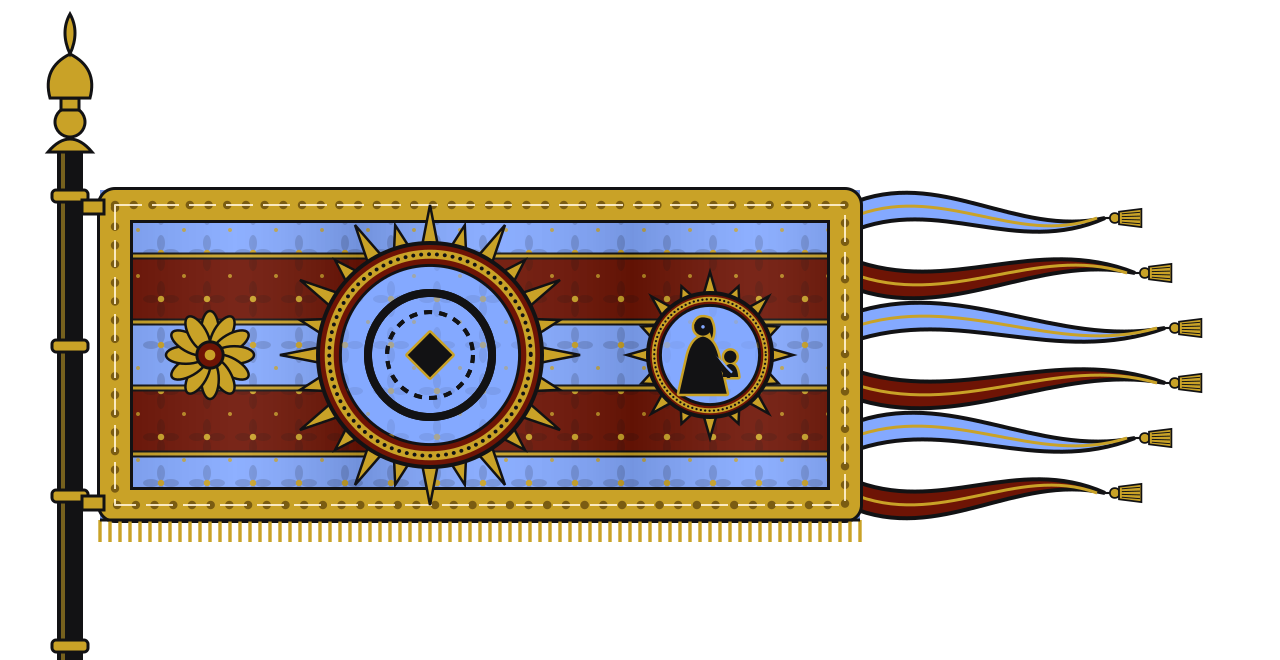
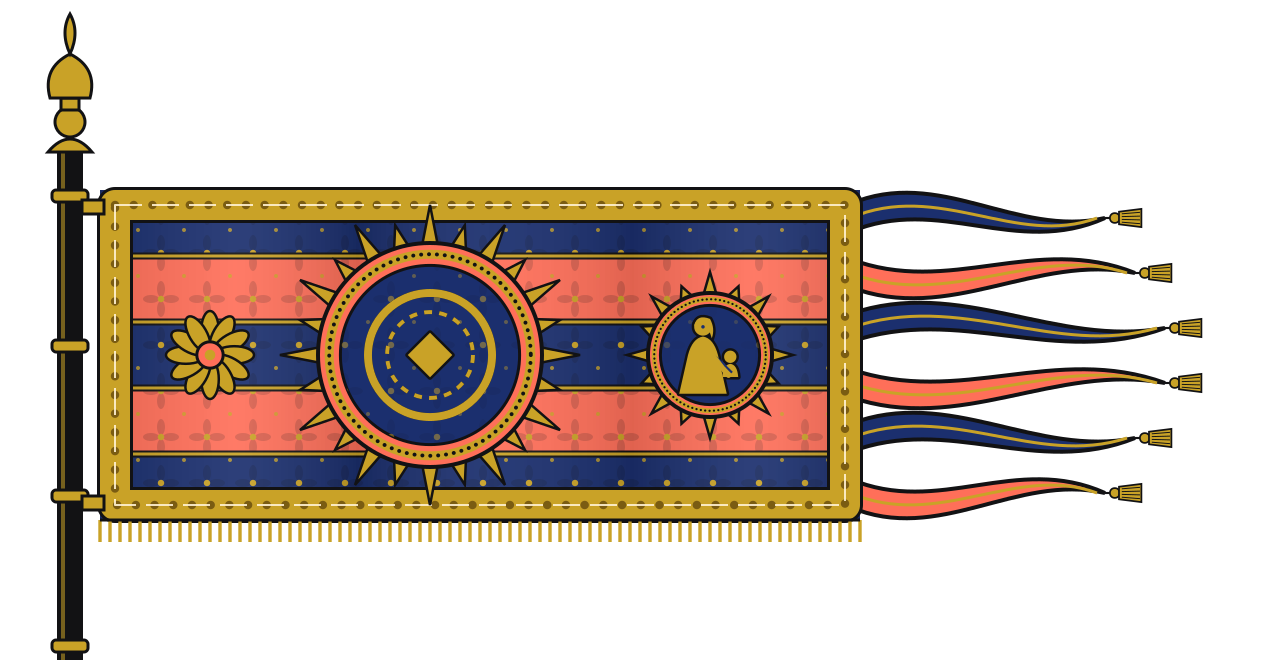
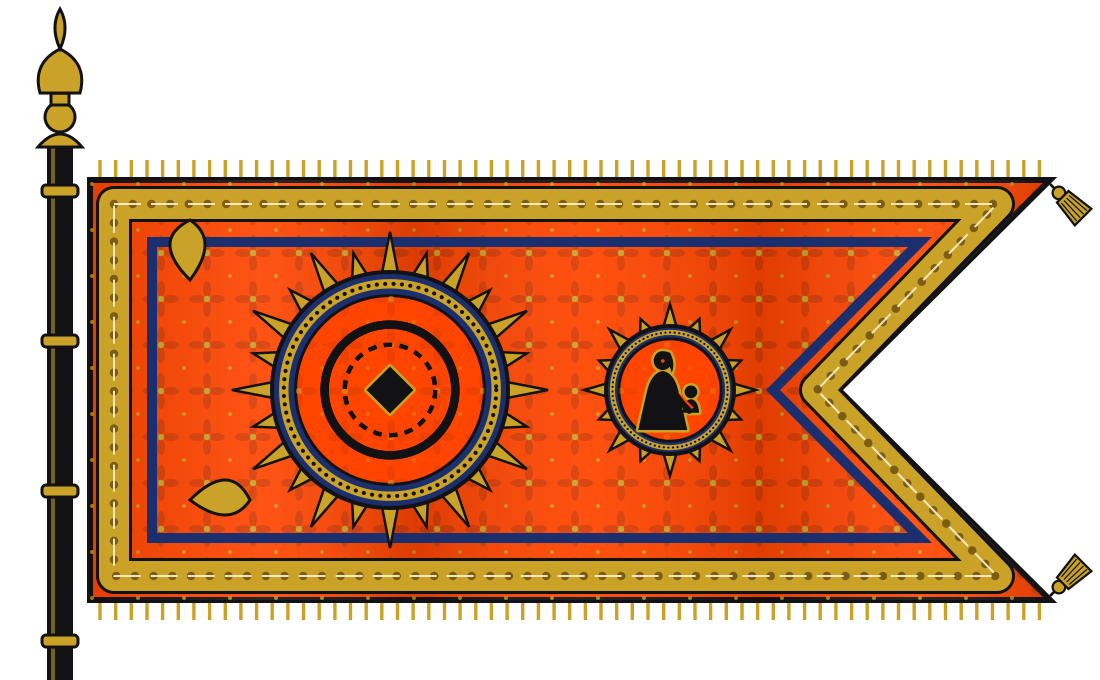
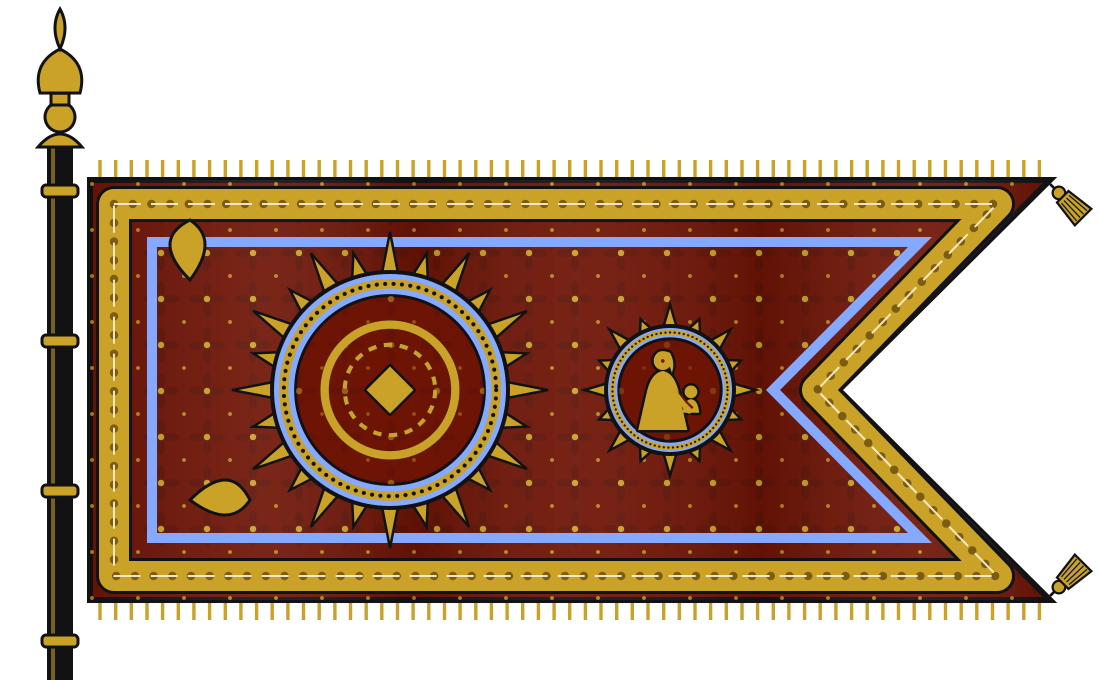
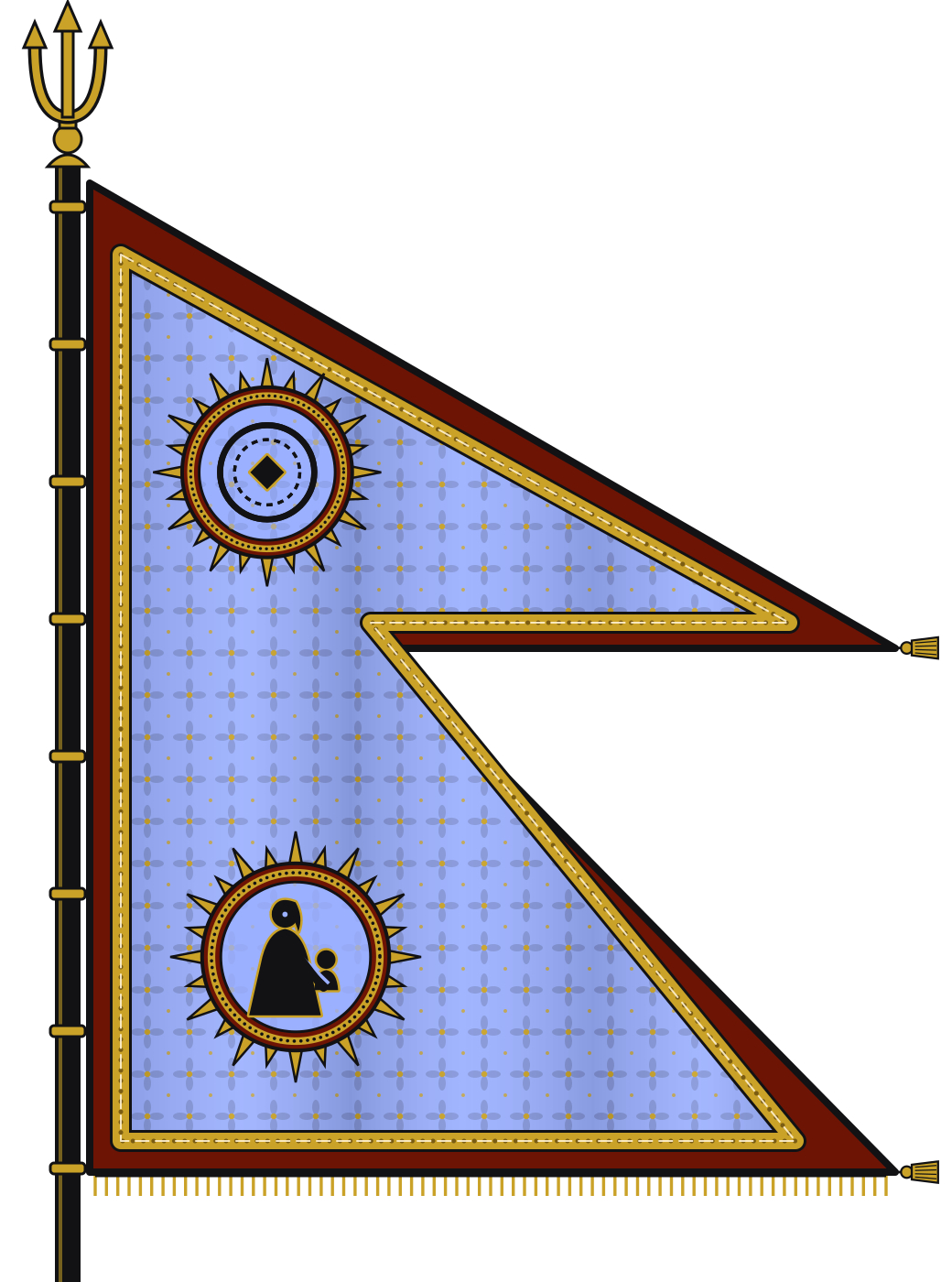
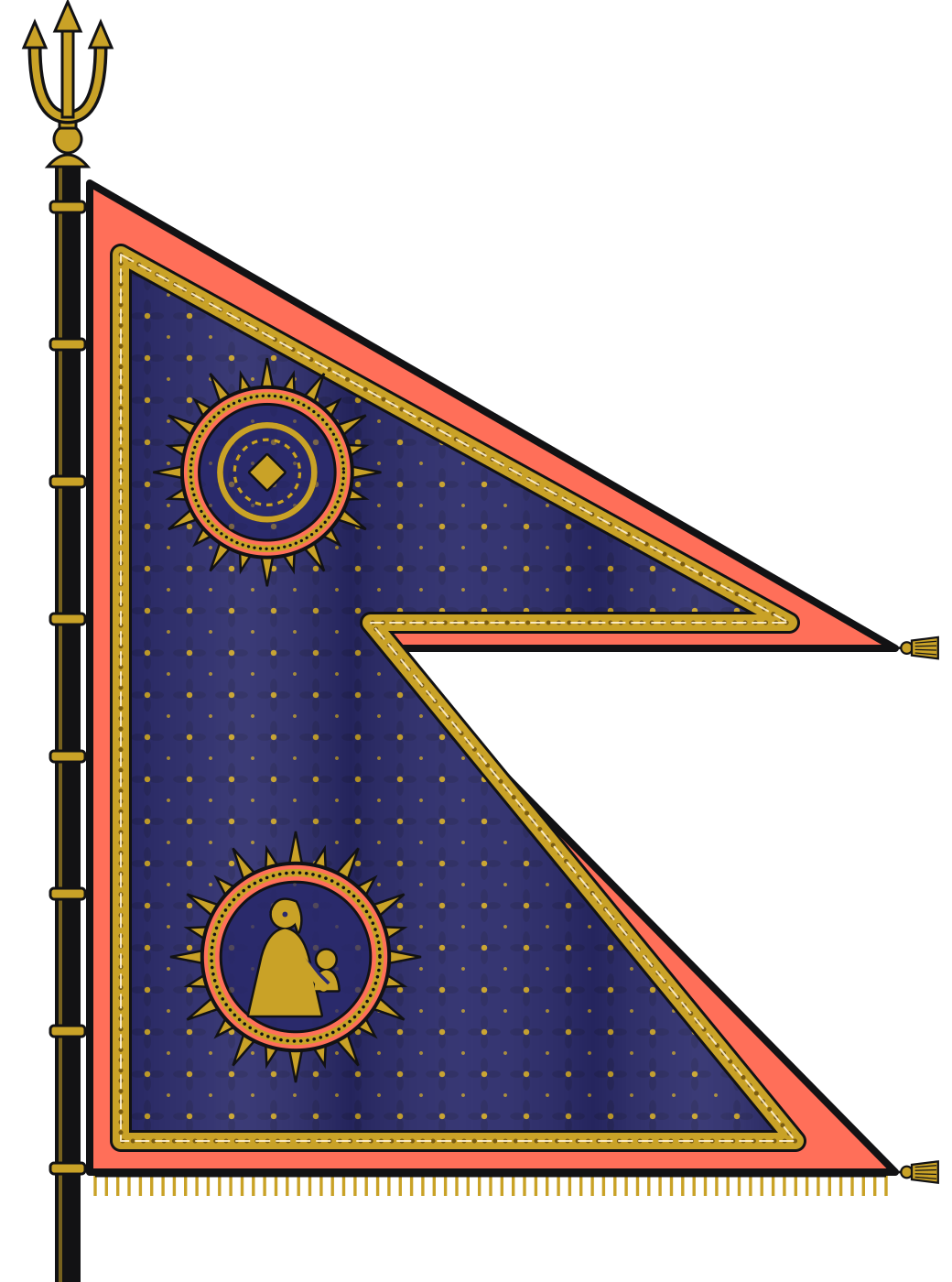
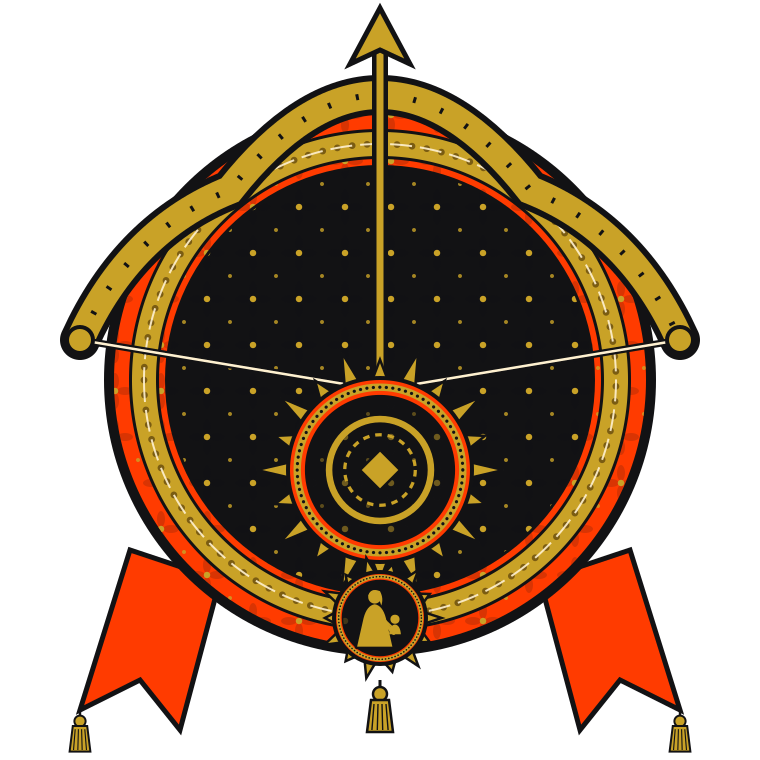
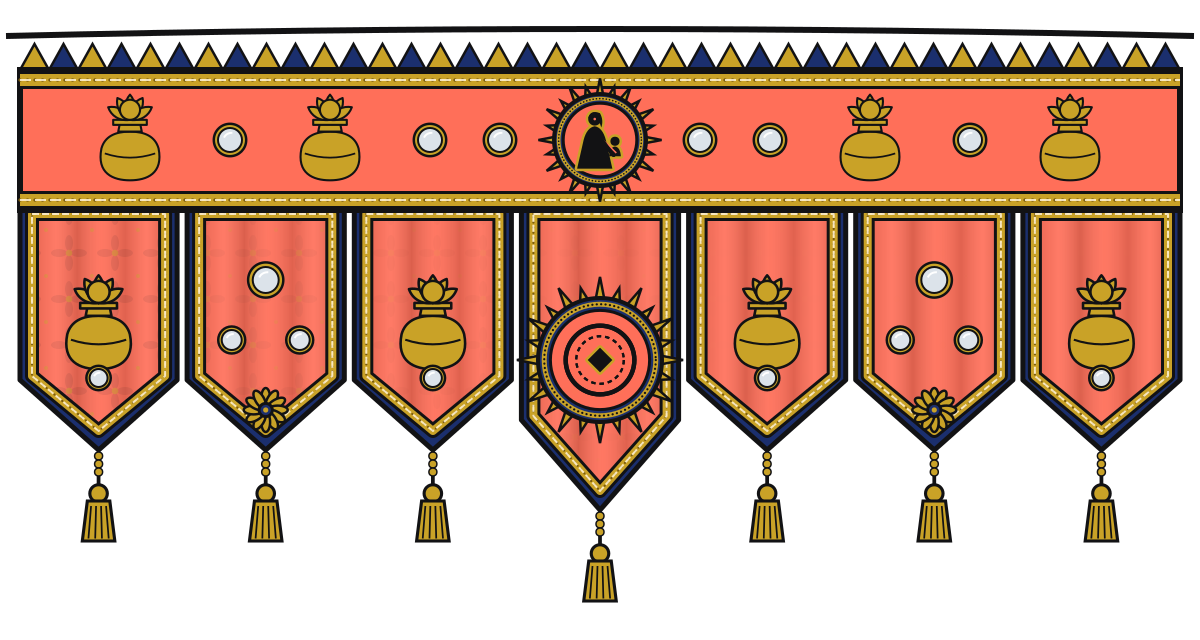
The Atlas's emblem and flag are project designs: a ring of drums for the Wangala 100-drums festival, and a mother figure for matrilineal society[2][4]. No documented arms or emblem for the Garo are recorded in the extracts.
| Part of the kit | This clan |
|---|---|
| Field | Deep Brick #7E2A1E |
| Accent | Deep Cosmic Blue #9BB0FF |
| Emblem colour | Metallic Gold #C9A227 |
| Zari metal | Gold |
| Main emblem | A ring of drums |
| Second image | A mother figure |
| Night and day | Every visual accessory has two versions: by night the emblem on the dark field, by day the clan's field colour on cloth woven from its metal. |

6. Flags
Every clan has every flag type; the type says the occasion and the colours say the clan. The outlined card is the flag the Atlas assigns.



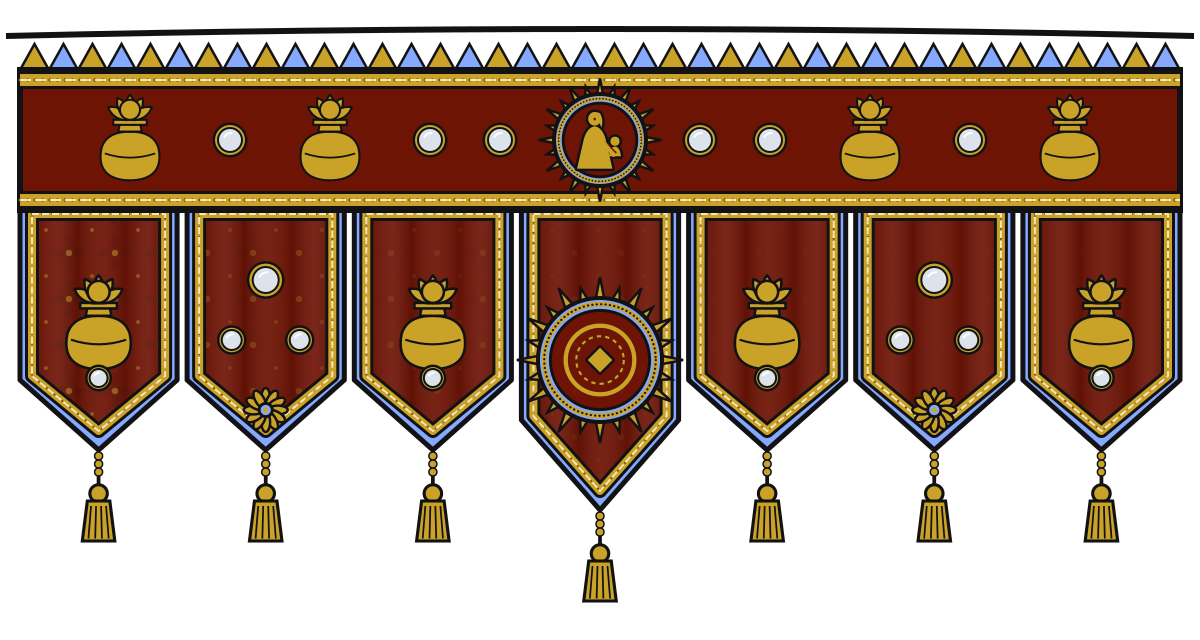
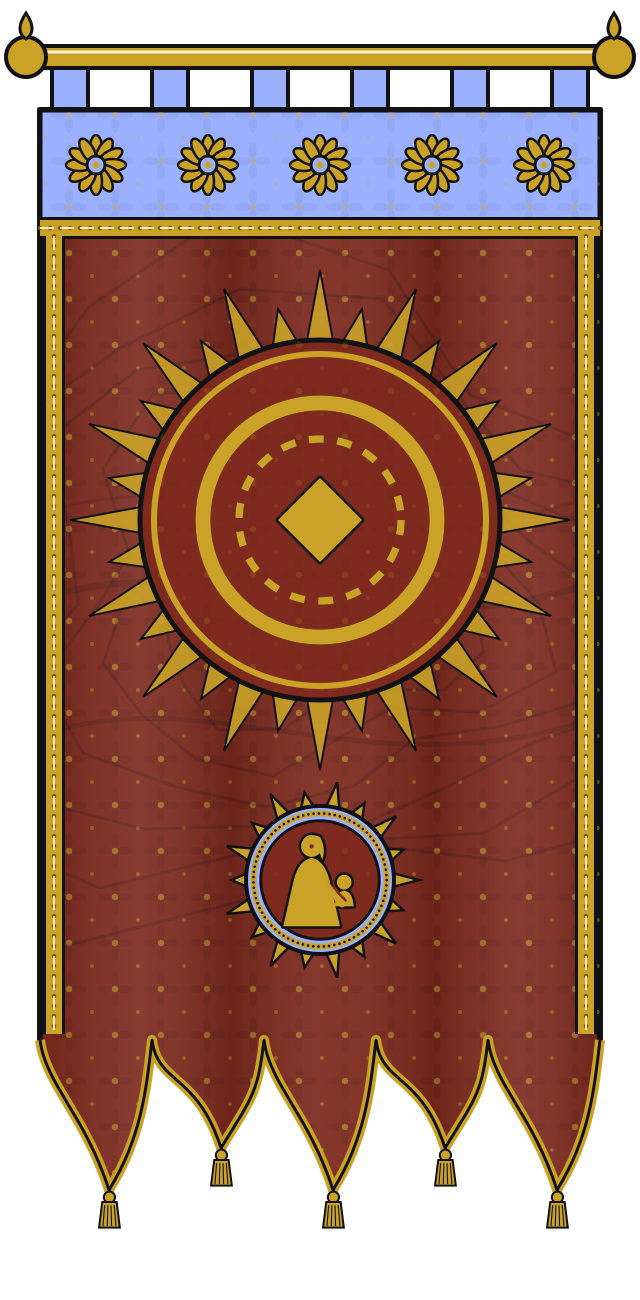
Historic banner
None known
New flag types
| Accessory | For this clan | Basis |
|---|---|---|
| A9 Pota-dhvaja · ship and trade flag For ships, caravans and markets | Not yet designed for this clan | Design |
| A10 Utsava-patāka · festival flag Light, bright flag for fairs and festivals | Not yet designed for this clan | Design |
| A11 Shoka-dhvaja · mourning flag White cloth with the emblem outline in the clan's metal | Not yet designed for this clan | Design |
7. Regalia
| Accessory | For this clan | Basis |
|---|---|---|
| E1 Chhatra · house parasol The ceremonial umbrella | Not yet designed for this clan | Design |
| E2 Chamara · fly-whisks The pair of whisks beside the head of the house | Not yet designed for this clan | Design |
| E3 Danda · staff of office Staff or scepter | Not yet designed for this clan | Design |
| E4 Simhasana · seat The seat of the house, covered in clan cloth | Not yet designed for this clan | Design |
| E5 Khetaka · shield A round shield; the Changi and Dhanush are its flag forms | Not yet designed for this clan | Regional tradition |
| E6 Kula-ayudha · clan weapon The weapon the clan honours | Mil·am: a two-edged sword with a cross-bar of ox-tail hair | Documented |
8. Worn
| Accessory | For this clan | Basis |
|---|---|---|
| F1 Kula-vastra · clan cloth The clan's woven pattern in its kit colours | Women's diamond-pattern skirt, said to show Susime's eye | Documented |
| F2 Kirti-vastra · honour cloth A cloth earned for a deed, not inherited | Not yet designed for this clan | Design |
| F3 Kula-mala · garland flower The flower or leaf the clan wears as a garland | Not yet found for this clan | Under research |
| F4 Chinha · house pin A metal badge with the pin emblem | Not yet designed for this clan | Design |
9. Records
| Accessory | For this clan | Basis |
|---|---|---|
| H1 Clan words A traditional line in the native script | Namenga ma? · “Greeting, as the article prints it; no translation is given in the source” A greeting in the Garo language, not a motto[3] | Design |
| H2 Biruda · titles The house's title or titles | Nokma: the headman of a village, the title of the village chief | Documented |
| H3 Prashasti · praise genealogy The lineage as written at the head of a grant | Not yet found for this clan | Under research |
| H4 Vahi · clan register The book of the clan's births, marriages and deaths | Not yet found for this clan | Under research |
| H5 Rana-ghosha · war cry The clan's cry in battle or celebration | Not yet found for this clan | Under research |
10. VishwaVit · knower of the world
Game values are design choices for this project, not historical claims.
References
- Government of Meghalaya, East Garo Hills district page, read 2026-11-15, https://meghalaya.gov.in/index.php/node/34290
- Wikipedia, Garo people, read 2026-11-15, https://en.wikipedia.org/wiki/Garo_people (cites Playfair 1909, Sinha 1955, Marak 2005 and Marak 2014 as printed in the article)
- Wikipedia, Garo language, read 2026-11-15, https://en.wikipedia.org/wiki/Garo_language
- Wikipedia, Songsarek, read 2026-11-15, https://en.wikipedia.org/wiki/Songsarek (citing Erik de Maaker 2007 and Mendiratta, The Pioneer, 2024, as printed)
- Wikipedia, Pa Togan Sangma, read 2026-11-15, https://en.wikipedia.org/wiki/Pa_Togan_Sangma (page marked as needing citations)
- Kamakhya Temple, Wikipedia (citing Shin 2010, Urban 2009–2019, Banerji 1925, Sarma 1981/1988, Nath 1989, Kakati 1989, Neog 1980).
- Indpaedia, Garo (mirror at dcmpx.remotevs.com; credits People of India vol. VIII), read 2026-11-15, link
- A. Playfair, The Garos (London: David Nutt, 1909), NVLI OCR RB858, read 2026-11-19 (pp. vi–86 of the text only), link
- Folk-Lore vol. 32, 'Garo Marriages, 1' (Wikisource, via Kiwix mirror, Sept 2022 copy), read 2026-11-15, link (author and year not stated on the page)
- Chie Nakane, Garo and Khasi: a comparative study in matrilineal systems (Mouton, 1967), eHRAF World Cultures record (abstract only), read 2026-11-19, link
- Pratibha Mandal, ‘The Garo Perception of Disease and Medicine: A History since the British Regime in the Indian Sub-Continent’, Indian Journal of History of Science 49.3 (2014), 348–358, read 2026-11-19, link
- Battle of Saraighat (Wikipedia, read 2026-10-09), citing S. L. Baruah (1986), S. C. Dutta (1981), S. K. Bhuyan, Lachit Barphukan and His Times (1947), P. Gogoi (1968), S. Kakoty (2003) and J. N. Sarkar (1992, 1994).
- Ahom-tribal Relations (a political study), NVLI OCR, author and year not read in the extract; Chapter I summarised, read 2026-10-19 (Khasi codex, run 38), link
- Wikipedia, Zawlbûk, read 2026-10-22, https://en.wikipedia.org/wiki/Zawlb%C3%BBk
- GlobalSecurity.org, Meghalaya - People, read 2026-10-29, https://www.globalsecurity.org/military/world/india/meghalaya-people.htm
- Wikipedia, List of Scheduled Tribes in West Bengal, read 2026-10-21, https://en.wikipedia.org/wiki/List_of_Scheduled_Tribes_in_West_Bengal
- Wikipedia, Matrilineal society of Meghalaya, read 2026-10-10, https://en.wikipedia.org/wiki/Matrilineal_society_of_Meghalaya