The Gandharas were the people of the Peshawar valley and Swat, whose land at its widest reached Taxila, the Kabul valley and the Karakoram[1]. The Rigveda knows the Gandhari tribe for its woolly sheep, and Buddhist texts count Gandhara among the sixteen mahajanapadas[1]. Darius I made it a Persian satrapy in 518 BCE with its capital at Pushkalavati, and Alexander, the Mauryas, Indo-Greeks, Sakas, Parthians, Kushans, Huns and the Shahi kings ruled it in turn until Mahmud of Ghazni defeated Jayapala at Peshawar in 1001 CE[1]. Its language, Gandhari, written in the Kharoshthi script, carried Buddhist texts to Khotan and China[2], and Takshashila (Taxila) was famed for its teachers[3].
01Faith and deities
Gandhara had no single deity of its own: it was a Vedic and later Hindu centre and for centuries a heartland of Buddhism[1]. The main deity is therefore the project KulDevi, Asamai (Asha Mai, the goddess of hope, a name of Durga), whose temple stands at the foot of Koh-e Asamai in Kabul, in the old Kabul valley of Greater Gandhara[4].
Asha Mai, the hill goddess of Kabul[4]
The presiding goddess of the clan's homeland or capital: a link of place, not a recorded clan tie.
| Deity or tradition | Place in the clan's life | Evidence |
|---|---|---|
| Vedic gods | Gandhara was a Vedic and later Hindu centre (Srinivasan 2008) | [1] |
| Shiva | The earliest images of Shiva in human form come from ancient Gandhara (Blurton 1993) | [1] |
| Lakshmi | Shown on Gandharan coins of the 1st century BCE | [1] |
| The Buddha and the Bodhisattvas | Buddhism flourished until the 8th–9th centuries; Amitabha with Avalokiteshvara and Mahasthamaprapta; Maitreya | [1] |
| Prajnaparamita | Edward Conze calls the north-west the 'fortress and hearth' of the Perfection of Wisdom | [1] |
| Ahura Mazda | The Avesta names Vaēkərəta (Gandhara) among the lands he made | [1] |
| Asamai (KulDevi) living | Hill goddess of Kabul; Afghan Hindus believe she lives on the hilltop; the temple moved down from the peak, where a small old site remains; renovated 2006 | [4] |
| Shaiva Hinduism (Hindu Shahi period) | Likely dominant under the Hindu Shahis; Saura, Buddhism and Islam were also followed (Meister 2007; Rehman 1976; Khaw 2016) | [5] |
02Temples
Gandhara's surviving sacred buildings are mostly Buddhist stupas and monasteries; the standing Hindu temple of the KulDevi is in Kabul.
Built by the clan
| Temple | Deity | Built by | When | Where |
|---|---|---|---|---|
| Stupas of Gandhara | The Buddha | Ashoka | 3rd century BCE | Gandhara[1] |
| Kanishka's tower | The Buddha | Kanishka | 2nd century CE; destroyed by Mahmud of Ghazni in the 11th century | Peshawar[1] |
| Hindu Shahi fort-temples | Not named in the source read | Under research | Hindu Shahi period, c. 822–1026 CE | Inside Hindu Shahi fortresses[5] |
| Malot and Shiv-Ganga temples | Under research | Under research | 10th century | Sandstone; blend Shahi and Kashmiri styles[5] |
Given patronage or grants by the clan
Not recorded.
Later temples in the clan's lands
| Temple | Deity | Built | Where | |
|---|---|---|---|---|
| Dharmarajika stupa and monastery | The Buddha | UNESCO World Heritage (Taxila) | Taxila[3][1] | |
| Jaulian stupa and monastery | The Buddha | UNESCO World Heritage (Taxila) | Taxila[3] | |
| Mohra Moradu stupa and monastery | The Buddha | UNESCO World Heritage (Taxila) | Taxila[3] | |
| Jandial complex | UNESCO World Heritage (Taxila) | Taxila[3] | ||
| Asamai Temple living | Asamai | Renovation funded by Ehsan Bayat, 2006 | Foot of Koh-e Asamai, Kabul[4] |
03Languages and scripts
| Language or script | Kind | Under the clan | Evidence |
|---|---|---|---|
| Gandhari lost | Early Middle Indo-Aryan Prakrit; keeps the three sibilants s, ś, ṣ apart | The speech of Gandhara; official in the Kushan empire, Khotan and Shanshan; died out about the 3rd century CE | [2][1] |
| Kharoshthi lost | Script derived from Aramaic, developed under the Achaemenids | Gandhara's own script until about 200 CE; deciphered in 1838 by Masson, Prinsep and Cunningham | [1][2] |
| Sanskrit | Old Indo-Aryan | Vedic and later learning; Panini's grammar; Buddhist texts in Gupta script | [1] |
| Old Persian | Imperial language | Achaemenid rule; Behistun inscription names Gandara | [1] |
| Greek | Coin legends | Indo-Greek and Indo-Scythian coins (with Kharoshthi) | [3] |
| Torwali, Shina and the Kohistani languages living | Dardic | Held by some (Zoller) to succeed Gandhari; Strand disputes the Dardic grouping | [2] |
| Tirahi lost | Dardic | Last of the old Gandhara dialect group to disappear | [2] |
| Sharada | Script | Script of the Hindu Shahi inscriptions and coin legends; Bactrian script fell out of use | [5][6] |
04Books and literature
Gandhara gave the oldest Buddhist manuscripts yet found in South Asia, in Gandhari and Kharoshthi; its Vedic and epic history comes from texts composed elsewhere.
Written in the clan's lands during its era
| Work | Author | Kind | When | Link to the clan |
|---|---|---|---|---|
| Ashtadhyayi | Panini | Sanskrit grammar; mentions Gandhari | 4th century BCE | [1] |
| Gandharan Buddhist texts | Many hands | Birch-bark scrolls found in clay pots: British Library (29 fragments), Senior (24 scrolls), Schøyen, University of Washington | Texts of the 3rd century BCE to the 4th century CE; finds from 1994 | [2] |
| Gandhari Dharmapada | Birch-bark manuscript found at Kohmari Mazar near Khotan, 1893 | [2] | ||
| Abhidharmakoshakarika | Vasubandhu | Buddhist philosophy | 4th century CE | [1] |
| Mahayanasamgraha | Asanga | Yogachara | 4th century CE | [1] |
| Longer Sukhavativyuha | Mahishasaka monks (possibly) | Pure Land sutra | 1st–2nd century CE | [1] |
| Milinda Panha | Dialogue of Menander and Nagasena | [1] |
Given patronage by the clan
| Work | Author | What the clan gave | When | Evidence |
|---|---|---|---|---|
| Chinese Buddhist translations | Lokakshema, Zhi Qian, Dharmaraksha and others | Gandharan monks translated sutras into Chinese from Gandhari originals | From c. 147 CE | [1][2] |
05Thinkers and scholars
| Name | Field | Era | Contribution |
|---|---|---|---|
| Panini | Grammar | 4th century BCE | Ashtadhyayi; linked to Taxila[1][3] |
| Chanakya (Kautilya) legend | Statecraft | 4th century BCE | Said to have taught at Taxila and written the Arthashastra there; the claim is marked 'failed verification'[3][1] |
| Jivaka | Medicine | Bimbisara's physician; said to have studied medicine at Taxila[3] | |
| Charaka legend | Ayurveda | Said to have studied at Taxila[3] | |
| Uddalaka Aruni | Upanishadic teacher | c. 7th century BCE | Vedic texts place him in Gandhara; the Jatakas say he and Shvetaketu studied at Taxila[3] |
| Kumaralata | Buddhist philosophy | 3rd century CE | Sautrantika[1] |
| Vasubandhu | Buddhist philosophy | 4th century CE | Abhidharmakosha[1] |
| Asanga | Buddhist philosophy | 4th century CE | Founder of Yogachara[1] |
| Garab Dorje | Buddhist teacher | 1st century CE | Dzogchen[1] |
| Lokakshema | Translator | 167–186 CE | First translator of Mahayana sutras into Chinese[1] |
| Prajna | Translator | fl. 810 CE | Taught the Japanese monk Kukai[1] |
| Padmasambhava | Buddhist teacher | 8th century CE | 'Second Buddha' of the Nyingma[1] |
Takshashila is called by some one of the earliest universities; others say it lacked colleges, halls or degrees[3].
06Art and architecture
The Gandharan school mixed Parthian, Scythian, Roman, Graeco-Bactrian and Gangetic styles; it began about 50 BCE–75 CE, peaked in the 1st–5th centuries CE and declined after the Hun invasions[1].
Painting and wall art
Not recorded.
Sculpture and temple art
| Art form | What it is | Era | Evidence |
|---|---|---|---|
| Gandharan Buddhas and Bodhisattvas | Schist and stucco: the youthful Buddha with Apollo-like curls, the jewelled prince Siddhartha, Maitreya (2nd century), the Parinirvana | [1] | |
| Atlas figures and acanthus capitals | Hellenistic forms carved for Buddhist monuments, as at Hadda | [1] | |
| Early Shiva images | The earliest human-form images of Shiva | [1] | |
| Taxila Museum living | Gandharan stone sculpture of the 1st–7th centuries, mostly from Marshall's digs | [3] |
Temple and building architecture
| Art form | What it is | Era | Evidence |
|---|---|---|---|
| Sirkap | Indo-Greek city at Taxila (2nd century BCE); a stupa base carved with Hindu, Buddhist and Greek temple fronts; a Jain temple | [3] | |
| Bhir Mound | Oldest city at Taxila, c. 800–525 BCE | [3] | |
| Sirsukh | Kushan city at Taxila | [3] | |
| Stupas and monasteries | Dharmarajika, Jaulian, Mohra Moradu, Kunala; Peshawar and Swat valleys | [3][1] | |
| Shahi fort-temples | Built inside fortresses; the typical Shahi temple has two ground-level chambers in a tower with a top ambulatory (Meister dates eight) | [5] | |
| Malot and Shiv-Ganga | Sandstone temples of the 10th century that blend Shahi and Kashmiri styles | [5] | |
| Gandhara-Nagara style | Named by Meister (2010); the source read does not describe it | [5] | |
| Barikot | A Buddhist monastery reused as a Hindu Shahi fort | [5] |
Weaving and textiles
Not recorded.
Clothing and jewellery
Not recorded.
Coins, pottery and crafts
| Art form | What it is | Era | Evidence |
|---|---|---|---|
| Reliquaries | The Jaulian silver reliquary and a crystal goose reliquary of the 1st century CE (British Museum) | [3] |
07History
Before the kingdom (to c. 800 BCE)
Stone tools and burnt bones at Sanghao near Mardan are put at about 15,000 years old, and later digs suggest about 30,000[1]. At Taxila, Sarai Khola was settled from the late 4th to the early 3rd millennium BCE[3]. The Gandhara Grave Culture, named for its burials, runs from about 1400 to 800 BCE; ancient DNA (Narasimhan et al. 2019) shows people with steppe ancestry mixing into the Swat population about 1900–1500 BCE[1]. Hathial, the first city at Taxila, dates from about 1000 BCE and traded with Pushkalavati by 900 BCE[3].
Vedic and epic Gandhara
The Rigveda knows the Gandhari tribe for its sheep with good wool (Macdonell and Keith 1912)[1]. The Atharvaveda names the Gandharis with the Mujavants, Angas and Magadhas in a hymn to Takman, the fever, as peoples outside the Vedic heartland[1][7]. The Chandogya Upanishad speaks of the Gandharas as far away; the Aitareya Brahmana has King Nagnajit of Gandhara consecrated by Parvata and Narada, and the Shatapatha Brahmana makes Svarjit his son[1]. Brahmana texts make Nagnajit a contemporary of King Karandu of Kalinga[8]. The Avesta lists Vaēkərəta, identified with Gandhara, as the sixth most beautiful place made by Ahura Mazda[1].
In the epics, Gandhara was founded by the Druhyu prince Gandhara legend, and in the Mahabharata Prince Shakuni of Gandhara drove Duryodhana's plots that led to the Kurukshetra war legend[1]. The Ramayana makes Bharata, Rama's brother, found Takshashila for his son Taksha and Pushkalavati for his son Pushkala legend[3].
Mahajanapada and Persian satrapy (6th–4th century BCE)
Buddhist texts count Gandhara among the sixteen mahajanapadas[1]. Pushkarasarin (Pushkarasakti) ruled in a time of power struggles; the last king is placed about 518 BCE[1]. Buddhist tradition remembers Pukkusati of Gandhara as the king who defeated Pradyota of Avanti[9]. Bhir Mound at Taxila was occupied from about 800 to 525 BCE[3].
Darius I came through the Khyber Pass in 518 BCE and made Gandhara a satrapy with its capital at Pushkalavati; the Behistun inscription lists 'Gandara', and Darius's tomb at Naqsh-i-Rustam lists Gadara beside Hindush[1]. Darius wintered near Taxila in 516–515 BCE[3]. The satrapy had weakened by about 380 BCE[1].
Pukkusati and Bimbisara (6th–5th century BCE)
Pukkusati, king of Gandhara with its capital at Takkasila legend, was a friend of Bimbisara of Magadha, and the two kingdoms exchanged missions and goods and valuables constantly[10]. The Buddhist account based on MN 140 and its commentary says Bimbisara asked merchants from Takkasila about their king, learned that he kept the ten kingly duties and was of the same age, and proposed friendship; Pukkusati sent eight pieces of five-coloured muslin in sandalwood cases, and Bimbisara gave four of them to the Buddha and kept four[11]. The Pali copy also says merchants and visitors were lodged and fed at the king's expense and no tariffs were levied on their goods, in its account of the friendship[12].
Bimbisara wished to send a gift of particular value and sent a letter instead, reporting the appearance in the world of the Buddha, the Dhamma and the Sangha[10][12]. In the ABT account the letter is a gold sheet in nested caskets, urging Pukkusati to renounce if he is able[11]. The MN 140 commentary says he had once been king of Takkasila and that the letter was a golden plate[13]. Pukkusati read it, reached the form-realm jhana, cut his hair with a sword and left[11]. The DPPN says he set out for Savatthi to see the Buddha; the ABT account says he passed Jetavana without knowing the Buddha was there and reached Rajagaha after sunset[10][11].
Sources differ on his ordination. The DPPN and its Pali copy say he was ordained and left his kingdom[10][12]. MN 140 and the ABT account say he had no bowl or robes for full admission, and that the Buddha told him they were needed for ordination[13][11]. In a potter's hut at Rajagaha he shared the night with the unrecognised Buddha, called him 'avuso' (friend), apologised and was forgiven[13].
His death is told in two ways. The MN 140 page says that while he searched for a bowl and robes a stray cow killed him; the Buddha said he was reborn in the Pure Abodes, to attain nibbana there, and the commentary says Aviha[13]. The ABT account says he was gored by a deranged cow while seeking rags, was reborn in Aviha and became an Arahat, and that Bimbisara cremated the body and enshrined the bones in a cetiya[11]. The DPPN says his conversion did not convert Gandhara, the memory of it was soon forgotten, and Majjhantika was sent later (Mahavamsa xii 3ff)[10].
His place in Gandhara's own history is less sure. Buddhist narratives credit him with expansion and a war against Pradyota of Avanti[14]; Prakash (1951) and Jain (1972) say he defeated Pradyota and fought a war with the Pandava tribe of the Punjab[15]. The Pali pages read (DPPN, its Pali copy and the ABT account) do not mention Pradyota. His fate as king is unknown: he may have been a vassal, replaced by a satrap, or have ruled Taxila[14]. The Pushkarasarin entry calls the tradition late and partly apocryphal, and identifies Pukkusati (Pali) with Pushkarasarin (Sanskrit), citing Lamotte (1988)[15].
Alexander and the Mauryas (327–c. 185 BCE)
In 327–326 BCE Alexander's army fought the Aspasioi in the Kunar valley and the Assakenoi at Ora, Bazira (Barikot), Massaga and Aornos; Ambhi (Omphis), king of Taxila, surrendered his city without battle, and Alexander crossed the Indus in July 326 BCE (Arrian, Curtius)[1][3]. After the Seleucid–Mauryan war of 303–302 BCE, Seleucus I ceded Gandhara to Chandragupta Maurya[16]. Ashoka began as governor in Gandhara and built stupas there; Mauryan rule lasted about 150 years[1], and Taxila became a Buddhist centre of learning on the royal road to Pataliputra[3].
Greeks, Sakas, Parthians and Kushans (c. 185 BCE – c. 230 CE)
Demetrius I invaded about 185 BCE, and Menander I ruled from Taxila and Sagala until about 140 BCE[1]. The Indo-Greeks built Sirkap at Taxila; the Heliodorus pillar (c. 100 BCE) names Antialcidas, who likely ruled from Taxila[3]. The Saka king Maues took power about 80 BCE, and the Parthian Gondophares made Taxila his capital about 20 BCE[1][3]. The Kushan Kujula Kadphises took Gandhara about 75 CE; Kanishka (127–150 CE) made Purushapura (Peshawar) a capital beside Mathura and raised a great tower there[1], and founded the city of Sirsukh at Taxila[3]. In these centuries the Gandharan school of art began, and Gandhari became an official language of the Kushan empire[1][2].
Huns and the Shahis (c. 230 – 1021 CE)
After the Kushans came Kushanshas under Sasanian overlordship (c. 230–440), the Kidarites (c. 390–500) and the Hephthalites, who held Gandhara by about 465; the Hun king Mihirakula persecuted Buddhists, and the Dharmarajika stupa at Taxila saw a massacre[1]. The Chinese pilgrim Faxian found Buddhism flourishing about 400 CE; Xuanzang found Taxila desolate in 630[1][3]. The Nezak kings (c. 565–644) and the Kabul Shahis (c. 644–870) followed[1].
Al-Biruni says the Hindu Shahi line was founded about 843–850 CE by Kallar, a Brahmin minister; its capital moved to Udabhandapura (Hund) on the Indus[1]. Mahmud of Ghazni defeated Jayapala at Peshawar in 1001 CE, Trilochanapala was killed in 1021, and the name Gandhara disappears after 1001[1].
Hindu Shahis and Ghazni (c. 822–1026 CE)
The Hindu Shahis, called Kabul or Odi Shahis, ruled Kabulistan, Gandhara and the Punjab. The 2026 Wikipedia page dates them c. 822–1026 and says they succeeded the Turk Shahis when the Brahmin minister Kallar deposed the last Turk Shahi king, Lagaturman; the Turk Shahis had been defeated by the Abbasids under al-Ma'mun in 815[5]. The start is disputed. The 2022 Wayback snapshot of the Gandhara page gives a Kabul Shahi line from c. 644 to 870 and a Hindu Shahi founding by Kallar c. 843–850, citing al-Biruni[1]. The 2026 Hindu Shahis page says its sources do not support a c. 644 start[5]. The Pritchett coin pages give al-Biruni's account of Lagaturman's overthrow by 'Kellar' without a date[6]. The dates c. 822 and c. 843–850 are both given and are not reconciled.
Al-Biruni calls Kallar a Brahmin minister and the Shahis Brahmins. Kalhana (Rajatarangini, 1148–49) calls them Kshatriyas, and Wink (1991) says every source but al-Biruni does the same[5]. The page lists these kings: Kallar c. 822; Samanta c. 850 (possibly Kallar's son, per al-Biruni); Lalliya c. 880, who retook Kabul and subdued Zabulistan; Toramana c. 903, installed by Gopalavarman as 'Kamaluka' (Kalhana); Bhimadeva c. 921; Jayapala 964–1001; Anandapala c. 1002; Trilochanapala c. 1010; Bhimapala c. 1021–1026[5].
Capitals on the page's infobox (Mishra 1972) were Kabul 822–870, Udabhandapura 870–1001, Nandana 1002–1014, Hastika 1014–1015 and Lahore 1015–1026[5]. The 2022 Gandhara page calls Udabhandapura, on the Indus at Hund, the final capital[1]. The two lists are not reconciled.
The Saffarid Ya'qub ibn al-Layth took Kabul in 870 and held it until 878; Shahi control was back by about 900 (Tarikh-i Sistan, via Rehman 1976). Samkaravarman of Kashmir invaded about 902 and was killed by a stray arrow at Urasa (Kalhana)[5]. The Lawik dynasty held Ghazni after 913 and was friendly with the Shahis, linked to them by marriage. Bhima's daughter married a Lohara king, and Didda, Bhima's granddaughter, became queen of Kashmir[5]. About 963 Bhimadeva captured Ghazni (Hund Slab Inscription); he died about 964–965, and the inscription suggests a ritual self-immolation 'through Shiva's desire'[5].
Jayapala's Hund inscription, dated year 146 (968 CE), calls Udabhanda a home of learned men[5]. About 990–991 Jayapala was defeated at Kindi, and about 998–999 he annexed Lahore[5]. In 986–987 he had met Sabuktigin at Ghuzak and agreed a treaty of one million Shahi dirhams, 50 elephants and forts; he broke it, and Sabuktigin sacked Lamghan (al-Utbi)[5].
The battle near Peshawar is dated 27 November 1001 on the battle page. The Hindu Shahis page gives 27 November in its infobox and 27 September in its text[17][5]. The battle page says Mahmud reached Peshawar in September 1001, annexed Peshawar and Udabhandapura, took Hund, and returned to Ghazni in April 1002[17]. Satish Chandra gives the Ghaznavids 15,000 cavalry and 10,000 ghazis and Afghans, and the Shahis 12,000 cavalry, 30,000 infantry and 300 elephants; casualties are put at 5,000–15,000[17]. Chach is dated December 1008 on the Hindu Shahis page and 1009 on the battle page[5][17].
Jayapala was captured with fifteen sons and grandsons (al-Utbi, via Elliot 1869). The battle page gives the terms as 250,000 dinars and 50 elephants, with one son and one grandson held as hostages, and Satish Chandra doubts that he was released. The Hindu Shahis page says he was sold as a slave (Unsuri) or ransomed for 2.5 million dirhams and 50 elephants (al-Ansab, the version Rehman prefers)[17][5]. He returned to Hund, abdicated for Anandapala and burned himself on a pyre[5][17].
Anandapala refused Mahmud passage to Multan in 1006 and fled to Kashmir; Trilochanapala led the army that lost at Chach; Bhimapala was routed at Nandana and Tausi in March 1014; about 1017 Trilochanapala took refuge with the Paramara Bhoja; and he was assassinated by mutinous troops in 1021 (al-Biruni; Ibn al-Athir differs)[5]. Bhimapala ruled to 1026, and the Ghaznavids annexed the lands in 1026[5]. Sandbal, a grandson of the Kabul Shah, was killed attacking Lahore about 1040 (Adab al-Harb)[5].
Kabul exported cotton cloth and indigo; Ibn Hawqal wrote of the wool and cotton trade; silver was smelted at Andarab and mined in Panjshir. Scholars were patronised, but no court texts survive. Inscriptions are exclusively in Sharada, and the Bactrian script fell out of use[5].
08Journey and migrations
The Gandharas were a settled people of the Peshawar valley; their story is of capitals that moved and of rulers who came to them, while their monks and their script travelled out along the trade roads.
| When | From | To | Why | Evidence |
|---|---|---|---|---|
| c. 1900–1500 BCE | Steppe | Swat valley | Ancient DNA shows steppe-ancestry people mixing with the Swat population | [1] |
| 2nd century CE | Pushkalavati (Charsadda) | Purushapura (Peshawar) | The capital moved; Pushkalavati had been capital until then | [1] |
| c. 147 CE onward | Gandhara | China | Lokakshema and later Gandharan monks took Buddhist texts to China and translated them | [1][2] |
| Early Buddhist missions | Gandhara | Khotan and Shanshan (Xinjiang) | Buddhist missions, tentatively Dharmaguptaka, carried Gandhari in Kharoshthi; Gandhari became an official language there | [2] |
| 9th century CE | Kabul | Udabhandapura (Hund) | The Hindu Shahi capital moved to the Indus | [1] |
| 19th century | Tirah | Near Jalalabad | Speakers of Tirahi, a language of the old Gandhara dialect group, expelled from Tirah | [2] |
09Seats and lands
| Place | Role | Where today |
|---|---|---|
| Pushkalavati | Capital of the kingdom and of the Achaemenid satrapy until the 2nd century CE | Charsadda, Khyber Pakhtunkhwa, Pakistan[1] |
| Takshashila (Taxila) | Capital; centre of learning; Bhir Mound, Sirkap and Sirsukh cities | Taxila Tehsil, Rawalpindi District, Punjab, Pakistan[3] |
| Purushapura | Kushan capital from the 2nd century CE | Peshawar, Khyber Pakhtunkhwa, Pakistan[1] |
| Kapisi | Capital | Bagram, Afghanistan[1] |
| Udabhandapura | Last capital, of the Hindu Shahis | Hund, on the Indus, Pakistan[1] |
| Oddiyana | City of the Swat valley | Swat, Pakistan[1] |
| Sagala | City; Menander's capital | Sialkot, Punjab, Pakistan[1] |
| Peshawar valley and Swat | The core of Gandhara | Khyber Pakhtunkhwa, Pakistan[1] |
| Kabul valley | Part of Greater Gandhara | Afghanistan[1] |
| Kabul | Hindu Shahi capital, 822–870 (infobox, Mishra 1972) | Kabul valley, Afghanistan[5][1] |
| Hund | Main archaeological site of the Hindu Shahis; the Hund Slab Inscription and Jayapala's Hund inscription of 968 CE | Hund, on the Indus, Pakistan[5][1] |
| Nandana | Hindu Shahi capital, 1002–1014 (infobox) | Under research[5] |
| Hastika | Hindu Shahi capital, 1014–1015 (infobox) | Under research[5] |
| Lahore | Hindu Shahi capital, 1015–1026 (infobox); the 2022 Gandhara page calls Udabhandapura the final capital, so the two lists are not reconciled[1] | Under research[5] |
10Notable figures
| Name | Role | Era | Known from |
|---|---|---|---|
| Nagnajit | King of Gandhara, consecrated by Parvata and Narada | Late Vedic | Aitareya Brahmana[1] |
| Svarjit | Son of Nagnajit | Late Vedic | Shatapatha Brahmana[1] |
| Shakuni legend | Prince of Gandhara who drove Duryodhana's plots | Epic | Mahabharata[1] |
| Gandhara legend | Druhyu prince, founder of the land | Epic | Epics[1] |
| Pukkusati | King of Gandhara who defeated Pradyota of Avanti | 6th century BCE | Buddhist tradition[9] |
| Pushkarasarin (Pushkarasakti) | Ruler of Gandhara in a time of power struggles | 6th century BCE | [1] |
| Ambhi (Omphis) | King of Taxila who surrendered to Alexander | 326 BCE | Arrian[3][1] |
| Ashoka | Began as governor in Gandhara; built stupas | 3rd century BCE | [1] |
| Menander I | Indo-Greek king at Taxila and Sagala; questioned the monk Nagasena | d. c. 140 BCE | Milinda Panha[1] |
| Gondophares | Parthian king who made Taxila his capital | c. 20 BCE onward | [3] |
| Kanishka | Kushan emperor; capital at Purushapura; great tower at Peshawar | 127–150 CE | [1] |
| Kallar | Brahmin minister, founder of the Hindu Shahis | c. 822 (2026 page) or c. 843–850 CE (2022 page) | Al-Biruni[1]; c. 822[5] |
| Jayapala | Last great Hindu Shahi king, defeated at Peshawar | 1001 CE | [1] |
| Trilochanapala | Hindu Shahi king, killed | 1021 CE | [1] |
| Bimbisara | King of Magadha; friend of Pukkusati; exchanged missions and gifts | In Pukkusati's time, as the sources date it | DPPN[10]; ABT account[11] |
| Lagaturman | Last Turk Shahi king at Kabul, deposed by Kallar | c. 822 | Al-Biruni via[5] and[6] |
| Samanta | Hindu Shahi king; possibly Kallar's son (al-Biruni) | c. 850 | [5] |
| Lalliya | Hindu Shahi king; retook Kabul and subdued Zabulistan | c. 880 | [5] |
| Toramana | Hindu Shahi king installed by Gopalavarman as 'Kamaluka' | c. 903 | Kalhana via[5] |
| Bhimadeva | Hindu Shahi king who captured Ghazni; the inscription suggests a ritual self-immolation | c. 921–965 | Hund Slab Inscription via[5] |
| Anandapala | Hindu Shahi king; refused Mahmud passage to Multan (1006), fled to Kashmir | c. 1002–1010/11 | [5] |
| Bhimapala | Last Hindu Shahi king on the page; routed at Nandana (1014) | c. 1021–1026 | [5] |
| Didda | Queen of Kashmir; Bhima's granddaughter; Lohara dynasty | Under research | Rajatarangini via[5] |
11Allies, rivals and marriages
| People | Relationship | When |
|---|---|---|
| Kurus legend | Shakuni of Gandhara drove Duryodhana's plots[1]; the Atlas and the Kurus codex record Gandhari of Gandhara's marriage to Dhritarashtra (epic passage still to be cited) | Epic |
| Kalingas | Nagnajit of Gandhara a contemporary of Karandu of Kalinga[8] | Late Vedic |
| Magadhas, Angas, Mujavants | Named with the Gandharis in the Atharvaveda as peoples outside the Vedic heartland[7] | Vedic |
| Avantis | Pukkusati of Gandhara defeated Pradyota of Avanti[9] | 6th century BCE |
| Achaemenid Persians | Conquered Gandhara (518 BCE) and ruled it as a satrapy[1] | 518–c. 380 BCE |
| Ashvakas (Assakenoi, Aspasioi) | Hill peoples of Swat, Buner and Kunar who fought Alexander[1] | 327 BCE |
| Mauryas | Gained Gandhara from Seleucus I; Taxila a provincial seat[16] | c. 305–185 BCE |
| Kambojas, Bahlikas | Held by one school of scholars to be cognate with the Gandharas[1] | Ancient |
| Yavanas, Shakas, Pahlavas, Kushanas, Hunas | Successive rulers of Gandhara[1] | c. 185 BCE – 6th century CE |
| Ghaznavids | Mahmud of Ghazni ended Hindu Shahi rule[1] | 1001–1021 CE |
| Magadhas (Bimbisara) | Friends with Pukkusati; exchanged missions, goods and a letter on the Buddha[10][11] | In Pukkusati's time, as the sources date it |
| Madras (Madrakas) | Bimbisara married Kshema, daughter of the Madra king, a vassal of Pukkusati (Prakash 1951; Jain 1972; Raychaudhuri 1953)[15] | In Pukkusati's time, as the sources date it |
| Kekayas, Madras, Ushinaras, Shivis | Said to be under Gandhara suzerainty (Prakash 1951)[15] | In Pukkusati's time, as the sources date it |
| Pandavas (Punjab) | Pukkusati fought a war with the Pandava tribe of the Punjab (Prakash 1951; Jain 1972)[15] | In Pukkusati's time, as the sources date it |
| Turk Shahis | Predecessors at Kabul; Kallar deposed the last Turk Shahi king, Lagaturman[5]; Spalapati Deva drachms are the last Turk Shahi issues at Kabul[6] | c. 822 |
| Saffarids | Ya'qub ibn al-Layth took Kabul and held it to 878[5] | 870–878 |
| Kashmir | Samkaravarman invaded about 902; Anandapala fled to Kashmir in 1006, and Tunga, Didda's minister, was linked to him[5] | c. 902–1006 |
| Lohara (Kashmir) | Marriage ties: Bhima's daughter married a Lohara king; Didda, Bhima's granddaughter, became queen of Kashmir[5] | Under research |
| Lawiks | Held Ghazni after 913; friendly with the Shahis and linked to them by marriage[5] | After 913 |
| Paramaras | Trilochanapala took refuge with the Paramara Bhoja[5] | c. 1017 |
| Ghaznavids (Alp-Tegin) | Alp-Tegin seized Ghazna in 962 (Bauer 2010)[17] | From 962 |
| Rahbut | Al-Masudi calls Gandhara the 'country of the Rahbut'[5] | Under research |
12Society and livelihood
Gandhara was a kingdom and then a province of great empires, living by trade on the roads between India, Central Asia and Iran.
Government and social order
| Institution or group | What it was | Evidence |
|---|---|---|
| Kings of Gandhara | Consecrated kings in the late Vedic texts (Nagnajit) | [1] |
| Satrapy | Persian province with its seat at Pushkalavati | [1] |
| Teachers of Takshashila | Independent teachers who ran schools in their homes; students came at about 16 and stayed about eight years; poor students were taught free at night in return for household work; no examinations or degrees | [3] |
| Trade guilds | Struck their own coins at Taxila in the gaps between Greek kings | [3] |
| Buddhist monasteries | Stupas and monasteries of the Peshawar and Swat valleys and Taxila; centres of translation | [1][3] |
| Hindu Shahi court | Scholars were patronised; no court texts survive | [5] |
Livelihood over time
| Era | Livelihood | Evidence |
|---|---|---|
| Vedic | Sheep with good wool | [1] |
| c. 900 BCE onward | Trade between Taxila and Pushkalavati | [3] |
| Ancient | Trade in spices, aromatics and perfumes on the roads joining India, Central Asia and the Middle East | [1] |
| Gupta era | Taxila a trade hub for silk, sandalwood, horses, pearls and spices | [3] |
| c. 1030 CE | Al-Biruni describes a garden land with canals and orchards | [1] |
| Hindu Shahi period | Cotton cloth and indigo exported from Kabul | [5] |
| Hindu Shahi period | Silver smelted at Andarab and mined in Panjshir; wool and cotton trade (Ibn Hawqal) | [5] |
13Sub-clans and related clans
The sources tie the Gandharas to Vedic neighbours, to the hill peoples Alexander fought, and to the dynasties that ruled Gandhara in turn.
| Clan | Relation | Where | Size | In the Atlas | Evidence |
|---|---|---|---|---|---|
| Druhyus द्रुह्यु | Parent people | ANC-033 | The epics make Gandhara's founder a Druhyu prince legend[1] | ||
| Ashvakas | Related people | Swat, Buner, Kunar valley | ANC-012 | Assakenoi and Aspasioi, who fought Alexander[1] | |
| Astanenoi | Related people | Pushkalavati | same name as ANC-161: check | Greek name for the people of Pushkalavati in Alexander's time[1] | |
| Kambojas कम्बोज | Related people | ANC-046 | One school of scholars holds them cognate with the Gandharas[1] | ||
| Vahlikas | Related people | ANC-138 | Bahlikas, claimed as cognate, with Iranian affinities[1] | ||
| Mujavants | Related people | ANC-083 | Named with the Gandharis in the Atharvaveda[1] | ||
| Yavanas | Dynasty from this clan | Taxila, Sagala | ANC-154 | Indo-Greek kings Demetrius I and Menander I[1] | |
| Shakas | Dynasty from this clan | Taxila | ANC-119 | Indo-Scythian Maues and Azilises[1][3] | |
| Pahlavas | Dynasty from this clan | Taxila | ANC-092 | Indo-Parthian Gondophares[3] | |
| Kushanas | Dynasty from this clan | Purushapura | ANC-070 | Kujula Kadphises and Kanishka[1] | |
| Kidarites | Dynasty from this clan | Gandhara | same name as ANC-177: check | Held Gandhara c. 390–500 CE; last ruler Kandik[1] | |
| Hunas | Dynasty from this clan | Gandhara | ANC-040 | Hephthalites and Alchon Huns; Mihirakula[1] | |
| Nezak kings | Dynasty from this clan | Kapisa, Udabhandapura | same name as ANC-180: check | c. 565–644 CE[1] | |
| Kabul Shahis | Dynasty from this clan | Kabul | same name as ANC-176: check | c. 644–870 CE per the 2022 Gandhara page[1]; the 2026 Hindu Shahis page says its sources do not support a c. 644 start[5] | |
| Hindu Shahis | Dynasty from this clan | Udabhandapura | same name as ANC-175: check | Founded by Kallar: c. 843–850 CE per al-Biruni in the 2022 Gandhara page[1], or c. 822 per the 2026 Hindu Shahis page[5]; ended 1021 (Trilochanapala) or 1026 (Ghaznavid annexation)[5] | |
| Kohistani | Related people | Indus Kohistan | SUB-043 | Kohistani languages likely descend from ancient Gandhara dialects[2] | |
| Torwali | Related people | new clan candidate | Torwali is closest to Niya Prakrit, a Gandhari dialect[2] | ||
| Tirahi | Related people | Tirah; later near Jalalabad | same name as SUB-128: check | Morgenstierne: remnant of a dialect group running from Tirah through Peshawar to Swat and Dir[2] | |
| Turk Shahis | Dynasty from this clan | Kabul | same name as ANC-230: check | Predecessors of the Hindu Shahis; their last king, Lagaturman, was deposed by Kallar c. 822[5][6] | |
| Ghaznavids | Dynasty from this clan | Ghazni | same name as ANC-205: check | Mahmud of Ghazni captured Jayapala at Peshawar (1001)[17]; the Ghaznavids annexed the Shahi lands in 1026[5] | |
| Lawiks | Dynasty from this clan | Ghazni | same name as ANC-192: check | Held Ghazni after 913; friendly with the Shahis and linked to them by marriage[5] | |
| Saffarids | Dynasty from this clan | Kabul (taken 870) | same name as SUB-187: check | Ya'qub ibn al-Layth took Kabul in 870 and held it to 878[5] | |
| Lohara of Kashmir | Dynasty from this clan | Kashmir | same name as ANC-194: check | Marriage ties with the Hindu Shahis; Didda, Bhima's granddaughter, became queen of Kashmir[5] | |
| Paramaras | Dynasty from this clan | same name as ANC-181: check | Trilochanapala took refuge with the Paramara Bhoja c. 1017[5] | ||
| Pandavas (Punjab) | Related people | Punjab | same name as ANC-220: check | A war with the Pandava tribe of the Punjab (Prakash 1951; Jain 1972)[15] | |
| Shivis | Related people | same name as ANC-228: check | Said to be under Gandhara suzerainty (Prakash 1951)[15] | ||
| Rahbut | Related people | new clan candidate | Al-Masudi calls Gandhara the 'country of the Rahbut'[5] | ||
| Madras | Related people | ANC-074 | Bimbisara married Kshema, daughter of the Madra king, a vassal of Pukkusati[15] | ||
| Kekayas | Related people | ANC-051 | Said to be under Gandhara suzerainty (Prakash 1951)[15] | ||
| Ushinaras | Related people | ANC-134 | Said to be under Gandhara suzerainty (Prakash 1951)[15] | ||
| Pradyotas | Dynasty from this clan | Avanti | ANC-156 | Defeated by Pukkusati, per Prakash (1951) and Jain (1972); the Pali pages read do not mention Pradyota[15][10] | |
| Magadhas | Related people | Rajagaha | ANC-075 | Bimbisara, friend of Pukkusati of Gandhara[10][11] |
Clans marked "new clan candidate" are not in the Atlas yet.
14Surnames
Not recorded.
15Songs and music
No song of the ancient Gandharas survives. The land's living culture today is chiefly Pashto and Hindko; the forms below are listed by name only.
Landay living
A traditional couplet ending on a 'ma' or 'na' sound, on love, grief, homeland, war and separation; thought related to the Sanskrit shloka. A regional form, not one recorded for the ancient Gandharas[18]
Qissakhwani de Wechkaar
Sung by Hidayatullah of Nowshera for the 1980 Hindko film, described as the first and last Hindko film[19]
16Poems, lullabies and children's rhymes
None recorded yet.
17Stories, legends and proverbs
Stories and legends
| Story | What happens | Told by | Evidence |
|---|---|---|---|
| Taksha and Pushkala legend | Bharata, Rama's brother, founds Takshashila for his son Taksha and Pushkalavati for his son Pushkala | Ramayana | [3] |
| The Druhyu prince legend | Gandhara is founded by a Druhyu prince named Gandhara | Epics | [1] |
| The first telling of the Mahabharata legend | Vaishampayana first recites the epic at Janamejaya's snake sacrifice at Takshashila | Mahabharata | [3] |
| Shakuni's plots legend | The prince of Gandhara drives Duryodhana's schemes toward the Kurukshetra war | Mahabharata | [1] |
| The gift of the head legend | Faxian explains Taxila's name as 'cut-off head', from a Jataka in which the Buddha gives his head | Faxian; Jatakas | [3] |
| Thomas and Gondophares legend | The apostle Thomas meets the Parthian king, perhaps at Taxila | Christian tradition | [3] |
| Pukkusati and the potter's hut legend | The king of Gandhara, moved by Bimbisara's letter, meets the unrecognised Buddha in a potter's hut at Rajagaha and calls him 'friend' | MN 140 and its commentary | [13] |
Proverbs and sayings
Not recorded.
18Festivals and fairs
| Festival or fair | When | Where | What happens |
|---|---|---|---|
| Navaratri at Asamai living | September–October | Asamai Temple, Kabul | Kept at the KulDevi's temple even in hard years (2005, 2021), with neighbours joining[20][21] |
| Diwali at Asamai living | October–November | Asamai Temple, Kabul | Held in the temple's halls[20] |
19Food, dress and games
Food
Not recorded.
Dress
| Item | What it is | Evidence |
|---|---|---|
| Hindu Shahi dress | Cotton outer garments, trousers and shoes; men shaved their hair and beards | [5] |
| Dhoti and uttariya | Shown on a gold coin of Bhimadeva | [5] (Rehman 1976) |
Games and martial arts
Not recorded.
Tags: living still practised · revived brought back after a break · lost known only from records · research reported but not yet confirmed from a source. Songs and poems under copyright are listed by title only; restricted or sacred material is noted without its content.
20Status today
The kingdom of Gandhara ended with the Hindu Shahis in the early 11th century; its heartland is the Peshawar valley and Swat in Khyber Pakhtunkhwa, with Taxila in Pakistan's Punjab and the Kabul valley in Afghanistan[1]. Taxila is a UNESCO World Heritage Site (1980)[3]. No community has a documented descent from the ancient Gandharas; the Dardic Kohistani and Torwali languages are held by some scholars to descend from Gandhara's speech[2].
Who carries the name today
| Community | Link | Basis | Evidence |
|---|---|---|---|
| Kohistani (SUB-043) | Speakers of the Kohistani languages of Indus Kohistan | Under research | The Kohistani languages likely descend from ancient Gandhara dialects; a linguistic link, not a documented descent[2] |
| Torwali (not in the Atlas) | Torwali speakers | Under research | Torwali is closest to Niya Prakrit, a Gandhari dialect (Burrow 1936); a linguistic link only[2] |
Recognised heritage
| What | Recognition | Evidence |
|---|---|---|
| Taxila (18 sites) | UNESCO World Heritage Site, 1980 (criteria iii, vi; no. 139) | [3] |
| Taxila Museum | Gandharan sculpture collection | [3] |
| Gandharan Buddhist manuscripts | British Library, Schøyen, Senior and University of Washington collections | [2] |
Not yet reviewed by any community.
21For children
The school with no walls
Long ago, in a city called Takshashila, there was no big school building. Teachers taught in their own homes. Students came from far away when they were about sixteen and stayed for years. They learned the Vedas, medicine, law and even archery. Students who had no money paid nothing: they helped with the housework and studied at night. Today the old city is called Taxila, and you can still walk among its stones.
Written for this project
Riddle: I am a script that grew from Aramaic letters, and the speech of Gandhara was written in me. What am I? (Kharoshthi)
22Across the project
| Project | What carries this clan | Status |
|---|---|---|
| Atlas of the Janas | Pin between Pushkalavati and Takshashila (ANC-035), era c. 1500 BCE – 1000 CE; area drawn from the Codex | Live |
| KulDevi and GrahDevi | Asamai of Kabul (KD-002), homeland shrine | From the Atlas[4] |
| Planet naming | Not yet checked against the Tier registers | To check |
| Renaming and waters | Kubha (Kabul) and Sindhu (Indus) are candidates; not yet checked against the renaming register | To check |
23Open questions
- Gandhari's marriage to Dhritarashtra and Subala as king of Gandhara: cite the Mahabharata passages from an edition (ed_mahabharata) read in a run.
- Rigveda and Atharvaveda verses on the Gandharis (sheep with good wool; the Takman hymn) should be cited from editions, not via an encyclopedia.
- Pushkarasarin and Pukkusati: one king? The Pushkarasarin entry identifies them, citing Lamotte (1988); the Pali texts read use only the name Pukkusati[10]. A Sanskrit source is needed before this is settled[15].
- Pukkusati's death: a stray cow (MN 140 page[13]) or a deranged cow (ABT account[11]). Rebirth in the Pure Abodes (MN 140 page[13]) or in Aviha (commentary, ABT[11]): the sources read do not say how these relate.
- Pukkusati's ordination: the DPPN says he was ordained; MN 140 and the ABT account say he lacked the bowl and robe needed for full admission[13][11].
- Pradyota of Avanti: credited to Pukkusati by the Gandhara page's Buddhist narratives and by Prakash (1951) and Jain (1972)[14][15], but the Pali pages read do not mention him[10][11]. Under research.
- Hindu Shahi start: c. 822 (2026 Hindu Shahis page) or c. 843–850 (al-Biruni via the 2022 Gandhara page). The 2026 page does not support a Kabul Shahi c. 644 start. The primary text (al-Biruni, Sachau 1910) is not yet read.[5][1]
- Hindu Shahi end: Trilochanapala killed in 1021 (al-Biruni; Ibn al-Athir differs), or Bhimapala's rule to 1026 with the Ghaznavid annexation in 1026.[5]
- Peshawar 1001: the battle is dated 27 November (battle page; Hindu Shahis infobox) or 27 September (Hindu Shahis text). Chach: December 1008 or 1009. Jayapala's release: sold as a slave (Unsuri), ransomed for 2.5 million dirhams (al-Ansab), or released on terms of 250,000 dinars with hostages (al-Utbi via Elliot).
- Capitals: Lahore 1015–1026 (Hindu Shahis infobox, Mishra 1972) against Udabhandapura as the final capital (2022 Gandhara page). Samanta coins placed at Ohind (Deyell, via Pritchett) against Udabhandapura[6][5][1]. Coordinates for Nandana, Hastika and Lahore: under research.
- Kabul Shahis and Hindu Shahis may be one dynasty: the 2026 page calls the Hindu Shahis 'Kabul or Odi Shahis', while the 2022 page lists two successive lines. Kallar's caste: a Brahmin (al-Biruni) or a Kshatriya (Kalhana; Wink 1991 says all sources but al-Biruni)[5].
- Native-script forms: none of Pukkusati, Pushkarasarin, the Shahi kings or the Shahi coin legends is printed in the sources read; the Sharada legends are given only in Roman letters[6].
- Surnames, proverbs, lullabies, food and games of the Peshawar valley are still to be sourced.
- Kharoshthi direction and dating: the Kharoshthi page was not read this run.
24Astitva
अस्तित्व · being, existence: everything by which the clan is known
The sources read so far give Gandhara's coins (guild coins of Taxila, Lakshmi on 1st-century BCE coins) and the woolly sheep of the Rigveda; no coin legend, seal or title of a Gandharan king has yet been read[1][3]. The coins of the later Turk and Hindu Shahis are regional, not this clan's own. Turk Shahi drachms (silver, bull and horseman, c. 750–850, Kabul mint) bear 'Sri Spalapati Deva', where Spalapati Deva is read as a title, 'Military Commander'; Samanta-series drachms bear the title 'Feudatory Chief'[6]. The bull-and-horseman motif goes back to Azes I[5]. The dealer pages (low authority) place the Samanta coins at Ohind, while the Hindu Shahis page gives Udabhandapura as the capital; the two names are not reconciled[6][5].
Every clan has every accessory, royal objects included. Each one says how it is known: Documented This clan's own object is recorded. · Regional tradition Recorded for the region or for peoples like this one, not for this clan. · Design Made for this project, with no historical claim. · Under research To be found for this clan from sources. Legends and titles are written in the clan's own script.
1. Seals and coins
| Accessory | For this clan | Basis |
|---|---|---|
| B1 Rajamudra · house seal Round seal with the clan emblem and a short legend in the clan's script | Not yet designed for this clan | Design |
| B2 Anguliya-mudra · signet ring Personal seal ring of the head of the house | Not yet designed for this clan | Design |
| B3 Chhapa · house stamp Ink or block stamp for letters, goods and cloth | Not yet designed for this clan | Design |
| B4 Tamrapatra · charter plate Copper-plate grant on a ring, closed with the house seal | Not yet designed for this clan | Design |
| B5 Shreni-mudra · guild or trade seal Seal for the clan's trade, craft or caravan | Not yet designed for this clan | Design |
| C1 Clan coin Emblem or deity on one side, a legend in the clan's script | Local coins of Taxila struck by trade guilds in the gaps between Greek kings (a Taxila coin of 200–100 BCE is in the British Museum); Gandharan coins of the 1st century BCE show Lakshmi on a lotus | Documented |
| C2 Coin die The die that strikes the coin | Not yet designed for this clan | Design |
2. Living symbols
| Accessory | For this clan | Basis |
|---|---|---|
| I1 Totem trio The tree, bird and animal the clan protects | Animal: the woolly sheep The Rigveda knows the Gandhari tribe for its sheep with good wool[1] | Documented |
| I2 Kaval-maram · guardian tree The tree that stands at the clan's seat | Not yet found for this clan | Under research |
3. Stone and gate
| Accessory | For this clan | Basis |
|---|---|---|
| G1 Torana · gateway The built gate of the seat; the cloth Toran hangs in it | Not yet designed for this clan | Regional tradition |
| G2 Viragallu · hero stone Carved panel stone for a member who died defending the clan | Not yet designed for this clan | Regional tradition |
| G3 Kula-shila · clan stones Standing and table stones that remember the ancestors | Not yet designed for this clan | Design |
| G4 Jayastambha · victory pillar A pillar raised for a victory | Not yet designed for this clan | Design |
| G5 Sima-shila · boundary stone Marks the clan's land, with a line in the native script | Not yet designed for this clan | Design |
4. Sounds
| Accessory | For this clan | Basis |
|---|---|---|
| D1 Pancha-mahashabda · five great sounds The right to five instruments | Not yet designed for this clan | Design |
| D2 Shankha · clan conch The clan's own named war conch | Not yet designed for this clan | Design |
| D3 Murasu · house drums Three drums: war, charity and justice | Not yet designed for this clan | Design |
5. Kit: colours, metals and emblems
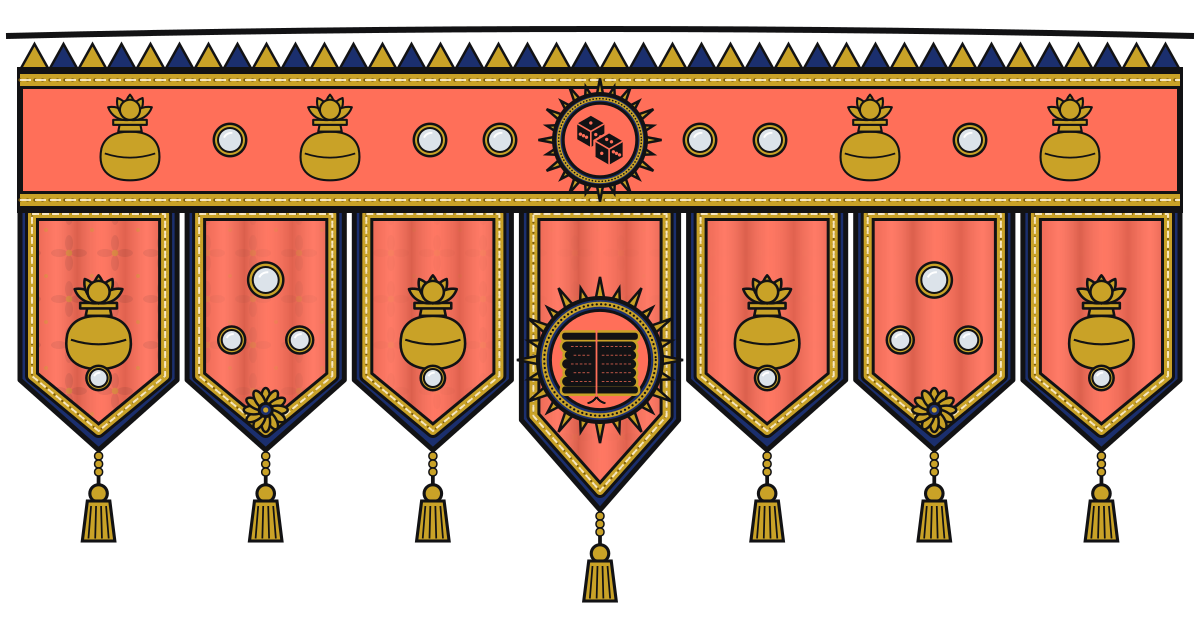
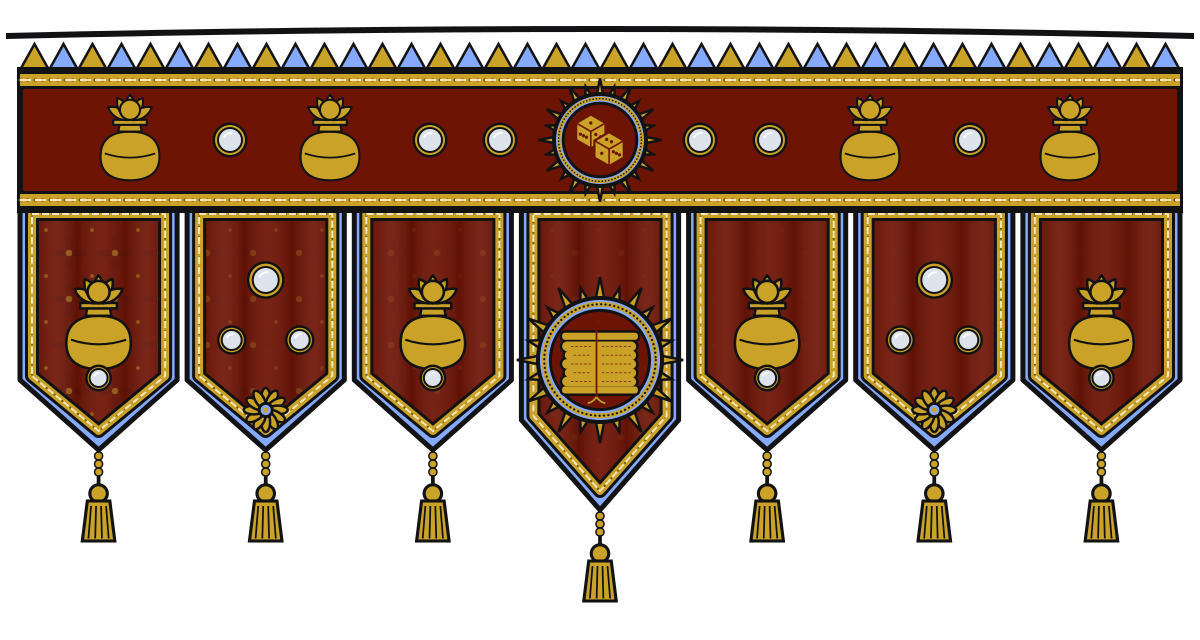
The Atlas gives the Gandharas an open palm-leaf manuscript, for the scholarship of Takshashila, and a pair of dice, for Shakuni of the Mahabharata. The flag is a Vaijayanti, the imperial standard.
| Part of the kit | This clan |
|---|---|
| Field | Royal Navy #1B2F6E |
| Accent | Warm Red-Orange #FF6F59 |
| Emblem colour | Metallic Gold #C9A227 |
| Zari metal | Gold |
| Main emblem | An open palm-leaf manuscript |
| Second image | A pair of dice |
| Night and day | Every visual accessory has two versions: by night the emblem on the dark field, by day the clan's field colour on cloth woven from its metal. |

6. Flags
Every clan has every flag type; the type says the occasion and the colours say the clan. The outlined card is the flag the Atlas assigns.
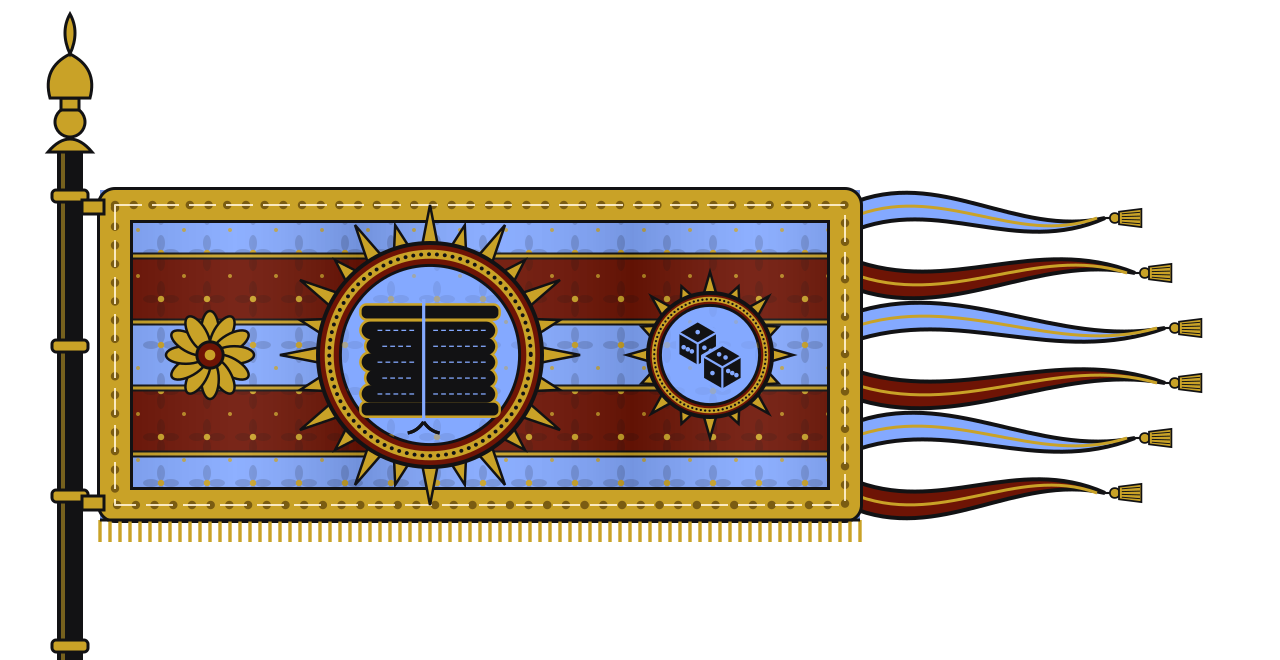

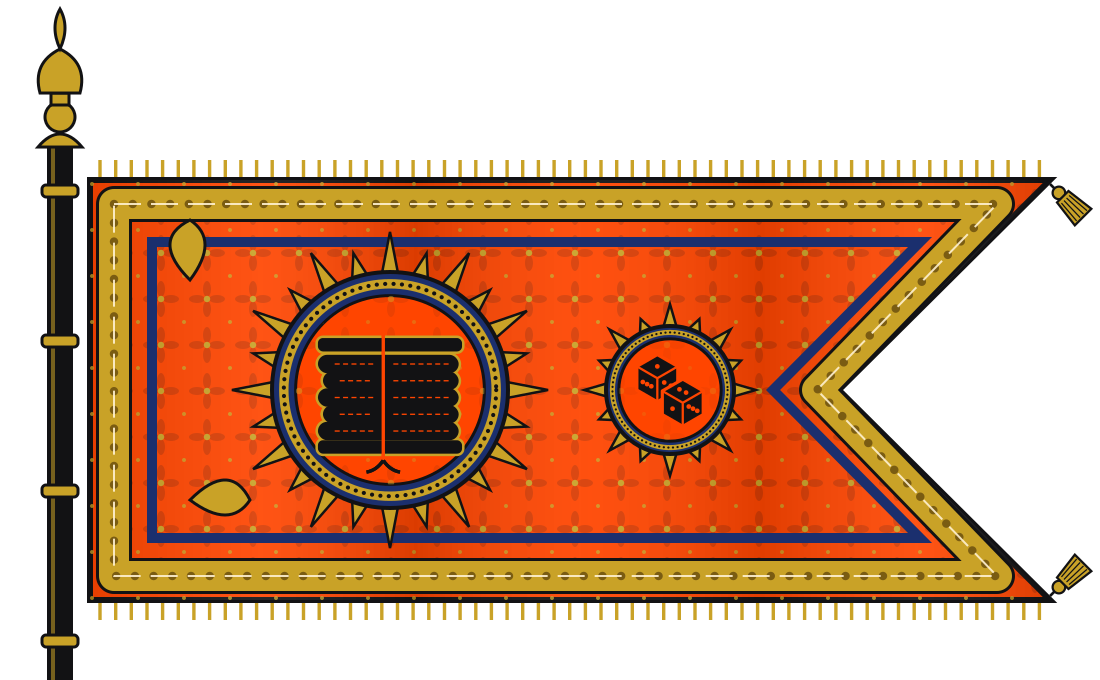
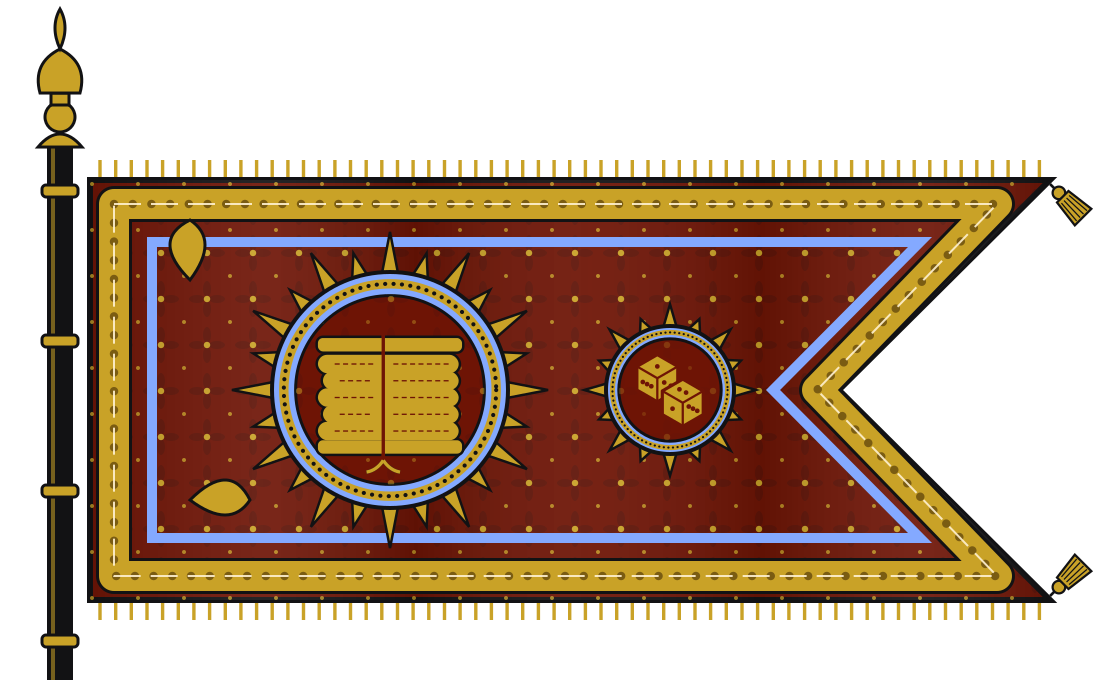

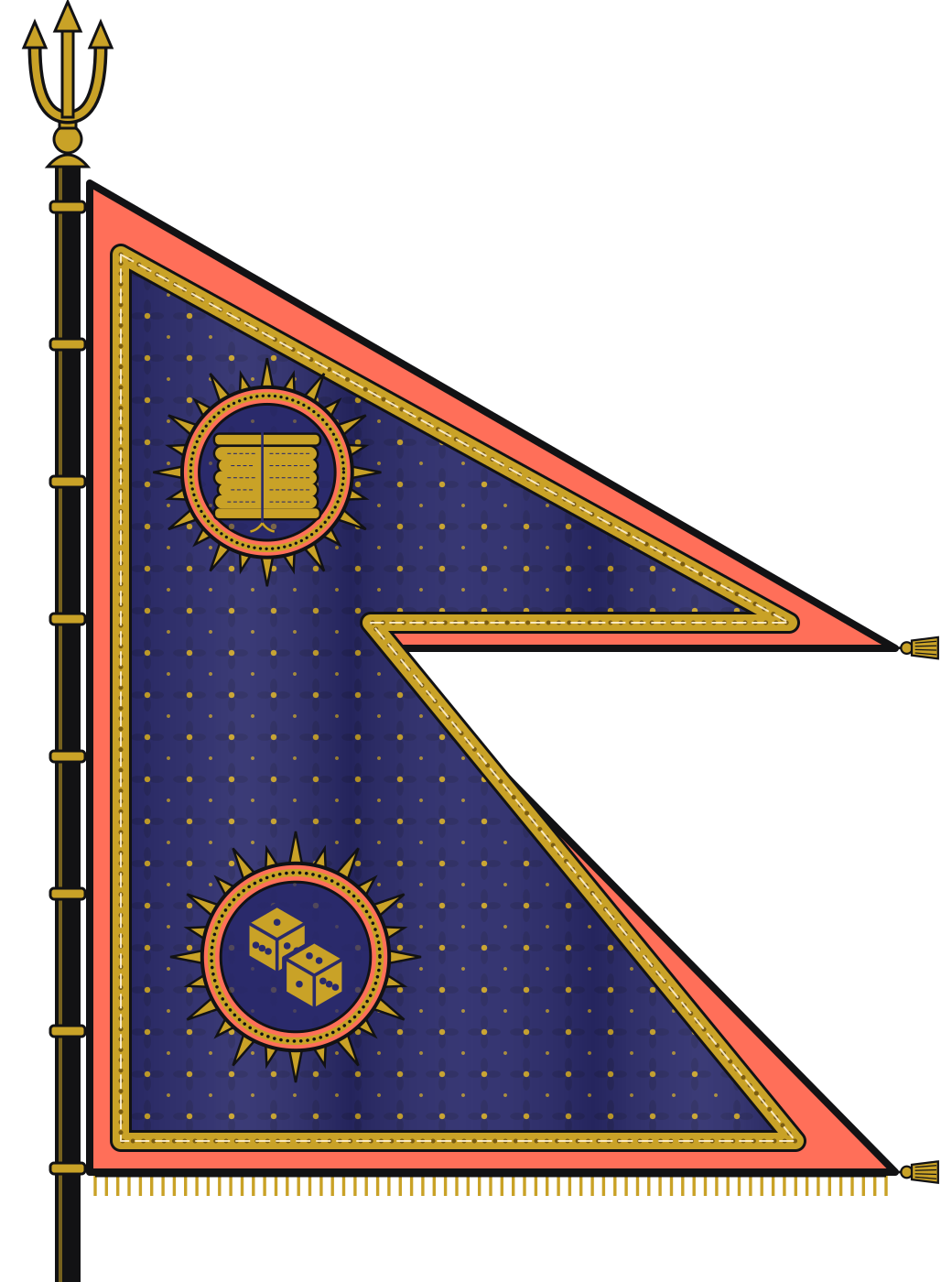




Historic banner
None known
New flag types
| Accessory | For this clan | Basis |
|---|---|---|
| A9 Pota-dhvaja · ship and trade flag For ships, caravans and markets | Not yet designed for this clan | Design |
| A10 Utsava-patāka · festival flag Light, bright flag for fairs and festivals | Not yet designed for this clan | Design |
| A11 Shoka-dhvaja · mourning flag White cloth with the emblem outline in the clan's metal | Not yet designed for this clan | Design |
7. Regalia
| Accessory | For this clan | Basis |
|---|---|---|
| E1 Chhatra · house parasol The ceremonial umbrella | Not yet designed for this clan | Design |
| E2 Chamara · fly-whisks The pair of whisks beside the head of the house | Not yet designed for this clan | Design |
| E3 Danda · staff of office Staff or scepter | Not yet designed for this clan | Design |
| E4 Simhasana · seat The seat of the house, covered in clan cloth | Not yet designed for this clan | Design |
| E5 Khetaka · shield A round shield; the Changi and Dhanush are its flag forms | Not yet designed for this clan | Regional tradition |
| E6 Kula-ayudha · clan weapon The weapon the clan honours | Not yet found for this clan | Under research |
8. Worn
| Accessory | For this clan | Basis |
|---|---|---|
| F1 Kula-vastra · clan cloth The clan's woven pattern in its kit colours | Not yet designed for this clan | Design |
| F2 Kirti-vastra · honour cloth A cloth earned for a deed, not inherited | Not yet designed for this clan | Design |
| F3 Kula-mala · garland flower The flower or leaf the clan wears as a garland | Not yet found for this clan | Under research |
| F4 Chinha · house pin A metal badge with the pin emblem | Not yet designed for this clan | Design |
9. Records
| Accessory | For this clan | Basis |
|---|---|---|
| H1 Clan words A traditional line in the native script | गन्धार · गन्ध · “Gandhara, from gandha, 'perfume': the land some scholars name for the spices and scents it traded” Clan words · the derivation of the name given on the Gandhara page, after Watters (1904)[1] | Design |
| H2 Biruda · titles The house's title or titles | Not yet found for this clan | Under research |
| H3 Prashasti · praise genealogy The lineage as written at the head of a grant | Not yet found for this clan | Under research |
| H4 Vahi · clan register The book of the clan's births, marriages and deaths | Not yet found for this clan | Under research |
| H5 Rana-ghosha · war cry The clan's cry in battle or celebration | Not yet found for this clan | Under research |
10. VishwaVit · knower of the world
Game values are design choices for this project, not historical claims.
References
- Gandhara (Wikipedia, snapshot of 24 May 2022, read 2026-10-09), citing Macdonell and Keith (1912), Al-Biruni (tr. Sachau 1910), Watters (1904), Salomon (1998), Neelis (2010), Behrendt (2007), Srinivasan (2008), Blurton (1993), Upinder Singh (2017) and Narasimhan et al. (2019).
- Gandhari language (Wikipedia, read 2026-10-09), citing R. Salomon (1998, 2007, 2008), Salomon, Allchin and Barnard, Ancient Buddhist Scrolls from Gandhara (1999), T. Burrow (1936) and C. Masica (1993).
- Taxila (Wikipedia, read 2026-10-09), citing J. Marshall, Taxila (1951) and A Guide to Taxila (1960), A. Cunningham (1871), R. K. Mookerji (1951), H. Scharfe (2002), R. Thapar (1997) and U. Singh (2008).
- Koh-e Asamai, Wikipedia.
- Wikipedia, Hindu Shahis, read 2026-10-10, https://en.wikipedia.org/wiki/Hindu_Shahis (citing Rehman 1976, 1978, al-Biruni, Kalhana, Meister 2010, Khan 2017, Wink 1991)
- Fran Pritchett, Hindu Shahi coins (Ghaznavids pages), read 2026-10-10, https://franpritchett.com/00routesdata/1000_1099/ghaznavids/hindushahicoins/hindushahicoins.html (dealer descriptions, Deyell attribution)
- Magadha (Wikipedia, read 2026-10-08), citing J. Bronkhorst, Greater Magadha (2007), M. Witzel (1987, 1995), H. C. Raychaudhuri (1953), R. C. Majumdar (1977), J. Keay, India: A History (2011) and K. T. S. Sarao (2003).
- Kalinga (region) (Wikipedia, read 2026-10-08), citing R. C. Majumdar, Outline of the History of Kalinga (1996), S. Misra, Janapada State in Ancient India (1973), H. C. Raychaudhuri (1953), D. C. Sircar (1971) and B. Patra (2005).
- Pradyota dynasty (Wikipedia, read 2026-10-08), citing K. C. Jain (1972, 1974), V. A. Smith (1957), H. C. Raychaudhuri (1953) and P. D. Gune (1920).
- G. P. Malalasekera, Dictionary of Pali Proper Names, Pukkusati/Gandhara (Association for Insight Meditation copy, updated 8 Oct 2020), read 2026-10-10, https://aimwell.org/DPPN/gandhara.html
- Ancient Buddhist Texts, Great Chronicles of Buddhas, ch. 36 ‘King Pukkusati and Others’ (based on MN 140 and its commentary), read 2026-10-10, https://ancient-buddhist-texts.net/English-Texts/Great-Chronicles/36.htm
- G. P. Malalasekera, Dictionary of Pali Proper Names, Gandhara entry (palikanon.com copy), read 2026-10-10, https://palikanon.com/namen/g/gandhaara.htm
- Majjhima Nikaya 140 Dhatuvibhanga Sutta (Pali with English, Buddha's Word copy), read 2026-10-10, https://dhamma.gift/bw/mn/mn140.html (translator not named)
- Wikipedia, Gandhāra (kingdom), read 2026-10-10, https://en.wikipedia.org/wiki/Gandh%C4%81ra_(kingdom) (citing Raychaudhuri 1953, Macdonell and Keith 1912, Karttunen 1989, Young CAH, Higham 2014)
- Wikipedia, Pushkarasarin, read 2026-10-10, https://en.wikipedia.org/wiki/Pushkarasarin (citing Lamotte 1988, Karttunen 1989, Prakash 1951, Jain 1972, Sethna 2000)
- Maurya Empire (Wikipedia, read 2026-10-08), drawing on Megasthenes' Indica (in later quotations), Ashoka's edicts, R. Thapar, H. Kulke and D. Rothermund, and T. R. Trautmann.
- Wikipedia, Battle of Peshawar (1001), read 2026-10-10, https://en.wikipedia.org/wiki/Battle_of_Peshawar_(1001) (citing Satish Chandra, Nazim 1931, Elliot 1869, Ziad 2016)
- Landay (poetry) (Wikipedia, read 2026-10-09), citing the Poetry Foundation glossary and E. Griswold, “Landays” (Poetry Foundation).
- Pashto folk singer Hidayatullah dies at 79, Sher Alam Shinwari, Dawn, 29 Sep 2019.
- Navaratri at the Asamai temple, Kabul, Hinduism Today news (2005).
- Hindus celebrate Navratras in Kabul, The Tribune, 13 Oct 2021.