The Gamit are a farming people[1] of Tapi, Surat, Dang, Bharuch, Valsad and Navsari districts in south Gujarat, with some in Maharashtra[2][3]. The Gamit are believed to be a sub-tribe of the Bhils, and Bhils who settled in villages came to be known as Gamits[2]. The name is traced to gamta, a headman, or to gam, a village[1]. They speak Gamit, a Bhil language, which the 2011 census counts at about 140,000 native speakers[3][2]. The Tribal Research and Training Institute of Gujarat says that the first god the Gamit worship is the Sun God, and a caste panch still governs marriage, remarriage, divorce and education[4][2].
01Faith and deities
Mother-goddess of the Bhils and the south Gujarat tribes[6]
The presiding goddess of the clan's homeland or capital: a link of place, not a recorded clan tie.
The Atlas gives Devmogra Mata as the Gamit KulDevi, basis 'Homeland shrine'. The TRTI and Wikipedia pages name the Gamit gods without her[4][6]. The tie is unconfirmed.
| Deity or tradition | Place in the clan's life | Evidence |
|---|---|---|
| Devli Madi, Gaumukh, Dunger Dev, Gowal Dev, Anaj Dev | Gods of the Gamit named together | [4][2][1] |
| Astala, Mavli, Vaghdev | Further gods and goddesses named by the TRTI page, with 'etc.' | [4] |
| Hiwaryo dev, Gaondev, Kuwarli, Devalimadi | Deities of the Mavchi, a related people | [7] |
| Yahamogi | Named among the Mavchi deities. The Dev Mogra page gives the names Devmogra, Devmogi and Yaah Devmogi; it does not say whether Yahamogi is one of them | [7][8] |
| Waghdev | Worshipped on the Sravan full moon by the Mavchi. The Gamit name a festival of Vaghdev Mahadev; the sources do not say the two are one deity | [7][2] |
02Temples
The sources read name no temple built or patronised by the Gamit. The sources give no places of worship for the gods named above.
Built by the clan
Not recorded.
Given patronage or grants by the clan
Not recorded.
03Languages and scripts
| Language or script | Kind | Under the clan | Evidence |
|---|---|---|---|
| Gamit (Gamti) living | A Bhil language; written in Devanagari and Gujarati; the Joshua Project prints the name in Devanagari | About 140,000 native speakers (2011 census, as Wikipedia gives it); 342,000 (Joshua Project, no year). Secondary: Gujarati, Bhili, Marathi and Goan Konkani | [3][1] |
| Gujarati | Used alongside Gamit | Gamits use more Gujarati words than the Mavchi, who use more Marathi | [7] |
| No fixed form of speech | An eBook cited by Wikipedia says the Gamit have 'no fixed form of speech' | Undated | [2] |
04Books and literature
No Gamit book, author or written text is named in the sources read. The language is written in Devanagari and Gujarati scripts[3], but no literature in it is named.
Written during the clan's history
Not recorded.
Given patronage by the clan
Not recorded.
05Thinkers and scholars
Not recorded.
No Gamit writer, thinker or scholar is named in the sources read. Leads: Enthoven, Tribes and Castes of Bombay, not yet read.
06Art and architecture
The sources name no painting, sculpture or temple of the Gamit. Their houses are described below, and their dress is under Life.
Painting and wall art
Not recorded.
Sculpture and temple art
Not recorded.
Temple and building architecture
| Art form | What it is | Era | Evidence |
|---|---|---|---|
| Village houses | Spaced apart; clay, cow dung, paddy grass, bamboo walls and tile roofs | Undated | [1] |
Weaving and textiles
Not recorded.
Clothing and jewellery
Not recorded.
Coins, pottery and crafts
Not recorded.
07History
Name and origin
The Gamit are believed to be a sub-tribe of the Bhils, and the Bhils who settled in villages were known as Gamits[2]. The name is given two sources: gamta, a headman, among the Bhil, or gam, a village[1]. A page on the Mavchi, a related people, links Gamit to the Gujarati gam and Gavit in Maharashtra to the Marathi gav, village[7].
A claimed Rajput descent (community tradition)
The Joshua Project says the Gamit are believed to claim descent from a Rajput community of the Sun dynasty, and gives a possible migration from the Khaibar and Bolan passes in Sindh to Marwad. The page presents this as belief, not as a recorded history[1].
1960: Uchhal taluka moves to Gujarat
Uchhal taluka, largely Mavchi, moved from Maharashtra to Gujarat in 1960, and its residents became known as Gamits[7]. Uchhal is in Surat district today[2].
Polity named in the Atlas
The Atlas names the Dangs chiefdoms as the Gamit's historical polity. None of the sources read describes those chiefdoms, so this page gives no dates or rulers for them.
08Journey and migrations
The sources give one dated movement of the Gamit, the 1960 transfer of Uchhal taluka. The route through Sindh is a claimed tradition, not a dated record.
| When | From | To | Why | Evidence |
|---|---|---|---|---|
| Undated (claimed) | Possible route via the Khaibar and Bolan passes, Sindh | Marwad | Possible migration route the Joshua Project gives, marked 'believed' | [1] |
| 1960 | Maharashtra | Uchhal taluka, Surat district, Gujarat | Taluka transferred to Gujarat; residents known as Gamits | [7] |
09Seats and lands
| Place | Role | Where today |
|---|---|---|
| Tapi district | Named among the Gamit districts[2] | Gujarat |
| Surat district | Vyara, Songadh, Uchchal and Nizar talukas[2] | Gujarat |
| Dang district | Gamit district (Dangs)[2][1] | Gujarat |
| Bharuch, Valsad and Navsari | Gamit districts[2][1] | Gujarat |
| Nandurbar and Dhule | Districts where the Gamit language is spoken[3] | Maharashtra |
| Uchhal taluka | Largely Mavchi; moved to Gujarat in 1960[7] | Surat district, Gujarat |
| Dangs chiefdoms | Historical polity named in the Atlas; no detail in the sources read | Dang district |
10Notable figures
Not recorded.
11Allies, rivals and marriages
| People | Relationship | When |
|---|---|---|
| Bhil | Parent people: the Gamit are believed to be a sub-tribe of the Bhils[2] | Undated |
| Mavchi (also Gavit) | Related people with marriage ties; customs like the Gamit of Tapi district[7] | Undated |
| Vasave, Valvi and Gavit | Neighbouring Bhil groups whose customs the Mavchi resemble[7] | Undated |
| Dubla, Chaudhari and Dhodia | Live in separate villages in the Gamit region[1] | Undated |
| Rajput (Sun dynasty) | Claimed ancestry, given with 'believed'[1] | Claimed |
12Society and livelihood
A caste panch with a written constitution handles marriage, remarriage, divorce and education[2][1].
Government and social order
| Institution or group | What it was | Evidence |
|---|---|---|
| Caste panch | Handles marriage, remarriage, divorce and education; has a written constitution | [2][1] |
| Marriage book | Marriages are registered in a book | [2] |
| Marriage rules | Marriage mostly within the same gotra (Wikipedia; Joshua Project also lists same-gotra marriage). The Mavchi page instead gives endogamy with clan exogamy for the Mavchi | [2][1][7] |
| Marriage customs | Aana, Khandhad marriage, love marriage, salivatu, diyarvatu, polygamy and remarriage; bride price | [2][1] |
| Divorce rule | No divorce within three years; fine of Rs. 351 | [2] |
| Birth rites | The Dai bathes the child for five days; the Pancharo falls on day five, or the chhathi on day six | [2] |
| Betrothal and marriage day | Betrothal is called Piyan; Tuesday or Thursday is better for marriage | [2] |
| Burial and cremation | Children are buried; the Ambli, Babool and Tick woods are used for cremation | [2] |
Livelihood over time
| Era | Livelihood | Evidence |
|---|---|---|
| Undated | Village farming | [1] |
| Undated | Hill farming in the Dangs-Tapi hills | From the Atlas |
| Present (undated) | Some Mavchi migrate to Surat and Mumbai for work in sugar mills | [7] |
13Sub-clans and related clans
The Gamit name three sub-tribes: Padvi, Valvi and Vasava[2]. The Mavchi (also Gavit) are a related people with marriage ties, and the Bhils are the parent people. Each name without a sheet ID is a new clan candidate.
| Clan | Relation | Where | Size | In the Atlas | Evidence |
|---|---|---|---|---|---|
| Padvi | Sub-clan | new clan candidate | [2] | ||
| Valvi | Sub-clan | ST-065 | [2] | ||
| Vasava | Sub-clan | 5,200, listed as Vasawa, Joshua Project, no year[1] | ST-514 | [2] | |
| Mavchi | Branch | Uchhal taluka, Gujarat (since 1960); Maharashtra, where the name is also Gavit | 2,400, listed as Mawchi, Joshua Project, no year[1] | new clan candidate | [7][1] |
| Bhil | Parent people | ST-027 | [2] | ||
| Dubla | Related people | Separate villages in the Gamit region | 18,697, Dubla, Talavia, Halpati, Maharashtra list 2011 (state figure)[9] | ST-074 | [1] |
| Dhodia | Related people | Separate villages in the Gamit region | 17,520, Maharashtra list 2011 (state figure)[9] | ST-067 | [1] |
| Chaudhari | Related people | Separate villages in the Gamit region | new clan candidate | [1] |
Clans marked "new clan candidate" are not in the Atlas yet.
14Surnames
Not recorded.
15Songs and music
Men sing at weddings, and festivals have community singing[1]. The sources name Gamit instruments but give no song texts.
None recorded yet.
Instruments and styles
| Instrument or style | What it is | Evidence |
|---|---|---|
| Dobru | Instrument named; not described in the sources read | [2] |
| Ghonghali | Instrument named; not described in the sources read | [2] |
| Pawari | Instrument named; not described in the sources read | [2] |
| Noly | Instrument named; not described in the sources read | [2] |
| Dhan | Instrument named; not described in the sources read | [2] |
16Poems, lullabies and children's rhymes
None recorded yet.
17Stories, legends and proverbs
Stories and legends
Not recorded.
Proverbs and sayings
Not recorded.
18Festivals and fairs
| Festival or fair | When | Where | What happens |
|---|---|---|---|
| Gam dev no | Not dated | Not stated | Named as a Gamit festival; no detail given[2] |
| Holi | Not dated | Not stated | Named as a Gamit festival[2][1] |
| Gowal Dev festival | Not dated | Not stated | Festival of the god Gowal Dev[2][1] |
| Vaghdev Mahadev | Not dated | Not stated | Named as a Gamit festival[2][1] |
| Waghdev | Sravan full moon | Mavchi | Worship of Waghdev[7] |
| Dussera and Diwali | Not dated | Not stated | Named as Gamit festivals[2][1] |
| Nano Dev-Moto Dev | Not dated | Not stated | Named as a Gamit festival[2][1] |
| Ganapati and Navratri | Not dated | Mavchi | Celebrated by the Mavchi as education spreads[7] |
19Food, dress and games
Food
Not recorded.
Dress
| Item | What it is | Evidence | |
|---|---|---|---|
| Shell necklaces | Women traditionally wear necklaces of rows of shells | Traditional, undated | [1] |
Games and martial arts
Not recorded.
Tags: living still practised · revived brought back after a break · lost known only from records · research reported but not yet confirmed from a source. Songs and poems under copyright are listed by title only; restricted or sacred material is noted without its content.
20Status today
The Gamit are a living Scheduled Tribe in Gujarat and Maharashtra. The 2011 census counts about 140,000 native speakers of Gamit[3], and the Maharashtra list counts 67,796 people under the names Gamit, Gamta, Gavit, Mavchi and Padvi (state figure)[9].
Who carries the name today
| Community | Link | Basis | Evidence |
|---|---|---|---|
| Gamit community (ST-080) | Documented | [2] |
Recognised heritage
| What | Recognition | Evidence |
|---|---|---|
| Scheduled Tribe status | Listed as a Scheduled Tribe (Atlas, list dated 09-07-2024) | From the Atlas |
No community review is recorded for this page.
21For children
The Gamit and their hill fields
The Gamit are a people who live in south Gujarat, in the Tapi and Dang country. Gamit families are farmers. The Gamit speak their own language, which is a Bhil language. Some people think the name Gamit comes from the word for a village, and some think it comes from the word for a headman. When there is a Gamit wedding, the men sing. The first god the Gamit worship is the Sun God. Today Gamit people live in Gujarat and Maharashtra.
22Across the project
| Project | What carries this clan | Status |
|---|---|---|
| Atlas of the Janas | Districts: Tapi, Surat, Dang, Bharuch, Valsad, Navsari. No footprint file written in this run | To do |
| KulDevi and GrahDevi | Devmogra Mata is the Atlas's KulDevi; the Gamit tie is unconfirmed | From the Atlas |
| Planet naming | Not checked | To check |
| Renaming and waters | No place or water name drawn from the Gamit in the sources read | — |
23Open questions
- The 52 family names behind 'Gamits of 52 families' (Wikipedia, citing an Indian Tribal Heritage eBook). Find the eBook or a list.
- Surnames: no list found. Are any of the alternate names (Padvi, Valvi, Vasava, Gavit, Gabit, Gamti, Pandvi) used as surnames?
- Marriage rules: the Mavchi page gives endogamy with clan exogamy, while Wikipedia and the Joshua Project give same-gotra marriage for the Gamit. Check which holds for each people.
- KulDevi: the Atlas's Devmogra Mata is not named for the Gamit by TRTI or Wikipedia. The Mavchi list names Yahamogi; the Dev Mogra page gives 'Yaah Devmogi' as one of its names but does not link it to Yahamogi. Confirm or drop the tie.
- Two Gujarat list counts saved from another codex (rows 11 and 29) are not mapped to the Gamit and are not used here.
- Gazetteer of the Bombay Presidency vol. VI (1880): only the first 100,000 characters were read; the rest of the volume may name the Gamit.
- Enthoven, Tribes and Castes of Bombay (NVLI, archive.org; vols I and III): not yet read. Leads for clans, surnames, songs and sayings.
- The Dangs chiefdoms (Atlas polity): no source read describes them.
- Songs, rhymes, sayings and stories: none found. The Gamit gods are named but not told about.
- Native script: only Devanagari (Joshua Project). The Gujarati form is not found.
- Words: no Gamit line or motto is recorded. The name in Devanagari stands in and is marked illustrative.
- Emblem: the Atlas's main emblem is a hill field with a plough. Check when the emblem is drawn.
- Chaudhari: named as living in separate villages (Joshua Project), with no sheet row. The Chaudhri row (ST-053) is not matched here and no review draft is written, as there are no sourced sub-type or era.
- Valvi: Wikipedia names Valvi as a Gamit sub-tribe[2]; the TRTI Tadvi page names Valvi as a division of Dhanka, with Tadvi and Tetariya[10]. The codex links Valvi to ST-065 (Dhanka) without a check.
- Mavchi: the Joshua Project lists Mawchi as a Gamit subgroup (2,400, no year)[1]; the Mavchi page describes them as similar to the Gamit of Tapi, with marriage ties[7]. The clans table says branch; the relations table says related people.
- Speakers: 140,000 (2011 census, as Wikipedia gives it)[3] and 342,000 (Joshua Project, no year)[1] both appear on this page and are not reconciled.
24Astitva
अस्तित्व · being, existence: everything by which the clan is known
No seal, coin, title, totem, war cry or banner of the Gamit is recorded in the sources read. The one documented record is the marriage book (H4).
Every clan has every accessory, royal objects included. Each one says how it is known: Documented This clan's own object is recorded. · Regional tradition Recorded for the region or for peoples like this one, not for this clan. · Design Made for this project, with no historical claim. · Under research To be found for this clan from sources. Legends and titles are written in the clan's own script.
1. Seals and coins
| Accessory | For this clan | Basis |
|---|---|---|
| B1 Rajamudra · house seal Round seal with the clan emblem and a short legend in the clan's script | Not yet designed for this clan | Design |
| B2 Anguliya-mudra · signet ring Personal seal ring of the head of the house | Not yet designed for this clan | Design |
| B3 Chhapa · house stamp Ink or block stamp for letters, goods and cloth | Not yet designed for this clan | Design |
| B4 Tamrapatra · charter plate Copper-plate grant on a ring, closed with the house seal | Not yet designed for this clan | Design |
| B5 Shreni-mudra · guild or trade seal Seal for the clan's trade, craft or caravan | Not yet designed for this clan | Design |
| C1 Clan coin Emblem or deity on one side, a legend in the clan's script | Not yet designed for this clan | Design |
| C2 Coin die The die that strikes the coin | Not yet designed for this clan | Design |
2. Living symbols
| Accessory | For this clan | Basis |
|---|---|---|
| I1 Totem trio The tree, bird and animal the clan protects | Not yet found for this clan | Under research |
| I2 Kaval-maram · guardian tree The tree that stands at the clan's seat | Not yet found for this clan | Under research |
3. Stone and gate
| Accessory | For this clan | Basis |
|---|---|---|
| G1 Torana · gateway The built gate of the seat; the cloth Toran hangs in it | Not yet designed for this clan | Regional tradition |
| G2 Viragallu · hero stone Carved panel stone for a member who died defending the clan | Not yet designed for this clan | Regional tradition |
| G3 Kula-shila · clan stones Standing and table stones that remember the ancestors | Not yet designed for this clan | Design |
| G4 Jayastambha · victory pillar A pillar raised for a victory | Not yet designed for this clan | Design |
| G5 Sima-shila · boundary stone Marks the clan's land, with a line in the native script | Not yet designed for this clan | Design |
4. Sounds
| Accessory | For this clan | Basis |
|---|---|---|
| D1 Pancha-mahashabda · five great sounds The right to five instruments | Not yet designed for this clan | Design |
| D2 Shankha · clan conch The clan's own named war conch | Not yet designed for this clan | Design |
| D3 Murasu · house drums Three drums: war, charity and justice | Not yet designed for this clan | Design |
5. Kit: colours, metals and emblems
The Atlas gives the Gamit a flag type, colours and a design: a hill field with a plough in gold on deep brick. No documented coin, seal or banner is recorded in the sources read, so the emblem is a sheet design, not a documented symbol.
| Part of the kit | This clan |
|---|---|
| Field | Deep Brick #7E2A1E |
| Accent | Deep Cosmic Blue #9BB0FF |
| Emblem colour | Metallic Gold #C9A227 |
| Zari metal | Gold |
| Main emblem | A hill field with a plough |
| Second image | — |
| Night and day | Every visual accessory has two versions: by night the emblem on the dark field, by day the clan's field colour on cloth woven from its metal. |
6. Flags
Every clan has every flag type; the type says the occasion and the colours say the clan. The outlined card is the flag the Atlas assigns.
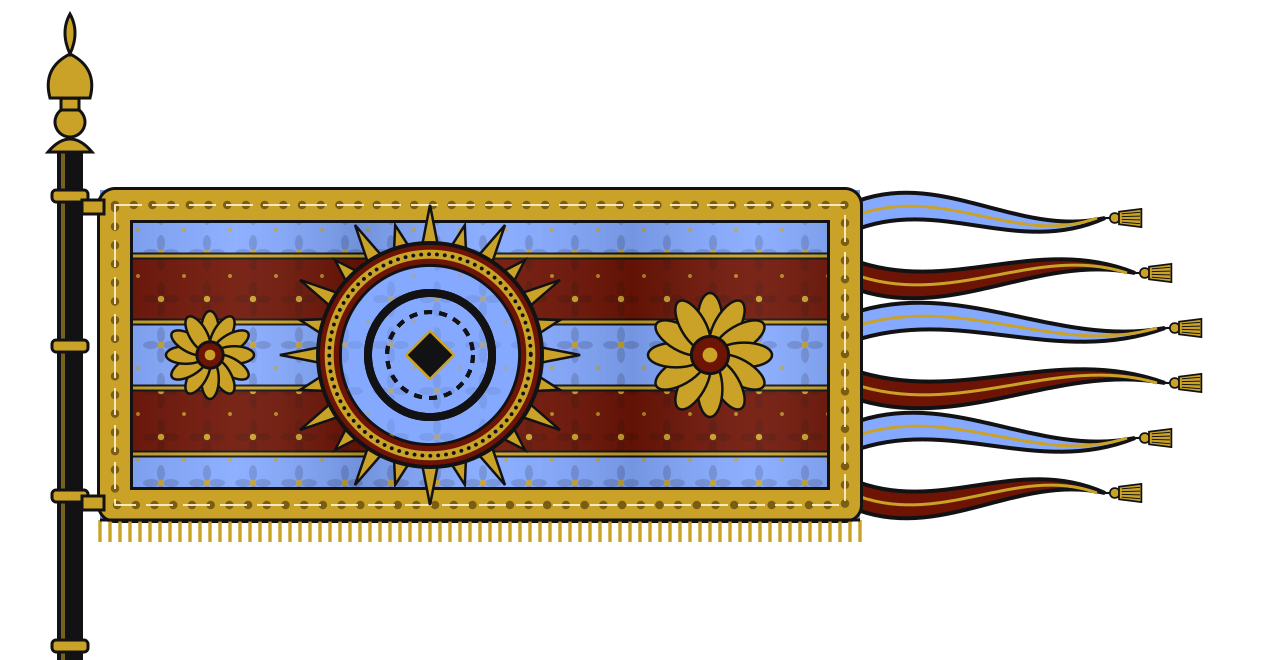
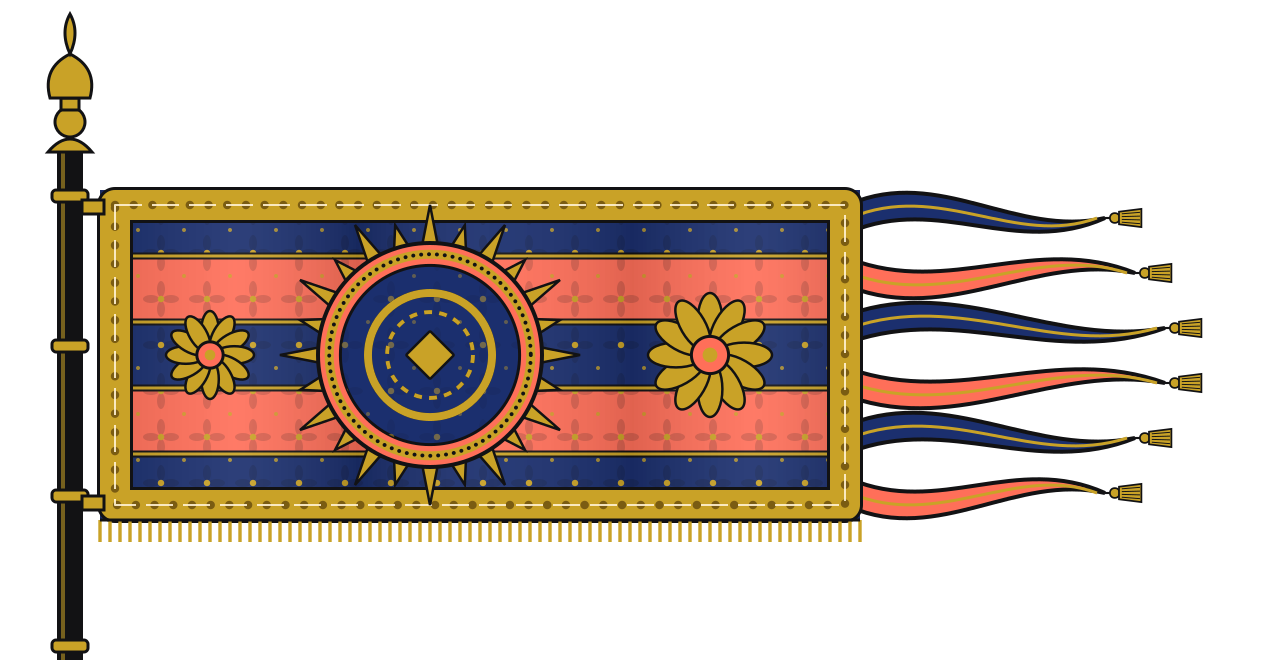
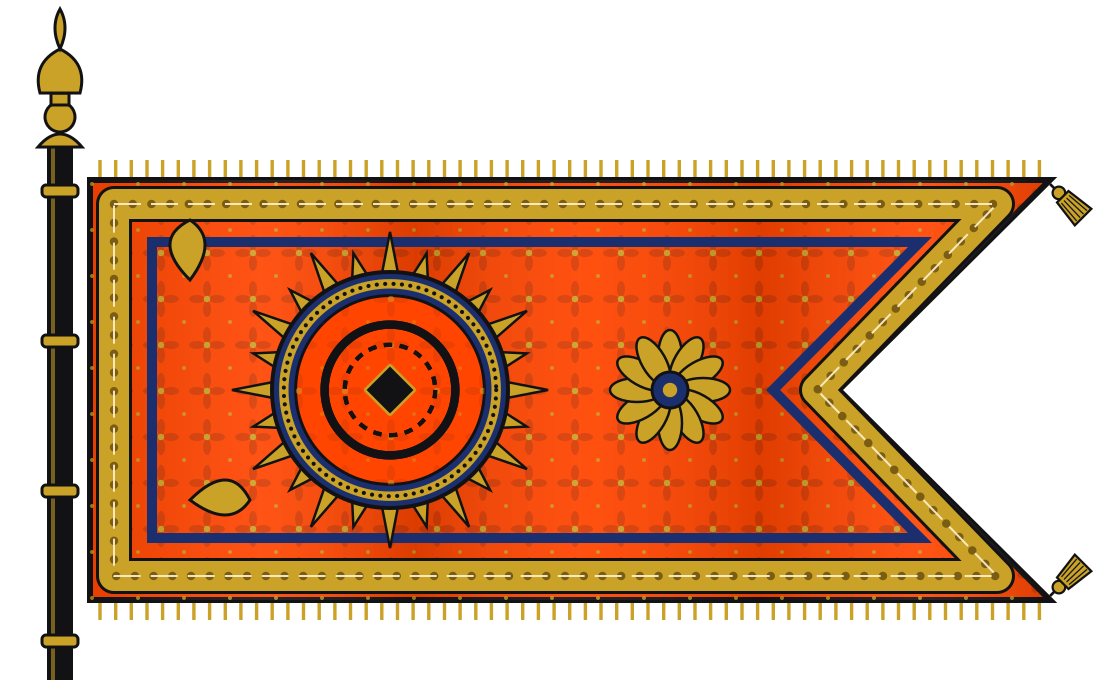
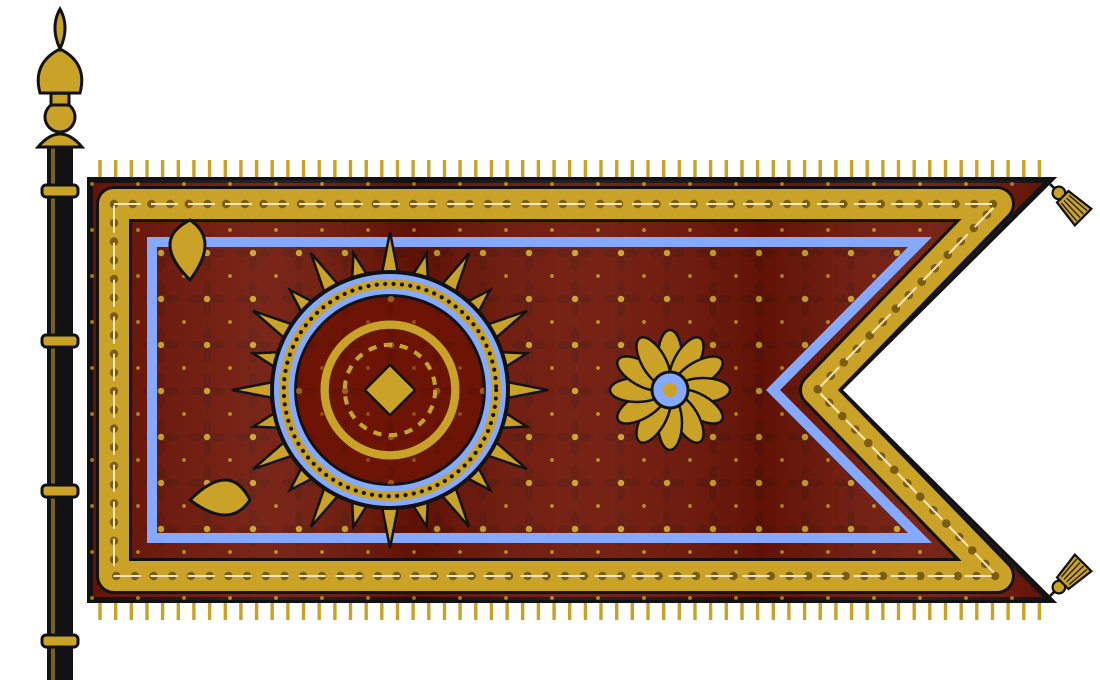
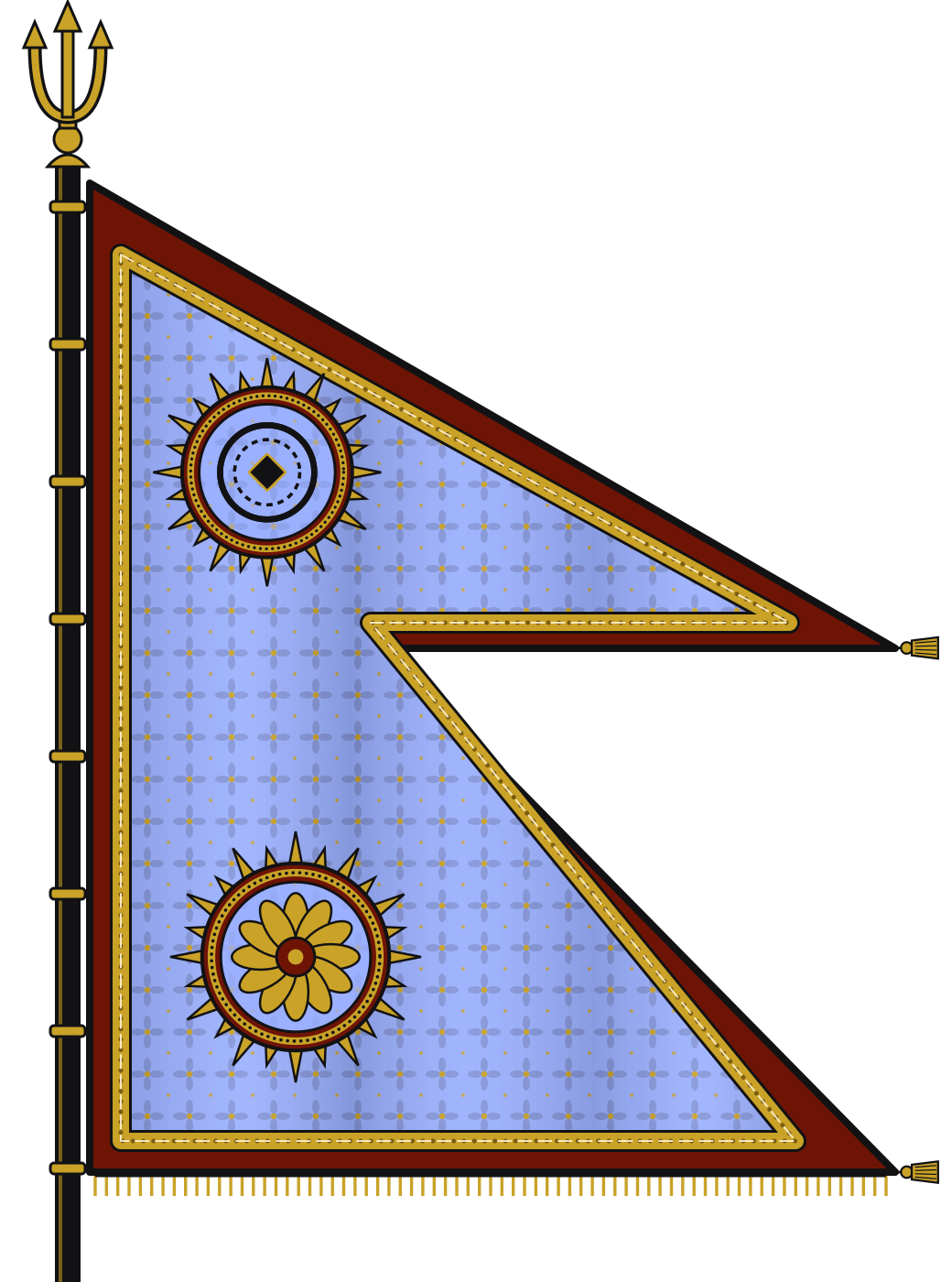
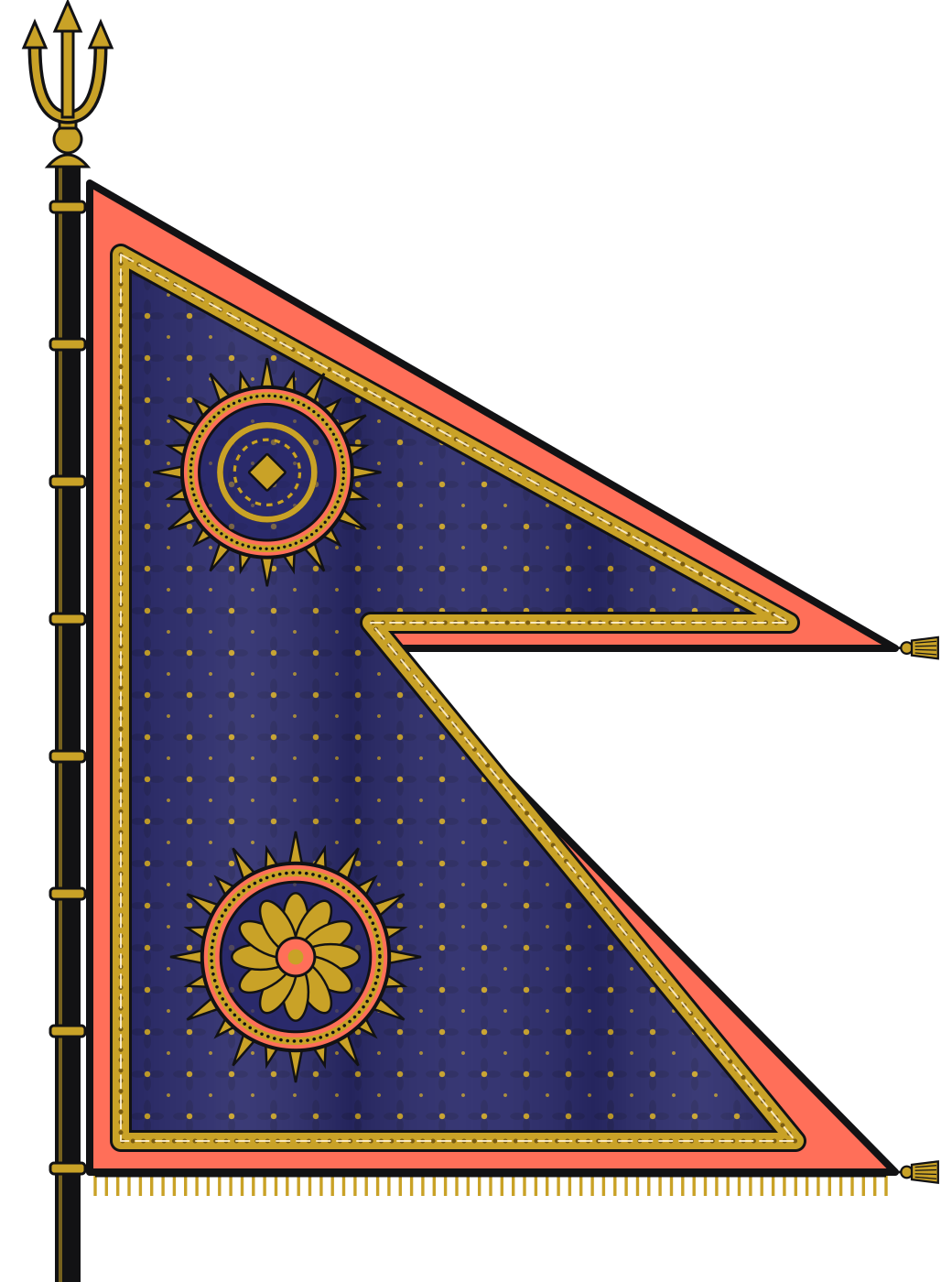

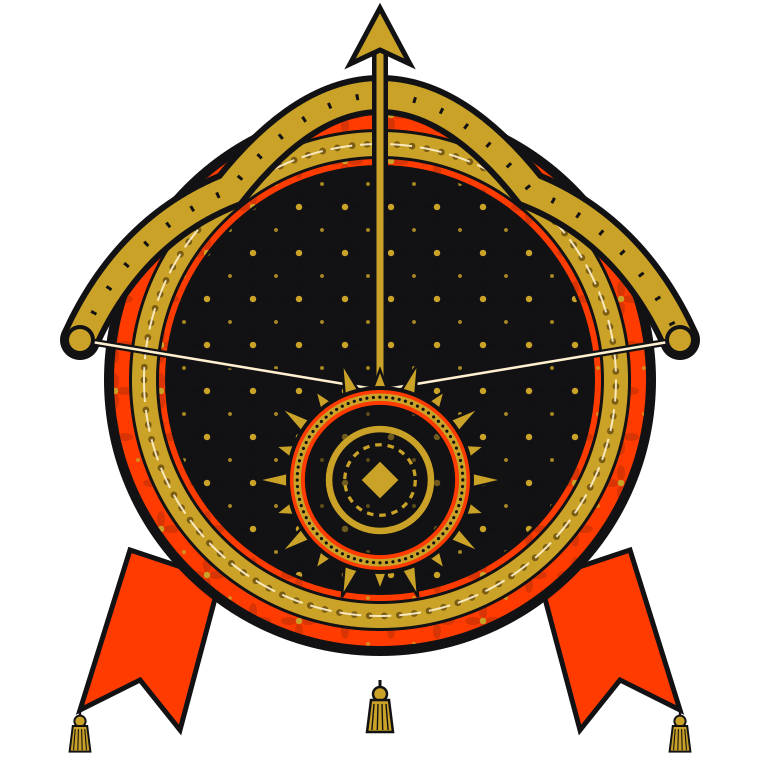
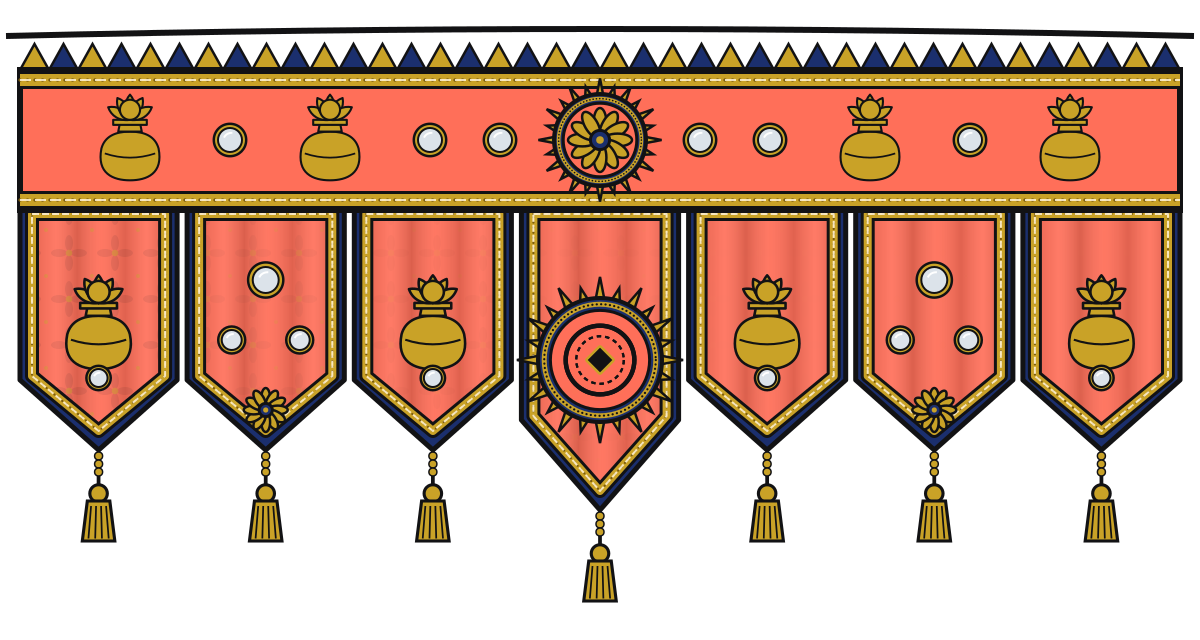

Historic banner
None known
New flag types
| Accessory | For this clan | Basis |
|---|---|---|
| A9 Pota-dhvaja · ship and trade flag For ships, caravans and markets | Not yet designed for this clan | Design |
| A10 Utsava-patāka · festival flag Light, bright flag for fairs and festivals | Not yet designed for this clan | Design |
| A11 Shoka-dhvaja · mourning flag White cloth with the emblem outline in the clan's metal | Not yet designed for this clan | Design |
7. Regalia
| Accessory | For this clan | Basis |
|---|---|---|
| E1 Chhatra · house parasol The ceremonial umbrella | Not yet designed for this clan | Design |
| E2 Chamara · fly-whisks The pair of whisks beside the head of the house | Not yet designed for this clan | Design |
| E3 Danda · staff of office Staff or scepter | Not yet designed for this clan | Design |
| E4 Simhasana · seat The seat of the house, covered in clan cloth | Not yet designed for this clan | Design |
| E5 Khetaka · shield A round shield; the Changi and Dhanush are its flag forms | Not yet designed for this clan | Regional tradition |
| E6 Kula-ayudha · clan weapon The weapon the clan honours | Not yet found for this clan | Under research |
8. Worn
| Accessory | For this clan | Basis |
|---|---|---|
| F1 Kula-vastra · clan cloth The clan's woven pattern in its kit colours | Not yet designed for this clan | Design |
| F2 Kirti-vastra · honour cloth A cloth earned for a deed, not inherited | Not yet designed for this clan | Design |
| F3 Kula-mala · garland flower The flower or leaf the clan wears as a garland | Not yet found for this clan | Under research |
| F4 Chinha · house pin A metal badge with the pin emblem | Not yet designed for this clan | Design |
9. Records
| Accessory | For this clan | Basis |
|---|---|---|
| H1 Clan words A traditional line in the native script | गमित · “Gamit” The people's name in Devanagari, as printed by the Joshua Project[1]. No line or motto of the Gamit is recorded in the sources read; the name stands in until one is found. | Design |
| H2 Biruda · titles The house's title or titles | Not yet found for this clan | Under research |
| H3 Prashasti · praise genealogy The lineage as written at the head of a grant | Not yet found for this clan | Under research |
| H4 Vahi · clan register The book of the clan's births, marriages and deaths | A book in which marriages are registered Marriages are registered in a book[2] | Documented |
| H5 Rana-ghosha · war cry The clan's cry in battle or celebration | Not yet found for this clan | Under research |
10. VishwaVit · knower of the world
Game values are design choices for this project, not historical claims.
References
- Joshua Project, Gamit in India (people 16781; missions-data estimates, no year), read 2026-11-10, https://joshuaproject.net/people_groups/16781/IN.
- Gamit people, Wikipedia, read 2026-11-10 (codex team run, Gamit ST-080).
- Gamit language, Wikipedia, read 2026-11-10, citing Ethnologue 25th ed. (2022).
- "Gamit", Tribal Research and Training Institute, Gujarat (trti.gujarat.gov.in), read 29 October 2026.
- Vajiram and Ravi, Tribes of Gujarat, read 2026-10-18, https://vajiramandravi.com/current-affairs/tribes-of-gujarat/
- "Gamit people", Wikipedia, read 29 October 2026.
- Bhil Mavchi, Wikipedia, read 2026-11-10, crediting People of India: Maharashtra vol. XXX part 1 (ed. B.V. Bhanu et al.), pp. 312-319.
- Dev Mogra, Wikipedia (read 2026-10-09), citing the Bombay Gazetteer vol. 6 (1880) and R. D. Tribhuwan, Fairs and Festivals of Indian Tribes (2003).
- dhammabharat.com, List of Scheduled Tribes in Maharashtra and Population of each Tribe (2011 Census), read 2026-10-10, https://dhammabharat.com/?p=13656
- Tadvi, Valvi, Tetariya, Tribal Research and Training Institute, Gujarat, re-read 2026-11-10 (codex team run 172, Dhanka ST-065).