The Gadaba are a Scheduled Tribe (list dated 09-07-2024) of Koraput and the Visakhapatnam area, with a 2011 population of 122,770 in Odisha and Andhra Pradesh, and 578 in Madhya Pradesh[1][2]. Their Gutob speakers use a Munda language of the Austro-Asiatic family, while the Ollara Gadaba speak a Dravidian language[3][1]. Thurston (1909) gives their chief deities as Ganga Devi, also called Takurani, with Iswara or Mouli, Bhairava and Jhankara, and records that they had no temples as a rule[4]. Their origin tradition places their ancestors by the Gada, a stream of the Godavari valley, before the Raja of Nandapur, the former capital of the Rajas of Jeypore[5][6][4]. The women's kerang fibre cloth and their large neck-rings are the clan's best-known marks, and the cloth is now said to be nearly extinct[5][1].
01Faith and deities
Thurston (1909) gives the chief deities, under the terms Devata or Mahaprabhu, as Ganga Devi or Takurani, Iswara or Mouli, Bhairava and Jhankara[4]. This is the clan's own chief deity, so the Atlas's KulDevi is not used here; it is named in the section Across.
Majhighariani of Rayagada, goddess of the Koraput hills
The presiding goddess of the clan's homeland or capital: a link of place, not a recorded clan tie.
| Deity or tradition | Place in the clan's life | Evidence |
|---|---|---|
| Iswara or Mouli | Worshipped at Chaitra with a she-buffalo; the two have temples at certain places[4] | [4] |
| Jhankara | God of land, rainfall and crops, to whom a cow is sacrificed; the sacred grove ringed with stones is named after him[4] | [4] |
| Bhairava | A chief deity in Thurston; venerated during festivals in the Sahapedia account[4][5] | [4] |
| Burhi Mata or Thakurani Mata | Goddess of smallpox and rinderpest; a white cock is offered to the sun and a red one to the moon[7] | [7] |
| Bhandarin, Dharni, Bharwan and Dand Devi | Goddess of agriculture; of good health; protector of cattle; protector from wild beasts[7] | [7] |
| Matideo | God of hunting, who lives in a tree; game is cooked before him at the Chait hunt[7] | [7] |
| Bana Debta, the nature god | Named as supreme in Muduli's account, with Basmati (earth goddess), Daramdevta (sky god), Surya (sun), Jal (water), tree deities, Patal kamini, Jal kamini and Dongor devi[5]. Attributed to the author. | [5] |
| Ancestors | Liquor is given to the ancestors on feast days[7] | [7] |
| Stone, earth and village | Worship slabs of stone, earth and the village, with no portraits; the SPPEL note names no deity[3] | [3] |
| Sacrifice | Goat or fowl in small rituals; buffalo sacrifice (podo) long ago. The author says the government has abolished the sacrificial ritual[5] | [5] |
02Temples
As a rule, Thurston says, the Gadaba had no temples. The puja place is a sacred grove ringed with stones, named Jhankara. Ganga Devi, Iswara and Mouli have temples at certain places, but the extracts do not say who built or patronised them[4].
Built by the clan
Not recorded.
Given patronage or grants by the clan
Not recorded.
03Languages and scripts
| Language or script | Kind | Under the clan | Evidence |
|---|---|---|---|
| Gutob living | Munda, Austro-Asiatic; the clan's own speech in the Gutob branch | Gutob-speaking Gadaba. About 85% of Gutobs no longer speak it[3] | |
| Ollari research | Dravidian | Spoken by the Ollara Gadaba[3][1] | |
| Desia Odia | Widely spoken; Odia is the school language | Spoken widely among the Gadaba[3][5] | |
| Gadba dialect of Mundari | Russell calls the Gadba's language a Mundari dialect | The Gadba of 1916[7] | |
| Gutob numerals | muititti, glossed by Thurston as '1 + a hand'; martitti, '2 + a hand' | Gutob Gadaba[4] | |
| No script | Gutob words are given in Latin letters and IPA only | No native script in the sources[3] |
04Books and literature
The extracts name no Gadaba text of the clan's own. The works below are by outsiders and are listed as sources.
Written during the clan's history
| Work | Author | Kind | When | Link to the clan |
|---|---|---|---|---|
| Castes and Tribes of Southern India, vol. 2 | Thurston and Rangachari | Survey entry 'Gadaba' | 1909 | [4] |
| Castes and Tribes of Southern India, vol. 1 | Thurston and Rangachari | Language entry 'Gadaba', one of the Munda languages | 1909 | [8] |
| The Tribes and Castes of the Central Provinces of India, vol. 3 | R. V. Russell and Hira Lal | Survey entry 'Gadba' | 1916 | [7] |
| Indigenous Colours of Odisha: Handbook on 62 Tribes | Sushree Mohanty | Handbook with districts and 2011 population | Not dated | [9] |
Given patronage by the clan
Not recorded.
05Thinkers and scholars
| Name | Field | Era | Contribution |
|---|---|---|---|
| Edgar Thurston and K. Rangachari | Survey of castes and tribes | 1909 | Gadaba entries in vols. 1 and 2[4] |
| R. V. Russell and Hira Lal | Survey of tribes and castes | 1916 | Gadba entry, vol. 3[7] |
| Dhanu Muduli | Gadaba community member, headmaster at Machkund State Government School | Not dated | Sahapedia essay on Gadaba narratives; his views are his own[5] |
| Sushree Mohanty | Ethnography (KISS handbook) | Not dated | Districts and population of the Gadaba[9] |
| Mitchell | Quoted by Russell on the word Gadba | Before 1916 | Meaning of the name[7] |
| Glasfurd, Henderson, Taylor, Paddison and Lakshminarayan | Quoted by Thurston | Before 1909 | Dance, festivals, marriage and legend[4] |
| SPPEL, CIIL Mysuru | Language documentation | Not dated | Gutob-Gadaba documentation[3] |
| Odisha State Tribal Museum | Museum page on the Gadaba | Not dated | Tribes of Odisha: Gadaba[6] |
Thurston's informants are not named in the extracts apart from Glasfurd, Henderson, Taylor, Paddison and Lakshminarayan, as the entry quotes them.
06Art and architecture
The extracts name no painting from the clan's past. Textiles, ornaments and the house-line of stones carry the visual record.
Painting and wall art
| Art form | What it is | Era | Evidence |
|---|---|---|---|
| Bark cloth painting | Bark coverings of the kuring tree painted red, yellow and blue, formerly (Russell) | [7] |
Sculpture and temple art
| Art form | What it is | Era | Evidence |
|---|---|---|---|
| Stone slabs | Erected to the dead; no carving is named | [4] |
Temple and building architecture
| Art form | What it is | Era | Evidence |
|---|---|---|---|
| Sacred grove | A grove ringed with stones, named Jhankara; no built structure is named | [4] |
Weaving and textiles
| Art form | What it is | Era | Evidence |
|---|---|---|---|
| Kerang fibre cloth | Women weave cloth from kerang fibre (Sahapedia); the Kerang Kapus weave from the Calotropis gigantea fibre (Thurston). The girl must weave before she marries[5][4] | [5] | |
| Women's cloth colours | Blue or reddish-brown, with white edges, a blue strip and a reddish-brown middle with narrow stripes[4] | [4] | |
| Two-piece dress | Striped red, blue and white, woven by the women themselves[1] | [1] |
Clothing and jewellery
| Art form | What it is | Era | Evidence |
|---|---|---|---|
| Women's bustle | Called irre or kitte; a goddess who visited in disguise decreed that all Gadaba women should wear it[4] | [4] | |
| Men's earrings | Men wear three earrings in each ear, according to Russell[7] | [7] | |
| Men | Men may wear cotton; the women must wear fibre cloth at marriage[4] | [4] |
Coins, pottery and crafts
Not recorded.
07History
The Gada river and the name
Thurston (1909) records the tradition that the Gadaba's ancestors came from the banks of the Godavari and settled at Nandapur, the former capital of the Rajas of Jeypore[4].
The Odisha State Tribal Museum gives the name as coming from Gada, a stream in the Godavari valley, and says the people are believed to have left a traditional home in the northern highlands of the Vindhya Mountains[6]. The Koraput district website gives the name as likely from Gada, a river of the region, with 'ba' meaning belonging to[10].
Russell (1916) says that Mitchell took the word Gadba to mean one who carries loads on the shoulders, and records that the people call themselves Guthau[7].
Jeypore and Nandapur
Sahapedia's account, written by a Gadaba community member, says the ancestors lived near the Gada by the Godavari and moved to the Koraput settlements before the reign of the Nandpur Raja[5]. The author's account is his own and is attributed to him.
The Atlas gives the historical polity as the subjects of the Jeypore kingdom.
Palanquin service to the Raja of Bastar (1916)
Russell records the Gadba as cultivators, labourers and village watchmen, and as hereditary palanquin-bearers to the Raja of Bastar, with a free land grant. He notes that only in Bastar State, in the Central Provinces, had some 700 persons immigrated[7].
Displacement by dams (since the early 1980s)
Wikipedia reports that since the early 1980s many Gadaba have been largely displaced from their villages by hydro-electric dams and lakes[1].
08Journey and migrations
The extracts give several undated traditions of movement and two dated moves: service in Bastar in 1916 and the displacement by dams from the early 1980s.
| When | From | To | Why | Evidence |
|---|---|---|---|---|
| Before the reign of the Nandpur Raja (undated) | Area of the Gada, by the Godavari | Settlements of the Koraput hills | The ancestors' move, as Sahapedia's author tells it | [5] |
| Undated (Thurston's tradition) | Banks of the Godavari | Nandapur, former capital of the Rajas of Jeypore | Tradition of emigration recorded in 1909 | [4] |
| Undated (OSTM) | Northern highlands of the Vindhya Mountains | Odisha | Migration believed to have happened; no date given | [6] |
| Before 1909 | Not stated | Assam tea-gardens | Some Gadabas emigrated; the practice was stopped by edict | [4] |
| 1916 (Russell) | Not stated | Bastar State | Hereditary palanquin-bearers to the Raja; some 700 persons had immigrated | [7] |
| Since the early 1980s | Villages in the dam and lake areas | Not named in the source | Displaced by hydro-electric dams and lakes | [1] |
09Seats and lands
| Place | Role | Where today |
|---|---|---|
| Koraput district | Main area. Gadaba are largely in the Lamataput, Similiguda and Pottangi blocks | Koraput, Odisha[10][9] |
| Lamtaput block (Lamptaput) | Sahapedia names Similigida, Lamptaput, Baipariguda, Nandpur and Jeypore; SPPEL names 40 villages of the Lamtaput block where the Gutob-Gadaba are concentrated | Koraput, Odisha[5][3] |
| Malkangiri | Named as a Gadaba district | Odisha[6][9] |
| Nowrangapur | Named as a Gadaba district, as the KISS handbook prints it | Odisha[9] |
| Nandapur | Former capital of the Rajas of Jeypore; origin tradition | Not stated in the extract[4] |
| Sembliguda-Koraput road | A settlement said to have been founded by a former Raja for bearer service | Koraput road[4] |
| Visakhapatnam | Gutob-Gadaba documentation area; Vizagapatam in Thurston | Andhra Pradesh[3][4] |
| Bastar State | Hereditary palanquin-bearers to the Raja (1916); some 700 immigrants | Bastar, Chhattisgarh (per the Atlas)[7] |
| Madhya Pradesh | 2011 Scheduled Tribe row 'Gadaba, Gadba': 578 | Madhya Pradesh[2] |
10Notable figures
Not recorded.
11Allies, rivals and marriages
| People | Relationship | When |
|---|---|---|
| Bonda Poroja (Bondo, ST-042) | Thurston calls the Bonda Poroja a section of the Gadabas, who call themselves Bonda Gadaba; the Bonda deny the language link (disputed) | 1909[11] |
| Parengi Poroja | Thurston: a section of the Gadabas, buffalo-eating and not, speaking a Gadaba dialect[11] | 1909 |
| Porja (Poroja) (ST-261) | A conglomerate of endogamous sections, of which the Parengi and Bonda are two[11] | 1909 |
| Munda peoples | Gutob is a Munda language; Grierson places the Gadaba language in the Munda family[3][4][1] | Not dated |
| Ollari (Dravidian) | The Ollara Gadaba speak a Dravidian language, distinct from Gutob[3] | Not dated |
| Savar (ST-285) | Russell: with the Savars, the only Mundari tribes so far south[7] | 1916 |
| Bhatra, Parja and Muria | Russell: a member of any of these may become a Gadba for two or three rupees[7] | 1916 |
| Chenchu (ST-054) | The Madras Census of 1891 returned nearly a thousand Gadabas under a 'Chenchu' sub-division; Thurston did not confirm it[4] | 1891 |
| Kerang Kapus | Related people, named by Thurston after Turner (1871)[4] | 1871 |
| Raja of Bastar | Hereditary palanquin-bearers, with a free land grant[7] | 1916 |
| Rajas of Jeypore | Nandapur, their former capital, is the seat named in the origin tradition[4][5] | Before 1909 |
12Society and livelihood
Gadaba villages are small and run by a headman, with a Kirasani who is also the caste priest, and dormitories for unmarried boys and girls. A Disari fixes the day of a marriage. Outsiders may be admitted to the tribe, according to Russell.
Government and social order
| Institution or group | What it was | Evidence |
|---|---|---|
| Headman | Janni or Nayako in the hills, Naidado on the plains; assisted by the Kirasani, who is also the caste priest[4] | |
| Village officers | Naik (elder), Chalan (assistant, chosen from the elders), Barik (from a lower caste, as the page gives it)[3] | |
| Dormitories | Dormitories for unmarried boys and girls[6] | |
| Disari | The priest who fixes the day of a marriage[4] | |
| Admission | A Bhatra, Parja, Muria or member of a superior caste may become a Gadba for two or three rupees. The novice is shaved, fed rice cooked in Ganges water, and the tribe feasts on a pig[7] | |
| Marriage (Thurston) | Marriage comes after puberty. The bridegroom's side brings a rupee and cloth for the bride's mother; the bride is given a glass-bead necklace and brass bangles on the right wrist; the wedding pandal has four bamboo poles with sal and addagirli; the couple bathe at a stream after mud-throwing; a feast and dance follow[4] | |
| Marriage (Parenga Gadaba) | Biba, a fist fight for the bride, after which the groom must carry her off; or lethulia, an elopement followed by a fine of 20 rupees or what he can afford[4] | Paddison, via Thurston |
| Marriage (Russell) | The groom's party is stopped by the girls and men of the bride's village; the girl asks for a ring; presents of food, liquor, cloth and two rupees; widow marriage by tika[7] | |
| Service and divorce | Ghorojavai, service for the father-in-law, was practised, and cash now replaces it; widows may remarry; divorce payments are buchni and chatni[4] | |
| Weaving before marriage | A maiden must learn to weave before she can marry[4]; earlier, a girl was expected to weave two pieces of kerang after puberty[5] | |
| Naming and walking | Children are named after the day of the week on which they were born; plains Gadabas use low-country names such as Ramudu, Lachigadu and Arjanna. A bamboo fork with a cross-bar is used to teach children to walk[4] | |
| Death (Thurston) | Men are burnt and women and children buried; pollution lasts three days; stone slabs are erected to the dead and sacrifices offered[4] | |
| Death (Russell) | The dead are buried with the feet to the west; mourning lasts nine days; a cow or bullock is killed with a blunt axe head, an office that is hereditary in some families[7] | |
| Goter | The important death ritual, which thanks and appeases the ancestor spirits[3] | |
| Customs | Men may not ride a horse, according to Russell[7]. Dormitories and village sacrifice are described under faith and festivals. |
Livelihood over time
| Era | Livelihood | Evidence |
|---|---|---|
| Undated | Cultivators, labourers and village watchmen; shifting cultivation; millets, pulses and niger[7][10] | |
| 1909 | Agriculturists, coolies and hunters in Vizagapatam; hill palanquin-bearers; some went to the Assam tea-gardens, stopped by edict[4] | |
| 1916 | Hereditary palanquin-bearers to the Raja of Bastar, with a free land grant[7] | |
| Undated | Agriculture, hunting, fishing and forest produce; ploughing cattle; some make brooms[6] | |
| Today | Farming and daily labour; slash-and-burn and the plough; permanent villages[1] |
13Sub-clans and related clans
Thurston (1909) names five sections: Bodo (big) or Gutob, Parenga, Olaro, Kaththiri or Kaththara, and Kapu. The Odisha list, the OSTM page and Wikipedia print variant sub-group names, and the sheet's aliases are shown only as the sheet gives them. Totemistic exogamous septs are named by Thurston and by Russell. Each name the extracts give is listed; a master-sheet ID is given only where the people is named in the sheet.
| Clan | Relation | Where | Size | In the Atlas | Evidence |
|---|---|---|---|---|---|
| Bodo (big) or Gutob Gadaba | Sub-clan | Thurston's first section, 'Bodo (big) or Gutob'. The Odisha list and the OSTM page print Bodo and Gutob as separate sub-groups, and Wikipedia gives Gutab. Bodo and Gutob Gadaba are PVTG. | new clan candidate | [4][12][6][1] | |
| Parenga Gadaba (Farenga) | Sub-clan | One of Thurston's five sections. The Odisha list gives Parenga Gadaba, and Wikipedia gives Farenga Gadaba. The Odisha list also gives Parenga as a separate people (ST-253). | new clan candidate | [4][12][1] | |
| Olaro (Ollara) Gadaba | Sub-clan | Thurston's 'Olaro', one of the five sections. The OSTM page and the Odisha list give Ollara. SPPEL says the Ollara Gadaba speak a Dravidian language, Ollari, distinct from Gutob. | new clan candidate | [4][6][12][3] | |
| Kaththiri (Kaththara) | Sub-clan | One of Thurston's five sections. The Atlas gives Kathera as an alias. Thurston says the Kaththiri and the Kapu settled in the plains and say they are Bodo and Olaro migrants. | new clan candidate | [4] | |
| Kapu Gadaba | Sub-clan | One of Thurston's five sections; settled in the plains, and says it is a Bodo and Olaro migrant. The Odisha list and the OSTM page name Kapu Gadaba. | new clan candidate | [4][6][12] | |
| Sano (Sana) Gadaba | Sub-clan | The Odisha list and OSTM give Sano Gadaba; Wikipedia gives Sana Gadaba. | new clan candidate | [6][12][1] | |
| Bada Gadaba | Sub-clan | Named among the Gadaba subgroups by Wikipedia. | new clan candidate | [1] | |
| Allar Gadaba | Sub-clan | Named among the Gadaba subgroups by Wikipedia. | new clan candidate | [1] | |
| Kora (sun) sept | Sub-clan | Totem sept of the Bodo and Olaro (Thurston). The plains Gadabas have forgotten the sept names but will not kill certain animals, such as the cobra. | new clan candidate | [4] | |
| Nag (cobra) sept | Sub-clan | Totem sept of the Bodo and Olaro (Thurston). | new clan candidate | [4] | |
| Bhag (tiger) sept | Sub-clan | Totem sept of the Bodo and Olaro (Thurston). | new clan candidate | [4] | |
| Kira (parrot) sept | Sub-clan | Totem sept of the Bodo and Olaro (Thurston). | new clan candidate | [4] | |
| Gollari (monkey) sept | Sub-clan | Totem sept of the Bodo and Olaro (Thurston). | new clan candidate | [4] | |
| Gutal (dog) sept | Sub-clan | Totemistic exogamous sept named after an animal; members do not kill it (Russell). | new clan candidate | [7] | |
| Angwan (bear) sept | Sub-clan | Totemistic exogamous sept named after an animal; members do not kill it (Russell). | new clan candidate | [7] | |
| Dungra (tortoise) sept | Sub-clan | Totemistic exogamous sept named after an animal; members do not kill it (Russell). | new clan candidate | [7] | |
| Surangai (tiger) sept | Sub-clan | Totemistic exogamous sept named after an animal; members do not kill it (Russell). | new clan candidate | [7] | |
| Gumal (snake) sept | Sub-clan | Totemistic exogamous sept named after an animal; members do not kill it (Russell). | new clan candidate | [7] | |
| Bonda Poroja (Bonda Gadaba) | Related people | Thurston: a section of the Gadabas, who call themselves Bonda Gadaba. The Bonda deny the language link, so the descent is disputed. Bondo is the sheet's ST-042. | ST-042 | [11] | |
| Parengi Poroja | Related people | A section of the Porja, buffalo-eating and not; Thurston also calls it a section of the Gadabas, speaking a Gadaba dialect. | new clan candidate | [11] | |
| Porja (Poroja) | Related people | A conglomerate of endogamous sections, including the Parengi and Bonda sections (Thurston). | 374,628, Odisha, 2011[12] | ST-261 | [11][12] |
| Kerang Kapu | Related people | Related Kerang Kapus, whose women weave cloth from the fibre of kerang (Calotropis gigantea) (Thurston, citing Turner 1871). | new clan candidate | [4] | |
| Chenchu | Related people | The Madras Census of 1891 returned nearly a thousand Gadabas under a 'Chenchu' sub-division. Thurston did not confirm it. | ST-054 | [4] | |
| Munda | Related people | The Gutob language is a Munda language, and Wikipedia lists Munda peoples as related. | ST-229 | [3][1] | |
| Savar | Related people | Russell: the Gadbas, with the Savars, are the only Mundari tribes so far south. | ST-285 | [7] | |
| Bhatra | Related people | Russell: a Bhatra may be admitted to the Gadaba for two or three rupees. | ST-026 | [7] |
Clans marked "new clan candidate" are not in the Atlas yet.
14Surnames
No Gadaba surname is recorded in the extracts. Thurston and Russell name exogamous septs, not surnames. The surnames in the Koraput page (Majhi, Chalan, Nayak and others) belong to the Bhattra, not the Gadaba.
Not recorded.
15Songs and music
The extracts give no song text. They describe improvised duets sung in a dance, and occasion songs, and name the instruments. No words are printed here.
Instruments and styles
| Instrument or style | What it is | Evidence |
|---|---|---|
| Tamudibaja, madal, tamak and mahuri | Played by the men (OSTM) | [6] |
| Pipe and drum; fife and drum | Festival dance to a pipe and a drum (Russell); fife and drum at the dance (Glasfurd, via Thurston) | [7][4] |
| Circle dance with long poles | A circle holding long poles, jumping to and from the centre (Russell); two-storied shoulder pyramid of men (Henderson, via Thurston) | [7][4] |
16Poems, lullabies and children's rhymes
The extracts name no poem, lullaby or rhyme.
None recorded yet.
17Stories, legends and proverbs
Stories and legends
| Story | What happens | Told by | Evidence |
|---|---|---|---|
| Sita and the fibre cloth legend | Sita, in exile with Rama in the Dandaka forest, was mocked by the Gadaba women, and cursed them to wear only fibre cloth. At marriage a maiden must wear it, or misfortune follows | The Gadaba, as recorded in Thurston; Lakshminarayan says they believe the legend[4] | [4] |
| The goddess and the bustle legend | A goddess visited in disguise and was told to sit on the floor; she decreed that all Gadaba women should wear the bustle | Thurston's account | [4] |
| The first paddy legend | The ancestors of the Gadaba are credited with discovering and cultivating the first paddy | Muduli, for Sahapedia[5] | [5] |
Proverbs and sayings
Not recorded.
18Festivals and fairs
| Festival or fair | When | Where | What happens |
|---|---|---|---|
| Ittakaparva | March to April, a hunting feast; unsuccessful hunters are pelted with cow-dung by the women | Not stated | The chief festival, as Taylor reports it[4] |
| Chait hunt | Game is cooked before Matideo; in Madras, women pelt unsuccessful hunters with cow-dung | Chait | Russell[7] |
| First-fruits | New rice is cooked and served to the cattle in new bamboo baskets, and then eaten | Not stated | Russell[7] |
| Mango festival | A festival at the ripening of the mango | Not stated | Russell[7] |
| Chaita Purba, Dialli Mas and Barbati | Festivals with the veneration of local deities | Not stated | Sahapedia[5] |
| Dingri Purbo | Prayer to birds to protect the crops | Not stated | Sahapedia[5] |
| Dusserah and Holi dances | The devil dance at Dusserah, Holi and other holidays | Not stated | Glasfurd, via Thurston[4] |
| Village goddess festival | A swing with thorns; the priest or priestess sits on it unharmed | Not stated | Thurston[4] |
| Epidemic rite | A little go-cart carries a clay image away, with a white flag | In an epidemic | Paddison, via Thurston[4] |
| Mage Parab (not kept) | Wikipedia says the Gadab do not keep the Mage Parab festival of the Ho | Magh | [13] |
19Food, dress and games
Food
| Item | What it is | Evidence |
|---|---|---|
| Mandia (ragi) | The staple grain[3] | [3] |
| Millets, pulses and niger | Crops of shifting cultivation[10] | [10] |
| penɖoːm | A local liquor used in ceremonies (SPPEL, IPA) | [3] |
| Snake-eating | Once practised, and now stopped[3] | [3] |
| Liquor for the ancestors | Given on feast days[7] | [7] |
Dress
| Item | What it is | Evidence |
|---|---|---|
| Women's neck-rings | Each weighs about 500 to 700 g and can be removed only by a blacksmith; they are removed after death[1]. SPPEL calls them large aluminium neck rings (kagla)[3] | [1][3] |
| Bark girdle and kusa circlet | Women wear a bark girdle as thick as a man's arm; a circlet of kusa grass seed on the forehead[7] | [7] |
| Earrings and chaplets | Huge brass-wire earrings reaching the shoulders; a chaplet of Oliva shells, beads or red-and-black Abrus berries[4] | [4] |
| Necklaces, bangles and anklets | Bead necklaces with coin pendants; brass or copper bracelets and rings; anklets[4] | [4] |
Games and martial arts
Not recorded.
Tags: living still practised · revived brought back after a break · lost known only from records · research reported but not yet confirmed from a source. Songs and poems under copyright are listed by title only; restricted or sacred material is noted without its content.
20Status today
The Gadaba are a Scheduled Tribe (Atlas list dated 09-07-2024) in Odisha and Andhra Pradesh. Bodo and Gutob are PVTG (no list date recorded). Their Gutob language is declining, and the Odisha and Andhra population is 122,770 (2011)[1][3].
Who carries the name today
| Community | Link | Basis | Evidence |
|---|---|---|---|
| Bonda (Bondo, ST-042) | Disputed | [11] | |
| Parengi Poroja (Porja section) | Documented | [11] |
No community review of this page is recorded. Dhanu Muduli, a Gadaba community member who writes for Sahapedia, is the clan's own voice in the extracts; his views are attributed to him[5].
21For children
The Gadaba of the hills
The Gadaba people live in the hills of Koraput and Malkangiri, in Odisha. Their women wove a cloth from the fibre of a plant called kerang, but few now weave it. The women wear large neck-rings. In the past a girl had to learn to weave before she married. The Gadaba speak Gutob, which is a Munda language, but the younger Gadaba have largely stopped speaking it. The people say that their ancestors found the first paddy.
22Across the project
| Project | What carries this clan | Status |
|---|---|---|
| Atlas of the Janas | No pin is set yet. The districts are in the lands section. All of the districts are in the states the sheet lists, so no footprint file is needed | To check |
| KulDevi and GrahDevi | KulDevi Majhighariani, goddess of Rayagada and the Koraput hills; the GrahDevi forms are Brahmani, Maheshvari, Kaumari, Vaishnavi, Varahi, Indrani, Chamunda and Narasimhi, also. The clan's own chief deity is Ganga Devi (section 01) | From the Atlas |
| Planet naming | Not in the extracts | Under research |
| Renaming and waters | The name comes from the Gada, a stream in the Godavari valley (OSTM). Since the early 1980s dams and lakes have displaced many Gadaba from their villages (Wikipedia) | From the sources |
23Open questions
- Native script: no Gutob, Odia or Desia form in the extracts; the native name is given in Latin letters. Find a native-script form and the Gadaba's own name for themselves (Russell gives Guthau).
- Words: no line of the Gadaba's own is in the extracts, so the words field is empty and marked illustrative. Find a clan line or a cited classical line.
- Bodo and Gutob: Thurston treats them as one section, 'Bodo (big) or Gutob'; the Odisha list and OSTM print them separately. Check with the Odisha list's notes or SPPEL.
- Neck-rings: Wikipedia gives 500 to 700 g each (citing india9) and does not name the metal; SPPEL says aluminium (kagla). Thurston gives brass wire for the earrings. Check the metal with a field source.
- Death rites: Thurston says men are burnt and women and children buried; Russell says the dead are buried with the feet to the west. Set both out, and ask which applies where.
- Deities: Thurston and Russell name Takurani, Burhi Mata and Matideo; Sahapedia names Bana Debta and others; SPPEL names no deity. Set out the sources side by side until the community confirms.
- Festivals: Thurston's Ittakaparva and Russell's Chait hunt may be the same festival.
- Dance: the 'devil dance' (Glasfurd, via Thurston) and the Dhemsa of the Koraput and OSTM pages may be the same dance.
- Parenga: the Odisha list gives Parenga Gadaba and Parenga (ST-253) as separate rows. Check whether they are one people.
- Population: 2011 Odisha 84,689 (Odisha list and OSTM) and 122,770 across Odisha and Andhra Pradesh (Wikipedia, citing the census). Check the census table and the Odisha sub-group breakdown.
- States: the Atlas lists Chhattisgarh and Telangana; the sources name Odisha, Andhra Pradesh and Madhya Pradesh, and Russell names Bastar State. Check the sheet.
- Sept names and surnames: check the census surname tables for the sept names (see the research note in surnames).
- Ollari: the Ollara Gadaba speak a Dravidian language. The Herald (University of Hyderabad) descriptive grammar of Ollari Gadaba is a lead in the pack and has not been read.
- The Assam tea-gardens emigration and the stopping of it by edict: find the dates and the places.
- Kerang weaving: Sahapedia says women have mostly stopped weaving it. Ask the Gadaba how many still weave it.
- Block spelling: Lamataput (Koraput district page), Lamtaput (SPPEL) and Lamptaput (Sahapedia) name the same block in the lands section. Choose one spelling after checking the block list.
24Astitva
अस्तित्व · being, existence: everything by which the clan is known
What is known of the Gadaba's sacred objects and dress: the animal and bird septs, the sal or kosangi tree worshipped at harvest, the stone slabs erected to the dead, and the kerang cloth. No seal, coin, title or war cry is recorded in the extracts[4][7].
Every clan has every accessory, royal objects included. Each one says how it is known: Documented This clan's own object is recorded. · Regional tradition Recorded for the region or for peoples like this one, not for this clan. · Design Made for this project, with no historical claim. · Under research To be found for this clan from sources. Legends and titles are written in the clan's own script.
1. Seals and coins
| Accessory | For this clan | Basis |
|---|---|---|
| B1 Rajamudra · house seal Round seal with the clan emblem and a short legend in the clan's script | Not yet designed for this clan | Design |
| B2 Anguliya-mudra · signet ring Personal seal ring of the head of the house | Not yet designed for this clan | Design |
| B3 Chhapa · house stamp Ink or block stamp for letters, goods and cloth | Not yet designed for this clan | Design |
| B4 Tamrapatra · charter plate Copper-plate grant on a ring, closed with the house seal | Not yet designed for this clan | Design |
| B5 Shreni-mudra · guild or trade seal Seal for the clan's trade, craft or caravan | Not yet designed for this clan | Design |
| C1 Clan coin Emblem or deity on one side, a legend in the clan's script | Not yet designed for this clan | Design |
| C2 Coin die The die that strikes the coin | Not yet designed for this clan | Design |
2. Living symbols
| Accessory | For this clan | Basis |
|---|---|---|
| I1 Totem trio The tree, bird and animal the clan protects | Animal and bird septs: Kora (sun), Nag (cobra), Bhag (tiger), Kira (parrot) and Gollari (monkey) among the Bodo and Olaro (Thurston); gutal (dog), angwan (bear), dungra (tortoise), surangai (tiger) and gumal (snake) (Russell) | Documented |
| I2 Kaval-maram · guardian tree The tree that stands at the clan's seat | A sal or kosangi tree, sometimes planted with a bamboo hedge and worshipped at harvest | Documented |
3. Stone and gate
| Accessory | For this clan | Basis |
|---|---|---|
| G1 Torana · gateway The built gate of the seat; the cloth Toran hangs in it | Not yet designed for this clan | Regional tradition |
| G2 Viragallu · hero stone Carved panel stone for a member who died defending the clan | Not yet designed for this clan | Regional tradition |
| G3 Kula-shila · clan stones Standing and table stones that remember the ancestors | Stone slabs erected to the dead, with sacrifices offered; the sacred grove ringed with stones named Jhankara | Documented |
| G4 Jayastambha · victory pillar A pillar raised for a victory | Not yet designed for this clan | Design |
| G5 Sima-shila · boundary stone Marks the clan's land, with a line in the native script | Not yet designed for this clan | Design |
4. Sounds
| Accessory | For this clan | Basis |
|---|---|---|
| D1 Pancha-mahashabda · five great sounds The right to five instruments | Not yet designed for this clan | Design |
| D2 Shankha · clan conch The clan's own named war conch | Not yet designed for this clan | Design |
| D3 Murasu · house drums Three drums: war, charity and justice | Not yet designed for this clan | Design |
5. Kit: colours, metals and emblems
The extracts record no seal, coin or banner for the Gadaba. The main emblem, the kit colours and the flag type come, as project design. The kerang cloth and the stone slabs that the page's astitva section uses come from the sources named there.
| Part of the kit | This clan |
|---|---|
| Field | Deep Brick #7E2A1E |
| Accent | Deep Cosmic Blue #9BB0FF |
| Emblem colour | Metallic Gold #C9A227 |
| Zari metal | Gold |
| Main emblem | Coiled brass neck-rings |
| Second image | A loom with kerang fibre |
| Night and day | Every visual accessory has two versions: by night the emblem on the dark field, by day the clan's field colour on cloth woven from its metal. |
6. Flags
Every clan has every flag type; the type says the occasion and the colours say the clan. The outlined card is the flag the Atlas assigns.
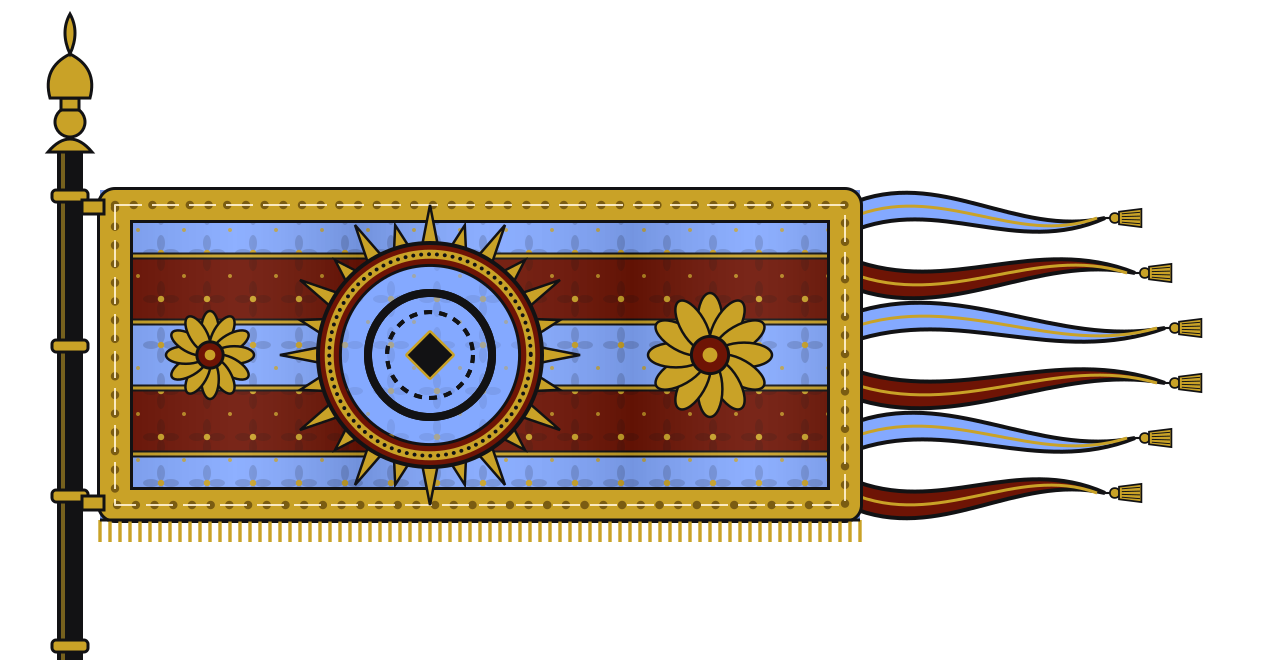
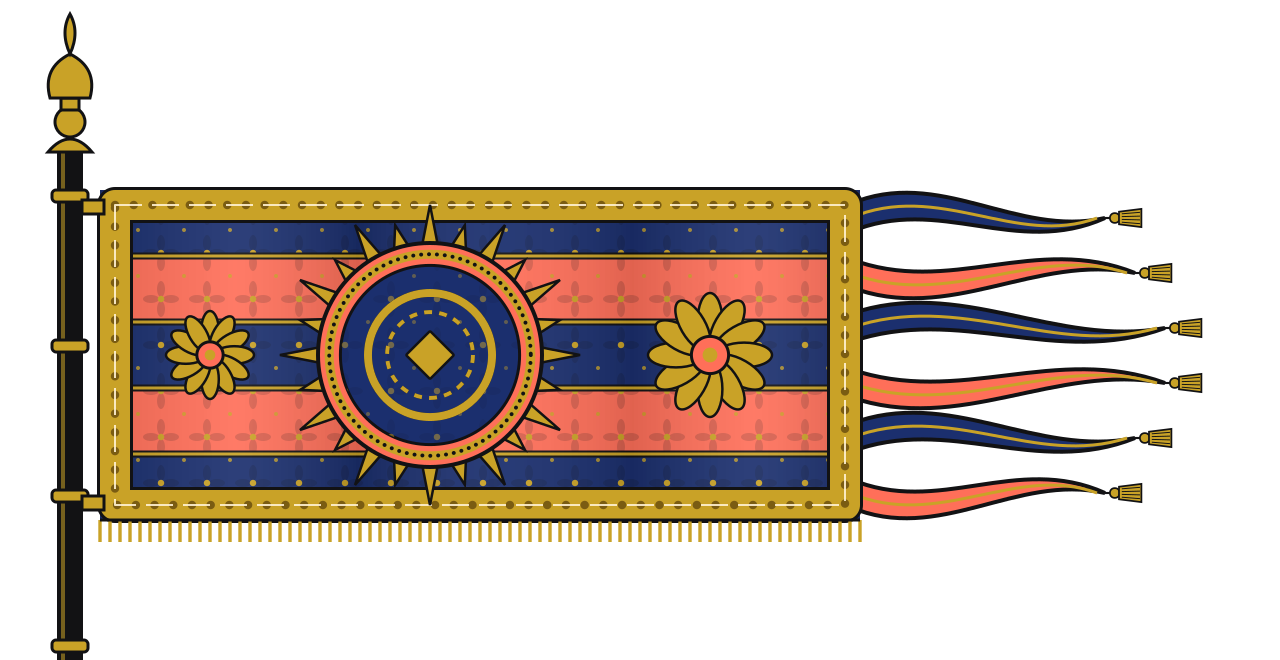
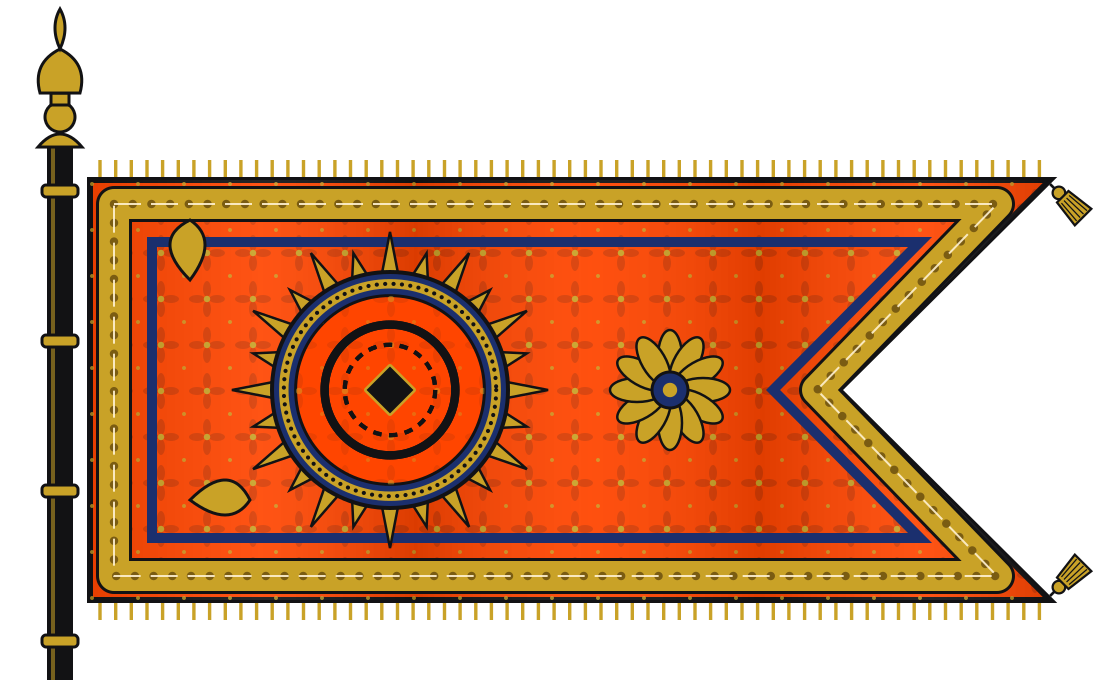
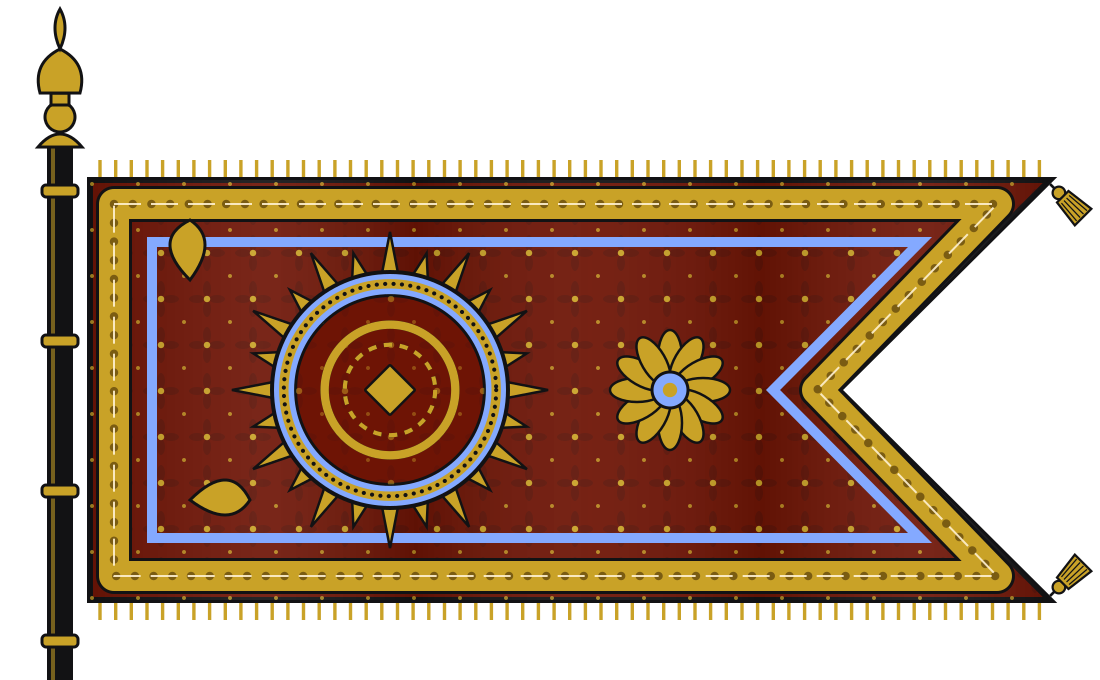

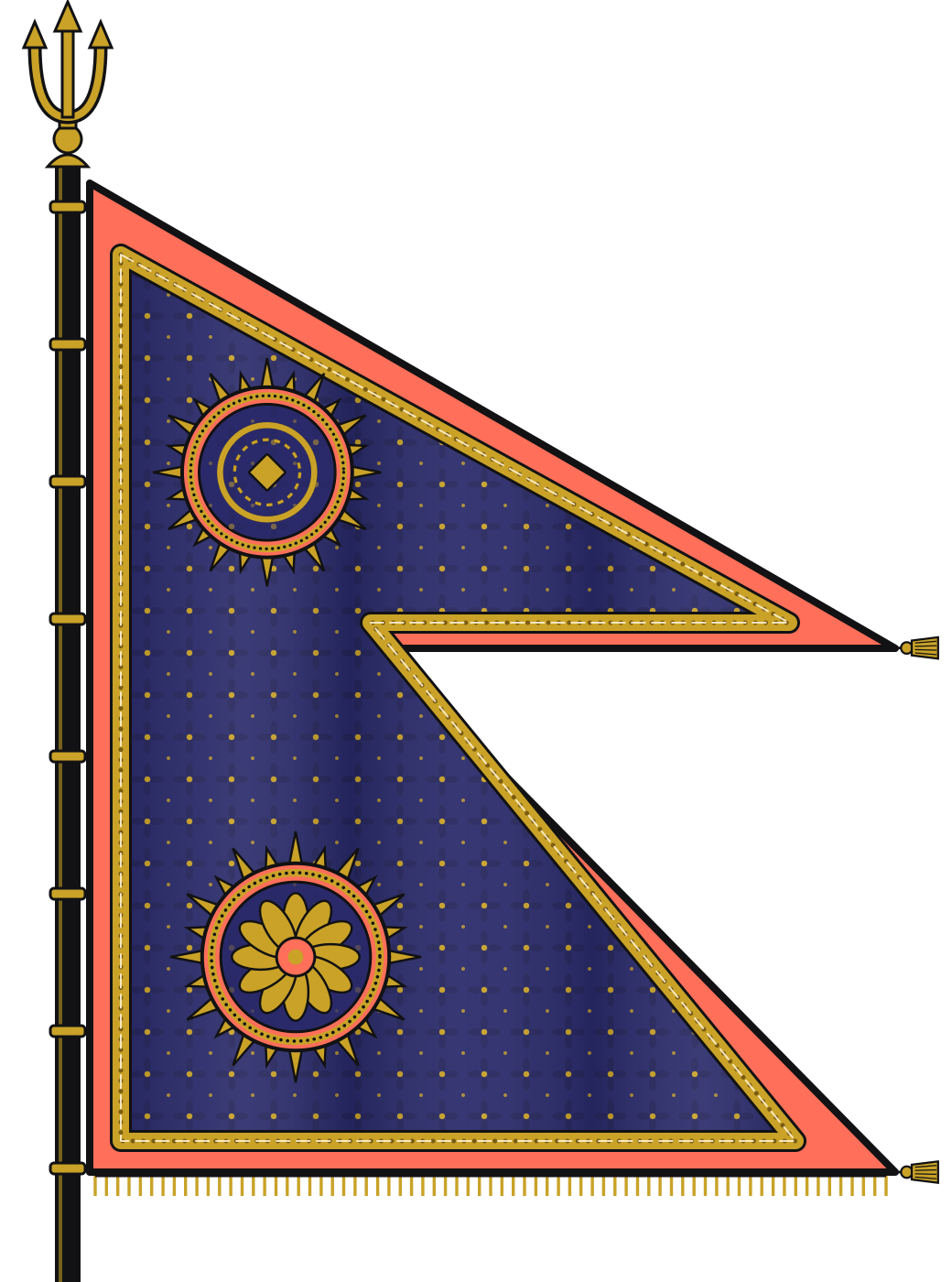


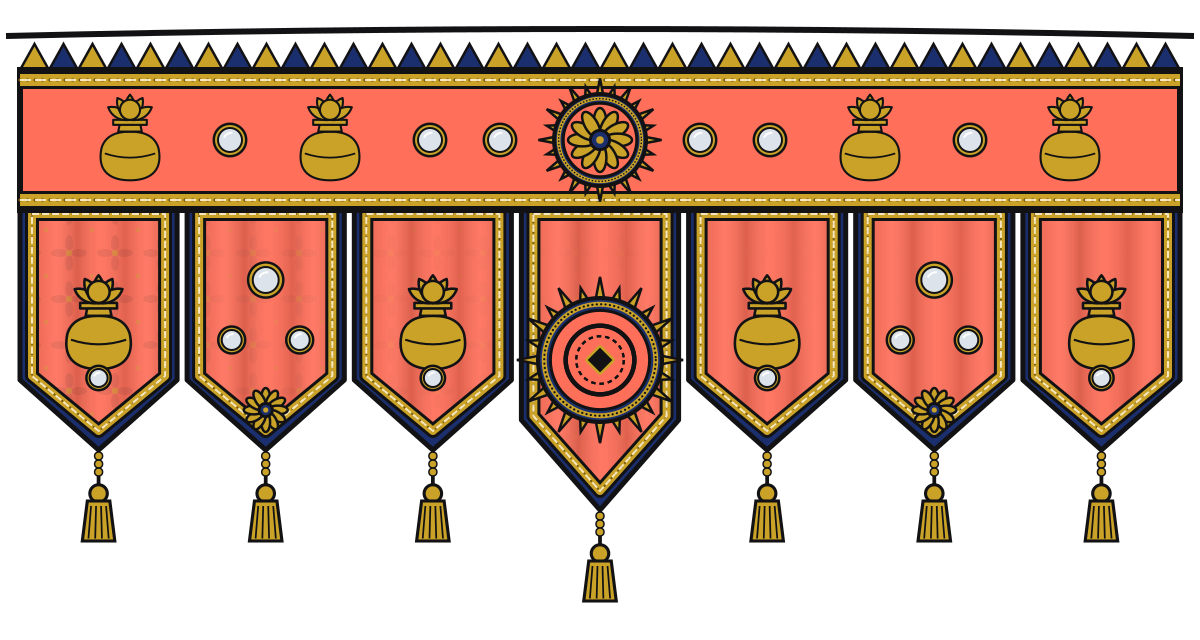
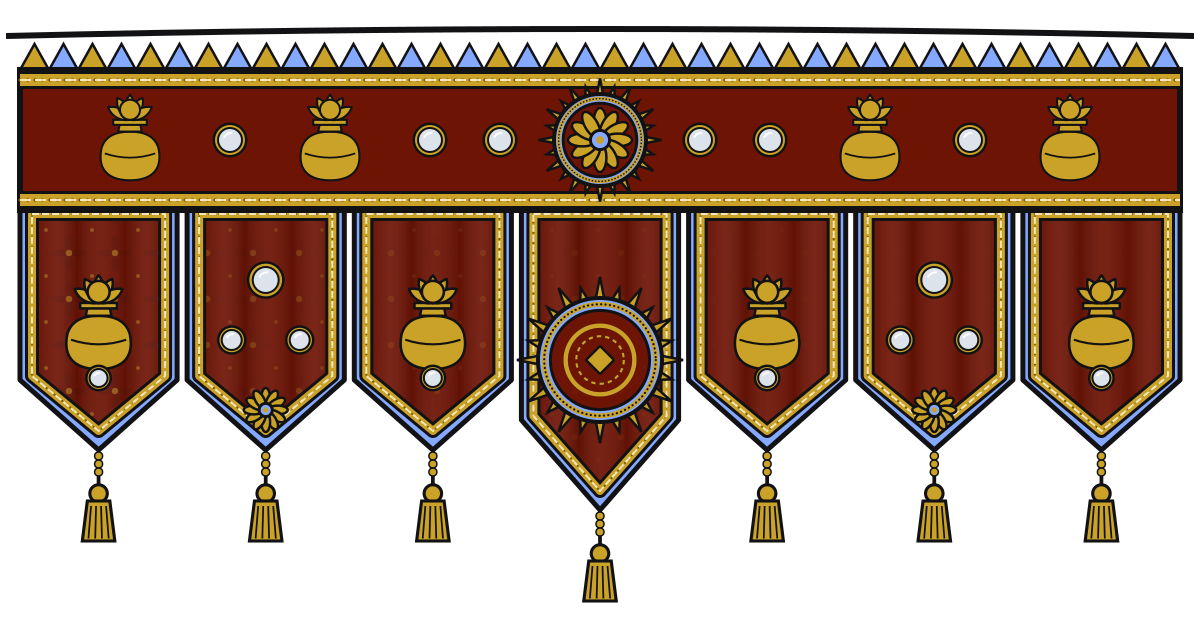

Historic banner
None known
New flag types
| Accessory | For this clan | Basis |
|---|---|---|
| A9 Pota-dhvaja · ship and trade flag For ships, caravans and markets | Not yet designed for this clan | Design |
| A10 Utsava-patāka · festival flag Light, bright flag for fairs and festivals | Not yet designed for this clan | Design |
| A11 Shoka-dhvaja · mourning flag White cloth with the emblem outline in the clan's metal | Not yet designed for this clan | Design |
7. Regalia
| Accessory | For this clan | Basis |
|---|---|---|
| E1 Chhatra · house parasol The ceremonial umbrella | Not yet designed for this clan | Design |
| E2 Chamara · fly-whisks The pair of whisks beside the head of the house | Not yet designed for this clan | Design |
| E3 Danda · staff of office Staff or scepter | Not yet designed for this clan | Design |
| E4 Simhasana · seat The seat of the house, covered in clan cloth | Not yet designed for this clan | Design |
| E5 Khetaka · shield A round shield; the Changi and Dhanush are its flag forms | Not yet designed for this clan | Regional tradition |
| E6 Kula-ayudha · clan weapon The weapon the clan honours | Not yet found for this clan | Under research |
8. Worn
| Accessory | For this clan | Basis |
|---|---|---|
| F1 Kula-vastra · clan cloth The clan's woven pattern in its kit colours | Women's cloth, blue or reddish-brown with white edges, a blue strip and narrow stripes; the women weave kerang fibre cloth (Sahapedia) | Documented |
| F2 Kirti-vastra · honour cloth A cloth earned for a deed, not inherited | Not yet designed for this clan | Design |
| F3 Kula-mala · garland flower The flower or leaf the clan wears as a garland | Not yet found for this clan | Under research |
| F4 Chinha · house pin A metal badge with the pin emblem | Not yet designed for this clan | Design |
9. Records
| Accessory | For this clan | Basis |
|---|---|---|
| H1 Clan words A traditional line in the native script | · “No line of the Gadaba's own words is in the extracts. See the research note in the lead and open questions.” No source in the pack gives a Gadaba line | Design |
| H2 Biruda · titles The house's title or titles | Not yet found for this clan | Under research |
| H3 Prashasti · praise genealogy The lineage as written at the head of a grant | Not yet found for this clan | Under research |
| H4 Vahi · clan register The book of the clan's births, marriages and deaths | Not yet found for this clan | Under research |
| H5 Rana-ghosha · war cry The clan's cry in battle or celebration | Not yet found for this clan | Under research |
10. VishwaVit · knower of the world
Game values are design choices for this project, not historical claims.
References
- Wikipedia, Gadaba people, read 2026-10-26, https://en.wikipedia.org/wiki/Gadaba_people
- Wikipedia, Tribals in Madhya Pradesh, read 2026-10-19, https://en.wikipedia.org/wiki/Tribals_in_Madhya_Pradesh
- SPPEL, CIIL Mysuru, Gutob-Gadaba language documentation, read 2026-10-26, https://sppel.org/resources/language-documentation/gutob-gadaba
- Edgar Thurston and K. Rangachari, Castes and Tribes of Southern India, vol. 2 (Madras, 1909), Project Gutenberg eBook #42992, https://www.gutenberg.org/ebooks/42992
- Dhanu Muduli, Cultural Narratives of the Gadaba Adivasis of Odisha, Sahapedia, read 2026-10-26, https://www.sahapedia.org/cultural-narratives-of-the-gadaba-adivasis-of-odisha
- Odisha State Tribal Museum, Tribes of Odisha: Gadaba, read 2026-10-26, https://ostm.in/?p=5444
- R. V. Russell and Hira Lal, The Tribes and Castes of the Central Provinces of India, vol. 3 (London, 1916), Project Gutenberg eBook #41424, https://www.gutenberg.org/ebooks/41424
- Edgar Thurston and K. Rangachari, Castes and Tribes of Southern India, vol. 1 (Madras, 1909), Project Gutenberg eBook #42991, https://www.gutenberg.org/ebooks/42991
- Sushree Mohanty, Indigenous Colours of Odisha: Handbook on 62 Tribes (KISS), read 2026-10-20, link
- Koraput district website (koraput.odisha.gov.in), Major Tribes of Koraput, read 2026-10-26, https://koraput.odisha.gov.in/en/more/tribal-communities
- Edgar Thurston and K. Rangachari, Castes and Tribes of Southern India, vol. 6 (Madras, 1909), Project Gutenberg eBook #42996, https://www.gutenberg.org/ebooks/42996
- Wikipedia, List of Scheduled Tribes in Odisha, read 2026-10-20, https://en.wikipedia.org/wiki/List_of_Scheduled_Tribes_in_Odisha
- Wikipedia, Mage Parab, read 2026-10-22, https://en.wikipedia.org/wiki/Mage_Parab