Dubla is a Scheduled Tribe (list dated 09-07-2024) of western India, also called Talavia or Halpati; Halpati means cultivator in Gujarati[1][2]. The main population is in Gujarat, in the districts of Surat, Valsad, Bharuch and Vadodara, and the Maharashtra population is mainly in Thane district[2]. Under the hali system Halpatis were tied to landowners as farm workers; Scroll says they were especially caught in it, and Joshua Project says agricultural slavery was not abolished until 1923, a date the sources do not confirm[3][4]. The Halpati claim descent from Rathore Rajputs; this is the community's own claim, recorded on Bharatpedia and not established in the sources[2]. The 2011 Census gives 643,120 in Gujarat and 18,697 in Maharashtra (state figures)[5][6].
01Faith and deities
Mother-goddess of the Bhils and the south Gujarat tribes
The presiding goddess of the clan's homeland or capital: a link of place, not a recorded clan tie.
| Deity or tradition | Place in the clan's life | Evidence |
|---|---|---|
| Bamaniya Bhoot | A spirit (bhoot) among the deities the TRTI page names | [7] |
| Marki Mata | Also offered with animal sacrifice | [7] |
| Kanseri Devi (Anna-Mat) | Held in much regard | [7] |
| Hirwa Dev | Named in the TRTI list; no further detail | [7] |
| Bhangwen Bapji | Named in the TRTI list; no further detail | [7] |
| Aspher Dev | Village deity, per TRTI | [7] |
| Varun Deo | Named in the TRTI list; no further detail | [7] |
| Siliya and Simaliya Dev | Local gods of the Bardoli area, named as endorsing Gandhi; the extract does not say they are Dubla deities | [3] |
02Temples
The TRTI page names three places of worship: Ambika Mata Temple, Mahadeoji and Unai Mata[7]. The extract does not say who built or patronised them, so none is listed here.
Built by the clan
Not recorded.
Given patronage or grants by the clan
Not recorded.
03Languages and scripts
| Language or script | Kind | Under the clan | Evidence |
|---|---|---|---|
| Dubli living | Bhil, Indo-Aryan; spoken by the Talavia Dubla people | About 184,000 speakers (estimate, no year)[4] | |
| Gujarati living | Named as a language of the Dubla in Bharatpedia's text | About 102,000 speakers (estimate, no year)[4]; Bharatpedia's infobox names Dubli and Gujarati[2] | |
| Vasavi living | Language listed by Joshua Project | About 4,200 speakers (estimate, no year)[4] | |
| Hindi living | Language listed by Joshua Project | About 400 speakers (estimate, no year)[4] |
04Books and literature
Under research: the extracts name no books or manuscripts by or about the Dubla.
Written during the clan's history
Not recorded.
Given patronage by the clan
Not recorded.
05Thinkers and scholars
Not recorded.
Under research: no scholars or thinkers from this people are named in the extracts.
06Art and architecture
The extracts record one building type and no painting, sculpture, textiles or crafts.
Painting and wall art
Not recorded.
Sculpture and temple art
Not recorded.
Temple and building architecture
| Art form | What it is | Era | Evidence |
|---|---|---|---|
| One-room mud-brick house | Talavia Dubla homes; floods sometimes force a move | [4] |
Weaving and textiles
Not recorded.
Clothing and jewellery
Not recorded.
Coins, pottery and crafts
Not recorded.
07History
Names
The name Dubla is said to come from a Hindi word meaning a thin person, and in Maharashtra it is linked to durbala, weakling[2]. The Bardoli account gives the meaning 'weak'[3]. The community is known today as Halpati[3], and Talvia or Talvi Rathode is also given as a name[2].
Rathore descent claim (a community claim)
The Halpati say they are Rathore Rajputs who got their nickname from taking up cultivation. This is the page's claim, and Maharashtra Halpati also claim Rathore descent[2]. The Talavia division see themselves as superior because of that Rajput ancestry[2]. No independent source in the extracts confirms it.
Bardoli, 1921 to 1928
The 1921 census counted 137 Bardoli villages with about 87,000 people, over half of them Adivasis, colloquially Kaliparaj ('black people'), later Raniparaj ('people of the forest'), including Gamit, Chodhara or Chodhari and Dubla[3]. The land tax in Bardoli taluka rose 22% in 1927, and the Bardoli Satyagraha began on 4 February 1928 under Vallabhbhai Patel, as told by Mahadev Desai (1929)[3]. Halpatis were especially caught in the hali system, akin to bonded labour; a 1927 Congress enquiry called hali 'an unending perpetuation of slavery' (Mehta, as cited)[3].
Kaliparaj leaders and the movement
The Kaliparaj Parishad, a body of educated Adivasis, announced support for Gandhi and Congress five years before Bardoli, and many of its members had been educated through the efforts of Maharaja Sayajirao Gaekwad III[3]. Bhajan mandalis toured the villages with songs inviting people to join, and a nagada drum gave the lookout warning; no lyrics are recorded[3]. Leaders presented Gandhi as endorsed by the local gods Siliya and Simaliya Dev, according to Arun Vaghela of Gujarat University[3]. The sources name no Dubla leader.
After agricultural slavery
Joshua Project says that after the end of agricultural slavery the Dubla had more landless day labourers[4]. Jan Breman, who studied the hali from 1962 to 2017, found it replaced by casualised daily-wage labour[3]. Vaghela's 2010 fieldwork counted about 40 Adivasi freedom fighters in the area, of whom 10 to 15 were recognised with pensions[3].
08Journey and migrations
The sources give no dated migration for the Dubla. One undated move, to the cities for work, is recorded.
| When | From | To | Why | Evidence |
|---|---|---|---|---|
| Undated | Gujarat (origin not stated) | Surat and Ahmedabad | Work in diamond cutting; many moved (Bharatpedia) | [2] |
09Seats and lands
| Place | Role | Where today |
|---|---|---|
| Surat, Valsad, Bharuch and Vadodara districts | Main Halpati area; cultivators and landless labourers | Gujarat[2] |
| Bardoli villages | One of the Bardoli villages where Dubla were among the Adivasi population in 1921 | Gujarat[3] |
| Thane district | Main Maharashtra area; agriculture, small landowners and landless labourers | Maharashtra[2] |
| Daman and Diu; Dadra and Nagar Haveli | Halpati table figures: 11,087 and 2,703 (year not printed; refs cite Census 2011) | Union territories[1] |
| Karnataka and Goa | Small Census 2011 figures: 264 and 74 | Karnataka, Goa[2] |
| Villages along small rivers near Bhil villages | Talavia Dubla settlements; one-room mud-brick houses, and floods sometimes force moves | Not stated[4] |
10Notable figures
Not recorded.
11Allies, rivals and marriages
| People | Relationship | When |
|---|---|---|
| Gamit | Listed beside Dubla among the Adivasis of the Bardoli villages[3] | 1921 census |
| Chodhara or Chodhari | Listed beside Dubla among the Adivasis of the Bardoli villages[3] | 1921 census |
| Dhodia and Warli | Customs similar to the Dubla's, per Bharatpedia[2] | Undated |
| Bhil | Dubli, the Talavia Dubla language, is classed as Bhil, Indo-Aryan; Talavia villages lie near Bhil villages[4] | Undated |
| Rathore Rajputs | Claimed ancestors of the Halpati and Talavia; a community claim[2] | Claimed |
12Society and livelihood
Dubla were cultivators and landless agricultural labourers. Joshua Project gives a literacy rate of about 10% (no year)[4].
Government and social order
| Institution or group | What it was | Evidence |
|---|---|---|
| Gujarat divisions | Sub-divisions of equal status that intermarry (Bharatpedia says twenty; its list has twenty-one), except the Talavia, who see themselves as superior because of Rajput ancestry | [2] |
| Maharashtra divisions | Seven endogamous divisions that do not intermarry | [2] |
| Village bhagat | Village priest and healer for spiritual guidance | [4] |
Livelihood over time
| Era | Livelihood | Evidence |
|---|---|---|
| Before 1923 | Bonded to landowners under the hali system; Joshua Project says agricultural slavery was 'not abolished until 1923' (unverified) | [4] |
| After 1923 | More landless day labourers (Joshua Project); hali replaced by casualised daily-wage labour (Breman, as cited by Scroll) | [4][3] |
| Undated, Gujarat | Marginal cultivators and landless labourers; keep buffaloes, cows and goats and sell milk; some petty traders and shopkeepers | [2] |
| Undated, Maharashtra | Agriculture, small landowners and landless labourers | [2] |
| Undated | Many moved to Surat and Ahmedabad for diamond cutting | [2] |
13Sub-clans and related clans
Bharatpedia lists twenty Gujarat sub-divisions (its text says twenty, and its list has twenty-one names, all given here as printed) and seven Maharashtra endogamous divisions[2]. The Gujarat divisions are of equal status and intermarry, except the Talavia; the Maharashtra divisions do not intermarry[2].
| Clan | Relation | Where | Size | In the Atlas | Evidence |
|---|---|---|---|---|---|
| Talavia तालविया | Sub-clan | Gujarat; sees itself as superior because of its claimed Rajput ancestry (Bharatpedia); Joshua Project gives the Talavia Dubla a higher status than the other subgroups | About 308,000, missions-data estimate, no year[4] | new clan candidate | [2][4] |
| Rathoria | Sub-clan | Gujarat division (Bharatpedia list) | new clan candidate | [2] | |
| Vohariya | Sub-clan | Gujarat division (Bharatpedia list) | new clan candidate | [2] | |
| Damaria | Sub-clan | Gujarat division (Bharatpedia list) | new clan candidate | [2] | |
| Valsadia | Sub-clan | Gujarat division (Bharatpedia list) | new clan candidate | [2] | |
| Olpadia | Sub-clan | Gujarat division (Bharatpedia list) | new clan candidate | [2] | |
| Mandavia | Sub-clan | Gujarat division (Bharatpedia list) | new clan candidate | [2] | |
| Umberia | Sub-clan | Gujarat division (Bharatpedia list) | new clan candidate | [2] | |
| Ghanghodia | Sub-clan | Gujarat division (Bharatpedia list) | new clan candidate | [2] | |
| Khodia | Sub-clan | Gujarat division (Bharatpedia list) | new clan candidate | [2] | |
| Choria | Sub-clan | Gujarat division (Bharatpedia list) | new clan candidate | [2] | |
| Ukharia | Sub-clan | Gujarat division (Bharatpedia list) | new clan candidate | [2] | |
| Baramia | Sub-clan | Gujarat division (Bharatpedia list) | new clan candidate | [2] | |
| Baria | Sub-clan | Gujarat division (Bharatpedia list) | new clan candidate | [2] | |
| Narda | Sub-clan | Gujarat division (Bharatpedia list) | new clan candidate | [2] | |
| Haevia | Sub-clan | Gujarat division (Bharatpedia list) | new clan candidate | [2] | |
| Thakura | Sub-clan | Gujarat division (Bharatpedia list) | new clan candidate | [2] | |
| Watal | Sub-clan | Gujarat division (Bharatpedia list) | new clan candidate | [2] | |
| Parsi Dubla | Sub-clan | Gujarat division (Bharatpedia list) | new clan candidate | [2] | |
| Laldatwala Dubla | Sub-clan | Gujarat division (Bharatpedia list) | new clan candidate | [2] | |
| Karcha | Sub-clan | A Gujarat division and a Maharashtra endogamous division (both lists) | new clan candidate | [2] | |
| Bhahmaniya | Sub-clan | Maharashtra endogamous division (Bharatpedia list) | new clan candidate | [2] | |
| Garasia | Sub-clan | Maharashtra endogamous division (Bharatpedia list) | same name as ST-083: check | [2] | |
| Mandvia | Sub-clan | Maharashtra endogamous division (Bharatpedia list); spelled Mandvia here, Mandavia in the Gujarat list (may be the same) | new clan candidate | [2] | |
| Ratjod | Sub-clan | Maharashtra endogamous division (Bharatpedia list) | new clan candidate | [2] | |
| Rajput | Sub-clan | Maharashtra endogamous division (Bharatpedia list) | new clan candidate | [2] | |
| Taravia | Sub-clan | Maharashtra endogamous division (Bharatpedia list) | new clan candidate | [2] | |
| Rathore Rajput (claimed ancestry) | Dynasty from this clan | Claimed by the Halpati and Talavia; a community claim, not confirmed by the extracts | new clan candidate | [2] | |
| Dhodia | Related people | Customs similar (Bharatpedia); listed next to Dubla in the Gujarat ST list | same name as ST-067: check | [2][5] | |
| Warli | Related people | Customs similar (Bharatpedia) | new clan candidate | [2] | |
| Gamit | Related people | Listed beside Dubla among the Bardoli Adivasis (1921 census) | same name as ST-080: check | [3] |
Clans marked "new clan candidate" are not in the Atlas yet.
14Surnames
The extracts name no surnames for the Dubla.
Not recorded.
15Songs and music
The extracts record singing but no song titles or lyrics.
None recorded yet.
Instruments and styles
| Instrument or style | What it is | Evidence |
|---|---|---|
| Bhajan mandalis | Singing groups that toured the Bardoli villages inviting people to join the movement; no lyrics recorded | [3] |
| Nagada drum | Lookout-warning drum in the Bardoli movement; regional, not documented as a Dubla instrument | [3] |
16Poems, lullabies and children's rhymes
None recorded yet.
17Stories, legends and proverbs
Stories and legends
| Story | What happens | Told by | Evidence |
|---|---|---|---|
| Gandhi and the local gods | Leaders presented Gandhi as endorsed by the local gods Siliya and Simaliya Dev, per Arun Vaghela (as cited by Scroll) | Bardoli leaders, as reported | [3] |
Proverbs and sayings
Not recorded.
18Festivals and fairs
Not recorded.
19Food, dress and games
Food
Not recorded.
Dress
Not recorded.
Games and martial arts
Not recorded.
Tags: living still practised · revived brought back after a break · lost known only from records · research reported but not yet confirmed from a source. Songs and poems under copyright are listed by title only; restricted or sacred material is noted without its content.
20Status today
The Dubla are a Scheduled Tribe, living in Gujarat, Maharashtra, Dadra and Nagar Haveli, Daman and Diu, and smaller numbers in Karnataka and Goa. The 2011 Census figures are 643,120 in Gujarat, 18,697 in Maharashtra, 11,087 in Daman and Diu, 2,703 in Dadra and Nagar Haveli, 264 in Karnataka and 74 in Goa[2][5][6].
Who carries the name today
| Community | Link | Basis | Evidence |
|---|---|---|---|
| Talavia (Dubla group) | Community tradition | [2] |
Recognised heritage
| What | Recognition | Evidence |
|---|---|---|
| Adivasi freedom fighters of Bardoli (Kaliparaj area) | Vaghela's 2010 fieldwork: about 40 fighters, 10 to 15 recognised with pensions (as reported by Scroll). Dubla were among the area's Adivasis; the sources name no Dubla fighter. | [3] |
No community review is recorded in the extracts. This page has not been reviewed by the Dubla or Halpati community.
21For children
The Halpati farmers
The Dubla are a people of western India. Many of them live in Gujarat, and some live in Maharashtra. Their Halpati name means a cultivator, someone who works the land. In the past many of them worked on other people's farms and were tied to their landowners. Today they are on the official list of Scheduled Tribes (list dated 09-07-2024). Many of them speak Gujarati, and some speak Dubli. Some families moved to the cities of Surat and Ahmedabad to find work.
22Across the project
| Project | What carries this clan | Status |
|---|---|---|
| Atlas of the Janas | Homeland from the Atlas: South Gujarat, Dadra & Nagar Haveli, Daman, Maharashtra, Karnataka, Goa. No place coordinates are sourced. | From the Atlas |
| KulDevi and GrahDevi | KulDevi Devmogra Mata (basis: homeland shrine). The TRTI and Wikipedia pages name no clan goddess (checked 31 Oct 2026). | From the Atlas |
| Planet naming | GrahDevi forms, inner to outer, from the Atlas: Brahmani, Maheshvari, Kaumari, Vaishnavi, Varahi, Indrani, Chamunda, Narasimhi | From the Atlas |
| Renaming and waters | Under research: no place or water name from the Dubla is in the extracts. | — |
23Open questions
- Surnames and exogamous clan names: none in the extracts. Check People of India (Gujarat Vol. XXI; Maharashtra Vol. XXX).
- Population figures disagree: 643,120 (Gujarat, 2011 Census), 675,945 (India, year not printed) and about 308,000 (Talavia Dubla, Joshua Project estimate). Check the Census tables.
- Gujarat divisions: Bharatpedia says twenty and lists twenty-one names. Which is right?
- The Rathore claim and the Talavia's superior status rest on the community's own account. Is there an independent source?
- Native-script forms: only तालविया (Talavia, Joshua Project) is found. Look for the Gujarati or Dubli form of Dubla and Halpati.
- Joshua Project's 1923 date for the end of agricultural slavery is unverified. The Cambridge excerpt (9781108712279) on the hali is unread.
- The Thana I gazetteer (NVLI) on Maharashtra is unread.
- Not used in this write: the Diu administration page (diu.gov.in/?p=27652) names Dubla among tribal communities, and the Devmogra temple page (pilgrimdata) lists Dubla in the Daabmandal legend. Both are in the library and may hold spillover.
- Clan words: no line from this people is sourced in the extracts. A cited line linked to the Dubla is needed; until then the words block is blank.
- Community review: none recorded.
24Astitva
अस्तित्व · being, existence: everything by which the clan is known
No seal, coin, totem, drum, shield, title, war cry or cloth is documented for the Dubla in the extracts. The nagada drum of the Bardoli movement is regional and is noted under Living culture[3].
Every clan has every accessory, royal objects included. Each one says how it is known: Documented This clan's own object is recorded. · Regional tradition Recorded for the region or for peoples like this one, not for this clan. · Design Made for this project, with no historical claim. · Under research To be found for this clan from sources. Legends and titles are written in the clan's own script.
1. Seals and coins
| Accessory | For this clan | Basis |
|---|---|---|
| B1 Rajamudra · house seal Round seal with the clan emblem and a short legend in the clan's script | Not yet designed for this clan | Design |
| B2 Anguliya-mudra · signet ring Personal seal ring of the head of the house | Not yet designed for this clan | Design |
| B3 Chhapa · house stamp Ink or block stamp for letters, goods and cloth | Not yet designed for this clan | Design |
| B4 Tamrapatra · charter plate Copper-plate grant on a ring, closed with the house seal | Not yet designed for this clan | Design |
| B5 Shreni-mudra · guild or trade seal Seal for the clan's trade, craft or caravan | Not yet designed for this clan | Design |
| C1 Clan coin Emblem or deity on one side, a legend in the clan's script | Not yet designed for this clan | Design |
| C2 Coin die The die that strikes the coin | Not yet designed for this clan | Design |
2. Living symbols
| Accessory | For this clan | Basis |
|---|---|---|
| I1 Totem trio The tree, bird and animal the clan protects | Not yet found for this clan | Under research |
| I2 Kaval-maram · guardian tree The tree that stands at the clan's seat | Not yet found for this clan | Under research |
3. Stone and gate
| Accessory | For this clan | Basis |
|---|---|---|
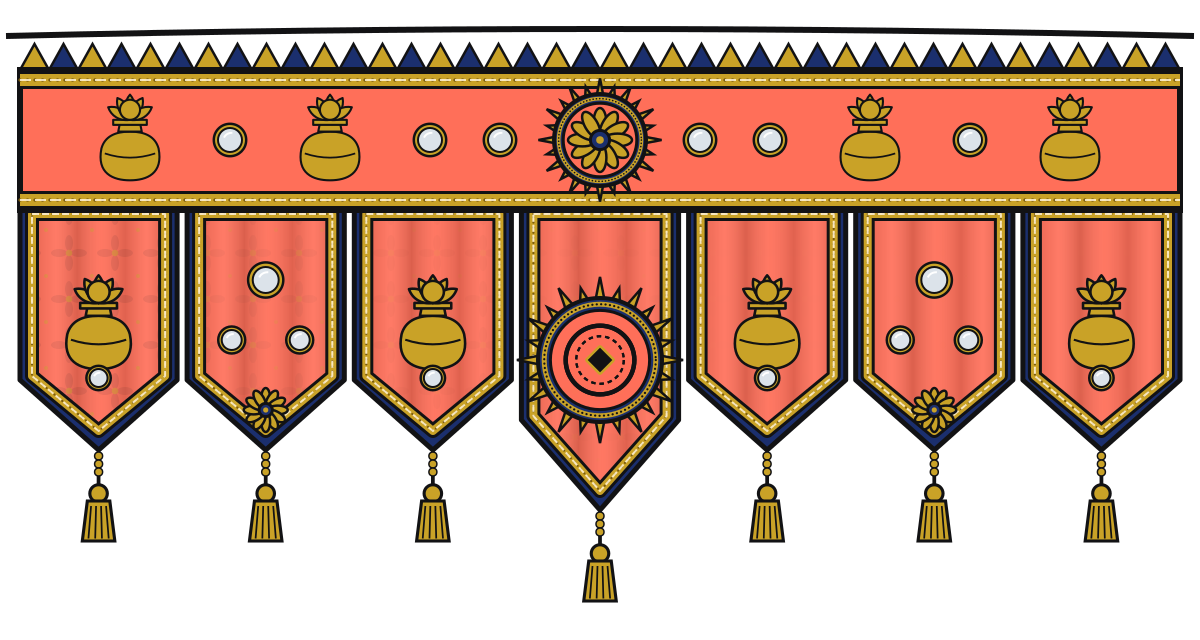
| G1 Torana · gateway The built gate of the seat; the cloth Toran hangs in it | Not yet designed for this clan | Regional tradition |
| G2 Viragallu · hero stone Carved panel stone for a member who died defending the clan | Not yet designed for this clan | Regional tradition |
| G3 Kula-shila · clan stones Standing and table stones that remember the ancestors | Not yet designed for this clan | Design |
| G4 Jayastambha · victory pillar A pillar raised for a victory | Not yet designed for this clan | Design |
| G5 Sima-shila · boundary stone Marks the clan's land, with a line in the native script | Not yet designed for this clan | Design |
4. Sounds
| Accessory | For this clan | Basis |
|---|---|---|
| D1 Pancha-mahashabda · five great sounds The right to five instruments | Not yet designed for this clan | Design |
| D2 Shankha · clan conch The clan's own named war conch | Not yet designed for this clan | Design |
| D3 Murasu · house drums Three drums: war, charity and justice | Not yet designed for this clan | Design |
5. Kit: colours, metals and emblems
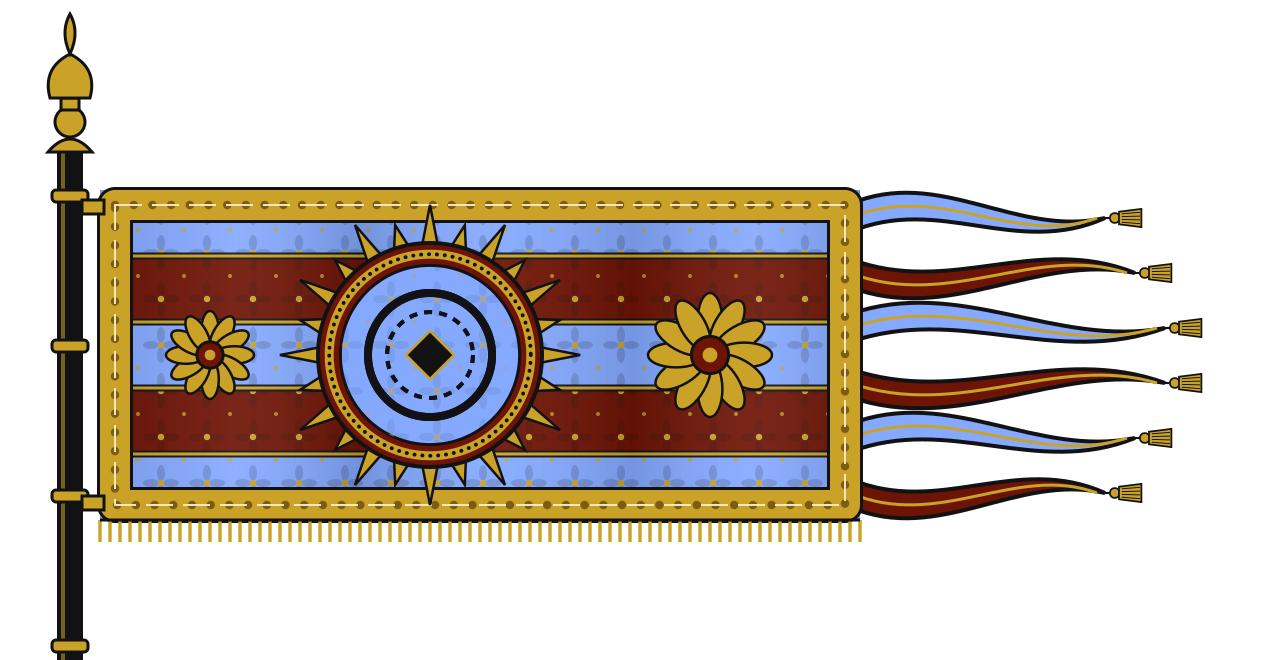
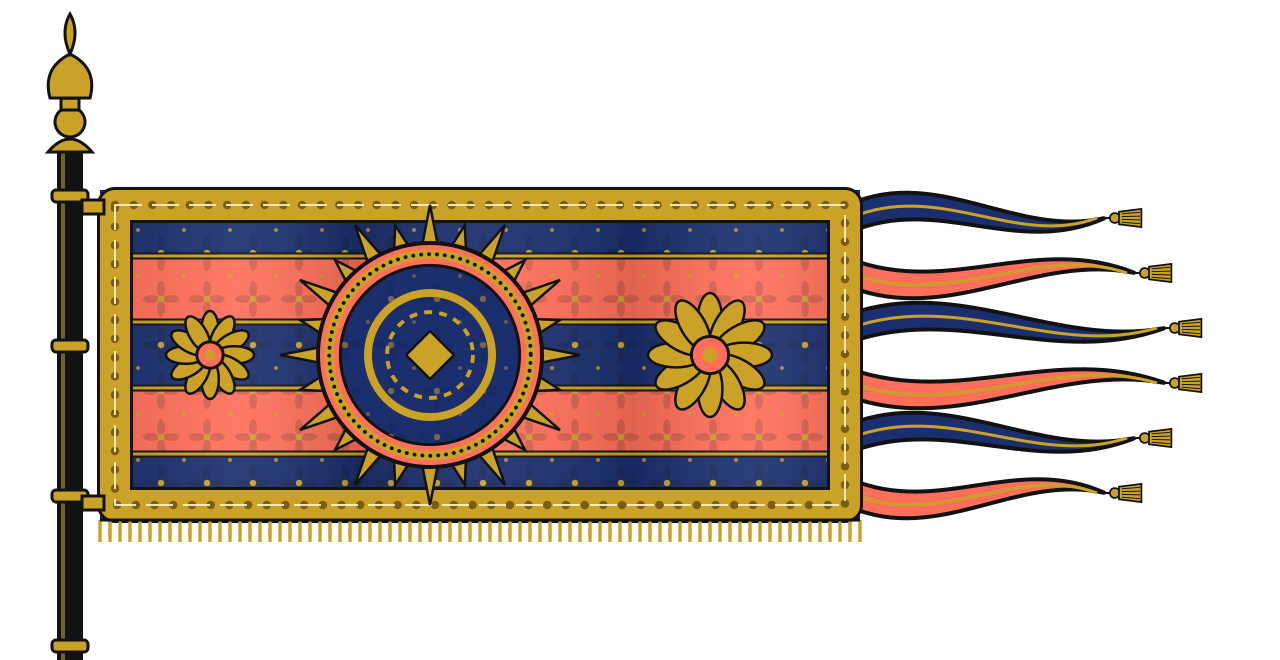
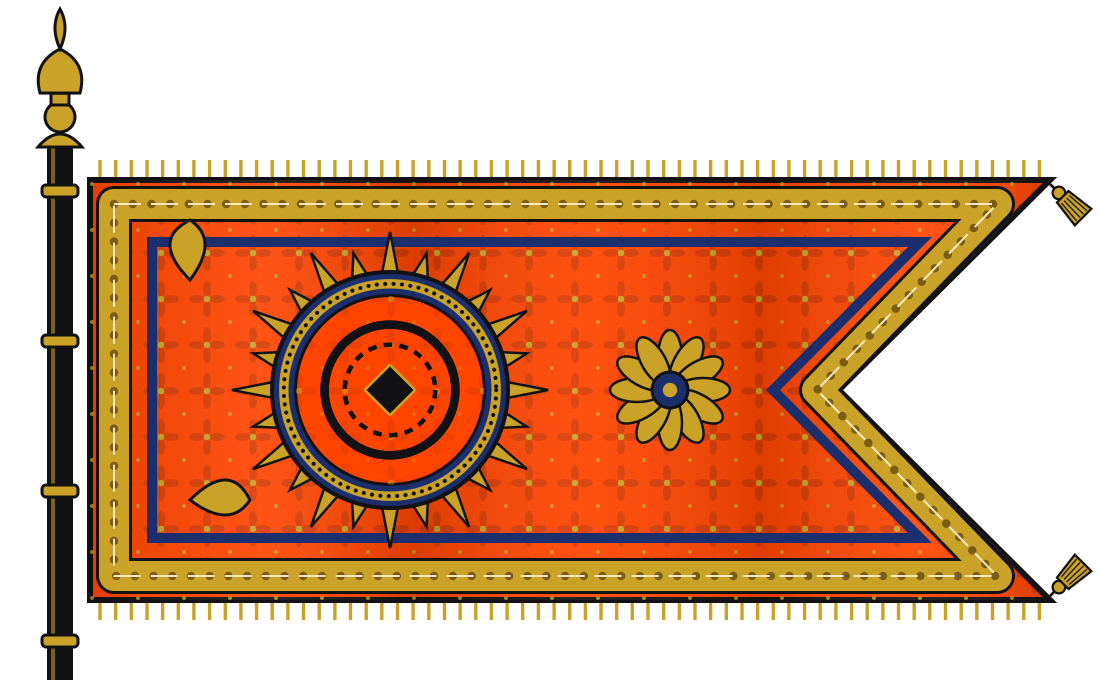
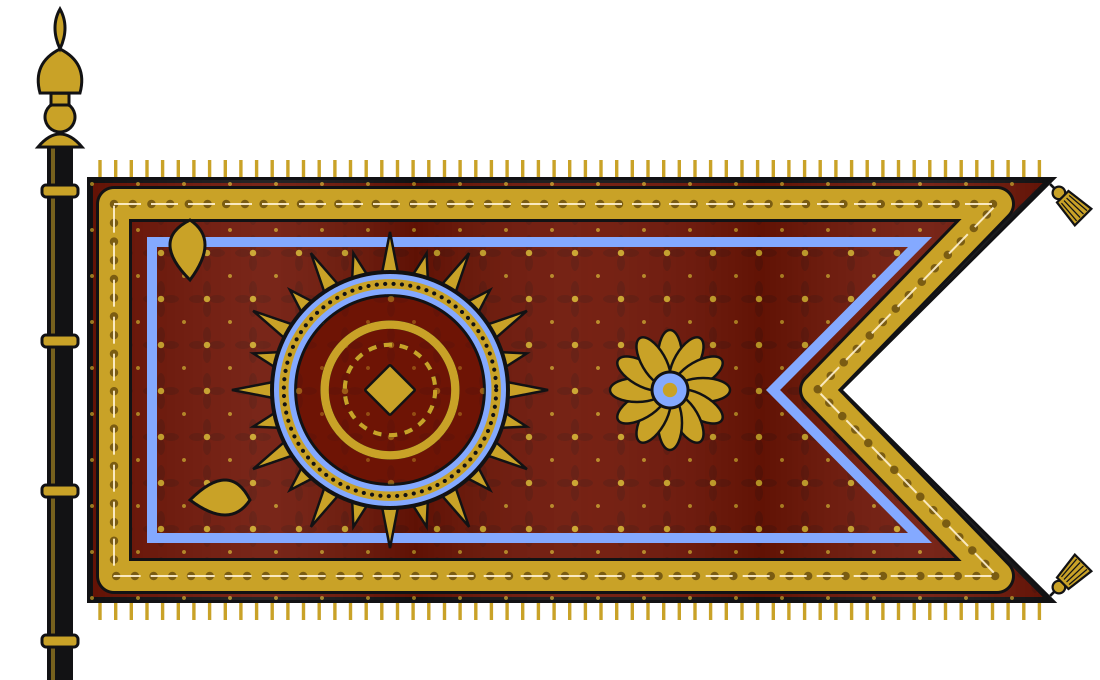
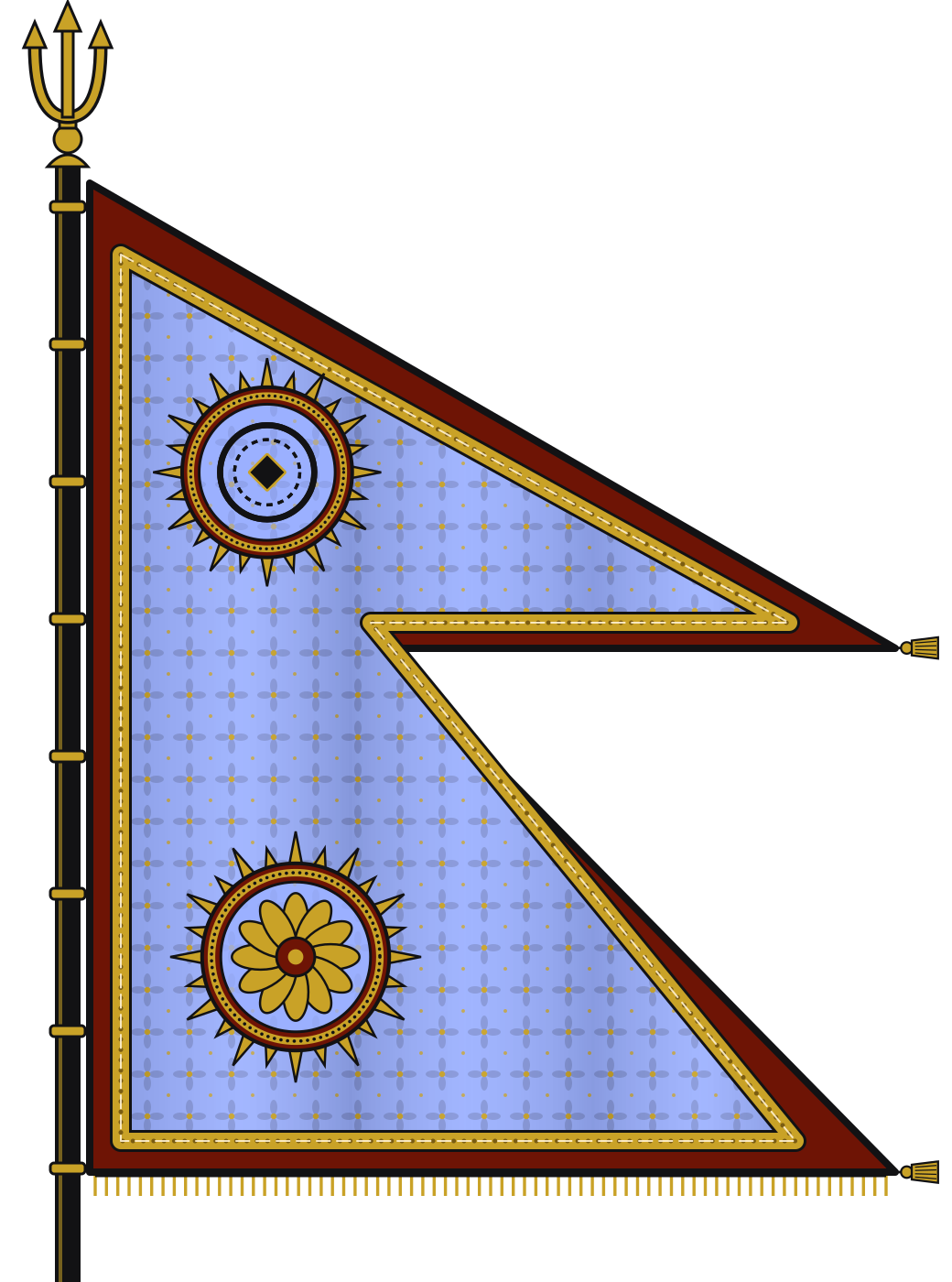
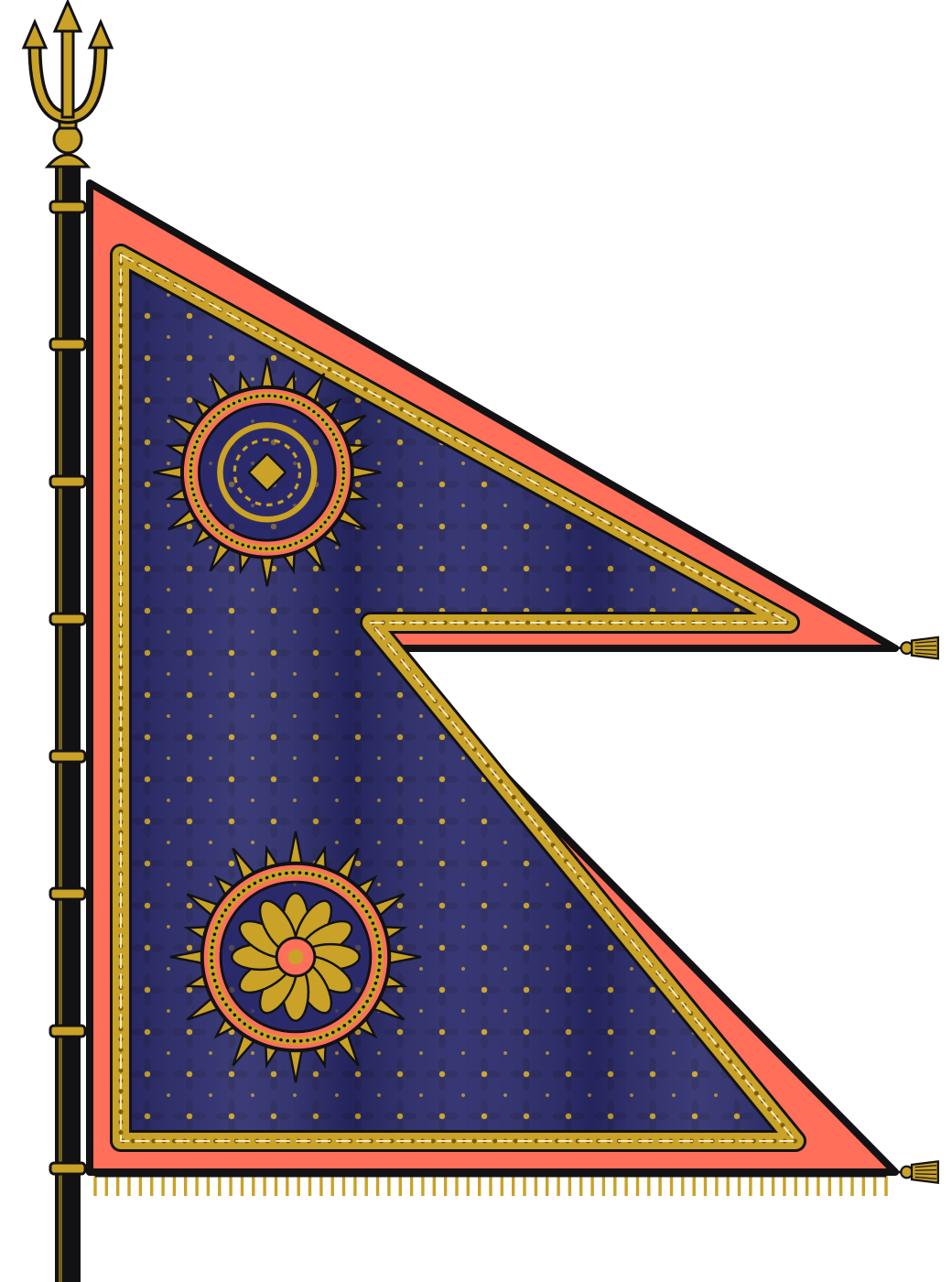
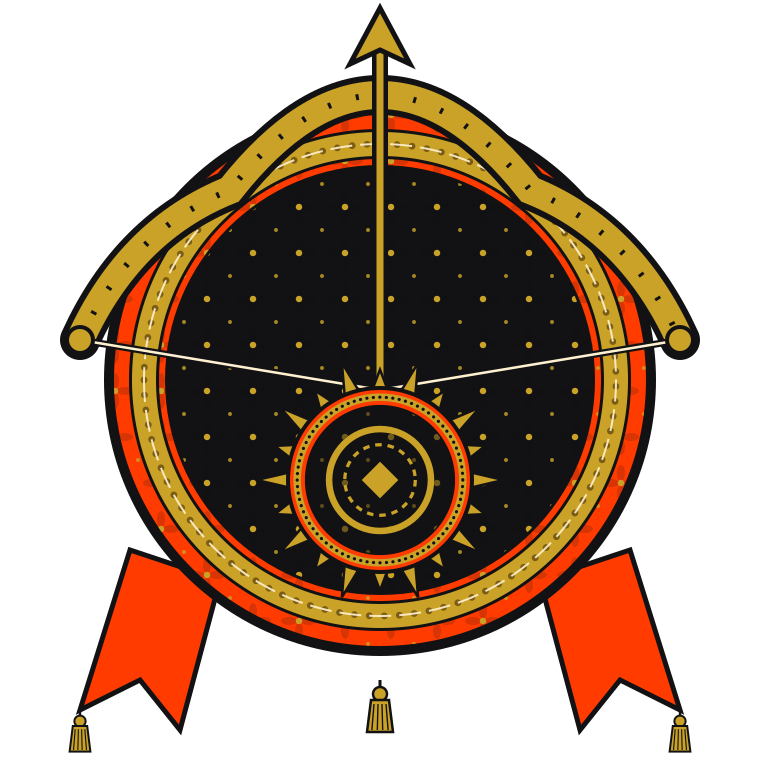
The sheet's emblem and flag are design ideas made for the project, not documented symbols: a broken chain for freedom from bonded labour, and a bundle of sugarcane for farm work in south Gujarat. The hali bondage the chain stands for is described in[3].
| Part of the kit | This clan |
|---|---|
| Field | Deep Brick #7E2A1E |
| Accent | Intense Electric Blue #84A9FF |
| Emblem colour | Metallic Gold #C9A227 |
| Zari metal | Gold |
| Main emblem | A broken chain |
| Second image | A bundle of sugarcane |
| Night and day | Every visual accessory has two versions: by night the emblem on the dark field, by day the clan's field colour on cloth woven from its metal. |
6. Flags
Every clan has every flag type; the type says the occasion and the colours say the clan. The outlined card is the flag the Atlas assigns.

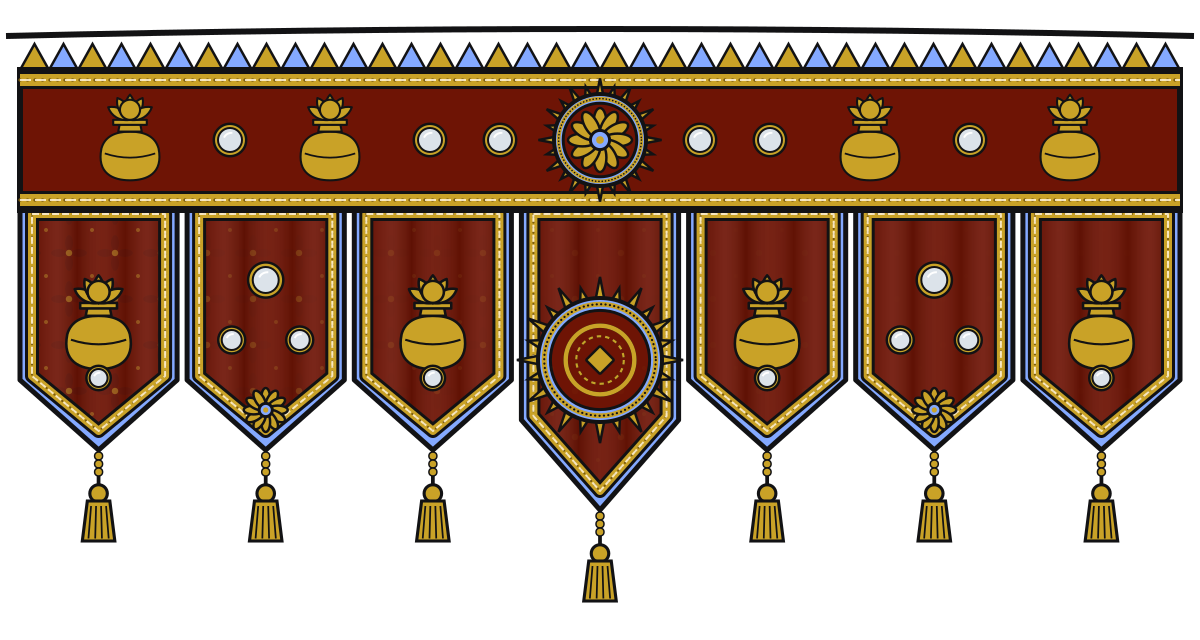

Historic banner
None known
New flag types
| Accessory | For this clan | Basis |
|---|---|---|
| A9 Pota-dhvaja · ship and trade flag For ships, caravans and markets | Not yet designed for this clan | Design |
| A10 Utsava-patāka · festival flag Light, bright flag for fairs and festivals | Not yet designed for this clan | Design |
| A11 Shoka-dhvaja · mourning flag White cloth with the emblem outline in the clan's metal | Not yet designed for this clan | Design |
7. Regalia
| Accessory | For this clan | Basis |
|---|---|---|
| E1 Chhatra · house parasol The ceremonial umbrella | Not yet designed for this clan | Design |
| E2 Chamara · fly-whisks The pair of whisks beside the head of the house | Not yet designed for this clan | Design |
| E3 Danda · staff of office Staff or scepter | Not yet designed for this clan | Design |
| E4 Simhasana · seat The seat of the house, covered in clan cloth | Not yet designed for this clan | Design |
| E5 Khetaka · shield A round shield; the Changi and Dhanush are its flag forms | Not yet designed for this clan | Regional tradition |
| E6 Kula-ayudha · clan weapon The weapon the clan honours | Not yet found for this clan | Under research |
8. Worn
| Accessory | For this clan | Basis |
|---|---|---|
| F1 Kula-vastra · clan cloth The clan's woven pattern in its kit colours | Not yet designed for this clan | Design |
| F2 Kirti-vastra · honour cloth A cloth earned for a deed, not inherited | Not yet designed for this clan | Design |
| F3 Kula-mala · garland flower The flower or leaf the clan wears as a garland | Not yet found for this clan | Under research |
| F4 Chinha · house pin A metal badge with the pin emblem | Not yet designed for this clan | Design |
9. Records
| Accessory | For this clan | Basis |
|---|---|---|
| H1 Clan words A traditional line in the native script | · “” No clan line is sourced in the extracts. Under research (see open questions). | Documented |
| H2 Biruda · titles The house's title or titles | Not yet found for this clan | Under research |
| H3 Prashasti · praise genealogy The lineage as written at the head of a grant | Not yet found for this clan | Under research |
| H4 Vahi · clan register The book of the clan's births, marriages and deaths | Not yet found for this clan | Under research |
| H5 Rana-ghosha · war cry The clan's cry in battle or celebration | Not yet found for this clan | Under research |
10. VishwaVit · knower of the world
Game values are design choices for this project, not historical claims.
References
- Wikipedia, Halpati, read 2026-10-31, https://en.wikipedia.org/wiki/Halpati
- Bharatpedia, Dubla (Wikipedia mirror), read 2026-11-14, https://en.bharatpedia.org/wiki/Dubla
- Nolina Minj, Erased from the record: the Adivasi freedom fighters of Bardoli, Scroll.in, 15 Aug 2025, read 2026-11-14, https://scroll.in/article/1085533/erased-from-the-record-the-adivasi-freedom-fighters-of-bardoli
- Joshua Project, Talavia Dubla in India (people 19465; missions-data estimates, no year), read 2026-11-14, https://joshuaproject.net/people_groups/19465/IN
- Wikipedia, List of Scheduled Tribes in Gujarat (2011 census figures), read 2026-10-18, https://en.wikipedia.org/wiki/List_of_Scheduled_Tribes_in_Gujarat
- dhammabharat.com, List of Scheduled Tribes in Maharashtra and Population of each Tribe (2011 Census), read 2026-10-10, https://dhammabharat.com/?p=13656
- Halpati, Tribal Research and Training Institute, Gujarat (read 31 Oct 2026, KulDevi clan check).
- Dubla, Wikipedia mirror on IPFS (4everland), read 31 Oct 2026 (KulDevi clan check), link
- Constitution (Goa, Daman and Diu) Scheduled Tribes Order, 1968, tribal.nic.in, read 2026-10-11, https://tribal.nic.in/downloads/CLM/CLM_Const/TheConstitutionGoaDamannDiuScheudledTribesOrder1968.pdf