The Dimasa, also called Dimasa Kachari, are a Boroic-speaking people of Assam and neighbouring states, whose kingdom had capitals at Dimapur, Maibang and Khaspur from the 13th to the 19th century (Wikipedia, Dimasa Kingdom).[1] Their supreme God is Madai, and the house of that God is the daikho; the goddess Ranachandi, the Dimasa royal goddess, is the KulDevi in the Atlas and is worshipped at Khaspur and Bijoypur[2][3][4]. A coin of 1520 CE calls the king a worshipper at the feet of the goddess Chandi, and the Ahom and Koch wars shaped the kingdom from the 16th to the 18th century[1]. Under British rule the kingdom was annexed in 1832 (plains) and 1834 (hills); the plains Dimasa who took the surname Barman are still known as Barmans in Cachar[1][5][6]. Today the Dimasa are a Scheduled Tribe in India (Atlas, citing the Ministry of Tribal Affairs list dated 09-07-2024), and the 2011 Census counts 262,413 Dimasa[2].
01Faith and deities
Madai is the supreme God, and the daikho is his house (Thousen 2019, as cited on the people page)[2]. The Atlas's KulDevi, Ranachandi, is set out below.
War goddess of the Dimasa Kachari kings[3]
A recorded tie between the clan and the goddess.
| Deity or tradition | Place in the clan's life | Evidence |
|---|---|---|
| Madai | Supreme God. The spiritual beings known as Madai are in earth, air and sky (Endle 1911, cited on the people page) | [2] |
| Daikho | Twelve territorial sacred areas, the house of Madai, which hold the clans; unstructured mythological shrines | [2] |
| Six ancestral gods | The 'Area God' concept: six ancestral gods have authority over the whole land | [2] (Thousen 2019) |
| Kechai Khaiti (Kesai Khati) | Tutelary goddess of the Kacharis, with a primary shrine at Sadiya, worshipped by the rulers even after they moved to Cachar | [1] (Bhattacharjee 1992) |
| Chandi | Named on the 1520 coin: the king is 'a worshipper at the feet of the goddess Chandi' | [1] |
| Ranachandi (KulDevi) | The Dimasa royal goddess, also called Damadi daikho; a sword was worshipped as her at Khaspur, and a piece of sword is her symbol at Bijoypur | [3][4] |
| Tamreswari | Worshipped by the Dimasa among other Bodo-Kachari groups | [7] |
| Hidimba | An 18th-century Brahmin tradition at Khaspur linked the kings to Hidimba and Bhima-Hidimbi-Ghatotkacha; the kingdom page calls it an invented tradition | [1] |
02Temples
The daikho are twelve sacred areas with no fixed structures (Thousen 2019). The Dimapur ruins show no clear Brahminical temples (Wikipedia). The Ranachandi shrines at Khaspur and Bijoypur are the only dated temples in the extracts.
Built by the clan
| Temple | Deity | Built by | When | Where |
|---|---|---|---|---|
| Ranachandi Mandir, Khaspur | Ranachandi (earlier a sword was worshipped as her; now no image or idol) | Ramchandra Narayan Hasnu | 1740 | Khaspur, near the northern Singhadwar of the royal capital[3] |
| Ranachandi Temple, Bijoypur | Ranachandi (a piece of sword is worshipped as her) | Not stated; the narrator says it was established | 1852 (per the narrator) | Bijoypur, Cachar[4] |
Given patronage or grants by the clan
| Temple | Deity | What the clan gave | When | Where |
|---|---|---|---|---|
| Kechai Khaiti shrine | Kechai Khaiti | Worship by the Dimasa rulers | Not dated (after the kingdom moved to Cachar, the rulers still worshipped there) | Sadiya[1] |
03Languages and scripts
| Language or script | Kind | Under the clan | Evidence |
|---|---|---|---|
| Dimasa (Dimasa Kachari, Grao-Dima) living | Boroic, Sino-Tibetan; six vowels, sixteen consonants; SOV. 137,184 native speakers (2011 Census); dialects Hawar, Hasao, Dembra and Dizuwa | [8][6] | |
| Latin and Eastern Nagari scripts | Latin is used in lower primary schools in Dima Hasao; Bengali script is used in Cachar. No native-script form of the language's name is printed | [8] | |
| Dimasa Lairidim Hosom | The literary apex body, which promotes Latin-script literacy | [8] |
04Books and literature
The written sources the extracts use are mostly by outsiders (Endle, Anderson, Grierson) and by later scholars on the Dimasa. No Dimasa-language book is named in the extracts.
Written during the clan's history
| Work | Author | Kind | When | Link to the clan |
|---|---|---|---|---|
| The Kacharis | Sidney Endle (intro. J. D. Anderson) | Ethnography | 1911 | [9] |
| A Collection of Kachári Folk-Tales and Rhymes | J. D. Anderson (1852–1920) | Folk-tales and rhymes of the Mangaldai Kacharis (not specifically Dimasa) | Not dated (Gutenberg release 2016) | [10] |
| Among the Dimasas of Assam | Danda | Book | 1988 | [2] |
| History of the Dimasas | Barpujari | History | 1997 | [2] |
| Ecological Significance of the Traditional Beliefs and Practices of Dimasa Tribe | Chhetri | Study of belief and practice | 2001 | [2] |
| A History of the Dimasa Kacharis | Rhodes and Bose | History | 2006 | [2] |
| Phonology and Morphology of Bodo and Dimasa | Brahma | Linguistics | 2014 | [8] |
| Out of the Hills | Kolb | Book | 2019 | [2] |
| Dimasa Language: Structure and Texts | Evans and Langthasa | Structure and texts (Academia Sinica) | 2024 | [8] |
Given patronage by the clan
Not recorded.
05Thinkers and scholars
| Name | Field | Era | Contribution |
|---|---|---|---|
| Sidney Endle | Ethnography (The Kacharis) | 1911 | The Kacharis, with a population table and the marriage rules of the Kachari groups[9] |
| J. D. Anderson | Folklore (Kachari folk-tales) | 1852–1920 | Folk-tales and rhymes of the Mangaldai Kacharis[10] |
| Barpujari | History | Book 1997 | History of the Dimasas, cited for the Khaspur history, pp. 45–79[6] |
| Rhodes and Bose | History | Book 2006 | A History of the Dimasa Kacharis; the royal titles and the coin reading[1] The 2006 date is from[2]. |
Other scholars named in the extracts (Thousen 2019, Shin 2020, Maretina 2011, Kolb 2019) are cited in the references and not characterised here.
06Art and architecture
The extracts name Dimasa dance and ornaments but describe no painting, sculpture or textile.
Painting and wall art
Not recorded.
Sculpture and temple art
Not recorded.
Temple and building architecture
| Art form | What it is | Era | Evidence |
|---|---|---|---|
| Ranachandi Mandir, Khaspur | Built in 1740 for protection from enemy kingdoms, according to the Bodo Dimasa Archive | 1740 | [3] |
| Maibong gateway | A gateway erected by Meghanarayana | 1576 | [1] |
| Dimapur ruins (Kachari Rajbari) | ASI-maintained Kachari Rajbari ruins at Dimapur; the same article names a circular fort at Beremah built by Krishna Chandra | Kachari period | [11] |
Weaving and textiles
Not recorded.
Clothing and jewellery
Not recorded.
Coins, pottery and crafts
Not recorded.
07History
Origin tradition, before the 13th century
The people's tradition, as Baruah (2020) records it, puts their departure from the ancestral land about 60,000 lunar months ago, after a severe drought[2].
They settled at Di-lao-bra Tsangi-bra, at the confluence of the Dilao (Lohit) and the Sangi (Di-tsang, the Brahmaputra). A legend of the crossing says that many were swept away in the river, and that is how they came to be called Dimasa (Bhattacharjee 1992). The name is also glossed as 'people of big waters' (Ramirez 2007; Thousen 2019)[1][2].
An early state followed the fall of Kamarupa. Under Suteuphaa (r. 1268–1281) the realm moved west of the Dikhou, and in the late 13th century its sphere ran from the Dikhu to the Kolong[2][1].
Dimapur and Maibang, 1520–1576
A silver coin dated 1442 Saka (1520 CE) of Viravijayanarayana calls the king 'a worshipper at the feet of the goddess Chandi'; its legend reads Chandi Charana Para- (Shin 2020; Rhodes and Bose). Rhodes thinks he was probably Khorapha, killed in an Ahom attack in 1526[1].
Radiocarbon dating from the Rajbari suggests Kachari occupation of Dimapur from at least the 3rd century CE (Dutta and ARF 2024, as cited)[1].
Suhungmung killed Khorapha around 1526 and occupied Dimapur in 1536, after which Dimapur was abandoned. Madanakumara, son of Detsung, took the name Nirbhaya Narayana in 1558/59 and founded Maibang[1]. Meghanarayana (r. 1566–83) erected the Maibong gateway in 1576[1].
The Dimapur ruins are the Kachari Rajbari, maintained by the Archaeological Survey of India. Maibang inscriptions indicate the Hasnu clan[11].
Ahom wars and Koch overlordship, 1490–1706
Suhenphaa made peace with the Ahoms in 1490 after they offered a princess, and the Dimasa later helped the Ahoms against Turbak in 1532/33[1].
Chilarai (Koch) subjugated the Ahoms in 1564, and the kingdom became a Koch feudatory (Sarkar 1992)[1]. Chilarai had earlier set up a Koch principality at Khaspur under an Uparaja, later the Kingdom of Khaspur (Barpujari 1997)[6].
Satrudaman (Yasho Narayan) took parts of Sylhet, struck coins and installed Jasa Manik in Jaintia[1]. Tamradhwaj Narayan (r. 1697–1708?) declared independence. Rudra Singha invaded Kachar in December 1706 and destroyed the forts at Maibong[1].
Khaspur, 1740–1790
Ramchandra Narayan Hasnu built the Ranachandi Mandir at Khaspur in 1740, for protection from enemy kingdoms and as 'a symbol of power and strength' (Bodo Dimasa Archive, narrator's account)[3].
In 1745 Khaspur and Maibang merged under Gopichandranarayan (r. 1745–1757), and the administrative centre moved to Khaspur, probably between 1745 and 1755. The Barmans page gives the 1745 marriage of Kanchani to the Dimasa prince Lakshmi Chandra[1][6].
In 1790 Gopichandranarayan and Laxmichandranarayan proclaimed themselves Hindu Kshatriyas (Cantile 1980). Raja Krishna Chandra (1790–1813) built a circular fort at Beremah[1][11]. Krishna Chandra and Govinda Chandra took the surname 'Barman'[5].
British annexation, 1826–1834
After Yandabo (1826) the British restored Govinda Chandra Hasnu. They annexed the plains in 1832 and the hills in 1834[1].
When Govinda Chandra Hasnu died heirless in 1832, the Forty Sengphongs petitioned the British for Tula Ram (NAI Doc 82, May 1832). Thomas Fisher (1830) recorded that the Cachar throne was elected by the Forty Sengphongs[11]. Senapati Tularam Thaosen was pensioned in 1832[1].
Angami raids in the 1840s led the British to build a stockade and salt depot at Dimapur[11].
Barmans of Cachar, from the 19th century
Plains Dimasas who converted to Hinduism in the 19th century became Barmans (Kolb 2019). 'Barman' is a Hindu caste name adopted by the Dimasa aristocracy settled in Cachar, not a native Dimasa name[2][6].
08Journey and migrations
The sources give one tradition of migration and a series of moves between the capitals. Dates for the moves are approximate, as the sources say.
| When | From | To | Why | Evidence |
|---|---|---|---|---|
| About 60,000 lunar months ago (tradition) | The ancestral land | Di-lao-bra Tsangi-bra, the Dilao and Brahmaputra confluence | Severe drought (tradition) | [2] |
| Under Suteuphaa, r. 1268–1281 | Not stated | West of the Dikhou (Dikhu) | Not stated | [1] |
| 18th century | Not stated | The Cachar plains | Not stated; the page says the community was divided by the move | [2] (Ramirez 2007) |
| Probably 1745–1755 | Maibang | Khaspur, near Silchar | The merger of Khaspur and Maibang in 1745 | [1][6] |
09Seats and lands
| Place | Role | Where today |
|---|---|---|
| Dimapur | Kachari capital (coin of 1520; occupied by Suhungmung in 1536) | Nagaland |
| Maibang | Capital; founded 1558/59 by Nirbhaya Narayana | North Cachar Hills, Assam |
| Khaspur | Capital from about 1745–1755; the Khaspur Rajbari and Ranachandi Mandir | Near Silchar, Cachar, Assam |
| Sadiya | Primary shrine of Kechai Khaiti, the Kachari tutelary goddess | Assam |
| Dima Hasao (Jatinga and Dhansiri valleys) | Dimasa areas today | Assam |
| Diphu, Howraghat, West Karbi Anglong, Kampur (Nagaon), Hojai, Hailakandi, Karimganj | Places where Dimasa live (Wikipedia people page) | Assam |
| Dimapur and Jiribam | Places where Dimasa live (Wikipedia people page) | Nagaland; Manipur |
| Cachar and the Barak valley, Upper Cachar around Khaspur | Settlement of the Barman Dimasa; titles Aditya and Sezwal in Central Cachar | Assam |
| Dima Hasao, Nagaland and Manipur | Dimasa areas, per the Vajiram and Ravi exam-preparation site (secondary source) | Assam, Nagaland, Manipur |
10Notable figures
| Name | Role | Era | Known from |
|---|---|---|---|
| Hachengsa legend | Boy raised by a tiger; reportedly replaced the king by divine oracle | Not dated | [1] (Shin 2020) |
| Suteuphaa | King; moved the realm west of the Dikhou | r. 1268–1281 | [1] |
| Suhenphaa | King; peace with the Ahoms after a princess was offered | 1490 | [1] |
| Viravijayanarayana | King on the 1520 coin, probably Khorapha, killed by the Ahoms in 1526 | 1520 | [1] |
| Khunkhara | King | 1526–31 | [1] |
| Detchung (Detsung) | King | 1531–36 | [1] |
| Suhungmung | King; occupied Dimapur | 1536 | [1] |
| Nirbhaya Narayana (Madanakumara) | King; took the name in 1558/59 and founded Maibang | 1558/59 | [1] |
| Meghanarayana | King; erected the Maibong gateway | 1566–83 (gateway 1576) | [1] |
| Satrudaman (Yasho Narayan) | King; struck coins; installed Jasa Manik in Jaintia | Not dated | [1] |
| Tamradhwaj Narayan | King; declared independence | r. 1697–1708? | [1] |
| Ramchandra Narayan Hasnu | King; built the Ranachandi Mandir at Khaspur | 1740 | [3] |
| Gopichandranarayan | King; Khaspur merged with Maibang under him | r. 1745–1757 | [1] |
| Lakshmi Chandra | Prince; married Kanchani, daughter of Bhimsingha, the last ruler of the Khaspur kingdom | 1745 | [6] |
| Raja Krishna Chandra | Raja; built a circular fort at Beremah; took the surname Barman | 1790–1813 | [11][5] |
| Govinda Chandra Hasnu | Raja; restored after Yandabo; died heirless | 1826–1832 | [1][11] |
| Tularam Thaosen (Senapati) | Commander; pensioned in 1832 | 1832 | [1] |
| Nandita Garlosa | Politician | Present day | [2] |
11Allies, rivals and marriages
| People | Relationship | When |
|---|---|---|
| Ahoms | Peace in 1490, then wars: Dimasa help against Turbak (1532/33), Ahom attacks on Kachari lands (1526, 1536), Rudra Singha's invasion of Kachar (December 1706), skirmishes over Moamaria refugees (1803–05) | 1490–1805 |
| Koch | Chilarai's Koch principality at Khaspur; the kingdom a Koch feudatory after his 1564 campaign | 16th century |
| Jaintia | Rival over Dimarua; Satrudaman installed Jasa Manik in Jaintia; the Kachari king controlled Jaintia in the late 16th century (Banglapedia) | 16th century |
| Manipur | Cooperated against Burma; Krishnachandra received a Manipuri princess | Date not stated |
| Tripura (Hill Tipperah) | The Raja gave the Surma Valley as dowry to a daughter who married the Raja of Maibang (Grierson); a Kachari king annexed Hailakandi in the 18th century | 18th century |
| Rabha | Cognate tribe; Kacharis occasionally take Rabha wives, which is not looked upon with favour (Endle 1911); shared Kechai Khaiti | Recorded 1911 |
| Garo | Playfair (1909): very close linguistically, perhaps 'originally one and the same' | Recorded 1909 |
| Bodo-Kachari family | Boro, Tripuri, Rabha, Garo, Tiwa, Koch, Moran (Wikipedia people page); Dimasa closely related to Moran (Jacquesson 2017, per the kingdom page) | Present day |
| Angami | Raids in the 1840s on Dimapur, which led the British to build a stockade and salt depot | 1840s |
| British | Treaty of Yandabo (1826) and the annexation of the plains (1832) and hills (1834) | 1826–1834 |
12Society and livelihood
The Dimasa are patrilineal through a sengphong and matrilineal through a julu. Same-clan marriage is forbidden (Sahapedia). The royal council and the officials of the kingdom are set out below.
Government and social order
| Institution or group | What it was | Evidence |
|---|---|---|
| Sengphong (male clans) | Patrilineal descent from one of the male clans, 'holder of the sword' | [2][6] |
| Julu (female clans, or jalik) | Matrilineal descent from one of the female clans; both are exogamous | [6][5] |
| The Mel | Royal council of about 40 sengphong clans, which could elect a king | [1] |
| Ministers | Patra, Bhandari and Barbhandari | [1] |
| Specialist clans | Songyasa (cooks) and Nablaisa (fishermen) | [1] |
| Khels and Uzir | The plains were organised in khels, and revenue was collected through the Uzir | [1] |
| Village officials | Khunang (headman), Dillik (assistant), Daulathu, Haphaisgao, Phrai, Montri, Hangsbukhu and Jalairao | [2] (Haflongbar and De 2017) |
| Bachelors' institution | The Zawlbuk article names the Dimasa among peoples with a similar institution | [12] |
| Kacharir Niyam | A code that codified the administration of the kingdom | [1] |
Livelihood over time
Not recorded.
13Sub-clans and related clans
The 40 male clans (sengphong) below are the names the Wikipedia Dimasa people article gives from the 1961 Census and the Surnames blog. The article says 42 male clans and prints 40 names (see Open questions). Also listed: the three ruling semfongs, specialist clans of the kingdom, and related peoples.
| Clan | Relation | Where | Size | In the Atlas | Evidence |
|---|---|---|---|---|---|
| Ardaosa | Sub-clan | new clan candidate | [2] | ||
| Mitherpangsa | Sub-clan | new clan candidate | [2] | ||
| Diphusa | Sub-clan | new clan candidate | [2] | ||
| Hagjersa | Sub-clan | new clan candidate | [2] | ||
| Thaosensa | Sub-clan | new clan candidate | [2] | ||
| Phonglosa | Sub-clan | new clan candidate | [2] | ||
| Sengyungsa | Sub-clan | new clan candidate | [2] | ||
| Raijungsa | Sub-clan | new clan candidate | [2] | ||
| Bader-Baiga | Sub-clan | new clan candidate | [2] | ||
| Daulagajao | Sub-clan | new clan candidate | [2] | ||
| Daolagupu | Sub-clan | new clan candidate | [2] | ||
| Hojaisa | Sub-clan | new clan candidate | [2] | ||
| Kemprai | Sub-clan | new clan candidate | [2] | ||
| Jidungsa | Sub-clan | new clan candidate | [2] | ||
| Baindosa (Nunisa) | Sub-clan | new clan candidate | [2] | ||
| Khersa | Sub-clan | new clan candidate | [2] | ||
| Hasnu | Sub-clan | new clan candidate | [2] | ||
| Haflongbar | Sub-clan | new clan candidate | [2] | ||
| Bodosa (Bathari) | Sub-clan | new clan candidate | [2] | ||
| Hapila | Sub-clan | new clan candidate | [2] | ||
| Diruwasa | Sub-clan | new clan candidate | [2] | ||
| Naidingsa | Sub-clan | new clan candidate | [2] | ||
| Daodunglangtha | Sub-clan | new clan candidate | [2] | ||
| Karigapsa | Sub-clan | new clan candidate | [2] | ||
| Joraisa | Sub-clan | new clan candidate | [2] | ||
| Hasamsa | Sub-clan | new clan candidate | [2] | ||
| Nabensa | Sub-clan | new clan candidate | [2] | ||
| Dibragede | Sub-clan | new clan candidate | [2] | ||
| Langthasa | Sub-clan | new clan candidate | [2] | ||
| Girisa | Sub-clan | new clan candidate | [2] | ||
| Porbosa | Sub-clan | new clan candidate | [2] | ||
| Maibangsa | Sub-clan | new clan candidate | [2] | ||
| Johorisa | Sub-clan | new clan candidate | [2] | ||
| Sorongpang | Sub-clan | new clan candidate | [2] | ||
| Gorlosa | Sub-clan | new clan candidate | [2] | ||
| Hakmaosa | Sub-clan | new clan candidate | [2] | ||
| Maramsa | Sub-clan | new clan candidate | [2] | ||
| Jarambusa | Sub-clan | new clan candidate | [2] | ||
| Labtaisa | Sub-clan | new clan candidate | [2] | ||
| Laobangdisa | Sub-clan | new clan candidate | [2] | ||
| Hachemsa | Sub-clan | new clan candidate | Most kings claimed descent from this clan (Shin 2020, cited on the kingdom page)[1] | ||
| Thaosengsa | Sub-clan | new clan candidate | One of three ruling semfongs, the royal clan (Maretina 2011, cited on the kingdom page)[1] | ||
| Hasyungsa | Sub-clan | new clan candidate | One of three ruling semfongs, the royal relatives (Maretina 2011, cited on the kingdom page)[1] | ||
| Songyasa | Sub-clan | new clan candidate | Specialist clan of cooks in the kingdom ([1]) | ||
| Nablaisa | Sub-clan | new clan candidate | Specialist clan of fishermen in the kingdom ([1]) | ||
| Hojai | Branch | Assam (Hojai) | ST-103 | Atlas; Hojai is named among communities in 'Kachari' ([5]) | |
| Barman | Branch | Cachar and the Barak valley, Assam | ST-018 | [6];[5] | |
| Rabha | Related people | ST-268 | [9] (cognate tribe);[1] (shared Kechai Khaiti) | ||
| Garo | Related people | ST-084 | [13] (listed as related);[14] | ||
| Tripuri | Related people | ST-319 | [2] (Bodo-Kachari family) | ||
| Moran | Related people | NE-007 | [1] (Dimasa closely related to Moran, Jacquesson 2017) | ||
| Tiwa | Related people | ST-316 | [6] (cognate in Shafer 1955) | ||
| Koch | Related people | ST-136 | [6] (cognate in Shafer 1955);[1] (Koch overlordship) | ||
| Boro | Related people | ST-043 | [15] (Bodo-Kachari family) | ||
| Mech | Related people | ST-213 | [15] (Bodo-Kachari family) | ||
| Chutia | Related people | NE-003 | [15] (Bodo-Kachari family);[1] (shared Kechai Khaiti) | ||
| Deori | Related people | ST-064 | [6] (cognate in Shafer 1955) |
Clans marked "new clan candidate" are not in the Atlas yet.
14Surnames
The Wikipedia people article says the clan names serve as surnames, so the 40 male clans are listed as surnames. Barman is a Hindu caste name that the Dimasa aristocracy in Cachar adopted.
| Surname | Clan or sub-clan | Where | People with this surname | Also used by other communities |
|---|---|---|---|---|
| Ardaosa | Ardaosa (sengphong) | not yet counted | Not checked | |
| Mitherpangsa | Mitherpangsa (sengphong) | not yet counted | Not checked | |
| Diphusa | Diphusa (sengphong) | not yet counted | Not checked | |
| Hagjersa | Hagjersa (sengphong) | not yet counted | Not checked | |
| Thaosensa | Thaosensa (sengphong) | not yet counted | Not checked | |
| Phonglosa | Phonglosa (sengphong) | not yet counted | Not checked | |
| Sengyungsa | Sengyungsa (sengphong) | not yet counted | Not checked | |
| Raijungsa | Raijungsa (sengphong) | not yet counted | Not checked | |
| Bader-Baiga | Bader-Baiga (sengphong) | not yet counted | Not checked | |
| Daulagajao | Daulagajao (sengphong) | not yet counted | Not checked | |
| Daolagupu | Daolagupu (sengphong) | not yet counted | Not checked | |
| Hojaisa | Hojaisa (sengphong) | not yet counted | Not checked | |
| Kemprai | Kemprai (sengphong) | not yet counted | Not checked | |
| Jidungsa | Jidungsa (sengphong) | not yet counted | Not checked | |
| Baindosa | Baindosa (Nunisa) (sengphong) | not yet counted | Not checked | |
| Khersa | Khersa (sengphong) | not yet counted | Not checked | |
| Hasnu | Hasnu (sengphong) | not yet counted | Not checked | |
| Haflongbar | Haflongbar (sengphong) | not yet counted | Not checked | |
| Bodosa | Bodosa (Bathari) (sengphong) | not yet counted | Not checked | |
| Hapila | Hapila (sengphong) | not yet counted | Not checked | |
| Diruwasa | Diruwasa (sengphong) | not yet counted | Not checked | |
| Naidingsa | Naidingsa (sengphong) | not yet counted | Not checked | |
| Daodunglangtha | Daodunglangtha (sengphong) | not yet counted | Not checked | |
| Karigapsa | Karigapsa (sengphong) | not yet counted | Not checked | |
| Joraisa | Joraisa (sengphong) | not yet counted | Not checked | |
| Hasamsa | Hasamsa (sengphong) | not yet counted | Not checked | |
| Nabensa | Nabensa (sengphong) | not yet counted | Not checked | |
| Dibragede | Dibragede (sengphong) | not yet counted | Not checked | |
| Langthasa | Langthasa (sengphong) | not yet counted | Not checked | |
| Girisa | Girisa (sengphong) | not yet counted | Not checked | |
| Porbosa | Porbosa (sengphong) | not yet counted | Not checked | |
| Maibangsa | Maibangsa (sengphong) | not yet counted | Not checked | |
| Johorisa | Johorisa (sengphong) | not yet counted | Not checked | |
| Sorongpang | Sorongpang (sengphong) | not yet counted | Not checked | |
| Gorlosa | Gorlosa (sengphong) | not yet counted | Not checked | |
| Hakmaosa | Hakmaosa (sengphong) | not yet counted | Not checked | |
| Maramsa | Maramsa (sengphong) | not yet counted | Not checked | |
| Jarambusa | Jarambusa (sengphong) | not yet counted | Not checked | |
| Labtaisa | Labtaisa (sengphong) | not yet counted | Not checked | |
| Laobangdisa | Laobangdisa (sengphong) | not yet counted | Not checked | |
| Barman | Barman (ST-018), Cachar Dimasa | Cachar and the Barak valley | not yet counted | Not checked |
Counts are of everyone with the surname, from the cited source and year, not only members of this clan. A surname shared with other communities says nothing about any one person's origin.
15Songs and music
No song title or lyric is in the extracts. The Busu Dima article says the singing starts on the first day, with the Kharam drum and the Muri fife, and a wooden bugle, through the first three days.
None recorded yet.
Instruments and styles
| Instrument or style | What it is | Evidence |
|---|---|---|
| Kharam | Drum played in the Busu singing | [16] |
| Muri | Fife played in the Busu singing | [16] |
| Wooden bugle | Bugle of wood played at Busu | [16] |
| Baidima | Dimasa dance ('Bai' dance, 'Dima' the Dimasa) | [2] |
16Poems, lullabies and children's rhymes
None recorded yet.
17Stories, legends and proverbs
Stories and legends
| Story | What happens | Told by | Evidence |
|---|---|---|---|
| Crossing the Dilao | The people cross the great river, many are swept away, and the survivors are named Dimasa | Bhattacharjee (1992), cited on the kingdom page | [1] |
| Hachengsa legend | A boy raised by a tiger, who replaces the king by divine oracle | Shin (2020), cited on the kingdom page | [1] |
| The Hidimba descent | A Brahmin origin story of 18th-century Khaspur linking the kings to Hidimba and Ghatotkacha; the kingdom page calls it an invented tradition | Brahmins at Khaspur | [1] |
| The sword of Ranachandi | A king loses a war with the Ahoms; a dream tells him to make an iron sword from iron shaped by birds' droppings; the king is angry and imprisons the blacksmith; a later dream shows a snake in a pond, and touching its tail leaves a piece of sword, which he worships and by which he wins the war | Nayan Barman, narrator at Bijoypur (2022) | [4] |
Proverbs and sayings
Not recorded.
18Festivals and fairs
| Festival or fair | When | Where | What happens |
|---|---|---|---|
| Busu Dima (Bushu, Bishu) | January; 27–28 January in towns; 27 January is a festival day declared by the Dima Hasao Autonomous Council since 1994 | Dima Hasao and the Dimasa areas | A harvest festival of the Dimasa Kachari in three forms: Jidaap (2 days), Surem Baino (5 days) and Hangshu Busu (7 days). Singing with the Kharam drum and Muri fife, a wooden bugle, dancing through the night in traditional dress[16][2] |
| Ranachandi puja | Once a year at Khaspur; weekly on Sundays and at the main festivals in January and April at Bijoypur | Khaspur and Bijoypur, Cachar | Evening puja at Khaspur, called malai puja by the Dimasa; at Bijoypur both Dimasa and non-Dimasa devotees take part[3][4] |
19Food, dress and games
Food
Not recorded.
Dress
| Item | What it is | Evidence |
|---|---|---|
| Traditional dress | Worn at Busu Dima; no description given | [16] |
| Male ornaments | Yaocher, Kharik, Phowal (names as given) | [2] |
| Female ornaments | Phowal, Jongsama, Rangbarsha, Chandrawal, Rmailik, Likjao, Likshim, Khadu, Khamaothai, Yaoshidam (names as given) | [2] |
Games and martial arts
Not recorded.
Tags: living still practised · revived brought back after a break · lost known only from records · research reported but not yet confirmed from a source. Songs and poems under copyright are listed by title only; restricted or sacred material is noted without its content.
20Status today
The Dimasa are a Scheduled Tribe in India (list dated 09-07-2024, per the Atlas) with a living community across Assam, Meghalaya, Mizoram and Nagaland, and in Dimapur and Manipur. Their kingdom's history survives in the Dimapur ruins and at Khaspur[2][8][11].
Who carries the name today
| Community | Link | Basis | Evidence |
|---|---|---|---|
| Barman (ST-018) | Documented | [6][5]: the Dimasa of Cachar, the aristocracy settled there, are known as Barmans |
Recognised heritage
| What | Recognition | Evidence |
|---|---|---|
| Busu Dima | 27 January declared a festival day by the Dima Hasao Autonomous Council since 1994 | [2] |
| Ranachandi Mandir, Khaspur, and Ranachandi Temple, Bijoypur | Recorded as oral accounts by the Bodo Dimasa Archive (2022) | [3][4] |
| Dimapur ruins (Kachari Rajbari) | Maintained by the Archaeological Survey of India | [11] |
| Dimasa Lairidim Hosom | The literary apex body, promoting Latin-script literacy | [8] |
Not stated. No community review of this page is recorded in the sources read.
21For children
The People of Big Waters
The old story says that long ago the Dimasa people left their first home because of a bad drought. They came to a great river, the Dilao, and they crossed it. The old story says that many people were swept away in the water. The people who reached the other side kept the name Dimasa, which is said to mean 'people of big waters'. Later the Dimasa had kings and cities, including Dimapur, Maibang and Khaspur. Today the Dimasa live in the hills and valleys of Assam and in other states.
Riddle: What is the name of the Dimasa harvest festival that is sung with drums? (Busu Dima)
22Across the project
| Project | What carries this clan | Status |
|---|---|---|
| Atlas of the Janas | The three capitals, Dimapur, Maibang and Khaspur, and the Dima Hasao homeland are in the lands list above | [1] |
| KulDevi and GrahDevi | KulDevi: Ranachandi (basis documented; family Mahavidya; a note from the Atlas calls her the war goddess of the Dimasa Kachari kings). GrahDevi forms: Kali, Tara, Shodashi, Bhuvaneshvari, Bhairavi, Chhinnamasta, Dhumavati, Bagalamukhi, Matangi, Kamala | Atlas |
| Planet naming | The GrahDevi forms for the Dimasa come; no planet naming for the Dimasa is in the extracts | Atlas |
| Renaming and waters | The name Dimasa is glossed as 'people of big waters' (Ramirez 2007; Thousen 2019), and the Dilao is the Lohit | [2] |
23Open questions
- The 42 vs 40 male clan count: the Wikipedia Dimasa people article gives 42 male clans (sengphong) in its text, citing Ramirez 2007, but prints only 40 names. The Barmans in Cachar page and Sahapedia both give 40 male and 42 female clans. The 40 names used here are the article's list; the 42nd male clan and the 42 julu names are not in the extracts.
- Thaosensa (census list) and Thaosengsa (royal semfong): probably the same clan under two spellings; not merged.
- Hasnu and Maibang dates: the kingdom page gives the founding of Maibang in 1558/59 by Nirbhaya Narayana; Playfair (1909, p. 15) says the Kachari capital moved to Maibong in 1536. Not resolved.
- The Evans and Langthasa date for the vulnerability rating: the people page cites 2023, the language page cites 2024 for the same book; the rating and year need a check.
- The Dimapur monoliths named in the Atlas ('mushroom-shaped stone monoliths') are not described in the fetched Sentinel article; the emblem is from the sheet only.
- Ranachandi: the Wikipedia Dimasa Kingdom page does not mention Ranachandi; the goddess is sourced from the Bodo Dimasa Archive (oral accounts recorded 2022). The Atlas's KulDevi is kept as given.
- Native-script names: none for the Dimasa, the kings, the clans or the songs are in the extracts. The Bengali script used in Cachar is noted, but no form of a name is given in it.
- A 'Dimasa' entry in the Assam Scheduled Tribe list (2012 population column, 19,702, for areas outside the autonomous districts) is in the pack notes but the entry name is not in the extract, so it is not used here.
- Dimasa Kachari in North Cachar Hills: 74,502 (about 35% of the district) is given on the Barmans page without a year, so it is not used.
- Kachari claim to Jaintia: Gale (2008) says the Jaintia were vassals of the Kachari kingdom; the Banglapedia says the Kachari king controlled Jaintia in the late 16th century. Both are attributed, not reconciled.
- Lead list for the next run: NEHU 'History of the Dimasa-Kachari royal dynasty: Fact and fiction' (https://dspace.nehu.ac.in/handle/1/9145); the Bodo Dimasa Archive stone inscription at Khaspur; Morung Express and Eastern Mirror Dimapur ruins articles; Academia Sinica Dimasa texts; the Endle full text beyond 100,000 characters; the Anderson full text (Gutenberg #53506).
- Khorapha's death: the history section says Suhungmung killed Khorapha around 1526 (kingdom page, citing Shin 2020 and Rhodes and Bose); the coin entry and figures list say Rhodes thinks Khorapha was probably killed in an Ahom attack in 1526 (kingdom page). Both are on the page; not resolved.
- Gopichandranarayan's dates: the page gives his reign as 1745-1757 (kingdom page), but also says that in 1790 Gopichandranarayan and Laxmichandranarayan proclaimed themselves Hindu Kshatriyas (kingdom page, citing Cantile 1980). The two dates conflict; not resolved.
- Barman surname and conversion: the Barmans section says plains Dimasas who converted to Hinduism in the 19th century became Barmans (Kolb 2019), but Krishna Chandra (1790-1813) and Govinda Chandra took the surname Barman earlier (Sahapedia). Not resolved.
24Astitva
अस्तित्व · being, existence: everything by which the clan is known
The sources give a coin of 1520 with a legend, royal titles, the Maibong gateway and the sword worshipped as Ranachandi[1][11][3]. The Dimapur monoliths are named in the Atlas only, and the Kharam drum, Muri fife and wooden bugle are played at Busu[16].
Every clan has every accessory, royal objects included. Each one says how it is known: Documented This clan's own object is recorded. · Regional tradition Recorded for the region or for peoples like this one, not for this clan. · Design Made for this project, with no historical claim. · Under research To be found for this clan from sources. Legends and titles are written in the clan's own script.
1. Seals and coins
| Accessory | For this clan | Basis |
|---|---|---|
| B1 Rajamudra · house seal Round seal with the clan emblem and a short legend in the clan's script | Not yet designed for this clan | Design |
| B2 Anguliya-mudra · signet ring Personal seal ring of the head of the house | Not yet designed for this clan | Design |
| B3 Chhapa · house stamp Ink or block stamp for letters, goods and cloth | Not yet designed for this clan | Design |
| B4 Tamrapatra · charter plate Copper-plate grant on a ring, closed with the house seal | Not yet designed for this clan | Design |
| B5 Shreni-mudra · guild or trade seal Seal for the clan's trade, craft or caravan | Not yet designed for this clan | Design |
| C1 Clan coin Emblem or deity on one side, a legend in the clan's script | Silver coin dated 1442 Saka (1520 CE) of Viravijayanarayana, probably Khorapha. The legend reads Chandi Charana Para- (Latin transliteration; no native-script form is in the extracts) and the coin calls the king a worshipper at the feet of the goddess Chandi. | Documented |
| C2 Coin die The die that strikes the coin | Not yet designed for this clan | Design |
2. Living symbols
| Accessory | For this clan | Basis |
|---|---|---|
| I1 Totem trio The tree, bird and animal the clan protects | Not yet found for this clan | Under research |
| I2 Kaval-maram · guardian tree The tree that stands at the clan's seat | Not yet found for this clan | Under research |
3. Stone and gate
| Accessory | For this clan | Basis |
|---|---|---|
| G1 Torana · gateway The built gate of the seat; the cloth Toran hangs in it | The Maibong gateway, erected by Meghanarayana in 1576 | Documented |
| G2 Viragallu · hero stone Carved panel stone for a member who died defending the clan | Not yet designed for this clan | Regional tradition |
| G3 Kula-shila · clan stones Standing and table stones that remember the ancestors | The Dimapur monoliths, named as the Dimasa's popular identifier in the Atlas; no description is in the fetched sources Atlas only; the Sentinel article gives no description ([11]) | Under research |
| G4 Jayastambha · victory pillar A pillar raised for a victory | Not yet designed for this clan | Design |
| G5 Sima-shila · boundary stone Marks the clan's land, with a line in the native script | Not yet designed for this clan | Design |
4. Sounds
| Accessory | For this clan | Basis |
|---|---|---|
| D1 Pancha-mahashabda · five great sounds The right to five instruments | Not yet designed for this clan | Design |
| D2 Shankha · clan conch The clan's own named war conch | Not yet designed for this clan | Design |
| D3 Murasu · house drums Three drums: war, charity and justice | Not yet designed for this clan | Design |
5. Kit: colours, metals and emblems
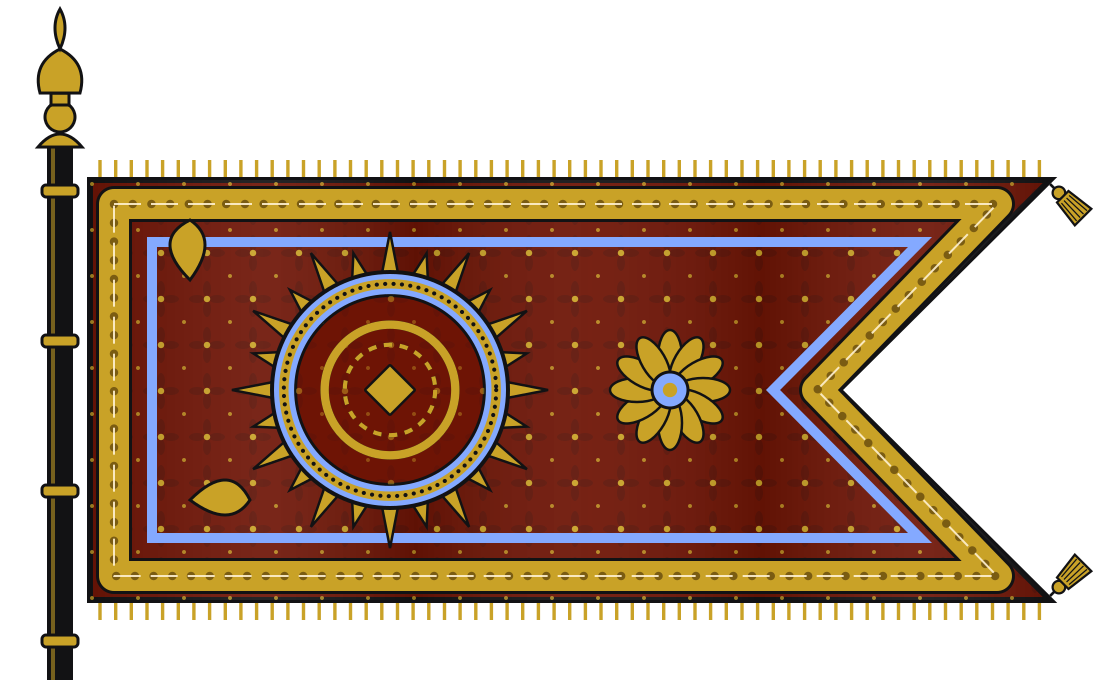
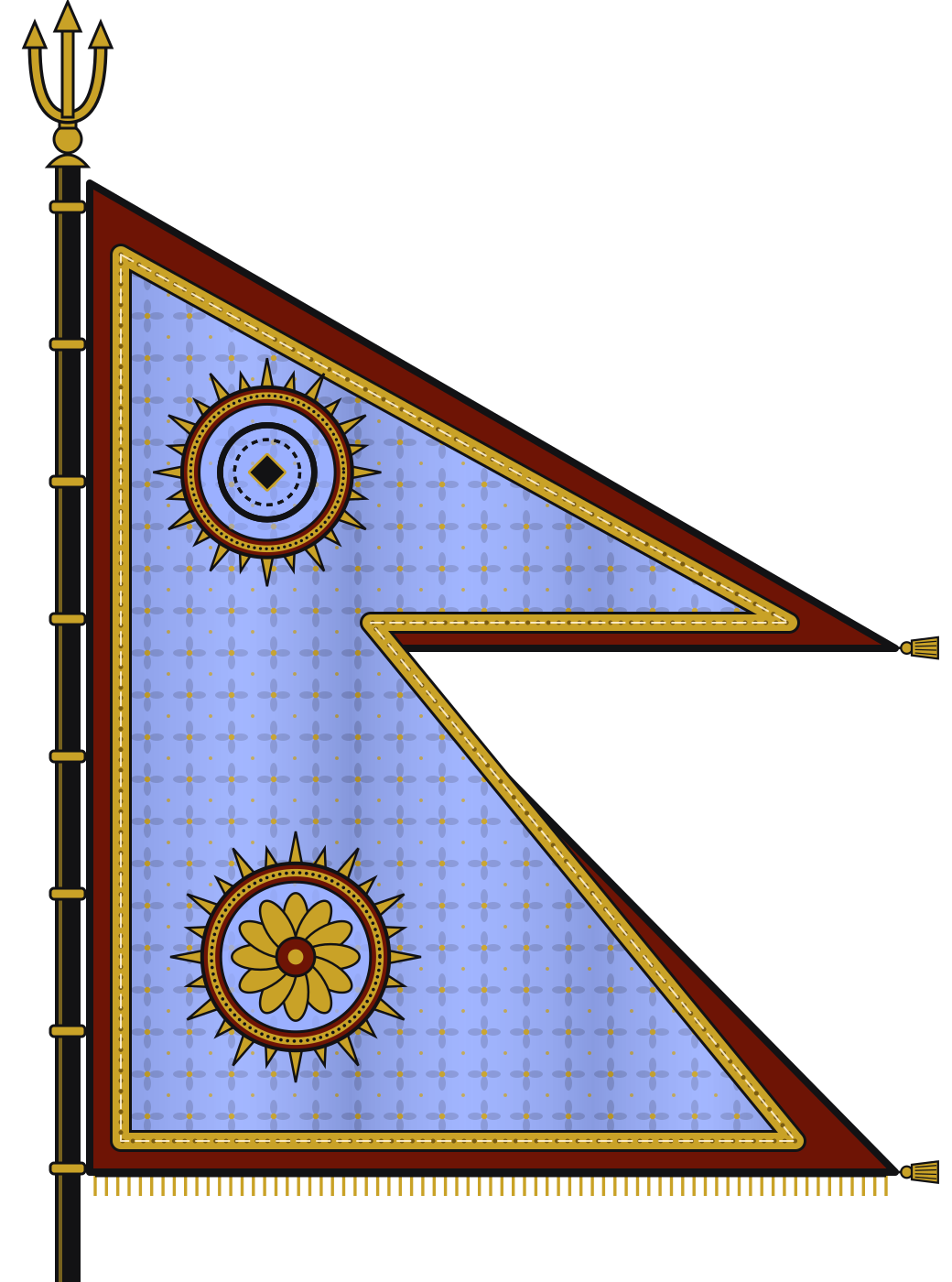
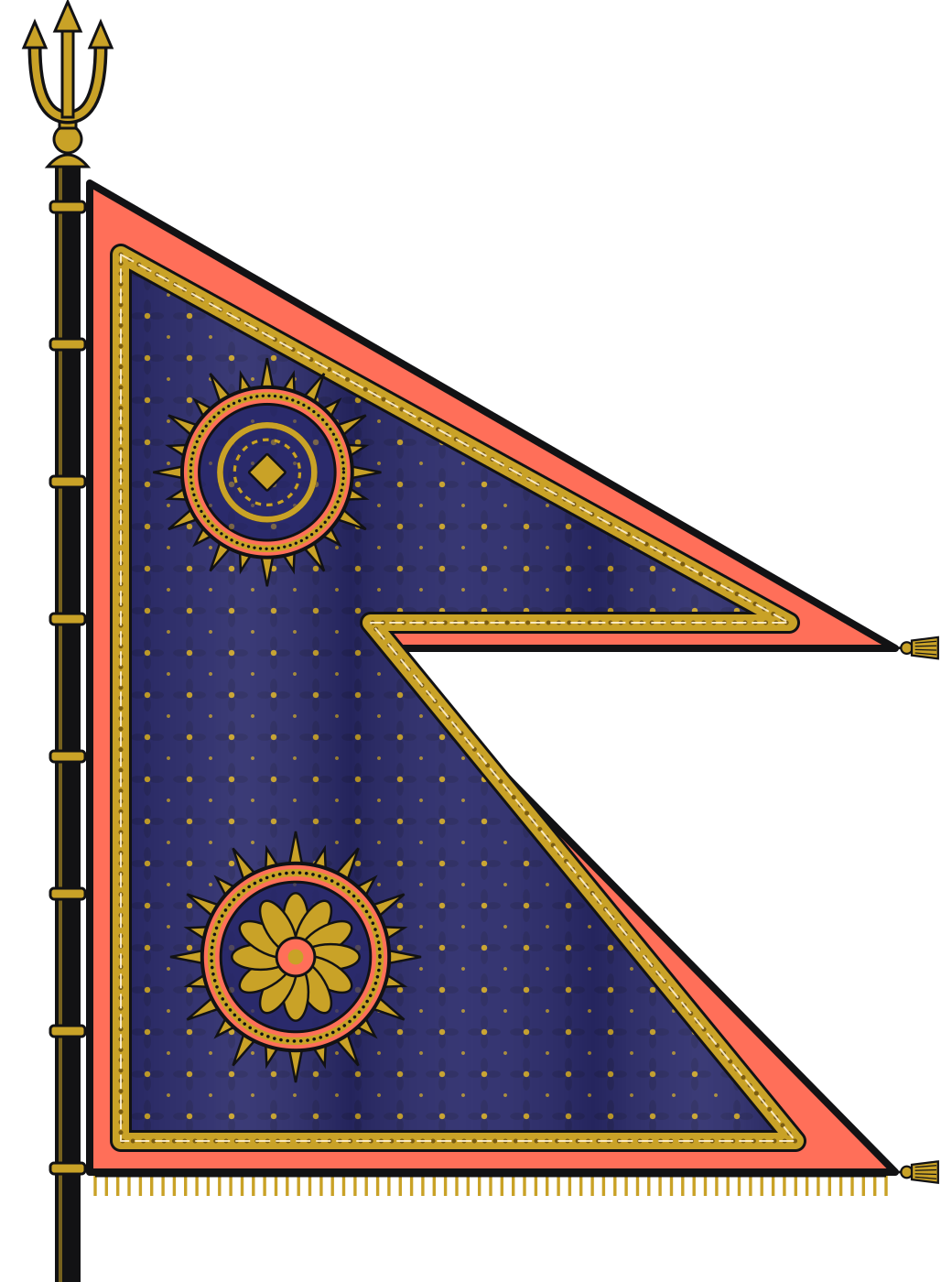
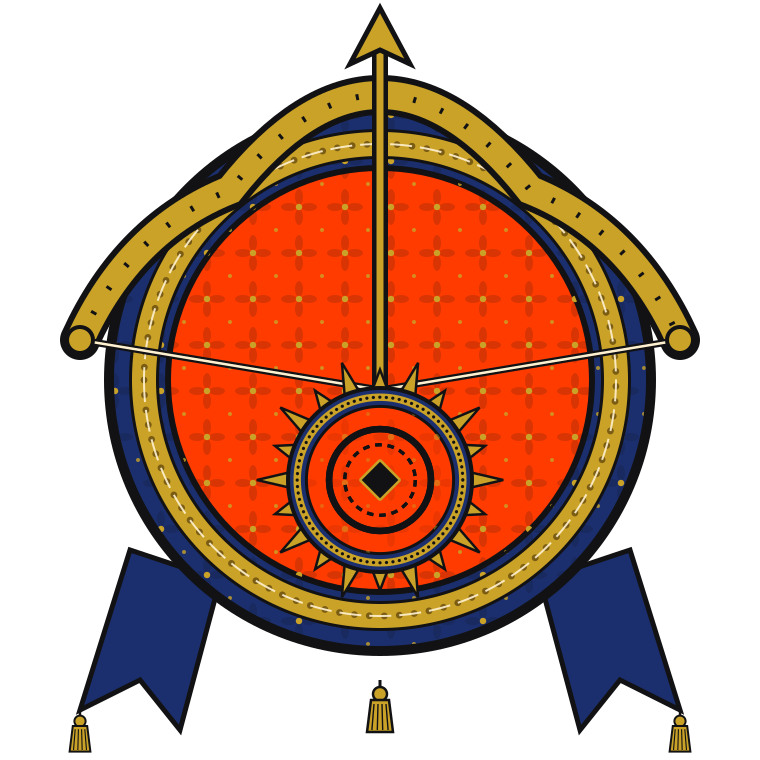
The sources name a coin, royal titles and a gateway, but no flag or seal of the Dimasa. The emblem and flag shown here come from the Atlas as project designs.
| Part of the kit | This clan |
|---|---|
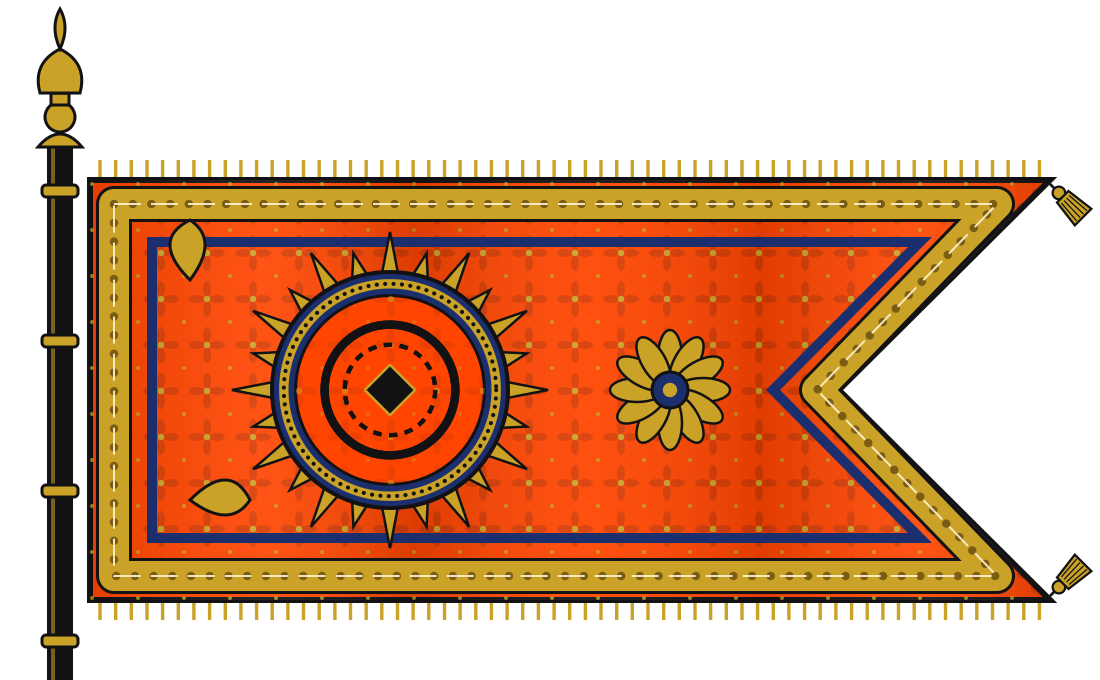
| Field | Royal Navy #1B2F6E |
| Accent | Fiery Vermilion #FF4500 |
| Emblem colour | Metallic Gold #C9A227 |
| Zari metal | Gold |
| Main emblem | Mushroom-shaped stone monoliths |
| Second image | A river |
| Night and day | Every visual accessory has two versions: by night the emblem on the dark field, by day the clan's field colour on cloth woven from its metal. |
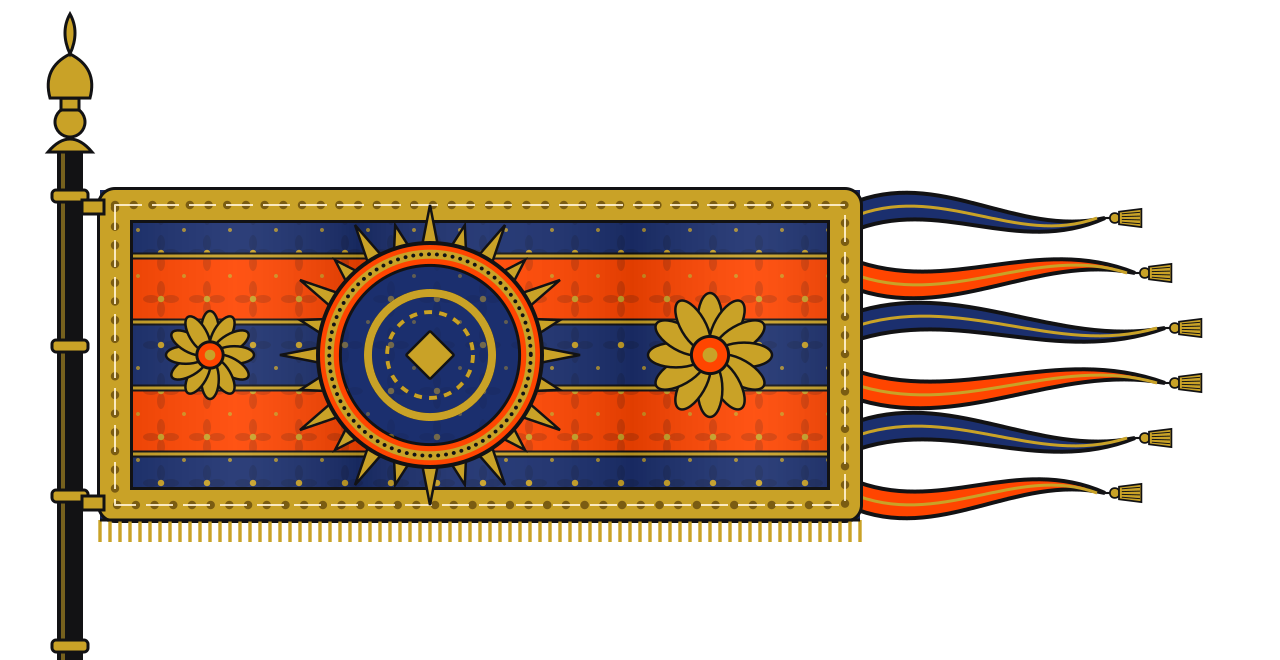
6. Flags
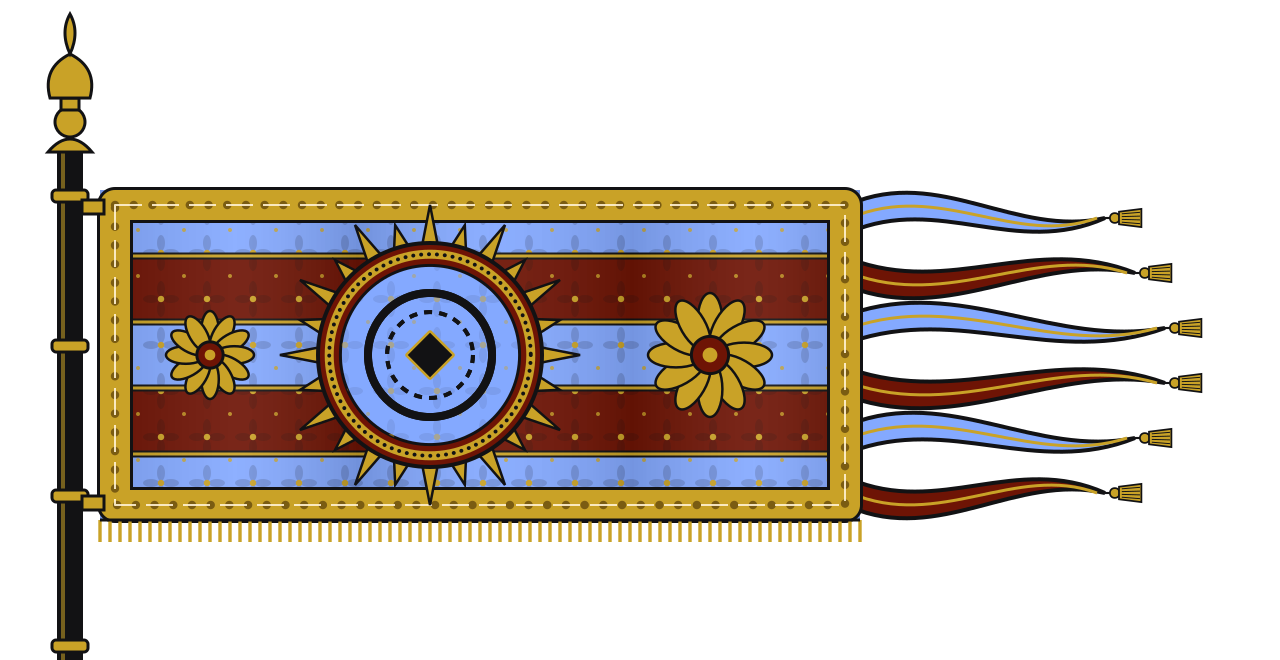
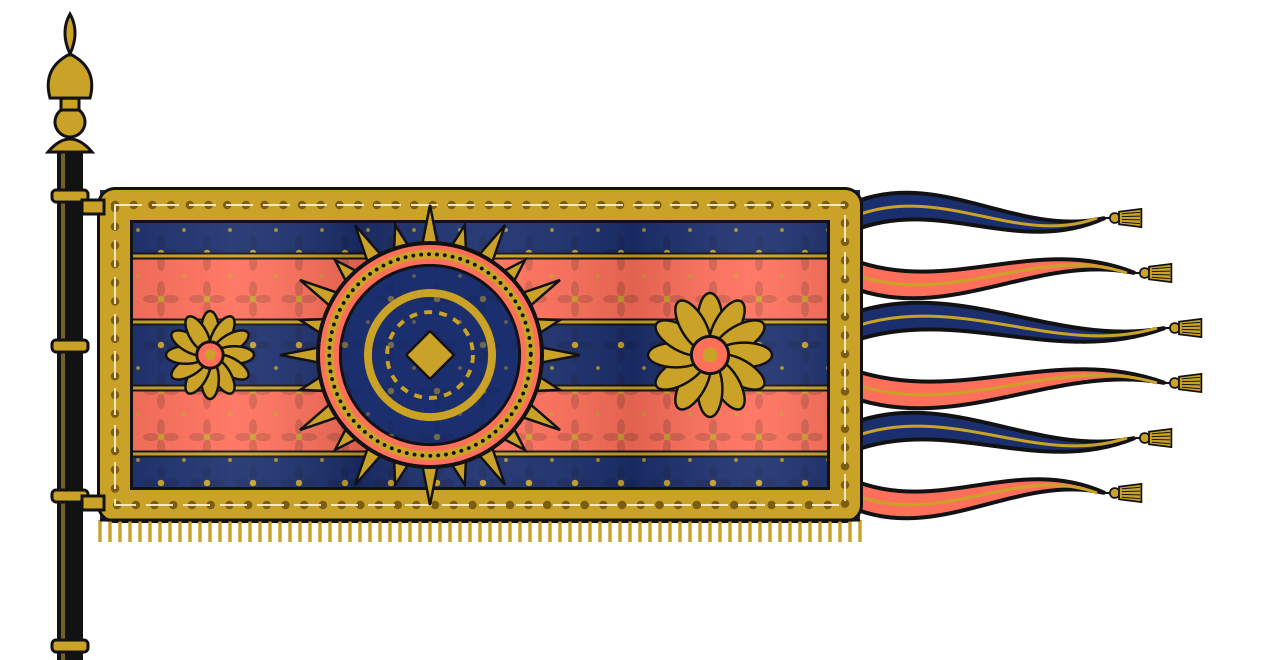
Every clan has every flag type; the type says the occasion and the colours say the clan. The outlined card is the flag the Atlas assigns.
Historic banner
None known
New flag types
| Accessory | For this clan | Basis |
|---|---|---|
| A9 Pota-dhvaja · ship and trade flag For ships, caravans and markets | Not yet designed for this clan | Design |
| A10 Utsava-patāka · festival flag Light, bright flag for fairs and festivals | Not yet designed for this clan | Design |
| A11 Shoka-dhvaja · mourning flag White cloth with the emblem outline in the clan's metal | Not yet designed for this clan | Design |
7. Regalia
| Accessory | For this clan | Basis |
|---|---|---|
| E1 Chhatra · house parasol The ceremonial umbrella | Not yet designed for this clan | Design |
| E2 Chamara · fly-whisks The pair of whisks beside the head of the house | Not yet designed for this clan | Design |
| E3 Danda · staff of office Staff or scepter | Not yet designed for this clan | Design |
| E4 Simhasana · seat The seat of the house, covered in clan cloth | Not yet designed for this clan | Design |
| E5 Khetaka · shield A round shield; the Changi and Dhanush are its flag forms | Not yet designed for this clan | Regional tradition |
| E6 Kula-ayudha · clan weapon The weapon the clan honours | A sword worshipped as the goddess Ranachandi. At Khaspur the sword was worshipped earlier; the page now says there is no image or idol there. At Bijoypur a piece of sword is worshipped as her symbol | Documented |
8. Worn
| Accessory | For this clan | Basis |
|---|---|---|
| F1 Kula-vastra · clan cloth The clan's woven pattern in its kit colours | Not yet designed for this clan | Design |
| F2 Kirti-vastra · honour cloth A cloth earned for a deed, not inherited | Not yet designed for this clan | Design |
| F3 Kula-mala · garland flower The flower or leaf the clan wears as a garland | Not yet found for this clan | Under research |
| F4 Chinha · house pin A metal badge with the pin emblem | Not yet designed for this clan | Design |
9. Records
| Accessory | For this clan | Basis |
|---|---|---|
| H1 Clan words A traditional line in the native script | · “Under research” No Dimasa line of the people's own is in the extracts, and no classical source ties a line to them. Leads: the Endle 1911 full text (Gutenberg #50008; only its first 100,000 characters were read), J. D. Anderson's Kachari folk-tales and rhymes (Gutenberg #53506, read as a page only), and the Academia Sinica Dimasa texts (Evans and Langthasa). | Documented |
| H2 Biruda · titles The house's title or titles | Royal titles of the kings: Herambeswara, Haidambesvara, Herambadhiswara (Latin transliteration, from Rhodes and Bose as cited by the Sentinel) | Documented |
| H3 Prashasti · praise genealogy The lineage as written at the head of a grant | Not yet found for this clan | Under research |
| H4 Vahi · clan register The book of the clan's births, marriages and deaths | Not yet found for this clan | Under research |
| H5 Rana-ghosha · war cry The clan's cry in battle or celebration | Not yet found for this clan | Under research |
10. VishwaVit · knower of the world
Game values are design choices for this project, not historical claims.
References
- "Dimasa Kingdom", Wikipedia (English), read 10 October 2026 (re-read 2026-11-20).
- "Dimasa people", Wikipedia, read 29 October 2026 (re-read 2026-11-20).
- "Ranachandi Mandir, Khaspur", Bodo Dimasa Archive (narrator Romaranjan Phonglo Barman, recorded 19 November 2022), read 10 October 2026.
- "Ranachandi Temple, Bijoypur village", Bodo Dimasa Archive (narrator Nayan Barman, filmed 22 November 2022), read 10 October 2026.
- "The Dimasa Kacharis of Cachar District: An Overview", Sahapedia, read 10 October 2026.
- Wikipedia, Barmans in Cachar, read 2026-11-20, https://en.wikipedia.org/wiki/Barmans_in_Cachar.
- Tamreswari Temple, Wikipedia, read 10 Oct 2026.
- Wikipedia, Dimasa Kachari language, read 2026-11-20, https://en.wikipedia.org/wiki/Dimasa_Kachari_language.
- Sidney Endle, The Kacharis (Macmillan, London, 1911), Project Gutenberg #50008, read 2026-11-19 (first 100,000 characters only), https://dev4.gutenberg.org/ebooks/50008.txt.utf-8.
- J. D. Anderson, A Collection of Kachári Folk-Tales and Rhymes, Project Gutenberg #53506 (page only; text not read), read 2026-11-20, https://m.gutenberg.org/ebooks/53506.
- K Naben, "Historical facts of Dimapur ruins", Sentinel Assam (Digital Desk), 11 Nov 2021, read 2026-11-20, https://www.sentinelassam.com/more-news/editorial/historical-facts-of-dimapur-ruins-562772.
- Zawlbûk, Wikipedia, read 2026-10-22.
- Garo people, Wikipedia, read 2026-11-15 (cites Playfair 1909, Sinha 1955, Marak 2005 and Marak 2014 as printed in the article).
- A. Playfair, The Garos (London: David Nutt, 1909), NVLI OCR RB858 (pp. vi–86 of the text only), read 2026-11-19, link.
- Wikipedia, Bodo–Kachari people, read 2026-11-16, https://en.wikipedia.org/wiki/Bodo%E2%80%93Kachari_people.
- Wikipedia, Busu Dima, read 2026-11-20, https://en.wikipedia.org/wiki/Busu_Dima.
- PTI, "Assam oppn claims ST status report 'vague', govt says 'all satisfied'", The Week, 30 Nov 2025, read 2026-10-24, link.