The Dhodia (ધોડિયા) are a Scheduled Tribe (Atlas list dated 09-07-2024) of south Gujarat, and are also found in Dadra and Nagar Haveli, Daman and Diu, Maharashtra and other states[1][2]. They speak Dhodia, one language of the Dhodia–Kukna group, written in the Gujarati script[3]. Their origin is told in legends of Rajput princes who married Naika women, and the extracts give no dated record for it[2]. Legend also makes the Dhodia and the Naikda descendants of two brothers, Dhana Khatri and Rupa Khatri[4][5]. The 2011 census counts 6,35,695 in Gujarat's Scheduled Tribe list and 17,520 in Maharashtra, a state figure[6][7].
01Faith and deities
Mother-goddess of the Bhils and the south Gujarat tribes[8]
The presiding goddess of the clan's homeland or capital: a link of place, not a recorded clan tie.
| Deity or tradition | Place in the clan's life | Evidence |
|---|---|---|
| Bharam Dev | Kul dev (the kuldev) | [1] |
| Kameshari Devi | Home deity; deity of grains | [2] |
| Kanasari / Kanseri | Goddess of food; known as Annapurna to many Hindus; honoured at the harvest | [1] |
| Kak Balia | Protects against smallpox | [2] |
| Goal Devi | Protects cattle | [2] |
| Nagdev | Protects against snakebite | [2] |
| Jalaram Bapa | Worshipped on the seventh day of the dark half of Kartik | [2] |
| Mahadeo, Hanuma, Amba Mata, Kalka, Balia, Bagh Devi | Named among the deities worshipped | [2] |
| Chosath Jogini, Bagla Brahmchari, Baliya dev | Named among the deities | [1] |
02Temples
Wikipedia mentions a clan temple with yearly worship, but gives no name or place. TRTI names pilgrimage places (Nasik, Shirdi, Dwarka, Dakot, Unai, Veerpur) without saying the clan built or patronised a temple there. Under research.
Built by the clan
Not recorded.
Given patronage or grants by the clan
Not recorded.
03Languages and scripts
| Language or script | Kind | Under the clan | Evidence |
|---|---|---|---|
| Dhodia living | Indo-Aryan, Bhil branch of the Dhodia–Kukna group; written in the Gujarati script | Spoken among the clan; has unique words and words from Gujarati and Marathi[1] | |
| Gujarati living | Language of the wider community and of writing | Dhodia speak Gujarati as well as their own dialect[2] |
04Books and literature
The extracts list Gujarati-language works about the Dhodia and a 2014 Shodhganga thesis. Only titles and bibliographic details are in the extracts, not their content.
Written during the clan's history
| Work | Author | Kind | When | Link to the clan |
|---|---|---|---|---|
| અહા આમું ઢોડિયા | Shri Kulin Patel | Gujarati book | Not stated | [1] |
| ઢોડિયા જાતી: બોલી,સાહિત્ય અને સંસકૃતિ | Late Shri Manchharambhai Naranadas Patel | Gujarati book (language, literature and culture) | Not stated | [1] |
| વડલો | Not stated | Gujarati book | Not stated | [1] |
| A Historical Study of Dhodia, a Schedule Tribe among the Tribal Sector of South Gujarat | Patel Bharatkumar Naginbhai | Ph.D. thesis, Pacific University, Debari (guide Gopal Vallabh Vyas) | 2014 | [9] |
Given patronage by the clan
Not recorded.
05Thinkers and scholars
| Name | Field | Era | Contribution |
|---|---|---|---|
| Patel Bharatkumar Naginbhai | Social science, Ph.D. | 2014 | Thesis on the Dhodia of Surat, Navsari and Valsad[9] |
| Shri Manchharambhai Naranadas Patel (late) | Writer on Dhodia language, literature and culture | Not stated | Gujarati book on the Dhodia[1] |
| Shri Kulin Patel | Writer on the Dhodia | Not stated | Gujarati book on the Dhodia[1] |
The thesis record has no abstract beyond its title. Under research for other scholars.
06Art and architecture
The extracts name no painting, sculpture, architecture, textile or craft of the Dhodia. Women's dress is under Food, dress and games.
Painting and wall art
Not recorded.
Sculpture and temple art
Not recorded.
Temple and building architecture
Not recorded.
Weaving and textiles
Not recorded.
Clothing and jewellery
Not recorded.
Coins, pottery and crafts
Not recorded.
07History
Origin legends (no dates given)
The name may derive from Dhulia in Maharashtra, from which the Rajput princes Dhan Singh and Roop Singh are said to have come before marrying Naika women[2].
A second legend places the origin at Dholaka Dhandhuka, near the south bank of the Narmada, where Dhana and Roopa married the Naika women Sani and Jheeni[2].
Another account has the Jadav Rajputs, descendants of Krishna, moving south after disturbances at Dwarka. They came with cattle (dhor), were first called Dhorwala and later Dhodia[2].
PeopleGroups gives the same legendary descent from Rajput princes who married Naika women[10].
Census record, 1971 to 2001
The census counted 358,773 in 1971 and 589,108 in 2001 (296,115 men and 292,993 women)[2].
08Journey and migrations
The extracts give no dated migration. The legends place the people's movements from Dhulia, Dholaka Dhandhuka and Dwarka into south Gujarat.
| When | From | To | Why | Evidence |
|---|---|---|---|---|
| Undated (legend) | Dhulia, Maharashtra | Not stated | Dhan Singh and Roop Singh came, then married Naika women | [2] |
| Undated (legend) | Dholaka Dhandhuka, near the Narmada | Not stated | Dhana and Roopa married the Naika women Sani and Jheeni | [2] |
| Undated (legend) | Dwarka | Not stated (south) | Jadav Rajputs moved south after disturbances, with cattle | [2] |
09Seats and lands
| Place | Role | Where today |
|---|---|---|
| Vapi to Tapi | Area given for the people's base | Gujarat |
| Surat, Valsad, Navsari | Main areas, south Gujarat | Gujarat |
| Bharuch, Vadodara, Ahmedabad, Dangs | Also found (TRTI) | Gujarat |
| Dadra and Nagar Haveli, Daman and Diu | Also found | Union territories |
| Thane (mainly), Maharashtra | Main area in Maharashtra (Wikipedia) | Maharashtra |
| Madhya Pradesh, Karnataka, Rajasthan | Also found (Wikipedia) | — |
| Nasik, Shirdi, Dwarka, Dakot, Unai, Veerpur | Pilgrimage places (TRTI). Bones are given to the Tapi at Surat or the Godavari at Nasik | — |
10Notable figures
| Name | Role | Era | Known from |
|---|---|---|---|
| Dhan Singh legend | Rajput prince; said to have come from Dhulia and married Naika women | Legendary, undated | [2] |
| Roop Singh legend | Rajput prince, with Dhan Singh | Legendary, undated | [2] |
| Dhana legend | Legendary ancestor; married the Naika women with Roopa at Dholaka Dhandhuka | Legendary, undated | [2] |
| Roopa legend | Legendary ancestor, with Dhana | Legendary, undated | [2] |
| Sani and Jheeni legend | Naika women married in the legend | Legendary, undated | [2] |
| Jadav Rajputs legend | Descendants of Krishna who came south from Dwarka with cattle | Legendary, undated | [2] |
11Allies, rivals and marriages
| People | Relationship | When |
|---|---|---|
| Naikda (ST-232) | Common ancestry claimed: Dhana Khatri (Dhodia) and Rupa Khatri (Naikda), two brothers[5] | Legend, undated |
| Brahman, Vania, Rajput, Kanbi, Ahir | Ranked above the Dhodia in local rank order (TRTI) | Present (TRTI) |
| Gamit, Dubla, Naika, Kokna, Chodhury, Kotwalia, Warli, Kolcha | Ranked below the Dhodia in local rank order (TRTI) | Present (TRTI) |
| Higher castes | Dhodia accept food and water from them; share wells; separate crematoria (TRTI) | Present (TRTI) |
| Dubla, Gamit | Midwives (dayan) come from the own community, Gamit or Duble (TRTI) | Present (TRTI) |
| Bhil (ST-027) | Dhodia listed among Bhil divisions and clans (Wikipedia, citing the Bombay Gazetteer 1880, 1901 and later works) | 1880 onward (as sources state) |
| Kokna (Kukna) (ST-140) | Named with the Dhodia as the ethnic groups of the Dhodia–Kukna language | Present |
12Society and livelihood
Dhodia are a Scheduled Tribe (Atlas, ST list dated 09-07-2024), organised in clans, with a registered community body for welfare and reform[2].
Government and social order
| Institution or group | What it was | Evidence |
|---|---|---|
| Clan (kud) | Exogamous clan with a headman (agewan) who worships the clan deity; clans grouped in chaura units of five to twenty villages | [2] |
| Samasta Dhodia Samaj | Registered community body for welfare and reform | [2] |
| Marriage | Mainly monogamous; polygyny for barrenness or insanity. Girls marry about 16 to 20, boys 18 to 25. Negotiated, or by service. Patrilocal. Divorce needs cash compensation. A widow may remarry, and levirate applies if a suitable younger brother is free | [2] |
| Inheritance | Property passes through the male line | [2] |
| Life-cycle rites | Khola Bharana in the seventh month; Chhatti on the fourth day for girls, fifth for boys; Mundan; marriage with garlands and four rounds of the sacred fire (mangalphera), kanyadan; cremation (under-ones are buried); barwa on the twelfth day | [2] |
| Healers | Bhagats and Bhuwas heal the effects of violent spirits with herbal medicine | [2] |
Livelihood over time
| Era | Livelihood | Evidence |
|---|---|---|
| Traditional | Agriculture and fishing | [10] |
| Present (TRTI) | Several members have served as MLAs and MPs; contractors and businesspeople are present | [2] |
| From the Atlas | Farming on south Gujarat's coastal plain | Atlas, ST-067 |
13Sub-clans and related clans
Locally called kud (TRTI). Each clan has a headman who worships the clan deity. Wikipedia notes several subcastes or "Kul" (કુળ) but names none. TRTI lists these exogamous clans, equal in status, "among others":
| Clan | Relation | Where | Size | In the Atlas | Evidence |
|---|---|---|---|---|---|
| Desari | Sub-clan | new clan candidate | [2] | ||
| Naika | Sub-clan | new clan candidate | [2] | ||
| Garasia | Sub-clan | same name as ST-083: check | [2] | ||
| Mehta | Sub-clan | new clan candidate | [2] | ||
| Joshi | Sub-clan | new clan candidate | [2] | ||
| Rawat | Sub-clan | new clan candidate | [2] | ||
| Ahir | Sub-clan | same name as ST-363: check | [2] | ||
| Vajaria | Sub-clan | new clan candidate | [2] | ||
| Rupasari | Sub-clan | new clan candidate | [2] | ||
| Gaikwad | Sub-clan | new clan candidate | [2] | ||
| Sadu Bamaniya | Sub-clan | new clan candidate | [2] | ||
| Pradhaniya | Sub-clan | new clan candidate | [2] | ||
| Kedariya | Sub-clan | new clan candidate | [2] | ||
| Naikda | Related people | Gujarat (Navsari, Surat, Valsad) and Rajasthan | 3,93,024, 2001 census[4] | ST-232 | [4] |
| Gamit | Related people | ST-080 | [2] | ||
| Dubla | Related people | ST-074 | [2] | ||
| Kokna (Kukna) | Related people | ST-140 | [3] | ||
| Warli | Related people | ST-326 | [2] | ||
| Kolcha | Related people | new clan candidate | [2] | ||
| Kotwalia | Related people | new clan candidate | [2] | ||
| Chodhury | Related people | new clan candidate | [2] | ||
| Bhil | Related people | ST-027 | [11] | ||
| Jadav Rajputs | Dynasty from this clan | Dwarka (legend) | new clan candidate | [2] |
Clans marked "new clan candidate" are not in the Atlas yet.
14Surnames
No surname list is in the extracts. TRTI says the clan names are the only family-identity markers. The extracts do not say those names are used as surnames, so none are listed here.
Not recorded.
15Songs and music
Oral tradition and folk songs (TRTI). The extracts give no song titles, lyrics or sayings.
None recorded yet.
Instruments and styles
| Instrument or style | What it is | Evidence |
|---|---|---|
| Tur | Instrument played at Holi | [2] |
| Drum | Played with the tur at Holi | [2] |
| Gheria | Folk dance over the five days of Diwali | [1] |
16Poems, lullabies and children's rhymes
No poem, lullaby or children's rhyme of the Dhodia is in the extracts.
None recorded yet.
17Stories, legends and proverbs
Stories and legends
| Story | What happens | Told by | Evidence |
|---|---|---|---|
| Dhan Singh and Roop Singh legend | Rajput princes come from Dhulia and marry Naika women; the name may come from Dhulia | Community legend (TRTI) | [2] |
| Dhana and Roopa at Dholaka Dhandhuka legend | Two men near the south bank of the Narmada marry the Naika women Sani and Jheeni | Community legend (TRTI) | [2] |
| The Jadav Rajputs from Dwarka legend | Descendants of Krishna leave Dwarka after disturbances, bringing cattle, and are first called Dhorwala | Community legend (TRTI) | [2] |
Proverbs and sayings
Not recorded.
18Festivals and fairs
| Festival or fair | When | Where | What happens |
|---|---|---|---|
| Diwali | Diwali, over five days | Not stated | Gheria folk dance; Bhakhras for pooja to the Kuldev[1] |
| Holi | Holi | Not stated | The tur and drum are played[2] |
| Kanseri | Annually at the harvest | Not stated | Honours Kanasari / Kanseri, goddess of food[1] |
| Divaso (Diwaso) | Not stated | Not stated | Named in both sources; no detail given[1][2] |
| Vagh baras (Vagh: tiger) | Not stated | Some villages; not all | In some villages men paint tiger stripes; others paint white or colours for cattle. A tiger chases the cattle and the village eats together[1] |
| Parjan (ancestor rite) | Every two years (Wikipedia) or every three to four years (TRTI) | Not stated | All gather for collective ancestor worship. The sources differ on the interval[1][2] |
| Ganesh Chaturthi, Rakhi, Dashahara | Not stated | Not stated | Named among the festivals kept[2] |
19Food, dress and games
Food
| Item | What it is | Evidence |
|---|---|---|
| Rice, wheat, jawar, pulses, vegetables and milk; non-vegetarian; alcohol and tobacco used[2] | ||
| Lapsi, a sweet dish, on festive occasions[2] |
Dress
| Item | What it is | Evidence |
|---|---|---|
| Women's kachhedo or dhadku saree, close to the Marathi saree[1] |
Games and martial arts
Not recorded.
Tags: living still practised · revived brought back after a break · lost known only from records · research reported but not yet confirmed from a source. Songs and poems under copyright are listed by title only; restricted or sacred material is noted without its content.
20Status today
The Dhodia are a living Scheduled Tribe (Atlas list dated 09-07-2024) of south Gujarat and nearby union territories and states, with a community body for welfare and reform[2][1].
Who carries the name today
| Community | Link | Basis | Evidence |
|---|---|---|---|
| Jadav Rajputs (no sheet ID) | Community tradition | [2] | |
| Rajput princes Dhan Singh and Roop Singh (legend, no sheet ID) | Community tradition | [2] |
Recognised heritage
| What | Recognition | Evidence |
|---|---|---|
| Samasta Dhodia Samaj: registered community body for welfare and reform | Registered (TRTI) | [2] |
| Scheduled Tribe status | Constitution (Goa, Daman and Diu) Scheduled Tribes Order, 1968; ST list dated 09-07-2024 | [13] |
Not yet reviewed by the Dhodia community.
21For children
Where the Dhodia came from
This is one of the legends the Dhodia tell about their beginnings. The story says two Rajput princes, Dhan Singh and Roop Singh, came from a town called Dhulia. They married Naika women. Another story says the Jadav Rajputs came from Dwarka with their cattle. Because they brought cattle, people first called them Dhorwala, and later Dhodia. Today the Dhodia live in south Gujarat, and they speak their own language. Each clan has a headman who worships the clan deity.
22Across the project
| Project | What carries this clan | Status |
|---|---|---|
| Atlas of the Janas | Base area: Vapi to Tapi, south Gujarat, with Surat, Valsad and Navsari[1]. No pin set yet. | To check |
| KulDevi and GrahDevi | KulDevi Devmogra Mata, homeland shrine, mother-goddess of the Bhils and south Gujarat tribes. Not confirmed by a source read. GrahDevi forms: Brahmani, Maheshvari, Kaumari, Vaishnavi, Varahi, Indrani, Chamunda, Narasimhi. | From the Atlas, unconfirmed |
| Planet naming | Not checked against the Tier registers. The extracts give no planet names. | To check |
| Renaming and waters | Also known as Dhodi. The name may derive from Dhulia (TRTI). Bones are given to the Tapi at Surat or the Godavari at Nasik[2]. | Sourced |
23Open questions
- Which KulDevi do Dhodia families worship? The Atlas gives Devmogra Mata. Wikipedia gives Bhavani Mata (clan deity) and Bharam Dev (kul dev)[1]. No source read names Devmogra Mata.
- Is the Dhodia Naika clan the same people as the Naikda (ST-232)? Are the Garasia (ST-083) and Ahir (ST-363) clans the master-sheet rows?
- Parjan interval: every two years (Wikipedia)[1] or every three to four years (TRTI)[2]?
- Population: PeopleGroups gives 891,000 and its description 870,000[10]. Wikipedia gives 5,36,000 for 2012[1]. Which figure holds for the national total?
- Dated history: no inscription, chronicle or colonial-era account has been read. Next: Enthoven (The Tribes and Castes of Bombay) and the Shodhganga thesis chapters.
- Songs, lullabies, rhymes, proverbs, totems, coins, seals and titles: none in the extracts. Leads: Enthoven, the Shodhganga thesis.
- The clan temple Wikipedia mentions has no name or place. Which temple is it?
- Sub-clan sizes and places, and the surname use of the clan names, are not in the extracts.
24Astitva
अस्तित्व · being, existence: everything by which the clan is known
Nothing documented: the extracts give no seal, coin, title, totem, war cry, guardian tree or clan cloth for the Dhodia[2].
Every clan has every accessory, royal objects included. Each one says how it is known: Documented This clan's own object is recorded. · Regional tradition Recorded for the region or for peoples like this one, not for this clan. · Design Made for this project, with no historical claim. · Under research To be found for this clan from sources. Legends and titles are written in the clan's own script.
1. Seals and coins
| Accessory | For this clan | Basis |
|---|---|---|
| B1 Rajamudra · house seal Round seal with the clan emblem and a short legend in the clan's script | Not yet designed for this clan | Design |
| B2 Anguliya-mudra · signet ring Personal seal ring of the head of the house | Not yet designed for this clan | Design |
| B3 Chhapa · house stamp Ink or block stamp for letters, goods and cloth | Not yet designed for this clan | Design |
| B4 Tamrapatra · charter plate Copper-plate grant on a ring, closed with the house seal | Not yet designed for this clan | Design |
| B5 Shreni-mudra · guild or trade seal Seal for the clan's trade, craft or caravan | Not yet designed for this clan | Design |
| C1 Clan coin Emblem or deity on one side, a legend in the clan's script | Not yet designed for this clan | Design |
| C2 Coin die The die that strikes the coin | Not yet designed for this clan | Design |
2. Living symbols
| Accessory | For this clan | Basis |
|---|---|---|
| I1 Totem trio The tree, bird and animal the clan protects | Not yet found for this clan | Under research |
| I2 Kaval-maram · guardian tree The tree that stands at the clan's seat | Not yet found for this clan | Under research |
3. Stone and gate
| Accessory | For this clan | Basis |
|---|---|---|
| G1 Torana · gateway The built gate of the seat; the cloth Toran hangs in it | Not yet designed for this clan | Regional tradition |
| G2 Viragallu · hero stone Carved panel stone for a member who died defending the clan | Not yet designed for this clan | Regional tradition |
| G3 Kula-shila · clan stones Standing and table stones that remember the ancestors | Not yet designed for this clan | Design |
| G4 Jayastambha · victory pillar A pillar raised for a victory | Not yet designed for this clan | Design |
| G5 Sima-shila · boundary stone Marks the clan's land, with a line in the native script | Not yet designed for this clan | Design |
4. Sounds
| Accessory | For this clan | Basis |
|---|---|---|
| D1 Pancha-mahashabda · five great sounds The right to five instruments | Not yet designed for this clan | Design |
| D2 Shankha · clan conch The clan's own named war conch | Not yet designed for this clan | Design |
| D3 Murasu · house drums Three drums: war, charity and justice | Not yet designed for this clan | Design |
5. Kit: colours, metals and emblems
No seal, coin, totem or banner is documented for the Dhodia in the extracts. TRTI mentions no totems[2]. The flag and banner shown on this page are project designs.
| Part of the kit | This clan |
|---|---|
| Field | Warm Red-Orange #FF6F59 |
| Accent | Deep Cosmic Blue #9BB0FF |
| Emblem colour | Charcoal Black #121214 |
| Zari metal | Gold |
| Main emblem | A paddy field by the sea |
| Second image | — |
| Night and day | Every visual accessory has two versions: by night the emblem on the dark field, by day the clan's field colour on cloth woven from its metal. |
6. Flags
Every clan has every flag type; the type says the occasion and the colours say the clan. The outlined card is the flag the Atlas assigns.
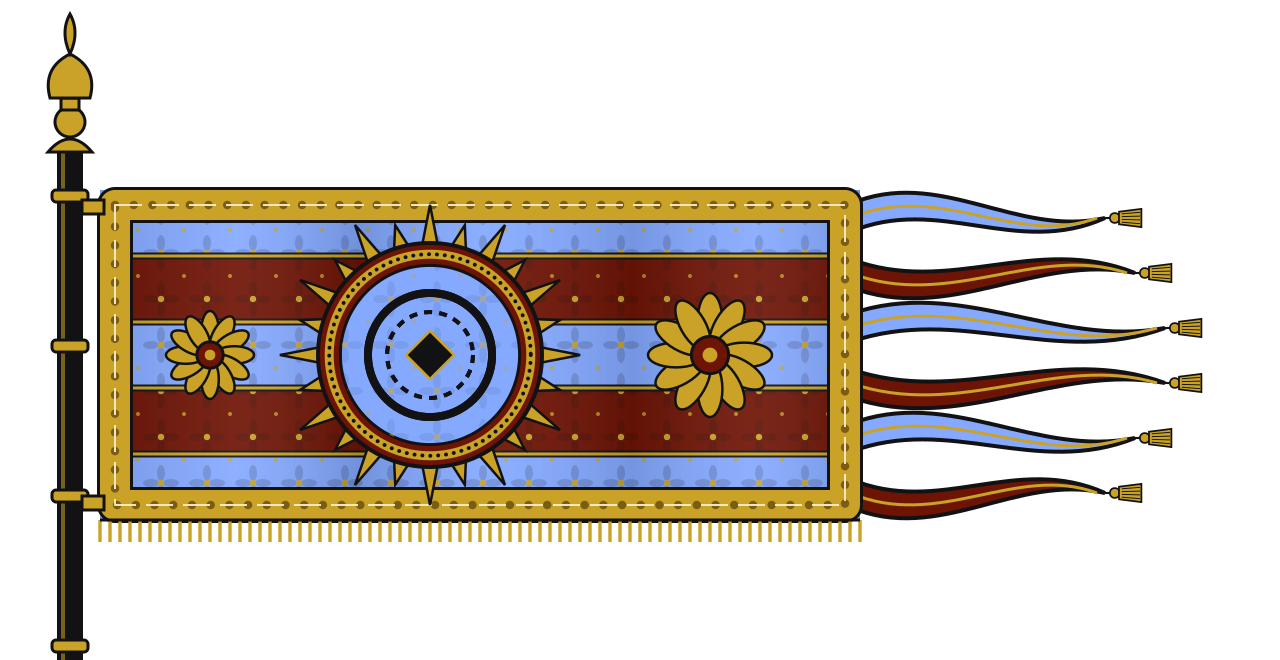
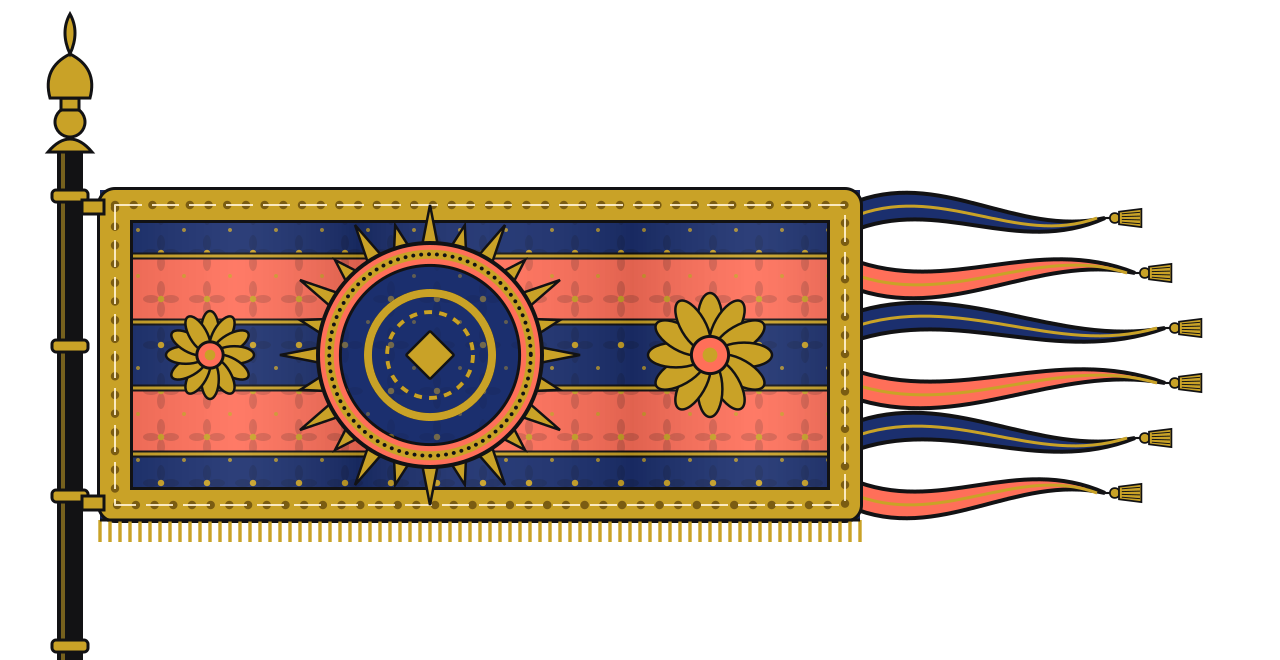
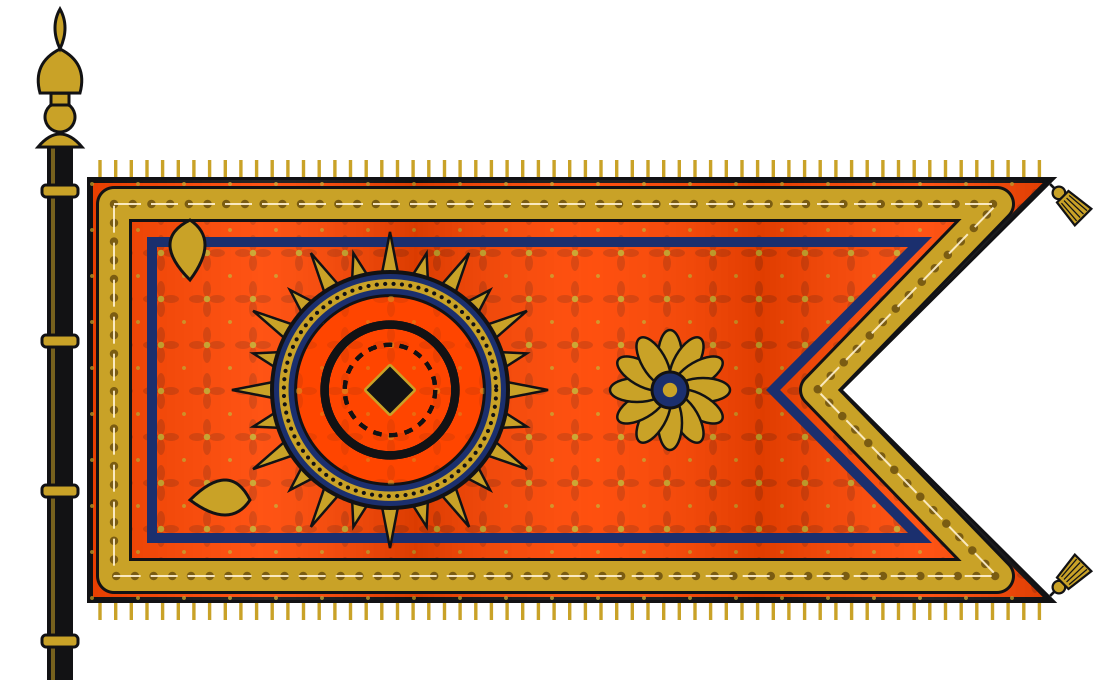
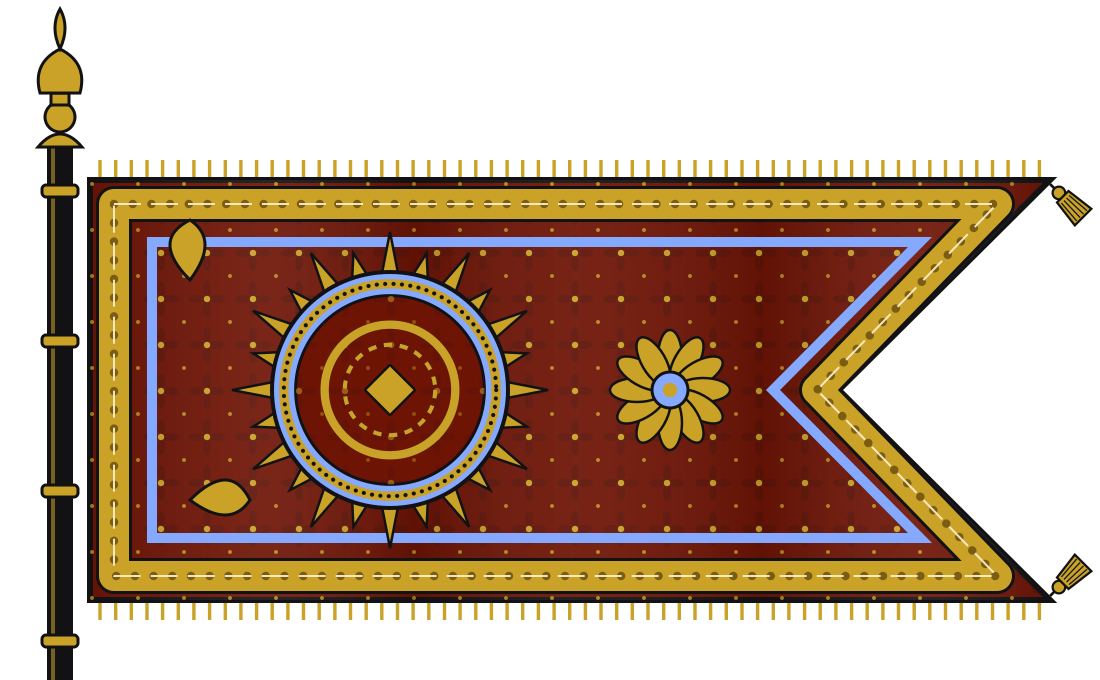
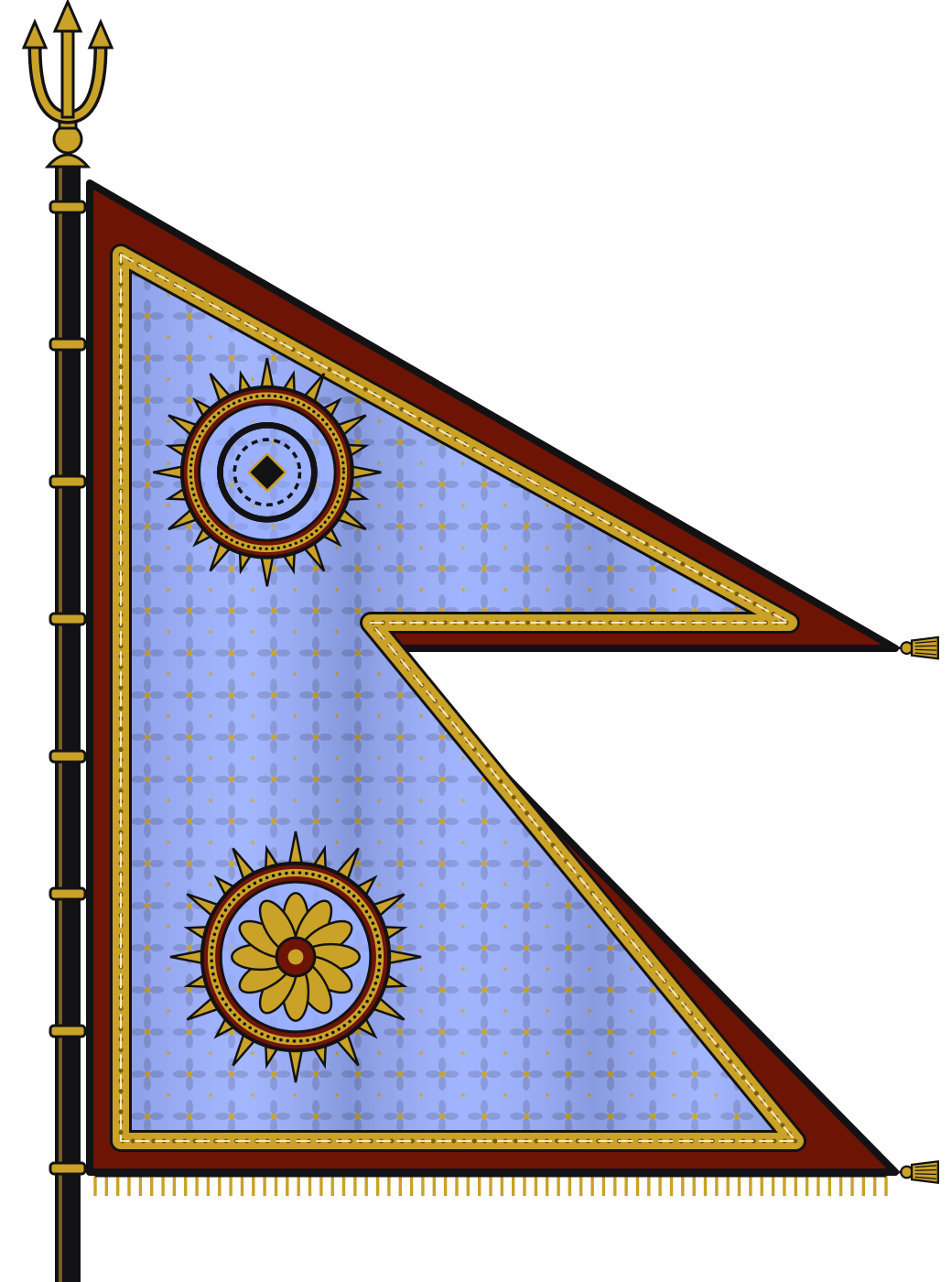
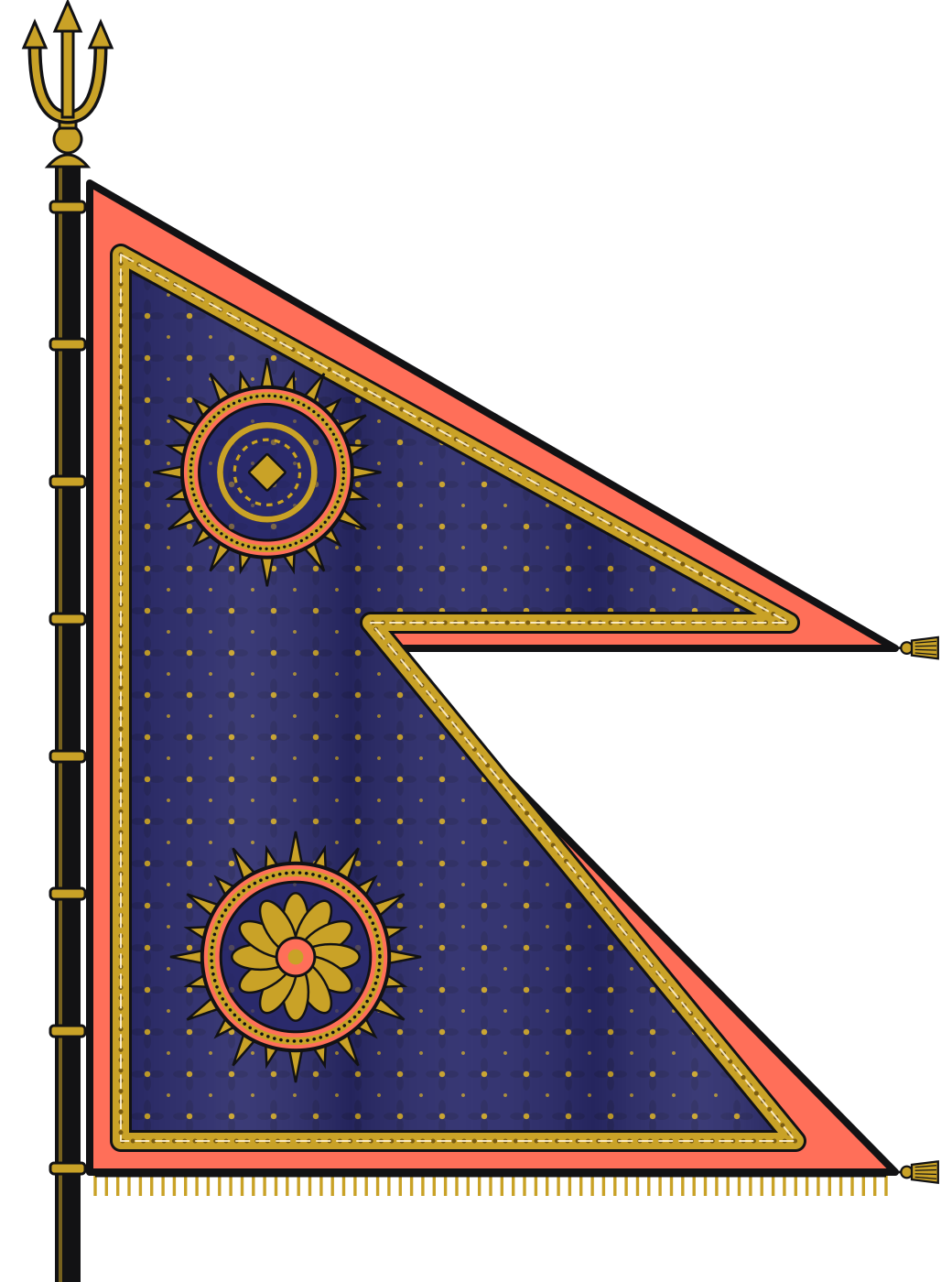

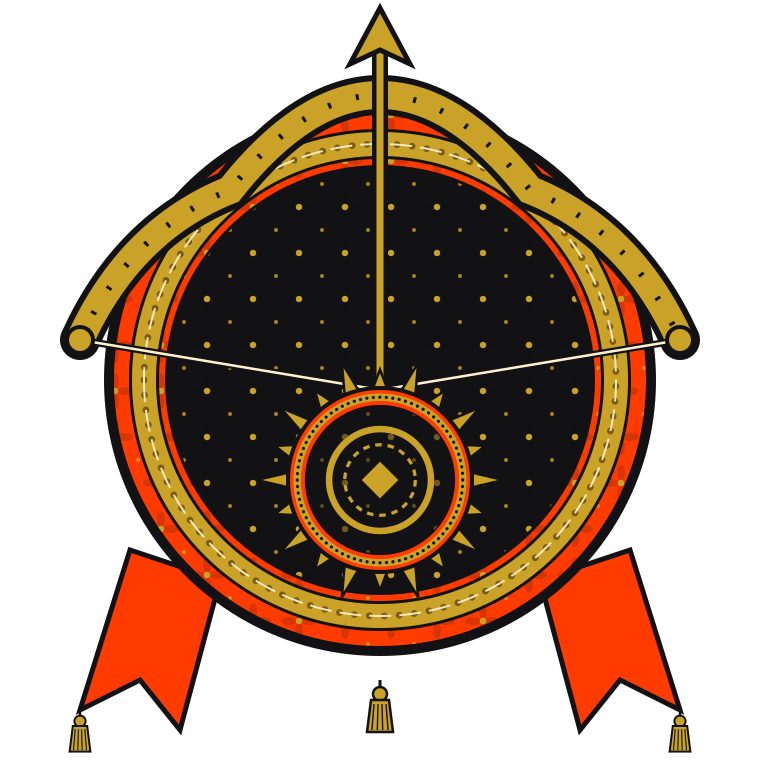
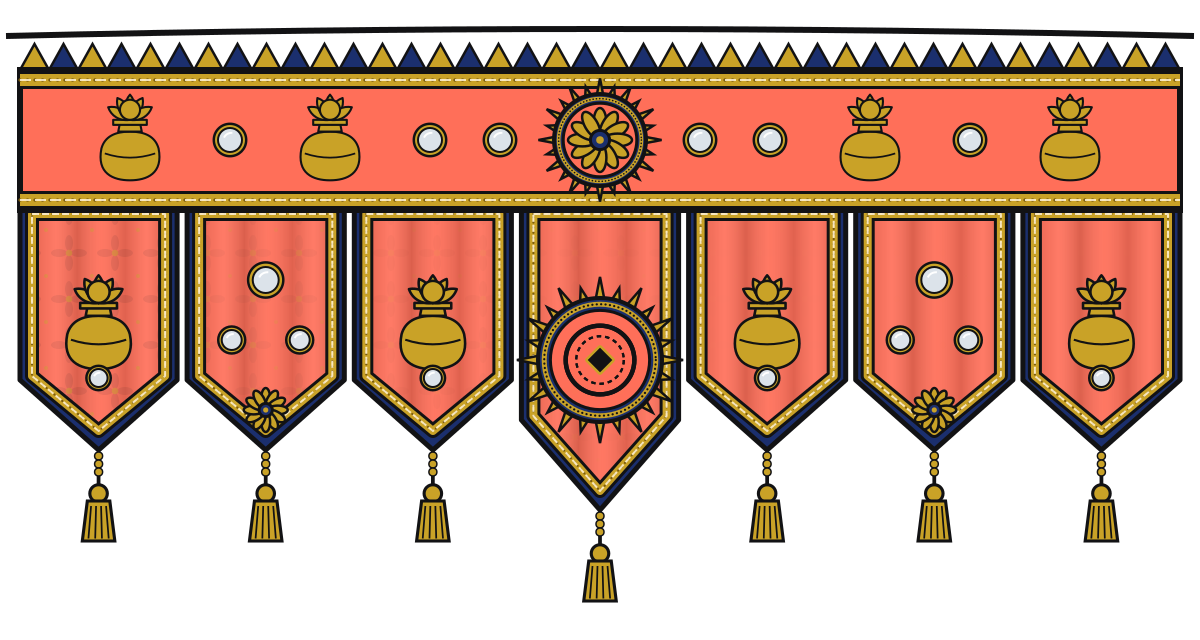
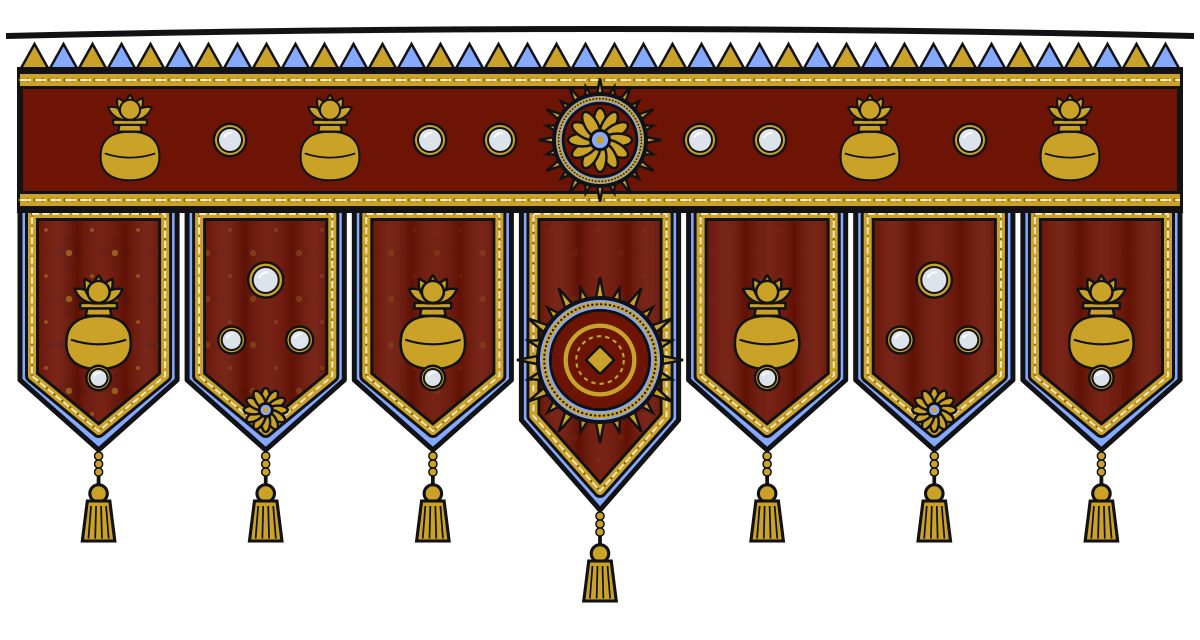
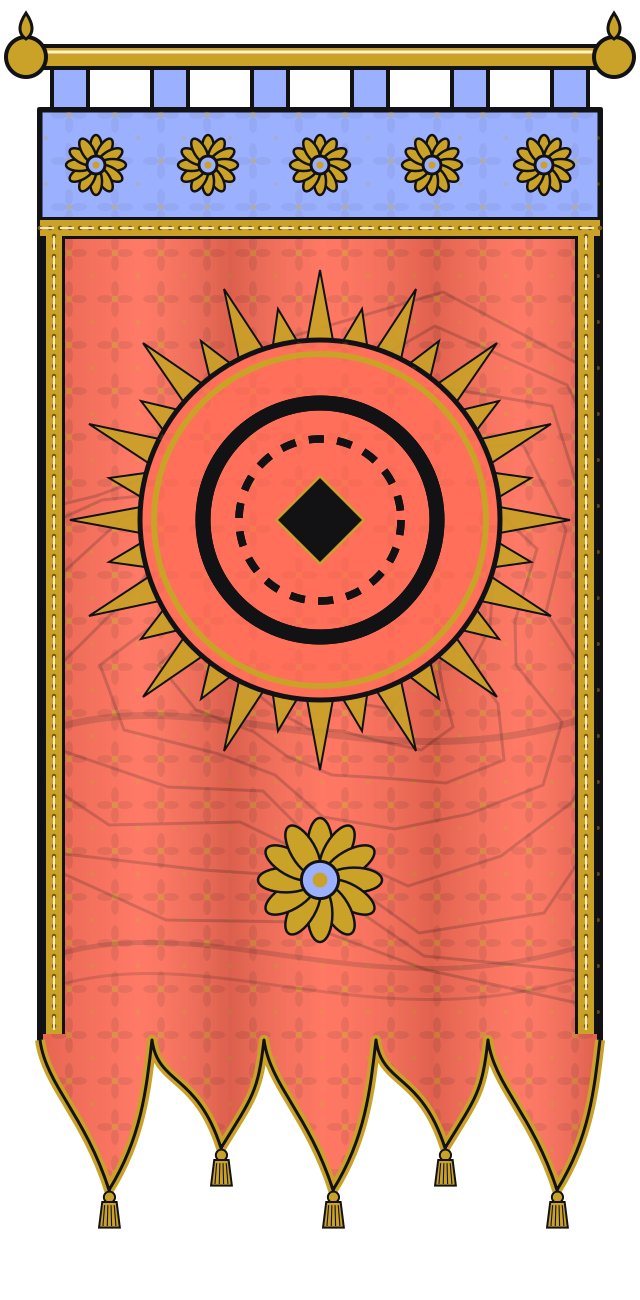
Historic banner
None known
New flag types
| Accessory | For this clan | Basis |
|---|---|---|
| A9 Pota-dhvaja · ship and trade flag For ships, caravans and markets | Not yet designed for this clan | Design |
| A10 Utsava-patāka · festival flag Light, bright flag for fairs and festivals | Not yet designed for this clan | Design |
| A11 Shoka-dhvaja · mourning flag White cloth with the emblem outline in the clan's metal | Not yet designed for this clan | Design |
7. Regalia
| Accessory | For this clan | Basis |
|---|---|---|
| E1 Chhatra · house parasol The ceremonial umbrella | Not yet designed for this clan | Design |
| E2 Chamara · fly-whisks The pair of whisks beside the head of the house | Not yet designed for this clan | Design |
| E3 Danda · staff of office Staff or scepter | Not yet designed for this clan | Design |
| E4 Simhasana · seat The seat of the house, covered in clan cloth | Not yet designed for this clan | Design |
| E5 Khetaka · shield A round shield; the Changi and Dhanush are its flag forms | Not yet designed for this clan | Regional tradition |
| E6 Kula-ayudha · clan weapon The weapon the clan honours | Not yet found for this clan | Under research |
8. Worn
| Accessory | For this clan | Basis |
|---|---|---|
| F1 Kula-vastra · clan cloth The clan's woven pattern in its kit colours | Not yet designed for this clan | Design |
| F2 Kirti-vastra · honour cloth A cloth earned for a deed, not inherited | Not yet designed for this clan | Design |
| F3 Kula-mala · garland flower The flower or leaf the clan wears as a garland | Not yet found for this clan | Under research |
| F4 Chinha · house pin A metal badge with the pin emblem | Not yet designed for this clan | Design |
9. Records
| Accessory | For this clan | Basis |
|---|---|---|
| H1 Clan words A traditional line in the native script | ઢોડિયા જાતી: બોલી,સાહિત્ય અને સંસકૃતિ · “” Gujarati book title, by the late Shri Manchharambhai Naranadas Patel[1]. The extracts give no translation, and no saying or motto of the clan. | Design |
| H2 Biruda · titles The house's title or titles | Not yet found for this clan | Under research |
| H3 Prashasti · praise genealogy The lineage as written at the head of a grant | Not yet found for this clan | Under research |
| H4 Vahi · clan register The book of the clan's births, marriages and deaths | Not yet found for this clan | Under research |
| H5 Rana-ghosha · war cry The clan's cry in battle or celebration | Not yet found for this clan | Under research |
10. VishwaVit · knower of the world
Game values are design choices for this project, not historical claims.
References
- Wikipedia, Dhodia people, read 9 Nov 2026, https://en.wikipedia.org/wiki/Dhodia_people
- Tribal Research and Training Institute Gujarat, Brief Details of Dhodia, read 9 Nov 2026, https://trti.gujarat.gov.in/dhodia
- Wikipedia, Dhodia-Kukna language, read 9 Nov 2026, https://en.wikipedia.org/wiki/Dhodia%E2%80%93Kukna_language
- Tribal Research and Training Institute Gujarat, Brief Details of Naikda, read 9 Nov 2026, https://trti.gujarat.gov.in/naikda
- Wikipedia, Naikda, read 9 Nov 2026, https://en.wikipedia.org/wiki/Naikda
- Wikipedia, List of Scheduled Tribes in Gujarat (2011 census figures), read 2026-10-18, https://en.wikipedia.org/wiki/List_of_Scheduled_Tribes_in_Gujarat
- dhammabharat.com, List of Scheduled Tribes in Maharashtra and Population of each Tribe (2011 Census), read 2026-10-10, https://dhammabharat.com/?p=13656
- Dhodia people, Wikipedia (read 31 Oct 2026, KulDevi clan check).
- Shodhganga, Patel Bharatkumar Naginbhai, A Historical Study of Dhodia (Ph.D., Pacific University, 2014), read 9 Nov 2026, http://hdl.handle.net/10603/321683
- PeopleGroups.org, The Dhodia of India (page updated 2025), read 9 Nov 2026, https://peoplegroups.org/people_groups/pg041432/
- Bhil, Wikipedia (read 2026-10-09), citing Gall & Hobby (2009), K. S. Singh (1996), V. R. Williams (2020), S. K. Ghosh (1987), Ram Pande, M. Unnithan-Kumar (1997), Census of India 2011 and the Bombay Presidency Gazetteer (1880, 1901).
- Vajiram and Ravi, Tribes of Goa, read 2026-10-11, https://vajiramandravi.com/current-affairs/tribes-of-goa/
- Constitution (Goa, Daman and Diu) Scheduled Tribes Order, 1968, tribal.nic.in, read 2026-10-11, https://tribal.nic.in/downloads/CLM/CLM_Const/TheConstitutionGoaDamannDiuScheudledTribesOrder1968.pdf