The Dhanwar are a Scheduled Tribe of central India (list dated 09-07-2024), listed in Chhattisgarh, Madhya Pradesh and Maharashtra, with Dhanuhar and Dhanuwar as other names[1][2][3]. Russell and Hira Lal (1916) explain the name as bowman, and record that most had lived by hunting with bow and arrows until recently[4]. Their origin legend links them with the Gonds and Kawars, and twenty of the fifty sept names Russell returned are also found among the Kawars[4]. Their principal deities, as recorded in 1916, were Thakur Deo, god of agriculture, and Dulha Deo, god of family and hearth[4]. No inscription or dynastic history was found in the sources read, so the history here is thin and marked for research.
01Faith and deities
The clan's own chief deity is named in the sources: Thakur Deo, god of agriculture, and Dulha Deo, the god of family and hearth[4]. The master-sheet KulDevi is listed below, labelled as project data.
Mahamaya of Ratanpur, goddess of Chhattisgarh
The presiding goddess of the clan's homeland or capital: a link of place, not a recorded clan tie.
| Deity or tradition | Place in the clan's life | Evidence |
|---|---|---|
| Thakur Deo | God of agriculture; a village Baiga, usually a Gond, offers a coconut twice a year ('Jai Thakur Deo'); a goat in calamity | [4] |
| Dulha Deo | God of family and hearth; a goat at marriage or at the birth of a first son | [4] |
| Maiya Andhiyari (Rat Devi, Rat Mai) | Goddess of the dark fortnight; husband and wife worship her in the house on a Tuesday in the dark fortnight of Magh, with a she-goat and a pit | [4] |
| Maswasi | Mythical ancestress and goddess of hunting; worshipped every third year in the dark fortnight of Magh, in the forest, by men only, with a black she-goat, before a hunt | [4] |
| Each household's bow | Every household has a bow, worshipped at every festival | [4] |
| Grass deity | In Aghan (November) a goat is offered for the safety of grass-cutters | [4] |
| Spirits of hills and woods | Spirits of the hills and woods; the dead Baigas attend Thakur Deo | [4] |
| KulDevi | Mahamaya of Ratanpur, goddess of Chhattisgarh; family Navadurga; basis, homeland shrine. This is project data, not sourced to these extracts; no source read names a Mahamaya for the Dhanwar. | from the Atlas |
02Temples
No temple built or patronised by the Dhanwar is named in the extracts. Russell 1916 records a pilgrimage by offenders to the shrine of Narsingh Nath in the Bodasamar zamindari.
Built by the clan
Not recorded.
Given patronage or grants by the clan
Not recorded.
03Languages and scripts
| Language or script | Kind | Under the clan | Evidence |
|---|---|---|---|
| Chhattisgarhi living | Regional Indo-Aryan language (Atlas: Indo-Aryan family) | Primary language; 34,000 speakers (agency estimate). Russell 1916: the people have no language of their own and speak a corrupt form of Chhattisgarhi Hindi | [5][4] |
| Hindi, Marathi, Bengali, Odia | Secondary languages | Joshua Project's list (agency). Indianetzone adds Marathi | [5][6] |
| 'Dhanwar' speech research | Called a dialect in a popular page | Not confirmed: the Wikipedia disambiguation says a Dhanwar language of India does not actually exist | [6][7] |
04Books and literature
The only book about the Dhanwar in the extracts is Russell and Hira Lal's 1916 ethnography. No Dhanwar-authored work is recorded.
Written during the clan's history
Not recorded.
Given patronage by the clan
Not recorded.
05Thinkers and scholars
| Name | Field | Era | Contribution |
|---|---|---|---|
| R. V. Russell and Hira Lal | Ethnographers | 1916 | The Dhanwar entry in The Tribes and Castes of the Central Provinces of India, vol. 2[4] |
Jeorakhan Lal, quoted by Russell, gave the meaning of the name and the bow and arrow kit[4]. No Dhanwar scholar is recorded in the extracts.
06Art and architecture
No painting, sculpture or architecture is recorded for the Dhanwar in the extracts. The one crafted object the sources describe is the bow (see Astitva).
Painting and wall art
Not recorded.
Sculpture and temple art
Not recorded.
Temple and building architecture
Not recorded.
Weaving and textiles
Not recorded.
Clothing and jewellery
Not recorded.
Coins, pottery and crafts
| Art form | What it is | Era | Evidence |
|---|---|---|---|
| Bamboo matting and large grain baskets | Made by many Dhanwar; small baskets and fans are the Turis' calling | 1916 | [4] |
07History
Recorded in 1916
Russell and Hira Lal describe the Dhanwar as a people of the hill country of the Bilaspur zamindari estates, adjoining Chota Nagpur, counted at 19,000 in 1911[4].
They record that the people had no endogamous divisions, only totemistic exogamous septs, and that most had lived by hunting until recently[4].
The origin legend (as recorded in 1916)
In the legend, two babies were unearthed by a tigress and reared with her cubs. They were named Naga Lodha and Nagi Lodhi, and they became husband and wife when the deity required it[4].
Their twelfth son, Karankot, was born with a bow and arrows. Karankot defeated the twelve herdsman (Gaoli) brothers who had captured his eleven brothers, and he married the youngest of their sisters, Maswasi. In the legend the tribes of the country descend from the couples, and the Dhanwar from Karankot and Maswasi[4].
08Journey and migrations
No migration is recorded in the sources read.
Not recorded.
09Seats and lands
| Place | Role | Where today |
|---|---|---|
| Bilaspur zamindari hill country | Homeland as recorded in 1916: hill and forest country adjoining Chota Nagpur[4] | Under research: not mapped from the extracts |
| Bodasamar zamindari, shrine of Narsingh Nath | Offenders made a pilgrimage to this shrine (1916)[4] | Under research |
| Forest hamlets | Live in a separate hamlet (1916)[4]; forest fringes and small hamlets[6] | Chhattisgarh, Madhya Pradesh, Maharashtra |
| Chhui mithi white-clay pits | Said in the legend to be formed from the bones of animals Karankot killed[4] | The tract (1916); not located |
10Notable figures
| Name | Role | Era | Known from |
|---|---|---|---|
| Naga Lodha and Nagi Lodhi legend | Ancestral pair reared by a tigress | Legendary | [4] |
| Karankot legend | Twelfth son, born with a bow and arrows; the ancestral hero who defeated the herdsmen | Legendary | [4] |
| Maswasi legend | Karankot's wife and the youngest of the herdsmen's sisters; mythical ancestress and goddess of hunting | Legendary | [4] |
| The twelve Gaoli brothers legend | Herdsmen who captured the eleven brothers, and divine hunters in belief | Legendary | [4] |
11Allies, rivals and marriages
| People | Relationship | When |
|---|---|---|
| Kawar | Probable parent people (Russell: offshoot of the Gond or Kawar, or a mixture); 20 of 50 sept names shared; a Kawar may become a Dhanwar | 1916 account |
| Gond | Probable parent people; origin legend nearly the same; 4 of 50 sept names shared; Gond women may be married in | 1916 account |
| Korwa, Kol, Binjhwar, Bhumia, Majhi, Kawar | Named in the origin legend as descended from the other legendary couples | Legendary |
| Binjhwar, Rawat | Women may be married into the Dhanwar | 1916 account |
| Dhanuk | Not related: Russell says almost certainly not; Indianetzone agrees | — |
| Baiga | The village Baiga, usually a Gond, offers a coconut to Thakur Deo; dead Baigas attend Thakur Deo | 1916 account |
| Dhanwar Rai (Nepal) | A different group with a similar name, speaking an Indo-Aryan language of Nepal[7] | — |
12Society and livelihood
Russell 1916 describes exogamous septs, with rules of marriage, admission and purification that are set out below. Hamlets are separate, and the family moves out of the hut after an elder dies.
Government and social order
| Institution or group | What it was | Evidence |
|---|---|---|
| Sept (got) and exogamy | Totemistic exogamous septs; members do not kill the namesake of their sept; marriage within the sept is not allowed, nor between first cousins | [4] |
| Panchayat of five | Admission: a Majhi pours water mixed with goat's blood; a Kawar may become a Dhanwar; Gond, Binjhwar and Rawat women may marry in | [4] |
| Sonwani sept | Readmits an outcast by purifying with gold water through a bamboo tube | [4] |
| Marriage | The boy's father seeks the girl; betrothal (Phaldan, 'gift of the fruit'); inspection with copper rings (Barokhi); bride-price of six rupees and a cloth; wedding in the day, with seven handfuls of parched rice and seven rounds of the marriage post | [4] |
| Marriage night | Women of the bridegroom's house sing the Dindwa songs in the marriage shed; the bridegroom carries an arrow in place of a dagger | [4] |
| Tattoo | Women are tattooed at their parents' house before or just after marriage; a Dhanwar will not take water from an untattooed woman | [4] |
| Birth and naming | Children are named on the sixth day (chathi); bad names are given to avert ill-luck; after a birth the mother cooks no food for two months after a girl and three after a boy | [4] |
| Death | The dead are buried; bearers carry the corpse seven times round the grave; in the month of Kunwar a man feeds caste-fellows and pours water facing east; a man killed by a tiger becomes a Baghia Masan, a woman dying in childbirth a Churel | [4] |
Livelihood over time
| Era | Livelihood | Evidence |
|---|---|---|
| Until recently (1916 account) | Hunting with bow and arrows, the proper calling; most had lived by it until recently | [4] |
| 1916 | Many are cultivators and labourers; bamboo matting and large grain baskets; women sell sal leaves for leaf-pipes | [4] |
| Undated (agency profile) | Archers who hunted wild game in the forests of Madhya Pradesh and Maharashtra; government regulation pushed many to basket-making or agriculture; most are landless | [5] |
| Earlier times (popular page, no source credited) | Cattle rearers and nomads | [6] |
13Sub-clans and related clans
Russell 1916 records no endogamous divisions, but totemistic exogamous septs, many named after plants or animals. The sept names below are those the entry gives. Items with an ID are in the Atlas; the others are new clan candidates.
| Clan | Relation | Where | Size | In the Atlas | Evidence |
|---|---|---|---|---|---|
| Sonwani | Sub-clan | Dhanwar sept | ST-556 | [4] | |
| Son Sonwani | Sub-clan | Division of the Sonwani sept | new clan candidate | [4] | |
| Rakat Sonwani | Sub-clan | Division of the Sonwani sept; the name means blood of a sacrificial fowl | new clan candidate | [4] | |
| Hardi Sonwani | Sub-clan | Division of the Sonwani sept; turmeric water at funerals | new clan candidate | [4] | |
| Kari Sonwani | Sub-clan | Division of the Sonwani sept; totem a black cow | new clan candidate | [4] | |
| Deswar | Sub-clan | Also called Dui Duaria; the sept that eats bison flesh | new clan candidate | [4] | |
| Rakat-bund | Branch | Named as 'drop of blood Deswars' (1916) | new clan candidate | [4] | |
| Manakhia | Sub-clan | Dhanwar sept | new clan candidate | [4] | |
| Telasi | Sub-clan | Dhanwar sept; totem a lamp over a deer's head | new clan candidate | [4] | |
| Surajgoti | Sub-clan | Dhanwar sept; totem the sun | new clan candidate | [4] | |
| Kausi | Sub-clan | Dhanwar sept | new clan candidate | [4] | |
| Kawar | Parent people | Probable parent people (Russell 1916); 20 of 50 sept names shared | ST-126 | [4] | |
| Gond | Parent people | Probable parent people (Russell 1916); 4 of 50 sept names shared | ST-088 | [4] | |
| Korwa | Related people | Named in the origin legend | ST-157 | [4] | |
| Kol | Related people | Named in the origin legend | ST-141 | [4] | |
| Binjhwar | Related people | Named in the origin legend; women may marry into the Dhanwar | ST-039 | [4] | |
| Bhumia | Related people | Named in the origin legend | ST-032 | [4] | |
| Majhi | Related people | Named in the origin legend | ST-181 | [4] | |
| Rawat | Related people | Women may be married into the Dhanwar | new clan candidate | [4] | |
| Dhanuhar | Related people | Russell 1916 gives Dhanuhar as another name for this people; the Atlas lists ST-526 as a Korwa sub-clan (see open questions) | ST-526 | [4] |
Clans marked "new clan candidate" are not in the Atlas yet.
14Surnames
No modern surname for the Dhanwar is recorded in the extracts. Joshua Project says that clan names are used as family names but lists none.
Not recorded.
15Songs and music
The only Dhanwar song text in the extracts is from the marriage songs recorded in 1916. Those songs are recorded, not known to be sung now.
Dindwa
Russell and Hira Lal, 1916, from the Dhanwar entry[4]. Dindwa is also a term for a man without a wife.
The wheat-cake is below and the urad-cake is above.“Four lines are quoted in the 1916 book; this is the first, in translation.”
16Poems, lullabies and children's rhymes
No poems, lullabies or children's rhymes are recorded in the extracts.
None recorded yet.
17Stories, legends and proverbs
Stories and legends
| Story | What happens | Told by | Evidence |
|---|---|---|---|
| The tigress's foundlings legend | Two babies unearthed by a tigress and reared with her cubs; they become husband and wife at the deity's bidding, and their son Karankot is born with a bow and arrows | Dhanwar origin legend, as recorded in 1916 | [4] |
| Karankot and the herdsmen legend | Karankot defeats the twelve Gaoli herdsman brothers, frees his eleven brothers, and marries the youngest sister, Maswasi | Dhanwar origin legend, as recorded in 1916 | [4] |
| The white-clay pits legend | The chhui mithi pits in the tract are said to hold the bones of animals Karankot killed | Dhanwar origin legend, as recorded in 1916 | [4] |
Proverbs and sayings
| Saying | Meaning | Evidence |
|---|---|---|
| Widow remarriage: "A woman cannot be anointed twice with the marriage oil, as a wooden cooking-vessel cannot be put twice on the fire." (no native script in the source) | A widow who remarries is called Churiyahi Dauki, 'wife made by bangles' | [4] |
| Tattoo: "All other pleasures are transient, but the tattoo marks are my companions through life." (no native script in the source) | The marks are said to remain on the soul | [4] |
| Bhule bisare kausi got (transliteration only; no native script printed) | A man who has no got belongs to the Kausi got; Kausi is said to mean a stranger | [4] |
18Festivals and fairs
| Festival or fair | When | Where | What happens |
|---|---|---|---|
| Maiya Andhiyari worship | Tuesday in the dark fortnight of Magh | In the house | Husband and wife worship with a she-goat and a pit[4] |
| Maswasi worship | Every third year, dark fortnight of Magh | In the forest; men only | A black she-goat, before a hunt[4] |
| Thakur Deo offering | Twice a year | By the village Baiga | A coconut, with 'Jai Thakur Deo'[4] |
| Aghan grass offering | Aghan (November) | Not stated | A goat for the safety of grass-cutters[4] |
| Bow worship | At every festival | In each household | Each household's bow is worshipped[4] |
19Food, dress and games
Food
| Item | What it is | Evidence |
|---|---|---|
| Diet | Almost all food except beef and leftovers; the Deswar sept eats bison flesh | [4] |
Dress
| Item | What it is | Evidence |
|---|---|---|
| Tattoo | Women are tattooed at their parents' house before or just after marriage | [4] |
Games and martial arts
Not recorded.
Tags: living still practised · revived brought back after a break · lost known only from records · research reported but not yet confirmed from a source. Songs and poems under copyright are listed by title only; restricted or sacred material is noted without its content.
20Status today
The Dhanwar are a Scheduled Tribe listed in Chhattisgarh, Madhya Pradesh and Maharashtra. The 2011 census state rows are small: 2,715 in Madhya Pradesh and 4,094 in Maharashtra, both state figures[2][3].
Who carries the name today
| Community | Link | Basis | Evidence |
|---|---|---|---|
| Dhanwar of the origin legend (ST-066) | Community tradition | [4] | |
| Dhanuhar (ST-526) | Disputed | [4] (the Atlas lists ST-526 as a Korwa sub-clan) |
Recognised heritage
| What | Recognition | Evidence |
|---|---|---|
| Scheduled Tribe, Madhya Pradesh and Maharashtra lists | Named in the 2011 census ST rows of both states | [2][3] |
| Synonyms in the Chhattisgarh ST list | Dhanuhar and Dhanuwar given as synonyms of Dhanwar | [1] |
Not yet reviewed by the Dhanwar community.
21For children
The bowman's family
Long ago, a tigress found two babies in the forest and raised them with her cubs. When the two grew up, they became husband and wife. Their son Karankot was born with a bow and arrows. Twelve herdsman brothers had captured his eleven brothers. Karankot beat the herdsmen and set his brothers free. Then he married the youngest of the herdsmen's sisters, Maswasi. In the old story, the Dhanwar families come from Karankot and Maswasi.
22Across the project
| Project | What carries this clan | Status |
|---|---|---|
| Atlas of the Janas | Homeland in Chhattisgarh, Madhya Pradesh and Maharashtra; no pin set in this run | Not yet |
| KulDevi and GrahDevi | KulDevi from the Atlas: Mahamaya of Ratanpur (Navadurga family); not named in the sources read for the Dhanwar. GrahDevi forms from the sheet: Shailaputri, Brahmacharini, Chandraghanta, Kushmanda, Skandamata, Katyayani, Kalaratri, Mahagauri, Siddhidatri | From the Atlas |
| Planet naming | Not in the extracts | — |
| Renaming and waters | Not in the extracts | — |
23Open questions
- KulDevi: the Atlas gives Mahamaya of Ratanpur. No source read names a Mahamaya for the Dhanwar. The gktoday Hindi page names no deity and no kuldevi[8]; a 2026 blogspot page names Thakur Deo and Dulha Deo, and no kuldevi[9]. Check the sheet's basis.
- Atlas ST-526 'Dhanuhar' is a Korwa sub-clan. Russell 1916 gives Dhanuhar as another name for the Dhanwar. Resolve before the two are linked.
- Joshua Project's alias list includes Baiga, Lodha and several other names, and the native form धनवर as printed. Some look like other groups' names and were not used as Dhanwar names.
- Dhanwar Rai of Nepal is a different group (Wikipedia disambiguation). Not included as a clan.
- Chhattisgarh 2011 census figure for the Dhanwar, and the People of India volume. Leads: census ST tables, Tribal Research Institute Raipur.
- Roughly fifty sept names: the full list from Russell's Dhanwar entry (the extract gives about ten).
- Surnames: Joshua Project says clan names are used as family names, but lists none.
- Native-script forms of deity names, sept names and the Dindwa songs: none in the extracts.
- Clan's own words: no traditional line in native script was found. The name is shown under words, marked illustrative.
- Festivals: Holi, Diwali, Navratri and Rama Navami are generic (Joshua Project). Dhanwar-specific festivals: Russell vol. 3 and Sahapedia's Karma pages (check whether they mention the Dhanwar).
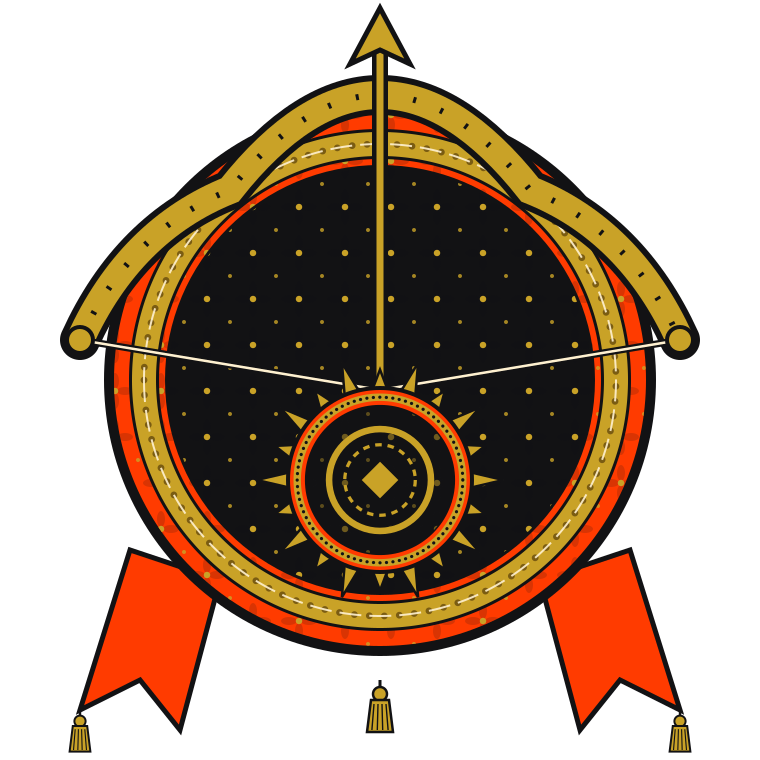
- Emblem: the placeholder is the Atlas's drawn bow. No documented seal, coin, banner or war cry was found.
- Official status: the list dated 09-07-2024 is quoted; the ministry list itself was not read in this run.
- Contradiction: the descendants list gives Dhanuhar (ST-526) as a separate descendant line (basis disputed), but the lead, the info table and the clans list give Dhanuhar as another name for the Dhanwar (Russell 1916[4]; Chhattisgarh ST list[1]). Settle which before publishing.
24Astitva
अस्तित्व · being, existence: everything by which the clan is known
The sources record a bow with its arrow and string, and sept totems. No seal, coin, plate, title or war cry is recorded for the Dhanwar[4].
Every clan has every accessory, royal objects included. Each one says how it is known: Documented This clan's own object is recorded. · Regional tradition Recorded for the region or for peoples like this one, not for this clan. · Design Made for this project, with no historical claim. · Under research To be found for this clan from sources. Legends and titles are written in the clan's own script.
1. Seals and coins
| Accessory | For this clan | Basis |
|---|---|---|
| B1 Rajamudra · house seal Round seal with the clan emblem and a short legend in the clan's script | Not yet designed for this clan | Design |
| B2 Anguliya-mudra · signet ring Personal seal ring of the head of the house | Not yet designed for this clan | Design |
| B3 Chhapa · house stamp Ink or block stamp for letters, goods and cloth | Not yet designed for this clan | Design |
| B4 Tamrapatra · charter plate Copper-plate grant on a ring, closed with the house seal | Not yet designed for this clan | Design |
| B5 Shreni-mudra · guild or trade seal Seal for the clan's trade, craft or caravan | Not yet designed for this clan | Design |
| C1 Clan coin Emblem or deity on one side, a legend in the clan's script | Not yet designed for this clan | Design |
| C2 Coin die The die that strikes the coin | Not yet designed for this clan | Design |
2. Living symbols
| Accessory | For this clan | Basis |
|---|---|---|
| I1 Totem trio The tree, bird and animal the clan protects | Sept totems: a black cow (Kari Sonwani), the sun (Surajgoti), a lamp over a deer's head (Telasi) Septs named after plants and animals do not kill the namesake; other septs refuse bison; the 1916 account gives the reason that Sita, in exile, revered a bison legend[4] | Documented |
| I2 Kaval-maram · guardian tree The tree that stands at the clan's seat | Not yet found for this clan | Under research |
3. Stone and gate
| Accessory | For this clan | Basis |
|---|---|---|
| G1 Torana · gateway The built gate of the seat; the cloth Toran hangs in it | Not yet designed for this clan | Regional tradition |
| G2 Viragallu · hero stone Carved panel stone for a member who died defending the clan | Not yet designed for this clan | Regional tradition |
| G3 Kula-shila · clan stones Standing and table stones that remember the ancestors | Not yet designed for this clan | Design |
| G4 Jayastambha · victory pillar A pillar raised for a victory | Not yet designed for this clan | Design |
| G5 Sima-shila · boundary stone Marks the clan's land, with a line in the native script | Not yet designed for this clan | Design |
4. Sounds
| Accessory | For this clan | Basis |
|---|---|---|
| D1 Pancha-mahashabda · five great sounds The right to five instruments | Not yet designed for this clan | Design |
| D2 Shankha · clan conch The clan's own named war conch | Not yet designed for this clan | Design |
| D3 Murasu · house drums Three drums: war, charity and justice | Not yet designed for this clan | Design |
5. Kit: colours, metals and emblems
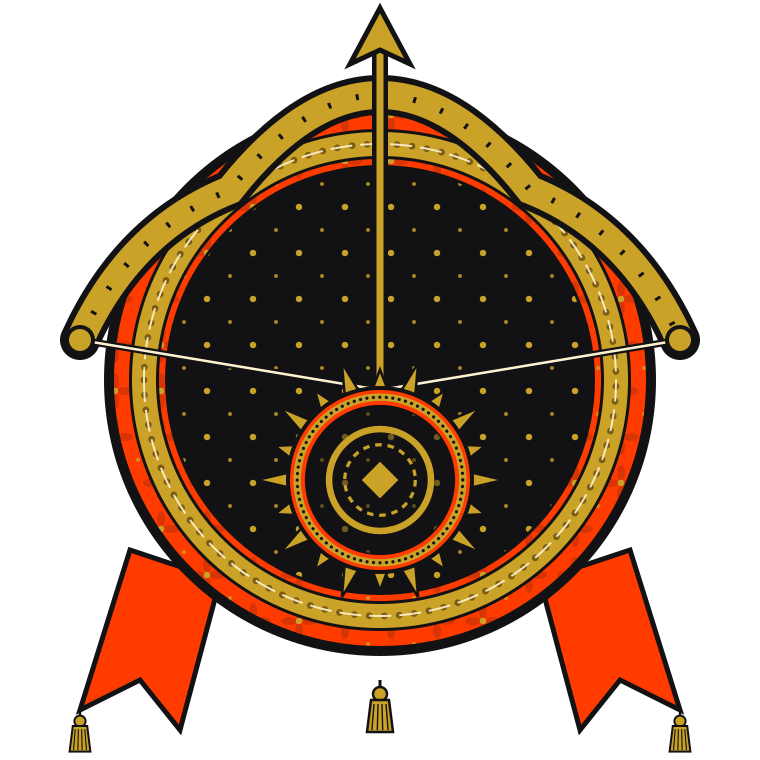
The bow is the one object the extracts record for this people: each household's bow is worshipped at festivals, and the bridegroom carries an arrow[4]. The emblem is the Atlas's drawn bow, a placeholder and not a documented seal.
| Part of the kit | This clan |
|---|---|
| Field | Charcoal Black #121214 |
| Accent | Deep Crimson Red #FF3B00 |
| Emblem colour | Metallic Gold #C9A227 |
| Zari metal | Gold |
| Main emblem | A drawn bow |
| Second image | — |
| Night and day | Every visual accessory has two versions: by night the emblem on the dark field, by day the clan's field colour on cloth woven from its metal. |
6. Flags
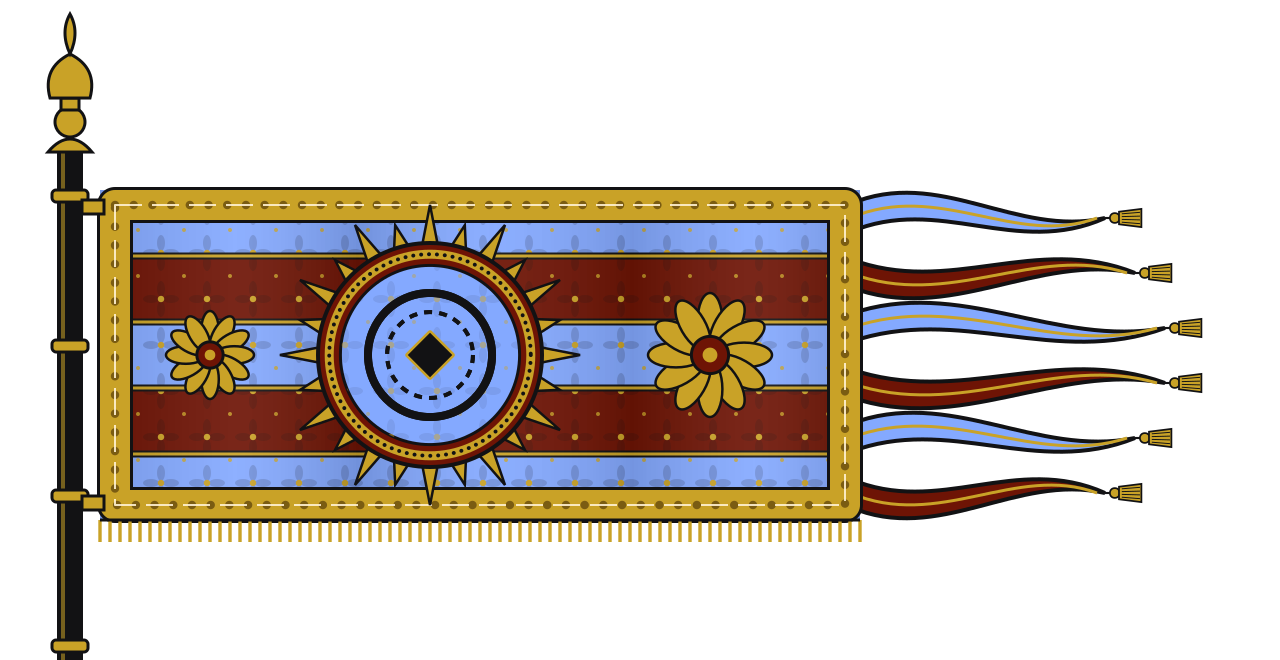
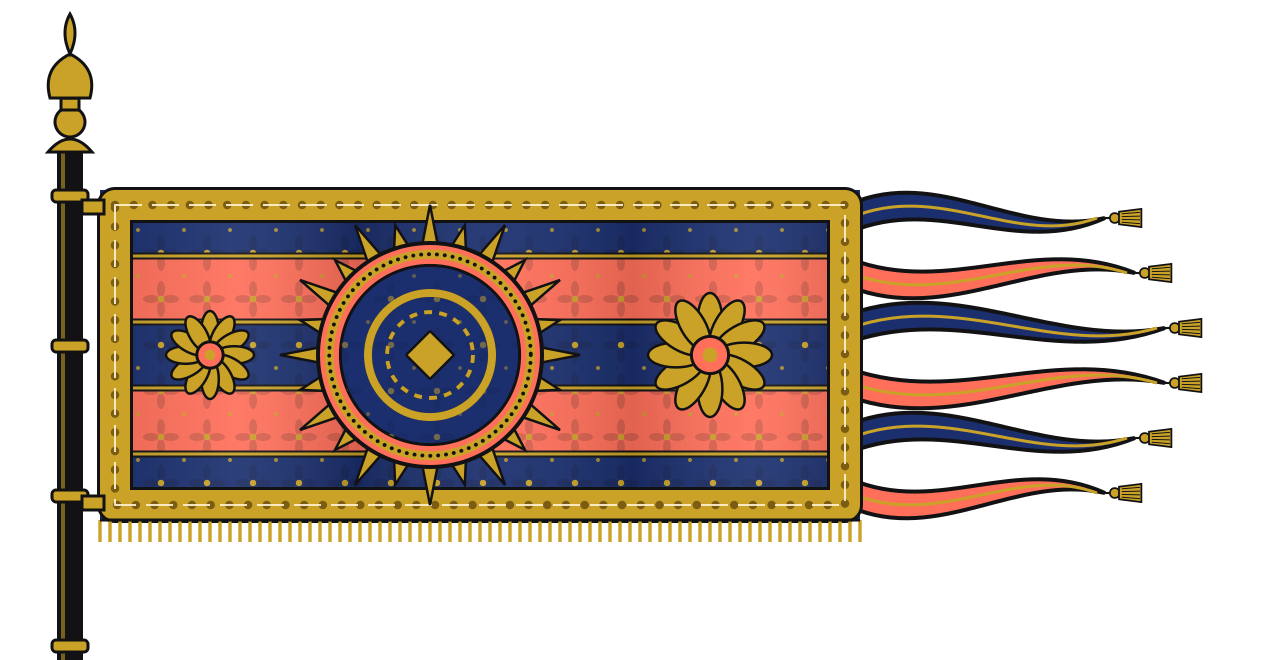
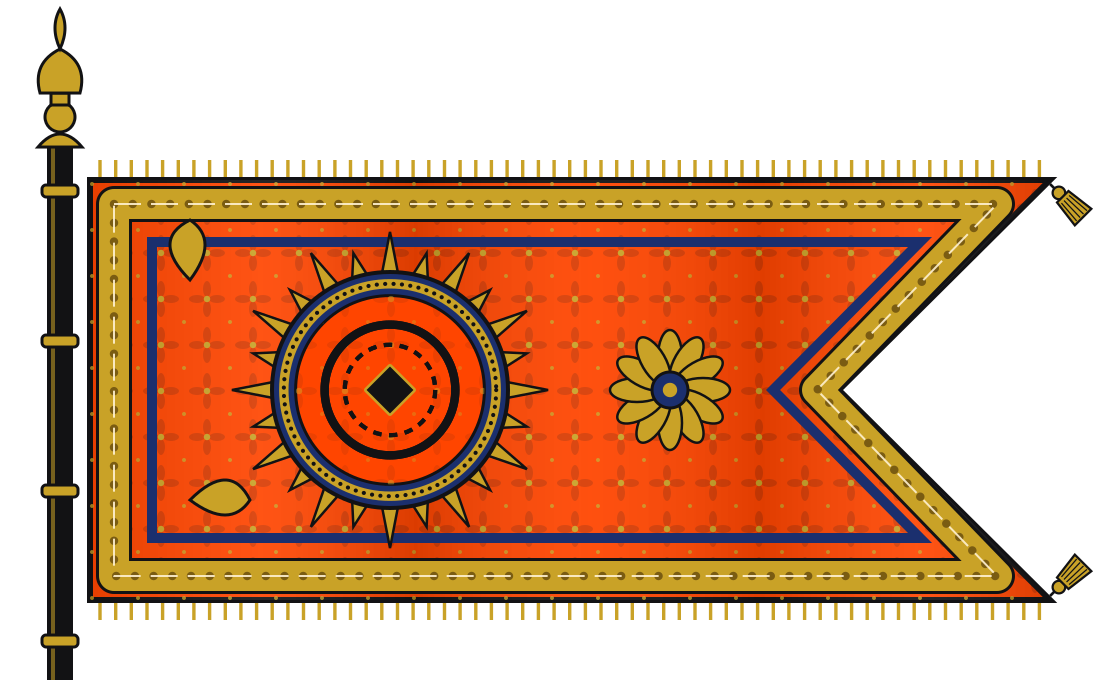
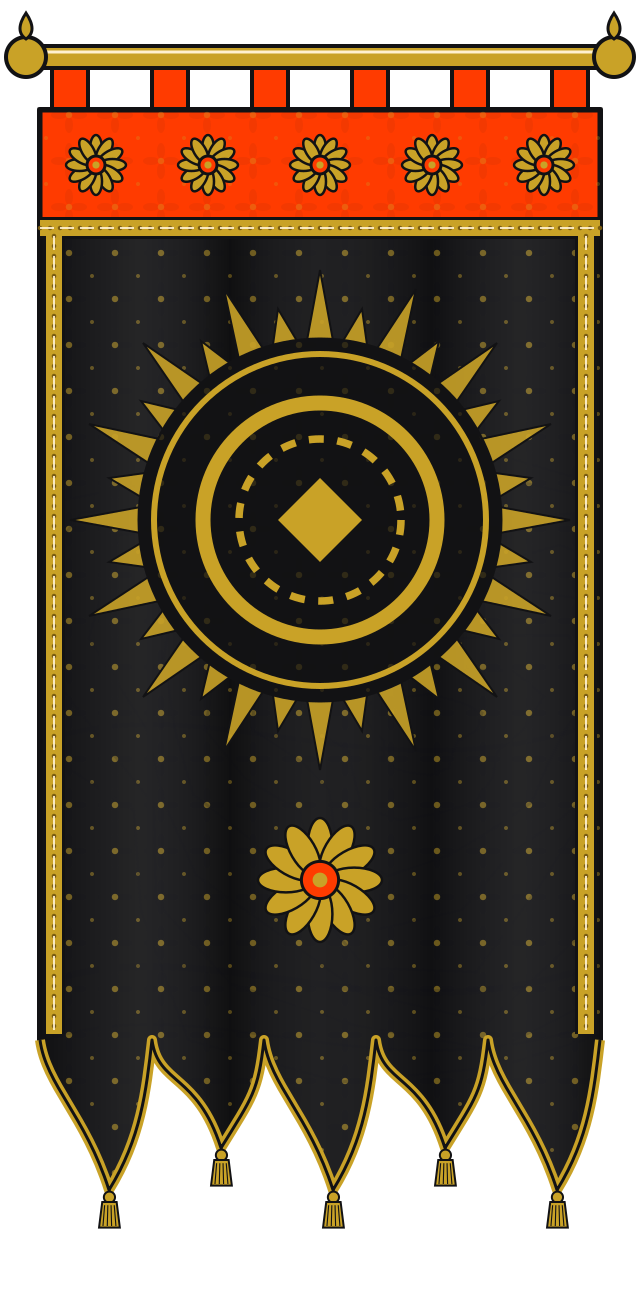
Every clan has every flag type; the type says the occasion and the colours say the clan. The outlined card is the flag the Atlas assigns.
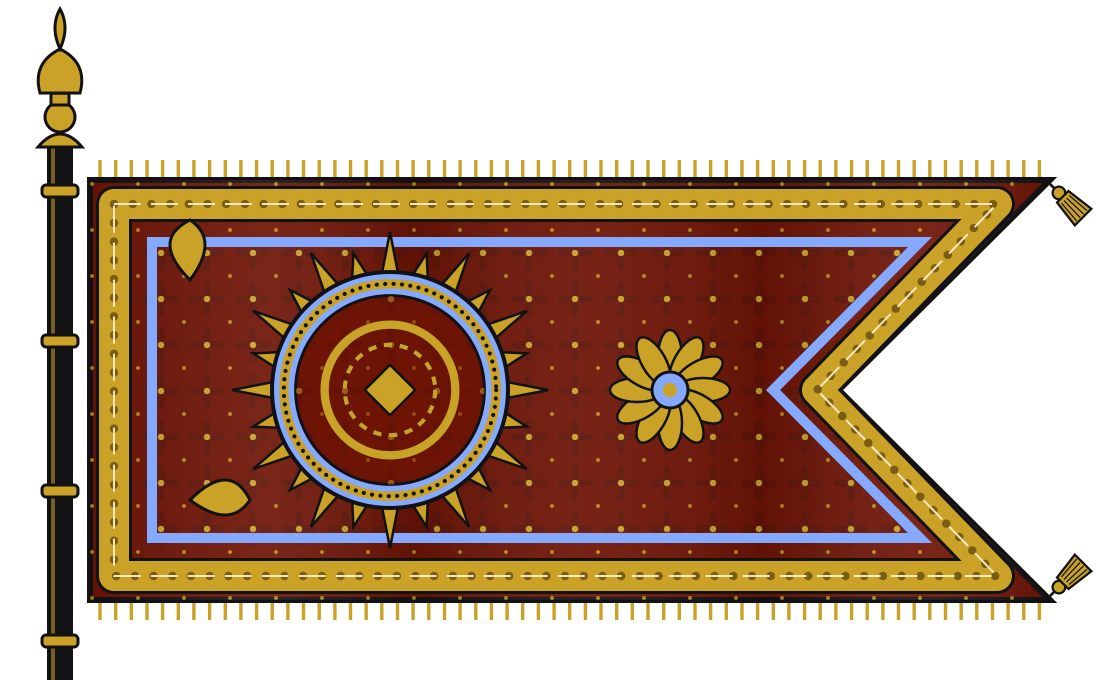
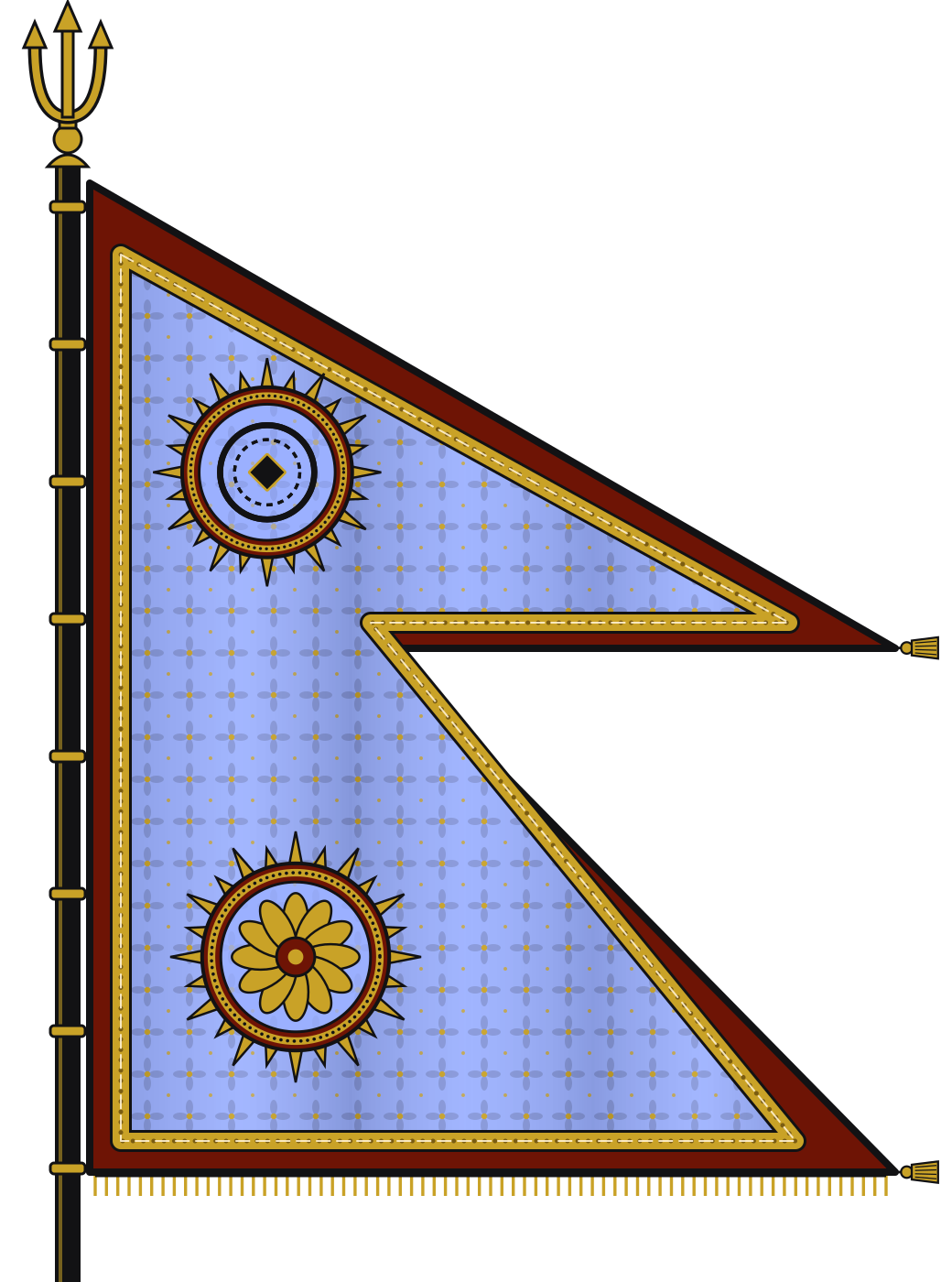
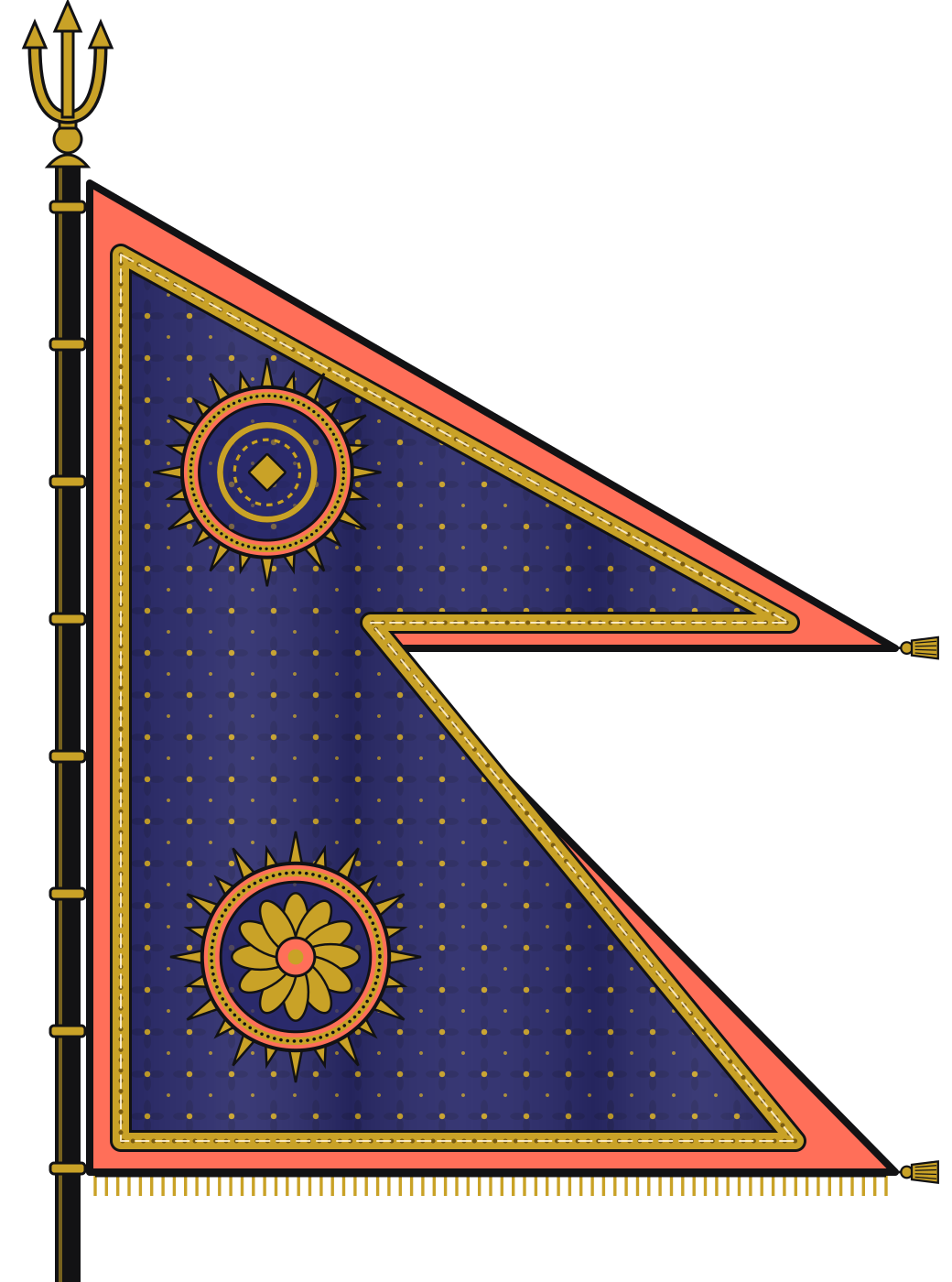
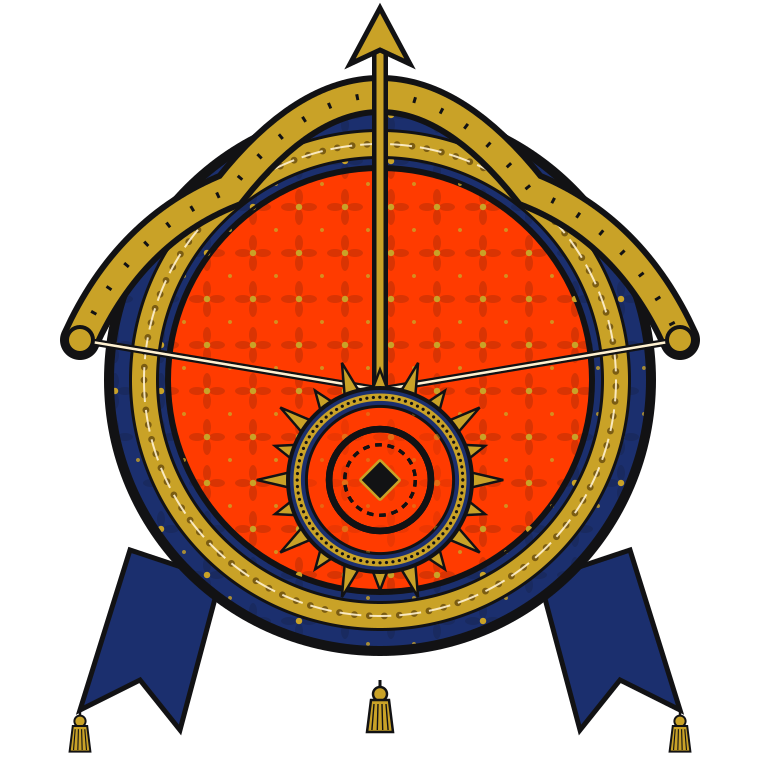
Historic banner
None known
New flag types
| Accessory | For this clan | Basis |
|---|---|---|
| A9 Pota-dhvaja · ship and trade flag For ships, caravans and markets | Not yet designed for this clan | Design |
| A10 Utsava-patāka · festival flag Light, bright flag for fairs and festivals | Not yet designed for this clan | Design |
| A11 Shoka-dhvaja · mourning flag White cloth with the emblem outline in the clan's metal | Not yet designed for this clan | Design |
7. Regalia
| Accessory | For this clan | Basis |
|---|---|---|
| E1 Chhatra · house parasol The ceremonial umbrella | Not yet designed for this clan | Design |
| E2 Chamara · fly-whisks The pair of whisks beside the head of the house | Not yet designed for this clan | Design |
| E3 Danda · staff of office Staff or scepter | Not yet designed for this clan | Design |
| E4 Simhasana · seat The seat of the house, covered in clan cloth | Not yet designed for this clan | Design |
| E5 Khetaka · shield A round shield; the Changi and Dhanush are its flag forms | Not yet designed for this clan | Regional tradition |
| E6 Kula-ayudha · clan weapon The weapon the clan honours | Bow and arrow: a cleft-bamboo bow; an arrow of dhaman wood with an iron tip (phani), feathers of vulture or peacock, and a tasar silk string Each household's bow is worshipped at every festival; boys learn the bow at five; the bridegroom carries an arrow in place of a dagger[4] | Documented |
8. Worn
| Accessory | For this clan | Basis |
|---|---|---|
| F1 Kula-vastra · clan cloth The clan's woven pattern in its kit colours | Not yet designed for this clan | Design |
| F2 Kirti-vastra · honour cloth A cloth earned for a deed, not inherited | Not yet designed for this clan | Design |
| F3 Kula-mala · garland flower The flower or leaf the clan wears as a garland | Not yet found for this clan | Under research |
| F4 Chinha · house pin A metal badge with the pin emblem | Not yet designed for this clan | Design |
9. Records
| Accessory | For this clan | Basis |
|---|---|---|
| H1 Clan words A traditional line in the native script | धनवार · “Dhanwar (also Dhanuhar): the name of the people; Russell 1916 gives Dhanuhar as 'bowman'” No traditional line in native script is in the extracts, so the people's own name is shown instead. Russell 1916 gives Dhanuhar as "bowman", and Jeorakhan Lal's account derives it from "Dhanusdhar", holder of a bow[4]. | Design |
| H2 Biruda · titles The house's title or titles | Not yet found for this clan | Under research |
| H3 Prashasti · praise genealogy The lineage as written at the head of a grant | Not yet found for this clan | Under research |
| H4 Vahi · clan register The book of the clan's births, marriages and deaths | Not yet found for this clan | Under research |
| H5 Rana-ghosha · war cry The clan's cry in battle or celebration | Not yet found for this clan | Under research |
10. VishwaVit · knower of the world
Game values are design choices for this project, not historical claims.
References
- Drishti IAS, 12 Caste Communities of Chhattisgarh Included in Scheduled Tribes, 15 Sep 2022, read 2026-10-19, drishtiias.com
- Wikipedia, Tribals in Madhya Pradesh, read 2026-10-19, https://en.wikipedia.org/wiki/Tribals_in_Madhya_Pradesh
- dhammabharat.com, List of Scheduled Tribes in Maharashtra and Population of each Tribe (2011 Census), read 2026-10-10, https://dhammabharat.com/?p=13656
- R. V. Russell and Hira Lal, The Tribes and Castes of the Central Provinces of India, vol. 2 (London, 1916), Project Gutenberg eBook #22010, https://www.gutenberg.org/ebooks/22010
- Joshua Project, Dhanwar in India (people group 16708), read 2026-11-07, https://joshuaproject.net/index.php/people_groups/16708/IN
- Indianetzone, Dhanwar Tribe, read 2026-11-07, https://www.indianetzone.com/dhanwartribe
- Wikipedia, Dhanwar language (disambiguation), read 2026-11-07, https://en.wikipedia.org/wiki/Dhanwar_language
- GK Today, Hindi, Dhanwar tribe (Madhya Pradesh), read 2026-10-30, GK Today (Hindi) page on the Dhanwar
- Monish Mishra, The Dhanwar tribe, preservers of central India, blog, April 2026, read 2026-10-30, https://inz-monishmishra.blogspot.com/2026/04/the-dhanwar-tribe-preservers-of-central.html