The Chudasamas were a dynasty that ruled parts of Saurashtra from Vamanasthali (Vanthali) and, from the time of Navaghana, Junagadh; the Dynasty page gives a traditional founding in the late 9th century, and the first ruler attested in inscriptions is Mandalika I (1294–1306)[1][2]. The dynasty ended in 1472, when Mandalika III was defeated by Sultan Mahmud Begada, who annexed the state[1][3]. The clan survives as a Rajput clan in Gujarat, and its Sarvaiya branch claims descent from Bhim, a son of a Chudasama king[4][5]. Early dates and rulers' reigns differ between sources, and the bardic legends are treated as unreliable, so each date below is attributed to its source[1][6].
01Faith and deities
The Atlas's KulDevi field is empty for this clan, so no KulDevi is given as sheet data. A Wikipedia extract names Khodiyar as the kuldevi of the Chudasamas and Gohils, a folk attribution still to be checked[7]. The extracts name Sadashiva as an ancestor in Ranchhodji's chronology, which is not a chief deity[2].
No KulDevi has been found for this clan yet; it is on the research list.
| Deity or tradition | Place in the clan's life | Evidence |
|---|---|---|
| Sadashiva | Named as an ancestor of the dynasty in Ranchhodji Amarji's Tarikh-i-Sorath (1825) | [2] |
| Khodiyar | Named in a Wikipedia extract as the kuldevi of the Chudasamas and Gohils; the extract says Ra Navghan was born by her grace (folk account, not the sheet's KulDevi) | [7] |
| Ashapura Mata | Shrine at Junagadh; Chudasama is listed among the communities who honour her | [8] |
| Neminatha (temple on Girnar) | Temple of Neminath at Girnar, built VS 1185; carries the Ra Khengar Mahal inscription | [9][2] |
02Temples
Each building is listed as its source attributes it. Builders and dates are not reconciled where sources differ.
Built by the clan
| Temple | Deity | Built by | When | Where |
|---|---|---|---|---|
| Navghan Kuvo | Not stated | Navaghana (attributed) | Late 11th century (Dynasty page); 1306–1308 (Ranchhodji) | Junagadh[1][2] |
| Adi Kadi Vav | Not stated | Navaghana (attributed) | Late 11th century (Dynasty page); 1306–1308 (Ranchhodji) | Junagadh[1][2] |
| Sodhali Vav (stepwell) | Not stated | Not named in the extract | Inscription of VS 1202 (Shri Simha Samvat 52) (Parikh, 1938) | Mangarol[9] |
| Temple at Prabhas, Veraval | Not stated | Mahipala (reported; which Mahipala is not stated) | Not dated | Prabhas Veraval[2] |
Given patronage or grants by the clan
| Temple | Deity | What the clan gave | When | Where |
|---|---|---|---|---|
| Neminatha temple, Girnar | Neminatha | Carries the Ra Khengar Mahal inscription (Diskalkar No. 77) | Built VS 1185 (builder not named in the extract) | Girnar[9][2] |
| Somnath, Prabhas Patan | Not stated | Repair by Khengar IV (reported by Ranchhodji) | Not dated | Prabhas Veraval[2] |
| Ra Khengar Vav, Junagadh | Not stated | Bears Khengara's name; built by Tejapala, a Vaghela minister, per the Dynasty page | Not dated | Junagadh[1] |
Later temples in the clan's lands
| Temple | Deity | Built | Where | |
|---|---|---|---|---|
| Ranakdevi's shrine and memorial stone, Wadhwan | Memorial (paliya) to the queen | Built under Dharanivaraha of the Chhapa dynasty, probably; the page dates it to the last quarter of the 9th century, before her 12th-century lifetime | Last quarter of the 9th century (page's own dating) | Wadhwan, south bank of the Bhogavo river[6] |
03Languages and scripts
| Language or script | Kind | Under the clan | Evidence |
|---|---|---|---|
| Persian | Chronicle language | Ranchhodji Amarji's Tarikh-i-Sorath (1825) | [2] |
| Sanskrit | Literary language | Mandalika Kavya by Gangadhara (limited historical accuracy) | [2] |
| Apabhramsa | Verse language | Verses in the Khengara story; eleven in one chronicle and eight in another; attributed to Sonaladevi on the Ranakadevi page | [9][6] |
| Gujarati living | Regional language | Burgess used Gujarati translations of the Persian manuscripts; the clan's own spoken language is not in the extracts | [2] |
04Books and literature
The early history is almost lost and the bardic lists are unreliable (Dynasty page). Later accounts draw on inscriptions, the Persian chronicle Tarikh-i-Sorath (1825), and 19th- and 20th-century histories and gazetteers, listed under Thinkers.
Written during the clan's history
| Work | Author | Kind | When | Link to the clan |
|---|---|---|---|---|
| Mandalika Kavya | Gangadhara | Sanskrit poem about Mandalika | Not dated in the extract | [2] |
| Prabandha-chintamani | Merutunga | Chronicle; gives the Khengara story and Navaghana as 'Abhira Ranaka' | Not dated in the extract | [9] |
| Puratana-prabandha-sangraha | Not named in the extract | Chronicle; names the officer Udayana as Khengara's killer and gives Apabhramsa verses | Not dated in the extract | [9] |
| Vividha Tirtha Kalpa | Jinaprabha | Chronicle; dates the Neminatha temple at Girnar to VS 1185 and mentions Khengara's death | Not dated in the extract | [9] |
Given patronage by the clan
Not recorded.
05Thinkers and scholars
| Name | Field | Era | Contribution |
|---|---|---|---|
| Ranchhodji Amarji | Chronicler; Diwan of Junagadh | 1825 | Tarikh-i-Sorath, and the chronology table in the Chronology page[2] |
| James Burgess | Antiquarian | 1876 | Report on the Antiquities of Kathiawad and Kachh; criticised Tod's count of Chudachandra[2] |
| James W. Watson | Gazetteer | 1884 | Gazetteer of the Bombay Presidency, vol. 8 (Kathiawar); worked on genealogy and chronology[2][9] |
| A. K. Forbes | Ras Mala | Not dated in the extract | Forbes's Ras Mala, which holds many ballad verses on Khengara and Ranakadevi[6] |
| Gaurishankar Oza | Genealogy and chronology | Not dated in the extract | Worked on the dynasty's genealogy and chronology[2] |
| Wilberforce-Bell | History | 1916 | The History of Kathiawad from the Earliest Times[2] |
| Rasiklal Parikh and Hariprasad Shastri | Gujarati history | 1977 | ગુજરાતનો રાજકીય અને સાંસ્કૃતિક ઇતિહાસ: સલ્તનત કાલ, given as a Gujarati source title on the Dynasty page[1] |
These later histories were written after the dynasty fell and are not works of its own time.
06Art and architecture
The extracts describe the stepwells and temples under Faith, and no painting, sculpture, textile, clothing or craft.
Painting and wall art
Not recorded.
Sculpture and temple art
Not recorded.
Temple and building architecture
Not recorded.
Weaving and textiles
Not recorded.
Clothing and jewellery
Not recorded.
Coins, pottery and crafts
Not recorded.
07History
Traditional founding (late 9th century)
The Dynasty page gives a traditional founding by Chudachandra in the late 9th century, and its early history is almost lost; bardic lists are unreliable[1].
The Chronology page says the dynasty ruled roughly VS 900 to VS 1527 (about 875–1472 CE), and names the founder Chudachandra (Chuda of the Samma) in the Dhandusar inscription of VS 1445[2].
Early kings (10th–12th century; dates conflict)
Graharipu (c. 10th century) occupied Uparkot Fort. Navaghana is dated late 11th century by the Dynasty page[1], and 1306–1308 in Ranchhodji Amarji's table, which the Chronology page gives with a note that its sources conflict[2]. Both dates are kept here; neither is preferred.
Under Navaghana the capital moved to Junagadh, Uparkot was reportedly rebuilt, and the Soomra were defeated[1][2]. The Chronology page says he regained Junagadh and conquered Sindh, per Ranchhodji[2].
Khengara is early 12th century on the Dynasty page[1] and 1331–1351 in Ranchhodji's table[2]. The Khengara page gives Watson's 1884 dates of 1098–1125 and says the dates are not reliable[9].
Bardic account of Noghan (Indian Antiquary, 1873)
The Indian Antiquary account, which is a bardic story, says Ra Noghan ascended the Junagadh throne in Samvat 874 and reigned until his death in Samvat 916. The era is not named in that account[10].
In the same account a thanadar takes Devait Bodar to Alidar Bodidhar; Devait's son Uga is put to death, which saves Noghan, and Noghan is later proclaimed king after a wedding ruse[10]. Noghan's four sons are named as Bhim, Sodo, Kuvat and Khengar, the youngest, who succeeded[10].
Khengara and Ranakadevi
Bardic tales say Khengara was killed in battle, but the sources disagree on the killer: the Vividha Tirtha Kalpa names Jayasimha, the Puratana-prabandha-sangraha names an officer Udayana, and the Prabhavaka-charitra names Jayasimha[9]. The Khengara page finds no direct evidence of the year of his defeat[9].
The Ranakadevi page calls the bardic legend of her and the war with Jayasimha Siddharaja 'not credible', and places her at the palace on Girnar hill fort[6]. Ranchhodji gives her death as VS 952 (895 CE)[2]. The Chronology page records a Ranik Devi story as a tale[2].
The Dynasty page says the Chaulukya kings Mularaja and Jayasimha Siddharaja fought the early Chudasama rulers, a conflict recorded in Jain chronicles[1]. The Khengara page gives Jayasimha's dates as c. 1092–c. 1142 (Shastri and Parikh, 1977)[9].
Mandalika I to III (1294–1472)
Mandalika I (1294–1306) is the first Chudasama attested in inscriptions, and the Khalji dynasty of Delhi invaded Gujarat during his reign[1]. The Vanthali inscription of VS 1346 names King Mandalika, whose kingdom Jagatsimha, a Chaulukya feudatory under Viradhavala (c. VS 1288), had seized; Mandalika later regained Vanthali as Chaulukya rule weakened[2].
The Chudasamas then ruled independently or as vassals of the Delhi and Gujarat Sultanates[1]. Ranchhodji's table gives Mandalika III as 1451–1472 (VS 1507)[2].
The end (1472)
Junagadh was conquered by Mahmud Begada in VS 1527 (1472 CE), and the state was annexed[1][3]. The Chronology page notes that sources differ on Mandalika's capture, 1470 or 1472[2].
The Dynasty page says Mandalika III was forcibly converted to Islam. Ranchhodji says he was captured by Kiwamu-al-Mlik, amir of Sultan Mahmud, and embraced Islam, and that his son was restored as jagirdar with the title Raizada[2]. Ranchhodji also says he died in Ahmedabad and was buried in Manek Chowk[2].
08Journey and migrations
The sources give different accounts of the family's origin and moves. Each move is attributed to its source and not reconciled.
| When | From | To | Why | Evidence |
|---|---|---|---|---|
| 7th–8th century (probably) | Not stated | India | Yaduvanshi origin, per the Anthropological Survey of India citing Chaube 1975 | [4] |
| Undated | Sindh or northern Rajasthan | Vamanasthali (Vanthali) | Founder Chudachandra's migration, per bardic legends and Jain texts (a 2025 blog, weak) | [11] |
| Dated in a 17th-century record | Sindh | Saurashtra | Migration from Sindh recorded in Nainsi ri Khyat (17th century) | [1] |
| Late 11th century (Dynasty page) or 1306–1308 (Ranchhodji) | Vamanasthali (Vanthali) | Junagadh | Navaghana moved the capital | [1][2] |
| Khengara's reign (Ranchhodji: 1331–1351) | Junagadh | Girnar | Khengar took refuge on Girnar after Junagadh was taken by Sams Khan under Tughluq orders (Ranchhodji) | [2] |
| 1472 (VS 1527) | Junagadh | Ahmedabad | Mandalika III reportedly died there after capture; the Dynasty page gives the conquest in 1472 | [2][1] |
09Seats and lands
| Place | Role | Where today |
|---|---|---|
| Vamanasthali (Vanthali) | Capital until Navaghana moved it to Junagadh | Saurashtra (Atlas homeland) |
| Junagadh | Capital from Navaghana (Dynasty page); Navghan Kuvo, Adi Kadi Vav and Ra Khengar Vav are in the city | Junagadh, Saurashtra |
| Uparkot Fort | Occupied under Graharipu; reportedly rebuilt by Navaghana | Junagadh |
| Girnar | Hill fort with a palace where Ranakadevi lived (Ranakadevi page); Khengar took refuge there (Ranchhodji) | Girnar hill |
| Wadhwan (Vardhamanapura) | Site of Ranakadevi's sati in the legend and of her memorial shrine | Wadhwan |
| Anahilavada (Patan) | Chaulukya capital; Khengara attacked it (Ranakadevi page) | Patan |
| Prabhas Veraval (Somnath) | Somnath repaired by Khengar IV (reported); a temple reportedly built by Mahipala | Prabhas Veraval |
| Diu and 17 other islands | Conquered by Khengar IV (Ranchhodji) | Diu |
| Sindh | Home of the Samma chief named as the founder's father; Navaghana conquered it (Ranchhodji) | Sindh |
| Mangarol | Sodhali Vav stepwell, with an inscription of VS 1202 | Mangarol |
| Dhandusar | Site of the VS 1445 inscription naming the founder (Diskalkar No. 48) | Not located in the extracts |
| Ahmedabad | Where Mandalika III reportedly died and was buried in Manek Chowk (Ranchhodji) | Ahmedabad |
| Alidhar | Seat of Devait Bodar (Chronology page); the rescue of Navghan there is a bardic tale | Not located in the extracts |
| Revatikunda, Umeta, Bagasara, Okha | Named in Ranchhodji's chronology; their roles are not given | Not located in the extracts |
| Kachchh, Junagadh and Jamnagar districts | Where Chudasama Rajputs are found today (ASI, citing Gujarat 2003) | Gujarat |
10Notable figures
| Name | Role | Era | Known from |
|---|---|---|---|
| Chudachandra (Ra Chuda) | Traditional founder; father a Samma chief of Sindh (Dynasty page) | Late 9th century (traditional); named in VS 1445 inscription | [1][2] |
| Wala Ram | Named as the last chief of Vamanasthali (Dynasty page) | c. 875 | [1] |
| Graharipu | Early ruler under whom Uparkot was occupied; a 2025 blog says he resisted Mahmud of Ghazni (weak) | c. 10th century (Dynasty page) | [1][11] |
| Navaghana | Moved the capital to Junagadh; the Navghan Kuvo and Adi Kadi Vav are attributed to him; defeated the Soomra | Late 11th century (Dynasty page); 1306–1308 (Ranchhodji) | [1][2] |
| Khengara (Khengar) | Ruler at Uparkot, Junagadh; contemporary of Jayasimha Siddharaja; the Ra Khengar Mahal inscription is on the Neminatha temple at Girnar | Early 12th century (Dynasty page); 1331–1351 (Ranchhodji); 1098–1125 (Watson, 1884) | [9][1][2] |
| Khengar IV | Repaired Somnath; conquered Diu and 17 other islands (Ranchhodji) | Not dated | [2] |
| Mahipala | Reportedly built a temple at Prabhas, Veraval; Ranchhodji's table has three Mahipalas and does not say which | 1308–1331; 1378–1384; 1430–1451 (Ranchhodji's table) | [2] |
| Mandalika I | First ruler attested in inscriptions; the Khalji invasion of Gujarat fell in his reign | 1294–1306 | [1] |
| Mandalika III | Last king; defeated in 1472 by Mahmud Begada, who annexed the state | 1451–1472 | [1][3] |
| Ranakadevi રાણકદેવી legend | Khengara's queen; the bardic legend of her and the war with Jayasimha Siddharaja is 'not credible' (page) | 12th century (Ranakadevi page); VS 952 (Ranchhodji) | [6][2] |
| Bhim | Second son of Rao Naundhan; received the Chorasi of Sarva; ancestor of the Sarvaiya | Not dated | [5][4] |
| Jasal legend | Devait's daughter, carried off by Hamir Sumro of Sindh during a famine and rescued by Noghan (Indian Antiquary, bardic account) | Samvat 875 | [10] |
11Allies, rivals and marriages
| People | Relationship | When |
|---|---|---|
| Samma (chief of Sindh) | Father of the founder Chudachandra (Dynasty page); parent people (Rajput page) | Founder's time (traditional) |
| Chavda dynasty | Preceded the Chudasamas | Before the Chudasamas (not dated) |
| Chaulukya (Solanki) kings | Constant conflict: Mularaja and Jayasimha Siddharaja; Jagatsimha, a feudatory under Viradhavala, seized Mandalika's kingdom (c. VS 1288) | Jayasimha c. 1092–c. 1142 (Khengara page) |
| Vaghela dynasty | Succeeded the Chudasamas; minister Tejapala is credited with the Ra Khengar Vav (Dynasty page) | After the Chaulukya and Vaghela rule (not dated) |
| Delhi and Gujarat Sultanates | The Chudasamas ruled independently or as their vassals; Mandalika I's reign saw the Khalji invasion | Mandalika I's reign (1294–1306) |
| Soomra | Defeated by Navaghana (Chronology page) | Navaghana's reign (dates in Navaghana's entry) |
| Ahirs (Abhiras) | Aided Navghan; in the Sorath famine they went to Sindh for food and joined the attack on the thanadar's men (Indian Antiquary); Merutunga calls Navaghana 'Abhira Ranaka' | Navaghana's reign (dates in Navaghana's entry) |
| Kathis | Fought battles under Mahipal III and Khengar III | Mahipal III: 1430–1451 (Ranchhodji) |
| Rathod | Took Vanthali (Chronology page) | Not dated |
| Jhala | Jhala Krishnaji is named among the figures in Ranchhodji's chronology (role not given) | Not dated |
| Devait Bodar of Alidhar legend | Said to have saved Navghan as a child (Chronology page); the Indian Antiquary account has his son Uga put to death, which saved Noghan | Not dated (Chronology); the Indian Antiquary account gives no date for Devait |
| Hamir Sumro of Sindh legend | Carried off Jasal, Devait's daughter, during the famine, in a bardic account (Indian Antiquary) | Samvat 875 |
| Sultan Mahmud Begda | Annexed the state in 1472; Sarvaiya Vejoji fought his troops from Vejalkot (Sarvaiya page) | 1472 |
| Kiwamu-al-Mlik | Amir of Sultan Mahmud who captured Mandalika III (Ranchhodji) | Mandalika III's capture (1470 or 1472) |
| Malek | Brother of Mandalika, son of a slave-girl (Ranchhodji) | Not dated |
12Society and livelihood
The extracts describe the dynasty's rule and its later jagir system, not the present-day society of the clan.
Government and social order
| Institution or group | What it was | Evidence |
|---|---|---|
| Jagirdars | Tributary land-holders under the Gujarat Sultans; real power lay with thanadars sent from Ahmedabad (Ranchhodji) | [2] |
| Thanadars | Sultanate officers from Ahmedabad who held the real power in Junagadh (Ranchhodji) | [2] |
| Sarvaiya jagirs | Vasavad, Bhadli, Chital and Bhakhalka, held by Sarvaiya jagirdars until jagirdari was abolished at Independence | [5] |
| United State of Kathiawar | Jesar, Hathsani and Datha, ruled by Sarvaiya Rajputs at Independence, merged into it | [5] |
Livelihood over time
| Era | Livelihood | Evidence |
|---|---|---|
| Under the Gujarat Sultans | Jagir land-holding paying tribute (jagirdars) | [2] |
| British Raj | Sarvaiya Rajputs as talukdars of many places | [4] |
| At Independence | Sarvaiya jagirdars lost their jagirs when jagirdari was abolished | [5] |
13Sub-clans and related clans
Sub-clans, branches, parent peoples and related groups named in the extracts. Sizes are not given in the extracts. Descent is set out on both sides. The clan is claimed as Yaduvanshi (the Girnar inscriptions of c. VS 1510 call the dynasty Yadava) and as Chandravanshi (Ranchhodji)[4][1][2]. It is also described as an offshoot of the Samma of Sindh[4], with the Dynasty page saying only that it is possibly of Samma origin[1]. None of these is settled here.
| Clan | Relation | Where | Size | In the Atlas | Evidence |
|---|---|---|---|---|---|
| Sarvaiya | Sub-clan | Mainly Gujarat; former jagirs at Vasavad, Bhadli, Chital and Bhakhalka; ruled estates at Jesar, Hathsani and Datha at Independence | new clan candidate | [5] | |
| Samma (Sindhi Samma) | Parent people | Sindh | SUB-078 | [4][1] | |
| Yaduvanshi (Yadava lineage) | Parent people | Claimed lineage, not a settled clan | new clan candidate | [4][2] | |
| Jadejas | Related people | Kutch (links noted on the Dynasty page) | SUB-169 | [1] | |
| Gohils | Related people | Gohil dynasty of Sihor; shares Khodiyar as kuldevi | new clan candidate | [7] | |
| Jarecha | Related people | Allied Yadu clan (Kothiyal, 2016) | new clan candidate | [4] | |
| Jhala | Related people | Named in Ranchhodji's chronology | new clan candidate | [2] | |
| Rathod (Rajput) | Related people | Took Vanthali (Chronology page); the sheet's Rathod entry (ST-486) is a Deccan group, so it is not linked here | new clan candidate | [2] | |
| Mer | Related people | Saurashtra, mainly Porbandar district; Chudasama is one of the Mer's 14 clans | SUB-332 | [12] | |
| Chavdas | Related people | Dynasty before the Chudasamas | SUB-171 | [1] | |
| Chaulukyas (Solankis) | Related people | Rivals and overlords; Anahilavada (Patan) | SUB-173 | [1][9] | |
| Vaghelas | Related people | Succeeded the Chudasamas | SUB-216 | [1] | |
| Soomra | Related people | Sindh | SUB-081 | [2] | |
| Kathis | Related people | Kathiawar | NE-023 | [2] | |
| Ahirs | Related people | Aided Navghan; Navaghana called 'Abhira Ranaka' (Merutunga) | ST-363 | [2][9] | |
| Abhiras | Related people | Associated with the dynasty (Dynasty page) | ANC-001 | [1] |
Clans marked "new clan candidate" are not in the Atlas yet.
14Surnames
Variant spellings of Sarvaiya in the sources: Sarvaiyya, Sarvia, Sarwia, Savaria, Sawaria, Sawariya[5]. Raizada is a title, not a surname, in the extracts.
| Surname | Clan or sub-clan | Where | People with this surname | Also used by other communities |
|---|---|---|---|---|
| Chudasama ચુડાસમા | Chudasamas (dynasty and clan) | Saurashtra (Atlas homeland); Kachchh, Junagadh and Jamnagar districts today[4] | not yet counted | Not checked |
| Sarvaiya | Sarvaiya (sub-clan) | Mainly Gujarat[5] | not yet counted | Not checked |
Counts are of everyone with the surname, from the cited source and year, not only members of this clan. A surname shared with other communities says nothing about any one person's origin.
15Songs and music
Ballad verses on Khengara and Ranakadevi are in Forbes's Ras Mala; the Ranakadevi page does not reproduce them[6]. Folk songs and oral traditions of Charans and Bhats celebrating the rulers are mentioned, with no titles[11] (weak source). No text is in the extracts, so no excerpt is given.
Ballad verses on Khengara and Ranakadevi (in Ras Mala) research
16Poems, lullabies and children's rhymes
Sorathas (couplets) are attributed to Ranakadevi in bardic accounts, though the page doubts their historical value[6]. The 1873 Indian Antiquary gives a duho praising Devait in English rendering only[10]. No native-script text is in the extracts.
None recorded yet.
17Stories, legends and proverbs
Stories and legends
| Story | What happens | Told by | Evidence |
|---|---|---|---|
| Ranakdevi રાણકદેવી legend | Versions: a potter's daughter of Majevadi near Junagadh, or a king's child raised by a potter. Desal and Visal are expelled, lead Jayasimha to Junagadh, and are executed when the Girnar gate is opened. Ranakadevi curses Jayasimha at Vardhamanapura and performs sati on Khengara's pyre | Bardic tradition; the chronicles Puratana-prabandha-sangraha and Prabandha-chintamani omit her[6] | |
| The Devait and Uga account legend | Devait Bodar's son Uga is put to death, which saves Noghan; a wedding ruse ends with the thanadar and his army killed | Bardic account, Indian Antiquary 1873[10] | |
| Khengara's four vows legend | Khengara vows to slay Harraj of Umeta, destroy Bhoira fort, break the gate of Anahilapataka, and split the cheeks of the Charan Mesan. The Khengara page calls the legend not credible | Bardic legend, per the Khengara page[9] | |
| Uga Wala research | Named in Wilberforce-Bell (1916) as a tale; its text is not in the extracts | Wilberforce-Bell, 1916[2] |
Proverbs and sayings
Not recorded.
18Festivals and fairs
Not recorded.
19Food, dress and games
Food
Not recorded.
Dress
Not recorded.
Games and martial arts
Not recorded.
Tags: living still practised · revived brought back after a break · lost known only from records · research reported but not yet confirmed from a source. Songs and poems under copyright are listed by title only; restricted or sacred material is noted without its content.
20Status today
The Chudasamas are described as a Rajput clan in Gujarat, which claims Yaduvanshi descent[4]. The dynasty itself ended in 1472[1].
Who carries the name today
Recognised heritage
| What | Recognition | Evidence |
|---|---|---|
| Ranakadevi's story in print and on screen | Gujarati novel Ranakdevi (1883); Amar Chitra Katha #452 (1977); Gujarati play Gadh Juno Girnar (1967); films of 1923, 1930, 1946 and 1973 | [6] |
| Stepwells and temples named in the sources | Navghan Kuvo, Adi Kadi Vav and Ra Khengar Vav are at Junagadh; Sodhali Vav is at Mangarol; the extracts give no heritage listing | [1][9] |
Not yet reviewed by the community.
21For children
The Kings of Junagadh
Long ago, in the land of Saurashtra, a Rajput family called the Chudasamas became kings. Their first capital was Vanthali, and later their kings moved the capital to Junagadh. A hill called Girnar had a fort on its top. The old stories say that a king named Khengara ruled here, and that his queen, Ranakadevi, lived in a palace on the hill fort. The stories were told by bards, and the dynasty's page says that the bardic lists are not always reliable. Today the Chudasama name is still found in Gujarat.
Written for this project
Riddle: I am a hill with a fort on my top, and a queen once lived in my palace. What am I? (Girnar)
22Across the project
| Project | What carries this clan | Status |
|---|---|---|
| Atlas of the Janas | Homeland: Vamanasthali (Vanthali) and Junagadh, Saurashtra | From the Atlas |
| KulDevi and GrahDevi | KulDevi under research: the sheet field is empty; Khodiyar is named as kuldevi in a Wikipedia extract. GrahDevi not in the sheet | Under research |
| Planet naming | Not in the Atlas or the extracts | — |
| Renaming and waters | Rivers named in the extracts: the Raval river at Girnar (Vejalkot) and the Bhogavo river at Wadhwan. No renaming is in the extracts | — |
23Open questions
- KulDevi: the Atlas field is empty. Khodiyar is named as kuldevi in the Wikipedia extract; a source for the sheet field is needed before any KulDevi claim is labelled as sheet data.
- Dates of Navaghana are unresolved: late 11th century (Dynasty page) against 1306–1308 (Ranchhodji's table). Both are kept, attributed.
- Dates of Khengara are unresolved: early 12th century (Dynasty page), 1331–1351 (Ranchhodji), 1098–1125 (Watson, 1884), and c. 1092–c. 1142 for Jayasimha (Khengara page).
- Start of the dynasty: traditional late 9th century (Dynasty page), VS 900 (Chronology page), and Samvat 874 for Ra Noghan (Indian Antiquary, era not named). Not reconciled.
- Mandalika's capture: 1470 or 1472, per the Dynasty page's note. Not settled.
- Whether Naundhan (Rajput and Sarvaiya pages, father of Bhim), Noghan (Indian Antiquary) and Navaghana (Dynasty page) are the same ruler is not established.
- Two Jasals: the Khodiyar extract dates a Jasal marriage to 1025 CE; the Indian Antiquary account has Jasal, Devait's daughter, in Samvat 875. Not reconciled.
- Which Mahipala built the Prabhas temple (three Mahipalas in Ranchhodji's table).
- Builder of the Sodhali Vav at Mangarol and of the Neminatha temple at Girnar (VS 1185).
- Descent: Yaduvanshi or Chandravanshi lineage against Samma origin. Both sides are set out in Clans; neither is settled.
- Coins: the Dynasty page names currency units (kodi, karshapan, dram, vishopak, rupak); the Khengara page says no coins were minted and coins appear only as tribute. Not documented as a clan coin.
- Clan words: no traditional line is in the extracts. A line is still to be found, from a native-script source.
- Rathod (Rajput) and the sheet's Rathod (ST-486) may be different peoples; not linked, pending a source.
- Pages not read: Legendary and early kings of Chudasama dynasty (Wikipedia); Statistical Account of Junagadh (Bombay Gazetteer); Burgess's Tarikh-i-Sorath translation; Forbes's Ras Mala (archive.org); jainqq Indian Antiquary vol. 12 p. 216; Raijada; Hathsani inscription; the PARI article on Kutch.
- Official status, population and community review are not in the extracts or the sheet.
- Coordinates for the Sarvaiya candidate are not in the extracts, so no pin is set in the draft.
- Ranakadevi's date: 12th century (Ranakadevi page,[6]) against VS 952 (895 CE) given by Ranchhodji ([2]). Not reconciled.
- Wadhwan shrine: dated to the last quarter of the 9th century by the Ranakadevi page ([6]), which also places her as a 12th-century queen. Not reconciled.
- Shastri and Parikh 1977 is given with two Gujarati titles: સલ્તનત કાલ on the Dynasty page ([1]) and સોલંકી કાલ on the Khengara page ([9]). Which is the printed title is not settled.
24Astitva
अस्तित्व · being, existence: everything by which the clan is known
Titles and inscriptions are documented for this clan. No coin, seal, plate, war cry, totem or flag is in the extracts. The Dynasty page names currency units, and the Khengara page says no coins were minted[1][9].
Every clan has every accessory, royal objects included. Each one says how it is known: Documented This clan's own object is recorded. · Regional tradition Recorded for the region or for peoples like this one, not for this clan. · Design Made for this project, with no historical claim. · Under research To be found for this clan from sources. Legends and titles are written in the clan's own script.
1. Seals and coins
| Accessory | For this clan | Basis |
|---|---|---|
| B1 Rajamudra · house seal Round seal with the clan emblem and a short legend in the clan's script | Not yet designed for this clan | Design |
| B2 Anguliya-mudra · signet ring Personal seal ring of the head of the house | Not yet designed for this clan | Design |
| B3 Chhapa · house stamp Ink or block stamp for letters, goods and cloth | Not yet designed for this clan | Design |
| B4 Tamrapatra · charter plate Copper-plate grant on a ring, closed with the house seal | Not yet designed for this clan | Design |
| B5 Shreni-mudra · guild or trade seal Seal for the clan's trade, craft or caravan | Not yet designed for this clan | Design |
| C1 Clan coin Emblem or deity on one side, a legend in the clan's script | Not yet designed for this clan | Design |
| C2 Coin die The die that strikes the coin | Not yet designed for this clan | Design |
2. Living symbols
| Accessory | For this clan | Basis |
|---|---|---|
| I1 Totem trio The tree, bird and animal the clan protects | Not yet found for this clan | Under research |
| I2 Kaval-maram · guardian tree The tree that stands at the clan's seat | Not yet found for this clan | Under research |
3. Stone and gate
| Accessory | For this clan | Basis |
|---|---|---|
| G1 Torana · gateway The built gate of the seat; the cloth Toran hangs in it | Not yet designed for this clan | Regional tradition |
| G2 Viragallu · hero stone Carved panel stone for a member who died defending the clan | Not yet designed for this clan | Regional tradition |
| G3 Kula-shila · clan stones Standing and table stones that remember the ancestors | Not yet designed for this clan | Design |
| G4 Jayastambha · victory pillar A pillar raised for a victory | Not yet designed for this clan | Design |
| G5 Sima-shila · boundary stone Marks the clan's land, with a line in the native script | Not yet designed for this clan | Design |
4. Sounds
| Accessory | For this clan | Basis |
|---|---|---|
| D1 Pancha-mahashabda · five great sounds The right to five instruments | Not yet designed for this clan | Design |
| D2 Shankha · clan conch The clan's own named war conch | Not yet designed for this clan | Design |
| D3 Murasu · house drums Three drums: war, charity and justice | Not yet designed for this clan | Design |
5. Kit: colours, metals and emblems
The Atlas's main emblem is a design idea, a stepwell (vav), not a documented symbol; the Dynasty page attributes the Junagadh vavs to the dynasty[1].
| Part of the kit | This clan |
|---|---|
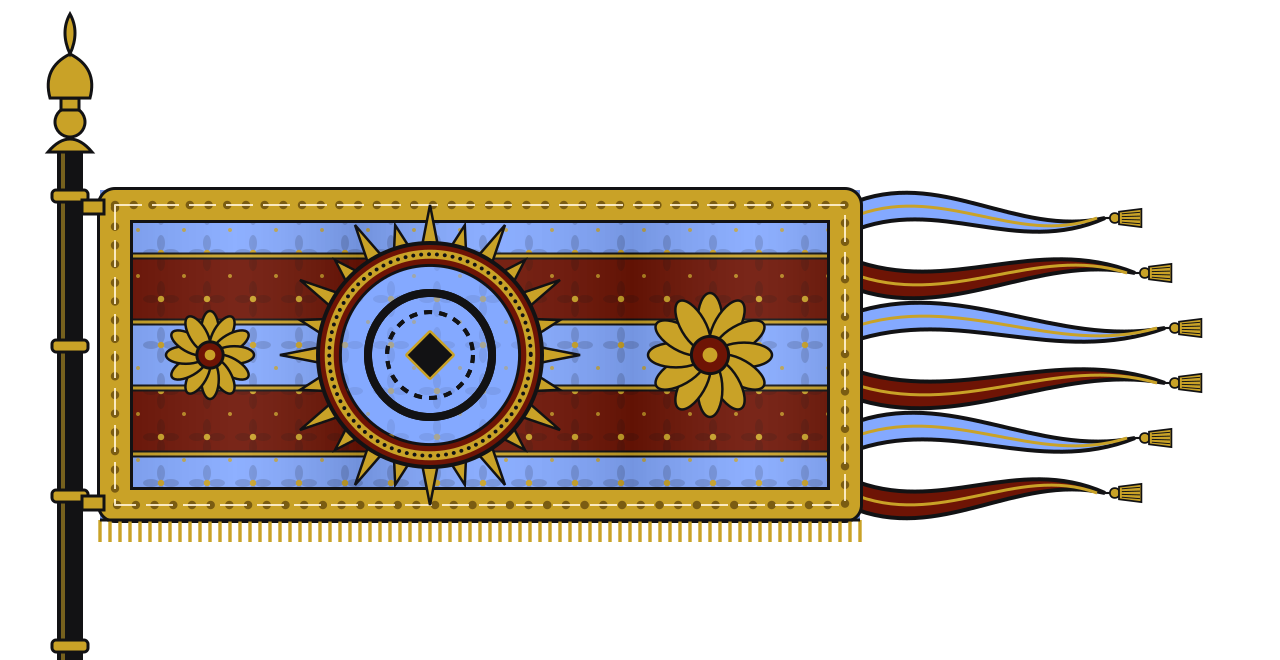
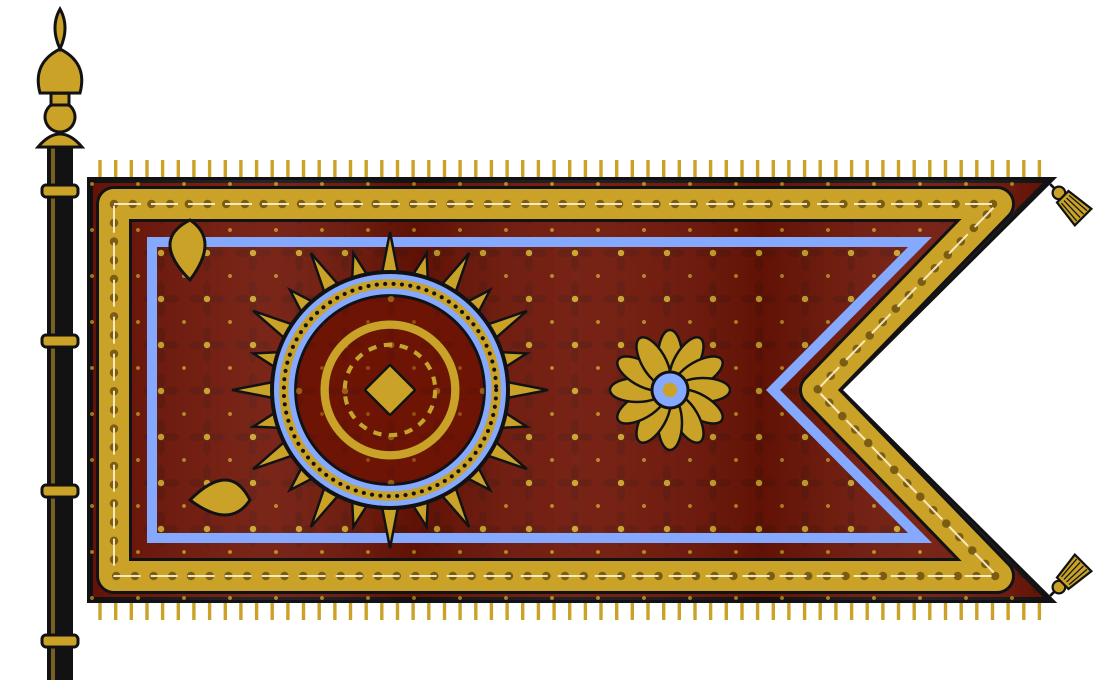
| Field | Deep Brick #7E2A1E |
| Accent | Intense Electric Blue #84A9FF |
| Emblem colour | Metallic Gold #C9A227 |
| Zari metal | Gold |
| Main emblem | A stepwell (vav) with steps going down |
| Second image | — |
| Night and day | Every visual accessory has two versions: by night the emblem on the dark field, by day the clan's field colour on cloth woven from its metal. |
6. Flags
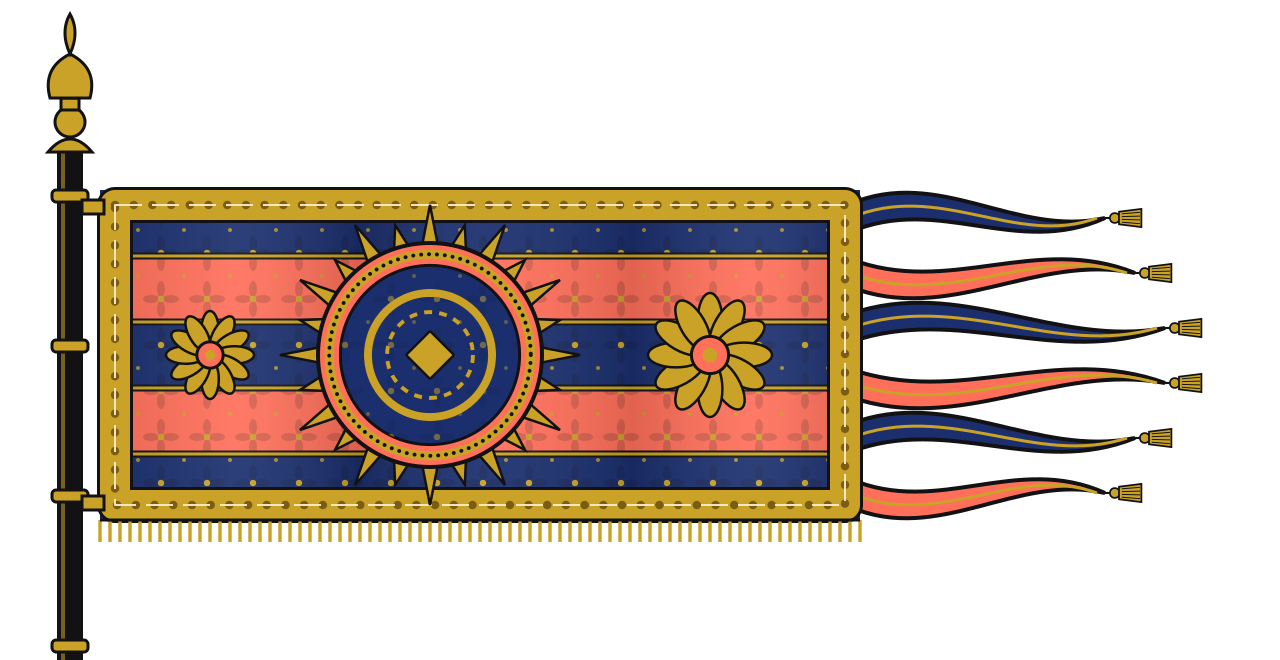
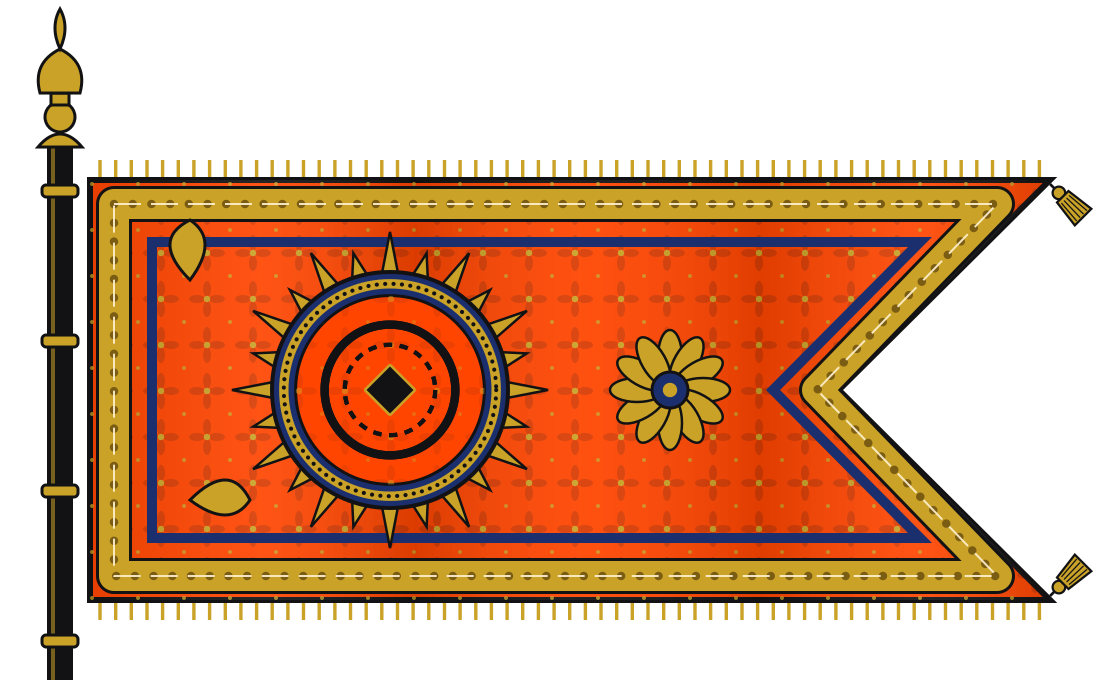
Every clan has every flag type; the type says the occasion and the colours say the clan. The outlined card is the flag the Atlas assigns.



Historic banner
None recorded.
New flag types
| Accessory | For this clan | Basis |
|---|---|---|
| A9 Pota-dhvaja · ship and trade flag For ships, caravans and markets | Not yet designed for this clan | Design |
| A10 Utsava-patāka · festival flag Light, bright flag for fairs and festivals | Not yet designed for this clan | Design |
| A11 Shoka-dhvaja · mourning flag White cloth with the emblem outline in the clan's metal | Not yet designed for this clan | Design |
7. Regalia
| Accessory | For this clan | Basis |
|---|---|---|
| E1 Chhatra · house parasol The ceremonial umbrella | Not yet designed for this clan | Design |
| E2 Chamara · fly-whisks The pair of whisks beside the head of the house | Not yet designed for this clan | Design |
| E3 Danda · staff of office Staff or scepter | Not yet designed for this clan | Design |
| E4 Simhasana · seat The seat of the house, covered in clan cloth | Not yet designed for this clan | Design |
| E5 Khetaka · shield A round shield; the Changi and Dhanush are its flag forms | Not yet designed for this clan | Regional tradition |
| E6 Kula-ayudha · clan weapon The weapon the clan honours | Not yet found for this clan | Under research |
8. Worn
| Accessory | For this clan | Basis |
|---|---|---|
| F1 Kula-vastra · clan cloth The clan's woven pattern in its kit colours | Not yet designed for this clan | Design |
| F2 Kirti-vastra · honour cloth A cloth earned for a deed, not inherited | Not yet designed for this clan | Design |
| F3 Kula-mala · garland flower The flower or leaf the clan wears as a garland | Not yet found for this clan | Under research |
| F4 Chinha · house pin A metal badge with the pin emblem | Not yet designed for this clan | Design |
9. Records
| Accessory | For this clan | Basis |
|---|---|---|
| H1 Clan words A traditional line in the native script | · “Under research” No clan line is in the extracts. The Gujarati clan name is not a line; a native-script source is still to be found. | Documented |
| H2 Biruda · titles The house's title or titles | Ra and Nripa (titles of the dynasty); Raizada (title given to Mandalika's son) | Documented |
| H3 Prashasti · praise genealogy The lineage as written at the head of a grant | Inscriptions naming the lineage | Documented |
| H4 Vahi · clan register The book of the clan's births, marriages and deaths | Not yet found for this clan | Under research |
| H5 Rana-ghosha · war cry The clan's cry in battle or celebration | Not yet found for this clan | Under research |
10. VishwaVit · knower of the world
Game values are design choices for this project, not historical claims.
References
- Wikipedia, Chudasama dynasty, read 2026-10-23, https://en.wikipedia.org/wiki/Chudasama_dynasty
- Wikipedia, Chronology of Chudasama dynasty, read 2026-11-15, https://en.wikipedia.org/wiki/Chronology_of_Chudasama_dynasty
- Wikipedia, Mahmud Begada, read 2026-10-23, https://en.wikipedia.org/wiki/Mahmud_Begada
- Wikipedia, Chudasama Rajput, read 2026-11-15, https://en.wikipedia.org/wiki/Chudasama_Rajput
- Wikipedia, Sarvaiya, read 2026-11-15, https://en.wikipedia.org/wiki/Sarvaiya
- Wikipedia, Ranakadevi, read 2026-11-15, https://en.wikipedia.org/wiki/Ranakadevi
- Khodiyar, Wikipedia (read 10 Oct 2026).
- Ashapura Mata, Wikipedia (accessed 8 Oct 2026).
- Wikipedia, Khengara (12th century king), read 2026-11-02, https://en.wikipedia.org/wiki/Khengara_(12th_century_king)
- Indian Antiquary vol. 2 (November 1873), page 353 (Wikisource mirror, 2022-09 snapshot), read 2026-11-15, https://kwx.liehendr.com/content/wikisource_en_all_maxi_2022-09/A/Page%3AThe_Indian_Antiquary_Vol_2.djvu/353
- Forgotten Nexus (blog), Chudasama Dynasty of Gujarat: Forgotten Rajput Kings of Saurashtra, July 2025, read 2026-11-15, a blog that cites no named sources, used as weak. https://forgottennexus.blogspot.com/2025/07/chudasama-dynasty-of-gujarat-forgotten.html
- Wikipedia, Mer (community), read 2026-11-05, https://en.wikipedia.org/wiki/Mer_(community)