The Cholas were a Tamil dynasty of the Kaveri delta, with Uraiyur as their early capital and Puhar (Kaveripumpattinam) as their port[1][2]. The Ashokan edicts name the Cholas outside his empire in the 3rd century BCE[3][2]. After an interregnum, Vijayalaya (c. 848 CE) founded the imperial line, and under Rajendra I the empire reached the Ganges and raided Srivijaya in 1025[1]. The Cholas were absorbed by the Pandyas and ceased in 1279[1], but their temples at Thanjavur, Gangaikonda Cholapuram and Darasuram are UNESCO-listed as the Great Living Chola Temples[4].
01Faith and deities
Fierce Durga worshipped by Vijayalaya Chola at Thanjavur
A recorded tie between the clan and the goddess.
| Deity or tradition | Place in the clan's life | Evidence |
|---|---|---|
| Nishumbhasudani (KulDevi, documented) | Clan goddess;, not a web source | Atlas |
| Fierce Durga | Worshipped by Vijayalaya Chola at Thanjavur; | Atlas |
| Vishnu, Durga, Surya, Harihara, Ardhanishvara | Shrines at Gangaikonda Cholapuram | [4] |
| Indra, Agni, Varuna, Vayu, Brahma, Surya, Vishnu, Durga, Saraswati, Ganesha, Subrahmanya | Shrine images at Darasuram | [4] |
| 63 Nayanars | Shrine images at Darasuram | [4] |
02Temples
The dynasty page notes Chola-style similarities at Prambanan (Java)[1].
Built by the clan
| Temple | Deity | Built by | When | Where |
|---|---|---|---|---|
| Brihadisvara, Thanjavur | Shiva | Rajaraja I | 1003–1010 CE (ASI) | Thanjavur[4] |
| Brihadisvara, Gangaikonda Cholapuram | Shiva | Rajendra I | Completed 1035 CE | About 70 km from Thanjavur[4] |
| Airavatesvara, Darasuram | Shiva | Rajaraja II | 1166 CE (Michell 2012); c. 1150 CE also given | Darasuram[4] |
Given patronage or grants by the clan
| Temple | Deity | What the clan gave | When | Where |
|---|---|---|---|---|
| Tiruvalangadu shrine | Goddess (name not given in the extract) | Land grant by Rajendra I | Rajendra I | Tiruvalangadu[5] |
| Vishnu temple, Kachhippedu | Vishnu | Confirmed dues by edict | Reign of Uttama Chola | Kanchipuram[5] |
03Languages and scripts
| Language or script | Kind | Under the clan | Evidence |
|---|---|---|---|
| Tamil living | Language | Main language of the Chola inscriptions | [5] |
| Sanskrit | Language | Used from the 6th century; some grants bilingual | [5] |
| Grantha | Script | Used for the Chola margin line on the copper plates | [5] |
| Telugu living | Language | Spoken under the Telugu Chola lines | [1] |
04Books and literature
Works from the Sangam age through the Chola period; the dynasty page lists court and literary works, most without dates.
Written in the clan's lands during its era
| Work | Author | Kind | When | Link to the clan |
|---|---|---|---|---|
| Purananuru | 157 poets (14 anonymous) | Sangam anthology: 400 poems (the page says 267–268 are lost) | 1st c. BCE – 5th c. CE | [6] |
| Pattinappalai | Author not named in the source | Sangam poem on the port of Kaveripumpattinam | Sangam age | [2] |
| Periapuranam | Not named in the source | Work listed on the dynasty page | 12th century | [1] |
| Jivaka-chintamani; Sulamani | Tirutakkatevar; Tolamoli | Tamil works | Not dated | [1] |
| Virasoliyam | Buddhamitra | Work listed on the dynasty page | Not dated | [1] |
| Andhra Mahabharatamu; Dasakumaracharitramu | Tikkana; Ketana | Telugu works listed on the dynasty page | Not dated | [1] |
Given patronage by the clan
| Work | Author | What the clan gave | When | Evidence |
|---|---|---|---|---|
| Ramavataram | Kamban | Kamban worked under Kulothunga III | 1178–1218 | [1][7] |
05Thinkers and scholars
| Name | Field | Era | Contribution |
|---|---|---|---|
| Nambi Andar Nambi | Shaiva scripture | Late 10th century | Arranged the Shaiva canon in eleven books[1] |
| Kamban | Tamil poetry | Under Kulothunga III | Ramavataram[7][1] |
| Ottakuttan | Literature named on the page | Kulothunga I | Poet linked to Kulothunga I[1] |
| Parimelazhagar | Tolkappiyam scholarship | Not dated | Annotated a commentary on the Tolkappiyam[1] |
Attributions and dates as the dynasty page gives them.
06Art and architecture
Temple architecture and bronze sculpture of the Chola period[1].
Painting and wall art
| Art form | What it is | Era | Evidence |
|---|---|---|---|
| Frescoes, Thanjavur | Painted frescoes in the Brihadisvara temple | [4] |
Sculpture and temple art
| Art form | What it is | Era | Evidence |
|---|---|---|---|
| Brass Nataraja, Thanjavur | Bronze of Shiva dancing | [4] | |
| Bronzes, Nandi and Ardhanarishvara, Gangaikonda Cholapuram | Bronze images and Nandi | [4] |
Temple and building architecture
| Art form | What it is | Era | Evidence |
|---|---|---|---|
| Brihadisvara, Thanjavur | Granite vimana; one of India's largest lingas; moat originally, walls added after the 16th century | [4] | |
| Airavatesvara, Darasuram | Carved pillars and the stone chariot-form Rajagambhira Thirumandapam | [4] |
Weaving and textiles
Not recorded.
Clothing and jewellery
Not recorded.
Coins, pottery and crafts
Not recorded.
07History
Sangam age and the first documented Cholas
The dynasty page gives Ilamchetchenni as the first documented founder, and places the Cholas as Mauryan southern neighbours in the Ashokan inscriptions[1].
Ashoka's 2nd and 13th rock edicts name the Cholas with the Pandyas, Cheras and Satiyaputras, outside the empire, in the period 273–232 BCE[3][2].
Early capitals were Uraiyur and Kaveripattinam[1]. Artefacts from Puhar (Kaveripumpattinam) date from c. 300 BCE to the early centuries CE, and offshore finds suggest parts of the port sank[2].
Interregnum and the imperial line
The dynasty page dates an interregnum from c. 300 CE to the 6th century, when the Kalabhras held the south and the Pandyas and Pallavas took over[1].
Vijayalaya (c. 848 CE), of the Pottapi Chola family, founded the imperial line. Aditya I defeated the Pallavas and Pandyas and took Tondaimandalam and Kongu Nadu. Parantaka I defeated the Rashtrakutas at Vallala[1].
Height of the empire (985–1070)
Rajaraja I (985–1014) built the Brihadisvara temple at Thanjavur between 1003 and 1010[4]. Rajendra I (1014–1044) completed the Brihadisvara temple at Gangaikonda Cholapuram in 1035[4][8].
Rajendra I reached the Ganges, Odisha and the Pala kingdom of Bengal, and raided Srivijaya in 1025. His successor Virarajendra conquered Kedah[1].
A gold kasu of Rajendra was struck before the title Gangai Konda Chola (c. 1025)[8].
Later Cholas and decline (1070–1279)
Athirajendra was assassinated in 1070. Kulothunga I, son of Ammanga Devi, began the Later Cholas[1].
Vikrama Chola (1118–1135), Kulothunga II (1133–1150), Rajaraja II (1146–1173), Rajadhiraja II (1166–1178) and Kulothunga III (1178–1218) followed. Kulothunga III beat the Western Chalukyas with the Hoysalas (1185–90)[1].
Kulothunga III was defeated by Maravarman Sundara Pandiyan II (1215–16). The Cholas were absorbed by the Pandyas and ceased in 1279 with Rajendra III. The Pandyan civil war and Sinhala involvement also contributed to the decline[1].
08Journey and migrations
The sources record a move from Uraiyur to the Telugu country and the dynasty's overseas contacts.
| When | From | To | Why | Evidence |
|---|---|---|---|---|
| c. 540 CE | Uraiyur | Telugu country | Reason not given in the extracts | [1] |
| 1014–1044 | Chola realm | Ganges and Bengal | Campaigns of Rajendra I | [1] |
| 1025 | Chola realm | Srivijaya | Raid | [1] |
| 1016, 1033, 1077 | Chola realm | China | Embassies | [1] |
09Seats and lands
| Place | Role | Where today |
|---|---|---|
| Uraiyur | Early capital | Listed as a capital in Chola Nadu[7] |
| Puhar (Kaveripumpattinam) | Port city and early capital | Delta location not stated in the extracts[2] |
| Kaveripattinam | Early capital | Not located in the extracts[1] |
| Arikamedu | Indo-Roman station; Chola-linked port city | Not located in the extracts[2] |
| Kudanthai (Kumbakonam) | Capital | Kumbakonam[1] |
| Thanjavur | Later capital; Brihadisvara temple | Thanjavur, Tamil Nadu[7] |
| Gangaikonda Cholapuram | Capital of Rajendra I | Ariyalur district[7] |
| Tondaimandalam, Kongu Nadu, Vengi, Gangavadi, Kalinga | Territories held at different times | Outside Chola Nadu[1] |
| Rajarata, Kedah, Maldives, Odisha, Bengal | Territories or conquests named by the page | Sri Lanka, Malaysia, Maldives, India[1] |
10Notable figures
| Name | Role | Era | Known from |
|---|---|---|---|
| Kantaman legend | Mythical king linked to Agastya and the origin of the Kaveri | Sangam legend | [1] |
| Karikala | Sangam-era king | Sangam age | [1] |
| Kocengannan | Sangam-era king | Sangam age | [1] |
| Ellalan (Elara) legend | Said to have taken Rajarata (Sri Lanka) | 235 BCE (Mahavamsa) | [1] |
| Vijayalaya | Founder of the imperial line | c. 848 CE | [1] |
| Rajaraja I | Built the Brihadisvara temple at Thanjavur | 985–1014 | [4] |
| Rajendra I | Reached the Ganges; raided Srivijaya in 1025; built Gangaikonda Cholapuram | 1014–1044 | [1][8] |
| Virarajendra | Conquered Kedah | Imperial period | [1] |
| Kulothunga I | Son of Ammanga Devi; began the Later Cholas | After 1070 | [1] |
| Kulothunga III | Beat the Western Chalukyas with the Hoysalas; defeated by Sundara Pandiyan II | 1178–1218 | [1] |
| Rajendra III | Last Chola ruler named by the page | Ceased 1279 | [1] |
11Allies, rivals and marriages
| People | Relationship | When |
|---|---|---|
| Pandyas | Rivals who also intermarried; absorbed the Cholas | 1150–1280 |
| Pallavas | Defeated by Aditya I; Pallava and Pandya kings took Chola princesses | Not dated[1] |
| Rashtrakutas | Defeated by Parantaka I at Vallala | Parantaka I[1] |
| Western Chalukyas | Beaten by Kulothunga III with the Hoysalas | 1185–90[1] |
| Hoysalas | Allies of Kulothunga III; Veera Ballala II married a Chola princess | 1185–90[1] |
| Cheras | Kulothunga III beat a Chera ruler | Reign of Kulothunga III[1] |
| Eastern Gangas and Kalinga | Fought the Cholas | Not dated[1] |
| Srivijaya | Raided by Rajendra I | 1025[1] |
| Sinhala kings (Rajarata) | Rajarata held, then lost; Sinhala involvement in the decline | Imperial period[1] |
| Tramira league (Kharavela's Hathigumpha) | Read as including the Cholas by the Kharavela page; the Sources page says the Hathigumpha does not name them (see open) | c. 150 BCE[9][2] |
12Society and livelihood
Chola society was centred on the king, with ports and trade on the coast[6][1].
Government and social order
| Institution or group | What it was | Evidence |
|---|---|---|
| The king | Society centred on the king; the poets' praise is thought exaggerated | [6] |
| Kuti (kudi) | A group name the Sangam text suggests for caste | [6] |
| Hero stones (natukal) | Stones raised after cremation | [6] |
| Tamil guilds | Tamil guilds on the Malay peninsula and in Sumatra | [1] |
Livelihood over time
| Era | Livelihood | Evidence |
|---|---|---|
| Sangam age | Ports and trade: Puhar, Arikamedu and Uraiyur; Roman coins near the delta | [2][1] |
| Modern (Chozhia Vellalar) | Landowners and tenant farmers | [10] |
13Sub-clans and related clans
Cadet branches named by the dynasty page, and related communities. Only the Chozhia Vellalar is a related caste rather than a branch.
| Clan | Relation | Where | Size | In the Atlas | Evidence |
|---|---|---|---|---|---|
| Chozhia Vellalar | Related people | Cauvery delta: Thanjavur, Mayiladuthurai, Nagapattinam, Thiruvarur; fewer in Tiruchirappalli, Karur, Namakkal | same name as SUB-166: check | [10] | |
| Velanati Cholas | Branch | Telugu country | same name as ANC-232: check | [1] | |
| Nellore Cholas | Branch | Telugu country | new clan candidate | [1] | |
| Renati Cholas | Branch | Telugu country | new clan candidate | [1] | |
| Pottapi Cholas | Branch | Telugu country | new clan candidate | [1] | |
| Konidena (Kondidela) Cholas | Branch | Telugu country | new clan candidate | [1] | |
| Nannuru Cholas | Branch | Telugu country | new clan candidate | [1] | |
| Nidugal Cholas | Branch | Karnataka | new clan candidate | [1] | |
| Chodaganga dynasty | Dynasty from this clan | Kalinga | new clan candidate | [1] |
Clans marked "new clan candidate" are not in the Atlas yet.
14Surnames
Names the sources give as Chola or royal-line surnames. No counts of bearers are sourced.
| Surname | Clan or sub-clan | Where | People with this surname | Also used by other communities |
|---|---|---|---|---|
| Chola | Cholas | not yet counted | Not checked | |
| Killi கிள்ளி | Cholas (royal line) | not yet counted | Not checked | |
| Valavan வளவன் | Cholas (royal line) | not yet counted | Not checked | |
| Sembiyan செம்பியன் | Sembiyan Cholas | not yet counted | Not checked | |
| Cenni | Cholas (royal line) | not yet counted | Not checked | |
| Cholan / Chulan | Malay princely names | Malaysia (Perak) | not yet counted | Yes |
| Pillai (title) | Chozhia Vellalar | Tamil Nadu | not yet counted | Yes |
Counts are of everyone with the surname, from the cited source and year, not only members of this clan. A surname shared with other communities says nothing about any one person's origin.
15Songs and music
No traditional Chola song text is in the sources. The Carnatic tradition of the delta is recorded below as regional, not as Chola song.
None recorded yet.
Instruments and styles
| Instrument or style | What it is | Evidence |
|---|---|---|
| Carnatic music (regional) | Tiruvarur Trinity (Tyagaraja, Syama Sastri, Muthuswami Dikshitar) and Shiyali Trinity | [7] |
16Poems, lullabies and children's rhymes
Purananuru has 138 poems praising 43 kings, 13 of them Chola[6]. The items below are summaries only, with no excerpts.
17Stories, legends and proverbs
Stories and legends
| Story | What happens | Told by | Evidence |
|---|---|---|---|
| King Shibi | A Buddhist Jataka figure from whom the Sembiyan Cholas trace descent; the claim is debated | Sembiyan Cholas (claim) | [1][6] |
| Kantaman legend | Mythical king linked to Agastya and the origin of the Kaveri | Sangam legend | [1] |
| Ponniyin Selvan later | Novel by Kalki (title only; copyrighted); films 2022 and 2023 | Kalki | [1] |
| Parthiban Kanavu; Kadal Pura; Yavana Rani; Udaiyar later | Novels on the Chola court (title only; copyrighted) | Sandilyan (Yavana Rani); Balakumaran (Udaiyar); Kalki named only for Ponniyin Selvan | [1] |
| Rajaraja Cholan later | Film (1973) | Film | [1] |
Proverbs and sayings
Not recorded.
18Festivals and fairs
| Festival or fair | When | Where | What happens |
|---|---|---|---|
| Adiperukku research | Annual | Kaveri (place not named by the page) | Celebration of the Kaveri floods; the page marks this as citation needed[1] |
| Pilgrimage at Darasuram | Yearly | Darasuram | Pilgrims come each year[4] |
19Food, dress and games
Food
| Item | What it is | Evidence |
|---|---|---|
| Eelattu-unavu | Food from Eelam (Sri Lanka), named in the Pattinappalai | [2] |
Dress
Not recorded.
Games and martial arts
Not recorded.
Tags: living still practised · revived brought back after a break · lost known only from records · research reported but not yet confirmed from a source. Songs and poems under copyright are listed by title only; restricted or sacred material is noted without its content.
20Status today
No present-day descendants are established. The Chozhia Vellalar page says its name reflects ties to Tanjore, not direct kinship with the Cholas[10].
Who carries the name today
| Community | Link | Basis | Evidence |
|---|---|---|---|
| Chozhia Vellalar | https://en.wikipedia.org/wiki/Chozhia_Vellalar | Disputed | [10] |
Recognised heritage
| What | Recognition | Evidence |
|---|---|---|
| Great Living Chola Temples | UNESCO World Heritage Site, ref 250bis, criteria (i)–(iv) | [4] |
Not reviewed by a Chola or Chozhia Vellalar community body; no source records a review.
21For children
The Tiger on the Coin
Long ago, in the land of Tamil Nadu, there were kings called the Cholas. Their sign was a tiger, and you can see the tiger on their old coins. The Cholas sent ships across the sea to faraway lands. Their kings built big temples with tall towers. The Brihadisvara temple in Thanjavur is one of them. King Rajaraja and King Rajendra built many of these temples. Today the temples still stand, and people come to visit them.
Riddle: I am a tiger on a king's coin. Who am I? (The Chola emblem)
22Across the project
| Project | What carries this clan | Status |
|---|---|---|
| Atlas of the Janas | Tamil Nadu; homeland Uraiyur, Puhar, later Thanjavur | Sheet data; no footprint file yet |
| KulDevi and GrahDevi | KulDevi Nishumbhasudani (documented; Mahavidya family); GrahDevi forms Kali to Kamala | From the Atlas |
| Renaming and waters | Kaveri river; Karikala's Kallanai dam (Atlas identifier) | Sheet identifier; not yet sourced |
23Open questions
- The Tamil-script form of the coin legend 'Chola, conqueror of the Gangas' is not in the extracts; a numismatic catalogue or the Nagasamy 1981 text would supply it.
- Date conflict: the dynasty page dates the interregnum c. 300 CE to the 6th century; the Chola Nadu page dates it c. 200 to c. 848. Both are cited above; neither is resolved.
- Date conflict: Airavatesvara, Darasuram is dated 1166 CE (Michell 2012) and c. 1150 CE on the same page[4].
- Kharavela's Tramira league is read as including the Cholas by the Kharavela page[9], but the Sources of ancient Tamil history page says the Hathigumpha does not name them[2]. The Cholas' place in that league is unresolved.
- Descent: the Sembiyan Cholas' claim to descent from Shibi is recorded, and the Purananuru page calls the Chola claim debated (Sastri 1955)[1][6]. No source supports it as fact.
- Chozhia Vellalar: the page says the name reflects ties to Tanjore, not kinship with the Cholas[10]. The page gives its status as Forward before 1975 and OBC later, with no date; the Tamil Nadu list itself is not fetched.
- Nishumbhasudani shrine at Thanjavur: the KulDevi is from the Atlas only; no source has been fetched for the shrine.
- Main deity: Shiva is taken from the dedications of the Great Living Chola temples, not from a source that names it as the clan's chief deity. The owner should confirm this choice.
- Karikala and the Kallanai dam (Atlas identifier): no source fetched. The Karikala and Nalankilli pages are unfetched.
- Telugu Chola branches: no sizes or genealogies are sourced.
- Tamil-language sources: the Pattinappalai page on Tamil Wikisource was too long to fetch, so no Tamil verse is quoted.
24Astitva
अस्तित्व · being, existence: everything by which the clan is known
The Chola tiger appears on coins and on the copper-plate seal; the sources record a seal, a coin legend and a Grantha margin line[5][1].
Every clan has every accessory, royal objects included. Each one says how it is known: Documented This clan's own object is recorded. · Regional tradition Recorded for the region or for peoples like this one, not for this clan. · Design Made for this project, with no historical claim. · Under research To be found for this clan from sources. Legends and titles are written in the clan's own script.
1. Seals and coins
| Accessory | For this clan | Basis |
|---|---|---|
| B1 Rajamudra · house seal Round seal with the clan emblem and a short legend in the clan's script | Seated tiger facing right, two fish, bow, parasol and whisks, lamps: the seal that closes the plates | Documented |
| B2 Anguliya-mudra · signet ring Personal seal ring of the head of the house | Not yet designed for this clan | Design |
| B3 Chhapa · house stamp Ink or block stamp for letters, goods and cloth | Not yet designed for this clan | Design |
| B4 Tamrapatra · charter plate Copper-plate grant on a ring, closed with the house seal | Typically five copper plates on a copper ring, closed by the Chola seal; the Anaimangalam set has 21 plates on a bronze ring, issued by Rajendra I (dated 1012–1042) | Documented |
| B5 Shreni-mudra · guild or trade seal Seal for the clan's trade, craft or caravan | Not yet designed for this clan | Design |
| C1 Clan coin Emblem or deity on one side, a legend in the clan's script | Seated tiger with two fish on the Rajaraja I coin; every coin of the dynasty bears a tiger on the reverse | Documented |
| C2 Coin die The die that strikes the coin | Not yet designed for this clan | Design |
2. Living symbols
| Accessory | For this clan | Basis |
|---|---|---|
| I1 Totem trio The tree, bird and animal the clan protects | Not yet found for this clan | Under research |
| I2 Kaval-maram · guardian tree The tree that stands at the clan's seat | Not yet found for this clan | Under research |
3. Stone and gate
| Accessory | For this clan | Basis |
|---|---|---|
| G1 Torana · gateway The built gate of the seat; the cloth Toran hangs in it | Not yet designed for this clan | Regional tradition |
| G2 Viragallu · hero stone Carved panel stone for a member who died defending the clan | Not yet designed for this clan | Regional tradition |
| G3 Kula-shila · clan stones Standing and table stones that remember the ancestors | Not yet designed for this clan | Design |
| G4 Jayastambha · victory pillar A pillar raised for a victory | Not yet designed for this clan | Design |
| G5 Sima-shila · boundary stone Marks the clan's land, with a line in the native script | Not yet designed for this clan | Design |
4. Sounds
| Accessory | For this clan | Basis |
|---|---|---|
| D1 Pancha-mahashabda · five great sounds The right to five instruments | Not yet designed for this clan | Design |
| D2 Shankha · clan conch The clan's own named war conch | Not yet designed for this clan | Design |
| D3 Murasu · house drums Three drums: war, charity and justice | Not yet designed for this clan | Design |
5. Kit: colours, metals and emblems
The Chola tiger is recorded on coins and on the copper-plate seal[2][5].
| Part of the kit | This clan |
|---|---|
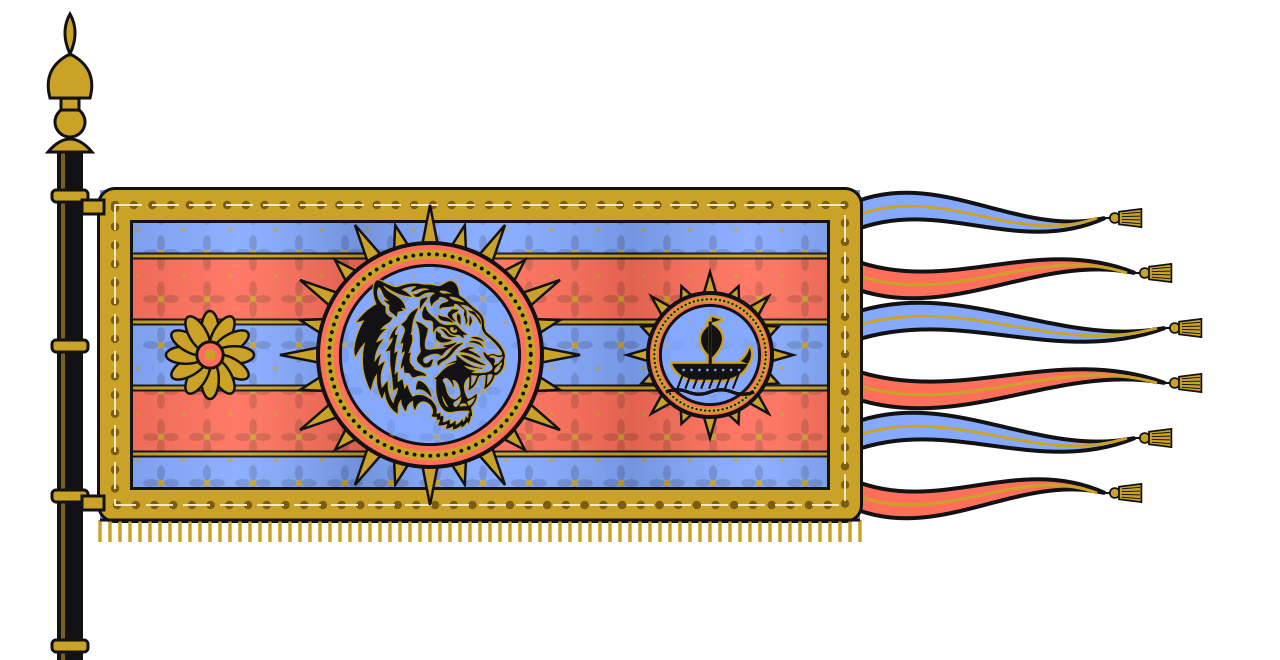
| Field | Intense Electric Blue #84A9FF |
| Accent | Warm Red-Orange #FF6F59 |
| Emblem colour | Charcoal Black #121214 |
| Zari metal | Gold |
| Main emblem | A leaping tiger |
| Second image | A war galley |
| Night and day | Every visual accessory has two versions: by night the emblem on the dark field, by day the clan's field colour on cloth woven from its metal. |
6. Flags
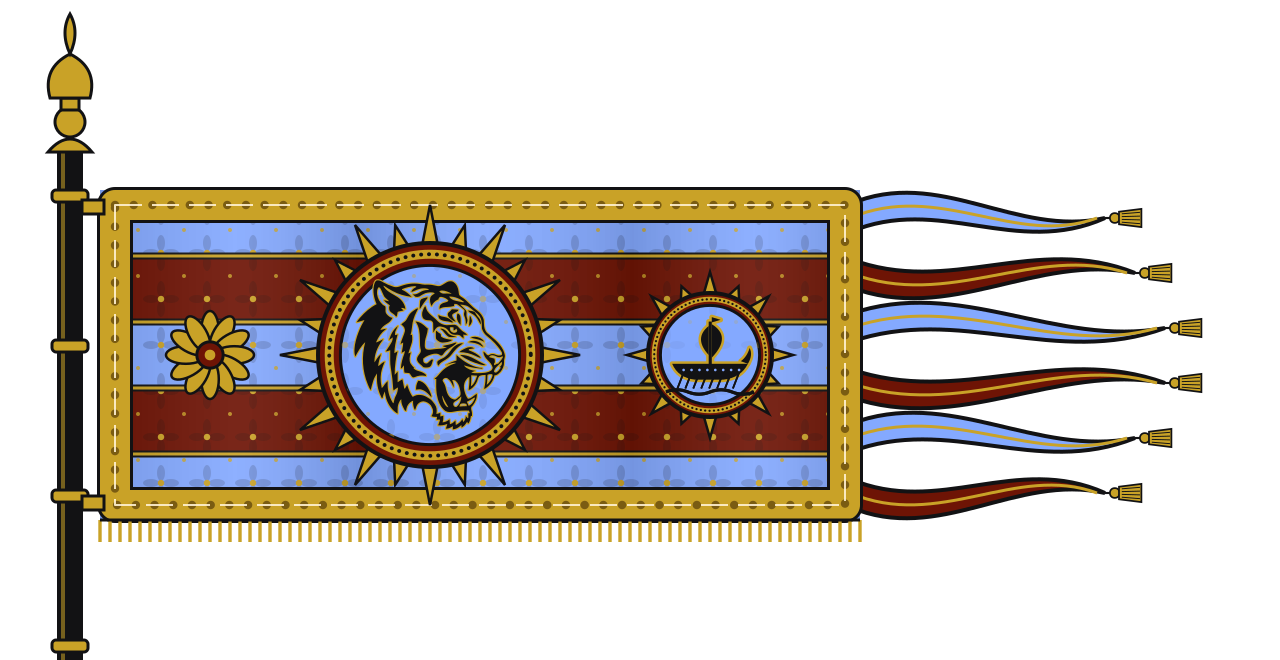
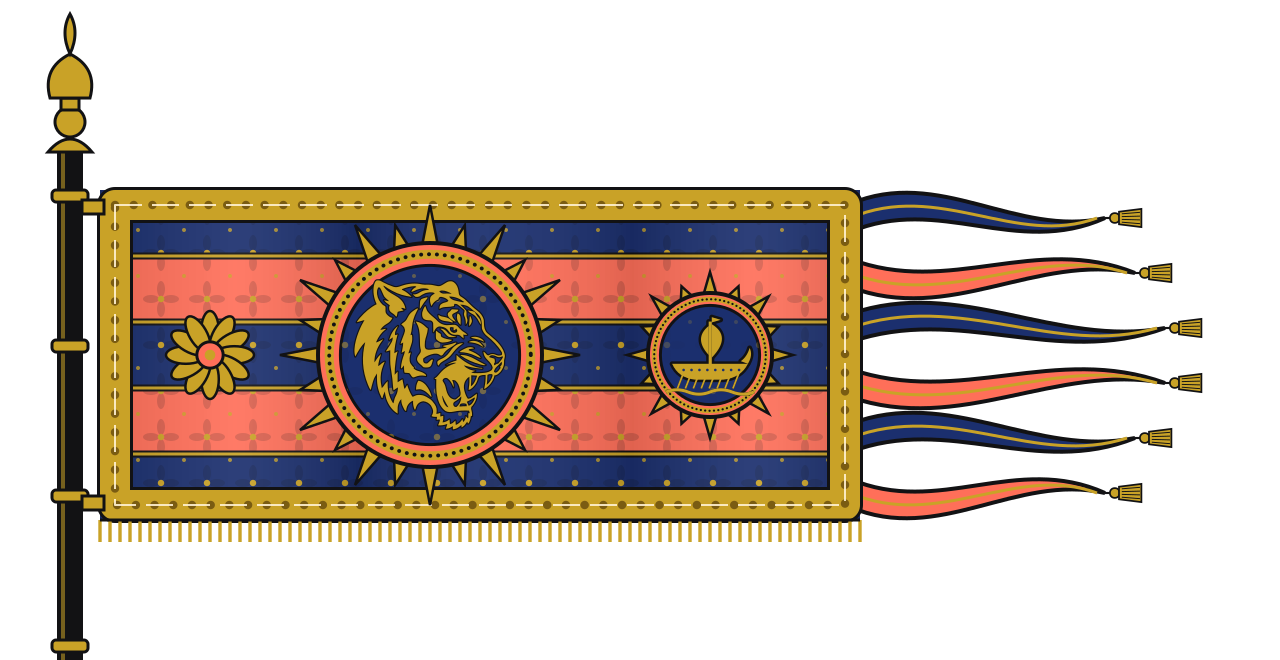
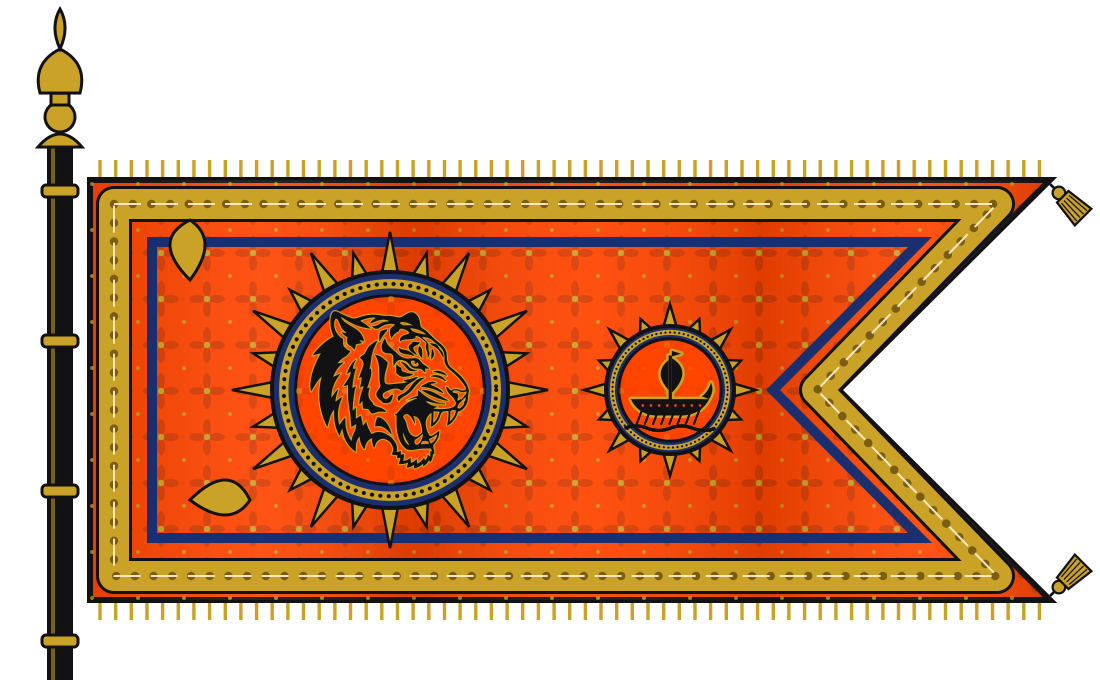
Every clan has every flag type; the type says the occasion and the colours say the clan. The outlined card is the flag the Atlas assigns.
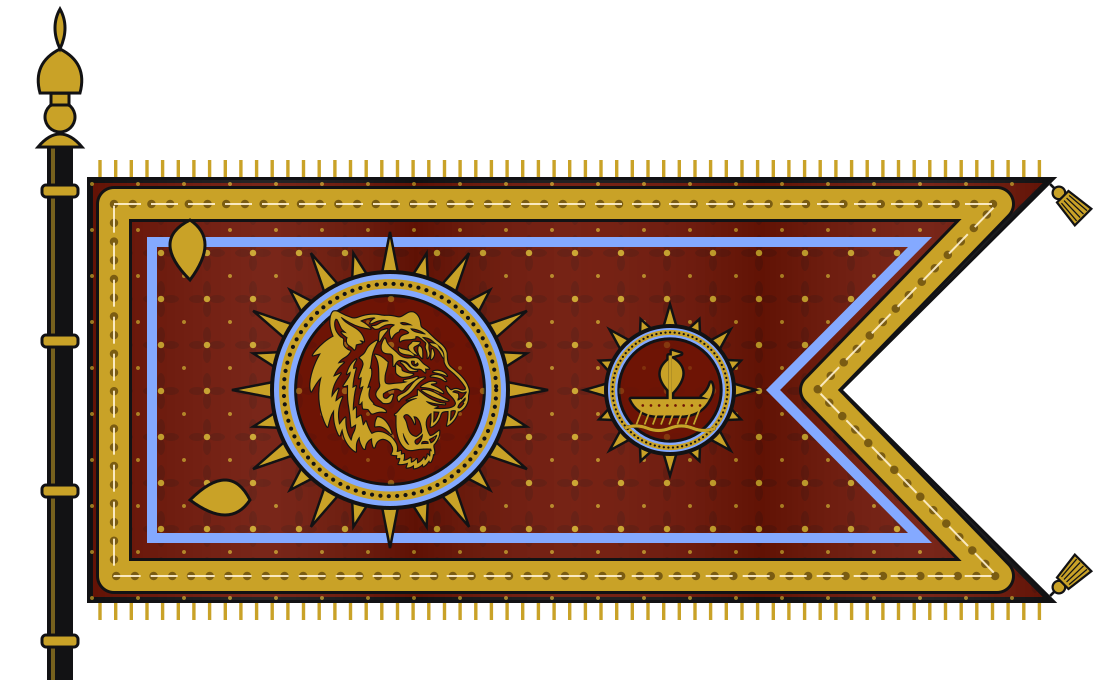
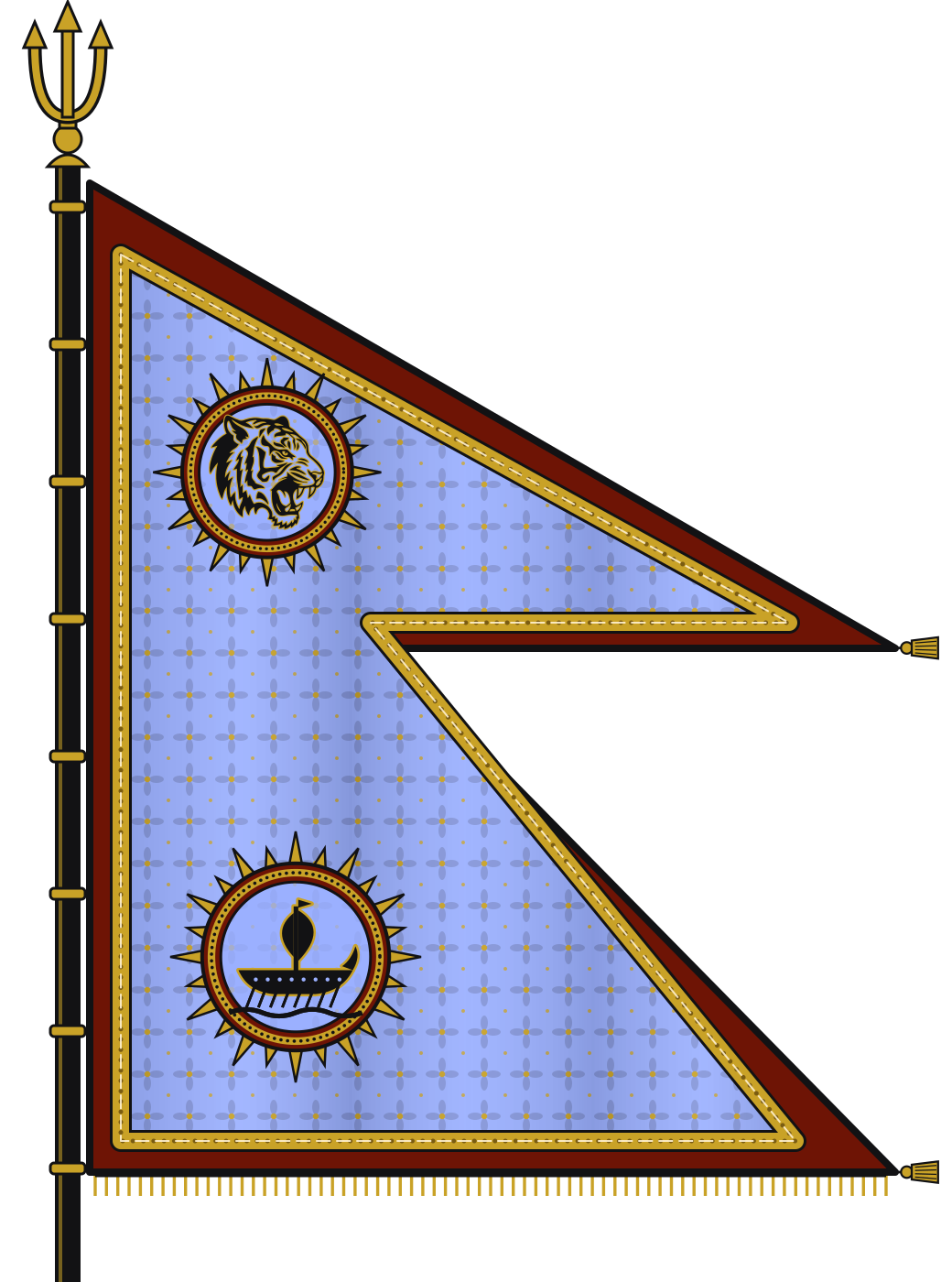
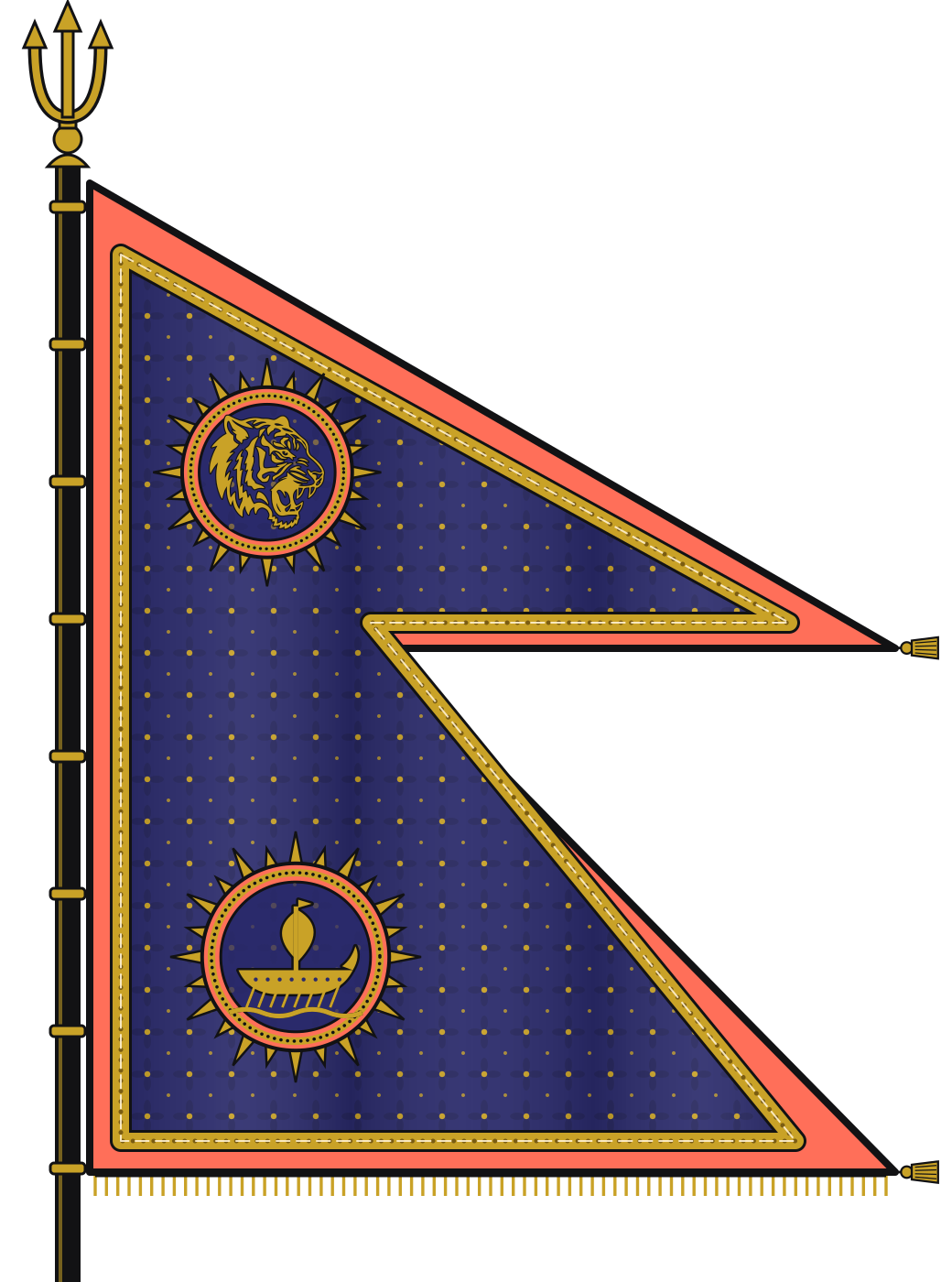


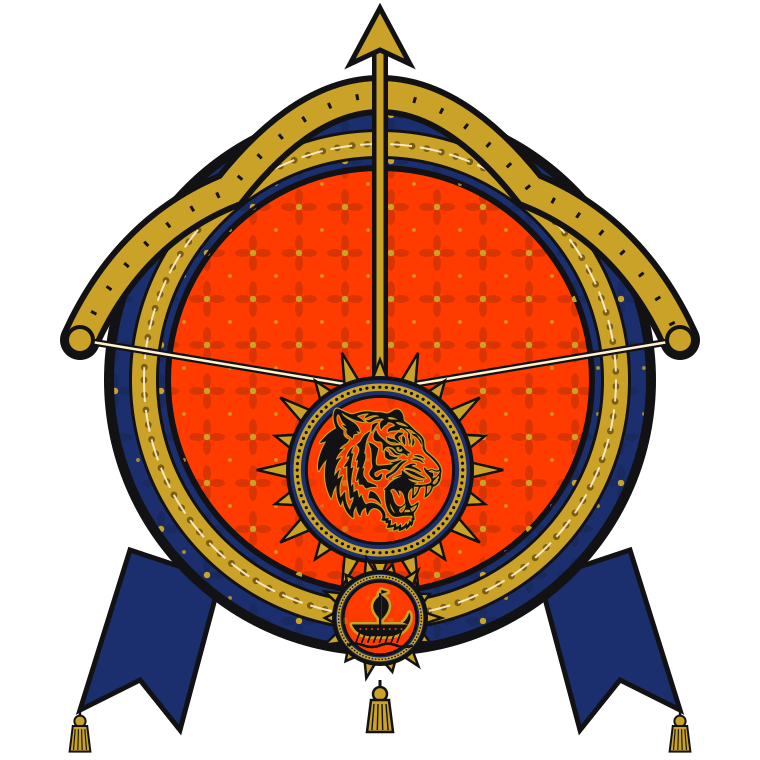
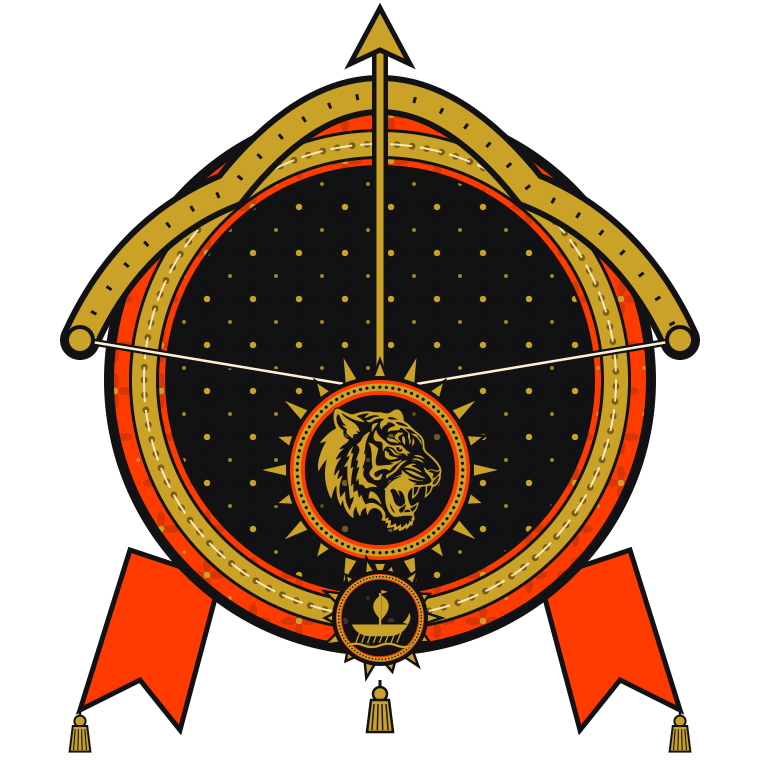
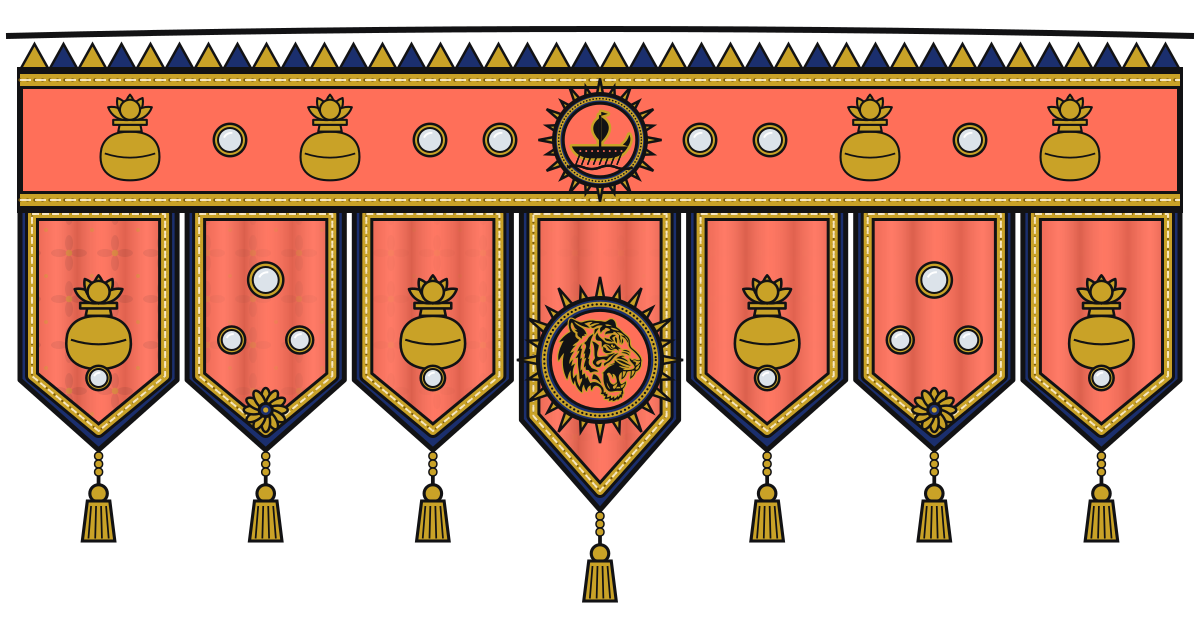
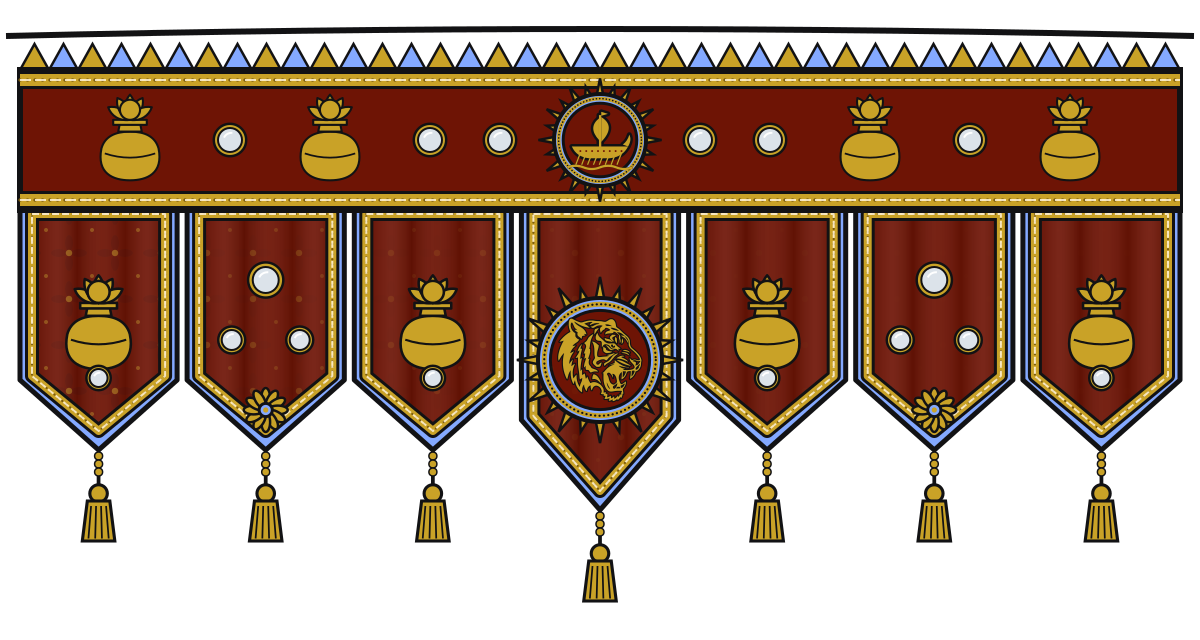
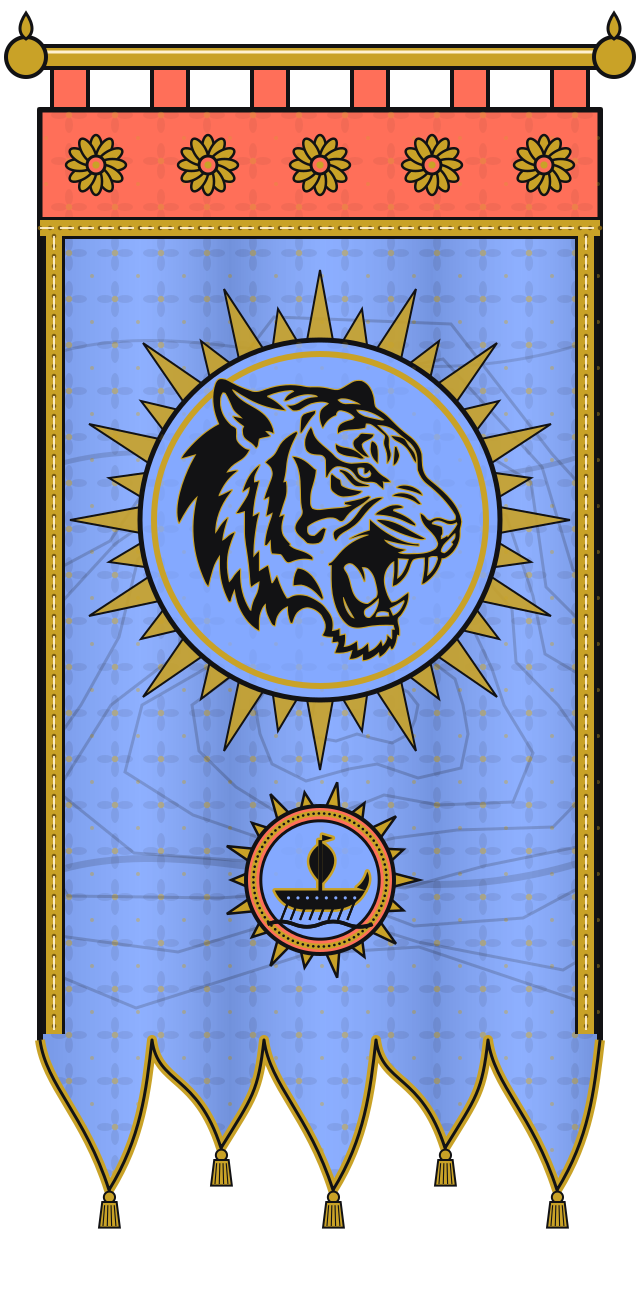
Historic banner
The Chola flag bore a tiger (puli kodi) according to Sangam literature and inscriptions
New flag types
| Accessory | For this clan | Basis |
|---|---|---|
| A9 Pota-dhvaja · ship and trade flag For ships, caravans and markets | Not yet designed for this clan | Design |
| A10 Utsava-patāka · festival flag Light, bright flag for fairs and festivals | Not yet designed for this clan | Design |
| A11 Shoka-dhvaja · mourning flag White cloth with the emblem outline in the clan's metal | Not yet designed for this clan | Design |
7. Regalia
| Accessory | For this clan | Basis |
|---|---|---|
| E1 Chhatra · house parasol The ceremonial umbrella | Parasol above the seal on the copper-plate set | Documented |
| E2 Chamara · fly-whisks The pair of whisks beside the head of the house | Two fly-whisks above the seal on the copper-plate set | Documented |
| E3 Danda · staff of office Staff or scepter | Not yet designed for this clan | Design |
| E4 Simhasana · seat The seat of the house, covered in clan cloth | Not yet designed for this clan | Design |
| E5 Khetaka · shield A round shield; the Changi and Dhanush are its flag forms | Not yet designed for this clan | Regional tradition |
| E6 Kula-ayudha · clan weapon The weapon the clan honours | Bow shown below the seal on the copper-plate set | Documented |
8. Worn
| Accessory | For this clan | Basis |
|---|---|---|
| F1 Kula-vastra · clan cloth The clan's woven pattern in its kit colours | Not yet designed for this clan | Design |
| F2 Kirti-vastra · honour cloth A cloth earned for a deed, not inherited | Not yet designed for this clan | Design |
| F3 Kula-mala · garland flower The flower or leaf the clan wears as a garland | Not yet found for this clan | Under research |
| F4 Chinha · house pin A metal badge with the pin emblem | Not yet designed for this clan | Design |
9. Records
| Accessory | For this clan | Basis |
|---|---|---|
| H1 Clan words A traditional line in the native script | Chola, conqueror of the Gangas · “Coin legend, as the source gives it in English; the Tamil-script form is not in the extracts” Coin caption on the Chola dynasty page, citing Nagasamy 1981[1] | Documented |
| H2 Biruda · titles The house's title or titles | Gangai Konda Chola, a title on Rajendra I's gold kasu struck before it (c. 1025) | Documented |
| H3 Prashasti · praise genealogy The lineage as written at the head of a grant | Not yet found for this clan | Under research |
| H4 Vahi · clan register The book of the clan's births, marriages and deaths | Not yet found for this clan | Under research |
| H5 Rana-ghosha · war cry The clan's cry in battle or celebration | Not yet found for this clan | Under research |
10. VishwaVit · knower of the world
Game values are design choices for this project, not historical claims.
References
- Wikipedia, Chola dynasty, read 2026-10-10, https://en.wikipedia.org/wiki/Chola_dynasty
- Wikipedia, Sources of ancient Tamil history, read 2026-10-10, https://en.wikipedia.org/wiki/Sources_of_ancient_Tamil_history
- Ashoka, Rock Edict II — the Pandyas beyond the empire.
- Wikipedia, Great Living Chola Temples, read 2026-10-10, https://en.wikipedia.org/wiki/Great_Living_Chola_Temples
- Wikipedia, Tamil copper-plate inscriptions, read 2026-10-10, https://en.wikipedia.org/wiki/Tamil_copper-plate_inscriptions
- Wikipedia, Purananuru, read 2026-10-10, https://en.wikipedia.org/wiki/Purananuru
- Wikipedia, Chola Nadu, read 2026-10-10, https://en.wikipedia.org/wiki/Chola_Nadu
- Lakdiva coins, India - Rajendra Chola 1014-1044, read 2026-10-10, https://coins.lakdiva.org.lk/medievalindian/rajendra_chola_au.html
- Kharavela (Wikipedia, read 2026-10-08) — the Hathigumpha inscription year by year, citing K. P. Jayaswal, R. D. Banerji, D. C. Sircar, N. K. Sahu and S. Chattopadhyaya.
- Wikipedia, Chozhia Vellalar, read 2026-10-10, https://en.wikipedia.org/wiki/Chozhia_Vellalar