The Chik Baraik are a Scheduled Tribe listed in Bihar, Jharkhand and West Bengal (Atlas, Ministry of Tribal Affairs list dated 09-07-2024), with 54,163 people in Jharkhand and 21,376 in West Bengal in the 2011 census[1][2]. Their mother tongue is Nagpuri, with Sadri, and Hindi is their link language[3]. Wikipedia and the Jharkhand Tribal Research Institute both tell of soldiers and palace guards under the Nagvanshi dynasty who later became weavers; Wikipedia gives no citation for it[3][4]. Their known craft is handwoven cloth: the lal pad saris, gamchhas and chadars. Sahapedia says looms were in nearly every village about five decades before its 2024 article[5].
01Faith and deities
Chhinnamasta of Rajrappa, Jharkhand
The presiding goddess of the clan's homeland or capital: a link of place, not a recorded clan tie.
| Deity or tradition | Place in the clan's life | Evidence |
|---|---|---|
| Devi Mai | Regarded as the supreme goddess (IndiaNetZone); family and village deities (Das 2007, as Wikipedia cites it) | [6][3] |
| Surjahi | The Sun, worshipped | [3] |
| Bar Pahari | A hill deity | [3] |
| Moon and earth | Worshipped | [3] |
| Snake | Worshipped as the ancestor (Minz and Hansda, 2010, as Wikipedia cites them) | [3] |
| Gram Deo, Dhiwar Deo, Pitar Deo, Nag Deo, Bagh Deo, Burheia Dei | Other deities (IndiaNetZone) | [6] |
| Hindu gods and goddesses | Worshipped, as Dalton recorded in 1872 | [8][3] |
02Temples
No temple is named in any extract. The sheet's homeland shrine (Chhinnamasta of Rajrappa, Jharkhand) is, not from a source for this clan.
Built by the clan
Not recorded.
Given patronage or grants by the clan
Not recorded.
03Languages and scripts
| Language or script | Kind | Under the clan | Evidence |
|---|---|---|---|
| Nagpuri living | Mother tongue (Indo-Aryan) | Chik Baraik | [3][4] |
| Sadri (Sadani) living | Mother tongue | Chik Baraik | [3][7] |
| Hindi living | Link language | Chik Baraik and neighbours | [3] |
| Bengali, Assamese, Odia, Kharia, Mundari, Kurukh | Link languages | Chik Baraik and neighbours | [7] |
04Books and literature
No book by or about the Chik Baraik is in the extracts beyond the colonial records named by Wikipedia (Dalton, 1872; Risley, 1891) and Sahapedia's 2024 essay. Research: the primary texts of Dalton and Risley were not read for this page; the Heidelberg copy was not reached.
Written during the clan's history
Not recorded.
Given patronage by the clan
Not recorded.
05Thinkers and scholars
| Name | Field | Era | Contribution |
|---|---|---|---|
| Dalton | Colonial ethnologist (record read through Wikipedia and Sahapedia) | 1872 | Found Aryan and Hindu features, and recorded that the Chik Baraik worship Hindu gods[3][8] |
| Risley | Colonial ethnographer (record read through Wikipedia) | 1891 | Made the Chik Baraik a sub-caste of the Pan weavers and listed their totemic clans[3] |
| Saroj Kerketta | Writer on Adivasi textile art | 2024 | Wrote the Sahapedia essay on the Badaik cloth craft of Jharkhand[5] |
The 1872 and 1891 entries come through Wikipedia and Sahapedia; the primary texts have not been read.
06Art and architecture
The extracts name no painting, sculpture or architecture of the Chik Baraik. What is recorded is cloth and its tools.
Painting and wall art
Not recorded.
Sculpture and temple art
Not recorded.
Temple and building architecture
Not recorded.
Weaving and textiles
| Art form | What it is | Era | Evidence |
|---|---|---|---|
| Lal pad cloth living | Thick cotton, white and red: saris, gamchhas and chadars | Undated; some families still weave | [5] |
| Looms (करघे) | Early looms; in nearly every village about five decades before 2024 | About five decades before 2024 | [5] |
| Bharna (भरना) | A square rotating yarn-winding frame of five upright and four horizontal sticks | Undated | [5] |
Clothing and jewellery
Not recorded.
Coins, pottery and crafts
Not recorded.
07History
Origin accounts
Wikipedia gives a belief that the Chik Baraik descend from a scarecrow of Shiva; it gives no citation for this[3].
Dalton (1872) found Aryan and Hindu features, not Dravidian or Kolarian. The 1872 census called them a semi-Hindu aboriginal people. Risley (1891) placed them as a sub-caste of the Pan weavers. Most anthropologists, as Wikipedia puts it, take them as descendants of Aryan weaving castes settled early in Chotanagpur[3]. The primary texts of Dalton and Risley have not been read for this page.
Nagvanshi guards and the Bairisal legend
Wikipedia and TRI say the Chik Baraik were soldiers and palace guards under the Nagvanshi dynasty before they became weavers. The extracts give no source for the claim[3][4].
In the Bairisal story (Wikipedia, which attributes it to Sahapedia; the Sahapedia text is not in the extracts) a king went into a river ditch seeking diamonds. After his anger many Baraik were killed and many took up weaving[3]. A secondary compilation (IPL Myths, from Wikiwand) has the Baraik and the Munda divide the kingdom while the king is away, and the survivors weave[7]. The legend is unverified.
Weaving and mill cloth
Sahapedia says the textile tradition is said to have been started by the Munda group. Sahapedia calls the early looms (करघे) primitive, and about five decades before its 2024 article there were looms in nearly every Chik Badaik village. Mill cloth and modernisation nearly ended the craft, and some families still weave[5].
08Journey and migrations
The Chik Baraik stayed mostly on the Chota Nagpur plateau and moved out for work: to West Bengal and Assam under British rule, and seasonally to Assam, Bhutan and the Andaman Islands.[3][7]
| When | From | To | Why | Evidence |
|---|---|---|---|---|
| Under British rule (no date in the extract) | Chotanagpur | West Bengal and Assam | Tea-garden work | [3] |
| Seasonal, undated | Chotanagpur | Assam, Bhutan and the Andamans | Seasonal work (chikbaraik.org, quoted by IPL Myths) | [7] |
09Seats and lands
| Place | Role | Where today |
|---|---|---|
| Southern and western Chota Nagpur Plateau | Homeland | Jharkhand[3] |
| Simdega district | Where Chik Badaik weaving is mainly done (Sahapedia) | Jharkhand[5] |
| West Bengal and Assam tea gardens | Work for families who moved under British rule | West Bengal, Assam[3] |
| Chhattisgarh | 27,311 in 1981, listed as Chikwa (SC; list date not in the extract) | Chhattisgarh[3] |
| Odisha | 14,623 (year not in the extract), listed as Badaik | Odisha[3] |
| Bihar | 2,135 (year not in the extract) | Bihar[3] |
10Notable figures
| Name | Role | Era | Known from |
|---|---|---|---|
| King Bairisal legend | Nagvanshi king in the Bairisal story; a king who entered a river ditch seeking diamonds | Not dated in the extract | [3] |
11Allies, rivals and marriages
| People | Relationship | When |
|---|---|---|
| Pan | Parent weaver group: Risley (1891) makes the Chik Baraik a sub-caste of the Pan[3] | 1891 |
| Munda | In the Bairisal legend the Baraik and the Munda divide the kingdom; Sahapedia credits the Munda group with starting the textile tradition[3][5] | Undated |
| Nagvanshi dynasty | Claimed service: soldiers and palace guards under the Nagvanshi kings[3] | Undated (claim) |
| Tanti, Panika, Pano | Grouped with the Chik Baraik by Wikipedia[3] | Undated |
| Pamoa, Pab, Ganda, Swansi (Samasi), Mahato | Related names in Risley's list[3] | 1891 |
| Khariya (Kharia), Munda, Santal, Ho, Oraon | Peoples whose cloth has a distinct pad (border) design, as Sahapedia notes[5] | Undated |
12Society and livelihood
Group endogamy, clan (gotra) exogamy and patrilineal descent; monogamy is the norm. Bride price is five rupees with food. Birth pollution lasts six days and death ten[3][4].
Government and social order
| Institution or group | What it was | Evidence |
|---|---|---|
| Clan (vansh) | Marriage is outside the clan; the vansh names are the clans | [3][4] |
| Group | Marriage stays within the group | [3] |
| Village Pahan | Leads the Maitkoran marriage rite (chikbaraik.org, quoted by IPL Myths) | [7] |
| Ghasi musicians | Play at the marriage rites | [7] |
| Community panchayat | A community council (IndiaNetZone, as quoted by IPL Myths) | [7] |
| Mandar service communities | The Mandar paper lists the Chik-Badaik among the weavers of the service communities of the Gumla area | [9] |
Livelihood over time
| Era | Livelihood | Evidence |
|---|---|---|
| About five decades before the 2024 Sahapedia article | Weaving: looms in nearly every village | [5] |
| Today (Wikipedia) | Most have left weaving for farming, industrial labour and government service | [3] |
| Today (TRI) | Weaving of dhoti, sari and gamcha continues; cultivation is secondary; mill cloth weakened weaving | [4] |
| Today (IPL Myths, quoting chikbaraik.org) | Bird trapping and daily labour; seasonal migration | [7] |
13Sub-clans and related clans
Wikipedia gives the vansh (lineage) names with their animal or object, and Risley's totems (1891). TRI prints a similar list. Names are as the sources print them; spellings are in brackets. Vansh names as Wikipedia gives them, with their animal or object: Baghel (tiger), Barha (boar), Baunkra (heron), Besra (sparrowhawk), Bhengraj (king crow), Bichhwar (scorpion), Boda (Russell's viper), Chand (moon), Dhan (rice), Dundoar (owl), Hanuman (langur), Harin (deer), Induar (eel), Kachhua, Kansi (kans grass), Kothi (coal oven), Kauwa (crow), Rajhans (swan), Loharbans (iron, TRI: Loha)[3][4]. Risley's totems (1891): Bhainsa (buffalo), Kachhuwa (turtle), Nag (cobra), Raja Kauwa (crow), Mayur (peacock), deer and wild berry[3][4].
| Clan | Relation | Where | Size | In the Atlas | Evidence |
|---|---|---|---|---|---|
| Baghel | Sub-clan | new clan candidate | [3] | ||
| Barha | Sub-clan | new clan candidate | [3] | ||
| Baunkra | Sub-clan | new clan candidate | [3] | ||
| Besra | Sub-clan | ST-354 | [3] | ||
| Bhengraj | Sub-clan | new clan candidate | [3] | ||
| Bichhwar | Sub-clan | new clan candidate | [3] | ||
| Boda | Sub-clan | new clan candidate | [3] | ||
| Chand | Sub-clan | new clan candidate | [3] | ||
| Dhan | Sub-clan | ST-384 | [3] | ||
| Dundoar | Sub-clan | new clan candidate | [3] | ||
| Gandha | Sub-clan | new clan candidate | [3] | ||
| Hanuman | Sub-clan | new clan candidate | [3] | ||
| Harin | Sub-clan | new clan candidate | [3] | ||
| Induar | Sub-clan | ST-395 | [3] | ||
| Kachhua | Sub-clan | new clan candidate | [3] | ||
| Kansi | Sub-clan | ST-546 | [3] | ||
| Kothi | Sub-clan | new clan candidate | [3] | ||
| Kauwa | Sub-clan | ST-419 | [3] | ||
| Kusum | Sub-clan | new clan candidate | [3] | ||
| Loharbans | Sub-clan | new clan candidate | [3] | ||
| Naurangi | Sub-clan | new clan candidate | [3] | ||
| Parwar | Sub-clan | new clan candidate | [3] | ||
| Rajhans | Sub-clan | new clan candidate | [3] | ||
| Singhi | Sub-clan | new clan candidate | [3] | ||
| Sona | Sub-clan | new clan candidate | [3] | ||
| Jamkiar | Sub-clan | new clan candidate | [3] | ||
| Kowriar | Sub-clan | new clan candidate | [3] | ||
| Kanjyasuri | Sub-clan | new clan candidate | [4] | ||
| Mahanandia | Sub-clan | new clan candidate | [3] | ||
| Malua | Sub-clan | new clan candidate | [3] | ||
| Masant | Sub-clan | new clan candidate | [3] | ||
| Gara | Sub-clan | new clan candidate | [7] | ||
| Khukhri | Sub-clan | new clan candidate | [7] | ||
| Bhainsa | Sub-clan | new clan candidate | [3] | ||
| Nag | Sub-clan | ST-476 | [3] | ||
| Pan | Parent people | new clan candidate | [3] | ||
| Tanti | Related people | ST-500 | [3] | ||
| Panika | Related people | ST-248 | [3] | ||
| Pano | Related people | SUB-307 | [3] | ||
| Ganda | Related people | NE-027 | [3] | ||
| Pamoa | Related people | new clan candidate | [3] | ||
| Pab | Related people | new clan candidate | [3] | ||
| Swansi | Related people | new clan candidate | [3] | ||
| Mahato | Related people | new clan candidate | [3] | ||
| Munda | Related people | ST-229 | [3] | ||
| Chikwa | Related people | Chhattisgarh (SC) | 27,311 (1981)[3] | new clan candidate | [4] |
| Badaik बड़ाईक | Related people | Odisha | SUB-338 | [4] | |
| Nagvanshi | Dynasty from this clan | ANC-215 | [3] |
Clans marked "new clan candidate" are not in the Atlas yet.
14Surnames
Wikipedia lists Baraik, Ganjhu, Karjee, Chaudhary and Singh as titles, with no citation. TRI has no surname list. Its Risley names are caste names, not confirmed surnames, so they are not listed here.
| Surname | Clan or sub-clan | Where | People with this surname | Also used by other communities |
|---|---|---|---|---|
| Baraik | Chik Baraik (also a title) | not yet counted | Not checked | |
| Ganjhu | Chik Baraik (title in Wikipedia) | not yet counted | Not checked | |
| Karjee | Chik Baraik (title in Wikipedia) | not yet counted | Not checked | |
| Chaudhary | Chik Baraik (title in Wikipedia) | not yet counted | Not checked | |
| Singh | Chik Baraik (title in Wikipedia) | not yet counted | Not checked |
Counts are of everyone with the surname, from the cited source and year, not only members of this clan. A surname shared with other communities says nothing about any one person's origin.
15Songs and music
No song, poem or proverb of the Chik Baraik is in the extracts, so none is quoted here. Dances are named in the extracts; the extracts give no detail for them.
None recorded yet.
Instruments and styles
| Instrument or style | What it is | Evidence |
|---|---|---|
| Jhumair | Dance named in Wikipedia's list of dances | [3] |
| Domkach (Damkach) | Dance named in Wikipedia and by chikbaraik.org | [3][7] |
| Fagua (Phaguwa) | Dance named in Wikipedia and by chikbaraik.org | [3][7] |
| Mardana Jhumair, Tharhiya, Lahasua, Sanjhi, Kalwa, Adhratiya, Bhinsariya | Dance forms named by chikbaraik.org; no detail in the extract | [7] |
16Poems, lullabies and children's rhymes
No poem, lullaby or rhyme of the Chik Baraik is in the extracts.
None recorded yet.
17Stories, legends and proverbs
Stories and legends
| Story | What happens | Told by | Evidence |
|---|---|---|---|
| Bairisal legend | A king goes into a river ditch seeking diamonds. After his anger, many Baraik are killed and many take up weaving | Wikipedia (attributed to Sahapedia) | [3] |
| The Baraik and the Munda legend | The Baraik and the Munda divide the kingdom while the king is away; the survivors weave | IPL Myths blog (secondary, from Wikiwand) | [7] |
Proverbs and sayings
Not recorded.
18Festivals and fairs
Not recorded.
19Food, dress and games
Food
Not recorded.
Dress
| Item | What it is | Evidence | |
|---|---|---|---|
| Dhoti, sari and karia | Everyday dress (Wikipedia and TRI) | Undated | [3][4] |
| Lahanga, pechhouri, barki, tolong | Garments named by chikbaraik.org (quoted by IPL Myths) | Undated | [7] |
Games and martial arts
Not recorded.
Tags: living still practised · revived brought back after a break · lost known only from records · research reported but not yet confirmed from a source. Songs and poems under copyright are listed by title only; restricted or sacred material is noted without its content.
20Status today
The Chik Baraik are a living Scheduled Tribe. Mill cloth weakened weaving, but handwoven cloth still has a seasonal ritual demand, and most families have left weaving for farming, industrial labour or government service[4][3].
Who carries the name today
| Community | Link | Basis | Evidence |
|---|---|---|---|
| Chikwa (Chhattisgarh) | Scheduled Caste name for the Chik Baraik in Chhattisgarh; no descent stated | Under research | [4] |
| Badaik (SUB-338, Odisha) | Same name in Odisha; listed as SC (TRI) or SEBC/OBC (Wikipedia); no descent stated | Under research | [4][3] |
Recognised heritage
| What | Recognition | Evidence |
|---|---|---|
| Lal pad cloth tradition | Written up by Sahapedia in 2024 as part of Jharkhand's Adivasi textile art | [5] |
No community review is recorded in the extracts. This page has not been reviewed by the Chik Baraik.
21For children
The weavers' cloth
Long ago, the Chik Baraik people lived on the Chota Nagpur plateau in Jharkhand. Many of them wove cloth on looms in their villages. They made saris, gamchhas and chadars from thick cotton, in white and red. Some families went far away to work in the tea gardens of West Bengal and Assam. Today most have found other work, such as farming or factory work. Some families still weave, and handmade cloth is still needed for special seasonal rituals.
22Across the project
| Project | What carries this clan | Status |
|---|---|---|
| Atlas of the Janas | Homeland: southern and western Chota Nagpur Plateau[3]. No pin drawn yet. | To check |
| KulDevi and GrahDevi | Chhinnamasta of Rajrappa is the sheet's homeland shrine. GrahDevi forms: Kali, Tara, Shodashi, Bhuvaneshvari, Bhairavi, Chhinnamasta, Dhumavati, Bagalamukhi, Matangi, Kamala | From the Atlas |
| Planet naming | Not yet checked against the Tier registers | To check |
| Renaming and waters | No place or water name for the Chik Baraik is in the extracts | — |
23Open questions
- Native script: the Wikipedia citation prints चीक बड़ाईक and चिक बड़ाईक. Check which spelling the community uses.
- Clan words: no motto or line of the Chik Baraik is in the extracts. lal pad is the only own term found. Lead: chikbaraik.org.
- Official status conflict: TRI calls the Odisha Badaik SC; Wikipedia calls them SEBC/OBC. Check the official list.
- Dates: the Bairisal legend, the British-period move to West Bengal and Assam, and the seasonal moves are undated.
- Primary texts not read: Dalton (1872), Risley (1891), the People of India volume. The Heidelberg copy and the NVLI copy were not reached.
- Population years for Odisha (14,623) and Bihar (2,135) are not stated in the extract.
- Songs, rhymes, proverbs and festival detail: chikbaraik.org, the IHD 'The Adivasis of Jharkhand' PDF, indiantribalheritage.org/?p=23691 and the Outlook handloom piece are not fetched.
- Descent: the Nagvanshi-guard origin is unverified and the scarecrow-of-Shiva origin has no citation. Both sides are set out in history.
- Accessories: no coin, seal, plate, war cry, guardian tree, garland flower or conch is in the extracts.
- Sheet KulDevi: no source for this clan names Chhinnamasta or Rajrappa.
- Surnames: no bearer counts for Baraik, Ganjhu, Karjee, Chaudhary or Singh.
- Legend names: Bairisal and The Baraik and the Munda have no native script or transliteration in the extracts. Add both when a source gives them.
- Supreme deity: IndiaNetZone calls both Sing Bonga and Devi Mai the supreme deity; section 01 gives both.
- Shared surnames: no extract says which of Baraik, Ganjhu, Karjee, Chaudhary and Singh other communities share.
24Astitva
अस्तित्व · being, existence: everything by which the clan is known
The extracts record the clan's cloth and its tools, and the animal and object names of its lineages. The cloth is documented; the rest is design or not yet found[5][3].
Every clan has every accessory, royal objects included. Each one says how it is known: Documented This clan's own object is recorded. · Regional tradition Recorded for the region or for peoples like this one, not for this clan. · Design Made for this project, with no historical claim. · Under research To be found for this clan from sources. Legends and titles are written in the clan's own script.
1. Seals and coins
| Accessory | For this clan | Basis |
|---|---|---|
| B1 Rajamudra · house seal Round seal with the clan emblem and a short legend in the clan's script | Not yet designed for this clan | Design |
| B2 Anguliya-mudra · signet ring Personal seal ring of the head of the house | Not yet designed for this clan | Design |
| B3 Chhapa · house stamp Ink or block stamp for letters, goods and cloth | Not yet designed for this clan | Design |
| B4 Tamrapatra · charter plate Copper-plate grant on a ring, closed with the house seal | Not yet designed for this clan | Design |
| B5 Shreni-mudra · guild or trade seal Seal for the clan's trade, craft or caravan | Not yet designed for this clan | Design |
| C1 Clan coin Emblem or deity on one side, a legend in the clan's script | Not yet designed for this clan | Design |
| C2 Coin die The die that strikes the coin | Not yet designed for this clan | Design |
2. Living symbols
| Accessory | For this clan | Basis |
|---|---|---|
| I1 Totem trio The tree, bird and animal the clan protects | Totems: buffalo, turtle, cobra, crow, peacock, deer and wild berry (Risley); lineage names include tiger, boar and heron Risley's totemic clans, as Wikipedia reports them[3] | Documented |
| I2 Kaval-maram · guardian tree The tree that stands at the clan's seat | Not yet found for this clan | Under research |
3. Stone and gate
| Accessory | For this clan | Basis |
|---|---|---|
| G1 Torana · gateway The built gate of the seat; the cloth Toran hangs in it | Not yet designed for this clan | Regional tradition |
| G2 Viragallu · hero stone Carved panel stone for a member who died defending the clan | Not yet designed for this clan | Regional tradition |
| G3 Kula-shila · clan stones Standing and table stones that remember the ancestors | Not yet designed for this clan | Design |
| G4 Jayastambha · victory pillar A pillar raised for a victory | Not yet designed for this clan | Design |
| G5 Sima-shila · boundary stone Marks the clan's land, with a line in the native script | Not yet designed for this clan | Design |
4. Sounds
| Accessory | For this clan | Basis |
|---|---|---|
| D1 Pancha-mahashabda · five great sounds The right to five instruments | Not yet designed for this clan | Design |
| D2 Shankha · clan conch The clan's own named war conch | Not yet designed for this clan | Design |
| D3 Murasu · house drums Three drums: war, charity and justice | Not yet designed for this clan | Design |
5. Kit: colours, metals and emblems
The sheet's flag is a Changi crest with a handloom shuttle for weaving; that is a design, not a recorded symbol. The extracts record the lal pad cloth and its weaving tools, the loom and the bharna[5].
| Part of the kit | This clan |
|---|---|
| Field | Deep Brick #7E2A1E |
| Accent | Intense Electric Blue #84A9FF |
| Emblem colour | Metallic Gold #C9A227 |
| Zari metal | Gold |
| Main emblem | A handloom shuttle |
| Second image | — |
| Night and day | Every visual accessory has two versions: by night the emblem on the dark field, by day the clan's field colour on cloth woven from its metal. |
6. Flags
Every clan has every flag type; the type says the occasion and the colours say the clan. The outlined card is the flag the Atlas assigns.
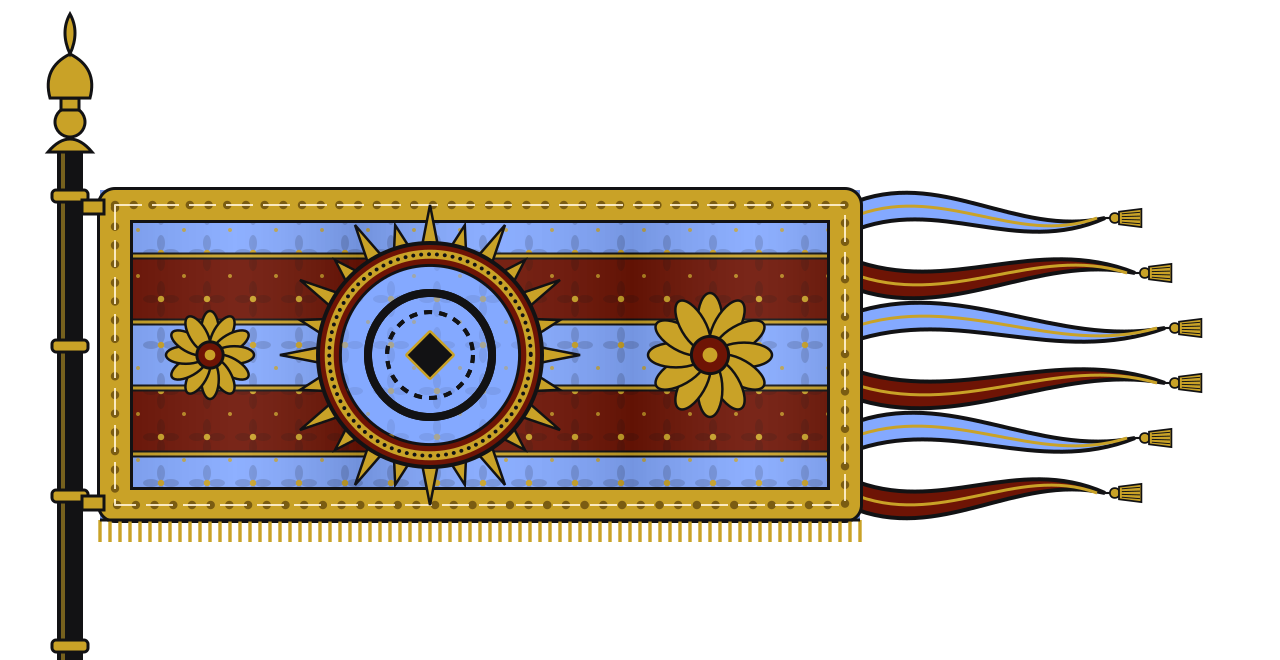
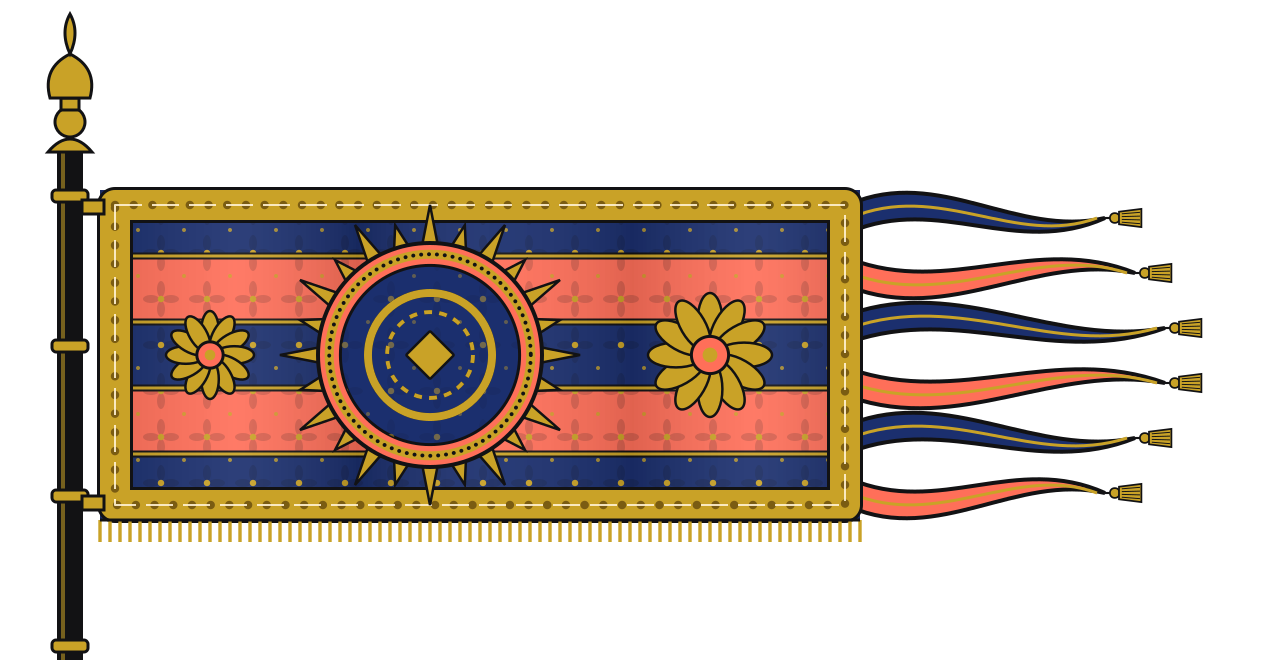
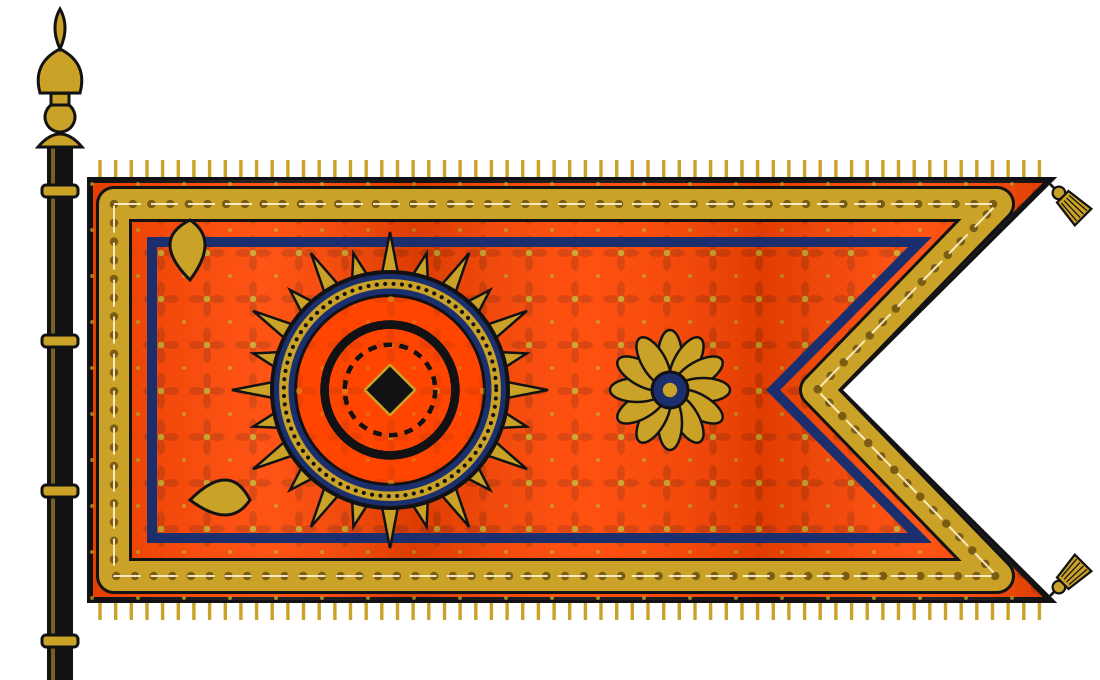
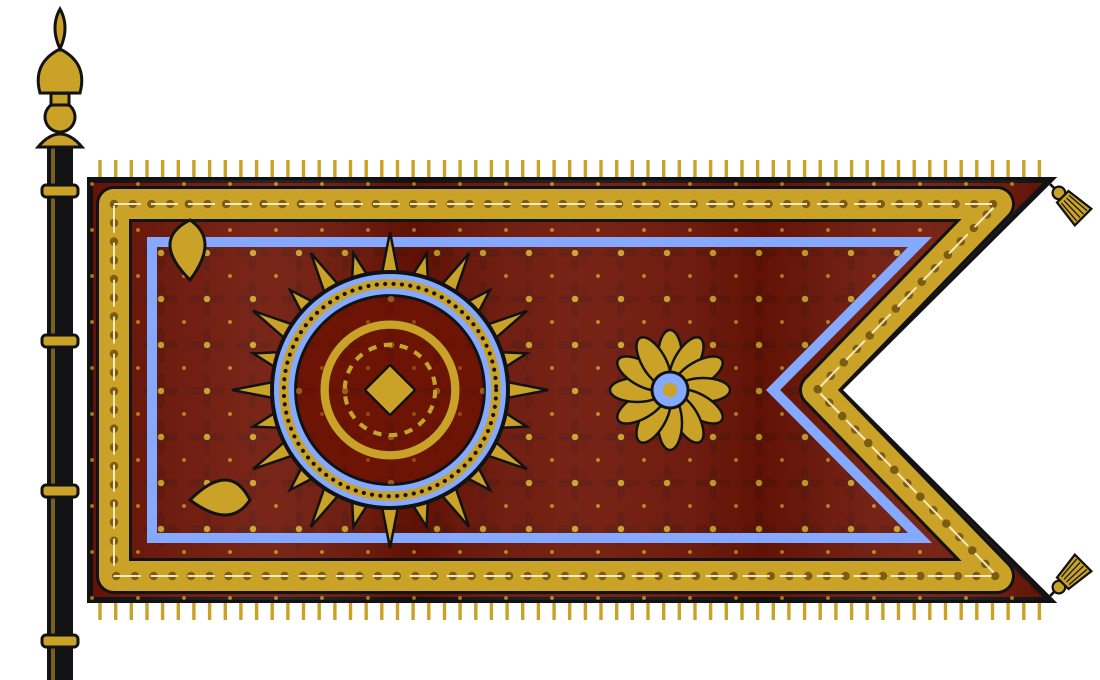
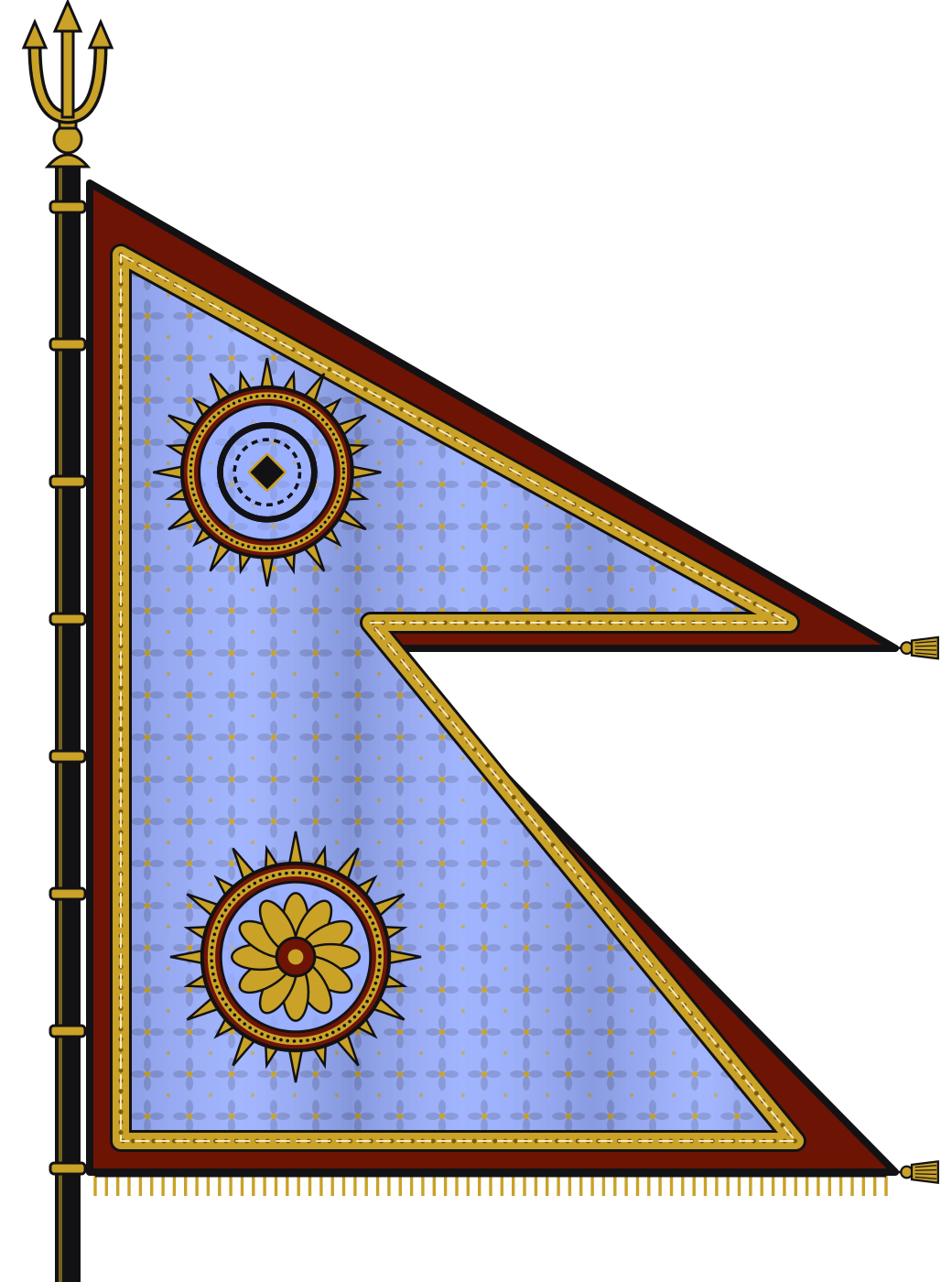
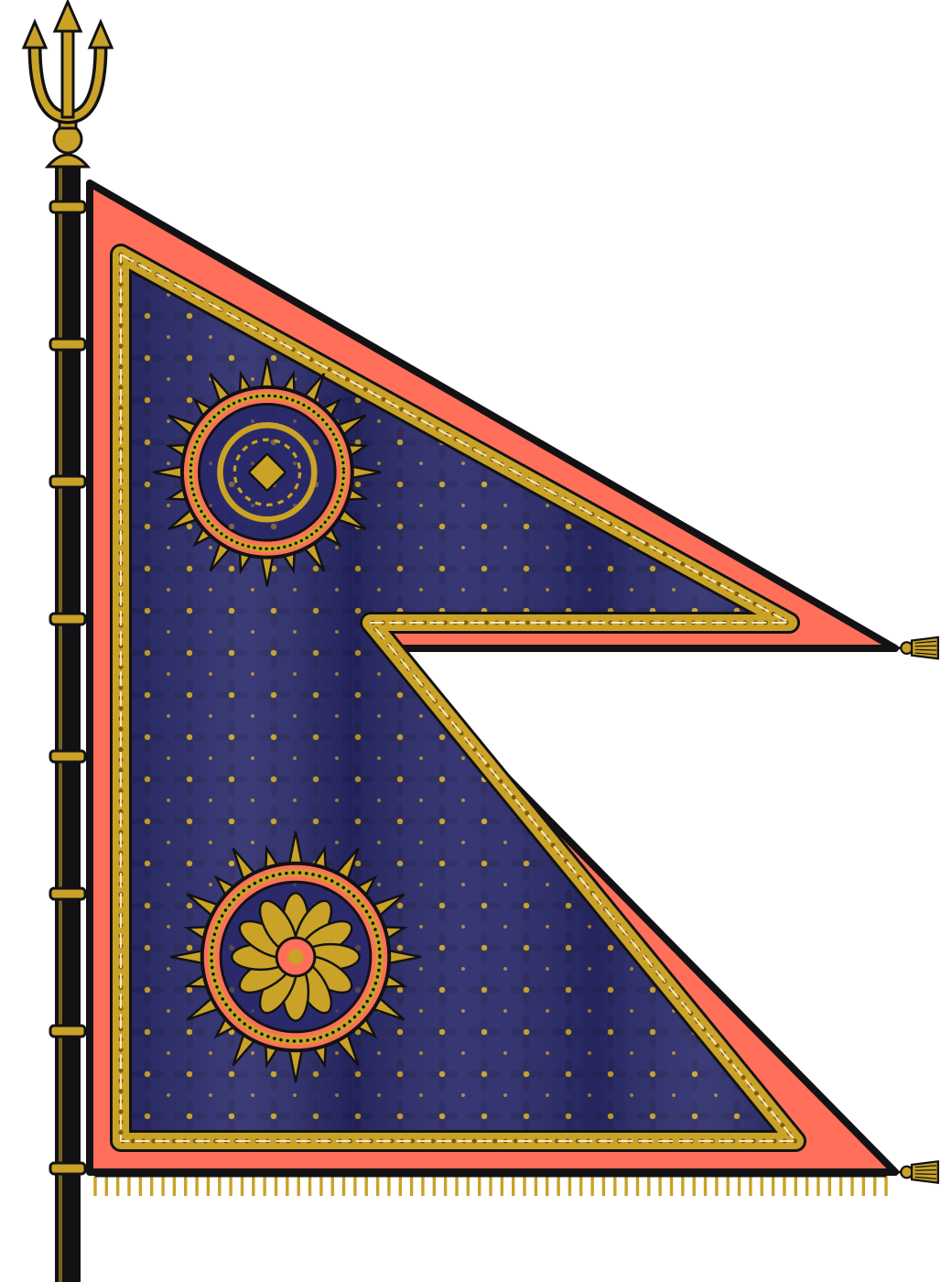
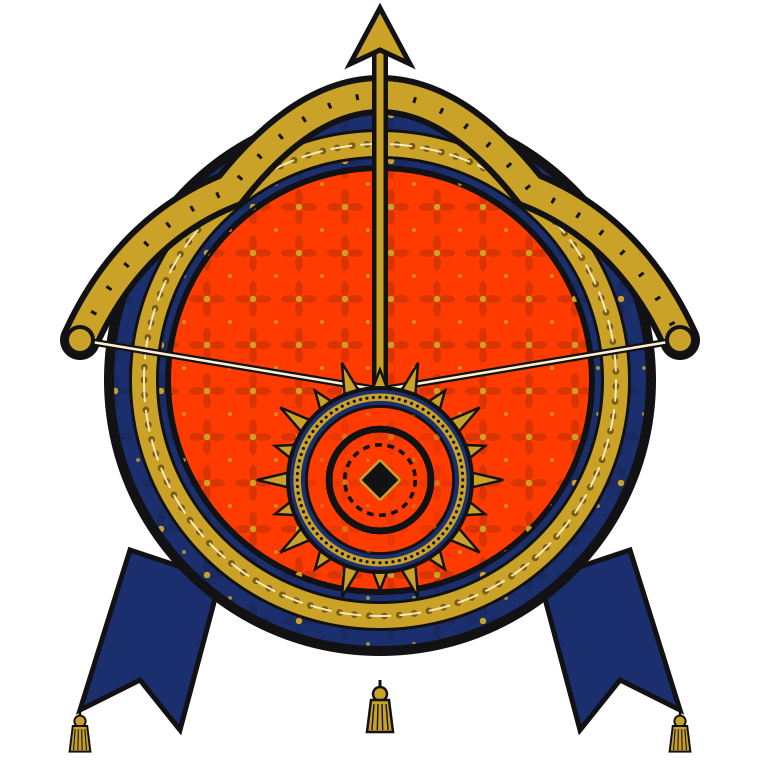
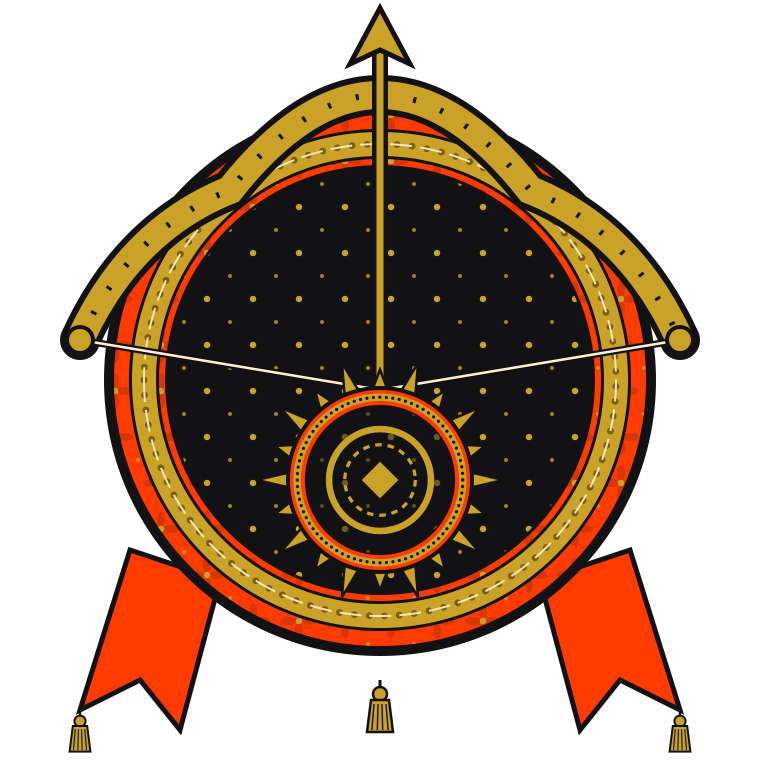
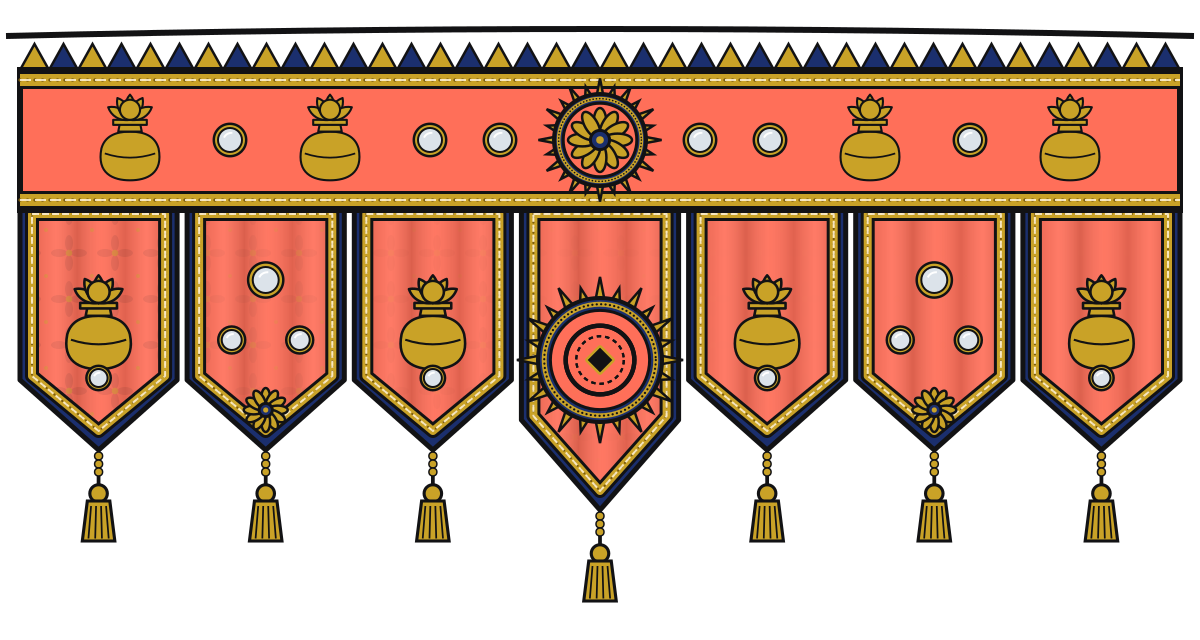
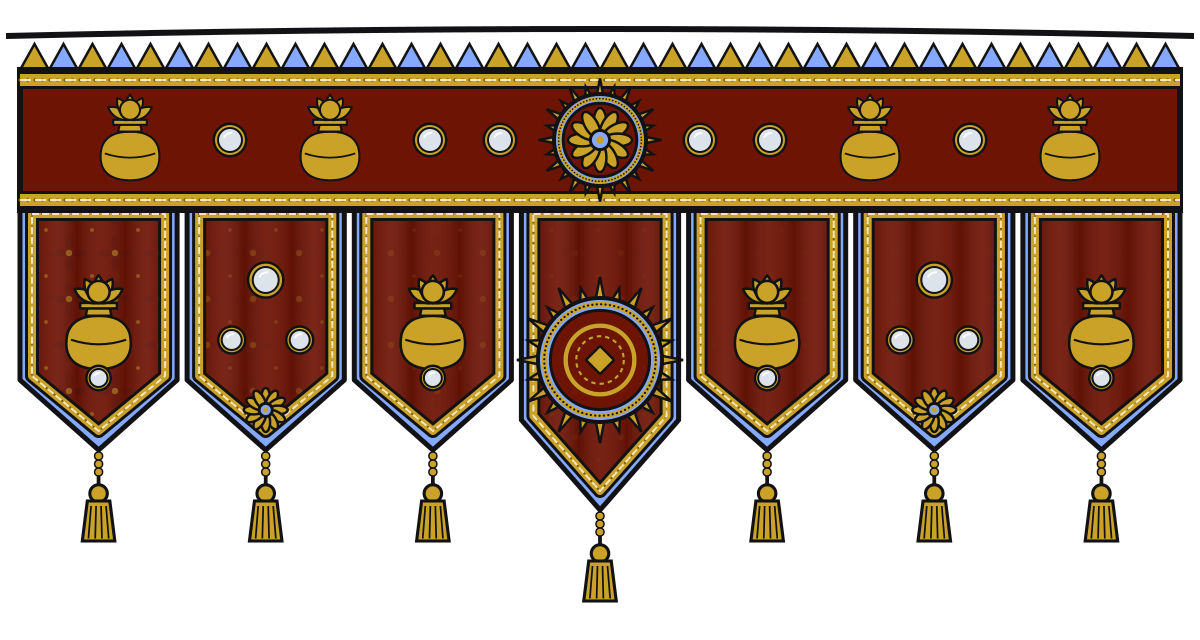
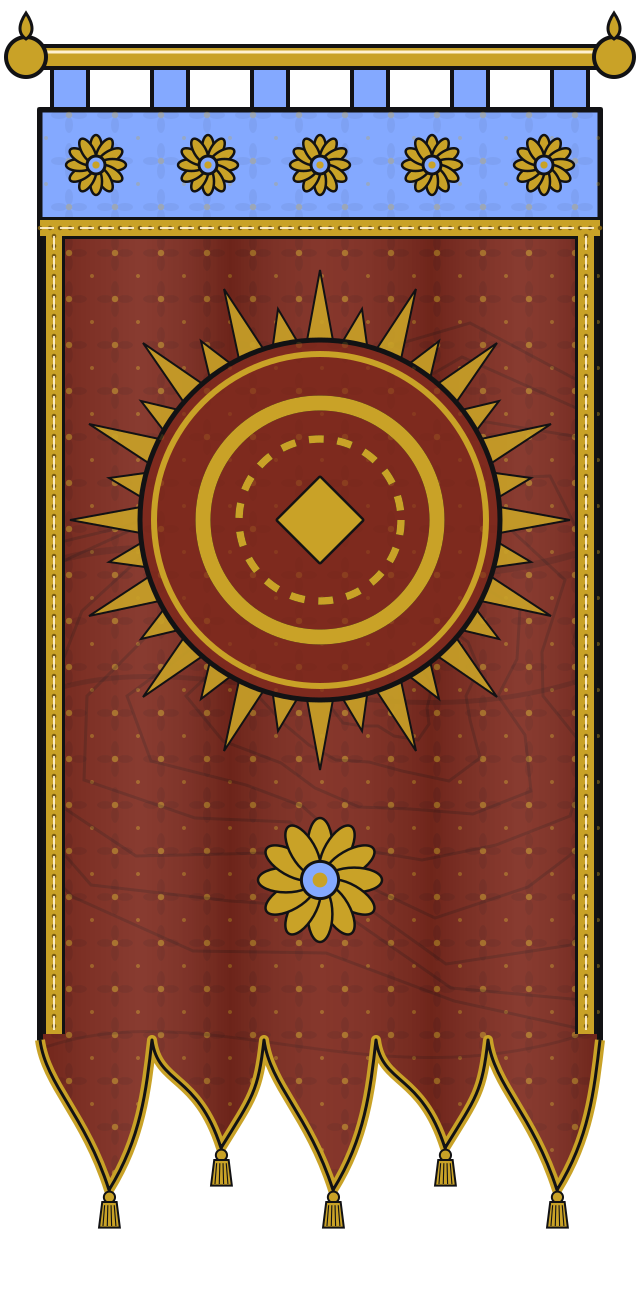
Historic banner
None known
New flag types
| Accessory | For this clan | Basis |
|---|---|---|
| A9 Pota-dhvaja · ship and trade flag For ships, caravans and markets | Not yet designed for this clan | Design |
| A10 Utsava-patāka · festival flag Light, bright flag for fairs and festivals | Not yet designed for this clan | Design |
| A11 Shoka-dhvaja · mourning flag White cloth with the emblem outline in the clan's metal | Not yet designed for this clan | Design |
7. Regalia
| Accessory | For this clan | Basis |
|---|---|---|
| E1 Chhatra · house parasol The ceremonial umbrella | Not yet designed for this clan | Design |
| E2 Chamara · fly-whisks The pair of whisks beside the head of the house | Not yet designed for this clan | Design |
| E3 Danda · staff of office Staff or scepter | Not yet designed for this clan | Design |
| E4 Simhasana · seat The seat of the house, covered in clan cloth | Not yet designed for this clan | Design |
| E5 Khetaka · shield A round shield; the Changi and Dhanush are its flag forms | Not yet designed for this clan | Regional tradition |
| E6 Kula-ayudha · clan weapon The weapon the clan honours | Not yet found for this clan | Under research |
8. Worn
| Accessory | For this clan | Basis |
|---|---|---|
| F1 Kula-vastra · clan cloth The clan's woven pattern in its kit colours | Lal pad cloth: saris, gamchhas and chadars, thick cotton in white and red लाल पाड़ The cloth the Chik Badaik weave[5] | Documented |
| F2 Kirti-vastra · honour cloth A cloth earned for a deed, not inherited | Not yet designed for this clan | Design |
| F3 Kula-mala · garland flower The flower or leaf the clan wears as a garland | Not yet found for this clan | Under research |
| F4 Chinha · house pin A metal badge with the pin emblem | Not yet designed for this clan | Design |
9. Records
| Accessory | For this clan | Basis |
|---|---|---|
| H1 Clan words A traditional line in the native script | लाल पाड़ · “Lal pad: the name of the cloth. Sahapedia glosses pad as the border (pad designs); the extract gives no gloss for lal. Not a motto.” Sahapedia, 2024[5]. No motto or line of the clan is in the extracts. | Documented |
| H2 Biruda · titles The house's title or titles | Baraik: a title that TRI says kings gave to weavers who fought, meaning great (reported, unsourced) बड़ाईक TRI's account of the title[4] | Documented |
| H3 Prashasti · praise genealogy The lineage as written at the head of a grant | Not yet found for this clan | Under research |
| H4 Vahi · clan register The book of the clan's births, marriages and deaths | Not yet found for this clan | Under research |
| H5 Rana-ghosha · war cry The clan's cry in battle or celebration | Not yet found for this clan | Under research |
10. VishwaVit · knower of the world
Game values are design choices for this project, not historical claims.
References
- Wikipedia, Tribes of Jharkhand, read 2026-10-20, https://en.wikipedia.org/wiki/Tribes_of_Jharkhand
- Wikipedia, List of Scheduled Tribes in West Bengal, read 2026-10-21, https://en.wikipedia.org/wiki/List_of_Scheduled_Tribes_in_West_Bengal
- Wikipedia, Chik Baraik, read 2026-11-11, https://en.wikipedia.org/wiki/Chik_Baraik
- Dr. Ramdayal Munda Tribal Welfare Research Institute, Jharkhand, Chik Baraik, read 2026-11-11, https://www.trijharkhand.in/en/chik-baraik
- Saroj Kerketta, झारखंड की आदिवासी वस्त्र कला परंपरा: बड़ाईक कपड़ा कारीगर, Sahapedia, 2024, read 2026-11-11, https://www.sahapedia.org/jhaarakhanda-kai-adaivaasai-vasatara-kalaa-paranparaa-badaaika-kapadaa-kaaraigara
- IndiaNetZone, Chik Baraik tribe, read 2026-10-26, https://www.indianetzone.com/chik_baraik_tribe
- IPL Myths blog, Mythologies of the Chick-Baraik Tribes (secondary compilation), Nov 2025, read 2026-11-11, https://iplmyths.blogspot.com/2025/11/mythologies-of-chick-baraik-tribe.html
- Sahapedia, लाल पाड़ : झारखंड के चिक बड़ाईक आदिवासियों की वस्त्र कला, read 2026-10-26, https://www.sahapedia.org/laala-paada-jhaarakhanda-kae-caika-badaaika-adaivaasaiyaon-kai-vasatara-kalaa-0
- Serials Publications journal abstract, Mandar makers of Chhotanagpur (title not printed in extract), read 2026-10-10, https://serialsjournals.com/abstract/74102_1-ahok.pdf