The Chenchu are a forest people of the Nallamala hills in Andhra Pradesh and Telangana, recorded as hunters and gatherers who do not cultivate the land[1]. Thurston recorded eight exogamous septs in 1909 (gurram, arati, manla, tota, mekala, indla, savaram and gundam), and the Tribal Tribune counts 26 exogamous clans[2][3]. They tell of the marriage of Narasimha of Ahobilam to a Chenchu girl in their own form, with Narasimha called Obalesudu and the girl Chenchita[2][4]. The Chenchu language is a Telugu-branch Dravidian language with 26,000 native speakers in 2007, and the Government of India lists the Chenchu as a PVTG (2020)[5].
01Faith and deities
[2] Thurston: the Chenchus are said to worship a god called Chenchu Devata, to whom honey and fruits are sometimes offered. The Atlas's KulDevi, Chenchu Lakshmi, is listed below.
Chenchu girl who married Narasimha (Srisailam / Ahobilam legend)[4]
A recorded tie between the clan and the goddess.
| Deity or tradition | Place in the clan's life | Evidence |
|---|---|---|
| Chenchu Devata | Said to be worshipped; honey and fruits sometimes offered | [2] |
| Lingamayya (Shiva) and Maisamma or Peddamma (Shakti) | Puja in Sravan (July–August) | [3] |
| Mallikarjuna at Srisailam | Incarnation of Shiva who married the Chenchu maiden Chenchu Laxmi; the Chenchus have special privileges at the temple | [3] |
| Narasimha of Ahobilam (Obalesudu to the Chenchus) | Carried off the Chenchu girl Chenchita; the Chenchus claim him as brother-in-law and carry cloths for the god and goddess at the annual festival (1909) | [2] |
| Chenchu Lakshmi | Consort of Narasimha at Ahobilam; a pillar at Lower Ahobilam shows Narasimha holding her chin, and the Thayar at Upper Ahobilam is named for her | [6][4] |
| Ankalamma, Potu Razu, Sunkalamma, Mallamma, Guruppa | Minor deities of the Chenchus | [2] |
02Temples
No temple built by the Chenchus is recorded in the extracts. Srisailam (Shiva and Devi Brahmaramba) is the temple where the Chenchus have special privileges[3]. The Srikalahasteeswara Temple is tied to the Kannappa story, in which Kannappa is said to be Chenchu[1]; no gift from the clan to it is recorded.
Built by the clan
Not recorded.
Given patronage or grants by the clan
| Temple | Deity | What the clan gave | When | Where |
|---|---|---|---|---|
| Sri Narasimha temple, Ahobilam | Narasimha; Chenchu Lakshmi as his consort | Honey, sandalwood and clothing; cloths for the god and goddess at the annual festival | Each Paruveta, from Makar Sankranti (January–February) | Allagadda mandal, Andhra Pradesh[7][6][2] |
03Languages and scripts
| Language or script | Kind | Under the clan | Evidence |
|---|---|---|---|
| Chenchu living | Dravidian language of the Telugu branch of the South-Central family | 26,000 native speakers (2007, Wikipedia infobox); described as vulnerable; 9,000 Chenchu speakers (Joshua Project, no year)[5][8] | [5] |
| Telugu living | Listed as spoken by the Chenchu | Telugu is listed as spoken by the Chenchu; use of Telugu has increased among Chenchu children (Reddy, 2019); Joshua Project gives 58,000 Telugu speakers among the people (no year)[1][5][8] | [5] |
| Telugu script living | The script of the Chenchu language | The Chenchu language is written with the Telugu alphabet; no native-script text of Chenchu is printed in the extracts[5] | [5] |
| Kannada, Odia, Tamil | Other languages spoken among the people | Kannada 700, Odia 200 and Tamil 100 speakers (Joshua Project, no year) | [8] |
04Books and literature
The Chenchu language is described as vulnerable. Books about the people are listed by title and author as the extracts give them.
Written during the clan's history
| Work | Author | Kind | When | Link to the clan |
|---|---|---|---|---|
| The Chenchus: A Jungle Folk of the Deccan | Christoph von Fürer-Haimendorf | Book | 1943 | [1] |
| Castes and Tribes of Southern India, vol. 2, Chenchu entry | Edgar Thurston and K. Rangachari | Book | 1909 | [2] |
| Adavichenchara Samskruti (in Kannada) | Prahlad Betageri | Book in Kannada | 1993 | [1] |
| Article on the Chenchu language, Int. J. Dravidian Linguistics 48(1): 45–56 (title not given in the extract) | V. S. S. Reddy | Linguistics | 2019 | [5] |
| Dravidian Linguistics, p. 57 | Zvelebil | Linguistics | 1990 | [5] |
| The Dravidian Languages, p. 208 | Krishnamurti | Linguistics | 2003 | [5] |
Given patronage by the clan
Not recorded.
05Thinkers and scholars
| Name | Field | Era | Contribution |
|---|---|---|---|
| Edgar Thurston and K. Rangachari | Author | 1909 | Chenchu entry: septs, marriage, songs, deities and the older accounts[2] |
| Christoph von Fürer-Haimendorf | Author | 1940s | Study of the Chenchus; the SOAS film archive holds a silent Chenchu clip[1][9][10] |
| Prahlad Betageri | Book in Kannada | 1993 | Adavichenchara Samskruti[1] |
| V. S. S. Reddy | Linguistics | 2019 | Chenchu language and the use of Telugu among children[5] |
| P. V. Sathya Mohan | Writer | Not dated | The Chenchu of Andhra Pradesh, Tribal Tribune[3] |
06Art and architecture
A 1958 Telugu film, Chenchu Lakshmi, is listed[1]. The Ahobilam carvings are the nearest art the extracts describe.
Painting and wall art
Not recorded.
Sculpture and temple art
| Art form | What it is | Era | Evidence |
|---|---|---|---|
| Pillar, Lower Ahobilam | Narasimha holds the chin of Chenchu Lakshmi | Not dated | [6] |
| Thayar, Upper Ahobilam | The consort is named Chenchu Lakshmi | Not dated | [6] |
Temple and building architecture
Not recorded.
Weaving and textiles
Not recorded.
Clothing and jewellery
Not recorded.
Coins, pottery and crafts
Not recorded.
07History
1694: the first description
Ferishta's account of 1694, as Thurston quotes it, describes Chenchus before Prince Muhammad Masum in the Kurnool district: black, long-haired, wearing caps of leaves, with bows and unbarbed arrows, living in caverns or under trees[2].
Colonial descriptions
Taylor's Catalogue raisonné places the Chenchus west of Ahobalam and Srisailam, carrying bows and arrows, clothing themselves with leaves and living on bamboo rice[2]. Thurston also cites Newbold, who wrote in 1846[2].
Headmen and courts
The Kurnool Manual says the Chenchu headman formerly disposed of murder cases[2].
One officer's view of toll and debt
A forest officer, quoted by Thurston, says the Chenchus levy a toll from pilgrims to Srisailam and are in debt to the Komatis; Thurston gives it as the officer's account[2].
Schools, 1904–05
In 1904–05 there were two Board upper primary schools for Chenchus in Kurnool district, with 73 pupils[2].
The semi-settled belt, as recorded in 1909
Thurston describes the Chenchus of the belt from Venkatapuram to Bairnuti as semi-civilised, with herds and fields, and credits the change to one Englishman at Bairnuti[2]. The Tribal Tribune describes the Chenchus of the Nallamalai forests as a food-gathering, hunting tribe[3].
A kineri in 1940
A 1940 photograph in the SOAS library shows the Chenchu headman of Malapur, a settlement of five houses in Mahbubnagar District, playing a kineri[10].
The kinnera returned, 2024
The kinnera, lost to the Chenchu about 50 years ago when the gourd for its resonator became locally extinct, was restored to the Chenchu at Appapur hamlet in the Nallamala forests on 9 August 2024[9].
Puranas and chronicles
The Tribal Tribune says the Chenchus have a special place in the Puranas, temple records and chronicles[3]. The extracts do not name the texts.
Kakatiya and Vijayanagara periods
Under research. The Atlas names the Kakatiya and Vijayanagara rule as the polity the Chenchu lived under, but no Chenchu evidence from either period is in the extracts. Leads: inscriptions at Ahobilam and Srisailam; Furer-Haimendorf 1943 (not online in this run).
08Journey and migrations
No migration of the Chenchu is recorded in the extracts. The Newbold origin legend (Yerra Golla shepherds) is a legend, not a move.
Not recorded.
09Seats and lands
| Place | Role | Where today |
|---|---|---|
| Nallamala forest | Homeland of the Chenchu | Telangana and Andhra Pradesh[1] |
| Srisailam | Temple where the Chenchus have special privileges | Nallamala forest[3] |
| Ahobilam | Narasimha shrine and the Paruveta festival | Allagadda mandal, Andhra Pradesh (Wikipedia gives Nandyal district; Sri Narasimha Kutumbam gives Kurnool)[7][4] |
| Appapur hamlet | Where the kinnera was returned in 2024 | Nallamala forests, Mahabubnagar district, Telangana[9] |
| Malapur | Settlement of five houses; the 1940 kineri photograph | Mahbubnagar District[10] |
| Kurnool district | 1904–05 schools; Taylor's Chenchus west of Ahobalam | Andhra Pradesh[4] |
| Venkatapuram to Bairnuti belt | Semi-settled Chenchus, as Thurston saw them in 1909 | Not located in the extracts[2] |
| Sundergarh and Baragarh | Odisha districts, as the KISS handbook prints them | Odisha[11] |
10Notable figures
| Name | Role | Era | Known from |
|---|---|---|---|
| Kannappa legend | Legendary Shaiva saint, one of the 63 Nayanmars, said to be Chenchu and believed a reincarnation of Arjuna | Legend | [1] |
| Chenchu Lakshmi legend | Chenchu girl who married Narasimha of Ahobilam; in tradition Mahalakshmi born in the tribe | Legend | [4][6] |
| Chenchita legend | The Chenchu girl taken by Obalesudu (Narasimha) in the Chenchu version | Legend | [2] |
| Mallikarjuna and Chenchu Laxmi legend | Srisailam couple; the Chenchus believe they descend from them (community belief) | Legend | [3] |
| Chenchu headman of Malapur (unnamed) | Headman playing a kineri in a 1940 photograph | 1940 | [10] |
| Peddamanishi | Village elder | Not dated | [3] |
| Kularaju | Priest who officiates at marriage | Not dated | [3] |
11Allies, rivals and marriages
| People | Relationship | When |
|---|---|---|
| Yanadi | Census 1891 gave Chenchu as a Yanadi sub-division; the Chenchus say they and the Yanadis are one[2] | 1891; 1909 |
| Irulas | Buchanan's 'Cat Chensu' were Irulas; the Census of 1901 gave Chenchu as a name for Irulas[2] | 1901 |
| Bonthuk Savara | Called 'Chenchu vandlu'; they too say Narasimha of Ahobilam married a girl of their tribe[2] | As recorded in 1909 |
| Banjara | Herders who graze cattle in the forest and have been allotted land there[1] | Not dated |
| Dakkali | Troubadours who inherited the kinnera; the instrument was handed back to the Chenchu by Dakkali Pochaiah[9] | 2024 |
| Non-tribal residents | Rent land from the Chenchus and pay a share of the harvest; relations described as largely symbiotic[1] | Not dated |
| Gondi and Telugu people | Listed as related groups[1] | Not dated |
12Society and livelihood
The Chenchu live in small settlements of huts grouped by kinship[3], and marry outside their exogamous septs[2].
Government and social order
| Institution or group | What it was | Evidence |
|---|---|---|
| Sept (intiperu) | Exogamous clans like gotras: no marriage within the clan; a woman joins her husband's clan | [3][2] |
| Penta | The village: huts spaced apart and grouped by kinship | [3] |
| Peddamanishi | Village elder | [3] |
| Kularaju | Priest who officiates at marriage | [3] |
| Uttaluri elders | Must be present at marriages | [3] |
| Headman | Formerly disposed of murder cases (Kurnool Manual, as Thurston quotes it) | [2] |
| Family and property | Patrilineal; the nuclear family is the basic unit; property is jointly owned | [8] |
| Marriage (pelli) | The bride's maternal uncle gives her away; divorce allowed; widow remarriage common | [3][2] |
| Marriage forms | Recorded by the Kurnool Manual: a night away by mutual consent; a cow-dung circle with a bow and arrow fixed in it; a Brahmin-led tali-tying, which Thurston calls a recent innovation. Arrows are set between the couple, and the marriage is complete when an arrow casts no shadow | [2] |
| Birth and burial | Cord cut with a knife or arrow; name given on the fourth day by an old woman; deer-skin cradle. The dead are carried in cloth, buried under a mound of earth and stones, and food is offered on the 2nd or 3rd and the 8th day | [2] |
| Settlement | Permanent villages average seven houses, occupied 10–15 years; hive-shaped wattle-thatch houses | [8] |
Livelihood over time
Not recorded.
13Sub-clans and related clans
Thurston (1909) records the Chenchu septs, which he calls intiperu. The Tribal Tribune counts 26 exogamous clans, like gotras, and names one of them, Uttaluri. Only the names below are in the extracts.
| Clan | Relation | Where | Size | In the Atlas | Evidence |
|---|---|---|---|---|---|
| Gurram | Sub-clan | new clan candidate | [2] | ||
| Arati | Sub-clan | new clan candidate | [2] | ||
| Manla | Sub-clan | new clan candidate | [2] | ||
| Tota | Sub-clan | new clan candidate | [2] | ||
| Mekala | Sub-clan | new clan candidate | [2] | ||
| Indla | Sub-clan | new clan candidate | [2] | ||
| Savaram | Sub-clan | new clan candidate | [2] | ||
| Gundam | Sub-clan | new clan candidate | [2] | ||
| Uttaluri | Sub-clan | new clan candidate | [3] | ||
| Yanadi | Related people | new clan candidate | [2] | ||
| Irulas | Related people | new clan candidate | [2] | ||
| Bonthuk Savara | Related people | new clan candidate | [2] | ||
| Lambadi | Related people | Nallamala forest, where Banjara herders graze | ST-173 | [1] | |
| Dakkali | Related people | Mahabubnagar district | new clan candidate | [9] |
Clans marked "new clan candidate" are not in the Atlas yet.
14Surnames
No clan or family name in the extracts is recorded as a surname. Thurston gives the septs as intiperu and does not say they are used as surnames today.
Not recorded.
15Songs and music
The extracts give one Chenchu song: a marriage song recorded in 1909. No other Chenchu song text is in the extracts.
Marriage song (Thurston's phonograph recording)
The refrain names the lord of the Chenchus; the song is in Thurston's English rendering[2].
The tali was of avaram leaves, Oh! the lord of the Chenchus.“Thurston's English rendering, 1909”
Instruments and styles
| Instrument or style | What it is | Evidence |
|---|---|---|
| Kinnera (kineri) revived | Stringed instrument with three resonators of dried gourds, a bamboo neck, strings of human hair or animal nerve, and frets of pangolin scale fixed with honey-wax. Lost about 50 years ago; restored to the Chenchu in 2024[9] | [9] |
| Thappata | A big tambourine-like drum for a dance, warmed over a blazing cholum straw fire. Reported in 1909; current use is not in the extracts | [2] |
16Poems, lullabies and children's rhymes
No Chenchu poem, lullaby or children's rhyme is in the extracts.
None recorded yet.
17Stories, legends and proverbs
Stories and legends
| Story | What happens | Told by | Evidence |
|---|---|---|---|
| Obalesudu and Chenchita legend | The Chenchu version: Narasimha of Ahobilam, called Obalesudu, carried off the Chenchu girl Chenchita and married her; Chenchita ordained that women be born ugly | The Chenchus, as recorded in 1909 | [2] |
| Narasimha and Chenchu Lakshmi legend | She puts him through many tests before she agrees to marry him; he is shown with her as Kalyana Murthy at Ahobilam | Sri Narasimha Kutumbam; Hindu Blog | [4][6] |
| The marriage in performance | Veedhinatakams, Harikatha and Burra katha portray the marriage; the Sanskrit play Vaasantika Parinayam dramatises it | Performers; the play is by the seventh Jeeyar (Hindu Blog) | [12][6] |
| Mallikarjuna and Chenchu Laxmi legend | The Shiva incarnation Mallikarjuna marries a Chenchu maiden; the Chenchus believe they descend from the couple | The Chenchus (community belief, Tribal Tribune) | [3] |
| Kannappa legend | Legendary saint said to be Chenchu, linked to the Srikalahasteeswara Temple | The Shaiva tradition (Wikipedia) | [1] |
| Yerra Golla origin legend | The Chenchwars were Yerra Golla shepherds before Krishna; Obal Iswara took a Golla maid as Chenchita | Newbold (1846), as Thurston cites him | [2] |
Proverbs and sayings
Not recorded.
18Festivals and fairs
| Festival or fair | When | Where | What happens |
|---|---|---|---|
| Paruveta (mock hunting festival) | Begins at Makar Sankranti, generally January–February; Kanuman, the day after Sankranti (Hindu Blog) | Sri Narasimha temple, Ahobilam, Allagadda mandal, and the Chenchu communities around it | The deity travels to the 32 Chenchu communities around Ahobilam over 40 days; Chenchu men shoot arrows and women dance; the Chenchus gather honey, linen and sacred mango leaves; the Chenchus receive the first prasadam; the Vadla Kammara community builds the palanquin; INTACH is working for UNESCO recognition[12][6] |
| Sravan puja | Sravan (July–August) | Shiva as Lingamayya and Shakti as Maisamma or Peddamma | Puja to Lingamayya and Maisamma or Peddamma[3] |
| Brahmotsavas | Every year in the month of Phalguna | Ugra (Ahobila) Narasimha temple, Ahobilam | Annual festival of the Ahobilam shrine[4] |
19Food, dress and games
Food
| Item | What it is | Evidence | |||||||||||||||||||||||||||||||||||||||||||||||||||||||||||||||||||||||||||||||||||||||||||||||||||||||||||||||||||||||||||
|---|---|---|---|---|---|---|---|---|---|---|---|---|---|---|---|---|---|---|---|---|---|---|---|---|---|---|---|---|---|---|---|---|---|---|---|---|---|---|---|---|---|---|---|---|---|---|---|---|---|---|---|---|---|---|---|---|---|---|---|---|---|---|---|---|---|---|---|---|---|---|---|---|---|---|---|---|---|---|---|---|---|---|---|---|---|---|---|---|---|---|---|---|---|---|---|---|---|---|---|---|---|---|---|---|---|---|---|---|---|---|---|---|---|---|---|---|---|---|---|---|---|---|---|---|---|
| G | r | u | e | l | o | f | j | o | w | a | r | o | r | m | a | i | z | e | , | a | n | d | b | o | i | l | e | d | t | u | b | e | r | s | [ | [ | e | t | r | i | b | a | l | _ | c | h | e | n | c | h | u | _ | a | n | d | h | r | a | ] | ] | |||||||||||||||||||||||||||||||||||||||||||||||||||||||||||||||||
| Y | a | m | s | d | u | g | w | i | t | h | a | n | i | r | o | n | - | t | i | p | p | e | d | d | i | g | g | i | n | g | - | s | t | i | c | k | , | f | o | r | e | s | t | f | r | u | i | t | s | a | n | d | a | n | i | m | a | l | s | ; | f | o | n | d | o | f | m | a | h | u | a | f | l | o | w | e | r | s | a | n | d | t | a | m | a | r | i | n | d | [ | [ | t | h | u | r | s | t | o | n | _ | 1 | 9 | 0 | 9 | _ | v | 2 | ] | ] | ||||||||||||||||
| H | o | n | e | y | , | r | o | o | t | s | , | f | r | u | i | t | s | , | b | e | e | d | i | l | e | a | f | , | m | a | h | u | a | f | l | o | w | e | r | a | n | d | g | u | m | [ | [ | e | t | r | i | b | a | l | _ | c | h | e | n | c | h | u | _ | a | n | d | h | r | a | ] | ] | [ | [ | t | h | u | r | s | t | o | n | _ | 1 | 9 | 0 | 9 | _ | v | 2 | ] | ] |
Dress
| Item | What it is | Evidence | ||||||||||||||||||||||||||||||||||||||||||||||||||||||||||||||||||||||||||||||||||||||||||||||||||||||||||||||||||||||
|---|---|---|---|---|---|---|---|---|---|---|---|---|---|---|---|---|---|---|---|---|---|---|---|---|---|---|---|---|---|---|---|---|---|---|---|---|---|---|---|---|---|---|---|---|---|---|---|---|---|---|---|---|---|---|---|---|---|---|---|---|---|---|---|---|---|---|---|---|---|---|---|---|---|---|---|---|---|---|---|---|---|---|---|---|---|---|---|---|---|---|---|---|---|---|---|---|---|---|---|---|---|---|---|---|---|---|---|---|---|---|---|---|---|---|---|---|---|---|---|---|
| C | a | p | s | o | f | l | e | a | v | e | s | ( | F | e | r | i | s | h | t | a | ' | s | a | c | c | o | u | n | t | o | f | 1 | 6 | 9 | 4 | ) | a | n | d | c | l | o | t | h | i | n | g | o | f | l | e | a | v | e | s | ( | T | a | y | l | o | r | ) | , | a | s | T | h | u | r | s | t | o | n | q | u | o | t | e | s | t | h | e | m | [ | [ | t | h | u | r | s | t | o | n | _ | 1 | 9 | 0 | 9 | _ | v | 2 | ] | ] |
Games and martial arts
Not recorded.
Tags: living still practised · revived brought back after a break · lost known only from records · research reported but not yet confirmed from a source. Songs and poems under copyright are listed by title only; restricted or sacred material is noted without its content.
20Status today
The Chenchu are a living Scheduled Tribe and PVTG. Many are now farmers or forest labourers, and the forest is a tiger reserve where efforts to shift to farming failed[8][3][1].
Recognised heritage
| What | Recognition | Evidence |
|---|---|---|
| Paruveta festival at Ahobilam | INTACH is working for UNESCO recognition (Outlook Traveller, 2024) | [12] |
| Kinnera (Chenchu, Dakkali) | Restored to the Chenchu at Appapur hamlet on 9 August 2024 by a team led by Jayadhir Tirumal Rao; co-presented by Telangana Rachayithala Vedika and the University of Hyderabad | [9] |
| Srisailam temple privileges | The Chenchus have special privileges at the temple (Tribal Tribune) | [3] |
No community review of this page is recorded in the extracts.
21For children
The brother-in-law of the forest
Long ago, in the Nallamala forest, lived the Chenchu people. They are hunters and gatherers, and they know the forest well. They gather honey from the cliffs with a long bamboo rope. They dig up yams with a digging stick and make fire with flint. The Chenchus tell a story that the god Narasimha of Ahobilam married a Chenchu girl, so they call him their brother-in-law. Each year, at the festival called Paruveta, the god visits the Chenchu villages around Ahobilam. The Chenchus receive the first prasadam.
22Across the project
| Project | What carries this clan | Status |
|---|---|---|
| Atlas of the Janas | Pin not yet set. The Ahobilam shrine is at 15.1333 N, 78.7167 E (Wikipedia); the homeland is the Nallamala forest | To check |
| KulDevi and GrahDevi | Chenchu Lakshmi (KD-109), Ashtalakshmi family; GrahDevi forms Adi Lakshmi to Dhana Lakshmi | From the Atlas |
| Planet naming | Star and planets not yet checked against the Tier registers | To check |
| Renaming and waters | No place or water name taken from the Chenchus is in the extracts | — |
23Open questions
- No fetched page prints a Telugu form of the name, so the header carries none. Joshua Project prints the Devanagari form चेंचू (see info).
- The Tribal Tribune counts 26 exogamous clans and names only Uttaluri. core.ac.uk/download/213412722.pdf (unread) may list more.
- Irulas (Thurston) may be the sheet's Irular (ST-106); Bonthuk Savara and Yanadi are not in the sheet. Check before merging.
- Population: 65,000 (Wikipedia, no year), 75,000 (Joshua Project, no year), 280,764 (1981 census, per the language page), 13 in Odisha (2011). A current census figure is needed.
- Speakers: 26,000 (2007, Wikipedia infobox) against 9,000 Chenchu speakers (Joshua Project, no year).
- Paruveta: the Hindu Blog says 33 villages; Outlook Traveller says 32 Chenchu communities.
- The 2025 Telangana case report names the Chenchu among the groups petitioners say were recognised from 1950. That is a petitioners' claim, not checked[14].
- Kakatiya and Vijayanagara periods: no Chenchu evidence was fetched. Inscriptions and migration are unresearched.
- Furer-Haimendorf 1943 is not online in this run. Read it for songs, proverbs, septs and any totems.
- Narasimha's kin term: Thurston and Outlook Traveller give brother-in-law (the Chenchus' claim); the Hindu Blog says the Chenchus call him son-in-law. Both are kept as their sources print them.
- Totems and sacred trees: no extract calls the sept names (horse, plantain tree and others) totems. Do not call them totems until a source does.
- The Srisailam privileges (Tribal Tribune) and the forest officer's toll account (Thurston) need the primary sources.
- No Chenchu-built temple is found. Descent from Mallikarjuna and Chenchu Laxmi is a community belief, not a documented descent.
- Cultivation: the lead says the Chenchu 'do not cultivate the land' (Wikipedia, of the people as recorded), while today.summary says many are now farmers (Joshua Project, no year) and efforts to shift to farming failed (Tribal Tribune).
24Astitva
अस्तित्व · being, existence: everything by which the clan is known
Documented for the Chenchu: the bow and arrow, the main tools[3][2]; arrows set on the marriage dais and in the marriage circle[2]; the kinnera, lost about 50 years ago and restored in 2024[9]; and the thappata drum. No coin, seal, plate, title, prashasti, war cry or totem is recorded.
Every clan has every accessory, royal objects included. Each one says how it is known: Documented This clan's own object is recorded. · Regional tradition Recorded for the region or for peoples like this one, not for this clan. · Design Made for this project, with no historical claim. · Under research To be found for this clan from sources. Legends and titles are written in the clan's own script.
1. Seals and coins
| Accessory | For this clan | Basis |
|---|---|---|
| B1 Rajamudra · house seal Round seal with the clan emblem and a short legend in the clan's script | Not yet designed for this clan | Design |
| B2 Anguliya-mudra · signet ring Personal seal ring of the head of the house | Not yet designed for this clan | Design |
| B3 Chhapa · house stamp Ink or block stamp for letters, goods and cloth | Not yet designed for this clan | Design |
| B4 Tamrapatra · charter plate Copper-plate grant on a ring, closed with the house seal | Not yet designed for this clan | Design |
| B5 Shreni-mudra · guild or trade seal Seal for the clan's trade, craft or caravan | Not yet designed for this clan | Design |
| C1 Clan coin Emblem or deity on one side, a legend in the clan's script | Not yet designed for this clan | Design |
| C2 Coin die The die that strikes the coin | Not yet designed for this clan | Design |
2. Living symbols
| Accessory | For this clan | Basis |
|---|---|---|
| I1 Totem trio The tree, bird and animal the clan protects | Not yet found for this clan | Under research |
| I2 Kaval-maram · guardian tree The tree that stands at the clan's seat | Not yet found for this clan | Under research |
3. Stone and gate
| Accessory | For this clan | Basis |
|---|---|---|
| G1 Torana · gateway The built gate of the seat; the cloth Toran hangs in it | Not yet designed for this clan | Regional tradition |
| G2 Viragallu · hero stone Carved panel stone for a member who died defending the clan | Not yet designed for this clan | Regional tradition |
| G3 Kula-shila · clan stones Standing and table stones that remember the ancestors | Not yet designed for this clan | Design |
| G4 Jayastambha · victory pillar A pillar raised for a victory | Not yet designed for this clan | Design |
| G5 Sima-shila · boundary stone Marks the clan's land, with a line in the native script | Not yet designed for this clan | Design |
4. Sounds
| Accessory | For this clan | Basis |
|---|---|---|
| D1 Pancha-mahashabda · five great sounds The right to five instruments | Not yet designed for this clan | Design |
| D2 Shankha · clan conch The clan's own named war conch | Not yet designed for this clan | Design |
| D3 Murasu · house drums Three drums: war, charity and justice | Not yet designed for this clan | Design |
5. Kit: colours, metals and emblems
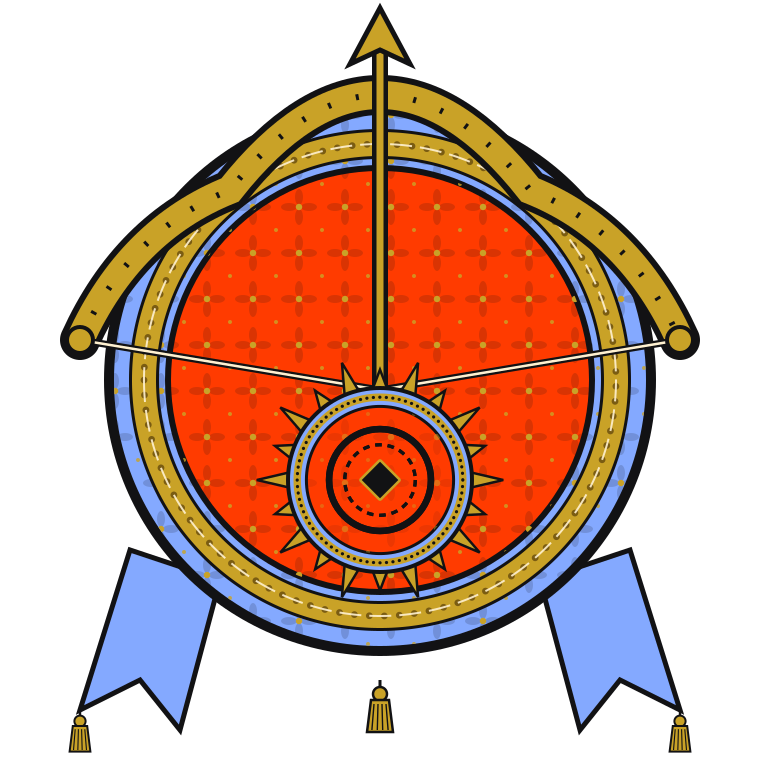
Nothing in the extracts documents a Chenchu coin, seal or emblem. The flag and banner are design work. The bow is documented as the people's main tool[3].
| Part of the kit | This clan |
|---|---|
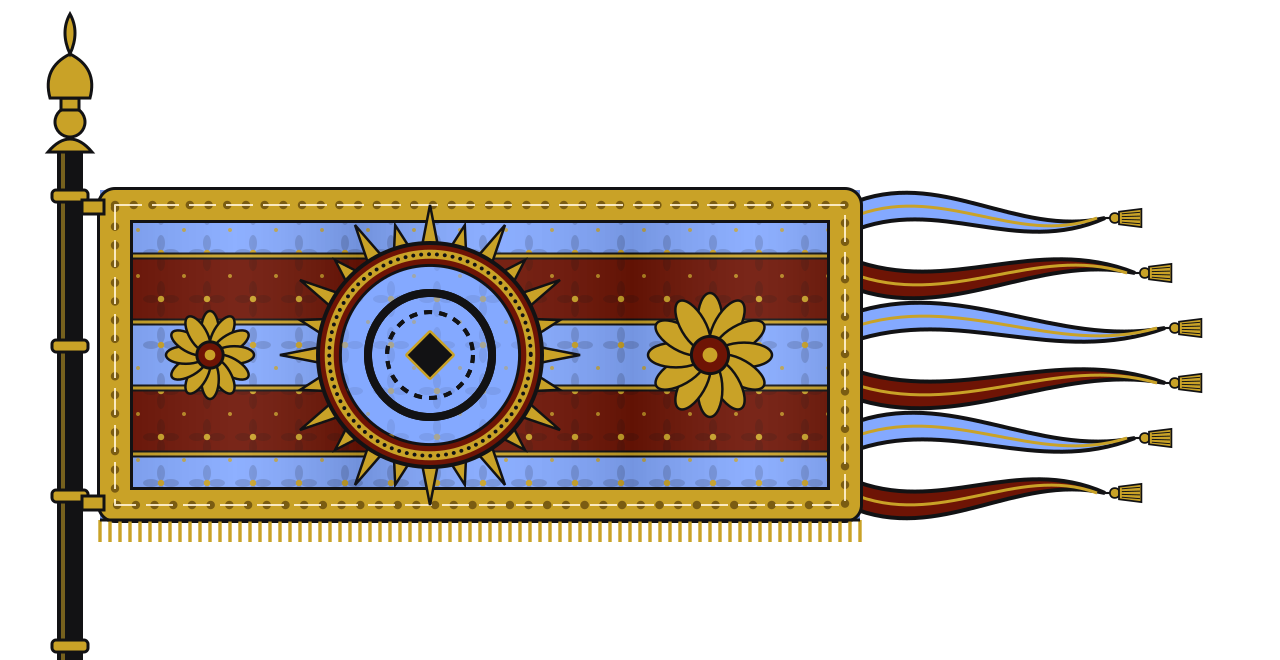
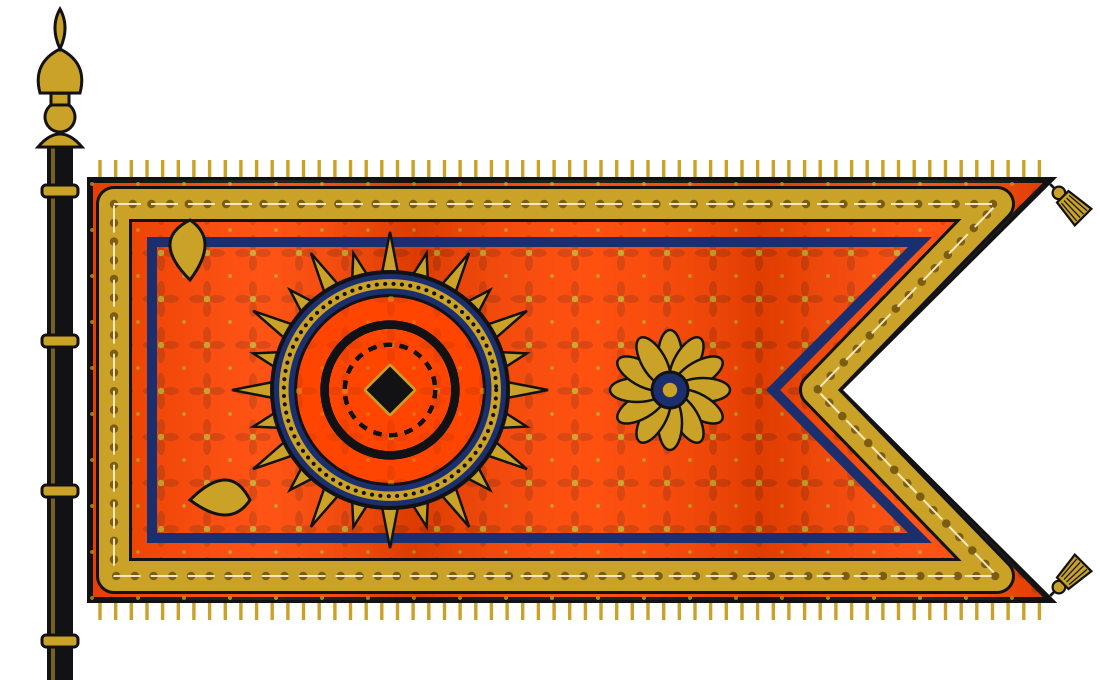
| Field | Deep Crimson Red #FF3B00 |
| Accent | Intense Electric Blue #84A9FF |
| Emblem colour | Charcoal Black #121214 |
| Zari metal | Gold |
| Main emblem | A bow hidden in forest shadows |
| Second image | A lion-headed deity silhouette |
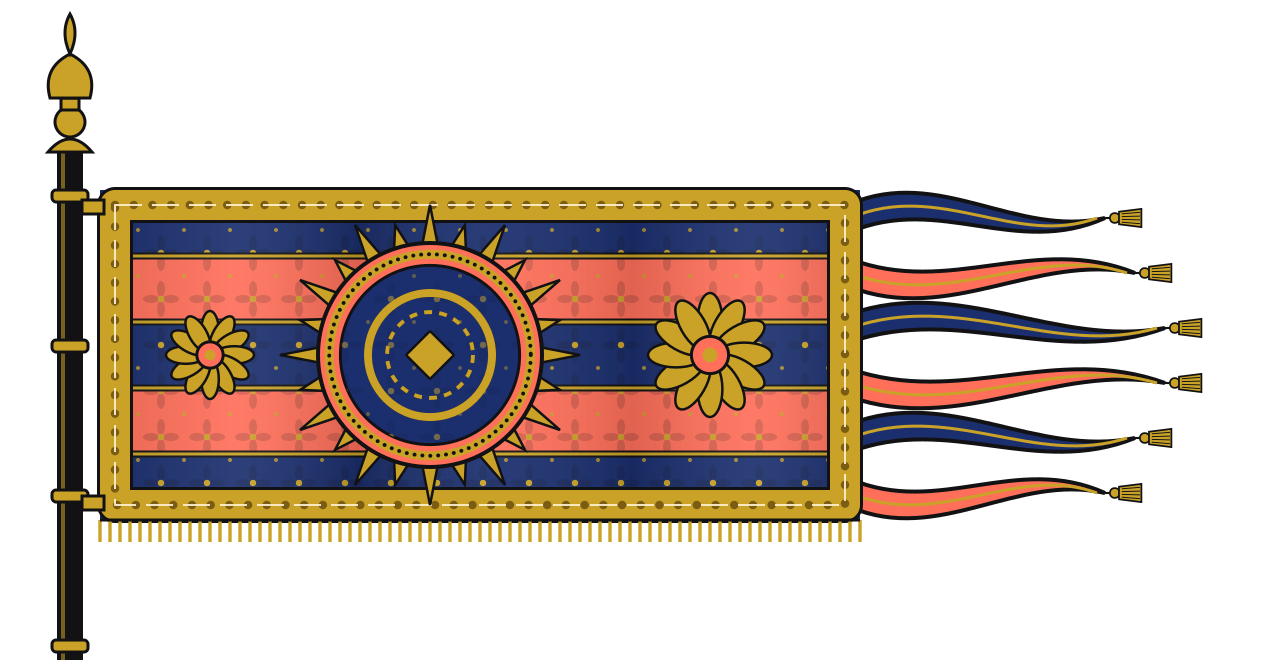
| Night and day | Every visual accessory has two versions: by night the emblem on the dark field, by day the clan's field colour on cloth woven from its metal. |
6. Flags
Every clan has every flag type; the type says the occasion and the colours say the clan. The outlined card is the flag the Atlas assigns.
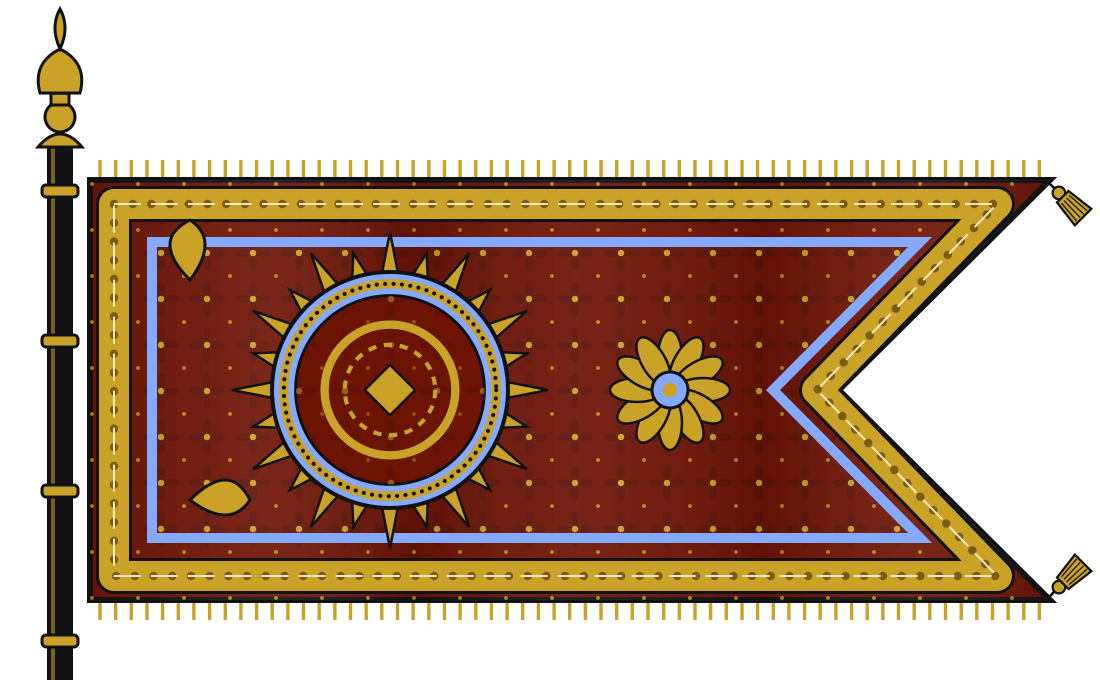
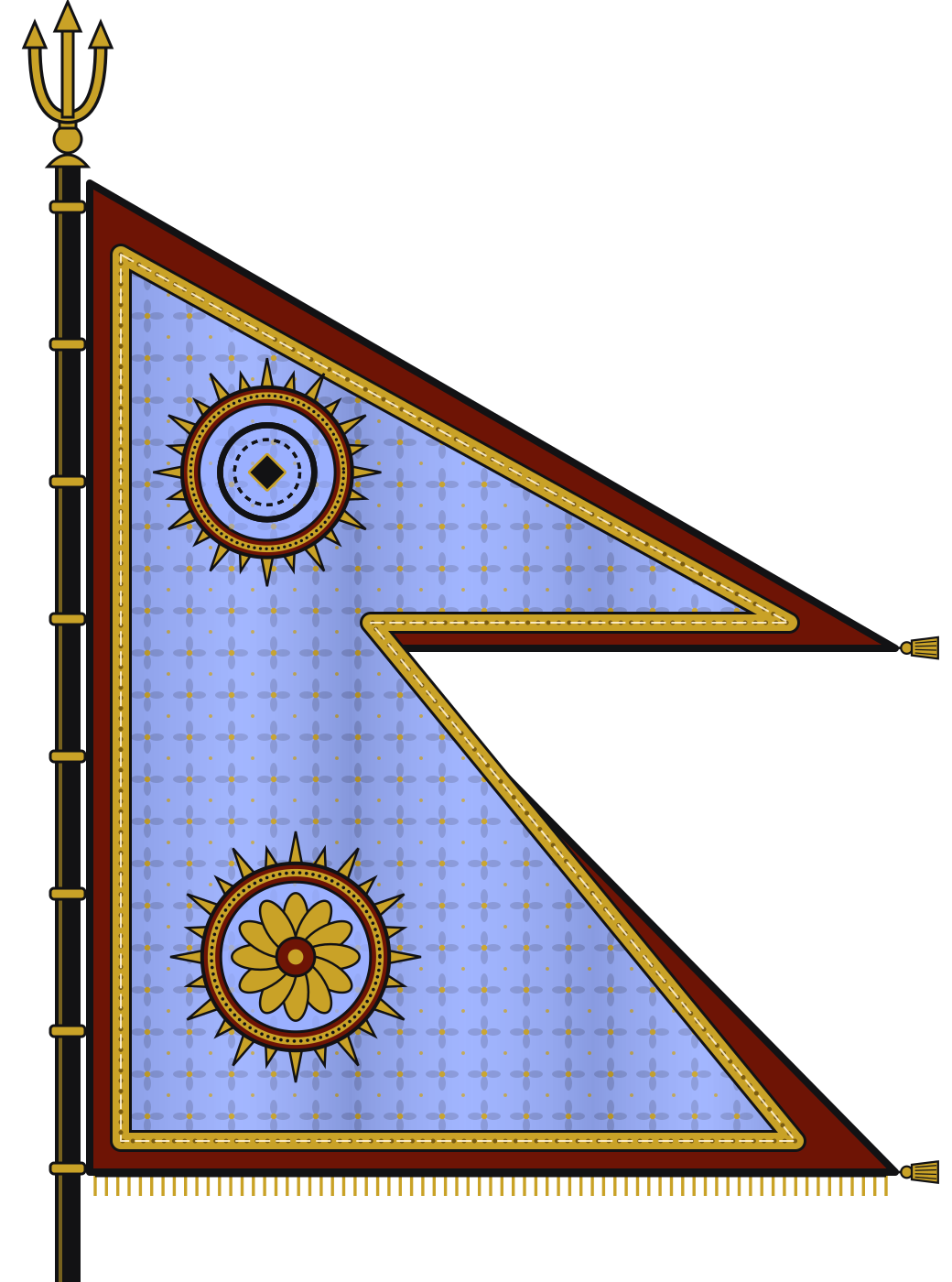
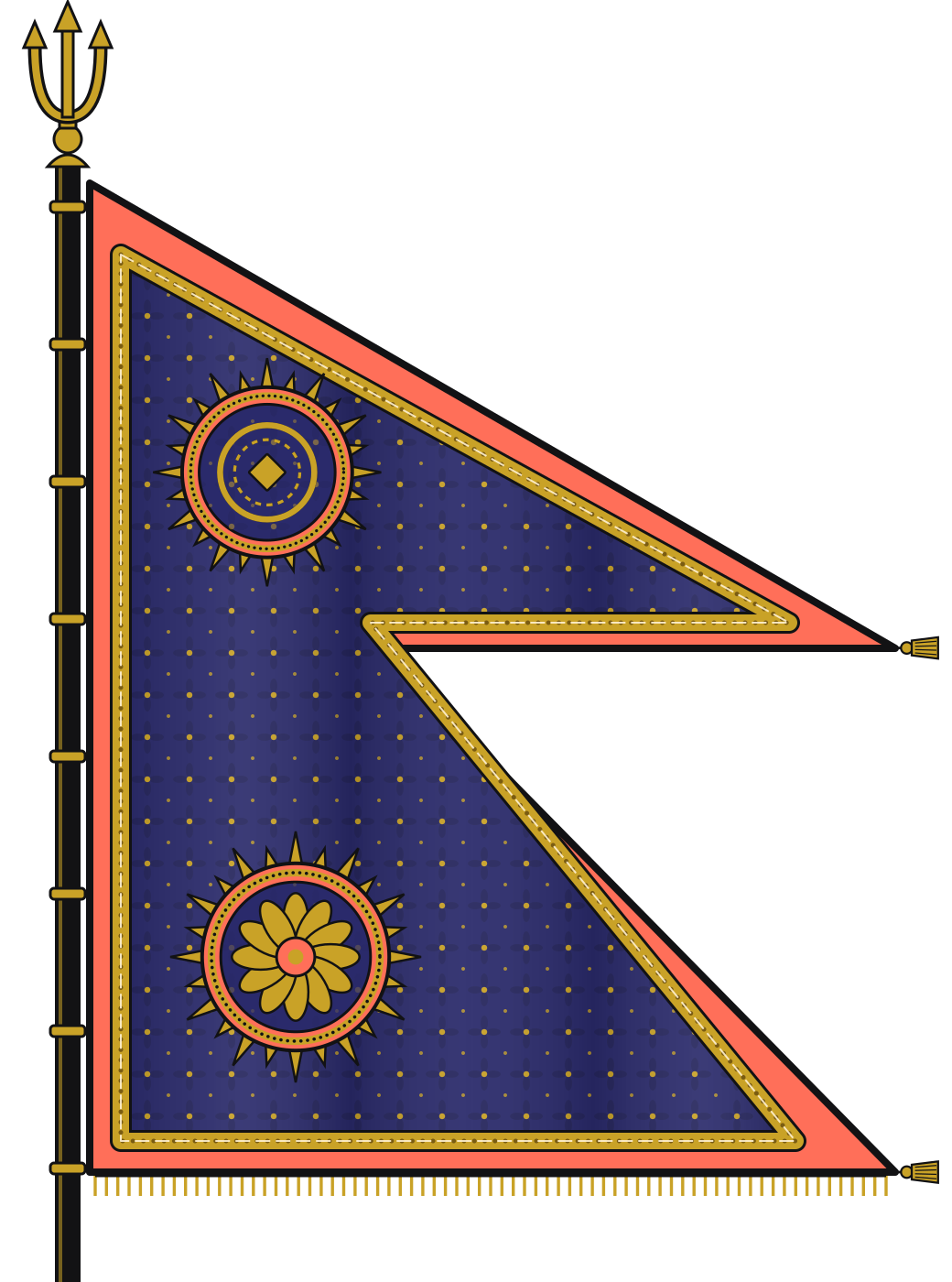

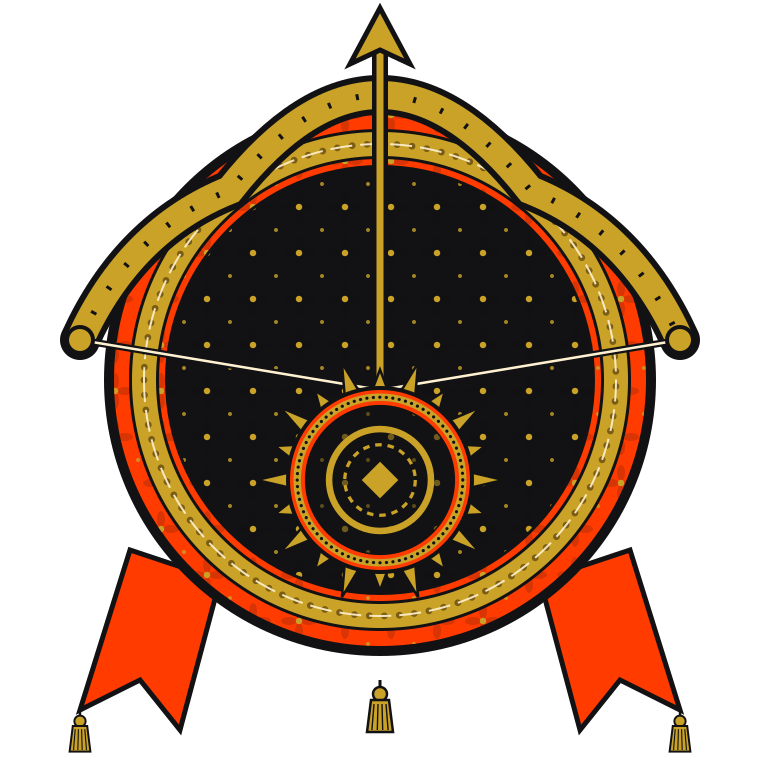
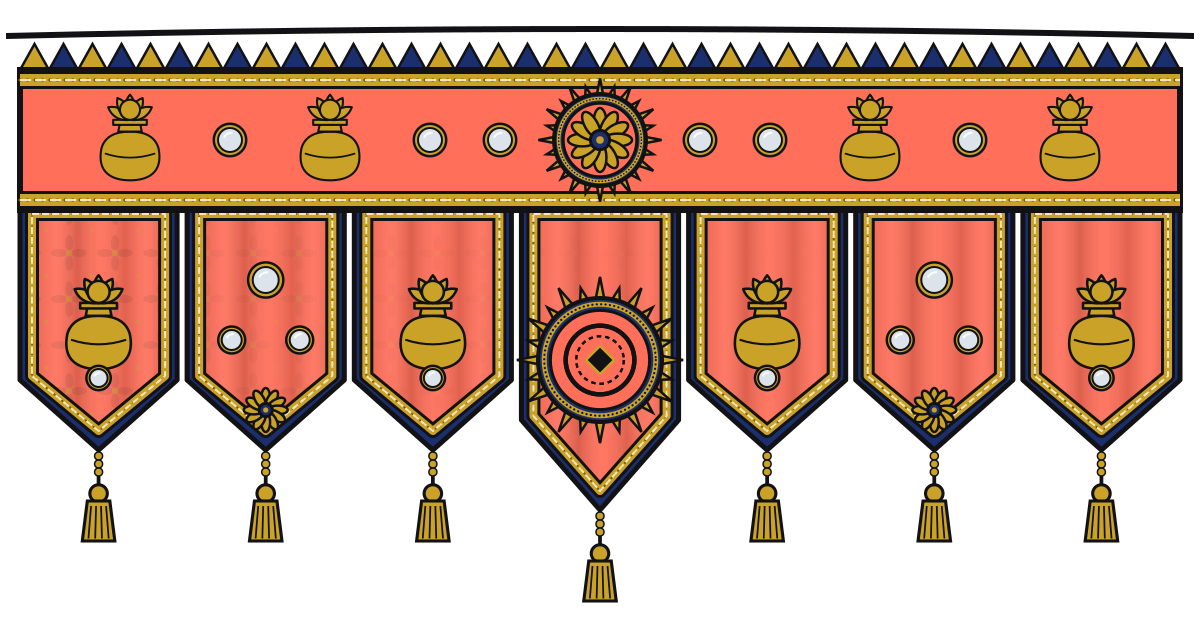
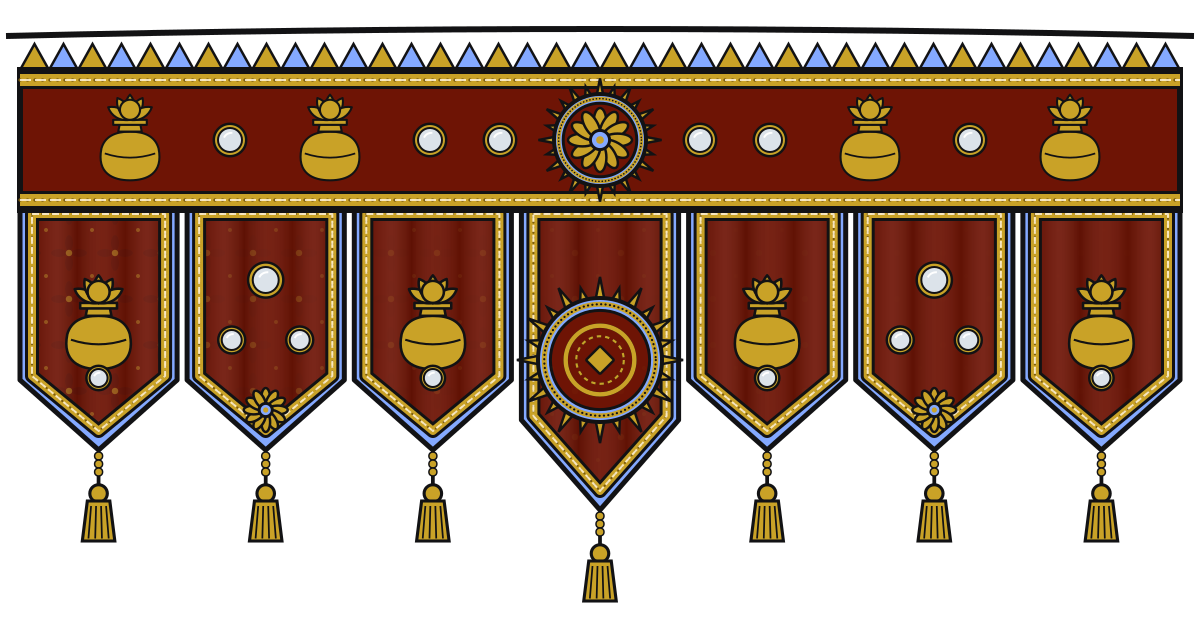
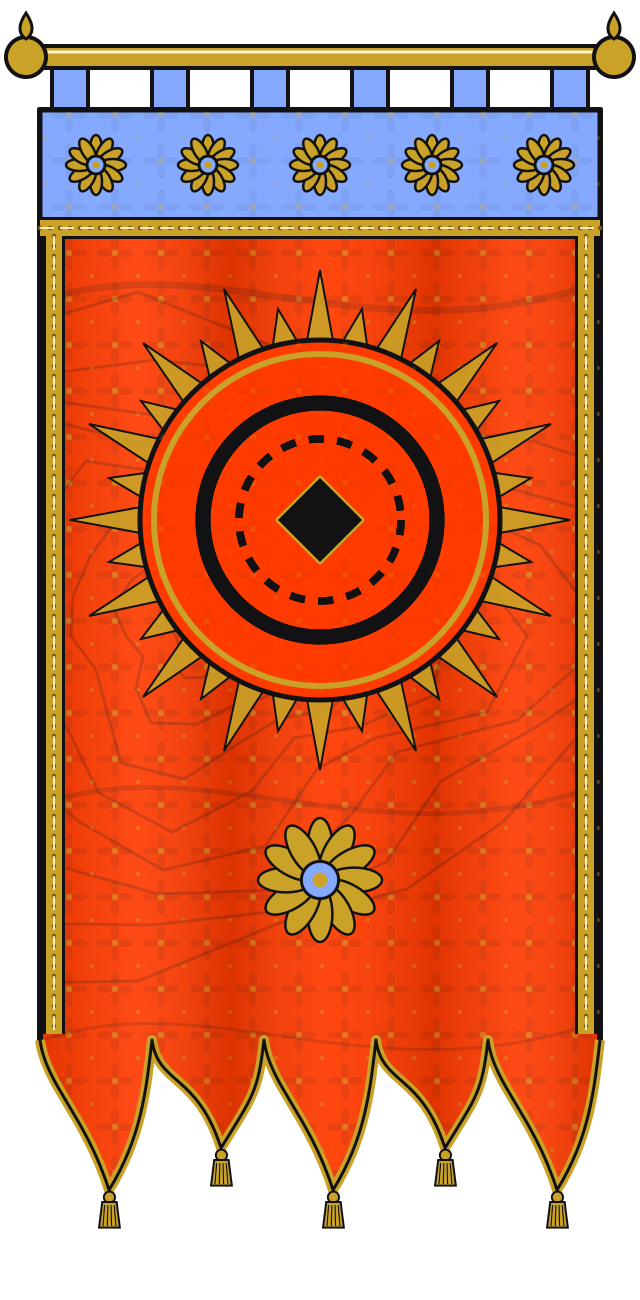
Historic banner
None known
New flag types
| Accessory | For this clan | Basis |
|---|---|---|
| A9 Pota-dhvaja · ship and trade flag For ships, caravans and markets | Not yet designed for this clan | Design |
| A10 Utsava-patāka · festival flag Light, bright flag for fairs and festivals | Not yet designed for this clan | Design |
| A11 Shoka-dhvaja · mourning flag White cloth with the emblem outline in the clan's metal | Not yet designed for this clan | Design |
7. Regalia
| Accessory | For this clan | Basis |
|---|---|---|
| E1 Chhatra · house parasol The ceremonial umbrella | Not yet designed for this clan | Design |
| E2 Chamara · fly-whisks The pair of whisks beside the head of the house | Not yet designed for this clan | Design |
| E3 Danda · staff of office Staff or scepter | Not yet designed for this clan | Design |
| E4 Simhasana · seat The seat of the house, covered in clan cloth | Not yet designed for this clan | Design |
| E5 Khetaka · shield A round shield; the Changi and Dhanush are its flag forms | Not yet designed for this clan | Regional tradition |
| E6 Kula-ayudha · clan weapon The weapon the clan honours | The bow and arrow, the main tools of the Chenchu; a bow and arrows are fixed in the marriage circle | Documented |
8. Worn
| Accessory | For this clan | Basis |
|---|---|---|
| F1 Kula-vastra · clan cloth The clan's woven pattern in its kit colours | Not yet designed for this clan | Design |
| F2 Kirti-vastra · honour cloth A cloth earned for a deed, not inherited | Not yet designed for this clan | Design |
| F3 Kula-mala · garland flower The flower or leaf the clan wears as a garland | Not yet found for this clan | Under research |
| F4 Chinha · house pin A metal badge with the pin emblem | Not yet designed for this clan | Design |
9. Records
| Accessory | For this clan | Basis |
|---|---|---|
| H1 Clan words A traditional line in the native script | Oh! the lord of the Chenchus. · “Refrain of a Chenchu marriage song, in Thurston's 1909 English rendering; the Chenchu words are not printed” Thurston, 1909, phonograph recording of a Chenchu marriage song[2] | Design |
| H2 Biruda · titles The house's title or titles | Not yet found for this clan | Under research |
| H3 Prashasti · praise genealogy The lineage as written at the head of a grant | Not yet found for this clan | Under research |
| H4 Vahi · clan register The book of the clan's births, marriages and deaths | Not yet found for this clan | Under research |
| H5 Rana-ghosha · war cry The clan's cry in battle or celebration | Not yet found for this clan | Under research |
10. VishwaVit · knower of the world
Game values are design choices for this project, not historical claims.
References
- Wikipedia, Chenchu people, read 2026-10-29, https://en.wikipedia.org/wiki/Chenchu_people
- Edgar Thurston and K. Rangachari, Castes and Tribes of Southern India, vol. 2 (Madras, 1909), Project Gutenberg eBook #42992, https://www.gutenberg.org/ebooks/42992
- P. V. Sathya Mohan, The Chenchu of Andhra Pradesh, The Tribal Tribune vol. 2 issue 6 (no date shown), read 2026-10-29, https://www.etribaltribune.com/index.php/volume-2/mv2i6/the-chenchu-of-andhra-pradesh
- Ahobilam (Divya Kshetra), Sri Narasimha Kutumbam, read 11 October 2026.
- Wikipedia, Chenchu language, read 2026-10-29, https://en.wikipedia.org/wiki/Chenchu_language
- Abhilash Rajendran, Hindu Blog, Chenchu Lakshmi, consort of Narasimha in Ahobilam, Sept 2020, read 2026-10-29, https://www.hindu-blog.com/2020/09/chenchu-lakshmi-goddess-consort-of-narasimha-in-abobilam.html
- Ahobilam, Wikipedia (read 11 Oct 2026).
- Joshua Project, Chenchu in India, read 2026-10-29, https://www.joshuaproject.net/people_groups/16581/IN
- Indian Tribal Heritage, Kinnera (Chenchu, Dakkali), posted 9 Aug 2024 from The Hindu, read 2026-10-29, https://indiantribalheritage.org/?p=19267
- SOAS Digital Library, Chenchu man with musical instrument (Furer-Haimendorf, 1940), read 2026-10-23, link
- Sushree Mohanty, Indigenous Colours of Odisha: Handbook on 62 Tribes (KISS), read 2026-10-20, link
- Outlook Traveller, All about the unique Paruveta festival in Andhra Pradesh, 23 Feb 2024, read 2026-10-29, https://www.outlooktraveller.com/experiences/heritage/all-about-the-unique-paruveta-festival-in-andhra-pradesh
- Wikipedia, List of Scheduled Tribes in Odisha, read 2026-10-20, https://en.wikipedia.org/wiki/List_of_Scheduled_Tribes_in_Odisha
- Verdictum, Tellam Venkata Rao v Union of India (report, 26 July 2025), read 2026-10-10, link