The Bonda, who call themselves Remo (glossed as 'people' by Wikipedia and as 'man' by the eTribal profile), live in the hills of Malkangiri district in south-west Odisha, near the point where Odisha, Chhattisgarh and Andhra Pradesh meet[1][2]. Their language, Remo or Remosam, is a South Munda language of the Austroasiatic family with no traditional script, and its speakers are shifting to Odia[1][3]. Their supreme deity is Patakhanda Mahaprabhu, a sword said to lie in the hollow of a great banyan at Mudulipada, whose festival is held on the last Monday of Magha[2][4]. The Bonda are a Scheduled Tribe in Odisha, listed with a 2011 population of 12,231[5].
01Faith and deities
Majhighariani of Rayagada, goddess of the Koraput hills
The presiding goddess of the clan's homeland or capital: a link of place, not a recorded clan tie.
| Deity or tradition | Place in the clan's life | Evidence |
|---|---|---|
| Mahaprabhu, the Great Lord | Supreme being, identified with the sun; demigods in streams, forests and homes | [1][6][7] |
| Patakhanda, a sword in the banyan | Presiding deity at Mudulipada. The festival is on the last Monday of Magha; the blood of the sword offering is smeared on villagers' heads | [4] |
| Sister Devi and Damaldei | Sister Devi is tied to a stone and grinding-stone legend; Damaldei, at Khairaput, is an energy or sister of Patakhanda | [4] |
| Pata Bhairav, Nandapur Budha Bhairava, Dular Dei | Other names in which Patakhanda is invoked | [4] |
| Takurani | Worshipped in Chaitra and Magho, with animal sacrifice | [8] |
| Matera Hundi, goddess of harvest | One egg is sacrificed at sowing for the village, to a branch of a kusi or jamo (guava) tree. The priest is a Mattia by caste | [8] |
| The Earth Goddess (shrine: Hundi) | The Earth Goddess worshipped by the Bonda, with a Hundi shrine | [9] |
| Sindibor | Sacred stone platform to mother earth; hunted animals are first brought there, women may not sit on it, and the main ceremonies are held there | [6][7] |
| Sun, Moon and demigods | Demigods of streams, forests and swiddens; the disharies are the shamans | [2] |
| Disease gods (smallpox, pneumonia, cholera, stomachache) | Show Hindu influence | [6] |
| Sisa (village priest) | Annually elected and removable; his wife brews a special rice beer and is linked to the hunt | [6] |
| Dissari (shaman) | Believed to descend from the original inhabitants | [6] |
| Sairem and jiwo (ghost and soul) | At death the sairem wanders until the gunum ceremony, which ends with a stone memorial; the jiwo dwells with Mahaprabhu until reincarnation | [6] |
| Death rites | The Bonda burn some jewellery with the corpse[8]. A cow is sacrificed on the tenth day, the Gaitang rite[1]. A half-burnt bone struck with a pebble shows, if it crumbles, that there was no sorcery[2] | [8][1][2] |
| Nua Khau | First-fruits sacrifice | [8] |
02Temples
The Bonda's shrines are stone platforms and a banyan. The extracts name no temple the Bonda built or patronised.
Built by the clan
| Temple | Deity | Built by | When | Where |
|---|---|---|---|---|
| Sindibor, stone platform in each village | Mother earth | Not named in the source | Not dated | Each village[2][6] |
| Hundi shrine | The Earth Goddess | Not named in the source | Not dated | [9] |
| Great banyan, Mudulipada | Patakhanda, the sword in its hollow | Not built: a living tree | Not dated | Mudulipada, Malkangiri; circumference over 50 m[4] |
Given patronage or grants by the clan
Not recorded.
03Languages and scripts
| Language or script | Kind | Under the clan | Evidence |
|---|---|---|---|
| Remo (Remosam) living | South Munda, Austroasiatic (ISO 639-3 bfw); Gutob-Remo branch | The clan's own speech. Remo is the self-name; Remosam means 'the human language' | [3][1] |
| Hill Remo and Plains Remo | Two dialects | Hill Remo in the Jeypore Hills; Plains Remo in 35 villages of Khairaput | [3] |
| Odia | Shift language and listed writing system | Speakers are shifting to Odia or Desiya Odia. Odia is listed as the writing system, though there is no traditional written system | [3][7] |
| No traditional script | No script or text | The language has no written tradition (Outlook 2010, via Wikipedia) | [1] |
| Weekday names | Monday Soma or Sombari; Tuesday Mangala or Manguli | The same names are used for men and women | [2] |
| Personal names | Female names end in -i and male names in -a | Names are gendered by suffix | [3] |
04Books and literature
The Remo language has no traditional script or text. The works below are by outside scholars and are listed as sources for the language and the people.
Written during the clan's history
| Work | Author | Kind | When | Link to the clan |
|---|---|---|---|---|
| A Grammar of Bonda Language | Swain | Grammar of Remo, 1998 | 1998 | [3] |
| A Bonda Dictionary | Bhattacharya | Dictionary of Remo, 1968 | 1968 | [3] |
| A Grammatical Sketch of Remo | Fernandez | Grammar sketch, 1968 | 1968 | [3] |
| Finding Remo | Cheng | Study of the language | 2012 | [3] |
| The Munda Languages | Anderson and Harrison | Language study | 2008 | [3] |
| Tribal and Indigenous People of India | Pati and Dash | Survey of tribal peoples | 2002 | [1] |
| Bonda Highlanders (also Bondo Highlanders) | Verrier Elwin | Ethnography (OUP); known here second-hand, not read | 1950 | [2] |
Given patronage by the clan
Not recorded.
05Thinkers and scholars
| Name | Field | Era | Contribution |
|---|---|---|---|
| Verrier Elwin | Ethnography | 1950 | Bonda Highlanders (OUP); cited second-hand by the eTribal profile and the Odisha Review[2] |
| Edgar Thurston and K. Rangachari | Survey of castes and tribes | 1909 | Castes and Tribes of Southern India, vol. 6: the Bonda Poroja, their totems, marriage and festivals[8] |
| Ramesh Prasad Mohanty | Ethnographic profile | Not dated | Profile of the Highland Bonda of Orissa, in The Tribal Tribune[2] |
| Debashis Patra | Writer on the Patakhanda festival | 2017 | Odisha Review article from fieldwork in 1999 to 2009[4] |
| Anderson and Harrison | Munda languages | 2008 | The Munda Languages: the Gutob-Remo branch and the Remo dialects[3] |
No Bonda writer is named in the extracts. The scholars above wrote about the Bonda from outside.
06Art and architecture
Bonda art is in the body and the home: beadwork, brass and aluminium ornaments, and painting on the house. The extracts name no painting or sculpture from the clan's past.
Painting and wall art
| Art form | What it is | Era | Evidence |
|---|---|---|---|
| Home paintings | Women paint pictures in their homes | [1] | |
| Jhoti rangoli | Three-colour rangoli called Jhoti | [4] |
Sculpture and temple art
| Art form | What it is | Era | Evidence |
|---|---|---|---|
| Carving | Carving is practised; no examples are named | [6] |
Temple and building architecture
Weaving and textiles
| Art form | What it is | Era | Evidence |
|---|---|---|---|
| Ringa | Fibre cloth about two feet by eight inches | [8] | |
| Short homespun cloth | Worn by the women; the eTribal profile prints the name as 'Nodi' | [2] |
Clothing and jewellery
| Art form | What it is | Era | Evidence |
|---|---|---|---|
| Men | A loincloth | [2] | |
| Women | Bead necklaces, metal rings, earrings, bangles and a scalp strap; heads shaved | [2] | |
| Boys | Begin wearing ornaments at 8 to 9 | [1] |
Coins, pottery and crafts
| Art form | What it is | Era | Evidence |
|---|---|---|---|
| Beaded headbands and necklaces | Turuba and lobeda (beaded headbands), mali (bead necklaces) | [1] | |
| Aluminium and brass ornaments | Khagla (aluminium neck bands), limbi (brass earrings), orti (aluminium finger rings), per Kanungo 2000, Bondo Costume Ornaments | [1] | |
| Metalwork by others | Bracelets and necklaces made by the Ghasia and Kammar metalworkers | [6] |
07History
Recorded by the British and by Thurston (1909)
Thurston and Rangachari, writing in 1909, describe the Bonda Poroja as 'a section of the Gadabas'. They say the Bonda call themselves Bonda Gadaba and speak a Gadaba dialect, and that the Bonda deny the language link[8].
The eTribal profile reports British accounts of the 'Bonda Highlanders' and says that some families later settled at the foothills, as Lower Bonda. The profile suggests that invaders pushed the people into the hills; it offers this view without proof[2].
Patra's account of Chakrakota and Nandapur (claimed)
Debashis Patra, writing in the Odisha Review in 2017 from fieldwork in 1999 to 2009, reports rock inscriptions at Barasur (1060 CE) and Kurashapali (1074 CE) about a succession at Chakrakota and a queen's flight to the Bondas. These are Patra's readings; the inscriptions themselves are not checked here[4].
In Patra's account, Queen Gundi Dei (Bundi Dei) and her son Someswar fled to the Bondas, and Madhurantak killed King Jagdev Bhusan of Chakrakota. He also reports that Raja Bikram Dev of Nandapur ruled from 1641 to 1669 and moved his capital to Jeypore[4].
Development and politics (1977 to 2014)
The Government of Odisha founded the Bonda Development Agency in 1977[1].
Dambaru Sisha, the first Bonda MLA, was sworn in in 2014[1].
On 12 October 2014 about 1,300 Bonda and Didai moved to cyclone shelters in the Mudulipada and Andrahal gram panchayats, as Wikipedia reports from the New Indian Express[1].
08Journey and migrations
The extracts give no route by which the Bonda came to the Malkangiri hills. They record one move from the hilltops to the foothills and one move to cyclone shelters.
| When | From | To | Why | Evidence |
|---|---|---|---|---|
| Undated (British reports) | Hilltop villages (Barajangar group) | Foothill settlements (Lower Bonda) | Some families settled at the foothills. The eTribal profile suggests earlier pressure from invaders, without proof | [2] |
| 12 Oct 2014 | Villages (not named in the source) | Cyclone shelters in Mudulipada and Andrahal gram panchayats | Move of about 1,300 Bonda and Didai to cyclone shelters | [1] |
09Seats and lands
| Place | Role | Where today |
|---|---|---|
| Mudulipada | Central village: the Naik's throne, the chief deity and the banyan with the sword | Malkangiri district, Odisha[2][4] |
| Barajangar | Twelve hilltop villages; the original Upper Bonda group | Malkangiri hills[2] |
| Gadaba-group villages | Daughter villages in the foothills; they do not recognise the Naik | Foothills (not named)[2] |
| Khairaput (Khairpat) | Plains Remo in 35 villages; the Damaldei festival | Khairput block, Malkangiri[3][4] |
| Jeypore Hills | Hill Remo | Jeypore Hills, Koraput[3] |
| Konda Kamberu range | Uplands of the Bonda, in the Eastern Ghats | South-west Odisha[2] |
| Nandapur | Royal seat that keeps the bronze hilt of the sword (Patra) | Not stated in the extracts[4] |
10Notable figures
| Name | Role | Era | Known from |
|---|---|---|---|
| Ramo and Gorvei legend | The first Bonda couple | Legendary | [4] |
| Sisa (Manadora or Manadhara) | Chief priest, in Patra's account | Not dated | [4] |
| Queen Gundi Dei (Bundi Dei) and Someswar | Queen and son who fled to the Bondas, in Patra's account | Not dated | [4] |
| Madhurantak | Named in Patra's account as the killer of King Jagdev Bhusan of Chakrakota | Not dated | [4] |
| Dambaru Sisha | First Bonda MLA | Sworn in 2014 | [1] |
11Allies, rivals and marriages
| People | Relationship | When |
|---|---|---|
| Gadaba | Thurston calls the Bonda Poroja a section of the Gadabas; the Bonda deny the language link | 1909 |
| Gadaba (Gutob) | Gutob and Remo form a Gutob-Remo branch of South Munda | 2008 (Anderson and Harrison) |
| Poroja | A conglomerate of seven endogamous sections, of which the Bonda Poroja is one | 1909 |
| Munda, Ho and Santhal | Related peoples in Wikipedia's infobox; Remo is a South Munda language | Not dated |
| Didayi (Didai) | Moved with the Bonda to the cyclone shelters | 2014 |
| Ghasia and Kammar | Metalworkers who make the bracelets and necklaces of the Bonda | Not dated |
| Nandapur royal house | Keeps the bronze hilt of the Patakhanda sword and worships it at Dussehra (Patra) | Yearly |
| Chakrakota | Royal house whose succession, in Patra's account, sent a queen to the Bondas | 11th century (per the inscriptions Patra reports) |
12Society and livelihood
Bonda society is patrilineal, with two exogamous moieties, village offices and dormitories for boys and girls. Women are the main food providers and workers, and marriage is by arrangement or by capture.
Government and social order
| Institution or group | What it was | Evidence |
|---|---|---|
| Moieties (baish) | Cobra (Ontal) and Tiger (Druka); both exogamous | [2] |
| Mada clans | Shared exogamous clans named after village functionaries: Muduli, Kirsani, Badnaik, Dhangada-Maghi, Chalan, Dora and Sisa | [2] |
| Munda (clan headman) | Each clan has a Munda. The Badnaik Munda is the secular head of the village, assisted by the Kirsani Munda and then the Chalan Munda. The offices are nearly hereditary | [2] |
| Naik | Chief of Mudulipada, with his throne and chief deity there; the Gadaba-group villages do not recognise him | [2] |
| Dormitories | Boys' dormitory Ingersing; girls' dormitory Selaniding | [2] |
| Trials | Held at the sindibor, the stone platform | [2] |
| Marriage (Dosinge) | Arranged (Salak-Boyi-Dosinge) or by capture (Wai-Boyi-Dosinge). Bride price (ginning): a cow, a bullock or 20 to 30 kg of cereal; 3 to 15 cattle for a capture. Girls marry boys 5 to 10 years younger (Pati and Dash 2002, via Wikipedia) | [2][1] |
| Divorce (Lung Sisi) | For adultery, the husband may demand double the bride price | [1] |
| Bonded labour (Gufam) | Through marriage (diosing); Gufam-Rem for men and Gufam-Boy for women | [1] |
| Descent | Patrilineal; 68.9% of families are nuclear (no year given) | [2] |
Livelihood over time
| Era | Livelihood | Evidence |
|---|---|---|
| Undated | Hunters and gatherers, later swidden cultivation | [2] |
| Undated | Women are the primary food providers and the main workers; the wife is 5 to 10 years older than the husband | [1][7] |
| Undated | Barter (binnimaya pratha) and a Sunday market; the barter continues | [1][7] |
| Undated | Debt: borrowing (Kalantar or Badi) from the community or from landlords (Sakar Remo); 62 of 245 households in debt (no year given) | [1] |
13Sub-clans and related clans
The Bonda have two exogamous moieties, Cobra and Tiger, and shared exogamous clans named after village offices. Upper and Lower Bonda are the two main groups; the Upper Bonda are divided into the Barajangar and Gadaba groups.
| Clan | Relation | Where | Size | In the Atlas | Evidence |
|---|---|---|---|---|---|
| Cobra (Ontal) | Sub-clan | Moiety; the more numerous of the two | new clan candidate | [2] | |
| Tiger (Druka) | Sub-clan | Moiety | new clan candidate | [2] | |
| Muduli | Sub-clan | Shared exogamous clan named after a village office | new clan candidate | [2] | |
| Kirsani | Sub-clan | Shared exogamous clan; holds the office of Kirsani Munda | new clan candidate | [2] | |
| Badnaik | Sub-clan | Shared exogamous clan; its Munda is the secular head of the village | new clan candidate | [2] | |
| Dhangada-Maghi | Sub-clan | Shared exogamous clan named after a functionary | new clan candidate | [2] | |
| Chalan | Sub-clan | Shared exogamous clan; holds the office of Chalan Munda | new clan candidate | [2] | |
| Dora | Sub-clan | Shared exogamous clan named after a functionary | new clan candidate | [2] | |
| Sisa | Sub-clan | Shared exogamous clan; the name is also that of the village priest | new clan candidate | [2][6] | |
| Barajangar group | Branch | Twelve hilltop villages; the original Upper Bonda group | new clan candidate | [2][4] | |
| Gadaba group (Bonda) | Branch | Daughter villages in the foothills; they do not recognise the Naik | new clan candidate | [2] | |
| Upper Bonda | Branch | The hilltop Bonda, with the Barajangar and Gadaba groups | about 6,700 (year not given) | new clan candidate | [1] |
| Lower Bonda | Branch | Settled at the foothills, per the eTribal profile | about 17,000 (year not given) | new clan candidate | [1][2] |
| Hill Bondo | Branch | Hill Remo, Jeypore Hills | new clan candidate | [7][3] | |
| Plain Bondo | Branch | Plains Remo, 35 villages in Khairaput | new clan candidate | [7][3] | |
| Gadaba | Parent people | Thurston 1909: the Bonda Poroja are 'a section of the Gadabas' | ST-076 | [8] | |
| Poroja | Parent people | Thurston 1909: a conglomerate of seven endogamous sections | ST-261 | [8] | |
| Munda | Related people | South Munda language relative | ST-229 | [1] | |
| Ho | Related people | Related people (Wikipedia infobox) | ST-102 | [1] | |
| Santal | Related people | Related people (Wikipedia infobox) | ST-280 | [1] | |
| Didayi | Related people | Moved with the Bonda in 2014; Dur/Didayi Poroja is a Poroja section | ST-070 | [1][8] | |
| Kondh | Related people | Same village priest and shaman offices (Gale 2008) | ST-152 | [6] | |
| Gour | Related people | Same village priest and shaman offices (Gale 2008) | new clan candidate | [6] | |
| Barang Jhodia | Related people | Poroja section (Thurston 1909) | new clan candidate | [8] | |
| Pengu Poroja | Related people | Poroja section (Thurston 1909) | new clan candidate | [8] | |
| Khondi (Kondi) Poroja | Related people | Poroja section (Thurston 1909) | new clan candidate | [8] | |
| Parengi Poroja | Related people | Poroja section (Thurston 1909) | new clan candidate | [8] | |
| Tagara Poroja | Related people | Poroja section (Thurston 1909) | new clan candidate | [8] | |
| Dur (Didayi) Poroja | Related people | Poroja section (Thurston 1909) | new clan candidate | [8] | |
| Mattia | Related people | Caste of the priest of Matera Hundi, per Henderson in Thurston 1909 | new clan candidate | [8] | |
| Ghasia | Related people | Metalworkers who make bracelets and necklaces for the Bonda | new clan candidate | [6] | |
| Kammar | Related people | Metalworkers who make bracelets and necklaces for the Bonda | new clan candidate | [6] | |
| Nandapur royal house | Dynasty from this clan | Raja Bikram Dev ruled 1641-1669 (Patra) | new clan candidate | [4] | |
| Chakrakota | Dynasty from this clan | Succession in the inscriptions Patra reports (1060 and 1074) | same name as ANC-289: check | [4] |
Clans marked "new clan candidate" are not in the Atlas yet.
14Surnames
No surname use is sourced for the Bonda. The clan names in the section above are not said to be used as surnames.
Not recorded.
15Songs and music
The extracts give no song text. A festival song in the Bonda language was recorded in 2024 and is held as audio only, with no text on the page[10].
A festival song in the Bonda language living
Instruments and styles
| Instrument or style | What it is | Evidence |
|---|---|---|
| Bells and dance | Young men wear strings of bells on their legs and hop, stamp and whirl; the women stand in a cluster, clapping and screaming | [8] |
| Madala drums and trumpets | Named in Patra's article on the Patakhanda festival | [4] |
| Drums, gongs, horns and flutes | Played at weddings, festivals and funerals | [6] |
16Poems, lullabies and children's rhymes
The extracts name no poem, lullaby or children's rhyme.
None recorded yet.
17Stories, legends and proverbs
Stories and legends
| Story | What happens | Told by | Evidence |
|---|---|---|---|
| Sita and the cursed women legend | Sita, called Maha Lakshmi by the Bonda, cursed the tribe's women to shave their heads and wear only a small cover, and said the tribe would be destroyed by tigers if they abandoned it | The Bonda, as recorded by Thurston (1909) | [8] |
| Sita's curse, another version legend | Bonda girls scorned Sita in exile and were cursed to seldom bathe | The eTribal profile | [2] |
| The origin of ringa cloth legend | After the women begged forgiveness, Sita gave them a torn piece of her sari, which is given as the origin of the ringa cloth | Outlook (2010), as Wikipedia cites it | [1] |
| Patakhanda and the Pandavas legend | The Pandavas left their arms in the banyan in exile. The sister hid underground and became stone; the brother became a sword. The soldiers of Nandapur took only the hilt | Patra's account of the Patakhanda legend | [4] |
Proverbs and sayings
Not recorded.
18Festivals and fairs
| Festival or fair | When | Where | What happens |
|---|---|---|---|
| Sume Gelirak | January | Not stated | Reaping and threshing[6] |
| Patakhanda festival | Last Monday of Magha (January to February) | Not stated | Blood of the sword offering smeared on villagers' heads[4] |
| Mundadhowni | After the Nandapur puja | Not stated | Heads washed and weapons cleaned[4] |
| Damaldei festival | Tuesday | Khairaput | Festival of Damaldei, an energy or sister of Patakhanda[4] |
| Tanku, Pousha and Chaiti | Not dated | Not stated | Named as festivals; not described[4] |
| Giag-gige | April | Not stated | Named in the Gale 2008 list; not described[6] |
| Gersum-gige | July | Not stated | Weeding[6] |
| Feast of First Fruits | August to September | Not stated | Maize[6]. Thurston names a Nua Khau first-fruits sacrifice[8]; the page does not say it is this feast |
| Dassera | October | Not stated | Millet[6]. The Nandapur royal family worships the bronze hilt at Dussehra[4] |
| Gewursung | October to November | Not stated | Matches Diwali[6] |
| Annual gathering | Yearly | Not stated | Cudgelling with salop branches, as J. A. May recorded it[8] |
| Tenth-day cow feast | Tenth day after a death, and a feast with the Soru-brothers | Not stated | A cow is sacrificed (Gaitang rite)[1]. The feast with the Soru-brothers is named in the eTribal profile[2] |
19Food, dress and games
Food
| Item | What it is | Evidence |
|---|---|---|
| Liquor | Made from rice, palm and mahua[1] | [1] |
| Meat | Beef and pig are eaten, in the Thurston account of the Bonda Poroja; women eat with men | [8] |
Dress
| Item | What it is | Evidence |
|---|---|---|
| Children | Ears pierced in infancy; heads shaved at three | [2] |
| Women's head | Castor oil is rubbed on the head | [1] |
Games and martial arts
| Item | What it is | Evidence |
|---|---|---|
| Cudgelling | Cudgelling with salop branches at the annual gathering | [8] |
Tags: living still practised · revived brought back after a break · lost known only from records · research reported but not yet confirmed from a source. Songs and poems under copyright are listed by title only; restricted or sacred material is noted without its content.
20Status today
The Bonda are a Scheduled Tribe in Odisha and a Particularly Vulnerable Tribal Group (PVTG). Their language is endangered, and one source says it may not survive the century[1][7].
Recognised heritage
| What | Recognition | Evidence |
|---|---|---|
| Bonda Development Agency | Founded by the Government of Odisha in 1977 | [1] |
| Scheduled Tribe and PVTG | Scheduled Tribe in Odisha; PVTG per the Planning Commission, as Wikipedia gives it | [5][1] |
Not reviewed by the Bonda community. No community review is recorded in the sources used here.
21For children
The sword in the banyan
The Bonda live in the hills of Malkangiri, in the south-west of Odisha. They call their own people Remo. Their supreme god is Patakhanda, a sword. The sword is said to be kept in a great banyan tree at Mudulipada. Every year, on the last Monday of the month of Magha, the Bonda hold the Patakhanda festival. Their language, Remo, is still spoken in the hills, but speakers are shifting to Odia.
22Across the project
| Project | What carries this clan | Status |
|---|---|---|
| Atlas of the Janas | No pin is set yet. The districts are in the lands section (Malkangiri, Koraput and Khairaput); the footprint file is left to the host | To check |
| KulDevi and GrahDevi | KulDevi Majhighariani (Rayagada, goddess of the Koraput hills); no source ties her to the Bonda. The Bonda's own deity is Patakhanda Mahaprabhu (section 01) | From the Atlas |
| Planet naming | Monday Soma or Sombari, Tuesday Mangala or Manguli (eTribal); not yet checked against the planet names of the Atlas | To check |
| Renaming and waters | Not in the extracts | Under research |
23Open questions
- Classification: Wikipedia and SPPEL place the Bonda in the Munda family. Thurston (1909) calls the Bonda Poroja a section of the Gadabas, and the Bonda deny the language link. Set out both sides until the Elwin text is read.
- Remo means 'people' (Wikipedia) or 'man' (eTribal, 'remo = man'). Check the Remo dictionary.
- Native script: no Remo or Odia script form is in the extracts, so the native name is given in Latin letters. Find any native-script form before the next run.
- Population: the 2001 count (5,565, Bonda Development Authority) and the 2011 figure (12,231) are from different methods. Check the 2011 census table.
- Marriage ages conflict: the eTribal profile gives wives 20 to 25 and husbands 7 to 10; Pati and Dash (via Wikipedia) say boys are expected to marry at 10 to 12.
- Literacy conflicts: 6% (Hindustan Times) and 14% (another reference).
- The Chakrakota inscriptions (Barasur 1060, Kurashapali 1074) and Raja Bikram Dev of Nandapur come from Patra alone. Check the inscriptions and the Koraput District Gazetteer (1945).
- Patra says that eleven other village chiefs attend a festival and decide the year's posts. The source does not say which festival. Check Patra's text.
- The sheet's KulDevi, Majhighariani, has no source tying her to the Bonda. She is not used as the main deity.
- Are the Earth Goddess (KISS handbook), Matera Hundi (Thurston) and the Hundi shrine the same? Not established.
- The Gaitang rite and the Soru-brothers' feast: the extracts give no meaning for either.
- Sita's curse has at least three versions (shaved heads, seldom bathing, the ringa origin). The page gives all three with their sources.
- The bow and arrow: the extracts do not show the clan using a bow and arrow. E6 is taken from Patakhanda.
- Kammar may be the same people as the sheet's Kammara (ST-118). No ID is set.
- Elwin (1950) is cited second-hand only. Read the first-hand text.
- Coordinates and the Atlas pin are not set, as no coordinates are in the extracts.
- Community review: none recorded.
- Sub-group sizes do not match the census: Upper Bonda about 6,700 and Lower Bonda about 17,000 (no year given) add to about 23,700, against 12,231 in 2011 and 5,565 in 2001[1][2]. The page does not reconcile them.
- The info table says no dynasty and no notable rulers. The clans list gives the Nandapur and Chakrakota royal houses as dynasties, and the figures list Raja Bikram Dev, all from Patra[4]. The page does not reconcile them.
24Astitva
अस्तित्व · being, existence: everything by which the clan is known
What is known of the Bonda's sacred objects: the sword Patakhanda in the banyan at Mudulipada, the sindibor stone platform of each village, the Naik's throne, and the totems tiger, cobra and cow recorded by Thurston[4][8].
Every clan has every accessory, royal objects included. Each one says how it is known: Documented This clan's own object is recorded. · Regional tradition Recorded for the region or for peoples like this one, not for this clan. · Design Made for this project, with no historical claim. · Under research To be found for this clan from sources. Legends and titles are written in the clan's own script.
1. Seals and coins
| Accessory | For this clan | Basis |
|---|---|---|
| B1 Rajamudra · house seal Round seal with the clan emblem and a short legend in the clan's script | Not yet designed for this clan | Design |
| B2 Anguliya-mudra · signet ring Personal seal ring of the head of the house | Not yet designed for this clan | Design |
| B3 Chhapa · house stamp Ink or block stamp for letters, goods and cloth | Not yet designed for this clan | Design |
| B4 Tamrapatra · charter plate Copper-plate grant on a ring, closed with the house seal | Not yet designed for this clan | Design |
| B5 Shreni-mudra · guild or trade seal Seal for the clan's trade, craft or caravan | Not yet designed for this clan | Design |
| C1 Clan coin Emblem or deity on one side, a legend in the clan's script | Not yet designed for this clan | Design |
| C2 Coin die The die that strikes the coin | Not yet designed for this clan | Design |
2. Living symbols
| Accessory | For this clan | Basis |
|---|---|---|
| I1 Totem trio The tree, bird and animal the clan protects | Tiger (bagh), cobra (nag) and cow (mandi): the totems of the Bonda Poroja. No tree or bird is recorded | Documented |
| I2 Kaval-maram · guardian tree The tree that stands at the clan's seat | The great banyan at Mudulipada, where the sword Patakhanda is kept in a hollow | Documented |
3. Stone and gate
| Accessory | For this clan | Basis |
|---|---|---|
| G1 Torana · gateway The built gate of the seat; the cloth Toran hangs in it | Not yet designed for this clan | Regional tradition |
| G2 Viragallu · hero stone Carved panel stone for a member who died defending the clan | Not yet designed for this clan | Regional tradition |
| G3 Kula-shila · clan stones Standing and table stones that remember the ancestors | Sindibor: a stone platform in each village. A stone memorial marks the dead after the gunum ceremony | Documented |
| G4 Jayastambha · victory pillar A pillar raised for a victory | Not yet designed for this clan | Design |
| G5 Sima-shila · boundary stone Marks the clan's land, with a line in the native script | Not yet designed for this clan | Design |
4. Sounds
| Accessory | For this clan | Basis |
|---|---|---|
| D1 Pancha-mahashabda · five great sounds The right to five instruments | Not yet designed for this clan | Design |
| D2 Shankha · clan conch The clan's own named war conch | Not yet designed for this clan | Design |
| D3 Murasu · house drums Three drums: war, charity and justice | Not yet designed for this clan | Design |
5. Kit: colours, metals and emblems
The Bonda have no documented coin, seal or banner in the extracts. Their documented emblems are the sword Patakhanda in the banyan, the sindibor stone platform and the Naik's throne at Mudulipada[4][2]. The flag and banner shown on the page come from the Atlas and are project designs.
| Part of the kit | This clan |
|---|---|
| Field | Deep Brick #7E2A1E |
| Accent | Deep Cosmic Blue #9BB0FF |
| Emblem colour | Metallic Gold #C9A227 |
| Zari metal | Gold |
| Main emblem | Stacked bead-and-brass necklaces |
| Second image | A mountain with a closed gate |
| Night and day | Every visual accessory has two versions: by night the emblem on the dark field, by day the clan's field colour on cloth woven from its metal. |
6. Flags
Every clan has every flag type; the type says the occasion and the colours say the clan. The outlined card is the flag the Atlas assigns.
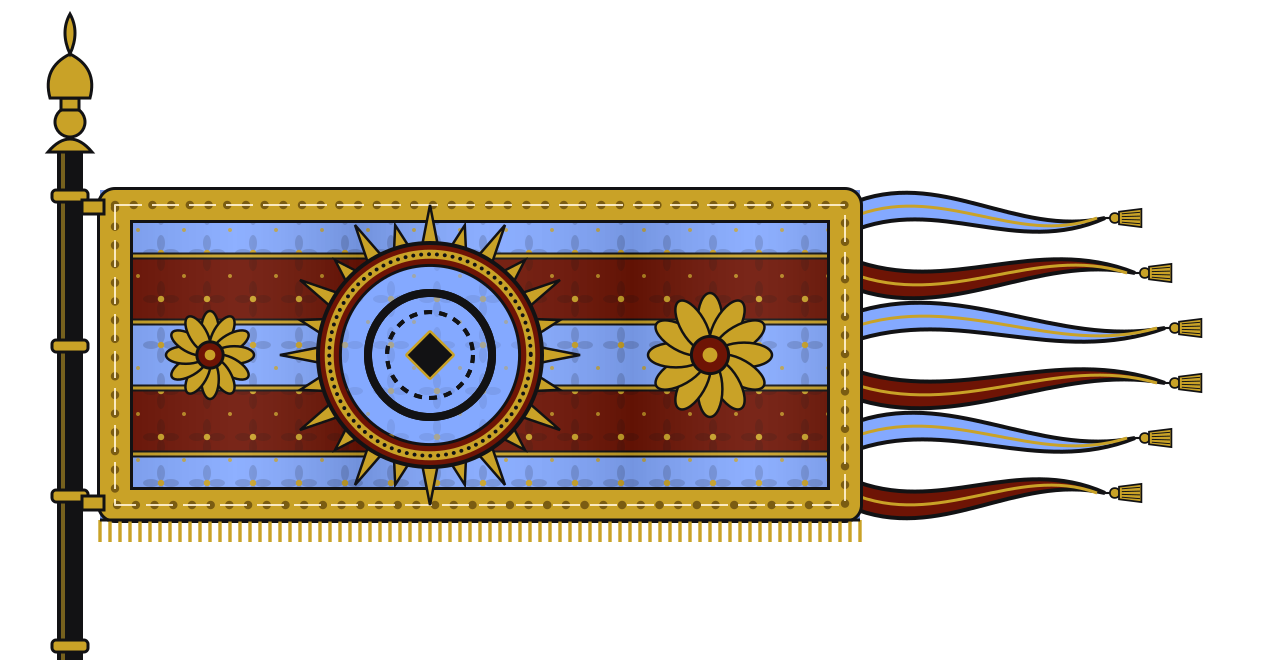
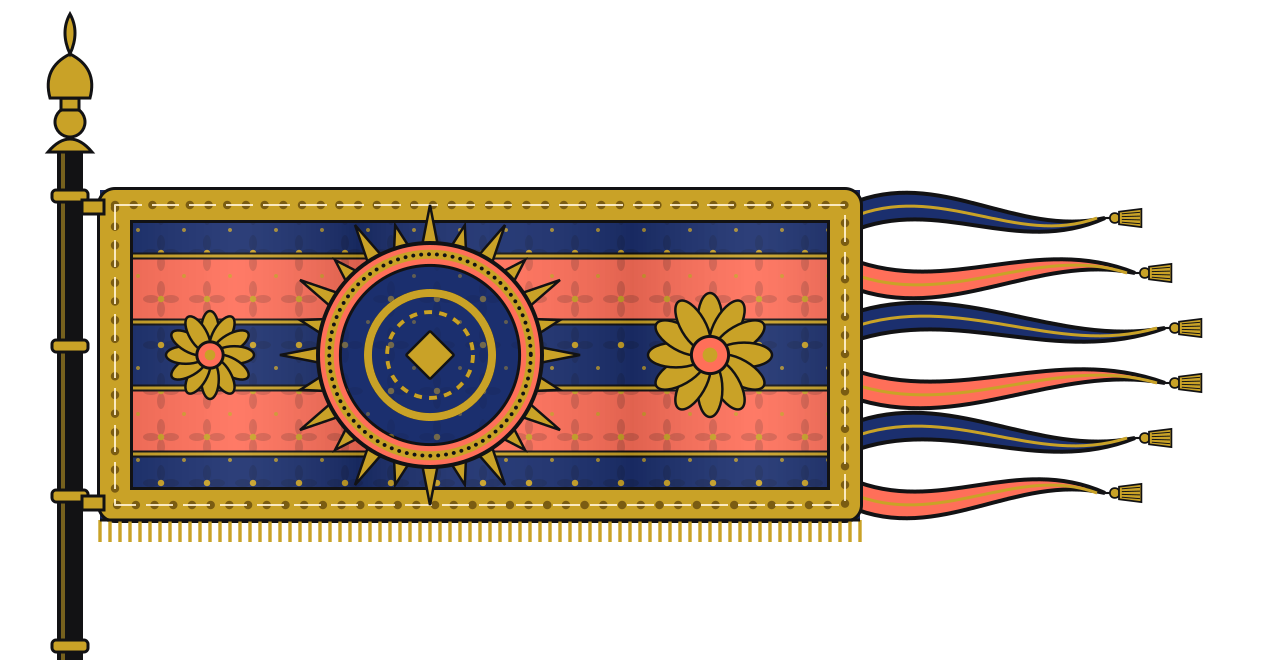
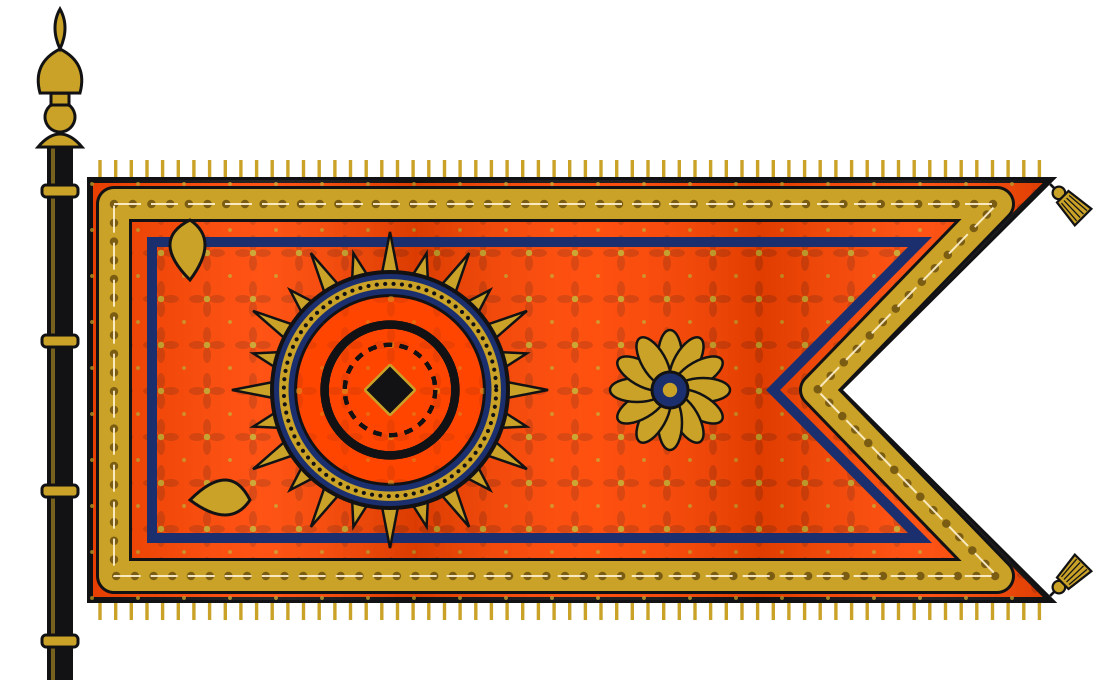
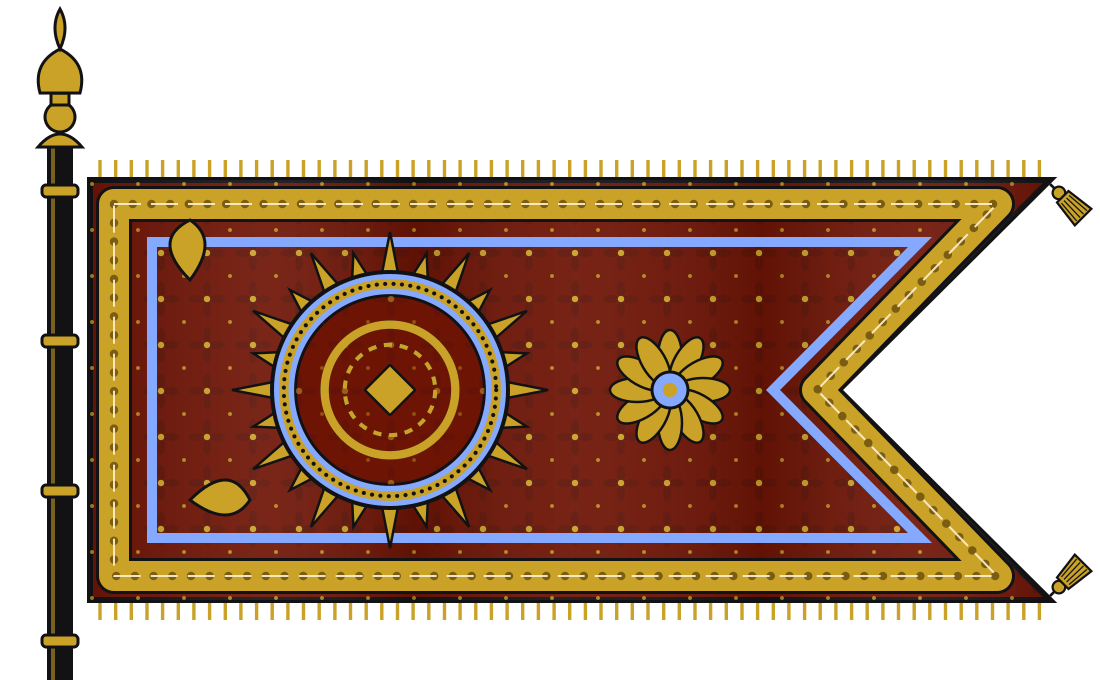

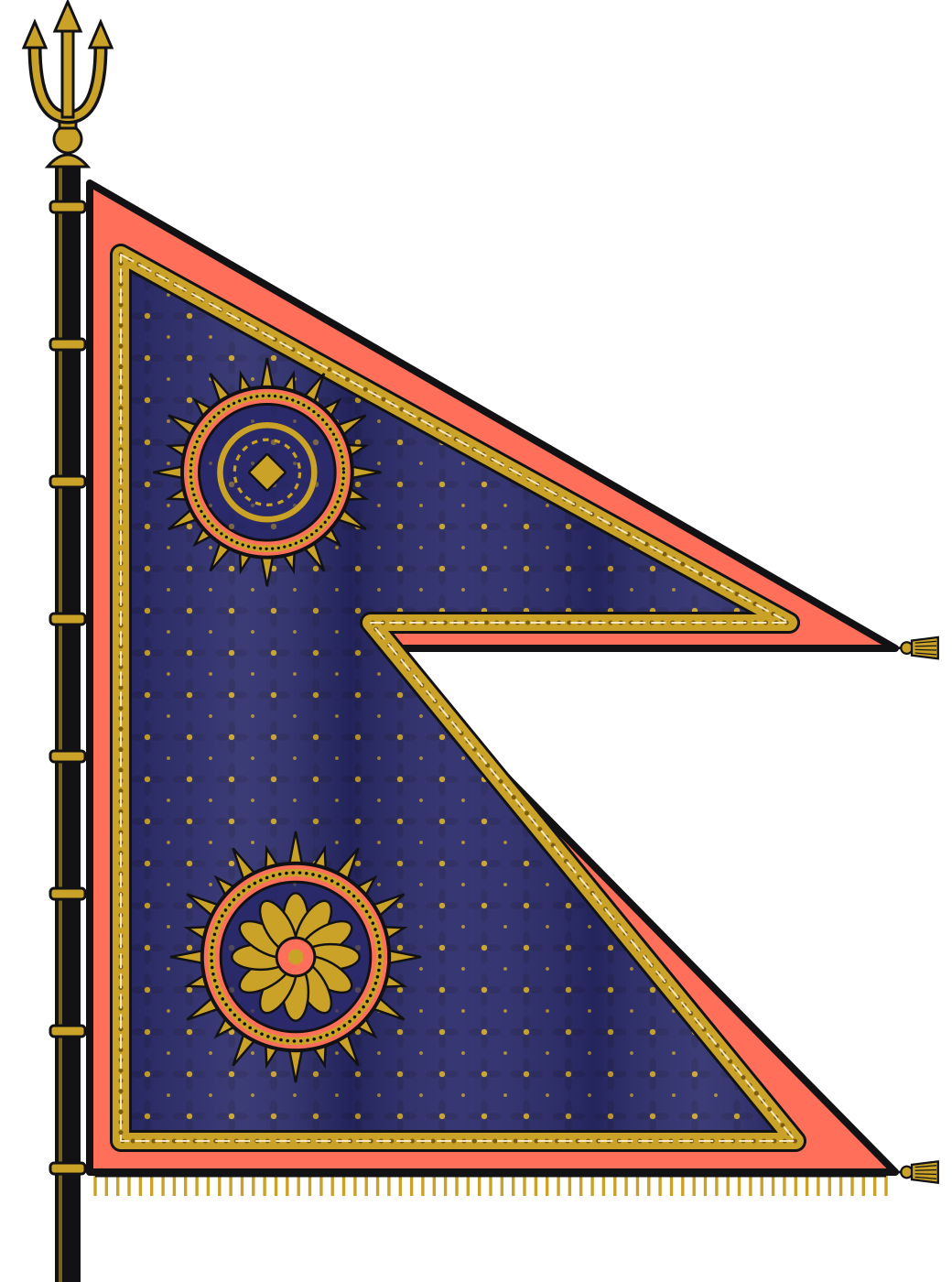


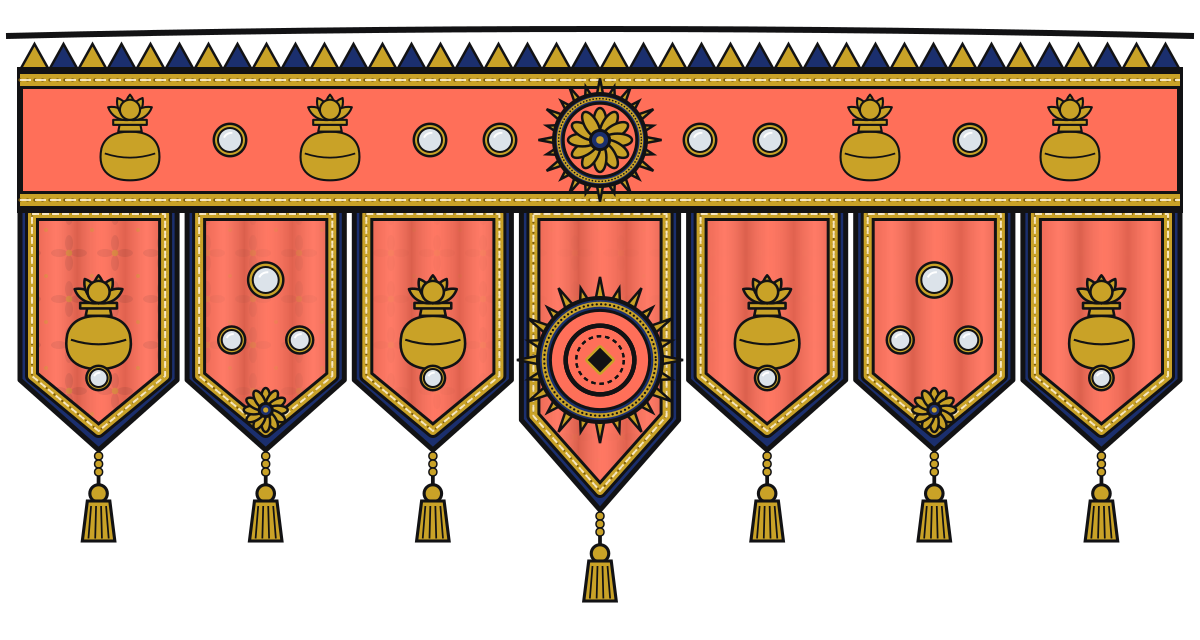
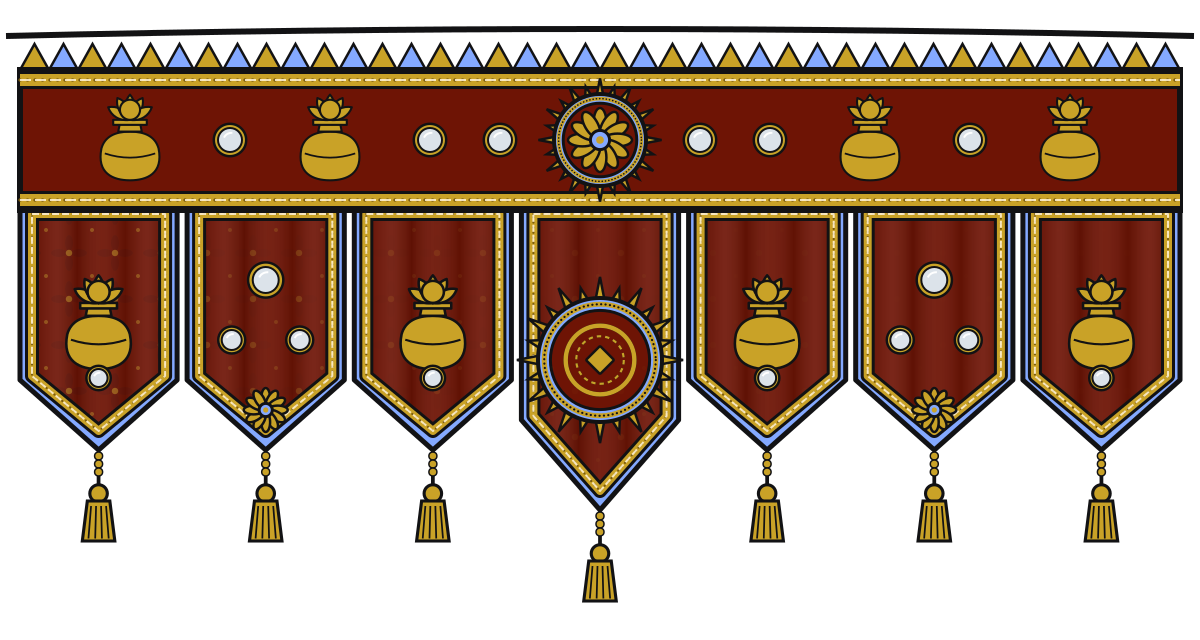

Historic banner
None known
New flag types
| Accessory | For this clan | Basis |
|---|---|---|
| A9 Pota-dhvaja · ship and trade flag For ships, caravans and markets | Not yet designed for this clan | Design |
| A10 Utsava-patāka · festival flag Light, bright flag for fairs and festivals | Not yet designed for this clan | Design |
| A11 Shoka-dhvaja · mourning flag White cloth with the emblem outline in the clan's metal | Not yet designed for this clan | Design |
7. Regalia
| Accessory | For this clan | Basis |
|---|---|---|
| E1 Chhatra · house parasol The ceremonial umbrella | Not yet designed for this clan | Design |
| E2 Chamara · fly-whisks The pair of whisks beside the head of the house | Not yet designed for this clan | Design |
| E3 Danda · staff of office Staff or scepter | Not yet designed for this clan | Design |
| E4 Simhasana · seat The seat of the house, covered in clan cloth | The Naik's throne at Mudulipada, the central village | Documented |
| E5 Khetaka · shield A round shield; the Changi and Dhanush are its flag forms | Not yet designed for this clan | Regional tradition |
| E6 Kula-ayudha · clan weapon The weapon the clan honours | Patakhanda, the sword in the banyan: the Bonda's presiding deity and the weapon they honour | Documented |
8. Worn
| Accessory | For this clan | Basis |
|---|---|---|
| F1 Kula-vastra · clan cloth The clan's woven pattern in its kit colours | Ringa: a fibre cloth about two feet by eight inches. No clan pattern is recorded | Documented |
| F2 Kirti-vastra · honour cloth A cloth earned for a deed, not inherited | Not yet designed for this clan | Design |
| F3 Kula-mala · garland flower The flower or leaf the clan wears as a garland | Not yet found for this clan | Under research |
| F4 Chinha · house pin A metal badge with the pin emblem | Not yet designed for this clan | Design |
9. Records
| Accessory | For this clan | Basis |
|---|---|---|
| H1 Clan words A traditional line in the native script | Patakhanda is not merely a Bonda god but their past, present and future. · “English, as printed in the source” Debashis Patra, Odisha Review, November 2017, on the Patakhanda festival[4] | Design |
| H2 Biruda · titles The house's title or titles | Office titles: Naik (chief of Mudulipada), Munda (clan headman), Sisa (village priest) and dissari (shaman) | Documented |
| H3 Prashasti · praise genealogy The lineage as written at the head of a grant | Not yet found for this clan | Under research |
| H4 Vahi · clan register The book of the clan's births, marriages and deaths | Not yet found for this clan | Under research |
| H5 Rana-ghosha · war cry The clan's cry in battle or celebration | Not yet found for this clan | Under research |
10. VishwaVit · knower of the world
Game values are design choices for this project, not historical claims.
References
- Wikipedia, Bonda people, read 2026-10-25, https://en.wikipedia.org/wiki/Bonda_people
- Ramesh Prasad Mohanty, Ethnographic Profile of Highland Bonda of Orissa, The Tribal Tribune vol. 2 issue 6, read 2026-10-25, https://www.etribaltribune.com/index.php/volume-3/15-v2i6
- Wikipedia, Bonda language, read 2026-10-25, https://en.wikipedia.org/wiki/Bonda_language
- Debashis Patra, Patakhanda, Odisha Review, November 2017, pp. 67-71, read 2026-10-25, https://magazines.odisha.gov.in/Orissareview/2017/November/engpdf/67-71.pdf
- Wikipedia, List of Scheduled Tribes in Odisha, read 2026-10-20, https://en.wikipedia.org/wiki/List_of_Scheduled_Tribes_in_Odisha
- Encyclopedia of World Cultures (Gale, 2008) via everyculture.com, Bondo: Religion and Expressive Culture, read 2026-10-25, https://www.everyculture.com/South-Asia/Bondo-Religion-and-Expressive-Culture.html
- SPPEL, CIIL Mysuru, Bondo language documentation, read 2026-10-25, https://sppel.org/resources/language-documentation/bondo
- Edgar Thurston and K. Rangachari, Castes and Tribes of Southern India, vol. 6 (Madras, 1909), Project Gutenberg eBook #42996, https://www.gutenberg.org/ebooks/42996
- Sushree Mohanty, Indigenous Colours of Odisha: Handbook on 62 Tribes (KISS), read 2026-10-20, https://kissnew.kiss.ac.in/wp-content/uploads/2026/05/Indigenous-Colours-of-Odisha-Handbook-on-62-Tribes-Sushree-Mohanty.pdf
- CIIL-Mysuru, Sanchika, A festival song in the Bonda language (audio, 2024), read 2026-10-25, https://sanchika.ciil.org/items/fb8eccf3-929c-4d36-9f4f-ea8f2c5b9ce2/full