The Birhor are a Munda-speaking Scheduled Tribe found in several states of central and eastern India, mainly in Jharkhand[1][2]. Their name is said to mean 'jungle people', from bir (jungle) and hor (men)[3]. Traditionally nomadic, they lived in camps of leaf huts, gathered honey and forest food, hunted monkeys, and made rope from siali creeper and jute bark, which they sold in markets[4][5][6]. They say they descended from the Sun, and they regard the Kharwars, who also claim Sun descent, as brothers[1][3]. Their language is rated Critically Endangered by UNESCO, and only a few thousand fluent speakers are recorded[6].
01Faith and deities
Chhinnamasta of Rajrappa, Jharkhand
The presiding goddess of the clan's homeland or capital: a link of place, not a recorded clan tie.
| Deity or tradition | Place in the clan's life | Evidence |
|---|---|---|
| Hapram | Ancestral spirits, held in high esteem | [1][3][4] |
| Dharti Mai (धरती माई) | Earth mother, worshipped with the devi-devta | [7] |
| देवी-देवता (devi-devta) | Goddesses and gods worshipped, in the GKToday Hindi account | [7] |
| Chief spirit of the ancestral hill | Yearly offering; an elder acts as priest, and the clan totem diagram is drawn on the ground | [8] |
02Temples
The sources name no temples or shrines of the Birhor[1]. The Atlas gives Chhinnamasta of Rajrappa, Jharkhand, as the KulDevi; no source ties her to the Birhor.
Built by the clan
Not recorded.
Given patronage or grants by the clan
Not recorded.
03Languages and scripts
| Language or script | Kind | Under the clan | Evidence |
|---|---|---|---|
| Birhor language (बिरहोर भाषा) living | Munda, Kherwarian group of Austroasiatic; ISO 639-3 biy | The Birhor's own language; about 2,000 native speakers (2007); speakers are shifting to Hindi | [6][1] |
| Hindi | Second language of most Birhor | Most speak Hindi | [1][3] |
| Sadri, Santali, Ho and Mundari | Other languages the Birhor speak | Used alongside Birhor | [1][3] |
| मुंडा भाषा समूह (Munda language group) | The language group the Birhor language belongs to | — | [7] |
04Books and literature
Books about the Birhor that the sources name. Roy's 1925 book is the fullest; its text is not yet read.
Written during the clan's history
| Work | Author | Kind | When | Link to the clan |
|---|---|---|---|---|
| The Birhors: A Little-known Jungle Tribe of Chota Nagpur | Sarat Chandra Roy | Book, 608 pages (Ranchi, G.E.L. Mission Press). Covers social systems, marriage, belief, birth and death rites, and has a Birhor vocabulary appendix (NVLI record) | 1925 | [9] |
| The Birhor (The Little Nomadic Tribe of India) | Vidyarthi | Book | 1960 | [6] |
| Birhor Jananayak | Lokesh Patel | Book on the Birhor economy, ISBN 978-93-5810-433-2 | 2026 | [1] |
| The Birhors | Kamal Kishore Soan | Book | Undated | [1] |
| The Birhor Universe | Adhikary | Work on Birhor belief, as Wikipedia cites it | Undated | [1] |
| The Birhor People | Michael Yorke | Web essay on Indian tribes | Undated | [4] |
Given patronage by the clan
Not recorded.
05Thinkers and scholars
| Name | Field | Era | Contribution |
|---|---|---|---|
| Sarat Chandra Roy | Ethnography | 1925 | The 1925 book on the Birhor, with a vocabulary appendix[9] |
| Michael Yorke | Anthropology and photography | Undated | Field account of tanda life, monkey-catching and the names used by the Ho and Munda[4] |
| Vidyarthi | Not stated in the sources | 1960 | Study of the Birhor, including the Uthlu groups near Bishunpur[6] |
| Sushree Mohanty | Handbook author (KISS) | Not stated | Handbook on 62 Odisha tribes: Birhor districts and the 2011 population[10] |
The sources name no Birhor author.
06Art and architecture
The sources record no painting, sculpture, textiles or clothing for the Birhor.
Painting and wall art
Not recorded.
Sculpture and temple art
Not recorded.
Temple and building architecture
| Art form | What it is | Era | Evidence |
|---|---|---|---|
| Tanda huts | Conical huts of leaves and branches; sal-leaf huts (OSTM); sal-branch shelters (Yorke) | Undated | [5][4][3] |
Weaving and textiles
Not recorded.
Clothing and jewellery
Not recorded.
Coins, pottery and crafts
| Art form | What it is | Era | Evidence |
|---|---|---|---|
| Rope and nets | Made from siali creeper fibre and jute bark; slings and halters | Traditional | [4][5] |
| Baskets and mats | Siali-bark baskets (topa, used for oil pressing); date-palm mats | Traditional | [5] |
| Earthen utensils | Earthen pots, digging tools and trapping gear | Traditional | [1] |
07History
Old homelands, undated
The Birhor are found mainly in the old districts of Hazaribagh, Ranchi and Singhbhum, in Jharkhand[1][7]. In Odisha the OSTM places them in Sambalpur and Sundergarh, depending on the Similipal hill ranges[5]. The sources give no dated history, inscriptions or rulers for them[1][5].
After 1947: settlement schemes
After 1947 the government tried to settle the Birhor with land, bullocks, implements and seeds, and set up schools, rope-making centres and honey-collection training[1][3]. Most reverted to a nomadic life[1][3]. Yorke, writing of the 1970s, found the Birhor almost totally uneducated and says that many government attempts to settle and educate them failed[4].
Claimed origins
The Birhor say they descended from the Sun, and they regard the Kharwars as brothers[1][3]. This is the community's own claim, not a documented origin. The OSTM, writing for the Odisha museum, calls the Birhor an offshoot of the Kol, with common descent with the Munda, Santal, Ho and Bhuiyans, as printed[5].
Classification: a conflict
The Birhor language is a Munda language, in the Kherwarian group of Austroasiatic[6]. Britannica calls the Birhor 'a Dravidian people', which contradicts the Munda classification given by the other sources and by the Atlas[8]. This page follows the Munda classification and leaves the conflict open.
08Journey and migrations
The Birhor have been traditionally nomadic. Wandering Birhors are called Uthlus and settled ones Janghis, and even settled families tend to live nomadically[1][3].
| When | From | To | Why | Evidence |
|---|---|---|---|---|
| Earlier records | — | Hazaribagh, Ranchi and Singhbhum | Found mainly here in the old districts | [1][7] |
| After 1947 | Forest camps | Land and farms under settlement schemes | Government tried to settle them; most went back to a nomadic life | [1][3] |
| Seasonal (Odisha) | Camp in one place | Shift camp in winter and summer, seeking siali and sal; settle in one region for the rains | Forest materials for rope and huts | [5] |
| Until recently | Leaf huts at the edges of village markets | Settled farming | Forest degradation made hunting and gathering unviable for many | [6] |
09Seats and lands
| Place | Role | Where today |
|---|---|---|
| Hazaribagh, Ranchi and Singhbhum | Old districts where the Birhor are found mainly[1][7] | Jharkhand |
| Saranda forest | Wandering ground; market at Chhotanagra, near Dubil village[4] | Singhbhum, Jharkhand |
| Bishunpur | Uthlu Birhors near Bishunpur, on the western border with Chhattisgarh (Vidyarthi 1960)[6] | Gumla district, Jharkhand |
| Similipal hill ranges | Depended on for siali and sal; the camps shift with the seasons[5] | Odisha |
| Sambalpur and Sundergarh | Odisha districts for the Birhor, in the spellings the sources print[5][10] | Odisha |
| Purulia | Found mainly here[11] | West Bengal |
| Mayurbhanj and Chhattisgarh | Also named as places of the Birhor[4][6] | Odisha; Chhattisgarh |
| Chota Nagpur Plateau | Most speakers live on the plateau and in the Santhal Paraganas[6][8] | Jharkhand and neighbouring states |
| Madhya Pradesh and Maharashtra | Smaller state counts: 52 in Madhya Pradesh and 145 in Maharashtra, 2011[12][13] | Madhya Pradesh; Maharashtra |
10Notable figures
Not recorded.
11Allies, rivals and marriages
| People | Relationship | When |
|---|---|---|
| Munda | Related; common descent claimed (OSTM); the Ho and Munda call the Birhor 'monkey eaters' (Yorke)[5][4] | Undated |
| Ho | Related; magico-religious beliefs akin to the Birhor's (TRI); Ho villagers are trading partners (Yorke)[3][4] | Undated |
| Santal | Related (Wikipedia); common descent claimed (OSTM); deities shared with the Birhor (Yorke)[1][5][4] | Undated |
| Kol | The Birhor are believed to be an offshoot of the Kol (OSTM, as printed)[5] | Undated |
| Bhumij | Listed as related (Wikipedia)[1] | Undated |
| Bhuiya | Common descent claimed (OSTM, as printed)[5] | Undated |
| Kharwar | Regarded as brothers; both claim descent from the Sun[1][3] | Undated |
| Mankirdia | Called an alternative name of the Birhor by OSTM and Yorke; listed as a separate tribe by KISS and by the Atlas[5][4][10] | Undated |
12Society and livelihood
The Birhor live in tandas, temporary camps of conical or leaf huts with an elder headman. Men hunt with nets, and women and children help with cooking and rope work[4][3][5].
Government and social order
| Institution or group | What it was | Evidence |
|---|---|---|
| Tanda | Temporary camp of several leaf or branch huts under an elder headman; the OSTM counts 10 to 15 huts called kumbha | [4][5][1] |
| Dhugaa | Dormitory for bachelors | [5] |
| Kudi Ada | Dormitory for spinsters | [5] |
| Totem clans | Patrilineal, exogamous totem groups named after animals, plants, Hindu castes, localities and objects; members treat the totem as a human member and keep strict taboos on it[8] | [8] |
| Uthlu and Janghi | Wandering and settled divisions; socio-economic groups, not clans (TRI)[3][1] | [3][1] |
| Lineage | GKToday says lineage (वंश) is absent from Birhor society; Britannica describes patrilineal clans. Conflict kept open | [7][8] |
| Household goods | Earthen utensils, digging tools, hunting and trapping gear, rope-making tools and baskets; aluminium and steel now entering the huts[1] | [1] |
| Names used by others | The Ho and Munda call them 'jom-sara:e', 'monkey eaters' (Yorke). In northern Odisha two groups are officially called 'monkey-eaters' and are openly despised (Living Tongues, via Wikipedia)[4][6] | [4][6] |
Livelihood over time
| Era | Livelihood | Evidence |
|---|---|---|
| Traditional | Gathering and hunting: squirrels, deer, rodents, monkeys, tubers, rock-bee honey, mahua flowers and fruit; trapping rabbits and titirs (small birds)[4][1][3] | [4][1][3] |
| Traditional | Rope from siali creeper and jute bark, sold in markets or traded for rice[5][4][3] | [5][4][3] |
| Traditional | Honey, wild silk cocoons ('lumam') and palm-leaf mats[4][5] | [4][5] |
| After 1947 | Settlement schemes: land, bullocks, tools and seeds; schools, rope-making centres and honey-collection training[1][3] | [1][3] |
| Until recently | Hunter-gatherers in leaf huts at the edges of village markets, selling rope; many are now settled agriculturalists[6] | [6] |
| Recent | Most depend on agriculture, with some wage labour and forest resources; they buy and exchange minor forest produce[7] | [7] |
| Odisha, today | Moving into permanent mud-wall, thatched houses; agriculture increasing[5] | [5] |
13Sub-clans and related clans
The related peoples and divisions the sources name. Relations are as the sources give them; the sheet's own records are kept as they are.
| Clan | Relation | Where | Size | In the Atlas | Evidence |
|---|---|---|---|---|---|
| Uthlu | Sub-clan | Wandering Birhor; near Bishunpur, Gumla district, Jharkhand | same name as ST-512: check | [6][3] | |
| Janghi | Sub-clan | Settled Birhor; no place recorded | same name as ST-464: check | [1][3] | |
| Munda | Related people | Jharkhand, Odisha and West Bengal[2][10][14] | Jharkhand 1,229,221, 2011[2] | ST-229 | [1][5] |
| Ho | Related people | Jharkhand, Odisha and West Bengal[2][10][14] | Jharkhand 928,289, 2011[2] | ST-102 | [3][4] |
| Santal | Related people | Jharkhand and others | Jharkhand 2,754,723, 2011[2] | ST-280 | [1][5][4] |
| Kol | Related people | Jharkhand and others | Jharkhand 53,584, 2011[2] | ST-141 | [5] |
| Bhumij | Related people | Jharkhand, Odisha, West Bengal | Jharkhand 209,448, 2011[2] | ST-033 | [1] |
| Bhuiya | Related people | Odisha | Odisha 306,129, 2011[10] | ST-031 | [5][10] |
| Kharwar | Related people | Jharkhand and others | Jharkhand 248,974, 2011[2] | ST-131 | [1][3] |
| Mankirdia | Related people | Mayurbhanj, Deogarh and Balasore, Odisha | Odisha 2,222, 2011[10] | ST-199 | [5][4][10] |
Clans marked "new clan candidate" are not in the Atlas yet.
14Surnames
The sources name no surnames for the Birhor.
Not recorded.
15Songs and music
The sources name the Birhor's dances and instruments, but give no song titles, lyrics or festival songs. The OSTM says music and dance are central, and each dance has its own song and event[5]. The dances named are Dong, Lagre and Karam[5].
None recorded yet.
Instruments and styles
| Instrument or style | What it is | Evidence |
|---|---|---|
| Madal | Instrument named by the OSTM | [5] |
| Tomka | Instrument named by the OSTM | [5] |
| Nagra | Instrument named by the OSTM | [5] |
| Tirio | Bamboo flute (OSTM) | [5] |
16Poems, lullabies and children's rhymes
None recorded yet.
17Stories, legends and proverbs
Stories and legends
| Story | What happens | Told by | Evidence |
|---|---|---|---|
| Descent from the Sun | The Birhor say they descended from the Sun; the Kharwars, who also claim Sun descent, are their brothers | The Birhor (community tradition) | [1][3] |
Proverbs and sayings
Not recorded.
18Festivals and fairs
| Festival or fair | When | Where | What happens |
|---|---|---|---|
| Yearly ancestral-hill ceremony | Yearly | Not named in the sources | An offering to the chief spirit of the ancestral hill; an elder acts as priest, and the clan totem diagram is drawn on the ground[8] |
| Dong, Lagre and Karam dances | Not dated | Not named in the sources | Dances named by the OSTM; each has its own song and event[5] |
19Food, dress and games
Food
| Item | What it is | Evidence |
|---|---|---|
| Forest food | Squirrels, deer, rodents, monkeys, tubers, rock-bee honey, mahua flowers and fruit | [4] |
| Small game | Rabbits and titirs (small birds), trapped | [3] |
Dress
Not recorded.
Games and martial arts
Not recorded.
Tags: living still practised · revived brought back after a break · lost known only from records · research reported but not yet confirmed from a source. Songs and poems under copyright are listed by title only; restricted or sacred material is noted without its content.
20Status today
The Atlas lists the Birhor as a Scheduled Tribe, PVTG, in seven states. The 2011 census figures are given below, and they conflict in places[1][15].
Recognised heritage
| What | Recognition | Evidence |
|---|---|---|
| Birhor language | UNESCO: Critically Endangered (3rd edition, 2010) | [6] |
Not yet reviewed by the Birhor community. This page is written from published sources only.
21For children
Rope from the forest
The Birhor are a forest people of central and eastern India. Their name is said to mean 'jungle people'. Traditionally their families lived in camps of leaf huts, which they call tandas. They gathered honey and forest food, and they caught small animals. From the siali creeper they made strong rope, and they sold it in the market. The Birhor speak a language from the Munda family. They say that they are descended from the Sun.
Riddle: I climb the forest trees, and my bark is pulled into strong rope. What am I? (The siali creeper)
22Across the project
| Project | What carries this clan | Status |
|---|---|---|
| Atlas of the Janas | No footprint file yet; the places named are under lands (Jharkhand, Odisha, West Bengal, Chhattisgarh, Madhya Pradesh, Maharashtra) | To check |
| KulDevi and GrahDevi | KulDevi Chhinnamasta of Rajrappa, Jharkhand; GrahDevi forms Kali, Tara, Shodashi, Bhuvaneshvari, Bhairavi, Chhinnamasta, Dhumavati, Bagalamukhi, Matangi and Kamala | From the Atlas |
| Planet naming | Not yet checked | To check |
| Renaming and waters | Nothing sourced for this run | To check |
23Open questions
- Population conflicts: the Wikipedia infobox gives 17,045 and the language page 17,044 (no year); Ethnologue and TRI say about 10,000; Yorke says 2,222 for the 2011 census, the same figure KISS gives for Mankirdia. For Odisha, Wikipedia and KISS give 596 and the OSTM gives 203 (Census 2011 ST figure and a 2010 micro-project PVTG figure). The infobox's five state figures add to 17,045 without the Madhya Pradesh (52) and Maharashtra (145) figures. Choose the figure for the infobox.
- Dravidian label: Britannica calls the Birhor 'a Dravidian people'; Wikipedia, TRI, GKToday and the Atlas say Munda. Check against a linguistic source (Glottolog birh1242 is a lead).
- Lineage: GKToday says the Birhor have no lineage (वंश) structure; Britannica describes patrilineal exogamous totem clans. Britannica's list of 37 clans (12 animal, 10 plant) gives no names; Roy's 1925 text is the lead.
- Sun: TRI calls Sing Bonga the Sun God; Wikipedia says he is not really a sun god (citing Soan); Yorke calls him the spirit of the sun. Record both until a fuller source is read.
- Mankirdia: the Atlas lists Mankirdia separately (ST-199), while the OSTM and Yorke call Mankidi and Mankirdia alternative names of the Birhor. Decide whether they are one people or two.
- Homeland: the Atlas names Palamu, which no extract names. The extracts name Singhbhum, Hazaribagh, Ranchi, Purulia, Sambalpur, Sundergarh and Saranda.
- Uthlu and Janghi: TRI says they are socio-economic groups, not clans. Decide whether they stay as sub-clans; both are new candidates with review drafts.
- Words: no coin legend, war cry, title, motto or traditional line is in the extracts. The clan's name is used as its words. A line needs Roy's 1925 text or a Birhor-language source.
- Native script: the language has no native script printed in the extracts. The name बिरहोर and the form बिरहोर भाषा are from the GKToday Hindi page.
- The GKToday page is titled 'Bihar' but describes Jharkhand, and is dated 2019; use its claims with that in mind.
- Songs, proverbs and festival names are missing from the extracts. Roy's 1925 text is the lead; check its rights before any excerpt.
- Emblem: the Atlas's coil of rope and monkey are designs. No documented symbol is in the extracts. A recorded totem trio (I1) would replace them.
- Descent: the Sun descent and the Kharwar brotherhood are community claims. No source gives a dated origin.
- Community review: none recorded. Descendant communities: none sourced.
24Astitva
अस्तित्व · being, existence: everything by which the clan is known
The sources record no coin, seal, title, war cry or motto for the Birhor. What is documented is their material culture: siali creeper for rope, sal for huts, date-palm for mats, and the instruments madal, tomka, nagra and tirio[5][3].
Every clan has every accessory, royal objects included. Each one says how it is known: Documented This clan's own object is recorded. · Regional tradition Recorded for the region or for peoples like this one, not for this clan. · Design Made for this project, with no historical claim. · Under research To be found for this clan from sources. Legends and titles are written in the clan's own script.
1. Seals and coins
| Accessory | For this clan | Basis |
|---|---|---|
| B1 Rajamudra · house seal Round seal with the clan emblem and a short legend in the clan's script | Not yet designed for this clan | Design |
| B2 Anguliya-mudra · signet ring Personal seal ring of the head of the house | Not yet designed for this clan | Design |
| B3 Chhapa · house stamp Ink or block stamp for letters, goods and cloth | Not yet designed for this clan | Design |
| B4 Tamrapatra · charter plate Copper-plate grant on a ring, closed with the house seal | Not yet designed for this clan | Design |
| B5 Shreni-mudra · guild or trade seal Seal for the clan's trade, craft or caravan | Not yet designed for this clan | Design |
| C1 Clan coin Emblem or deity on one side, a legend in the clan's script | Not yet designed for this clan | Design |
| C2 Coin die The die that strikes the coin | Not yet designed for this clan | Design |
2. Living symbols
| Accessory | For this clan | Basis |
|---|---|---|
| I1 Totem trio The tree, bird and animal the clan protects | Not yet found for this clan | Under research |
| I2 Kaval-maram · guardian tree The tree that stands at the clan's seat | Not yet found for this clan | Under research |
3. Stone and gate
| Accessory | For this clan | Basis |
|---|---|---|
| G1 Torana · gateway The built gate of the seat; the cloth Toran hangs in it | Not yet designed for this clan | Regional tradition |
| G2 Viragallu · hero stone Carved panel stone for a member who died defending the clan | Not yet designed for this clan | Regional tradition |
| G3 Kula-shila · clan stones Standing and table stones that remember the ancestors | Not yet designed for this clan | Design |
| G4 Jayastambha · victory pillar A pillar raised for a victory | Not yet designed for this clan | Design |
| G5 Sima-shila · boundary stone Marks the clan's land, with a line in the native script | Not yet designed for this clan | Design |
4. Sounds
| Accessory | For this clan | Basis |
|---|---|---|
| D1 Pancha-mahashabda · five great sounds The right to five instruments | Not yet designed for this clan | Design |
| D2 Shankha · clan conch The clan's own named war conch | Not yet designed for this clan | Design |
| D3 Murasu · house drums Three drums: war, charity and justice | Not yet designed for this clan | Design |
5. Kit: colours, metals and emblems
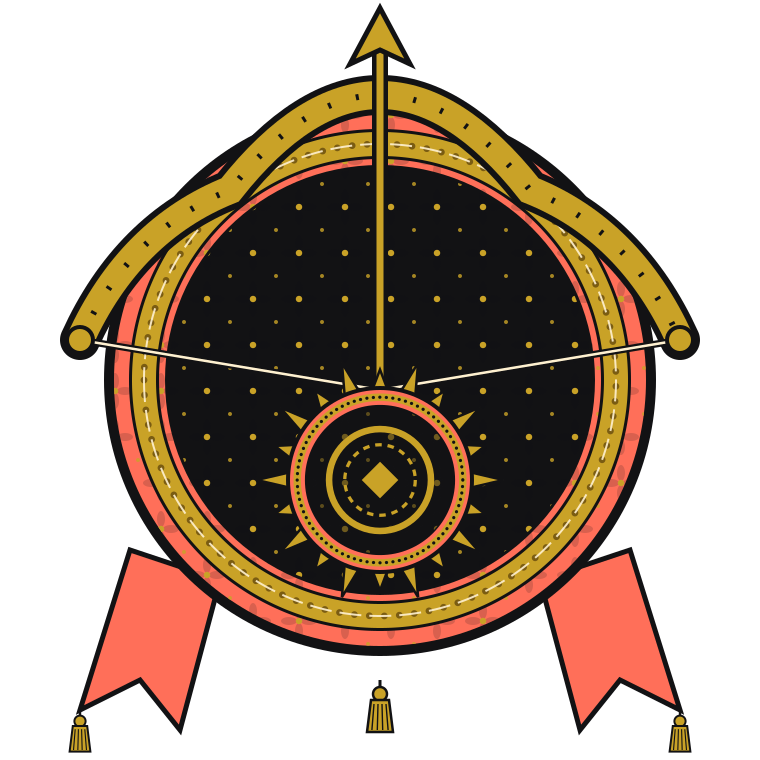
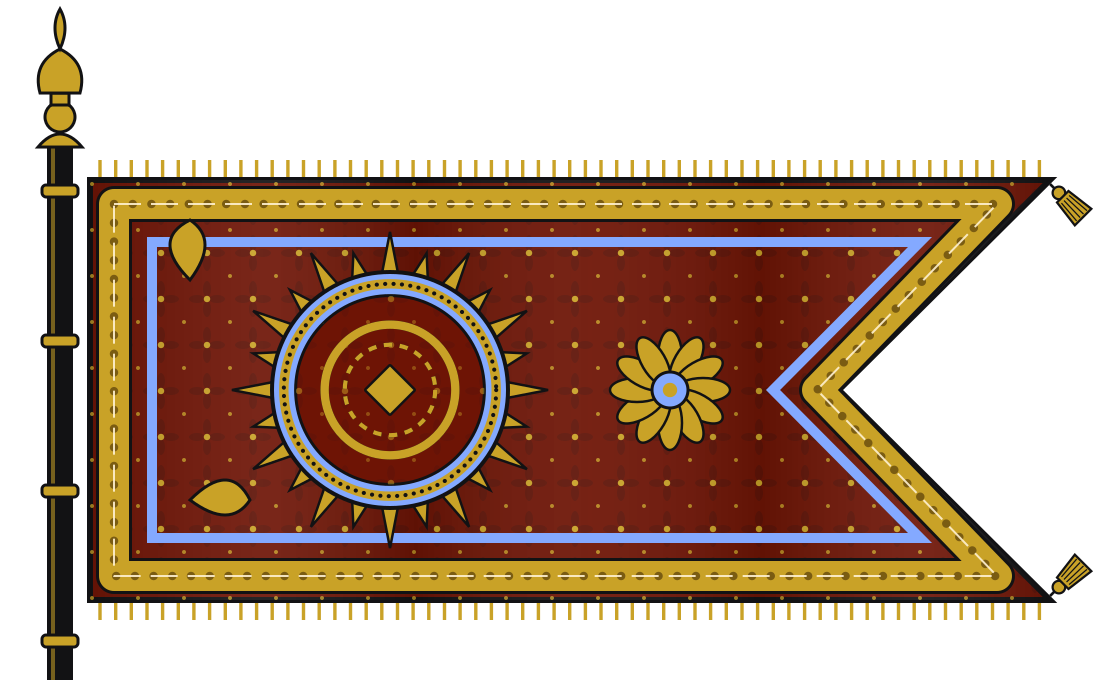
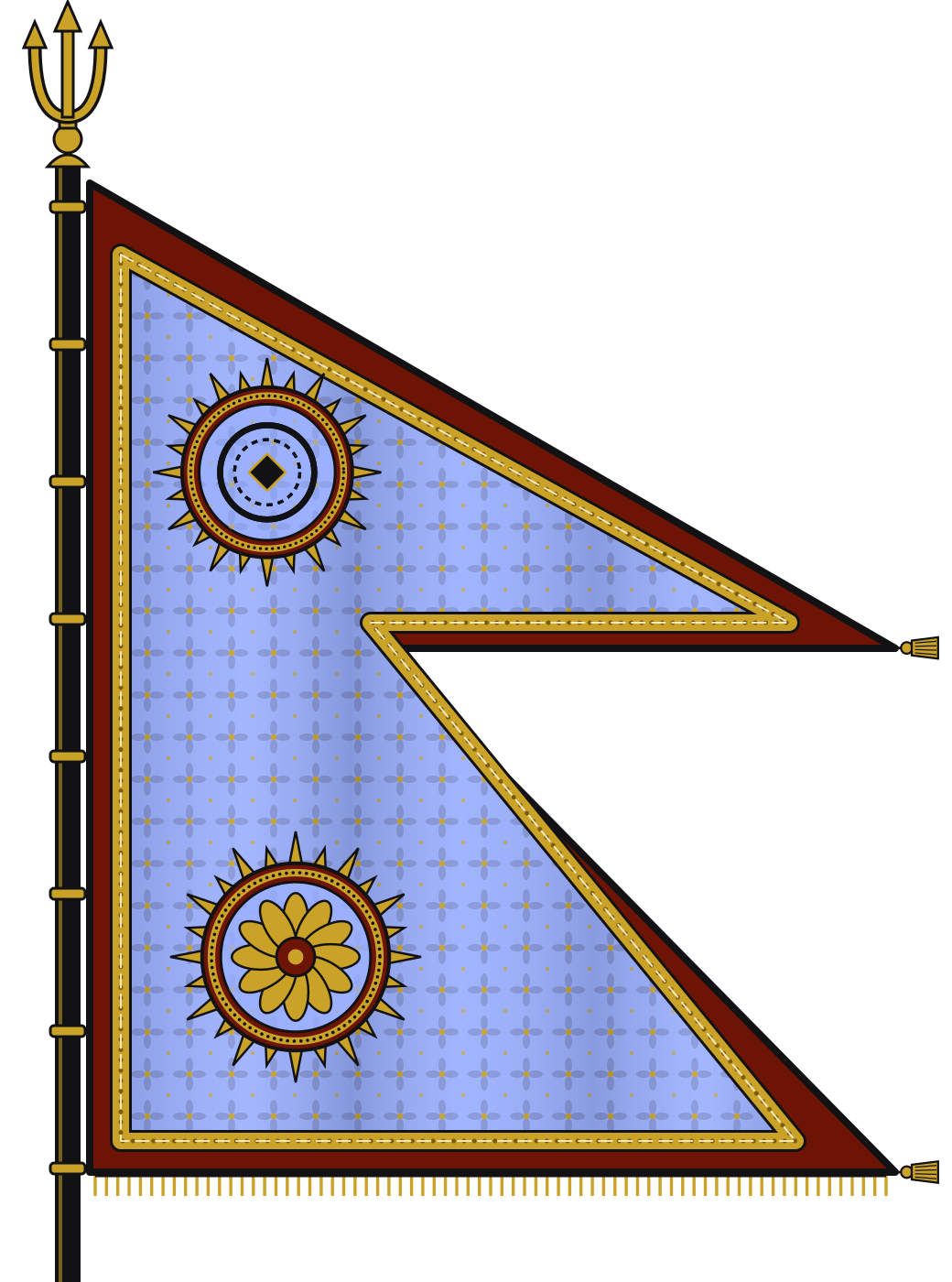
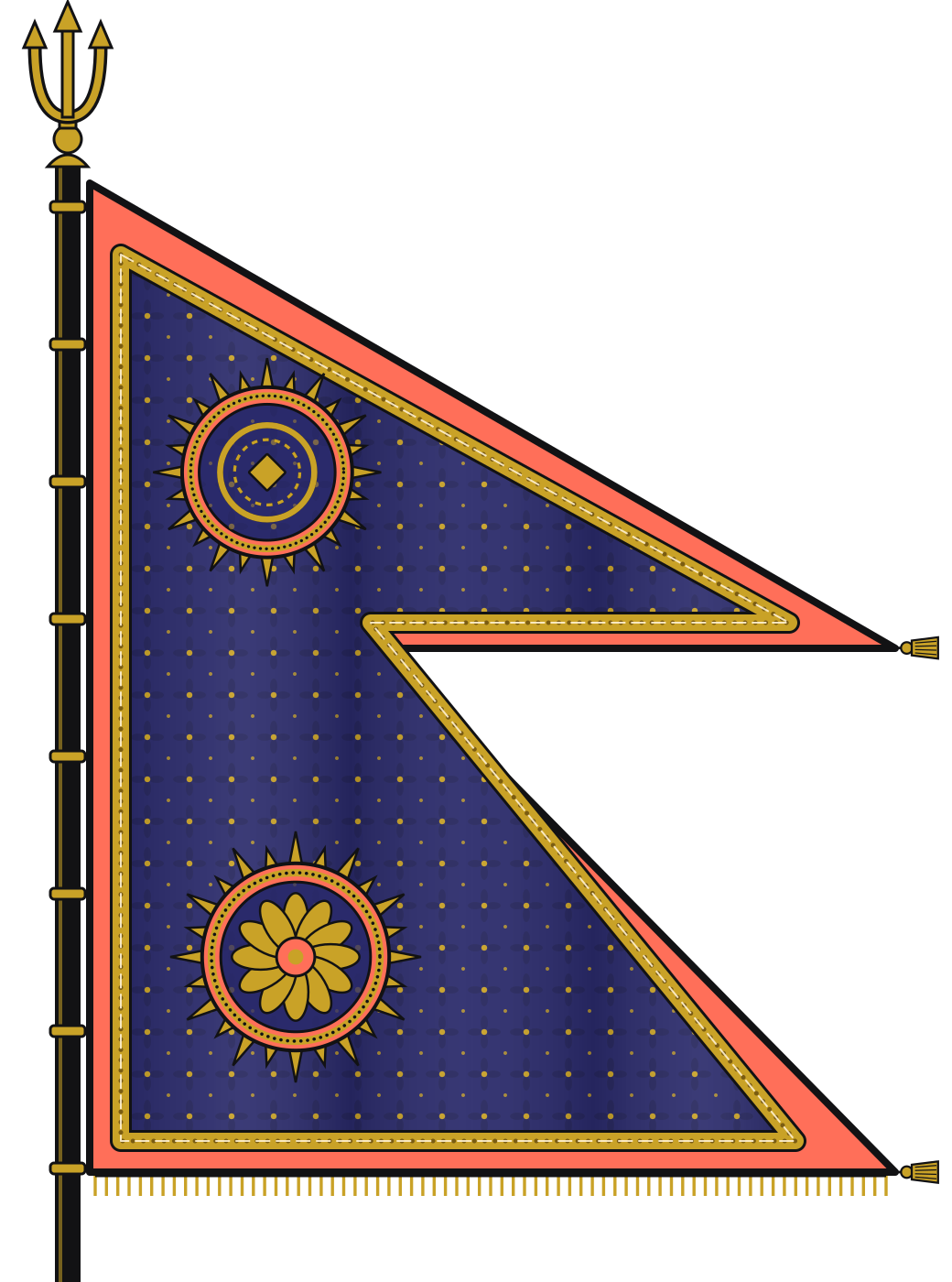
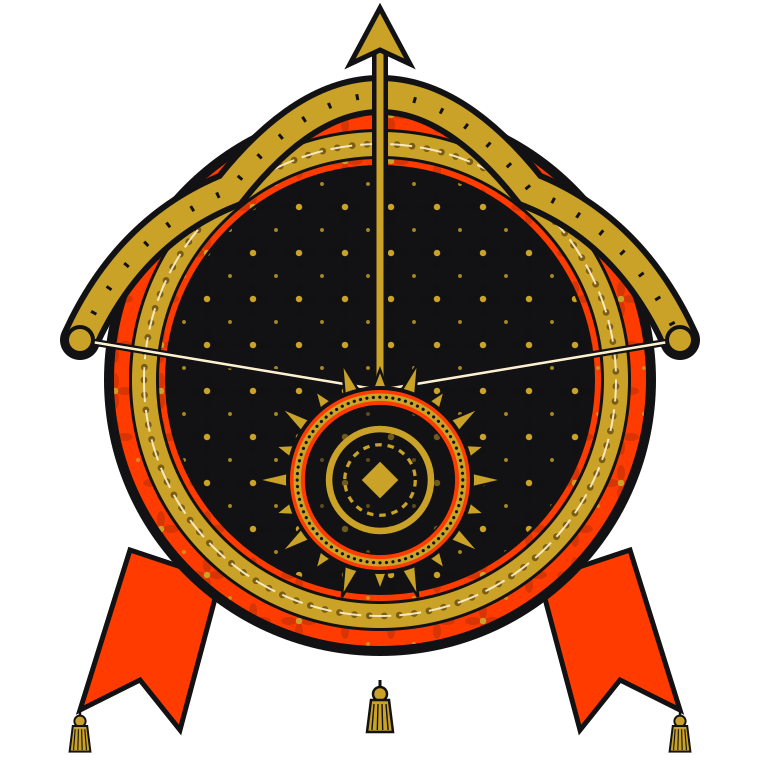
Nothing in the extracts ties a coin, seal or banner to the Birhor. The main emblem in the Atlas, a coil of rope, is a design; the rope comes from the siali bark the Birhor really use[5].
| Part of the kit | This clan |
|---|---|
| Field | Charcoal Black #121214 |
| Accent | Warm Red-Orange #FF6F59 |
| Emblem colour | Metallic Gold #C9A227 |
| Zari metal | Gold |
| Main emblem | A coil of rope |
| Second image | A monkey |
| Night and day | Every visual accessory has two versions: by night the emblem on the dark field, by day the clan's field colour on cloth woven from its metal. |
6. Flags
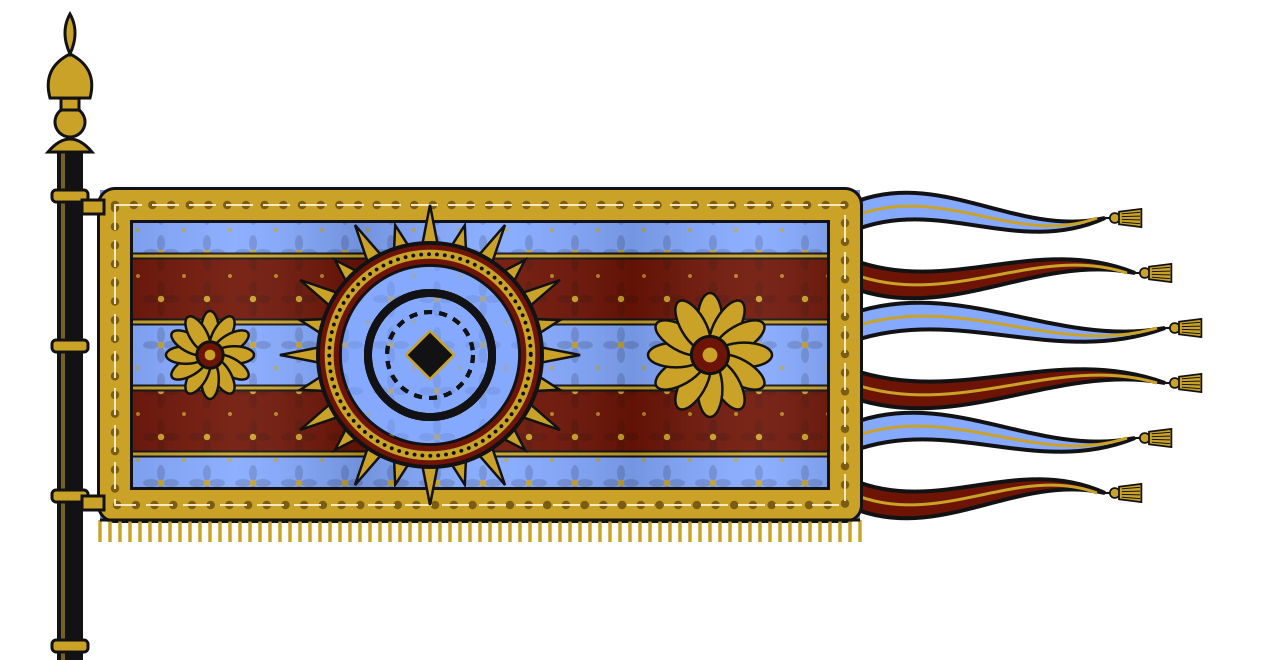
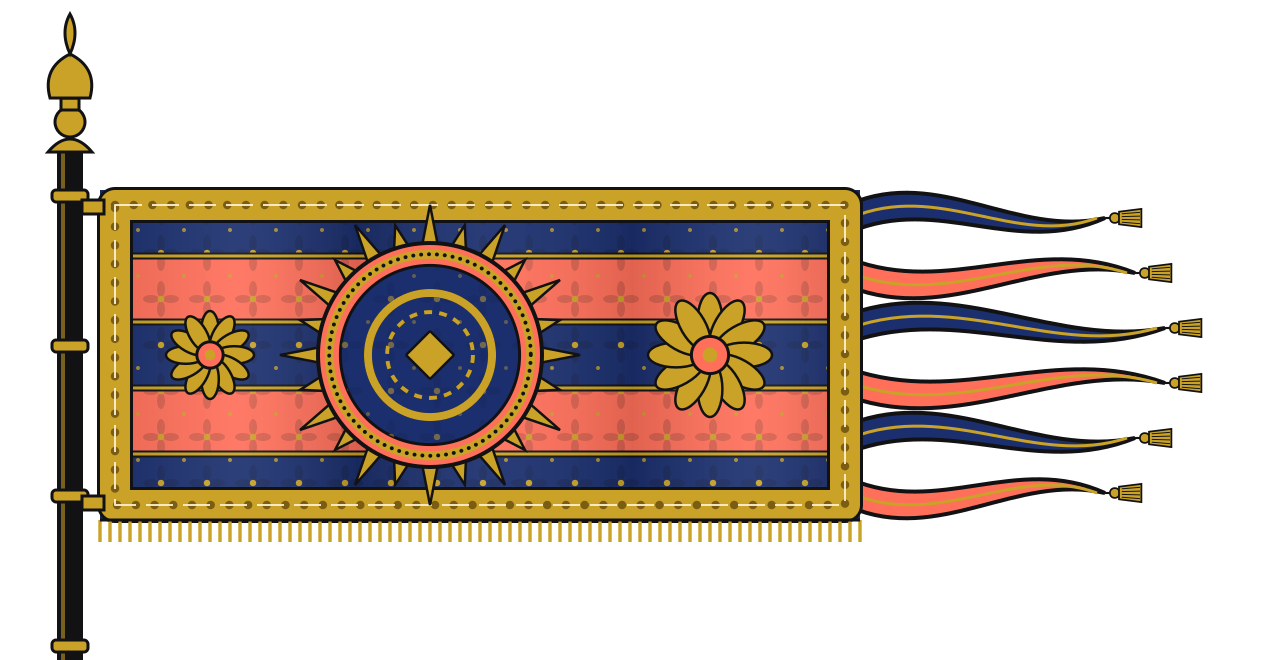
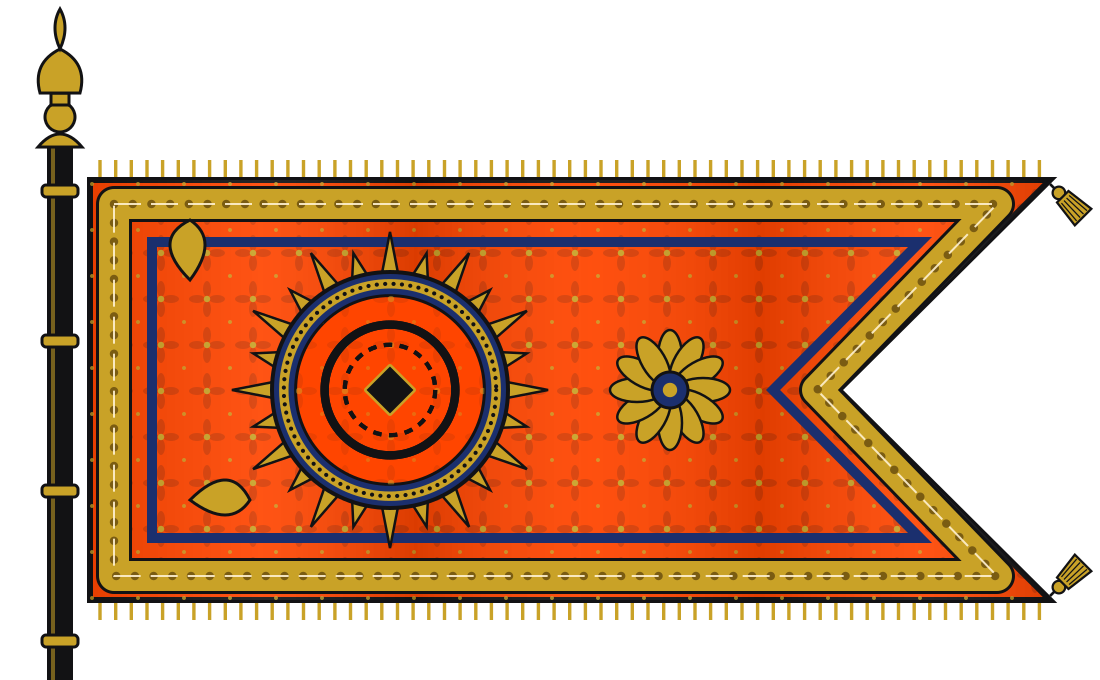
Every clan has every flag type; the type says the occasion and the colours say the clan. The outlined card is the flag the Atlas assigns.

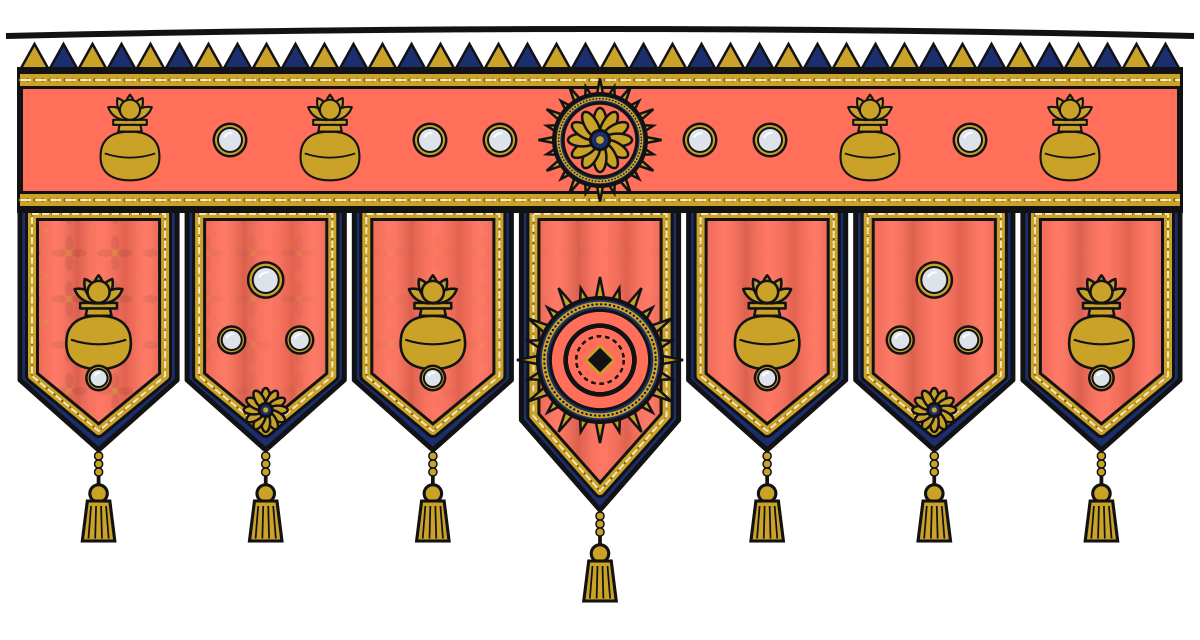
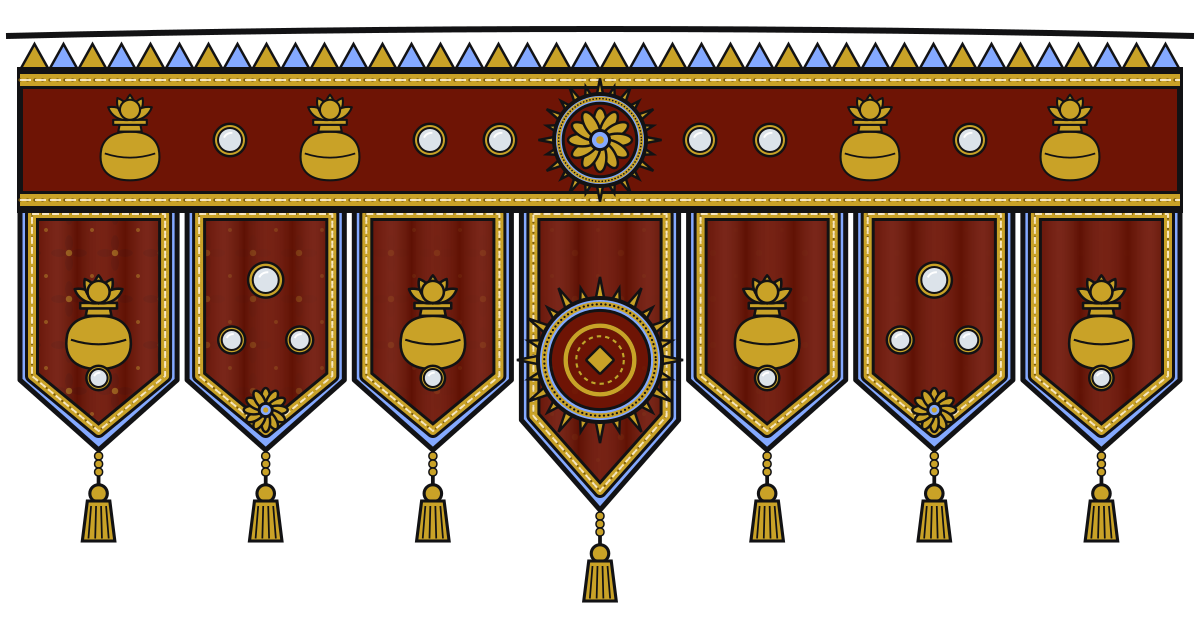

Historic banner
None known
New flag types
| Accessory | For this clan | Basis |
|---|---|---|
| A9 Pota-dhvaja · ship and trade flag For ships, caravans and markets | Not yet designed for this clan | Design |
| A10 Utsava-patāka · festival flag Light, bright flag for fairs and festivals | Not yet designed for this clan | Design |
| A11 Shoka-dhvaja · mourning flag White cloth with the emblem outline in the clan's metal | Not yet designed for this clan | Design |
7. Regalia
| Accessory | For this clan | Basis |
|---|---|---|
| E1 Chhatra · house parasol The ceremonial umbrella | Not yet designed for this clan | Design |
| E2 Chamara · fly-whisks The pair of whisks beside the head of the house | Not yet designed for this clan | Design |
| E3 Danda · staff of office Staff or scepter | Not yet designed for this clan | Design |
| E4 Simhasana · seat The seat of the house, covered in clan cloth | Not yet designed for this clan | Design |
| E5 Khetaka · shield A round shield; the Changi and Dhanush are its flag forms | Not yet designed for this clan | Regional tradition |
| E6 Kula-ayudha · clan weapon The weapon the clan honours | Not yet found for this clan | Under research |
8. Worn
| Accessory | For this clan | Basis |
|---|---|---|
| F1 Kula-vastra · clan cloth The clan's woven pattern in its kit colours | Not yet designed for this clan | Design |
| F2 Kirti-vastra · honour cloth A cloth earned for a deed, not inherited | Not yet designed for this clan | Design |
| F3 Kula-mala · garland flower The flower or leaf the clan wears as a garland | Not yet found for this clan | Under research |
| F4 Chinha · house pin A metal badge with the pin emblem | Not yet designed for this clan | Design |
9. Records
| Accessory | For this clan | Basis |
|---|---|---|
| H1 Clan words A traditional line in the native script | बिरहोर · “Birhor: 'jungle people', from bir (jungle) and hor (men)” | Documented |
| H2 Biruda · titles The house's title or titles | Not yet found for this clan | Under research |
| H3 Prashasti · praise genealogy The lineage as written at the head of a grant | Not yet found for this clan | Under research |
| H4 Vahi · clan register The book of the clan's births, marriages and deaths | Not yet found for this clan | Under research |
| H5 Rana-ghosha · war cry The clan's cry in battle or celebration | Not yet found for this clan | Under research |
10. VishwaVit · knower of the world
Game values are design choices for this project, not historical claims.
References
- Wikipedia, Birhor people, read 2026-10-23, https://en.wikipedia.org/wiki/Birhor_people
- Wikipedia, Tribes of Jharkhand, read 2026-10-20, https://en.wikipedia.org/wiki/Tribes_of_Jharkhand
- Dr. Ramdayal Munda Tribal Welfare Research Institute, Jharkhand, Birhor people, read 2026-10-23, https://trijharkhand.in/en/birhor
- Michael Yorke, The Birhor People, read 2026-10-23, https://michaelyorke.org/other-indian-tribes/
- Odisha State Tribal Museum, Tribes of Odisha: Birhor, read 2026-10-23, https://ostm.in/tribes_of_odisha/birhor/
- Wikipedia, Birhor language, read 2026-10-23, https://en.wikipedia.org/wiki/Birhor_language
- GKToday Hindi, बिरहोर जनजाति, बिहार, 11 August 2019, read 2026-10-23, link
- Encyclopaedia Britannica, Birhor, read 2026-10-23, https://www.britannica.com/topic/Birhor
- Sarat Chandra Roy, The Birhors: A Little-known Jungle Tribe of Chota Nagpur (Ranchi: G.E.L. Mission Press, 1925), NVLI rare books record, read 2026-10-23, https://icvtesting.nvli.in/rarebooks/birhors-little-known-jungle-tribe-chota-nagpur
- Sushree Mohanty, Indigenous Colours of Odisha: Handbook on 62 Tribes (KISS), read 2026-10-20, link
- Vajiram and Ravi, Tribes of West Bengal, read 2026-10-21, https://vajiramandravi.com/current-affairs/tribes-of-west-bengal/
- Wikipedia, Tribals in Madhya Pradesh, read 2026-10-19, https://en.wikipedia.org/wiki/Tribals_in_Madhya_Pradesh
- dhammabharat.com, List of Scheduled Tribes in Maharashtra and Population of each Tribe (2011 Census), read 2026-10-10, https://dhammabharat.com/?p=13656
- Wikipedia, List of Scheduled Tribes in West Bengal, read 2026-10-21, https://en.wikipedia.org/wiki/List_of_Scheduled_Tribes_in_West_Bengal
- Vajiram and Ravi, Tribes of Chhattisgarh, read 2026-10-19, vajiramandravi.com
- Wikipedia, List of Scheduled Tribes in Odisha, read 2026-10-20, https://en.wikipedia.org/wiki/List_of_Scheduled_Tribes_in_Odisha