The Binjhwar, also written Binjhal, are a Scheduled Tribe, listed in Odisha, Madhya Pradesh and Maharashtra[1][2][3]. Russell and Hira Lal (1916) call them a "comparatively civilised Dravidian tribe" of Raipur, Bilaspur and the adjoining Uriya country, with zamindars of Bodasamar, Rampur and Bhatgaon, and record them as an offshoot of the Baigas[4]. Their tutelary goddess is Vindhyabasini, who is carried in procession from village to village every third year[4][5]. Veer Narayan Singh of Sonakhan, hanged at Raipur on 10 December 1857, is called a Binjhwar by The Indian Tribal; the PARI article on him does not name the community[6][7].
01Faith and deities
Vindhyabasini: "the tribe still worship the goddess Vindhyabasini of these hills as their tutelary deity" (Russell and Hira Lal 1916; accepted by the owner 10 Oct 2026; family assigned by the sweep)
A recorded tie between the clan and the goddess.
| Deity or tradition | Place in the clan's life | Evidence |
|---|---|---|
| Vindhyabasini | Tutelary goddess, carried in procession from village to village every third year; the first wedding invitation goes to her, and the priest worships her at the wedding | [4][5] |
| Aruapat or Kunabhainra Puja | Home deity[5] | [5] |
| Deegudi shrine | Holds Thakurbudha, Bhatparsi, Phulmali, Peren Pat, Balaram Pat, Khail Buli, Budhimaa and Baburaae[5] | [5] |
| Village deities and Bura Deo | Common Chhattisgarh village deities and the Bura Deo of the Gonds are worshipped[4] | [4] |
| Dasahra weapons | Daggers, spears and arrows are venerated on Dasahra[4] | [4] |
| Bairagi gurus | Whisper the Karn mantra and give tulsi beads[4] | [4] |
| Sun God (Suryabanshi) | The groom's party seeks the Sun God's blessing; the Binjhal are described as Suryabanshi[5] | [5] |
02Temples
Under research: no temple is recorded for the Binjhwar in the sources used. GKToday names Danteshwari, a twelve-pillar Shiva temple and others, but the page is Dantewada context and no other source ties them to the Binjhwar, so they are not listed[8].
Built by the clan
Not recorded.
Given patronage or grants by the clan
Not recorded.
03Languages and scripts
| Language or script | Kind | Under the clan | Evidence |
|---|---|---|---|
| Binjhal dialect living | Dialect | Spoken by the Binjhal[5] | [5] |
| Sambalpuri living | Language (Odia variety) | Spoken in western Odisha; the Binjhal article lists Odia (Sambalpuri)[5][9] | [9] |
| Chhattisgarhi living | Language | Listed in the infobox of the Binjhal article[9] | [9] |
| Kosoli living | Language | Spoken in western Odisha, with Sambalpuri[5] | [5] |
04Books and literature
Under research: no further Binjhwar-specific text is read beyond Russell (1916) and the works cited here. Works listed below are cited by the sources and were not read.
Written during the clan's history
| Work | Author | Kind | When | Link to the clan |
|---|---|---|---|---|
| The Tribes and Castes of the Central Provinces of India | R. V. Russell and Hira Lal | Ethnography | 1916 | [4] |
| Native Peoples of the World (cited) | Danver | Reference | 2015 | Cited in[9] |
| Bengal District Gazetteers: Sambalpur (cited) | O'Malley | Gazetteer | 2007 (as cited) | Cited in[9] |
| Indigenous Colours of Odisha: Handbook on 62 Tribes | Sushree Mohanty | Handbook (KISS) | Not dated in the extract | [10] |
| Traditional Political System of the Binjhals (cited) | Panda | Monograph | 2005 | Cited in[5] |
| Binjhal (cited) | Ota et al. | Entry | 2015 | Cited in[5] |
| People of India, vol. III: the Scheduled Tribes (cited) | K. S. Singh (ed.) | National series | 1994 | [11] |
Given patronage by the clan
Not recorded.
05Thinkers and scholars
Not recorded.
Under research: no Binjhwar scholar or thinker is named in the sources used.
06Art and architecture
Ritual objects of the Binjhal wedding are recorded (Murmu and Patel 2020)[5]. No painting, sculpture or architecture is recorded in the sources used.
Painting and wall art
Not recorded.
Sculpture and temple art
Not recorded.
Temple and building architecture
Not recorded.
Weaving and textiles
Not recorded.
Clothing and jewellery
Not recorded.
Coins, pottery and crafts
| Art form | What it is | Era | Evidence |
|---|---|---|---|
| Groom's arrow | A ritual object of the wedding | [5] | |
| Lac bangles | Worn by married women | [5] | |
| Sargi-leaf invitations | Turmeric-stained leaf invitations to a wedding | [5] | |
| Bamboo, wood, metal and terracotta | Crafts listed for the tribe (GKToday, caution) | [8] |
07History
Name and early homes
Russell and Hira Lal say the name derives from the Vindhya hills, and that their ancestors were said to have migrated from Binjhakop to Lampa (Lamta in Balaghat, or Laphagarh in Bilaspur)[4].
Wikipedia gives two readings of the name, "without sweat" and the Vindhya range, and the Binjhal self-designation "Swa-Lakhi Vindhya Vasini" is recorded by Panda (2005), cited in[5][9].
Murmu and Patel (2020) record an oral migration from the Vindhya, Satpura and Aravalli hills of Madhya Pradesh, through Bilaspur, Raipur, Raigarh and Sarguja, to Bargarh in Odisha[5].
Russell records that the Binjhwars of Chhattisgarh and Sambalpur appear to have been originally Baigas[4].
The Chauhan legend and the Patna kings
Russell gives a legend that the mother of the first Raja of Patna, a Chauhan Rajput, fled to Sambalpur and bore her son in a Binjhwar's hut. He gave the Binjhwar the Bodasamar estate, and the tribute on each accession was a silk cloth[4].
Wikipedia says the Binjhal sheltered the mother of the Chauhan king Ramai Dev in the 14th century, citing Danver (2015) p. 524[9].
For the Chauhan kingdom of Patna, the Sambalpur history records that in 1540 it was split between Narasingh Deb and Balaram Deb, whose capital was first Nuagarh near Bargarh and later Sambalpur[12]. The same page does not mention the Binjhal.
The Paika rebellion
Wikipedia, citing Danver (2015) and O'Malley (2007), says the Binjhal fought alongside Veer Surendra Sai and Madho Singh (Ghess) in the Paika rebellion[9].
The Sambalpur history says Veer Surendra Sai fought the British and was freed from Hazaribagh prison in July 1857[12]. The extracts give no year for the Paika rebellion itself.
Sonakhan and Veer Narayan Singh (1856-1857)
The Indian Tribal (2 November 2025, a journalistic source) describes Veer Narayan Singh, born around 1795, as a Binjhwar (Binjhal) zamindar of Sonakhan, called the "Mahanayak of Sonakhan"[6].
In the famine of 1856 he gave out a British trader's grain to starving villagers. He was arrested at Raipur for "looting government property", escaped with help, rallied tribal and peasant fighters, was captured by deceit and publicly executed at Raipur on 10 December 1857, aged about 62[6].
PARI's Chhattisgarhi article (a translation of a 1997 Times of India piece) says the British hanged him at Raipur in 1857, and that in the 1850s famine he opened the grain stores of merchants and landlords to poor Adivasis, promising repayment from the harvest[7]. It does not name the Binjhwar.
Zamindaris
The landholding section of the tribe, like the Raj-Gonds among the Gonds, held the zamindaris of Bodasamar, Rampur and Bhatgaon[4].
08Journey and migrations
The moves the sources record. None is dated with a year except the 1916 survey.
| When | From | To | Why | Evidence |
|---|---|---|---|---|
| Before 1916 (ancestral tradition) | Binjhakop | Lampa (Lamta or Laphagarh) | Ancestors' migration, as Russell records it | [4] |
| Undated (oral tradition) | Vindhya, Satpura and Aravalli hills of Madhya Pradesh | Bilaspur, Raipur, Raigarh and Sarguja, then Bargarh (Odisha) | Oral migration, as Murmu and Patel record it | [5] |
09Seats and lands
| Place | Role | Where today |
|---|---|---|
| Bodasamar, Rampur, Bhatgaon | Zamindaris held by the tribe's landholders[4] | Not located in the sources |
| Lampa (Lamta or Laphagarh) | Ancestral settlement in Russell's account[4] | Lamta (Balaghat) or Laphagarh (Bilaspur), as Russell suggests |
| Raipur and Bilaspur | The districts where Russell found the tribe in 1916[4] | Chhattisgarh |
| Sonakhan सोनाखान | Zamindari of Veer Narayan Singh[6] | Balodabazar-Bhatapara district (The Indian Tribal); inside a wildlife sanctuary (PARI)[7] |
| Baragarh, Bolangir, Sonepur, Nuapara, Sambalpur | Odisha districts where the Binjhal are listed (handbook spellings)[10] | Odisha |
| Balangir, Baragarh, Kalahandi, Nuapada | Main areas of the Binjhal in Odisha, with Chhattisgarh[5] | Odisha and Chhattisgarh |
10Notable figures
| Name | Role | Era | Known from |
|---|---|---|---|
| Veer Narayan Singh | Zamindar of Sonakhan, led tribal and peasant fighters; called Mahanayak of Sonakhan | Born c. 1795; hanged 10 December 1857 | [6][7] |
| Twelve Brother Archers legend | Original ancestors, sons of Vindhyabasini, whose arrows stuck in the door of the great temple at Puri | Legendary | [4] |
| Mother of the first Raja of Patna legend | Chauhan Rajput mother sheltered by the Binjhwar; Wikipedia names the king as Ramai Dev | 14th century (Wikipedia) | [9] |
| Veer Surendra Sai | Fought the British; the Binjhal fought alongside him in the Paika rebellion | Freed from Hazaribagh prison, July 1857 | [12][9] |
| Madho Singh (Ghess) | Fought alongside the Binjhal in the Paika rebellion | Paika rebellion (no year given) | [9] |
11Allies, rivals and marriages
| People | Relationship | When |
|---|---|---|
| Baiga (ST-014) | Parent people: the Binjhwars are recorded as a subdivision of the Baigas[4] and an offshoot[9] | 1916; Wikipedia |
| Gonds (ST-088) | Landholding section like the Raj-Gonds; septs Tekam and Sonwani near the Gonds[4] | 1916 |
| Kols (ST-141) | The Binjhwar are listed among the Mandla Kol totemic septs[13] | 1916 |
| Chauhan Rajputs of Patna (SUB-109) | Legend of a Chauhan mother's son born in a Binjhwar's hut[4] | 14th century (Wikipedia) |
| Bharotia (ST-449) | Baiga subtribe that shares the territorial sept name Lapheya[4] | 1916 |
| Binjhia (ST-038) | Subdivision in Russell's list; zamindar of Bhatgaon[4] | 1916 |
12Society and livelihood
Mostly nuclear families with paternal descent, patrilocal, with monogamy common and negotiated marriage most common (Wikipedia citing SCSTRTI[9]). Russell records polygamy, and a zamindar marrying a Pat Rani on accession[4].
Government and social order
| Institution or group | What it was | Evidence |
|---|---|---|
| Jhankar | Village priest of the soil, crop, forest and hill deities; Binjhwars commonly hold the office in Sambalpur, with rent-free land[4] | [4] |
| Zamindari household | A zamindar of Bodasamar could take a fine of one to ten rupees for a divorce; polygamy was allowed[4] | [4] |
| Sambalpur marriage | No exogamous groups; marriage by relationship; bride-price about eight khandis (1,400 lb) of unhusked rice; weddings avoided in the rains and in Chait, Jeth and Pus; ceremony over Sunday to Wednesday, with a Gandsan scenting ceremony[4] | [4] |
| Wedding arrow rite | The arrow draws three lines for Brahma, Vishnu and Siva; the groom shoots seven arrows at a straw sambhar deer; the bride's brother feigns death with the arrow[4] | [4] |
| Sarba Bharatia Binjhal Samaja (Mahasabha) | Framed written marriage rules in 2003, age rules in 2008 and bride-price rules in 2018; fines of Rs 15,000 for elopement and Rs 25,000 for a woman marrying out; meets at Padampur King's Palace, Baragarh[5] | [5] |
| Elders | No traditional village council; elders settle disputes[9] | [9] |
| Death rites | The dead are usually buried; a lamp and rice on the grave on the third day; Kharpani ("Grass and Water") and, for elders, Badapani ("Great Water")[4] | [4] |
| Girls and weddings (GKToday, caution) | Girls may choose husbands; weddings usually at the groom's home; divorce permitted[8] | [8] |
Livelihood over time
| Era | Livelihood | Evidence |
|---|---|---|
| 1916 (Russell) | Mostly cultivators and labourers; the landholding section held zamindaris[4] | [4] |
| 1916 (Russell) | Sonjharas: gold-washers of the Mahanadi; Birjhias: bewar shifting cultivators[4] | [4] |
| Today (GKToday, caution) | Farming and forest produce[8] | [8] |
13Sub-clans and related clans
Russell (1916) names four subdivisions: Binjhwars proper, Sonjharas (gold-washers of the Mahanadi), Birjhias (shifting cultivators) and Binjhias (a diminutive form). The Hindi GKToday page gives four names in Devanagari, with caution because the page mixes in other material[8]. The exogamous divisions are totemistic, and the Odisha list gives its own exogamous vansas[9][5].
| Clan | Relation | Where | Size | In the Atlas | Evidence |
|---|---|---|---|---|---|
| Sonjhara सोनझर | Sub-clan | Gold-washers of the Mahanadi (Russell 1916) | new clan candidate | [4][8] | |
| Birjhia बिरजिह | Sub-clan | Bewar shifting cultivators (Russell 1916); septs Munna, Son and Solai have Munda names | NE-018 | [4] | |
| Binjhia बिंझी | Sub-clan | Diminutive form; zamindar of Bhatgaon (Russell 1916). The GKToday name is taken as Binjhia by name only; the sources do not say so | 11,419, 2011[1] | ST-038 | [4][1] |
| Amri | Sub-clan | Exogamous vansa of the Binjhal in Odisha (SCSTRTI, via Wikipedia) | new clan candidate | [9] | |
| Nag | Sub-clan | Exogamous vansa of the Binjhal in Odisha (SCSTRTI, via Wikipedia) | same name as ST-476: check | [9] | |
| Khusal | Sub-clan | Exogamous vansa of the Binjhal in Odisha (SCSTRTI, via Wikipedia) | new clan candidate | [9] | |
| Duguke | Sub-clan | Exogamous vansa of the Binjhal in Odisha (SCSTRTI, via Wikipedia) | new clan candidate | [9] | |
| Kamati | Sub-clan | Exogamous vansa of the Binjhal in Odisha (SCSTRTI, via Wikipedia) | new clan candidate | [9] | |
| Mahaiinga | Sub-clan | Exogamous vansa, spelt as the source prints it | new clan candidate | [9] | |
| Bagha | Sub-clan | Exogamous vansa of the Binjhal (SCSTRTI, via Wikipedia). May be the same name as the totem sept Bagh; the sources do not say | same name as ST-561: check | [9] | |
| Marthi Endja | Sub-clan | Exogamous vansa of the Binjhal (SCSTRTI, via Wikipedia) | new clan candidate | [9] | |
| Bentakar | Sub-clan | Exogamous vansa of the Binjhal (SCSTRTI, via Wikipedia) | new clan candidate | [9] | |
| Majhi | Sub-clan | Exogamous vansa of the Binjhal (SCSTRTI, via Wikipedia); also a caste-named sept in Russell's list. Not linked to the Atlas entry by the sources | same name as ST-181: check | [9][4] | |
| Bagh | Sub-clan | Totem sept: tiger (Russell 1916). Nicknames Udhar, Marai Meli Bagh and Ultum are given for septs | new clan candidate | [4] | |
| Pod | Sub-clan | Totem sept: buffalo (Russell 1916) | new clan candidate | [4] | |
| Kamalia | Sub-clan | Totem sept: lotus (Russell 1916) | new clan candidate | [4] | |
| Panknali | Sub-clan | Totem sept: water-crow (Russell 1916) | new clan candidate | [4] | |
| Tar | Sub-clan | Totem sept: date-palm (Russell 1916) | new clan candidate | [4] | |
| Jal | Sub-clan | Totem sept: net (Russell 1916); nickname Jalia | new clan candidate | [4] | |
| Lohar | Sub-clan | Caste-named sept (Russell 1916); one Lohar and one Kumhar are needed at a wedding | new clan candidate | [4] | |
| Dudh Kawaria | Sub-clan | Caste-named sept (Russell 1916) | new clan candidate | [4] | |
| Bhil | Sub-clan | Caste-named sept (Russell 1916). The sources do not say whether it is the Bhil people | same name as ST-027: check | [4] | |
| Banka | Sub-clan | Caste-named sept (Russell 1916) | new clan candidate | [4] | |
| Lapheya | Sub-clan | Territorial sept, from the Lapha zamindari; used by Binjhwars and Bharotias (Russell 1916) | new clan candidate | [4] | |
| Ghugharia | Sub-clan | Territorial sept, from Ghughri village in Mandla; used by Binjhwars and Bharotias (Russell 1916, Baiga article) | new clan candidate | [4] | |
| Bariha | Branch | Landholding Binjhwars, called from barah, the boar of the legend (Russell 1916) | new clan candidate | [4] | |
| Munna | Sub-clan | Septs of the Birjhia, with Munda names (Russell 1916) | new clan candidate | [4] | |
| Son | Sub-clan | Septs of the Birjhia, with Munda names (Russell 1916) | new clan candidate | [4] | |
| Solai | Sub-clan | Septs of the Birjhia, with Munda names (Russell 1916) | new clan candidate | [4] | |
| Tekam | Sub-clan | Gond-named sept, found where the Binjhwar live near the Gonds (Russell 1916) | same name as ST-502: check | [4] | |
| Sonwani | Sub-clan | Gond-named sept, found where the Binjhwar live near the Gonds (Russell 1916) | same name as ST-556: check | [4] | |
| Surya Bansi | Related people | Lineage name listed for the Binjhal (SCSTRTI, via Wikipedia) | new clan candidate | [9] | |
| Nag Bansi | Related people | Lineage name listed for the Binjhal (SCSTRTI, via Wikipedia) | new clan candidate | [9] | |
| Hillchip | Related people | Lineage name listed for the Binjhal (SCSTRTI, via Wikipedia) | new clan candidate | [9] | |
| Chauhan | Dynasty from this clan | Patna Chauhan legend (Russell 1916); Wikipedia lists Chauhan among the Binjhal lineages | SUB-109 | [4][9] | |
| Baiga | Parent people | Binjhwars recorded as a subdivision of the Baigas (Russell 1916); offshoot (Wikipedia) | ST-014 | [4][9] | |
| Bharotia | Related people | Baiga subtribe that shares the sept name Lapheya | ST-449 | [4] | |
| Gond | Related people | Landholding comparison (Raj-Gonds) and the Bura Deo; septs Tekam and Sonwani | ST-088 | [4] | |
| Kol | Related people | The Binjhwar are one of the Mandla Kol totemic septs (Russell 1916, Kol article) | ST-141 | [13] |
Clans marked "new clan candidate" are not in the Atlas yet.
14Surnames
No surname is stated for the Binjhwar in the sources used. Sept names above (Lohar, Bagh, Pod and others) are exogamous divisions, not stated as surnames.
Not recorded.
15Songs and music
The sources give no Binjhwar song with words. The Dalkhai dance is performed by young girls of the Binjhal, Soura and Mirdha tribes at Dusshera and Bhaijuntia[14].
Dalkhai (dance songs) living
Instruments and styles
| Instrument or style | What it is | Evidence |
|---|---|---|
| Drums and Ganda musicians | Lead the girls' village tours after the Karma festival[4] | [4] |
| Kendara | Sambalpuri instrument for the kendara gita; the Wikipedia article does not tie it to the Binjhal[14] | [14] |
16Poems, lullabies and children's rhymes
Under research: no Binjhwar poem, lullaby or rhyme is in the sources used.
None recorded yet.
17Stories, legends and proverbs
Stories and legends
| Story | What happens | Told by | Evidence |
|---|---|---|---|
| The Twelve Brother Archers | The barah bhai betkar, twelve sons of Vindhyabasini, were chasing a wild boar. Their arrows flew to the door of the great temple at Puri and stuck. The king's elephants could not pull them out, and the brothers drew them out by hand. The king gave them the estates their descendants hold. Landholders are called Bariha from barah, the boar. | Binjhwar tradition, as Russell gives it | [4] |
| The Chauhan prince's mother | The mother of the first Raja of Patna, a Chauhan Rajput, fled to Sambalpur and bore her son in a Binjhwar's hut. He gave the Binjhwar the Bodasamar estate. | Russell 1916 (legend) | [4] |
| The hill of elephants | The Binjhwar tradition says they dwelt on the kajli ban pahar, the hill of elephants. | Binjhwar tradition, as Russell gives it | [4] |
Proverbs and sayings
| Saying | Meaning | Evidence |
|---|---|---|
| Je maris te saris (Roman script, as printed) | That which is dead is rotten and gone (Russell's gloss). The extract has no native-script form | [4] |
18Festivals and fairs
| Festival or fair | When | Where | What happens | |
|---|---|---|---|---|
| Karma | 11th of Bhadon | Binjhwar villages | Youths and maidens bring home a young karma tree with singing, dancing and drums, and an all-night dance follows; next morning the tree is put in a stream or tank; girls then tour the villages with drummers and Ganda musicians[4]. Wikipedia says the Karma dance honours Karam Sani, the deity who grants children[14] | |
| Dasahra | Dasahra | Binjhwar villages | Daggers, spears and arrows are venerated[4] | [4] |
| Dalkhai | Dusshera and Bhaijuntia | Western Odisha | Young girls of the Binjhal, Soura and Mirdha tribes dance it[14] | [14] |
| Harali Parab, Pusa Punei (Madhen Parab), Makulbhaja Parab, Magha Parab | Listed as festivals of the Binjhal | Binjhal | What happens at each is not in the extract[5] | [5] |
19Food, dress and games
Food
| Item | What it is | Evidence |
|---|---|---|
| Diet | Indiscriminate except beef and monkeys (Russell 1916) | [4] |
Dress
| Item | What it is | Evidence |
|---|---|---|
| Tattooing | Women are tattooed on the chest, arms and legs with flowers, leaves and zigzags; a man will not take food from a woman not tattooed on the feet (Russell 1916) | [4] |
| Jewellery | Cane, grass, bead and silver jewellery (GKToday, caution) | [8] |
Games and martial arts
Not recorded.
Tags: living still practised · revived brought back after a break · lost known only from records · research reported but not yet confirmed from a source. Songs and poems under copyright are listed by title only; restricted or sacred material is noted without its content.
20Status today
Scheduled Tribe in Odisha, Madhya Pradesh and Maharashtra on the lists the extracts give; the Binjhal article also places the people in Chhattisgarh, but gives no Chhattisgarh list. 137,040 in Odisha in 2011[1][9].
Who carries the name today
| Community | Link | Basis | Evidence |
|---|---|---|---|
| Binjhia (ST-038) | Documented | [4] | |
| Birjhia (NE-018) | Documented | [4] | |
| Sonjhara | Documented | [4][8] |
Recognised heritage
| What | Recognition | Evidence |
|---|---|---|
| Shaheed Veer Narayan Singh of Sonakhan | A Tribal Freedom Fighters Museum and a horse-mounted statue, inaugurated by the Prime Minister, and a cricket stadium in Raipur named for him (The Indian Tribal, which calls him Binjhwar); the state has recognised him again with roads, buildings, tanks and gardens named for him (PARI, which does not name the community) | [6][7] |
This page has not yet been reviewed by Binjhwar or Binjhal community organisations. The Sarba Bharatia Binjhal Samaja (Mahasabha) is one body to ask[5]. Corrections and preferred spellings from the community will be recorded here.
21For children
The twelve brothers and the temple door
Long ago, in the Vindhya hills, there were twelve brothers called the Barah Bhai Betkar, which means the twelve brother archers. They were the sons of the goddess Vindhyabasini. One day they were chasing a wild boar with their bows. Their arrows flew all the way to the great temple at Puri, and they stuck in its door. The king's elephants could not pull the arrows out. The twelve brothers pulled them out with their own hands. The king was pleased and gave them land, and their children held that land for a long time.
Written for this project
Riddle: Twelve brothers shot their arrows, and the arrows flew a long way and stuck fast. Where did they stick? (In the door of the great temple at Puri.)
22Across the project
| Project | What carries this clan | Status |
|---|---|---|
| Atlas of the Janas | Odisha districts named in the handbook; Sonakhan in Balodabazar-Bhatapara (The Indian Tribal); the places Binjhakop and Lampa are not located | To check |
| KulDevi and GrahDevi | KulDevi Vindhyavasini, family Navadurga, documented; the Vindhyabasini tradition is in Russell 1916 | From the Atlas |
| Planet naming | Not researched for the Binjhwar | To check |
| Renaming and waters | Sonakhan lies inside a wildlife sanctuary (PARI); no water or place name drawn from the Binjhwar yet | — |
23Open questions
- Names: the official lists write Binjhal (Binjhwar) in Odisha and Binjhwar in Madhya Pradesh and Maharashtra. Confirm whether the Chhattisgarh figure of 119,718 uses the same name, and which total the census tables give (the Binjhal article gives about 256,758).
- Language family: the Atlas says Indo-Aryan, while Murmu and Patel (2020) class the Binjhal as Dravidian, as Russell does. Settle this from a linguistic source.
- Veer Narayan Singh: The Indian Tribal gives birth around 1795 and a famine in 1856; PARI gives the 1850s famine and does not name the community. Find a scholarly biography. Also confirm that he is not the Narayan Singh, raja of Sambalpur, who died in 1849 (Sambalpur history).
- Paika rebellion: no year in the extracts. Check Danver (2015) p. 524 and O'Malley (2007) p. 27 as Wikipedia cites them.
- Sub-clans: the Odisha vansas (Amri, Nag, Khusal and others), Russell's totem septs (Bagh, Pod and others) and the caste-named septs may overlap. Bagh and Bagha, and Majhi and Nag, may match master-sheet names (ST-181 Majhi, ST-476 Nag); the sources do not say.
- GKToday's four Devanagari sub-clan names are on a page that mixes in other material. Match them to Russell's four before using them.
- Chauhan legend: Russell gives no king's name; Wikipedia names Ramai Dev and dates the sheltering of his mother to the 14th century. Check the dynasty chronology.
- Surnames: no surname list is in the sources. Read the full Murmu and Patel (2020) article for family names.
- Songs, sayings and rhymes: only one saying, in Roman script. Check the CIIL Sanchika recordings and the Murmu and Patel article.
- Community review: none recorded. Ask the Sarba Bharatia Binjhal Samaja and the Binjhal writers the article cites.
- Chhattisgarh status: the Binjhal article places the people in Chhattisgarh and calls them Scheduled Tribe[9], while the lists in the extracts cover Odisha, Madhya Pradesh and Maharashtra only[1][3][2]. Find a Chhattisgarh list before stating the status there.
- Exogamy: Russell's Sambalpur note gives no exogamous groups[4]; the Odisha sources give exogamous vansas[9][5].
- Bride-price: rice in Russell[4]; cash in the Binjhal article, citing SCSTRTI[9].
- Sanskrit names: Russell says landholding Barhias adopted the Sanskrit names Gajendra, Rameswar and Nageshwar[4]; the surnames section says no surname is stated. Settle whether these are surnames.
24Astitva
अस्तित्व · being, existence: everything by which the clan is known
The arrow is the tribal symbol: cattle are branded with it, illiterate Binjhwars sign with it, and at a wedding an arrow is laid on the mahua marriage-post and honoured as the bridegroom[4]. No coin, seal or inscription is recorded in the sources used.
Every clan has every accessory, royal objects included. Each one says how it is known: Documented This clan's own object is recorded. · Regional tradition Recorded for the region or for peoples like this one, not for this clan. · Design Made for this project, with no historical claim. · Under research To be found for this clan from sources. Legends and titles are written in the clan's own script.
1. Seals and coins
| Accessory | For this clan | Basis |
|---|---|---|
| B1 Rajamudra · house seal Round seal with the clan emblem and a short legend in the clan's script | Not yet designed for this clan | Design |
| B2 Anguliya-mudra · signet ring Personal seal ring of the head of the house | Not yet designed for this clan | Design |
| B3 Chhapa · house stamp Ink or block stamp for letters, goods and cloth | Arrow mark: cattle are branded with the arrow, and illiterate Binjhwars sign with it Russell 1916[4] | Documented |
| B4 Tamrapatra · charter plate Copper-plate grant on a ring, closed with the house seal | Not yet designed for this clan | Design |
| B5 Shreni-mudra · guild or trade seal Seal for the clan's trade, craft or caravan | Not yet designed for this clan | Design |
| C1 Clan coin Emblem or deity on one side, a legend in the clan's script | Not yet designed for this clan | Design |
| C2 Coin die The die that strikes the coin | Not yet designed for this clan | Design |
2. Living symbols
| Accessory | For this clan | Basis |
|---|---|---|
| I1 Totem trio The tree, bird and animal the clan protects | Totem septs: tree, Tar (date-palm); bird, Panknali (water-crow); animal, Bagh (tiger). Pod (buffalo), Kamalia (lotus) and Jal (net) are also totems Exogamous, totemistic divisions (Russell 1916). The sources do not say that the clan protects them[4] | Documented |
| I2 Kaval-maram · guardian tree The tree that stands at the clan's seat | Not yet found for this clan | Under research |
3. Stone and gate
| Accessory | For this clan | Basis |
|---|---|---|
| G1 Torana · gateway The built gate of the seat; the cloth Toran hangs in it | Not yet designed for this clan | Regional tradition |
| G2 Viragallu · hero stone Carved panel stone for a member who died defending the clan | Not yet designed for this clan | Regional tradition |
| G3 Kula-shila · clan stones Standing and table stones that remember the ancestors | Not yet designed for this clan | Design |
| G4 Jayastambha · victory pillar A pillar raised for a victory | Not yet designed for this clan | Design |
| G5 Sima-shila · boundary stone Marks the clan's land, with a line in the native script | Not yet designed for this clan | Design |
4. Sounds
| Accessory | For this clan | Basis |
|---|---|---|
| D1 Pancha-mahashabda · five great sounds The right to five instruments | Not yet designed for this clan | Design |
| D2 Shankha · clan conch The clan's own named war conch | Not yet designed for this clan | Design |
| D3 Murasu · house drums Three drums: war, charity and justice | Not yet designed for this clan | Design |
5. Kit: colours, metals and emblems
The arrow is the Binjhwar's documented symbol, and its colours come[4].
| Part of the kit | This clan |
|---|---|
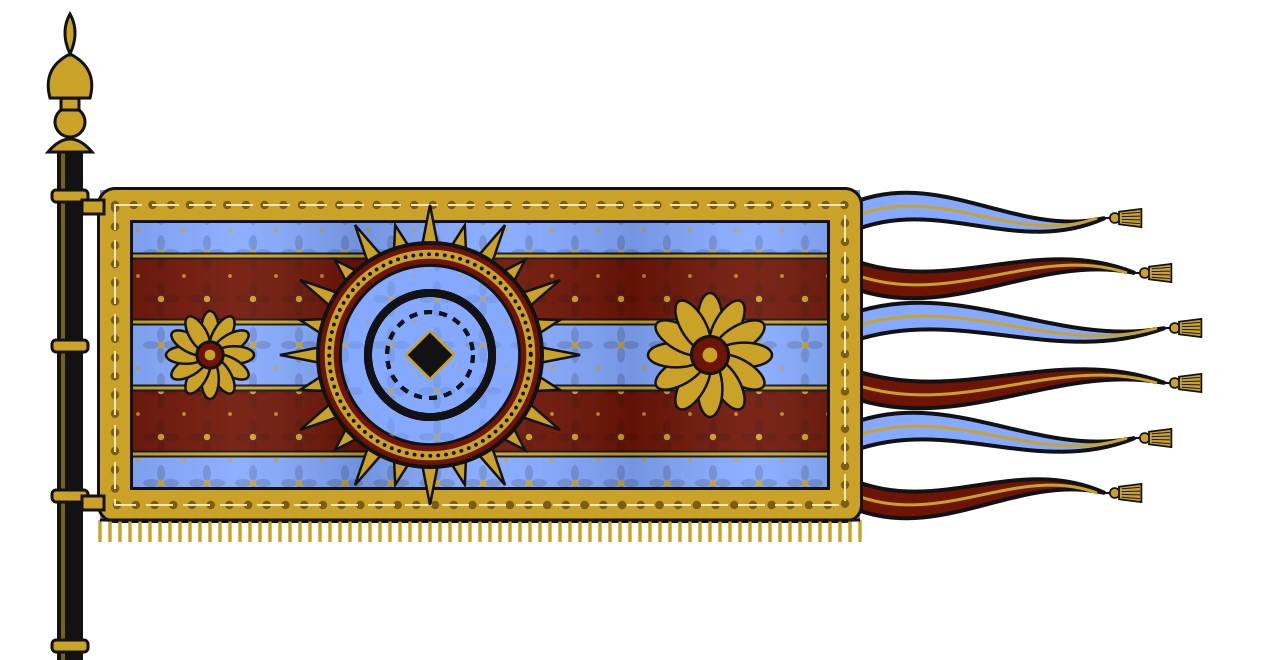
| Field | Maroon #6E1405 |
| Accent | Deep Cosmic Blue #9BB0FF |
| Emblem colour | Metallic Gold #C9A227 |
| Zari metal | Gold |
| Main emblem | A sword raised against a fort |
| Second image | Grain sacks |
| Night and day | Every visual accessory has two versions: by night the emblem on the dark field, by day the clan's field colour on cloth woven from its metal. |
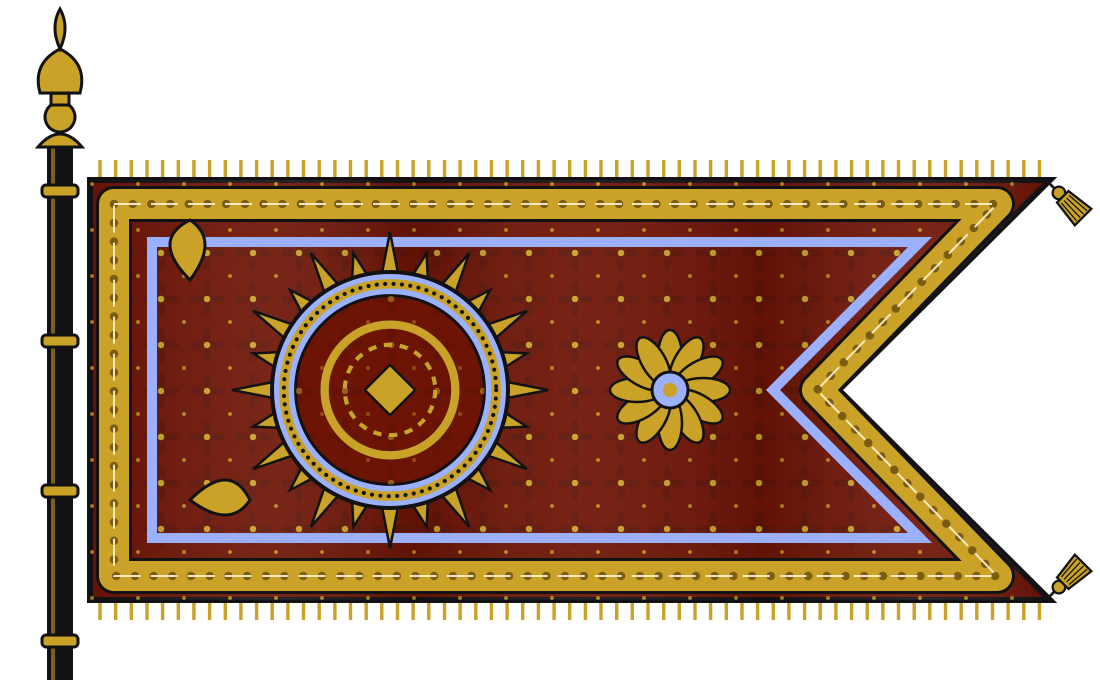
6. Flags
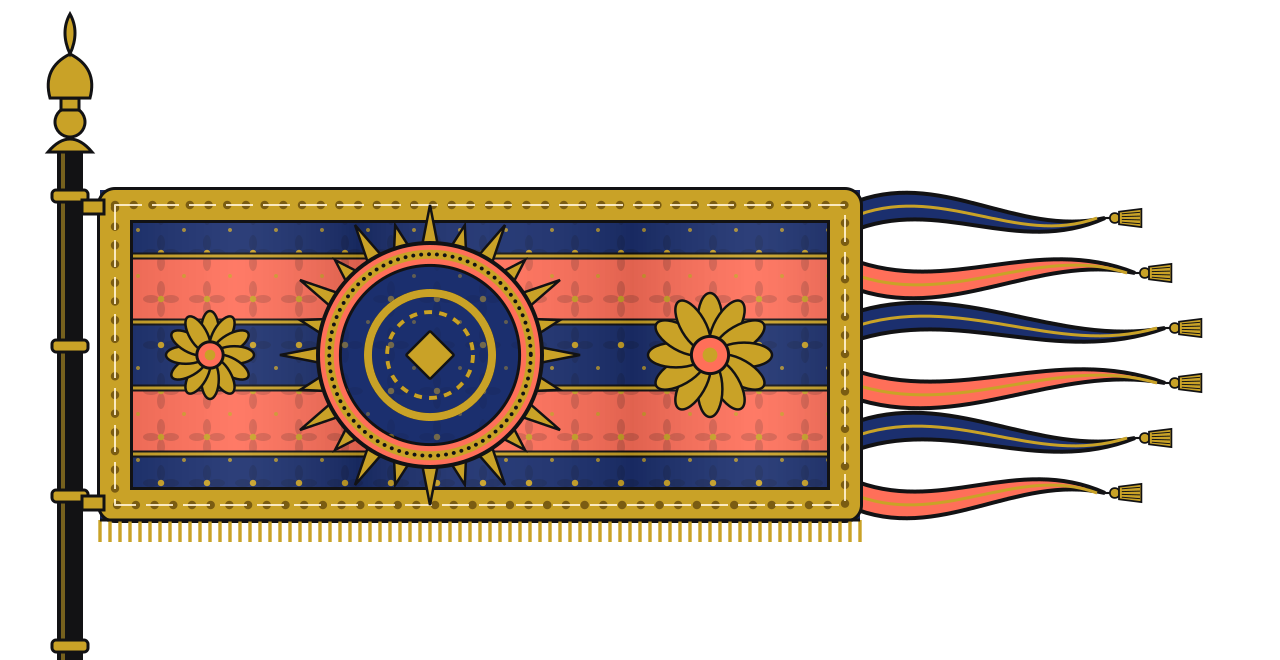
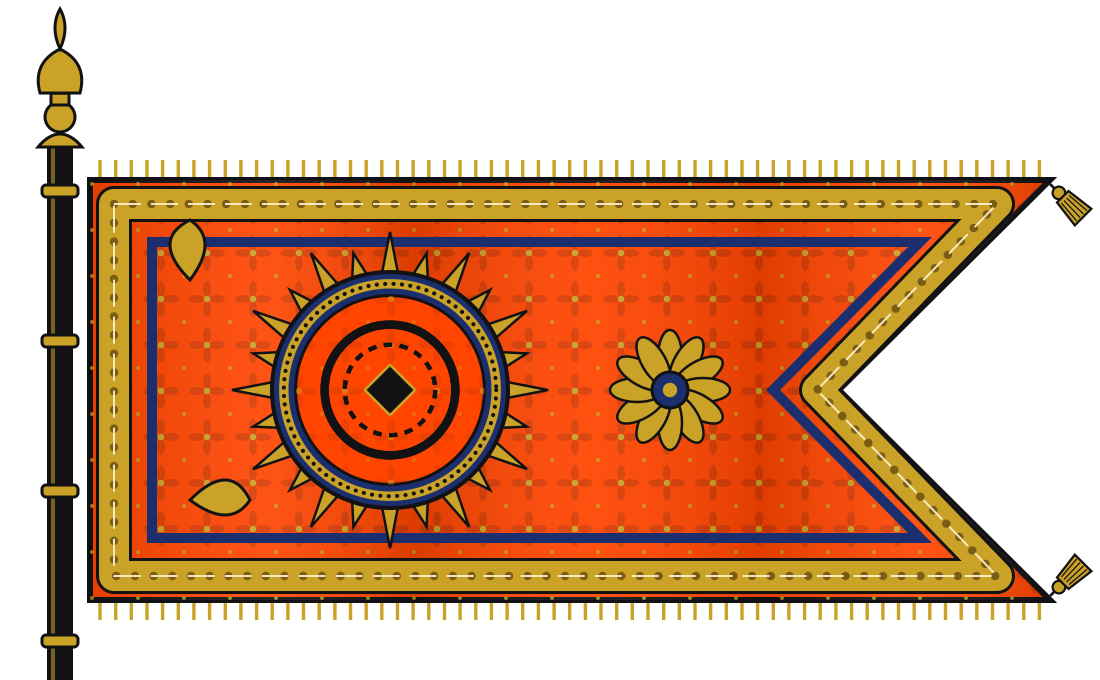
Every clan has every flag type; the type says the occasion and the colours say the clan. The outlined card is the flag the Atlas assigns.
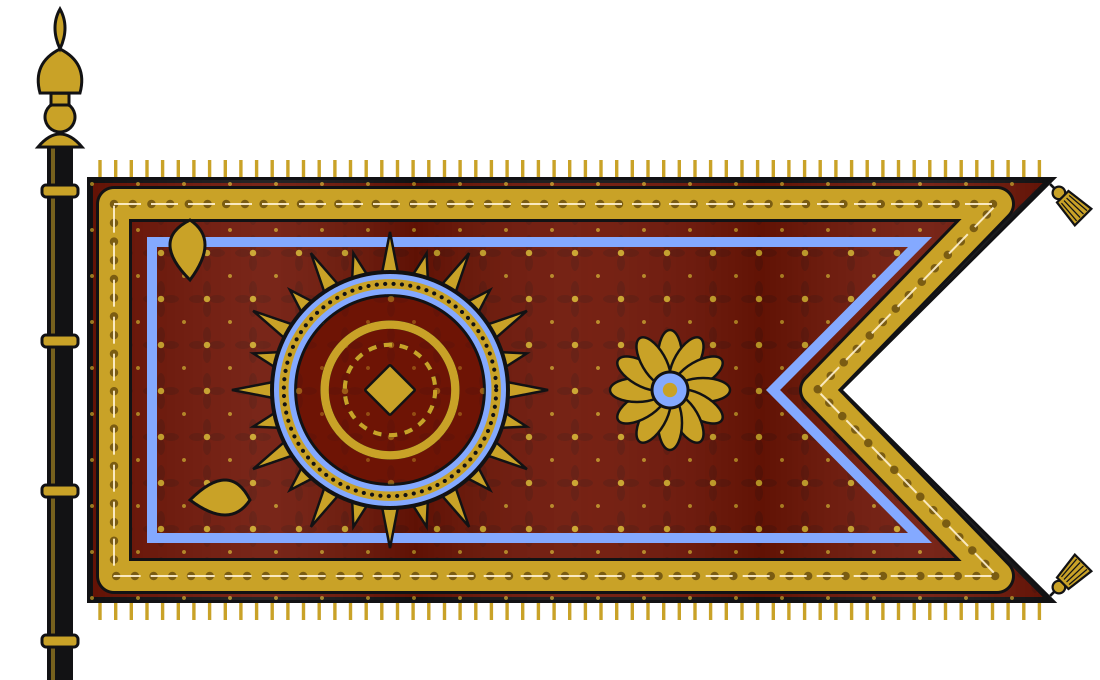
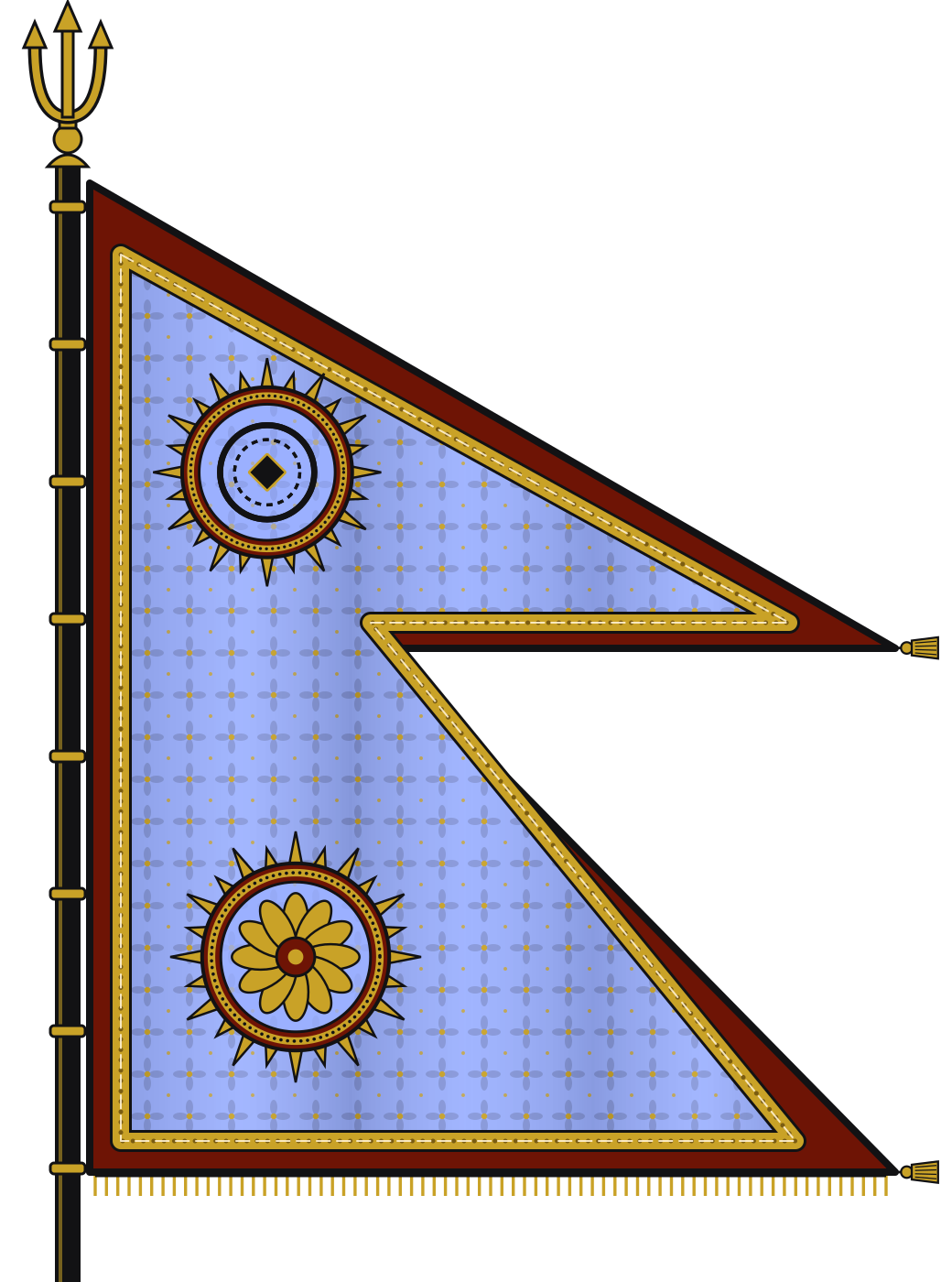
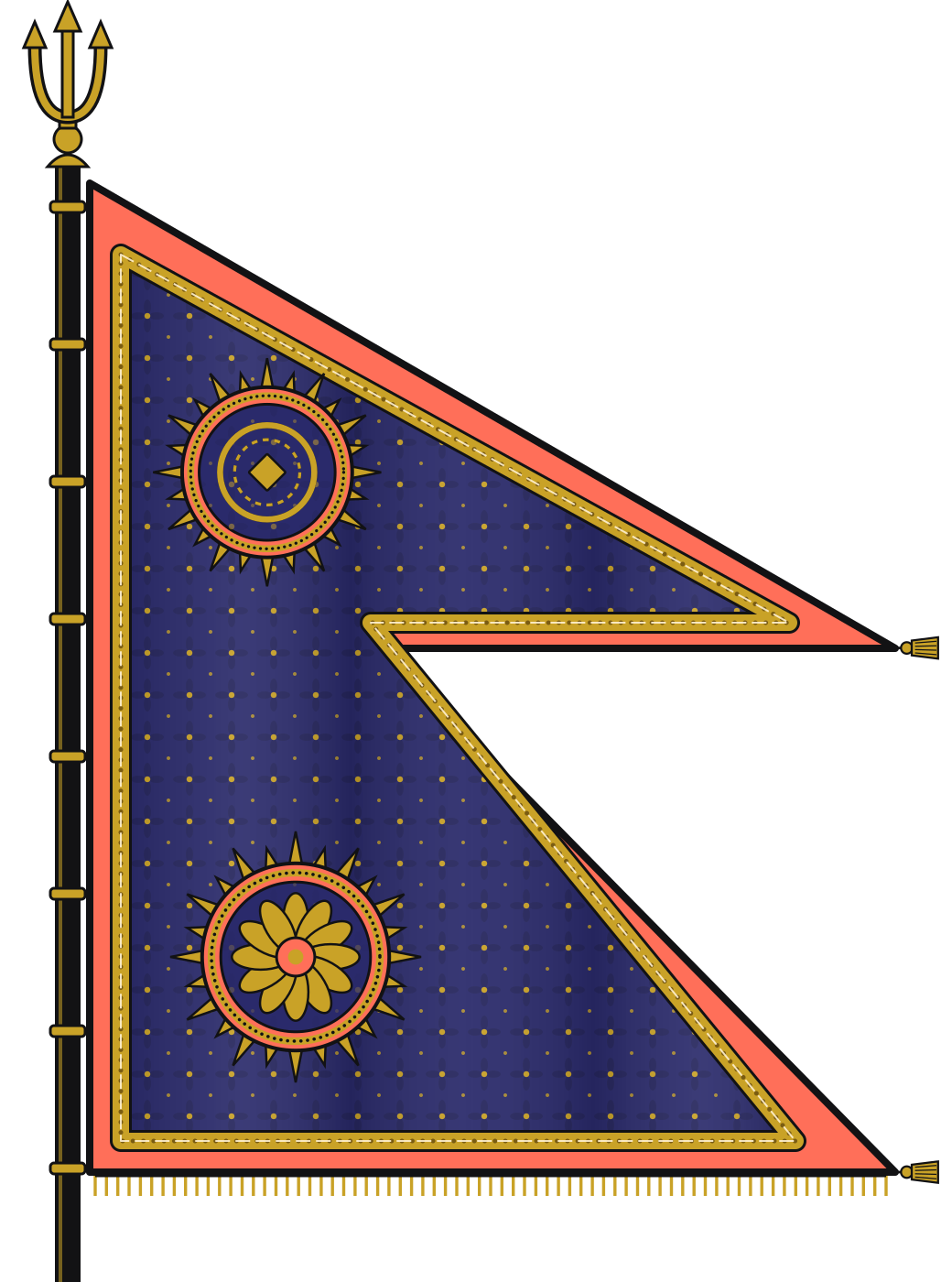

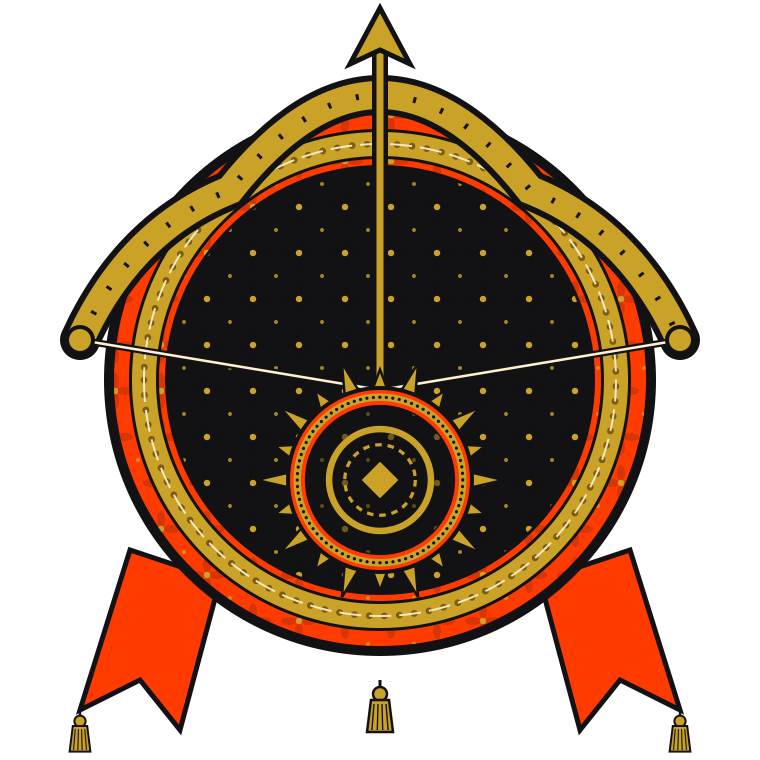
Historic banner
None known
New flag types
| Accessory | For this clan | Basis |
|---|---|---|
| A9 Pota-dhvaja · ship and trade flag For ships, caravans and markets | Not yet designed for this clan | Design |
| A10 Utsava-patāka · festival flag Light, bright flag for fairs and festivals | Not yet designed for this clan | Design |
| A11 Shoka-dhvaja · mourning flag White cloth with the emblem outline in the clan's metal | Not yet designed for this clan | Design |
7. Regalia
| Accessory | For this clan | Basis |
|---|---|---|
| E1 Chhatra · house parasol The ceremonial umbrella | Not yet designed for this clan | Design |
| E2 Chamara · fly-whisks The pair of whisks beside the head of the house | Not yet designed for this clan | Design |
| E3 Danda · staff of office Staff or scepter | Not yet designed for this clan | Design |
| E4 Simhasana · seat The seat of the house, covered in clan cloth | Not yet designed for this clan | Design |
| E5 Khetaka · shield A round shield; the Changi and Dhanush are its flag forms | Not yet designed for this clan | Regional tradition |
| E6 Kula-ayudha · clan weapon The weapon the clan honours | Arrow: the weapon the clan honours; daggers, spears and arrows are venerated on Dasahra Russell 1916[4] | Documented |
8. Worn
| Accessory | For this clan | Basis |
|---|---|---|
| F1 Kula-vastra · clan cloth The clan's woven pattern in its kit colours | Not yet designed for this clan | Design |
| F2 Kirti-vastra · honour cloth A cloth earned for a deed, not inherited | Not yet designed for this clan | Design |
| F3 Kula-mala · garland flower The flower or leaf the clan wears as a garland | Not yet found for this clan | Under research |
| F4 Chinha · house pin A metal badge with the pin emblem | Not yet designed for this clan | Design |
9. Records
| Accessory | For this clan | Basis |
|---|---|---|
| H1 Clan words A traditional line in the native script | Je maris te saris · “That which is dead is rotten and gone” A saying of the Binjhwar, as Russell and Hira Lal give it in Roman script (the extract has no native-script form)[4] | Documented |
| H2 Biruda · titles The house's title or titles | Mahanayak of Sonakhan: the title The Indian Tribal gives the zamindar Veer Narayan Singh The Indian Tribal[6] | Regional tradition |
| H3 Prashasti · praise genealogy The lineage as written at the head of a grant | Not yet found for this clan | Under research |
| H4 Vahi · clan register The book of the clan's births, marriages and deaths | Not yet found for this clan | Under research |
| H5 Rana-ghosha · war cry The clan's cry in battle or celebration | Not yet found for this clan | Under research |
10. VishwaVit · knower of the world
Game values are design choices for this project, not historical claims.
References
- Wikipedia, List of Scheduled Tribes in Odisha, read 2026-10-20, https://en.wikipedia.org/wiki/List_of_Scheduled_Tribes_in_Odisha
- dhammabharat.com, List of Scheduled Tribes in Maharashtra and Population of each Tribe (2011 Census), read 2026-10-10, https://dhammabharat.com/?p=13656
- Wikipedia, Tribals in Madhya Pradesh, read 2026-10-19, https://en.wikipedia.org/wiki/Tribals_in_Madhya_Pradesh
- R. V. Russell and Hira Lal, The Tribes and Castes of the Central Provinces of India, vol. 2 (London, 1916), Project Gutenberg eBook #22010, https://www.gutenberg.org/ebooks/22010
- Suresh Chandra Murmu and Sanjib Patel, "Marriage among the Binjhal of Western Odisha", The Eastern Anthropologist 73(3-4), 2020, read 2026-10-25, https://serialsjournals.com/abstract/33625_13-suresh_chandra_murmu_2020_marriage_among_the_binjhal_of_western_odisha.pdf
- The Indian Tribal, Shaheed Veer Narayan Singh (2 Nov 2025), read 2026-10-25, https://theindiantribal.com/2025/11/02/shaheed-veer-narayan-singh-the-first-freedom-fighter-of-chhattisgarh/
- PARI, सोनाखान: जब वीर नारायण दू पईंत मरिस (Chhattisgarhi; first in Times of India, 27 Aug 1997), read 2026-10-25, https://ruralindiaonline.org/article/सोनाखान-जब-वीर-नारायण-दू-पईंत-मरिस
- GKToday Hindi, बिंझवार जनजाति, मध्य प्रदेश (22 Sep 2019), read 2026-10-25, https://www.gktoday.in/hindi/%E0%A4%AC%E0%A4%BF%E0%A4%82%E0%A4%9D%E0%A4%B5%E0%A4%BE%E0%A4%B0-%E0%A4%9C%E0%A4%A8%E0%A4%9C%E0%A4%BE%E0%A4%A4%E0%A4%BF-%E0%A4%AE%E0%A4%A7%E0%A5%8D%E0%A4%AF-%E0%A4%AA%E0%A5%8D%E0%A4%B0%E0%A4%A6/
- Wikipedia, Binjhal, read 2026-10-25, https://en.wikipedia.org/wiki/Binjhal
- Sushree Mohanty, Indigenous Colours of Odisha: Handbook on 62 Tribes (KISS), read 2026-10-20, link
- Thanos Kouravelos (comp.), Binjhal, Hunter-Gatherers cosmos, citing K. S. Singh (ed.), People of India vol. III, 1994, read 2026-10-25, https://www.hgcosmos.org/assets/culture/AZ/B/Binjhal.pdf
- Wikipedia, History of Sambalpur, read 2026-10-25, https://en.wikipedia.org/wiki/History_of_Sambalpur
- R. V. Russell, The Tribes and Castes of the Central Provinces of India, vol. 3 (1916), Project Gutenberg #41424, read 2026-10-10, https://gutenberg.org/cache/epub/41424/pg41424-images.html
- Wikipedia, Sambalpuri culture, read 2026-10-25, https://en.wikipedia.org/wiki/Sambalpuri_culture