The Binjhia (बिंझिया) are a Scheduled Tribe listed in Odisha as Binjhia (Binjhoa), with 11,419 people in 2011[1]. Jharkhand's list gives 14,404 in 2011[2]. Their own tradition, as Wikipedia and the Jharkhand research institute record it, places their origin in the Vindhya valley and says they moved east to Chotanagpur, Keonjhar, Sundargarh and Barasombar[3][4]. The sources give no dates for these movements and no inscription or chronicle of the Binjhia. Whether they are the same people as the Binjhal or Binjhwar (ST-039) is not settled: the sources disagree[5][6][1].
01Faith and deities
No single main deity of the Binjhia is sourced. The main deity is the project KulDevi from the Atlas (homeland shrine, project data). The sources name Jagannath, the village deity Budharaja and ancestor worship (see below).
Samaleswari of Sambalpur, goddess of western Odisha
The presiding goddess of the clan's homeland or capital: a link of place, not a recorded clan tie.
| Deity or tradition | Place in the clan's life | Evidence |
|---|---|---|
| Jagannath | Worshipped with benevolent and malevolent spirits | [3][4] |
| Budharaja (बुधराज, Budhraj) | Village deity | [3][4] |
| Spirits | Benevolent and malevolent spirits, worshipped alongside the Hindu gods | [3][4] |
| Pitri (पितृ) | Ancestor worship at lineage and clan level | [3][4] |
02Temples
No temple of the Binjhia is named in the sources read. Under research.
Built by the clan
Not recorded.
Given patronage or grants by the clan
Not recorded.
03Languages and scripts
| Language or script | Kind | Under the clan | Evidence |
|---|---|---|---|
| Binjhwari | Language of the people (Wikipedia infobox); no script given | Listed for the Binjhia | [3] |
| Sadri | Listed in the infobox alongside Binjhwari; no script given | Listed for the Binjhia | [3] |
| Odia | Listed in the infobox; no script given | Listed for the Binjhia | [3] |
| Hindi | Primary language of the Joshua Project profile, which aggregates several groups | Not only the Binjhia | [7] |
04Books and literature
The books and articles below are the ones the sources read cite for the Binjhia.
Written during the clan's history
| Work | Author | Kind | When | Link to the clan |
|---|---|---|---|---|
| People of India: National Series, vol. III, The Scheduled Tribes | K. S. Singh (ed.) | Anthropological survey volume | 1994 (HGCosmos); Wikipedia cites Singh 1998 | [5][3] |
| Minz and Hansda (2010), title not in the extract | Minz and Hansda | Cited for marriage customs (p. 48); also cited for burial customs (no page) | 2010 | [3] |
| Indigenous Colours of Odisha: Handbook on 62 Tribes | Sushree Mohanty | Handbook (KISS) | Web copy uploaded May 2026 | [8] |
Given patronage by the clan
Not recorded.
05Thinkers and scholars
Not recorded.
Under research. No scholar of the Binjhia is named beyond the authors of the books listed above.
06Art and architecture
No painting, sculpture, architecture or craft of the Binjhia is recorded in the sources read. Jewellery and dress are under Life.
Painting and wall art
Not recorded.
Sculpture and temple art
Not recorded.
Temple and building architecture
Not recorded.
Weaving and textiles
Not recorded.
Clothing and jewellery
Not recorded.
Coins, pottery and crafts
Not recorded.
07History
Name
Some sources derive the name from the Vindhyas (K. S. Singh, Anthropological Survey of India, 1998, p. 497, as cited by Wikipedia). The TRI Jharkhand page gives the earlier self-name as विंध्यनिवासी (Vindhyaniwasi), and says the people of Chotanagpur called them बिंझिया (Binjhia)[3][4].
Origin tradition
Their original home is believed to have been Kolanagari in the Vindhya valley (Singh 2008, p. 187, as cited by Wikipedia)[3][4]. The sources do not date this.
Movement east
They are said to have moved east from the Vindhya hills to Chotanagpur, Keonjhar, Sundargarh and Barasombar (Singh 1998, p. 498)[3][4]. Whether this was one movement or several is not stated.
Unsettled link with the Binjhal and Binjhwar
HGCosmos gives Binjhia as an alternate name of Binjhal[5]. The TRI Jharkhand page gives Binjhawar as an alternate name of the Binjhia[4]. Russell and Hira Lal (1916) list the Binjhias, a diminutive form, as one of four subdivisions of the Binjhwar[6]. The Odisha ST list gives Binjhal (Binjhwar) and Binjhia (Binjhoa) as separate entries[1]. The Birjia language article gives Binjhia as another name of the Birjia, a Munda-group language, which may be a different people; this is not verified[9].
Records
No inscription, chronicle or royal record of the Binjhia is among the sources read. The Atlas's line 'Under Chotanagpur rulers' is project data without a source.
08Journey and migrations
Only the tradition of movement is recorded. No dates are given.
| When | From | To | Why | Evidence |
|---|---|---|---|---|
| Not dated | Kolanagari, Vindhya valley (believed original home) | Vindhya hills | Origin tradition | [3][4] |
| Not dated | Vindhya hills | Chotanagpur, Keonjhar, Sundargarh, Barasombar | Said to have moved east | [3][4] |
09Seats and lands
| Place | Role | Where today |
|---|---|---|
| Vindhya valley (Kolanagari) | Believed original home | Named in the tradition; not located further |
| Vindhya hills | Place the tradition says they left | Named in the tradition |
| Chotanagpur | Where local people called them Binjhia | Jharkhand (Binjhia are in the Jharkhand ST list) |
| Keonjhar | On the route east | Odisha (district named in the tradition) |
| Sundargarh (Sundergarh) | District given for the Binjhia in the KISS handbook | Odisha |
| Barasombar | On the route east | Not located in the sources |
10Notable figures
Not recorded.
11Allies, rivals and marriages
| People | Relationship | When |
|---|---|---|
| Binjhwar (Binjhal) ST-039 | Named as an alternate name or as a subdivision, depending on the source; not settled (see History) | Not dated |
| Birjia ST-041 | Also called Binjhia or Bijori in the Birjia language article; relation not verified | Not dated |
| Asur ST-012 | Asur-Binjhia is one of the four subgroup names; the sources do not state a link | Not dated |
| Agariya ST-003 | Agaria-Binjhia is one of the four subgroup names; the sources do not state a link | Not dated |
12Society and livelihood
Clan exogamy is not practised; the village is the exogamous unit[3][4]. Marriage is an important ritual[10]. Adult marriage is preferred in some groups and child marriage is common in others; cross-cousin marriage, levirate, sororate, and remarriage of widows and divorcees are allowed (Minz and Hansda 2010, p. 48, as cited by Wikipedia)[3][4]. Women are important in socio-economic exchange[3][4].
Government and social order
| Institution or group | What it was | Evidence |
|---|---|---|
| Village | Large homogeneous settlement; each village is an exogamous unit | [3] |
| Dibiris (डिबिरिस) | Extended family | [3][4] |
| Jama (जामा) | Minor lineage of three generations (TRI Jharkhand) | [4] |
| Khumuri (खुमुरी) | Major lineage | [3][4] |
| Barga (बरगा) | Small clan, led by a gauntia (गौतिया). Wikipedia tags the gauntia claim as needing a citation | [3][4] |
| Lineage burial ground | Each lineage has its own burial ground; burial and cremation are both practised | [3][4] |
| Clan-based governance | Allowed, according to GKToday (2019); no clan names given | [10] |
Livelihood over time
| Era | Livelihood | Evidence |
|---|---|---|
| Not dated | Mainly farmers, growing vegetables and fruit; fish farming; goats, chickens and ducks; forest labour (GKToday, 2019) | [10] |
| Not dated | Flooded-field rice; hired labour for landless families (Joshua Project, a profile that aggregates several groups) | [7] |
| Not dated | Barter at village level and at weekly markets | [3][4] |
13Sub-clans and related clans
The sources name four subgroups of the Binjhia, each with septs[3][4]. Names are given as the TRI Jharkhand page prints them. No septs, sizes or places are sourced for each. The sub-clans and the related peoples below are the ones the extracts name.
| Clan | Relation | Where | Size | In the Atlas | Evidence |
|---|---|---|---|---|---|
| Asur-Binjhia असुर-बिंझिया | Sub-clan | One of four subgroups (Singh 1998, p. 498); no place given | new clan candidate | [3][4] | |
| Agaria-Binjhia अगरिया-बिंझिया | Sub-clan | One of four subgroups (Singh 1998, p. 498); no place given | new clan candidate | [3][4] | |
| Pahariya Binjhia पहाड़िया बिंझिया | Sub-clan | One of four subgroups (Singh 1998, p. 498); no place given | new clan candidate | [3][4] | |
| Dand-Binjhia दंड-बिंझिया | Sub-clan | One of four subgroups (Singh 1998, p. 498); no place given | new clan candidate | [3][4] | |
| Binjhal (Binjhwar) | Related people | Odisha and Chhattisgarh (Odisha ST list lists them as a separate entry). Russell (1916) lists the Binjhias as a subdivision of the Binjhwar; HGCosmos gives Binjhia as an alternate name of Binjhal; the link is unresolved | 137,040 Odisha, 2011[1] | ST-039 | [6][5][1][11] |
| Birjia | Related people | Birjia language article: also called Binjhia or Bijori; a Munda-group language | ST-041 | [9] | |
| Asur | Related people | Named in the subgroup Asur-Binjhia; the Birjia article places Asur in the Asuri nation | ST-012 | [3][9] | |
| Agariya | Related people | Named in the subgroup Agaria-Binjhia; the Birjia article places Agariya in the Asuri nation | ST-003 | [3][9] |
Clans marked "new clan candidate" are not in the Atlas yet.
14Surnames
No surname is given in the sources for the Binjhia.
Not recorded.
15Songs and music
Festivals are accompanied by songs and dances, but the sources give no lyrics, titles or singing styles[10].
None recorded yet.
16Poems, lullabies and children's rhymes
None recorded yet.
17Stories, legends and proverbs
Stories and legends
Not recorded.
Proverbs and sayings
Not recorded.
18Festivals and fairs
| Festival or fair | When | Where | What happens |
|---|---|---|---|
| Sohrai (सोहराई) | Not dated | Not stated | Listed as a festival of the Binjhia; songs and dances accompany festivals[10] |
| Karma (करमा) | Not dated | Not stated | Listed as a festival of the Binjhia[10] |
| Sarhul (सरहुल) | Not dated | Not stated | Listed as a festival of the Binjhia[10] |
| Kartik Purnima (कार्तिक पूर्णिमा) | Not dated | Not stated | Listed as a festival of the Binjhia[10] |
| Jitiya (जितिया) | Not dated | Not stated | Listed as a festival of the Binjhia[10] |
| Dashahra (दशहरा) | Not dated | Not stated | Listed as a festival of the Binjhia[10] |
| Diwali (दिवाली) | Not dated | Not stated | Listed as a festival of the Binjhia[10] |
19Food, dress and games
Food
Not recorded.
Dress
| Item | What it is | Evidence |
|---|---|---|
| Men | Half dhoti and gamchha (गमछा) at home; dhoti, kurta and ganji outside | [10] |
| Women | Jewellery of steel, copper, bronze, glass and silver, with forest seeds and beads | [10] |
Games and martial arts
Not recorded.
Tags: living still practised · revived brought back after a break · lost known only from records · research reported but not yet confirmed from a source. Songs and poems under copyright are listed by title only; restricted or sacred material is noted without its content.
20Status today
The Binjhia are a Scheduled Tribe of Odisha and Jharkhand[1][2]. Their tradition places their origin in the Vindhya hills, and the sources record Jagannath, the village deity Budharaja and ancestor worship[3][4]. Whether they are the same people as the Binjhal or Binjhwar is not settled.
Who carries the name today
Recognised heritage
Not yet reviewed by a Binjhia community body; no review record is in the project. Corrections and preferred spellings from the community are welcome.
21For children
The Binjhia and their village deity
Long ago, the Binjhia are said to have lived in the Vindhya hills. Tradition says their first home was a place called Kolanagari, in the Vindhya valley. Over time, they are said to have moved east. Their journey took them to places such as Chotanagpur, Keonjhar and Sundargarh. Today the Binjhia live mainly in Odisha and Jharkhand. Many Binjhia families are farmers. They honour the village deity Budharaja, and they remember their ancestors in prayer.
Riddle: I am a village deity whom the Binjhia honour. Who am I? (Budharaja (Budhraj))
22Across the project
| Project | What carries this clan | Status |
|---|---|---|
| Atlas of the Janas | Odisha (Sundargarh) and Jharkhand, from the ST lists and the KISS handbook; the Atlas also gives Bihar and Chhattisgarh | Sources |
| KulDevi and GrahDevi | KulDevi Samaleswari, family Navadurga, homeland shrine; no clan goddess is sourced | From the Atlas |
| Planet naming | Not in the sources for the Binjhia | To check |
| Renaming and waters | Alternate names: Binjhoa (Odisha list) and Binjhawar (TRI); no water-body or renaming record found | Sources |
23Open questions
- Are the Binjhia the same people as the Binjhal or Binjhwar (ST-039)? HGCosmos, TRI, Russell (1916) and the Odisha list disagree; read People of India vol. III.
- Does the Birjia language article's 'also called Binjhia' refer to the same people? Not verified.
- Bindhyabasini is documented for the Binjhal and Binjhwar, not for the Binjhia in these sources.
- Census totals differ: 25,823 (infobox sum) and 25,835 (body text and TRI).
- Surnames and septs: People of India vol. III, pp. 497-498, and Minz and Hansda (2010), p. 48, are unread.
- The gauntia claim is tagged 'citation needed' on Wikipedia.
- Clan words: no line linked to the Binjhia is in the sources read; a source for a line is needed before one is shown.
- Dates for the movement east and the Kolanagari home are not given anywhere in the sources read.
- The Atlas's 'Under Chotanagpur rulers' has no source.
- GKToday (2019) places the Binjhia in Bihar (see Today, Where); the Odisha and Jharkhand ST lists and TRI Jharkhand do not, and the kids page says they live in Odisha and Jharkhand.
24Astitva
अस्तित्व · being, existence: everything by which the clan is known
The sources read name no seal, coin, totem, banner, instrument, title or war cry for the Binjhia.
Every clan has every accessory, royal objects included. Each one says how it is known: Documented This clan's own object is recorded. · Regional tradition Recorded for the region or for peoples like this one, not for this clan. · Design Made for this project, with no historical claim. · Under research To be found for this clan from sources. Legends and titles are written in the clan's own script.
1. Seals and coins
| Accessory | For this clan | Basis |
|---|---|---|
| B1 Rajamudra · house seal Round seal with the clan emblem and a short legend in the clan's script | Not yet designed for this clan | Design |
| B2 Anguliya-mudra · signet ring Personal seal ring of the head of the house | Not yet designed for this clan | Design |
| B3 Chhapa · house stamp Ink or block stamp for letters, goods and cloth | Not yet designed for this clan | Design |
| B4 Tamrapatra · charter plate Copper-plate grant on a ring, closed with the house seal | Not yet designed for this clan | Design |
| B5 Shreni-mudra · guild or trade seal Seal for the clan's trade, craft or caravan | Not yet designed for this clan | Design |
| C1 Clan coin Emblem or deity on one side, a legend in the clan's script | Not yet designed for this clan | Design |
| C2 Coin die The die that strikes the coin | Not yet designed for this clan | Design |
2. Living symbols
| Accessory | For this clan | Basis |
|---|---|---|
| I1 Totem trio The tree, bird and animal the clan protects | Not yet found for this clan | Under research |
| I2 Kaval-maram · guardian tree The tree that stands at the clan's seat | Not yet found for this clan | Under research |
3. Stone and gate
| Accessory | For this clan | Basis |
|---|---|---|
| G1 Torana · gateway The built gate of the seat; the cloth Toran hangs in it | Not yet designed for this clan | Regional tradition |
| G2 Viragallu · hero stone Carved panel stone for a member who died defending the clan | Not yet designed for this clan | Regional tradition |
| G3 Kula-shila · clan stones Standing and table stones that remember the ancestors | Not yet designed for this clan | Design |
| G4 Jayastambha · victory pillar A pillar raised for a victory | Not yet designed for this clan | Design |
| G5 Sima-shila · boundary stone Marks the clan's land, with a line in the native script | Not yet designed for this clan | Design |
4. Sounds
| Accessory | For this clan | Basis |
|---|---|---|
| D1 Pancha-mahashabda · five great sounds The right to five instruments | Not yet designed for this clan | Design |
| D2 Shankha · clan conch The clan's own named war conch | Not yet designed for this clan | Design |
| D3 Murasu · house drums Three drums: war, charity and justice | Not yet designed for this clan | Design |
5. Kit: colours, metals and emblems
The sources read for this page give no arms, seal or symbol for the Binjhia. The emblem and colours below come from the Atlas as a project design, not from a source.
| Part of the kit | This clan |
|---|---|
| Field | Deep Brick #7E2A1E |
| Accent | Intense Electric Blue #84A9FF |
| Emblem colour | Metallic Gold #C9A227 |
| Zari metal | Gold |
| Main emblem | A hill field with a plough |
| Second image | A sal leaf |
| Night and day | Every visual accessory has two versions: by night the emblem on the dark field, by day the clan's field colour on cloth woven from its metal. |
6. Flags
Every clan has every flag type; the type says the occasion and the colours say the clan. The outlined card is the flag the Atlas assigns.
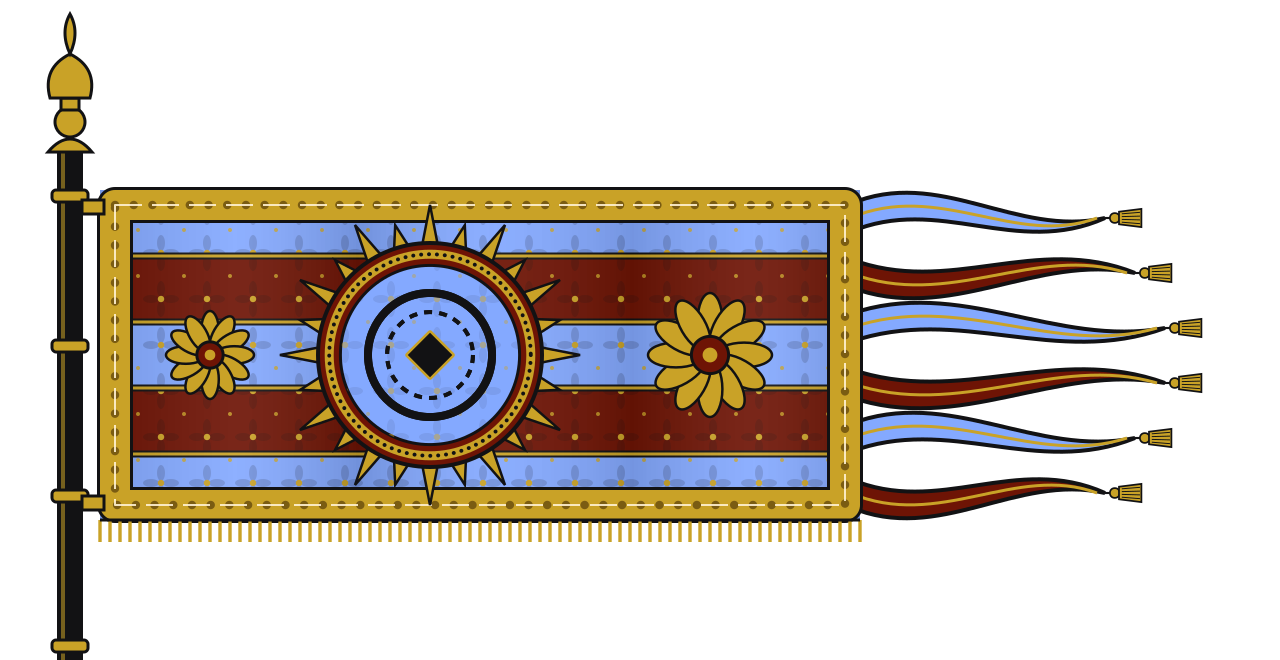
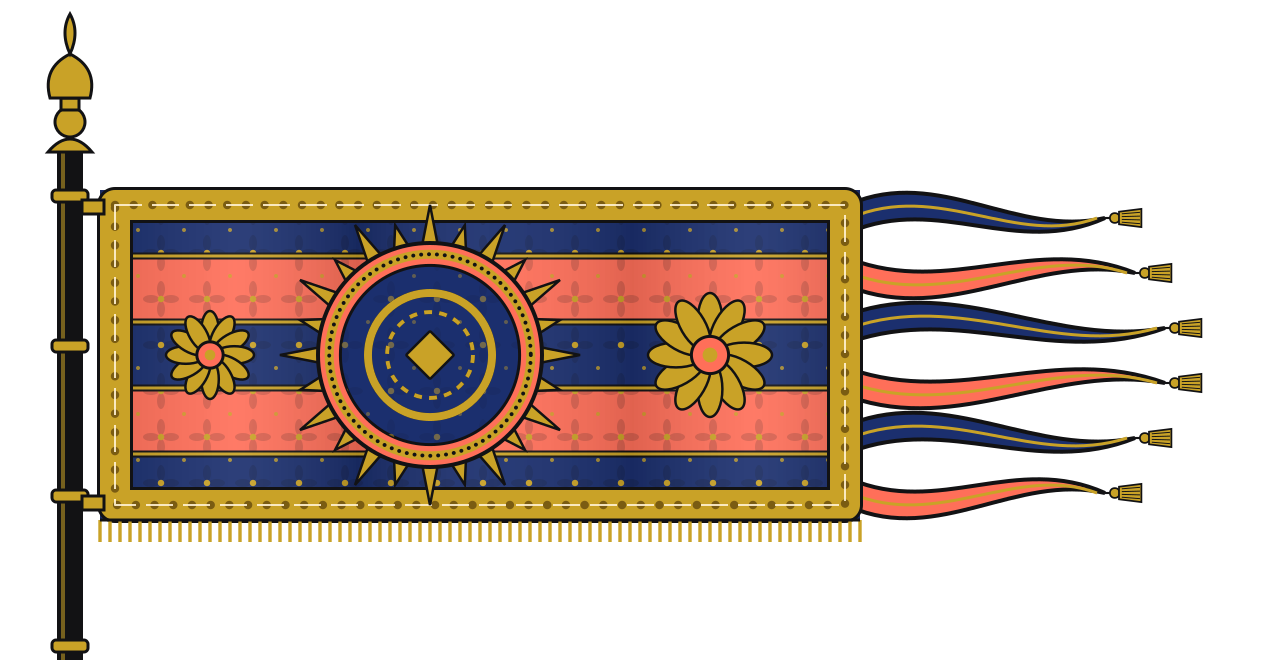
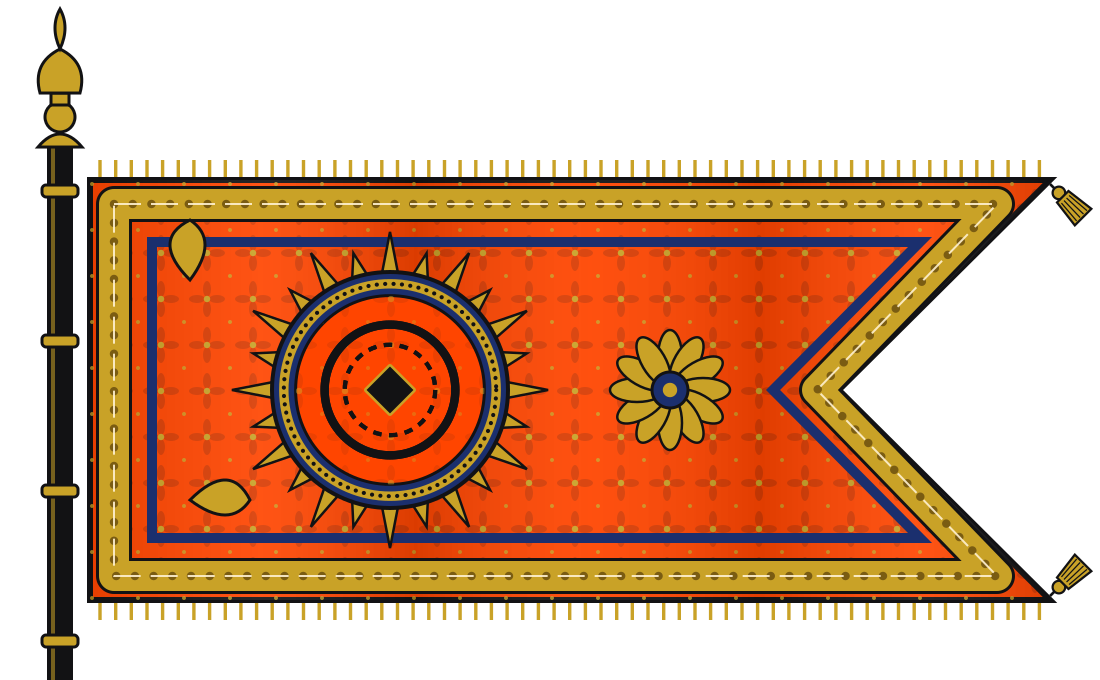
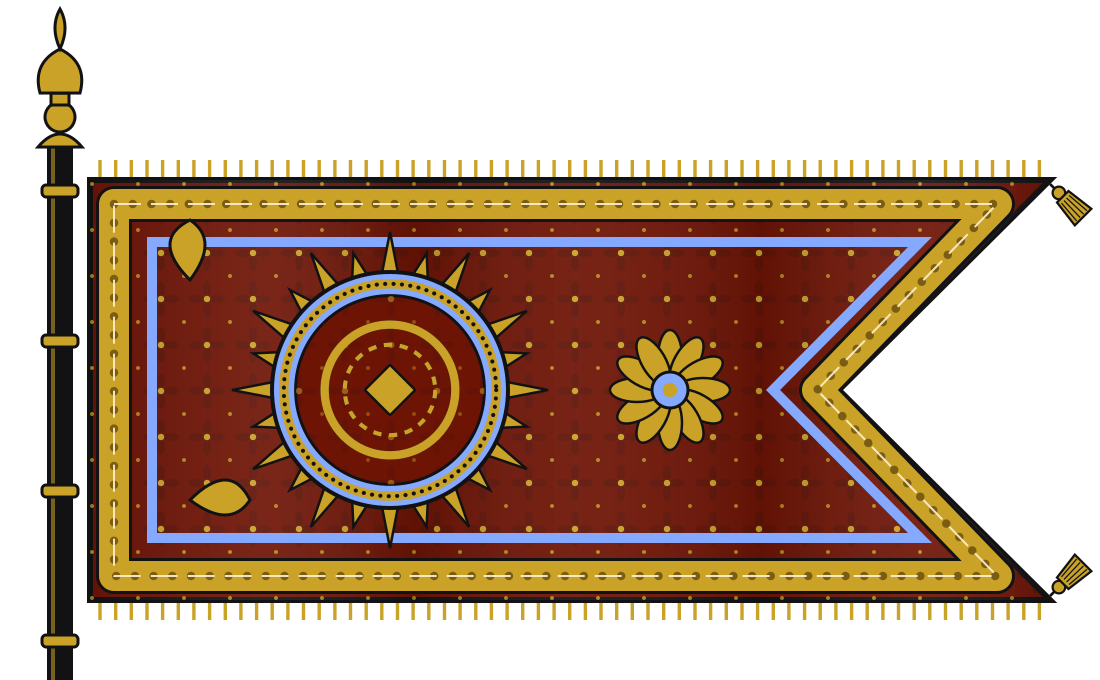

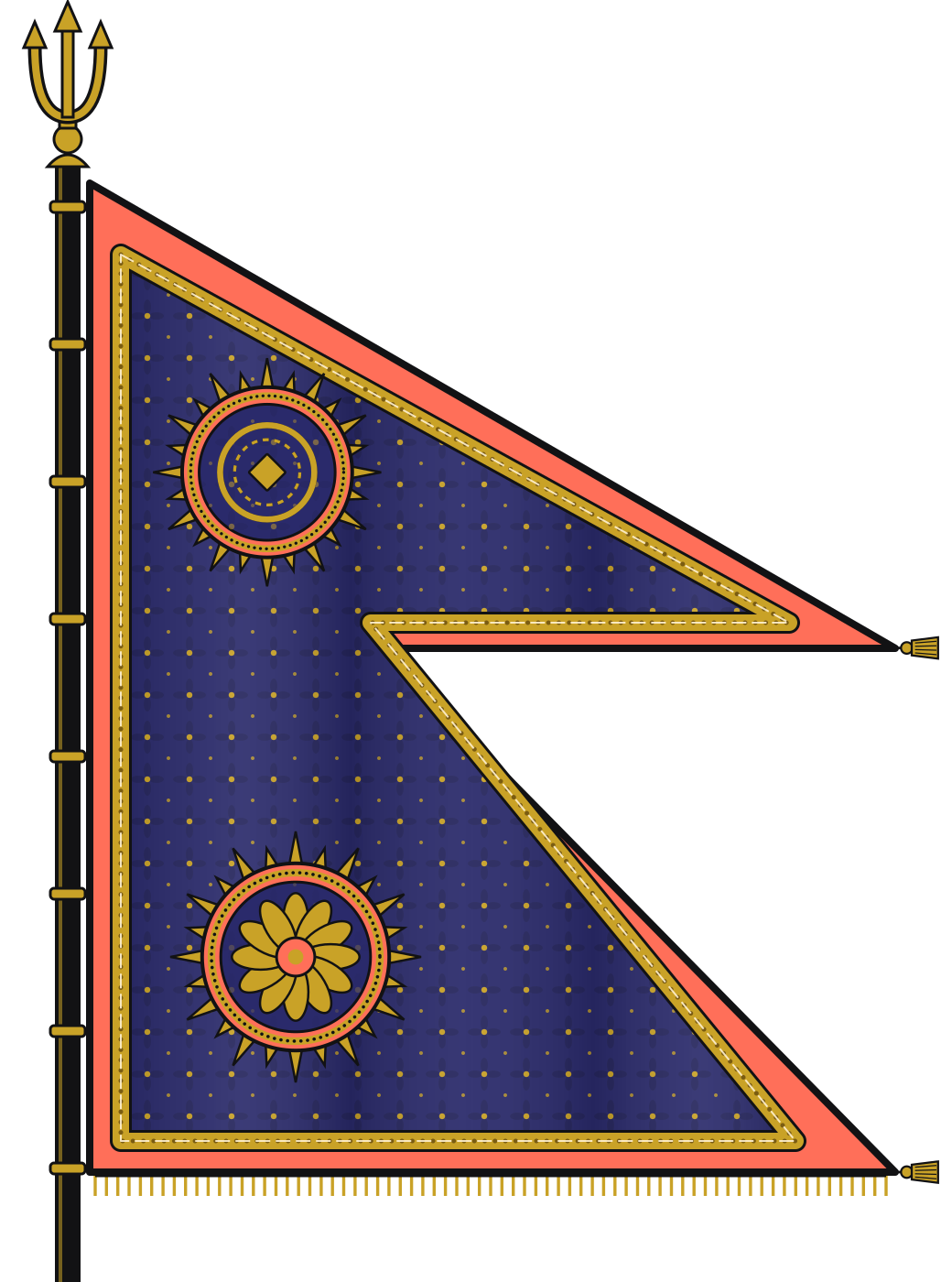

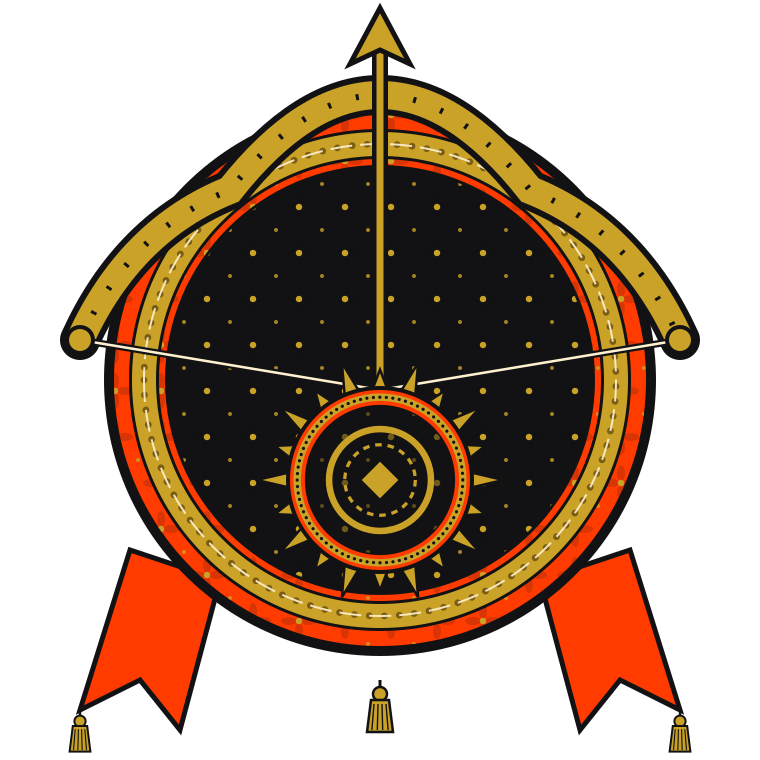
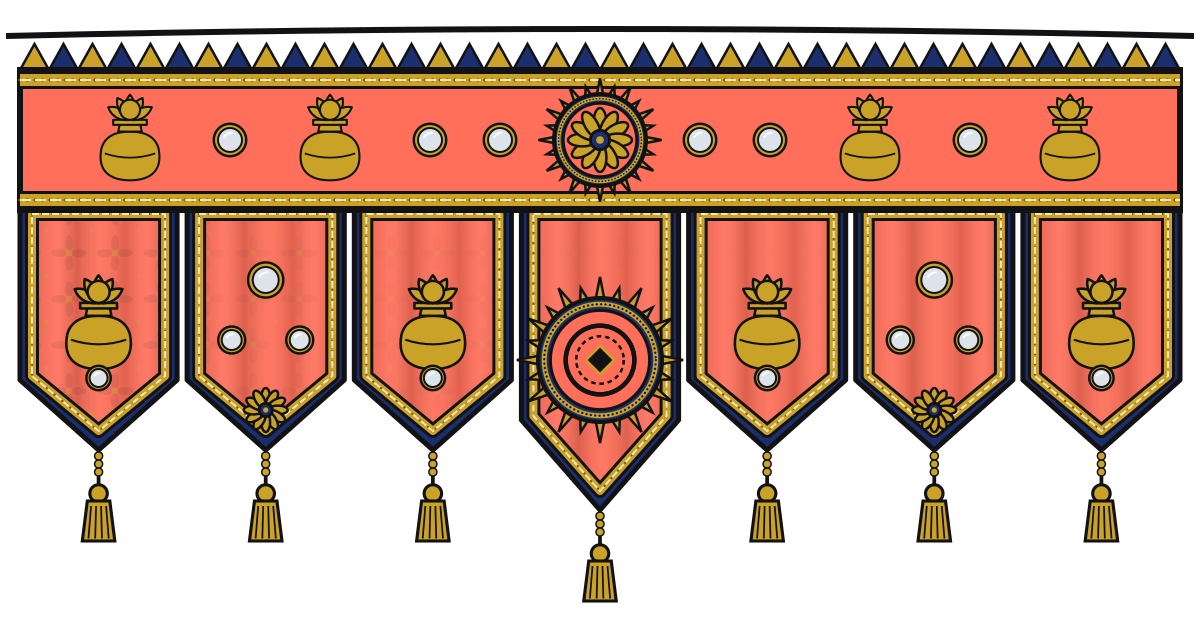
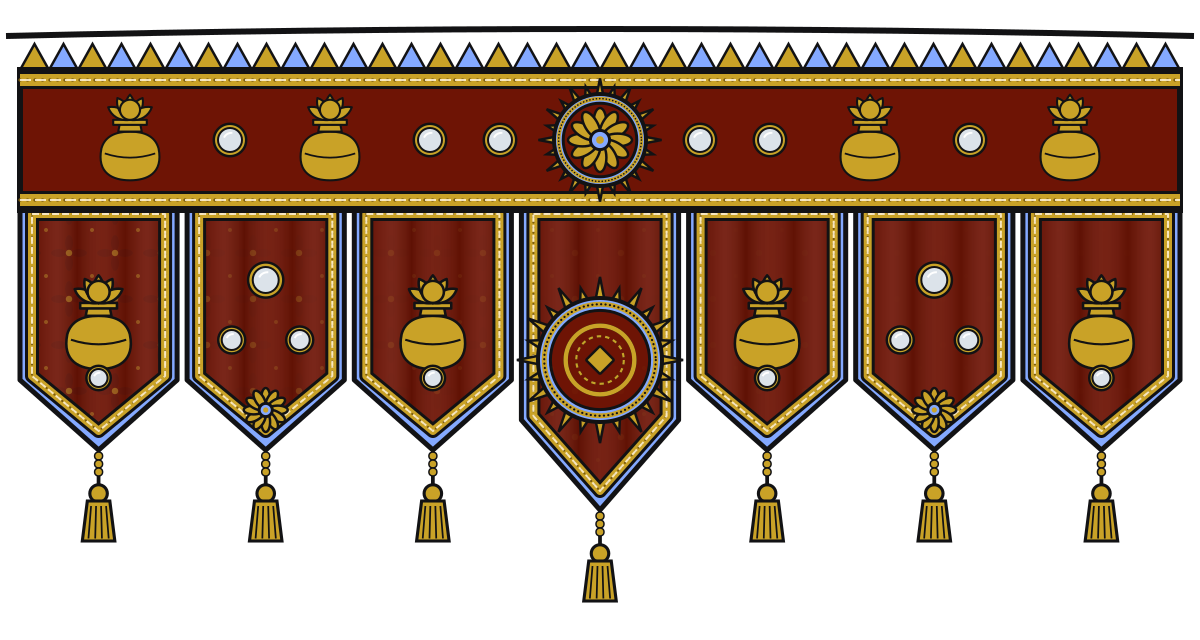

Historic banner
None known
New flag types
| Accessory | For this clan | Basis |
|---|---|---|
| A9 Pota-dhvaja · ship and trade flag For ships, caravans and markets | Not yet designed for this clan | Design |
| A10 Utsava-patāka · festival flag Light, bright flag for fairs and festivals | Not yet designed for this clan | Design |
| A11 Shoka-dhvaja · mourning flag White cloth with the emblem outline in the clan's metal | Not yet designed for this clan | Design |
7. Regalia
| Accessory | For this clan | Basis |
|---|---|---|
| E1 Chhatra · house parasol The ceremonial umbrella | Not yet designed for this clan | Design |
| E2 Chamara · fly-whisks The pair of whisks beside the head of the house | Not yet designed for this clan | Design |
| E3 Danda · staff of office Staff or scepter | Not yet designed for this clan | Design |
| E4 Simhasana · seat The seat of the house, covered in clan cloth | Not yet designed for this clan | Design |
| E5 Khetaka · shield A round shield; the Changi and Dhanush are its flag forms | Not yet designed for this clan | Regional tradition |
| E6 Kula-ayudha · clan weapon The weapon the clan honours | Not yet found for this clan | Under research |
8. Worn
| Accessory | For this clan | Basis |
|---|---|---|
| F1 Kula-vastra · clan cloth The clan's woven pattern in its kit colours | Not yet designed for this clan | Design |
| F2 Kirti-vastra · honour cloth A cloth earned for a deed, not inherited | Not yet designed for this clan | Design |
| F3 Kula-mala · garland flower The flower or leaf the clan wears as a garland | Not yet found for this clan | Under research |
| F4 Chinha · house pin A metal badge with the pin emblem | Not yet designed for this clan | Design |
9. Records
| Accessory | For this clan | Basis |
|---|---|---|
| H1 Clan words A traditional line in the native script | — · “No clan line sourced yet (under research)” Under research: no line linked to the Binjhia is in the sources read for this page | Documented |
| H2 Biruda · titles The house's title or titles | Not yet found for this clan | Under research |
| H3 Prashasti · praise genealogy The lineage as written at the head of a grant | Not yet found for this clan | Under research |
| H4 Vahi · clan register The book of the clan's births, marriages and deaths | Not yet found for this clan | Under research |
| H5 Rana-ghosha · war cry The clan's cry in battle or celebration | Not yet found for this clan | Under research |
10. VishwaVit · knower of the world
Game values are design choices for this project, not historical claims.
References
- Wikipedia, List of Scheduled Tribes in Odisha, read 2026-10-20, https://en.wikipedia.org/wiki/List_of_Scheduled_Tribes_in_Odisha
- Wikipedia, Tribes of Jharkhand, read 2026-10-20, https://en.wikipedia.org/wiki/Tribes_of_Jharkhand
- Wikipedia, Binjhia people, read 2026-10-28, https://en.wikipedia.org/wiki/Binjhia_people
- Dr. Ramdayal Munda Tribal Welfare Research Institute, Jharkhand, Binjhia Tribe, read 2026-10-28, https://trijharkhand.in/en/binjhia
- Thanos Kouravelos (comp.), Binjhal, Hunter-Gatherers cosmos, citing K. S. Singh (ed.), People of India vol. III, 1994, read 2026-10-25, https://www.hgcosmos.org/assets/culture/AZ/B/Binjhal.pdf
- R. V. Russell and Hira Lal, The Tribes and Castes of the Central Provinces of India, vol. 2 (London, 1916), Project Gutenberg eBook #22010, https://www.gutenberg.org/ebooks/22010
- Joshua Project, Binjhia in India, read 2026-10-28, https://www.joshuaproject.net/people_groups/16489/IN
- Sushree Mohanty, Indigenous Colours of Odisha: Handbook on 62 Tribes (KISS), read 2026-10-20, https://kissnew.kiss.ac.in/wp-content/uploads/2026/05/Indigenous-Colours-of-Odisha-Handbook-on-62-Tribes-Sushree-Mohanty.pdf
- Wikipedia, Birjia language, read 2026-10-10, https://en.wikipedia.org/wiki/Birjia_language
- GKToday Hindi, बिंझिया जनजाति, बिहार (11 Aug 2019), read 2026-10-28, link
- Wikipedia, Binjhal, read 2026-10-25, https://en.wikipedia.org/wiki/Binjhal