The Bhunjia are an Indo-Aryan-speaking people[1], recorded in Odisha and Chhattisgarh[2]. They are listed as a Scheduled Tribe in Odisha, Madhya Pradesh and Maharashtra, with 2011 census counts in each[3][4][5]. The Chuktia division is listed as a Particularly Vulnerable Tribal Group (PVTG) and lives on the Sunabeda plateau in Nuapada district, Odisha[6][7]. Their principal deity is Sunadei[7][8]. A Chuktia household's red-mud sacred kitchen is burned or abandoned and rebuilt if an outsider touches or enters it[7][9][10]. Origin accounts differ: Dubey reads them as a branch of the Halbas of Baster[2], and Russell 1916 reads the Chaukhutia branch as of mixed Gond and Halba descent[10].
01Faith and deities
Samaleswari of Sambalpur, goddess of western Odisha
The presiding goddess of the clan's homeland or capital: a link of place, not a recorded clan tie.
| Deity or tradition | Place in the clan's life | Evidence |
|---|---|---|
| Many gods and goddesses | Worshipped in different months on ritual occasions (Wikipedia, ETV Bharat) | [2][9] |
| Mata | A goat and a coconut every third year in Chait (March), against cholera and smallpox (Russell) | [10] |
| The sun | Bowed to daily; a coconut is offered when a debt is paid (Russell) | [10] |
| Tortoise | Revered as the footstool (pidha) of God (Russell) | [10] |
| Bura Deo (Thakur Deo) | A stone netted in the Pairi river, worshipped by the Chaukhutia; the Chaukhutia songs address Thakur Deo (Russell) | [10] |
| Tree spirit | A chicken is offered if a man falls from a tree (Russell) | [10] |
| Samaleswari (KulDevi) | The KulDevi in the Atlas, from the Navadurga family; no source in the extracts ties her to the Bhunjia | Atlas only |
02Temples
No temple is recorded in the extracts. The sacred kitchen is covered under Astitva.
Built by the clan
Not recorded.
Given patronage or grants by the clan
Not recorded.
03Languages and scripts
| Language or script | Kind | Under the clan | Evidence |
|---|---|---|---|
| Bhunjia (Halbic) living | Eastern Indo-Aryan, Halbic group (ISO bhu) | Spoken in Odisha and Chhattisgarh; 6,790 native speakers (2000, Ethnologue, via Wikipedia); spoken in preference to the wider community's language (SPPEL); described as a mixture of Odia, Marathi and Chhattisgarhi | [1][2][7] |
| Chhattisgarhi छत्तीसगढ़ी living | Indo-Aryan | Spoken by the Bhunjia (2011 census list); the Bhunjia dialect mixes Baiga and Chhattisgarhi (Sanskriti IAS) | [2][8] |
| Odia living | Indo-Aryan | Listed among languages spoken (2011 census, via Wikipedia) | [2] |
| Script | Not stated | The language's script is not stated; the Wikipedia page is a stub. The native name is in Devanagari in Sanskriti IAS | [1][8] |
04Books and literature
A Chuktia Bhunjia-Odia-English dictionary and a Bhunjia grammar are in progress (SPPEL). No published grammar is in the extracts.
Written during the clan's history
| Work | Author | Kind | When | Link to the clan |
|---|---|---|---|---|
| Oral Epics of Kalahandi | Mahendra Kumar Mishra | Book on Bhunjia folklore | 2007 | [2] |
| Cuktia Bhuñjia samskrti o loka sahitya | Surendra Kumar Mishra (Sinapali) | Book on Bhunjia culture and folk literature (Academy of Tribal Language and Culture, Bhubaneswar) | 2002 | [2] |
| The Tribes and Castes of the Central Provinces of India, vol. 2 | R. V. Russell and Hira Lal | Ethnography | 1916 | [10] |
Given patronage by the clan
Not recorded.
05Thinkers and scholars
| Name | Field | Era | Contribution |
|---|---|---|---|
| Surendra Kumar Mishra | Culture and folk literature | Undated | Wrote on Bhunjia culture, Sinapali[2] |
| Mahendra Kumar Mishra | Oral epics | 2007 | Oral Epics of Kalahandi, on Bhunjia folklore[2] |
| S. C. Dubey | Chhattisgarh myth and oral tradition | Undated | Reading of the Bhunjia origin tradition[2] |
| R. V. Russell and Hira Lal | Ethnography | 1916 | The Tribes and Castes of the Central Provinces[10] |
| G. A. Grierson | Linguistics | Undated | Calls the speech of the Bhunjias of Raipur a jargon form of Chhattisgarhi, like Baigani (quoted by Russell 1916)[10] |
| Jaimini Jhankar | Scholar | Recent (undated) | First woman of the tribe to earn a PhD[8] |
Sources in the Academy of Tribal Language and Culture, Bhubaneswar, are named by Wikipedia but not fetched.
06Art and architecture
No painting, sculpture or woven textile is recorded. The architecture and dress below are the living forms the sources describe.
Painting and wall art
Not recorded.
Sculpture and temple art
Not recorded.
Temple and building architecture
| Art form | What it is | Era | Evidence |
|---|---|---|---|
| Lal Bangla (red-mud sacred kitchen) | Built of clay away from the main house and painted red as a danger signal; a family may not sleep in it (ETV Bharat, 2020) | Present | [9][7] |
Weaving and textiles
Not recorded.
Clothing and jewellery
| Art form | What it is | Era | Evidence |
|---|---|---|---|
| White cloth | Men and women wear white cloth on every occasion (SPPEL) | Present | [7] |
Coins, pottery and crafts
| Art form | What it is | Era | Evidence |
|---|---|---|---|
| Bamboo weaving | Fishing baskets and grain bins (OSTM) | Present | [6] |
07History
Records of 1911 and 1916
Russell and Hira Lal record the Bhunjia as a small tribe in the Bindranawagarh and Khariar zamindaris of Raipur District, about 7,000 persons in 1911, with two branches, Chaukhutia and Chinda[10].
Russell also notes the Sherring list that places them among the hill tribes of the Jaipur zamindari, Vizagapatam[10].
Khariar and Odisha
The Nuapada area was part of the Khariar Zamindari, in eastern or south-eastern Raipur district, Central Province, until 1 April 1936, when it passed to Odisha[2].
Names and origin accounts
Russell suggests the name comes from bhum (earth) and jia (dependent)[10]; Sanskriti IAS says it means one who lives dependent on the soil, from भूमि (bhumi)[8].
Russell suggests the Bhunjia are an offshoot of the Gonds, Halbas and Baigas[10]; OSTM says they are believed to have formed from offshoot groups of Halba, Gond and Baiga[6].
The Chaukhutia legend, as Russell records it, says a Bhatra Gond named Bachar netted a stone in the Pairi river and dreamt it was Bura Deo; a cured Halba Konda married the Gond's daughter, and their son was the ancestor of the Chaukhutia division[10].
08Journey and migrations
The sources give one origin story that includes a move, and no dates for it.
| When | From | To | Why | Evidence |
|---|---|---|---|---|
| Not dated | Baster | Not stated | After a quarrel with the Dhakars, in Dubey's reading of oral tradition | [2] |
09Seats and lands
| Place | Role | Where today |
|---|---|---|
| Sunabeda plateau | Homeland, as SPPEL and Wikipedia give it; the main area is Komna block, Nuapada district | Odisha and Chhattisgarh[7][2] |
| Nuapada district | Settlements named by SPPEL: tehsils Nuapada, Komna, Khariar, Sinapalli and Boden | Odisha[7] |
| Bindranawagarh and Khariar zamindaris | Where Russell found the tribe in 1911 | Raipur District in 1916; the Khariar area passed to Odisha on 1 April 1936[10][2] |
| Odisha districts | Districts as the KISS handbook prints them (its spellings): Nuapara, Balasore, Mayurbhanj, Nowrangapur | ओड़िशा (Odisha)[8] |
| Raipur district | Found in Chhattisgarh, per Singh 1992 as Wikipedia cites it | Chhattisgarh[2] |
| Gariaband | Homeland as the Atlas gives it | Chhattisgarh |
10Notable figures
| Name | Role | Era | Known from |
|---|---|---|---|
| Bachar legend | Bhatra Gond who netted the stone in the Pairi river and dreamt it was Bura Deo | Chaukhutia legend, recorded 1916 | [10] |
| Konda Halba legend | Halba priest of Lafandi, cured after worshipping Bura Deo | Chaukhutia legend, recorded 1916 | [10] |
| Budha Raja legend | Named in the Chaukhutia song as Singh Sei, chief of Bindranawagarh (Russell's identification) | Recorded 1916 | [10] |
| Jaimini Jhankar | First woman of the tribe to earn a PhD | Recent (undated in the source) | [8] |
11Allies, rivals and marriages
| People | Relationship | When |
|---|---|---|
| Halba (ST-097) | Parent people: a branch of the Halbas of Baster, per Dubey's reading of oral tradition | Not dated[2] |
| Gond (ST-088) | Russell: the exogamous divisions derive from the Gonds; the Chaukhutia legend has a Bhatra Gond | 1916[10] |
| Baiga (ST-014) बैगा | Russell's origin suggestion names the Baiga; Sanskriti IAS: the dialect mixes Baiga and Chhattisgarhi | 1916; recent[10][8] |
| Kamar (ST-117) | Only Kamars accept food from Bhunjias; Kamars rank below Gonds; a tradition of a Kamar ruler dispossessed by the Chinda | 1916[10] |
| Binjhwar (ST-039) | Russell suggests the Chinda may come from Binjhwars or Baigas | 1916[10] |
| Dhakar | A quarrel with the Dhakars is given as the reason for leaving Baster | Not dated[2] |
| Holwa | Sanskriti IAS: the Chinda Bhunjia are of mixed Holwa and Gond descent | Recent[8] |
| Chinda saying | 'Chinda Raja, Bhunjia Paik' (paik: foot-soldier), a saying Russell records about the two | 1916[10] |
| Chaukhutia and Chinda | Chaukhutia keep their distance from outsiders in secluded hill areas; Chinda live in the plains in close contact with tribal and non-tribal communities | Present[2] |
12Society and livelihood
The two divisions differ in settlement and contact: Chaukhutia keep to the secluded hills and Chinda live in the plains (Wikipedia).
Government and social order
| Institution or group | What it was | Evidence |
|---|---|---|
| Pujari | The priest in worship, per SPPEL | [7] |
| Chhatriya | Holds an umbrella during worship, per SPPEL | [7] |
| Dinwari | The hereditary tribal priest who conducts marriage around a sacred post, per Russell 1916 | [10] |
| Mahalia and Jangalia | The two who make the proposal in an arrow marriage (the names stand for a barber and a water-carrier, per Russell) | [10] |
| Marriage | Monogamous; exchange and elopement common; levirate and sororate practised; bride price not prevalent (SCSTRTI, via Wikipedia) | [2] |
| Kand Byah (arrow marriage) | The girl walks seven times round an arrow fixed in the ground and is given to the man who brought the arrow (Russell 1916) | [10] |
| Preferred marriage | Brother's child with sister's child, per Russell and SPPEL | [10][7] |
| Widows and divorce | Widow marriage and divorce are permitted (Russell 1916) | [10] |
| Customs recorded in 1916 | Women secluded up to eight days; babies carried in a rag under the arm; branding with hot iron for ailments; food on leaf plates (Russell) | [10] |
Livelihood over time
| Era | Livelihood | Evidence |
|---|---|---|
| Undated (recent sources) | Shifting cultivation; rearing cattle, goats, hens and cows (SPPEL) | [7] |
| Undated (recent sources) | Wet and shifting agriculture, hunting, fishing and minor forest produce; wage work; cattle reared mainly for sacrifice; bamboo weaving of fishing baskets and grain bins (OSTM) | [6] |
13Sub-clans and related clans
Two divisions: Chuktia (Russell spells it Chaukhutia) and Chinda. Russell also names the sept Palgaria, the section Kunjam and the sept Marai. Other related peoples are listed below.
| Clan | Relation | Where | Size | In the Atlas | Evidence |
|---|---|---|---|---|---|
| Chuktia Bhunjia चुक्तिया भुंजिया | Sub-clan | Nuapada district and the Sunabeda plateau, Odisha (PVTG) | 2,378, 2010 micro-project survey[6]; 2,269, 2007 survey[8] | new clan candidate | [6][7] |
| Chinda Bhunjia चिंदा भुंजिया | Sub-clan | The plains, in close contact with tribal and non-tribal communities | new clan candidate | [8][2] | |
| Palgaria | Sub-clan | Exogamous sept; the name means sleeping on a palang or cot (Russell) | new clan candidate | [11] | |
| Kunjam | Related people | A section shared with the Basor (Russell) | ST-412 | [11] | |
| Marai | Related people | A sept of Baiga, Pasor and Bhunjia; Marai is the goddess of cholera (Russell) | new clan candidate | [11] | |
| Basor | Related people | Spelled Pasor in one Russell entry; shares the Kunjam section and the Marai sept | new clan candidate | [11] | |
| Dhakar | Related people | A quarrel with the Dhakars is the reason given for leaving Baster | new clan candidate | [2] | |
| Holwa | Related people | Spelling in Sanskriti IAS: the Chinda are of mixed Holwa and Gond descent | new clan candidate | [8] | |
| Halba | Parent people | Baster, per Dubey's reading of oral tradition | ST-097 | [2] | |
| Gond | Parent people | Russell: the divisions derive from the Gonds | ST-088 | [10] | |
| Baiga | Related people | Named in Russell's origin suggestion | ST-014 | [10] | |
| Kamar | Related people | Only Kamars accept food from Bhunjias (Russell) | ST-117 | [10] | |
| Binjhwar | Related people | Russell: the Chinda may come from Binjhwars or Baigas | ST-039 | [10] |
Clans marked "new clan candidate" are not in the Atlas yet.
14Surnames
No surname of the Bhunjia is recorded in the extracts. The septs (Palgaria, Kunjam, Marai) are listed under clans, not as surnames.
Not recorded.
15Songs and music
Epic songs and one marriage song. The extracts give titles only, except the 1916 song excerpt.
Allah Udal living
Tulsi beer living
Mandhar Majhi living
The life of Goddess Sunadi living
Chaukhutia marriage song (Johar, johar Thakur Deota)
Johar, johar Thakur Deota, Tumko lagon, / Do matia ghar men dine tumhare nam.“I make obeisance to thee, O Thakur Deo, I bow down to thee! In thy name have I placed two pots in my house.”
16Poems, lullabies and children's rhymes
The extracts give no lullabies, play rhymes, counting rhymes or riddles for this people.
None recorded yet.
17Stories, legends and proverbs
Stories and legends
| Story | What happens | Told by | Evidence |
|---|---|---|---|
| Sunadi myth | The myth of Goddess Sunadi (Mishra 2007); the text is not in the extracts | Bhunjia folklore | [2] |
| Origin of paddy | Paddy's origin is placed at Sunabeda (Mishra 2007) | Bhunjia folklore | [2] |
| Bhunjia origin myth | An origin myth is recorded by Mishra (2007); its text is not in the extracts | Bhunjia folklore | [2] |
| The Chaukhutia legend legend | A Bhatra Gond named Bachar netted a stone in the Pairi river and dreamt it was Bura Deo; a cured Halba Konda married the Gond's daughter; their son was the ancestor of the Chaukhutia division | Recorded by Russell, 1916 | [10] |
| The Kamar ruler of Bindranawagarh legend | Tradition: a Kamar ruler was dispossessed by the Chinda | Recorded by Russell, 1916 | [10] |
Proverbs and sayings
| Saying | Meaning | Evidence |
|---|---|---|
| Chinda Raja, Bhunjia Paik (native form not in the extract) | Paik means foot-soldier: a saying Russell records about the Chinda and the Bhunjia | [10] |
18Festivals and fairs
| Festival or fair | When | Where | What happens |
|---|---|---|---|
| Dussehra | Not stated | Not stated | Listed among the festivals (SCSTRTI, via Wikipedia)[2] |
| Dashera fair | Not stated | Not stated | Fair listed with seed sanctification and mahua collection (OSTM)[6] |
| Chaval Dhona | Not stated | Not stated | Listed among the festivals (SCSTRTI, via Wikipedia)[2] |
| Naya Khana | Not stated | Not stated | Listed among the festivals (SCSTRTI, via Wikipedia)[2] |
| Monthly ritual occasions | Monthly | Not stated | Worship centred on the monthly ritual occasions (Wikipedia)[2] |
| Weekly markets | Weekly | Markets | Cock fighting is a major sport at the weekly markets (OSTM)[6] |
19Food, dress and games
Food
| Item | What it is | Evidence |
|---|---|---|
| Pork | Eaten; beef and monkey are not (Russell 1916) | [10] |
Dress
| Item | What it is | Evidence |
|---|---|---|
| White cloth | Worn by men and women on every occasion (SPPEL) | [7] |
| Ornaments | Women wear sarees; jewellery: मौली, coins, glass and brass कंगन, पायल, बालियां (Sanskriti IAS) | [8] |
| Tattoos | Body and hand tattoos traditionally common, less so among the young (Sanskriti IAS) | [8] |
Games and martial arts
| Item | What it is | Evidence |
|---|---|---|
| Cock fighting | A major sport at the weekly markets (OSTM) | [6] |
Tags: living still practised · revived brought back after a break · lost known only from records · research reported but not yet confirmed from a source. Songs and poems under copyright are listed by title only; restricted or sacred material is noted without its content.
20Status today
The Bhunjia are a Scheduled Tribe in Odisha, Madhya Pradesh and Maharashtra, and are recorded in Chhattisgarh. The Chuktia division is listed as a PVTG, and 22,953 people are recorded in Odisha and Chhattisgarh in 2011[3][2][6].
Who carries the name today
| Community | Link | Basis | Evidence |
|---|---|---|---|
| Halba (ST-097) | Community tradition | Dubey's reading of oral tradition makes the Bhunjia a branch of the Halbas of Baster[2] | |
| Gond (ST-088) | Community tradition | Russell 1916 derives the divisions from the Gonds[10] |
Recognised heritage
| What | Recognition | Evidence |
|---|---|---|
| Chuktia Bhunjia | PVTG listing (OSTM; Sanskriti IAS) | [6][8] |
| Bhunjia | Scheduled Tribe in Odisha (2011 list); in Madhya Pradesh and Maharashtra (2011 lists) | [3][4][5] |
| Lal Bangla (sacred kitchen) | Practised as recorded by ETV Bharat in 2020 | [9] |
Not yet reviewed by the community. No community review is in the extracts.
21For children
The red kitchen
The Chuktia Bhunjia people live on the Sunabeda plateau in Odisha. They honour a goddess called Sunadei. Each family has a special kitchen made of red clay, built a little way from the main house. The kitchen is painted red, and that red is a warning. Outsiders must never touch it. If someone does, the family builds a new kitchen from clay.
22Across the project
| Project | What carries this clan | Status |
|---|---|---|
| Atlas of the Janas | Homeland: the Sunabeda plateau, Nuapada district (Odisha); Raipur district in Chhattisgarh (Singh 1992, via Wikipedia) | [2] |
| KulDevi and GrahDevi | KulDevi in the Atlas: Samaleswari, Navadurga family. No source in the extracts ties her to the Bhunjia; the main deity is Sunadei. | [7] |
| Planet naming | Nothing in the extracts | |
| Renaming and waters | The KISS handbook spells Nuapada as Nuapara, as printed | [12] |
23Open questions
- Dated moves from Baster or elsewhere: none sourced. Leads: the Elore journal article (journal.fi; blocked to the fetch), the JFR review (scholarworks.iu.edu), academia.edu/533567.
- Surnames: none sourced, and no 2011 surname counts. Need the census surname tables or a community list.
- Native script: the language's script is not stated; no Odia or native saying was found in the extracts.
- Spelling: Russell's Chaukhutia against the sheet's and OSTM's Chuktia. Confirm the division's name.
- Madhya Pradesh and Maharashtra: which districts the Bhunjia live in is not in the extracts.
- Holwa (Sanskriti IAS) against the sheet's Holva (ST-104): the same people or not.
- Septs Palgaria, Kunjam and Marai, and the Chuktia and Chinda divisions: confirm their status in the sheet.
- Sacred kitchen: ETV Bharat says the house is destroyed or burned; SPPEL says the kitchen is burned and rebuilt. Check against a field source.
- Goddess Marai (cholera) against Mata (cholera and smallpox) in Russell: the same goddess or not.
- The Thakur Deo stone: no matching accessory slot in the Astitva register.
- Festival dates and places (Dussehra, Chaval Dhona, Naya Khana).
- Epic texts (Allah Udal, Tulsi beer, Mandhar Majhi, the life of Sunadi): need the Mishra book or singers for text and rights.
- Community review of this page.
- Dictionary and grammar project (SPPEL): check when published.
- Present-day faith: SPPEL's account of the common belief[7] against the traditional worship under Deities[10][2]; the religious make-up of present-day members is not recorded here.
24Astitva
अस्तित्व · being, existence: everything by which the clan is known
The sources document a ceremonial umbrella, a white cloth and a revered tortoise for this people. The Lal Bangla sacred kitchen is in the heraldry above, since the catalogue has no slot for it. The stone Thakur Deo is in the deities. Ornaments (maoli, coins, kangan, payal, baliyan) and tattoos are noted under Life.
Every clan has every accessory, royal objects included. Each one says how it is known: Documented This clan's own object is recorded. · Regional tradition Recorded for the region or for peoples like this one, not for this clan. · Design Made for this project, with no historical claim. · Under research To be found for this clan from sources. Legends and titles are written in the clan's own script.
1. Seals and coins
| Accessory | For this clan | Basis |
|---|---|---|
| B1 Rajamudra · house seal Round seal with the clan emblem and a short legend in the clan's script | Not yet designed for this clan | Design |
| B2 Anguliya-mudra · signet ring Personal seal ring of the head of the house | Not yet designed for this clan | Design |
| B3 Chhapa · house stamp Ink or block stamp for letters, goods and cloth | Not yet designed for this clan | Design |
| B4 Tamrapatra · charter plate Copper-plate grant on a ring, closed with the house seal | Not yet designed for this clan | Design |
| B5 Shreni-mudra · guild or trade seal Seal for the clan's trade, craft or caravan | Not yet designed for this clan | Design |
| C1 Clan coin Emblem or deity on one side, a legend in the clan's script | Not yet designed for this clan | Design |
| C2 Coin die The die that strikes the coin | Not yet designed for this clan | Design |
2. Living symbols
| Accessory | For this clan | Basis |
|---|---|---|
| I1 Totem trio The tree, bird and animal the clan protects | Tortoise, revered as the footstool (pidha) of God Tortoise revered as the footstool of God (Russell 1916)[10] | Documented |
| I2 Kaval-maram · guardian tree The tree that stands at the clan's seat | Not yet found for this clan | Under research |
3. Stone and gate
| Accessory | For this clan | Basis |
|---|---|---|
| G1 Torana · gateway The built gate of the seat; the cloth Toran hangs in it | Not yet designed for this clan | Regional tradition |
| G2 Viragallu · hero stone Carved panel stone for a member who died defending the clan | Not yet designed for this clan | Regional tradition |
| G3 Kula-shila · clan stones Standing and table stones that remember the ancestors | Not yet designed for this clan | Design |
| G4 Jayastambha · victory pillar A pillar raised for a victory | Not yet designed for this clan | Design |
| G5 Sima-shila · boundary stone Marks the clan's land, with a line in the native script | Not yet designed for this clan | Design |
4. Sounds
| Accessory | For this clan | Basis |
|---|---|---|
| D1 Pancha-mahashabda · five great sounds The right to five instruments | Not yet designed for this clan | Design |
| D2 Shankha · clan conch The clan's own named war conch | Not yet designed for this clan | Design |
| D3 Murasu · house drums Three drums: war, charity and justice | Not yet designed for this clan | Design |
5. Kit: colours, metals and emblems
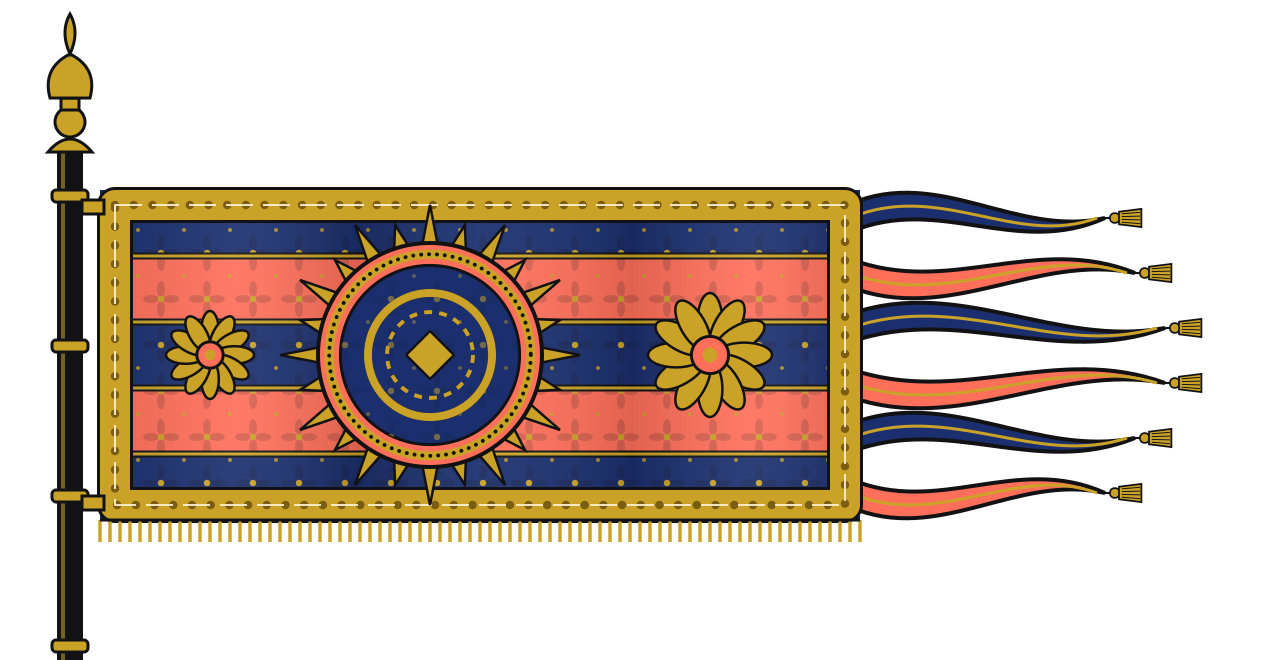
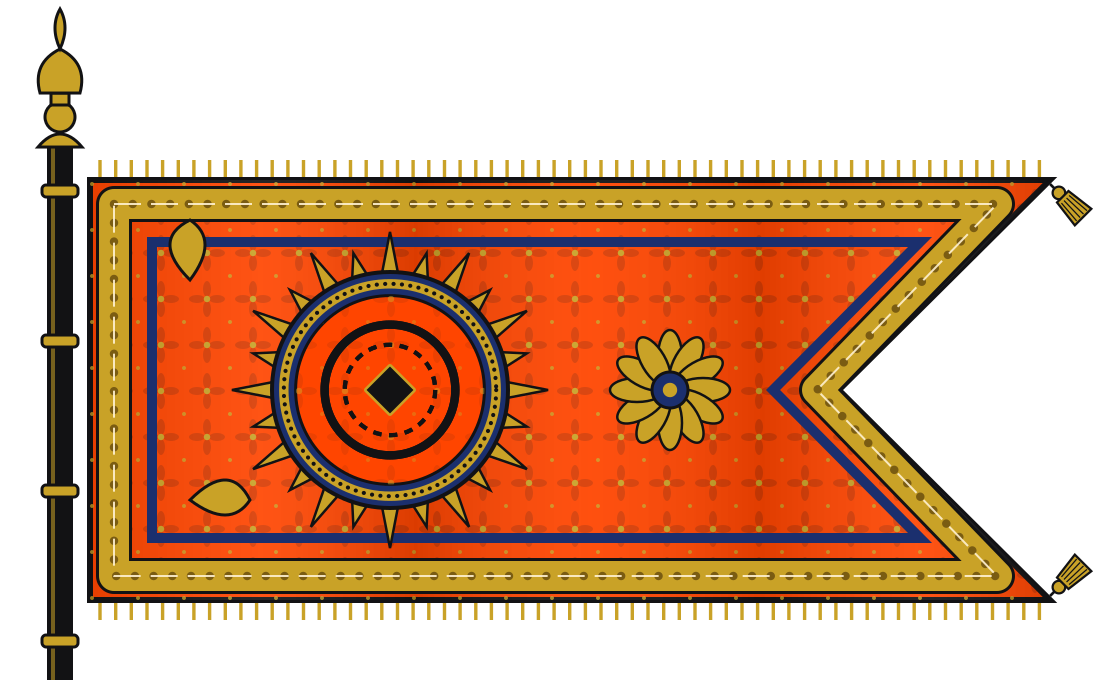
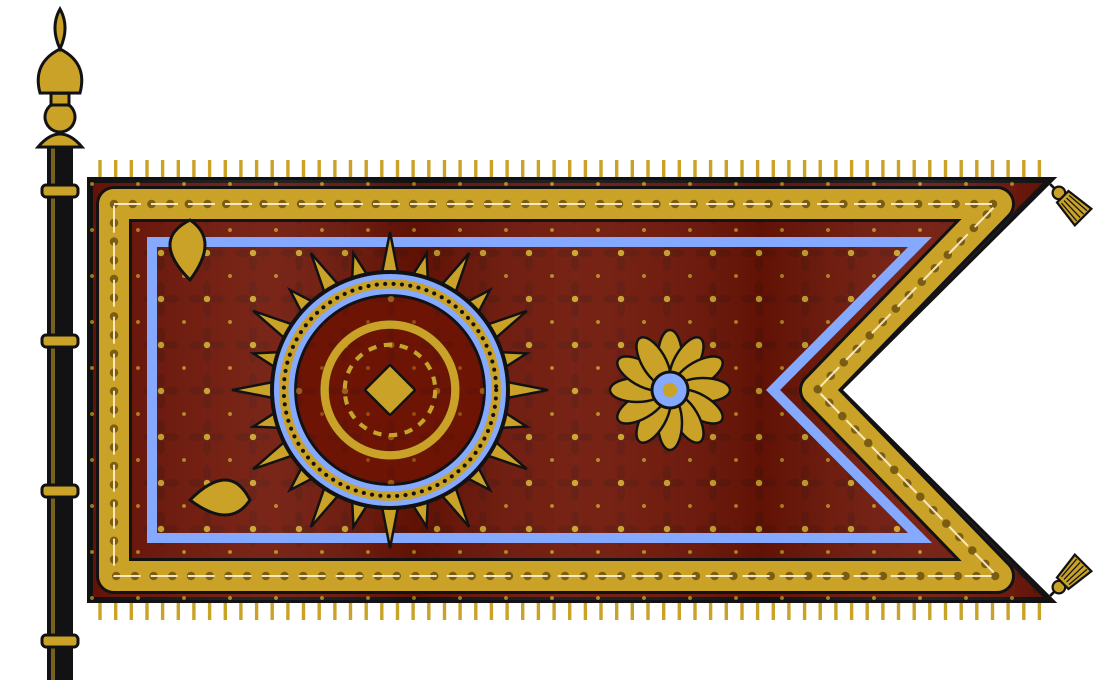
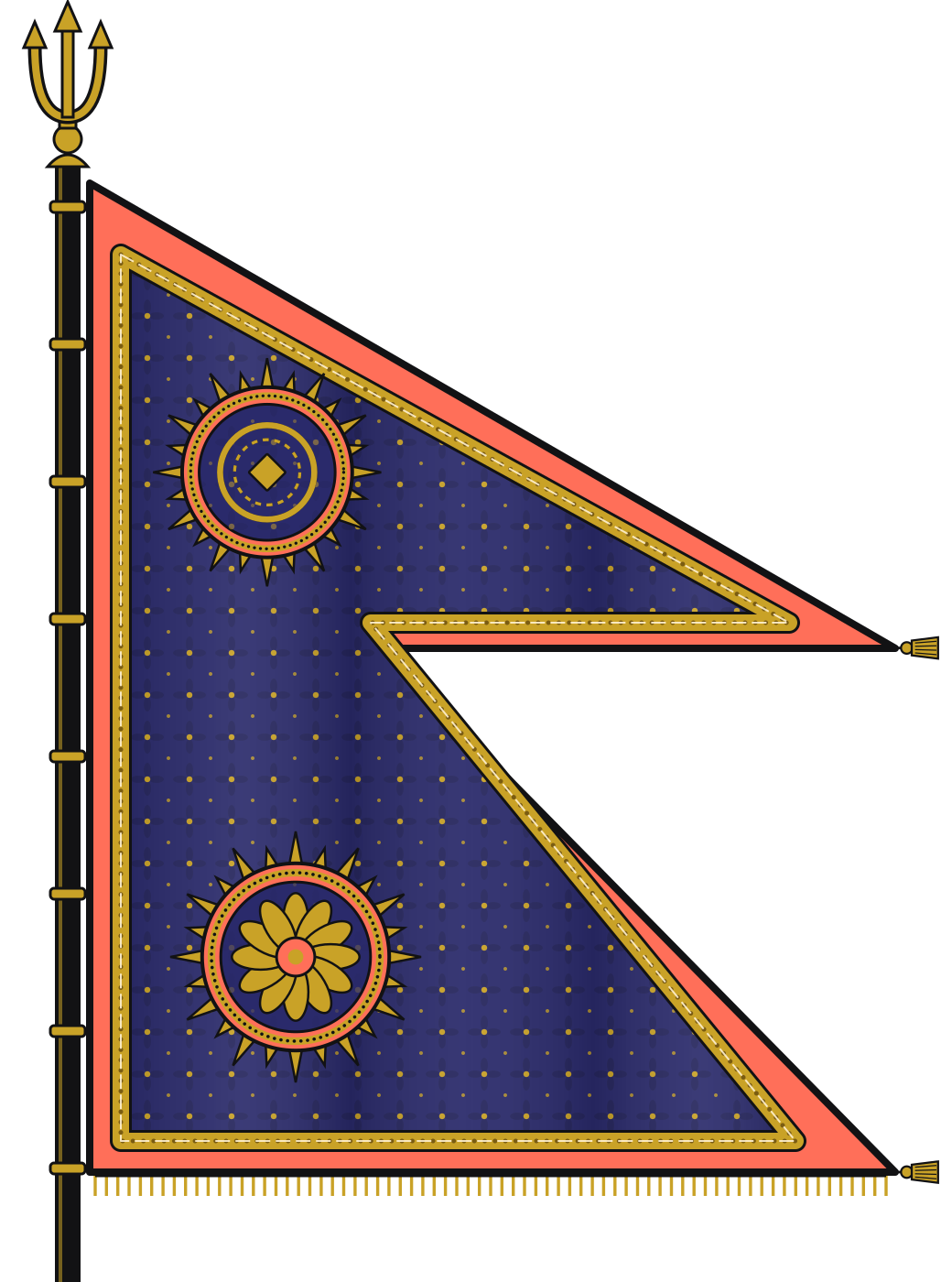
The sources describe one symbol for this people: the Lal Bangla, the Chuktia sacred kitchen. It is of red mud, painted red as a danger signal, and rebuilt if an outsider touches it[9][7][10].
| Part of the kit | This clan |
|---|---|
| Field | Warm Red-Orange #FF6F59 |
| Accent | Royal Navy #1B2F6E |
| Emblem colour | Charcoal Black #121214 |
| Zari metal | Gold |
| Main emblem | A small sacred hut with a closed door |
| Second image | — |
| Night and day | Every visual accessory has two versions: by night the emblem on the dark field, by day the clan's field colour on cloth woven from its metal. |
6. Flags
Every clan has every flag type; the type says the occasion and the colours say the clan. The outlined card is the flag the Atlas assigns.




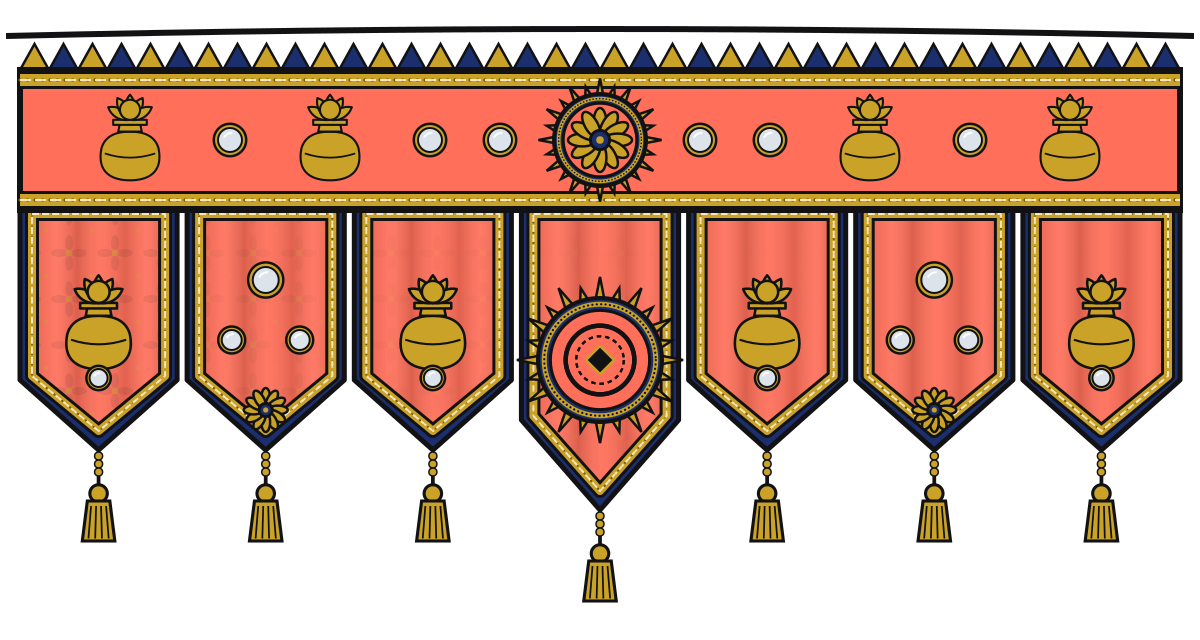
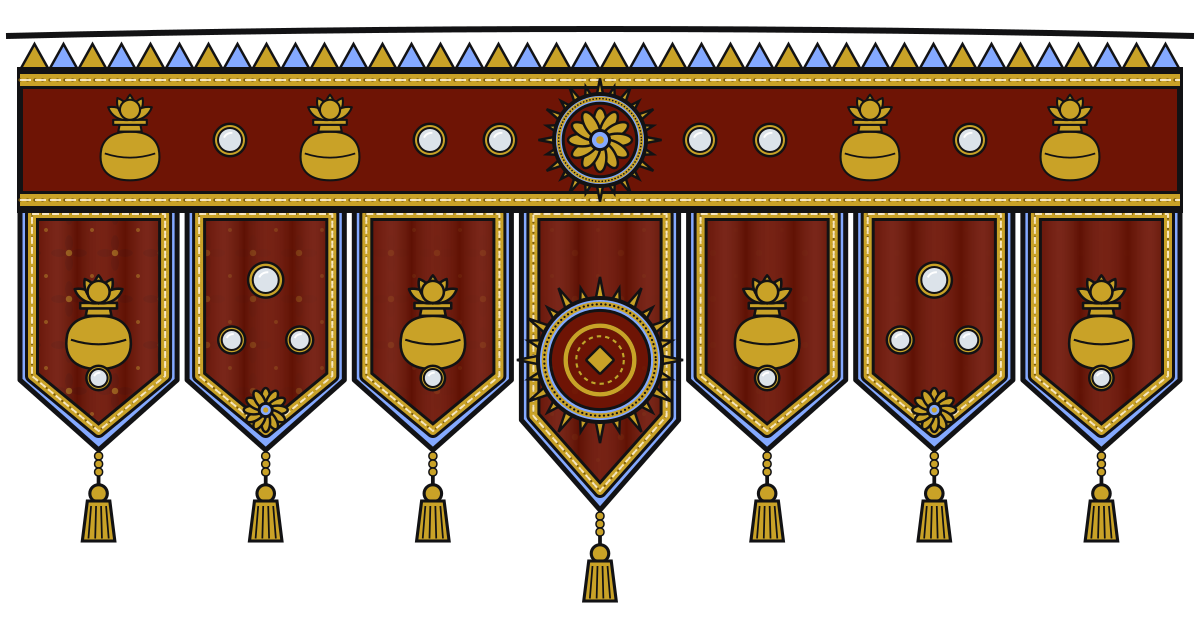

Historic banner
None known
New flag types
| Accessory | For this clan | Basis |
|---|---|---|
| A9 Pota-dhvaja · ship and trade flag For ships, caravans and markets | Not yet designed for this clan | Design |
| A10 Utsava-patāka · festival flag Light, bright flag for fairs and festivals | Not yet designed for this clan | Design |
| A11 Shoka-dhvaja · mourning flag White cloth with the emblem outline in the clan's metal | Not yet designed for this clan | Design |
7. Regalia
| Accessory | For this clan | Basis |
|---|---|---|
| E1 Chhatra · house parasol The ceremonial umbrella | Ceremonial umbrella, held by the chhatriya during worship The chhatriya holds an umbrella during worship (SPPEL)[7] | Documented |
| E2 Chamara · fly-whisks The pair of whisks beside the head of the house | Not yet designed for this clan | Design |
| E3 Danda · staff of office Staff or scepter | Not yet designed for this clan | Design |
| E4 Simhasana · seat The seat of the house, covered in clan cloth | Not yet designed for this clan | Design |
| E5 Khetaka · shield A round shield; the Changi and Dhanush are its flag forms | Not yet designed for this clan | Regional tradition |
| E6 Kula-ayudha · clan weapon The weapon the clan honours | Not yet found for this clan | Under research |
8. Worn
| Accessory | For this clan | Basis |
|---|---|---|
| F1 Kula-vastra · clan cloth The clan's woven pattern in its kit colours | White cloth worn by men and women on every occasion Men and women wear white cloth on all occasions (SPPEL)[7] | Documented |
| F2 Kirti-vastra · honour cloth A cloth earned for a deed, not inherited | Not yet designed for this clan | Design |
| F3 Kula-mala · garland flower The flower or leaf the clan wears as a garland | Not yet found for this clan | Under research |
| F4 Chinha · house pin A metal badge with the pin emblem | Not yet designed for this clan | Design |
9. Records
| Accessory | For this clan | Basis |
|---|---|---|
| H1 Clan words A traditional line in the native script | Johar, johar Thakur Deota, Tumko lagon, / Do matia ghar men dine tumhare nam. · “I make obeisance to thee, O Thakur Deo, I bow down to thee! In thy name have I placed two pots in my house.” Chaukhutia marriage song, as Russell 1916 transcribed it in Roman letters (the native-script form is not in the extract)[10] | Documented |
| H2 Biruda · titles The house's title or titles | Not yet found for this clan | Under research |
| H3 Prashasti · praise genealogy The lineage as written at the head of a grant | Not yet found for this clan | Under research |
| H4 Vahi · clan register The book of the clan's births, marriages and deaths | Not yet found for this clan | Under research |
| H5 Rana-ghosha · war cry The clan's cry in battle or celebration | Not yet found for this clan | Under research |
10. VishwaVit · knower of the world
Game values are design choices for this project, not historical claims.
References
- Wikipedia, Bhunjia language (Halbic), read 2026-10-26, https://en.wikipedia.org/wiki/Bhunjia_language_(Halbic)
- Wikipedia, Bhunjia, read 2026-10-26, https://en.wikipedia.org/wiki/Bhunjia
- Wikipedia, List of Scheduled Tribes in Odisha, read 2026-10-20, https://en.wikipedia.org/wiki/List_of_Scheduled_Tribes_in_Odisha
- Wikipedia, Tribals in Madhya Pradesh, read 2026-10-19, https://en.wikipedia.org/wiki/Tribals_in_Madhya_Pradesh
- dhammabharat.com, List of Scheduled Tribes in Maharashtra and Population of each Tribe (2011 Census), read 2026-10-10, https://dhammabharat.com/?p=13656
- Odisha State Tribal Museum, Tribes of Odisha (Bhunjia entry), read 2026-10-26, https://ostm.in/?p=5488
- SPPEL, Bhunjia Documentation, read 2026-10-26, https://sppel.org/bhunjiadoc.aspx
- Sanskriti IAS, Chuktia Bhunjia tribe, read 2026-10-26, https://www.sanskritiias.com/hindi/current-affairs/chuktia-bhunjia-tribe
- ETV Bharat, Lal Bangla, the mysterious sacred kitchen of Odisha tribal community, 20 July 2020, read 2026-10-26, link
- R. V. Russell and Hira Lal, The Tribes and Castes of the Central Provinces of India, vol. 2 (London, 1916), Project Gutenberg eBook #22010, https://www.gutenberg.org/ebooks/22010
- R. V. Russell and Hira Lal, The Tribes and Castes of the Central Provinces of India, vol. 1 (London, 1916), Project Gutenberg eBook #20583, https://www.gutenberg.org/ebooks/20583
- Sushree Mohanty, Indigenous Colours of Odisha: Handbook on 62 Tribes (KISS), read 2026-10-20, link
- Ministry of Tribal Affairs, State/UT-wise list of Scheduled Tribes (Constitution (ST) Order 1950 as amended; list dated 09-07-2024), via the Atlas entries ST-015 and ST-093.