The Bhumia are a Scheduled Tribe of Odisha (list dated 09-07-2024), counted at 125,977 in the 2011 Census[1]. The KISS handbook places them mainly in Koraput, Malkangiri and Nowrangapur, and names the village goddess Birkam Devta, whose shrine is in the village[2]. Thurston and Rangachari (1909) describe them as an Oriya caste of hill cultivators in the Jeypore Zamindari, who held that they were the first to cultivate the land on the hills[3]. Russell glosses the name as 'lord of the soil', an office of village priest; Thurston gives Captain Ward's account that the title comes from Sanskrit bhumi, earth[4][3].
01Faith and deities
The village goddess of the Bhumia; the KISS handbook gives her shrine[2]. The Atlas's KulDevi, Majhighariani, is a homeland shrine and is listed below.
Majhighariani of Rayagada, goddess of the Koraput hills
The presiding goddess of the clan's homeland or capital: a link of place, not a recorded clan tie.
| Deity or tradition | Place in the clan's life | Evidence |
|---|---|---|
| Birkam Devta | Village goddess; her shrine is in the village | [2] |
| Majhighariani (KulDevi) | Goddess of the Koraput hills; homeland shrine; family Saptamatrika (+Narasimhi) | Atlas |
02Temples
The extracts name no temple or shrine of the Bhumia apart from the village shrine of Birkam Devta.
Built by the clan
Not recorded.
Given patronage or grants by the clan
Not recorded.
03Languages and scripts
| Language or script | Kind | Under the clan | Evidence |
|---|---|---|---|
| Desia | Language, as the OSTM gives it | Spoken by the Bhumia (OSTM). Whether Desia and Odia are the same is not stated; Thurston calls the Bhumia an Oriya caste[5][3] |
04Books and literature
The extracts name these works on the Bhumia. None is a Bhumia-authored book.
Written during the clan's history
| Work | Author | Kind | When | Link to the clan |
|---|---|---|---|---|
| Castes and Tribes of Southern India, vol. 1 | Edgar Thurston and K. Rangachari | Castes and tribes survey | 1909 | Bhumia entry[3] |
| The Tribes and Castes of the Central Provinces of India, vol. 2 | R. V. Russell and Hira Lal | Castes and tribes survey | 1916 | Bhumia as a Baiga synonym[4] |
| Indigenous Colours of Odisha: Handbook on 62 Tribes | Sushree Mohanty | Handbook of 62 tribes | Bhumia shrine and districts[2] |
Given patronage by the clan
Not recorded.
05Thinkers and scholars
| Name | Field | Era | Contribution |
|---|---|---|---|
| Edgar Thurston | Castes and tribes survey | 1909 | Bhumia entry[3] |
| R. V. Russell and Hira Lal | Castes and tribes survey | 1916 | Bhumia as a Baiga synonym[4] |
The extracts name no Bhumia scholar. These two recorded the Bhumia in colonial-era surveys; Sushree Mohanty's handbook is on 62 tribes.
06Art and architecture
The extracts record one art of the Bhumia: houses painted in red, white, black and ochre. No painting, sculpture or textile is recorded.
Painting and wall art
Not recorded.
Sculpture and temple art
Not recorded.
Temple and building architecture
| Art form | What it is | Era | Evidence |
|---|---|---|---|
| Painted houses | Walls brightly painted in red, white, black and ochre | Today | [5] |
Weaving and textiles
Not recorded.
Clothing and jewellery
Not recorded.
Coins, pottery and crafts
Not recorded.
07History
The first cultivators (1909)
Thurston and Rangachari (1909) call the Bhumia an Oriya caste of hill cultivators in the Jeypore Zamindari, with a tradition that they were the first to cultivate the land on the hills[3].
Captain Ward, as Thurston quotes him, held that the title Bhumia, from Sanskrit bhumi (earth), came from the Baiga's decisions in boundary disputes, which were accepted as final[3].
Baiga and the name (1909–1916)
In the Central Provinces the Bhumia were said to be known as Baigas[3].
Russell gives Bhumia, 'Lord of the soil', as an office of village priest, sometimes a synonym for Baiga[4].
The Koraput region under British rule
The Odisha Review (2016) says undivided Koraput district came under direct British administration in 1863, and that the Government of India Act 1919 declared the whole district a Scheduled Area. This is the region's history, not one recorded for the Bhumia alone[6].
Freedom struggle (blog claim)
A blog page says the community took an active part in the freedom struggle in its district. The blog is unsourced and of low reliability, so the claim needs checking[7].
08Journey and migrations
No migration or move of the Bhumia is recorded in the extracts.
Not recorded.
09Seats and lands
| Place | Role | Where today |
|---|---|---|
| Koraput, Malkangiri, Nabrangpur | Main districts (OSTM); the KISS handbook prints Nowrangapur for the third | Odisha[5][2] |
| Ganjam, Sambalpur, Sundergarh, Kondhamal | Small numbers (OSTM) | Odisha[5] |
| Koraput, Phulbani, Gangam, Sundergarh | The blog's list, in its spellings; low reliability | Odisha[7] |
| Jeypore Zamindari | Where Thurston found the Oriya hill cultivators (1909) | Under research[3] |
| Central Provinces | Where Thurston says they were said to be known as Baigas (1909) | Under research[3] |
10Notable figures
| Name | Role | Era | Known from |
|---|---|---|---|
| Laxman Naik research | Freedom fighter; the blog says he belonged to the community | Under research | Blog only[7] |
11Allies, rivals and marriages
| People | Relationship | When |
|---|---|---|
| Baiga (ST-014) | Said to be known as Baigas in the Central Provinces; Russell sometimes gives Bhumia as a synonym for Baiga[3][4] | 1909 and 1916 records |
| Bhuiya (ST-031) | Everyculture lists Bhumia among the ethnonyms of the Bhuiya; the OSTM lists Bhuinya and Paudi Bhuyan as separate entries[8][5] | Today |
| Desari | A Desari officiates at Bhumia weddings[3] | 1909 record |
| Bhattra, Gond, Koya, Paraja, Kondh | Named with the Bhumia as the most populous tribes of Odisha (Meer) and as six Koraput tribes over one lakh each (Odisha Review)[9][6] | Today |
12Society and livelihood
The Bhumia are a Scheduled Tribe of hill cultivators (see Past). Thurston (1909) records marriage and death customs: a man may claim his paternal aunt's daughter; a jholla tonk of liquor, rice, a sheep or fowl and cloths goes to the bride's parents; a pandal of sorghi-tree poles stands before the bridegroom's house; a Desari officiates; widow remarriage is allowed, and the younger brother usually marries the elder's widow; divorce is compensated by a rupee and a new cloth; the dead are burned, with nine days' pollution and a feast on the tenth[3]. The blog adds that marriage is highly valued and that a common custom is for the groom to elope with his intended bride[7].
Government and social order
| Institution or group | What it was | Evidence |
|---|---|---|
| Mukhia | Village headman, according to the blog (low reliability) | [7] |
| Bhattanaik | Chosen for every twenty villages, according to the blog; to verify | [7] |
| Desari | Officiates at weddings (Thurston 1909) | [3] |
Livelihood over time
| Era | Livelihood | Evidence |
|---|---|---|
| Present (OSTM) | Settled agriculturalists growing gram and oil seeds; income from minor forest produce, farm labour and basket weaving; fishing and small game | [5] |
| 1909 record | Hill cultivators, with a tradition of first farming the hills | [3] |
13Sub-clans and related clans
Thurston (1909) names two septs of the Bhumia, bhag (tiger) and naga (cobra), with 'e.g.', so there may be more. The Baiga and Bhuiya are related peoples in the Atlas.
| Clan | Relation | Where | Size | In the Atlas | Evidence |
|---|---|---|---|---|---|
| Bhag | Sub-clan | Sept of the Bhumia (Thurston 1909); region not stated | new clan candidate | [3] | |
| Naga sept | Sub-clan | Sept of the Bhumia, named for the cobra (Thurston 1909); not known to be the same as Naga (ST-231) | new clan candidate | [3] | |
| Baiga | Related people | Mandla, Balaghat and Bilaspur (Russell 1916) | ST-014 | [4][3] | |
| Bhuiya | Related people | Keonjhar, Sundergarh, Jharsuguda, Mayurbhanj, Sambalpur, Angul (KISS) | 306,129, 2011[2] | ST-031 | [8][5] |
Clans marked "new clan candidate" are not in the Atlas yet.
14Surnames
No Bhumia surname is in the extracts.
Not recorded.
15Songs and music
No Bhumia song is in the extracts. The OSTM says the Bhumia are very fond of the Dhemsa dance (see Festivals).
None recorded yet.
16Poems, lullabies and children's rhymes
No Bhumia poem, lullaby or children's rhyme is in the extracts.
None recorded yet.
17Stories, legends and proverbs
Stories and legends
| Story | What happens | Told by | Evidence |
|---|---|---|---|
| The first cultivators of the hills | The Bhumia held that they were the first to cultivate the land on the hills | Recorded by Thurston (1909) | [3] |
Proverbs and sayings
Not recorded.
18Festivals and fairs
| Festival or fair | When | Where | What happens |
|---|---|---|---|
| Dhemsa | A group dance the Bhumia are very fond of | Not stated | [5] |
| Balijatra research | Said by the blog to be the most important festival of the community | Not stated | [7] |
19Food, dress and games
Food
| Item | What it is | Evidence |
|---|---|---|
| Fish and small game | Food, alongside farming (OSTM) | [5] |
Dress
Not recorded.
Games and martial arts
Not recorded.
Tags: living still practised · revived brought back after a break · lost known only from records · research reported but not yet confirmed from a source. Songs and poems under copyright are listed by title only; restricted or sacred material is noted without its content.
20Status today
The Bhumia are a Scheduled Tribe of Odisha, counted at 125,977 in the 2011 Census and settled mainly in Koraput, Malkangiri and Nabrangpur[1][2][5]. The OSTM says they are not a PVTG.
Not yet reviewed by the Bhumia community. The sources are a list of Scheduled Tribes, a museum page, a handbook, a blog and two colonial-era surveys.
21For children
The shrine in the village
The Bhumia are a people of Odisha. The OSTM says they are settled mainly in Koraput, Malkangiri and Nabrangpur. Thurston (1909) records that the Bhumia held that their people were the first to farm the hills. Their village goddess is called Birkam Devta, and her shrine stands in the village. The Bhumia grow gram and oil seeds, and they fish and hunt small game. Their houses are painted in bright red, white, black and ochre.
22Across the project
| Project | What carries this clan | Status |
|---|---|---|
| Atlas of the Janas | Under research: the districts above can seed a footprint file, not yet written | To check |
| KulDevi and GrahDevi | KulDevi Majhighariani (homeland shrine); family Saptamatrika (+Narasimhi); GrahDevi forms Brahmani, Maheshvari, Kaumari, Vaishnavi, Varahi, Indrani, Chamunda, Narasimhi | From the Atlas |
| Planet naming | Under research | — |
| Renaming and waters | Under research | — |
23Open questions
- Clan words: no line of the Bhumia's own, and no line linked to them, is in the extracts. The Odia-script sources have not been reached.
- Are bhag and naga the full sept list? Thurston writes 'e.g.'.
- Which blog claims can be checked: Mukhia, Bhattanaik, Laxman Naik, the freedom struggle and the Balijatra?
- Does Desia differ from Odia? Who are the Desari, and are they a people in their own right?
- Is Birkam Devta the same deity as the Atlas's KulDevi Majhighariani?
- The Koraput district site page (taxonomy term 518) names Sing Bonga and Dharau but not the tribe; it is not used here.
- Sept list: Thurston gives bhag and naga as examples ('e.g.'); the clans and astitva intros now both say so.
- District spelling: the lead keeps KISS's Nowrangapur; the summary keeps OSTM's Nabrangpur. Both name the same district.
24Astitva
अस्तित्व · being, existence: everything by which the clan is known
Thurston (1909) gives the Bhumia septs named for animals, the tiger and the cobra, as examples (e.g.)[3]. No seal, coin, stone, sound or regalia is recorded for them.
Every clan has every accessory, royal objects included. Each one says how it is known: Documented This clan's own object is recorded. · Regional tradition Recorded for the region or for peoples like this one, not for this clan. · Design Made for this project, with no historical claim. · Under research To be found for this clan from sources. Legends and titles are written in the clan's own script.
1. Seals and coins
| Accessory | For this clan | Basis |
|---|---|---|
| B1 Rajamudra · house seal Round seal with the clan emblem and a short legend in the clan's script | Not yet designed for this clan | Design |
| B2 Anguliya-mudra · signet ring Personal seal ring of the head of the house | Not yet designed for this clan | Design |
| B3 Chhapa · house stamp Ink or block stamp for letters, goods and cloth | Not yet designed for this clan | Design |
| B4 Tamrapatra · charter plate Copper-plate grant on a ring, closed with the house seal | Not yet designed for this clan | Design |
| B5 Shreni-mudra · guild or trade seal Seal for the clan's trade, craft or caravan | Not yet designed for this clan | Design |
| C1 Clan coin Emblem or deity on one side, a legend in the clan's script | Not yet designed for this clan | Design |
| C2 Coin die The die that strikes the coin | Not yet designed for this clan | Design |
2. Living symbols
| Accessory | For this clan | Basis |
|---|---|---|
| I1 Totem trio The tree, bird and animal the clan protects | Sept names bhag (tiger) and naga (cobra), as Thurston gives them; no tree or bird is recorded | Documented |
| I2 Kaval-maram · guardian tree The tree that stands at the clan's seat | Not yet found for this clan | Under research |
3. Stone and gate
| Accessory | For this clan | Basis |
|---|---|---|
| G1 Torana · gateway The built gate of the seat; the cloth Toran hangs in it | Not yet designed for this clan | Regional tradition |
| G2 Viragallu · hero stone Carved panel stone for a member who died defending the clan | Not yet designed for this clan | Regional tradition |
| G3 Kula-shila · clan stones Standing and table stones that remember the ancestors | Not yet designed for this clan | Design |
| G4 Jayastambha · victory pillar A pillar raised for a victory | Not yet designed for this clan | Design |
| G5 Sima-shila · boundary stone Marks the clan's land, with a line in the native script | Not yet designed for this clan | Design |
4. Sounds
| Accessory | For this clan | Basis |
|---|---|---|
| D1 Pancha-mahashabda · five great sounds The right to five instruments | Not yet designed for this clan | Design |
| D2 Shankha · clan conch The clan's own named war conch | Not yet designed for this clan | Design |
| D3 Murasu · house drums Three drums: war, charity and justice | Not yet designed for this clan | Design |
5. Kit: colours, metals and emblems
No documented emblem of the Bhumia is in the extracts. The arms below are the Atlas's design.
| Part of the kit | This clan |
|---|---|
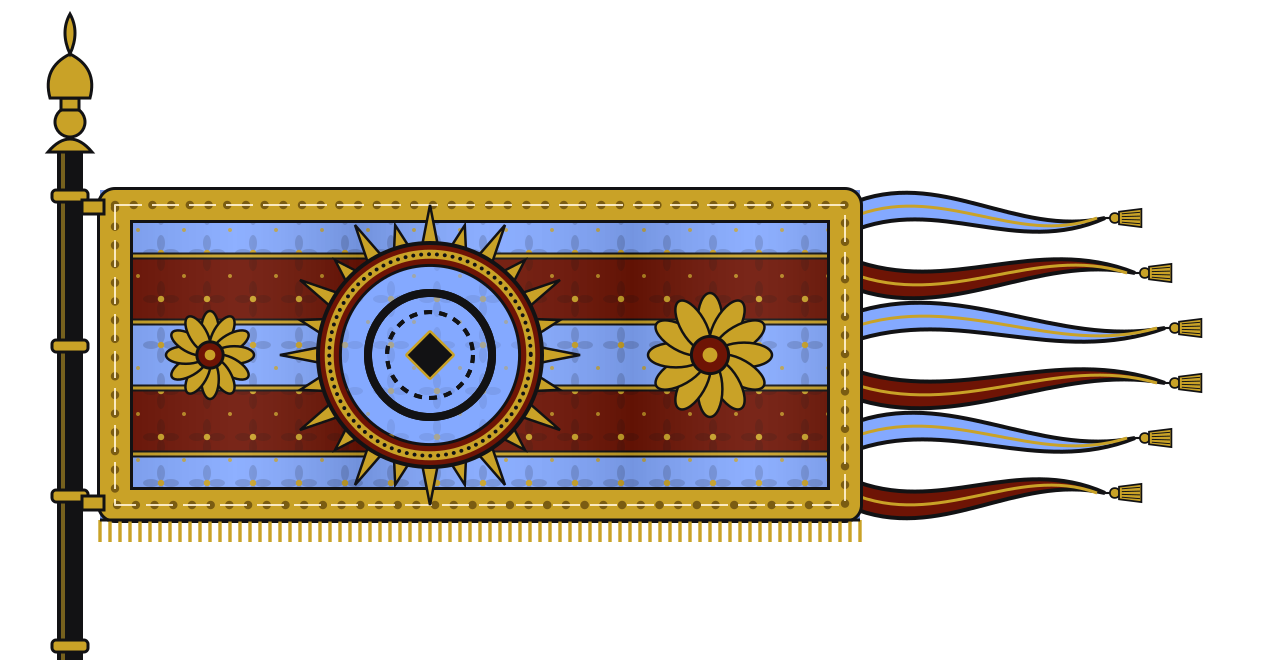
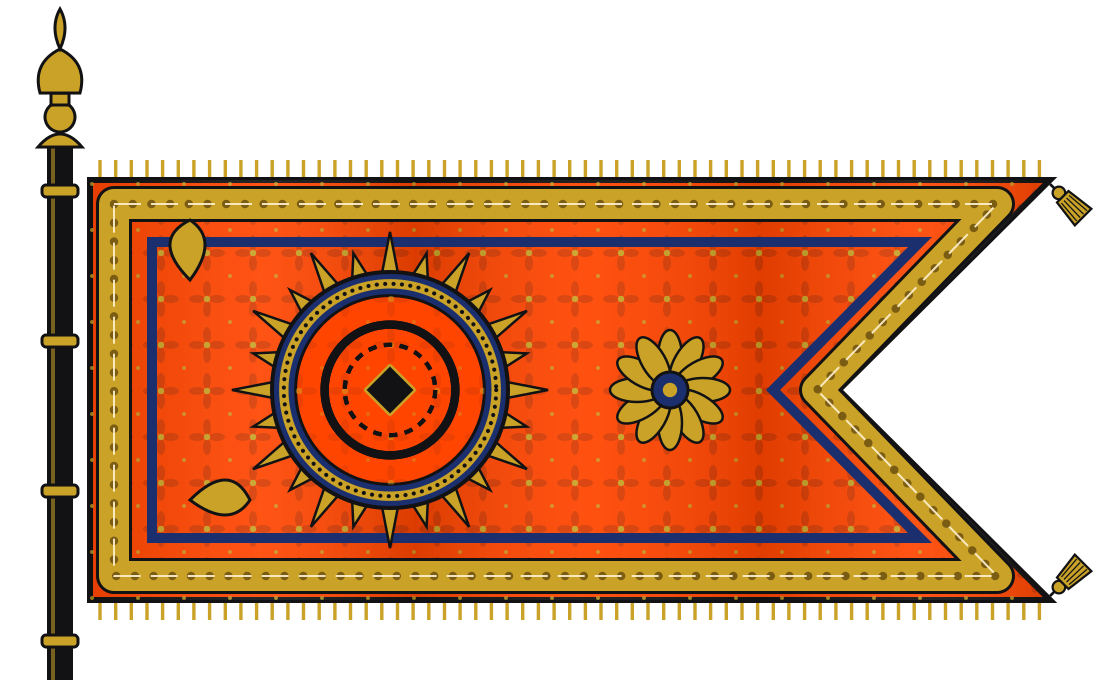
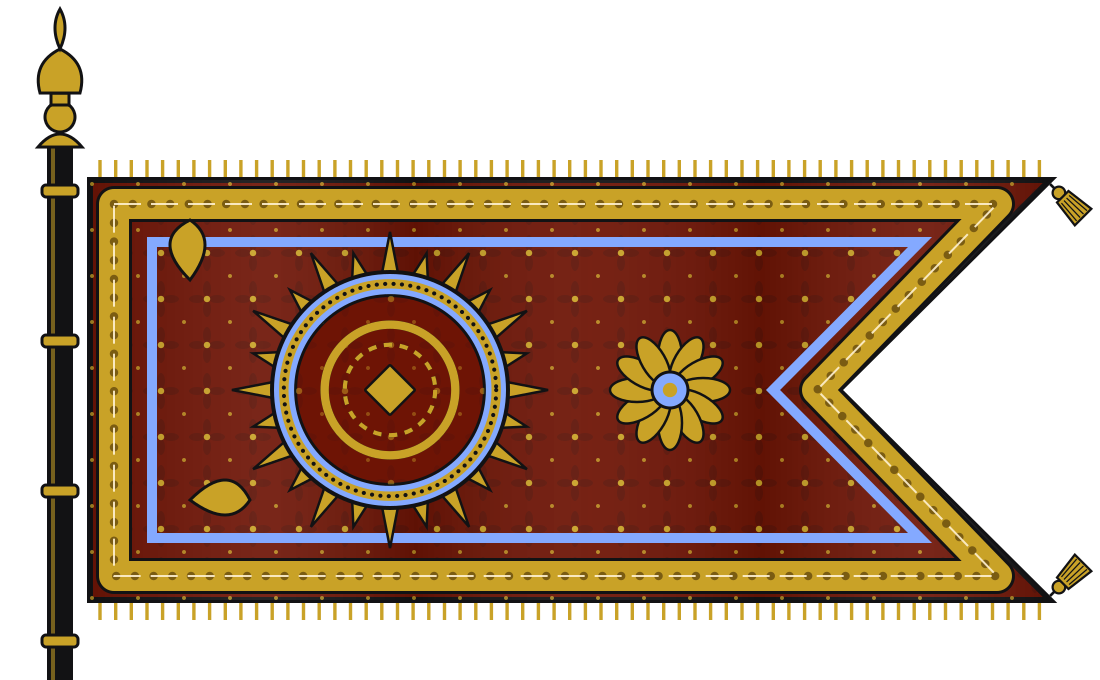
| Field | Deep Brick #7E2A1E |
| Accent | Intense Electric Blue #84A9FF |
| Emblem colour | Metallic Gold #C9A227 |
| Zari metal | Gold |
| Main emblem | A boundary stone in a field |
| Second image | — |
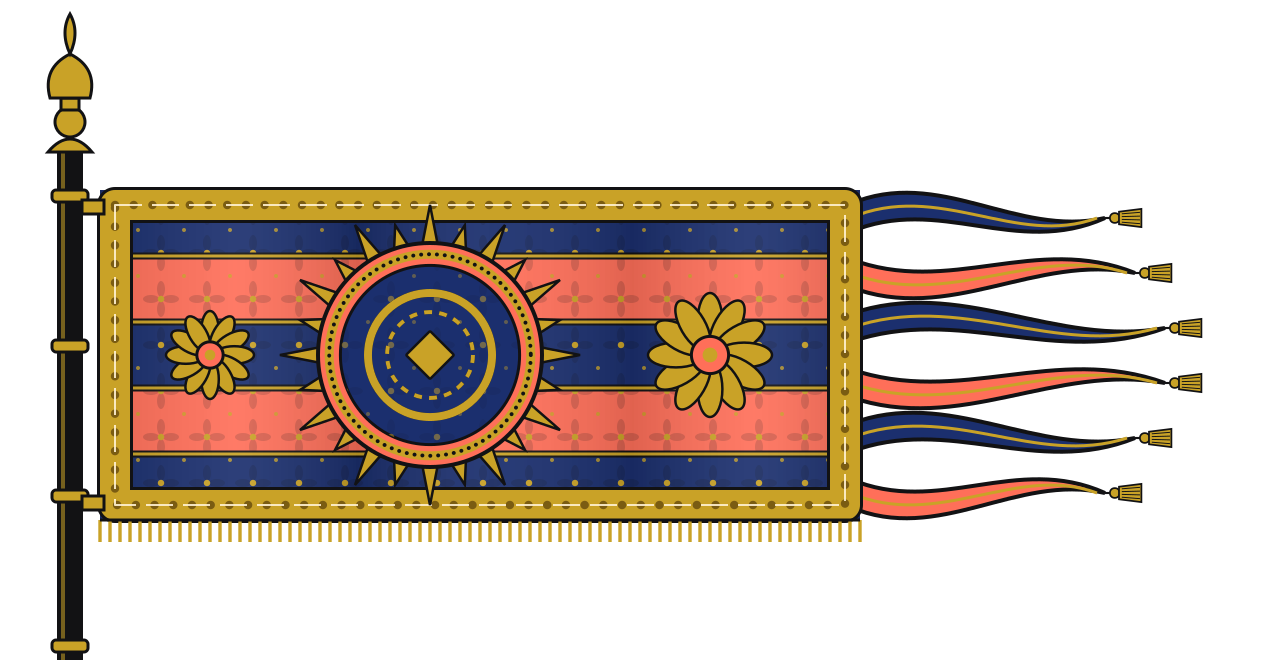
| Night and day | Every visual accessory has two versions: by night the emblem on the dark field, by day the clan's field colour on cloth woven from its metal. |
6. Flags
Every clan has every flag type; the type says the occasion and the colours say the clan. The outlined card is the flag the Atlas assigns.

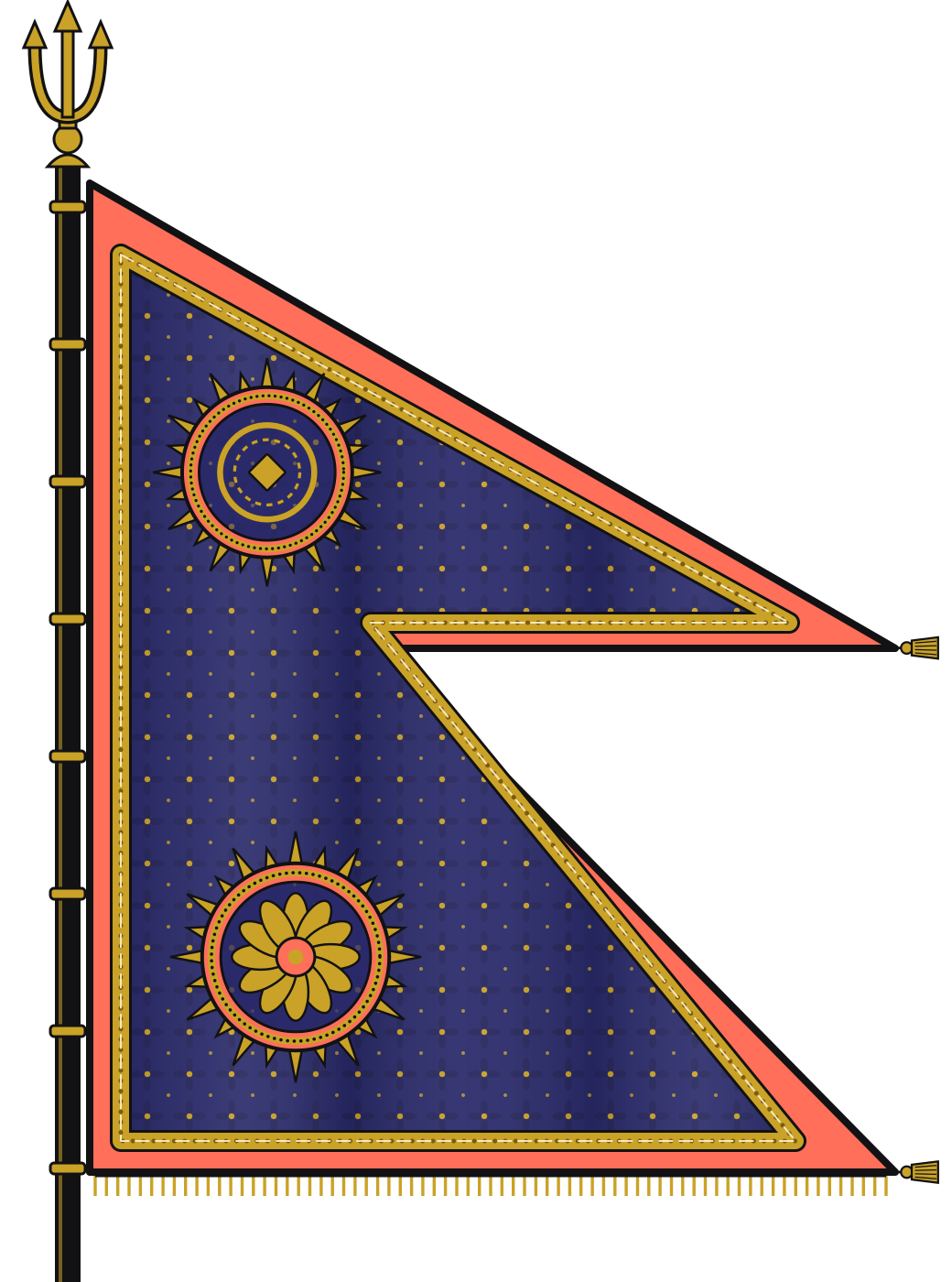


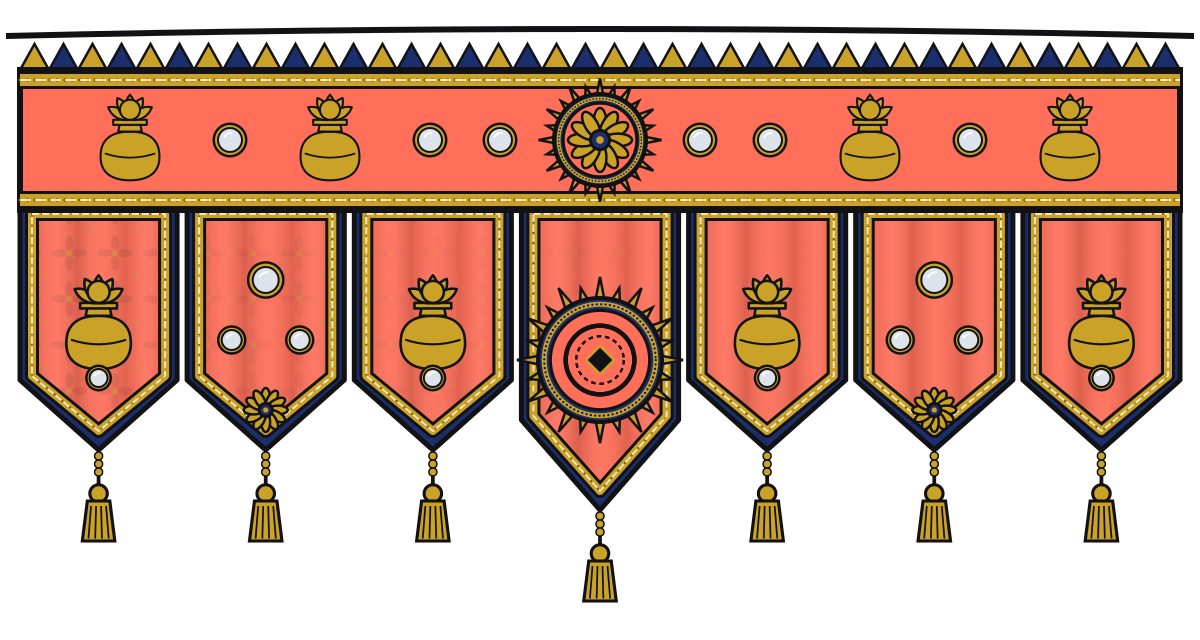
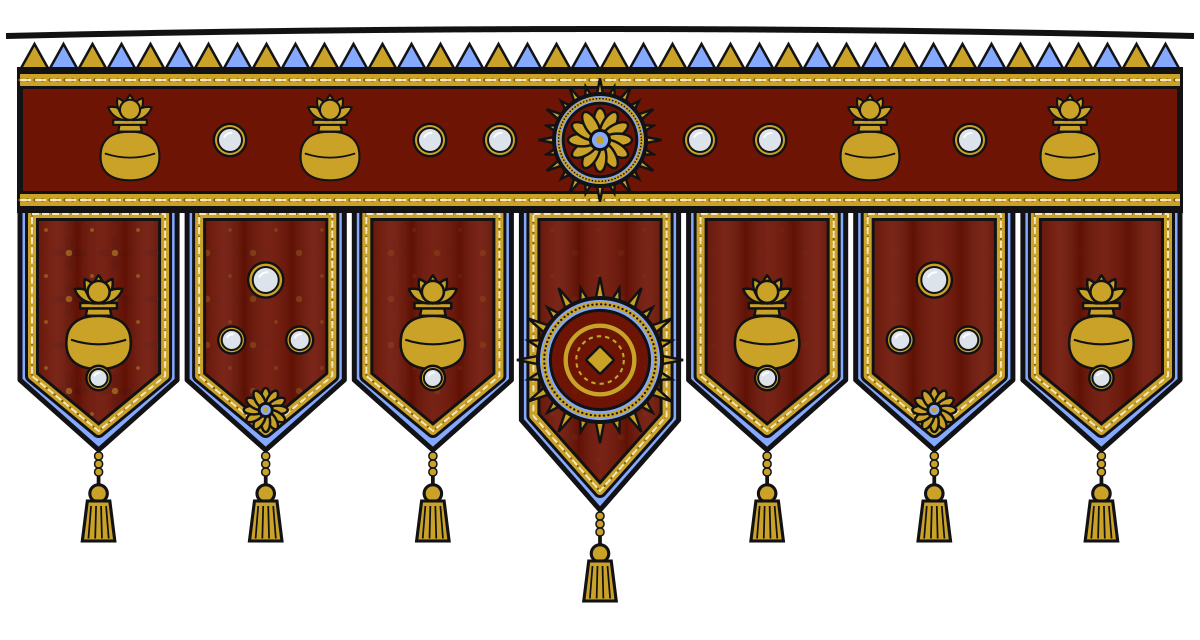

Historic banner
None known
New flag types
| Accessory | For this clan | Basis |
|---|---|---|
| A9 Pota-dhvaja · ship and trade flag For ships, caravans and markets | Not yet designed for this clan | Design |
| A10 Utsava-patāka · festival flag Light, bright flag for fairs and festivals | Not yet designed for this clan | Design |
| A11 Shoka-dhvaja · mourning flag White cloth with the emblem outline in the clan's metal | Not yet designed for this clan | Design |
7. Regalia
| Accessory | For this clan | Basis |
|---|---|---|
| E1 Chhatra · house parasol The ceremonial umbrella | Not yet designed for this clan | Design |
| E2 Chamara · fly-whisks The pair of whisks beside the head of the house | Not yet designed for this clan | Design |
| E3 Danda · staff of office Staff or scepter | Not yet designed for this clan | Design |
| E4 Simhasana · seat The seat of the house, covered in clan cloth | Not yet designed for this clan | Design |
| E5 Khetaka · shield A round shield; the Changi and Dhanush are its flag forms | Not yet designed for this clan | Regional tradition |
| E6 Kula-ayudha · clan weapon The weapon the clan honours | Not yet found for this clan | Under research |
8. Worn
| Accessory | For this clan | Basis |
|---|---|---|
| F1 Kula-vastra · clan cloth The clan's woven pattern in its kit colours | Not yet designed for this clan | Design |
| F2 Kirti-vastra · honour cloth A cloth earned for a deed, not inherited | Not yet designed for this clan | Design |
| F3 Kula-mala · garland flower The flower or leaf the clan wears as a garland | Not yet found for this clan | Under research |
| F4 Chinha · house pin A metal badge with the pin emblem | Not yet designed for this clan | Design |
9. Records
| Accessory | For this clan | Basis |
|---|---|---|
| H1 Clan words A traditional line in the native script | · “Under research: no line of the Bhumia's own, and no line linked to them, is in the extracts.” | Documented |
| H2 Biruda · titles The house's title or titles | Not yet found for this clan | Under research |
| H3 Prashasti · praise genealogy The lineage as written at the head of a grant | Not yet found for this clan | Under research |
| H4 Vahi · clan register The book of the clan's births, marriages and deaths | Not yet found for this clan | Under research |
| H5 Rana-ghosha · war cry The clan's cry in battle or celebration | Not yet found for this clan | Under research |
10. VishwaVit · knower of the world
Game values are design choices for this project, not historical claims.
References
- Wikipedia, List of Scheduled Tribes in Odisha, read 2026-10-20, https://en.wikipedia.org/wiki/List_of_Scheduled_Tribes_in_Odisha
- Sushree Mohanty, Indigenous Colours of Odisha: Handbook on 62 Tribes (KISS), read 2026-10-20, https://kissnew.kiss.ac.in/wp-content/uploads/2026/05/Indigenous-Colours-of-Odisha-Handbook-on-62-Tribes-Sushree-Mohanty.pdf
- Edgar Thurston and K. Rangachari, Castes and Tribes of Southern India, vol. 1 (Madras, 1909), Project Gutenberg eBook #42991, https://www.gutenberg.org/ebooks/42991
- R. V. Russell and Hira Lal, The Tribes and Castes of the Central Provinces of India, vol. 2 (London, 1916), Project Gutenberg eBook #22010, https://www.gutenberg.org/ebooks/22010
- Odisha State Tribal Museum (SCSTRTI), Tribes of Odisha: Bhumia, read 2026-10-28, https://ostm.in/?p=5432
- Odisha Review, Cultural Life of the Tribals of the Koraput Region, April 2016, read 2026-10-25, https://magazines.odisha.gov.in/Orissareview/2016/April/engpdf/78-82.pdf
- tribalcultureofodisha blog (author unnamed), Bhumia, read 2026-10-28, https://tribalcultureofodisha.blogspot.com/search/label/Bhumia
- Encyclopedia of World Cultures (Gale) via everyculture.com, Bhuiya (bibliography stub), read 2026-10-24, https://www.everyculture.com/South-Asia/Bhuiya.html
- Subhasish Chakraborty, Parab, Meer.com, 19 Aug 2017, read 2026-10-28, https://www.meer.com/en/27780-parab