The Bhuiya (also Bhuiyan, Bhuyan, Bhuinya) are a people of the Odisha hills and neighbouring states, listed as a Scheduled Tribe in Odisha, and the Paudi Bhuyan hill branch is a PVTG[1][2]. Their chiefs and militia are recorded as giving the tilak that Keonjhar's Raja needed, and the Raja of Keonjhar was always installed by the Bhuiyas, as Dalton described it[3][4]. Bhuiyan risings at Keonjhar in 1867 and 1891 are recorded as among the biggest tribal uprisings of nineteenth-century Odisha[5][6]. The principal deity recorded for them is the spirit of the nearest mountain[3]; the Atlas gives Maa Tarini of Ghatagaon as KulDevi, a link no fetched source makes[7].
01Faith and deities
The clan's own principal deity as recorded in 1916: 'the spirit of the nearest mountain', offered butter, rice and fowls (Russell). It is recorded for the Bhuiya, so it stands as the main deity and the sheet's KulDevi is listed below.[3]
Maa Tarini of Ghatagaon, Keonjhar[7]
The presiding goddess of the clan's homeland or capital: a link of place, not a recorded clan tie.
| Deity or tradition | Place in the clan's life | Evidence |
|---|---|---|
| Maa Tarini of Ghatagaon (KulDevi) ମା ତାରିଣୀ ମନ୍ଦିର | Sheet KulDevi and homeland shrine. The Kendujhar district page says the shrine 'is still worshiped by tribal priests', without naming the tribe; no fetched source ties Tarini to the Bhuiya | [8][7] |
| Sun as Dharam Deota | The sun, recorded as Dharam Deota | [3] |
| Cobra | Revered as mother or ancestor | [3] |
| Rambha Devi | Venerated at Rairakhol in 1916, possibly a corn-goddess; 'rambha' is burn-and-sow jungle clearing | [3] |
| Paudi Devi | Worship conducted by Bhuiya priests (a Tribal Tribune page on Odisha's deities) | [9] |
| Kanta Kumari | Central to Bhuiya religion and culture in Bonai, Gangpur and Keonjhar (Tribal Tribune) | [9] |
| Dharma Devta and Basuki Mata | Supreme god and goddess of the Paudi Bhuyan, formless (Roy, as Bhowmick gives it) | [10] |
| Thakurani | Village deity; the Thakurani shrine and Thakurani Jatra at Kuanar | [10] |
| Pats | Hill god of the Paudi Bhuyan | [10] |
| Bisri Usha | Serpent goddess; her story is recited at the Bisri Usha festival | [10] |
| Ma-Mangal Patha | Titular deity of the Kuanar Pir | [10] |
| Karma (karm tree) | A branch of the karm tree is brought in Kartik and the karma dance performed so that karma, mango, jack-fruit and mahua fruit well (Russell) | [3] |
02Temples
No temple built or patronised by the Bhuiya is named in the extracts. Shrines at Kuanar (Paudi Bhuyan) are the Thakurani shrine, the Bisri Usha Thakurani mandap and Gaisiri (Bhowmick); who built them is not stated. The sheet's KulDevi shrine, Maa Tarini Temple at Ghatgaon in Kendujhar district (ମା ତାରିଣୀ ମନ୍ଦିର, Kalinga architecture), is not shown as built or patronised by the Bhuiya, because no fetched source ties it to them[10][7].
Built by the clan
Not recorded.
Given patronage or grants by the clan
Not recorded.
03Languages and scripts
| Language or script | Kind | Under the clan | Evidence |
|---|---|---|---|
| Bhuyan dialect living | Mother tongue of the Paudi Bhuyan | Paudi Bhuyan hill villages | [10] |
| Odia living | Second language of the Paudi Bhuyan (Bhowmick); Oriya (OSTM) | Odisha | [10][2] |
| Hindi, Uriya, Bengali living | Bhuiyas had forgotten their own language by 1916 and spoke these (Russell, vol. 2, lines 12091-12093) | Bhuiya in the 1916 record | [3] |
| Indo-Aryan / Munda | Language family; the sheet's Scripts are not recorded | Bhuiya | Atlas |
04Books and literature
No script or written literature of the Bhuiya is recorded in the extracts. The works below are ethnographies about them.
Written during the clan's history
| Work | Author | Kind | When | Link to the clan |
|---|---|---|---|---|
| Descriptive Ethnology of Bengal | Dalton | Ethnology | 1872 | [11][12] |
| The Tribes and Castes of the Central Provinces of India | R. V. Russell and Hira Lal | Ethnography, two volumes | 1916 | [3] |
| Feudatory States of Orissa | Cobden-Ramsay | Kind not stated in the article | Not stated in the article | [11] |
| The Hill Bhuiyas of Orissa | S. C. Roy | Ethnography | 1935 | [11] |
| The Paudi Bhuyan | Ota | Ethnography | 2010 | [11] |
| Handbook of the Pauri Bhuiya | Patnaik, Ali, Rout and Debi | Handbook | 1980 | [13] |
| Encyclopedia of the Peoples of Asia and Oceania | West | Encyclopedia | 2009 | [11] |
| Indigenous Colours of Odisha: Handbook on 62 Tribes | Sushree Mohanty | Handbook (KISS) | 2026 (online handbook, uploaded May 2026) | [14] |
| The Paudi Bhuyan (chapter) | Bhowmick | Ethnographic chapter, six villages | 2022 | [10] |
Given patronage by the clan
Not recorded.
05Thinkers and scholars
Not recorded.
No Bhuiya thinkers or scholars are named in the extracts. The authors of the books above are listed under Books.
06Art and architecture
No painting, sculpture, architecture or craft is recorded for the Bhuiya in the extracts. The men's dormitory is called the 'house of the drums' (Russell), which is not an art form.
Painting and wall art
Not recorded.
Sculpture and temple art
Not recorded.
Temple and building architecture
Not recorded.
Weaving and textiles
Not recorded.
Clothing and jewellery
Not recorded.
Coins, pottery and crafts
Not recorded.
07History
Name and early tradition
Russell and Hira Lal give the name as a Sanskrit derivative meaning 'Lord of the soil'; it is also a title for landholders in other places[3]. Wikipedia derives it from Sanskrit bhumi, land[11].
Dalton (1872) speculated that the Bhuiyas were among the oldest inhabitants of Keonjhar, Bonai and other eastern states, and the Northern Tributary States of Orissa were their principal stronghold[11][12].
The Bhuiya tradition is that they call themselves 'children of the soil, Bhuin', and that they founded the Bhanja dynasty by stealing a boy of the royal family and making him king, keeping the right to dethrone him if he was oppressive[5]. Dalton gives a similar account: Bhuiyas stole a child of the Mayurbhanj (printed 'Moharbhanj') Raja's family about twenty-seven generations ago, and the Rajkuli branch descends from him[3]. These are community claims, not checked against other records.
Madala Panji claims, as Bhowmick prints them, that Anangabhima Dev gave gold for Jagannath and that about 40 lakh madhas were paid by Bhuyans as war indemnity. Bhowmick also cites the Anguttara Nikaya for Bhuyan traders, Tapasu and Bhallika, from Utkal who offered honey and rice cake to the Buddha. The chapter gives these as printed; they are not checked against the texts[10].
Some historians link the Atavika kingdom that resisted Ashoka to the Bhuyans and Savars, as the chapter states[10].
Medieval kingdoms
Keonjhar State is traditionally founded in the twelfth century under Eastern Ganga rule, with Jyoti Bhanja enthroned as Raja; the dominant local Bhuyan clans helped to enthrone him[4].
The Wikipedia article on the Bhuiya says the Ghatwar were medieval kings who rebelled against the Nagvanshi king Pratap Karn, helped by Baghdeo Singh of Kharyagarh (citing Prabhat Prakashan, 2020). The article does not say that the Ghatwar are Bhuiya; this is under research[11].
The Keonjhar coronation and the 1867-68 rising
After Gadadhar Bhanja died in 1861, the British refused Brundaban Bhanja, adopted son of Bishnupriya Dei, and crowned Dhanurjay Narayan Bhanja. Ratna Nayak led the Bhuiyan protest, and Queen Bishnupriya supported it[5].
In 1867 Ravenshaw declared Dhanurjay ruler, and Bhuiyans protested violently at Anandpur. The coronation was held in February 1868. On 28 April 1868 Ratna Nayak and Nanada Nayak besieged the palace, and on 19 May 1868 Ravenshaw issued a proclamation. About 2,000 rebels took part. The rajas of Mayurbhanj, Bonai, Pal Lahara, Dhenkanal and Udaipur helped the government. Ratna Nayak was captured in Pal Lahara; Nanda Pradhan and Rameya Kol were taken by Bonai's Dewan. Ten were sentenced to death, including Ratna Nayak and Rameya Kol, and 27 were transported for life[5].
The Tribal Tribune article is marked 'to be concluded'; the rest of it was not fetched[5].
The Dharanidhar Naik rising (dates differ by source)
Dharanidhar Naik, a Bhuyan born at Kusumita in Keonjhar in 1864, led a rising against forced labour (bethi) and a grain-sale law. Wikipedia dates it 1891-1893, against King Dhanurjaya Bhanja. Bhuyan, Kol and Juang took part, and the British crushed it; Naik was in Cuttack jail until 1897[6].
Bhowmick (2022) dates the same leader's five-year uprising to 1890, with seven years in prison and a later life as a saint. The Tribal Tribune gives 1891. The dates are shown as sourced differences and not resolved here[10][5].
A local tale says that pitha, a rice sweet, served as weapons in the uprising[10].
Chhotanagpur, Singhbhum and the Munda link
Russell records that the Baigas were thought to be a branch of the Bhuiya[3].
Russell gives Mazumdar's view that the Bhuiyas may have been the first Munda immigrants, and says the Mundas themselves claim to have driven the Bhuiyas out[3]. Dalton also links the Bhuiyas with the Savars[3].
The Ho had overcome the Bhuiyas by the 17th century and entered old Singhbhum[15]. Singhbhum Bhuiyas call themselves Pawan-bans, 'Children of the Wind', tied to Hanuman[3].
08Journey and migrations
No migration route is recorded in the extracts. The sources place the Bhuiya in a homeland of hills and states, and later in other states.
Not recorded.
09Seats and lands
| Place | Role | Where today |
|---|---|---|
| Keonjhar and Banai mountains | Principal home; seat of Keonjhar State; the Raja was installed by Bhuiya vassals | Keonjhar, Odisha[4][10] |
| Gangpur, Bonai, Keonjhar, Bamra | Principal home of the Bhuiya as Russell summarises Dalton; tilak from the Bhuiyas required before chiefs could rule | Odisha; the Bhuiya districts in the KISS handbook (as printed) are Keonjhar, Sundergarh, Jharsuguda, Mayurbhanj, Sambalpur, Angul[3][14] |
| Pal Lahara, Mayurbhanj, Gangpur, Bonai, Bamra | Scattered groups; highlands of Bonai, Pal Lahara and Keonjhar thought to be the original homeland | Odisha[5] |
| Sundergarh, Keonjhar, Mayurbhanj, Sambalpur, Deogarh, Anugul | Paudi Bhuyan hill settlements, not easily reached in the monsoon | Odisha[2] |
| Sonbhadra | The only Uttar Pradesh district where the Bhuiya are listed as ST, as of 2017 (Wikipedia) | Uttar Pradesh[16][11] |
| Singhbhum | Singhbhum Bhuiyas, who call themselves Pawan-bans | Singhbhum, as Russell gives it[3] |
| Bihar, Jharkhand, Madhya Pradesh, Assam, West Bengal | Places where the Bhuiya are found, per Wikipedia | As listed[11] |
10Notable figures
| Name | Role | Era | Known from |
|---|---|---|---|
| Ratna Nayak | Led the Bhuiyan protest and the 1868 siege of the palace; captured in Pal Lahara; sentenced to death | 1861-68 | [5] |
| Nanada Nayak | Besieged the palace with Ratna Nayak on 28 April 1868 | 1868 | [5] |
| Nanda Pradhan | Rebel captured by Bonai's Dewan | 1868 | [5] |
| Rameya Kol | Rebel captured by Bonai's Dewan; sentenced to death | 1868 | [5] |
| Dharanidhar Naik | Born 5 May 1864 at Kusumita, Keonjhar; described as a Bhuyan; led the rising against forced labour; surveyor to the Raja; died 1914 at Ali, Cuttack; built a hermitage at Ali | 1864-1914 | [6][10] |
| Tikait Umrao Singh | King of Bandhgawa in Ormanjhi; took part in the 1857 rebellion in Ranchi (listed in the Bhuiya article; his link to the Bhuiya is as the article gives) | 1857 | [11] |
| Tapasu and Bhallika legend | Bhuyan traders from Utkal who offered honey and rice cake to the Buddha (as the Bhowmick chapter gives the Anguttara Nikaya) | Buddha's time, as the source gives it | [10] |
11Allies, rivals and marriages
| People | Relationship | When |
|---|---|---|
| Keonjhar Raj house (Bhanja) | The Bhuiya installed the Raja; they claim to have founded the dynasty; in 1867-68 they protested the coronation of Dhanurjay | 1861-68 |
| Rajas of Gangpur, Bonai, Keonjhar, Bamra | Chiefs could not rule until they had the tilak of the Bhuiya vassals (Dalton, via Russell) | Recorded 1916 |
| Brahmans | Brahmanical rites are added to the Pauri ceremony of installing the Raja (Dalton, via Russell) | Recorded 1916 |
| Baiga | Branch: the Baigas were thought to be a branch of the Bhuiya (Russell) | Recorded 1916 |
| Bhumij | Related: Bhumij, applied to a branch of the Kol, has the same origin in bhu, earth (Russell vol. 1) | Recorded 1916 |
| Juang | Neighbours considered brothers; took part in the 1891-93 rising with the Bhuyan | Today; 1891-93 |
| Kol | Took part in the 1891-93 rising with the Bhuyan (Wikipedia) | 1891-93 |
| Munda | Mazumdar's view that Bhuiyas may have been the first Munda immigrants; the Mundas say they drove the Bhuiyas out (Russell) | Recorded 1916 |
| Savar (Saora) | Dalton links the Bhuiyas with the Savars (Russell) | Recorded 1916 |
| Ho | Rival: the Ho overcame the Bhuiyas by the 17th century and entered old Singhbhum | By the 17th century |
| Musahar and Khandait castes | Derived from the Bhuiyas (Russell) | Recorded 1916 |
| Bhuinhar and Babhan | Of Bengal and Benares; distinct from the Bhuiyas (Russell) | Recorded 1916 |
| Bara Bhuiyan landlords of Bengal | Historical landlords; distinct from the Bhuiya (Wikipedia) | Historical |
12Society and livelihood
Descent is patrilineal and clans are exogamous; women do not inherit and widows manage property (Bhowmick). Plains Bhuiyan live among non-tribals and hill Bhuiyan (Pauri) in forests, practising podu cultivation (Wikipedia). At Raigarh, no exogamous divisions are recorded (Russell). Marriage: capture (ghichha), elopement, love and negotiation are recorded; marriage within the village is forbidden, and marriage with a kutumb (agnatic relative) is forbidden while a bandhu (non-agnatic) is accepted[11][10][3]. Bhowmick lists the Paudi Bhuyan forms as Dharipala (elopement), Ghicha (capture), Phulkusi, Mangi Bibaha (negotiated, with its stages), and Rundi Bibaha (widow remarriage); some marriage rites are Sanskritised. Pabudia bride-price is two bullocks or cows (Russell).
Government and social order
| Institution or group | What it was | Evidence |
|---|---|---|
| Kutumba | Lineage; several kutumbas form an exogamous clan called bonso or khilli | [11] |
| Khilli | Local descent group; a daughter belongs to her father's khilli and a wife joins her husband's | [10] |
| Pidha | A confederation of villages, with a sardar | [11] |
| Pir | Inter-village council; the Kuanar Pir has seven villages | [10] |
| Darbar | Council; the village panchayat meets at the darbar under the pradhan | [11][10] |
| Manda ghar | Where the men of a village gather | [10] |
| Sahi | Sub-division of the village (grama) | [10] |
| Mandar Ghar (Dhangar basa, Darbarghar) | Bachelors' dormitory, 'house of the drums', also a guesthouse, granary and meeting place | [3][2] |
| Dhangaria basa | Maidens' dormitory | [3] |
| Ganthi | A knotted string passed village to village, said to throw the country into commotion (Dalton, via Russell) | [3] |
| Eikushia | Naming ceremony on the 21st day | [10] |
| Funeral customs | Feet toward the native village; the soul is called back on the tenth day; no mourning for death by tiger or tree; natural death by snake-bite | [3] |
| Pawri Desh chiefs | Sixty chiefs of the Pawri Desh (Dalton, via Russell) | [3] |
Livelihood over time
| Era | Livelihood | Evidence |
|---|---|---|
| Recorded 1916 | Shifting cultivation (khasrathumi) in Bamra | [3] |
| Today (OSTM) | Paddy in the valleys and shifting cultivation on the slopes; gathering mahua flowers, mango, thatching grass and rope fibre; fishing in the rains with the catch dried | [2] |
| Today (Wikipedia) | Agriculture, basket-making, livestock, fishing, hunting, forest produce (firewood, honey, resin) | [11] |
| Surveyed villages (Bhowmick, 2022) | Cultivation is the main occupation for 43.79% (the chapter's figure); NREGA work; all surveyed families hold BPL cards | [10] |
13Sub-clans and related clans
Sub-clans, subtribes, lineages and related peoples named in the extracts. Sambalpur septs and Bihar and Jharkhand lineages are named as the sources give them; items without a sheet ID are new clan candidates.
| Clan | Relation | Where | Size | In the Atlas | Evidence |
|---|---|---|---|---|---|
| Thakur | Sub-clan | Sambalpur, Odisha. | new clan candidate | [3] | |
| Saont | Sub-clan | Sambalpur, Odisha. | new clan candidate | [3] | |
| Padhan (Pradhan) | Sub-clan | Sambalpur, Odisha. | new clan candidate | [3] | |
| Naik | Sub-clan | Sambalpur, Odisha. | new clan candidate | [3] | |
| Kalo | Sub-clan | Sambalpur, Odisha. | new clan candidate | [3] | |
| Dehri (Dehrin) | Sub-clan | Sambalpur, Odisha. The Dehrin sept worship the village gods | new clan candidate | [3] | |
| Chatria | Sub-clan | Sambalpur, Odisha. | new clan candidate | [3] | |
| Sahu | Sub-clan | Sambalpur, Odisha. | new clan candidate | [3] | |
| Majhi | Sub-clan | Sambalpur, Odisha. | same name as ST-181: check | [3] | |
| Behra | Sub-clan | Sambalpur, Odisha. | new clan candidate | [3] | |
| Amata | Sub-clan | Sambalpur, Odisha. | new clan candidate | [3] | |
| Dandsena | Sub-clan | Sambalpur, Odisha. | new clan candidate | [3] | |
| Khandait (Paik) | Sub-clan | Subtribe named by Russell | new clan candidate | [3] | |
| Parja | Sub-clan | Subtribe named by Russell; not linked to the sheet's Porja (ST-261) without a source | new clan candidate | [3] | |
| Rautadi | Sub-clan | Subtribe named by Russell | new clan candidate | [3] | |
| Pabudia (Madhai) | Sub-clan | Hill Bhuiyas; attend and carry the Raja's loads; say their ancestors were twelve brothers of Keonjhar, four of whom divided Keonjhar, Bamra, Palahara and Bonai (Dalton, via Russell) | new clan candidate | [3] | |
| Kati (Khatti) | Sub-clan | Subtribe named by Russell | new clan candidate | [3] | |
| Bathudia | Sub-clan | Subtribe named by Russell; not linked to the sheet's Bathudi (ST-019) without a source | new clan candidate | [3] | |
| Rikhiasan Mahatwar | Sub-clan | Central Provinces (Russell); reverence for Rikhmun or Rikhiasan, the bear | new clan candidate | [3] | |
| Basuki | Sub-clan | Bihar and Jharkhand lineage, totem cobra (Wikipedia; as the article gives) | new clan candidate | [11] | |
| Kachhim | Sub-clan | Bihar and Jharkhand lineage, totem tortoise (Wikipedia; as the article gives) | new clan candidate | [11] | |
| Kali | Sub-clan | Bihar and Jharkhand lineage, totem snake (Wikipedia; as the article gives) | new clan candidate | [11] | |
| Sal | Sub-clan | Bihar and Jharkhand lineage, totem fish (Wikipedia; as the article gives) | new clan candidate | [11] | |
| Sigari | Sub-clan | Bihar and Jharkhand lineage, totem fox (Wikipedia; as the article gives) | new clan candidate | [11] | |
| Sinjkiri | Sub-clan | Bihar and Jharkhand lineage named in the Wikipedia article; no totem given there | new clan candidate | [11] | |
| Baiga | Branch | Baigas were thought to be a branch of the Bhuiya (Russell) | ST-014 | [3] | |
| Bhumij | Related people | Same origin of name; a branch of the Kol is called Bhumij (Russell vol. 1) | ST-033 | [17] | |
| Juang | Related people | Live close to the Bhuiya, considered brothers (OSTM); Keonjhar, Dhenkanal (KISS handbook) | ST-114 | [2][14] | |
| Kol | Related people | Took part in the 1891-93 rising with the Bhuyan (Wikipedia) | ST-141 | [6] | |
| Munda | Related people | Mundas say they drove out the Bhuiyas; Mazumdar's immigrant view (Russell) | ST-229 | [3] | |
| Savara (Saora) | Related people | Dalton links the Bhuiya with the Savars; the Odisha list gives Savar as an alias of Saora (ST-286) | ST-286 | [3][1] | |
| Ho | Related people | Overcame the Bhuiyas by the 17th century and entered old Singhbhum | ST-102 | [15] | |
| Musahar | Related people | Caste derived from the Bhuiyas (Russell) | SUB-063 | [3] | |
| Kewat | Related people | Some Bhuiya groups were Sanskritised into Kewat (Wikipedia) | same name as SUB-274: check | [11] | |
| Kaibarta | Related people | Some Bhuiya groups were Sanskritised into Kaibarta (Wikipedia) | same name as SUB-260: check | [11] | |
| Khandayat | Related people | Some Bhuiya groups were Sanskritised into Khandayat (Wikipedia); may be the Khandait subtribe (open) | same name as SUB-275: check | [11] | |
| Bhuinhar (Babhan) | Related people | Of Bengal and Benares; distinct from the Bhuiyas (Russell) | new clan candidate | [3] | |
| Bara Bhuiyan | Related people | Historical landlords of Bengal; distinct from the Bhuiya (Wikipedia) | same name as SUB-355: check | [11] | |
| Ghatwar | Related people | Medieval kings named in the Wikipedia Bhuiya article; relation not stated | new clan candidate | [11] | |
| Keonjhar Bhanja house | Dynasty from this clan | The Raja's house, installed by Bhuiya vassals (Keonjhar State) | same name as SUB-356: check | [4] |
Clans marked "new clan candidate" are not in the Atlas yet.
14Surnames
Surnames the sources give for the Bhuiya. Titles that the sources do not call surnames are under research.
| Surname | Clan or sub-clan | Where | People with this surname | Also used by other communities |
|---|---|---|---|---|
| Swain | Bhuiya (Paudi Bhuyan) | Paudi Bhuyan villages (Bhowmick) | not yet counted | Not checked |
| Pradhan | Sambalpur sept (Padhan) | Sambalpur, Odisha (Russell); Paudi Bhuyan (Bhowmick) | not yet counted | Not checked |
| Dehuri | Sambalpur sept (Dehri) | Paudi Bhuyan villages (Bhowmick) | not yet counted | Not checked |
Counts are of everyone with the surname, from the cited source and year, not only members of this clan. A surname shared with other communities says nothing about any one person's origin.
15Songs and music
No song text is found in the extracts, and none is quoted here. The sources describe a festival recitation, a drum-and-tambourine dance, and popular songs played at youth dances.
Bisri Usha recitation living
Tambourine circle song
Oriya and Hindi loudspeaker songs living
Instruments and styles
| Instrument or style | What it is | Evidence |
|---|---|---|
| Changu | The Paudi Bhuyan's favourite instrument | [2] |
| Wide tambourine | Carried by the men of the circle dance (Dalton, via Russell) | [3] |
16Poems, lullabies and children's rhymes
No poem, lullaby or rhyme is recorded for the Bhuiya in the extracts.
None recorded yet.
17Stories, legends and proverbs
Stories and legends
| Story | What happens | Told by | Evidence |
|---|---|---|---|
| Sun and moon | The moon cooked her children and the sun ate his; fire hid in a rengal tree; this explains why there are no stars by day, why the moon wanes, and how fire is made by rubbing rengal wood | Bhuiya, as recorded in 1916 | [3] |
| The stolen child who became Raja legend | Bhuiyas stole a child of the Mayurbhanj (printed 'Moharbhanj') Raja's family about twenty-seven generations ago and made him Raja; the Bhanja story in the Tribal Tribune is a similar tradition | Bhuiya tradition, as Dalton and Mohapatra give it | [3][5] |
| Twelve brothers of Keonjhar legend | Pabudia say their ancestors were twelve brothers of Keonjhar, four of whom divided Keonjhar, Bamra, Palahara and Bonai | Pabudia, as Dalton records it | [3] |
| Bisri Usha | Lakhinder, a sea trader hostile to the goddess, opposes her; Behula saves her husband | Gauni, folk singer, at the festival | [10] |
Proverbs and sayings
| Saying | Meaning | Evidence |
|---|---|---|
| Wherever you see a Bhuiya he always has a fire. (English only; no native-script form in the extracts) | Recorded by Russell in 1916 as a saying of the Bhuiyas; no further meaning is given | [3] |
18Festivals and fairs
| Festival or fair | When | Where | What happens |
|---|---|---|---|
| Bisri Usha | February to March | Paudi Bhuyan villages (Bhowmick) | A potter's idol of the serpent goddess; Gauni recites her story over seven days; a feast on the eighth day[10] |
| Am-Nuakhai | January to February | Gaisiri and Thakurani, Kuanar | Green mangoes are offered at the Gaisiri and Thakurani shrines[10] |
| Nuakhai and Karam Jatra | September to October | Paudi Bhuyan villages (Bhowmick) | Named in the chapter; details not given[10] |
| Karma | Kartik (October), or the month after | Not stated | A branch of the karm tree is brought and the karma dance performed so that karma, mango, jack-fruit and mahua bear well; worship on Monday, Wednesday and Friday[3] |
| Magah Podol | January to February | Paudi Bhuyan villages (Bhowmick) | Named in the chapter; details not given[10] |
| Kath Jatra | January to February | Paudi Bhuyan villages (Bhowmick) | Named in the chapter; details not given[10] |
| Akhin Pardih | March to April | Paudi Bhuyan villages (Bhowmick) | A ceremonial hunt[10] |
| Thakurani Jatra | Not stated | Kuanar | Seven days[10] |
19Food, dress and games
Food
| Item | What it is | Evidence | |||||||||||||||||||||||||||||||||||||||||||||||||||||||||||||||||||||||||||
|---|---|---|---|---|---|---|---|---|---|---|---|---|---|---|---|---|---|---|---|---|---|---|---|---|---|---|---|---|---|---|---|---|---|---|---|---|---|---|---|---|---|---|---|---|---|---|---|---|---|---|---|---|---|---|---|---|---|---|---|---|---|---|---|---|---|---|---|---|---|---|---|---|---|---|---|---|---|
| F | i | s | h | , | d | r | i | e | d | a | f | t | e | r | t | h | e | r | a | i | n | s | ( | O | S | T | M | ) | [ | [ | o | s | t | m | _ | p | a | u | d | i | _ | b | h | u | y | a | n | ] | ] | ||||||||||||||||||||||||||||
| M | a | h | u | a | f | l | o | w | e | r | s | a | n | d | m | a | n | g | o | , | g | a | t | h | e | r | e | d | f | r | o | m | t | h | e | f | o | r | e | s | t | ( | O | S | T | M | ) | [ | [ | o | s | t | m | _ | p | a | u | d | i | _ | b | h | u | y | a | n | ] | ] |
Dress
| Item | What it is | Evidence | |||||||||||||||||||||||||||||||||||||||||||||||||||||||||||||
|---|---|---|---|---|---|---|---|---|---|---|---|---|---|---|---|---|---|---|---|---|---|---|---|---|---|---|---|---|---|---|---|---|---|---|---|---|---|---|---|---|---|---|---|---|---|---|---|---|---|---|---|---|---|---|---|---|---|---|---|---|---|---|---|
| B | r | o | w | n | c | o | t | t | o | n | c | l | o | t | h | e | s | ; | n | o | t | a | t | t | o | o | i | n | g | ( | R | u | s | s | e | l | l | ) | [ | [ | r | u | s | s | e | l | l | _ | 1 | 9 | 1 | 6 | _ | v | 2 | ] | ] |
Games and martial arts
Not recorded.
Tags: living still practised · revived brought back after a break · lost known only from records · research reported but not yet confirmed from a source. Songs and poems under copyright are listed by title only; restricted or sacred material is noted without its content.
20Status today
The Bhuiya are a living community: a Scheduled Tribe in Odisha and Sonbhadra (Uttar Pradesh), and a Scheduled Caste in Bihar and Jharkhand as Wikipedia gives them. The Paudi Bhuyan hill branch is a PVTG. The 2011 figures differ by list and state, as the facts below show[1][2][16][11].
Who carries the name today
| Community | Link | Basis | Evidence |
|---|---|---|---|
| Paudi Bhuyan (PVTG) | Documented | [2] | |
| Bihar and Jharkhand lineages (Basuki, Kachhim, Kali, Sal, Sigari) | Documented | [11] | |
| Pabudia (hill Bhuiyan, claim of descent from twelve brothers of Keonjhar) | Community tradition | [3] |
Recognised heritage
| What | Recognition | Evidence |
|---|---|---|
| Bhuiyan uprising of 1867-68 | Recorded as one of the largest tribal uprisings of nineteenth-century Odisha (Tribal Tribune) | [5] |
| Paudi Bhuyan, museum page | Odisha State Tribal Museum page on the Paudi Bhuyan (data from SCSTRTI, 2018) | [2] |
This page has not yet been reviewed by Bhuiya community organisations. Corrections and preferred spellings from the community will be recorded here.
21For children
The People of the Soil
The Bhuiya are a people of the hills and valleys of Odisha, with some groups in Chhattisgarh and Uttar Pradesh. Their name is said to mean 'lord of the soil', so they call themselves the children of the soil. Many grow rice in the valleys, and some hill families move their fields from place to place on the slopes. They gather mahua flowers, mangoes and grass for thatch from the forest. The Paudi Bhuyan hill branch is one of the groups the government calls a particularly vulnerable tribal group. At a festival in honour of the serpent goddess Bisri Usha, a singer tells her story over seven days. An old saying says that wherever you see a Bhuiya, he always has a fire.
22Across the project
| Project | What carries this clan | Status |
|---|---|---|
| Atlas of the Janas | Keonjhar, Odisha, from the sources; footprint file not yet written | To do |
| KulDevi and GrahDevi | KulDevi Maa Tarini of Ghatagaon; no source ties Tarini to the Bhuiya | From the Atlas |
| Planet naming | Not in the extracts | — |
| Renaming and waters | No place or water name tied to the Bhuiya in the extracts | — |
23Open questions
- Native name: the Odia form ଭୂୟାଁ was inferred and is not printed in any fetched source. It is dropped; add it only when a source prints it.
- Songs and sayings: no song or ritual chant text was found, and the only saying is Russell's 1916 line (lines 12497-12503). The Odia-script search returned nothing relevant.
- Tarini: the KulDevi is. The Tribal Tribune deities page does not mention Tarini; the Kendujhar page says 'tribal priests' worship there without naming the tribe. The link to the Bhuiya is under research.
- Dharanidhar Naik rising: 1890 with five years and seven in prison (Bhowmick, 2022); 1891-1893 with jail until 1897 (Wikipedia); 1891 (Tribal Tribune). Not resolved.
- Bhuiyan Uprising: the Tribal Tribune article is 'to be concluded' and only part was fetched.
- Population conflicts: UP Scheduled Caste 19,694 (Wikipedia infobox) against 4,095 (Wikipedia article text). A UP Scheduled Caste figure of 18,055 (excluding Sonbhadra) appears in a saved note, but its source is not in this run's cache, so it is not used.
- Odisha figures: Scheduled Tribe 306,129 (Odisha list) and Paudi Bhuyan 13,776 (OSTM, Census 2011 ST) are printed side by side; how they relate is not stated.
- States: the Atlas lists Chhattisgarh, Odisha and Uttar Pradesh; Wikipedia also lists Bihar, Jharkhand, Madhya Pradesh, Assam and West Bengal. The sheet is not changed.
- Language: Russell (1916) says the Bhuiyas had forgotten their language; Bhowmick (2022) says the Paudi Bhuyan speak the Bhuyan dialect. These describe different groups and dates.
- Descent claims, set out on both sides: Pabudia say they descend from twelve brothers of Keonjhar (claimed). The Pauris claim the sole right to install the Raja (claimed, Dalton). The Bhanja dynasty was founded by Bhuyan tradition (claimed, Tribal Tribune). Mazumdar says the Bhuiyas may have been the first Munda immigrants and the Mundas say they drove them out (disputed, Russell).
- Lineage totems in Bihar and Jharkhand (Basuki, Kachhim, Kali, Sal, Sigari) come from Wikipedia. The extract marks Sinjkiri as partly unsourced and gives no totem for it; Sinjkiri is listed under clans without a totem.
- Ghatwar: Wikipedia names them as medieval kings in the Bhuiya article; whether they are Bhuiya is not stated.
- Links not made: Parja (Russell's subtribe) may be Porja, ST-261, which the sheet lists with the alias Parja; Dehuri (ST-380) may or may not be the Bhuiya Dehuri sept; Bathudia may be Bathudi, ST-019; Khandait and Khandayat may be one group. None is linked without a source.
- Savar: the Odisha list gives Savar as an alias of Saora (ST-286); the link here follows that list and is not checked against Russell's text.
- Oriya and Hindi loudspeaker songs: titles and rights are not sourced.
- Which tribe the 'tribal priests' at Ghatagaon belong to is not stated.
- Community review: none yet.
- Where most members live: Wikipedia gives Scheduled Caste counts of 848,151 (Jharkhand) and 716,269 (Bihar) against Scheduled Tribe 306,129 (Odisha); the page does not say which state holds most members[11][1].
- Scheduled status: Wikipedia lists the Bhuiya as Scheduled Tribe in Odisha and Sonbhadra (UP) but as Scheduled Caste in Bihar and Jharkhand; the page states each by state, and no list date is given in the extracts[1][16][11].
24Astitva
अस्तित्व · being, existence: everything by which the clan is known
Recorded for the Bhuiya: a sword as the emblem, affixed to documents; the bear and the cobra as totems; the Raja's tilak and installation; and the title Bhuiyan for landholders. No coins, seals with legends or inscriptions were found in the extracts[3][11].
Every clan has every accessory, royal objects included. Each one says how it is known: Documented This clan's own object is recorded. · Regional tradition Recorded for the region or for peoples like this one, not for this clan. · Design Made for this project, with no historical claim. · Under research To be found for this clan from sources. Legends and titles are written in the clan's own script.
1. Seals and coins
| Accessory | For this clan | Basis |
|---|---|---|
| B1 Rajamudra · house seal Round seal with the clan emblem and a short legend in the clan's script | Not yet designed for this clan | Design |
| B2 Anguliya-mudra · signet ring Personal seal ring of the head of the house | Not yet designed for this clan | Design |
| B3 Chhapa · house stamp Ink or block stamp for letters, goods and cloth | A sword, affixed to documents in place of a signature | Documented |
| B4 Tamrapatra · charter plate Copper-plate grant on a ring, closed with the house seal | Not yet designed for this clan | Design |
| B5 Shreni-mudra · guild or trade seal Seal for the clan's trade, craft or caravan | Not yet designed for this clan | Design |
| C1 Clan coin Emblem or deity on one side, a legend in the clan's script | Not yet designed for this clan | Design |
| C2 Coin die The die that strikes the coin | Not yet designed for this clan | Design |
2. Living symbols
| Accessory | For this clan | Basis |
|---|---|---|
| I1 Totem trio The tree, bird and animal the clan protects | Animal: the bear, Rikhmun or Rikhiasan (bear-totem origin per Risley); the cobra as mother or ancestor. Lineage totems in Bihar and Jharkhand, as the Wikipedia article gives them: Basuki (cobra), Kachhim (tortoise), Kali (snake), Sal (fish), Sigari (fox) | Documented |
| I2 Kaval-maram · guardian tree The tree that stands at the clan's seat | Not yet found for this clan | Under research |
3. Stone and gate
| Accessory | For this clan | Basis |
|---|---|---|
| G1 Torana · gateway The built gate of the seat; the cloth Toran hangs in it | Not yet designed for this clan | Regional tradition |
| G2 Viragallu · hero stone Carved panel stone for a member who died defending the clan | Not yet designed for this clan | Regional tradition |
| G3 Kula-shila · clan stones Standing and table stones that remember the ancestors | Not yet designed for this clan | Design |
| G4 Jayastambha · victory pillar A pillar raised for a victory | Not yet designed for this clan | Design |
| G5 Sima-shila · boundary stone Marks the clan's land, with a line in the native script | Not yet designed for this clan | Design |
4. Sounds
| Accessory | For this clan | Basis |
|---|---|---|
| D1 Pancha-mahashabda · five great sounds The right to five instruments | Not yet designed for this clan | Design |
| D2 Shankha · clan conch The clan's own named war conch | Not yet designed for this clan | Design |
| D3 Murasu · house drums Three drums: war, charity and justice | Not yet designed for this clan | Design |
5. Kit: colours, metals and emblems
The documented emblem of the Bhuiyas is a sword, affixed to documents in place of a signature (Russell, line 12523)[3]. The sheet's flag design of hands holding a clump of soil with a hill is a design for this project.
| Part of the kit | This clan |
|---|---|
| Field | Warm Red-Orange #FF6F59 |
| Accent | Deep Cosmic Blue #9BB0FF |
| Emblem colour | Charcoal Black #121214 |
| Zari metal | Gold |
| Main emblem | Hands holding a clump of soil |
| Second image | A hill |
| Night and day | Every visual accessory has two versions: by night the emblem on the dark field, by day the clan's field colour on cloth woven from its metal. |
6. Flags
Every clan has every flag type; the type says the occasion and the colours say the clan. The outlined card is the flag the Atlas assigns.








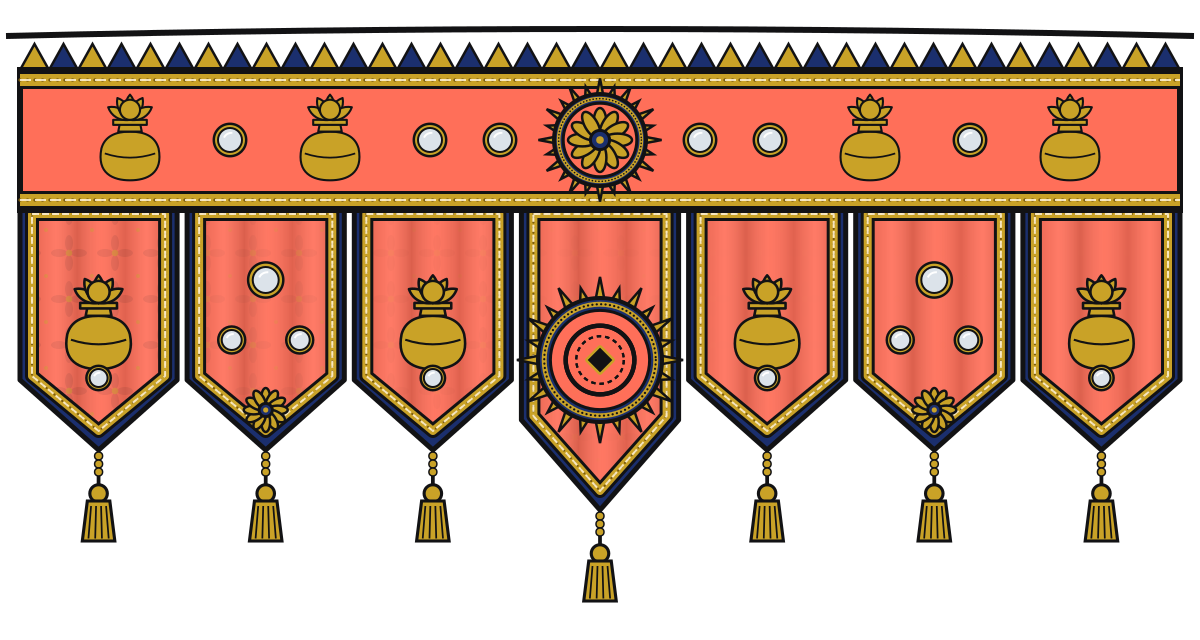
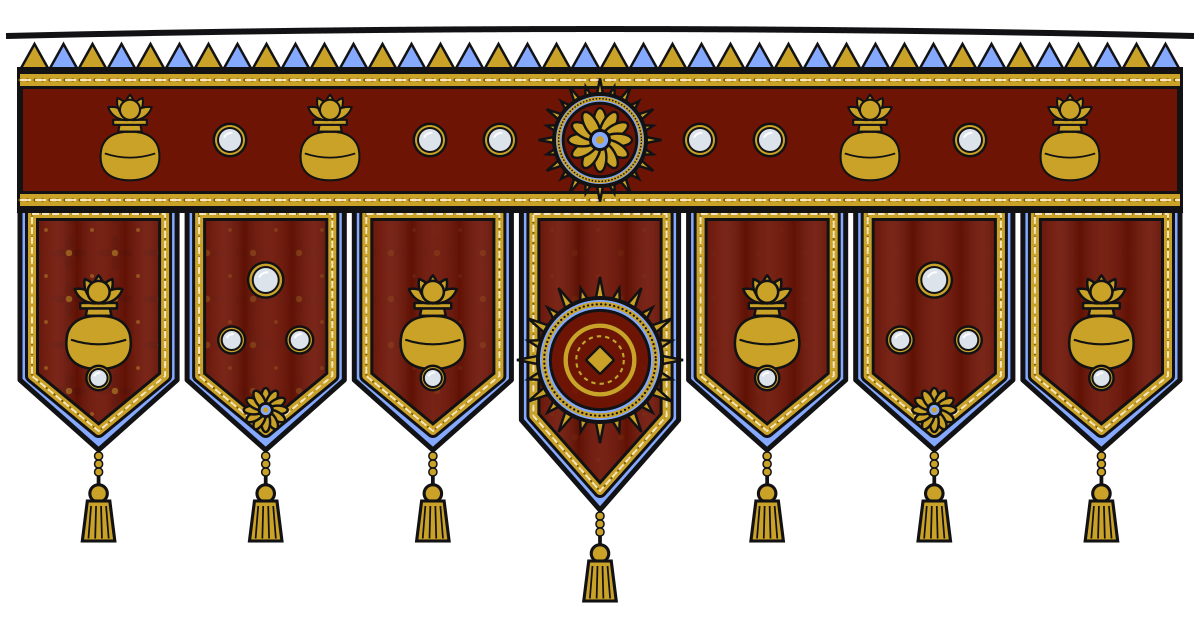

Historic banner
None known
New flag types
| Accessory | For this clan | Basis |
|---|---|---|
| A9 Pota-dhvaja · ship and trade flag For ships, caravans and markets | Not yet designed for this clan | Design |
| A10 Utsava-patāka · festival flag Light, bright flag for fairs and festivals | Not yet designed for this clan | Design |
| A11 Shoka-dhvaja · mourning flag White cloth with the emblem outline in the clan's metal | Not yet designed for this clan | Design |
7. Regalia
| Accessory | For this clan | Basis |
|---|---|---|
| E1 Chhatra · house parasol The ceremonial umbrella | Not yet designed for this clan | Design |
| E2 Chamara · fly-whisks The pair of whisks beside the head of the house | Not yet designed for this clan | Design |
| E3 Danda · staff of office Staff or scepter | Not yet designed for this clan | Design |
| E4 Simhasana · seat The seat of the house, covered in clan cloth | Not yet designed for this clan | Design |
| E5 Khetaka · shield A round shield; the Changi and Dhanush are its flag forms | Not yet designed for this clan | Regional tradition |
| E6 Kula-ayudha · clan weapon The weapon the clan honours | A sword: the emblem of the Bhuiyas | Documented |
8. Worn
| Accessory | For this clan | Basis |
|---|---|---|
| F1 Kula-vastra · clan cloth The clan's woven pattern in its kit colours | Not yet designed for this clan | Design |
| F2 Kirti-vastra · honour cloth A cloth earned for a deed, not inherited | Not yet designed for this clan | Design |
| F3 Kula-mala · garland flower The flower or leaf the clan wears as a garland | Not yet found for this clan | Under research |
| F4 Chinha · house pin A metal badge with the pin emblem | Not yet designed for this clan | Design |
9. Records
| Accessory | For this clan | Basis |
|---|---|---|
| H1 Clan words A traditional line in the native script | Wherever you see a Bhuiya he always has a fire. · “Recorded in English by Russell (1916); the extracts give no native-script form” Russell and Hira Lal 1916, saying of the Bhuiyas, lines 12497-12503[3] | Documented |
| H2 Biruda · titles The house's title or titles | Bhuiyan, 'lord of the soil', also a title for landholders; 'Bhuin', children of the soil; Singhbhum Bhuiyas call themselves Pawan-bans, 'Children of the Wind' | Documented |
| H3 Prashasti · praise genealogy The lineage as written at the head of a grant | Not yet found for this clan | Under research |
| H4 Vahi · clan register The book of the clan's births, marriages and deaths | Not yet found for this clan | Under research |
| H5 Rana-ghosha · war cry The clan's cry in battle or celebration | Not yet found for this clan | Under research |
10. VishwaVit · knower of the world
Game values are design choices for this project, not historical claims.
References
- Wikipedia, List of Scheduled Tribes in Odisha, read 2026-10-20, https://en.wikipedia.org/wiki/List_of_Scheduled_Tribes_in_Odisha
- Odisha State Tribal Museum (SCSTRTI), Paudi Bhuyan, read 2026-10-24, https://ostm.in/?p=5493
- R. V. Russell and Hira Lal, The Tribes and Castes of the Central Provinces of India, vol. 2 (London, 1916), Project Gutenberg eBook #22010, https://www.gutenberg.org/ebooks/22010
- Wikipedia, Keonjhar State, read 2026-10-24, https://en.wikipedia.org/wiki/Keonjhar_State
- Lalatendu Das Mohapatra, Bhuiyan Uprising, The Tribal Tribune vol. 2 issue 5 (to be concluded), read 2026-10-24, https://etribaltribune.com/index.php/volume-2/mv2i5/bhuiyan-uprising
- Wikipedia, Dharanidhar Naik, read 2026-10-24, https://en.wikipedia.org/wiki/Dharanidhar_Naik
- Maa Tarini Temple, Ghatgaon, Wikipedia (read 10 Oct 2026, KulDevi run 40).
- Maa Tarini Pitha, Ghatagaon, Kendujhar district, Government of Odisha (read 10 Oct 2026, KulDevi run 40).
- Deities of Orissa: a case of Hindu and tribal convergence, The Tribal Tribune vol. 2 (read 10 Oct 2026, KulDevi run 40).
- Bhowmick (2022), chapter on the Paudi Bhuyan, IntechOpen, read 2026-10-24, https://www.intechopen.com/chapters/84687
- Wikipedia, Bhuiya, read 2026-10-24, https://en.wikipedia.org/wiki/Bhuiya
- Matt Reeck, Dalton's Ethnology of Bengal, UCLA Center for India and South Asia, read 2026-10-20, https://southasia.ucla.edu/history-politics/colonial-epistemologies/daltons-ethnology-bengal
- Encyclopedia of World Cultures (Gale) via everyculture.com, Bhuiya (bibliography stub), read 2026-10-24, https://www.everyculture.com/South-Asia/Bhuiya.html
- Sushree Mohanty, Indigenous Colours of Odisha: Handbook on 62 Tribes (KISS), read 2026-10-20, link
- Wikipedia, Ho people, read 2026-10-22, https://en.wikipedia.org/wiki/Ho_people
- Wikipedia, List of Scheduled Tribes in Uttar Pradesh, read 2026-10-22, https://en.wikipedia.org/wiki/List_of_Scheduled_Tribes_in_Uttar_Pradesh
- R. V. Russell and Hira Lal, The Tribes and Castes of the Central Provinces of India, vol. 1 (London, 1916), Project Gutenberg eBook #20583, https://www.gutenberg.org/ebooks/20583