The Bhil are a family of indigenous peoples of western and central India, spread through the Aravalli, Vindhya and Satpura hills of Rajasthan, Madhya Pradesh, Gujarat and Maharashtra, with smaller groups as far as Tripura and in Sindh, Pakistan[1][2][3]. With 16.9 million people in the 2011 Census they are counted as India's largest tribe[3]. Some scholars take the name from a Dravidian word for the bow[3]. Bhils under Rana Punja of Panarwa fought beside Rana Pratap of Mewar at Haldighati in 1576[4], and in the nineteenth and twentieth centuries Bhil country saw repeated risings against British and princely rule[3]. Bhili, an Indo-Aryan language with many dialects, is widely spoken among them[2].
01Faith and deities
Pandori Mata of the Satpura Bhils[5]
A recorded tie between the clan and the goddess.
| Deity or tradition | Place in the clan's life | Evidence |
|---|---|---|
| Dev Mogra living | Ancestral and protective goddess of the Satpura Bhils; hill shrine near Sagbara | [5] |
| Gramdev living | Village deity | [3] |
| Jatidev, Kuldev, Kuldevi living | Family deities, kept as stones | [3] |
| Bhati dev and Bhilat dev | Serpent gods | [3] |
| Baba dev | Village god | [3] |
| Karkulia dev | God of the crops | [3] |
| Gopal dev | Pastoral god | [3] |
| Bag dev | Lion god | [3] |
| Bhairav dev | Dog god | [3] |
| Indel dev, Bada dev, Mahadevel, Kajal dev | Named gods | [3] |
| Tejaji | Worshipped deity | [3] |
| Lotha mai, Techma, Orka Chichma | Named goddesses | [3] |
| Bhensasaur | The buffalo, worshipped | [3] |
| Bhilvat Deo Baramathya | Twelve-headed god | [7] |
| Ektangya | One-legged god | [7] |
| Himali Harda legend | Goddess who gave back laughter, song and dance (Pithora myth) | [7] |
| Khandoba (Khande Rao) | Favourite of Hindu and Muslim Bhils; war-god of the Marathas, often represented by a sword | [8] |
| Moharia Mata | Goddess of the Moharia sept; turmeric and oil on her fingers at weddings | [8] |
| Maoli | Goddess of the Maoli sept at Barwani town; shrine shaped like a kilia grain-basket; women worship her at home | [8] |
| Juari Mata | Grain goddess; roasted juari is offered at weddings | [8] |
| Sanyan sept goddess | Turned a cat to stone | [8] |
| Hanuman | Chief divinity of the Bhils (EB 1911) | [1] |
| Pirs | Worshipped at tombs in Nimar | [8] |
| Hill sthans, Mewar | Stones or platforms on hill summits, with clay horse images and clay lamps lit before them | [8] |
| Ordinary Hindu deities and village godlings | Worshipped by the Bhils of the locality | [8] |
02Temples
Family deities (Jatidev, Kuldev, Kuldevi) are kept as stones[3].
Built by the clan
| Temple | Deity | Built by | When | Where |
|---|---|---|---|---|
| Dev Mogra shrine | Dev Mogra | Founded after a tribal priest's vision (local tradition) | Several generations ago | Hill near Sagbara, Gujarat[5] |
Given patronage or grants by the clan
Not recorded.
03Languages and scripts
| Language or script | Kind | Under the clan | Evidence |
|---|---|---|---|
| Bhili living | Indo-Aryan (Western, Bhil group) | Main language; up to 36 dialects, between Gujarati, Marathi and Rajasthani | [3][2] |
| Bhil languages living | Language group | Bhilodi, Adiwasa, Rajput Garasia, Bhilali (Rathawi), Chodri, Dhodia–Kukna, Dhanki, Dubli; Bareli (Palya, Pauri, Rathwi), Pardhi, Kalto; Gamit, Mawchi, Vasavi | [2] |
| Sindhi Bhili and Dhatki living | Speech of the Sindhi Bhils | Sindh, Pakistan | [3] |
| Lost Bhil language lost | The original aboriginal speech | Held to be lost (Anderson 2015) | [3] |
| Bhili in 1916 | Mainly derived from Gujarati, influenced by Marwari and Marathi; in Nimar a corrupt Marathi | Contains some non-Aryan words[8] |
04Books and literature
Bhil tradition is oral; the books below are about the Bhils.
Written during the clan's history
| Work | Author | Kind | When | Link to the clan |
|---|---|---|---|---|
| Gazetteer of the Bombay Presidency | Government of Bombay | Gazetteer | 1880, 1901 | Bhil divisions; Dev Mogra (vol. 6, p. 161)[3][5] |
| Bhil Dialects and Khandesi | Siddheshwar Varma | Linguistics | 1978 | [2] |
| The Singing Bow: Song-Poems of the Bhil | Randhir Khare | Translations | 2001 | [2] |
| Flight of Arrows: Selected Song Poems of the Bhils | Randhir Khare | Translations | [2] | |
| Dangs: Journeys Into the Heartland | Randhir Khare | Travel | [2] | |
| Fairs and Festivals of Indian Tribes | Robin David Tribhuwan | Study | 2003 | [5] |
| The Tribes and Castes of the Central Provinces of India, vol. 2 (Bhil entry) | R. V. Russell and Hira Lal | Ethnography | 1916 | [8] |
| Forest polities and agrarian empires: the Khandesh Bhils, c.1700–1850 | Sumit Guha | Article | 1996 | [9] |
| Bhil Revolt: A Century and a Quarter of Struggle (trans. Naresh Nadeem) | Subhash Chandra Kushwaha | Book (excerpt read) | Not dated in the excerpt | [10] |
Given patronage by the clan
Not recorded.
05Thinkers and scholars
| Name | Field | Era | Contribution |
|---|---|---|---|
| Govind Guru | Social reform | Late 19th–early 20th century | Led a movement for village councils, the end of forced labour and giving up meat and alcohol[3] |
| Siddheshwar Varma | Linguistics | 1978 | Study of the Bhil dialects and Khandesi[2] |
| Randhir Khare | Literature | 2001 | Translated Bhil song-poems into English[2] |
| R. V. Russell and Hira Lal | Ethnography | 1916 | Bhil entry in The Tribes and Castes of the Central Provinces of India[8] |
| Sumit Guha | History | 1996 | Study of the Khandesh Bhils, c.1700–1850[9] |
Bhil writers in Bhili are not yet sourced.
06Art and architecture
Painting and wall art
| Art form | What it is | Era | Evidence |
|---|---|---|---|
| Pithora living | Ritual wall painting of horses, made by the lekhindra and offered to the gods; held among the Bhilala and the Bhils of Jhabua | [3][7] | |
| Bhil painting living | Pictures filled with many-coloured dots; on paper since Bhuri Bai | [3][7] |
Sculpture and temple art
| Art form | What it is | Era | Evidence |
|---|---|---|---|
| Clay horse images | Set on the stone sthans of Bhil gods on Mewar hill summits, with clay lamps lit before them (Hendley, via Russell) | [8] |
Temple and building architecture
| Art form | What it is | Era | Evidence |
|---|---|---|---|
| Mittichitra living | Clay relief and paintings renewed on house walls each year | [7] |
Weaving and textiles
Not recorded.
Clothing and jewellery
| Art form | What it is | Era | Evidence |
|---|---|---|---|
| Pagri, angarkha, dhoti, gamchha living | Men's dress | [3] | |
| Sari, ghagra choli living | Women's dress | [3] |
Coins, pottery and crafts
| Art form | What it is | Era | Evidence |
|---|---|---|---|
| Bows and arrows living | Made by the Bhils themselves | [3] | |
| Natural pigments living | From leaves and flowers, put on with rags and cotton on neem twigs | [7] |
07History
The name and the people
Bhil is used as a blanket term for the aboriginal peoples of the region, divided into endogamous territorial groups with their own clans and lineages[3]. Some scholars derive the name from the Dravidian billa or billu, 'bow', after the weapon the Bhils were known for[3]. The original language of the Bhils is held to be lost; they now speak Indo-Aryan Bhili[3].
Russell and Hira Lal (1916) say the name Bhil first occurs about A.D. 600. They suggest the Bhils may be Ktesias's Pygmies (400 B.C.) or Ptolemy's Phyllitae (A.D. 150)[8].
The Bhillas in the texts
Sanskrit texts and lexicons name the Bhillas (भिल्ल) as a forest and hill people. The Brahmanda Purana (IV.7.19) names the Bhilla as a tribe[11]. The Lakulisha Pashupata manual Pātravidhi calls a Bhilla a wild tribesman whose touch pollutes ritual vessels[11]. In the Kuvalayamālā of Uddyotanasūri, dated 8th century on the page, wild Bhillas plunder a merchant's caravan[11]. Hemacandra's Triṣaṣṭiśalākāpuruṣacaritra counts the Bhillas as a Mleccha sub-division; the page gives the work as 11th century and its usual dating as 12th[11].
The dictionaries follow the same lines. Monier-Williams calls the Bhillas a wild mountain race and names 'a king of the Bhillas'[11]. Apte describes the Bhil as a wild tribe of the Vindhya hills and the forests of Malwa, Mewar, Khandesha and the Deccan, and gives the verse “मलये भिल्लपुरन्ध्री चन्दनतरुकाष्ठमिन्धनं कुरुते” without translation[11]. Molesworth's Marathi dictionary calls them hill people who live by hunting and robbing, and the Kannada entry ಭಿಲ್ಲ gives 'hunter'[11].
Medieval sources on Bhil state formation
Kapur (1993) gives the earliest Sanskrit mention of the Bhil as the Kathasaritsagara of Gunadhya (c. AD 600). It describes an unnamed elephant-riding Bhil chief who denied a king passage through the Vindhyas[12].
Kapur's abstract treats Bhil dealings with regional states and peasant society in southern Rajasthan and Gujarat in medieval times, using inscriptions, literary texts, bardic traditions and travellers' accounts. Its themes are the Bhil part in state formation and an emerging Bhil elite. The abstract gives no named chief for these centuries[12].
A reading of the first 100,000 characters of Bombay Gazetteer vol. VI (1880) found no Khandesh chiefs. That volume covers Rewa Kantha, not Khandesh; the Khandesh volume, vol. XII, is still to be read[13].
Before 1818: Mughals, Marathas and the Bhils
The Encyclopaedia Britannica of 1911 suggests that the Bhils may be Ptolemy's 'Phylittai' ('leaf-wearers'), and adds that these could be the Gonds[1].
Khandesh, a forested hill region[14], was part of the Maratha Confederacy under the Peshwa in the eighteenth and early nineteenth centuries; the Khandesh article states this without a source[15].
Russell and Hira Lal (1916) describe the Maratha years in harsher terms. As the Marathas occupied Central India they treated the Bhils with great cruelty: the Bhils were flogged, hanged and thrown over cliffs, and some were beheaded or blown from guns after being assembled under a promise of pardon. Russell adds that this left the Bhils 'with their hand against every man'[8].
Russell says that in Khandesh, in the disturbed years of the wars of Sindhia and Holkar, about A.D. 1800, the Bhils took to highway robbery in bands, in the mountains or in the villages beneath them. Revenue contractors would not pay for protection, and bands of hundreds attacked towns for cattle or ransom[8].
Russell gives the Mughal years a different note: the Muslim Bhils, known as Tadvi, were forcibly converted in Aurangzeb's time. In the 1916 account about 3,000 of the 28,000 Bhils of the Central Provinces were of that group[8].
The Khandesh article says that in 1670, under Aurangzeb, Daud Khan was Subhadar of Khandesh, with Burhanpur as capital[15]. The article has no Bhil content.
The Encyclopaedia Britannica of 1860 says the Bheel chiefs, trusting to their mountainous and jungly recesses, 'for some time continued refractory'. It says that the contests between the Holkar and Scindia families at the start of the century reduced Khandesh to near-desert, and that after the annexation of 1818 the Bheels were dislodged from many of their retreats by British officers in a long harassing warfare. In 1825 policy shifted to 'a more conciliatory line of conduct', after which the province was restored to tranquillity[16].
The Udaipur blog (secondary, blog-grade) gives constant Bhil–Maratha conflict from 1805 to 1817, and says Ahilyabai of Malwa oppressed the Bhils in 1767.[17].
Bhomat, 15th–16th century
Bhomat is a hill tract of Mewar of 1,233 km² in Rajasthan, with the sub-regions Bhader, Wakal and Khadak, and parts of Kotra, Jhadol and Kherwara tehsils of Udaipur district[18]. The Wikipedia page, citing Kapur (2002), credits Rana Kumbha in the 15th century with building fortresses to contain Bhil revolts[18].
In the 16th century, the page says, Bhomat sheltered the Ranas of Mewar in Mughal crises (Sharma 1951, p. 170; Agarwal, p. 46). Under the British it was called the 'Hilly Tracts of Mewar'. The page names no individual Bhil chief[18].
The Bhomat page lists its jagirs by Rajput clan: Chauhan (Jawas, Pahara, Barothi, Thana, Channi, Juda), Sarangdevot Sisodiya (Madari), Solanki (Panarwa, Oghna, Umariya) and Panwar (Patia). The jagirdars paid cash tribute (dasoond) and supplied contingents to the Maharana. Mewar's account (Mewar Under Maharana Bhupal Singh, p. 21) holds that they were jagirdars, not Bhumias; the page says they owed only nominal allegiance (Gupta and Bakshi 2008, p. 70)[18].
With Mewar: Rana Punja and Haldighati, 1576
The Maharana of Mewar Charitable Foundation calls Rana Punja the Solanki chief of the Bhils of Panarwa; he fought with fellow Bhils beside Rana Pratap at Haldighati on 18 June 1576, and he and his men repeatedly helped the Maharanas after that. He was given the prefix 'Rana'[4].
The same source says that at each succession a Bhil chieftain marked the new Maharana's forehead with a tilak of his own blood, without which the successor was not recognised, until the reign of Maharana Raj Singh II (1753–1761)[4]. The Udaipur coat of arms shows a Rajput and a Bhil on either side of a shield with Chittorgarh fort[4].
Russell (1916) says the Rajputs were at first lenient to the Bhils, and that intermarriage was frequent in the families of Bhil chieftains. The Bhilala caste arose from these unions and holds the chiefs and landholders of the Bhil country; it ranks above the Bhils[8].
Russell quotes a source of about 1909 on the Sesodia accession rite: the Bhil landholders of Oguna and Undri still claimed the privilege of performing the tika. The Oguna Bhil made the mark of sovereignty with blood drawn from his own thumb, and the Undri Bhil held the salver of spices and sacred grains of rice[8].
The Panarwa thikana page says that Bhil Gametis of the region entered the service of Akshayraj Solanki, who made Panarwa his seat c. 1478[19].
The Panarwa thikana page, citing Paliwal (2000), places Rana Punja in a different line: after Rawat Harpal Solanki and Rana Duda, as a Solanki Rajput chief of Panarwa. It calls the Panarwa chiefs Solanki Rajputs, names no Bhil chief of Mewar, and does not call Punja a Bhil[19]. The Udaipur blog (secondary, blog-grade) calls Rana Punja a Bhil chieftain who fought at Haldighati and received the title Rana[17]. Both identities are shown; the sources are not reconciled here.
Haldighati and the years after, 1576–1579
The Mewar Gavari page (2016) gives the numbers at Haldighati: 10,000 Mughals beat a Rajput and Bhil force of 3,000 in 1576. Rana Pratap then fought as a guerrilla for about two years, and from 1579 won back most of his kingdom with Rajput and Bhil help[20].
The same page says the Bhils fought on foot and were paid in food, and that their war-cry, 'kilki', gathers hundreds within minutes[20].
The Udaipur blog (secondary, blog-grade) says that after Haldighati Bhil and Rajput forces besieged Man Singh's army at Gogunda for about four months; that Pratap won at Dewair at Vijaydashmi in 1582; and that in 1661 Rajputs with Bhil help defeated Aurangzeb. The blog gives no source for the 1661 claim[17].
Khandesh and the Bhil agency, 1818–1825
The Company took Khandesh in 1818, after defeating the Peshwa Baji Rao II in the Third Anglo-Maratha War[21][15]. The Britannica says the British attempt to conquer the Bhils failed in 1818, that a Bhil Agency was formed in 1825, and that a Bhil corps was raised later[1].
Chil Naik led the 1818 revolt in Khandesh; he was captured and executed. Hiria, Sewram and Kania Naik led guerrilla resistance from 1819 to 1825, and Sewram's outbreak of 1825 was reportedly encouraged by the Holkars of Indore[21]. The grievances, GKToday says, were limits on forest use for shifting cultivation and grazing, moneylenders, liquor taxes and begar[21].
In 1825 James Outram was posted to Khandesh to organise a light infantry corps of Bhils, used to suppress raiding and plundering[14]. The Outram article says he gained great authority among the Bhils, whose cooperation rested on respect for his prowess as a hunter, tigers included[14]. GKToday says that Outram's policy combined military service with recruitment: Khandesh Bhil Corps recruits and settled Bhil families received land, tax concessions and agricultural loans[21].
Russell and Hira Lal (1916) also say the Khandesh Bhil Corps was first raised by Outram in 1825, so the name now rests on two sources, and the Outram article agrees on 1825[8]. Russell adds that the Bhils first feared the corps meant chains like galley-slaves. Outram drew in recruits, nine at first, one of them a notorious plunderer; those who surrendered were pardoned and given land and advances for seed and bullocks. Outram paid for food daily and the balance monthly, to check drinking[8]. A second battalion was raised at the time of the Mutiny and disbanded three years later. The corps stayed loyal in the Mutiny and was finally converted into police in 1891[8].
The Kandeesh Bhil Corps: name and dates
FIBIS gives the corps' formal name as "The Kandeesh Bhil Corps" (also Khandesh Bhil Corps). It was formed in 1825 as a Local Corps and is listed under the Bombay Infantry Regiments; the FIBIS page says it was disbanded in 1861. The page gives no officers, no strength, and does not mention Outram[22].
The sources disagree on the end date. The FIBIS page credits A. H. A. Simcox's A Memoir of the Khandesh Bhil Corps 1825-1891 (1912), whose title runs to 1891; the page's own disbandment date of 1861 conflicts with that, and the page does not address the conflict[22]. Russell and Hira Lal (1916) say the corps stayed loyal in the Mutiny and was finally converted into police in 1891[8]. The 1861 and 1891 dates are both on record and are not reconciled here.
Formation in 1825 is now supported by FIBIS, by Russell[8] and by the Outram article[14]. The Britannica of 1911 says a Bhil corps was raised later, after the Bhil Agency of 1825[1]; that wording is kept as a difference between the sources, not as an open question.
GIPE catalogues A. H. A. Simcox's memoir as Memoir of the Khandesh Bhil corps, 1825-1891 (Thacker and Company, Bombay, 1912, 281 p.), with no abstract. The record gives the title span but not the corps' end date, so 1861 and 1891 stay unsettled; the full text has not been read[23].
Barwani and Khandesh, 1833–1857
The Scroll.in excerpt from Subhash Chandra Kushwaha's Bhil Revolt says a revolt in Barwani began in 1833 after the arrest of one Hatania. Army-supervised Bhil settlement gained momentum from 1833. In the late 1830s, Bhils who were not receiving an agreed share of fixed revenue turned to raiding, and in the early 1840s colonial policy turned to armed force. By the mid-1840s officials were inspecting the Barwani forests and the Bhil chiefs' claims, with the Rajput ruler indifferent[10].
Kaji Singh Nayak was the guard of the Sendhwa Ghat road and served in the Bhil Corps from 1831 to 1851. He was sentenced in 1851 to ten years after a Bhil offender died from a beating, and was released in 1855 on Captain Rose's recommendation. In June 1857 he was given charge of the northern pass, and he later rebelled[10].
Bhima Nayak, a powerful Bhil chief of Barwani who had married Kaji Singh's sister, led the Datwara raid of 18 August 1857, when 500 to 700 men plundered the village from 10 am to 11 pm. In a letter of 27 September 1857 he wrote: 'I didn't plunder village Datwara of my own sweet will, as you suspect.' He named Maharaja Yashwant Singh of Barwani as having ordered the raid. In September 1857 he attacked Lieutenant Kennedy, claiming to represent the Mughal ruler of Delhi, and a reward of Rs 1,000 was set on him[10].
Kushwaha does not document Kaji Singh and Bhima as direct participants in the 1857 uprising[10]. A secondary dictionary entry gives a 1857 treasury raid at Sindwa Ghat by about 500 Bhils led by Kazi Singh (Kajee Naik), with disturbances to 1860[24].
GKToday names Bhagoji Naik and Kajar Singh as leaders of risings in the Satpura and Ajanta hills in 1857–58, with a battle at Amba Pani[21]. Scroll gives Kajar as another name for Kaji Singh Nayak, which is not confirmed.
The Scroll.in excerpt says Barwani and Alirajpur were ruled by Rajput thakurs under British control, and both stayed internally autonomous until independence. The Barwani king was indifferent to the Bhil chiefs' claims, so the raids went on. Brahmangaon on the Narmada was claimed by Barwani but taken by the Holkar state, and Bhima Nayak was then instigated to plunder it. Holkar territory, Khandesh, Barwani and the Bombay Highway all suffered his raids[10].
Dang states, 1825–1842
Pimpladevi was one of fourteen Dang states in Gujarat. Its chiefs were recorded as Bhils, with the title Pradhan and succession by primogeniture. They judged disputes and fined offenders, could sentence witches to be burnt, and shot other capital offenders with arrows[25].
In 1825 the Gaekwar of Baroda sent about 10,000 men against the Dangs and was defeated; the Dangs were subjugated in 1839. In 1842 the Bombay government leased Dang teak forests of 446 villages, a lease made perpetual in 1862. A tribute demanded by the Deshmukh of Mulher caused disturbances[25].
Mewar Bhil Corps, 1841
The Mewar Bhil Corps was raised in 1841, with its headquarters at Kherwara[21].
Bharatpedia, a Wikipedia mirror (date not shown), says the Mewar Bhil Corps was raised in 1841 under Captain W. Hunter to employ Bhils and police the Mewar hills, with four companies at first, ten in 1844 and eight in 1861. It was loyal in 1857, and in 1950 passed to the Rajasthan Police[26]. This is a different body from the Khandesh Bhil Corps.
Risings under British rule, 1846–1868
The Bhils of present-day Gujarat rebelled in 1846, 1857–58 and 1868[3]. The Criminal Tribes Act of 1871 listed the Bhils among 'criminal tribes'; Susan Abraham links the Act to these peoples' risings against the East India Company, including in 1857[3].
Protest and reform, 1881–1921 {LATER}
In 1881, Ram Pande reports, Bhils protested against the census classification, the ban on making liquor, new police and customs posts and the ban on killing witches[3]. Govind Guru widened the movement: his preaching led many Bhils to give up meat and alcohol and to press for village councils and an end to forced labour[3]. Pande states that 1,500 Bhils were shot in 1913[3].
In 1917 the Girasias of Mewar State joined the Bhils against petty taxes, forced labour and land revenue, and the jagirdars asked the British political agent to put the rising down. In 1921 Motilal Tejawat led a movement of Bhils and Girasias in Danta, Idar, Palanpur and Sirohi[3].
After independence {LATER}
A demand for a Bhil Pradesh was revived in 2014 and raised again in 2023 by the Gujarat MLA Chaitar Vasava[3].
08Journey and migrations
No early migration of the Bhils is sourced; what is recorded is a people spread widely, and seasonal work migration today.
| When | From | To | Why | Evidence |
|---|---|---|---|---|
| Undated | Aravalli–Vindhya–Satpura hills | Bengal and Tripura | Bhils are found far from the western hills; the Bauris of Bengal are said to represent them (a claim the page flags) | [3] |
| Undated | Western India | Sindh, Pakistan | The Sindhi Bhils, 1.2–1.7 million (2020) | [3] |
| Today, in drought years and between sowing and harvest | Bhil villages of Madhya Pradesh | Bhopal, Kota, Delhi | Construction and city work when the rains fail | [7] |
09Seats and lands
| Place | Role | Where today |
|---|---|---|
| Aravalli, Vindhya and Satpura hills | Homeland belt | Southern Aravallis (Rajasthan), western Satpuras (Madhya Pradesh), north-west Maharashtra, southern Gujarat[2] |
| Dhar, Jhabua, Khargone, Ratlam | Bhil districts of Madhya Pradesh | Madhya Pradesh[3] |
| Haldighati | Battle of 18 June 1576 | Mewar[4] |
| Sagbara | Hill shrine of Dev Mogra | Gujarat[5] |
| Bhomat | Hill tract of Mewar, 1,233 km², with the sub-regions Bhader, Wakal and Khadak; 'Hilly Tracts of Mewar' under the British | Rajasthan: parts of Kotra, Jhadol and Kherwara tehsils, Udaipur district[18] |
| Dadra and Nagar Haveli | Bhili spoken by 40.42% (Commissioner for Linguistic Minorities, 52nd report, 2014–15) | [2] |
| Sindh | Home of the Sindhi Bhils | Pakistan[3] |
| Khandesh | Forested hill region; Outram's Bhil corps from 1825; East (Jalgaon) and West (Dhulia) Khandesh from 1906 | [14][15] |
| Dang states | Fourteen Dang states, Pimpladevi among them; Dang teak forests leased in 1842 | Gujarat[25] |
| Kherwara | Headquarters of the Mewar Bhil Corps, raised 1841 | Mewar[21] |
| Barwani | Bhil revolt of 1833 onward; Rajput-ruled state under British control; Bhima Nayak's country; Maoli shrine in the town | [10][8] |
| Sendhwa Ghat | On the Sendhwa–Shirpur road; Kaji Singh Nayak was guard of the Sendhwa Ghat road | Khandesh[10] |
| Datwara | Village plundered in the raid of 18 August 1857 | Named in the Scroll excerpt[10] |
| Nimar | Mankar watchmen of the Bhils; Pirs at tombs (1916); Bhim Naik of Nimar (1867) | Central Provinces[8][21] |
| Moharia | Village of Moharia Mata, goddess of the Moharia sept | Indore State, 1916[8] |
| Mahi Kantha | Tosina fair, where the elopement custom was recorded in 1916 | Mahi Kantha[8] |
| Bhopawar Agency | Where most Bhilalas lived in 1916 | [8] |
| Oguna and Undri | Bhil landholders who claimed the privilege of performing the blood tilak for the Sesodias (c. 1909) | [8] |
| Idar | Taken from a Bhil chief in Tod's legend of Goha | Named by Tod, via Russell[8] |
| Udaipur, Sirohi, Dungarpur, Banswara, Kushalgarh | Rajasthan Bhil groupings, named by Kapur (1993) | Rajasthan[12] |
| Jalgaon, Dhule, Nandurbar, parts of Burhanpur | Kapur's footnote definition of Khandesh | Khandesh[12] |
| Rewa Kantha | 1872 census: 172,328 Bhils among the unsettled tribes, concentrated in Rajpipla, Sankheda Mehvas and Chhota Udepur (ch. III p. 26) | Bombay Gazetteer vol. VI (1880)[13] |
10Notable figures
| Name | Role | Era | Known from |
|---|---|---|---|
| Rana Punja | Solanki chief of the Bhils of Panarwa; fought at Haldighati | 16th century | Mewar tradition, MMCF[4] |
| Rana Punja (second account) | Bhil chieftain at Haldighati, given the title Rana (Udaipur blog, blog-grade). The Panarwa page places him in Rawat Harpal's Solanki line and does not call him a Bhil | 16th century | [17][19] |
| Jetsi Bhil | Ruler of Abu, who lost it to Bheemdev II of Gujarat (Bhanawat, quoted on the Udaipur blog, blog-grade); the blog says his descendants claim Parmar descent | c. 1190 | [17] |
| Dungariya Bhil legend | Credited with founding Dungarpur (Shyamaldas, quoted on the Udaipur blog, blog-grade); a founder tradition, not a dated record | Undated | [17] |
| Kotia Bhil legend | Credited with founding Kota (Shyamaldas, quoted on the Udaipur blog, blog-grade); a founder tradition, not a dated record | Undated | [17] |
| Vishna Bhil legend | Named founder of Banswara (Udaipur blog, blog-grade); a founder tradition, not a dated record | Undated | [17] |
| Tantia Bhil | Freedom fighter | Colonial period | Named among notable Bhils[3] |
| Bhima Nayak | Freedom fighter | Colonial period | [3] |
| Govind Guru | Social and political leader of the Bhil movement | Late 19th–early 20th century | [3] |
| Motilal Tejawat | Leader of the 1921 movement of Bhils and Girasias | 1920s | [3] |
| Bhuri Bai | Painter of Pitol; first Bhil artist to paint with ready-made colours on paper | Came to Bhopal in the 1980s | [3][7] |
| Lado Bai, Sher Singh, Ram Singh, Dubu Bariya | Bhil painters | Modern | [3] |
| Prema Fatya | Pithora painter; work at the Museum of Mankind, Bhopal | Modern | [7] |
| Chhotubhai Vasava | Politician | Modern | [3] |
| Rajkumar Roat | Politician | Modern | [3] |
| Chaitar Vasava | MLA in Gujarat; raised the Bhil Pradesh demand | 2023 | [3] |
| Dinesh Bhil | Archer | Modern | [3] |
| Nitin Bhille | Cricketer | Modern | [3] |
| Chil Naik | Led the 1818 revolt in Khandesh; captured and executed | 1818 | [21] |
| Hiria, Sewram, Kania Naik | Guerrilla leaders in Khandesh; Sewram's outbreak of 1825 | 1819–1825 | [21] |
| Chiefs of Pimpladevi | Dang chiefs recorded as Bhil, with the title Pradhan | Recorded in 1880 | [25] |
| Kaji Singh Nayak | Guard of the Sendhwa Ghat road; in the Bhil Corps 1831–1851; given the northern pass in June 1857, and later rebelled. A secondary source names a Kazi Singh (Kajee Naik) as leader of the 1857 Sindwa Ghat raid; the identity is not confirmed | 1831–1857 | [10][24] |
| Mawasia Nayak | Associate of Bhima Nayak in 1857 | 1857 | [10] |
| Hatania | Arrest of one Hatania began the revolt in Barwani | 1833 | [10] |
| Bhagoji Naik | Led a rising of 1857–58 in the Satpura and Ajanta hills; battle at Amba Pani | 1857–1858 | [21] |
| Kajar Singh | Led the 1857–58 risings with Bhagoji Naik; possibly the same man as Kaji Singh Nayak (not confirmed) | 1857–1858 | [21] |
| Bhim Naik of Nimar | Captured and deported to the Andamans; not confirmed to be Bhima Nayak | 1867 | [21] |
| Mandrup Singh and Nadir | Bhilala robber-chiefs of the Vindhya range, named by Malcolm | Not dated in the extract | [8] |
11Allies, rivals and marriages
| People | Relationship | When |
|---|---|---|
| Maharanas of Mewar | Allies at Haldighati; a Bhil chief's blood tilak had to mark each new Maharana's forehead before he was recognised; Bhil on the Udaipur arms | Tilak continued until Raj Singh II (1753–1761)[4] |
| Rana Kumbha | Credited with fortresses built to contain Bhil revolts | 15th century[18] |
| Girasias (Garasia) | Joined the Bhil risings of 1917 (Mewar) and 1921 (Tejawat) | 1917–1921[3] |
| Mewar jagirdars | Opponents in the 1917 rising, when they asked the British agent to suppress it | 1917[3] |
| East India Company and British Raj | Rebellions 1846, 1857–58, 1868; Criminal Tribes Act 1871 | 1846–1871[3] |
| Marathas and Peshwa Baji Rao II | Cruel treatment that drove the Bhils to outlawry (EB 1911); the Peshwa defeated by the Company in 1818, which then took Khandesh | Before 1818[1][21] |
| Holkars of Indore | Reportedly encouraged Sewram's 1825 outbreak | 1825[21] |
| Gaekwar of Baroda | Sent about 10,000 men against the Dangs in 1825 and was defeated | 1825[25] |
| James Outram | Posted to Khandesh in 1825 to organise the Bhil corps; gained great authority among the Bhils | 1825[14] |
| Deshmukh of Mulher | Demanded a tribute from the Dangs, which caused disturbances | Not dated[25] |
| Sesodias of Mewar | The Bhil landholders of Oguna and Undri claimed the privilege of performing the blood tilak at their accession (Russell, quoting a source of about 1909) | Not dated[8] |
| Rajputs | At first lenient to the Bhils; intermarriage frequent in Bhil chieftains' families; the Bhilala arose from these unions | Not dated[8] |
| Sindhia and Holkar | Their wars left Khandesh disturbed; Bhils took to highway robbery | About 1800[8] |
| Aurangzeb | Forcibly converted the Muslim Bhils, known as Tadvi | Aurangzeb's reign[8] |
| Maharaja Yashwant Singh of Barwani | Named by Bhima Nayak as having ordered the Datwara raid | 1857[10] |
| Mughal ruler of Delhi | Claimed by Bhima Nayak as the authority he acted for when he attacked Lieutenant Kennedy | September 1857[10] |
| Collector Masefield of Khandesh | Pardoned Kaji Singh Nayak several times | Not dated[10] |
| Rajput jagirdars of Bhomat | Chauhan, Sarangdevot Sisodiya, Solanki and Panwar jagirdars; paid cash tribute and supplied contingents to the Maharana. Mewar's account holds that they were jagirdars, not Bhumias | Not dated[18] |
12Society and livelihood
Bhil society is built of endogamous territorial divisions, each with clans and lineages[3].
Government and social order
| Institution or group | What it was | Evidence |
|---|---|---|
| Divisions, clans, lineages | Marriage within the division; clans and lineages inside it | [3] |
| Settlement | Houses spread widely, partly from fear of witchcraft and infection; the Bhils are described as middle-sized and 'wonderfully active' (Rewa Kantha, 1880, ch. III pp. 26-27) | [13] |
| Gameti | Traditional village headman, who settles most disputes | [3] |
| Bhopa | Healer | [3] |
| Marriage | Several forms, with free choice of partner; a bride price in all, elopement included | [7] |
| Birth rites | The baby is laid on a heap of maize; the father's cousin keeps it until the mother gives gifts | [7] |
| Tattooing living | Women usually tattoo before marriage | [3] |
| Naik | Title of Bhil village headmen | [21] |
| Pradhan | Title of the chiefs of the Dang states, recorded as Bhil (Pimpladevi) | [25] |
| Septs | Exogamous septs, mostly named for plants or animals; no marriage within the sept or the mother's and grandmother's families | [8] |
| Bhumia | Title of Bhil chiefs, who held absolute power; subjects called the chief Dhunni (Lord) | [8] |
| Mankar | Superior village watchman, in Nimar and Berar | [8] |
| Tadvi | A name formerly applied to a Bhil headman (said from tad, 'branch'); the Muslim Bhil group is called by it | [8] |
| Hattiwala | Tadvi Bhils who held villages granted free of revenue for keeping the Satpura passes open | [8] |
| Bhilala | Caste that arose from Rajput–Bhil unions; holds the chiefs and landholders; titles Rao or Rawat | [8] |
| Priests | Chief physicians of the Bhils | [8] |
| Badwa | Witch-finder, who ties charms of blue string with seven knots at Holi, Dasahra or another festival | [8] |
| Bride-price | Rs 9 to 20 (1916) | [8] |
| Elopement at the Tosina fair | A custom at the Tosina fair in Mahi Kantha: the man crosses the river with the girl | [8] |
| Marriage on 11 Kartik | A cone hut of eleven juari stalks; the groom sits in a grain basket and the bride in a winnowing-fan; the bridegroom strikes the marriage-shed with a dagger and steps in goat's blood | [8] |
| Bridegroom service | A bridegroom may serve for his wife; polygamy allowed (1916) | [8] |
| Widow remarriage | On Amawas or a Sunday | [8] |
| Burial | The dead are buried on the back, head to the south; a wheaten cake is put on the grave on the third day | [8] |
| Oaths | The most sacred oath is sworn on a dog (EB 1911); 'By the white ram' (Tod) | [1][8] |
Livelihood over time
| Era | Livelihood | Evidence |
|---|---|---|
| Traditional | Hunting with self-made bows and arrows, swords, knives and axes; forest fruits and vegetables | [3] |
| Traditional and today | Small fields of maize, onion, garlic and chili | [3] |
| Today | Seasonal and drought-year work in construction in Bhopal, Kota and Delhi | [7] |
| Today | Painting for galleries and the Adivasi Lok Kala Academy, Bhopal | [7] |
| Under the Marathas | Employed as village guards: Ramosi or Bhil, per Grant Duff | [8] |
13Sub-clans and related clans
The Bhil page lists the Bhils' endogamous territorial divisions, each with its own clans and lineages[3]. Inclusion in this list follows the sources and is not a claim about any group's identity.
| Clan | Relation | Where | Size | In the Atlas | Evidence |
|---|---|---|---|---|---|
| Bhil Garasia | Sub-clan | Listed among the divisions | same name as ST-356: check | [3] | |
| Dholi Bhil | Sub-clan | Listed among the divisions | same name as ST-361: check | [3] | |
| Dungri Bhil | Sub-clan | Listed among the divisions | same name as ST-388: check | [3] | |
| Dungri Garasia | Sub-clan | Listed among the divisions | new clan candidate | [3] | |
| Mewasi Bhil | Sub-clan | Listed among the divisions | same name as ST-455: check | [3] | |
| Rawal Bhil | Sub-clan | Listed among the divisions | same name as ST-489: check | [3] | |
| Tadvi Bhil | Sub-clan | Listed among the divisions; Tadvi is also an alias of the Dhanka in the Atlas | ST-065 | [3] | |
| Bhagalia | Sub-clan | Listed among the divisions | same name as ST-355: check | [3] | |
| Nirdhi Bhil | Sub-clan | Listed among the divisions | new clan candidate | [3] | |
| Bhilala | Sub-clan | Madhya Pradesh; the Pithora painters; Bhagoria[27] | ST-342 | [3][27] | |
| Barela | Sub-clan | Bhagoria districts of Madhya Pradesh; Bareli dialects | same name as ST-346: check | [3][27][2] | |
| Pawra | Sub-clan | Listed among the divisions | same name as ST-563: check | [3] | |
| Patelia | Sub-clan | Bhagoria; Bhili proper is also called Patelia | ST-256 | [3][27][2] | |
| Rathwa | Related people | Bhagoria; Rathwi Bareli dialect | ST-272 | [3][27] | |
| Vasava (Vasave) | Sub-clan | Listed among the divisions; Vasavi dialect | new clan candidate | [3][2] | |
| Dhanka | Related people | Listed among the divisions | ST-065 | [3] | |
| Dhodia | Related people | Listed among the divisions; Dhodia–Kukna language | ST-067 | [3][2] | |
| Gamit | Related people | Listed among the divisions; Gamit language | ST-080 | [3][2] | |
| Warli | Related people | Listed among the divisions | ST-326 | [3] | |
| Thakar | Related people | Listed among the divisions | ST-310 | [3] | |
| Meena | Related people | Listed among the divisions; the Atlas also lists the Mina as a separate Scheduled Tribe | ST-218 | [3] | |
| Nayak | Related people | Listed among the divisions | new clan candidate | [3] | |
| Barda | Sub-clan | Listed among the divisions | same name as ST-017: check | [3] | |
| Kataria | Sub-clan | Listed among the divisions | same name as ST-348: check | [3] | |
| Bagdi | Sub-clan | Listed among the divisions | same name as ST-343: check | [3] | |
| Khotil | Sub-clan | Listed among the divisions | new clan candidate | [3] | |
| Dangchai | Sub-clan | Listed among the divisions | same name as ST-358: check | [3] | |
| Dangehi | Sub-clan | Listed among the divisions | same name as ST-359: check | [3] | |
| Sonawane | Sub-clan | Listed among the divisions | same name as ST-495: check | [3] | |
| Nahal | Related people | Listed among the divisions (Nahals); Kalto (Nahali) speech | new clan candidate | [3][2] | |
| Mathvadi | Sub-clan | Listed among the divisions | new clan candidate | [3] | |
| Dorepi | Sub-clan | Listed among the divisions (Dorepis) | same name as ST-527: check | [3] | |
| Bhillava (Billava) | Related people | Listed among the divisions | new clan candidate | [3] | |
| Bauri | Related people | Bengal; said to represent the Bhil there (flagged 'better source needed') | same name as SUB-105: check | [3] | |
| Sindhi Bhil | Branch | Sindh, Pakistan; Sindhi Bhili and Dhatki speech | 1.2–1.7 million, 2020[3] | new clan candidate | [3] |
| Thari Bhil | Branch | Pakistan | same name as ST-506: check | [28] | |
| Chodri | Related people | Chodri language, northern Bhil group | same name as ST-525: check | [2] | |
| Mawchi | Related people | Mawchi language of the Bhil group | new clan candidate | [2] | |
| Pardhi | Related people | Pardhi speech in the Bareli group | ST-252 | [2] | |
| Bhil Mina | Related people | Between the Bhil and the Mina | ST-028 | [28] | |
| Bhillas | Parent people | The historical Bhils of the texts | ANC-023 | [28] | |
| Bhumiar | Related people | Mixed Bhil–Rajput group, named with the Bhilala | same name as SUB-146: check | [20] | |
| Jamania | Sub-clan | Bhil sept named for the jaman tree; will not cut or burn it | same name as ST-463: check | [8] | |
| Rohini | Sub-clan | Bhil sept named for the rohan tree | same name as ST-490: check | [8] | |
| Avalia | Sub-clan | Bhil sept named for the aonla tree | same name as ST-523: check | [8] | |
| Meheda | Sub-clan | Bhil sept named for the bahera tree | same name as ST-470: check | [8] | |
| Mori | Sub-clan | Bhil sept named for the peacock; offerings on a red cloth at its footprint; may not be tattooed | same name as ST-539: check | [8] | |
| Ghodmarya | Sub-clan | Bhil sept; 'horse-killer', may not tame or ride a horse | same name as ST-462: check | [8] | |
| Masrya | Sub-clan | Bhil sept; may not eat fish | same name as ST-537: check | [8] | |
| Sanyan | Sub-clan | Bhil sept named for the cat; its goddess turned a cat to stone | same name as ST-491: check | [8] | |
| Ghattaya | Sub-clan | Bhil sept; worship the grinding mill at weddings | same name as ST-529: check | [8] | |
| Solia | Sub-clan | Bhil sept named for the sun; four subsepts; wed at sunrise, sunset or starlight, with cotton thread | same name as ST-494: check | [8] | |
| Ada Solia | Sub-clan | Subsept of the Solia | new clan candidate | [8] | |
| Japa Solia | Sub-clan | Subsept of the Solia | new clan candidate | [8] | |
| Taria Solia | Sub-clan | Subsept of the Solia | new clan candidate | [8] | |
| Tar Solia | Sub-clan | Subsept of the Solia | new clan candidate | [8] | |
| Moharia | Sub-clan | Bhil sept; worships Moharia Mata of Moharia village, Indore State | same name as ST-471: check | [8] | |
| Maoli | Sub-clan | Bhil sept; goddess Maoli of Barwani town; may not make or use kilia baskets | same name as ST-469: check | [8] | |
| Sesodia | Sub-clan | Bhil sept carrying a Rajput clan name | same name as ST-554: check | [8] | |
| Panwar | Sub-clan | Bhil sept carrying a Rajput clan name | same name as ST-517: check | [8] | |
| Jamra | Sub-clan | Exogamous kul of the Bhilala (1916) | new clan candidate | [8] | |
| Saniyar | Sub-clan | Exogamous kul of the Bhilala (1916) | new clan candidate | [8] | |
| Astarya | Sub-clan | Exogamous kul of the Bhilala (1916) | new clan candidate | [8] | |
| Pipaladya | Sub-clan | Exogamous kul of the Bhilala (1916) | new clan candidate | [8] | |
| Mori (Bhilala kul) | Sub-clan | Rajput-named kul of the Bhilala (1916) | new clan candidate | [8] | |
| Baghel | Sub-clan | Rajput-named kul of the Bhilala (1916) | new clan candidate | [8] | |
| Solanki | Sub-clan | Rajput-named kul of the Bhilala (1916) | same name as ANC-229: check | [8] | |
| Chauhan | Related people | Rajput jagirdars of Bhomat, not a Bhil division (Jawas, Pahara, Barothi, Thana, Channi, Juda jagirs) | SUB-109 | [18] | |
| Sarangdevot Sisodiya | Related people | Rajput jagirdars of Bhomat, not a Bhil division (Madari jagir) | new clan candidate | [18] |
Clans marked "new clan candidate" are not in the Atlas yet.
14Surnames
Surnames below are carried by Bhils named in the sources; some are also division names. No count is sourced, nor whether other communities share them. A surname never tells a person's origin.
| Surname | Clan or sub-clan | Where | People with this surname | Also used by other communities |
|---|---|---|---|---|
| Vasava | Vasava division | Gujarat (Chaitar Vasava, MLA)[3] | not yet counted | Not checked |
| Roat | Named among notable Bhils[3] | not yet counted | Not checked | |
| Bariya | Named among notable Bhils[3] | not yet counted | Not checked | |
| Bhil | Used as a surname, e.g. Dinesh Bhil, Tantia Bhil[3] | not yet counted | Not checked |
Counts are of everyone with the surname, from the cited source and year, not only members of this clan. A surname shared with other communities says nothing about any one person's origin.
15Songs and music
Folk songs and dances are the Bhils' main recreation[3]. No song text is sourced yet.
Lokgeet of Bhagoria living
Sung with dancing at the Bhagoria haats[27]
Garba songs to the goddesses living
They invite the goddesses to dance; in one kind a goddess says she cannot come because her baby is crying[7]
Birth and wedding songs living
They call on elders, ancestors and deities[7]
Instruments and styles
| Instrument or style | What it is | Evidence |
|---|---|---|
| Kundi, apang, khajria, mandal | Local instruments named on the Bhil page | [3] |
| Bansuri | Flute | [3] |
| Jhanjh, thali | Cymbals and the struck metal plate | [3] |
| Dhol | Drum | [3] |
| Sarangi, harmonium, tabla | Also played | [3] |
16Poems, lullabies and children's rhymes
The Singing Bow: Song-Poems of the Bhil
Randhir Khare's translations of Bhil song-poems[2]
17Stories, legends and proverbs
Stories and legends
| Story | What happens | Told by | Evidence |
|---|---|---|---|
| Pithora and Himali Harda legend | In Dharmi Raja's kingdom the people forgot how to laugh, sing and dance; Prince Pithora rode to the goddess Himali Harda, who gave them back | Bhil tradition, painted in Pithora | [7] |
| The Bhil creation myth legend | Told in the Pithora wall paintings | Bhil tradition | [7] |
| The goddess with the crying baby | In a garba song a goddess declines to dance because her baby is crying | Bhil songs | [7] |
| Dev Mogra's shrine legend | A tribal priest's vision led to the founding of the hill shrine | Local tradition | [5] |
| Origin legend legend | The Bhils descend from a son of Mahadeva who was banished | Recorded in EB 1911 | [1] |
| Krishna and the Bhil's arrow legend | Krishna was killed by a Bhil's arrow when fighting the Bhils in Gujarat with the Yadavas; the Bhil could not draw the bow with his right forefinger afterwards | Hendley's tradition, via Russell | [8] |
| Goha and Idar legend | Goha, ancestor of the Sesodias, takes Idar from a Bhil chief | Tod, via Russell | [8] |
Proverbs and sayings
| Saying | Meaning | Evidence |
|---|---|---|
| 'I am the thief of Mahadeo' (a Bhil charged with theft) | My destiny is fixed by God (Russell's gloss on Malcolm's report) | [8] |
| 'What do I care for the clawing of a cat?' (Outram's remark on a panther) | Long remained a proverb among the Bhils | [8] |
18Festivals and fairs
| Festival or fair | When | Where | What happens |
|---|---|---|---|
| Bhagoria living | Seven days in March, before Holi; end of harvest | Barwani, Dhar, Alirajpur, Khargone, Jhabua (MP); Nandurbar and Dhule (Maharashtra) | Families come in decorated bullock carts, buy for Holi, meet, dance and sing; shared with the Bhilala, Patelia, Rathwa and Barela[27] |
| Galaliyu Haat living | Before Holi | Dahod (Gujarat); Banswara (Rajasthan) | The Bhagoria season under another name and theme[27] |
| Dev Mogra fair living | February–March | Sagbara, Gujarat | Pilgrimage of several hundred thousand, mostly Bhils[5] |
| Gavari living | After Holi | Udaipur | Named on the Bhil page[3] |
| Akhatij, Navmi, Diwasa, Nawai, Gal, Gar, Dhobi, Sanja, Indel, Doha | Through the year | Traditional festivals[3] | |
| Howan Mata ki Chalavani, Sawan Mata ki jatar | Seasonal | Goddess festivals[3] | |
| Navratri, Dashera, Diwali, Holi, Rakhi living | Calendar | Bhil country | Navratri mela[3] |
| Stick dance and war dance | Before festivals and battles | Men dance in a ring striking sticks; before battle a war-dance[8] | |
| Tosina fair | Not dated | Mahi Kantha | The elopement custom: the man crosses the river with the girl[8] |
| Chait, grave worship | Chait | Bhilala | The graves of the Bhilala are worshipped[8] |
19Food, dress and games
Food
| Item | What it is | Evidence |
|---|---|---|
| Maize living | From their own small fields | [3] |
| Wheat and rice | Kept for festivals | [3] |
| Game and forest foods | Hunting and gathering; traditionally non-vegetarian | [3] |
| Mahua liquor living | Distilled from mahua flowers | [3] |
| White foods | Bhils eat nothing white (Tod, via Russell) | [8] |
Dress
| Item | What it is | Evidence |
|---|---|---|
| Men living | Pagri, angarkha, dhoti, gamchha; kada, bajuband, chain, earrings, kardhani | [3] |
| Women living | Sari, ghagra choli; hansli, zele-zumke, earrings, narniyan bangles, nathni | [3] |
| Tattoos living | Women's, usually before marriage | [3] |
Games and martial arts
Not recorded.
Tags: living still practised · revived brought back after a break · lost known only from records · research reported but not yet confirmed from a source. Songs and poems under copyright are listed by title only; restricted or sacred material is noted without its content.
20Status today
The Bhil are a living people of Madhya Pradesh, Gujarat, Rajasthan and Maharashtra, with small groups in other states and in Sindh[3]. Pithora and Bhil painting are living arts[7]. Bhagoria is held each spring[27], and the Dev Mogra fair draws several hundred thousand devotees each year[5].
Who carries the name today
| Community | Link | Basis | Evidence |
|---|---|---|---|
| Bhil (ST-027) | Documented | [3] | |
| Bhillas (ANC-023), the Bhils of the texts | Under research | [28] |
Recognised heritage
| What | Recognition | Evidence |
|---|---|---|
| Udaipur (Mewar) coat of arms | A Bhil on the arms, beside a Rajput | [4] |
| Rana Punja | Given the prefix 'Rana' for helping the Maharanas of Mewar | [4] |
| Bhagoria | Reported in 2015 to get a Republic Day platform, to some tribal groups' objection (Indian Express headline) | [27] |
Not yet reviewed by the Bhil community.
21For children
The prince who brought back laughter
Long ago, the Bhils say, the people of a kingdom forgot how to laugh. They forgot how to sing and how to dance. Everything was quiet and grey. A young prince called Pithora got on his horse and rode a long, long way to the goddess Himali Harda. She gave the people back their laughter, their songs and their dances. That is why Bhil painters still paint Pithora's horses on the walls of their homes, bright with colours from leaves and flowers.
Written for this project
Riddle: I am painted with many little dots, and I tell the story of a whole village. Who painted me first on paper? (Bhuri Bai, the Bhil painter of Pitol)
22Across the project
| Project | What carries this clan | Status |
|---|---|---|
| Atlas of the Janas | Pin in the Aravalli hills of southern Rajasthan (ST-027); area drawn from the Codex districts, with Sindh hatched | Live |
| KulDevi and GrahDevi | Devmogra Mata (Dev Mogra), documented; Pandori Mata among the Satpura Bhils | Documented[5] |
| Planet naming | Not yet checked against the Tier registers | To check |
| Renaming and waters | Not yet checked against the renaming register | To check |
23Open questions
- Quote the official ST entries for each state with their date; the Atlas adds Telangana, which the Bhil page omits.
- Eklavya and Shabari: are they claimed as Bhil, by whom, and what is the other side?
- Rana Punja: his dates, and his identity. The MMCF page calls him Solanki chief of the Bhils of Panarwa[4]; the Panarwa thikana page places him in Rawat Harpal's Solanki line and does not call him a Bhil[19]; the Udaipur blog (blog-grade) calls him a Bhil chieftain[17]. The Times of India blog title points to a dispute ('a warrior wronged by identity politics'). All accounts are shown on the page; none is settled.
- Pandori Mata and Dev Mogra: one goddess or two, and the Dev Mogra legend in full.
- The 1913 Mangarh events: GKToday dates Mangarh to 17 November 1913 and names Govind Guru[21]; the 1,500 shot is Pande's figure, cited on the Bhil page[3]. The Udaipur blog (blog-grade) places the killing at Mandalgarh Hill and gives the same figure[17]. Other accounts are still needed.
- Tantia Bhil: no source yet. Bhima Nayak of Barwani led the Datwara raid of 18 August 1857[10]. Is the Bhim Naik of Nimar captured in 1867[21] the same man? Not confirmed.
- A Bhili song text, proverb and lullaby with clear rights; what Gavari is.
- Udaipur state emblem: the Mewar Gavari page says Rana Pratap and a Bhil stand either side of it, with Eklingji as titular deity of Mewar[20]; the Rana Punja page says a Rajput and a Bhil stand either side of a shield with Chittorgarh fort[4]. Which is the registered arms?
- Village headman: Naik is given by GKToday[21] and Gameti by the Bhil page[3]; Russell (1916) says Tadvi was formerly a headman's name and Mankar the superior village watchman[8]. Which title did village headmen use, and where?
- Blood tilak: the MMCF page says the Bhil chieftain's tilak continued until Maharana Raj Singh II (1753–1761)[4]; Russell, quoting a source of about 1909, says the Oguna and Undri Bhil landholders still claim the privilege[8]. The page gives both without reconciling them.
- Kandeesh Bhil Corps end date: FIBIS gives the disbandment as 1861 and cites a memoir titled 1825-1891[22]; Russell (1916) says the corps was converted into police in 1891[8]. The GIPE record of the memoir confirms the title span but not the end date, and the text is unread[23]. The page gives both without reconciling them.
24Astitva
अस्तित्व · being, existence: everything by which the clan is known
The sources record the Bhils' war-cry and titles. No seal or coin for the Bhils has been found.
Every clan has every accessory, royal objects included. Each one says how it is known: Documented This clan's own object is recorded. · Regional tradition Recorded for the region or for peoples like this one, not for this clan. · Design Made for this project, with no historical claim. · Under research To be found for this clan from sources. Legends and titles are written in the clan's own script.
1. Seals and coins
| Accessory | For this clan | Basis |
|---|---|---|
| B1 Rajamudra · house seal Round seal with the clan emblem and a short legend in the clan's script | Not yet designed for this clan | Design |
| B2 Anguliya-mudra · signet ring Personal seal ring of the head of the house | Not yet designed for this clan | Design |
| B3 Chhapa · house stamp Ink or block stamp for letters, goods and cloth | Not yet designed for this clan | Design |
| B4 Tamrapatra · charter plate Copper-plate grant on a ring, closed with the house seal | Not yet designed for this clan | Design |
| B5 Shreni-mudra · guild or trade seal Seal for the clan's trade, craft or caravan | Not yet designed for this clan | Design |
| C1 Clan coin Emblem or deity on one side, a legend in the clan's script | Not yet designed for this clan | Design |
| C2 Coin die The die that strikes the coin | Not yet designed for this clan | Design |
2. Living symbols
| Accessory | For this clan | Basis |
|---|---|---|
| I1 Totem trio The tree, bird and animal the clan protects | Peacock (Mori sept) · cat (Sanyan sept) Septs named for plants or animals; the Mori (peacock) and Sanyan (cat) septs are two examples[8] | Documented |
| I2 Kaval-maram · guardian tree The tree that stands at the clan's seat | Jaman (Jamania) · rohan (Rohini) · aonla (Avalia) · bahera (Meheda) Trees the septs are named for; Jamania will not cut or burn the jaman[8] | Documented |
3. Stone and gate
| Accessory | For this clan | Basis |
|---|---|---|
| G1 Torana · gateway The built gate of the seat; the cloth Toran hangs in it | Not yet designed for this clan | Regional tradition |
| G2 Viragallu · hero stone Carved panel stone for a member who died defending the clan | Not yet designed for this clan | Regional tradition |
| G3 Kula-shila · clan stones Standing and table stones that remember the ancestors | Not yet designed for this clan | Design |
| G4 Jayastambha · victory pillar A pillar raised for a victory | Not yet designed for this clan | Design |
| G5 Sima-shila · boundary stone Marks the clan's land, with a line in the native script | Not yet designed for this clan | Design |
4. Sounds
| Accessory | For this clan | Basis |
|---|---|---|
| D1 Pancha-mahashabda · five great sounds The right to five instruments | Not yet designed for this clan | Design |
| D2 Shankha · clan conch The clan's own named war conch | Not yet designed for this clan | Design |
| D3 Murasu · house drums Three drums: war, charity and justice | Not yet designed for this clan | Design |
5. Kit: colours, metals and emblems
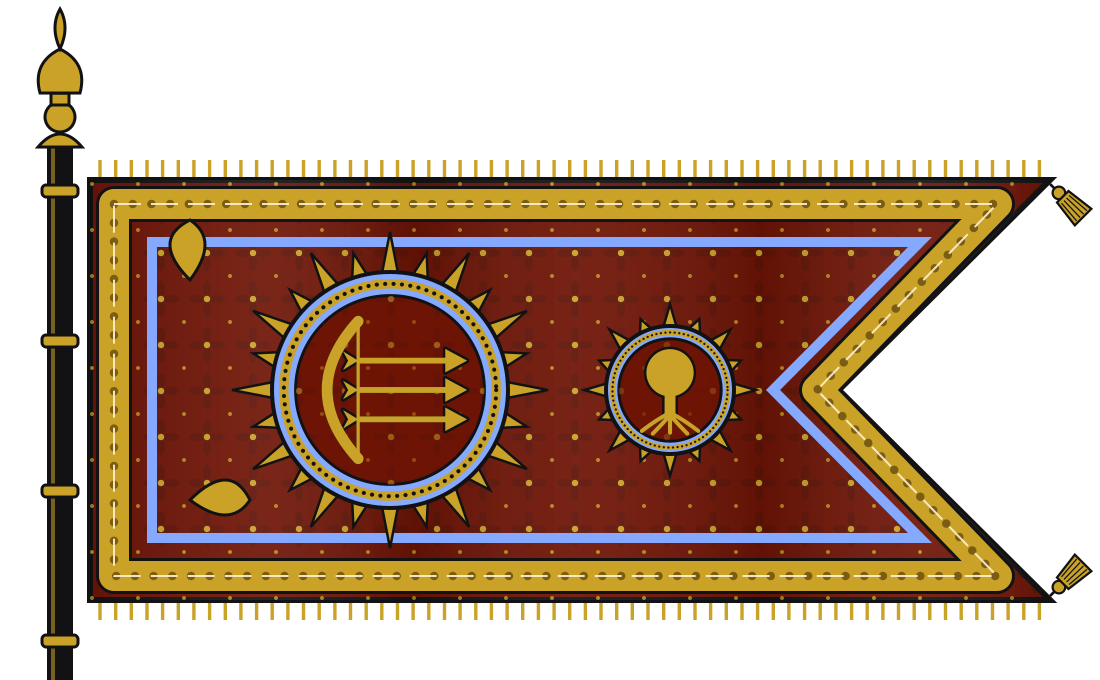
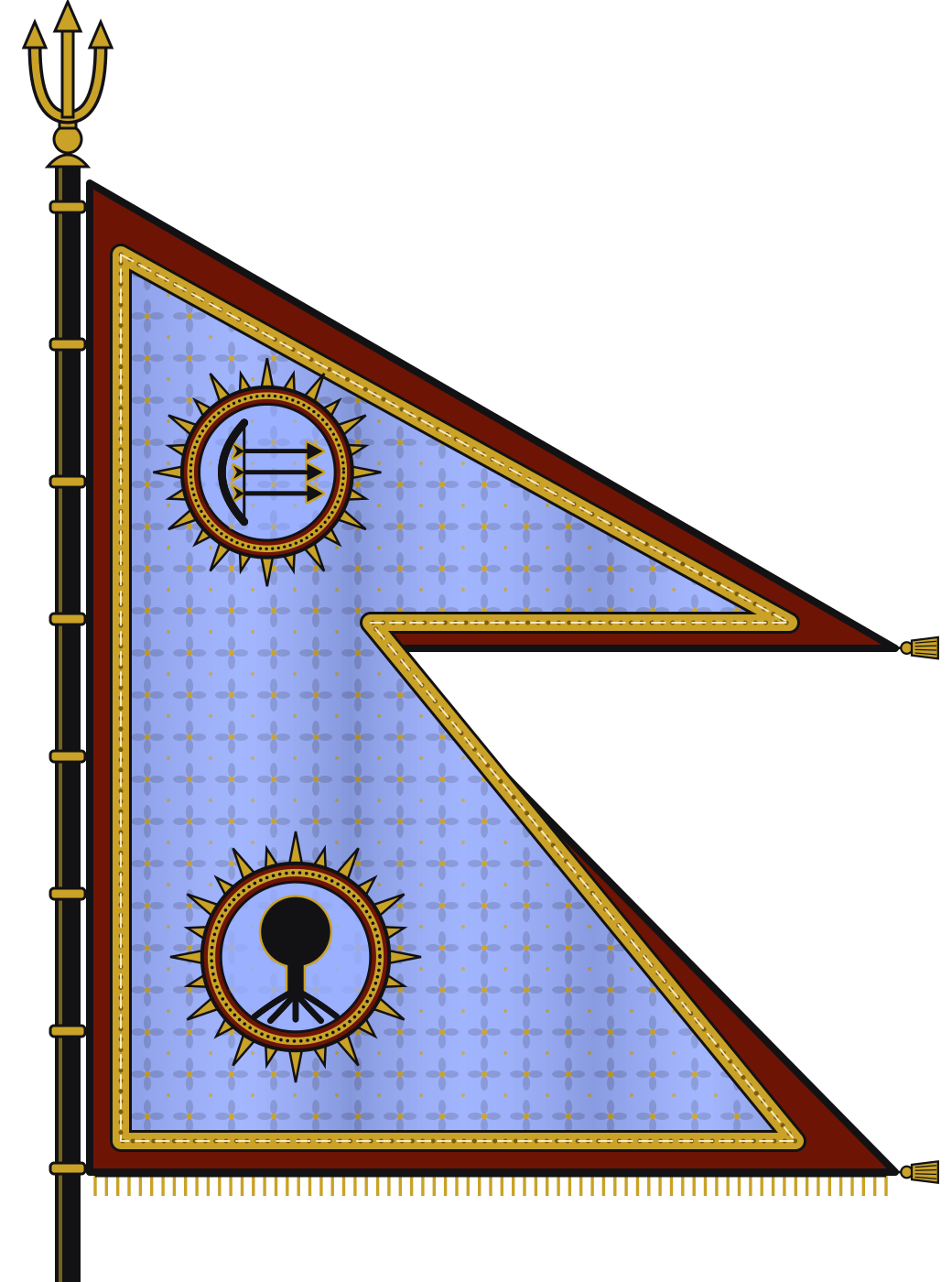
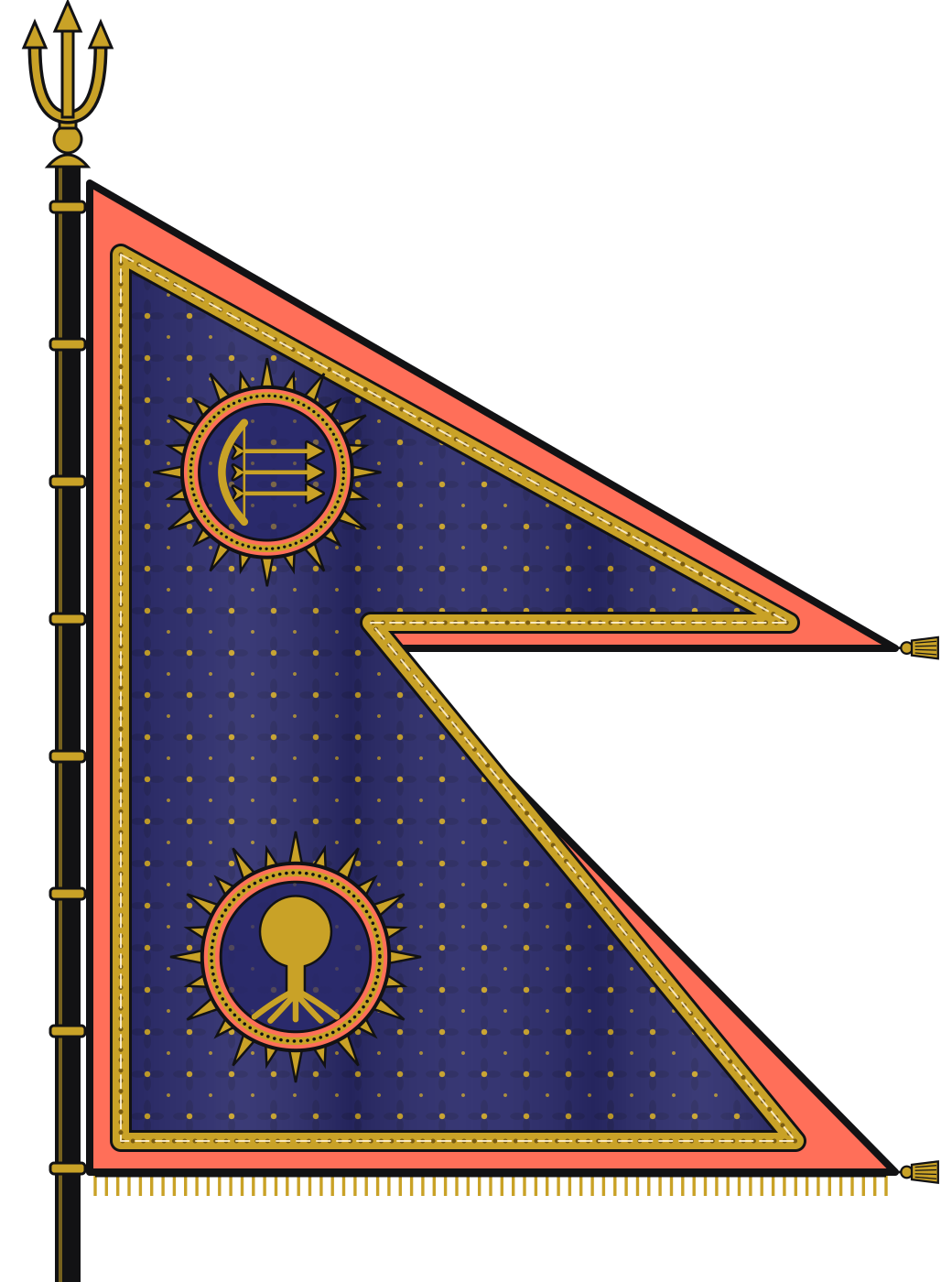
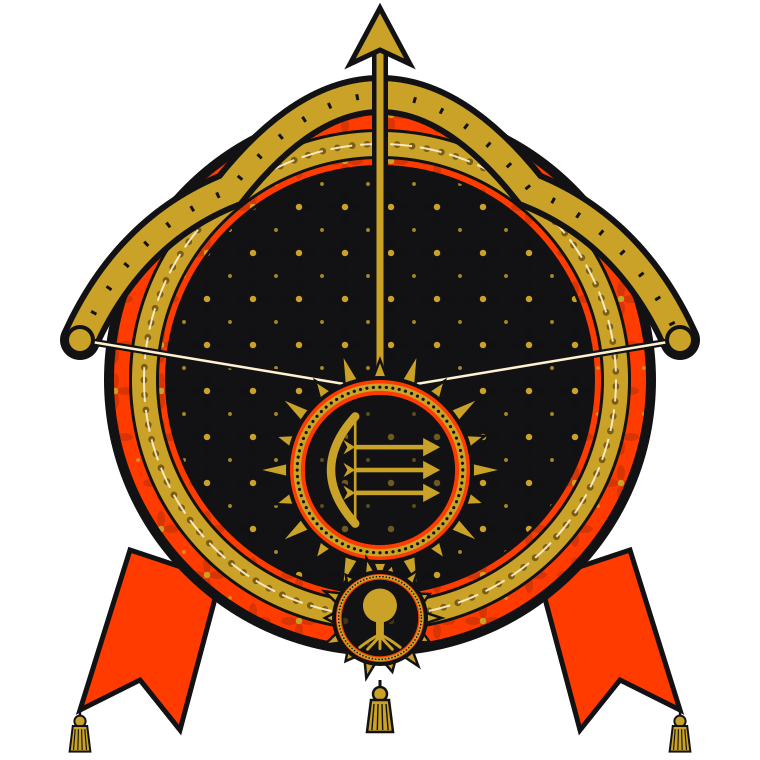
The Atlas gives the Bhil a bamboo bow with arrows, for the bow from which some derive their name and which they still make themselves[3], and a tree with strong roots, for a people counted as India's largest tribe[3]. The flag is a Vaijayanti. A Bhil stands beside a Rajput on the Udaipur coat of arms[4].
| Part of the kit | This clan |
|---|---|
| Field | Intense Electric Blue #84A9FF |
| Accent | Deep Crimson Red #FF3B00 |
| Emblem colour | Charcoal Black #121214 |
| Zari metal | Gold |
| Main emblem | A bamboo bow with arrows |
| Second image | A tree with strong roots |
| Night and day | Every visual accessory has two versions: by night the emblem on the dark field, by day the clan's field colour on cloth woven from its metal. |
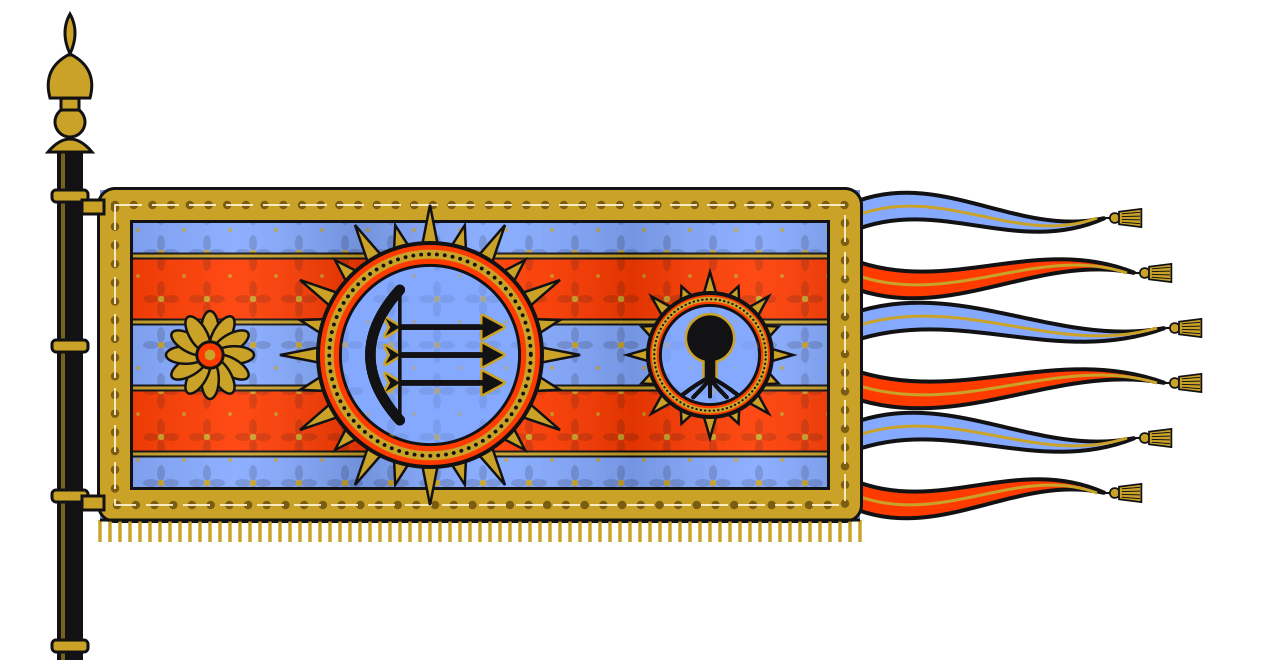
6. Flags
Every clan has every flag type; the type says the occasion and the colours say the clan. The outlined card is the flag the Atlas assigns.
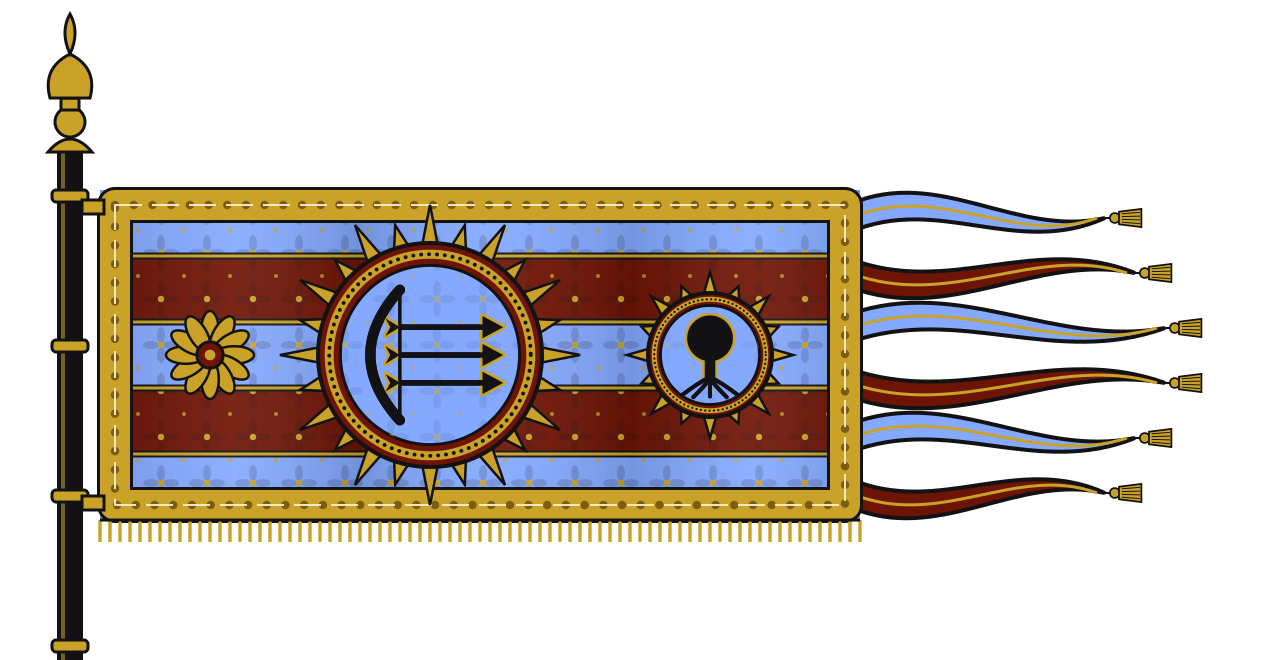
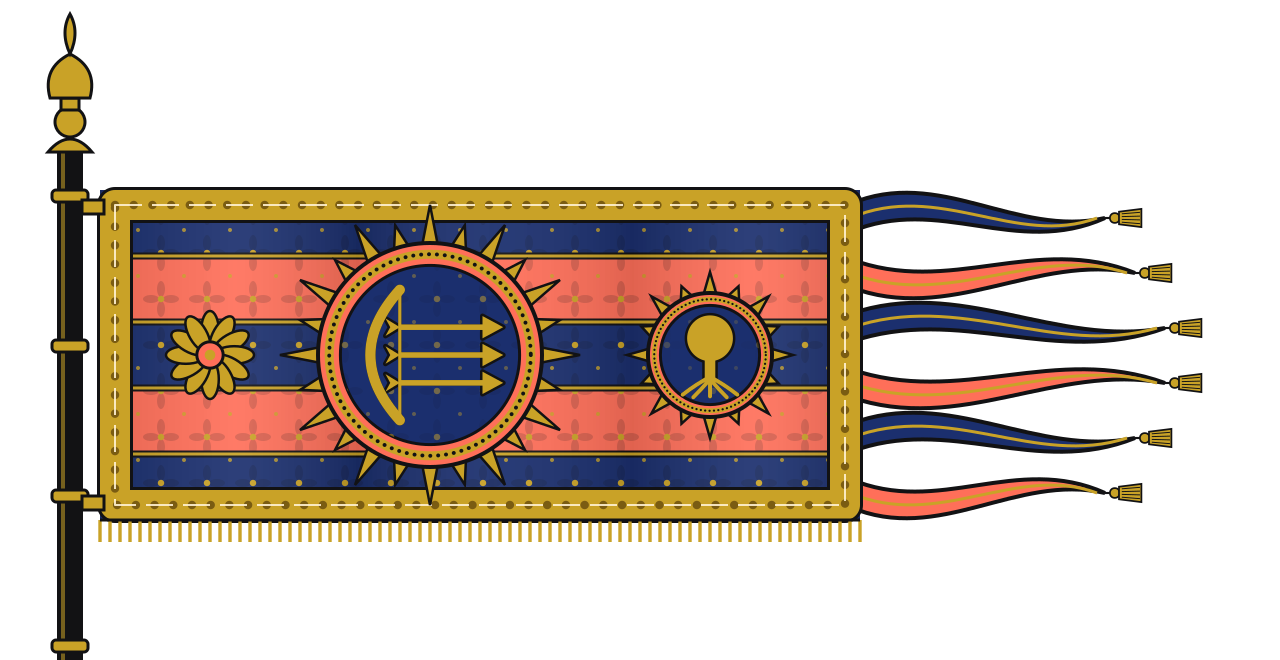
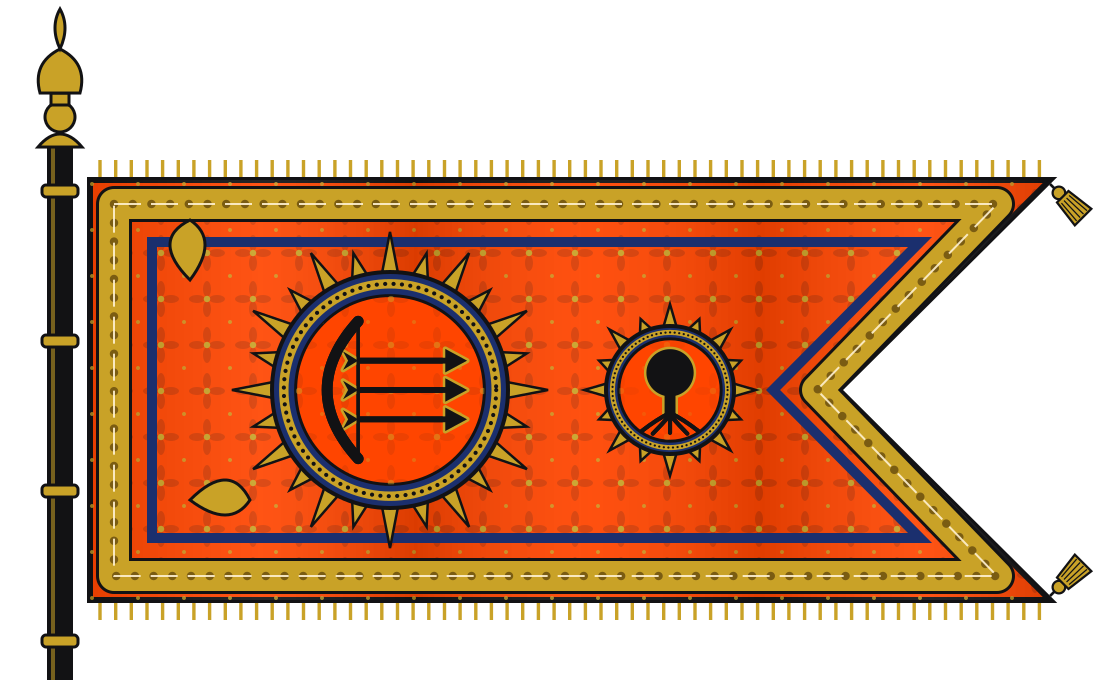



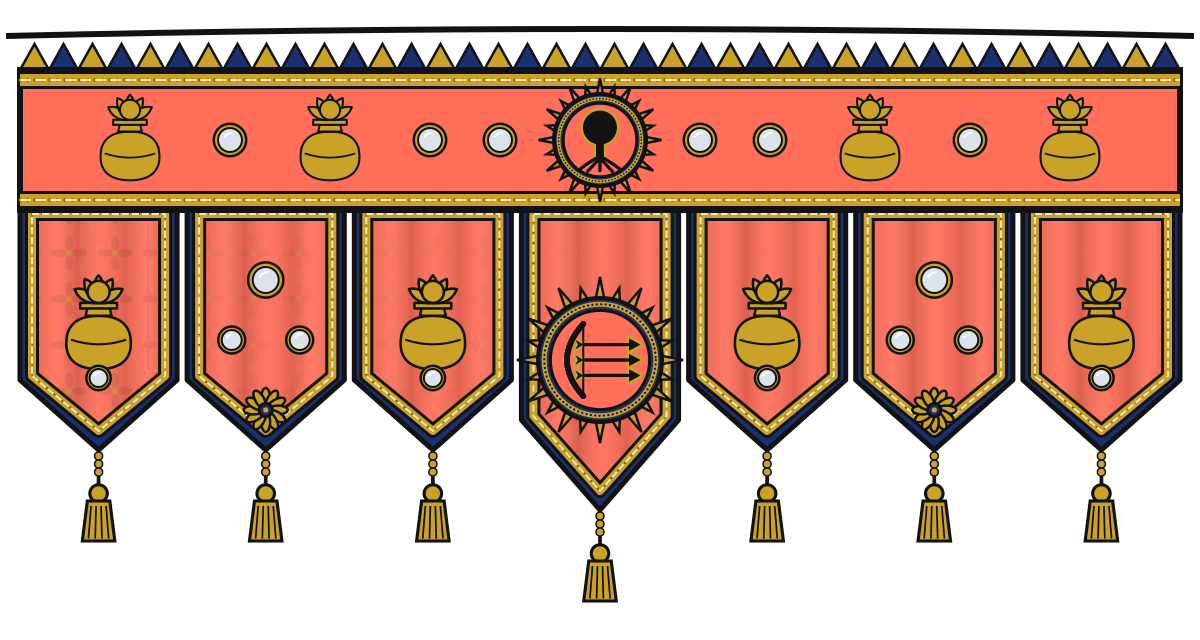
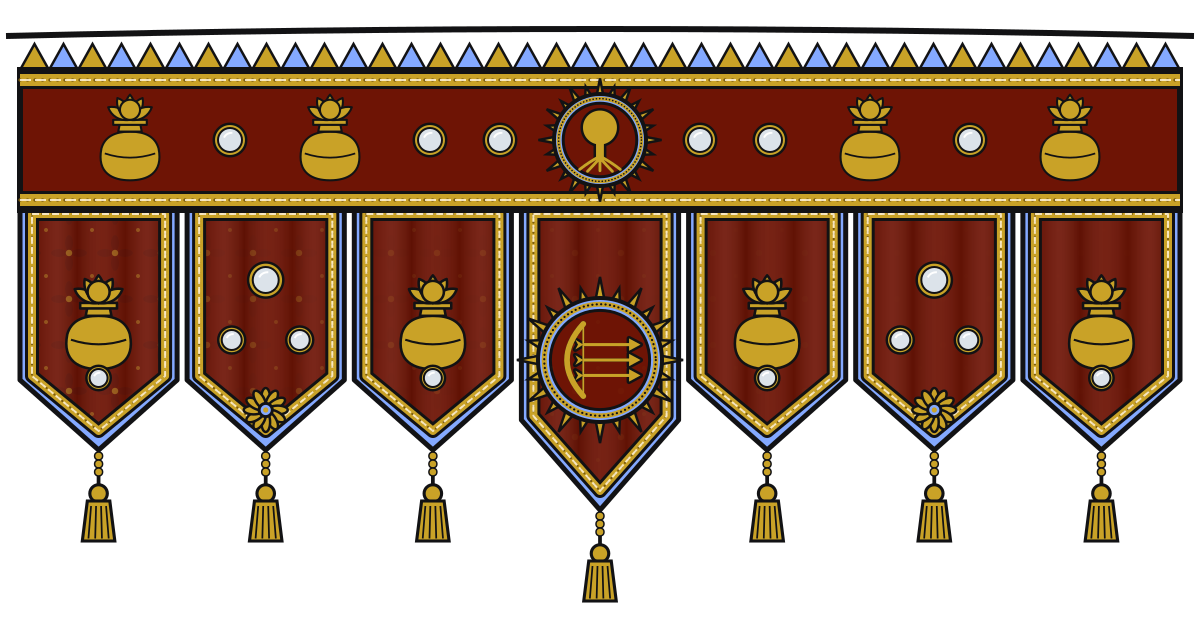

Historic banner
A Bhil archer appears beside a Rajput on the Mewar coat of arms
New flag types
| Accessory | For this clan | Basis |
|---|---|---|
| A9 Pota-dhvaja · ship and trade flag For ships, caravans and markets | Not yet designed for this clan | Design |
| A10 Utsava-patāka · festival flag Light, bright flag for fairs and festivals | Not yet designed for this clan | Design |
| A11 Shoka-dhvaja · mourning flag White cloth with the emblem outline in the clan's metal | Not yet designed for this clan | Design |
7. Regalia
| Accessory | For this clan | Basis |
|---|---|---|
| E1 Chhatra · house parasol The ceremonial umbrella | Not yet designed for this clan | Design |
| E2 Chamara · fly-whisks The pair of whisks beside the head of the house | Not yet designed for this clan | Design |
| E3 Danda · staff of office Staff or scepter | Not yet designed for this clan | Design |
| E4 Simhasana · seat The seat of the house, covered in clan cloth | Not yet designed for this clan | Design |
| E5 Khetaka · shield A round shield; the Changi and Dhanush are its flag forms | Not yet designed for this clan | Regional tradition |
| E6 Kula-ayudha · clan weapon The weapon the clan honours | Bamboo bow with a bark string; quiver of bamboo matting with sixty barbed arrows a yard long The national weapon of the Bhils in 1916; Khandoba is often represented by a sword[8] | Documented |
8. Worn
| Accessory | For this clan | Basis |
|---|---|---|
| F1 Kula-vastra · clan cloth The clan's woven pattern in its kit colours | Not yet designed for this clan | Design |
| F2 Kirti-vastra · honour cloth A cloth earned for a deed, not inherited | Not yet designed for this clan | Design |
| F3 Kula-mala · garland flower The flower or leaf the clan wears as a garland | Not yet found for this clan | Under research |
| F4 Chinha · house pin A metal badge with the pin emblem | Not yet designed for this clan | Design |
9. Records
| Accessory | For this clan | Basis |
|---|---|---|
| H1 Clan words A traditional line in the native script | भील · “Bhil, from billu, 'bow': the name some scholars derive from a Dravidian word for the bow, the Bhils' weapon” Clan words · the derivation of the name given on the Bhil page[3] | Design |
| H2 Biruda · titles The house's title or titles | Naik (village headman) · Pradhan (chiefs of the Dang states) | Documented |
| H3 Prashasti · praise genealogy The lineage as written at the head of a grant | Not yet found for this clan | Under research |
| H4 Vahi · clan register The book of the clan's births, marriages and deaths | Not yet found for this clan | Under research |
| H5 Rana-ghosha · war cry The clan's cry in battle or celebration | Kilki The Bhil war-cry, which gathers hundreds within minutes[20] | Documented |
10. VishwaVit · knower of the world
Game values are design choices for this project, not historical claims.
References
- Bhils, Encyclopaedia Britannica 11th ed. (1911), via Wikisource, read 2026-10-10
- Bhil languages, Wikipedia (read 2026-10-09), citing Census of India 2011 and the 52nd report of the Commissioner for Linguistic Minorities (2014–15).
- Bhil, Wikipedia (read 2026-10-09), citing Gall & Hobby (2009), K. S. Singh (1996), V. R. Williams (2020), S. K. Ghosh (1987), Ram Pande, M. Unnithan-Kumar (1997), Census of India 2011 and the Bombay Presidency Gazetteer (1880, 1901).
- MMCF (Maharana of Mewar Charitable Foundation), About Rana Punja, Bhil warrior of Mewar, eSamskriti, 24 June 2022 (read 2026-10-09).
- Dev Mogra, Wikipedia (read 2026-10-09), citing the Bombay Gazetteer vol. 6 (1880) and R. D. Tribhuwan, Fairs and Festivals of Indian Tribes (2003).
- Devmogra Mata Temple, Devmogra, Tal. Sagbara, Dist. Narmada, PilgrimData.in (read 2026-10-09), citing T. B. Naik, The Bhils – A Study (1956).
- The Bhils, Indira Gandhi National Centre for the Arts (read 2026-10-09).
- R. V. Russell and Hira Lal, The Tribes and Castes of the Central Provinces of India, vol. 2 (London, 1916), Project Gutenberg eBook #22010, https://www.gutenberg.org/ebooks/22010
- Sumit Guha, 'Forest polities and agrarian empires: the Khandesh Bhils, c.1700-1850', Indian Economic and Social History Review 33(2), 1996, pp. 133-153 (bibliographic record only, read 2026-10-24, ABIM, Groningen)
- Scroll.in, excerpt from Subhash Chandra Kushwaha, Bhil Revolt: A Century and a Quarter of Struggle (trans. Naresh Nadeem, Niyogi Books), 8 May 2026, read 2026-10-24, link
- WisdomLib, Bhilla: 16 definitions (read 2026-10-10)
- N. Sinha Kapur, The Bhils in the Historic Setting of Western India (Social Science Probing, 1993; reprinted in M. Behera, ed., Tribal Studies in India, Springer, 2020), abstract page read 2026-11-21, Springer
- Bombay Gazetteer vol. VI, Rewa Kantha, Narukot, Cambay and Surat States (1880, ed. J. M. Campbell), Cornell scan on archive.org, first 100,000 of 869,332 characters read 2026-11-21, archive.org
- Sir James Outram, 1st Baronet, Wikipedia (read 2026-10-10), citing EB 1911
- Khandesh district, Wikipedia (read 2026-10-10), citing Campbell, Gazetteer of Bombay Presidency: Khandesh (1880)
- Encyclopaedia Britannica, 8th ed. (1860), Khandesh entry, via jimclifford.ca, read 2026-10-30, link
- Udaipur Blog, All About the Bhil Community of Mewar (blog, secondary, blog-grade; read 2026-11-06), link
- Bhomat, Wikipedia (read 2026-11-06), citing Kapur (2002), Sharma (1951), Paliwal (2000), Report on Mewar Administration (1944)
- Panarwa thikana, Wikipedia (read 2026-10-24), citing Paliwal, Panarwa Ka Solanki Rajvansh (2000) and Sharma, Mewar and the Mughal Emperors (1954)
- The Bhils: Hindustan's Most Famous Tribal Warriors, Mewar Gavari (2016), read 2026-10-10
- GKToday, Bhil Revolts in Western India (read 2026-10-10)
- FIBIS wiki, The Kandeesh Bhil Corps, read 2026-10-30 (CC BY-NC-SA 3.0; page revision of 17 Sept 2015); cites A. H. A. Simcox, A Memoir of the Khandesh Bhil Corps 1825-1891 (1912)
- GIPE Digital Repository, record for A. H. A. Simcox, Memoir of the Khandesh Bhil corps, 1825-1891 (Thacker, Bombay, 1912), read 2026-11-06, link
- Marxists Internet Archive, Dicionario politico, 'Revolta Bheel' (read 2026-10-24, link), secondary, from Wikipedia
- Pimpladevi State, Wikipedia (read 2026-10-10), citing Gazetteer of the Bombay Presidency vol. 12 Khandesh (1880)
- Bharatpedia (Wikipedia mirror), Mewar Bhil Corps (read 2026-11-06), link, citing Showers (1891), Vashishta (1978), C. S. K. Singh (1995)
- Bhagoria Festival, Wikipedia (read 2026-10-09; page carries a maintenance notice), citing the Indian Express, 23 January 2015.
- Ministry of Tribal Affairs, State/UT-wise list of Scheduled Tribes (Constitution (ST) Order 1950 as amended; list dated 09-07-2024), via the Atlas entries ST-015 and ST-093.