The Bhattra, known in the records also as Bhottada, Bhotra and Bhatra, are a Scheduled Tribe found mainly in Odisha and Chhattisgarh[1]. Russell and Hira Lal (1916) found nothing known of their origin except a legend that they came with the Rajas of Bastar from Warangal twenty-three generations earlier[2]. The 2011 census gives 450,771 people under the Odisha list, a row that lists the Bhottada spellings, and 334,258 native speakers of their language, Bhatri[3][4]. Their clans are named after plants and animals such as the tortoise and the tiger, and nine young Bhatra men take part in the Bastar Dussehra rites of the goddess Danteshwari[5].
01Faith and deities
Bastar royal goddess, centre of Bastar Dussehra
The presiding goddess of the clan's homeland or capital: a link of place, not a recorded clan tie.
From the Atlas: Danteshwari, a homeland shrine (Bastar royal goddess, centre of Bastar Dussehra). This is not a clan-own deity in the sources.
| Deity or tradition | Place in the clan's life | Evidence |
|---|---|---|
| Danteshwari | Bastar goddess; Bhatra youths take part in her Dussehra rites | [5][6] |
| Bhima and Bhimsen | The village deities; the Gudi is the shrine for them | [7] |
| Budhi Thakurani, Bhairabi Budhi, Pardesi, Basumata, Banadurga | The clan's own pantheon, worshipped with Hindu deities | [1] |
| Mati Deo | God of hunting, who lives in a separate tree in each village; fowl and pig are offered to him at Bijphutni | [2] |
| Saraswati and Ganesh | Invoked at the start of each Bhatra Naat performance; no text printed | [8] |
02Temples
No temple built or patronised by the Bhattra is named in the extracts. The Danteshwari temple at Jagdalpur has a central part in the festival the Bhatra join[5]; their own shrines are the village Gudi and the Mati Deo tree[7][2]. Under research: temples and grants by the clan.
Built by the clan
Not recorded.
Given patronage or grants by the clan
Not recorded.
03Languages and scripts
| Language or script | Kind | Under the clan | Evidence |
|---|---|---|---|
| Bhatri living | Eastern Indo-Aryan language; called a semi autonomous, non-literacy dialect by the Koraput page | Spoken predominantly by the Bhottada; 334,258 native speakers (2011 census)[4][9] | [4] |
| Odia | Regional language of Odisha | Named beside Bhatri for the Bhottada in the Wikipedia infobox (no citation given on the page)[1] | [1] |
| Sasturia | Listed beside Bhatri | Named by the OSTM page for the tribe; no detail in the extracts[10] | [10] |
| Devanagari and Odia scripts | Writing systems listed for Bhatri | No Bhatri text in either script is in the extracts[4] | [4] |
04Books and literature
No book in Bhatri, or written by the Bhattra, is in the extracts. Books about them: Russell and Hira Lal (1916)[2]. A 2020 student blog on Bhatra Naat is a weak source[8]. Under research: any scholarly book on the Bhatra named in the extracts is catalogue-only and not read.
Written during the clan's history
Not recorded.
Given patronage by the clan
Not recorded.
05Thinkers and scholars
| Name | Field | Era | Contribution |
|---|---|---|---|
| R. V. Russell and Hira Lal | Colonial ethnography | 1916 | Entry on the Bhatra in The Tribes and Castes of the Central Provinces of India[2] |
Other writers the extracts name (Singh 1996, Masica 1991, Mhaiske and others 2016, Dube, Elwin and Majumdar) are not read in full, so they are not listed. Under research: a Bhatra scholar of their own is not named.
06Art and architecture
Paddy craft figurines are the only Bhattra art form in the extracts. No painting, sculpture, architecture or textiles are recorded for them.
Painting and wall art
Not recorded.
Sculpture and temple art
Not recorded.
Temple and building architecture
Not recorded.
Weaving and textiles
Not recorded.
Clothing and jewellery
Not recorded.
Coins, pottery and crafts
| Art form | What it is | Era | Evidence |
|---|---|---|---|
| Paddy figurines | Unhusked paddy tied with coloured thread into chains, bent into figures of deities and animals | As the OSTM page describes it | [10] |
07History
Legend of arrival, twenty-three generations before 1916
Russell and Hira Lal found nothing known of the Bhatra's origin except a legend that they came with the Rajas of Bastar from Warangal, twenty-three generations earlier[2]. They inferred that the Bhatra, like the Parjas, were older residents of Bastar than most Gonds[2].
The Odisha State Tribal Museum says they are believed to have come to Odisha from the Bastar region[10]. The Koraput district page gives a longer route, from Barthagada to Visakhapatnam, then Bastar, then Koraput, and quotes ethnographers who think the Bhatra are basically Hindus influenced by long contact with aboriginal people[9].
Wikipedia gives the name as derived from bhu (earth) and tara (chase), citing Singh (1996)[1]. Russell says the word Bhatra is said to mean a servant[2]. These accounts are set side by side; none is settled here.
1408 to 1775: Bastar Dussehra and the Bastar capital
Sahapedia dates the start of Bastar Dussehra to 1408 in one account, and to the 13th century in another. Dalpat Deo (1721-1775) moved the Bastar capital to Jagdalpur[5]. The Bhatra have a part in that festival, as Sahapedia's account of the rites shows (see Festivals).
1891 and 1916: counted with the Gonds
Russell (1916) describes the Bhatra as a primitive tribe of Bastar State and the south of Raipur District, akin to the Gonds, with 33,000 persons in 1891; later enumerations amalgamated them with the Gonds[2]. The divisions and septs Russell recorded are in Clans.
08Journey and migrations
Three accounts of the route, none dated beyond the legend. They are shown as sourced differences.
| When | From | To | Why | Evidence |
|---|---|---|---|---|
| 23 generations before 1916 (legend) | Warangal | Bastar | Came with the Rajas of Bastar | [2] |
| Not dated (oral tradition) | Bastar | Odisha | Migration into Odisha | [1][10] |
| Not dated | Barthagada | Visakhapatnam, then Bastar, then Koraput | Route of the original settlers, as the Koraput page gives it | [9] |
09Seats and lands
| Place | Role | Where today |
|---|---|---|
| Bastar | Homeland; Bastar State in Russell (1916); the Bastar Dussehra | Eastern Bastar district, Chhattisgarh[4] |
| South of Raipur district | Recorded by Russell (1916) with Bastar | Raipur District, as Russell (1916) names it[2] |
| Koraput and Nabarangpur | Main districts where Bhatri is spoken | Odisha[4][9] |
| Nowrangapur, Koraput, Kalahandi, Malkangiri | Odisha districts as the KISS handbook prints them; Kalahandi and Nabrangpur are named by the OSTM page | Odisha[7][10] |
| Warangal | Place named in the origin legend | Not located in the extracts[2] |
| Kumhdakot | The chariot of Bastar Dussehra is taken here | Bastar Dussehra route[5] |
| Madhya Pradesh | Scheduled Tribe row "Bhattra", 2011: 1,155 | Madhya Pradesh[11] |
| Maharashtra | Scheduled Tribe row "Bhattra", 2011: 66 | Maharashtra[12] |
10Notable figures
| Name | Role | Era | Known from |
|---|---|---|---|
| Under research | No named chief, king or leader of the Bhattra is in the extracts. Leads: the Bastar rajas' records and the Bastar State gazetteer (not found online in this run) | — |
11Allies, rivals and marriages
| People | Relationship | When |
|---|---|---|
| Gonds | Akin to the Bhatra (Russell); a sub-division of the Gond tribe (OSTM). The sources differ and this is not resolved[2][10] | 1916; today |
| Muria Gonds | The San division is considered practically identical with them[2] | 1916 |
| Parjas (Paroja) | Russell infers the Bhatra and Parjas are the older residents of Bastar[2] | 1916 |
| Bastar rajas | The legend has the rajas bring them from Warangal; the Raja formerly sold the sacred thread[2] | Legend; 1916 |
| Kilepal tribe | Pull the eight-wheeled chariot at Bastar Dussehra[5] | Bastar Dussehra (Sahapedia) |
| Panara (gardener caste) | A Panara man may join a Bhatra household if he lives with a Bhatra woman and eats from her hand[2] | 1916 |
| Kawar and Ahir | Share a Baghwa (tiger) sept with the Bhatra[13] | 1916 |
12Society and livelihood
A village is led by a Naik with a Chalan, a Pujari and a Gonda. A group of villages forms a Desh, headed by the Bhat Naik. Marriage is by negotiation, the costly ideal, though elopement, capture and service are also accepted; cross-cousin marriage, junior levirate, sororate and divorce are permitted, and the dead are buried[1]. Outsiders are not usually admitted[2].
Government and social order
| Institution or group | What it was | Evidence |
|---|---|---|
| Naik | Village chief, assisted by the Chalan, Pujari and Gonda | [1] |
| Bhat Naik and the Desh | Head of a group of villages; the Panigrahi and Desia Gonda settle disputes between villages | [1] |
| Majhi | Village headman, paid in grain | [2] |
| Pujari | Village priest; diagnoses illness with flowers or grains at the deity's forehead | [2] |
| Meda Gantia | Illiterate village astrologer who fixes the wedding date and forecasts rain and the sowing and harvest times | [2] |
| Admission | A woman of equal or higher caste who enters a house is recognised as wife; a Panara man may join | [2] |
Livelihood over time
| Era | Livelihood | Evidence |
|---|---|---|
| 1916 (Russell) | Cultivators and farm-servants, shifting cultivation; village watchmen and household servants | [2] |
| As the OSTM page describes them | Skilled agriculturalists with wet cultivation: paddy, sugarcane, pulses and tobacco | [10] |
| As the Koraput page describes them | One of the numerically major agricultural tribes of Odisha | [9] |
| Recent (2020 student blog, weak) | Shifting cultivation, no private lands, minor forest produce | [8] |
13Sub-clans and related clans
The sources give two sets of divisions and a list of totem septs. The division schemes conflict: two divisions (Wikipedia, citing SCSTRTI), three on the Koraput page (Bada, Madhya, Sana), and Russell's Pit, Amnait and San. Which division is which is not resolved. The septs are exogamous, named after totem animals.
| Clan | Relation | Where | Size | In the Atlas | Evidence |
|---|---|---|---|---|---|
| Bada | Sub-clan | Higher status and purer descent (Wikipedia; SCSTRTI); the Koraput page says Bada claims superiority for purer descent | new clan candidate | [1][9] | |
| Sana | Sub-clan | Named Sana by Wikipedia and the Koraput page. Russell (1916) has a San division ranked last | new clan candidate | [1][9][2] | |
| Madhya | Sub-clan | The middle of three divisions on the Koraput page only (the page prints "Bodo" once, apparently for Madhya) | new clan candidate | [9] | |
| Pit | Sub-clan | Bastar, Russell (1916): ranked first; the Pit refuse to make grass mats | new clan candidate | [2] | |
| Amnait | Sub-clan | Bastar, Russell (1916): ranked second; the Amnait make grass mats | new clan candidate | [2] | |
| Kachhimo | Sub-clan | Tortoise sept (Koraput page). Russell (1916) gives a Kachhun (tortoise) sept that, in some places, will not eat a fallen pumpkin unless it is broken at once | new clan candidate | [9][2] | |
| Bhag | Sub-clan | Tiger sept (Koraput page). Russell (1916): the tiger sept formerly ate the flesh at a sacrificial meal | new clan candidate | [9][2] | |
| Goyi | Sub-clan | Lizard sept (Koraput page) | new clan candidate | [9] | |
| Nag | Sub-clan | Cobra sept (Koraput page). Russell (1916) has a snake sept that formerly ate the sacrificial flesh | same name as ST-476: check | [9][2] | |
| Kukur | Sub-clan | Dog sept (Koraput page) | new clan candidate | [9] | |
| Mankad | Sub-clan | Monkey sept (Koraput page) | same name as ST-536: check | [9] | |
| Cheli | Sub-clan | Goat sept (Koraput page) | new clan candidate | [9] | |
| Pandki | Sub-clan | Pigeon sept (Koraput page only) | new clan candidate | [9] | |
| Gond | Related people | Akin to the Bhatra (Russell); a sub-division of the Gond tribe (OSTM); sources differ | ST-088 | [2][10] | |
| Muria Gond | Related people | Russell (1916): the San division is practically identical with them | new clan candidate | [2] | |
| Paroja | Related people | Parja; Russell (1916) infers older residence in Bastar, like the Bhatra | new clan candidate | [2] | |
| Panara | Related people | Gardener caste; a Panara man may join a Bhatra household (Russell, 1916) | new clan candidate | [2] | |
| Kilepal | Related people | Pull the chariot at Bastar Dussehra | same name as NE-059: check | [5] | |
| Kawar | Related people | Share a Baghwa (tiger) sept with the Bhatra (Russell 1916, vol. 3) | ST-126 | [13] | |
| Ahir | Related people | Share a Baghwa (tiger) sept with the Bhatra (Russell 1916, vol. 3) | ST-363 | [13] | |
| Bastar rajas | Dynasty from this clan | Bastar; the legend has them bring the Bhatra from Warangal; the sacred thread was sold by the Raja (Russell, 1916) | same name as SUB-255: check | [2] |
Clans marked "new clan candidate" are not in the Atlas yet.
14Surnames
The Koraput district page lists these fourteen names among the surnames of the tribe[9]. Majhi and Pujari are village offices (Russell 1916), and Chalan and Naik are village offices in the Wikipedia account, so a name here may be an office rather than a family. No counts are sourced.
| Surname | Clan or sub-clan | Where | People with this surname | Also used by other communities |
|---|---|---|---|---|
| Majhi | Listed on the Koraput page | not yet counted | Not checked | |
| Chalan | Listed on the Koraput page | not yet counted | Not checked | |
| Nayak | Listed on the Koraput page | not yet counted | Not checked | |
| Randhari | Listed on the Koraput page | not yet counted | Not checked | |
| Bhotra | Listed on the Koraput page | not yet counted | Not checked | |
| Bhatra | Listed on the Koraput page | not yet counted | Not checked | |
| Pujari | Listed on the Koraput page | not yet counted | Not checked | |
| Bhandarkaria | Listed on the Koraput page | not yet counted | Not checked | |
| Panigirit | Listed on the Koraput page (spelling as printed) | not yet counted | Not checked | |
| Bhatnayak | Listed on the Koraput page | not yet counted | Not checked | |
| Padhani | Listed on the Koraput page | not yet counted | Not checked | |
| Choudhury | Listed on the Koraput page | not yet counted | Not checked | |
| Somaratha | Listed on the Koraput page | not yet counted | Not checked | |
| Khordia | Listed on the Koraput page | not yet counted | Not checked |
Counts are of everyone with the surname, from the cited source and year, not only members of this clan. A surname shared with other communities says nothing about any one person's origin.
15Songs and music
No Bhattra song with its words is in the extracts, so none is listed. The men's masked drama Bhatra Naat is described by a 2020 student blog, which gives no lyrics[8].
Bhatra Naat living
Described by a 2020 student blog (weak source)[8]
16Poems, lullabies and children's rhymes
None recorded yet.
17Stories, legends and proverbs
Stories and legends
| Story | What happens | Told by | Evidence |
|---|---|---|---|
| Warangal origin legend | The Bhatra came with the Rajas of Bastar from Warangal, twenty-three generations earlier | Bhatra, as Russell recorded it | [2] |
| Bhatra Naat repertoire | Plays from the Mahabharata, Ramayan and Puranas, and ethical tales. Titles as printed: Ravan Vadh, Kansa Vadh, Karana Vadh, Keechak Vadh, Abhimanyu Vadh, Bharat Leela, Rukmini Vivah, Draupadi Chirharan | Men's drama troupes (weak source) | [8] |
| Totem taboo of the tortoise sept | The Kachhun sept will not eat a pumpkin that drops from a tree unless it is broken at once, as it looks like a tortoise | Custom recorded by Russell | [2] |
| Totem apology | A man who kills his totem animal apologises, breaks his cooking-pots, buries or burns the body, and a man of means gives alms in the animal's name | Custom recorded by Russell | [2] |
Proverbs and sayings
Not recorded.
18Festivals and fairs
| Festival or fair | When | Where | What happens |
|---|---|---|---|
| Bastar Dussehra | The 75-day festival in the Atlas | Bastar, Chhattisgarh; the Danteshwari temple at Jagdalpur; the chariot taken to Kumhdakot | Nine young Bhatra men take part in the Bhitar Raini and Bahar Raini rites[5] |
| Chait Parab | Not dated | Not stated | Listed by SCSTRTI with no detail[1] |
| Bijphutni | Chait (March) | Not stated | Threshing or harvest festival: a ceremonial net hunt; fowl and pig are offered to the god; seed from each house is soaked in mud and returned[2] |
| Akhiturti and Nua Khia | Not dated | Not stated | Listed by SCSTRTI with no detail[1] |
| Ancestor rite | 15 Asarh (June) | Not stated | Ancestors are offered rice and incense[2] |
| Joint ceremonial fishing | Not dated | Not stated | Done jointly by the village[2] |
| Frog marriage | Not dated | Not stated | A rite to bring rain[2] |
| Jackal marriage | Not dated | Not stated | A rite held when rain and sun come together[2] |
| Tiger-death rite | After a man is killed by a tiger | Not stated | The priest wears tiger-skin strips and peacock and blue-jay feathers, mimics a tiger, and receives 100 seers of rice[2] |
| Wedding | At marriage | Not stated | The couple walk seven times round a sacred mahua-wood post, later given to a river; date-palm marriage crowns; hand impressions in turmeric on the wall; a nut hidden in a mud pit; the bridegroom shoots a real or sham deer on the way home[2] |
| Burial | At death | Not stated | The dead are buried on the back, head to the north, with rice, cowries and a winnowing-fan[2] |
19Food, dress and games
Food
| Item | What it is | Evidence |
|---|---|---|
| Mahua drink | Popular; the mahua tree is revered and marriage cannot be completed without circling its post | [8] |
Dress
| Item | What it is | Evidence |
|---|---|---|
| Totem tattoo | Formerly tattooed with the totem plant and animal[2] | [2] |
| Sacred thread | Some men wear it; the Bastar Raja formerly sold it for four or five rupees[2] | [2] |
| Priest's dress | Tiger-skin strips, with peacock and blue-jay feathers, after a man is killed by a tiger[2] | [2] |
Games and martial arts
Not recorded.
Tags: living still practised · revived brought back after a break · lost known only from records · research reported but not yet confirmed from a source. Songs and poems under copyright are listed by title only; restricted or sacred material is noted without its content.
20Status today
The Bhattra are a Scheduled Tribe with a living community in four states in the Atlas. The largest count in the extracts is 450,771 under the Odisha list, a row that covers all the Bhottada spellings[3]. Their language, Bhatri, has 334,258 native speakers (2011 census)[4].
Who carries the name today
| Community | Link | Basis | Evidence |
|---|---|---|---|
| Bhattra / Bhottada (ST-026) | The Scheduled Tribe as listed in Odisha, Madhya Pradesh and Maharashtra | Documented | [1] |
Recognised heritage
| What | Recognition | Evidence |
|---|---|---|
| Bastar Dussehra rites | The Bhatra youths' part in the festival; no formal heritage listing is in the extracts | [5] |
Not yet reviewed by the Bhattra community.
21For children
The mahua post and the nine young men
Long ago, the Bhatra people lived in Bastar and Koraput. Their clans are named after plants and animals, such as the tortoise and the tiger, and the people of each clan respect their animal. When a Bhatra couple marries, they walk seven times round a sacred post made of mahua wood. Afterwards the post is carried to a river. Every year in Bastar there is a great Dussehra festival for the goddess Danteshwari.Nine young Bhatra men take part in its special rites.
Written for this project
Riddle: We walk round it seven times at a wedding, and then it goes down the river. What is it? (A sacred post of mahua wood)
22Across the project
| Project | What carries this clan | Status |
|---|---|---|
| Atlas of the Janas | Districts in Odisha and Bastar named in the sources; no pin set yet | To check |
| KulDevi and GrahDevi | Danteshwari, a homeland shrine; GrahDevi forms | From the Atlas |
| Planet naming | Star and planets not yet checked against the Tier registers | To check |
| Renaming and waters | No place or water name drawn from the Bhattra yet | — |
23Open questions
- No native-script form of the name, no song with words, no proverb and no children's rhyme is in the extracts. Find a Devanagari or Odia form of the name in a Bhatri source.
- Clan words: no line of the clan's own words is sourced. The words block is left empty for the host to decide (a classical line with a citation, marked illustrative, or left out).
- Which division is which: Bada and Sana (Wikipedia, SCSTRTI), Bada, Madhya and Sana (Koraput), Pit, Amnait and San (Russell). Check whether Pit is Bada and whether San is Sana.
- The origin accounts (Warangal legend; Bastar to Odisha; Barthagada, Visakhapatnam, Bastar, Koraput; Hindu influence) and the Gond relation (akin, or a sub-division) are shown as differences; none is resolved.
- Russell's Baghwa (tiger) sept among the Ahir, Bhatra and Kawar is cited from volume 3 (Gutenberg 41424); the Kawar extract quotes the line at L13958, so check it against the volume 3 text. The Bhatra entry itself is cited from volume 2 (Gutenberg 22010); confirm the volume.
- The Odisha list row (450,771) is the only figure for all the Bhottada spellings; confirm that the count covers every spelling.
- Chhattisgarh Scheduled Tribe figure and an all-India figure: find in the Census 2011 Chhattisgarh table.
- Bastar State gazetteer (1909) and Grigson (1938) are leads only; neither has been read.
- Bhatra Naat is described only by a 2020 student blog. Find a fuller source (Dube, Elwin, Majumdar are named in it).
- Surnames: counts and sub-clan links for the fourteen names on the Koraput page.
- Sept names: the clans note says the septs are named after totem animals (Wikipedia; Koraput page); Russell (1916) and the lead say plants and animals. Both are shown.
- Community review of this page: not yet done.
24Astitva
अस्तित्व · being, existence: everything by which the clan is known
Russell (1916) records that the Bhatra were tattooed with their totem plant and animal, apologised for killing a totem animal, and a priest wore tiger-skin strips and feathers after a man was killed by a tiger[2]. No seal, coin, war cry or title is in the extracts. The living symbols are the totems and the sacred mahua-wood post at weddings[2][9].
Every clan has every accessory, royal objects included. Each one says how it is known: Documented This clan's own object is recorded. · Regional tradition Recorded for the region or for peoples like this one, not for this clan. · Design Made for this project, with no historical claim. · Under research To be found for this clan from sources. Legends and titles are written in the clan's own script.
1. Seals and coins
| Accessory | For this clan | Basis |
|---|---|---|
| B1 Rajamudra · house seal Round seal with the clan emblem and a short legend in the clan's script | Not yet designed for this clan | Design |
| B2 Anguliya-mudra · signet ring Personal seal ring of the head of the house | Not yet designed for this clan | Design |
| B3 Chhapa · house stamp Ink or block stamp for letters, goods and cloth | Not yet designed for this clan | Design |
| B4 Tamrapatra · charter plate Copper-plate grant on a ring, closed with the house seal | Not yet designed for this clan | Design |
| B5 Shreni-mudra · guild or trade seal Seal for the clan's trade, craft or caravan | Not yet designed for this clan | Design |
| C1 Clan coin Emblem or deity on one side, a legend in the clan's script | Not yet designed for this clan | Design |
| C2 Coin die The die that strikes the coin | Not yet designed for this clan | Design |
2. Living symbols
| Accessory | For this clan | Basis |
|---|---|---|
| I1 Totem trio The tree, bird and animal the clan protects | Animal totems: tortoise, tiger, cobra, monkey, dog, lizard, goat and pigeon. Russell also has a plant totem, which the text does not name. | Documented |
| I2 Kaval-maram · guardian tree The tree that stands at the clan's seat | A separate tree in each village where Mati Deo, the god of hunting, lives | Documented |
3. Stone and gate
| Accessory | For this clan | Basis |
|---|---|---|
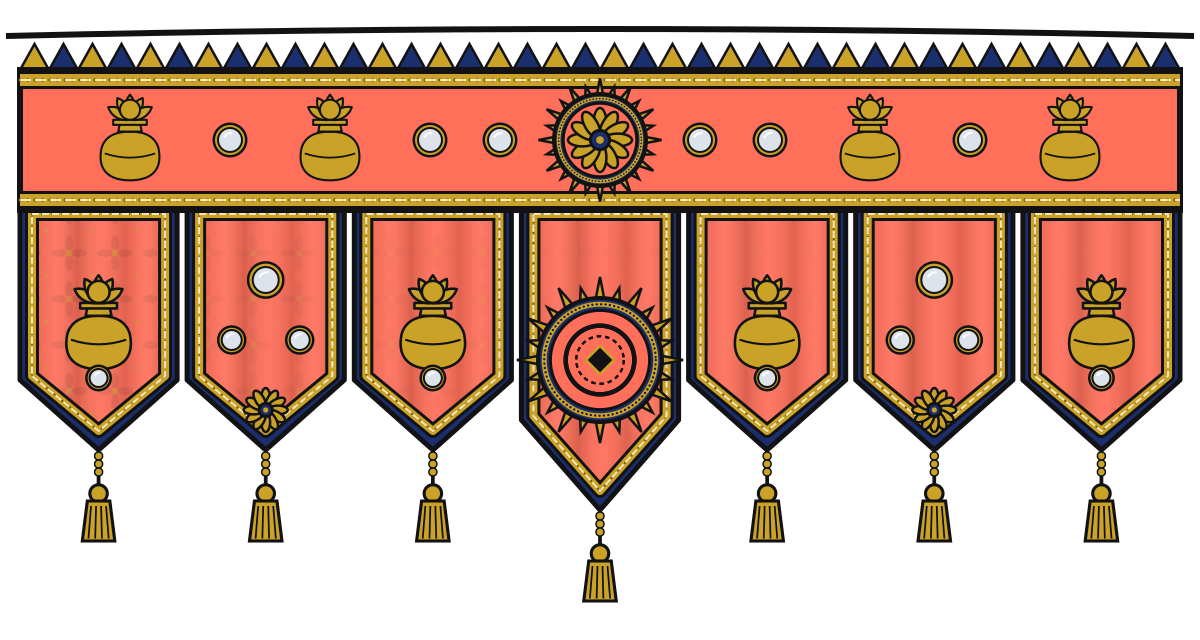
| G1 Torana · gateway The built gate of the seat; the cloth Toran hangs in it | Not yet designed for this clan | Regional tradition |
| G2 Viragallu · hero stone Carved panel stone for a member who died defending the clan | Not yet designed for this clan | Regional tradition |
| G3 Kula-shila · clan stones Standing and table stones that remember the ancestors | Not yet designed for this clan | Design |
| G4 Jayastambha · victory pillar A pillar raised for a victory | Not yet designed for this clan | Design |
| G5 Sima-shila · boundary stone Marks the clan's land, with a line in the native script | Not yet designed for this clan | Design |
4. Sounds
| Accessory | For this clan | Basis |
|---|---|---|
| D1 Pancha-mahashabda · five great sounds The right to five instruments | Not yet designed for this clan | Design |
| D2 Shankha · clan conch The clan's own named war conch | Not yet designed for this clan | Design |
| D3 Murasu · house drums Three drums: war, charity and justice | Not yet designed for this clan | Design |
5. Kit: colours, metals and emblems
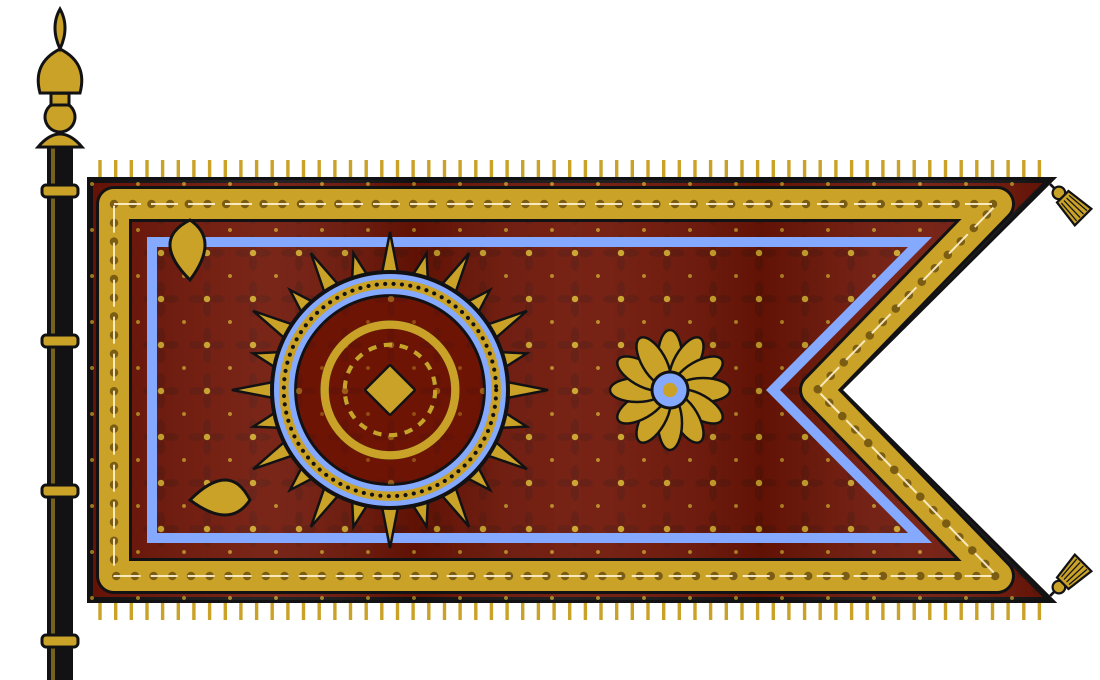
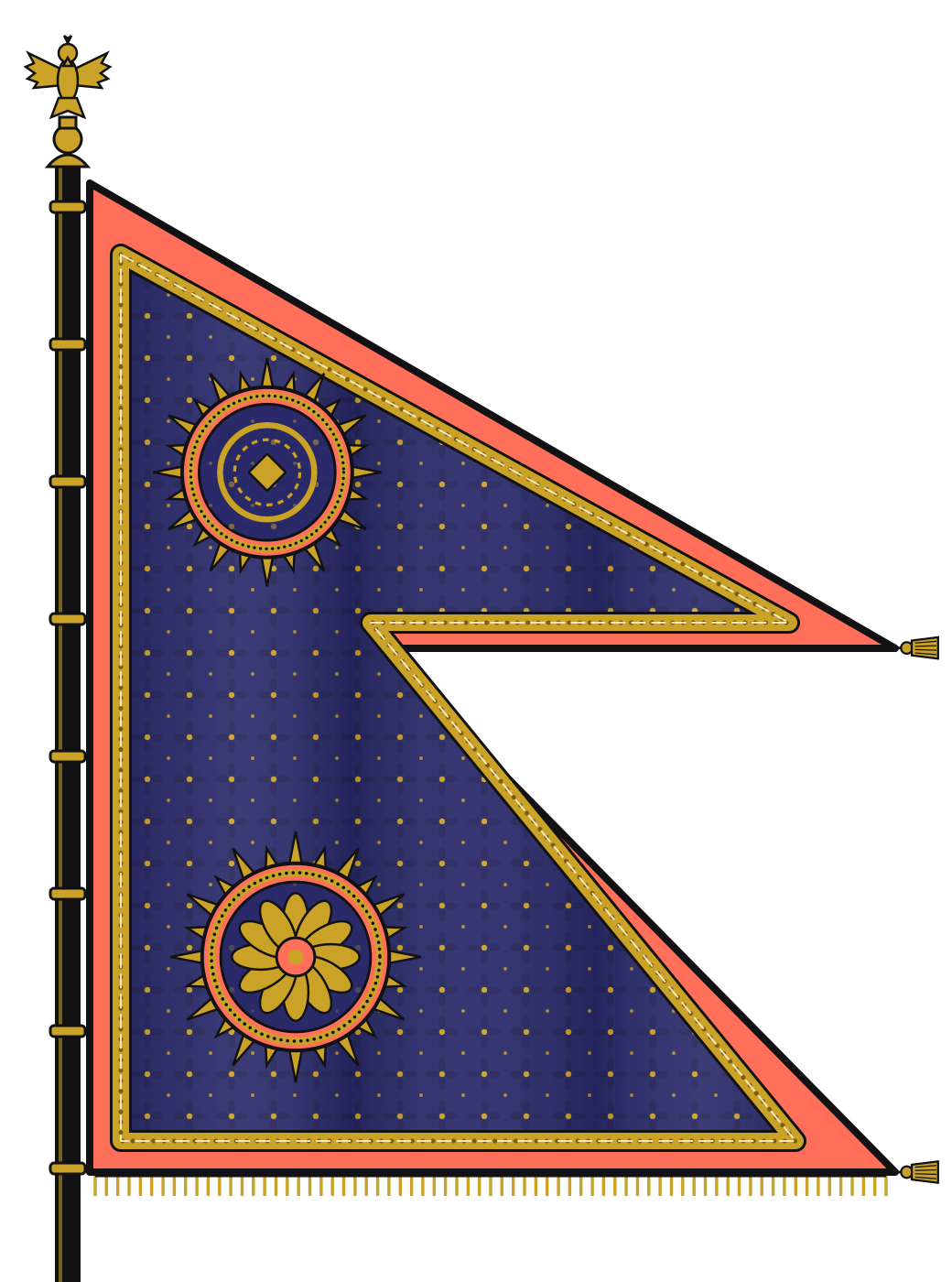
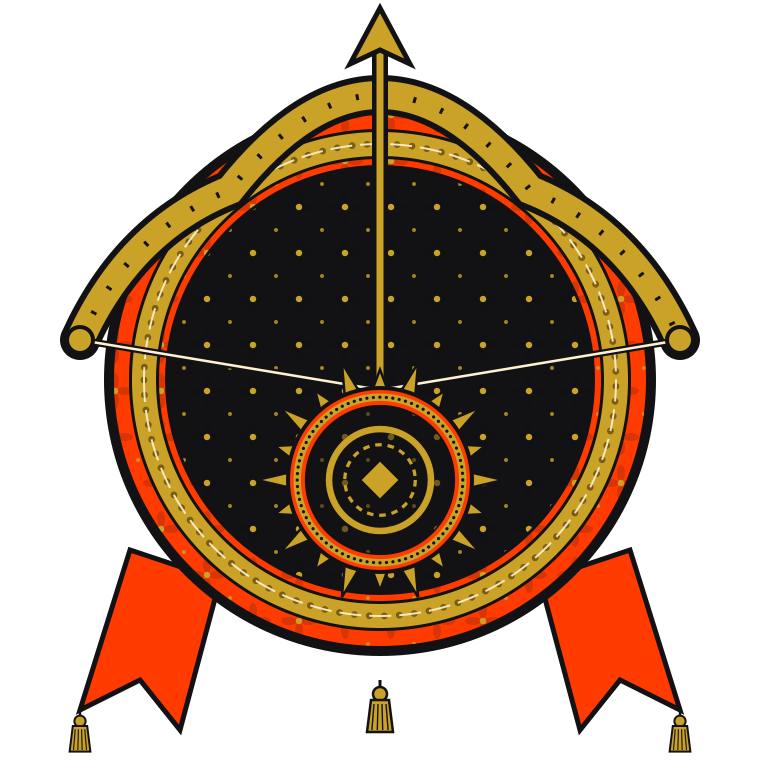
The emblem is a placeholder: the extracts record no documented symbol of the Bhattra. The Atlas sets a decorated wooden chariot for the main emblem, for the Bastar Dussehra in which the Bhatra take part. The page shows the placeholder medallion until the emblem is designed.
| Part of the kit | This clan |
|---|---|
| Field | Deep Indigo #2A2A6B |
| Accent | Warm Red-Orange #FF6F59 |
| Emblem colour | Metallic Gold #C9A227 |
| Zari metal | Gold |
| Main emblem | A decorated wooden chariot |
| Second image | — |
| Night and day | Every visual accessory has two versions: by night the emblem on the dark field, by day the clan's field colour on cloth woven from its metal. |
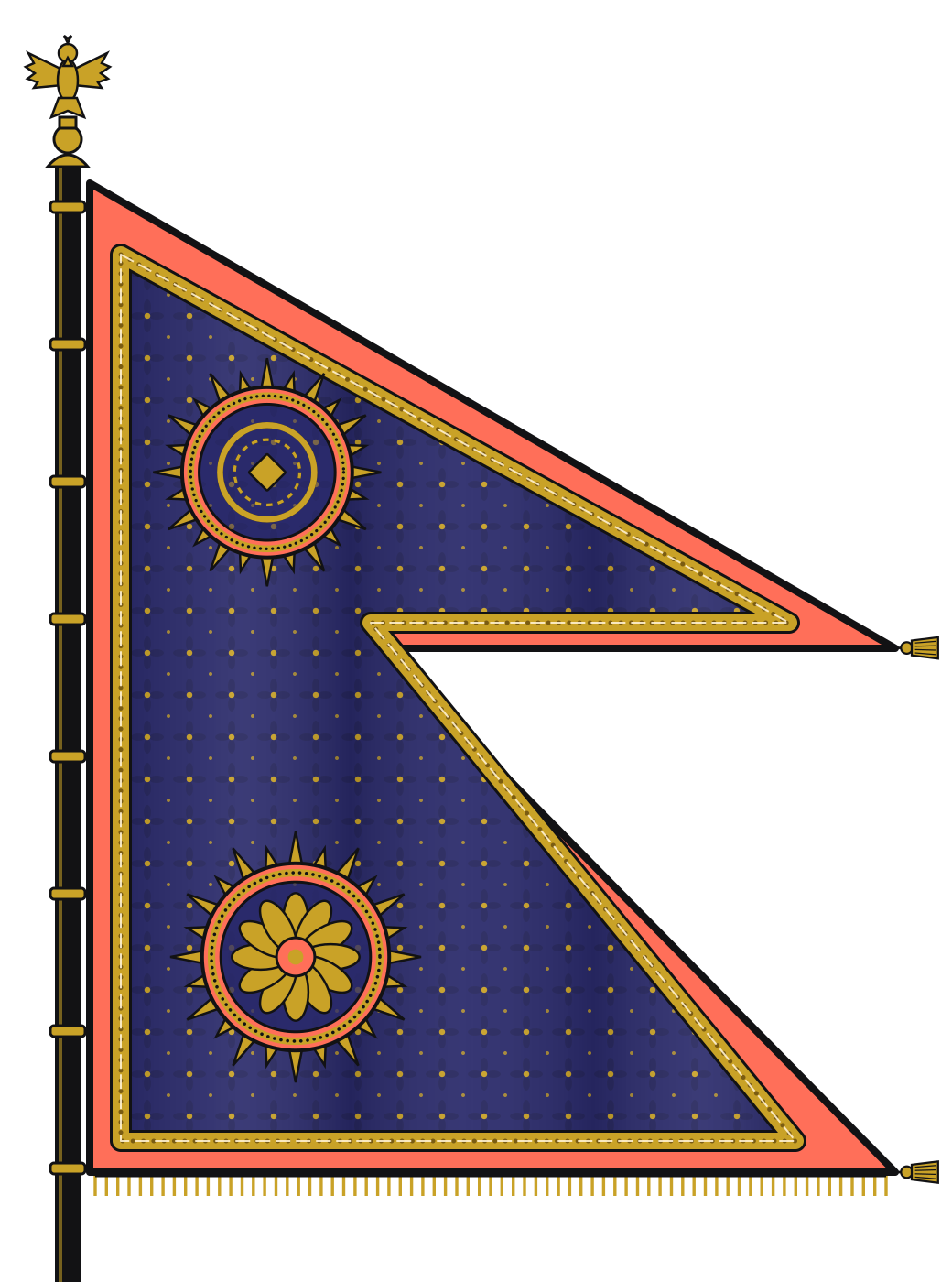
6. Flags
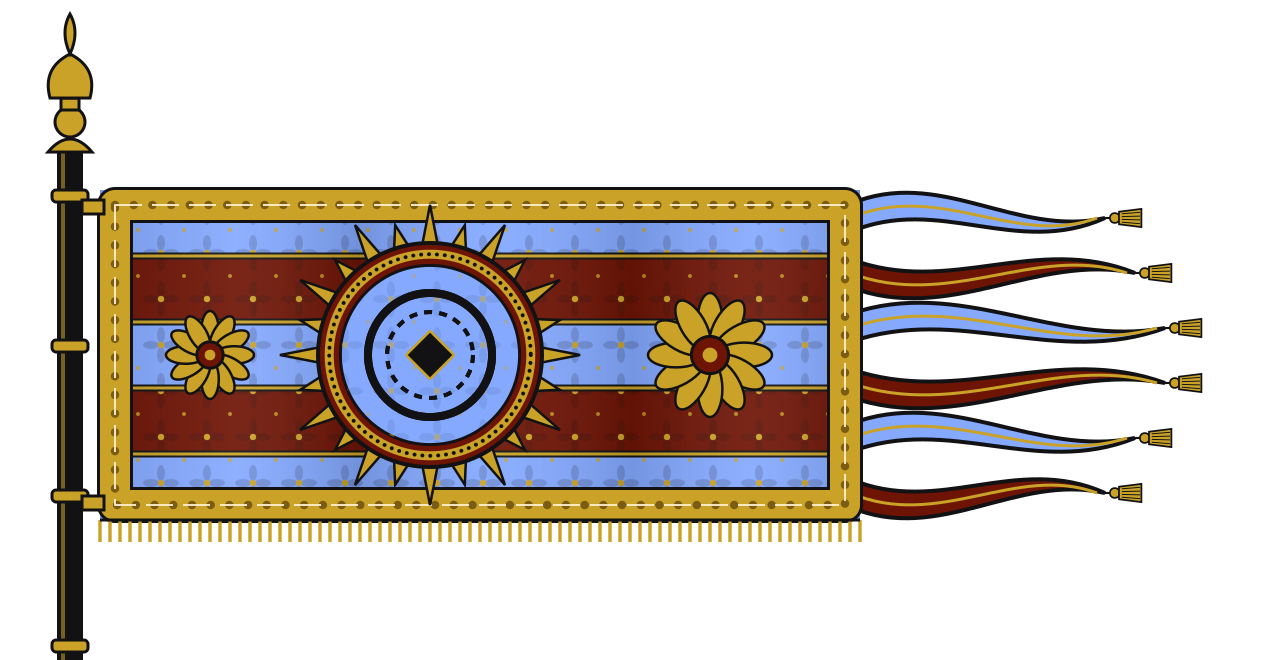
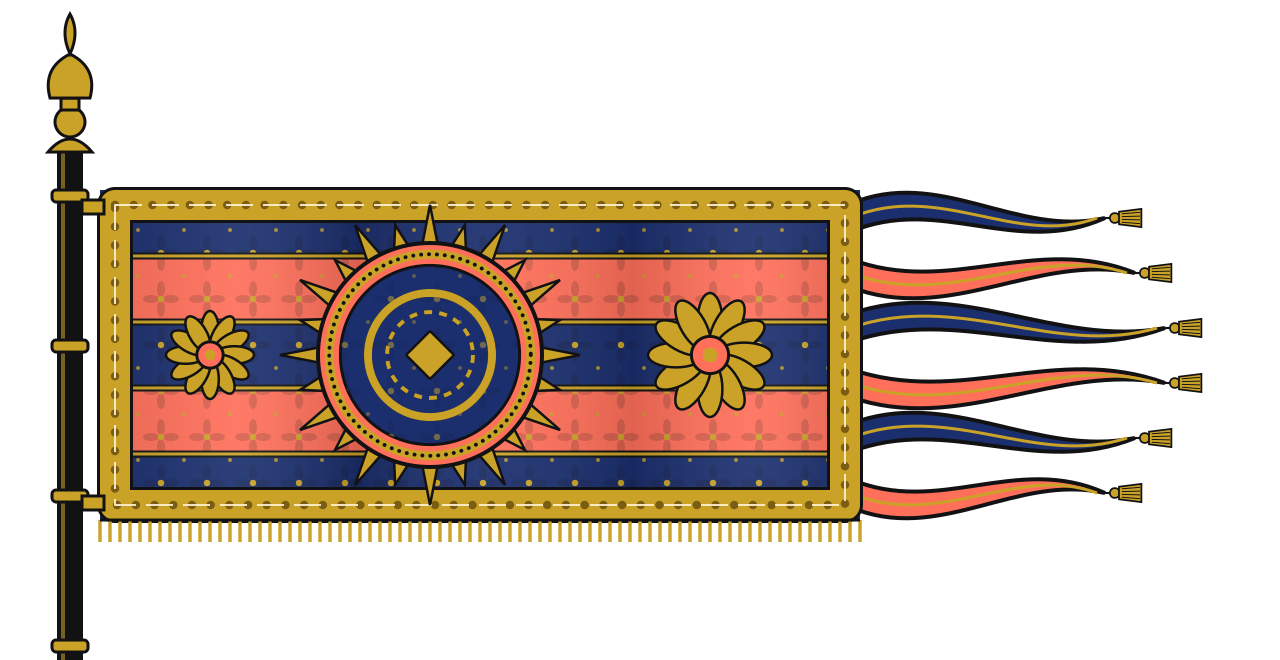
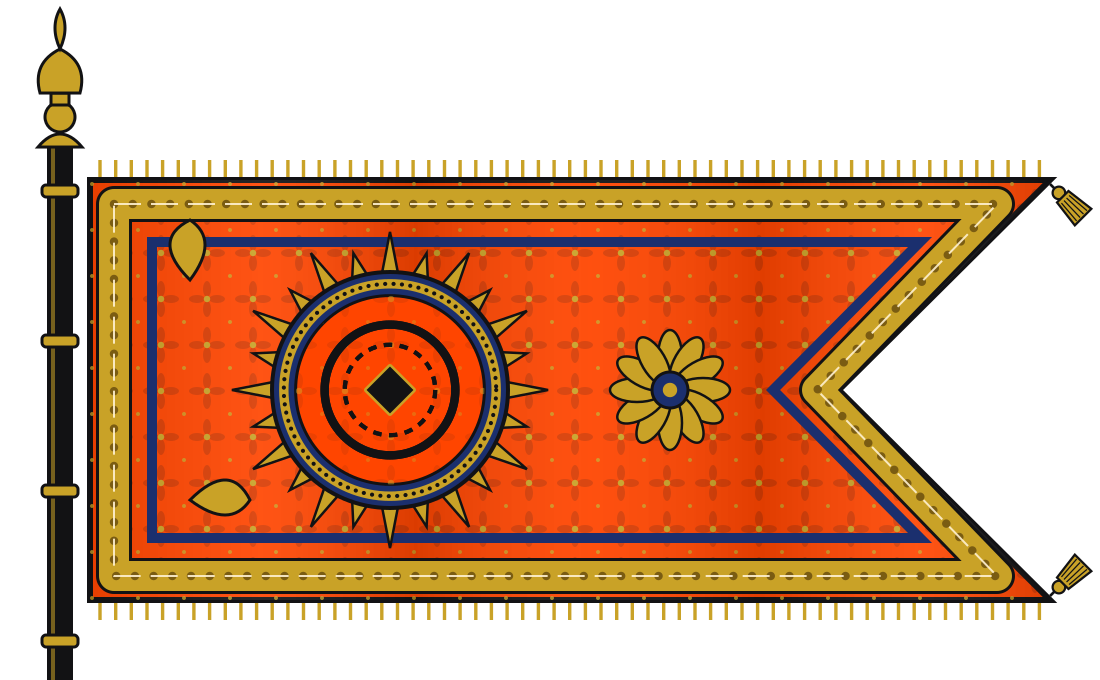
Every clan has every flag type; the type says the occasion and the colours say the clan. The outlined card is the flag the Atlas assigns.


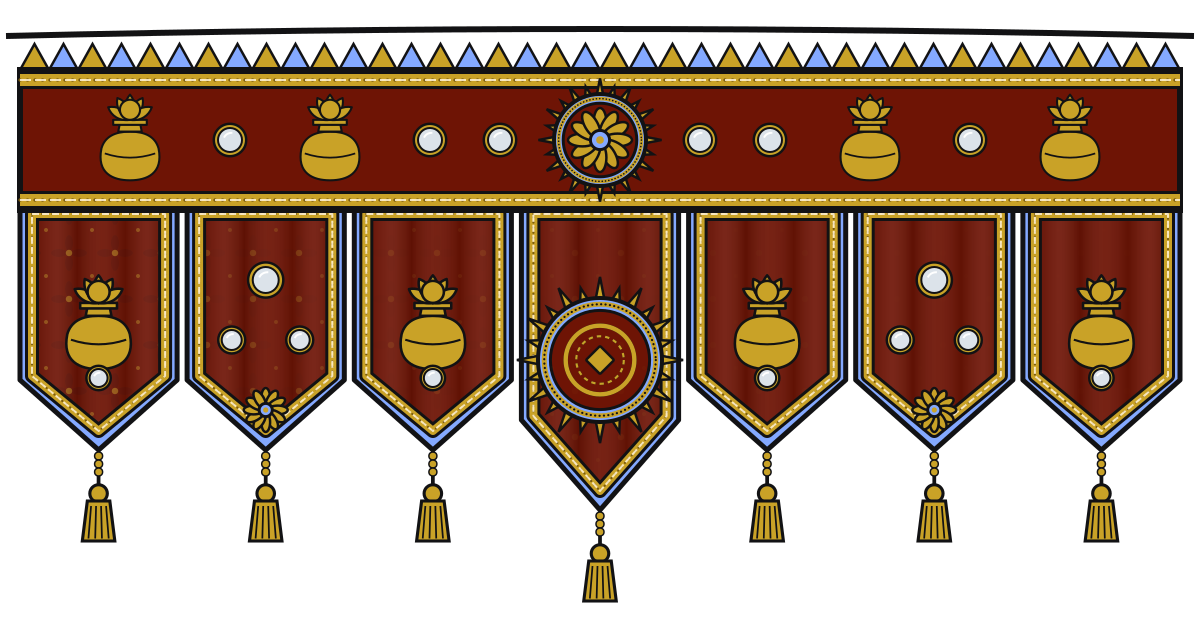

Historic banner
None known
New flag types
| Accessory | For this clan | Basis |
|---|---|---|
| A9 Pota-dhvaja · ship and trade flag For ships, caravans and markets | Not yet designed for this clan | Design |
| A10 Utsava-patāka · festival flag Light, bright flag for fairs and festivals | Not yet designed for this clan | Design |
| A11 Shoka-dhvaja · mourning flag White cloth with the emblem outline in the clan's metal | Not yet designed for this clan | Design |
7. Regalia
| Accessory | For this clan | Basis |
|---|---|---|
| E1 Chhatra · house parasol The ceremonial umbrella | Not yet designed for this clan | Design |
| E2 Chamara · fly-whisks The pair of whisks beside the head of the house | Not yet designed for this clan | Design |
| E3 Danda · staff of office Staff or scepter | Not yet designed for this clan | Design |
| E4 Simhasana · seat The seat of the house, covered in clan cloth | Not yet designed for this clan | Design |
| E5 Khetaka · shield A round shield; the Changi and Dhanush are its flag forms | Not yet designed for this clan | Regional tradition |
| E6 Kula-ayudha · clan weapon The weapon the clan honours | Not yet found for this clan | Under research |
8. Worn
| Accessory | For this clan | Basis |
|---|---|---|
| F1 Kula-vastra · clan cloth The clan's woven pattern in its kit colours | Not yet designed for this clan | Design |
| F2 Kirti-vastra · honour cloth A cloth earned for a deed, not inherited | Tiger-skin strips, with peacock and blue-jay feathers, worn by the priest after a man is killed by a tiger | Documented |
| F3 Kula-mala · garland flower The flower or leaf the clan wears as a garland | Marriage crowns of date-palm leaves at the wedding | Documented |
| F4 Chinha · house pin A metal badge with the pin emblem | Not yet designed for this clan | Design |
9. Records
| Accessory | For this clan | Basis |
|---|---|---|
| H1 Clan words A traditional line in the native script | · “” Under research: no line of the Bhattra's own words is in the extracts, and no classical line is linked to them with a source. | Documented |
| H2 Biruda · titles The house's title or titles | Not yet found for this clan | Under research |
| H3 Prashasti · praise genealogy The lineage as written at the head of a grant | Not yet found for this clan | Under research |
| H4 Vahi · clan register The book of the clan's births, marriages and deaths | Not yet found for this clan | Under research |
| H5 Rana-ghosha · war cry The clan's cry in battle or celebration | Not yet found for this clan | Under research |
10. VishwaVit · knower of the world
Game values are design choices for this project, not historical claims.
References
- Wikipedia, Bhottada people, read 2026-10-24, https://en.wikipedia.org/wiki/Bhottada_people
- R. V. Russell and Hira Lal, The Tribes and Castes of the Central Provinces of India, vol. 2 (London, 1916), Project Gutenberg eBook #22010, https://www.gutenberg.org/ebooks/22010
- Wikipedia, List of Scheduled Tribes in Odisha, read 2026-10-20, https://en.wikipedia.org/wiki/List_of_Scheduled_Tribes_in_Odisha
- Wikipedia, Bhatri language, read 2026-10-24, https://en.wikipedia.org/wiki/Bhatri_language
- "Bastaria Dussehra: Coming Together of Deities", Sahapedia, read 10 October 2026
- Tribes of Bastar, eTribal Tribune vol. 2, read 20 Oct 2026
- Sushree Mohanty, Indigenous Colours of Odisha: Handbook on 62 Tribes (KISS), read 2026-10-20, link
- Hareshwar Roy, "Bhatra Naat: Part and Parcel of Life", englitmail.com, 4 May 2020, read 2026-10-24 (student blog, weak source), https://www.englitmail.com/2020/05/bhatra-naat-part-and-parcel-of-life.html
- Koraput district website (koraput.odisha.gov.in), Major Tribes of Koraput, read 2026-10-24, https://koraput.odisha.gov.in/en/more/tribal-communities
- Odisha State Tribal Museum, Tribes of Odisha: Bhottada, read 2026-10-24, https://ostm.in/?p=5430
- Wikipedia, Tribals in Madhya Pradesh, read 2026-10-19, https://en.wikipedia.org/wiki/Tribals_in_Madhya_Pradesh
- dhammabharat.com, List of Scheduled Tribes in Maharashtra and Population of each Tribe (2011 Census), read 2026-10-10, https://dhammabharat.com/?p=13656
- R. V. Russell, The Tribes and Castes of the Central Provinces of India, vol. 3 (1916), Project Gutenberg #41424, read 2026-10-10, https://gutenberg.org/cache/epub/41424/pg41424-images.html
- Ministry of Tribal Affairs, State/UT-wise list of Scheduled Tribes, list dated 09-07-2024 (cited; not fetched)