The Bharia (भारिया), also listed as Bharia Bhumia[1], live in the Patalkot valley of Chhindwara district, Madhya Pradesh, a bowl-shaped valley in the Satpura range[2][3]. Russell (1916) called them a Dravidian tribe of about 50,000 and thought their name a contemptuous form of Bhar[4]. Their speech, Bhariati, is Indo-Aryan in the Wikipedia classification and Dravidian in GKToday's[2][5]. The Madhya Pradesh Scheduled Tribe list counts 1,93,230 in the 2011 census row 'Bharia Bhumia, etc.'[1], and the Bharias of Patalkot are a PVTG according to the Atlas. They are best known for their herbal knowledge of the valley's plants[6].
01Faith and deities
Sharda of Maihar, Baghelkhand
The presiding goddess of the clan's homeland or capital: a link of place, not a recorded clan tie.
| Deity or tradition | Place in the clan's life | Evidence |
|---|---|---|
| Dulha Deo | Family god, recorded with Bura Deo and Karua | [4] |
| Karua, the cobra | Family god; the snake Karua is also the figure of a legend | [4] |
| Bagheshwar | Tiger god; a tiger is invited on Diwali to drink gruel | [4] |
| Baradeo, Buradeo, Mutva Baba and Nagbaba | Deities the Bharia worship, as bharia.in lists them | [7] |
| Meghnad | Ravana's son and god of rains, worshipped for crop fertility; some villages have a 'Magnad Stamb' pillar | [8] |
| Own deities, unnamed | bharia.in says only that some people worship their own deities | [7] |
| KulDevi: Sharda Maa | Basis on the sheet: homeland shrine; note: Sharda of Maihar, Baghelkhand. No source in the extracts names a goddess for this people |
02Temples
No temple is named in the extracts. The Meghnad pillar, the 'Magnad Stamb', stands in some villages[8].
Built by the clan
Not recorded.
Given patronage or grants by the clan
Not recorded.
03Languages and scripts
| Language or script | Kind | Under the clan | Evidence |
|---|---|---|---|
| Bhariati living | Indo-Aryan (Wikipedia); called Dravidian by GKToday | Spoken by the Bharia, in Chhindwara, Seoni and Narsinghpur; the purest form is in Patalkot. Called 'parsi' or 'Bharia' in some villages[9] | [2][5][9] |
| Hindi | Used with outsiders | Patalkot speakers use Hindi with outsiders[3]. Russell (1916) wrote that the Bharias spoke only Hindi and had forgotten their own language[4] | [3][4] |
04Books and literature
No book by the Bharia is sourced in the extracts. The two works below describe them.
Written during the clan's history
| Work | Author | Kind | When | Link to the clan |
|---|---|---|---|---|
| The Tribes and Castes of the Central Provinces of India, vol. 2 | R. V. Russell and Hira Lal | Colonial ethnography | 1916 | [4] |
| Paataalkot mein Beejon ki Rishtedaaree (A relationship with seeds) | Baba Mayaram (trans. Anuradha Arjunwadkar) | Story, in translation | 2019 | [3] |
Given patronage by the clan
Not recorded.
05Thinkers and scholars
Not recorded.
No thinker from the Bharia is named in the extracts.
06Art and architecture
No painting, sculpture or architecture of the Bharia is sourced. The living crafts in the extracts are bamboo and wood work.
Painting and wall art
Not recorded.
Sculpture and temple art
Not recorded.
Temple and building architecture
Not recorded.
Weaving and textiles
Not recorded.
Clothing and jewellery
Not recorded.
Coins, pottery and crafts
| Art form | What it is | Era | Evidence |
|---|---|---|---|
| Bamboo and wood work | Most Bharias are bamboo and wood artisans | Present | [8] |
07History
Names and origin
Russell (1916) thought the name Bharia was a contemptuous form of Bhar, and gave a tradition of Raja Karna Deva of Dahal (c. 1040–1080 AD), a Bhar, and of a former home at Mahoba or Bandhogarh[4]. Some records link them to the Bhar group[5]. The Wikipedia article says the Bharias are originally Dravidian, but gives no source[2].
Karna Deva of Dahal (tradition)
Russell (1916) records a tradition that Raja Karna Deva, a former king of Dahal, the classical name of the Jubbulpore country, was a Bhar, and that the Bharias may have come into Jubbulpore in his period, which he takes as c. 1040–1080 AD. Russell's own words are 'it may be'; his link rests on equating Bharia with Bhar[4].
The same passage gives Mahoba or Bandhogarh as the Bharias' former home, in the country of the Bhars[4]. No other extract mentions Mahoba.
No source in the extracts links Karna to the Bhars or the Bharias. The Wikipedia article on Lakshmikarna does not mention Bhars or Bharias[10], and the first 100,000 characters of Crooke's vol. 2 do not mention Karna, Dahal or Mahoba[11]. Whether the Kalachuri king below is the Karna of the tradition is not stated by any extract; Russell's dates and the Wikipedia reign dates differ.
Lakshmikarna of the Kalachuris (dynastic history)
This is dynastic history, kept apart from the tradition above. Lakshmikarna (Karna), Kalachuri of Tripuri (Dahala, Chedi), reigned c. 1041–1073 CE, succeeding his father Gangeyadeva in 1041. He crowned his son Yashahkarna c. 1073, apparently abdicating[10]. The Kalachuri page gives their homeland as the Dahala mandala in Baghelkhand, part of the wider Chedi region, and identifies their capital Tripuri with present-day Tewar near Jabalpur[12].
His inscriptions date from 1042 (issued at Prayaga, found at Varanasi), 1047 (issued at Karna-tirtha, found at Goharwa) and 1048–49 (the Rewa stone)[10]. He subjugated the Chandela Devavarman (r. c. 1050–1060) and held part of Chandela territory for over a decade, until Kirttivarman ousted him before 1075–76. The extract does not name Mahoba in this connection[10].
Under the Gonds
Russell (1916) says the Bharias were closely associated with the Gonds[4], and the Wikipedia article says the same[2]. MP Tourism records that Bharias regard themselves as the younger brothers of the Gonds[8].
Isolation in the valley
MP Tourism reports the valley as isolated for over 500 years, and gives local lore that Bhonsle kings escaped the British through a tunnel[8]. The sources give these as local reports, not as dated history.
Recent development
The Bhaariya Vikas Abhikaran, a development agency, was set up for the Patalkot Bharias. The Vikalp Sangam article reports that the valley once practised dahiya (broadcast) farming, which was re-adopted through the initiative of Naresh Vishvas[3].
08Journey and migrations
The extracts give a tradition of a former home at Mahoba or Bandhogarh, and an account of the Bharia-Baigas of Mandla who came from Rewah. Neither is dated, and no migration route is sourced.
| When | From | To | Why | Evidence |
|---|---|---|---|---|
| Not dated (own account) | Rewah | Mandla district | Not stated; the Bharia-Baigas there are village priests[4] | [4] |
| Not dated (tradition) | Mahoba or Bandhogarh | Not stated | Former home in tradition[4] | [4] |
09Seats and lands
| Place | Role | Where today |
|---|---|---|
| Patalkot valley | Homeland; a bowl-shaped valley in the Satpura range, with 12 inhabited villages | Chhindwara district, Madhya Pradesh[3][8] |
| Dudhi river | Patalkot is its source | Madhya Pradesh[2] |
| Chhindwara, Seoni and Narsinghpur | Districts where the Bharia live | Madhya Pradesh[14] |
| Tamia and Harrai blocks | Blocks of Chhindwara where Bharias live; the purest speech is in Patalkot and the Harrai hillsides | Chhindwara, Madhya Pradesh[14][9] |
| Jubbulpore, Chhindwara and Bilaspur | Where Russell (1916) found the Bharias, about half in Jubbulpore | 1916 distribution[4] |
| Mandla | Where the Bharia-Baiga village priests live | Madhya Pradesh[4] |
| Maharashtra | Listed on the Maharashtra Scheduled Tribe list | Maharashtra |
| Mahoba or Bandhogarh | Former home in a tradition | Not stated[4] |
10Notable figures
| Name | Role | Era | Known from |
|---|---|---|---|
| Raja Karna Deva of Dahal | A Bhar ruler in the Bharia tradition | c. 1040–1080 AD (tradition) | [4] |
| Karua legend | A snake, born in a Bharia family, burnt in an oven and deified | Not dated | [4] |
| Bhagats | Herbal healers, as the Wikipedia article names them (page tagged 'citation needed') | Not dated | [2] |
| Naresh Vishvas | Led the re-adoption of dahiya (broadcast) farming in Patalkot | Recent (2019 article) | [3] |
11Allies, rivals and marriages
| People | Relationship | When |
|---|---|---|
| Gonds | Closely associated; Bharias call themselves the younger brothers of the Gonds[4][8] | 1916; present |
| Rajjhars | Say they descend from a Raja and a Bharia woman; Bharias acknowledge the link but refuse water from them[4] | 1916 |
| Baiga (Bharia-Baigas) | Village priests of Mandla who say they came from Rewah[4] | 1916 |
| Kols | Bharias, Savars and Khairwars of the Central Provinces call themselves Kols[15] | 1916 |
| Bhar | Name link: Bharia thought to be a contemptuous form of Bhar[4][5] | Not dated |
| Bhumia (ST-032) | Bhumia, the Lord of the Soil, is the title of the Bharia village priest[8] | Present |
12Society and livelihood
The Bharias of Patalkot are forest-dwelling, with a low literacy rate according to bharia.in, and have a panchayat that keeps order[5]. Their society was centred on hunting and fishing, and their village priest is the Bhumia[2][14][8][4].
Government and social order
| Institution or group | What it was | Evidence |
|---|---|---|
| Panchayat (पंचायत) | Keeps order in the community | [5] |
| Bhumia | Village priest; the title means the Lord of the Soil | [4][8] |
| Bhumka or padihar | Herbal healers and herb sellers | [6][8] |
| Marriage | Proposals come from the groom's side. As recorded in 1916: a midua burlesque dance, the bride weeps, and gharjian service[5][4] | [5][4] |
Livelihood over time
| Era | Livelihood | Evidence |
|---|---|---|
| Traditional | Hunting and fishing; shifting cultivation; gathering tubers, roots and fruits | [2][5] |
| Present | Corn, goats and chickens; herbs, berries, wood and bamboo; most are bamboo and wood artisans | [8] |
| Present | Irrigation and chemical farming have been tried. Forest foods listed: Bada Kaandaa, mushrooms and greens | [3] |
| Present | Many now work in forest department offices | [5] |
13Sub-clans and related clans
The GKToday Hindi list (2019) names 11 Bharia clans. Russell (1916) gives 51 exogamous groups; the extract names 18 of them below, and also notes Dhur Bharias in Bilaspur. Russell's notes: Chandel is the lowest group and is used by those who do not know their clan; Kaitha takes its name from the kaith tree; Karondiha from the karonda; Magarha uses a crocodile image of flour; Sonwani readmits by gold water[4].
| Clan | Relation | Where | Size | In the Atlas | Evidence |
|---|---|---|---|---|---|
| Thakariya ठाकरिया | Sub-clan | new clan candidate | [5] | ||
| Angariya अंगारिया | Sub-clan | new clan candidate | [5] | ||
| Bapothiya बापोथिया | Sub-clan | new clan candidate | [5] | ||
| Bhardiya भारदिया | Sub-clan | new clan candidate | [5] | ||
| Bijariya बिजारिया | Sub-clan | new clan candidate | [5] | ||
| Mehaniya मेहानिया | Sub-clan | new clan candidate | [5] | ||
| Amoliya अमोलिया | Sub-clan | new clan candidate | [5] | ||
| Papchaliya पपचलिया | Sub-clan | new clan candidate | [5] | ||
| Nahal नाहल | Sub-clan | new clan candidate | [5] | ||
| Rawatiya रावतिया | Sub-clan | new clan candidate | [5] | ||
| Gadariya गडरिया | Sub-clan | new clan candidate | [5] | ||
| Agaria | Sub-clan | new clan candidate | [4] | ||
| Ahirwar | Sub-clan | new clan candidate | [4] | ||
| Bamhania | Sub-clan | new clan candidate | [4] | ||
| Chandel | Sub-clan | new clan candidate | [4] | ||
| Dagdoha | Sub-clan | new clan candidate | [4] | ||
| Dhurua | Sub-clan | new clan candidate | [4] | ||
| Kuanpa | Sub-clan | new clan candidate | [4] | ||
| Kurka | Sub-clan | new clan candidate | [4] | ||
| Maravi | Sub-clan | new clan candidate | [4] | ||
| Rathor | Sub-clan | same name as ST-487: check | [4] | ||
| Samarba | Sub-clan | new clan candidate | [4] | ||
| Yarkara | Sub-clan | new clan candidate | [4] | ||
| Gambhele | Sub-clan | new clan candidate | [4] | ||
| Kaitha | Sub-clan | new clan candidate | [4] | ||
| Karondiha | Sub-clan | new clan candidate | [4] | ||
| Magarha | Sub-clan | new clan candidate | [4] | ||
| Sonwani | Sub-clan | same name as ST-556: check | [4] | ||
| Binjhwar (Binjha) | Related people | ST-039 | [4] | ||
| Dhur Bharia | Branch | Bilaspur | new clan candidate | [4] | |
| Rajjhar | Related people | new clan candidate | [4] | ||
| Savar | Related people | Central Provinces | ST-285 | [15] | |
| Khairwar | Related people | Central Provinces | ST-127 | [15] | |
| Kol | Related people | Central Provinces | ST-141 | [15] | |
| Gond | Related people | Patalkot valley, with the Bharia | ST-088 | [2][8] | |
| Baiga | Related people | Mandla (Bharia-Baigas) | ST-014 | [4] | |
| Bhumia | Related people | Title of the Bharia village priest | ST-032 | [8][4] | |
| Bhar भार | Related people | new clan candidate | [5][4] |
Clans marked "new clan candidate" are not in the Atlas yet.
14Surnames
Not recorded.
15Songs and music
The extracts name one traditional folk song and several dances. No song text is given, so no excerpt is quoted.
Shaitaam living
A traditional folk song of the Patalkot valley[3]
Instruments and styles
| Instrument or style | What it is | Evidence |
|---|---|---|
| Bhadam (Bharam) | Wedding dance with dhol, timki and cymbals[8] | [8] |
| Saitam (Setam) | A dance with men and women together[8] | [8] |
| Saila and Ahirai | Named as dances, without a description[8] | [8] |
| Danda and Gedee | Dances named in the valley[3] | [3] |
| Holi bonfire singing | Singing through the night round the Holi bonfire[3] | [3] |
16Poems, lullabies and children's rhymes
None recorded yet.
17Stories, legends and proverbs
Stories and legends
| Story | What happens | Told by | Evidence |
|---|---|---|---|
| Bhasmasura | A legend of Shiva and Mohini, given by MP Tourism for the valley | Valley tradition[8] | [8] |
| Sita's Patal Pradesh | Sita vanished into the earth, and the valley is called her Patal Pradesh | Valley tradition[8] | [8] |
| Arjun and bharru grass | A legend that Arjun made the Bharias from bharru grass | Recorded by Russell 1916[4] | [4] |
| The horse | God ordered the Bharias never to be soldiers and gave them a winnowing-fan and a broom | Recorded by Russell 1916[4] | [4] |
| Karua the snake legend | Born in a Bharia family, burnt in an oven, and then deified | Recorded by Russell 1916[4] | [4] |
Proverbs and sayings
| Saying | Meaning | Evidence |
|---|---|---|
| 'Bharia bhwaka, pwanda langwata' (transliterated; no native script in the extract) | Recorded by Russell 1916: 'the Bharia is a devil who covers his loins with a strip of cloth'. The extract does not say whether it is the people's own saying | [4] |
| 'The Bharia came down from the hills and got burnt by a cinder, so that his face is black.' | Recorded by Russell 1916. The extract does not say whether it is the people's own saying | [4] |
| 'Pay for the marriage of a Bharia and he is your bond-slave for ever.' | Recorded by Russell 1916. The extract does not say whether it is the people's own saying | [4] |
18Festivals and fairs
| Festival or fair | When | Where | What happens |
|---|---|---|---|
| Holi · होली | Not stated | Patalkot | All-night singing round the bonfire[3]; Holi is on bharia.in's list[7] |
| Diwali · दिवाली | Not stated | Patalkot | Cattle are washed, decorated with peacock feathers, geru and ribbons, and worshipped[3]. A tiger is invited to drink gruel[4] |
| Pola | Not stated | Patalkot | Stilts (baans ki gedi) and clay bullocks[3] |
| Nag Panchami | Not stated | Patalkot | Cobras are worshipped[3] |
| Hariyali Amavasya (Harijevti) | Not stated | Patalkot | Fields are worshipped[3] |
| Shivaratri · शिवरात्रि | Not stated | Not stated | Listed as a festival[5][7] |
| Akhati · अखाती | Not stated | Not stated | Listed as a festival[5][7] |
| Bujalia | Not stated | Not stated | Listed as a festival[7] |
| Rakhi | Not stated | Not stated | Listed as a festival[7] |
19Food, dress and games
Food
| Item | What it is | Evidence |
|---|---|---|
| Forest foods | Bada Kaandaa, mushrooms and greens | [3] |
| Kutki and dishes | Kutki with ballar daal, pej soup, and mahua ka bhurka | [3] |
Dress
| Item | What it is | Evidence |
|---|---|---|
| Red cloth, lac beads and spangles | Worn as recorded in 1916; iron wrist ring and tattoos are in Astitva | [4] |
Games and martial arts
Not recorded.
Tags: living still practised · revived brought back after a break · lost known only from records · research reported but not yet confirmed from a source. Songs and poems under copyright are listed by title only; restricted or sacred material is noted without its content.
20Status today
The Bharia are listed as a Scheduled Tribe (list dated 09-07-2024, Atlas), and their Patalkot community is a PVTG according to the Atlas. Many now work in forest department offices[5], and younger Bharias pursue education and jobs[8].
Who carries the name today
| Community | Link | Basis | Evidence |
|---|---|---|---|
| Rajjhars | Community tradition | [4] |
Recognised heritage
| What | Recognition | Evidence |
|---|---|---|
| Scheduled Tribe | Ministry of Tribal Affairs list, dated 09-07-2024 | |
| Particularly Vulnerable Tribal Group | Bharias of Patalkot; a development agency, the Bhaariya Vikas Abhikaran, was set up for them[3] | [3] |
Not reviewed by the Bharia community. Speakers prefer to be identified as Bharia[9].
21For children
The valley of the herb-healers
Far away, in the green Patalkot valley, live the Bharia people. The valley is deep, with hills all around it. The Bharia know the plants of the forest very well. When someone is sick, a healer called a bhumka gathers herbs from the hills, and many families use them instead of going to a doctor. Their houses are made of wood, stone and bamboo. At Diwali, the cattle are washed and decorated with peacock feathers. At Holi, the people sing all night round the bonfire.
Riddle: Which valley lies about 400 metres below Tamia, where the Bharia live? (Patalkot)
22Across the project
| Project | What carries this clan | Status |
|---|---|---|
| Atlas of the Janas | Homeland: the Patalkot valley, Chhindwara, Madhya Pradesh | [8] |
| KulDevi and GrahDevi | KulDevi, from the Atlas: Sharda Maa (basis: homeland shrine); family Saraswati (12 names). No source in the extracts names a goddess for this people | From the Atlas |
| Planet naming | No planet is named for the Bharia in the extracts | — |
| Renaming and waters | The Dudhi river rises in Patalkot[2] | Not yet drawn on the map |
23Open questions
- The Sharda Maa KulDevi in the Atlas has no source in the extracts. The bharia.in page names no goddess for this people.
- Which sub-clans and surnames are used today? The GKToday list gives 11 clan names, and Russell's 51 groups are only partly named in the extract.
- Named temples or shrines: none in the extracts. Check the Sabrang India and inz-monishmishra pages, which the pack lists as unread.
- Native-script songs and proverbs: the Hindi Bharatdiscovery page did not fetch. Only transliterations are in the extracts.
- Bhar origin (Russell 1916, GKToday) against the Dravidian claim (Wikipedia, unsourced): which is the stronger basis?
- Dates for the Rewah tradition and for the Mahoba or Bandhogarh tradition. Russell ties a possible move into Jubbulpore to Karna Deva's period (c. 1040–1080 AD), not to Mahoba, and no extract covers Mahoba itself.
- The road into Patalkot is still undated; the Wikipedia page gives no date for it.
- Karna Deva of the tradition and Lakshmikarna of the Kalachuris: no extract says they are the same man, and no source links either to the Bhars. Dates differ: Russell c. 1040–1080 AD, Wikipedia c. 1041–1073 CE.
- The emblem is a placeholder: the Atlas's design idea (healing herbs in a deep valley) is not yet drawn.
- The name 'Bharia' is the only line in the words block: no motto or saying of the people's own is in the extracts.
- PVTG list date: no extract gives a list date for the Patalkot PVTG status. It rests in the Atlas and on the undated 2019 Vikalp Sangam article ("PVTG"), so the status is not dated here.
- Population, contradiction: the Madhya Pradesh ST row gives 1,93,230 (2011 census, a multi-name row 'Bharia Bhumia, etc.')[1], while bharia.in estimates about 50,000 across Chhindwara, Seoni and Narsinghpur, with no year[14]. Which figure applies to the Bharia alone is not settled.
- Language, contradiction: Russell (1916) says the Bharias spoke only Hindi and had forgotten their own language[4], while bharia.in and Vikalp Sangam describe Bhariati as spoken today, purest in Patalkot[9][3].
24Astitva
अस्तित्व · being, existence: everything by which the clan is known
Tattoos recorded in 1916 are a cock, a crown, a chair, a pitcher stand, a sieve and a dhandha, with an iron wrist ring[4]. In Patalkot, bells hang on bullocks' necks[3]. Neither has an accessory ID.
Every clan has every accessory, royal objects included. Each one says how it is known: Documented This clan's own object is recorded. · Regional tradition Recorded for the region or for peoples like this one, not for this clan. · Design Made for this project, with no historical claim. · Under research To be found for this clan from sources. Legends and titles are written in the clan's own script.
1. Seals and coins
| Accessory | For this clan | Basis |
|---|---|---|
| B1 Rajamudra · house seal Round seal with the clan emblem and a short legend in the clan's script | Not yet designed for this clan | Design |
| B2 Anguliya-mudra · signet ring Personal seal ring of the head of the house | Not yet designed for this clan | Design |
| B3 Chhapa · house stamp Ink or block stamp for letters, goods and cloth | Not yet designed for this clan | Design |
| B4 Tamrapatra · charter plate Copper-plate grant on a ring, closed with the house seal | Not yet designed for this clan | Design |
| B5 Shreni-mudra · guild or trade seal Seal for the clan's trade, craft or caravan | Not yet designed for this clan | Design |
| C1 Clan coin Emblem or deity on one side, a legend in the clan's script | Not yet designed for this clan | Design |
| C2 Coin die The die that strikes the coin | Not yet designed for this clan | Design |
2. Living symbols
| Accessory | For this clan | Basis |
|---|---|---|
| I1 Totem trio The tree, bird and animal the clan protects | Not yet found for this clan | Under research |
| I2 Kaval-maram · guardian tree The tree that stands at the clan's seat | Not yet found for this clan | Under research |
3. Stone and gate
| Accessory | For this clan | Basis |
|---|---|---|
| G1 Torana · gateway The built gate of the seat; the cloth Toran hangs in it | Not yet designed for this clan | Regional tradition |
| G2 Viragallu · hero stone Carved panel stone for a member who died defending the clan | Not yet designed for this clan | Regional tradition |
| G3 Kula-shila · clan stones Standing and table stones that remember the ancestors | Not yet designed for this clan | Design |
| G4 Jayastambha · victory pillar A pillar raised for a victory | Not yet designed for this clan | Design |
| G5 Sima-shila · boundary stone Marks the clan's land, with a line in the native script | Not yet designed for this clan | Design |
4. Sounds
| Accessory | For this clan | Basis |
|---|---|---|
| D1 Pancha-mahashabda · five great sounds The right to five instruments | Not yet designed for this clan | Design |
| D2 Shankha · clan conch The clan's own named war conch | Not yet designed for this clan | Design |
| D3 Murasu · house drums Three drums: war, charity and justice | Not yet designed for this clan | Design |
5. Kit: colours, metals and emblems
No seal, coin, banner or totem of the Bharia is recorded in the extracts. The emblem on this page is a placeholder until a documented symbol is found. The flag type in the Atlas is the Changi, and its image is a design idea.
| Part of the kit | This clan |
|---|---|
| Field | Deep Brick #7E2A1E |
| Accent | Intense Electric Blue #84A9FF |
| Emblem colour | Metallic Gold #C9A227 |
| Zari metal | Gold |
| Main emblem | Healing herbs in a deep valley |
| Second image | A mortar and pestle |
| Night and day | Every visual accessory has two versions: by night the emblem on the dark field, by day the clan's field colour on cloth woven from its metal. |
6. Flags
Every clan has every flag type; the type says the occasion and the colours say the clan. The outlined card is the flag the Atlas assigns.
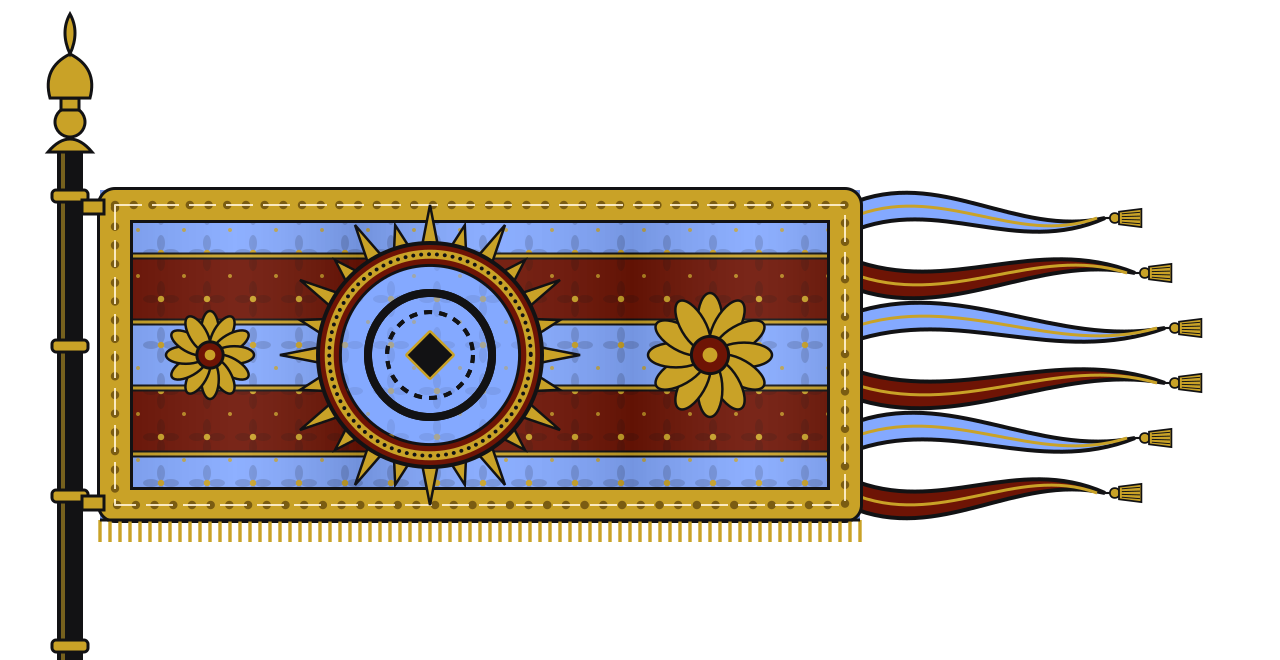
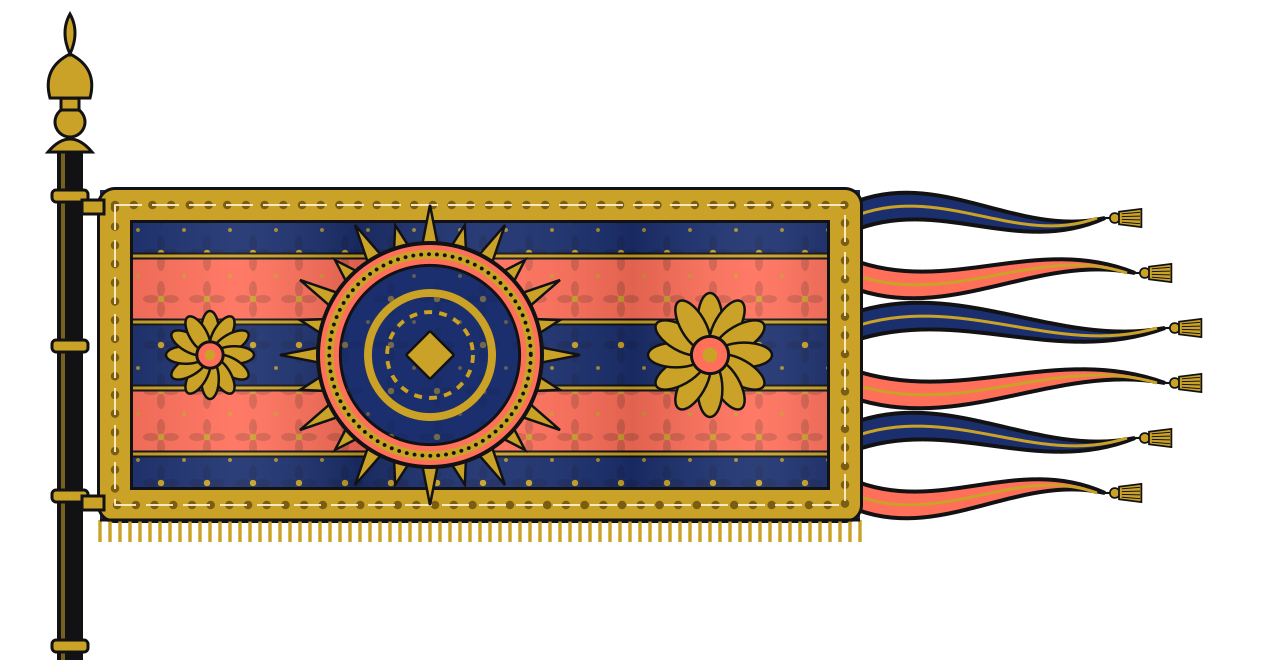
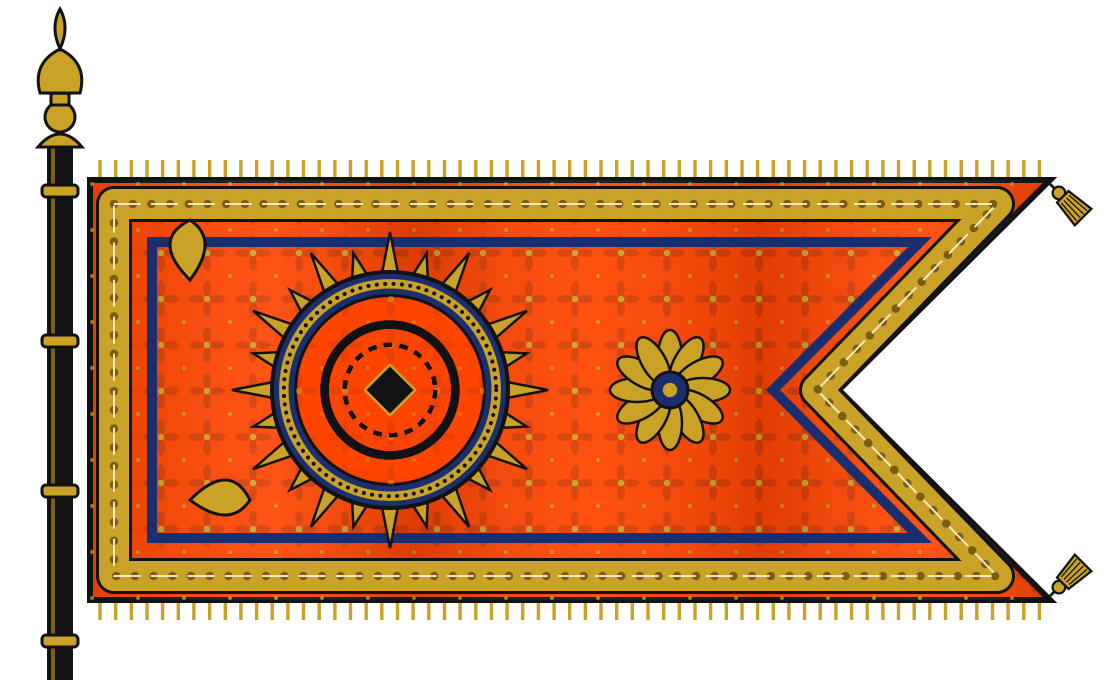
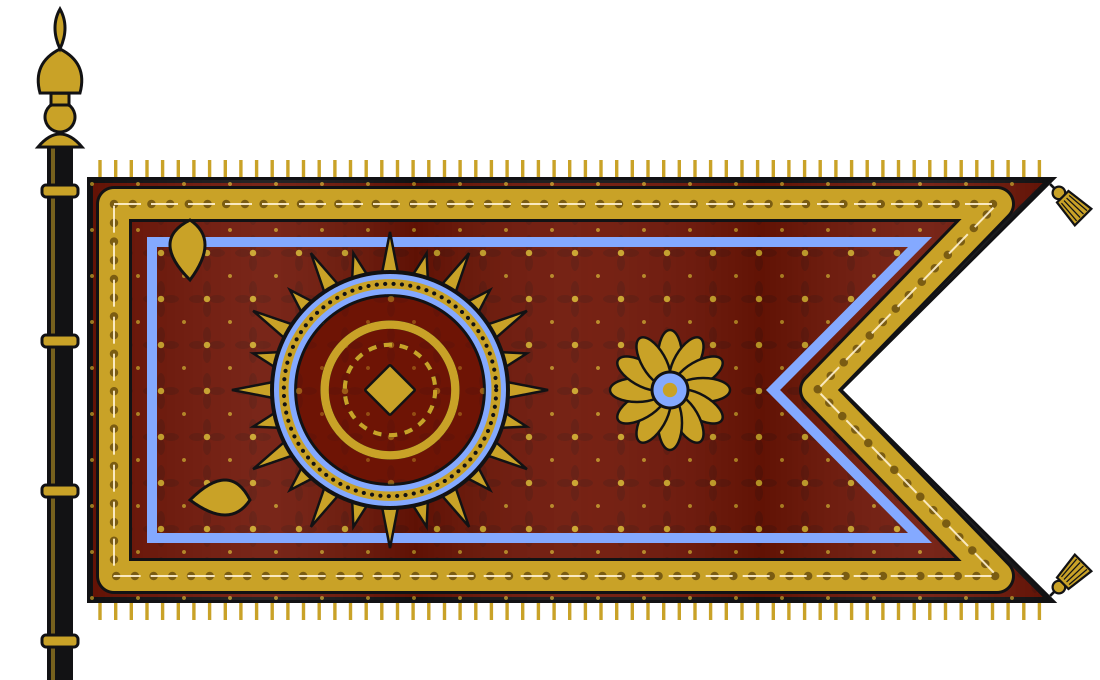

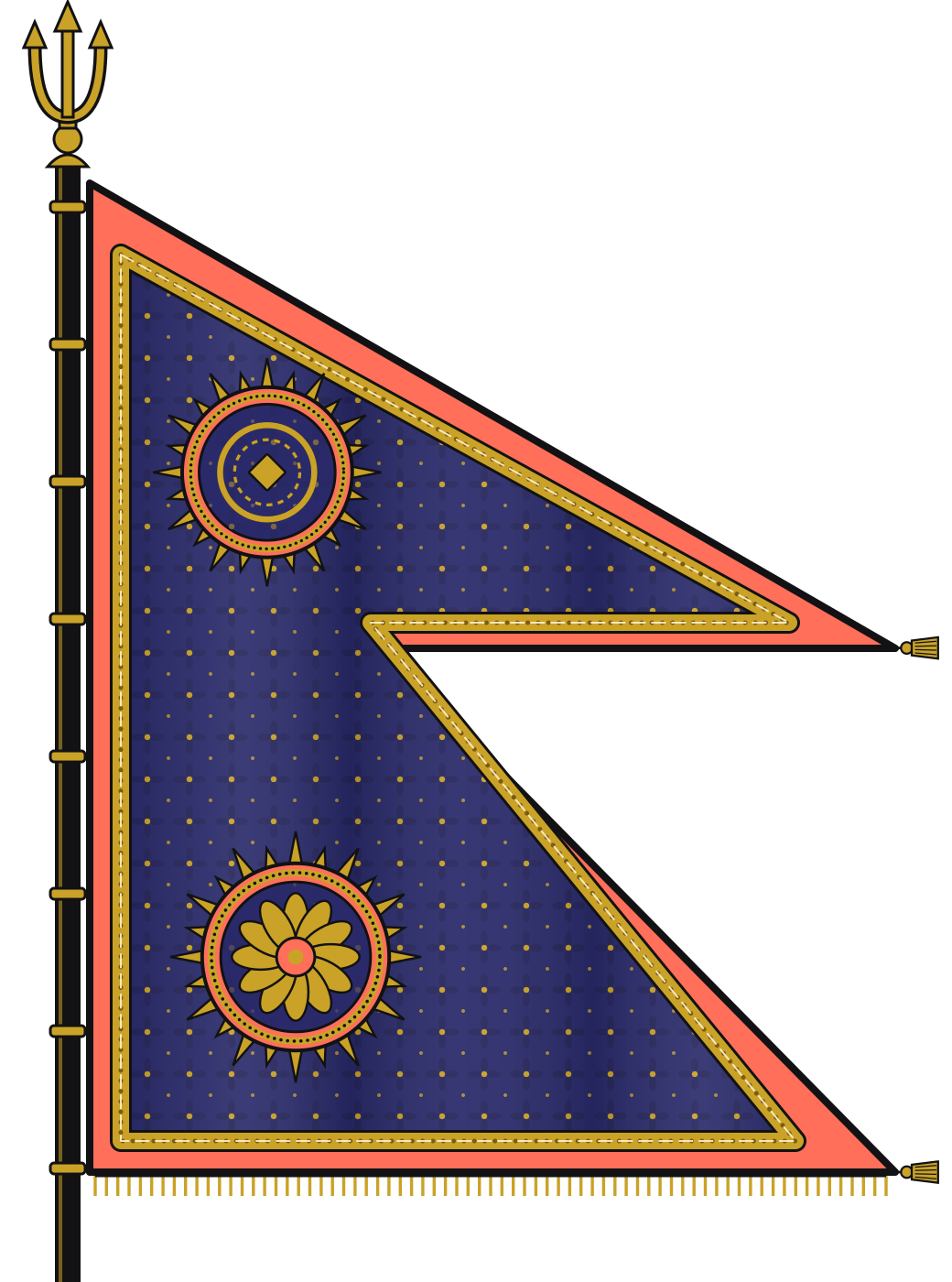

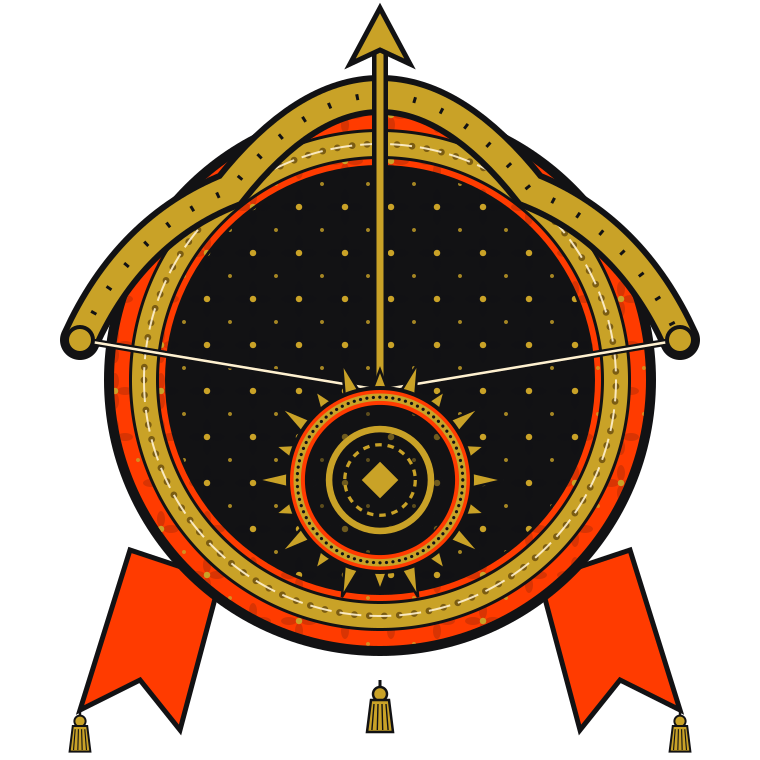
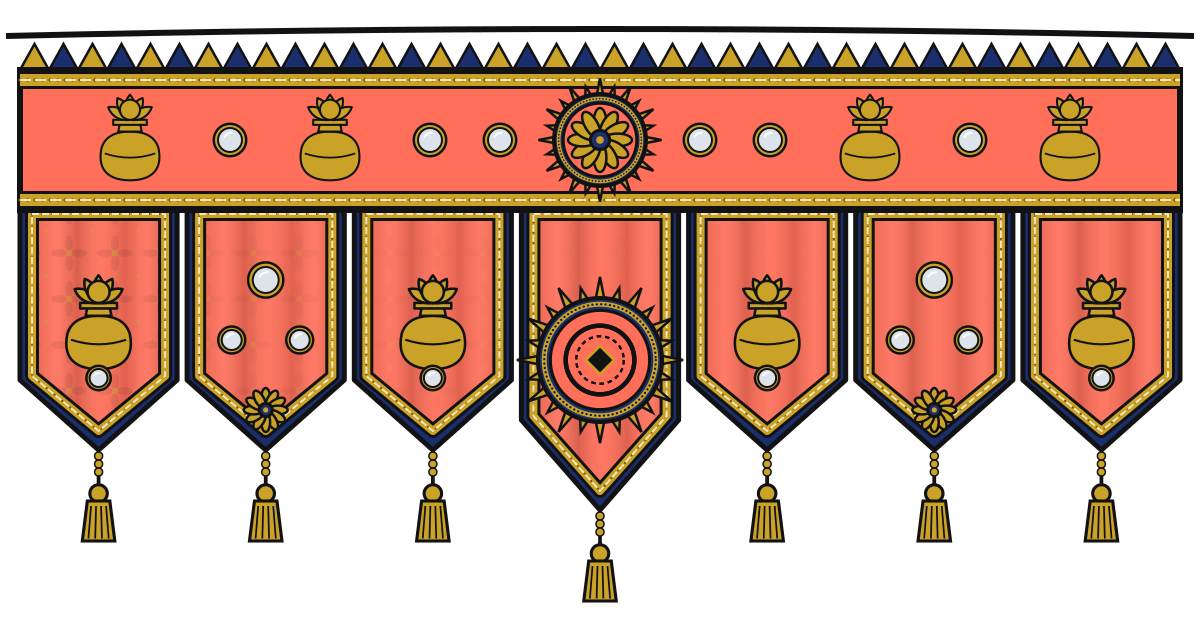
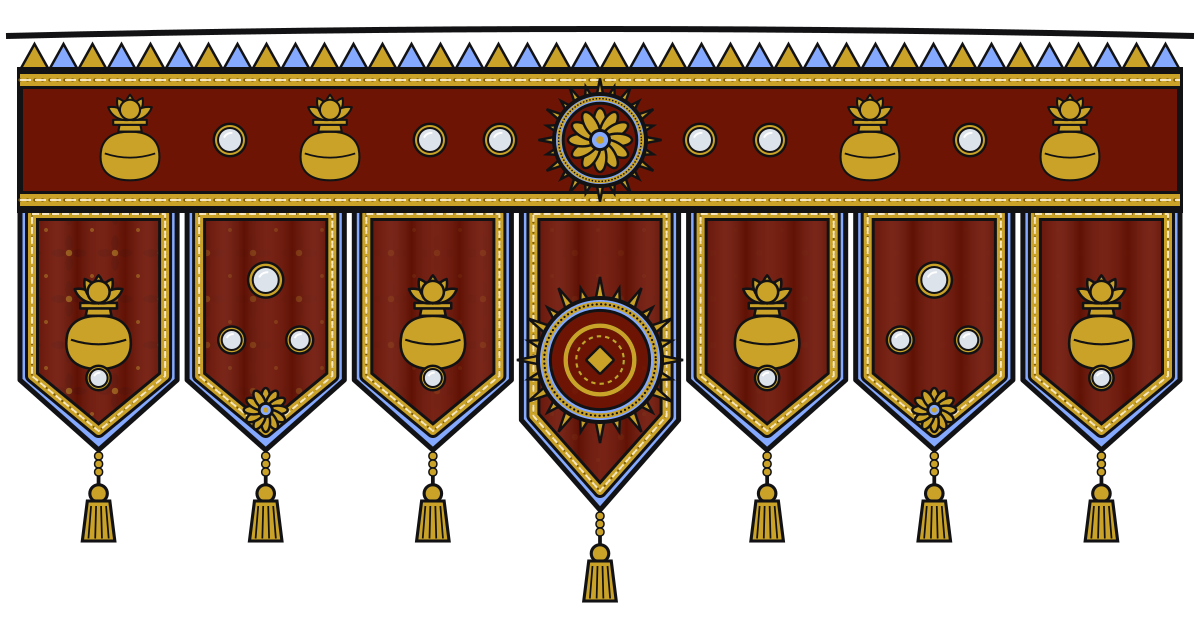

Historic banner
None known
New flag types
| Accessory | For this clan | Basis |
|---|---|---|
| A9 Pota-dhvaja · ship and trade flag For ships, caravans and markets | Not yet designed for this clan | Design |
| A10 Utsava-patāka · festival flag Light, bright flag for fairs and festivals | Not yet designed for this clan | Design |
| A11 Shoka-dhvaja · mourning flag White cloth with the emblem outline in the clan's metal | Not yet designed for this clan | Design |
7. Regalia
| Accessory | For this clan | Basis |
|---|---|---|
| E1 Chhatra · house parasol The ceremonial umbrella | Not yet designed for this clan | Design |
| E2 Chamara · fly-whisks The pair of whisks beside the head of the house | Not yet designed for this clan | Design |
| E3 Danda · staff of office Staff or scepter | Not yet designed for this clan | Design |
| E4 Simhasana · seat The seat of the house, covered in clan cloth | Not yet designed for this clan | Design |
| E5 Khetaka · shield A round shield; the Changi and Dhanush are its flag forms | Not yet designed for this clan | Regional tradition |
| E6 Kula-ayudha · clan weapon The weapon the clan honours | Not yet found for this clan | Under research |
8. Worn
| Accessory | For this clan | Basis |
|---|---|---|
| F1 Kula-vastra · clan cloth The clan's woven pattern in its kit colours | Red cloth, worn as recorded in 1916. The extracts give no woven pattern | Documented |
| F2 Kirti-vastra · honour cloth A cloth earned for a deed, not inherited | Not yet designed for this clan | Design |
| F3 Kula-mala · garland flower The flower or leaf the clan wears as a garland | Not yet found for this clan | Under research |
| F4 Chinha · house pin A metal badge with the pin emblem | Not yet designed for this clan | Design |
9. Records
| Accessory | For this clan | Basis |
|---|---|---|
| H1 Clan words A traditional line in the native script | भारिया · “Bharia” The people's own name in Devanagari, as GKToday Hindi (2019) gives it[5]. No line of their own is recorded in the extracts. | Documented |
| H2 Biruda · titles The house's title or titles | Not yet found for this clan | Under research |
| H3 Prashasti · praise genealogy The lineage as written at the head of a grant | Not yet found for this clan | Under research |
| H4 Vahi · clan register The book of the clan's births, marriages and deaths | Not yet found for this clan | Under research |
| H5 Rana-ghosha · war cry The clan's cry in battle or celebration | Not yet found for this clan | Under research |
10. VishwaVit · knower of the world
Game values are design choices for this project, not historical claims.
References
- Wikipedia, Tribals in Madhya Pradesh, read 2026-10-19, https://en.wikipedia.org/wiki/Tribals_in_Madhya_Pradesh
- Wikipedia, Bharia people, read 4 Nov 2026, https://en.wikipedia.org/wiki/Bharia_people
- Baba Mayaram (trans. Anuradha Arjunwadkar), A Relationship with seeds - the Paataalkot story, Vikalp Sangam, 6 Nov 2019, read 4 Nov 2026, https://vikalpsangam.org/article/paatalkot-translation/
- R. V. Russell and Hira Lal, The Tribes and Castes of the Central Provinces of India, vol. 2 (London, 1916), Project Gutenberg eBook #22010, https://www.gutenberg.org/ebooks/22010
- GKToday Hindi, भारिया जनजाति, मध्य प्रदेश (22 Sep 2019), read 4 Nov 2026, GKToday Hindi page
- bharia.in, Bharia Tribe Speciality, read 4 Nov 2026, https://bharia.in/en/node/17
- bharia.in, Festivals and Fairs of the Bharia tribe (node 15), read 30 Oct 2026, https://bharia.in/en/node/15
- MP Tourism, Bharia tribes, Patalkot Valley, read 4 Nov 2026, https://www.mptourism.com/bharia-tribes-patalkot-valley-madhya-pradesh.html
- bharia.in, About Bharia language, read 4 Nov 2026, https://bharia.in/en/node/5
- Wikipedia, Lakshmikarna, read 2026-11-08, https://en.wikipedia.org/wiki/Lakshmikarna
- W. Crooke, The Tribes and Castes of the North-Western Provinces and Oudh, vol. 2 (Calcutta, 1896), Project Gutenberg eBook #78543, read 2026-11-08, https://gutenberg.org/cache/epub/78543/pg78543-images.html
- Wikipedia, Kalachuris of Tripuri, read 2026-11-05 (cached), https://en.wikipedia.org/wiki/Kalachuris_of_Tripuri
- Bharatpedia, Bandhogarh State, read 2026-11-08, https://en.bharatpedia.org/wiki/Bandhogarh_State
- bharia.in, Demographic Details and Location of the Bharia Tribe, read 4 Nov 2026, https://bharia.in/en/node/4
- R. V. Russell, The Tribes and Castes of the Central Provinces of India, vol. 3 (1916), Project Gutenberg #41424, https://www.gutenberg.org/ebooks/41424
- dhammabharat.com, List of Scheduled Tribes in Maharashtra and Population of each Tribe (2011 Census), read 2026-10-10, https://dhammabharat.com/?p=13656