The Bhaina (भैईना, as Joshua Project prints it[1]) are a people of the forest tract between the Satpura range and the Chota Nagpur plateau, principally in Bilaspur district, where about 17,000 were returned in the 1911 census[2]. In 1916 Russell and Hira Lal wrote that they are 'of mixed descent' and derived principally from the Baigas and Kawars, a view the authors gave as their own inference[2]. Their principal deity in Bilaspur was Nakti Devi, and the Atlas's KulDevi for the people is the same goddess, documented from that account[2]. The people are listed as Scheduled Tribes in the 2011 census rows of Madhya Pradesh and Maharashtra[3][4], and the Ministry of Tribal Affairs list dated 09-07-2024 includes them, as the Atlas records it.
01Faith and deities
The clan's own: principal deity in Bilaspur, Russell and Hira Lal 1916; the Atlas's KulDevi is the same goddess[2]
Nakti Devi: "Their principal deity in Bilaspur is Nakti Devi" (Russell and Hira Lal 1916; accepted by the owner 10 Oct 2026; family assigned by the sweep)
A recorded tie between the clan and the goddess.
| Deity or tradition | Place in the clan's life | Evidence |
|---|---|---|
| Nakti Devi | Principal deity in Bilaspur: rice is laid on a floor washed with cowdung, ghi burnt, a hen made to eat the rice and then offered; a cock after a man's death, a hen after a woman's[2] | russell_1916_v2 |
| Thakur Deo | Deity of cultivation, worshipped the day before the autumn sowing; the Baiga leads the rite[2] | russell_1916_v2 |
| Dulhadeo and Thakur Dec | Village deities named by Joshua Project (spelling as printed)[1] | joshuaproject_bhaina |
| Sept totems | The septs' animals are not killed; at weddings the bride's father makes a clay image of the groom's sept animal and the groom worships it[2] | russell_1916_v2 |
02Temples
No temple is recorded in the extracts.
Built by the clan
Not recorded.
Given patronage or grants by the clan
Not recorded.
03Languages and scripts
| Language or script | Kind | Under the clan | Evidence |
|---|---|---|---|
| Native dialect (unnamed) lost | Forgotten by 1916, when the people spoke Hindi[2] | Under the clan | russell_1916_v2 |
| Chhattisgarhi living | Primary language today, about 57,000 speakers (Joshua Project)[1] | Under the clan | joshuaproject_bhaina |
| Hindi living | 15,000 speakers (Joshua Project)[1] | Under the clan | joshuaproject_bhaina |
04Books and literature
The extracts name no book by a Bhaina author. The 1997 thesis is a study of the people; its full text was not read.
Written during the clan's history
| Work | Author | Kind | When | Link to the clan |
|---|---|---|---|---|
| A study of genetic demography and variability in a tribal population: The Bhaina of Madhya Pradesh | Bharati Mishra | Thesis (anthropology) | 1997 | [5] |
Given patronage by the clan
Not recorded.
05Thinkers and scholars
| Name | Field | Era | Contribution |
|---|---|---|---|
| R. V. Russell and Hira Lal | Ethnographers (Central Provinces) | 1916 | The Tribes and Castes of the Central Provinces of India[2] |
| Bharati Mishra | Anthropology (genetic demography) | 1997 | Thesis on the Bhaina of Madhya Pradesh[5] |
The two authors above are the sources named in the extracts.
06Art and architecture
No painting, sculpture, architecture, textile or craft is recorded in the extracts.
Painting and wall art
Not recorded.
Sculpture and temple art
Not recorded.
Temple and building architecture
Not recorded.
Weaving and textiles
Not recorded.
Clothing and jewellery
Not recorded.
Coins, pottery and crafts
Not recorded.
07History
Origins, as the 1916 authors reasoned
Russell and Hira Lal describe the Bhainas as 'of mixed descent and appears to have been derived principally from the Baigas and Kawars', and say the name 'would appear to have originated with the Baiga tribe'; the authors give this as their inference[2].
Forts and chiefs (1916 account)
The authors infer that the Bhainas were older residents than the Gonds and Kawars, and they attribute the oldest forts in Bilaspur to them[2]. A chief of the tribe is remembered as ruling at Bilaigarh, and the tribe was said to have been dominant at Pendra, where the estate is now held by a Kawar[2].
The Phuljhar account {LEG}
A manuscript history of the Phuljhar chiefs records a Bhaina king holding the country when the Gonds invaded from Chanda. The Bhaina and his soldiers took refuge in an underground chamber with two exits; the Gonds filled the openings with grass and burnt them[2]. On this account the tribe would not enter Phuljhar territory in 1916[2].
08Journey and migrations
The extracts record one move, which the 1916 authors give as a tale rather than a dated event.
| When | From | To | Why | Evidence |
|---|---|---|---|---|
| Undated (tale) | Phuljhar, Raipur | Not stated in the extract | Expelled by the Gonds, according to the Phuljhar manuscript history legend | [2] |
09Seats and lands
| Place | Role | Where today |
|---|---|---|
| Bilaspur district and adjoining forest tract | Principal area of the people in 1916 | Chhattisgarh (Atlas: Bilaspur, Korba) |
| Bilaigarh | Where a Bhaina chief is remembered as ruling | Under research |
| Pendra | Where the Bhainas were said to be dominant; the estate is held by a Kawar in 1916 | Under research |
| Phuljhar, Raipur legend | Country of a Bhaina king in the manuscript history; the tribe would not enter it in 1916 | Under research |
10Notable figures
| Name | Role | Era | Known from |
|---|---|---|---|
| Unnamed Bhaina chief | Remembered as ruling at Bilaigarh | Undated | [2] |
| Unnamed Bhaina king of Phuljhar legend | Whose country the Gonds took, according to the manuscript history | Undated | [2] |
11Allies, rivals and marriages
| People | Relationship | When |
|---|---|---|
| Kawar | Closely connected: formerly ate together and intermarried; Bhainas still take rice boiled in Kawar water; a Kawar may be admitted into the Bhaina community[2] | 1916 account |
| Baiga | Named by the authors as the people the Bhainas derived from; a Bhaina village priest is called Baiga in Bilaspur[2] | 1916 account |
| Gond | Said to have expelled the Bhainas from Phuljhar legend[2] | Undated tale |
| Savar (Sawara) or Saonr | Uriya Bhainas accept food cooked without water from them, and they accept it from Uriya Bhainas[2] | 1916 account |
| Saora, Bhuia, Rout and Lohar | Accept food and water from the Bhaina, who do not accept it from them[1] | Current (Joshua Project page) |
12Society and livelihood
The 1916 account describes exogamous septs, the marriage and widow customs, and an outcaste and purification system. Present-day practice is sourced only by Joshua Project's short description.
Government and social order
| Institution or group | What it was | Evidence |
|---|---|---|
| Village priest | A Bhaina is often a village priest, called Baiga in Bilaspur[2] | russell_1916_v2 |
| Septs and marriage | Outsiders are not usually admitted, but the children of a Bhaina man by a woman of another tribe are. Marriage: a boy when he can drive the plough, a girl when she can manage the house; betrothal rite 'Tatia kholna' (the opening of the door); bride-price of rice, cloth, goat and about five rupees; a wedding usually on a Monday or Friday; four days of anointing with drums; the groom daubs the bride's forehead with red lead seven times[2] | russell_1916_v2 |
| Widows and divorce | A widow is usually taken by her late husband's younger brother (Dewar); a divorced woman's new husband pays the first husband twelve rupees, a goat and liquor[2] | russell_1916_v2 |
| Outcaste and purification | Temporary outcaste for listed offences, ended by killing a fowl and swallowing a drop of blood with turmeric; purification by members of the Sonwani and Patel septs[2] | russell_1916_v2 |
Livelihood over time
| Era | Livelihood | Evidence |
|---|---|---|
| 1916 | Mostly agriculture; few hold land, and the bulk are farm labourers[2] | russell_1916_v2 |
| Current (Joshua Project page) | Farmers and labourers; low literacy[1] | joshuaproject_bhaina |
13Sub-clans and related clans
Russell and Hira Lal name two territorial subdivisions, caste-named septs, totem septs, inanimate-object septs and male and female divisions. Items without a sheet ID are new clan candidates.
| Clan | Relation | Where | Size | In the Atlas | Evidence |
|---|---|---|---|---|---|
| Laria or Chhattisgarhi | Sub-clan | Territorial subdivision (Russell) | new clan candidate | [2] | |
| Uriya | Sub-clan | Territorial subdivision; Uriya Bhainas | same name as ST-511: check | [2] | |
| Jhalyara | Sub-clan | Forest-living section (Russell) | new clan candidate | [2] | |
| Ghantyara or Ghatyara | Sub-clan | Forest-living section (Russell) | new clan candidate | [2] | |
| Dhobia | Sub-clan | Caste-named sept (washerman) | new clan candidate | [2] | |
| Ahera | Sub-clan | Caste-named sept (cowherd) | new clan candidate | [2] | |
| Gond | Related people | Caste-named sept; also the Gonds named in the Phuljhar tale | ST-088 | [2] | |
| Mallin | Sub-clan | Caste-named sept (gardener) | new clan candidate | [2] | |
| Panika | Sub-clan | Caste-named sept (from a Panka or Ganda) | same name as ST-248: check | [2] | |
| Nag | Sub-clan | Totem sept: cobra | same name as ST-476: check | [2] | |
| Bagh | Sub-clan | Totem sept: tiger | new clan candidate | [2] | |
| Chitwa | Sub-clan | Totem sept: leopard | new clan candidate | [2] | |
| Gidha | Sub-clan | Totem sept: vulture | new clan candidate | [2] | |
| Besra | Sub-clan | Totem sept: hawk | same name as ST-354: check | [2] | |
| Bendra | Sub-clan | Totem sept: monkey | new clan candidate | [2] | |
| Kok or Lodha | Sub-clan | Totem sept: wild dog | new clan candidate | [2] | |
| Bataria | Sub-clan | Totem sept: quail | new clan candidate | [2] | |
| Durgachhia | Sub-clan | Totem sept: black ant | new clan candidate | [2] | |
| Gawad | Sub-clan | Inanimate-object sept: cowdung | new clan candidate | [2] | |
| Mircha | Sub-clan | Inanimate-object sept: chillies | new clan candidate | [2] | |
| Sonwani | Sub-clan | Purification sept (gold-water) | same name as ST-556: check | [2] | |
| Patel | Sub-clan | Purification sept | new clan candidate | [2] | |
| Hathi | Sub-clan | Sept named for the elephant | new clan candidate | [2] | |
| Bandar | Sub-clan | Sept named for the monkey; holds the office of Sonwan at Janjgir | new clan candidate | [2] | |
| Nagbans Andura and Nagbans Mai | Sub-clan | Male and female divisions of the Nag sept | new clan candidate | [2] | |
| Karsayal Singhara and Karsayal Mundi | Sub-clan | Male and female divisions (stag and doe) | new clan candidate | [2] | |
| Baghchhal Andura and Baghchhal Mai | Sub-clan | Male and female divisions of the Bagh sept | new clan candidate | [2] | |
| Savar (Sawara) | Related people | Related people (Uriya Bhainas share food) | ST-285 | [2] | |
| Kawar | Related people | Closely connected people | 18,603, Madhya Pradesh ST row (2011 census)[3] | ST-126 | [2] |
| Baiga | Related people | People the authors name as the origin of the Bhainas (their inference) | ST-014 | [2] | |
| Bhuia | Related people | Accepts food and water from the Bhaina (Joshua Project; spelled Bhuia there) | new clan candidate | [1] | |
| Saora | Related people | Accepts food and water from the Bhaina (Joshua Project) | new clan candidate | [1] | |
| Rout | Related people | Accepts food and water from the Bhaina (Joshua Project) | new clan candidate | [1] | |
| Lohar | Related people | Accepts food and water from the Bhaina (Joshua Project) | new clan candidate | [1] |
Clans marked "new clan candidate" are not in the Atlas yet.
14Surnames
The extracts name no surname used by the Bhaina.
Not recorded.
15Songs and music
No song is recorded in the extracts.
None recorded yet.
Instruments and styles
| Instrument or style | What it is | Evidence |
|---|---|---|
| Drums | Played for the four days of anointing before a wedding, when the bride and groom dance[2] | russell_1916_v2 |
16Poems, lullabies and children's rhymes
No poem, lullaby or rhyme is recorded in the extracts.
None recorded yet.
17Stories, legends and proverbs
Stories and legends
| Story | What happens | Told by | Evidence |
|---|---|---|---|
| The chamber at Phuljhar legend | A Bhaina king's country is taken by the Gonds; the Bhainas hide in an underground chamber, an old Gond woman betrays them, and the openings are burnt. The tribe avoids Phuljhar (as told in the manuscript history) | Phuljhar chiefs' manuscript history, quoted by Russell | [2] |
| Why Kawars stopped marrying Bhainas legend | A Kawar asks for a Bhaina girl; the women entertain him, having no axes the girl breaks sticks and thatch for the fire, and he leaves without his meal; the authors suggest a time before iron | Russell and Hira Lal 1916 account | [2] |
Proverbs and sayings
| Saying | Meaning | Evidence |
|---|---|---|
| Mainhar ki manjh / Bhaina ki pang (Roman as printed; no native-script form in the extracts) | A saying about a Bhaina's magical skill, compared with the powdered mainhar fruit that stupefies fish (Russell's gloss) | [2] |
18Festivals and fairs
Not recorded.
19Food, dress and games
Food
| Item | What it is | Evidence |
|---|---|---|
| Food | Rice boiled in Kawar water is taken; pork and rats are eaten, beef is not; a hen or cock is offered to Nakti Devi[2] | russell_1916_v2 |
Dress
| Item | What it is | Evidence |
|---|---|---|
| Tattoos | Women are tattooed with the sept totem, and with lines on the knees and ankles called ghats, said to help them climb to heaven[2] | russell_1916_v2 |
Games and martial arts
Not recorded.
Tags: living still practised · revived brought back after a break · lost known only from records · research reported but not yet confirmed from a source. Songs and poems under copyright are listed by title only; restricted or sacred material is noted without its content.
20Status today
The people are listed as a Scheduled Tribe in Madhya Pradesh and Maharashtra (2011 census rows)[3][4]; the Atlas also lists Chhattisgarh, and Joshua Project's state table puts most of the population there[1].
Recognised heritage
| What | Recognition | Evidence |
|---|---|---|
| Scheduled Tribe listing | Ministry of Tribal Affairs list, dated 09-07-2024 | From the Atlas |
Community review: not yet done; no community review is recorded in the extracts.
21For children
The Animal Families
The Bhaina are a people of the forest plateau in central India. Some family lines, called septs, honour an animal. The Nag sept honours the cobra, the Bagh sept honours the tiger, and the Chitwa sept honours the leopard. Members do not hurt their sept animal. If one of these animals dies, they bathe and shave as they would for a family death. The people honour the goddess Nakti Devi, who is the most important goddess in Bilaspur.
22Across the project
| Project | What carries this clan | Status |
|---|---|---|
| Atlas of the Janas | Pin at Bilaspur district as the homeland the Atlas gives; no pin drawn from the extracts yet | To check |
| KulDevi and GrahDevi | Nakti Devi, Navadurga family (Atlas, Documented) | From the Atlas |
| Planet naming | Not yet checked against the Tier registers | To check |
| Renaming and waters | No place or water name drawn from the Bhaina yet | — |
23Open questions
- Which Bhaina subdivisions and septs are the Atlas's Laria, Uriya, Nag, Besra, Panika and Lodha (ST-413, ST-511, ST-476, ST-354, ST-248, ST-177)?
- Joshua Project's state table puts most of the people in Chhattisgarh, while its page text places them in Raigarh and Bilaspur of Madhya Pradesh; which is right is not settled by the extracts.
- Any surname, present-day sub-clan list or festival: the 1997 thesis (Mishra) and the NCST list are the leads.
- Russell's 1916 account of marriage, outcaste and the Phuljhar tale is 110 years old; no present-day source confirms it.
- Present-day marriage: Joshua Project gives general present-day rituals[1]; the detailed rites and funeral practice are known only from 1916[2].
- Bhuia or Bhuiya: whether Joshua Project's 'Bhuia', which accepts food from the Bhaina[1], is the Atlas's Bhuiya (ST-031) is not settled by the extracts.
- Septs: the children's story now says some septs honour an animal, while the clans section also lists caste-named and inanimate-object septs[2].
24Astitva
अस्तित्व · being, existence: everything by which the clan is known
The extracts document totem septs whose animals are not killed, clay totem images at weddings, a caste mark of a bow, and ghat-line tattoos[2]. No seal, coin, war cry or inscription is recorded.
Every clan has every accessory, royal objects included. Each one says how it is known: Documented This clan's own object is recorded. · Regional tradition Recorded for the region or for peoples like this one, not for this clan. · Design Made for this project, with no historical claim. · Under research To be found for this clan from sources. Legends and titles are written in the clan's own script.
1. Seals and coins
| Accessory | For this clan | Basis |
|---|---|---|
| B1 Rajamudra · house seal Round seal with the clan emblem and a short legend in the clan's script | Not yet designed for this clan | Design |
| B2 Anguliya-mudra · signet ring Personal seal ring of the head of the house | Not yet designed for this clan | Design |
| B3 Chhapa · house stamp Ink or block stamp for letters, goods and cloth | Not yet designed for this clan | Design |
| B4 Tamrapatra · charter plate Copper-plate grant on a ring, closed with the house seal | Not yet designed for this clan | Design |
| B5 Shreni-mudra · guild or trade seal Seal for the clan's trade, craft or caravan | Not yet designed for this clan | Design |
| C1 Clan coin Emblem or deity on one side, a legend in the clan's script | Not yet designed for this clan | Design |
| C2 Coin die The die that strikes the coin | Not yet designed for this clan | Design |
2. Living symbols
| Accessory | For this clan | Basis |
|---|---|---|
| I1 Totem trio The tree, bird and animal the clan protects | Totem septs (animals, not a tree or bird): cobra (Nag), tiger (Bagh), leopard (Chitwa), vulture (Gidha), hawk (Besra), monkey (Bendra), wild dog (Kok or Lodha), quail (Bataria), black ant (Durgachhia). Members do not kill the animal of their sept[2] | Documented |
| I2 Kaval-maram · guardian tree The tree that stands at the clan's seat | Not yet found for this clan | Under research |
3. Stone and gate
| Accessory | For this clan | Basis |
|---|---|---|
| G1 Torana · gateway The built gate of the seat; the cloth Toran hangs in it | Not yet designed for this clan | Regional tradition |
| G2 Viragallu · hero stone Carved panel stone for a member who died defending the clan | Not yet designed for this clan | Regional tradition |
| G3 Kula-shila · clan stones Standing and table stones that remember the ancestors | Not yet designed for this clan | Design |
| G4 Jayastambha · victory pillar A pillar raised for a victory | Not yet designed for this clan | Design |
| G5 Sima-shila · boundary stone Marks the clan's land, with a line in the native script | Not yet designed for this clan | Design |
4. Sounds
| Accessory | For this clan | Basis |
|---|---|---|
| D1 Pancha-mahashabda · five great sounds The right to five instruments | Not yet designed for this clan | Design |
| D2 Shankha · clan conch The clan's own named war conch | Not yet designed for this clan | Design |
| D3 Murasu · house drums Three drums: war, charity and justice | Not yet designed for this clan | Design |
5. Kit: colours, metals and emblems
Russell and Hira Lal record the totem septs and their animals[2]. The people's emblem is not documented in the extracts; the placeholder is the Atlas's design idea.
| Part of the kit | This clan |
|---|---|
| Field | Warm Red-Orange #FF6F59 |
| Accent | Deep Indigo #2A2A6B |
| Emblem colour | Charcoal Black #121214 |
| Zari metal | Gold |
| Main emblem | A paddy field on a plateau |
| Second image | — |
| Night and day | Every visual accessory has two versions: by night the emblem on the dark field, by day the clan's field colour on cloth woven from its metal. |
6. Flags
Every clan has every flag type; the type says the occasion and the colours say the clan. The outlined card is the flag the Atlas assigns.
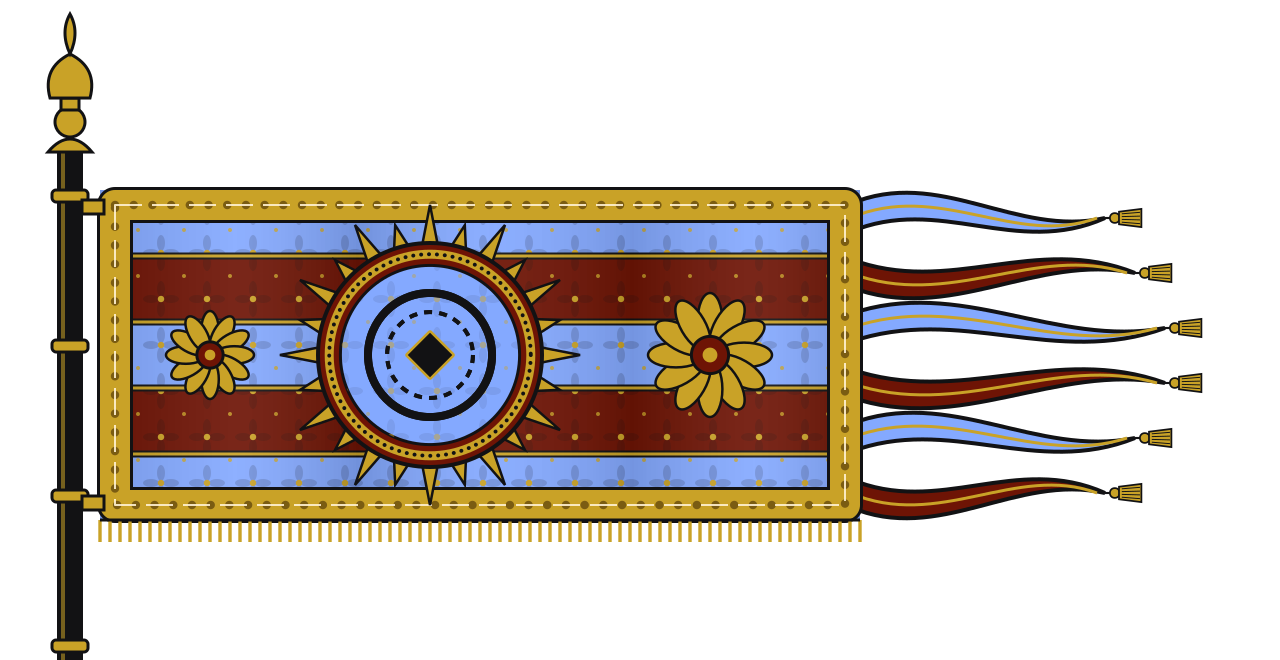
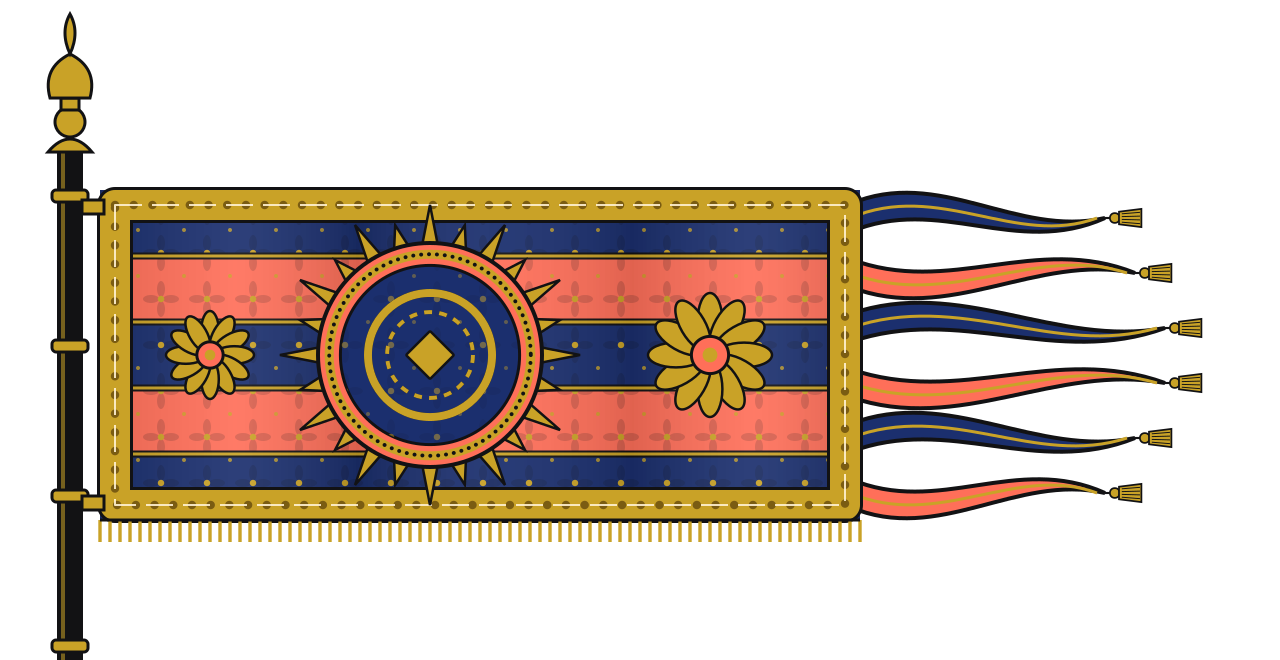
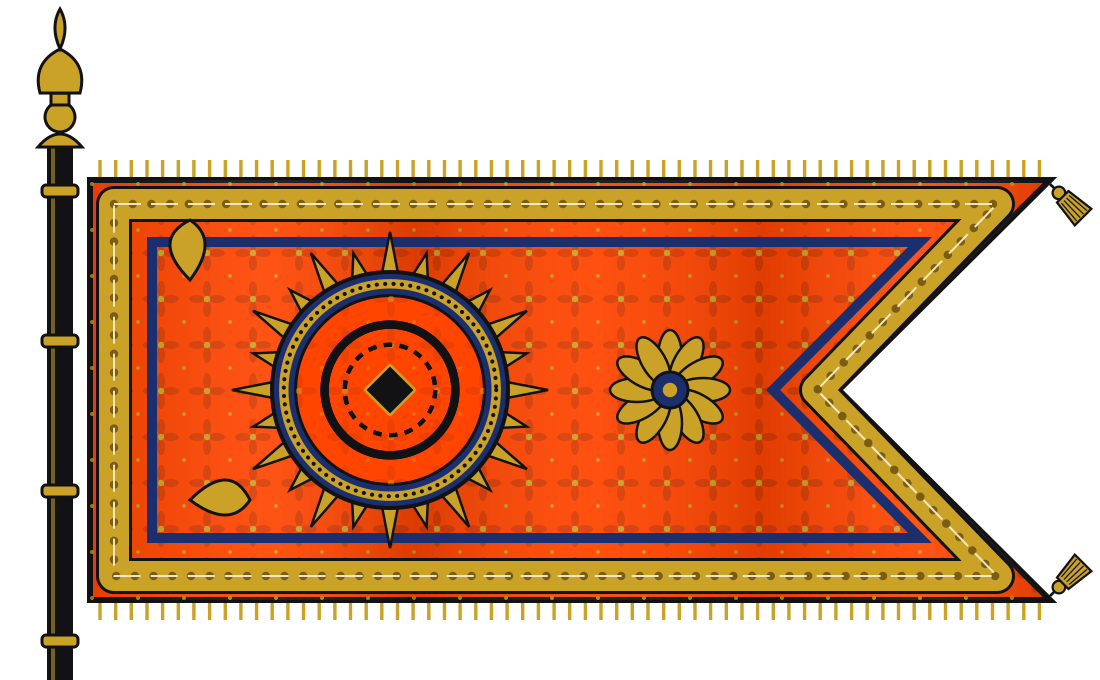
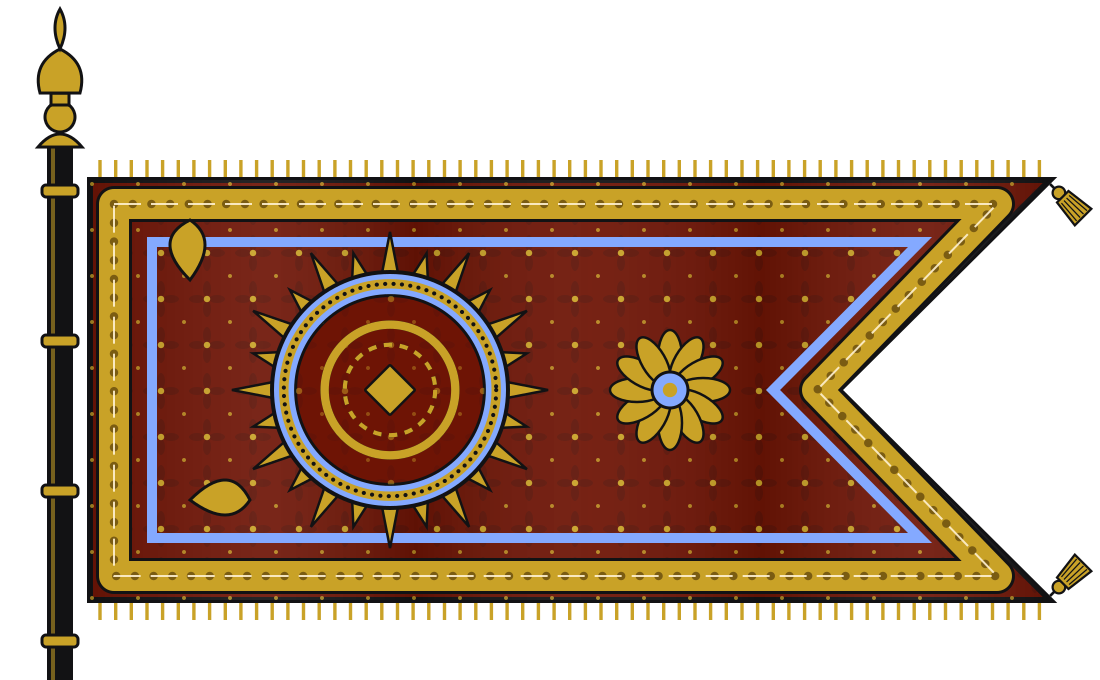

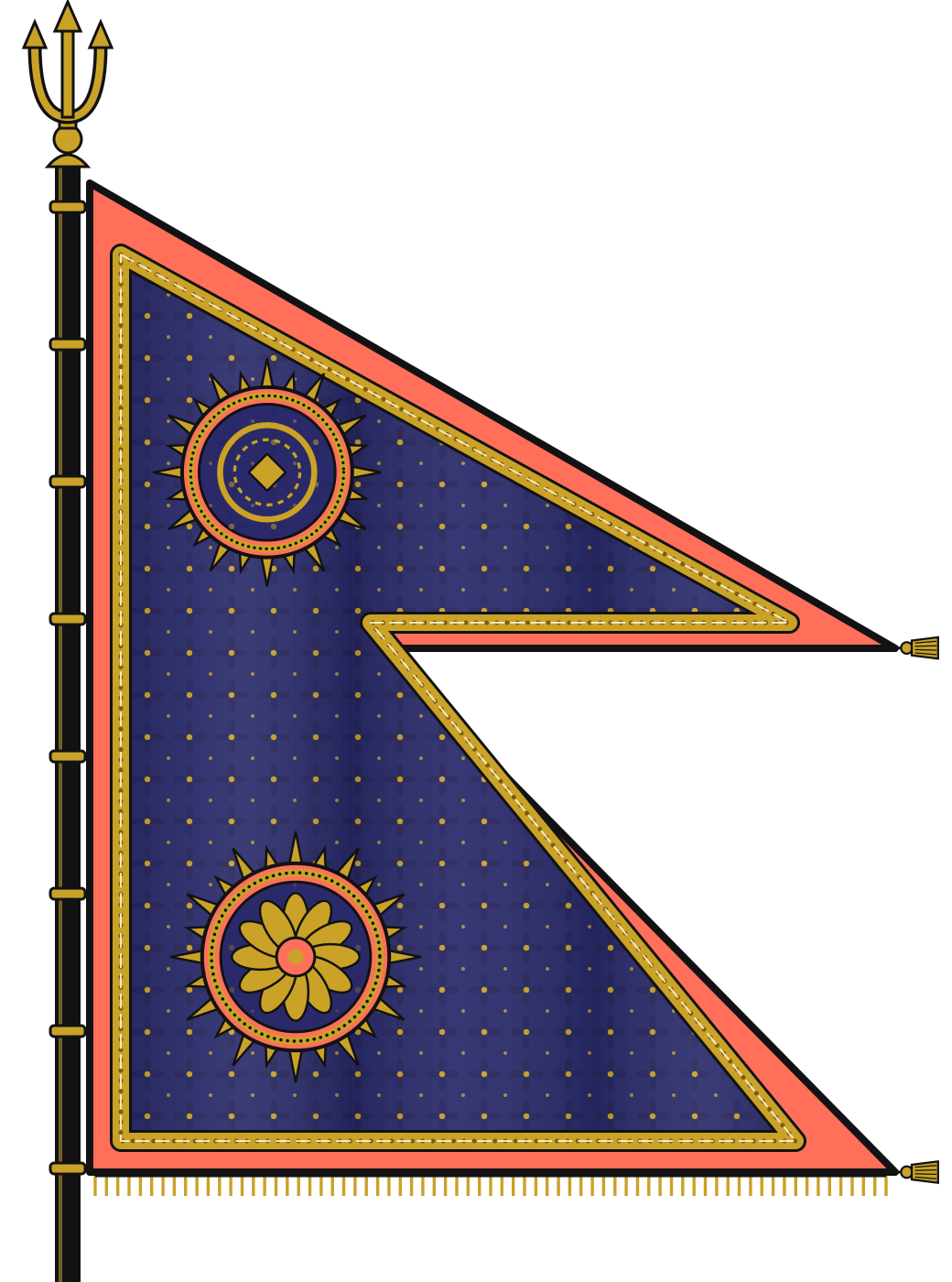


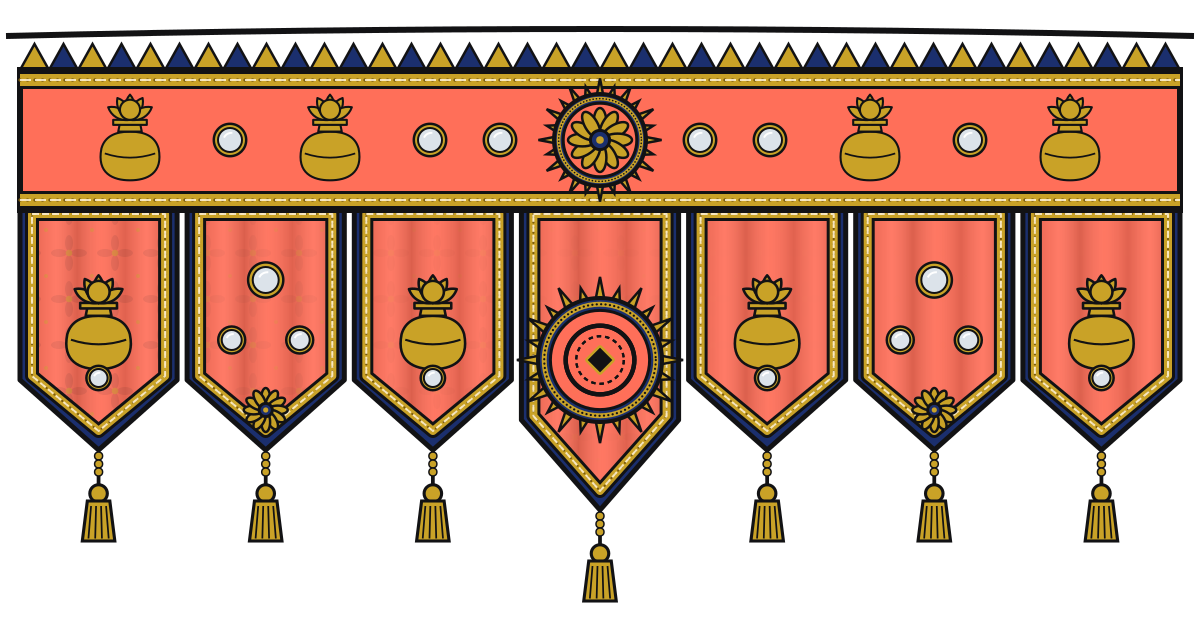
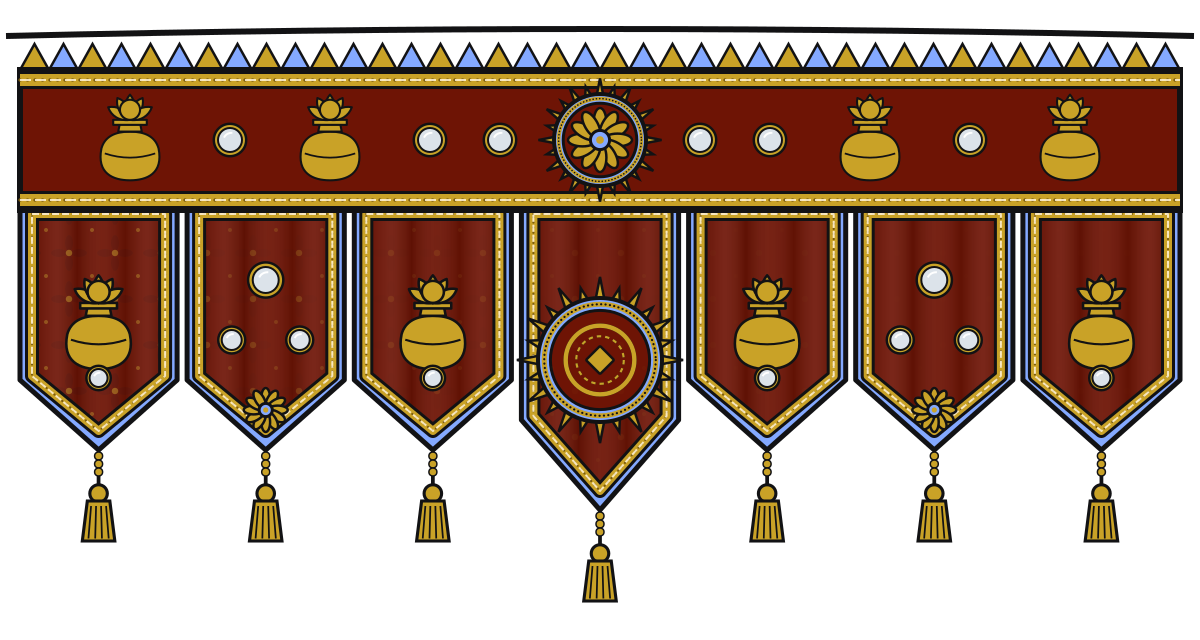

Historic banner
None known
New flag types
| Accessory | For this clan | Basis |
|---|---|---|
| A9 Pota-dhvaja · ship and trade flag For ships, caravans and markets | Not yet designed for this clan | Design |
| A10 Utsava-patāka · festival flag Light, bright flag for fairs and festivals | Not yet designed for this clan | Design |
| A11 Shoka-dhvaja · mourning flag White cloth with the emblem outline in the clan's metal | Not yet designed for this clan | Design |
7. Regalia
| Accessory | For this clan | Basis |
|---|---|---|
| E1 Chhatra · house parasol The ceremonial umbrella | Not yet designed for this clan | Design |
| E2 Chamara · fly-whisks The pair of whisks beside the head of the house | Not yet designed for this clan | Design |
| E3 Danda · staff of office Staff or scepter | Not yet designed for this clan | Design |
| E4 Simhasana · seat The seat of the house, covered in clan cloth | Not yet designed for this clan | Design |
| E5 Khetaka · shield A round shield; the Changi and Dhanush are its flag forms | Not yet designed for this clan | Regional tradition |
| E6 Kula-ayudha · clan weapon The weapon the clan honours | Not yet found for this clan | Under research |
8. Worn
| Accessory | For this clan | Basis |
|---|---|---|
| F1 Kula-vastra · clan cloth The clan's woven pattern in its kit colours | Not yet designed for this clan | Design |
| F2 Kirti-vastra · honour cloth A cloth earned for a deed, not inherited | Not yet designed for this clan | Design |
| F3 Kula-mala · garland flower The flower or leaf the clan wears as a garland | Not yet found for this clan | Under research |
| F4 Chinha · house pin A metal badge with the pin emblem | Not yet designed for this clan | Design |
9. Records
| Accessory | For this clan | Basis |
|---|---|---|
| H1 Clan words A traditional line in the native script | भैईना · “Bhaina” The people's name as Joshua Project prints it[1]; no line of the clan's own is in the extracts | Documented |
| H2 Biruda · titles The house's title or titles | Not yet found for this clan | Under research |
| H3 Prashasti · praise genealogy The lineage as written at the head of a grant | Not yet found for this clan | Under research |
| H4 Vahi · clan register The book of the clan's births, marriages and deaths | Not yet found for this clan | Under research |
| H5 Rana-ghosha · war cry The clan's cry in battle or celebration | Not yet found for this clan | Under research |
10. VishwaVit · knower of the world
Game values are design choices for this project, not historical claims.
References
- Joshua Project, Bhaina in India, read 2026-11-07, https://joshuaproject.net/people_groups/16401/in
- R. V. Russell and Hira Lal, The Tribes and Castes of the Central Provinces of India, vol. 2 (London, 1916), Project Gutenberg eBook #22010, https://www.gutenberg.org/ebooks/22010
- Wikipedia, Tribals in Madhya Pradesh, read 2026-10-19, https://en.wikipedia.org/wiki/Tribals_in_Madhya_Pradesh
- dhammabharat.com, List of Scheduled Tribes in Maharashtra and Population of each Tribe (2011 Census), read 2026-10-10, https://dhammabharat.com/?p=13656
- Bharati Mishra, A study of genetic demography and variability in a tribal population: The Bhaina of Madhya Pradesh (Sambalpur University, 1997), Shodhganga record, read 2026-11-07, https://shodhganga.inflibnet.ac.in:8443/jspui/handle/10603/187857