The Bathudi, also spelled Bathuri, are a Scheduled Tribe of Odisha, mostly in Mayurbhanj, Keonjhar and Balasore, with groups in Jharkhand and West Bengal[1][2][3][4]. The 2011 Census gives 217,395 in Odisha and 3,464 in Jharkhand[1][3]. Their origin is uncertain; they are traced to the Panchpir plateau and the Similipal hills, and the Odisha State Tribal Museum says they are believed to have come from Bakua in the Similipal hills[4][2]. Their chief god, Badaam Thakur, is worshipped at Athara Deula in the Similipal forest[5]. Colonial writers linked them with the Bhuyans: Gait and Russell described them as a sub-caste or sub-division of the Bhuyans[6], and Russell (1916) lists 'Bathudia' among the Bhuiya subtribes[7].
01Faith and deities
Maa Tarini of Ghatagaon, Keonjhar
The presiding goddess of the clan's homeland or capital: a link of place, not a recorded clan tie.
| Deity or tradition | Place in the clan's life | Evidence |
|---|---|---|
| Badaam Thakur at Athara Deula | Chief god; tree branches are offered to him at the Daali festival | [5] |
| Badam Sala and Thakurani Sala | Tree and stone shrines; the Dehuri leads weekly worship at Badam Sala | [8] |
| Niraakaar | The formless god | [5] |
| Aadimaataa | The mother goddess | [5] |
| Basuki and Basumaataa | The first ancestors | [5] |
| Sahan Dei | A goddess | [5] |
| Jama Raja | God of death | [5] |
| Brahma, Bishnu, Maheswar | Hindu gods named by Mishra; the origin belief is from the arms of Brahma | [5][4] |
| Hindu gods and goddesses (not named) | A section worships them, with animist beliefs retained | [4][9] |
| Maa Tarini of Ghatagaon (KulDevi) | Sheet KulDevi, basis: homeland shrine, in Keonjhar. No fetched source ties Tarini to the Bathudi; the Keonjhar tourism page describes the shrine itself | [10] |
02Temples
The shrines are the worship places of the chief god: Athara Deula, Badam Sala and Thakurani Sala. The extracts do not say who built them or when, so the record below states only what is known.
Built by the clan
| Temple | Deity | Built by | When | Where |
|---|---|---|---|---|
| Athara Deula ('18 temples'), Similipal | Badaam Thakur | Not stated in the extracts | Not stated | Manab Deula is its core in the Bakua range, Mayurbhanj[8][5] |
Given patronage or grants by the clan
Not recorded.
03Languages and scripts
| Language or script | Kind | Under the clan | Evidence |
|---|---|---|---|
| Odia living | Dialect of Odia, spoken by most | Most speak a dialect of Odia (Wikipedia); Mishra says they speak local Odia and have no mother tongue of their own | [4][5] |
| Hindi (Devanagari dialect) living | Dialect, in Jharkhand | Jharkhand Bathudis | [4] |
| Bengali living | Language, spoken by some | Jharkhand Bathudis | [4] |
| Kudmali living | Language, spoken by some | Jharkhand Bathudis | [4] |
| Ho living | Mother tongue of a few | A few Bathudis | [4] |
04Books and literature
The extracts name no published book by the clan. Wikipedia cites works about the tribe (Minz and Hansda 2010; Tribes of Orissa 1990; Pati and Dash 2002; the Anthropological Survey of India 1998; Dash 2004; Ota 2019), which are not the clan's own literature.
Written during the clan's history
| Work | Author | Kind | When | Link to the clan |
|---|---|---|---|---|
| Aadya Sunya Gupta Puran | Trilochan Bipra | Palm-leaf text, unpublished; kept by the Dalei family; still performed in Palla | Not stated | [5] |
| Badaam Puran | Chakradhar Mishra | Text based on the Kuraal Puran | 1340 A.D. (Mishra) | [5] |
| Kuraal Puran | Not stated | Source text of the Badaam Puran (Mishra) | Not stated | [5] |
Given patronage by the clan
Not recorded.
05Thinkers and scholars
| Name | Field | Era | Contribution |
|---|---|---|---|
| Chittaranjan Mishra | Folk literature | 2021 | 'Bathudi Folk Literature: A Bird's Eye View', Odisha Review, April 2021[5] |
| Sudhansu Sekhar Das Mangaraj | Profile of the tribes of Mayurbhanj | 2018 | 'A Profile of the Tribes of Mayurbhanj', Odisha Review, December 2018[6] |
| Rabindra nath Nayak | Community blog | 2018 | 'The Bathudi Tribe', blog posts of 28-29 August 2018 (a community blog, not a scholarly source)[8] |
| R. V. Russell and Hira Lal | The Tribes and Castes of the Central Provinces of India | 1916 | Lists 'Bathudia' among the subtribes of the Bhuiya[7] |
These are the authors whose work the extracts give. Gait and Dalton are reached only through Mangaraj and Russell, so they are not listed.
06Art and architecture
The extracts record mud walls with multi-coloured floral designs and the Khada tattoo. No painting, sculpture or textile is named for the clan.
Painting and wall art
Not recorded.
Sculpture and temple art
Not recorded.
Temple and building architecture
| Art form | What it is | Era | Evidence |
|---|---|---|---|
| Mud walls with multi-coloured floral designs | Decoration on the mud walls of the houses | [4][9] |
Weaving and textiles
Not recorded.
Clothing and jewellery
| Art form | What it is | Era | Evidence |
|---|---|---|---|
| Khada tattoo | Women practise it; girls often tattoo one or two floral designs on the forehead or arm before marriage | [4] |
Coins, pottery and crafts
| Art form | What it is | Era | Evidence |
|---|---|---|---|
| Date-palm-leaf mats; leaf cups and plates | Women weave the mats (Wikipedia) | [4] |
07History
Origin (uncertain)
The origin of the Bathudi is uncertain. Their homeland is traced to the Panchpaidh (Panchpir) plateau in Mayurbhanj and the Similipal forest range, from which they later spread to neighbouring areas[4][9]. The Odisha State Tribal Museum says they are believed to have migrated from Bakua in the Similipal hills[2]. Mishra calls them the original inhabitants of Mayurbhanj[5].
The name
The Odisha State Tribal Museum gives the name as Bathudi, also spelled Bathuri[2]. Mishra cites Nagendranath Basu on the name 'Bahuri or Bathuri' and records a story that the name 'Baathuli', later misspelt 'Baathudi', came from Bahubali and Uthuli, said to be its parents legend[5].
Under the Bhuyans in colonial records
Gait described the Bathudi as a sub-caste of the Bhuyans, and Russell called them a sub-division of the Bhuyans, regarded as inferior in social status. Mangaraj notes that the Bhuyan and Bathudi share food habits, clothing and social manners[6]. Russell and Hira Lal (1916) list 'Bathudia' among the Bhuiya subtribes[7].
Zamindar families of the Mayurbhanj hills
Mishra records that some Bathudi families were made zamindars of Adipur, Karanjia, Jashipur and Similipal[5].
Mayurbhanj kings and descent
The Atlas places the Bathudi under the Bhanja kings of Mayurbhanj, and gives as their popular identifier a claim to descent from soldiers of the Mayurbhanj kings. No fetched source says this, so it is set out as sheet data until a source is found. See Descendants in part four.
1340 A.D.: Badaam Puran
Mishra says the Badaam Puran was written by Chakradhar Mishra in 1340 A.D., based on the Kuraal Puran[5]. The palm-leaf Aadya Sunya Gupta Puran by Trilochan Bipra is kept by the Dalei family of Haladibata village; it is unpublished[5].
08Journey and migrations
The origin is uncertain. The community's own tradition, as the Odisha State Tribal Museum and Mishra record it, is a move out of the Similipal hills, and later moves are recorded to Jharkhand and West Bengal.
| When | From | To | Why | Evidence |
|---|---|---|---|---|
| Before the records (tradition) | Bakua, Similipal hills | Mayurbhanj, Keonjhar and Balasore (current districts) | The community left Similipal as its numbers grew and wild animals attacked it (Mishra, 2021) | [2][5] |
| Not dated | Mayurbhanj and Odisha | Jharkhand | Migration to Jharkhand; no date in the extracts | [4] |
| Not dated | Mayurbhanj and Odisha | West Bengal | Migration to West Bengal; no date in the extracts | [4] |
09Seats and lands
| Place | Role | Where today |
|---|---|---|
| Panchpir plateau (Panchpaidh), Mayurbhanj | Traced origin; most of the people are in the Panchpir subdivision (Mangaraj) | Mayurbhanj, Odisha[6][9] |
| Similipal hills and Bakua | Believed place of origin; Athara Deula in the Similipal forest; Manab Deula is its core in the Bakua range (blog) | Mayurbhanj[2][8] |
| Keonjhar (Kendujhar) | Named in the 2011 district split as 78,964 (blog, citing the Census); Goranjodi (Saharpada) and Tando (Patna) are named | Keonjhar district[8][11] |
| Balasore (Baleshwar) | Nilgiri subdivision (Mishra); 16,502 in the 2011 district split (blog) | Balasore district[5][8] |
| Jashipur, Karanjia (Kuliposi), Baripada | Places named as Bathudi settlements; zamindar families in Jashipur and Karanjia (Mishra; blog) | Mayurbhanj[8][5] |
| Haladibata, Saharapada block | Village where the Dalei family keeps the palm-leaf text (Mishra) | Saharapada block, Keonjhar (blog)[5] |
| Jharkhand and West Bengal | Places reached by migration | Jharkhand (3,464 in 2011); West Bengal[4][3] |
10Notable figures
| Name | Role | Era | Known from |
|---|---|---|---|
| Karna Guru | Baishnab (Vaishnava) guru who gives initiation chants before education and weddings | Not stated | [4] |
| Trilochan Bipra | Author of the palm-leaf Aadya Sunya Gupta Puran (unpublished) | Not stated | [5] |
| Chakradhar Mishra | Author of the Badaam Puran, based on the Kuraal Puran | 1340 A.D. (Mishra) | [5] |
| Brundaban Mohapatra | Began the 10-day Athara Deula puja programme in Chaitra | Not stated | [8] |
| Nagendranath Basu | Cited by Mishra on the name 'Bahuri or Bathuri' | Not stated | [5] |
11Allies, rivals and marriages
| People | Relationship | When |
|---|---|---|
| Bhuyan (Bhuiya) | Gait describes the Bathudi as a sub-caste of the Bhuyans; Russell calls them a sub-division, regarded as inferior in social status (Mangaraj) | Recorded by Gait and Russell |
| Bhuiya subtribes | Russell lists 'Bathudia' among the Bhuiya subtribes | Recorded 1916 |
| Similipal hill communities: Hill Khadia, Birhor, Mankidia, Santal, Kolha, Mahali, Bhuyan | The Bathudi are among the communities named for the Similipal hills, where the hill communities have their original home | Down To Earth, 2021 |
| Bhanja kings of Mayurbhanj | Historical polity of the Bathudi in the Atlas; no fetched source gives the link | Atlas |
12Society and livelihood
Endogamous, with exogamous khilli: marriage within a khilli is forbidden, and cousin marriage on either side is a taboo. The sororate is practised but not strictly sanctioned, and marriage by service (gharjamai) is prevalent[4]. The groom gives a bride price[6]. Burial and cremation are both practised[4].
Government and social order
| Institution or group | What it was | Evidence |
|---|---|---|
| Khilli (exogamous sections) | More than 50 recorded; none named in the extracts | [4][9] |
| Dehuri (priest) | Priest of the shrines; the Gaon Dehuri leads weekly Saturday worship at Badam Sala | [8] |
| Brahmin priest | Officiates at weddings | [4] |
| Birth customs | Birth pollution for nine days; the mother stays out of the kitchen for 21 days; naming on day 9 or 21; the mother avoids fish, sweets and ripe jackfruit for about two years | [4] |
| Village youth teams | Village youth teams perform the Changu Nacha in Chaitra | [8] |
| Dalei family of Haladibata | Keeps the palm-leaf Aadya Sunya Gupta Puran | [5] |
Livelihood over time
| Era | Livelihood | Evidence |
|---|---|---|
| Earlier | Hunting and fishing were a living; the blog says they no longer are | [8] |
| Per the sources (2018-2021) | Settled farming and farm labour, the main income; land shortage pushes many into farm labour | [4][2] |
| Per the sources (2018-2021) | Rain-fed farming on small holdings; seasonal collection of forest produce | [8] |
| Lean months | Women weave date-palm-leaf mats and make leaf cups and plates; chuda and mudi are eaten in lean months | [4] |
13Sub-clans and related clans
The Bathudi are endogamous, with more than 50 exogamous khilli (sections) recorded; no khilli, sub-clan, branch or totem is named in any fetched source. The items below are the related peoples the extracts name. Items without a master-sheet ID are new clan candidates.
| Clan | Relation | Where | Size | In the Atlas | Evidence |
|---|---|---|---|---|---|
| Bhuiya | Parent people | Keonjhar, Sundergarh, Jharsuguda, Mayurbhanj, Sambalpur and Angul (KISS) | 306,129, Odisha, 2011[1] | ST-031 | [6][7] |
| Mankirdia | Related people | Similipal hills, original home (Down To Earth, 2021) | 2,222, Odisha, 2011[1] | ST-199 | [12] |
| Birhor | Related people | Similipal hills, original home (Down To Earth, 2021) | 596, Odisha, 2011[1] | ST-040 | [12] |
| Hill Khadia | Related people | Similipal hills, original home; one of the 13 PVTGs (Down To Earth, 2021) | new clan candidate | [12] | |
| Santal | Related people | Mayurbhanj, Balasore, Keonjhar (KISS) | 894,764, Odisha, 2011[1] | ST-280 | [12][11] |
| Kolha | Related people | Mayurbhanj, Keonjhar, Balasore (KISS) | 625,009, Odisha, 2011[1] | ST-447 | [12][11] |
| Mahali | Related people | Mayurbhanj, Sundergarh, Keonjhar (KISS) | 18,625, Odisha, 2011[1] | new clan candidate | [12][11] |
Clans marked "new clan candidate" are not in the Atlas yet.
14Surnames
The extracts name one family name. Mishra gives Dalei only as the family that keeps the palm-leaf text, not as a general surname.
| Surname | Clan or sub-clan | Where | People with this surname | Also used by other communities |
|---|---|---|---|---|
| Dalei | Family of Haladibata village (Mishra) | Haladibata village, Saharapada block | not yet counted | Not checked |
Counts are of everyone with the surname, from the cited source and year, not only members of this clan. A surname shared with other communities says nothing about any one person's origin.
15Songs and music
The extracts describe song types but give no lyrics, so no song text is carried. Changu Nacha is a village youth performance in Chaitra[8].
Doli Geeta
Badi Geeta
Kaandana Geeta
Daali festival songs living
Children's play songs
Epic and romantic songs
Palla of the Aadya Sunya Gupta Puran living
Instruments and styles
| Instrument or style | What it is | Evidence |
|---|---|---|
| Changu | A one-sided drum used for the Changu songs and Changu Nacha | [5][8] |
16Poems, lullabies and children's rhymes
The extracts name riddles by their answers only.
None recorded yet.
17Stories, legends and proverbs
Stories and legends
| Story | What happens | Told by | Evidence |
|---|---|---|---|
| Khairi and Bhandani | Rivers named in the community's stories; the tale is not given in the extracts | Not stated | [5] |
| Suni and Puni | Two sisters; the story is not given in the extracts | Not stated | [5] |
| Origin of the name | The name 'Baathuli', later misspelt 'Baathudi', is said to have come from Bahubali and Uthuli, said to be its parents | Community story, as Mishra records it | [5] |
| Badaam Puran | A text of 1340 A.D., based on the Kuraal Puran; its contents are not given | Not stated | [5] |
Proverbs and sayings
| Saying | Meaning | Evidence |
|---|---|---|
| 'Community is greater than a person' (Odia text not given) | The community matters more than any one person (Mishra's idiom) | [5] |
18Festivals and fairs
| Festival or fair | When | Where | What happens |
|---|---|---|---|
| Changu Nacha | Chaitra | Villages (youth teams) | Village youth teams perform the Changu Nacha; the ritual verse on the blog is not copied[8] |
| Athara Deula puja | A 10-day programme in Chaitra | Athara Deula, Similipal | Begun under Brundaban Mohapatra[8] |
| Dasandha puja | Every ten years | Not stated | Tied to a Nabakalebara rite[8] |
| Gamha Purnima | Shraban full moon (July-August) | Not stated | Named as a festival; what happens at it is not given[5] |
| Daali | From Kumar Purnima, Aaswin (September-October) | Not stated | Tree branches are offered to Badaam Thakur; Daali festival songs[5] |
| Hindu festivals (not named) | Not stated | Not stated | Some are observed[4] |
19Food, dress and games
Food
| Item | What it is | Evidence |
|---|---|---|
| Chuda and mudi | Eaten in the lean months | [4] |
Dress
Games and martial arts
Not recorded.
Tags: living still practised · revived brought back after a break · lost known only from records · research reported but not yet confirmed from a source. Songs and poems under copyright are listed by title only; restricted or sacred material is noted without its content.
20Status today
The Bathudi are a living Scheduled Tribe, mostly in Odisha and some in Jharkhand and West Bengal. Figures differ by source, as the facts below show[1][4][3].
Who carries the name today
| Community | Link | Basis | Evidence |
|---|---|---|---|
| Bhuyan kinship (Gait, Russell, as Mangaraj reports) | Under research | [6] Origin is uncertain[4] | |
| Descendants of soldiers of the Mayurbhanj kings | Under research | Atlas popular identifier. No fetched source gives this claim; it needs a source before it is stated as fact. |
Recognised heritage
| What | Recognition | Evidence |
|---|---|---|
| Scheduled Tribe status | Official lists for Odisha and Jharkhand | [1][3] |
| Palla performance of the palm-leaf text | Still practised (Mishra, 2021) | [5] |
No community review of this page is recorded.
21For children
The Changu Drum
The Bathudi are a people of Odisha, with some groups in Jharkhand and West Bengal. Their chief god is Badaam Thakur, who is worshipped at Athara Deula in the Similipal forest. Old stories say their people came long ago from Bakua in the Similipal hills. In the month of Chaitra, village youth teams perform the Changu Nacha, with a one-sided drum called the changu. At the Daali festival, they offer tree branches to Badaam Thakur. Children sing play songs about visiting their uncle's home.
Written for this project
22Across the project
| Project | What carries this clan | Status |
|---|---|---|
| Atlas of the Janas | Mayurbhanj, Keonjhar and Balasore in Odisha; the Similipal hills; Jharkhand. No footprint file yet | To do |
| KulDevi and GrahDevi | KulDevi Maa Tarini of Ghatagaon; GrahDevi forms from the Atlas: Brahmani, Maheshvari, Kaumari, Vaishnavi, Varahi, Indrani, Chamunda, Narasimhi | From the Atlas |
| Planet naming | Not in the extracts | — |
| Renaming and waters | Rivers Khairi and Bhandani in the stories (Mishra, 2021); Jashipur and Haladibata | [5] |
23Open questions
- Odia-script name: the research pack's rendering of the native name is not printed in any fetched source, so the page leaves the native field empty. Verify before use.
- Odia-script texts: the idiom, the riddles, the song words and the Odia names of the deities are not in the extracts.
- Khilli and sub-clan names: more than 50 khilli are recorded and none is named. Try Risley, Dalton and the People of India (Orissa) entry.
- Descent from soldiers of the Mayurbhanj kings: needs a source. Gait and Russell's sub-caste link to the Bhuyans is stated as their view.
- Census figures differ: 217,395 (Odisha list, Wikipedia list) against 220,859 (Wikipedia Bathudi article, total); 3,464 (Jharkhand list) against 3,461 (Wikipedia Bathudi article). The 2001 figure from Mangaraj has no stated scope.
- Origin: the blog's Godavari route is not confirmed by another source. The Bakua and Panchpir traditions need a second source.
- Dates: the Badaam Puran (1340) is dated only by Mishra. No extract dates Athara Deula, or the move to Jharkhand or West Bengal.
- Risley, Tribes and Castes of Bengal; Dalton, Descriptive Ethnology of Bengal; the Bagchee listing 'Ethnohistory of the Bathudi Tribe'; the Joshua Project page (blocked): not yet read.
- Who built the Athara Deula shrines and when is not stated in any fetched source.
- Hill Khadia (new clan candidate) and Hill Kharia (ST-394, Atlas) may be the same people; the extracts do not say so. Mahali (new clan candidate) and the Jharkhand Mahli may also be linked; not checked.
- Origin: Mishra calls the Bathudi the original inhabitants of Mayurbhanj[5]; the Odisha State Tribal Museum says they are believed to have migrated from Bakua in the Similipal hills[2]. Both accounts are kept; no extract reconciles them.
24Astitva
अस्तित्व · being, existence: everything by which the clan is known
No seal, coin, war cry, totem or guardian tree is recorded for the Bathudi in the extracts. The changu drum and the Khada tattoo are not accessories in the catalogue, so they are set out in the culture sections.
Every clan has every accessory, royal objects included. Each one says how it is known: Documented This clan's own object is recorded. · Regional tradition Recorded for the region or for peoples like this one, not for this clan. · Design Made for this project, with no historical claim. · Under research To be found for this clan from sources. Legends and titles are written in the clan's own script.
1. Seals and coins
| Accessory | For this clan | Basis |
|---|---|---|
| B1 Rajamudra · house seal Round seal with the clan emblem and a short legend in the clan's script | Not yet designed for this clan | Design |
| B2 Anguliya-mudra · signet ring Personal seal ring of the head of the house | Not yet designed for this clan | Design |
| B3 Chhapa · house stamp Ink or block stamp for letters, goods and cloth | Not yet designed for this clan | Design |
| B4 Tamrapatra · charter plate Copper-plate grant on a ring, closed with the house seal | Not yet designed for this clan | Design |
| B5 Shreni-mudra · guild or trade seal Seal for the clan's trade, craft or caravan | Not yet designed for this clan | Design |
| C1 Clan coin Emblem or deity on one side, a legend in the clan's script | Not yet designed for this clan | Design |
| C2 Coin die The die that strikes the coin | Not yet designed for this clan | Design |
2. Living symbols
| Accessory | For this clan | Basis |
|---|---|---|
| I1 Totem trio The tree, bird and animal the clan protects | Not yet found for this clan | Under research |
| I2 Kaval-maram · guardian tree The tree that stands at the clan's seat | Tree branches are offered to Badaam Thakur at the Daali festival; no guardian tree at the seat is named. | Under research |
3. Stone and gate
| Accessory | For this clan | Basis |
|---|---|---|
| G1 Torana · gateway The built gate of the seat; the cloth Toran hangs in it | Not yet designed for this clan | Regional tradition |
| G2 Viragallu · hero stone Carved panel stone for a member who died defending the clan | Not yet designed for this clan | Regional tradition |
| G3 Kula-shila · clan stones Standing and table stones that remember the ancestors | Not yet designed for this clan | Design |
| G4 Jayastambha · victory pillar A pillar raised for a victory | Not yet designed for this clan | Design |
| G5 Sima-shila · boundary stone Marks the clan's land, with a line in the native script | Not yet designed for this clan | Design |
4. Sounds
| Accessory | For this clan | Basis |
|---|---|---|
| D1 Pancha-mahashabda · five great sounds The right to five instruments | Not yet designed for this clan | Design |
| D2 Shankha · clan conch The clan's own named war conch | Not yet designed for this clan | Design |
| D3 Murasu · house drums Three drums: war, charity and justice | Not yet designed for this clan | Design |
5. Kit: colours, metals and emblems
The main emblem in the Atlas is a soldier's spear and round shield, standing for the soldiers of the Mayurbhanj kings. No fetched source gives a Bathudi emblem, seal, coin or war cry.
| Part of the kit | This clan |
|---|---|
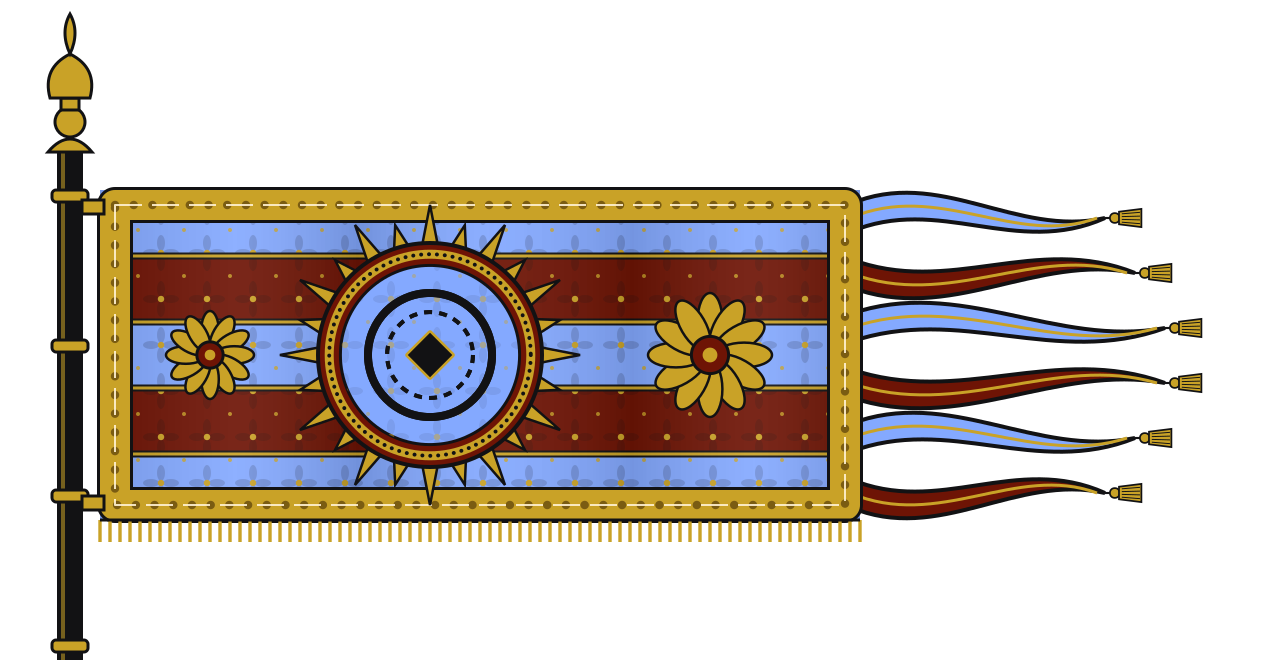
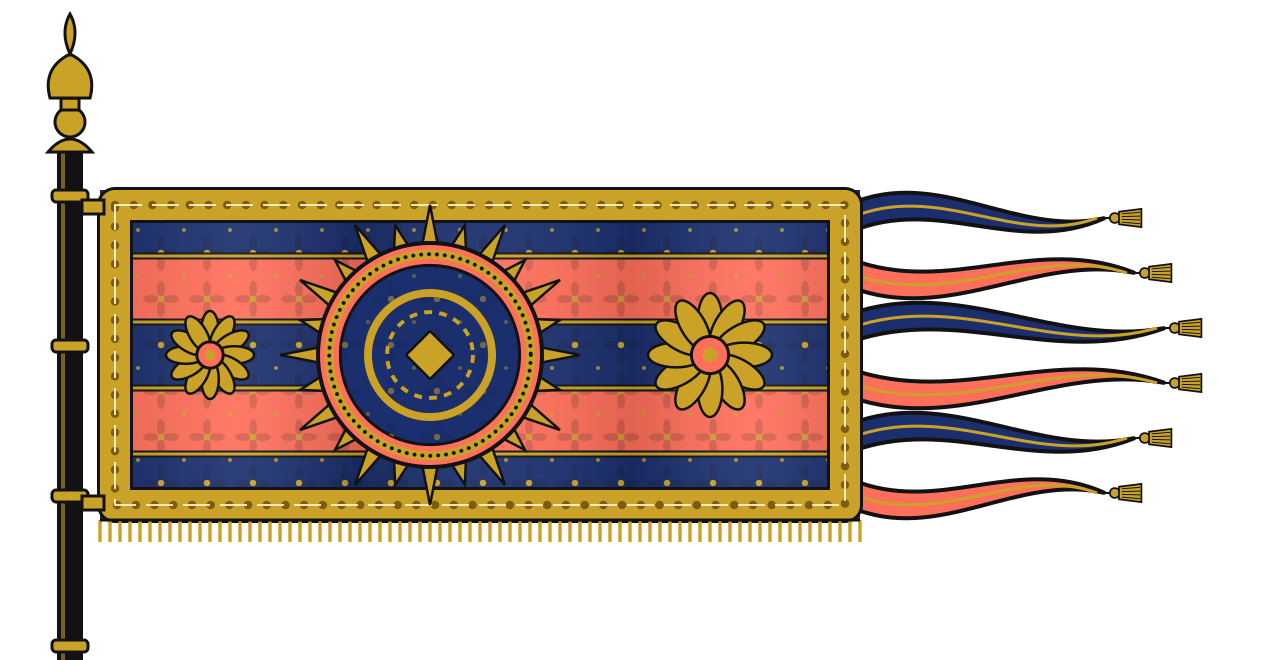
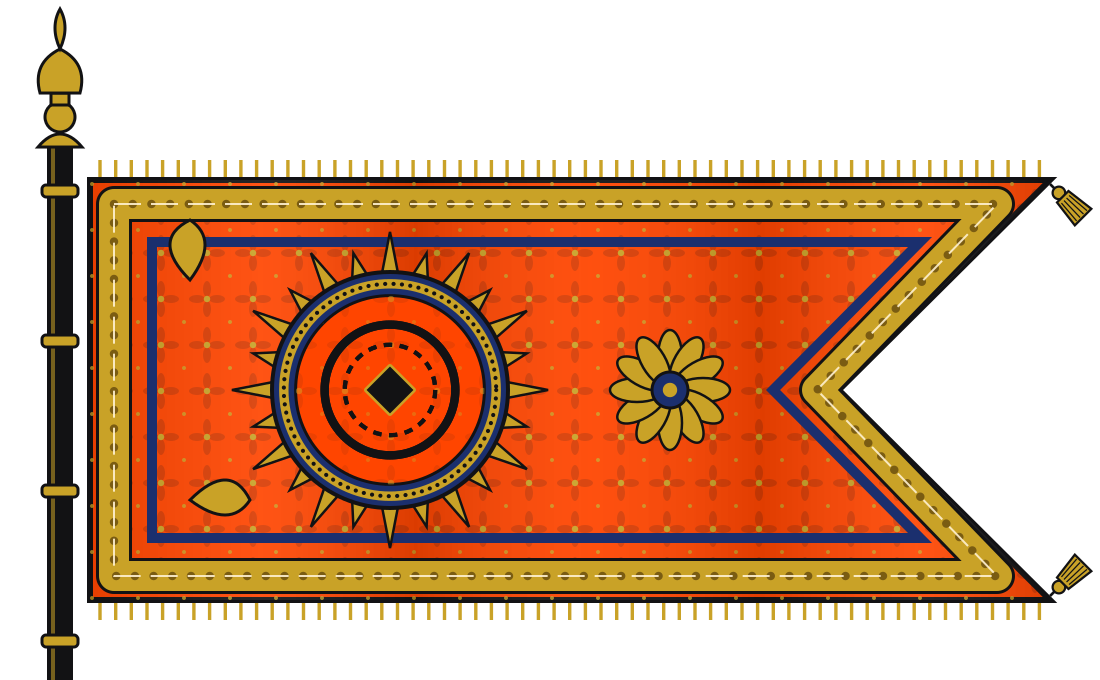
| Field | Maroon #6E1405 |
| Accent | Intense Electric Blue #84A9FF |
| Emblem colour | Metallic Gold #C9A227 |
| Zari metal | Gold |
| Main emblem | A soldier's spear and round shield |
| Second image | — |
| Night and day | Every visual accessory has two versions: by night the emblem on the dark field, by day the clan's field colour on cloth woven from its metal. |
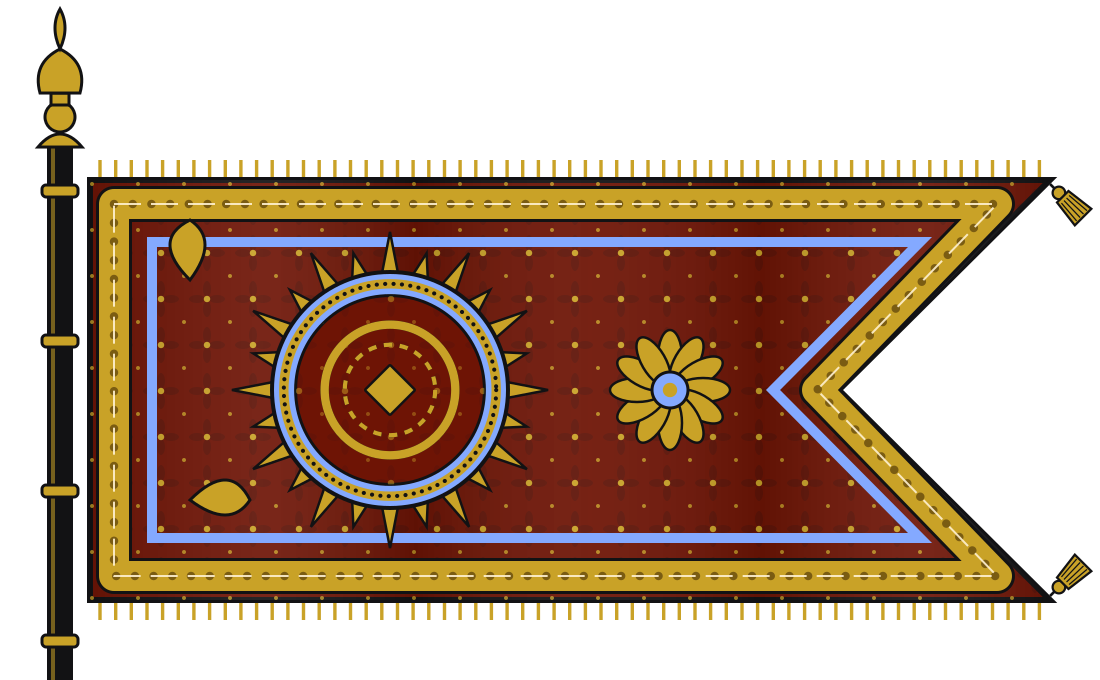
6. Flags
Every clan has every flag type; the type says the occasion and the colours say the clan. The outlined card is the flag the Atlas assigns.
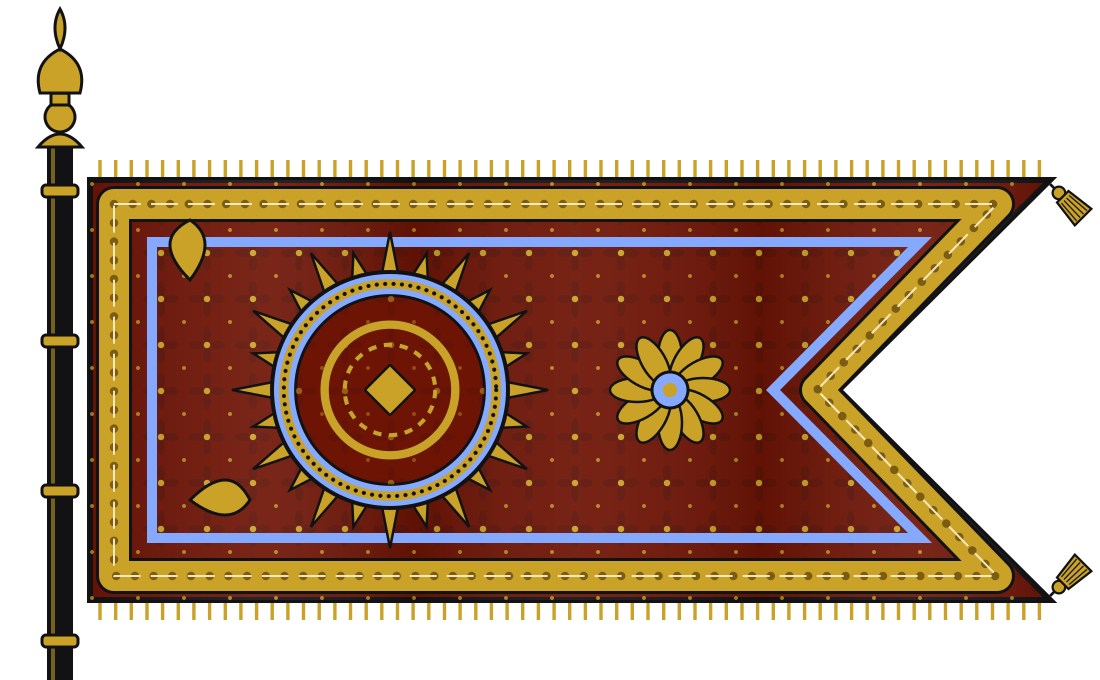

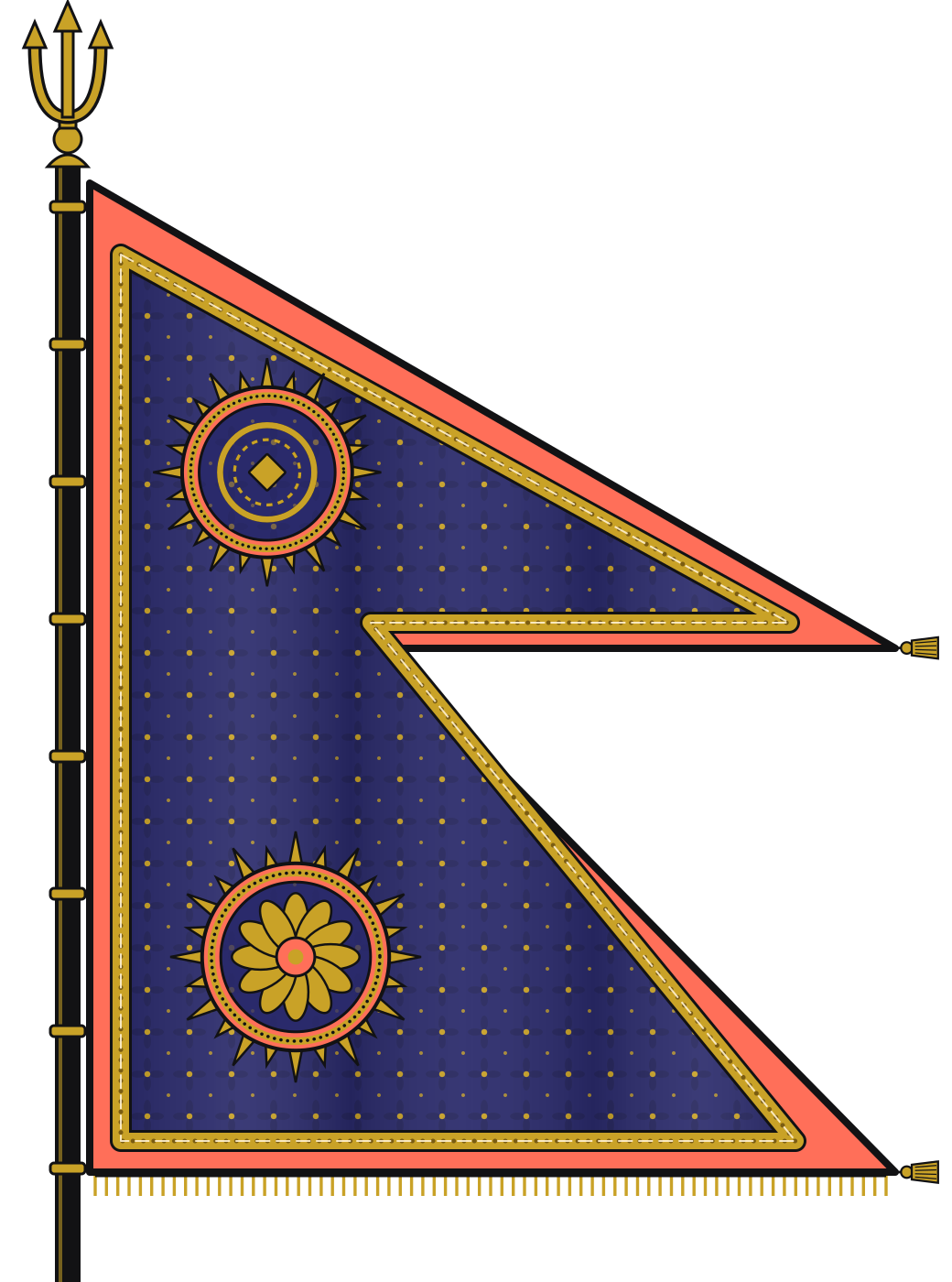


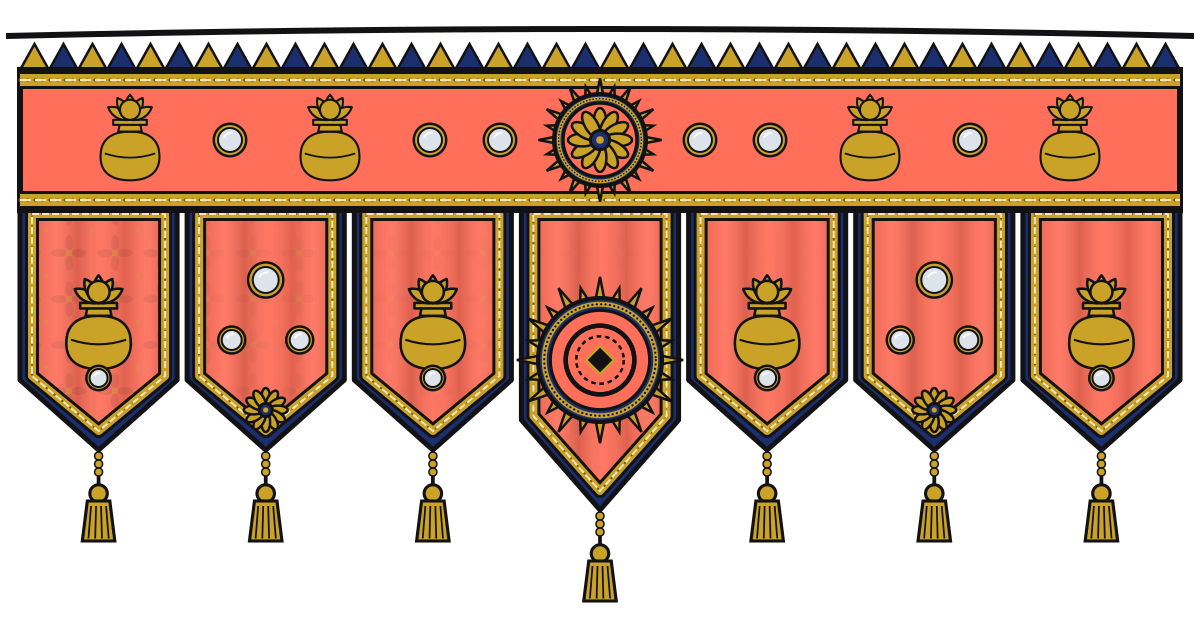
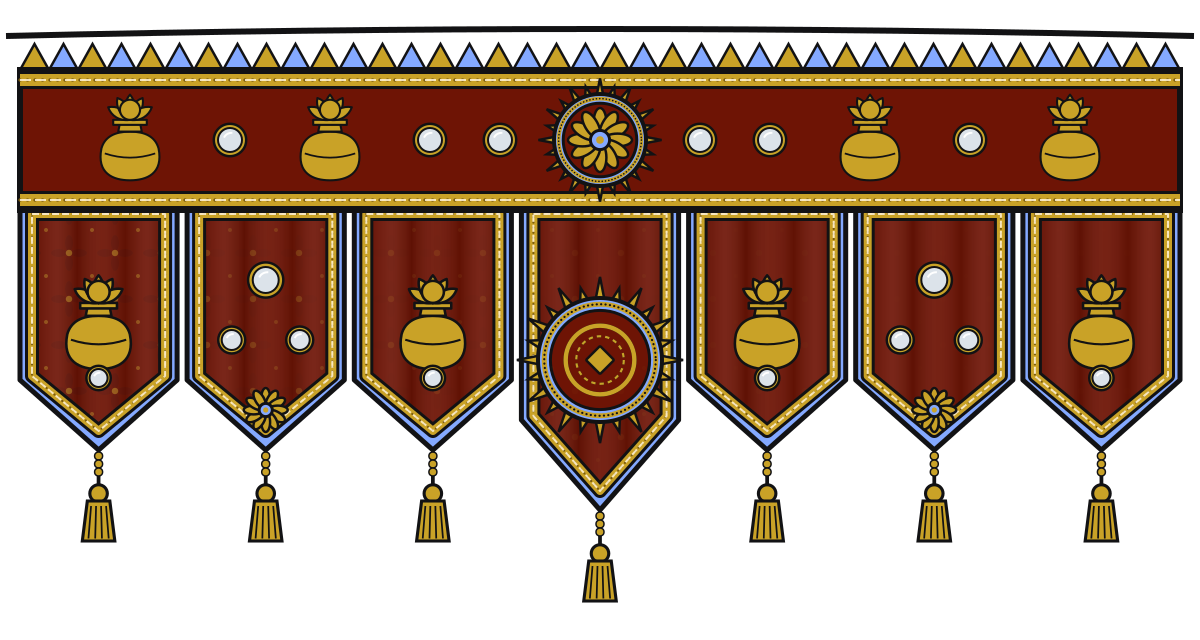

Historic banner
None known
New flag types
| Accessory | For this clan | Basis |
|---|---|---|
| A9 Pota-dhvaja · ship and trade flag For ships, caravans and markets | Not yet designed for this clan | Design |
| A10 Utsava-patāka · festival flag Light, bright flag for fairs and festivals | Not yet designed for this clan | Design |
| A11 Shoka-dhvaja · mourning flag White cloth with the emblem outline in the clan's metal | Not yet designed for this clan | Design |
7. Regalia
| Accessory | For this clan | Basis |
|---|---|---|
| E1 Chhatra · house parasol The ceremonial umbrella | Not yet designed for this clan | Design |
| E2 Chamara · fly-whisks The pair of whisks beside the head of the house | Not yet designed for this clan | Design |
| E3 Danda · staff of office Staff or scepter | Not yet designed for this clan | Design |
| E4 Simhasana · seat The seat of the house, covered in clan cloth | Not yet designed for this clan | Design |
| E5 Khetaka · shield A round shield; the Changi and Dhanush are its flag forms | Not yet designed for this clan | Regional tradition |
| E6 Kula-ayudha · clan weapon The weapon the clan honours | Arrows: seven arrows are set in a pot of water at the marriage. This is a ritual use; no clan weapon is named in the extracts. | Under research |
8. Worn
| Accessory | For this clan | Basis |
|---|---|---|
| F1 Kula-vastra · clan cloth The clan's woven pattern in its kit colours | Not yet designed for this clan | Design |
| F2 Kirti-vastra · honour cloth A cloth earned for a deed, not inherited | Not yet designed for this clan | Design |
| F3 Kula-mala · garland flower The flower or leaf the clan wears as a garland | Not yet found for this clan | Under research |
| F4 Chinha · house pin A metal badge with the pin emblem | Not yet designed for this clan | Design |
9. Records
| Accessory | For this clan | Basis |
|---|---|---|
| H1 Clan words A traditional line in the native script | Community is greater than a person. · “Recorded in English by Mishra (2021); the extracts give no Odia text” Chittaranjan Mishra, Bathudi Folk Literature: A Bird's Eye View, 2021, one idiom of the Bathudi[5] | Documented |
| H2 Biruda · titles The house's title or titles | Not yet found for this clan | Under research |
| H3 Prashasti · praise genealogy The lineage as written at the head of a grant | Not yet found for this clan | Under research |
| H4 Vahi · clan register The book of the clan's births, marriages and deaths | Not yet found for this clan | Under research |
| H5 Rana-ghosha · war cry The clan's cry in battle or celebration | Not yet found for this clan | Under research |
10. VishwaVit · knower of the world
Game values are design choices for this project, not historical claims.
References
- Wikipedia, List of Scheduled Tribes in Odisha, read 2026-10-20, https://en.wikipedia.org/wiki/List_of_Scheduled_Tribes_in_Odisha
- Odisha State Tribal Museum (SCSTRTI), Tribes of Odisha: Bathudi, read 2026-10-28, https://ostm.in/tribes_of_odisha/bathudi/
- Wikipedia, Tribes of Jharkhand, read 2026-10-20, https://en.wikipedia.org/wiki/Tribes_of_Jharkhand
- Wikipedia, Bathudi Tribe, read 2026-10-28, https://en.wikipedia.org/wiki/Bathudi_Tribe
- Chittaranjan Mishra, Bathudi Folk Literature: A Bird's Eye View, Odisha Review, April 2021, read 2026-10-28, link
- Sudhansu Sekhar Das Mangaraj, A Profile of the Tribes of Mayurbhanj, Odisha Review, Dec 2018, read 2026-10-28, link
- R. V. Russell and Hira Lal, The Tribes and Castes of the Central Provinces of India, vol. 2 (London, 1916), Project Gutenberg eBook #22010, https://www.gutenberg.org/ebooks/22010
- Rabindra nath Nayak, The Bathudi Tribe (blog), posts 28-29 Aug 2018, read 2026-10-28, https://odishabathudi.blogspot.com
- Tribal Research Institute Jharkhand, Bathudi Tribe, read 2026-10-28, https://trijharkhand.in/en/bathudi
- Maa Tarini Pitha, Ghatagaon, Kendujhar district, Government of Odisha (read 10 Oct 2026, KulDevi run 40).
- Sushree Mohanty, Indigenous Colours of Odisha: Handbook on 62 Tribes (KISS), read 2026-10-20, https://kissnew.kiss.ac.in/wp-content/uploads/2026/05/Indigenous-Colours-of-Odisha-Handbook-on-62-Tribes-Sushree-Mohanty.pdf
- Hemanta Kumar Sahoo, Similipal fire: Lives and livelihoods of Mankidia tribals in distress, Down To Earth, 11 Mar 2021, read 2026-10-27, link