The Baiga are a Scheduled Tribe of central India, counted in the 2011 census at 414,526 in Madhya Pradesh and 89,744 in Chhattisgarh[1]. Russell and Hira Lal recorded in 1916 that their principal deity was Bura Deo, who lives in a saj tree, and that it was a sin to plough the breast of their mother earth[2][3]. They practised shifting cultivation, called bewar, and their own language is lost, so they now speak Hindi and Chhattisgarhi, and some Gondi or Marathi[4][1]. The Atlas records them as priests to the Gond kings of Garha-Mandla, and Russell calls them generally priests of the Gonds[2]. Forced evictions since the 1960s, often justified as tiger conservation, are recorded in the sources[1].
01Faith and deities
Russell (1916) records Bura Deo as the principal deity[2]. The KulDevi in the Atlas is Dharti Mata (KD-107, documented; see the rows below).
Mother Earth; Baigas once refused to plough her
A recorded tie between the clan and the goddess.
| Deity or tradition | Place in the clan's life | Evidence |
|---|---|---|
| Bura Deo | Principal deity; resides in a saj tree (Terminalia tomentosa); worshipped in Jeth (May) with goats, fowls, coconuts and new mahua liquor[2] | |
| Thakur Deo | God of village land and boundaries; propitiated with a white goat[2] | |
| Dharti Mata (Mother Earth) | Wife of Thakur Deo, propitiated for the crops; ploughing her breast is a sin[2][3] | |
| Dulha Deo | Averts disease; offered a reddish fowl or goat[2] | |
| Bhimsen | Deity of rainfall[2] | |
| Narayan Deo | The sun-god, who receives a pig[2] | |
| Nag Deo | Worshipped in an ant-hill[2] | |
| Bhagavan | Creator in the legends, who is said to live in the Maikal hills to the east[4]; the Baiga helped him create the world[1] | |
| Bara Deo or Budha Deo | Named among the gods (deo), without further detail[4] | |
| Gansam Deo | Protects from wild animals[4] | |
| Aji-Dadi | Household ancestors; the ancestors are said to live behind the hearth[4] | |
| Nanga Baiga and Nangi Baigin | Mythic ancestors born from the goddess Dharti Mata; Nanga Baiga had great magic power[1] | |
| Spirits (bhut and jiv) | Spirits (bhut) are hostile, with the unmarried dead in trees; spirits in streams are of the married[2]; death splits a person into jiv, chhaya and bhut[4] | |
| Dewar (priest) | Performs the important rites of agriculture and village protection[3] |
02Temples
The extracts record no temple built or patronised by the Baiga. The Encyclopedia says temples, shrines, granaries and corporate houses are absent from Baiga villages, and household worship is at a deosthan behind the hearth. Russell records pats (shrines) for forest spirits. A Sahapedia folk tale has a Dharti Mata shrine at Sarguja, which a Baiga visits in the story; it is not a Baiga temple[4][2][5].
Built by the clan
Not recorded.
Given patronage or grants by the clan
Not recorded.
03Languages and scripts
| Language or script | Kind | Under the clan | Evidence |
|---|---|---|---|
| Baiga language (Austroasiatic, as believed) lost | Ancestral language; no trace remains (Wikipedia, "citation needed") | Forgotten; the Baiga speak broken Hindi in the Satpuras (Russell 1916) | [2][4] |
| Baigani research | Once named as the mother tongue of some Mandla Baiga; now recognised as a Chhattisgarhi variety influenced by Gondi (Wikipedia, citing Grierson, Linguistic Survey of India vol. 6, p. 241) | Described as Indo-Aryan (Encyclopedia); a Chhattisgarhi variety (Wikipedia) | [1][4] |
| Chhattisgarhi living | Indo-Aryan (Atlas gives the language family as Indo-Aryan) | Most speak a corrupt Chhattisgarhi (Russell); Chhattisgarhi in Bilaspur (Encyclopedia) | [2][4] |
| Hindi living | Language most speakers use (Wikipedia) | Modified Eastern Hindi in Mandla (Encyclopedia) | [1][4] |
| Gondi or Marathi living | Used by some Baiga (Wikipedia) | Marathi, Hindi, Gondi or a mix in Balaghat (Encyclopedia) | [1][4] |
04Books and literature
The books below are listed from the extracts. None is patronised by the clan.
Written during the clan's history
| Work | Author | Kind | When | Link to the clan |
|---|---|---|---|---|
| The Baiga | Verrier Elwin | Ethnography | 1939 (Encyclopedia); 1938 as Wikipedia prints it | [4][1] |
| The Tribes and Castes of the Central Provinces of India, vol. 2 | R. V. Russell and Hira Lal | Ethnography, Baiga article | 1916 | [2] |
| The Kingdom of the Young | Verrier Elwin | Ethnography | 1968 | [4] |
| The Gond and Bhumia of Eastern Mandla | Fuchs | Ethnography | 1960 | [4] |
| Tribalism in India | Chattopadhyaya | Study | 1978 | [4] |
| The Baigas of Madhya Pradesh: a demographic study | Reddy and Modell | Demography | 1997 | [1] |
| The Baiga: Survival strategies | Prasad | Study | 1998 | [1] |
| Encyclopaedia of Scheduled Tribes in Jharkhand | Minz and Hansda | Encyclopaedia | 2010 | [1] |
| The Scheduled Tribes, vol. III | Singh | Survey | 1994 | [1] |
| Baiga photo handbook | Ota et al. | Photo handbook | 2021 | [1] |
| Kaleidoscope of Baiga Folksongs, Dialogue 12(2), pp. 70–75 | Author not named on the abstract | Journal article | 2016 | [6] |
Given patronage by the clan
Not recorded.
05Thinkers and scholars
| Name | Field | Era | Contribution |
|---|---|---|---|
| Verrier Elwin | Ethnography | 1939 | Observations on village decline and on kinship classification[4] |
| R. V. Russell and Hira Lal | Ethnography | 1916 | The Baiga article in The Tribes and Castes of the Central Provinces of India[2] |
| Pandey | Socio-economic study | 2015 | Study of Baiga socio-economic status in the EPW (bibliography)[1] |
Scholars named in the extracts. Russell and the Encyclopedia are the main sources for the sections above.
06Art and architecture
The extracts record basketry, rare door carving, masking and tattooing, mainly by women (Encyclopedia), and a modern painter. They do not record painting or sculpture from the clan's past.
Painting and wall art
| Art form | What it is | Era | Evidence |
|---|---|---|---|
| Jodhaiya Bai Baiga later | Tribal artist named on Wikipedia (New Indian Express, 2019) | [1] | |
| A Baiga labourer later | Debut as an international painter in Milan and Paris (New Indian Express, 5 October 2019) | [1] |
Sculpture and temple art
Not recorded.
Temple and building architecture
| Art form | What it is | Era | Evidence |
|---|---|---|---|
| Door carving | Rare, as the Encyclopedia gives it | [4] |
Weaving and textiles
Not recorded.
Clothing and jewellery
Not recorded.
Coins, pottery and crafts
| Art form | What it is | Era | Evidence |
|---|---|---|---|
| Basketry | Named as a craft (Encyclopedia) | [4] | |
| Masking | Named as a craft (Encyclopedia) | [4] |
07History
Origins as recorded in 1916
Russell and Hira Lal say the original home of the Baigas may have been the Chhattisgarh plain and the hills around it, and that they were thought to be a branch of the Bhuiya of Chota Nagpur, once dominant in that plain[2].
The Encyclopedia of World Cultures gives the same migration, from Chhattisgarh into the Satpura Hills[4].
Numbers in 1911
Russell gives about 30,000 Baigas proper in 1911, and notes that the Binjhwars of Chhattisgarh and Sambalpur appear to have been originally Baigas[2].
Priests of the Gonds
The Atlas gives the Baiga's historical polity as priests (baiga) to the Gond kings of Garha-Mandla. Russell says the Baigas were generally priests of the Gonds, and that a Baiga's decision on a boundary was almost always final in Mandla[2].
Kol and Gond regard the Baiga as priests with knowledge of the secrets of the soil[4]. Russell records that Garha-Mandla abounded in wild elephants, as the Ain-i-Akbari gives it, and that in Mandla the Baigas hang a bamboo mat on a pole as a flag, said to have flown from the palace of a Baiga king[2].
The British period
Relations with the British were generally favourable. The limits on bewar were the main dispute. Gandhi's prohibition caused some negative sentiment, and Christian missions had little success[4].
Evictions from the 1960s
Forced evictions have been carried out since the 1960s, often justified as tiger conservation. Bhanpur Khera was relocated from Khana National Park in 1968 (Wikipedia, citing galli.in, Survival International and The Hindu, 2012)[1].
A 2018 public-interest petition at the Chhattisgarh High Court gave Baiga women access to contraceptives (Wikipedia, citing The Wire)[1].
08Journey and migrations
The earliest homeland is not dated. The 1916 record and the Encyclopedia give the Chhattisgarh plain and the hills around it (the Encyclopedia names the Satpura Hills); the 1968 move is an eviction.
| When | From | To | Why | Evidence |
|---|---|---|---|---|
| Not dated | Chhattisgarh plain and the hills around it | Eastern Satpura hills | Migration, as the Encyclopedia gives it; no date is recorded | [4][2] |
| 1968 | Khana National Park (Bhanpur Khera) | Relocated; the destination is not given in the extract | Forced eviction, often justified as tiger conservation | [1] |
09Seats and lands
| Place | Role | Where today |
|---|---|---|
| Maikal hills | Homeland; the Encyclopedia says Bhagavan is said to live in the hills to the east | Mandla, Dindori, Kawardha |
| Eastern Satpura hills | Where Russell found the Baigas in 1916: Mandla, Balaghat and Bilaspur districts | Madhya Pradesh and Chhattisgarh |
| Baiga Chak | 52 villages | All in Dindori district, Madhya Pradesh[3] |
| Mandla and Balaghat | Largest numbers of Baiga, with Baiga-chuk (Wikipedia) | Madhya Pradesh[1] |
| Sonbhadra | The Uttar Pradesh Baiga: 30,006 as Scheduled Tribe in 2011; 17,387 as Scheduled Caste in other districts[7][1] | Uttar Pradesh |
| Shahdol | District named for the Baiga in the Madhya Pradesh tribe article | Madhya Pradesh[8] |
| Sundergarh and Balesore | Odisha districts as the KISS handbook prints them (its spellings) | Odisha[9] |
| Paschim Medinipur | 12,845 Baiga in 2011, within 13,423 in West Bengal | West Bengal[1] |
10Notable figures
| Name | Role | Era | Known from |
|---|---|---|---|
| Nanga Baiga and Nangi Baigin legend | Mythic first humans, of the Baiga creation legends | Legend | [2][1] |
| Jodhaiya Bai Baiga later | Tribal artist | Modern | [1] |
| A Baiga king legend | Unnamed; a bamboo-mat flag in Mandla is said to have flown from his palace | Not dated | [2] |
11Allies, rivals and marriages
| People | Relationship | When |
|---|---|---|
| Gond (ST-088) | Baiga generally priests of the Gonds (Russell); Gond and Kol regard them as priests with knowledge of the soil (Encyclopedia) | 1916 record |
| Kol (ST-141) | Regard the Baiga as priests with knowledge of the secrets of the soil | Not dated |
| Bhuiya (ST-031) | The Baigas were thought to be a branch of the Bhuiya of Chota Nagpur (Russell) | 1916 record |
| Binjhwar (ST-039) | Sub-group of the Baiga in the 1916 record and Wikipedia; the Binjhwars of Chhattisgarh and Sambalpur appear originally Baigas | 1916 record |
| Bharia (ST-024) | Bharia-Baigas in Mandla, village priests, who say they came from Rewah (Russell) | 1916 record |
| Agariya (ST-003) | Iron tools from the Agaria and the Lohar (Encyclopedia); the Agaria make the iron nails of the creation legend (Sahapedia) | Not dated |
| Bhumia (ST-032) | Bhumia, "lord of the soil", a village priest's office sometimes used as a synonym for Baiga (Russell) | 1916 record |
| Bagal (West Bengal) | Alleged to identify as Baiga to claim Scheduled Tribe benefits (Wikipedia). A claim, not settled | 1991–2019 |
12Society and livelihood
The Baiga are patrilineal, and their jat are endogamous and split into exogamous garh and goti (Encyclopedia). Marriage is initiated by the man, with dosi and suasin as key participants; the ceremony can run for several days, or take the lighter haldi-pani form; divorce is allowed and the couple live patrilocally (Encyclopedia). Under the custom of "reverse dowry" the man's family pays for the wedding or offers mahua liquor, and after a divorce the new husband compensates the former one. Child custody passes to the wife first, then to the husband, then to the community guardian until age 15 (Wikipedia). Children were named after a month or day, or a defect, and the dead were buried with their heads to the south (Russell)[2][1].
Government and social order
| Institution or group | What it was | Evidence |
|---|---|---|
| Mukkadam | Village headman (Encyclopedia) | [4] |
| Malguzar | Village landlord (Encyclopedia) | [4] |
| Katwar | Village watchman (Encyclopedia) | [4] |
| Panch | The council of five, to which disputes go (Encyclopedia) | [4] |
| Dewar | Priest who performs the important rites of agriculture and village protection (Sahapedia) | [3] |
Livelihood over time
| Era | Livelihood | Evidence |
|---|---|---|
| Recorded in 1916 | Only shifting cultivation (bewar), burning patches of forest; the Baiga did not plough (Russell; Sahapedia) | [2][3] |
| Wikipedia (undated) | Shifting cultivation is still named as bewar or dahiya; the Baiga do not plough; diet of kodo millet and kutki, forest foods, fish and small mammals | [1] |
| British period | Limits on bewar were the main dispute with the British (Encyclopedia) | [4] |
13Sub-clans and related clans
Sub-groups and divisions from the 1916 record, the Encyclopedia and Wikipedia. The Encyclopedia gives the endogamous jat, which are subdivided into exogamous garh and goti; garh, based on residence, is the more important. Russell adds the septs of 1916. Names that are not yet in the Atlas are new clan candidates.
| Clan | Relation | Where | Size | In the Atlas | Evidence |
|---|---|---|---|---|---|
| Binjhwar | Sub-clan | Chhattisgarh and Sambalpur (Russell); territorial sept Lapheya (Lapha zamindari), shared with the Bharotias | 15,805 in Madhya Pradesh, 2011 (the separate Binjhwar Scheduled Tribe row)[8] | ST-039 | [2][1] |
| Bharotia | Sub-clan | Partially shaved heads; known in Mandla as Mundia or Mudia (Russell) | same name as ST-449: check | [2] | |
| Narotia (Nahar) | Sub-clan | Russell gives Narotia or Nahar as one sub-tribe | new clan candidate | [2][1] | |
| Raibhaina (Rai maina) | Sub-clan | Rai-Bhaina in Balaghat (Russell) | new clan candidate | [2][1] | |
| Kathbhaina (Kath maina) | Sub-clan | Kath-Bhaina in Bilaspur; Taliyapani (Sahapedia legend) | new clan candidate | [2][5] | |
| Kondwan (Kundi) | Sub-clan | Named from the Khond tract south of the Mahanadi (Russell) | new clan candidate | [2][4] | |
| Gondwaina | Sub-clan | Probably Baiga-Gond offspring (Russell) | same name as ST-444: check | [2] | |
| Mondya | Sub-clan | Jat list (Encyclopedia) | same name as ST-456: check | [4] | |
| Bheronnthya | Sub-clan | Jat list (Encyclopedia; spelling as printed) | same name as ST-435: check | [4] | |
| Muria Baiga | Sub-clan | Jat list (Encyclopedia) | same name as ST-520: check | [4] | |
| Bhumia | Related people | Jat list (Encyclopedia); office of village priest (Russell) | ST-032 | [4][2] | |
| Kurka Baiga | Sub-clan | Jat list (Encyclopedia) | same name as ST-468: check | [4] | |
| Sawat Baiga | Sub-clan | Jat list (Encyclopedia) | new clan candidate | [4] | |
| Dudhbhaina | Sub-clan | Jat list (Encyclopedia) | new clan candidate | [4] | |
| Bharia-Baiga (Bharia) | Related people | Mandla; village priests, from Rewah (Russell) | ST-024 | [2] | |
| Bagal | Related people | West Bengal; alleged identification (Wikipedia) | same name as NE-032: check | [1] | |
| Garh | Sub-clan | Exogamous residence-based division, the more important of the two (Encyclopedia) | new clan candidate | [4][10] | |
| Goti | Sub-clan | Exogamous division with garh (Encyclopedia) | new clan candidate | [4][10] | |
| Markam | Sub-clan | Exogamous sept; worships seven gods; may not intermarry (Russell) | same name as ST-453: check | [2] | |
| Maravi | Sub-clan | Exogamous sept; worships seven gods (Russell) | new clan candidate | [2] | |
| Netam | Sub-clan | Exogamous sept; worships seven gods (Russell) | same name as ST-480: check | [2] | |
| Tekam | Sub-clan | Exogamous sept; worships seven gods (Russell) | same name as ST-502: check | [2] | |
| Dhurua | Sub-clan | Exogamous sept; worships six gods (Russell) | new clan candidate | [2] | |
| Pusam | Sub-clan | Exogamous sept; worships six gods (Russell) | same name as ST-548: check | [2] | |
| Bania | Sub-clan | Exogamous sept; worships six gods (Russell) | same name as SUB-131: check | [2] | |
| Mawar | Sub-clan | Exogamous sept; worships six gods (Russell) | new clan candidate | [2] | |
| Lapheya | Sub-clan | Territorial sept of the Binjhwars and Bharotias, from the Lapha zamindari (Russell) | new clan candidate | [2] | |
| Ghugharia | Sub-clan | Territorial sept, from Ghughri village, Mandla (Russell) | new clan candidate | [2] |
Clans marked "new clan candidate" are not in the Atlas yet.
14Surnames
The extracts give no list of surnames. Russell names exogamous septs (Markam, Maravi, Netam, Tekam, Dhurua, Pusam, Bania, Mawar) and territorial septs (Lapheya, Ghugharia), but does not say they are used as surnames, so they appear only under Sub-clans.
Not recorded.
15Songs and music
The Baiga sing while grazing cattle and working in the fields (Dialogue, 2016 abstract). The extracts name the karma, sua and saila dance forms and the mandar drum, but give no lyrics beyond one marriage song quoted by Russell.
Marriage song (as Russell quotes it)
O girl, take your pleasure in going round the marriage-post once and for all, for there is no second birth.
Sua and Saila (dance forms)
Instruments and styles
| Instrument or style | What it is | Evidence |
|---|---|---|
| Mandar drum | A drum with a deep bass note, sounded at the karma dance (Russell 1916) | [2] |
16Poems, lullabies and children's rhymes
No poem, lullaby or rhyme of the Baiga is in the extracts.
None recorded yet.
17Stories, legends and proverbs
Stories and legends
| Story | What happens | Told by | Evidence |
|---|---|---|---|
| The beating of Bhagavan | A dog steals a Baiga's gold; he sets out to beat Bhagavan. A seth, a horse and a Gond each give a message. Bhagavan, as a dewar, resolves it, and the gold is found at home. | Kath-Bhaina Baiga, Taliyapani, Bilaspur (Elwin 1944, as Sahapedia gives it) | [5] |
| Wealth and sleep | Cow, Wind, Sorrow and Sleep dispute which is greatest; Wealth wins. | Recorded at Hirapur, Balaghat (Sahapedia) | [5] |
| The making of the land legend | God makes the land from soil brought up by Crow, with the tortoise Kunwar Kakaramal from Raja Kichakmal in Paataal Lok, churned with a snake. Nanga Baiga fixes the four corners of the earth with iron nails made by the Agaria. | Baiga creation legend (no credit given) | [5] |
| The first Baiga and the sal trees legend | Nanga Baiga and Nangi Baigin, first of the human race, chose to live by felling trees. The first Baiga felled 2,000 sal trees in a day; God told him to sprinkle kutki on the ashes. | Recorded by Russell (1916) | [2] |
| A Baiga folk tale | Saanti Baiga travels with seven children to the Dharti Mata shrine at Sarguja. Dharti Mata asks for a sacrifice; a wild boar is given in place of his children. She is pleased with the karma dance and asks it to continue. | Compiled by Basant Nirgune (1989), translated from Hindi | [5] |
| The tiger and the Baiga | A boy is raised by tigers; the Baiga consider the tiger their brother. | Basant Nirgune (1989), Dhutiya hill | [5] |
| Elephant | A crocodile seizes an elephant's leg; God rescues it, and elephants lose their wings. | Vijay Chaurasia, Prakriti Putra Baiga (2004) | [5] |
Proverbs and sayings
Not recorded.
18Festivals and fairs
| Festival or fair | When | Where | What happens |
|---|---|---|---|
| Karma | Not dated | Not stated | Dance around a karma tree with a flag, with offerings of a wild boar and chicks, said to honour Dharti Mata[5]; men and women dance in lines, with musicians between (Russell)[2] |
| Bura Deo worship | Jeth (May) | At the saj tree where Bura Deo resides | Goats, fowls, coconuts and new mahua liquor are offered[2] |
| Bidri | June (Encyclopedia); before the rains (Russell) | Not stated | A ceremony before the rains, which the extracts do not describe[4][2] |
| Bida | Dassara | Not stated | A cleansing rite (Encyclopedia), not described further |
| Cherta or Kichrahi | January | Not stated | Named (Encyclopedia), not described |
| Phag | March | Not stated | Named (Encyclopedia), not described |
| Hareli | August | Not stated | Named (Encyclopedia), not described |
| Pola | October | Not stated | Named (Encyclopedia), not described |
| Nawa | After the rains | Not stated | Harvest feast (Encyclopedia) |
| Holi, Diwali and Dassara | Yearly | Not stated | Observed (Encyclopedia), not described |
19Food, dress and games
Food
| Item | What it is | Evidence |
|---|---|---|
| Grain | Coarse grains, especially kodo millet and kutki[1] | [1] |
| Drink | Pej, made from ground macca or the water from boiling rice[1] | [1] |
| Forest food | Forest foods, fish and small mammals[1] | [1] |
| Mahua | New mahua liquor is offered to Bura Deo[2]; mahua liquor is also offered in the marriage custom[1] | [2][1] |
Dress
| Item | What it is | Evidence |
|---|---|---|
| Tattooing | Girls are tattooed on the forehead at five and all over before marriage, for ornament and health (Russell 1916); tattooing is mainly by women (Encyclopedia) | [2][4] |
| Tattoo motifs | Triangles, baskets, peacocks and fish bones; on men, the moon and a scorpion (Encyclopedia) | [4] |
Games and martial arts
Not recorded.
Tags: living still practised · revived brought back after a break · lost known only from records · research reported but not yet confirmed from a source. Songs and poems under copyright are listed by title only; restricted or sacred material is noted without its content.
20Status today
A Scheduled Tribe of central India, mainly in Madhya Pradesh, with Particularly Vulnerable Tribal Group (PVTG) status in Madhya Pradesh and Chhattisgarh. Wikipedia says the Chhattisgarh Baiga are a PVTG with a declining population and low literacy[1].
Who carries the name today
| Community | Link | Basis | Evidence |
|---|---|---|---|
| Binjhwar (ST-039) | A sub-group that the 1916 record links to the Baiga; a separate Scheduled Tribe today | Community tradition | [2] |
| Bagal (West Bengal) | Alleged by Wikipedia to claim Baiga Scheduled Tribe benefits; contested in the sources | Disputed | [1] |
| Baiga sub-groups named in 1916 and by the Encyclopedia | Bharotia, Narotia, Raibhaina, Kathbhaina, Kondwan, Gondwaina and others, listed under Sub-clans | Documented | [4][2] |
Recognised heritage
| What | Recognition | Evidence |
|---|---|---|
| PVTG status | Particularly Vulnerable Tribal Group in Madhya Pradesh and Chhattisgarh; Wikipedia says the government lists 75 PVTGs in 18 states and one UT | [1] |
| Jodhaiya Bai Baiga | Tribal artist named on Wikipedia (New Indian Express, 2019) | [1] |
| Habitat rights | A Down to Earth article (2018) is cited on Wikipedia as crediting the Baiga with India's first community habitat rights; the article was not read | [1] |
This page has not yet been reviewed by Baiga community organisations. Corrections and preferred spellings from the community will be recorded here.
21For children
The protectors of the earth
Long ago, in the green hills of central India, there lived the first Baiga, Nanga Baiga and Nangi Baigin. In a Baiga legend, God made the land from soil that a crow brought up, and the land was churned with a snake. Nanga Baiga fixed the four corners of the earth with iron nails made by the Agaria. Ever since, the Baiga have been known as the protectors of the earth. The Baiga believe the earth is their mother, Dharti Mata, and that it is wrong to cut her breast with a plough. So they farm by clearing a small patch of forest.
Written for this project
Riddle: I am the mother of the crops, and it is a sin to cut my breast. Who am I? (Dharti Mata, Mother Earth)
22Across the project
| Project | What carries this clan | Status |
|---|---|---|
| Atlas of the Janas | Homeland in the Maikal hills; the Encyclopedia gives the Chhattisgarh plain and Satpura hills as earlier homes | To check |
| KulDevi and GrahDevi | KulDevi Dharti Mata (KD-107, documented). GrahDevi forms: Brahmani, Maheshvari, Kaumari, Vaishnavi, Varahi, Indrani, Chamunda, Narasimhi | From the Atlas |
| Planet naming | Not checked against the Tier registers | To check |
| Renaming and waters | No place or water name drawn from the Baiga yet | — |
23Open questions
- Native-script names of the deities, songs, sayings and sub-groups are not in the extracts. Leads: the GKToday Hindi page on the Baiga (not fetched), and the Bharatdiscovery page (fetch failed on the run).
- Jharkhand: the Wikipedia Baiga page gives 3,583 and the Tribes of Jharkhand list gives 3,582. Check the census table.
- The Wikipedia Baiga page prints a total of 552,495, but its state figures add to 569,884. No total is given on this page until the census table is checked.
- Elwin's The Baiga is dated 1939 by the Encyclopedia and 1938 by Wikipedia.
- The priest role for the Garha-Mandla Gond kings is in the Atlas; no fetched page says so. Russell says generally priests of the Gonds.
- The name meaning "sorcerer-medicine man" on Wikipedia is uncited.
- The Bagal identification claim is contested in the sources; the West Bengal reports of 2011–12 and 2019 need reading.
- The Dharti Mata of the Atlas and the Nanga Baiga birth from her (Wikipedia) need checking against the Sahapedia legend text.
- Surnames: the 1916 septs are not stated as surnames; a surname count with its year and source is needed.
- Karma, sua and saila lyrics, dadaria, and the Dialogue 2016 article (full text) are still to read.
- Down to Earth 2018 (habitat rights): the article has not been read.
- Balesore is spelled as the KISS handbook prints it; check the official district name.
- PVTG status: the Atlas gives PVTG status in Madhya Pradesh and Chhattisgarh. Wikipedia names the PVTG status for the Chhattisgarh Baiga only[1]. The list date of the PVTG designation is not in the extracts; the ST list date (09-07-2024) is.
24Astitva
अस्तित्व · being, existence: everything by which the clan is known
The extracts give two documented accessories for the Baiga: Bura Deo's saj tree (Russell 1916) and the bhiri platform and stone for the dead (Russell 1916). The tattoo, the mandar drum and the bamboo-mat flag of Mandla are recorded in the notes but have no catalogue ID.
Every clan has every accessory, royal objects included. Each one says how it is known: Documented This clan's own object is recorded. · Regional tradition Recorded for the region or for peoples like this one, not for this clan. · Design Made for this project, with no historical claim. · Under research To be found for this clan from sources. Legends and titles are written in the clan's own script.
1. Seals and coins
| Accessory | For this clan | Basis |
|---|---|---|
| B1 Rajamudra · house seal Round seal with the clan emblem and a short legend in the clan's script | Not yet designed for this clan | Design |
| B2 Anguliya-mudra · signet ring Personal seal ring of the head of the house | Not yet designed for this clan | Design |
| B3 Chhapa · house stamp Ink or block stamp for letters, goods and cloth | Not yet designed for this clan | Design |
| B4 Tamrapatra · charter plate Copper-plate grant on a ring, closed with the house seal | Not yet designed for this clan | Design |
| B5 Shreni-mudra · guild or trade seal Seal for the clan's trade, craft or caravan | Not yet designed for this clan | Design |
| C1 Clan coin Emblem or deity on one side, a legend in the clan's script | Not yet designed for this clan | Design |
| C2 Coin die The die that strikes the coin | Not yet designed for this clan | Design |
2. Living symbols
| Accessory | For this clan | Basis |
|---|---|---|
| I1 Totem trio The tree, bird and animal the clan protects | Not yet found for this clan | Under research |
| I2 Kaval-maram · guardian tree The tree that stands at the clan's seat | Saj tree (Terminalia tomentosa), where Bura Deo resides Bura Deo resides in a saj tree, worshipped in Jeth[2] | Documented |
3. Stone and gate
| Accessory | For this clan | Basis |
|---|---|---|
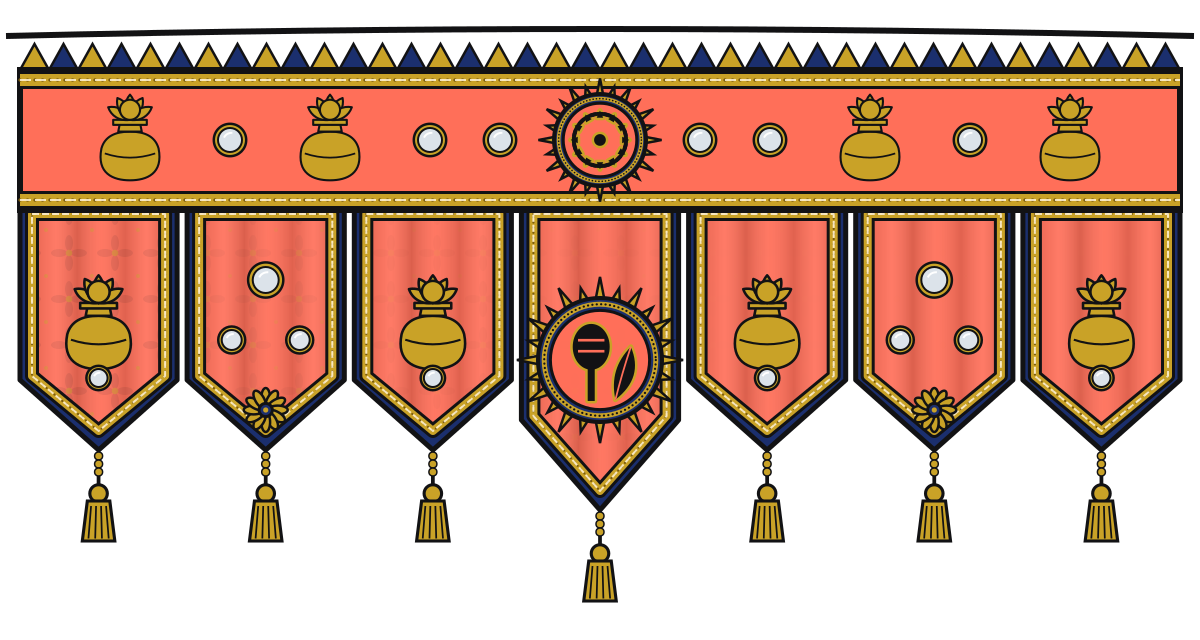
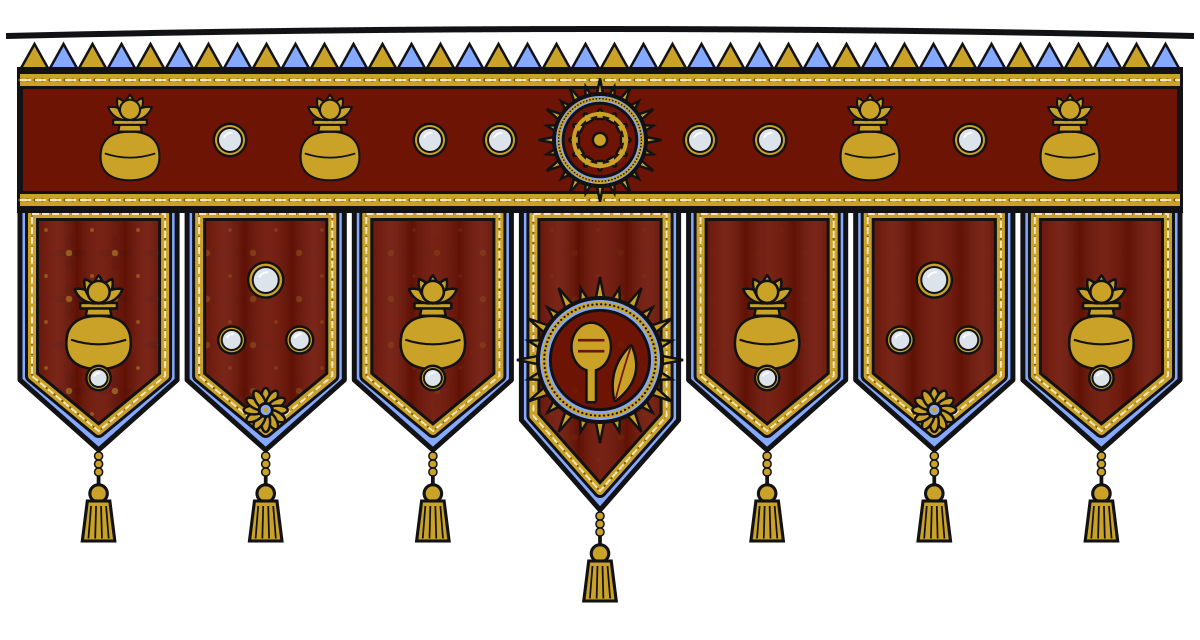
| G1 Torana · gateway The built gate of the seat; the cloth Toran hangs in it | Not yet designed for this clan | Regional tradition |
| G2 Viragallu · hero stone Carved panel stone for a member who died defending the clan | Not yet designed for this clan | Regional tradition |
| G3 Kula-shila · clan stones Standing and table stones that remember the ancestors | Bhiri: a platform and a stone for the dead Russell records the bhiri platform and stone for the dead, with the dead buried head to the south[2] | Documented |
| G4 Jayastambha · victory pillar A pillar raised for a victory | Not yet designed for this clan | Design |
| G5 Sima-shila · boundary stone Marks the clan's land, with a line in the native script | Not yet designed for this clan | Design |
4. Sounds
| Accessory | For this clan | Basis |
|---|---|---|
| D1 Pancha-mahashabda · five great sounds The right to five instruments | Not yet designed for this clan | Design |
| D2 Shankha · clan conch The clan's own named war conch | Not yet designed for this clan | Design |
| D3 Murasu · house drums Three drums: war, charity and justice | Not yet designed for this clan | Design |
5. Kit: colours, metals and emblems
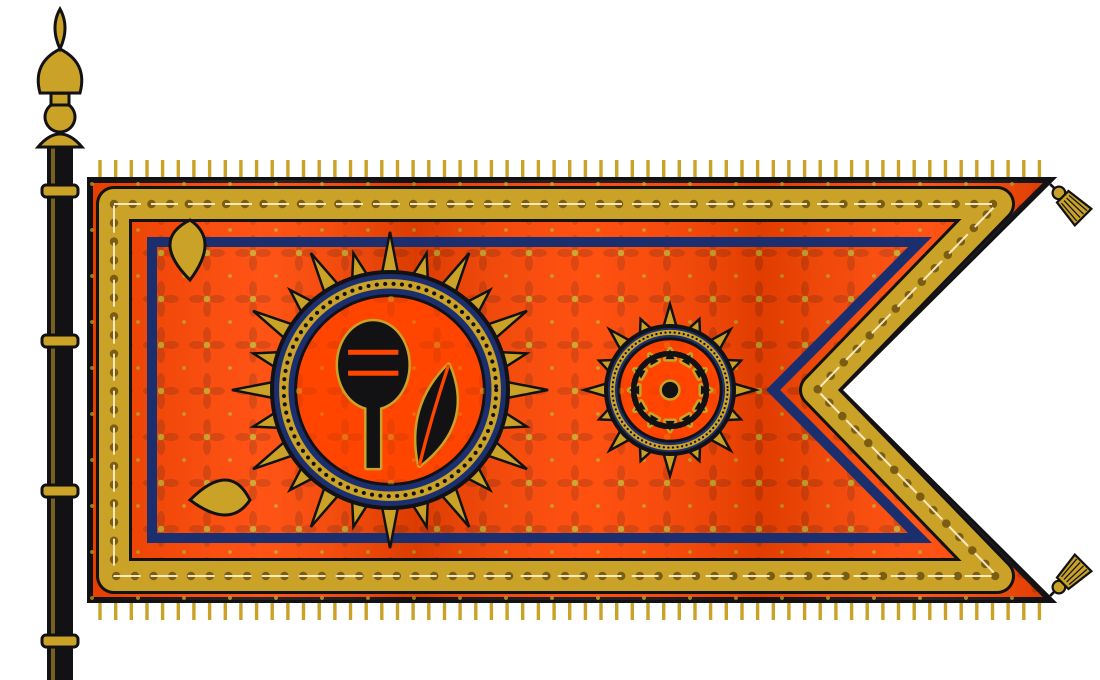
The main emblem is a design made for the project, not a documented Baiga symbol: a shaman's rattle and a forest leaf, with tattoo patterns in a ring, standing for forest magic and the tattooing tradition that the extracts record[4].
| Part of the kit | This clan |
|---|---|
| Field | Deep Cosmic Blue #9BB0FF |
| Accent | Warm Red-Orange #FF6F59 |
| Emblem colour | Charcoal Black #121214 |
| Zari metal | Gold |
| Main emblem | A shaman's rattle and a forest leaf |
| Second image | Tattoo patterns in a ring |
| Night and day | Every visual accessory has two versions: by night the emblem on the dark field, by day the clan's field colour on cloth woven from its metal. |

6. Flags
Every clan has every flag type; the type says the occasion and the colours say the clan. The outlined card is the flag the Atlas assigns.










Historic banner
None known
New flag types
| Accessory | For this clan | Basis |
|---|---|---|
| A9 Pota-dhvaja · ship and trade flag For ships, caravans and markets | Not yet designed for this clan | Design |
| A10 Utsava-patāka · festival flag Light, bright flag for fairs and festivals | Not yet designed for this clan | Design |
| A11 Shoka-dhvaja · mourning flag White cloth with the emblem outline in the clan's metal | Not yet designed for this clan | Design |
7. Regalia
| Accessory | For this clan | Basis |
|---|---|---|
| E1 Chhatra · house parasol The ceremonial umbrella | Not yet designed for this clan | Design |
| E2 Chamara · fly-whisks The pair of whisks beside the head of the house | Not yet designed for this clan | Design |
| E3 Danda · staff of office Staff or scepter | Not yet designed for this clan | Design |
| E4 Simhasana · seat The seat of the house, covered in clan cloth | Not yet designed for this clan | Design |
| E5 Khetaka · shield A round shield; the Changi and Dhanush are its flag forms | Not yet designed for this clan | Regional tradition |
| E6 Kula-ayudha · clan weapon The weapon the clan honours | Not yet found for this clan | Under research |
8. Worn
| Accessory | For this clan | Basis |
|---|---|---|
| F1 Kula-vastra · clan cloth The clan's woven pattern in its kit colours | Not yet designed for this clan | Design |
| F2 Kirti-vastra · honour cloth A cloth earned for a deed, not inherited | Not yet designed for this clan | Design |
| F3 Kula-mala · garland flower The flower or leaf the clan wears as a garland | Not yet found for this clan | Under research |
| F4 Chinha · house pin A metal badge with the pin emblem | Not yet designed for this clan | Design |
9. Records
| Accessory | For this clan | Basis |
|---|---|---|
| H1 Clan words A traditional line in the native script | Ever since the Baigas are known as the protectors of the earth. · “English line quoted from a Baiga creation legend (no native-script line is in the extracts)” Sahapedia, Some Legends and Folk Stories of the Baiga People, creation legend, quoted in English[5] | Design |
| H2 Biruda · titles The house's title or titles | Not yet found for this clan | Under research |
| H3 Prashasti · praise genealogy The lineage as written at the head of a grant | Not yet found for this clan | Under research |
| H4 Vahi · clan register The book of the clan's births, marriages and deaths | Not yet found for this clan | Under research |
| H5 Rana-ghosha · war cry The clan's cry in battle or celebration | Not yet found for this clan | Under research |
10. VishwaVit · knower of the world
Game values are design choices for this project, not historical claims.
References
- Wikipedia, Baiga people, read 2026-10-23, https://en.wikipedia.org/wiki/Baiga_people
- R. V. Russell and Hira Lal, The Tribes and Castes of the Central Provinces of India, vol. 2 (London, 1916), Project Gutenberg eBook #22010, https://www.gutenberg.org/ebooks/22010
- Culture of the Baiga People, Sahapedia (read 11 Oct 2026, KulDevi run 125).
- Hugh R. Page, Jr., Baiga, Encyclopedia of World Cultures (Gale) via Encyclopedia.com, read 2026-10-23, https://www.encyclopedia.com/humanities/encyclopedias-almanacs-transcripts-and-maps/baiga
- Riddhi Pandey (comp.), Some Legends and Folk Stories of the Baiga People of Central India, Sahapedia, read 2026-10-23, https://www.sahapedia.org/some-legends-and-folk-stories-of-the-baiga-people-of-central-india
- Kaleidoscope of Baiga Folksongs, Dialogue: A Journal Devoted to Literary Appreciation 12(2), 2016, pp. 70-75, read 2026-10-23, https://dialoguethejournal.com/index.php/Dialogue/article/view/284
- Wikipedia, List of Scheduled Tribes in Uttar Pradesh, read 2026-10-22, https://en.wikipedia.org/wiki/List_of_Scheduled_Tribes_in_Uttar_Pradesh
- Wikipedia, Tribals in Madhya Pradesh, read 2026-10-19, https://en.wikipedia.org/wiki/Tribals_in_Madhya_Pradesh
- Sushree Mohanty, Indigenous Colours of Odisha: Handbook on 62 Tribes (KISS), read 2026-10-20, link
- Encyclopedia of World Cultures (Gale, 2008) via everyculture.com, Baiga: Kinship, read 2026-10-23, https://www.everyculture.com/South-Asia/Baiga-Kinship.html
- Wikipedia, Tribes of Jharkhand, read 2026-10-20, https://en.wikipedia.org/wiki/Tribes_of_Jharkhand
- Wikipedia, List of Scheduled Tribes in Odisha, read 2026-10-20, https://en.wikipedia.org/wiki/List_of_Scheduled_Tribes_in_Odisha
- dhammabharat.com, List of Scheduled Tribes in Maharashtra and Population of each Tribe (2011 Census), read 2026-10-10, https://dhammabharat.com/?p=13656
- Ministry of Tribal Affairs, State/UT-wise list of Scheduled Tribes (Constitution (ST) Order 1950 as amended; list dated 09-07-2024), via the Atlas entries ST-015 and ST-093.