The Bagata are a Scheduled Tribe of Andhra Pradesh[1] (2023-24 annual report) and of Odisha[2] (list date not printed), also written Bhakta, Bagatha, Bagat or Bogad[3]; the Odisha list gives 8,813 people in 2011[2]. In 1909 Thurston called them Telugu fresh-water fishermen expert with a long spear[4], and in the 17th century they served the Golconda and Madugula chieftains as army personnel and then as local chiefs[5]. Their own tradition, recorded by Wikipedia, is a claim to warrior and Kshatriya status[6]. They are known for the Dhimsa dance, which all ages dance together[7]. The pack names no Bagata deity, inscription or song text, so most of the page is under research.
01Faith and deities
No deity of the Bagata is named in any source in the pack[8]. The Atlas gives Modakondamma of Paderu, goddess of the Visakhapatnam Agency, as the clan goddess (KulDevi, from the homeland shrine). The pack shows no link between her and the Bagata, so she is the project KulDevi, not a sourced deity of this clan.
Modakondamma of Paderu, goddess of the Visakhapatnam Agency
The presiding goddess of the clan's homeland or capital: a link of place, not a recorded clan tie.
| Deity or tradition | Place in the clan's life | Evidence |
|---|---|---|
| Hindu gods and goddesses, with family and tribal gods | Worshipped; no names given | [3][7] |
| Vaishnava and Saiva divisions | Odisha Bagatas are divided into Vaishnavites and Saivites. Vaishnavites are branded on the arm by a Vaishnava guru in Godavari district, burn their dead, and have Satanis as officiants; Saivites bury their dead sitting, with Jangams as officiants | [4][8] |
| Dasara worship | On Dasara day the Bagatas worship their fishing baskets and a kind of trident (Census 1901) | [4] |
| Chinna and pedda rozu | Death ceremonies, named by Thurston | [4] |
02Temples
No temple is recorded as built by the Bagata in the pack. The thatched shrine by the Matsya gundam fish pool, near Matam, has a Bagata priest at Sivaratri, but the pack does not say who built it.
Built by the clan
Not recorded.
Given patronage or grants by the clan
| Temple | Deity | What the clan gave | When | Where |
|---|---|---|---|---|
| Matsya gundam shrine, near Matam, under Yendrika hill | Not named | Priest and Sivaratri festival; sacred fish are fed | Sivaratri | Macheru river fish pool[4] |
03Languages and scripts
| Language or script | Kind | Under the clan | Evidence |
|---|---|---|---|
| Telugu living | Main language of the Bagata in Andhra Pradesh | Andhra Bagata | [6][3] |
| Odia (Desia Odia; Adivasi Odia) living | Among themselves a form of Odia; local dialect Adivasi Oriya | Odisha Bagata and border areas | [3][6] |
| Bagatha (hill accent) living | A hill accent, named by Endangered Alphabets alongside Telugu and a form of Odia | Hill Bagatas | [5] |
| Odisha languages: Hindi, Odia, Sadri, Laria, Kurmali | Languages the Odisha Bagata speak, per Wikipedia citing Pati and Dash (2002) | Odisha Bagata | [6] |
| Bagatha script research | A script reported by Endangered Alphabets, developed by Prof. Sathupati Prasanna Sree; no letters are printed in the pack | Bagata | [5] |
04Books and literature
The pack names no Bagata-language book. The works on the Bagata are the ones below, as the sources cite them[6].
Written during the clan's history
| Work | Author | Kind | When | Link to the clan |
|---|---|---|---|---|
| Bagata | A. B. Ota | Study (SCSTRTI) | 2015 | [9] |
| People of India: Odisha | Das | Survey | 2012 | [6] |
| Castes and Tribes of Southern India, vol. 1 | Edgar Thurston and K. Rangachari | Ethnographic survey | 1909 | [4] |
| Ethnography of Bagatha Tribe in Andhra Pradesh | J. M. Naidu | Ethnography | Not dated | [6] |
| Madras District Gazetteer | Francis | Gazetteer | 1907 | [6] |
| Work by Singh (title not given) | Singh | Study | 1998 | [6] |
| Work by Pati and Dash (title not given) | Pati and Dash | Study | 2002 | [6] |
Given patronage by the clan
Not recorded.
05Thinkers and scholars
| Name | Field | Era | Contribution |
|---|---|---|---|
| Sathupati Prasanna Sree | Script maker | Not dated | Developed the Bagatha script, per Endangered Alphabets[5] |
| A. B. Ota | Author | 2015 | The study of the Bagata that Wikipedia relies on[9] |
| Edgar Thurston and K. Rangachari | Ethnographers | 1909 | The Bagata entry in Castes and Tribes of Southern India[4] |
| Mahima Singh | Writer | Not dated | A popular article on the Bagata, internally inconsistent[10] |
No Bagata scholar is named in the pack beyond the authors above.
06Art and architecture
The art the pack records for the Bagata is the Dhimsa dance and the domed house and script shapes. No painting, sculpture or textile is recorded.
Painting and wall art
Not recorded.
Sculpture and temple art
Not recorded.
Temple and building architecture
| Art form | What it is | Era | Evidence |
|---|---|---|---|
| Domed or semi-circular house | Bagatha houses are domed or semi-circular; the script's letters share the domed shape | Recorded | [5] |
Weaving and textiles
Not recorded.
Clothing and jewellery
| Art form | What it is | Era | Evidence |
|---|---|---|---|
| Tribal dress and ornaments | Female dancers wear distinctive tribal clothing and ornaments | Recorded | [7] |
Coins, pottery and crafts
| Art form | What it is | Era | Evidence |
|---|---|---|---|
| Bamboo split wooden comb | Named among the Bagata's traditional crafts | Popular source | [10] |
07History
Service under the Golconda and Madugula rulers (17th century)
Dr. Prasanna Sree, as Endangered Alphabets reports, says the Bagatha served the 17th-century Golconda and Gangaraju Madugole chieftains of the Visakhapatnam Agency as army personnel and were later appointed local chiefs. Their status grew over about fifty years, from the late 1600s into the early 1700s, after which they 'claimed themselves as a warrior tribe'[5].
Bhakti service and land, as Thurston recorded it (1909)
Thurston and Rangachari give the name, by tradition, from bhakti service to the former rulers of Golgonda and Madugula, who granted land in mokhasa tenure[4]. The 1871 census records the low-country Bhaktas ranking themselves as soldiery and disdaining cultivation[4]. Some were hill cultivators in the Vizagapatam Agency[4].
The community's own account and its limits
Vajiram reports the Bagatas' own account: their name comes from their devotion as the Bhaktas, warriors of the then rulers[3]. A popular article credits the Archaeological Survey of India with saying that no evidence can define the origin precisely[10]. That article is popular and internally inconsistent, so it is not used for dates.
Movement north
Wikipedia, citing Ota (2015), says the Bagata migrated from Andhra Pradesh to the Ranchi region of Chota Nagpur before the 20th century, and then to northern Odisha districts[6][9].
Under research
No inscription, dated grant, named chief or dated record is in the pack. Leads: Francis's Madras District Gazetteer (1907), as cited by Wikipedia[6], and the Vizagapatam Gazetteer that Thurston cites[4].
08Journey and migrations
The sources record one movement, from Andhra Pradesh to the Ranchi region and then to northern Odisha, and it is not dated more closely than before the 20th century.
| When | From | To | Why | Evidence |
|---|---|---|---|---|
| Before the 20th century | Andhra Pradesh | Ranchi region of Chota Nagpur | Not stated | [6][9] |
| Before the 20th century | Ranchi region | Northern Odisha districts | Not stated | [6][9] |
09Seats and lands
| Place | Role | Where today |
|---|---|---|
| Visakhapatnam Agency hills: Paderu, Sujanakota, Karakapalli, Tajangi, Devarapalli, Peddavalasa | Hill places named in the Endangered Alphabets account | Visakhapatnam district, Andhra Pradesh[5][11] |
| Araku valley and Koraput hills | Homeland as the Atlas gives it | Not detailed in the pack |
| Golgonda and Madugula, the rulers' country | Where the Bagata served as army personnel and were granted land | Not stated[5][4] |
| Sundergarh, Mayurbhanj, Sambalpur; Baleshwar also in Wikipedia's list | Odisha districts, spelt as the KISS handbook prints them | Odisha[12][6] |
| Odisha border areas | Where a form of Odia is spoken, per Endangered Alphabets | Odisha[5] |
| Visakhapatnam, Vizianagaram, East Godavari, Rangareddy | Andhra districts as Wikipedia lists them | Andhra Pradesh as Wikipedia prints it[6][11] |
10Notable figures
Not recorded.
11Allies, rivals and marriages
| People | Relationship | When |
|---|---|---|
| Konda Mala village | Looted by the Bagatas after a cockfight defeat, as recorded for 1901 | 1901[4] |
| Kapus (Kapu) | Kapu is the Bagata's local name in Andhra Pradesh (Wikipedia); Padala, an exogamous sept of Kapus, is linked to them by Thurston, who suggests they are a Kapu offshoot | Not dated[6][4] |
| Telagas and Vantaris | Share some exogamous septs (intiperulu) with the Bagata, per C. Hayavadana Rao in Thurston | As recorded in 1909[4] |
| Lodha, Mirdha Bhumia, Jatapu, Pentia, Gond | Listed with the Bagata in Wikipedia's account as having no distinct linguistic identity | Not dated[6] |
12Society and livelihood
The Bagata are patriarchal and patrilineal, with exogamous clans[10][6]. Nuclear families are common, and cross-cousin marriage is preferred[3]. Wikipedia says the Andhra Bagatas kept their original socio-cultural characteristics, while the Odisha Bagatas underwent 'socio-cultural purification'[6].
Government and social order
| Institution or group | What it was | Evidence |
|---|---|---|
| Village council (peddamanusulu) | Settles disputes in the village; a daughter inherits if there is no son | [5] |
| Padal | Village head, a title recorded by Thurston | [4] |
| Nayak or Raju | Overlord of the Padals, styled so by Thurston | [4] |
| Dora | Title of the mokhasadar, per Thurston | [4] |
| Majji and Razu | Titles recorded for the Bagata in Thurston's notes | [4] |
Livelihood over time
| Era | Livelihood | Evidence |
|---|---|---|
| Census 1871 (as Thurston prints it) | Low-country Bhaktas ranked themselves as soldiery and disdained cultivation | [4] |
| Not dated | Hill cultivation; farming; agricultural labour; collection of minor forest produce | [4][5][3] |
| Today, as recorded | Farming, fishing and wage labour (a popular source) | [10] |
13Sub-clans and related clans
The Vaishnava section has totemic clans, listed by Wikipedia from Ota (2015): Belhar (monkey), Samudia, Bamia, Tiruar (bird), Sarania (flute), Nag, Hatiar (elephant), Chumiar and Kuardar[6][9]. Popular sources spell some of them differently (Sarnia, Hatiyar, Chuniar)[10]. Each one not in the Atlas is a candidate for its own entry.
| Clan | Relation | Where | Size | In the Atlas | Evidence |
|---|---|---|---|---|---|
| Belhar | Sub-clan | Vaishnava section; region not stated | new clan candidate | [6][9] | |
| Samudia | Sub-clan | Vaishnava section; region not stated | new clan candidate | [6][9] | |
| Bamia | Sub-clan | Vaishnava section; region not stated | new clan candidate | [6][9] | |
| Tiruar | Sub-clan | Vaishnava section; region not stated | new clan candidate | [6][9] | |
| Sarania | Sub-clan | Vaishnava section; region not stated | new clan candidate | [6][10] | |
| Nag | Sub-clan | Vaishnava section; region not stated | same name as ST-476: check | [6][9] | |
| Hatiar | Sub-clan | Vaishnava section; region not stated | new clan candidate | [6][10] | |
| Chumiar | Sub-clan | Vaishnava section; region not stated | new clan candidate | [6][9] | |
| Kuardar | Sub-clan | Vaishnava section; region not stated | new clan candidate | [6][9] | |
| Bansa | Related people | Term for matrimonial clans (popular source) | new clan candidate | [10] | |
| Padal | Related people | Andhra Pradesh; village-headman title and an alternative name | new clan candidate | [4][6] | |
| Kapu | Related people | Andhra Pradesh; local name of the Bagata there (Wikipedia) | new clan candidate | [6][4] | |
| Telaga | Related people | Shares some exogamous septs with the Bagata | new clan candidate | [4] | |
| Vantari | Related people | Shares some exogamous septs with the Bagata | new clan candidate | [4] | |
| Konda Mala | Related people | A village looted by Bagatas in 1901; the people's place is not stated | new clan candidate | [4] | |
| Mirdha Bhumia | Related people | Named in Wikipedia's account; the sheet's Mirdha and Bhumia are not matched | new clan candidate | [6] | |
| Lodha | Related people | Named in Wikipedia's account | ST-177 | [6] | |
| Jatapu | Related people | Named in Wikipedia's account | ST-111 | [6] | |
| Pentia | Related people | Named in Wikipedia's account | ST-257 | [6] | |
| Gond | Related people | Named in Wikipedia's account | ST-088 | [6] |
Clans marked "new clan candidate" are not in the Atlas yet.
14Surnames
Clan names are used as surnames, and they follow the clan lines[6][10]. The authors say the Bagata had no original surname system and took the custom after migration, as other societies did[6].
| Surname | Clan or sub-clan | Where | People with this surname | Also used by other communities |
|---|---|---|---|---|
| Belhar | Belhar (Vaishnava section) | Not stated | not yet counted | Not checked |
| Samudia | Samudia (Vaishnava section) | Not stated | not yet counted | Not checked |
| Bamia | Bamia (Vaishnava section) | Not stated | not yet counted | Not checked |
| Tiruar | Tiruar (Vaishnava section) | Not stated | not yet counted | Not checked |
| Sarania | Sarania (Vaishnava section) | Not stated | not yet counted | Not checked |
| Nag | Nag (Vaishnava section) | Not stated | not yet counted | Not checked |
| Hatiar | Hatiar (Vaishnava section) | Not stated | not yet counted | Not checked |
| Chumiar | Chumiar (Vaishnava section) | Not stated | not yet counted | Not checked |
| Kuardar | Kuardar (Vaishnava section) | Not stated | not yet counted | Not checked |
Counts are of everyone with the surname, from the cited source and year, not only members of this clan. A surname shared with other communities says nothing about any one person's origin.
15Songs and music
The Bagata have traditional songs at festivals and weddings, but the pack gives no lyrics and no titles[10].
None recorded yet.
Instruments and styles
| Instrument or style | What it is | Evidence |
|---|---|---|
| Dhimsa dance | Danced by groups of eight to eighty men and women, of all ages | [10][3] |
| Dhimsa rhythms | Mori, Kiridi, Tudumu, Dappu and Jodukommulu are the rhythms the Dhimsa follows; no lyrics | [7] |
| Tudumu and Dappu | Named under the Bagata tribe in the INTACH archive; no further detail | [13] |
16Poems, lullabies and children's rhymes
None recorded yet.
17Stories, legends and proverbs
Stories and legends
Not recorded.
Proverbs and sayings
Not recorded.
18Festivals and fairs
| Festival or fair | When | Where | What happens |
|---|---|---|---|
| Dasara | Dasara day; the prime annual festival | Not stated | The fishing baskets and a kind of trident are worshipped[4][10] |
| Sivaratri | Sivaratri | Thatched shrine by the Matsya gundam fish pool, near Matam | A festival with a Bagata priest; sacred fish are fed[4] |
| Itiga Ponduga | Not dated | Hill Bagatas | A festival observed by the hill Bagatas[4] |
| Dhimsa dance | Chaitra (March–April), at weddings and social events | Bagata villages | Dancers from one village visit another and join a community feast; the dance builds friendship among neighbouring villages[7][3] |
| Sankidi Kelbar | Not dated | Bagata villages | Dances called by this name; no further detail[7] |
19Food, dress and games
Food
Not recorded.
Dress
| Item | What it is | Evidence |
|---|---|---|
| Tribal dress and ornaments | Distinctive tribal clothing and ornaments worn by female dancers | [7] |
| Hair buns and handmade attire | Hair buns decorated with clips and flowers; handmade attire | [10] |
Games and martial arts
Not recorded.
Tags: living still practised · revived brought back after a break · lost known only from records · research reported but not yet confirmed from a source. Songs and poems under copyright are listed by title only; restricted or sacred material is noted without its content.
20Status today
The Bagata are a living Scheduled Tribe. The Atlas records the ST status, and the Odisha list counts 8,813 in 2011[2].
Recognised heritage
| What | Recognition | Evidence |
|---|---|---|
| Intangible heritage records (INTACH) | Two records of the Bagata tribe in Andhra Pradesh, Tudumu and Dappu, with no further detail[13] | [13] |
Not yet reviewed by the Bagata community. No community body or review is in the pack.
21For children
The devoted warriors of the hills
Long ago, the Bagata lived in the hills of the Visakhapatnam Agency in Andhra Pradesh. They say their name means devoted warriors, the Bhaktas who served the rulers of their hills. Some of them were fishermen who were skilled with a long spear. Each Dasara day they honoured their fishing baskets and their trident. At the festival of Sivaratri, a Bagata priest looks after the sacred fish in a pool near Matam. Today the Bagata still dance the Dhimsa at weddings, with men and women of all ages together. The Dhimsa follows drum rhythms with names such as Tudumu and Dappu.
22Across the project
| Project | What carries this clan | Status |
|---|---|---|
| Atlas of the Janas | Homeland: the Araku valley and Koraput hills; the Visakhapatnam Agency hills and the Odisha districts are in Lands. No footprint drawn yet | To check |
| KulDevi and GrahDevi | KulDevi: Modakondamma. GrahDevi forms: Brahmani, Maheshvari, Kaumari, Vaishnavi, Varahi, Indrani, Chamunda, Narasimhi | From the Atlas |
| Planet naming | Planet names are not in the pack | To check |
| Renaming and waters | The Macheru river fish pool at Matam, with its shrine (Thurston), is the only water place the pack names | From sources |
23Open questions
- Native-script name: none is in the pack. The Bagatha script is reported by Endangered Alphabets, but no letters are printed. Find the Telugu-script name and a script sample.
- Clan words: no line of the Bagata is sourced; the words block is under research. Find a coin, seal or inscription legend, or a cited line.
- Deities: no Bagata deity is named in any source. Lead: Thurston on the Vaishnava and Saiva sects[4].
- Population totals conflict: Wikipedia gives Andhra Pradesh 1,33,427 with no year[6], and a popular article gives about 146,000 for 2011[10]. Find the census table for the state.
- Rangareddy: Wikipedia lists it among the Andhra districts[6], and the sheet lists Telangana. Check the state split.
- Mirdha Bhumia is named by Wikipedia; the sheet has Mirdha (ST-219) and Bhumia (ST-032). Decide whether it is one of them.
- Kapu: Wikipedia gives Kapu as the Andhra local name of the Bagata; Thurston suggests a Kapu offshoot. Not decided; left as a related candidate.
- Dates and named chiefs from before 1900 are not in the pack. Leads: Francis (1907)[6] and the Vizagapatam Gazetteer that Thurston cites[4].
- Ota (2015), SCSTRTI, is cited by Wikipedia but was not read directly.
- Main emblem: the Atlas's headman's staff is not in any source, so no documented staff is recorded for the Bagata.
- Community review: the page has not been reviewed by the Bagata community.
24Astitva
अस्तित्व · being, existence: everything by which the clan is known
The pack gives the Bagata few accessories: the totem animals of the Vaishnava clans (Wikipedia, citing Ota 2015), the trident honoured at Dasara, the titles of the headmen, and the sun dot in the Bagatha script's domed letters[6][4][5].
Every clan has every accessory, royal objects included. Each one says how it is known: Documented This clan's own object is recorded. · Regional tradition Recorded for the region or for peoples like this one, not for this clan. · Design Made for this project, with no historical claim. · Under research To be found for this clan from sources. Legends and titles are written in the clan's own script.
1. Seals and coins
| Accessory | For this clan | Basis |
|---|---|---|
| B1 Rajamudra · house seal Round seal with the clan emblem and a short legend in the clan's script | Not yet designed for this clan | Design |
| B2 Anguliya-mudra · signet ring Personal seal ring of the head of the house | Not yet designed for this clan | Design |
| B3 Chhapa · house stamp Ink or block stamp for letters, goods and cloth | Not yet designed for this clan | Design |
| B4 Tamrapatra · charter plate Copper-plate grant on a ring, closed with the house seal | Not yet designed for this clan | Design |
| B5 Shreni-mudra · guild or trade seal Seal for the clan's trade, craft or caravan | Not yet designed for this clan | Design |
| C1 Clan coin Emblem or deity on one side, a legend in the clan's script | Not yet designed for this clan | Design |
| C2 Coin die The die that strikes the coin | Not yet designed for this clan | Design |
2. Living symbols
| Accessory | For this clan | Basis |
|---|---|---|
| I1 Totem trio The tree, bird and animal the clan protects | Totem animals of the Vaishnava clans: monkey (Belhar), bird (Tiruar), elephant (Hatiar) | Documented |
| I2 Kaval-maram · guardian tree The tree that stands at the clan's seat | Not yet found for this clan | Under research |
3. Stone and gate
| Accessory | For this clan | Basis |
|---|---|---|
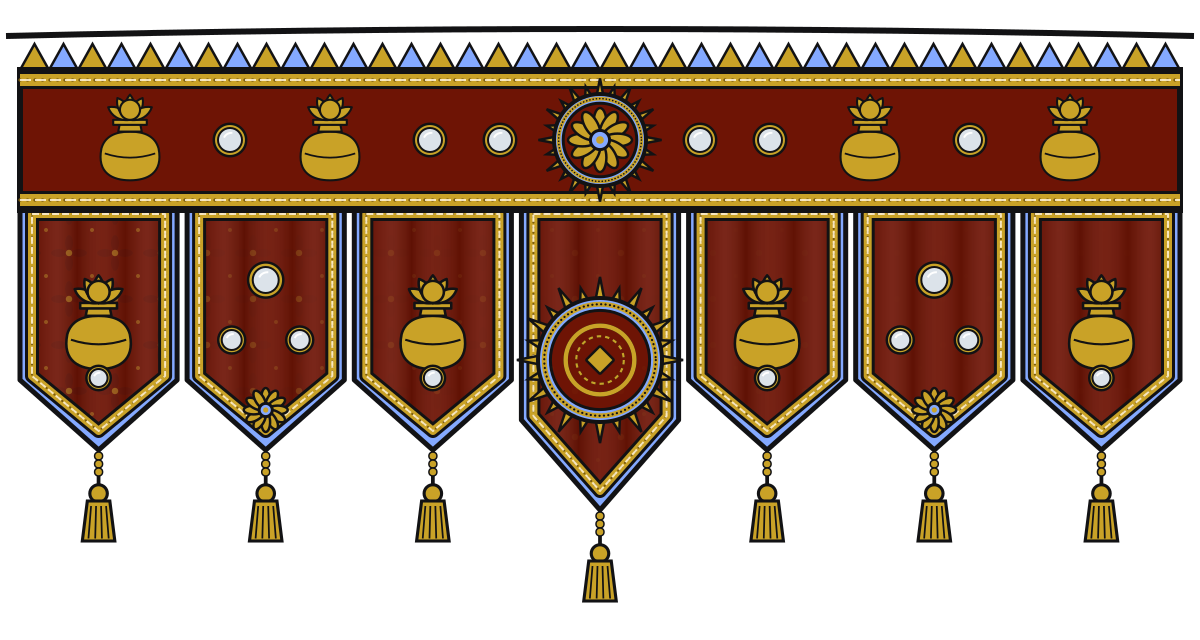
| G1 Torana · gateway The built gate of the seat; the cloth Toran hangs in it | Not yet designed for this clan | Regional tradition |
| G2 Viragallu · hero stone Carved panel stone for a member who died defending the clan | Not yet designed for this clan | Regional tradition |
| G3 Kula-shila · clan stones Standing and table stones that remember the ancestors | Not yet designed for this clan | Design |
| G4 Jayastambha · victory pillar A pillar raised for a victory | Not yet designed for this clan | Design |
| G5 Sima-shila · boundary stone Marks the clan's land, with a line in the native script | Not yet designed for this clan | Design |
4. Sounds
| Accessory | For this clan | Basis |
|---|---|---|
| D1 Pancha-mahashabda · five great sounds The right to five instruments | Not yet designed for this clan | Design |
| D2 Shankha · clan conch The clan's own named war conch | Not yet designed for this clan | Design |
| D3 Murasu · house drums Three drums: war, charity and justice | Not yet designed for this clan | Design |
5. Kit: colours, metals and emblems
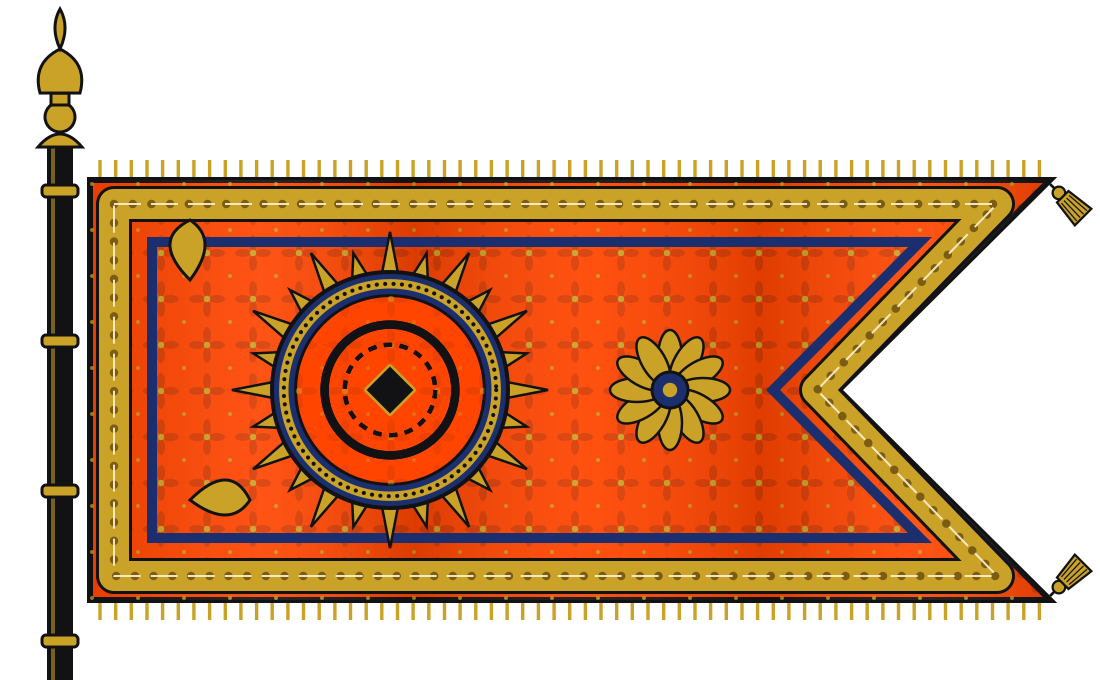
The Atlas gives a headman's staff as the main emblem, and a Changi (sun dynasty crest) as the flag type. The sources name the village head as the Padal and the overlord's title as Nayak or Raju[4]. None records a staff or a crest for the Bagata, so the emblem is from the sheet, not a documented symbol.
| Part of the kit | This clan |
|---|---|
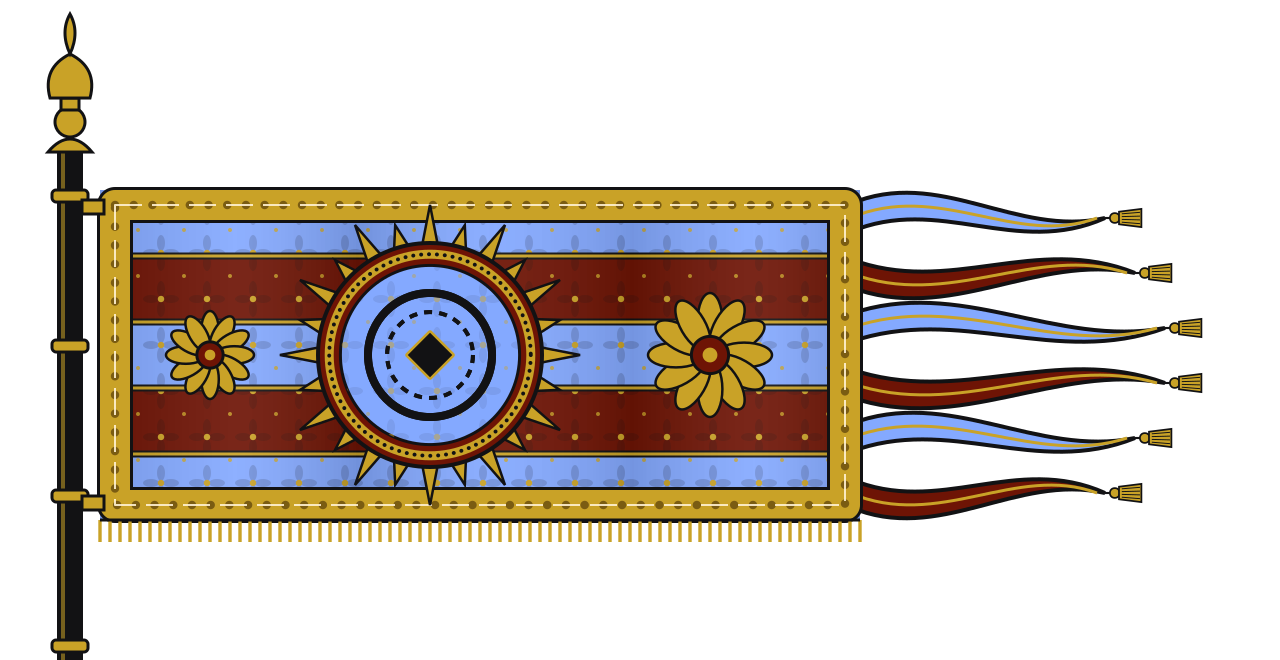
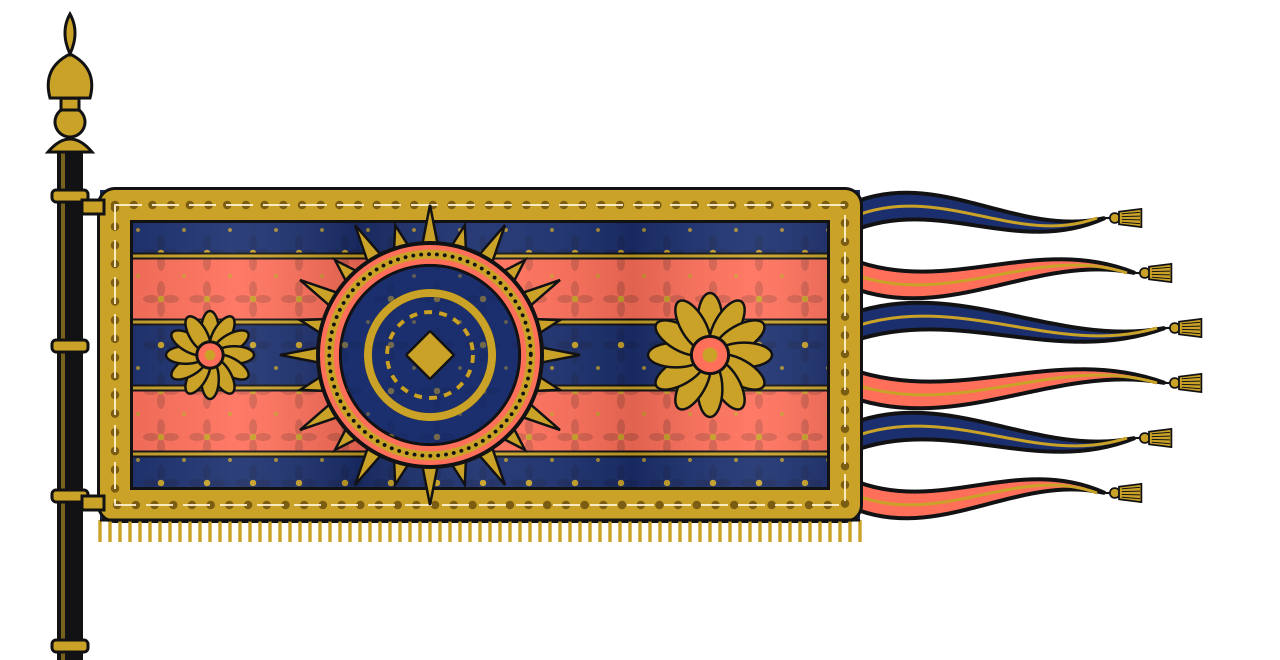
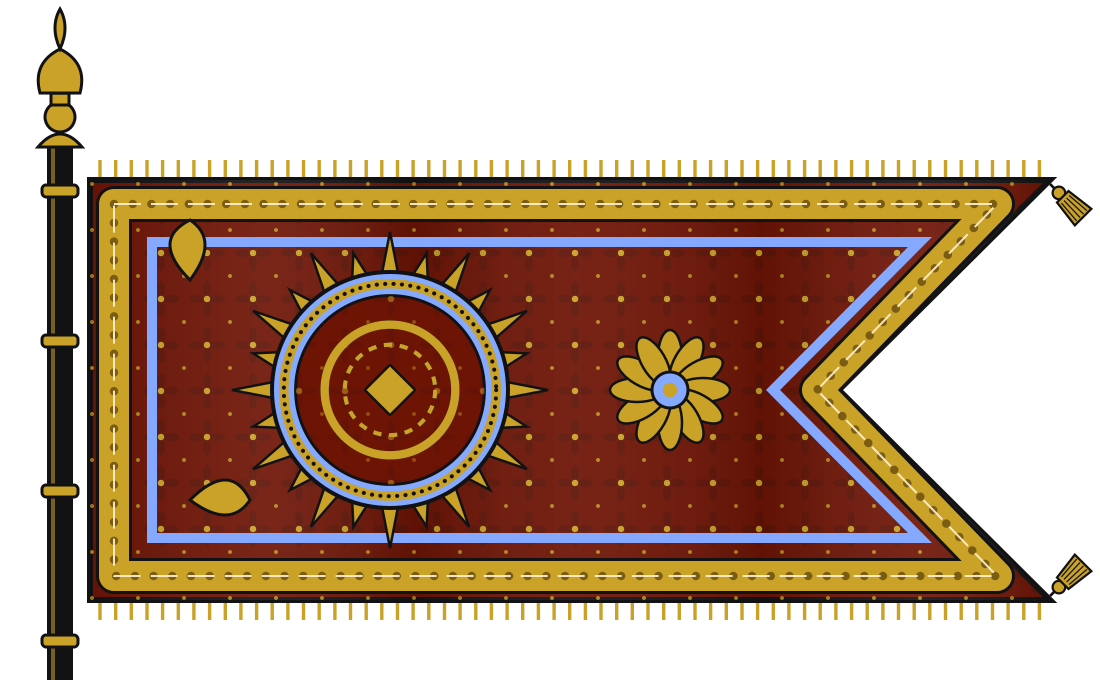
| Field | Warm Red-Orange #FF6F59 |
| Accent | Intense Electric Blue #84A9FF |
| Emblem colour | Charcoal Black #121214 |
| Zari metal | Gold |
| Main emblem | A headman's staff |
| Second image | Two dancers linked arm in arm |
| Night and day | Every visual accessory has two versions: by night the emblem on the dark field, by day the clan's field colour on cloth woven from its metal. |
6. Flags
Every clan has every flag type; the type says the occasion and the colours say the clan. The outlined card is the flag the Atlas assigns.
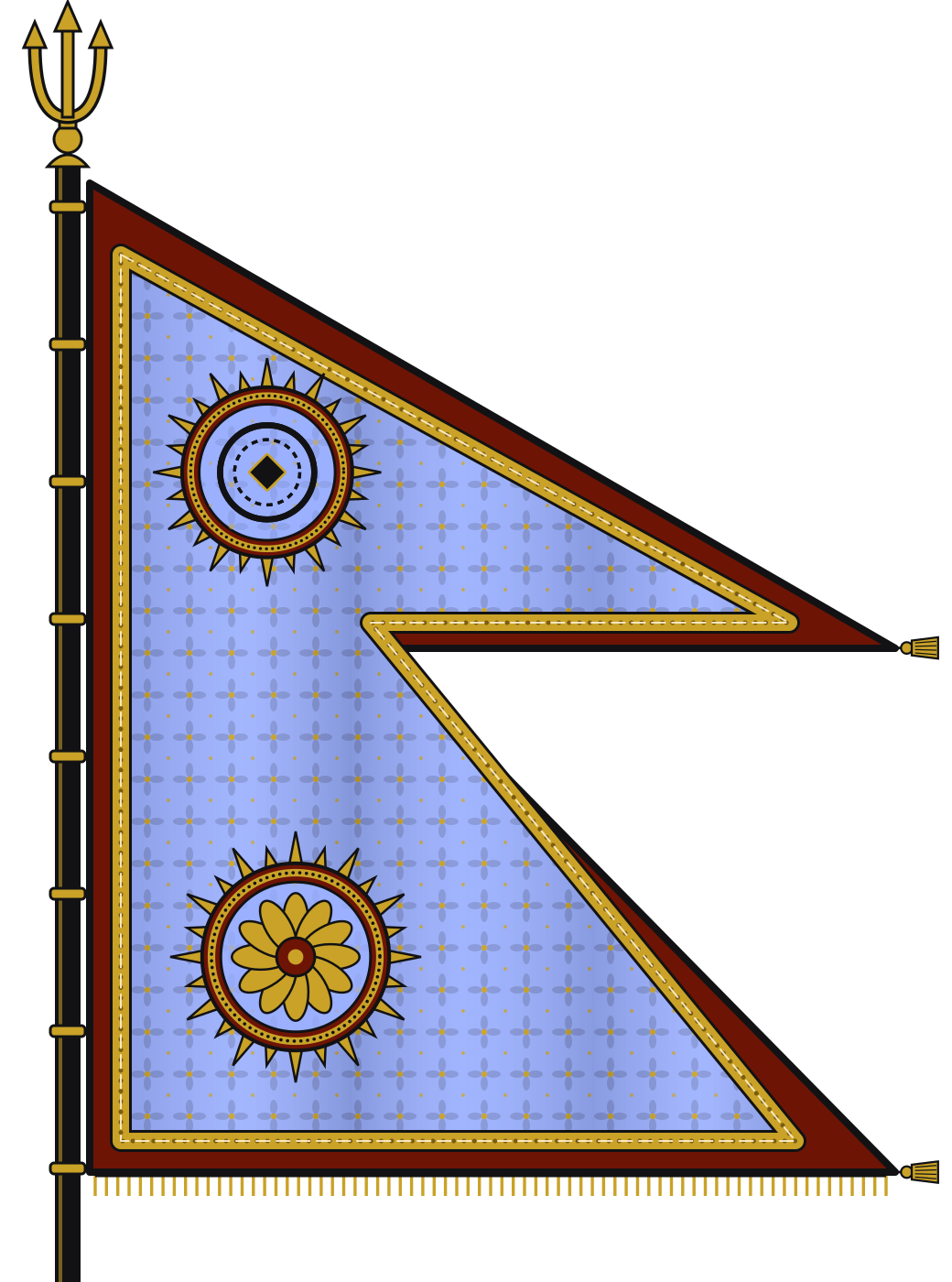
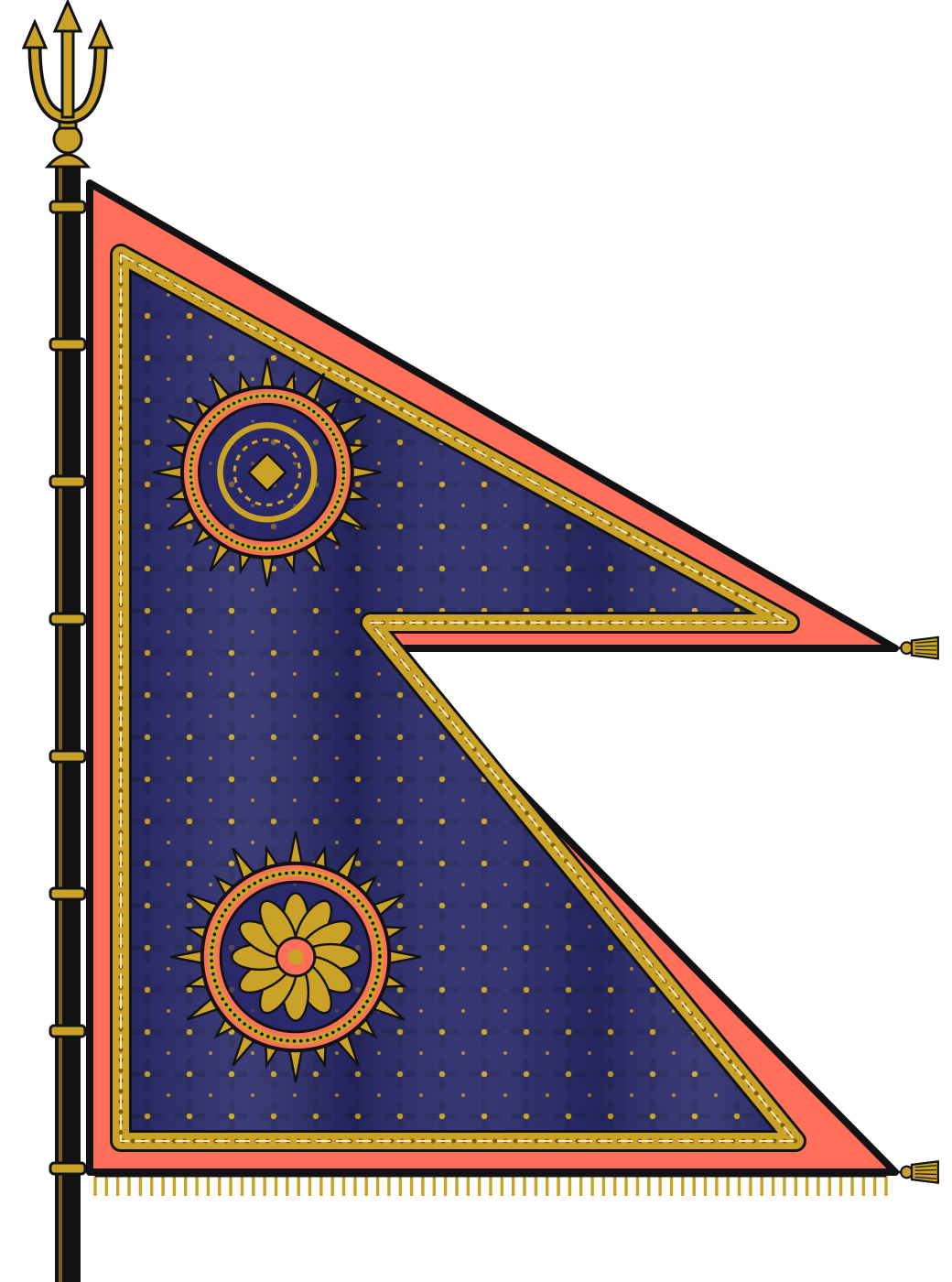

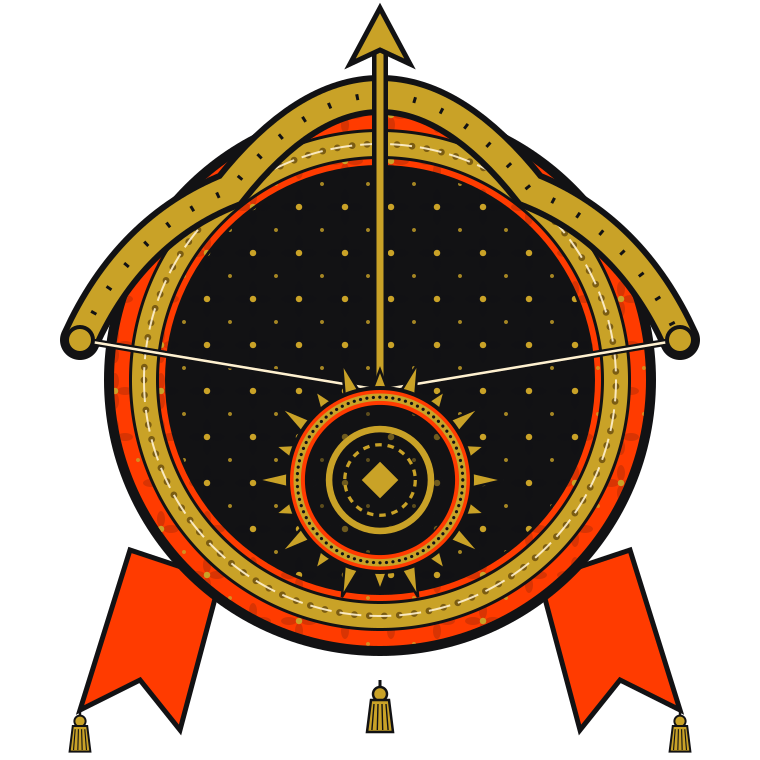
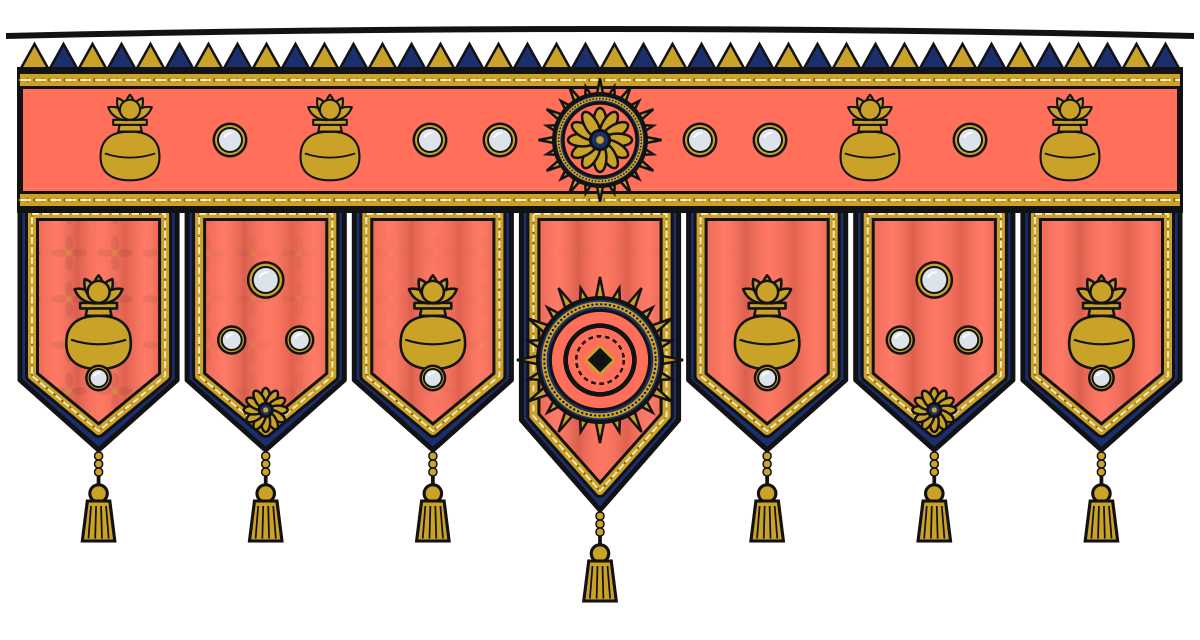

Historic banner
None known
New flag types
| Accessory | For this clan | Basis |
|---|---|---|
| A9 Pota-dhvaja · ship and trade flag For ships, caravans and markets | Not yet designed for this clan | Design |
| A10 Utsava-patāka · festival flag Light, bright flag for fairs and festivals | Not yet designed for this clan | Design |
| A11 Shoka-dhvaja · mourning flag White cloth with the emblem outline in the clan's metal | Not yet designed for this clan | Design |
7. Regalia
| Accessory | For this clan | Basis |
|---|---|---|
| E1 Chhatra · house parasol The ceremonial umbrella | Not yet designed for this clan | Design |
| E2 Chamara · fly-whisks The pair of whisks beside the head of the house | Not yet designed for this clan | Design |
| E3 Danda · staff of office Staff or scepter | Not yet designed for this clan | Design |
| E4 Simhasana · seat The seat of the house, covered in clan cloth | Not yet designed for this clan | Design |
| E5 Khetaka · shield A round shield; the Changi and Dhanush are its flag forms | Not yet designed for this clan | Regional tradition |
| E6 Kula-ayudha · clan weapon The weapon the clan honours | A kind of trident, worshipped with the fishing baskets on Dasara day Census 1901, as Thurston records it[4] | Documented |
8. Worn
| Accessory | For this clan | Basis |
|---|---|---|
| F1 Kula-vastra · clan cloth The clan's woven pattern in its kit colours | Not yet designed for this clan | Design |
| F2 Kirti-vastra · honour cloth A cloth earned for a deed, not inherited | Not yet designed for this clan | Design |
| F3 Kula-mala · garland flower The flower or leaf the clan wears as a garland | Not yet found for this clan | Under research |
| F4 Chinha · house pin A metal badge with the pin emblem | Not yet designed for this clan | Design |
9. Records
| Accessory | For this clan | Basis |
|---|---|---|
| H1 Clan words A traditional line in the native script | · “Under research” | Documented |
| H2 Biruda · titles The house's title or titles | Titles recorded for the Bagata: Padal (village head), Majji, Razu Recorded in Thurston's notes[4] | Documented |
| H3 Prashasti · praise genealogy The lineage as written at the head of a grant | Not yet found for this clan | Under research |
| H4 Vahi · clan register The book of the clan's births, marriages and deaths | Not yet found for this clan | Under research |
| H5 Rana-ghosha · war cry The clan's cry in battle or celebration | Not yet found for this clan | Under research |
10. VishwaVit · knower of the world
Game values are design choices for this project, not historical claims.
References
- State-wise ST list (annual report 2023-24), Andhra Pradesh Part I, read 2026-10-10, https://iiitl.ac.in/wp-content/uploads/2024/08/07014a84-st-list-as-per-annual-report_-2023-24.pdf
- Wikipedia, List of Scheduled Tribes in Odisha, read 2026-10-20, https://en.wikipedia.org/wiki/List_of_Scheduled_Tribes_in_Odisha
- Vajiram and Ravi, Bagata Tribe (exam-prep, secondary), read 2026-10-31, https://vajiramandravi.com/current-affairs/bagata-tribe/
- Edgar Thurston and K. Rangachari, Castes and Tribes of Southern India, vol. 1 (Madras, 1909), Project Gutenberg eBook #42991, https://www.gutenberg.org/ebooks/42991
- Endangered Alphabets Project, Bagatha (quoting Dr. Prasanna Sree), read 2026-10-31, https://www.endangeredalphabets.net/alphabets/bagatha/
- Wikipedia, Bagata people, read 2026-10-31, https://en.wikipedia.org/wiki/Bagata_people
- Indianetzone, Bagata Tribe (tertiary), read 2026-10-31, https://www.indianetzone.com/bagata_tribe
- Odisha State Tribal Museum, Tribes of Odisha: Bagata, read 2026-10-21, https://ostm.in/tribes_of_odisha/bagata/
- A. B. Ota, Bagata (SCSTRTI, 2015), as cited on Wikipedia, Bagata people; not read directly, read 2026-10-31, https://en.wikipedia.org/wiki/Bagata_people
- Mahima Singh, Bagata Tribe of Odisha and Andhra Pradesh, auchitya.com (popular, inconsistent), read 2026-10-31, https://www.auchitya.com/?p=3514
- Vajiram and Ravi, Tribes of Andhra Pradesh, read 2026-10-10, https://vajiramandravi.com/current-affairs/tribes-of-andhra-pradesh/
- Sushree Mohanty, Indigenous Colours of Odisha: Handbook on 62 Tribes (KISS), read 2026-10-20, link
- INTACH Intangible Cultural Heritage archive, object 16025, read 2026-10-22. https://icharchive.intach.org/Detail/objects/16025