Avanti was one of the sixteen great realms (mahajanapadas) listed in the Anguttara Nikaya[1][2]. It lay in what is now Malwa in Madhya Pradesh, split by the Vindhyas into a northern part around Ujjayini on the Sipra and a southern part around Mahishmati on the Narmada[2]. The Puranas say the Haihayas ruled it first; the Pradyota dynasty, founded in 546 BCE, made Avanti a rival of Magadha[2][3]. Magadha conquered it in the late 5th century BCE[3], and under the Nandas and Mauryas it became the western province, ruled from Ujjayini[2][4].
01Faith and deities
The Avantis had no single deity of their own in the sources read: the realm followed the historical Vedic religion, Jainism and Buddhism[2]. The main deity is therefore the project KulDevi, Harsiddhi, goddess of Ujjain, by tradition Vikramaditya's kuldevi[5]; her temple is among Ujjain's temples[4].
Goddess of Ujjain, by tradition Vikramaditya's kuldevi[5]
A recorded tie between the clan and the goddess.
| Deity or tradition | Place in the clan's life | Evidence |
|---|---|---|
| Vedic religion | Listed as a religion of the realm | [2] |
| Buddhism | Queen Gopalamata, a disciple of the monk Mahakatyayana, built a stupa in Ujjayini; Avanti was an important Buddhist centre where theras and theris were born | [2][6] |
| Jainism | Listed as a religion of the realm; Jain accounts tie Palaka's accession to Mahavira's death | [2] |
| Agni legend | Said to protect Mahishmati through marriage to its king's daughter | [7] |
| Mahakala (Shiva) living | Mahakaleshwar Jyotirlinga; Shaiva, Vaishnava and Shakta pilgrims come to the city | [4] |
| Harsiddhi living | Goddess of Ujjain; the project KulDevi | [5][4] |
02Temples
Only one monument of the Avanti kings themselves is recorded in the sources read; Ujjain's living temples are later.
Built by the clan
| Temple | Deity | Built by | When | Where |
|---|---|---|---|---|
| Stupa of Gopalamata | Buddhist | Queen Gopalamata | Pradyota era (no date given for the stupa) | Ujjayini[2] |
Given patronage or grants by the clan
Not recorded.
Later temples in the clan's lands
| Temple | Deity | Built | Where | |
|---|---|---|---|---|
| Mahakaleshwar Jyotirlinga living | Shiva | Ujjain[4] | ||
| Harsiddhi temple living | Harsiddhi | Ujjain[4] | ||
| Kal Bhairav, Mangalnath, Chintaman Ganesh, Siddhwat living | Ujjain[4] | |||
| Sandipani Ashram living | Ujjain[4] | |||
| Harsud Shiva temple | Shiva | Merchant Keshava (per the 1218 inscription) | 1218 CE | Harsud[8] |
| Elephanta Caves | Shiva | Possible Kalachuri patronage (the page's word) | Not dated in the source | Elephanta; earliest Brahmanical caves at Ellora[9] |
03Languages and scripts
| Language or script | Kind | Under the clan | Evidence |
|---|---|---|---|
| Sanskrit | Old Indo-Aryan | A language of the realm | [2] |
| Prakrit | Middle Indo-Aryan | A language of the realm | [2] |
| Malvi living | Indo-Aryan | Widely spoken in the Malwa heartland today | [4] |
| Hindi living | Indo-Aryan | Official language of Ujjain today | [4] |
04Books and literature
No book written by the Avantis is known; they appear in Buddhist, Jain, epic and Puranic texts, and Ujjain is the setting of later plays and poems.
Written in the clan's lands during its era
| Work | Author | Kind | When | Link to the clan |
|---|---|---|---|---|
| Anguttara Nikaya | Buddhist canon | Lists Avanti among the sixteen mahajanapadas[1] | ||
| Mahagovinda Suttanta (Digha Nikaya) | Buddhist canon | Names King Vessabhu and Mahissati[2][7] | ||
| Mahavagga | Buddhist canon | Calls Pradyota cruel[2] | ||
| Mahabharata | Epic | Vinda and Anuvinda; the Avantis 'very powerful' (5.19.24)[2][6] | ||
| Malavikagnimitram (मालविकाग्निमित्रम्) later | Kalidasa | Play | Kalidasa's first play, per the page; set at Vidisha under the Shunga emperor Agnimitra and based on events of Pushyamitra's reign; names neither Ujjain nor Avanti[10] | |
| Mricchakatika later | Shudraka | Play | Set in Ujjain; Aryaka's revolt against Palaka[2][4] | |
| Plays of Bhasa later | Bhasa | Plays | Set in Ujjain; Vasavadatta and Udayana[4] | |
| Meghaduta later | Kalidasa | Poem | Describes Ujjain[4] | |
| Kathasaritsagara later | Somadeva | Story collection | 11th century | Ujjain made by Vishwakarma; Palaka's rule over Vatsa[4][2] |
| Subhashita-Ratna-Sandoha | Amitagati | 993–994 CE | Links the Vikrama era to Vikramaditya[11] |
Given patronage by the clan
Not recorded.
05Thinkers and scholars
| Name | Field | Era | Contribution |
|---|---|---|---|
| Mahakatyayana | Buddhism | Teacher of Queen Gopalamata[2] | |
| Kalidasa later | Poetry and drama | Refers often to Ujjain and may have lived there[4] | |
| Bhartrhari later | Poetry | Said to have written the Niti Shataka in Ujjayini[4] |
Ujjain was a centre of Jain, Buddhist and Hindu learning[4]. The Ujjain page also lists Varahamihira, Brahmagupta and Bhaskara II among people linked to the city; their work there is not yet sourced for this page. Under Chandragupta II, the page's court lists Kalidasa and Varahamihira (New World Encyclopedia)[12].
06Art and architecture
What survives of Avanti is earthworks, brick and pottery; the stupa of Gopalamata is known from texts.
Painting and wall art
Not recorded.
Sculpture and temple art
Not recorded.
Temple and building architecture
| Art form | What it is | Era | Evidence |
|---|---|---|---|
| Ramparts of Ujjayini | A 12 m mud rampart and a moat 45 m wide and 6.6 m deep around Garh Kalika hill | 6th–4th century BCE (Allchin and Erdosy); before 600 BCE (Schlingloff) | [4] |
| Stone and burnt-brick buildings | Structures of the ancient city | Ancient period | [4] |
| Jantar Mantar later | Built by Jai Singh II | 18th century | [4] |
| Udayagiri Cave 5 Varaha relief later | Colossal Varaha (Vishnu as man-boar) with Chandragupta II shown bowing; Virasena is shown in Cave 13 and the Varaha panel | Stietencron suggests 410–412 CE for the niche | [13] |
Weaving and textiles
Not recorded.
Clothing and jewellery
Not recorded.
Coins, pottery and crafts
| Art form | What it is | Era | Evidence |
|---|---|---|---|
| Black-and-red burnished ware | Pottery of ancient Ujjain | Ancient period | [4] |
07History
Haihayas and Vitihotras {LEG}
Puranic accounts say the Haihayas were Avanti's earliest rulers: they took the land from the Nagas and ruled first from Mahishmati; later the realm was split, with capitals at Mahishmati and Ujjayini[2]. The Haihayas were a confederation of five clans (Vitihotras, Bhojas, Avantis, Tundikeras and Sharyatas), later known mainly by the Vitihotras[2]. The Digha Nikaya names a king Vessabhu of Avanti, probably a Vitihotra[2].
The Pradyotas (546–c. 408 BCE)
Ripunjaya, the last Vitihotra king of Ujjayini, was overthrown by his minister Pulika, who placed Pradyota on the throne[2]. The dynasty is dated from 546 BCE (K. C. Jain 1972): Pradyota 546–523, Palaka 523–499, Vishakhayupa 499–449, Ajaka 449–428 and Nandivardhana 428–408 BCE[3].
Pradyota, called Mahasena and, in Buddhist texts, Canda-Pajjota ('the cruel'), was a contemporary of the Buddha[2][3]. He captured Udayana of Vatsa and later married his daughter Vasavadatta to him, fought Pushkarasarin of Takshashila, and the page names the port of Bharukaccha[2][3]. Ajatashatru of Magadha fortified Rajagriha against an attack he planned[2][3].
Palaka to Avantivardhana
Jain accounts date Palaka's accession to the day Mahavira died[2]. The Kathasaritsagara and Avashyaka Kathanaka say that under Palaka Vatsa was part of Avanti, with a prince governing Kaushambi[2]. In the play Mricchakatika, Palaka is overthrown by a popular revolt that puts Aryaka on the throne legend[2]. The Puranas then name Nandivardhana or Vartivardhana, probably for Avantivardhana, who was defeated by Shishunaga of Magadha[2].
Magadha's western province (4th–2nd century BCE)
Avanti was part of the Magadhan empire under the Shaishunagas and Nandas; under the Nandas it was the Avantirattha, the western province, with its capital at Ujjayini[2]. Chandragupta Maurya annexed Avanti in the 4th century BCE[4]; the Junagadh inscription of Rudradaman I (150 CE) names Pushyagupta as his western governor[2]. Under Bindusara the prince Ashoka was viceroy at Ujjain, one of the empire's four provinces under princes[4][14]. After the Mauryas, under Pushyamitra Shunga, Agnimitra was viceroy at Vidisha[2]. The Malavikagnimitram page calls him Shunga emperor, ruling from Vidisha, and names neither Ujjain nor Avanti[10]; the two pages differ on his rank, and no source read places Shunga rule at Ujjain.
Ujjain after Avanti {LATER}
Ujjain passed to the Shungas, Satavahanas and Western Satraps, and stayed important under the Guptas[4]; Chastana of the Chashtana house is called the Ujjain satrap[15]; Rudradaman's Ujjain seat is unproven[16]; and his Junagadh inscription lists Akaravanti and Avanti among his lands[17]. Umayyad Arabs raided it in the 8th century; the Paramaras (9th–14th centuries) moved their capital to Dhar; Iltutmish's raid is dated 1233–35 CE (see the Paramara section); Ranoji Scindia made it his capital in 1731[4].
Shungas and Satavahanas {LATER}
The Shunga dynasty of Magadha was founded by Pushyamitra after Brihadratha's assassination, dated 185 BCE (184 in some reconstructions), and ended in 73 BCE; its capitals were Pataliputra and Besnagar, which is Vidisha in eastern Malwa[18]. The Puranas say the Andhras destroyed the Shunga remnant around Vidisha[18].
The Satavahanas, founded by Simuka (Puranas: Sishuka, Sindhuka), are dated from the late 2nd century BCE to about 224 CE, with capitals at Pratishthana (Paithan), Amaravati, Junnar and Pauni[19]. Wilfried Pieper's coin gallery says that die-struck local copper at Ujjain began about or shortly after 200 BC and ended in the mid-1st century BC, when the Satavahanas absorbed Malwa; the page speaks of Malwa, not of Avanti by name[20]. Gautamiputra Satakarni's Nashik prashasti lists 'Akaravanti' among his regions; Wikipedia glosses it as eastern and western Malwa and says the prashasti does not name Ujjain[21].
The Shungas after Pushyamitra {LATER}
The Malavikagnimitram claims Pushyamitra's empire reached the Narmada, and the Shungas 'may also have controlled the city of Ujjain' (Sen 1999, p. 169). The Shunga Empire page names Avanti only in its infobox and gives no further detail on Ujjain[22].
Agnimitra, son of Pushyamitra, is dated c. 149–141 BCE on that page (infobox 151–141) and is called viceroy of Vidisha in Kalidasa's drama; the empire disintegrated after him[22]. Later emperors such as Bhagabhadra held court at Besnagar (Vidisha)[22]. The Heliodorus pillar at Vidisha, c. 110 BCE, is tied to an envoy of Antialcidas to Bhagabhadra[22].
The page dates Shunga rule to c. 185/184 to c. 73/75 BCE, with Devabhuti the last ruler (83–73 BCE)[22]. It says the Shungas fought the Satavahanas: the Puranas say Andhra Simuka ended Shunga power, and the Andhras destroyed the last Shunga remains near Vidisha (Raychaudhuri 1923, p. 216; Sen 1999, p. 170)[22].
The Western Satraps and the Chashtana house {LATER}
The Western Satraps ruled c. 35–415 CE: first the Kshaharatas (Abhiraka, Bhumaka, Nahapana), then the Chashtana house, whose Chastana is called the Ujjain satrap. Chastana may have founded the Saka era in 78 CE; the page also gives a competing Azes-era view[15]. Gautamiputra Satakarni defeated Nahapana, a defeat Wikipedia dates c. 124 CE (Dhavalikar), after 71 CE (Fynes) or c. 78 CE (Bhandare)[21]; Rudradaman I gave his daughter to Vashishtiputra Satakarni[15].
Rudradaman I (c. 130 CE) made Sanskrit his court language[15]; his Junagadh inscription lists Akaravanti and Avanti among his lands[17]. Scholars following Rapson place his capital at Ujjain, but Wikipedia says no direct evidence supports this; Jain sources and Ptolemy (160 CE) suggest Chastana, not Rudradaman, held Avanti[16]. Visvasena (293–304) is one of the Chashtana rulers, and Rudrasimha III was the last ruler; a Sanchi inscription of Chandragupta II is dated 412–413 CE[15].
The Guptas and Ujjain (4th–5th century) {LATER}
Chandragupta II, son of Samudragupta, ruled 375–415 CE and is styled Vikramaditya[12]. His greatest victory was over the Shaka-Kshatrapas: he annexed their Gujarat kingdom and defeated the last ruler, Rudrasimha III. Ujjain was relegated to a second capital, with Pataliputra remaining the main one[12]. The page does not mention Malwa, so a conquest of Malwa by him is not recorded here. His Cave 6 inscription at Udayagiri, about 6 km west of Vidisha, is a Sanskrit record by a Vaishnava minister dated Gupta year 82 (c. 401 CE); the page says he came to be titled Vikramaditya, 'sun of prowess' (Willis), and does not mention Malwa, Sanakanika or a Shaka conquest there[13]. The undated Cave 8 inscription says Virasena of Pataliputra came with his king, 'desirous of conquering the whole world'[13].
Ujjain stayed important under the Guptas in the 4th and 5th centuries[4]. The Junagadh (Girnar) rock inscription of Skandagupta records the repair of the Sudarshana lake embankment; the page dates the burst to Gupta year 136, equated with 455–56 CE. Skandagupta appointed Parnadatta governor of Surashtra (Kathiawad)[23]. The Gupta empire is dated c. 240 – c. 579 CE, and Garuda was its emblem[24].
Chandragupta II and the Western Satraps (395–409 CE) {LATER}
The Gupta–Saka Wars page says in its infobox that Chandragupta II conquered western Malwa, Gujarat, Rajasthan and Sindh, and that the whole Kathiawar peninsula came under Gupta rule[25]. He defeated Rudrasimha III, the last Western Satrap, in 395; the campaign reportedly lasted until 409. Western Satrap coinage declined toward the end of the 4th century and Gupta coinage replaced it[25]. A Sanchi inscription dated 412–413 CE says he 'acquired banners of victory and fame in many battles'[25].
The page does not name Avanti, and does not say that Chandragupta II took Ujjain. It does mention Western Kshatrapa rulers of Ujjain, and, on Jayaswal's theory, links them to the 'Shakas' of the Allahabad pillar (lines 23–24)[25]. This adds to the New World Encyclopedia account above, which does not mention Malwa.
Sharan's account: Malwa, Gujarat and Saurashtra (388–402 CE) {LATER}
M. S. Sharan's essay on the Gupta chronology, a secondary source that engages Sethna's revisionist chronology[26], dates Chandragupta II's conquest of Malwa, Gujarat and Saurashtra, ruled by Saka chiefs for centuries, to 388–402 CE (Sharan 2008, as cited there). The Great Satraps of Ujjain had become independent of the Kushans; the twenty-first Great Satrap was killed by Chandragupta II near the close of the 4th century and his territory absorbed. The essay says the satrap names and dates are known mainly from coins. Ujjain was Chandragupta II's second capital, and court astronomers moved there from Pataliputra (Joseph 2000, as cited by Sharan)[26]. The Gupta–Saka Wars page gives a different span, 395 (defeat of Rudrasimha III) to a campaign reportedly lasting until 409 CE[25], and the two are not reconciled here.
Sharan says Chandragupta II took the title Vikramaditya later in life (Sharan 2004), and accepts 380 CE as his date, rejecting Sethna's chronology, which puts him in 259 BCE[26]. Sethna proposes Yashodharman as Vikramaditya; Sharan rejects this, citing the Mandasor inscription of Yashodharman dated 532 CE (VS 589; Sircar 1969)[26]. On the era, Cunningham reckoned it from the vernal equinox of 57 BCE, and Sharan argues that its start was fixed by Chandragupta II's court astronomers[26].
The Cave 6 date also differs. Sharan and Balasubramaniam (2004) give 26 June 402 CE for the Udayagiri Cave 6 inscription of Gupta year 82[26]; the Udayagiri Caves page gives c. 401 CE[13]. This is a conflict, not an answer.
The Vikrama era and the Vikramaditya tradition {LEG}
The Vikrama Samvat starts from 57 BCE. Its earlier names were Krita (inscriptions of 343 and 371 CE, 'Kritaa' in 404 CE) and 'era of the Malava tribe' (424 CE)[11]. The name 'Vikrama' does not appear before the 9th century; the earliest inscription is from Dholpur, VS 898 (20 April 842 CE), and the earliest linking the era to a king Vikramaditya is of 971 CE[11]. Native script: विक्रम संवत[11].
The tradition says Vikramaditya of Ujjain founded the era after defeating the Shakas. In the Kalakacharya story (ed. W. Norman Brown, 1933), King Gandharvasena of Ujjain abducts a nun; the monk Kalaka enlists the Shaka king Sahi of Sistan, who defeats Gandharvasena; Gandharvasena's son Vikramaditya later rules from Pratishthana and drives the Shakas from Ujjain[11]. Colonial scholars read the era as commemorating the expulsion of the Shakas from Ujjain; the Vikram Samvat page says later evidence shows no historical basis for this[11]. Attribution theories: V. A. Smith and D. R. Bhandarkar tie the title to Chandragupta II; Rudolf Hoernle to Yashodharman, the 'Harsha Vikramaditya' of Kalhana's Rajatarangini; the Azes-era theory is discredited (Falk and Bennett 2009: Azes era 47–46 BCE)[11].
The Kalachuris of Mahishmati (c. 550–625) {LATER}
The early Kalachuris had their capital at Mahishmati; the Chalukyas called them Haihayas, a name their own records do not use[9]. Krishnaraja (c. 550–575) is the probable founder. Shankaragana (c. 575–600) took Ujjain c. 597 from Mahasenagupta of Malwa, as the Abhona grant of 597 CE (Kalachuri era 347, issued from Ujjain) records; the inscription claims reach from the western to the eastern ocean[9].
Buddharaja (c. 600–625), the last known king, took Vidisha c. 608 after Devagupta's defeat in 605; the Vadner grant of 609–610 (KE 360) was issued from Vidisha and the Sarsavani grant of 610–611 from Anandapura (Vadnagar)[9]. All three styled themselves Parama-Maheshvara; Buddharaja's queen Ananta-Mahayi was a Pashupata[9]. The Kalachuri power ended with the Chalukyas: Mangalesha attacked them (Mahakuta and Nerur inscriptions), Nashik was under the Chalukyas by 630, and a 687 record of Vinayaditya suggests feudatory status[9]. The Kalachuri page does not mention Avanti.
Ujjain under the Paramaras (9th–14th century) {LATER}
The Udaipur Prashasti names Vakpati I as king of Avanti, and the Harsola Granth (early 10th century) says the Paramaras descended from the Rashtrakutas[27]. Vairisimha II lost Malwa to the Pratihara Mahipala I, who with his Kalachuri ally Bhamanadeva took land to the Narmada, including Ujjain and Dhar. Paramara rule resumed by 946, and under Siyaka II the Paramaras became independent, with their capital in the Mahakala Vana area of Ujjain[27]. Siyaka (940–972) sacked Manyakheta c. 972[28].
The Paramaras moved their capital to Dhar[4]. The Mahishmati page says the city may have flourished to the 13th century, citing a Paramara inscription it does not name[7]. Bhoja (1010–1055) is described as a polymath, with a Bhoj Shala at Dhar[28]. The Ujjain page dates the Paramaras to the 9th–14th centuries[4]. Iltutmish's raid on Ujjain is dated three ways: 1233–34, by Kielhorn's editorial note, which cites Muslim sources (Bhilsa taken, Ujjain reached, the Mahakala temple demolished)[29]; 1234, with systematic temple destruction, by the district site[27]; and 1235 CE, by Wikipedia[4]. The sources are not reconciled. The last Paramara, Siladitya, was captured by the Sultans of Mandu[27].
Bhoja's Depalpur plates, VS 1079 {LATER}
The Depalpur copper-plate inscription of Bhojadeva, Paramara, is dated the 14th day of the bright half of Chaitra, Vikrama 1079. Ojha computes this as 19 March 1022 CE; the editors argue that the year begins with Karttika, which gives 1023 CE[30]. It grants land at Kirikaika (modern Karki, about 10 km from Depalpur, on the Chambal and about 65 km from Ujjain), and the excerpt names Dhara as Bhoja's capital (Dhar)[30]. It was possibly issued on Bhoja's return from a successful campaign, as expiation (prayaschitta) for the killing of enemy warriors, with an allusion to the Chambal, the old Charmanvati[30]. The excerpt mentions no Mahishmati, Mandhata or Kalachuri.
The Mahakala temple inscription (Ujjain), undated {LATER}
Inscription No. 25 in the Inscriptions of the Paramaras of Malwa, the Mahakala Temple (Ujjain) Inscription, is undated. It is in Nagari script of the 11th–12th century CE and in Sanskrit. It opens with a prasasti of Siva in six stanzas (79–84) and appears to record the restoration of the Mahakala temple[31]. It is a black basalt (serpentine) stone of 28 lines, about 35 by 44 cm, in the temple compound, with some syllables flaked. Earlier notices are by K. K. Lele, D. R. Bhandarkar and K. N. Sastri (Epigraphia Indica XXXI, pp. 25 ff.). The excerpt names no king and mentions neither Mahishmati, Mandhata nor the Kalachuris[31].
Devapala and the Mandhata grant (1218–1239) {LATER}
Devapala, Paramara of Malwa, reigned c. 1218 to c. 1239 CE, after Arjunavarman. He was the son of Harishchandra, a Paramara branch chief of the Bhopal principality, and not Arjunavarman's son[8]. His inscriptions are at Harsud (1218, a Shiva temple built by the merchant Keshava), Mandhata (1225, a grant of a village to Brahmins, with the title Maharaja) and Udaipur (1229 and 1232, land donations to temples)[8]. Kielhorn dates the Udaipur grant, Samvat year 1289 (unit digit unclear), to 2 December 1232 CE[29].
The Mahishmati page says the Mandhata inscription of 1225 records Devapala's stay at Mahishmati[7]. The Devapala page does not link the grant to Mahishmati, so that link is not settled here. Iltutmish captured Bhilsa c. 1233–34[8]; Vagabhata of Ranthambhor killed Devapala, according to the Hammira Mahakavya of Nayachandra Suri[8]. A later grant of Jayavarman II, which whatisindia calls the Mandhata grant, says Devapala 'killed' a Mlechchhadhipa at Bhilsa[29]; Wikipedia dates a Jayavarman II inscription with the same claim to 1274 CE[8].
Jayavarman I and the Mandhata plates (c. 1142–1261 CE) {LATER}
Jayavarman I (Ajayavarman), c. 1142–1143, son of Yashovarman, regained part of the ancestral kingdom including Dhara[32]. A Chaulukya inscription of Siddharaja, dated 1138 (the Ujjain inscription), attests the Chaulukya capture of much Paramara land[32]. His only known inscription was found at Ujjain by James Tod, presented to the Royal Asiatic Society in 1824, and is now in the British Museum; it names the earlier kings Udayaditya, Naravarman and Yashovarman, and the places Vardhamana-pura (Badnawar), Chandrapuri and Vatakhetaka[32].
Moving to the Bhopal region brought him near the Kalachuris of Tripuri; the Kalachuri Gayakarna married a Paramara princess (Trivedi 1991). The page says these are the Tripuri Kalachuris, not the Mahishmati line[32]. His successors were Ballala (Dhara; 1160 Veraval inscription), Lakshmivarman (Bhopal) and Vindhyavarman, who regained territory before 1190[32].
The Mandhata copper-plate inscription of Jayavarman (II) is equivalent to 12 May 1261 CE (Karttikadi year). It styles him Maharajadhiraja Sri-Jayavarmadeva, names Jaitugi as his predecessor, and was issued from Mandapa-durga, identified with Mandu, about 35 km south of Dhar. The plates were found at Mandhata, where the Amaresvara temple stands; Reva (line 29) is the Narmada[33]. Its editorial note dates Iltutmish's march on Ujjain and destruction of the Mahakala temple to c. 1233–34[33]. The composer was Harshadeva, the reviser Amadeva, the engraver Kanhada and the messenger (duta) Ajayadeva[33].
The Mandhata Plates of Paramara Jayasimha-Jayavarman, V.S. 1331, four copper plates found in 1927 on the south bank of the Narmada near the Kasi-Visvesvara temple, were edited by D. C. Sircar, who says they 'throw welcome light on the history of the Paramaras of Malwa'. The excerpt does not mention Ujjain, Mahishmati or the Kalachuris[34]. Neither the 1261 plate nor the V.S. 1331 plates link the Paramaras to Mahishmati in the excerpts read.
08Journey and migrations
The Avantis were a settled people of Malwa; their story is of two capitals and of the roads that ran through them.
| When | From | To | Why | Evidence |
|---|---|---|---|---|
| Before the Pradyotas legend | Mahishmati | Ujjayini | The Haihayas ruled first from Mahishmati; the realm was later split between Mahishmati and Ujjayini, and Ujjayini became the capital of all Avanti | [2][6] |
| 4th century BCE | Pataliputra | Ujjayini | Avanti became Magadha's western province; Mauryan princes such as Ashoka were sent to govern it | [2][4] |
| 3rd century BCE | Ujjain | Sri Lanka | Sinhalese tradition says Ashoka's children Mahendra and Sanghamitra were born in Ujjain | [4][14] |
| Paramara age later | Ujjain | Dhar | The Paramaras moved their capital to Dhar | [4] |
| c. 597 CE | Malwa under Mahasenagupta | Ujjain | Shankaragana of the Kalachuris took Ujjain (Abhona grant, Kalachuri era 347) | [9] |
| c. 608 CE | Not stated | Vidisha | Buddharaja took Vidisha after Devagupta's defeat in 605 | [9] |
09Seats and lands
| Place | Role | Where today |
|---|---|---|
| Ujjayini (Ujjeni, Avantika) | Capital of northern Avanti, later of all Avanti and of the western province; walled city around Garh Kalika hill | Ujjain, Ujjain district, Madhya Pradesh[4] |
| Mahishmati (Mahissati) | Capital of southern Avanti and of the Haihayas; for a time Avanti's capital | On the Narmada; site disputed: Maheshwar or Mandhata–Omkareshwar[7] |
| Sipra river | Drains northern Avanti; Ujjain stands on it | Flows into the Chambal[2][4] |
| Narmada river | Drains southern Avanti | Madhya Pradesh[2] |
| Pariyatra mountains | The Puranas place the Avantis along this western branch of the Vindhyas | Western Vindhyas[2] |
| Bharukaccha | Port of Bharukaccha, named on the Pradyota page | Site not given in the sources read[3] |
| Kaushambi | Vatsa capital, governed by an Avanti prince under Palaka | Vatsa country[2] |
| Vidisha | Seat of the Shunga viceroy Agnimitra | East of Ujjayini; the sources read do not place it further[2] |
| Kayatha | Chalcolithic settlement about 26 km from Ujjain, c. 2000 BCE | Ujjain district[4] |
| Dhar | Paramara capital after Ujjain; Bhoj Shala | Malwa, Madhya Pradesh[28][4] |
| Mandu | Later Paramara capital (Mandapa-Durga); the last Paramara was captured by its sultans | Malwa[28][27] |
| Besnagar | Shunga capital, with Pataliputra; the same place as Vidisha | Vidisha, eastern Malwa[18] |
| Pratishthana (Paithan) | Satavahana capital; in the Kalakacharya story Vikramaditya ruled from here | Maharashtra[19][11] |
| Mandhata | Paramara copper plates found here: Jayavarman II (1261 CE) and Jayasimha-Jayavarman (V.S. 1331); the Amaresvara temple stands here | South bank of the Narmada, near the Kasi-Visvesvara temple[34][33] |
| Vardhamana-pura, Chandrapuri, Vatakhetaka | Places named in the Ujjain inscription of Jayavarman I | Vardhamana-pura is Badnawar; the source does not locate the other two[32] |
10Notable figures
| Name | Role | Era | Known from |
|---|---|---|---|
| Kartavirya Arjuna legend | Haihaya king who ruled the earth from Mahishmati; killed by Parashurama | Legendary | Anushasana Parva 13.52[7] |
| Vessabhu | King of Avanti, probably a Vitihotra | Vitihotra age, before Pradyota | Mahagovinda Suttanta, Digha Nikaya[2] |
| Ripunjaya | Last Vitihotra king of Ujjayini | Before Pradyota | [2] |
| Pulika | Minister who overthrew Ripunjaya and enthroned Pradyota | Before Pradyota | [2] |
| Pradyota (Mahasena, Canda-Pajjota) | Founder of the Pradyota dynasty | 546–523 BCE (K. C. Jain) | [2][3] |
| Gopalamata | Pradyota's chief queen; disciple of Mahakatyayana; built a stupa in Ujjayini | Pradyota era | [2] |
| Vasavadatta | Pradyota's daughter, married to Udayana of Vatsa | Pradyota era | [2][3] |
| Palaka | Pradyota's son and successor | 523–499 BCE | [2][3] |
| Gopala | Pradyota's son by Gopalamata | Pradyota era | [2] |
| Vishakhayupa | Pradyota king | 499–449 BCE | [3] |
| Ajaka | Pradyota king | 449–428 BCE | [3] |
| Nandivardhana (Avantivardhana) | Last Pradyota king, defeated by Shishunaga of Magadha | 428–408 BCE | [2][3] |
| Aryaka legend | Put on the throne by a popular revolt against Palaka | Undated in the source | Mricchakatika[2] |
| Vinda and Anuvinda legend | Brother kings of Avanti; each led an akshauhini for Duryodhana; slain by Arjuna | Epic | Mahabharata 5.19, 5.167, 7.96 (Ganguli)[6] |
| Mitravinda legend | Their sister; married Krishna | Epic | [6] |
| Nila legend | King of Mahishmati, defeated by Sahadeva; a rathi in the war | Epic | Sabha Parva 2.30; 5.167[7] |
| Pushyagupta | Western governor under Chandragupta Maurya | 4th century BCE | Junagadh inscription[2] |
| Ashoka | Viceroy of Ujjain under Bindusara | 3rd century BCE | [4][14] |
| Agnimitra | Son of Pushyamitra; viceroy of Vidisha in Kalidasa's drama (Shunga Empire page); the Malavikagnimitram page calls him Shunga emperor ruling from Vidisha | c. 149–141 BCE (Shunga Empire page; its infobox gives 151–141) | [22][10] |
| Krishnaraja later | Probable founder of the Kalachuris of Mahishmati; coins with a Nandi bull are attributed to him | c. 550–575 CE | [9] |
| Shankaragana later | Kalachuri king who took Ujjain from Mahasenagupta of Malwa | c. 575–600 CE; Ujjain c. 597 | [9] |
| Buddharaja later | Last known Kalachuri king of Mahishmati; took Vidisha | c. 600–625 CE; Vidisha c. 608 | [9] |
| Mahasenagupta of Malwa | Ruler of Malwa; Shankaragana took Ujjain from him | Before c. 597 CE | [9] |
| Pushyamitra Shunga | Founder of the Shunga dynasty of Magadha | 185 BCE | [18] |
| Simuka | Founder of the Satavahana dynasty (Puranas: Sishuka, Sindhuka) | Late 2nd century BCE | [19] |
| Nahapana | Kshaharata king, one of the first Western Satraps; defeated by Gautamiputra Satakarni | Reign dated 24–70, 66–71 or 119–124 CE (Western Satraps page); defeat dated c. 124 CE (Dhavalikar), after 71 CE (Fynes) or c. 78 CE (Bhandare) | [15][21] |
| Gautamiputra Satakarni | Satavahana king; the Nashik prashasti lists 'Akaravanti' among his regions and says he rooted out the Khakharata race; defeated Nahapana | Reign dates vary: 86–110, c. 103–127, 106–130 or c. 60–85 CE | [21] |
| Chashtana | Chastana of the Chashtana (Kardamaka) house of the Western Satraps; the page calls him the Ujjain satrap and possibly founder of the Saka era | c. 78 CE (Saka era, uncertain) | [15] |
| Rudradaman I | Mahakshatrapa; Junagadh inscription (150 CE); made Sanskrit his court language; Ujjain as his capital is unproven | Reigned 130–150 CE | [15][17][16] |
| Rudrasimha III | Last ruler of the Western Satraps, defeated by Chandragupta II | Defeated under Chandragupta II (375–415 CE); defeated in 395, campaign reported to 409 (Gupta–Saka Wars page) | [12][15][25] |
| Chandragupta II Vikramaditya | Gupta emperor; annexed the Saka-Kshatrapas' Gujarat kingdom; styled Vikramaditya; conquered western Malwa, Gujarat, Rajasthan and Sindh (Gupta–Saka Wars page infobox) | 375–415 CE | [12][13][25] |
| Skandagupta | Gupta king; his Junagadh inscription records the repair of the Sudarshana lake | Gupta year 136 (455–56 CE, as the page equates) | [23] |
| Parnadatta | Appointed governor of Surashtra by Skandagupta | Gupta year 136 (455–56 CE, as the page equates) | [23] |
| Vikramaditya of Ujjain legend | Legendary king who drove the Shakas from Ujjain; the era is named after him by tradition | Tradition; era from 57 BCE | [11] |
| Gandharvasena legend | King of Ujjain; father of Vikramaditya in the Kalakacharya story | Legend | [11] |
| Kalaka legend | Monk who enlisted the Shaka king Sahi of Sistan against Gandharvasena | Legend | [11] |
| Mahipala I | Pratihara who took Malwa from Vairisimha II with Kalachuri ally Bhamanadeva | Not dated in the source | [27] |
| Vakpati I | King of Avanti named in the Udaipur Prashasti | Not dated in the source | [27] |
| Siyaka II | Paramara who made the Paramaras independent, with capital in the Mahakala Vana area of Ujjain | Not dated in the source | [27] |
| Bhoja | Paramara king, a polymath, with a Bhoj Shala at Dhar | 1010–1055 CE | [28] |
| Devapala | Paramara of Malwa; inscriptions at Harsud, Mandhata and Udaipur; killed by Vagabhata of Ranthambhor (Hammira Mahakavya) | c. 1218–1239 CE | [8] |
| Jayavarman I (Ajayavarman) later | Paramara, son of Yashovarman; regained part of the ancestral kingdom including Dhara; his only known inscription was found at Ujjain | c. 1142–1143 CE | [32] |
| Ballala later | Paramara successor of Jayavarman I, at Dhara; named in the 1160 Veraval inscription | 1160 CE (inscription) | [32] |
| Lakshmivarman later | Paramara successor of Jayavarman I, at Bhopal | Not dated in the source | [32] |
| Vindhyavarman later | Paramara successor of Jayavarman I; regained territory | Before 1190 CE | [32] |
| Jaitugi later | Predecessor of Jayavarman II, named in the Mandhata copper plate | Not dated in the source | [33] |
| Jayavarman II later | Paramara; styled Maharajadhiraja Sri-Jayavarmadeva; Mandhata copper plate issued from Mandapa-durga | 12 May 1261 CE (Karttikadi year) | [33] |
| Harshadeva, Amadeva, Kanhada, Ajayadeva later | Composer, reviser, engraver and messenger (duta) of the Mandhata copper plate of Jayavarman II | 12 May 1261 CE (the plate's date) | [33] |
| Jayasimha-Jayavarman later | Paramara; Mandhata Plates, V.S. 1331, edited by D. C. Sircar; the excerpt does not link him to Jayavarman II | V.S. 1331 (as the plates give it) | [34] |
11Allies, rivals and marriages
| People | Relationship | When | |
|---|---|---|---|
| Magadhas (ANC-075) | Pradyota friendly with Bimbisara, then rival of Ajatashatru; Avanti conquered by Shishunaga and absorbed into the Magadhan empire | 6th–4th century BCE[2][3] | |
| Vatsas (ANC-144) | Pradyota captured Udayana, then married Vasavadatta to him; Vatsa part of Avanti under Palaka | 6th–5th century BCE[2] | |
| Gandharas (ANC-035) | Pradyota fought Pushkarasarin, king of Takshashila; the Pradyota page says he lost a war against Pukkusati of Gandhara | 6th century BCE[2][3] | |
| Licchavis (ANC-072) | Pradyota married Shiva, daughter of Chetaka | 6th century BCE[3] | |
| Shurasenas (ANC-124) | Shurasena's daughter Rajadhidevi married Jayasena of Avanti legend; Subahu of the Shurasenas was called Avantiputra | Epic; 6th century BCE[6][3] | |
| Vrishnis (ANC-149) | Mitravinda of Avanti married Krishna legend | Epic[6] | |
| Kurus (ANC-069) | Vinda and Anuvinda fought for their friend Duryodhana legend | Epic[6] | |
| Haihayas (ANC-039) | Earliest rulers of Avanti; the Avantis were one of their five clans legend | Puranic[2] | |
| Nagas (ANC-088) | Held the land, and Mahishmati under Karkotaka, before the Haihayas legend | Puranic[2][7] | |
| Malavas (ANC-078) | Sometimes treated as the same country as Avanti | Later[2] | |
| Western Satraps | Chastana is called the Ujjain satrap; Rudradaman's Ujjain seat is unproven; his lands included Akaravanti and Avanti | c. 35–415 CE[15][16][17] | |
| Kalachuris of Mahishmati (ANC-171) | Took Ujjain c. 597 (Shankaragana) and Vidisha c. 608 (Buddharaja); the Chalukyas called them Haihayas | c. 550–625 CE[9] | |
| Shungas (ANC-159) | Agnimitra governed Vidisha under Pushyamitra; capitals Pataliputra and Besnagar (Vidisha); Malavikagnimitram places Agnimitra's rule at Vidisha and names neither Ujjain nor Avanti | 185–73 BCE[18][2][10] | |
| Satavahanas | Absorbed Malwa, per Pieper's coin gallery (the page says Malwa, not Avanti); Gautamiputra Satakarni defeated Nahapana; the Nashik prashasti names 'Akaravanti' (eastern and western Malwa per Wikipedia), not Ujjain | Mid-1st century BCE (Pieper); the Nahapana defeat is dated c. 124 CE (Dhavalikar), after 71 CE (Fynes) or c. 78 CE (Bhandare)[20][15][21] | |
| Guptas (ANC-169) | Chandragupta II annexed the Saka-Kshatrapas' Gujarat kingdom and made Ujjain a second capital | 375–415 CE[12] | |
| Paramaras | Ruled Ujjain (Mahakala Vana) and then Dhar; Devapala's inscriptions at Harsud, Mandhata and Udaipur | 9th–14th century; Devapala c. 1218–1239[27][8] | |
| Pratiharas | Mahipala I took Malwa from Vairisimha II, with the Kalachuri ally Bhamanadeva | Not dated in the source[27] | |
| Chaulukyas | Chaulukya Siddharaja's 1138 Ujjain inscription attests Chaulukya capture of much Paramara land | 1138 CE | [32] |
| Kalachuris of Tripuri | Gayakarna married a Paramara princess (Trivedi 1991); the page says these are the Tripuri Kalachuris, not the Mahishmati line | Not dated in the source | [32] |
12Society and livelihood
Avanti was a monarchy with ministers; under Magadha it became a province ruled by princes.
Government and social order
| Institution or group | What it was | Evidence |
|---|---|---|
| Kingship | Monarchy; kings of the Vitihotra and then Pradyota lines | [2] |
| Minister (amatya) | Pulika, a minister, could unseat a king and enthrone another | [2] |
| Avantirattha | The western province of Magadha under the Nandas, ruled from Ujjayini | [2] |
| Kumara province | Under the Mauryas, Ujjain was one of four provinces ruled by princes | [4][14] |
Livelihood over time
| Era | Livelihood | Evidence |
|---|---|---|
| c. 2000 BCE | Chalcolithic settlement at Kayatha, about 26 km from Ujjain | [4] |
| c. 700–600 BCE | Early urbanisation (c. 700 BCE); Ujjain a centre of the Malwa plateau (c. 600 BCE) | [4] |
| Pradyota era | Port of Bharukaccha, named on the Pradyota page | [3] |
| Undated in the sources read | Trade on the road from Pratishthana through Mahishmati to Ujjayini, part of the southern high road (Dakshinapatha) from Rajagriha | [7][6] |
13Sub-clans and related clans
The sources set the Avantis inside the Haihaya confederation and name the dynasties that ruled Avanti and Mahishmati.
| Clan | Relation | Where | Size | In the Atlas | Evidence |
|---|---|---|---|---|---|
| Haihayas | Parent people | Mahishmati and Avanti | ANC-039 | A confederation of five clans, the Avantis among them legend[2] | |
| Vitihotras | Dynasty from this clan | Ujjayini | new clan candidate | Later known mainly by the Vitihotras; the line of Ujjayini before Pradyota[2] | |
| Bhojas | Related people | ANC-024 | One of the five Haihaya clans[2] | ||
| Tundikeras | Related people | new clan candidate | One of the five Haihaya clans[2] | ||
| Sharyatas | Related people | new clan candidate | One of the five Haihaya clans[2] | ||
| Pradyotas | Dynasty from this clan | Ujjayini | ANC-156 | Ruled Avanti 546–c. 408 BCE[3][2] | |
| Anupas | Related people | Mahishmati, Narmada valley | ANC-160 | Mahishmati was the capital of Anupa and other kingdoms that split from Avanti[7] | |
| Malavas मालव | Related people | Malwa | ANC-078 | Sometimes treated as the same country as Avanti[2][35] | |
| Mahishakas | Related people | ANC-077 | The Padma Purana names a founder called Mahisha of Mahishmati[7] | ||
| Kalachuris of Mahishmati | Dynasty from this clan | Mahishmati | ANC-171 | Possibly ruled from Mahishmati in the 6th–7th centuries later[7] | |
| Paramaras परमार | Dynasty from this clan | Ujjain; Dhar | same name as ANC-181: check | Ruled Ujjain in the 9th–14th centuries and moved the capital to Dhar later[4][35] | |
| Shungas | Dynasty from this clan | Pataliputra; Besnagar (Vidisha) | ANC-159 | Shunga dynasty, 185–73 BCE; Agnimitra governed Vidisha[18][2] | |
| Satavahanas | Dynasty from this clan | Pratishthana (Paithan); Amaravati | same name as ANC-294: check | Dated late 2nd century BCE to c. 224 CE; Ujjain symbol on their coins[19] | |
| Western Satraps | Dynasty from this clan | Ujjain (Chastana, called the Ujjain satrap); Saurashtra | same name as ANC-185: check | Ruled c. 35–415 CE; Chastana is called the Ujjain satrap[15] | |
| Kshaharatas | Dynasty from this clan | Western India | ANC-172 | First house of the Western Satraps (Abhiraka, Bhumaka, Nahapana)[15] | |
| Guptas | Dynasty from this clan | Pataliputra; Ujjain as a second capital | ANC-169 | Chandragupta II (375–415 CE) annexed the Saka-Kshatrapas' Gujarat kingdom[12][24] | |
| Rashtrakutas | Related people | same name as ANC-182: check | The Paramaras' Harsola Granth claims descent from them; the claim is disputed[27][28] |
Clans marked "new clan candidate" are not in the Atlas yet.
14Surnames
Not recorded.
15Songs and music
No song of the ancient Avantis survives. The living stage-song of the region is Maach, listed here as a regional form, not one recorded for the Avantis.
Maach living
Semi-sacred sung theatre of Malwa on Hindustani ragas, with rhyme (vanag), tune (rangat) and dialogue (bol); Gopalji Guru is said to have brought it to Madhya Pradesh[36]
Instruments and styles
| Instrument or style | What it is | Evidence |
|---|---|---|
| Sarangi, harmonium and dhol | The usual accompaniment of Maach | [36] |
16Poems, lullabies and children's rhymes
None recorded yet.
17Stories, legends and proverbs
Stories and legends
| Story | What happens | Told by | Evidence |
|---|---|---|---|
| Udayana and Vasavadatta | Pradyota captures Udayana of Vatsa, then gives him his daughter Vasavadatta in marriage | Bhasa's plays; Buddhist and story literature | [2][4] |
| Aryaka's rising legend | A popular revolt unseats Palaka and crowns Aryaka | Shudraka, Mricchakatika | [2] |
| Kartavirya Arjuna legend | The Haihaya king takes Mahishmati from the Naga Karkotaka, rules the earth, and is killed by Parashurama | Mahabharata; Puranas | [7] |
| Vikramaditya legend | Legendary king of Ujjain | Legends | [4] |
| The city of Vishwakarma legend | Ujjain was made by the divine architect | Somadeva, Kathasaritsagara | [4] |
| Maach tales living | Raja Gopichand, Prahlad, Nala and Damayanti, and the Malwa heroes Tejaji and Kedar Singh | Maach troupes | [36] |
| Kalakacharya's appeal to the Shakas legend | Kalaka enlists the Shaka king Sahi of Sistan, who defeats Gandharvasena of Ujjain; his son Vikramaditya later drives the Shakas out | Kalakacharya Kathanaka (Mahesarasuri; ed. Brown 1933) | [11] |
Proverbs and sayings
Not recorded.
18Festivals and fairs
| Festival or fair | When | Where | What happens |
|---|---|---|---|
| Simhastha Kumbh living | Every 12 years | Ujjain, on the Shipra | One of the four Kumbh sites where drops of amrita fell; bathing in the Shipra is said to free one from sin[4] |
| Makar Sankranti kites living | Makar Sankranti | Ujjain | Kite flying across the city[4] |
| Holi Maach living | Holi | Malwa | Maach was first a Holi performance[36] |
19Food, dress and games
Food
Not recorded.
Dress
Not recorded.
Games and martial arts
| Item | What it is | Evidence |
|---|---|---|
| Kite flying | At Makar Sankranti in Ujjain | [4] |
Tags: living still practised · revived brought back after a break · lost known only from records · research reported but not yet confirmed from a source. Songs and poems under copyright are listed by title only; restricted or sacred material is noted without its content.
20Status today
Avanti ended as a kingdom when Magadha conquered it; its two capitals are Ujjain, seat of Ujjain district and division in Madhya Pradesh, and Mahishmati, whose site on the Narmada is still debated[4][7]. The living people of the region speak Malvi and Hindi[4].
Recognised heritage
| What | Recognition | Evidence |
|---|---|---|
| Mahakaleshwar Jyotirlinga, Ujjain | One of the jyotirlingas; pilgrimage site | [4] |
| Simhastha Kumbh, Ujjain | One of the four Kumbh Mela sites | [4] |
Not yet reviewed by the community.
21For children
The princess and the captive king
Long ago, the city of Ujjayini had a strong king called Pradyota. Another king, Udayana of Vatsa, was his rival. Pradyota captured Udayana. But in the end the two kings did not stay enemies. Pradyota married his daughter Vasavadatta to Udayana, and the rival kings became family. Much later, poets wrote plays about them. Today Ujjayini is called Ujjain, and it still stands on the river Shipra.
Written for this project
Riddle: I am a river; Ujjain stands on my bank and I flow into the Chambal. What am I? (The Shipra (Sipra))
22Across the project
| Project | What carries this clan | Status |
|---|---|---|
| Atlas of the Janas | Pin at Ujjayini (ANC-016), era c. 700–300 BCE; Mahishmati as the southern capital | Live |
| KulDevi and GrahDevi | Harsiddhi of Ujjain, documented tie in the Atlas | From the Atlas[5] |
| Planet naming | Not yet checked against the Tier registers | To check |
| Renaming and waters | Shipra (Sipra) and Narmada are candidates; not yet checked against the renaming register | To check |
23Open questions
- Which river divided northern and southern Avanti: the Vindhyas (Avanti page) or the Vetravati (Avanti kingdom page)?
- Where was Mahishmati: Maheshwar or Mandhata–Omkareshwar?
- When and by whom was the Harsiddhi temple at Ujjain built, and since when is she linked to Vikramaditya?
- Does the Mandhata grant of 1225 CE link Devapala to Mahishmati? The Mahishmati page says it records his stay there; the Devapala page does not link it. Neither the 1261 Mandhata plate nor the V.S. 1331 Mandhata plates in the new excerpts mentions Mahishmati.
- When did Iltutmish raid Ujjain: 1233–34 (Kielhorn's editorial note), 1234 (district site) or 1235 CE (Wikipedia)? The editorial note on the 1261 Mandhata plate (whatisindia 203) also gives c. 1233–34. The sources differ; this is a conflict, not an answer
- Is Siyaka II (Ujjain district site, Paramara independence) the same king as Siyaka (940–972, Paramara page)?
- Agnimitra: viceroy at Vidisha under Pushyamitra (Avanti page,[2]) or Shunga emperor ruling from Vidisha (Malavikagnimitram page,[10])? The Shunga Empire page (read 31 Oct 2026) also calls him viceroy of Vidisha, in Kalidasa's drama[22]; the Malavikagnimitram page is the one that says emperor. The play names neither Ujjain nor Avanti.
- Gautamiputra's defeat of Nahapana: c. 124 CE (Dhavalikar), after 71 CE (Fynes) or c. 78 CE (Bhandare)[21]? The sources differ; this is a conflict, not an answer.
- Rudradaman I's capital: Ujjain (scholars following Rapson,[16]) or Chastana's Avanti (Jain sources and Ptolemy, 160 CE,[16])? Wikipedia says no direct evidence supports Ujjain.
- Samudragupta's dates: the Gupta–Saka Wars page gives 336–380 for him and also death in 375, and calls its own Samudragupta dates internally inconsistent[25]. Which is right is not settled by the sources read.
- Which Jayavarman II grant says Devapala 'killed' a Mlechchhadhipa at Bhilsa[29], and what date does it carry? The Devapala page dates a Jayavarman II inscription with that claim to 1274 CE, near Bhailasvamin[8]; the Mandhata copper plate on whatisindia (203) is dated 12 May 1261 CE and does not mention Devapala[33]. The sources do not say whether these are the same record.
- Are Jayasimha-Jayavarman (Mandhata Plates, V.S. 1331,[34]) and Jayavarman II (Mandhata copper plate, 12 May 1261 CE,[33]) the same king? Neither excerpt says.
- Which span is right for Chandragupta II's western conquest: 388–402 CE (Sharan's essay, secondary) or 395 (defeat of Rudrasimha III) to 409 CE (Gupta–Saka Wars page)? The sources differ; this is a conflict, not an answer.
- Was the Udayagiri Cave 6 inscription (Gupta year 82) dated 26 June 402 CE (Sharan and Balasubramaniam 2004) or c. 401 CE (Udayagiri Caves page)? The sources differ; this is a conflict, not an answer.
- When was the Depalpur plate of Bhoja (VS 1079) dated: 19 March 1022 CE (Ojha) or 1023 CE (the editors, with the year beginning in Karttika)? The sources differ; this is a conflict, not an answer.
- Who restored the Mahakala temple, and when? The Mahakala temple inscription (no. 25) is undated and names no king in the excerpt read.
- Did Chandragupta II conquer Malwa? The Guptas and Ujjain section says the NWE page does not mention Malwa, so a conquest of Malwa is not recorded there; Sharan's essay dates his conquest of Malwa to 388–402 CE. The sources differ; this is a conflict, not an answer.
24Astitva
अस्तित्व · being, existence: everything by which the clan is known
The sources read give Pradyota's name and Mauryan-period coins found at Ujjain; no seal or coin legend of an Avanti king has been read[2][4].
Every clan has every accessory, royal objects included. Each one says how it is known: Documented This clan's own object is recorded. · Regional tradition Recorded for the region or for peoples like this one, not for this clan. · Design Made for this project, with no historical claim. · Under research To be found for this clan from sources. Legends and titles are written in the clan's own script.
1. Seals and coins
| Accessory | For this clan | Basis |
|---|---|---|
| B1 Rajamudra · house seal Round seal with the clan emblem and a short legend in the clan's script | Not yet designed for this clan | Design |
| B2 Anguliya-mudra · signet ring Personal seal ring of the head of the house | Not yet designed for this clan | Design |
| B3 Chhapa · house stamp Ink or block stamp for letters, goods and cloth | Not yet designed for this clan | Design |
| B4 Tamrapatra · charter plate Copper-plate grant on a ring, closed with the house seal | Copper-plate inscriptions of the Paramaras of Malwa: the Depalpur plates of Bhojadeva (VS 1079, a grant of land) and the Mandhata copper plate of Jayavarman II (12 May 1261 CE). These are regional examples; no Avanti charter plate is read in the sources. | Regional tradition |
| B5 Shreni-mudra · guild or trade seal Seal for the clan's trade, craft or caravan | Not yet designed for this clan | Design |
| C1 Clan coin Emblem or deity on one side, a legend in the clan's script | Copper coins of the Mauryan period excavated at Ujjain; the cross with four circles called the 'Ujjain symbol' appears on Satavahana coins. The Pieper coin gallery lists the Ujjain symbol as the reverse emblem on early copper of the Western Malwa series, and a copper coin of that series carries the Brahmi legend 'bhumimitasa' (Bhumimitra). Chandragupta II's silver coins imitated Western Satrap designs, with a Gupta Garuda replacing the chaitya on the reverse; the Gupta–Saka Wars page does not tie them to Ujjain[25] | Regional tradition |
| C2 Coin die The die that strikes the coin | Not yet designed for this clan | Design |
2. Living symbols
| Accessory | For this clan | Basis |
|---|---|---|
| I1 Totem trio The tree, bird and animal the clan protects | Not yet found for this clan | Under research |
| I2 Kaval-maram · guardian tree The tree that stands at the clan's seat | Not yet found for this clan | Under research |
3. Stone and gate
| Accessory | For this clan | Basis |
|---|---|---|
| G1 Torana · gateway The built gate of the seat; the cloth Toran hangs in it | Not yet designed for this clan | Regional tradition |
| G2 Viragallu · hero stone Carved panel stone for a member who died defending the clan | Not yet designed for this clan | Regional tradition |
| G3 Kula-shila · clan stones Standing and table stones that remember the ancestors | Not yet designed for this clan | Design |
| G4 Jayastambha · victory pillar A pillar raised for a victory | Not yet designed for this clan | Design |
| G5 Sima-shila · boundary stone Marks the clan's land, with a line in the native script | Not yet designed for this clan | Design |
4. Sounds
| Accessory | For this clan | Basis |
|---|---|---|
| D1 Pancha-mahashabda · five great sounds The right to five instruments | Not yet designed for this clan | Design |
| D2 Shankha · clan conch The clan's own named war conch | Not yet designed for this clan | Design |
| D3 Murasu · house drums Three drums: war, charity and justice | Not yet designed for this clan | Design |
5. Kit: colours, metals and emblems
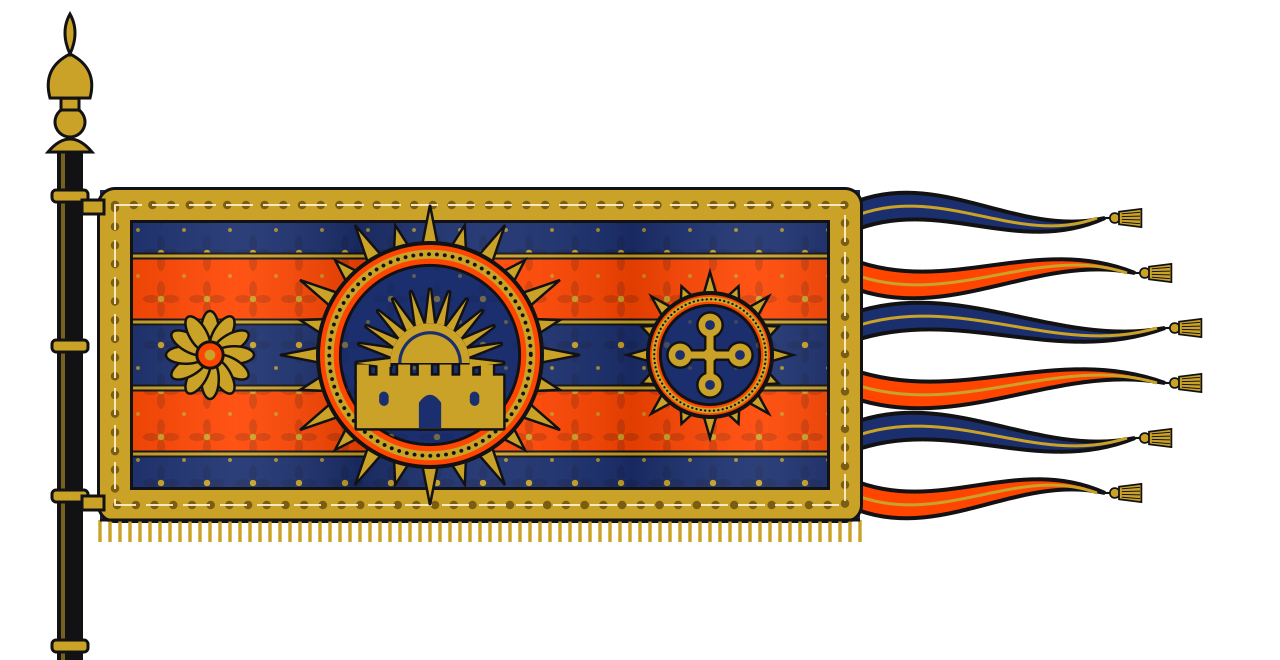
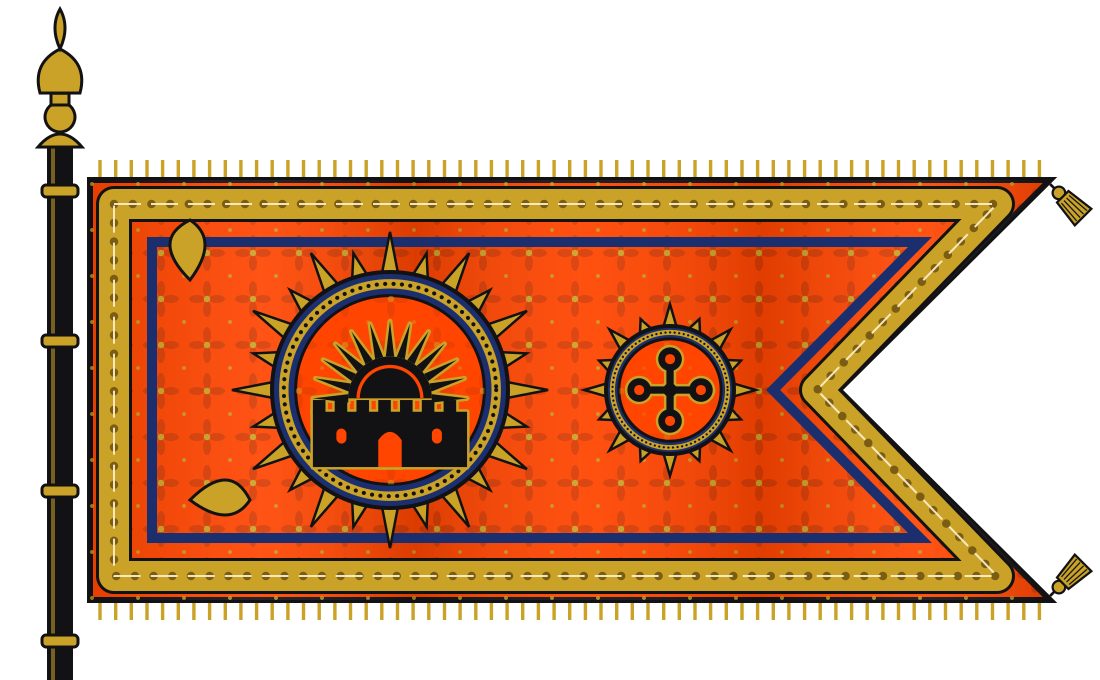
The Atlas gives the Avantis a rising sun over city ramparts, for a rival great power, and a four-circled cross, the Ujjain symbol. The flag type is a Vaijayanti.
| Part of the kit | This clan |
|---|---|
| Field | Royal Navy #1B2F6E |
| Accent | Fiery Vermilion #FF4500 |
| Emblem colour | Metallic Gold #C9A227 |
| Zari metal | Gold |
| Main emblem | A rising sun over city ramparts |
| Second image | A four-circled cross |
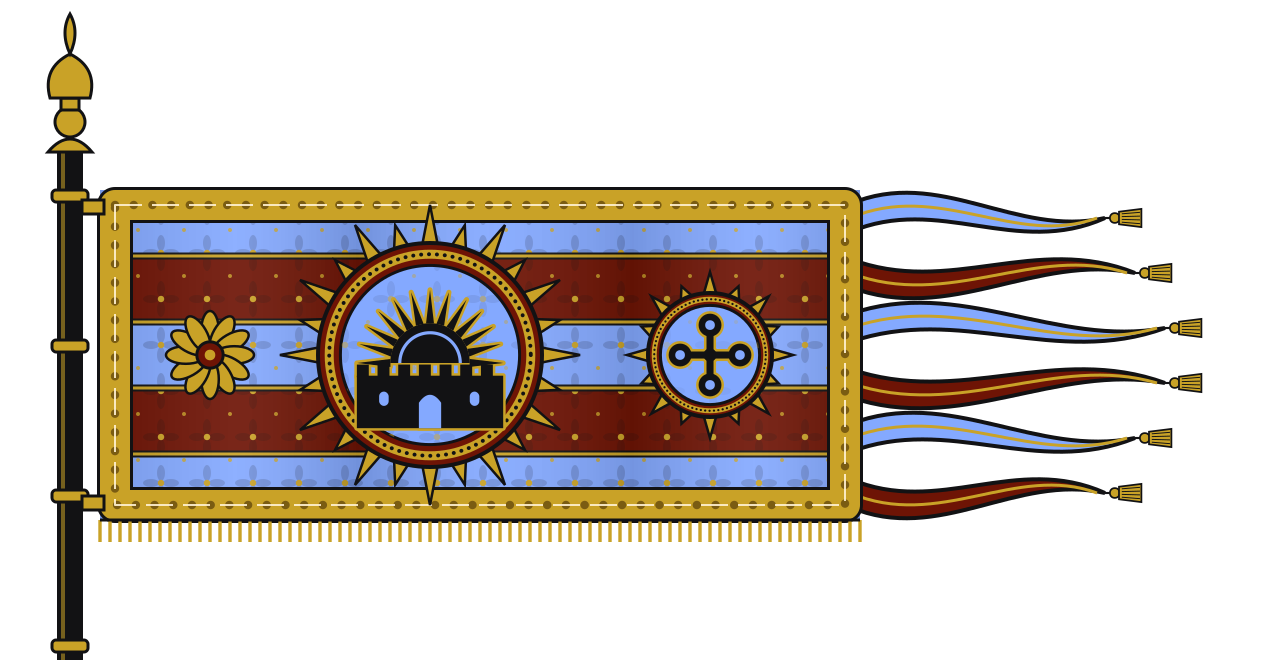
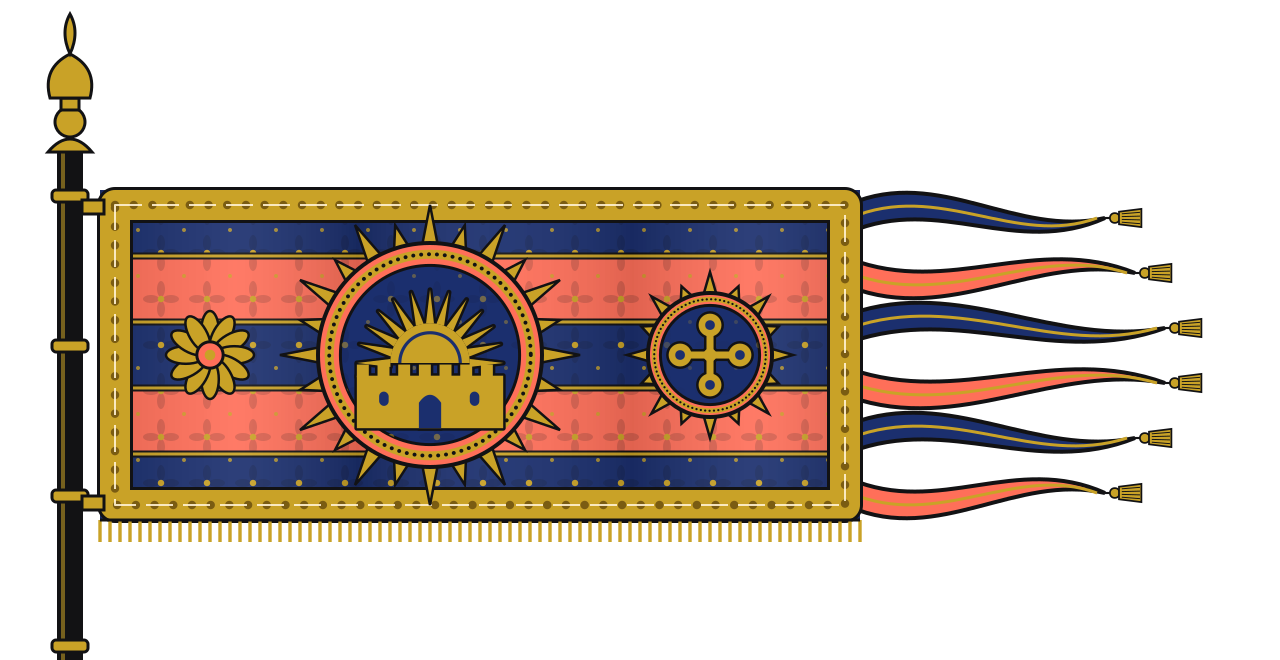
| Night and day | Every visual accessory has two versions: by night the emblem on the dark field, by day the clan's field colour on cloth woven from its metal. |
6. Flags
Every clan has every flag type; the type says the occasion and the colours say the clan. The outlined card is the flag the Atlas assigns.
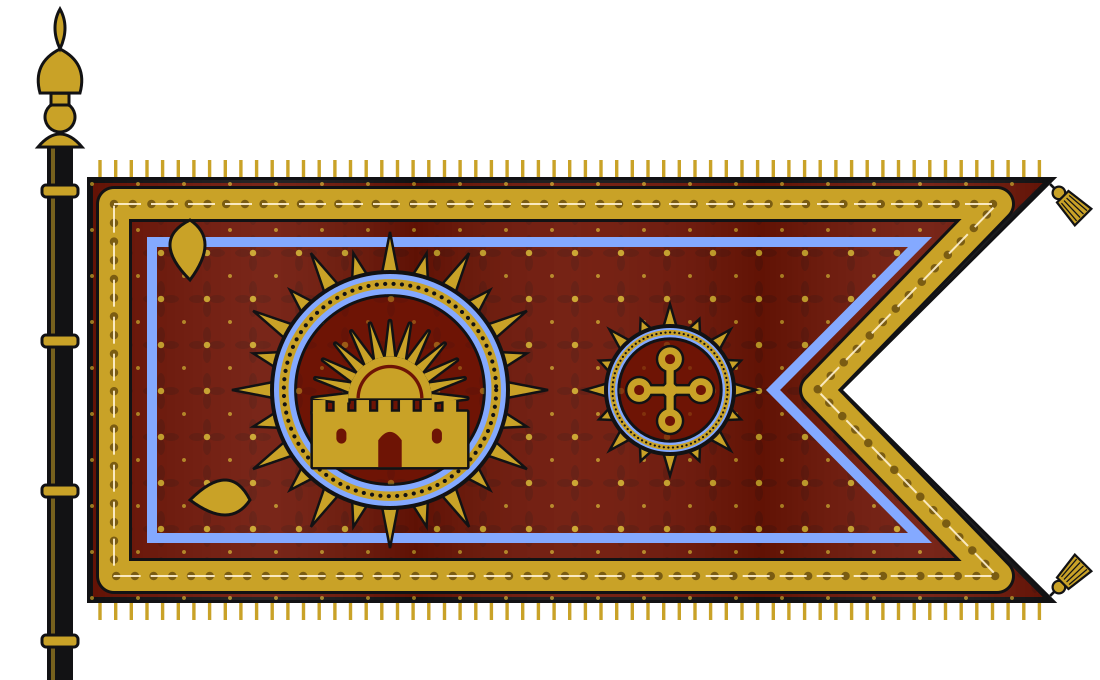
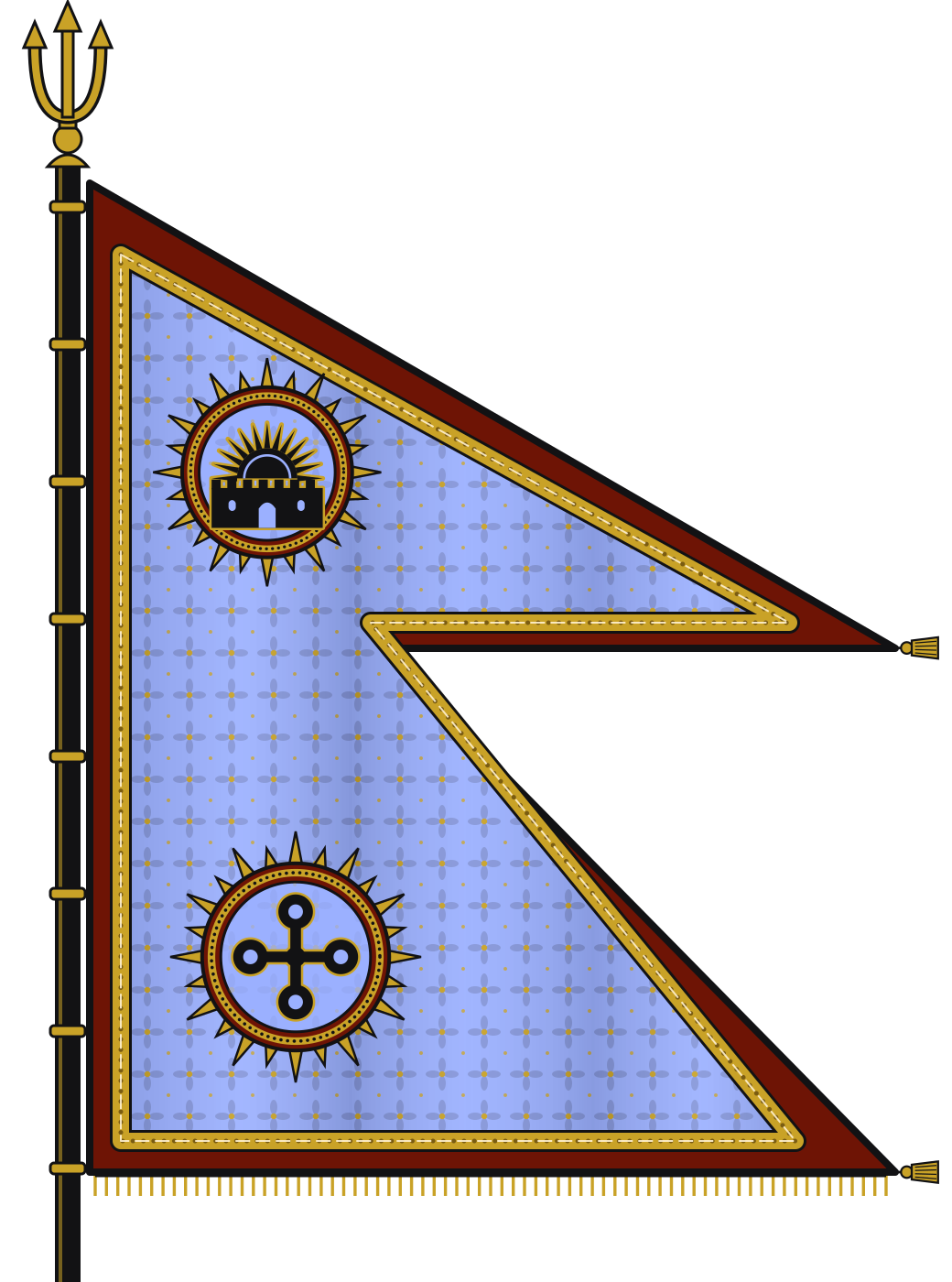
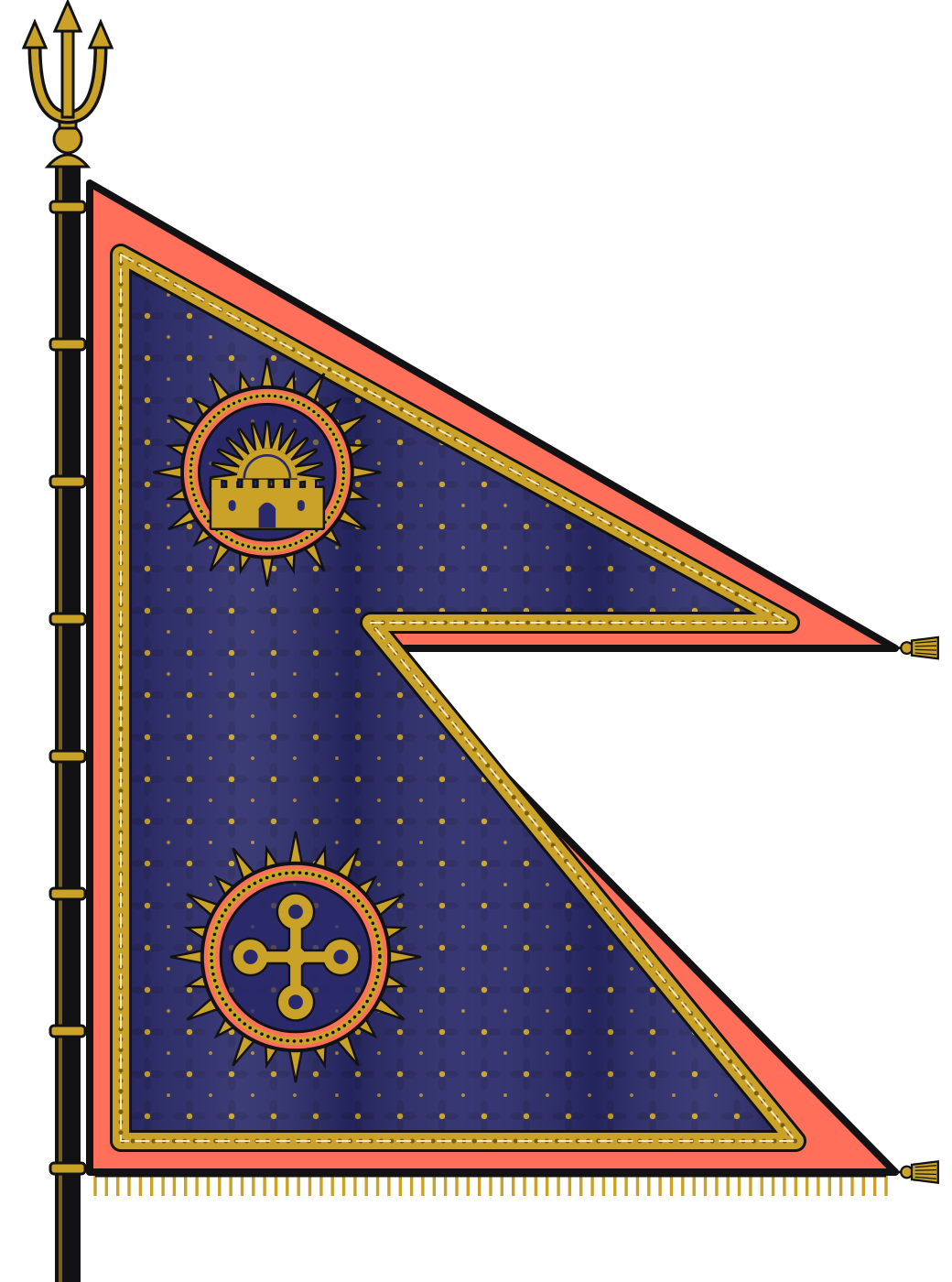



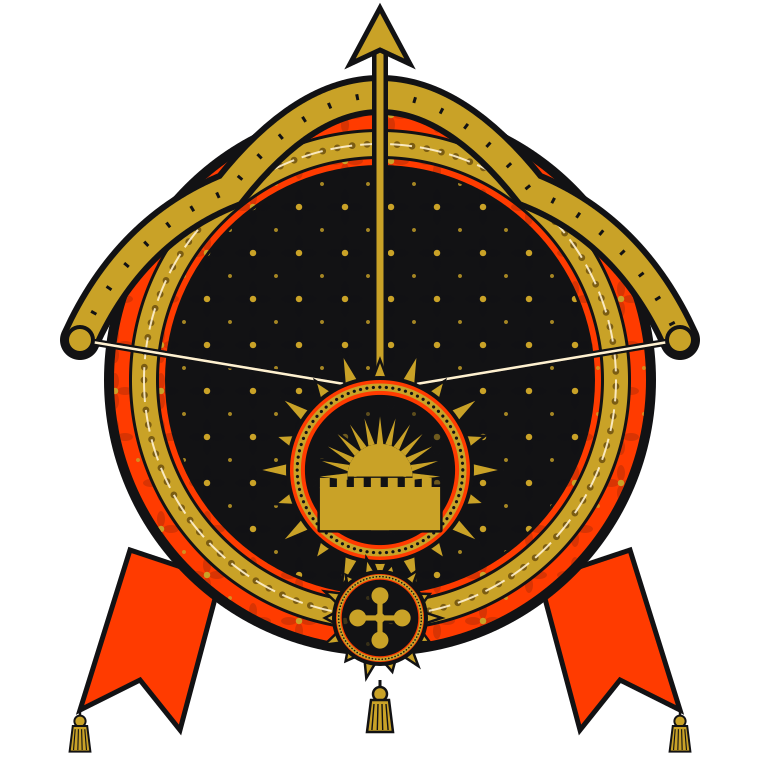
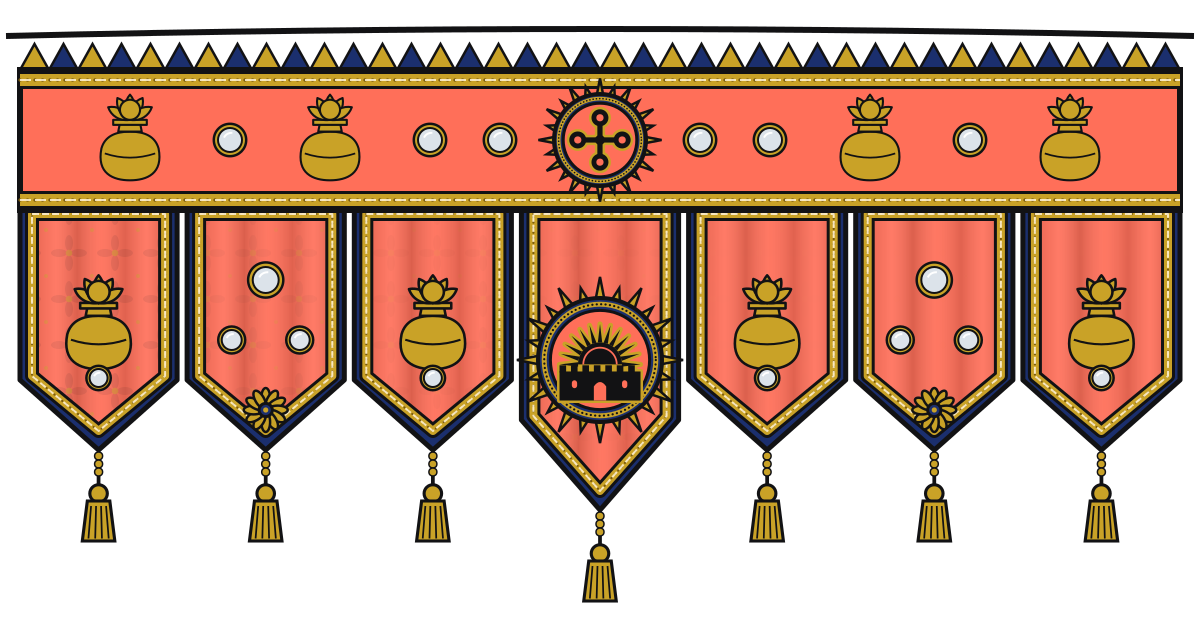
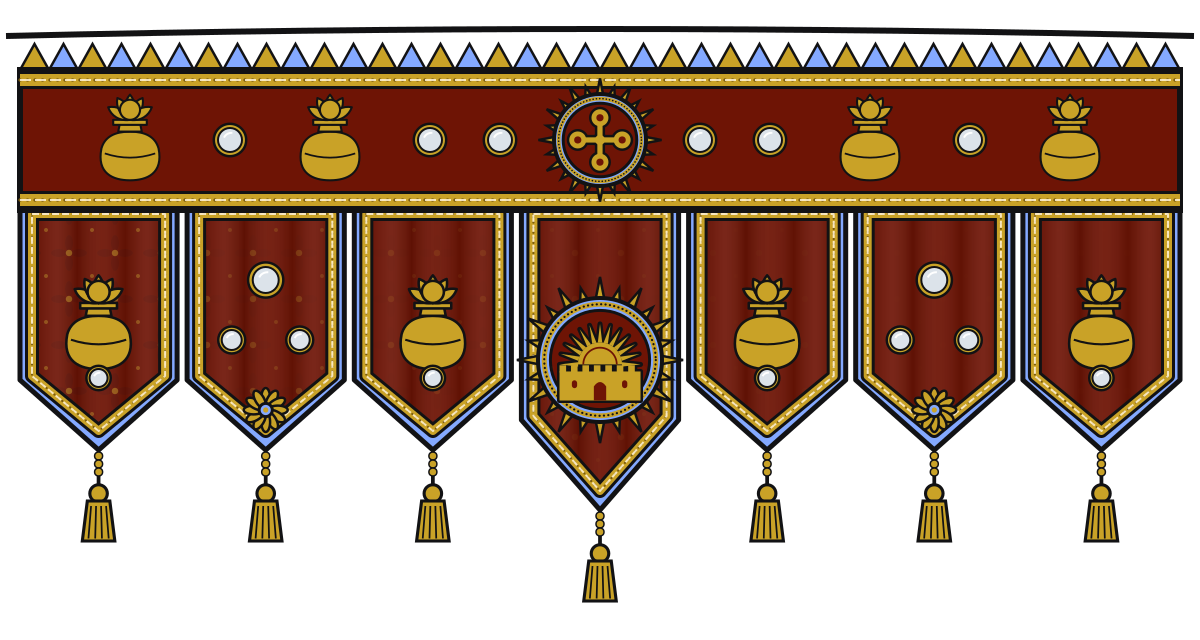
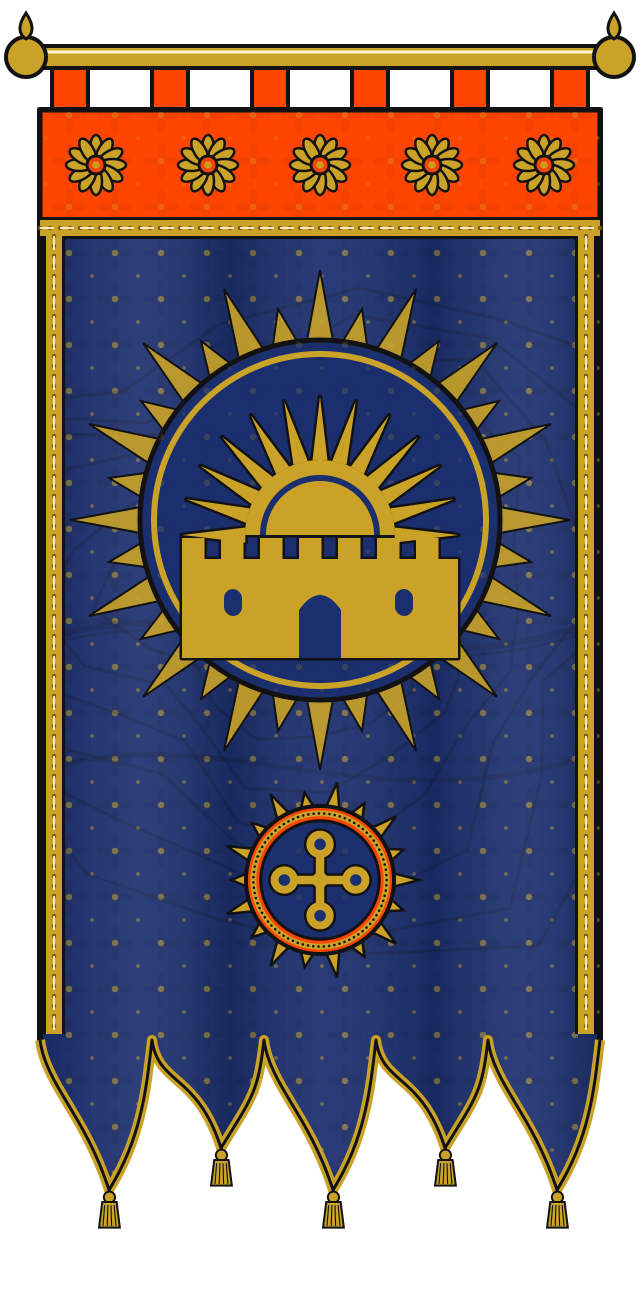
Historic banner
The "Ujjain symbol" (cross with four circles) appears on Avanti-region punch-marked coins
New flag types
| Accessory | For this clan | Basis |
|---|---|---|
| A9 Pota-dhvaja · ship and trade flag For ships, caravans and markets | Not yet designed for this clan | Design |
| A10 Utsava-patāka · festival flag Light, bright flag for fairs and festivals | Not yet designed for this clan | Design |
| A11 Shoka-dhvaja · mourning flag White cloth with the emblem outline in the clan's metal | Not yet designed for this clan | Design |
7. Regalia
| Accessory | For this clan | Basis |
|---|---|---|
| E1 Chhatra · house parasol The ceremonial umbrella | Not yet designed for this clan | Design |
| E2 Chamara · fly-whisks The pair of whisks beside the head of the house | Not yet designed for this clan | Design |
| E3 Danda · staff of office Staff or scepter | Not yet designed for this clan | Design |
| E4 Simhasana · seat The seat of the house, covered in clan cloth | Not yet designed for this clan | Design |
| E5 Khetaka · shield A round shield; the Changi and Dhanush are its flag forms | Not yet designed for this clan | Regional tradition |
| E6 Kula-ayudha · clan weapon The weapon the clan honours | Not yet found for this clan | Under research |
8. Worn
| Accessory | For this clan | Basis |
|---|---|---|
| F1 Kula-vastra · clan cloth The clan's woven pattern in its kit colours | Not yet designed for this clan | Design |
| F2 Kirti-vastra · honour cloth A cloth earned for a deed, not inherited | Not yet designed for this clan | Design |
| F3 Kula-mala · garland flower The flower or leaf the clan wears as a garland | Not yet found for this clan | Under research |
| F4 Chinha · house pin A metal badge with the pin emblem | Not yet designed for this clan | Design |
9. Records
| Accessory | For this clan | Basis |
|---|---|---|
| H1 Clan words A traditional line in the native script | · “Avanti, mahavala ('very powerful'): the word the Udyoga Parva uses for the Avantis” Clan words · Mahabharata, Udyoga Parva 19.24, as cited on the Avanti page[2] | Design |
| H2 Biruda · titles The house's title or titles | Mahasena, a name of Pradyota (the Avanti page); Buddhist texts call him Canda-Pajjota, 'the cruel' | Under research |
| H3 Prashasti · praise genealogy The lineage as written at the head of a grant | Not yet found for this clan | Under research |
| H4 Vahi · clan register The book of the clan's births, marriages and deaths | Not yet found for this clan | Under research |
| H5 Rana-ghosha · war cry The clan's cry in battle or celebration | Not yet found for this clan | Under research |
10. VishwaVit · knower of the world
Game values are design choices for this project, not historical claims.
References
- Anguttara Nikaya — the list of sixteen Mahajanapadas.
- Avanti (region) (Wikipedia, read 2026-10-09), citing H. C. Raychaudhuri (1953, 1972), K. C. Jain (1972), P. K. Bhattacharyya (1977), R. Thapar (2001), B. C. Law (1973) and K. M. Ganguli's Mahabharata translation.
- Pradyota dynasty (Wikipedia, read 2026-10-08), citing K. C. Jain (1972, 1974), V. A. Smith (1957), H. C. Raychaudhuri (1953) and P. D. Gune (1920).
- Ujjain (Wikipedia, read 2026-10-09), citing K. C. Jain (1972), H. Kulke and D. Rothermund (2004), F. R. Allchin and G. Erdosy (1995), A. Eraly (2002) and the Census of India 2011.
- Atlas row ANC-016 (Avantis): KulDevi Harsiddhi, basis documented, 'Goddess of Ujjain, by tradition Vikramaditya's kuldevi'.
- Avanti kingdom (Mahabharata) (Wikipedia, read 2026-10-09): Mahabharata passages by book and chapter in K. M. Ganguli's translation (1883–1896).
- Mahishmati (Wikipedia, read 2026-10-09), citing P. K. Bhattacharyya (1977), F. E. Pargiter (1911, 1922), H. D. Sankalia (1977) and the Mahabharata (Ganguli/Roy).
- Devapala (Paramara dynasty) (Wikipedia, read 2026-10-11), citing K. C. Jain (1972) and H. V. Trivedi (1991), Inscriptions of the Paramaras, CII VII
- Kalachuris of Mahishmati (Wikipedia, read 2026-10-11), citing V. V. Mirashi (1974), C. D. Collins (1988), R. K. Sharma (1980), Malandra (1993)
- Wikipedia, "Malavikagnimitram", read 25 Oct 2026, https://en.wikipedia.org/wiki/M%C4%81lavik%C4%81gnimitram
- Vikram Samvat (Wikipedia, read 2026-10-11), citing Salomon (1998), W. N. Brown (1933), Falk and Bennett (2009)
- Chandragupta II (New World Encyclopedia, adapted from Wikipedia, CC BY-SA 3.0, read 2026-10-11)
- Wikipedia, "Udayagiri Caves", read 25 Oct 2026, https://en.wikipedia.org/wiki/Udayagiri_Caves (citing Upinder Singh 2008; Dass and Willis 2002; Willis 2009)
- Maurya Empire (Wikipedia, read 2026-10-08), drawing on Megasthenes' Indica (in later quotations), Ashoka's edicts, R. Thapar, H. Kulke and D. Rothermund, and T. R. Trautmann.
- Western Satraps (Wikipedia, read 2026-10-09), citing E. J. Rapson, R. Salomon (1998), U. Singh (2008), D. C. Sircar and J. Cribb (2013).
- Wikipedia, "Rudradaman I", read 25 Oct 2026, https://en.wikipedia.org/wiki/Rudradaman_I (citing Upinder Singh 2008; Rapson; Thomas, Epigraphia Indica 16)
- Junagadh rock inscription of Rudradaman (Wikipedia, read 2026-10-09), citing F. Kielhorn (Epigraphia Indica VIII), R. Salomon, Indian Epigraphy (1998) and D. K. Chakrabarti (1999).
- Shunga Empire (Wikipedia, read 2026-10-08)
- Satavahana dynasty (Wikipedia, read 2026-10-09, Codex run 8): coin types, including the Ujjain symbol.
- Wilfried Pieper, Ujjain coin galleries 1 (coinindia.com), read 2026-10-10, https://coinindia.com/galleries-ujjain1.html
- Wikipedia, "Gautamiputra Satakarni", read 10 Oct 2026, https://en.wikipedia.org/wiki/Gautamiputra_Satakarni
- Wikipedia, Shunga Empire, read 2026-10-31, URL
- The Indian Analyst (whatisindia.com), Skandagupta's Junagadh rock inscription, Gupta Inscriptions page, read 2026-10-10, link (editor not named on page)
- Gupta Empire (Wikipedia, read 2026-10-09)
- Wikipedia, Gupta-Saka Wars, read 2026-10-31, URL
- M. S. Sharan, Sethna chronology of the Guptas (GUPTA_IX), engr.mun.ca, read 2026-11-07, https://www.engr.mun.ca/~asharan/SETHNA/GUPTA_IX.htm
- History, District Ujjain, Government of Madhya Pradesh (read 2026-10-11)
- Paramara dynasty (Wikipedia, read 2026-10-09)
- The Indian Analyst (whatisindia.com), Inscriptions of the Paramaras of Malwa, Devapala's Udaipur (MP) grant, after Corpus Inscriptionum Indicarum VII (Kielhorn), read 25 Oct 2026, URL
- Inscriptions of the Paramaras of Malwa, Depalpur plates of Bhojadeva, whatisindia.com, read 2026-11-07, link
- Inscriptions of the Paramaras of Malwa, No. 25 Mahakala Temple (Ujjain) Inscription, whatisindia.com, read 2026-11-07, link
- Wikipedia, Jayavarman I of Malwa, read 2026-10-31, URL
- The Indian Analyst, Mandhata Copper-Plate Inscription of Jayavarman (II), read 2026-10-31, URL
- D. C. Sircar, Mandhata Plates of Jayasimha-Jayavarman, Epigraphia Indica 32 (via whatisindia.com), read 2026-10-31, URL
- Bharat Discovery (भारतकोश), मालवा, read 2026-10-10, https://bharatdiscovery.org/india/%E0%A4%AE%E0%A4%BE%E0%A4%B2%E0%A4%B5%E0%A4%BE
- Maach (Wikipedia, read 2026-10-09), citing K. Hansen, Grounds for Play (1992), J. R. Brandon (1993) and M. Banham (2000).