The Asur are a Munda-speaking Scheduled Tribe of Jharkhand, Bihar and West Bengal, known as iron smelters of the Chotanagpur plateau[1][2][3]. They claim descent from the ancient Asuras, linked to metalcraft, and Sahapedia records that Asur tradition credits them with discovering iron smelting[4][2]. Their clans are named after animals, birds and grains, and disputes are settled by the jati panch[1]. Ironworking was largely out of the market by the 1960s, and about 33,000 Asurs were counted in the 2011 census[2][1].
01Faith and deities
No KulDevi has been found for this clan yet; it is on the research list.
| Deity or tradition | Place in the clan's life | Evidence |
|---|---|---|
| Dharati Mata | Named among the Asur deities | [4] |
| Duari | Named among the Asur deities | [4] |
| Patdaraha | Named among the Asur deities | [4] |
| Turi Husid | Named among the Asur deities | [4] |
| Sukra and Sukraain (सुकरा, सुकराईन) | The first Asur couple, said to have made iron; invisibly present as protectors | [2][5] |
| Mahishasur | Many Asurs regard him as a benevolent ancestor; mourned in Navratri | [4][1] |
| Pat Deota | High in the pantheon, per the NBU paper, citing Leuva (1963) | [3] |
| Mahadania | A great god, once worshipped with human sacrifice and later with effigies, per the NBU paper, citing Leuva (1963) | [3] |
| Varuna | The NBU paper's claim that Varuna was the principal deity in a Rig Vedic struggle, citing Banerjee-Shastri (1926); not confirmed by other sources | [3] |
| Sanrasi-Kutasi (tongs and hammer) | Worship of the tongs and hammer for good iron, per the NBU paper | [3] |
| Animism and ancestor worship | The Tribal Research Institute describes a religion blending animism, ancestor worship, belief in bhut-pret and witchcraft | [4] |
| No idol worship | Asurs do not worship idols, per Forward Press | [6] |
| Marang Bonga | Named alongside Singbonga; other Bongas are also named | [5] |
| Goddess Earth | Invoked in Asur weddings | [5] |
| Ancestral spirits, with fowl at the hearth (Hahn) | Hahn (c. 1899): only ancestral spirits are feared and propitiated, with fowl sacrifices at the fire-hearth; the creator Sigboga, identified with the sun, needs no worship | [7] |
02Temples
No Asur temple, built or patronised, is named in the sources read. Worship is recorded at the furnace, in the Sanrasi-Kutasi rite, and in the deities listed under Faith.
Built by the clan
Not recorded.
Given patronage or grants by the clan
Not recorded.
03Languages and scripts
| Language or script | Kind | Under the clan | Evidence |
|---|---|---|---|
| Asuri living | A Munda language (Austroasiatic, North Munda, Kherwarian); no script of its own; about 7,000 speakers in 2007; Dravidian loanwords from contact with Kurukh | The clan's own language | [8] |
| Devanagari | The script in which Asur words are written in Hindi, as in the Sahapedia article | Hindi writing of Asur words | [2] |
| Sadri, Nagpuri, Hindi | Languages the Bir Asur also speak, per Forward Press | Bir Asur | [6] |
| Asur (the name speakers prefer) | Speakers prefer 'Asur' to 'Asuri' (ELAR, 2019) | How speakers name their language | [9] |
| Asur as a Kolarian dialect (Hahn, c. 1899) | Hahn calls it a Kolarian dialect close to Mundari and Santali; no grammatical gender, three numbers, numerals to four only with Hindi numerals beyond; example sentence 'Asur reni Baiga hunid' (the Asurs have no priest), in Hahn's transliteration | Hahn's record, c. 1899 | [7] |
| Possible loanwords in Asur (Hahn) | baiga (priest), ede (to plant) and efa (second), which Hahn thinks may come from Oraon or Kurukh; parild (good), usad (anger) and duhma (to speak) are not traced. Transliteration only | Hahn's record, c. 1899 | [7] |
| Asur, Ashree, Asura, Assur | Other names and spellings of the language, which the Endangered Languages Project lists as threatened | How the language is named | [10] |
| Writing (2024) | No script of its own; some youths write it in Devanagari | How Asur is written today | [11] |
| Asur grammar (Khalid, ICON 2020) | A grammatical sketch of Asur as a North Munda language, given as its first documentary description; the abstract covers gender, number, case, pronouns, tense-aspect-mood, negation and questions. Sample sentences are in the PDF, not read | Grammar, 2020 | [12] |
| Asur sound and grammar against Mundari (Hahn, c. 1899) | Hahn notes Asur 'v' where Mundari has initial 'h', and the auxiliary idana where Mundari has mena (transliteration) | Hahn's record, c. 1899 | [7] |
04Books and literature
Hahn's primer of 1900 is the one early Asur text read in part; its grass-burning chant is not yet read. The other works below are cited, none has its text read, and they are listed by title only.
Written during the clan's history
| Work | Author | Kind | When | Link to the clan |
|---|---|---|---|---|
| The Asur | K. K. Leuba (Leuva in the NBU paper) | Ethnography (cited, not read) | 1963 | Cited by Sahapedia[2] and by the NBU paper[3] |
| Bihar ke Asur | Prakash Chandra Oraon | Book (cited, not read) | 1994 | Cited by Sahapedia[2] |
| Asur Siring | Edited by Sushma Asur and Vandana Tete | Poetry collection | 2016 | Title only[6] |
| The Tribes and Castes of the Central Provinces of India, vol. 2 | R. V. Russell and Hira Lal | Ethnography; its Agaria entry is about a Gond offshoot and does not name the Asur | 1916 | [13] |
| Kavi Man Jani Man | Vandana Tete (ed.); source of the Sushma Asur poem under Poems | Poetry collection (title only) | 2019 | [14] |
| A Primer of the Asur Dukma, a Dialect of the Kolarian Language | Rev. Fr. Hahn (communicated by G. A. Grierson) | Language primer; read December 1899, published 1900 (pp. 149-172; journal title not confirmed) | 1900 | [7] |
| A Grammatical Sketch of Asur: A North Munda language | Zoya Khalid | Grammar (paper; abstract read, PDF not read) | 2020 | [12] |
Given patronage by the clan
Not recorded.
05Thinkers and scholars
| Name | Field | Era | Contribution |
|---|---|---|---|
| Sushma Asur | Poetry and documentation | 2016 to today | Creator of the Asur Adivasi Wisdom Documentation Initiative; co-editor of Asur Siring[15][6] |
| Vandna Tete | Writing and documentation | 2019 to 2026 | Sahapedia-UNESCO Fellowship interviews on iron-making (2019)[2]; coordinator of the Asur Adivasi Mobile Radio[16] |
| Roshni Asur | Storyteller, Asur Akhra Mobile Radio | 2024 | [11] |
| Milan Asur | Storyteller, Asur Akhra Mobile Radio | 2024 | [11] |
Scholars cited in the sources are listed under Books. The Asur Adivasi Gyan Akhara (2019) works to preserve the language, culture and ironwork[2].
06Art and architecture
No Asur painting, sculpture, textile or carved craft is in the sources read.
Painting and wall art
Not recorded.
Sculpture and temple art
Not recorded.
Temple and building architecture
| Art form | What it is | Era | Evidence |
|---|---|---|---|
| Mud house with tiles (khapra) | The traditional house, with mud walls and a tiled roof | [4][1] |
Weaving and textiles
Not recorded.
Clothing and jewellery
Not recorded.
Coins, pottery and crafts
| Art form | What it is | Era | Evidence |
|---|---|---|---|
| Clay furnace and smithing tools | Clay furnace with an outlet at its base; leather bellows (चपुआ), tongs (संड़सी) and hammer (कुटासी); sal charcoal, about 3:1 to the ore; products hoes, arrows, axes and swords | [2] | |
| Ores | पोला (magnetite), बीची (hematite) and गोटा (laterite-derived hematite) | [2] | |
| Fuel, by two accounts | Forward Press says the ore is smelted with charcoal from burnt wood; Sahapedia says charcoal of fresh sal. Both are given | [5][2] |
07History
Undated: the Asur claim and the scholars' links
The Asur claim descent from the ancient Asuras, who were linked to metalcraft; the page gives this as the Asur's own self-identification, with no dates[1][4]. Haddon (1924), cited by the NBU paper, wrote that the Asura absorbed the Nishada and retreated to Chota Nagpur, and some scholars link the Asur to the Vedic Asura[3].
The NBU paper also says the Asur were driven from the Indus Valley in a Vedic struggle, and cites Roy (1926) for urns, copper and terracotta at Khunti graveyards that it likens to finds at Mohenjo-daro. These are the paper's own claims and are set out here as such[3].
Undated: the legend of Bir Asur
The Asur tell of Bir Asur, a legendary king, and his queen. A remark about sal trees by the king leaves them stranded in the forest; he starts making charcoal and smelting iron, and later trades iron tools to the Oraon for rice. The queen's magic makes the sal fruit lose its sweetness so that the king will return home[2].
Before 1900: Hahn's count and the colonial record
Rev. Fr. Hahn of the German Evangelical Lutheran Mission in Chota Nagpur, writing about 1899, counted about 2,500 Asurs, whom he describes as a non-Aryan tribe, mainly in Ranchi and Palamau districts and the Sarguja tributary state[7].
Hahn gives, as his own theory, that the Asurs were the first settlers of Chota Nagpur, that Munda newcomers from the west fought and largely destroyed them, and that the victors then propitiated the victims' spirits. He links this to a Munda and Uraon legend in which Sigboga destroyed the Asurs and ordered their spirits worshipped[7]. He says the Asurs have few traditions.
Hahn records iron smelting as their main occupation. The Lohara Asurs made iron utensils and tools, farmed jungle land, and moved when their fields were exhausted[7].
Dalton's 1867 essay 'The Kols of Chota-Nagpore' does not list the Asur among the Kols, according to Sanjay Nath (2015), who adds that Dalton's classifications fed the 1872 census report[17]. The UCLA essay on Dalton's Descriptive Ethnology of Bengal (Calcutta, 1872) says Dalton was Commissioner for Chotanagpur from 1858 to 1875, and that the essay does not mention the Asur[18]. The book itself has not been read.
1907 to 1975: Tata and the end of the furnace trade
Ironworking continued into the early 20th century. Tata's steel plant at Sakchi (Jamshedpur) opened in 1907, and the small clay furnaces could not compete; the trade was largely out of the market by the 1960s[15][2].
Mahto Asur, described as the last professional smelter in the region, died in 1975, according to Melan Asur. Jata Asur and Sohna Asur still smelted occasionally in the mid-1990s[15]. The Asur believe the Tatas copied their method; the archaeologist Tathagata Neogi says the two processes are 'totally different'[15].
Forest laws and the Netarhat firing range
The NBU paper says forest laws restricted access to the forest, a statement it dates to 1968[3]. Caravan reports that the Forest Conservation Act of 1980 threatened the smelting method, in the view of Pankaj[15].
The Kendriya Jan Sangharsh Samiti was formed in 1994 over the Netarhat Field Firing Range. Melan Asur says stray shots killed 20 to 25 people, and Sameer Asur says the Samiti drew about 100,000 members from the Asur, Munda and Oraon[15].
2019 to 2026: documentation and radio
Sahapedia's 2019 interviews recorded elders on iron-making, and the Asur Adivasi Gyan Akhara, set up in 2019, works to preserve the language, culture and ironwork[2].
The Asur Adivasi Mobile Radio broadcasts in Asur from Netarhat villages. All India Radio and Ranchi Doordarshan invited it, and in April 2026 Cultural Survival described it as a lifeline for the language and the Asur's rights[16].
08Journey and migrations
The sources give no dated migration for the Asur as a whole. The NBU paper gives a claim of movement from the Indus Valley, and an early home on the Netarhat plateau.
| When | From | To | Why | Evidence |
|---|---|---|---|---|
| Not dated (claim) | Indus Valley | Chota Nagpur | The NBU paper's own claim, of a retreat in a Vedic struggle | [3] |
| Not dated | Chota Nagpur | Netarhat plateau, Ranchi district | Early home (Gupta and Dutta 1963, cited by the NBU paper) | [3] |
| 1874 | Chota Nagpur | Gajoldoba, the Duars (West Bengal) | First tea garden at Gajoldoba, per the NBU paper | [3] |
| Later (not dated) | Chota Nagpur | Tea gardens of the Duars | The East India Company later recruited Asur labour from Chota Nagpur, per the NBU paper | [3] |
09Seats and lands
| Place | Role | Where today |
|---|---|---|
| Netarhat plateau | Early home, per the NBU paper; furnaces built near water sources ('डाड़ी', 'चुआं' and river banks) | Jharkhand[2][3] |
| Gumla, Lohardaga, Palamu, Latehar | Districts in Jharkhand that Wikipedia names among the Asur areas | Jharkhand[1] |
| Sakhuapani | Village of about 75 families, mainly Asur, about 15 km from Netarhat; its name means 'sal water' | Jharkhand[15] |
| Jobhipat, Lupungpat | Netarhat villages where the Asur Adivasi Mobile Radio broadcasts | Jharkhand[16] |
| Kalkut Basti, Majherdabri Asur Line, Satali Basti, Carron Tea Estate, Lakhipara | Asur villages in the Alipurduar tea gardens studied by the NBU paper | West Bengal[3] |
| Bihar | Asur population, 4,987 in 2011 | Bihar[1] |
| Odisha, Chhattisgarh, Madhya Pradesh | Pockets of Asurs, per Forward Press; Asuri is also spoken in Raigarh, Jashpur and Sambalpur | Today[6][8] |
| Bishunpur and Mahuatand valleys | Valleys of the Chota Nagpur plateau where the Asur are especially found, per Forward Press (Gumla, Lohardaga, Palamu) | Jharkhand[5] |
| Ghaghra | Village in Gumla, named by Sahapedia alongside Chait Toppo | Jharkhand[2] |
| Ranchi and Palamau districts | Where Hahn counted the Asurs, c. 1899 | Chota Nagpur (state today not given in the extract)[7] |
| Sarguja | Tributary state where Hahn counted the Asurs, c. 1899 | Named by Hahn (state today not given in the extract)[7] |
10Notable figures
| Name | Role | Era | Known from |
|---|---|---|---|
| Bir Asur (बिर असुर) legend | Legendary king, with his queen | Legendary | [2] |
| Mahto Asur | Described as the last professional smelter in the region | Died 1975 | [15] |
| Sushma Asur | Poet of Netarhat and activist; led a troupe to a Kolkata pandal in 2016; co-editor of Asur Siring | 2016 to today | [19][15] |
| Melan Asur | Source on smelting, the 1994 firing range and the radio | Living | [15][16] |
| Jogesar Asur | Interviewed on iron-making, which he calls a festival | Interview, 2019 | [2] |
| Ajay Asur | Of Sakhuapani; credited with a folk verse on iron | Interview, 2019 | [2] |
| Chait Toppo | Interviewed on iron-making | Interview, 2019 | [2] |
| Asinta Asur | Leader of the Asur Adivasi Mobile Radio at Jobhipat | 2026 | [16] |
| Sameer Asur | Of the Kendriya Jan Sangharsh Samiti | Not dated | [15] |
| Khambilal | Father of Sushma Asur; source of the account that Tata employees spied on smelting | Not dated | [15] |
11Allies, rivals and marriages
| People | Relationship | When |
|---|---|---|
| Kharwar (ST-131) | Putative kinship, claimed by the Asur; the Asur accept food from Kharwar[1] | Not dated |
| Munda (ST-229) | Putative kinship, claimed by the Asur[1] | Not dated |
| Oraon (ST-241) | The Bir Asur legend has the Asur trading iron tools to the Oraon for rice[2]; the Asur accept food from the Oraon[1] | Legendary; not dated |
| Rajput, Thakur, Ghasi | The Asur accept food from them[1] | Not dated |
| Agaria | Elwin, as cited by Forward Press, says the Agarias and the Asurs descend from the Asurs of the Sanskrit texts. Russell (1916) describes the Agaria as a Gond offshoot and does not mention the Asur. The link is unproven[6][13] | Not dated |
| Majhwar (ST-182) | Unclassified; possibly an Asuri dialect[8] | Today |
| Birjia (ST-041), Bir (Kol) Asur, Agaria Asur | The three sub-tribal divisions of the Asur[4] | Not dated |
| Asuras of the ancient texts | Claimed ancestors, linked to metalcraft; the Asur's own claim[4][1] | Ancient (claimed) |
| Namasudras and Munda groups in West Bengal | Have taken up the veneration of Mahishasur, per the New Indian Express (2019)[1] | 2019 |
| Korwa (ST-157) | Hahn says Korwa or Uraon priests officiated where Asurs joined village deity worship; the Asurs had no priests of their own[7] | c. 1899 |
12Society and livelihood
The Asur are endogamous, and each clan is exogamous. Settlements are called pats, clearings in the forest, and houses are mud-walled with tiles (khapras)[4][1]. The NBU paper records a chati purification rite eight days after birth, and says the dead are buried[3].
Government and social order
| Institution or group | What it was | Evidence |
|---|---|---|
| Jati panch | The community council that settles disputes. Rule-breakers are expelled and readmitted after a community feast[1] | [1] |
| Mahto and the elders' panchayat | A hereditary village headman, the Mahto, with the elders' panchayat; the statutory Panchayat now largely replaces it (Leuva 1963, per the NBU paper) | [3] |
| Marriage | Monogamy is the norm; bigamy or polygamy is allowed for barrenness or widowhood; widow remarriage is allowed[1] | [1] |
| Kendriya Jan Sangharsh Samiti | Formed in 1994 over the Netarhat Field Firing Range; Sameer Asur says it drew about 100,000 members from the Asur, Munda and Oraon[15] | [15] |
| Asur Adivasi Gyan Akhara | Set up in 2019 to preserve the language, culture and ironwork[2] | [2] |
| Asur Adivasi Mobile Radio | Community radio broadcasting in Asur from Netarhat villages; coordinated by Vandna Tete[16] | [16] |
| Forms of marriage | Forward Press gives four forms and names three: arranged (Odhah Biha), consensual and then formalised (Iditaiyete Biha), and love marriage (Sah-palayan). It also notes 'no vermilion' | [5] |
| Marriage (Hahn, c. 1899) | Marriage simple; polygamy and widow remarriage permitted; child marriage unknown (Hahn's observation) | [7] |
| Funeral (Hahn, c. 1899) | Cremation; eight days of food offerings outside the home, then a funeral meal with rice-beer | [7] |
Livelihood over time
| Era | Livelihood | Evidence |
|---|---|---|
| Undated | Hunter-gathering and shifting cultivation, with occasional bow-and-arrow hunting; the page tags this 'citation needed'[1] | [1] |
| Long-standing | Iron smelting: hoes, arrows, axes and swords, made with sal charcoal[2] | [2] |
| Early 20th century to 1960s | Ironworking continued into the early 20th century; Tata's arrival and the small clay furnaces could not compete, and it was largely out of the market by the 1960s[2] | [2] |
| 1874 onward | First tea garden at Gajoldoba, the Duars (1874); later recruitment of Asur labour from Chota Nagpur, per the NBU paper[3] | [3] |
| 2011 | Cultivators: 91.19% of Asurs, per the Tribal Research Institute; Wikipedia tags the figure 'citation needed'[4][1] | [4] |
| Today | Many now work in mining; the loss of iron smelting and bauxite mining threatens livelihoods[1]. Melan Asur says 95% shifted reluctantly to agriculture[15] | [1] |
13Sub-clans and related clans
Twelve Asur clans, named after animals, birds and grains, are listed by Wikipedia, citing the Bharatiya Adimjati Sevak Sangh (1963, pp. 64-65), which it says applies to the Asur generally[1]. The NBU paper lists the same twelve for the Bir Asur, citing Leuva (1963), and calls them exogamous with totems[3]. The divisions of the Asur are the Bir (Kol), Birjia and Agaria Asur[4].
| Clan | Relation | Where | Size | In the Atlas | Evidence |
|---|---|---|---|---|---|
| Aind | Sub-clan | Totem: eel | same name as ST-365: check | [1][3] | |
| Dhan | Sub-clan | Totem: rice | same name as ST-384: check | [1][3] | |
| Lila | Sub-clan | Totem: deer | same name as ST-414: check | [1][3] | |
| Suar | Sub-clan | Totem: pig | same name as ST-496: check | [1][3] | |
| Bharewa | Sub-clan | Totem: wild dog | same name as ST-377: check | [1][3] | |
| Kerketta | Sub-clan | Totem: a bird (not named as a species) | same name as ST-405: check | [1][3] | |
| Munjani | Sub-clan | Totem: Arjun tree | same name as ST-473: check | [1][3] | |
| Titio | Sub-clan | Totem: a bird (not named as a species) | new clan candidate | [1][3] | |
| Beng | Sub-clan | Totem: frog | same name as ST-373: check | [1][3] | |
| Khusar | Sub-clan | Totem: a bird (also written Khusro; not named as a species) | new clan candidate | [1][3] | |
| Non | Sub-clan | Totem: salt | same name as ST-481: check | [1][3] | |
| Toppo | Sub-clan | Totem: woodpecker | same name as ST-507: check | [1][3] | |
| Bir (Kol) Asur | Branch | 7,783 of 10,712 in Jharkhand in 1991 | 10,712, 1991, nationally[6] | same name as ST-378: check | [4][6] |
| Birjia | Branch | Mainly Jharkhand | 5,356, 2001, per Forward Press citing a PIB document[6] | ST-041 | [4][6] |
| Agaria Asur | Branch | Jharkhand (Lohardaga, Latehar, Ranchi) | 22,459 in Jharkhand, Census 2011[3] | same name as ST-364: check | [4][3] |
| Telia | Sub-clan | Divisions of the Birajia Asur, per Forward Press | same name as ST-504: check | [6] | |
| Sinduria | Sub-clan | Divisions of the Birajia Asur, per Forward Press | same name as ST-493: check | [6] | |
| Majhwar | Related people | Unclassified; possibly an Asuri dialect | ST-182 | [8] | |
| Agaria (Gond offshoot) | Related people | Maikal range: Mandla, Raipur, Bilaspur (Central Provinces, 1916) | 9,500, 1911[13] | new clan candidate | [13] |
| Agoria | Sub-clan | Named by Hahn (c. 1899) as an Asur sub-tribe. Not stated whether it is the Agaria Asur (ST-364) of the other lists | new clan candidate | [7] | |
| Brijia/Binjhia | Sub-clan | Named by Hahn (c. 1899) as one Asur sub-tribe. Not stated whether it is the Birjia (ST-041) or the Binjhia (ST-038); IDs | new clan candidate | [7] | |
| Lohara Asur | Sub-clan | Named by Hahn (c. 1899) as an Asur sub-tribe; the Lohara Asurs made iron utensils and tools | new clan candidate | [7] | |
| Kol Asur | Sub-clan | Named by Hahn (c. 1899) as an Asur sub-tribe. Not stated whether it is the Bir (Kol) Asur of the 1963 list | new clan candidate | [7] | |
| Paharia Asur | Sub-clan | Named by Hahn (c. 1899) as an Asur sub-tribe | new clan candidate | [7] |
Clans marked "new clan candidate" are not in the Atlas yet.
14Surnames
Caravan says 'Asur' is the surname of every Asur individual it names[15]. Two clan names are also borne by named people: Toppo, as in Chait Toppo and Barnabas Toppo, and Kerketta, as in Shradhanand Kerkett[15][16]. Chait Toppo is named in[2]. The NBU paper says there are no surnames beyond the clan names[3].
| Surname | Clan or sub-clan | Where | People with this surname | Also used by other communities |
|---|---|---|---|---|
| Asur | Not stated | not yet counted | Yes | |
| Toppo | Toppo (woodpecker totem) | Named bearers in the sources: Chait Toppo, Barnabas Toppo | not yet counted | Yes |
| Kerketta | Kerketta (bird totem) | Named bearer in the sources: Shradhanand Kerkett | not yet counted | Yes |
Counts are of everyone with the surname, from the cited source and year, not only members of this clan. A surname shared with other communities says nothing about any one person's origin.
15Songs and music
The Asur sing at the furnace, and the sources give no texts. Traditional songs are played over market speakers and broadcast by the Asur Adivasi Mobile Radio, with no lyrics given[16]. Asuri has the words sirind (song) and anend (dance). Forward Press says Asur songs are tied to festivals, work and life events, that they 'express emotions' rather than tell stories, and it reproduces no lyrics[5]. It adds that the songs now also take up factories and mining, land degradation, debt bondage and seasonal migration to tea estates and brick kilns[5]. Outlook Traveller says the radio programme began in 2019, with 15 Asur members recording songs that are carried on pen drives to weekly bazaars and played on loudspeakers[20].
Traditional songs and stories of the radio living
Fagud songs living
Sarhul songs living
Karam songs living
Sohrai songs living
Purkha songs living
Panjya songs living
Labour songs living
Biha Sirind living
Ni Demu
Songs written by community members living
Grass-burning chant (Hahn, c. 1899)
16Poems, lullabies and children's rhymes
The Asur poems in the sources read are a modern collection, a modern poem by Sushma Asur, and one folk verse. No lullaby, rhyme or riddle is recorded.
17Stories, legends and proverbs
Stories and legends
| Story | What happens | Told by | Evidence |
|---|---|---|---|
| Mahishasur, ancestor and hero living | Treacherously killed in Navratri; mourned in that season, when the Asur stay indoors | Asur tradition, per the Tribal Research Institute and Forward Press | [4][19] |
| The Bir Asur legend (बिर असुर) legend | A king's remark about sal trees leaves him and his queen stranded; he begins making charcoal and smelting iron, and trades iron tools to the Oraon for rice; the queen's magic makes the sal fruit lose its sweetness so that the king will return | Recounted in the Sahapedia interviews (2019) | [2] |
| Sukra and Sukraain (सुकरा, सुकराईन) legend | The first Asur couple, said to have made iron; the origin story is recited during Sanrasi-Kutasi | Asur tradition, per Sahapedia | [2] |
| The Tatas copied the method living | Asur believe the Tatas copied their smelting; Sushma Asur, from her father Khambilal's account, says Tata employees with cameras spied on the ore-finding and smelting. Archaeologist Tathagata Neogi says the two processes are 'totally different' | Asur belief; Sushma Asur | [15] |
| Sigboga and the destruction of the Asurs legend | Sigboga destroyed the Asurs and ordered their spirits worshipped; Hahn gives this as the one tradition he records | Munda and Uraon legend, as recorded by Hahn (c. 1899) | [7] |
| Mahisasur and the name Asur | The name is linked to Mahisasur, and some accounts say Asurs regard him as a god | Per the 2024 Indian Tribal article | [11] |
Proverbs and sayings
Not recorded.
18Festivals and fairs
| Festival or fair | When | Where | What happens |
|---|---|---|---|
| Sanrasi-Kutasi (संड़सी-कुटासी) living | Phalgun full-moon night (March); the most important religious festival | Asur villages | The village priest fasts; the rite near midnight has tongs and hammer on an iron block, with rice, incense and hanria; a black hen for Sukraain and a red rooster for Sukra; the priest circles the block three times to the right. On the second day there is a collective hunt, after an arms-puja. A three-day fair is held at गाढ़ा कुजाम[2] |
| Sarhul living | Late March to early April | Not given | The principal festival, per the NBU paper citing Leuva (1963)[3]; listed as an Asur festival[1] |
| Karma living | Jeth and Bhadhon months, per Forward Press | Not given | Listed among Asur festivals; the NBU paper gives Karam Puja as observed today[1][3] |
| Dhanbuni, Kadelta, Rajj karma, Dasahara Karam | Not dated | Not given | Listed among Asur festivals, from jharkhandi.com as cited by Wikipedia[1] |
| Hariari | July to August | Not given | Named by the NBU paper, citing Leuva (1963)[3] |
| Durga Puja mourning living | Navratri and Durga Puja | Asur in general; a Kolkata pandal in 2016 | Asur mourn Mahishasur and stay indoors. On 7 October 2016 a seven-member troupe led by Sushma Asur danced mournfully outside a Kolkata pandal and she declined to enter it[19][1] |
| Asur Utsab | Not dated | Purulia | Named by the NBU paper among festivals observed today, with Karam Puja, Sarna Puja, Holi, Kali Puja, Saraswati Puja and Shiv Puja[3] |
| Fagud | Fagun, with Sarhul, per Forward Press | Not given | A festival with its own song class (Fagud songs)[5] |
| Sahiya Guhiya | Assadh month, per Forward Press | Not given | Named in Forward Press without a description[5] |
| Kagleta Puja | Savan month, per Forward Press | Not given | Named in Forward Press without a description[5] |
| Sohrai | Katik month, per Forward Press | Not given | Named in Forward Press; it has its own song class (Sohrai songs)[5] |
| Khanihari Puja | Aghan month, per Forward Press | Not given | Named in Forward Press without a description[5] |
| Kharveij or Huddhiro Puja | Poos month, per Forward Press | Not given | Named in Forward Press without a description[5] |
| Weddings | Magh month, per Forward Press | Not given | Goddess Earth is invoked, and the wedding songs are Biha Sirind[5] |
19Food, dress and games
Food
| Item | What it is | Evidence |
|---|---|---|
| Hanria (rice beer) | A social drink, and offered in the Sanrasi-Kutasi rite | [3][2] |
Dress
| Item | What it is | Evidence |
|---|---|---|
| Dhoti | Men wear the dhoti | [1] |
| Totemic tattoos | Women tattoo totemic objects, per Wikipedia. The NBU paper, citing Leuva (1963), says tattooing is taboo because it is believed to anger the deities and ancestors; both are given | [1][3] |
Games and martial arts
Not recorded.
Tags: living still practised · revived brought back after a break · lost known only from records · research reported but not yet confirmed from a source. Songs and poems under copyright are listed by title only; restricted or sacred material is noted without its content.
20Status today
The Asur are a living Scheduled Tribe and PVTG, mostly in Jharkhand. Ironwork has given way to farming, mining and migration, and their language, Asuri, is endangered[1][8].
Who carries the name today
| Community | Link | Basis | Evidence |
|---|---|---|---|
| Birjia (ST-041) | Documented | [4][1] | |
| Bir (Kol) Asur | Documented | [4] | |
| Agaria Asur | Documented | [4][3] | |
| Asuras of the ancient texts (the Asur's own claim) | Community tradition | [4][1] | |
| The Vedic Asura (a link some scholars propose) | Disputed | [3] |
Recognised heritage
| What | Recognition | Evidence |
|---|---|---|
| Asur Adivasi Mobile Radio | Community radio in Asur from Netarhat villages; invited by All India Radio and Ranchi Doordarshan | [16] |
| Asur Adivasi Gyan Akhara (2019) | Works to preserve the language, culture and ironwork | [2] |
| Scheduled Tribe and PVTG | Official status, from the Atlas (state list dated 09-07-2024) | [21] |
| ELAR collection 0584 | About 11 hours of Asur recordings from a workshop in Ranchi (April 2019), openly accessible | [9] |
| Asur Akhra Mobile Radio (AAMR) | The 2024 article's name for the radio. Conceived in 2019, working from about 2021; run by the Jharkhandi Bhasha Sahitya Sanskriti Akhra (general secretary Vandana Tete), with the Pyara Foundation as mother organisation[11] | [11] |
| Recording and broadcast (2024) | Recorded in open fields at Jobhipat and Sakhuapani (Bishunpur block, Gumla), stored on pen drives and played at haats; a station at Lupingpat was planned[11] | [11] |
| AAMR team (2024) | A team of 20 led by Chait Toppo; storytellers Asinta Asur, Roshni Asur and Milan Asur. Asinta Asur was invited to a Bhopal literary festival in 2023[11] | [11] |
| Preservation work (from 2006) | The Akhra began preservation work in 2006, starting with publishing texts[11] | [11] |
The page has not yet been reviewed by the Asur community.
21For children
The clan of the eel
In the hills of Netarhat, the Asur people live among the sal trees. Long ago, they learned to make iron from stones in a clay furnace. The furnace is warmed with sal charcoal and blown with a leather bellows. Asur women sing to the furnace, as if it were a mother about to have a baby. Each Asur clan takes its name from an animal, a bird or a grain. At the festival of Sanrasi-Kutasi, the village priest honours the tongs and the hammer.
Riddle: Which Asur clan is named after the eel? (The Aind clan.)
22Across the project
| Project | What carries this clan | Status |
|---|---|---|
| Atlas of the Janas | Homeland: the Netarhat plateau; no pin is confirmed in the sources | To check |
| KulDevi and GrahDevi | The Atlas's KulDevi has the basis 'Research'; no Devi is sourced for the Asur, and the sheet says one should come from the community | Open |
| Planet naming | Not checked against the registers | To check |
| Renaming and waters | Furnaces were built near water sources ('डाड़ी', 'चुआं', river banks); Sakhuapani's name means 'sal water'[2][15] | From the sources |
23Open questions
- KulDevi: the Atlas's basis is 'Research', and its note says a Devi should come from the community. No Asur Devi is sourced here; the main deity is Singbonga. Forward Press also names Singbonga the chief deity[5].
- Second image: the Atlas's radio mast is a modern image, which the emblem rules exclude. The approver should decide whether to redraw it, for example with a second documented symbol.
- Population: Wikipedia gives about 33,000 (2011), and its state figures sum to 33,722. The NBU paper's 22,459 Agaria Asur in Jharkhand is a division figure that is not reconciled with the 28,735 for the Asur in Jharkhand. Check the 2011 census table.
- Birjia 2001: Forward Press gives 5,356 Birajia Asurs, citing a PIB document. The Birjia codex gives a different 2001 figure; the two need reconciling against the Census.
- Bir Asur gotras: Forward Press lists Ayind, Toppo, Darode, Khusar and Koybarwa. Darode and Koybarwa are not on the 1963 list, and are not matched.
- Tattooing: Wikipedia says the Asur women tattoo totemic objects; the NBU paper, citing Leuva (1963), says it is taboo. Both are given; no reading is preferred.
- Descent: the Asur's claim to the Asuras, the NBU paper's Indus Valley and Vedic claims, and the Haddon (1924) link to the Nishada are set out on both sides. None is confirmed by a primary text read.
- Agaria: Russell (1916) describes the Agaria as a Gond offshoot and does not mention the Asur; Elwin, as cited by Forward Press, links them to the Asurs of the Sanskrit texts. The Agaria Asur is a division of the Asur (NBU paper), and the Agaria of Russell is a different entry. These need separating. Hahn (c. 1899) names a third, Agoria, sub-tribe of the Asur, which is not identified with either[7].
- End of furnace trade: Sahapedia says largely out of the market by the 1960s; Caravan says Mahto Asur, the last professional smelter, died in 1975, and that some smelted in the mid-1990s. Both are given.
- Clan word: the only line given is the word 'उत्सव' ('festival'), said by Jogesar Asur of iron-making. A fuller clan line should come from the community.
- Accessories: the clan weapon, guardian tree, garland flower, titles, prashasti, register and war cry are not sourced (see Astitva).
- Surnames: no count of bearers for Asur, Toppo or Kerketta is in the sources read.
- Atlas pin: no coordinates are given in the pack; the approver should set the pin at the Netarhat plateau.
- Division of the Asur: Sahapedia calls Asur, Agariya and Birjia one community with different names[2]; the Tribal Research Institute, Wikipedia and the NBU paper list them as three sub-tribal divisions of the Asur[4][1][3]. Both are given; none is preferred. Hahn (c. 1899) names five sub-tribes instead (Agoria, Brijia/Binjhia, Lohara, Kol and Paharia Asurs)[7], which are not matched to the three divisions.
- Community review: none recorded yet.
- Midnight puja: the festival row names the village priest; the Sahapedia extract says the elder or household head performs it, not the Baiga. Check the Sahapedia article before relying on either.
- Fuel: Forward Press says charcoal from burnt wood, and Sahapedia says charcoal of fresh sal. Both are given; none is preferred.
- Sanrasi-Kutasi and Sarhi Kutasi: Forward Press names Sarhi Kutasi as the rite for the iron industry to prosper. Whether it is the same rite as Sanrasi-Kutasi is not stated.
- Speakers: about 7,000 (2007, Wikipedia), 5,000 to 10,000 (ELAR, 2019) and about 9,500 (Outlook Traveller, 2025). All three are given; none is preferred.
- Marriage: Forward Press says there are four forms and names three. The fourth is not named in the extract read.
- Asur Siring (2016): its text has not been read, so no poem from it is given.
- Creator name: Hahn (c. 1899) names the Asur creator Sigboga, identified with the sun. The main deity here is Singbonga. The extract does not say whether they are the same deity[7].
- Priests: Hahn (c. 1899) says the Asurs had no priests of their own; household heads performed the rites, and Korwa or Uraon priests officiated where Asurs joined village deity worship[7]. The Sanrasi-Kutasi row names the village priest, who fasts[2]. The two sources are about a century apart (Sahapedia interviews 2019), and the page does not reconcile them; both are given.
- Marriage: Hahn (c. 1899) says polygamy and widow remarriage are permitted; Wikipedia says monogamy is the norm. Both are given; none is preferred.
- Speakers: Khalid (ICON 2020, abstract) gives fewer than 10,000, a fourth estimate beside the three above.
- Chait Toppo: the 2024 article names him as leader of the radio team; the Sahapedia interviewee of 2019 of the same name is not matched.
- Radio names: the 2024 article's Asur Akhra Mobile Radio (AAMR) and Cultural Survival's Asur Adivasi Mobile Radio are not matched by the sources.
- Akhra: the 2024 article says the Akhra began preservation work in 2006; the Sahapedia-based row says the Asur Adivasi Gyan Akhara was set up in 2019. The sources do not say whether they are the same body; both are given.
- Team size: Outlook Traveller says 15 Asur members recorded songs for the radio from 2019; the 2024 article gives a team of 20. The sources give different dates, so both are given.
24Astitva
अस्तित्व · being, existence: everything by which the clan is known
The Asur's documented accessory is the clan totem, which the sources give for each of the twelve clans[3][1]. No seal, coin, title, war cry or prashasti is recorded.
Every clan has every accessory, royal objects included. Each one says how it is known: Documented This clan's own object is recorded. · Regional tradition Recorded for the region or for peoples like this one, not for this clan. · Design Made for this project, with no historical claim. · Under research To be found for this clan from sources. Legends and titles are written in the clan's own script.
1. Seals and coins
| Accessory | For this clan | Basis |
|---|---|---|
| B1 Rajamudra · house seal Round seal with the clan emblem and a short legend in the clan's script | Not yet designed for this clan | Design |
| B2 Anguliya-mudra · signet ring Personal seal ring of the head of the house | Not yet designed for this clan | Design |
| B3 Chhapa · house stamp Ink or block stamp for letters, goods and cloth | Not yet designed for this clan | Design |
| B4 Tamrapatra · charter plate Copper-plate grant on a ring, closed with the house seal | Not yet designed for this clan | Design |
| B5 Shreni-mudra · guild or trade seal Seal for the clan's trade, craft or caravan | Not yet designed for this clan | Design |
| C1 Clan coin Emblem or deity on one side, a legend in the clan's script | Not yet designed for this clan | Design |
| C2 Coin die The die that strikes the coin | Not yet designed for this clan | Design |
2. Living symbols
| Accessory | For this clan | Basis |
|---|---|---|
| I1 Totem trio The tree, bird and animal the clan protects | Twelve clan totems: eel (Aind), rice (Dhan), deer (Lila), pig (Suar), wild dog (Bharewa), Arjun tree (Munjani), frog (Beng), salt (Non), woodpecker (Toppo); birds for Kerketta, Titio and Khusar. Women's totemic tattoos are reported by Wikipedia, and the NBU paper says tattooing is taboo | Documented |
| I2 Kaval-maram · guardian tree The tree that stands at the clan's seat | Not yet found for this clan | Under research |
3. Stone and gate
| Accessory | For this clan | Basis |
|---|---|---|
| G1 Torana · gateway The built gate of the seat; the cloth Toran hangs in it | Not yet designed for this clan | Regional tradition |
| G2 Viragallu · hero stone Carved panel stone for a member who died defending the clan | Not yet designed for this clan | Regional tradition |
| G3 Kula-shila · clan stones Standing and table stones that remember the ancestors | Not yet designed for this clan | Design |
| G4 Jayastambha · victory pillar A pillar raised for a victory | Not yet designed for this clan | Design |
| G5 Sima-shila · boundary stone Marks the clan's land, with a line in the native script | Not yet designed for this clan | Design |
4. Sounds
| Accessory | For this clan | Basis |
|---|---|---|
| D1 Pancha-mahashabda · five great sounds The right to five instruments | Not yet designed for this clan | Design |
| D2 Shankha · clan conch The clan's own named war conch | Not yet designed for this clan | Design |
| D3 Murasu · house drums Three drums: war, charity and justice | Not yet designed for this clan | Design |
5. Kit: colours, metals and emblems
The Atlas gives the Asur a clay furnace as the main emblem and a radio mast as the second image, for iron smelting and the Asur Adivasi Mobile Radio. The furnace is documented: Sahapedia describes its outlet, its sal charcoal and its leather bellows[2]. The radio mast is a modern image, which the emblem rules for this project set aside; it is noted for the approver under Open.
| Part of the kit | This clan |
|---|---|
| Field | Deep Brick #7E2A1E |
| Accent | Intense Electric Blue #84A9FF |
| Emblem colour | Metallic Gold #C9A227 |
| Zari metal | Gold |
| Main emblem | An iron-smelting clay furnace |
| Second image | A radio mast |
| Night and day | Every visual accessory has two versions: by night the emblem on the dark field, by day the clan's field colour on cloth woven from its metal. |
6. Flags
Every clan has every flag type; the type says the occasion and the colours say the clan. The outlined card is the flag the Atlas assigns.








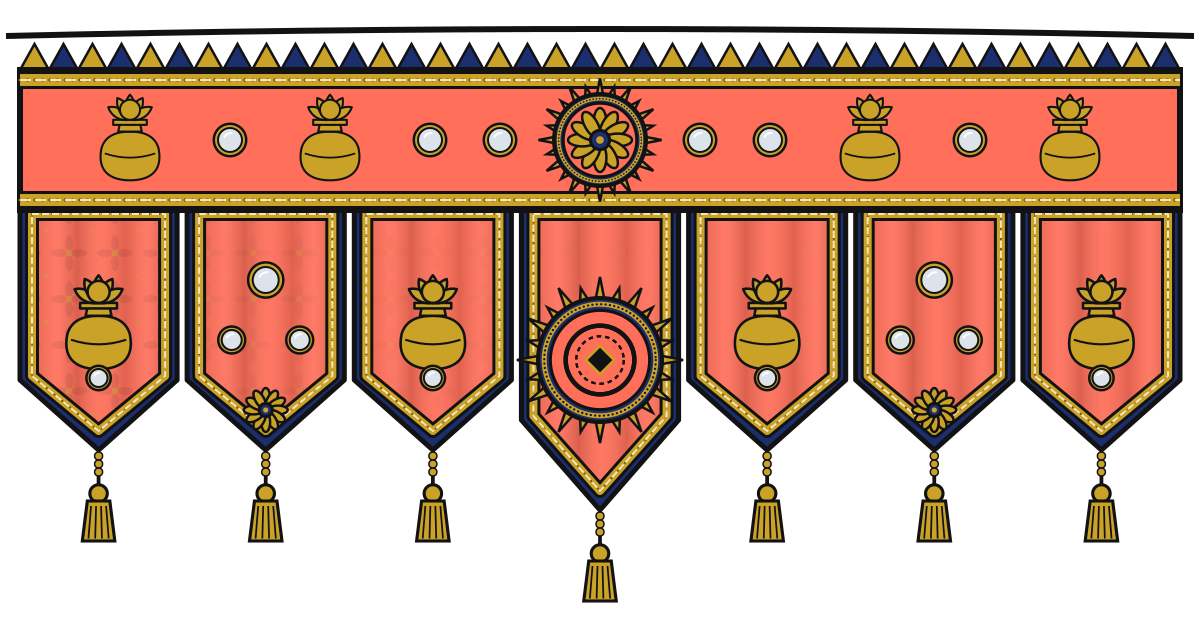
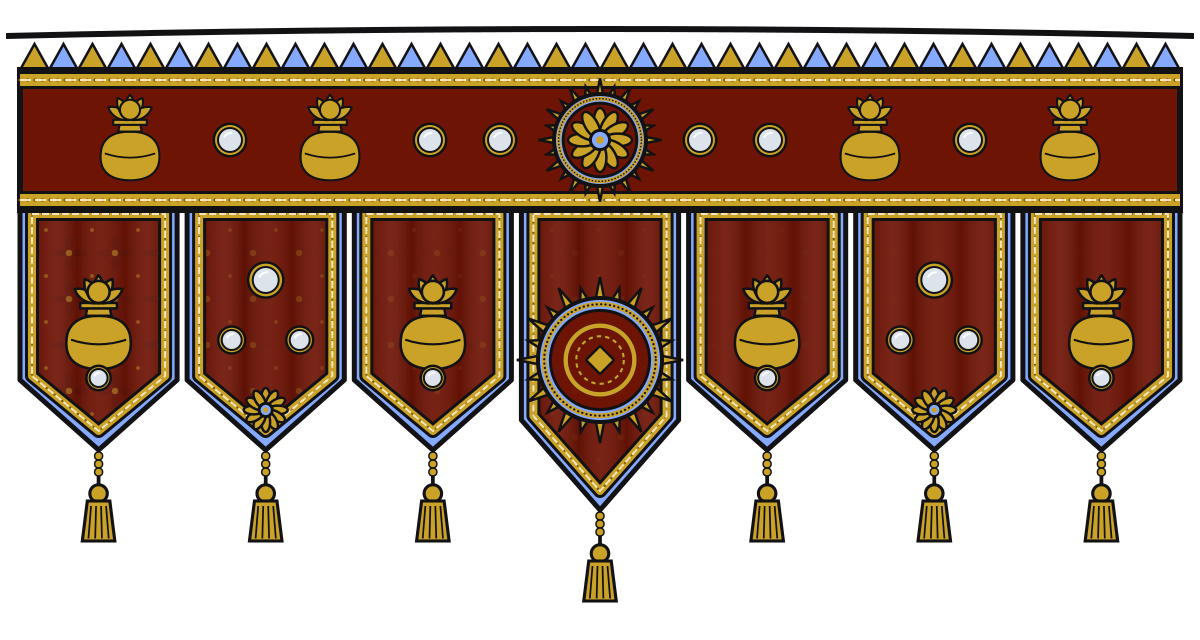

Historic banner
None known
New flag types
| Accessory | For this clan | Basis |
|---|---|---|
| A9 Pota-dhvaja · ship and trade flag For ships, caravans and markets | Not yet designed for this clan | Design |
| A10 Utsava-patāka · festival flag Light, bright flag for fairs and festivals | Not yet designed for this clan | Design |
| A11 Shoka-dhvaja · mourning flag White cloth with the emblem outline in the clan's metal | Not yet designed for this clan | Design |
7. Regalia
| Accessory | For this clan | Basis |
|---|---|---|
| E1 Chhatra · house parasol The ceremonial umbrella | Not yet designed for this clan | Design |
| E2 Chamara · fly-whisks The pair of whisks beside the head of the house | Not yet designed for this clan | Design |
| E3 Danda · staff of office Staff or scepter | Not yet designed for this clan | Design |
| E4 Simhasana · seat The seat of the house, covered in clan cloth | Not yet designed for this clan | Design |
| E5 Khetaka · shield A round shield; the Changi and Dhanush are its flag forms | Not yet designed for this clan | Regional tradition |
| E6 Kula-ayudha · clan weapon The weapon the clan honours | Not yet found for this clan | Under research |
8. Worn
| Accessory | For this clan | Basis |
|---|---|---|
| F1 Kula-vastra · clan cloth The clan's woven pattern in its kit colours | Not yet designed for this clan | Design |
| F2 Kirti-vastra · honour cloth A cloth earned for a deed, not inherited | Not yet designed for this clan | Design |
| F3 Kula-mala · garland flower The flower or leaf the clan wears as a garland | Not yet found for this clan | Under research |
| F4 Chinha · house pin A metal badge with the pin emblem | Not yet designed for this clan | Design |
9. Records
| Accessory | For this clan | Basis |
|---|---|---|
| H1 Clan words A traditional line in the native script | उत्सव · “utsav: 'festival'. Jogesar Asur calls iron-making by this word” Jogesar Asur, quoted in the Sahapedia article on Asur iron[2] | Documented |
| H2 Biruda · titles The house's title or titles | Not yet found for this clan | Under research |
| H3 Prashasti · praise genealogy The lineage as written at the head of a grant | Not yet found for this clan | Under research |
| H4 Vahi · clan register The book of the clan's births, marriages and deaths | Not yet found for this clan | Under research |
| H5 Rana-ghosha · war cry The clan's cry in battle or celebration | Not yet found for this clan | Under research |
10. VishwaVit · knower of the world
Game values are design choices for this project, not historical claims.
References
- Wikipedia, Asur people, read 2026-10-20, https://en.wikipedia.org/wiki/Asur_people
- Vandna Tete, असुरों की 'चमत्कारी' धातु लोहा, Sahapedia (Sahapedia-UNESCO Fellowship, interviews 2019), read 2026-10-20, https://www.sahapedia.org/asauraon-kai-camatakaarai-dhaatau-laohaa
- Das and Biswas (2024), paper on the Asur of Alipurduar, West Bengal (title not given by the fetch), North Bengal University repository, read 2026-10-20, https://ir.nbu.ac.in/bitstreams/433966b0-ebbf-479e-b317-993794d84d62/download
- Dr. Ramdayal Munda Tribal Welfare Research Institute, Asur, read 2026-10-10, https://trijharkhand.in/en/asur
- Suresh Jagannadham, Forward Press, article on Asur songs (30 Aug 2017), read 2026-10-28, https://forwardpress.in/?p=25874
- Rajan Kumar, Forward Press, article on Birajia Asurs and Agarias (p=26095; date not given), read 2026-10-20, https://www.forwardpress.in/?p=26095
- Rev. Fr. Hahn, A Primer of the Asur Dukma, a Dialect of the Kolarian Language (communicated by G. A. Grierson; read Dec 1899, pub. 1900, pp. 149-172; journal title to be confirmed), read 2026-11-04, https://archive.org/details/biostor-279977
- Wikipedia, Asur language, read 2026-10-20, https://en.wikipedia.org/wiki/Asur_language
- ELAR/ELDP collection 0584, Asur recordings, Ranchi workshop April 2019, read 2026-10-28, https://eldp.access.preservica.com/dk0584/
- Endangered Languages Project, Asur sample 11499, read 2026-11-04, https://www.endangeredlanguages.com/lang/1579/samples/11499
- The Indian Tribal, Ingenious mobile radio to preserve endangered Asur language, 1 Sep 2024, read 2026-11-16, https://theindiantribal.com/2024/09/01/ingenious-mobile-radio-to-preserve-endangered-asur-language-spreading-wings
- Zoya Khalid, A Grammatical Sketch of Asur: A North Munda language, ICON 2020, read 2026-11-16, https://aclanthology.org/2020.icon-main.6
- R. V. Russell and Hira Lal, The Tribes and Castes of the Central Provinces of India, vol. 2 (London, 1916), Project Gutenberg eBook #22010, https://www.gutenberg.org/ebooks/22010
- Lehigh University (Srishti Raj, Amardeep Singh), Adivasi Writers: Sushma Asur, The Mountain's Home Is Gone, read 2026-10-28, URL
- Sudipto Mullick, Heavy Metal: India's first smelters and their fraught history with the Tatas, The Caravan, 1 Dec 2017, read 2026-10-20, https://caravanmagazine.in/lede/india-first-smelters-fraught-history-with-tatas
- Vandna Tete, Asur Adivasi Mobile Radio becomes lifeline, Cultural Survival, 27 Apr 2026, read 2026-10-20, https://www.culturalsurvival.org/news/asur-adivasi-mobile-radio-becomes-lifeline-defending-land-language-and-asur-peoples-rights-0
- Sanjay Nath, 'Pages from the Old Records: A Note on The Kols of Chota-Nagpore by E.T. Dalton', Journal of Adivasi and Indigenous Studies III(2), Aug 2015, pp. 52-53 (read in part: first 100,000 of 116,070 characters), read 2026-11-04, https://www.academia.edu/42298290
- Matt Reeck, Dalton's Ethnology of Bengal, UCLA Center for India and South Asia, read 2026-10-20, https://southasia.ucla.edu/history-politics/colonial-epistemologies/daltons-ethnology-bengal
- Anil Varghese, When Asurs refused to enter a Kolkata Durga Puja pandal, Forward Press, 14 Oct 2016, read 2026-10-20, https://www.forwardpress.in/2016/10/when-asurs-refused-to-enter-a-kolkata-durga-puja-pandal/
- Anasuya Basu, Tongues To Tunes, Outlook Traveller, 28 Jul 2025, read 2026-10-28, URL
- Ministry of Tribal Affairs, State/UT-wise list of Scheduled Tribes (Constitution (ST) Order 1950 as amended; list dated 09-07-2024), via the Atlas entries ST-015 and ST-093.
- Vishad Kumar, The plight of the Asurs of Netarhat, Forward Press, 29 Oct 2021 (headline only), read 2026-11-16, https://www.forwardpress.in/?p=80739