The Angami are a Naga people of Nagaland, also written Tenyimia in the Atlas[1][2]. Their traditional society was made up of autonomous village-states, each with clan genealogies and oral records of settlement[1][3]. Their language, Tenyidie, is written in Latin and is classed as vulnerable[4]. Missionary records run from the 1870s, and the Kohima mission began in 1881[1][4], and the Angami are a Scheduled Tribe in India (list dated 09-07-2024)[2][5].
01Faith and deities
The clan's own: named as the creator and protector of the universe[6]. The Atlas's KulDevi Kamakhya is assigned by the project and is not the Angami's faith (see the row below).
Kamakhya of Assam, the great goddess of the north-east
The clan followed another faith. This goddess of its homeland is assigned for naming only.
| Deity or tradition | Place in the clan's life | Evidence |
|---|---|---|
| Pfütsana (also Krüna) | Traditional religion; no deities or temples named on the Wikipedia page | [1] |
| Terhuomia | Spirit of death | [6] |
| Zievo | Priest who conducted the sacrifices offered to avoid the malevolent of two spirits | [6] |
| Kamakhya, KulDevi | Assigned by the project; Kamakhya is the great goddess of the north-east, not the Angami's own faith | [2] |
02Temples
No Angami temple is named in the extracts, and none is recorded as built or patronised by the clan. Research: the Pfütsana places of worship are not described.
Built by the clan
Not recorded.
Given patronage or grants by the clan
Not recorded.
03Languages and scripts
| Language or script | Kind | Under the clan | Evidence |
|---|---|---|---|
| Tenyidie living | Tibeto-Burman (Naga) language, also called Angami | Prestige dialect, used in publications and taught in schools | [4][1] |
| Keyho, Dzu-o | Named with Tenyidie in the infobox | Keyho is also given as a Southern dialect (Viswe or Keyho) | [1] |
| Khwüno, Kewhi | Dialects | Khwüno in the Western Angami area; Kewhi in the Northern | [1] |
| Latin script | Writing system; the language has no traditional script of its own | Tenyidie is written in Latin | [3][4] |
| Tenyidie in education | Teaching | NEHU Shillong recognised it in 1988; Nagaland University introduced it in 1997; Kohima College was first to teach it | [6] |
04Books and literature
Tenyidie is written in Latin. Earlier documentation, from the 1870s to the 1960s, was mostly by Christian missionaries[4].
Written during the clan's history
| Work | Author | Kind | When | Link to the clan |
|---|---|---|---|---|
| The Angami Nagas | J. H. Hutton | Ethnography (cited; not opened) | 1921 | [7] |
| A Matter of Belief | Vibha Joshi | Book (cited) | 2012 | [1] |
| Naga Identities | Oppitz et al. | Book (cited) | 2008 | [1] |
| Naga: A Forgotten Mountain Region Rediscovered | Kunz and Joshi | Book (cited) | 2008 | [1] |
| Angami-English Phrasebook | S. W. Rivenburg | Phrasebook | 1905 | [4] |
| Angami-English-Hindi dictionary | Giridha and Handoo | Dictionary | 1987 | [4] |
| Complete Tenyidie Bible | Bible Society of India | Translation | 1970 | [4] |
| Angami Naga folklore | Sekhose | Folklore collection (text not read) | 1970 | [4] |
| Shieshülie | Baptist Revival Church | Songbook of Tenyidie Christian songs | 2011 | [4] |
| The Angami Naga Society: Continuity and Change | Medonuo Pienyu | Journal article, Journal of North East Indian Cultures 3(2) | 2017 | [6] |
| Clan, Village and the Angami Language | Kelhouvinuo Suokhrie | Article (credited; not opened) | Not given | [8] |
| Legal Pluralism and Indian Democracy | Pereira, Dutta and Kakati | Book (credited) | 2017 | [8] |
Given patronage by the clan
Not recorded.
05Thinkers and scholars
| Name | Field | Era | Contribution |
|---|---|---|---|
| Rev. C. D. King | Missionary; Tenyidie teaching | 1881–1884 | Mission work at Kohima from 1881; Tenyidie teaching from 1884[1][6] |
| Medonuo Pienyu | Writer on Angami society | 2017 | The Angami Naga Society: Continuity and Change[6] |
| Mhasileno Peseyie | Folktales | 2024 | A study of Angami folktales in relation to Kenyü and customary law (Asian Ethnicity)[1] |
| Rashmi Gaur | Folktales | 2025 | A study of Angami folktales in relation to Kenyü and customary law (Contemporary South Asia)[1] |
| Kelhouvinuo Suokhrie | Clan, village and language | Not given | Clan, Village and the Angami Language (credited)[8] |
Stockhausen (2014) is cited on the Wikipedia page, but the title is not in the extract. Hutton's 1921 text was not read.
06Art and architecture
The extracts describe little Angami art. The one recorded form is the village gate of the khel.
Painting and wall art
Not recorded.
Sculpture and temple art
Not recorded.
Temple and building architecture
| Art form | What it is | Era | Evidence |
|---|---|---|---|
| Kharu · walled gate of a khel | Each khel of an Angami village is walled and gated | Not dated | [6] |
Weaving and textiles
Not recorded.
Clothing and jewellery
Not recorded.
Coins, pottery and crafts
Not recorded.
07History
Early records
Documentation of the language from the 1870s to the 1960s was mostly by Christian missionaries[4].
1881 and after: the Kohima mission
American Baptist missionary Rev. C. D. King and his wife established mission work at Kohima in 1881[1].
Tenyidie teaching began with C. D. King in 1884[6].
Under British rule
The Angami were among the first Naga tribes under British rule. Each village was a self-sufficient village state[3].
The British introduced the Goanbura system, and the Dobashi was a salaried interpreter[6]. Japanese currency circulated briefly in World War II[6].
Khonoma and the British, 1879–80
The Atlas records that Khonoma village fought the British in 1879–80[2]. No extract in the cache describes that fight.
The Eastern Angamis become the Chakhesang
Eastern Angamis later separated and are now recognised as the Chakhesang Nagas[1].
08Journey and migrations
Oral tradition traces the people's ancestry to Makhel. The extracts give no dated moves.
| When | From | To | Why | Evidence |
|---|---|---|---|---|
| Not dated (oral tradition) | — | Makhel, Senapati District, Manipur | A common point of dispersal for the Tenyimi | [1] |
| Not dated (oral tradition) | — | Kigwema and Viswema | Considered the oldest ancestral settlements | [1] |
09Seats and lands
| Place | Role | Where today |
|---|---|---|
| Kohima, Kohima Village, Chiephobozou | Northern Angami area and the Kohima mission site | Kohima District, Nagaland[1][6] |
| Khonoma, Jotsoma, Dzüleke, Sechü Zubza | Western Angami centres | Western Angami area; district not given[1] |
| Viswema, Jakhama, Kidima, Kezoma | Southern Angami villages named in the 2024 report | Southern Angami area, Nagaland[1][9] |
| Chümoukedima, Medziphema, Kirha, Tenyiphe I and II, Kuda | Flatland centres | Chümoukedima and Dimapur Districts, Nagaland[1] |
| Tsiepama, Viphoma | Centres named on the Niuland side | Niuland District, Nagaland[1] |
| Makhel | Historic settlement; common point of dispersal for the Tenyimi (oral tradition) | Senapati District, Manipur[1] |
10Notable figures
| Name | Role | Era | Known from |
|---|---|---|---|
| Rev. C. D. King | American Baptist missionary; began mission work at Kohima | 1881 | [1] |
| Toba Khatso | President of the Southern Angami Sports Association; chief guest at the 2011 Pcheda event | 2011 | [10] |
11Allies, rivals and marriages
| People | Relationship | When |
|---|---|---|
| Chakhesang | Former Eastern Angami; separated, and now recognised as their own Naga people | Separation not dated[1] |
| Mao, Maram, Zeliangrong, Chokri and Khezha Chakhesang, Sümi, Rengma, Western Sümi | Neighbours | Not dated[1] |
| Mao, Poumai, Maram Nagas and Meiteis | Reportedly use the terms Shüngamei or Ngami, from which 'Angami' may derive | Not dated[1] |
| Chakhesang, Mao, Poumai, Maram, Rengma, Zeme | Related Tenyimi groups | Not dated[1] |
| British administration | Among the first Naga tribes under British rule; Khonoma fought them | 1879–80 (Khonoma); early British rule[3][2] |
12Society and livelihood
Traditional society was a set of autonomous village-states, patrilineal, patrilocal and patriarchal[1][6]. Honesty is the top value, and houses are often left unlocked[3].
Government and social order
| Institution or group | What it was | Evidence |
|---|---|---|
| Village-state | Autonomous village, with clan genealogies and oral records of settlement | [1] |
| Khel (Thinuo) | Village division on clan lines. Each khel is walled and gated (Kharu). Wikipedia's Angami name page calls the village clans Thinuo or Thenü | [6][8] |
| Clan (Chienuo) | Autonomous clans named after an apical ancestor, handling administration and marriage ceremonies; clans own land | [6] |
| Tepo and Teva | Moieties, at least two in each clan, essential to village ritual | [6] |
| Morungs | Kichuki for girls and Tehuba for boys; schools and churches have replaced the morung | [6] |
| Peli | Peer-group system | [6] |
| Kenyü and Penyie | Kenyü is the individual moral code and taboo; Penyie are community taboos | [6][3] |
| Village Council | Apex body of the village; customary law is influential | [6] |
| Angami Public Organisation | Formed in 1972 | [6] |
| Inheritance | Ancestral property (Siephru) goes to sons, else to the nearest male kin (Kayie); men traced ancestors up to 14 generations | [6] |
| Marriage | Cousin marriage existed; polygamy was not allowed; sororate was forbidden; widow remarriage was permitted, but not to the deceased husband's eldest brother | [6] |
| Birth and death | A cock for a male child, a hen for a female; the mother stays at home nine days; death taboos last five to ten days | [6] |
Livelihood over time
| Era | Livelihood | Evidence |
|---|---|---|
| Not dated | Terrace wet rice cultivation; Feasts of Merit | [3] |
| Not dated | Rice is central; galho (rice with Himalayan knotweed, vegetables, pork or beef) is a popular dish | [1] |
| Not dated | Terrace farming (signature in the Atlas) | [2] |
13Sub-clans and related clans
Villages are divided into khels (Thinuo) on clan lines, and clans (Chienuo) are named after an apical ancestor[6]. Each clan has at least two moieties, Tepo and Teva[6]. The extracts name no clan by its own name. The branches below are Wikipedia's four regions and the two moieties. The related peoples are the groups the extracts name. The Wikipedia list gives no relation to the Angami for the groups from Ao to Yimkhiung, so they are listed as related peoples only[11]. Vajiram and Ravi name four groups (Khonoma, Kohima, Viswema, Chakroma) that are mostly places and differ from Wikipedia's (Chakhro, Northern, Southern, Western)[3].
| Clan | Relation | Where | Size | In the Atlas | Evidence |
|---|---|---|---|---|---|
| Chakhro Angami | Branch | Nagaland (a region; its place is not given) | new clan candidate | [1] | |
| Northern Angami | Branch | Kohima, Kohima Village, Chiephobozou (named centres) | new clan candidate | [1] | |
| Southern Angami | Branch | Viswema, Jakhama, Kidima, Kezoma (named villages) | new clan candidate | [1][9] | |
| Western Angami | Branch | Khonoma, Jotsoma, Dzüleke, Sechü Zubza (named centres) | new clan candidate | [1] | |
| Tepo | Branch | Moiety; each Angami clan has Tepo and Teva | new clan candidate | [6] | |
| Teva | Branch | Moiety; each Angami clan has Tepo and Teva | new clan candidate | [6] | |
| Chakhesang | Related people | Nagaland; sub-groups Chokri and Khezha; formerly the Eastern Angami | 154,874 (Tohring 2010; no census year)[11] | ST-048 | [1][8][11] |
| Chokri Chakhesang | Related people | Sub-group of the Chakhesang | new clan candidate | [11] | |
| Khezha Chakhesang | Related people | Sub-group of the Chakhesang | new clan candidate | [11] | |
| Mao | Related people | Neighbour; Tenyimi group | ST-202 | [1] | |
| Maram | Related people | Neighbour; Tenyimi group | ST-204 | [1] | |
| Poumai | Related people | Tenyimi group | ST-262 | [1] | |
| Zeme | Related people | Zeliangrong group | ST-337 | [1][11] | |
| Liangmai | Related people | Zeliangrong group; the Atlas lists Liangmai as an alias of Zeme | new clan candidate | [11] | |
| Rongmei | Related people | Zeliangrong group | ST-277 | [11] | |
| Inpui | Related people | Zeliangrong group; the Atlas lists Inpui as an alias of Rongmei | new clan candidate | [11] | |
| Zeliangrong | Parent people | Group of Zeme, Liangmai, Rongmei and Inpui | new clan candidate | [11] | |
| Rengma | Related people | Neighbour; Tenyimi group; Nagaland (per the list) | 85,000 (Tohring 2010; no census year)[11] | ST-274 | [1][11] |
| Sümi | Related people | Neighbour; also called Sema; Nagaland (per the list) | 236,313 (Tohring 2010; no census year)[11] | ST-300 | [1][11] |
| Western Sümi | Related people | Neighbour | new clan candidate | [1] | |
| Ao | Related people | Nagaland (per the list) | 226,625 (Tohring 2010; no census year)[11] | ST-009 | [11] |
| Chang | Related people | Nagaland (per the list) | 64,226 (Tohring 2010; no census year)[11] | ST-050 | [11] |
| Chirr | Related people | India, Nagaland (per the list); no deity or district given | 138 (Tohring 2010; no census year)[11] | new clan candidate | [11] |
| Khiamniungan | Related people | India (per the list) | 61,647 (Tohring 2010; no census year)[11] | ST-133 | [11] |
| Konyak | Related people | Nagaland (per the list) | 205,458 (Tohring 2010; no census year)[11] | ST-153 | [11] |
| Lotha | Related people | Nagaland (per the list) | 173,111 (Tohring 2010; no census year)[11] | ST-179 | [11] |
| Phom | Related people | Nagaland (per the list) | 52,682 (Tohring 2010; no census year)[11] | ST-258 | [11] |
| Pochury | Related people | Nagaland (per the list) | 21,948 (Tohring 2010; no census year)[11] | ST-259 | [11] |
| Sangtam | Related people | Nagaland (per the list) | 74,994 (Tohring 2010; no census year)[11] | ST-279 | [11] |
| Tikhir | Related people | Nagaland (per the list) | 7,537 (Tohring 2010; no census year)[11] | ST-315 | [11] |
| Yimkhiung | Related people | Nagaland (per the list) | 66,972 (Tohring 2010; no census year)[11] | ST-333 | [11] |
Clans marked "new clan candidate" are not in the Atlas yet.
14Surnames
Angami names have a given name, a middle name and a surname, and surnames are called Sarami. Wikipedia says Angami names are usually more diverse than those of other Naga communities[8]. Lineage, descent and surname pass through the father[6].
Not recorded.
15Songs and music
The extracts name a Tenyidie Christian songbook and the tati and theku, but give no song text.
Shieshülie living
Published by the Baptist Revival Church[4]. No song text is in the extracts.
Instruments and styles
| Instrument or style | What it is | Evidence |
|---|---|---|
| Tati | Single-string fiddle, named as played by the Angami and Chakhesang Nagas | [12] |
| Theku | String instrument, named as played by the Angami and Chakhesang Nagas | [12] |
16Poems, lullabies and children's rhymes
No poem, lullaby or children's rhyme is in the extracts.
None recorded yet.
17Stories, legends and proverbs
Stories and legends
| Story | What happens | Told by | Evidence |
|---|---|---|---|
| The Tepo and Teva brothers | Southern Angami legend: the Tepo and Teva moieties were brothers | Southern Angami tradition | [6] |
| Origin at Makhel | Ancestry traced to Makhel, a historic settlement in present-day Senapati District, Manipur | Angami oral tradition | [1] |
| Folktales | Angami folktales, studied by Peseyie (2024) and Gaur (2025) in relation to Kenyü and customary law; the tales are not retold in the extracts | Studied; not retold | [1] |
Proverbs and sayings
Not recorded.
18Festivals and fairs
| Festival or fair | When | Where | What happens |
|---|---|---|---|
| Sekrenyi (also Phousanyi) | Ten days. Dates differ by source: the start of sowing (Pienyu, 2017), or February after the harvest (Vajiram and Ravi) | Angami villages | A ten-day purification festival[1]. Village well purification, rooster sacrifice, singing, feasting and rice beer; the youth event Thekra Hie, hunting and gate-pulling; work stops[3]. A male festival, from which women are taboo[6] |
| Te-l Khukhu | 13th of Chünyi (July) | Not given | A food-sharing festival dedicated to girls[1] |
| Khoupfhünyi (also Theyu-ukhuka, Liekhwenyi) | Near the end of planting and of the millet harvest | Not given | A female festival[6] |
| Kerunyi | Start of paddy transplantation | Not given | Named as the start of paddy transplantation[1] |
| Sokren (as the 2024 report spells it) | Not dated | Viswema | Pcheda is a highlight of the festival[9] |
| Terhünyi | Not dated | Not given | Named; not described in the extracts[1][6] |
| Ngonyi (Pienyu: Gnonyi) | Not dated | Not given | Named; not described[1][6] |
| Chadanyi | Not dated | Not given | Named; not described[1] |
| Kreghaghi, Kinoghe, Pichepeli | Not dated | Not given | Named only[6] |
19Food, dress and games
Food
| Item | What it is | Evidence |
|---|---|---|
| Galho | Rice with Himalayan knotweed, vegetables, pork or beef; a popular dish | [1][3] |
| Rice | Central to Angami life | [1] |
| Rice beer | Served at the Sekrenyi festival | [3] |
Dress
Not recorded.
Games and martial arts
| Item | What it is | Evidence |
|---|---|---|
| Pcheda (also Luda; opche or olu) living | Men throw a thin dried bamboo stick as far as they can, sliding it across a platform of solid mud; the furthest wins. In a 2024 report, 17 throws in total (8 and 9 to and fro) and teams of about ten at Kezoma. Toba Khatso called it 'a gentleman game' and 'a game of technique and muscle reflex' (2011). A 2025 report says it is mostly played by the Southern Angamis of Kohima district[10][9][13] | [10][9][13] |
| Luda (Olu Da, Olu Mehe) | Shown by Kezoma at the Hornbill Festival, 2022; tied to the Tsaboye closing ritual at sowing season. The 2024 report writes 'Pcheda/Luda' | [14][9] |
| Thulo | Shown by Kezoma at the Hornbill Festival, 2022; not described in the extract | [14] |
| Terhüchü research | Wikipedia and Ludii cite J. H. Hutton (1921, pp. 101–102) for Terhüchü among the Angami Nagas, and name the Angami Nagas with it. Wikipedia and Ludii describe its board and moves (pieces move one point along a line and capture by jumping); the Hutton text itself is not read. The 2022 and 2024 reports do not mention it | [7][15][16] |
| Stick-throwing game, Kidima | Photographed at Kidima on 26 January 1923. The record does not name Terhüchü | [17] |
| Torü Ke-Rha | A women's group event with four teams, held beside the 2025 Pcheda championship at Viswema | [13] |
| Games in season | Viswema, Jakhama, Kidima and Kezoma keep traditional games alive in season, early January to February. The 2024 report says traditional games are less popular than conventional sports | [9] |
Tags: living still practised · revived brought back after a break · lost known only from records · research reported but not yet confirmed from a source. Songs and poems under copyright are listed by title only; restricted or sacred material is noted without its content.
20Status today
A Scheduled Tribe of Nagaland (list dated 09-07-2024), and a living community whose language is classed as vulnerable[2][4].
Who carries the name today
| Community | Link | Basis | Evidence |
|---|---|---|---|
| Chakhesang (ST-048) | Former Eastern Angami; sub-groups Chokri and Khezha | Documented | [1][8] |
Recognised heritage
| What | Recognition | Evidence |
|---|---|---|
| Khonoma, the green village | Atlas only; the article on it (The Quint) was not read | [2] |
| Tenyidie in schools and university | Recognised by NEHU Shillong in 1988; taught at Nagaland University from 1997; Tenyidie materials used in Kohima schools and university | [6][4] |
| Pcheda | Speakers at the 2011 event called for wider recognition at state, national and international levels; no opposing view was recorded | [10] |
| Village Council and customary law | The Village Council is the apex body; customary law is influential | [6] |
No community review is recorded in the extracts; this page has not been reviewed by the community.
21For children
The terraces on the hill
The Angami people live in the hills of Nagaland, in north-east India. Each village once governed itself, like a small state. Families grow rice on terraces. Each village division is walled and gated, and its gate is called kharu. At the Sekrenyi festival, which lasts ten days, people sing, feast and purify their village well. Men play a game called Pcheda, throwing a thin bamboo stick as far as they can.
Written for this project
Riddle: I am a stairway cut into the hill, and I am full of rice. What am I? (Terraces (rice terraces))
22Across the project
| Project | What carries this clan | Status |
|---|---|---|
| Atlas of the Janas | Nagaland, with parts in Senapati District, Manipur; homeland Kohima, Manipur | [2][1] |
| KulDevi and GrahDevi | KulDevi Kamakhya, of the Mahavidya family, assigned by the project and not the Angami's own faith. GrahDevi forms in the Atlas: Kali, Tara, Shodashi, Bhuvaneshvari, Bhairavi, Chhinnamasta, Dhumavati, Bagalamukhi, Matangi, Kamala | [2] |
| Planet naming | Under research | |
| Renaming and waters | Under research |
23Open questions
- Two saved notes say the Angami gave up their hunting rights, one citing Down To Earth (15 June 2021)[18] and one Mongabay India (2025)[19]. The cached Down To Earth article says it (Angami, Nagaland); the cached Mongabay article does not name the Angami. Check the Mongabay source before this claim is used.
- A saved note from CIS Indus names Miawenúo as a Devi who was believed to grant her devotees' wishes[20]. It is a secondary page; the cached extract lists it under the Angami, but no primary source confirms it.
- The named clans and surnames: check ijih.org (volume 1153) and Cambridge Nagas record R70009, and read Suokhrie's article on clan and village.
- Khonoma's fight with the British (1879–80) is in the Atlas only. Find a source for the war and its leaders.
- Hutton (1921) pp. 101–102 for Terhüchü, and the full text, have not been read. Stockhausen (2014) is cited on the Wikipedia page; its title is missing.
- Sekrenyi dates differ (sowing, or February after harvest). Settle the date with a second source.
- The population figures (141,732 for the Angami; the other groups' figures) are Tohring 2010 and have no census year. Find a census-year figure.
- The Wikipedia regions (Chakhro, Northern, Southern, Western) and Vajiram's list (Khonoma, Kohima, Viswema, Chakroma) do not match. Check which is current.
- Liangmai and Inpui appear in the Atlas as aliases of Zeme and Rongmei, but are listed here as separate related peoples. Decide which.
- Pienyu (2017) credits Roy (2004), Lohe (2011) and Das (1994). Read them for the society and the clan names.
- Native script: none of the extracts gives the language in native script. Tenyidie is written in Latin. Add a native-script form only if a source gives one.
- The clan's own line for the words field is not in the extracts. Find one, then set words.illustrative to false.
- Emblem: the main emblem is not drawn yet (placeholder). The emblem and banner are design work, not a documented symbol.
- Contradiction: the khel is the village division on clan lines[6], but Wikipedia's Angami name page calls the village clans Thinuo or Thenü[8]. Settle which term names which before the clans and society sections are used.
- Contradiction: Wikipedia's list says Chakhesang is formerly Pochury (Southern Sangtam)[11], but the Angami pages say it is the former Eastern Angami[1][8].
- Contradiction: the Atlas gives the homeland as Kohima, Manipur[2], but Kohima is in Nagaland[1] (see the lands section).
- Contradiction: Pcheda is written 'also Luda', and the 2024 report writes Pcheda/Luda[9], but the 2022 report lists Luda and Thulo as separate games[14]. The Luda row keeps the 2022 wording; settle whether the two names are one game.
24Astitva
अस्तित्व · being, existence: everything by which the clan is known
Nothing is documented in the extracts for seals, coins, totems, titles or clan cloth. The walled and gated khel (Kharu) is documented[6]. The other accessories are design work for the project[2].
Every clan has every accessory, royal objects included. Each one says how it is known: Documented This clan's own object is recorded. · Regional tradition Recorded for the region or for peoples like this one, not for this clan. · Design Made for this project, with no historical claim. · Under research To be found for this clan from sources. Legends and titles are written in the clan's own script.
1. Seals and coins
| Accessory | For this clan | Basis |
|---|---|---|
| B1 Rajamudra · house seal Round seal with the clan emblem and a short legend in the clan's script | Not yet designed for this clan | Design |
| B2 Anguliya-mudra · signet ring Personal seal ring of the head of the house | Not yet designed for this clan | Design |
| B3 Chhapa · house stamp Ink or block stamp for letters, goods and cloth | Not yet designed for this clan | Design |
| B4 Tamrapatra · charter plate Copper-plate grant on a ring, closed with the house seal | Not yet designed for this clan | Design |
| B5 Shreni-mudra · guild or trade seal Seal for the clan's trade, craft or caravan | Not yet designed for this clan | Design |
| C1 Clan coin Emblem or deity on one side, a legend in the clan's script | Not yet designed for this clan | Design |
| C2 Coin die The die that strikes the coin | Not yet designed for this clan | Design |
2. Living symbols
| Accessory | For this clan | Basis |
|---|---|---|
| I1 Totem trio The tree, bird and animal the clan protects | Not yet found for this clan | Under research |
| I2 Kaval-maram · guardian tree The tree that stands at the clan's seat | Not yet found for this clan | Under research |
3. Stone and gate
| Accessory | For this clan | Basis |
|---|---|---|
| G1 Torana · gateway The built gate of the seat; the cloth Toran hangs in it | Kharu: the walled, gated khel of an Angami village Each khel (Thinuo) is walled and gated[6] | Documented |
| G2 Viragallu · hero stone Carved panel stone for a member who died defending the clan | Not yet designed for this clan | Regional tradition |
| G3 Kula-shila · clan stones Standing and table stones that remember the ancestors | Not yet designed for this clan | Design |
| G4 Jayastambha · victory pillar A pillar raised for a victory | Not yet designed for this clan | Design |
| G5 Sima-shila · boundary stone Marks the clan's land, with a line in the native script | Not yet designed for this clan | Design |
4. Sounds
| Accessory | For this clan | Basis |
|---|---|---|
| D1 Pancha-mahashabda · five great sounds The right to five instruments | Not yet designed for this clan | Design |
| D2 Shankha · clan conch The clan's own named war conch | Not yet designed for this clan | Design |
| D3 Murasu · house drums Three drums: war, charity and justice | Not yet designed for this clan | Design |
5. Kit: colours, metals and emblems
No seal, coin, totem or banner of the Angami is documented in the extracts. The emblem and banner are design work from the Atlas (stepped terraces, a green village with a stone gate)[2]. The walled and gated khel (Kharu) is the one documented object[6].
| Part of the kit | This clan |
|---|---|
| Field | Deep Brick #7E2A1E |
| Accent | Intense Electric Blue #84A9FF |
| Emblem colour | Metallic Gold #C9A227 |
| Zari metal | Gold |
| Main emblem | Stepped rice terraces |
| Second image | A green hill village with a stone gate |
| Night and day | Every visual accessory has two versions: by night the emblem on the dark field, by day the clan's field colour on cloth woven from its metal. |
6. Flags
Every clan has every flag type; the type says the occasion and the colours say the clan. The outlined card is the flag the Atlas assigns.
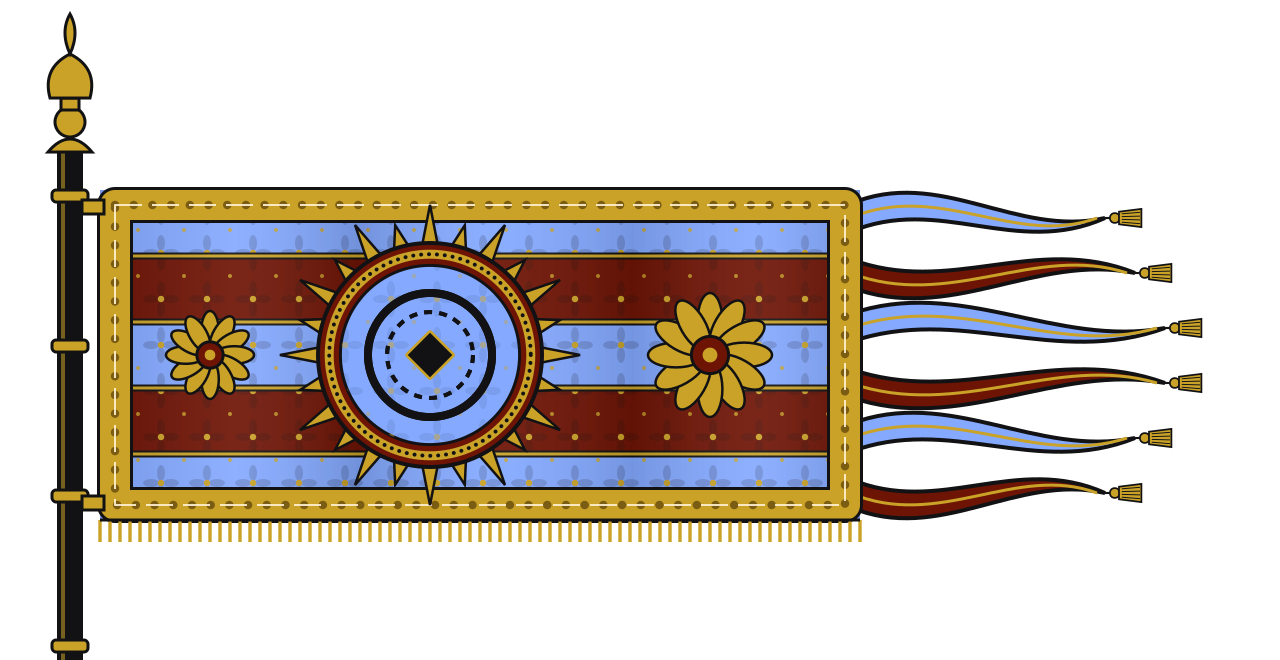
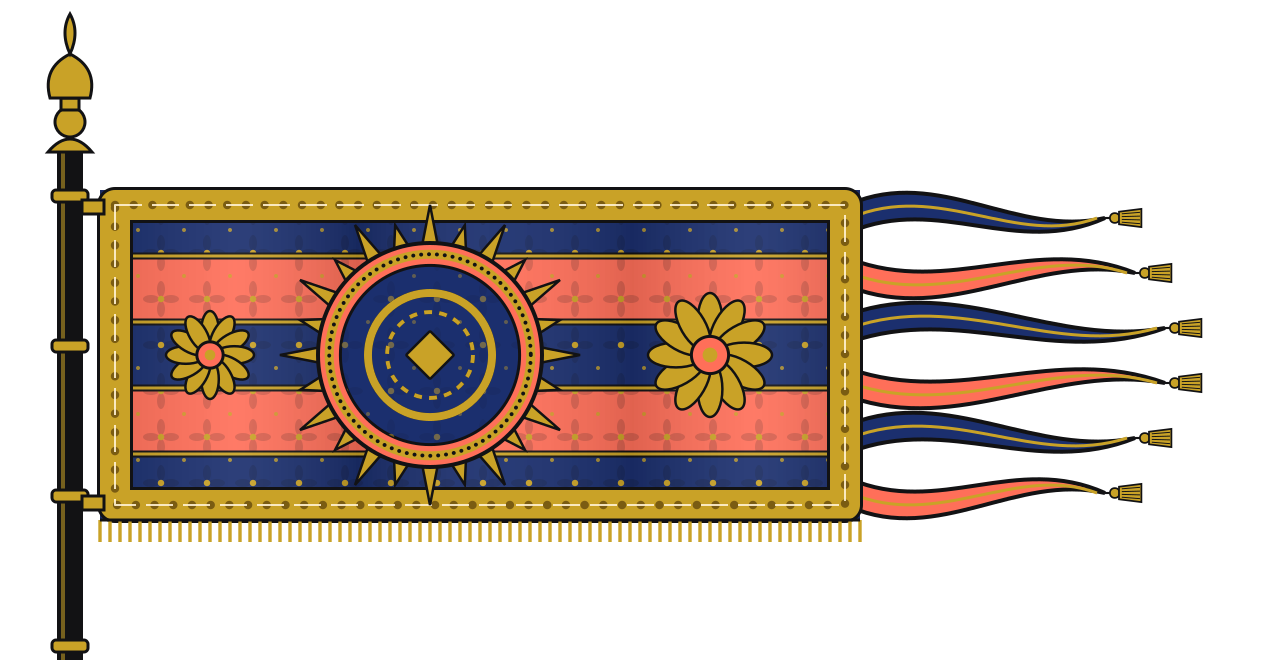
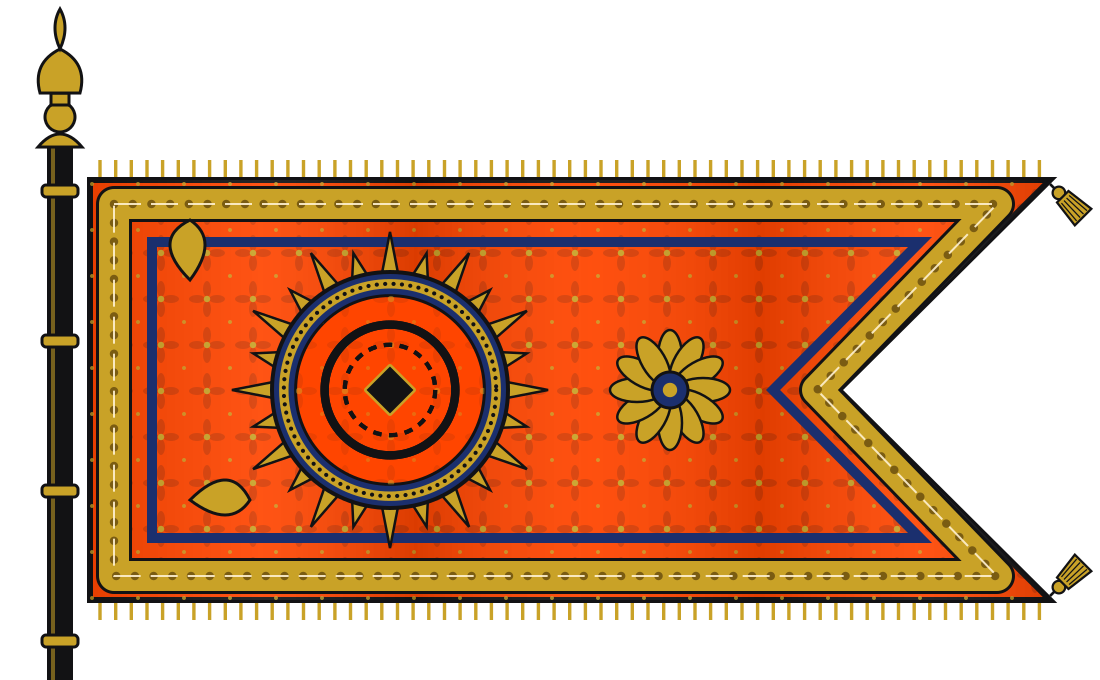
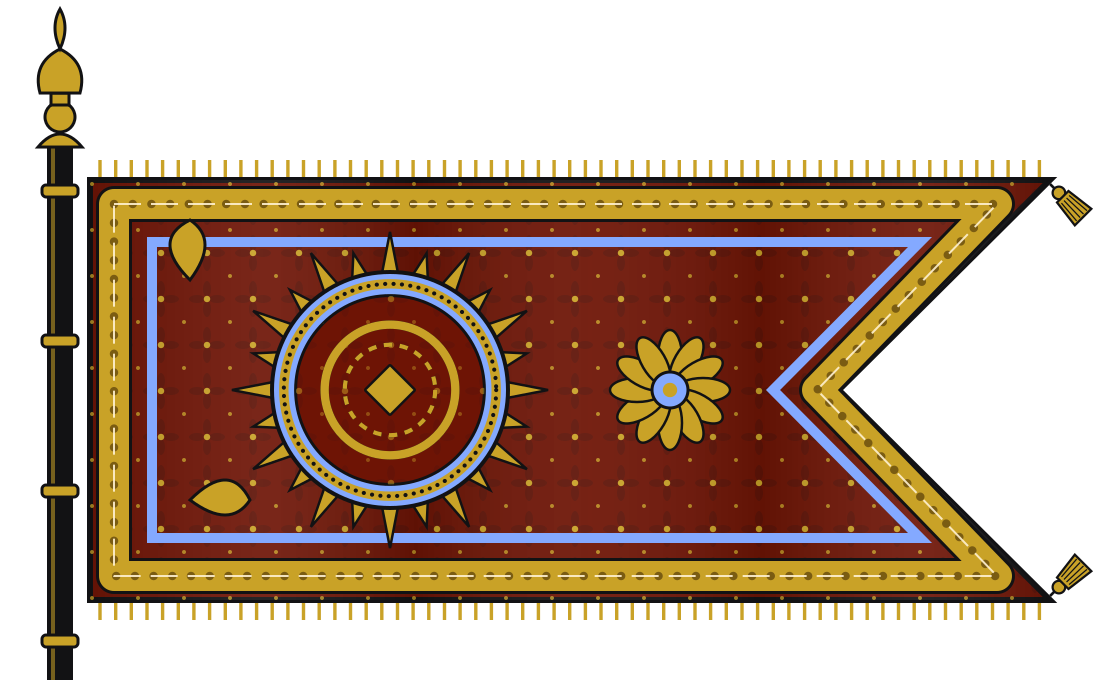
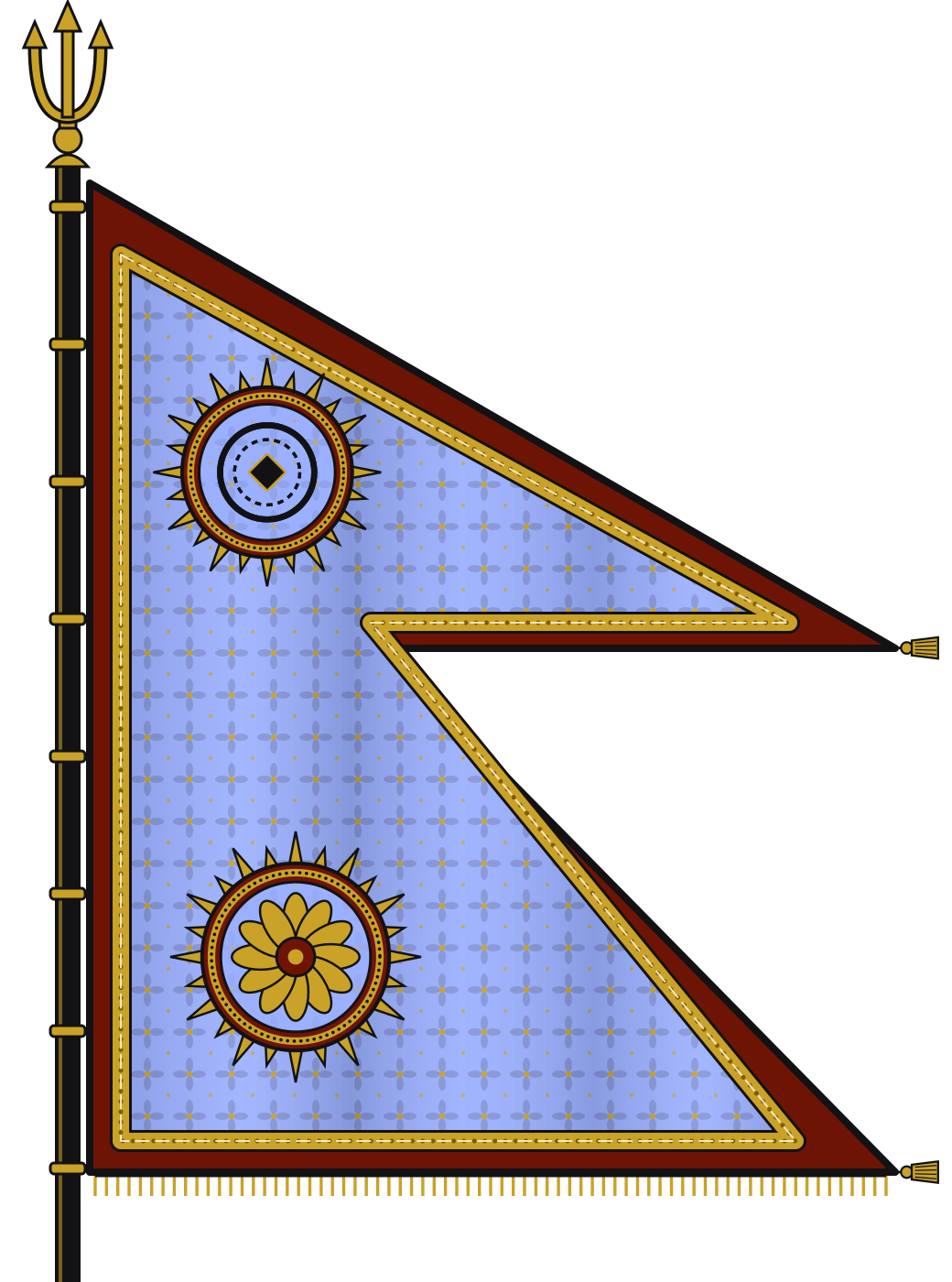
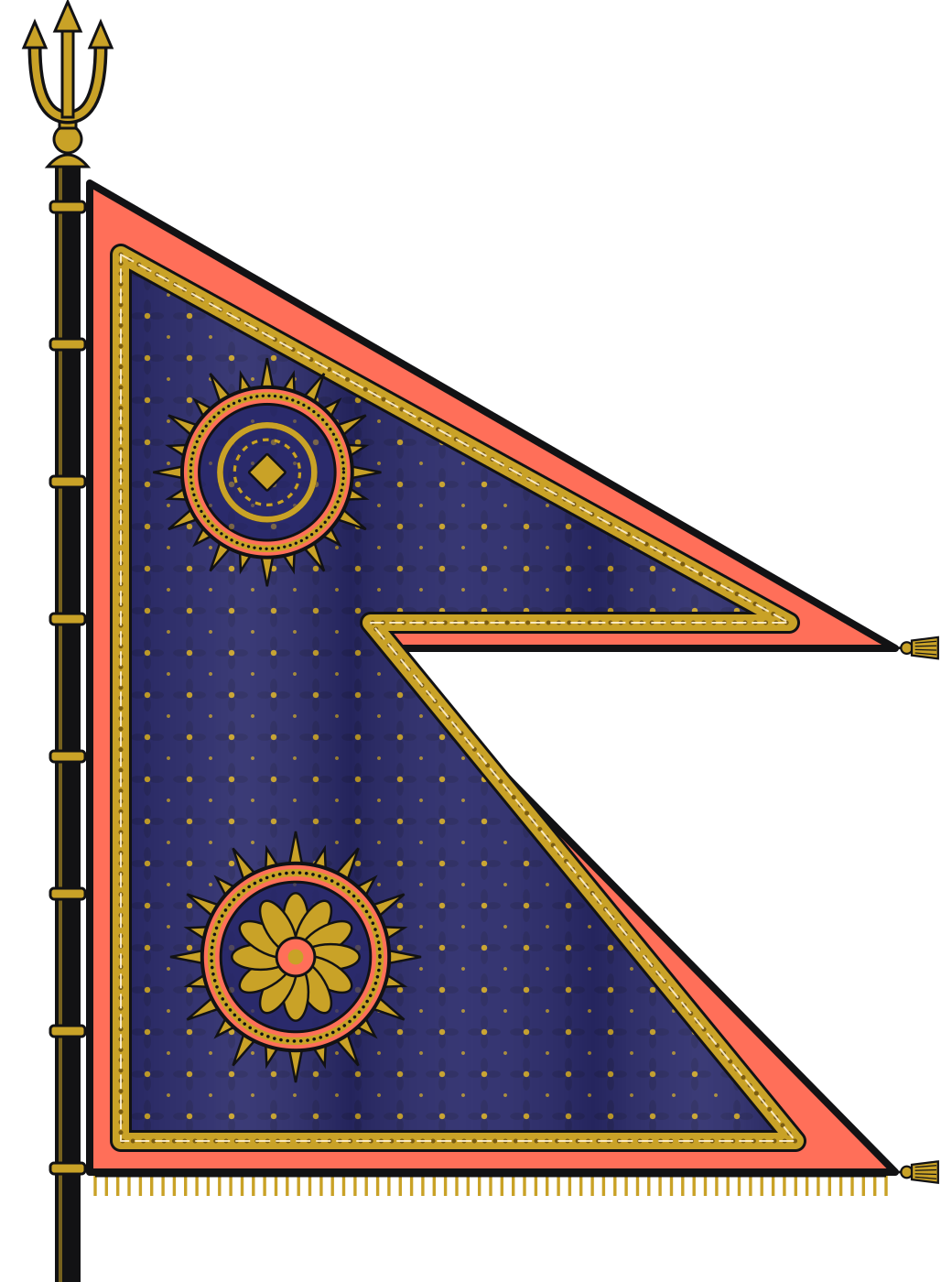

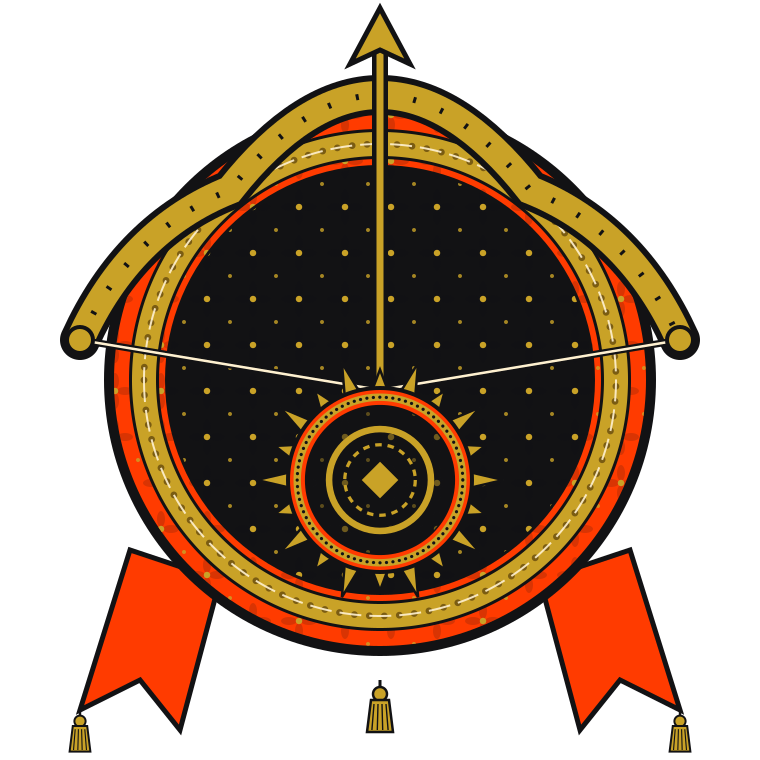
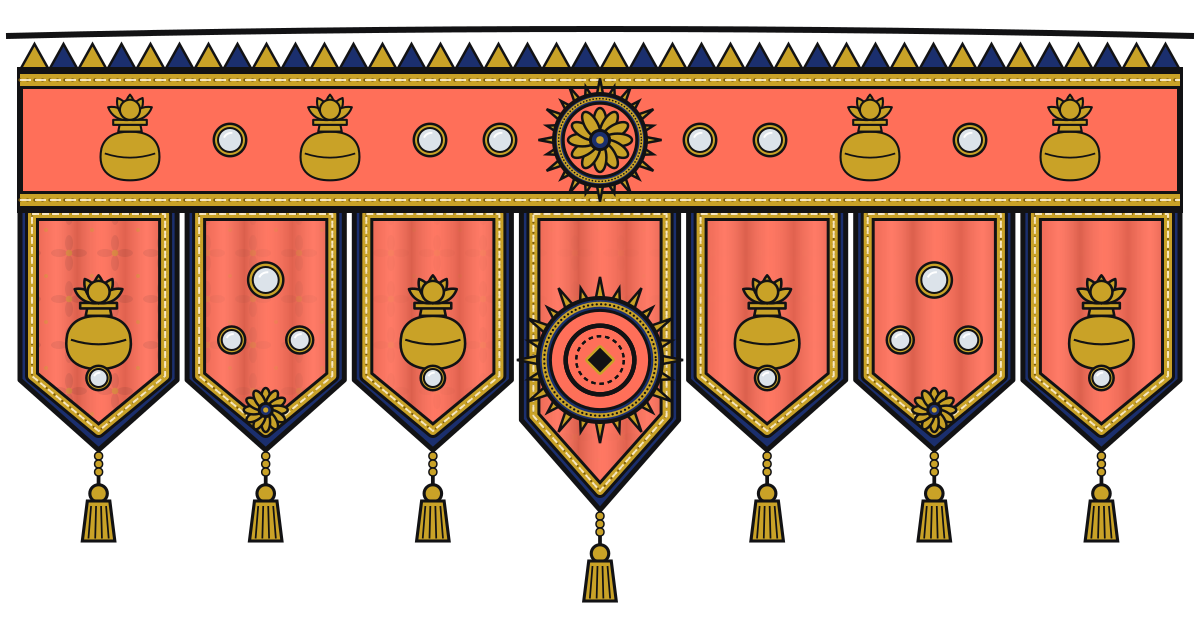
Historic banner
None known
New flag types
| Accessory | For this clan | Basis |
|---|---|---|
| A9 Pota-dhvaja · ship and trade flag For ships, caravans and markets | Not yet designed for this clan | Design |
| A10 Utsava-patāka · festival flag Light, bright flag for fairs and festivals | Not yet designed for this clan | Design |
| A11 Shoka-dhvaja · mourning flag White cloth with the emblem outline in the clan's metal | Not yet designed for this clan | Design |
7. Regalia
| Accessory | For this clan | Basis |
|---|---|---|
| E1 Chhatra · house parasol The ceremonial umbrella | Not yet designed for this clan | Design |
| E2 Chamara · fly-whisks The pair of whisks beside the head of the house | Not yet designed for this clan | Design |
| E3 Danda · staff of office Staff or scepter | Not yet designed for this clan | Design |
| E4 Simhasana · seat The seat of the house, covered in clan cloth | Not yet designed for this clan | Design |
| E5 Khetaka · shield A round shield; the Changi and Dhanush are its flag forms | Not yet designed for this clan | Regional tradition |
| E6 Kula-ayudha · clan weapon The weapon the clan honours | Not yet found for this clan | Under research |
8. Worn
| Accessory | For this clan | Basis |
|---|---|---|
| F1 Kula-vastra · clan cloth The clan's woven pattern in its kit colours | Not yet designed for this clan | Design |
| F2 Kirti-vastra · honour cloth A cloth earned for a deed, not inherited | Not yet designed for this clan | Design |
| F3 Kula-mala · garland flower The flower or leaf the clan wears as a garland | Not yet found for this clan | Under research |
| F4 Chinha · house pin A metal badge with the pin emblem | Not yet designed for this clan | Design |
9. Records
| Accessory | For this clan | Basis |
|---|---|---|
| H1 Clan words A traditional line in the native script | · “Under research” | Documented |
| H2 Biruda · titles The house's title or titles | Not yet found for this clan | Under research |
| H3 Prashasti · praise genealogy The lineage as written at the head of a grant | Not yet found for this clan | Under research |
| H4 Vahi · clan register The book of the clan's births, marriages and deaths | Not yet found for this clan | Under research |
| H5 Rana-ghosha · war cry The clan's cry in battle or celebration | Not yet found for this clan | Under research |
10. VishwaVit · knower of the world
Game values are design choices for this project, not historical claims.
References
- Wikipedia, Angami Naga, read 2026-11-11, link
- Project Atlas, row ST-008 (Angami): official status, KulDevi, flag and emblem fields. Project data, labelled as such, not a web source.
- Vajiram and Ravi, Angami Tribe, History, Language, Origin, Culture, read 2026-11-11, link
- Wikipedia, Angami language, read 2026-11-11, link
- Ministry of Tribal Affairs, State/UT-wise list of Scheduled Tribes (Constitution (ST) Order 1950 as amended; list dated 09-07-2024), as recorded in the Atlas
- Medonuo Pienyu, The Angami Naga Society: Continuity and Change, Journal of North East Indian Cultures 3(2), 2017, read 2026-11-11, link
- J. H. Hutton, The Angami Nagas (London: Macmillan, 1921), pp. 101-102, as cited by Wikipedia and Ludii (not opened) (cited by Wikipedia and Ludii; not opened in this run)
- Wikipedia, Angami name, read 2026-11-11, link
- Morung Express, Southern Angami villages keeping traditional games alive, 4 Jan 2024, read 2026-10-30, link
- Morung Express, Indigenous game of Southern Angamis Pcheda draws huge participants, 5 Jan 2011, read 2026-11-08, link
- Wikipedia, List of Naga ethnic groups, read 2026-10-27, link
- Wikipedia, Music of Nagaland, read 2026-10-25, link
- Morung Express, 9th Nagaland Open Pcheda Championship 2025, 11 Jan 2025, read 2026-11-08, link
- Morung Express, Angami Nagas perform indigenous games (Hornbill Festival 2022 coverage; date not in the cached text), read 2026-10-30, link
- Ludii Portal, Terhüchü (gameId 134), read 2026-10-30, link
- Wikipedia, Terhüchü, read 2026-10-30, link
- Cambridge University Library, Nagas record R57453 (photograph, Angami stick-throwing game, Kidima, 26 Jan 1923), read 2026-10-30, link
- Down To Earth, Tribal hunting rights vs wildlife protection laws, 15 June 2021 (read 2026-10-10), link
- Mongabay India, Efforts to end ritualistic hunting results in reduced kills, read 10 Oct 2026, link
- CIS Indus, Sakti worship in North East India: a historical cultural perspective, part II, read 2026-10-27, URL